Ignore the Drumbeat of Doom, the NSA’s Call Records Program Didn’t Stop a Single Terrorist Attack
By Rachel Nusbaum | ACLU | March 4, 2015
Do you hear that? It’s starting.
The predictable drumbeat of dire warnings about what will happen if portions of the Patriot Act – the post-9/11 law being used to conduct controversial NSA dragnet surveillance – are allowed to expire on June 1 has already begun.
James Clapper, the director of national intelligence, issued what is likely to be the first of many vague warnings from the intelligence community on Monday. Faced with the expiration of the part of the Patriot Act that allows the bulk collection of information about Americans’ phone calls, Clapper brought out the favored hypothetical of the surveillance hawk: An unspecified attack will occur, which would have been prevented if Congress had reauthorized the dragnet collection of Americans’ phone calls.
“If that tool is taken away from us… and some untoward incident happens that could have been thwarted if we had had it,” Clapper said, “I hope that everyone involved in that decision assumes the responsibility.”
There’s just one problem with this particular bit of emotional blackmail, however. The pesky, rather inconvenient fact is that the government’s mass surveillance programs operating under Section 215 of the Patriot Act have never stopped an act of terrorism. That is not the opinion of the NSA’s most ardent critics, but rather the findings of the president’s own review board and the Privacy and Civil Liberties Oversight Board. This program has had over a decade to prove its value, and yet there is no evidence that it has helped identify a terrorism suspect or “made a concrete different in the outcome of a counterterrorism investigation.”
In less than three months, Section 215 will expire unless Congress takes action to extend that authority. As that deadline approaches, we will be hearing more from folks in the intelligence community who would like to see the program continued indefinitely.
Congress would do well to remember that this is a program that is sweeping up vast amounts of data on innocent Americans in violation of their constitutional rights. It’s also one that, despite the rhetoric, has not succeeded in making us any safer. In fact, even Director Clapper has expressed support for some reform of Section 215.
The drumbeat of doom is only going to get louder between now and June. But it can’t drown out the truth. Surveillance reform is urgently needed to rein in out of control government spying and to restore our rights.
Peaceful Man Shot In The Face During Botched Drug Raid, No Drugs or Guns Found
By John Vibes | The Free Thought Project | March 4, 2015
Deltona, Florida – Twenty six-year-old Derek Cruice was shot and killed by police in cold blood this Wednesday inside of his home on Maybrook Drive in Deltona.
Witnesses say that police were conducting a “no-knock” raid where they knocked down the door with a battering ram and entered the home with their weapons drawn. Friends who were inside the home told reporters that police fired their weapons without hesitation, and that it was blatantly obvious that Cruice was unarmed, as he was wearing basketball shorts and no shirt. The friends were also quick to point out that there were no weapons on the property at all.
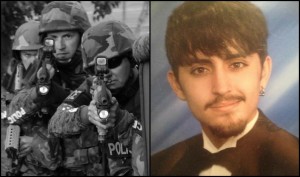 Cruice was reportedly shot directly in the face by Deputy Todd Raible, and although the police claim that he “advanced” towards the officers, his friends said that this is an absolute lie.
“Volusia County Sheriff’s Office narcotics investigators and the Street Crimes Unit were attempting to serve a search warrant at a residence. They were met with resistance and a shooting occurred,” Volusia County Sheriff Ben Johnson said in a statement.
“That is completely a lie. I was there; I watched the whole thing. There was no advancement. There was no reaching for anything. The guy was wearing basketball shorts like I am. It’s kind of hard to conceal anything or hide anything when this is all you have on,” roommate Steven Cochran told reporters.
Friends of Cruice said he is not a violent person, and that he was a great human being.
“I drove by, because it feels surreal and Derek was one of the nicest guys I know. You know, it’s not fair for this to happen to somebody like Derek,” friend Devin McGraw said.
Cruice was probably a wonderful and generous person just as his friends describe him, and he is not accused of committing any violent crimes, nor is he accused of any theft, or fraudulent activity. He was accused of vending substances that the government has laws against, but there weren’t even any drugs found in the home.
Ukraine Conscripts 800 Protesting Coal Miners from Western Region
By Oleg Tyshkevich | Vesti | March 2, 2015
The coal miners of Western Ukraine who threatened a large-scale rebellion due to the three- month delay of salaries are being inducted into the army.
800 rebellious miners received notices directly from military commissars who delivered them to the coal mines.
According to the deputy mayor of Novovolynsk, Eduard Savik, the notices were delivered to coal mines no. 1 and no. 9 in Novovolynsk, which the state is planning to close. That’s where the majority of rebellious miners is employed.
The miners blocked highways several times this winter to protest government policies which does not finance the mines, but instead wants to close them and is not even paying coal miners’ salaries.
Several hundred miners are planning to stage a protest in Kiev on March 3 to force the government to pay them.
“They are taking revenge for strikes—they decided to simply draft the rebels. Many of my comrades who were blocking highways and were preparing to picket the Ministry of Energy and the Cabinet of Ministers, received draft notices,” says Aleksey, a miner from Novovolynsk. “This is even worse than the 1990s. There was hunger, but there was no war. Now it’s total chaos.”
This article was translated by J.Hawk.
Social Media as Material Support for Terrorism
By Sue Udry | Dissent News Wire | February 27, 2015
ISIS is winning the Internet! Conventional wisdom has it that the terrorist group is brilliant at using social media to spread its message and recruit adherents. That troubles lawmakers and national security officials. Social media is a “free form of communication that you can use to plot and plan. A new way to propagandize and reach individuals… in their home,” John Carlin, assistant attorney general for national security told a cybersecurity conference last Monday, Feb. 23.
At a House terrorism subcommittee hearing last month, members wrestled with the problem of countering ISIS propaganda on social media without infringing on First Amendment rights. Representative Ted Poe (R-Texas), who chairs the committee, asked why the Department of Justice couldn’t use material support laws (which prohibit giving assistance to terrorist groups) to go after Twitter and other social-media sites that allow terrorist groups to use their services.
No one could give Poe a firm answer at the hearing, but Carlin waded into the fray on Monday while answering questions at the cybersecurity conference. He indicated that the Department of Justice could use material-support laws to go after those who spread ISIS propaganda on social media. “We have and will charge under our criminal-justice system,” he said.
While Carlin seemed ready to prosecute individuals under the theory that some sort of technical expertise is involved in retweeting and liking, Representative Poe wants the Department of Justice to go after Twitter itself. He took to the floor on Feb. 24 to speak on the issue:
Mr. Speaker, during World War II, we never would have allowed America’s foreign enemies to take out ads in The New York Times recruiting Americans to join the Nazis and go abroad and fight and kill Americans. Today is no different. Social-media companies need to do more. Private companies not only have a public responsibility, but a legal obligation to be proactive.
Section 219 of the Immigration and Nationality Act states that it is unlawful to provide a designated foreign terrorist organization–like ISIS–with “material support or resources,” including “any property, tangible or intangible, or services.” That is about as comprehensive as you can get. You don’t need to be a law-school professor to understand this law actually applies to Twitter.
It is mind-boggling to think that those who behead and burn others alive are able to use our own companies against us to further their cause. This is nutty. But that is exactly what is occurring. As a result, there are more than 15,000 foreign fighters, many of whom have been radicalized online, now fighting in Iraq and Syria. That is more than there were in the 14 years of war in Afghanistan.
Designated foreign terrorist organizations should not be allowed to use private American companies to reach billions of people with their violent hate propaganda and recruitment. It is time to put a stop to this. It is time for Twitter to take down terrorists’ accounts.
And that is just the way it is.
Ferguson police levied excessive traffic fines on blacks – DOJ leak
RT | March 2, 2015
A US Department of Justice report, to be released this week, alleges that Ferguson police are guilty of disproportional fining and arresting African-American residents to balance the town’s budget, making the lives of those unable to pay a nightmare.
Officials familiar with the report told The New York Times that it will be “highly critical” of police practices in the town, where the majority of the population is black but the police department and local government are mostly white.
Traffic fines are the town’s second largest source of income, after sales tax. The DoJ report says that financial incentives are driving law enforcement to continue unfair policies, predominantly targeting African-Americans.
In 2013, African-Americans accounted for 86 percent of traffic stops, while making up 63 percent of Ferguson’s population.
For those too poor to pay their tickets, routine traffic stops in Ferguson could end up in repeated imprisonment due to mounting fines.
“Because such systems do not account for individual circumstances of the accused, they essentially mandate pretrial detention for anyone who is too poor to pay the predetermined fee,” the NYT cited the top civil rights prosecutor supervising the Ferguson inquiry at the Justice Department, Vanita Gupta.
Grievances against the city administration have been accumulating for years before finally erupting in the form of violent protests in August 2014, sparked by a killing of an unarmed African-American young man, Michael Brown, by white police officer Darren Wilson on August 9.
The DoJ report will likely result in significant changes inside the Ferguson Police Department, because local officials will have to either negotiate a settlement with the DoJ or be sued by the department on civil rights charges.
The Justice Department recently filed a similar lawsuit against the city of Clanton, Alabama, which imprisoned poor debtors unable to pay fines.
The report is not expected to dig specifically into racial motivations behind Ferguson police concentrating their activities on African-Americans, but it will criticize police tactics as having a “disparate impact” on the African-American majority, which could be avoided.
Last summer, when the DoJ prepared a report into similar activities by the police department in Newark, it acknowledged that local law enforcement stopped African-Americans significantly more often than whites, meaning that African-Americans “bore the brunt” of the unconstitutional police practices taking root in the city.
“This disparity is stark and unremitting,” the Justice Department wrote in that report.
READ MORE:
Ferguson sued for municipal fines & jailing those who can’t pay
US jail system stacked against poor, ill nonviolent offenders – report
LAPD Execute Mentally Ill Homeless Man in the Street
By Jay Syrmopoulos | The Free Thought Project | March 1, 2015
Los Angeles, Calif. – In a brutal display, Los Angeles police shot and killed a homeless man in front of Union Rescue Mission today, after he scuffled with officers.
A video of the event, posted on Facebook, shows numerous officers fighting with the man and eventually wrestling him to the ground where he continues to struggle against the officers.
The footage shows officers violently attacking the man with blows and then throwing him to the ground as four officers attempt to subdue him as he continues to resist the officers’ aggression.
At this point in the video, an officer can be heard yelling, “Get off my gun. Get off my gun.”
While possible that the victim went for the officer’s weapon, it must be noted that one of the tactics utilized by police, as a means of conditioning witnesses, is to yell out phrases such as “stop resisting” even if the person is doing no such thing.
Similarly, saying that someone went for the officers weapon is an accepted justification to use deadly force, and has become the default justification in many encounters where officers have killed unarmed citizens.
Suddenly a barrage of 5-6 gunshots ring out. Witnesses can be heard yelling, “Ain’t nobody got no guns!,” after the gunfire subsides.
No gun was reportedly found at the scene by police.
Witnesses on the scene named Dennis Horne, 29, the victim was a man that went by the name “Africa.”
Horne said that Africa had been arguing with someone in a tent when police arrived, reported the LA Times.
After refusing to come out of the tent after being commanded to do so by officers, cops tasered him and dragged him out, according to Horne.
“It’s sad,” Horne said. “There’s no justification to take somebody’s life.”
Ina Murphy, who lives in an apartment nearby, told the Times that Africa had arrived in the area about four or five months ago. He reportedly told her he had recently been released after spending 10 years in a mental facility.
The LA Times reported that Witness Lonnie Frank, 53, said five to six officers pulled up in three to four cars as Africa was lying face down on the sidewalk. The officers approached with guns drawn yelling, ”down, down.”
When Africa got up and started fighting, the officers “went straight to lethal force,” Franklin said.
Protests are scheduled to begin at 9 a.m. in front of the LAPD Headquarters at 100 W. First, Los Angeles.
An emergency call to action has been issued on Facebook.
The video speaks for itself. Tragically another life has been lost at the hands of law enforcement continuing the pace of one citizen killed by a cop every eight hours so far this year.
You can follow Jay Syrmopoulos on Twitter @sirmetropolis, on Facebook at Sir Metropolis and now on tsu.
Total Mainstream Media Blackout of Chicago Secret ‘Black Site’ at Homan Square
Nick Bernabe | ANTIMEDIA | February 28, 2015
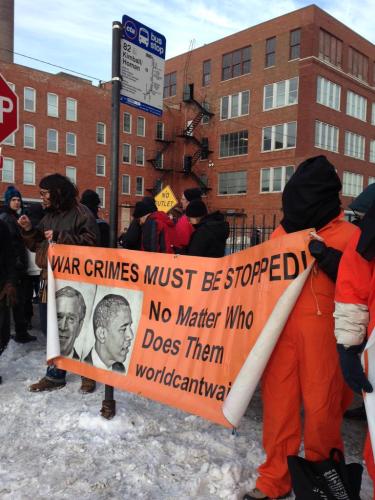 Chicago, IL — As the nation continues to react to the newly discovered ‘black site’ operated by Chicago Police, the mainstream media continues to bury it’s head in the sand.
National media outlets like Fox, MSNBC, and CNN are unsurprisingly refusing to touch this story, driving even further suspicion that the corporate media has become nothing more than a mouthpiece for big government and corporate America.
As we reported earlier this week, local corporate media was literally running stories about Homan Square that were direct copies from CPD’s public relations statements.
According to interviews conducted by The Atlantic, local mainstream reporters often agree with these disappear and torture tactics, so they refuse to do their jobs at uncovering what is going on there;
“I think that many crime reporters in Chicago have political views that are right in line with the police,” Tracy Siska said. “They tend to agree about the tactics needed by the police. They tend to have by one extent or the other the same racist views of the police — a lot of urban police (not all of them by any stretch, but a lot of them) embody racism.”
Meanwhile, a campaign we launched to shed light on Homan Square, #Gitmo2Chicago, trended nationwide last night on Twitter and today on Facebook — showing that the public at large is generally disgusted by these CIA-style tactics.
So while the corporate media posts 3 million stories about the color of a dress, the country is questioning the police state in a big way.
As I write this, a large protest is taking place in Chicago at Homan Square to shut it down, with more protests being planned across the country in the coming weeks.
But keep in mind, the Revolution will not be televised on Cable TV, but it will be on the internet. Watch live video from the protests here.
Obama Regime Proposes Ridiculous Anti-Consumer Plan for GMO Labeling
By | February 26, 2015
Despite polls showing overwhelming support for labeling for genetically engineered foods, USDA Secretary Tom Vilsack proposed yesterday that consumers should use their smartphones to scan bar codes on food packages to find out whether their food contains GMOs.
Vlisack’s idea is sure to cheer the food industry, while denying Americans the right to know what is in our food.
Why not just enforce our right to know what is in our food? Why does the Obama administration stand up for Big Food and not consumers?
A fancy smart phone and a pricy data plan should not be prerequisites for knowing if your food has been genetically engineered.
In 2007, as a presidential candidate, then-Senator Obama promised mandatory labeling of genetically engineered foods. He said: “Here’s what I’ll do as president … We’ll let folks know if their food has been genetically modified, because Americans should know what they’re buying,” Obama has yet to keep his promise.
In 2001, then-Governor Vilsack was named Governor of the Year for the Biotechnology Industry Organization.
A January 24 statement published in the journal Environmental Sciences Europe — signed by 300 scientists, physicians and scholars — asserts there is no scientific consensus on the safety of GMOs.
Israeli troops ‘violently’ attack Palestinian teen at border crossing
Ma’an – 28/02/2015
JENIN – A teenage Palestinian boy from the northern West Bank says he was violently assaulted by Israeli soldiers at al-Jalama crossing north of Jenin while he was trying to cross into Israel.
Muhammad Asri Fayyad, 17, told Ma’an Saturday that on Thursday morning he arrived at the crossing along with a busload of young men and teenagers who had organized a trip to Israel and obtained the needed permits from Israeli authorities.
He says he entered the crossing and complied with the instructions Israeli officers were giving through loudspeakers. The instructions included “that we shove our mobile phones in one place and we cross from a different place which we did.”
“Everybody received back their mobile phones except me. The soldiers asked me to pass through a path under a bridge on top of which stood a number of soldiers pointing their guns at me.
“They then asked me to enter a room which has several doors and I obeyed the orders. All the doors were immediately locked before the officers started to shout through loudspeakers demanding that I take off my clothes and my shoes.”
He added that he took off his shoes first but the soldiers continued to shout “violently” repeating that he must take off all his clothes.
“When I took off my clothes, they turned on a huge ceiling fan which caused frigid coldness. I told them to turn off the fan because I was freezing, but they didn’t, and so I knocked on the fan in an attempt to cause it to stop. At that point the soldiers broke into the room and started to beat be with rifle butts until I fell to the ground.
“They then tied my hand to a steel bar behind my back and tied my foot to another bar. I remained in that position from 9 a.m. until 2 p.m. After that a number of soldiers arrived and a female soldier untied me after she took a silver necklace I was wearing. She ordered me to put on my clothes, then she handcuffed and blindfolded my eyes and escorted me outside the crossing and told me that I was denied entry to Israel. She gave me a small sack in which I found the remnants of my mobile phone which had been smashed.”
Muhammad says he has been suffering severe shoulder and foot pain ever since.
UN Reveals ‘Credible and Reliable’ Evidence of US Military Torture in Afghanistan
By Sarah Lazare | Common Dreams | February 26, 2015
The United Nations revealed Wednesday it has “credible and reliable” evidence that people recently detained at U.S. military prisons in Afghanistan have faced torture and abuse.
The UN’s Assistance Mission and High Commissioner for Human Rights exposed the findings in a report based on interviews with 790 “conflict-related detainees” between February 2013 and December 2014.
According to the investigation, two detainees “provided sufficiently credible and reliable accounts of torture in a U.S. facility in Maydan Wardak in September 2013 and a U.S. Special Forces facility at Baghlan in April 2013.”
The report states that the allegations of torture were investigated by “relevant authorities” but provided no information about the outcome of the alleged probes or the nature of the mistreatment.
This is not the first public disclosure of evidence of torture during the U.S. war in Afghanistan, now into its 14th year. The U.S. military’s Bagram Prison, which was shuttered late last year, was notorious for torture, including beatings, sexual assault, and sleep deprivation, and further atrocities were confirmed in the Senate report (pdf) on CIA torture, released late last year in a partially-redacted form. Afghan residents have repeatedly spoken out against torture and abuse by U.S., international, and Afghan forces.
The Senate report on CIA torture, released late last year in a partially-redacted form, exposes U.S. torture at black sites in Afghanistan and around the world.
Moreover, residents of Afghanistan have testified to—and protested—torture by U.S., international, and Afghan forces.
Beyond U.S.-run facilities, the UN report finds that torture and abuse have slightly declined over recent years but remain “persistent” throughout detention centers run by the U.S.-backed Afghan government, including police, military, and intelligence officials. Of people detained for conflict-related reasons, 35 percent of them faced torture and abuse at the hands of their Afghan government captors, the report states.
Featured Video

Trump asks Iran not to retaliate after he strikes Pickaxe Mountain
or go to
Aletho News Archives – Video-Images
Book Review & Summary
Calling of an Angel: The True Story of Rene Caisse and an Indian Herbal Medicine Called Essiac (1988)
Dr. Gary L. Glum – 30 Q&As – Book Review & Summary
Lies are Unbekoming | October 17, 2026
On June 10, 1975, Dr. Chester Stock, a vice president at Memorial Sloan-Kettering Institute for Cancer Research, wrote to a Canadian nurse named Rene Caisse: “Enclosed are test data in two experiments indicating some regressions in sarcoma 180 of mice treated with Essiac.” The sentence sat in a letter from one of the world’s largest private cancer research centers, concerning an herbal tea an elderly English woman had learned from an Ojibwa medicine man at a northern Ontario mining camp in the 1890s. The tests were terminated the following year after Sloan-Kettering admitted, in sworn affidavit three years later, that they had prepared the injectable solution improperly from the dried material supplied — freezing and thawing the herb rather than boiling it as Rene had instructed. By the time Calling of an Angel was published in 1988, Rene Caisse had been dead for a decade, having treated thousands of cancer patients across fifty-six years in her Bracebridge, Ontario kitchen, never charging a fee, and refusing every offer — from Memorial Sloan-Kettering, the National Cancer Institute, Merck, Parke Davis, and private corporations dangling contracts up to $1 million — to release her formula before the medical establishment admitted her remedy had merit. … continue
Blog Roll
 Aletho News
- Trump asks Iran not to retaliate after he strikes Pickaxe Mountain – w/ Prof. Marandi
- Vice President J.D. Vance’s Deceptive ‘Antiwar’ Campaign Speech
- Iran: Palestinians’ rights must not be compromised in Gaza’s future; US, Israel to blame for Hormuz situation
- Ongoing tales of Syrian chemical weapons
- Moscow blasts UN for ignoring torture of Russian POWs
- Millions of Books Could Have Been Destroyed in Lebanon During Israeli Bombings
- Moscow warns of ‘hunt for Russians’
- Calling of an Angel: The True Story of Rene Caisse and an Indian Herbal Medicine Called Essiac (1988)
- South Korean Assistance to the U.S. in the War with Iran: Between Allied Duty and National Interests
- Pharma- and Gates-Funded GAVI Seeks to Assure Parents
- If Americans Knew
- Israeli soldiers debunk Israel’s talking points
- In West Bank, Israeli settlers are totally out of control – Daily Update
- NPR investigation finds evidence of widespread fraud at mall kiosks tied to Israeli skincare brand
- Tucker Carlson exposes Israeli Lies about the Oct 7th attack, Charlie Kirk, and the U.S.
- Israel has detained thousands of Palestinian children since Oct 7th – over half spent time in solitary, many uncharged
- Israeli Analysis: Is Netanyahu Planning an ‘October Surprise’ Attack Before Israel’s Election?
- Israeli settlers brutally attack Palestinians and Washington Post female photographer, 65
- Words Have Changed, Occupation Continues: The Reality of the Gaza Ceasefire
- Gaza’s child amputees are growing faster than their prosthetics allow
- Israel keeps Palestinians struggling just to survive–Daily Update
- No Tricks Zone
- New Study Suggests Large Regions Of The Pacific Ocean Have Been Cooling For The Last 80 Years
- Germany’s Green Energy Debacle: High Energy Costs Force Kahla Porzellan to Close After 182 Years!
- New Study: 50 Years Of The Most Aggressive ‘Net Zero’ Policies Can Only Affect The Global Climate By 0.03°C
- US September “Heat” Was No Record…Many Records Set Decades Ago
- Latest European Green Energy Debacle; Portugal’s Largest Flagship Solar Park Insolvent!
- Green Energy Debacle: German Expert Professor Fritz Vahrenholt Warns Of Severe Economic And Social Consequences
- Two More Paleo Reconstructions Affirm Meters-Higher Sea Levels Across Ireland, Brazil 7000-6000 Years Ago
- New Study: Earth And Venus Surface Warmth Largely Explained By Convection And Lapse Rate, Not CO2 Or Radiation
- 2025 Nature Paper Claiming Worsening Global Drought Gets RETRACTED …Heavily Flawed
- New Study: ‘Global Drought Shows No Detectable Recent Acceleration Under Climate Warming’

