Egypt Refers 271 Muslim Brotherhood Supporters to Military Court
Al-Akhbar | February 27, 2015
Egyptian prosecutors referred 271 people to a military court on charges of belonging to the outlawed Muslim Brotherhood group and attacking court buildings in central Egypt two years ago.
The defendants were charged with ransacking and torching a court building, as well as a prosecution office in the city of Malawi in the Minya province, in August of 2013.
The attack on Malawi’s official buildings happened following the dispersal of two major protest camps staged by supporters of ousted President Mohammed Mursi in Cairo and Giza, during which police and security forces killed more than 1,400 people.
Egyptian prosecutors are legally permitted to refer cases to the military prosecution in cases involving charges of vandalizing government property.
In October of last year, Egyptian President Abdel Fattah al-Sisi issued a law that allows the referral of violations against state institutions to military courts.
The move was widely criticized by local and international rights organizations, which voiced fear that defendants would not receive fair trials before military courts.
In recent days, prosecutors referred 570 people to military trials on similar charges.
After Sisi’s rise to power, more than 15,000 Mursi supporters were imprisoned, while scores have been sentenced to death after speedy trials which the United Nations has denounced as “unprecedented in recent history.”
Mursi and many top leaders of his now-banned Muslim Brotherhood are themselves in jail and on trial in cases in which they face the death penalty if convicted.
Besides Islamists, many of the leading secular activists behind the 2011 uprising have also found themselves on the wrong side of the new political leadership, getting locked up for taking part in peaceful demonstrations following a ban on unlicensed protests.
(Anadolu, Al-Akhbar)
Russian journalists detained in Kiev as Ukraine steps up censorship
RT | February 26, 2015
Four Russian journalists were detained in Ukraine and ordered to return back to Moscow. Three of them were stopped when filming a Right Sector rally. The Russian Foreign Ministry has expressed outrage at the incident, calling it a “provocation.”
Ukraine’s Security Service (SBU) detained Channel One journalists Elena Makarova and Sergey Korenev, and NTV’s Andrey Grigoryev, who were in Kiev at the time. The SBU indicated that they will all be deported back to Russia and banned from entering Ukraine for the next five years.
Grigoryev is already back in Moscow, NTV reported. “I got detained right in Kiev’s downtown area while filming the rally, which included ultra-nationalist Right Sector members, football fans, and others who disagree with the direction the current government is taking,” Grigoryev said. “A few of the rally participants approached me and asked for my ID. I told them I would show my identification only to police, which is where they escorted me to.”
“Nothing was recorded at the police station… It looked like the decision [to deport] was made ahead of time,” he said.
A video has emerged showing the moment the journalist was apprehended.
Makarova said that 10 people with Right Sector stickers approached her and the cameraman. The individuals showed her SBU identification. When she asked to see their badges again, she was told: “If we show you the IDs again, you will be liquidated.” When Makarova inquired as to what they meant by that, the group replied: “It is best you don’t know.” She was then separated from her cameraman Korenev.
During the interrogations, she was asked what channel she was with and then told that her station “posed a threat to [Ukraine]” and that she would be deported.
Also on Wednesday, another NTV reporter, Inna Osipova, was refused entry into Ukraine after arriving at Kiev’s airport. She was asked a lot of questions about the purpose of her trip during customs control and was eventually told “the reason for her trip could not be proven.” Her passport was confiscated and she is currently stuck inside the airport.
’Ukraine’s actions are a provocation’
The Russian Foreign Ministry described the detention as “a provocation towards Russian journalists, and a violation of Ukraine’s obligations to guarantee the safety of journalist.”
“We demand that our journalists be immediately released and the hunt for representatives of the Russian media be halted,” the ministry added. “We expect corresponding reaction from specialized international organizations, primarily OSCE Representative on the Freedom of the Media Dunja Mijatovic, to new unlawful acts by the Ukrainian authorities.”
The incident comes after the SBU issued recommendations to strip more than 100 Russian media outlets of accreditation on February 21. Earlier in the month, 239 Ukrainian lawmakers voted in favor of suspending Russian journalists’ accreditation until the conflict in eastern Ukraine ends.
The list includes TASS, Rossiya Segodnya, and all Russian TV channels except Dozhd, according to government spokesperson Yelena Gitlyanskaya.
‘Silencing opposing voices’
Ukraine is justifying its actions by citing new legislation, professor of political science at the University of Rhode Island Nicolai Petro told RT. “It’s an attempt to achieve total information control – the ability to exclude all dissident voices, partly in Ukraine, from getting through to Ukrainian citizens.”
Ukraine is taking censorship to a whole new level, Petro explained. “In the West, the wartime precedent is that censorship can only occur in situations which directly involve military operations. The Ukrainian government is going far beyond that – to essentially silence opposition voices which are being silenced at home and use the Russian media to get back inside the country.”
The response in the West is likely to be “very muted,” the professor noted, “because this is an issue they would prefer not to deal with.”
But such attempts are usually not very successful. “The politicians tend to underestimate the ability of people to go around the restrictions to get information from a wide variety of sources. These attempts are ultimately bound to fail,” Petro said.
In addition to limiting freedom of expression inside Ukraine, Kiev announced this week that it is joining the information war by creating an ‘online army,’ according to the Information Policy Ministry.
Read more: Ukraine’s Security Service detains Russian journalists in Kiev, deny entry for 5 years
Cop Assaults Man for Filming Brutality, Stomps Phone to Destroy Evidence — Video Survived
By Cassandra Rules | The Free Thought Project | February 26, 2015
Amherst, MA– University of Massachusetts Amherst student, Thomas Donovan, who is majoring in legal studies and had planned to become a Massachusetts State Trooper, has filed a lawsuit alleging his civil rights were violated after he was pepper sprayed, assaulted, and arrested for filming police brutality.
The officer also repeatedly stomped on his cellphone in an attempt to destroy the evidence and cover up the crime- but the video survived.
The incident took place last March during his neighborhood’s Blarney Blowout parties, an annual tradition attended by thousands and held the weekend before St. Patrick’s Day where Amherst and neighboring towns are full of informal St. Patrick’s Day drinking and festivities.
Last year saw 58 people arrested, 21 of which were UMass students after police in riot gear violently moved in.
During the commotion, Donovan noticed an officer using excessive force while making an arrest, so the student pulled out his cell phone to exercise his First Amendment right to film the incident. Donovan was on the other side of a fence, a safe distance away, and was not interfering with the brutality at all. At this point. An officer wearing full riot gear and carrying a pepper-ball gun— believed to be Officer Andrew Hulse—approached Mr. Donovan to prevent him from filming, the lawsuit states.
Despite the police intimidation, Donovan did not stop filming. He was then pepper-sprayed at close range by another officer. Donovan requested the officer’s name and badge number, but the officer would not identify himself.
Moments later, Officer Jesus Arocho knocked the phone out of his hand and threw him to the ground face first. The phone landed flat on the ground with the camera pointed up and continuing to film.
“Arocho, assisted by Defendant Andrew Hulse, placed Mr. Donovan under arrest. Meanwhile, Mr. Donovan’s phone, which had landed on the ground with the camera facingup, continued to film. It captured the actions of another police officer, Defendant John Doe 3, who walked over to the phone, stood over it, then stomped on it with his boot, several times, in an unsuccessful effort to destroy it.” the lawsuit continued.
Thankfully, Donovan’s phone was inside a shock-resistant protective case and the phone was unharmed. The video, and evidence of this blatant misconduct, was preserved.
Arocho then arrested Donovan on bogus charges of “disorderly conduct” and for “riot, failure to disperse.” These charges were ultimately dropped.
Arocho lied in his police report, stating Donovan was pepper sprayed “as he began to close the distance between himself and the officers.” The complaint points out that this claim is blatantly false as the incident was captured on video.
Donovan ended up spending 5 to 6 hours in a cell, falsely imprisoned, and was denied any assistance removing the pepper spray from his eyes.
Due to the officer’s insane actions, Donovan was suspended from the university, until he contested and won after he was found not to have committed any wrong-doing.
“Defendants knew that it was wrong to stop a civilian from filming police officers in public when the civilian did not interfere with police activity.
Defendants knew that it was wrong to use force against a civilian for filming police officers in public when the civilian did not interfere with police activity.
Defendants knew that it was wrong to arrest a civilian for filming police officers in public when the civilian did not interfere with police activity.
Defendants knew that it was wrong to try to destroy a civilian’s phone merely because it contained video of police officers performing their duties in public.” the complaint asserts.
This year’s Blarney Blowout parties are expected to begin on March 7, but students will be prohibited from hosting guests who are not UMass Amherst students. The University will also be offering “school sanctioned” events this year to monitor the amount of fun being had.
Perhaps a more reasonable course of action would have been to have the militarized police stand down and not bring violence and chaos to celebrations.
Israeli Forces Demolish Four Bedouin Homes in Negev
Al-Akhbar | February 25, 2015
Israeli forces demolished four Bedouin homes in the Negev desert in southern Occupied Palestine on Tuesday, Ma’an news agency reported, leaving dozens homeless.
Israeli forces, escorted by bulldozers, raided the Tel Shebaa area of Beersheba early Tuesday and demolished the properties on the pretext that they lacked building permits. Locals said the homes belonged to the al-Nabbari family.
One of the family members, Sufian al-Nabbari, 20, was arrested after attempting to prevent the demolition.
“We will not let go of our lands. More than 60 police officers arrived in the area and demolished our homes and livestock barns,” Mohammed al-Nabbari said. “They even chopped down our olive trees.”
The head of the regional council for Bedouin villages unrecognized by Israeli authorities, Attiya al-Asam, said that the “brutality” of demolitions has increased recently in Bedouin towns in Occupied Palestine.
On Sunday, Israeli authorities demolished four homes belonging to Palestinian Bedouins near the town of Hurah in the Negev desert.
In 2013, authorities said that the homes of the 1,500 residents of the village were to be demolished because the area had been converted into a closed military zone.
Palestinians with Israeli citizenship complain of routine discrimination, particularly in housing, land access and employment.
There are about 260,000 Bedouin in historical Palestine, mostly living in and around the Negev in the arid south.
The Israeli government classifies approximately 40 villages in the Negev desert as “unrecognized,” arguing that the roughly 53,000 Palestinian Bedouins living there cannot prove their ownership of the land and are hence living there “illegally.”
Claiming that most of the land in the Negev desert is Israeli “state property,” Israel has repeatedly demolished Bedouin homes in the area.
In November, the IOF razed the Bedouin village of al-Araqib in the Negev Desert for the 78th time in four years.
The village was demolished for the first time in July 2010, before being rebuilt with metal and wood.
Dozens of Palestinians with Israeli citizenship living in Araqib say that they have owned the land since before Israel came into being in 1948.
Israel has demolished 77 Palestinian homes and agricultural structures since the beginning of 2015, leaving 110 people homeless, the United Nations Office for the Coordination of Humanitarian Affairs said.
Meanwhile, Bedouins are regularly attacked by the IOF, who killed 22-year-old Sami al-Jaar in the southern Negev region on January 14. During Jaar’s funeral, a 45-year-old Bedouin man, Sami Ibrahim Zayadna, suffocated to death due to tear gas sprayed by Israeli forces. … Full article
Secret Police Facility “Black Site” Discovered Inside America, Detaining & Torturing Americans
By Jay Syrmopoulos | The Free Thought Project | February 24, 2015
Chicago, Ill. – In a startling report from the Guardian, details have been revealed about Chicago police detaining American citizens at “black sites.” These sites are similar to those used by the CIA around the world to interrogate/torture alleged terrorists.
The stunning revelation of the Chicago Police Department operating what amounts to an off-the-books interrogation facility is threatening, to say the least. The facility apparently operates outside the bounds of the U.S. Constitution, and its discovery exposes the very real and present danger of the threat posed by the police state to American freedom and liberty.
Housed in a warehouse on Chicago’s west side, Homan Square has long been the home to secretive police work. Attorneys as well as protesters, tell a tale of being systematically being denied their constitutional rights.
According to the Guardian,
Alleged police practices at Homan Square, according to those familiar with the facility who spoke out to the Guardian after its investigation into Chicago police abuse, include:
• Keeping arrestees out of official booking databases.
• Beating by police, resulting in head wounds.
• Shackling for prolonged periods.
• Denying attorneys access to the “secure” facility.
• Holding people without legal counsel for between 12 and 24 hours, including people as young as 15.At least one man was found unresponsive in a Homan Square “interview room” and later pronounced dead.
In addition, no one is booked into Homan Square. Thus, there is no way of allowing anyone to account for their whereabouts as would typically happen at a precinct. When attorneys attempt to gain access due to a client being inside, they are summarily turned away from the “secure facility.”
“It’s sort of an open secret among attorneys that regularly make police station visits, this place – if you can’t find a client in the system, odds are they’re there,” said Chicago lawyer Julia Bartmes.
According to Chicago civil-rights attorney Flint Taylor the practices entrenched in the operation of Homan Square violate both the Fifth and Sixth Amendments of the U.S. Constitution.
“This Homan Square revelation seems to me to be an institutionalization of the practice that dates back more than 40 years,” Taylor said, “of violating a suspect or witness’ rights to a lawyer and not to be physically or otherwise coerced into giving a statement.”
According to Eliza Solowiej of Chicago’s First Defense Legal Aid, one man had his booking information changed in the central booking database. He was then taken to Homan Square with no record of the transfer. After his stint at Homan Square, he was taken to the hospital with a head injury, and she was finally able to find him.
“He said that the officers caused his head injuries in an interrogation room at Homan Square. I had been looking for him for six to eight hours, and every department member I talked to said they had never heard of him,” Solowiej said. “He sent me a phone pic of his head injuries because I had seen him in a police station right before he was transferred to Homan Square without any.”
Then, in a case that highlights the extremely ominous nature of Homan Square, 44-year-old John Hubbard was pronounced dead on February 2, 2013 after being found “unresponsive inside an interview room.”
The Cook County Medical Examiner’s Office “could not locate any record for the Guardian indicating a cause of Hubbard’s death. It remains unclear why Hubbard was ever in police custody,” the Guardian reports.
We are clearly teetering on the brink of total despotism and violations of the Constitution. This egregious practice must be investigated and prosecuted by the Department of Justice if they hope to keep the social fabric from unraveling.
James Trainum, a retired Washington DC homicide detective, who now studies national policing issues for the Innocence Project and the Constitution Project said,
“I’ve never known any kind of organized, secret place where they go and just hold somebody before booking for hours and hours and hours. That scares the hell out of me that that even exists or might exist.”
The egregious nature of this clear and present danger to American liberty cannot be overstated. According to Tracy Siska, a criminologist and civil-rights activist with the Chicago Justice Project,
“The real danger in allowing practices like Guantánamo or Abu Ghraib is the fact that they always creep into other aspects,” Siska said.
“They creep into domestic law enforcement, either with weaponry like with the militarization of police, or interrogation practices. That’s how we ended up with a black site in Chicago.”
Revelations like this case show how easy it is for constitutional protections to be completely disregarded and how quickly the slide into tyranny can occur.
Let’s get the word out and wake people up, by sharing this article wide and far. The time has come to unite and demand the systemic changes necessary to create a more just society and sustaining liberty.
Gaza in Ruins After Receiving Only 5% of Pledged Reconstruction Funds
By Ken Klippenstein | Reader Supported News | February 23, 2015
Chris Gunness, spokesman for the United Nations Relief and Works Agency for Palestinian Refugees in the Near East (UNRWA), discusses the causes and consequences of the fact that only about 5% of pledged donations have reached Gaza.
Ken Klippenstein: What has been the impact of the failure of donor aid funds to reach Gaza?
Chris Gunness: Let me illustrate that with one simple vignette. I was in Gaza yesterday, and I met a grandfather living in the northern area, which is near the fence with Israel. The man is 62. Two of his grandchildren froze to death (i.e., died of hypothermia) during the storm known as Huda, which was in January.
They are living, 15 of them, in a shack, which I assumed when I saw it from the road was for animals. When I went there, it was a tiny, three-roomed wooden structure covered in leaky plastic. It was raining, so water was flowing in. And that is the very place where baby Salima died on the 21st of January at the age of just 40 days old.
The floor is sand, and on top of that they’ve put threadbare carpets. When you sit on them, they’re so wet and cold [that] it’s no protection whatsoever. Baby Salima basically got rained on all night. There was nowhere for them to go. Her body was blue and trembling. They took her to the hospital, and after one night the doctor phoned up and said that Salima was dead. Another grandchild, a boy, was 50 days old. He was in a UN shelter; it was freezing cold, and he died very suddenly of hypothermia.
There are about 110,000 homes which are either completely uninhabitable or very badly damaged. Assuming each home has between six and eight people, that’s 600,000-800,000 people, approximately. So in terms of both the depth of the suffering and the breadth of the humanitarian impact, it’s immense.
KK: Why haven’t the donor funds gone through? We heard so many different countries, from the Gulf states to the West, pledged aid – $5.4 billion, in fact.
CG: Your question is a very good one. Unfortunately, I don’t have the answer. It’s not from lack of appeals from us; it’s not from want of me telling stories like this; it’s not from lack of donors being given the figures, analysis, what the cost will be in human terms. All of this stuff they know, so there’s absolutely no shortage of information.
KK: What obligation does the West – particularly the United States, but also Europe – have to reconstruct Gaza, given that they are the ones who armed Israel? The West armed Israel with precisely the same weapons that were used to destroy Gaza in this last operation.
CG: And also, it’s those same donors who all met in Cairo [and agreed to rebuild Gaza] – without any security guarantees that it’s not going to be completely leveled again in another couple of years’ time, as has happened for the last six years. There have been three wars since 2009.
You should also ask what are the responsibilities of the belligerent parties, because in a conflict, the belligerent parties are responsible for the protection of civilians.
I think if you look at the Palestinian refugees in Gaza … we have a situation where Gaza is under blockade and the political pressures that need to come to bear to lift the blockade are not being effectively brought to bear. So the blockade continues.
Not only do huge swaths of Gaza look like an earthquake just hit, but it’s proven very difficult to reconstruct, because the funds simply are not there.
What is the point of reconstructing Gaza if the place is not allowed to have a functioning economy? Do you want gleaming white, new houses and totally impoverished people because the population can’t export?
What you need in an economy like Gaza is to be able to import raw materials to make things [like] garments and export them. If you can’t export them, then you can’t have a functioning economy. The people of Gaza are incredibly entrepreneurial. They’re very proud. They don’t want to suffer the indignities of aid dependency.
What are the obligations of the international community? One of their obligations is to put pressures to bear on the right place so that the blockade is lifted by Israel and the people of Gaza are allowed to trade. If you trade, you can have a disposable income; if you have a disposable income, you can buy things.
We don’t want to be going to the donor community with our begging bowl in hand and asking for money. It’s much better if people in Gaza can have their own economy. Of course they’ll need assistance reconstructing the place, but thereafter, they need to have a functioning economy. Otherwise they’re going to be condemned for decades more to this life-support system known as international aid.
KK: Israel has necessitated this aid by its blockade since Gaza doesn’t have a viable economy?
CG: Yeah. In the year 2000, there were 80,000 people in UNRWA’s food distribution. Fifteen years later, it’s 10 times that – 800,000. A lot of that aid dependency is due to the fact that there’s a blockade and Gaza cannot trade.
Unemployment is 44%. Food insecurity is rising. 90% of the water in Gaza is undrinkable. That’s the impact of the blockade. It’s devastating.
KK: As a UN official, could you comment on what obligations Israel has [under international law] as the occupying force in the Palestinian territories?
CG: In the UN, Israel is an occupying power, and has obligations to provide services, housing, water, electricity; all the things which protected populations need to have in situations of occupation. It’s all very clearly stipulated in the 4th Geneva Convention.
KK: What has been the effect of the destruction of the supply tunnels running from Egypt to Gaza?
CG: Make no mistake, the destruction of the tunnels has devastated a lifeline to the people of Gaza. I have absolutely no doubt whatsoever about that. But the majority of the crossings into Gaza are through Israel.
The Rafah crossing – I’ve been through it – is a single road in one direction. A very narrow road, actually. And a very narrow single road in the other direction. It is not a crossing through which you would want to mount a major import-export or aid operation to 1.8 million people.
KK: How does the failure of the aid to reach Gaza now compare with previous instances?
CG: This is as bad as it’s ever been, I think. After the Cairo conference where the donor community pledged $5.4 billion, we created a plan for $720 million [in aid]. That was for essentially two things: rental properties for people whose houses had been destroyed, and for repair and reconstruction. That $720 million plan has a deficit of $585 million.
I’ve never known it to be this bad and I’ve been here for 9 years.
KK: I imagine failing to reconstruct Gaza represents a security risk.
CG: Having 1.8 million desperate, isolated, destitute people at any country’s doorstep – especially given the history, and given that there’s a fence around it and a blockade – how can that ever be considered to be in anybody’s interest – not just Israel, but all of us?
The Palestinian cause is a source of anger and frustration in many places, including across the Middle East. So it’s in nobody’s interest anywhere in the world to have Gaza in the state that it’s in.
[This transcript has been lightly edited.]
Sisi passes anti-terrorism law
Mada Masr | February 24, 2015
President Abdel Fattah al-Sisi issued a new law on terrorism, announced in the official Gazette on Tuesday morning.
The law’s 10 articles focus on defining terrorist entities, listing such groups and bodies, and stipulating legal processes for appealing these lists.
The law has been widely criticized since it was first drafted, with some claiming it restricts civil liberties.
Article one of the law defines terrorist entities as: “any association, organization, group or gang that attempts to, aims to, or calls for destabilizing public order; endangers the wellbeing or safety of society; harms individuals or terrorizes them, or endangers their lives or freedoms or rights or safety; endangers social unity; harms the environment or natural resources or monuments or communications or transportation or funds or buildings or public or private property, or occupies them; obstructs the work of public authorities or the judiciary or government entities or local municipalities or houses of worship or hospitals or scientific institutions or diplomatic missions or international organizations; blocks public or private transportation, or roads; harms national unity or threatens national peace; obstructs the implementation of the constitution or laws or bylaws; uses violence or power or threats or acts of terrorism to achieve any of its goals.”
The second article gives the prosecution the right to draw up lists of identified terrorist entities, including groups that are officially ruled as terrorist organizations. The prosecution will also be tasked with generating lists of “terrorists” found guilty of organizing identified terrorist groups.
The law stipulates that organizations designated as terrorist entities must remain on such lists for three weeks, and if no judicial order is issued to confirm the nature of these organizations, the prosecution retains the right to extend the period for further investigation.
Penalties against designated terrorist entities can include dissolving the organization, suspending its activities, shutting down its headquarters, banning meetings held by its members, halting funding to the organization directly or indirectly, freezing assets owned by the organization or its leaders, banning membership to, or promotion of, the group, and temporarily banning the group from political participation.
Mohamed Zaree, Egypt program manager at the Cairo Institute for Human Rights Studies (CIHRS) told Mada Masr previously that the law broadens the definition of a terrorist act to such an extent that it could encompass “crimes and even legal activities that do not relate to terrorism, including terms which are difficult to define legally, such as ‘severely undermining public order,’ ‘subjecting the safety, interest, or security of society to danger,’ ‘disrupting the authorities from carrying out some of their activities,’ ‘subjecting the lives, rights, or freedoms of citizens to danger,’ ‘preventing educational institutions from carrying out their work,’ and ‘[carrying out] acts which seek to hinder the implementation of the constitution or the law’.”
Given this broad definition, political groups, activists and civil society organizations could potentially be targeted under the law, he warned.
“It is clear that the principle aim of this bill in its current form is not to counter terrorism, but rather to restrict such groups, movements, and organizations from existing. This provision could easily be interpreted to punish individuals or organizations which call for constitutional or legal reforms, even if done peacefully,” Zaree claimed.
Jewish State forces kill Palestinian teen in Duheisha refugee camp
By Saed Bannoura | IMEMC & Agencies | February 24, 2015
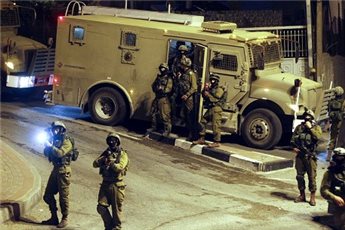 Israeli soldiers invaded the Deheishe refugee camp, in the West Bank district of Bethlehem, shot and killed a Palestinian teen, and wounded several others on Tuesday at dawn.
Medical sources said the slain young man has been identified as Jihad Shehada al-Ja’fary, 19 years of age.
The sources added that al-Ja’fary was shot by a live round that penetrated his left shoulder, and lodged in his chest causing a severe bleeding.
The soldiers prevented Palestinian medics from reaching the seriously wounded man, and he bled to death before the medics managed to move him to the al-Yamama hospital, in Bethlehem.
His body was then moved to the Beit Jala governmental hospital, and will later be moved to a forensic center.
The slain Palestinian was standing on his home’s rooftop, overlooking the main road, when he was shot.
Eyewitnesses said scores of soldiers invaded the camp in an attempt to kidnap a Palestinian, an issue that led to clashes between the soldiers and local youths who hurled stones and empty bottles on them.
The army fired gas bombs, rubber-coated metal bullets and rounds of live ammunition, causing several injuries.
UK Home Office refuses to admit responsibility for ‘aid for executions’
Reprieve | February 22, 2015
The Home Office is refusing to disclose the part played by UK counter-narcotics funding in facilitating executions in countries such as Pakistan – even though a number of Brits have been revealed to be on that country’s death row.
The UK provides counter-narcotics funding to organisations such as Pakistan’s Anti-Narcotics Force – which has cited the number of death sentences it secures as a key ‘prosecution achievement.’ Reprieve has warned ministers that the funding amounts to public funds being used to support executions overseas, at odds with the UK’s long-standing policy of opposition to the death penalty.
In recent correspondence with legal charity Reprieve, which supports British citizens and others facing the death penalty abroad, the Home Office recently stated that the issue of counter-narcotics aid doesn’t fall under their remit, but rather that of the Foreign Office. However, in a Parliamentary answer earlier this month, minister Lynne Featherstone admitted that the Home Office has “lead responsibility” for international counter-narcotics policy.
Twenty-four people have been executed in Pakistan since December 2014, when the authorities began a new wave of executions. There are now fears that drug offenders on the country’s 8000-strong death row, among them a number of British citizens, are directly at risk of being executed.
Commenting, Maya Foa, head of Reprieve’s death penalty team, said: “Pakistan has the largest death row in the world, and is now actively executing prisoners – placing a number of Brits at risk. The UK Government has given a series of flaccid excuses for continuing to support anti-drug raids in Pakistan, which very often see drug offenders sentenced to death. Now that the Pakistani authorities are once again carrying out executions, the lives of these people and many others are in grave danger. If the UK is committed to ending the death penalty worldwide, why is British anti-narcotics aid supporting these drug convictions – and why won’t the Home Office admit responsibility?”
Israel is still banning Gaza students from West Bank universities
MEMO | February 20, 2015
Palestinian students from Gaza are still prevented by Israel from studying at West Bank universities, after an announcement this week to the contrary was retracted as a mistake.
On Wednesday, Israel’s Coordinator of Government Activities in the Territories (COGAT) announced that a quota of 50 students would be permitted to exit Gaza “for the purpose of academic studies” in the West Bank. However, as related by NGO Gisha, the very same evening, COGAT clarified that there had been a “clerical error” in the relevant document, and that there would be no such permits.
The Israeli government has opposed Palestinians from Gaza studying in the West Bank on the grounds of ‘security’. The High Court of Justice has also rejected petitions by human rights groups on the matter, including one filed on behalf of five women studying gender, democracy and law.
In 2009, 21-year-old, Bethlehem University student Berlanty Azzam was arrested at a West Bank checkpoint and immediately returned to the Gaza Strip, after a solider noted Gaza City as the town of residence on her ID.
The ill-fated announcement was included on a list of various measures apparently prepared by Israel to “ease” restrictions. According to reports from COGAT and Palestinian officials, it would appear that the number of merchant permits will rise, as will the type and quantity of goods permitted to exit from Gaza for sale in the West Bank.
Back in November, two truckloads of wooden planks left Gaza for sale in the West Bank, the first time that wood from Gaza has been sold in the West Bank since the blockade was imposed in 2007. The same month, some truckloads of clothes, fish, and agricultural products made the same journey, again for the first time.
This is less indicative of Israeli authorities’ generosity but rather highlights the deception that is the ‘security’ rationale for the restrictions in the first place. Why were Gaza’s farmers allowed to send cucumbers to the West Bank on November 6, 2014 – but not before? Why won’t Israel lift restrictions on exports, save for piecemeal exceptions?
The continued refusal to allow Palestinian students from Gaza to study in West Bank universities is further evidence that Israel’s approach is one based on collective punishment. Worth remembering, the next time someone tries justifying yet another apartheid policy in the name of ‘security’.
Featured Video

Trump asks Iran not to retaliate after he strikes Pickaxe Mountain
or go to
Aletho News Archives – Video-Images
Book Review & Summary
Calling of an Angel: The True Story of Rene Caisse and an Indian Herbal Medicine Called Essiac (1988)
Dr. Gary L. Glum – 30 Q&As – Book Review & Summary
Lies are Unbekoming | October 17, 2026
On June 10, 1975, Dr. Chester Stock, a vice president at Memorial Sloan-Kettering Institute for Cancer Research, wrote to a Canadian nurse named Rene Caisse: “Enclosed are test data in two experiments indicating some regressions in sarcoma 180 of mice treated with Essiac.” The sentence sat in a letter from one of the world’s largest private cancer research centers, concerning an herbal tea an elderly English woman had learned from an Ojibwa medicine man at a northern Ontario mining camp in the 1890s. The tests were terminated the following year after Sloan-Kettering admitted, in sworn affidavit three years later, that they had prepared the injectable solution improperly from the dried material supplied — freezing and thawing the herb rather than boiling it as Rene had instructed. By the time Calling of an Angel was published in 1988, Rene Caisse had been dead for a decade, having treated thousands of cancer patients across fifty-six years in her Bracebridge, Ontario kitchen, never charging a fee, and refusing every offer — from Memorial Sloan-Kettering, the National Cancer Institute, Merck, Parke Davis, and private corporations dangling contracts up to $1 million — to release her formula before the medical establishment admitted her remedy had merit. … continue
Blog Roll
 Aletho News
- Trump asks Iran not to retaliate after he strikes Pickaxe Mountain – w/ Prof. Marandi
- Vice President J.D. Vance’s Deceptive ‘Antiwar’ Campaign Speech
- Iran: Palestinians’ rights must not be compromised in Gaza’s future; US, Israel to blame for Hormuz situation
- Ongoing tales of Syrian chemical weapons
- Moscow blasts UN for ignoring torture of Russian POWs
- Millions of Books Could Have Been Destroyed in Lebanon During Israeli Bombings
- Moscow warns of ‘hunt for Russians’
- Calling of an Angel: The True Story of Rene Caisse and an Indian Herbal Medicine Called Essiac (1988)
- South Korean Assistance to the U.S. in the War with Iran: Between Allied Duty and National Interests
- Pharma- and Gates-Funded GAVI Seeks to Assure Parents
- If Americans Knew
- Israeli soldiers debunk Israel’s talking points
- In West Bank, Israeli settlers are totally out of control – Daily Update
- NPR investigation finds evidence of widespread fraud at mall kiosks tied to Israeli skincare brand
- Tucker Carlson exposes Israeli Lies about the Oct 7th attack, Charlie Kirk, and the U.S.
- Israel has detained thousands of Palestinian children since Oct 7th – over half spent time in solitary, many uncharged
- Israeli Analysis: Is Netanyahu Planning an ‘October Surprise’ Attack Before Israel’s Election?
- Israeli settlers brutally attack Palestinians and Washington Post female photographer, 65
- Words Have Changed, Occupation Continues: The Reality of the Gaza Ceasefire
- Gaza’s child amputees are growing faster than their prosthetics allow
- Israel keeps Palestinians struggling just to survive–Daily Update
- No Tricks Zone
- New Study Suggests Large Regions Of The Pacific Ocean Have Been Cooling For The Last 80 Years
- Germany’s Green Energy Debacle: High Energy Costs Force Kahla Porzellan to Close After 182 Years!
- New Study: 50 Years Of The Most Aggressive ‘Net Zero’ Policies Can Only Affect The Global Climate By 0.03°C
- US September “Heat” Was No Record…Many Records Set Decades Ago
- Latest European Green Energy Debacle; Portugal’s Largest Flagship Solar Park Insolvent!
- Green Energy Debacle: German Expert Professor Fritz Vahrenholt Warns Of Severe Economic And Social Consequences
- Two More Paleo Reconstructions Affirm Meters-Higher Sea Levels Across Ireland, Brazil 7000-6000 Years Ago
- New Study: Earth And Venus Surface Warmth Largely Explained By Convection And Lapse Rate, Not CO2 Or Radiation
- 2025 Nature Paper Claiming Worsening Global Drought Gets RETRACTED …Heavily Flawed
- New Study: ‘Global Drought Shows No Detectable Recent Acceleration Under Climate Warming’

