Violence and Resistance in Palestine
An African American Perspective on Israel/Palestine
By Ajamu Baraka | November 19, 2014
For the many thousands of tourists who fly into Israel/Palestine every year, landing in the modern Ben-Gurion airport in Tel Aviv marks the beginning of a great adventure in the “holy land.” But for members of the “African Heritage” delegation, flying into Ben-Gurion was fraught with tension and foreboding. Before departing the U.S. on October 27, our delegation rehearsed how we would move and act, role-playing what to say and what to avoid when we would face Israel’s first line of defense – its custom officials at the airport.
The normally simple act of landing, showing that prized blue book that is the U.S. passport and passing effortlessly through customs and into the country, was something that we understood might not be automatic for us. And indeed it wasn’t – within an hour of our landing our delegation’s co-leader, a young Palestinian woman, was detained. We later found out that she was interrogated, held overnight, and deported the next day.
As our delegation slowly made its way through Israel’s entry process those first couple of hours at the airport, we did not quite grasp that our experience at the airport would not be the first of the strange dualities that we would experience and witness of life in Israel/Palestine. The gaggle of wide-eyed excited tourists that were happy to be in the country greatly contrasted with our already lived experience of Israel as a police state on guard against all threats, real and imagined.
The delegation and program:
The African Heritage delegation was made up of activists, educators, journalists, clergy, students and folks representing the full spectrum of African American life in all of its diversity. Sponsored by the Interfaith Peace Builders, an organization of dedicated young activists experienced in organizing delegations to Israel/Palestine, the individual members of our delegation had various positions and motivations for being a part of the delegation. But a genuine feeling of solidarity with the plight of the Palestinian people and a desire to better understand the situation in order to share what we observed with our constituencies where we lived and worked emerged as the common denominator that united most of us.
Our ambitious agenda included meetings and visits that took us across the country. From East Jerusalem to “Israel proper” through to the West Bank and down to the Negev desert, we met with peace activists, political activists, clergy, the settler community of Hebron, Palestinian-Arab Bedouin women, and lived with Palestinian families in Bil’in and the Deheisheh refugee camp. It was an exhilarating and emotionally exhausting experience that touched us all in very personal ways.
The never ending conflict?
The deeply troubling impression that I came away with was that a negotiated, relatively “peaceful” resolution of the conflict is impossible and that those individuals who believe that the Israeli state would grant sovereignty and respect the human rights of Palestinians within the context of either a one or two state solution are either naive regarding the nature of Israel’s settler project or fundamentally dishonest.
The obscene level of investment in the infrastructure of repression in the occupied territories along with the most aggressive settlement policies since the 67 war clearly demonstrates that the Israeli state has no interest in a negotiated settlement with Palestinians.
Indeed the “facts on the ground” all point toward policies of permanent control of Palestinian life and land. Those facts include the over six hundred thousand Israeli settlers in the West Bank and settlement expansion into Palestinian East Jerusalem, the so-called security wall that is more an enclosure wall to expropriate Palestinian land, and the emergence over the last 15 years of a right- wing, militarized Israeli civil society symbolized by the popular support given to the governing coalition anchored by the right-wing Lukid party. These facts coupled with the complete collapse of what is referred to as liberalism within Israel, suggest that the current political alignments and power relations shatter any illusions that a domestic constituency strong enough to counter the hegemony of the Zionist positions exist anywhere in Israel.
On the Palestinian side, there are deep divisions among the leadership of Hamas and Fatah, the two main Palestinian organizations, despite the so-called unity government that was established in June of this year. I was struck by the number of people who have lost all faith in the Palestinian authority created out of the Oslo process. Yet at the level of the “people,” Palestinians living in the occupied territories are still united in their steadfast commitment to resist the occupation.
Unity on the issue of Palestinian resistance stems primarily from the daily indignities of life under military occupation and the repressive brutality that is a permanent feature of Palestinian life. Our delegation observed and experienced, if only briefly, life under military occupation as we moved through military checkpoints throughout the country but especially in the West Bank.
In the village of Bil’in, a community in resistance that was documented in the Academy Award nominated film Five Broken Cameras, our delegation was hosted by the village’s popular resistance committee. As part of our visit we were taken down to the separation wall or what many of us call the apartheid wall. Without provocation or warnings of any kind, the delegation suddenly found itself on the receiving end of a barrage of Israeli gas grenades. After having to run back to our cars through gas, we were informed by our hosts that since the authorities were aware that internationals were in the town for the night we should be aware that there was a possibility that soldiers might raid houses that night to arrest us, something that has happened before.
Two days later, we once again experienced the duality of experiences reflected in the lives and positions of Palestinians. In the morning we met with the Holy Land Trust, an organization that is committed to developing what it calls a spiritual, pragmatic and strategic approach to the ongoing conflict. It sees its work of reconciliation between Palestinians and Jews as a viable model for realizing a joint community that respected each other and was committed to justice, political equality and peaceful coexistence. That evening, however, we stayed in the Deheisheh refugee camp, a camp located near Bethlehem that was established after the expulsion of the more than 750,000 Palestinians in the war of 1948 that resulted in the creation of the state of Israel. Our hosts at Deheisheh were clear that for them, peaceful coexistence was impossible in a settler-colonial context that did not allow them to recoup all of the land that they argue was stolen by the Israeli state.
A week after returning from the super-charged, repressive environment that is Israel/Palestine, it is not surprising that Jerusalem is now being consumed by an intensification of violence. From what I observed, the allegations that Israeli settlers lynched Yousuf al-Ramouni, a Palestinian bus driver in Jerusalem that then sparked the retaliatory killing of four Israeli’s, is not surprising nor beyond the realm of possibility. Settler and state violence are central components of the colonial project. And violence as part of Israel’s colonial project has always been strategically deployed. It is used as a means of social control but by manipulating issues to evoke Palestinian resistance it is used to support Israel’s narrative as victim. Israeli Prime Minister Ariel Sharon adroitly used this device to provide the pretext for destroying the last vestiges of the Oslo process and the functionality of the Palestinian Authority. In the aftermath of the disastrous assault on Gaza that resulted in a public relations defeat for Israel and has even led some European governments to recognize a Palestinian state, it appears that the government of Benjamin Netanyahu has gone back to the Sharon playbook. The closure of the A-Aqsa Mosque a few weeks ago had the predictable results of Palestinian Muslim resistance that Israel is attempting to use to its advantage.
The consciously provoked violence in Jerusalem also has another effect. It diverts attention away from political and material basis of the “conflict” – Israel’s brutal occupation and illegal theft of Palestinian land.
As one activist framed the political conundrum: “if a two state solution in which Palestinians were offered the 28% [of the] land mass of historic Palestine with borders between this state and Israel that approximated the 67 green line and a just solution to Palestinian refugees as part of the Oslo process in the 90s, it would have been hard to accept but it might have been viable.” But for this activist and many others in Palestine, it is now clear that the Israeli state never intended to seriously consider establishing a viable Palestinian state or resolving the issue of Palestinian refugees in a just manner.
Difficult as it was, traveling to Palestine and seeing first hand the realities on the ground was a political necessity and an eye opener. One can read about the repression, the growing expressions of racism, and see images from time to time of Israeli brutality, but nothing really prepares you for being thrust into that oppressive reality. And for those of us who reside in oppressive communities where our lives and dignity are also under constant attack, we can feel the humiliation and degradation experienced by Palestinians which after a few days becomes emotionally overwhelming.
During my activist life I have traveled to many of the counties that Western colonial/capitalist leaders characterized as despotic totalitarian states – the old Soviet Union, North Korea, Cuba before 1989 – but in none of those states did I witness the systematic mechanism of population control and scientific repression that I witness in “democratic” Israel. The security walls, towers, checkpoints, and armed settlers created an aura of insecurity and impending assault on one’s dignity at any time. I left that space wondering how anyone with a modicum of humanity and any sense of morality could reconcile living in that environment from the spoils of Palestinian dispossession and degradation and how any nation could support the Israeli political project.
Ajamu Baraka is a long-time human rights activist and veteran of the Black Liberation, anti-war, anti-apartheid and Central American solidarity Movements in the United States.
US Police Visit Israel to Learn New Strategies
teleSUR | November 17, 2014
Police officers from Chicago, Illinois, in the United States, which is one of the countries with the most militarized police corps, visited Israel, which has one of the most repressive security agencies, to learn “cutting-edge policing strategies and technologies.”
The public security officials attended the Third International Homeland Security Conference held last week in Tel Aviv.
The U.S. delegation was led by the Chicago Police Superintendent Garry McCarthy, who spoke at the conference, according to the Jewish United Fund (JUF), which sent the officials to Israel.
Several areas were addressed during the conference, including cybersecurity, emergency preparedness, counterterrorism and critical infrastructure, such as ports, airports, trains and pipelines.
Both countries have recently been under the radar for the repressive and violent methods that their police corps use against their population.
As an example, United States security agencies have been condemned over the incidents in Ferguson, Missouri, where heavily armed policemen dispersed huge protests and riots that erupted in August after officer Darren Wilson shot and killed Michael Brown, an unarmed teenage African-American boy.
Witnesses assert that Brown had his arms raised before being shot, six times. But Wilson claims he feared for his life after Brown resisted arrest.
Policemen that attended Ferguson to “control” the riots were seen using automatic rifles, camouflage uniforms and tactical equipment. Veterans from the Iraq and Afghanistan wars condemned authorities for that and asserted that the policemen were better equipped and armed than they were when at war in the aforementioned countries.
“Lets remind the officers were facing unarmed angry civilians and that the U.S. soldiers were fighting a regular army and insurgent groups, all of them using heavy weapons,” the veterans said in a joint statement.
On the other hand, Israeli security corps, who are always questioned over their lack of respect toward human and civil rights, have always been criticized for the repressive methods they use against Palestinians.
They use tear gas, rubber bullets and even real bullets to disperse demonstrations, while Palestinians throw rocks. Dozens of videos demonstrate how Israeli policemen and soldiers hit children and unarmed Palestinians.
And most recently, Israeli security agencies have staged several clashes with dozens of Palestinians after agents blocked access to the Al-Aqsa mosque, one of the most holiest sites in the world for Muslims.
However, United States is not the only country that is learning Israeli methods. Agencies from over 60 nations sent representatives to the security conference in the Israeli capital, according to the JUF.
“We will now bring the lessons home; our community should feel secure knowing that the relationships in Chicago and Cook County between homeland security, law enforcement, emergency management and JUF is a testament to the strong relationships, common interests and shared concerns of everyone,” said McCarthy.
High Court will hear case of UK torture and rendition victim
Reprieve | November 19, 2014
A High Court judge has said that a victim of UK rendition and torture can proceed with his claims against the British Government.
In a judgment handed down today, Mr Justice Leggatt found that the court would be “failing in its duty” if it did not deal with the claims of Yunus Rahmatullah, from Pakistan. Mr Rahmatullah was seized by UK forces in Iraq in 2004 and tortured before being handed over to the US and rendered to Bagram prison in Afghanistan, via the notorious Abu Ghraib prison in Iraq. He suffered a further decade of secret US detention before he was finally released in June this year.
The UK long denied any involvement in rendition, before being forced to correct the record in Parliament in 2008, when then-Defence Secretary John Hutton publically admitted that the rendition of Mr Rahmatullah and another man, Amanatullah Ali, had taken place.
The judgment by Mr Justice Leggatt, published this morning, confirms he was unconvinced by the Government’s ‘Foreign Act of State’ argument – the theory that a British court cannot hear cases where the UK has cooperated with another state, in this case the US, in wrongdoing. Mr Leggatt wrote: “If it is necessary to adjudicate on whether acts of US personnel were lawful… in order to decide whether the defendants violated the claimant’s legal rights, then the court can and must do so.”
Today’s judgment follows a recent Court of Appeal ruling that a separate renditions case – Abdul-Hakim Belhaj and anor v Jack Straw and ors – should be heard, despite similar claims by the British Government that doing so would damage US-UK relations.
Kat Craig, legal director at charity Reprieve, which is assisting Mr Rahmatullah, said: “Yunus Rahmatullah suffered some of the most shocking abuses of the ‘war on terror’ – now we know the Government’s attempt to avoid accountability for his ordeal is without merit. The fact is that victims of British rendition and torture, like Yunus, deserve their day in court – the Government must accept this, and be prepared to answer for its past actions.”
Sapna Malik, Partner at Leigh Day said: “The High Court has rightly stated that it would be failing in its duty if it refused to adjudicate upon the allegations made in these claims just because it may be required to make findings about the conduct of US personnel. It is now high time for the British government to abandon its attempts to evade judicial scrutiny of its conduct in operations involving the US in Iraq and Afghanistan, so that justice may finally be served for what has passed and lessons learned for the future.”
I’m confused, can anyone help me? Part Three
RT | November 18, 2014
I’m confused. The first thing I’m confused about is democratic legitimacy after elections are held in war-torn countries.
Western leaders have hailed the recent parliamentary elections in Ukraine, as a great triumph of “democracy.”
Barack Obama said it was “an important milestone in Ukraine’s democratic development.” Top EU officials said it represented “a victory of the people of Ukraine and of democracy.”
Yet large parts of war-torn Ukraine took no part in the vote. Turnout, according to the Ukraine Central Election Commission was just 52.42 percent.
In May’s presidential elections, turnout, according to official figures, was 60.3 percent. They were won by Petro Poroshenko with 54.7 percent of the vote. Again, western leaders hailed the results as a great victory for “democracy.”
Now let’s consider the case of Syria, another war-torn country where there were also important elections this year.
Unlike Ukraine’s elections, leading western politicians did not say the result of Syria’s first multi-candidate presidential election in over forty years represented an “important milestone in Syria’s democratic development”- even though, according to official figures, the turnout was much higher than in Ukraine, at 73.42 percent.
Far from it, the same people who hailed the elections in Ukraine haughtily dismissed the election in Syria as a “farce.”
“This election bore no relation to genuine democracy. It was held in the midst of civil war,” said British Foreign Secretary William Hague.
“Today’s presidential election in Syria is a disgrace,” said US State Department spokesperson Maria Harf.
French Foreign Minister Laurent Fabius called Syria’s election a “fake.” Fabius did not telephone Bashar al-Assad, the winner, to offer his “warmest congratulations” as he did with Poroshenko.
How come one election held in a country divided by war is hailed as a “victory of the people and of democracy” but another election- where the turnout is higher -denounced? Why are Poroshenko and the Ukrainian Prime Minister Yatsenyuk deemed to be the legitimate representatives of the Ukrainian people but Bashar al-Assad, despite his higher level of popular support, denied any kind of democratic legitimacy? I’m confused. Can anyone help me?
At the recent G20 summit in Brisbane, Canadian Prime Minister Stephen Harper told Vladimir Putin to “get out of Ukraine.” Leaving aside the fact that there’s no hard evidence that Russia is in Ukraine – and that Harper didn’t produce any- the statement seems to imply that the Canadian Prime Minister doesn’t like other countries interfering in the affairs of others and believes in state sovereignty and the inviolability of state borders.
But in 2003, Harper was a strong supporter of the US-led invasion of Iraq (and wanted Canada to join in), a clear example of one county “getting” into another. He actually thought it was a “mistake” of the then Canadian government not to take part in the invasion of Iraq. Why is Stephen Harper so concerned about a non-existent Russian invasion of Ukraine, but happy to support a real, actual, and blatantly illegal invasion of Iraq?Does the Canadian Prime Minister support state sovereignty and the inviolability of state borders, or doesn’t he? I’m confused. Can anyone help me?
David Cameron tells us that ISIS poses a “clear and present threat to the United Kingdom.” Yet only last year he was trying desperately to persuade Parliament to vote for air strikes against a secular Syrian government that was fighting ISIS and other radical extremists associated to al Al-Qaeda. Cameron describes ISIS as “an evil against which the whole world must unite,” but even now the British government, in common with other western governments is still working for the violent overthrow of the government in Damascus whose forces are the only ones on the ground in Syria capable of defeating ISIS. If defeating ISIS really was so important, why is the west trying to topple the anti-ISIS Syrian government? Why, if “the whole world must unite” against ISIS, won’t the British and western governments work with the Syrian government? I‘m confused. Can anyone help me?
To coincide with the launch of RT UK, we’ve seen a wave of attacks on RT by self-proclaimed “democrats” and “liberals” in the British media.Some of these attacks have urged Ofcom – the broadcasting regulator – to take action against RT. I always thought that being a “democrat” and “liberal” meant support for alternative voices being heard, not trying to stop people from hearing them. John Stuart Mill, the author of On Liberty, a classic text on liberalism, wrote of the “peculiar evil of silencing the expression of an opinion” and that “all silencing of discussion is an assumption of infallibility.”
So how come western “liberals” want to silence the opinions expressed on RT? Why are those who claim to be anti-censorship, so censorious when it comes to RT? I would have thought people calling themselves “democrats” and “liberals” would welcome a wide variety of news channels for people to watch, yet instead of that supporters of “free speech” are attacking a channel which broadcasts opinions which they don’t agree with it. I’m confused. Can anyone help me?
Western politicians say that they are appalled by the “barbarism” shown by ISIS in the various beheading videos they have released.But if beheading people is so bad (as most people would agree that it is), why is there no similar condemnation of the beheadings which take place in Saudi Arabia? In August, Amnesty International reported a “surge” in beheadings in Saudi Arabia, amounting to at least 23 in three weeks. Why are beheadings by ISIS “savage” but the ones carried out in Saudi Arabia acceptable? I’m confused. Can anyone help me?
Pussy Riot, the Russian punk protest group who were jailed after a demonstration in an Orthodox Cathedral in Moscow are feted as heroes in the West, with a whole range of public figures including the pop star Madonna coming forward to express their support. But there was no such celebrity support for Trenton Oldfield, a protestor who was jailed for six months in Britain after trying to disrupt the Oxford- Cambridge University boat race in 2012. Oldfield said he was protesting against elitism, inequality and government cuts. If Pussy Riot’s cause is deserving of “progressive” support, then why isn’t Oldfield’s? Why are some anti-government protestors who go to jail hailed as heroes, but others totally ignored? I’m confused. Can anyone help me?
You can read I’m confused, can anyone help me Parts One and Two.
Interview with Serena Shim’s Sister
See also, Press TV Reporter Killed in Car Accident Following Threats by Turkish Intelligence, which includes videos of Shim, including one of her last reports before her death.
Do Wars Really Defend “America’s Freedom”?
By Lawrence Wittner | CounterPunch | November 17, 2014
U.S. politicians and pundits are fond of saying that America’s wars have defended America’s freedom. But the historical record doesn’t bear out this contention. In fact, over the past century, U.S. wars have triggered major encroachments upon civil liberties.
Shortly after the United States entered World War I, seven states passed laws abridging freedom of speech and freedom of the press. In June 1917, they were joined by Congress, which passed the Espionage Act. This law granted the federal government the power to censor publications and ban them from the mail, and made the obstruction of the draft or of enlistment in the armed forces punishable by a hefty fine and up to 20 years’ imprisonment. Thereafter, the U.S. government censored newspapers and magazines while conducting prosecutions of the war’s critics, sending over 1,500 to prison with lengthy sentences. This included the prominent labor leader and Socialist Party presidential candidate, Eugene V. Debs. Meanwhile, teachers were fired from the public schools and universities, elected state and federal legislators critical of the war were prevented from taking office, and religious pacifists who refused to carry weapons after they were drafted into the armed forces were forcibly clad in uniform, beaten, stabbed with bayonets, dragged by ropes around their necks, tortured, and killed. It was the worst outbreak of government repression in U.S. history, and sparked the formation of the American Civil Liberties Union.
Although America’s civil liberties record was much better during World War II, the nation’s participation in that conflict did lead to serious infringements upon American freedoms. Probably the best-known was the federal government’s incarceration of 110,000 people of Japanese heritage in internment camps. Two-thirds of them were U.S. citizens, most of whom had been born (and many of whose parents had been born) in the United States. In 1988, recognizing the blatant unconstitutionality of the wartime internment, Congress passed the Civil Liberties Act, which apologized for the action and paid reparations to the survivors and their families. But the war led to other violations of rights, as well, including the imprisonment of roughly 6,000 conscientious objectors and the confinement of some 12,000 others in Civilian Public Service camps. Congress also passed the Smith Act, which made the advocacy of the overthrow of the government a crime punishable by 20 years’ imprisonment. As this legislation was used to prosecute and imprison members of groups that merely talked abstractly of revolution, the U.S. Supreme Court ultimately narrowed its scope considerably.
The civil liberties situation worsened considerably with the advent of the Cold War. In Congress, the House Un-American Activities Committee gathered files on over a million Americans whose loyalty it questioned and held contentious hearings designed to expose alleged subversives. Jumping into the act, Senator Joseph McCarthy began reckless, demagogic accusations of Communism and treason, using his political power and, later, a Senate investigations subcommittee, to defame and intimidate. The president, for his part, established the Attorney General’s List of “subversive” organizations, as well as a federal Loyalty Program, which dismissed thousands of U.S. public servants from their jobs. The compulsory signing of loyalty oaths became standard practice on the federal, state, and local level. By 1952, 30 states required some sort of loyalty oath for teachers. Although this effort to root out “un-Americans” never resulted in the discovery of a single spy or saboteur, it did play havoc with people’s lives and cast a pall of fear over the nation.
When citizen activism bubbled up in the form of protest against the Vietnam War, the federal government responded with a stepped-up program of repression. J. Edgar Hoover, the FBI director, had been expanding his agency’s power ever since World War I, and swung into action with his COINTELPRO program. Designed to expose, disrupt, and neutralize the new wave of activism by any means necessary, COINTELPRO spread false, derogatory information about dissident leaders and organizations, created conflicts among their leaders and members, and resorted to burglary and violence. It targeted nearly all social change movements, including the peace movement, the civil rights movement, the women’s movement, and the environmental movement. The FBI’s files bulged with information on millions of Americans it viewed as national enemies or potential enemies, and it placed many of them under surveillance, including writers, teachers, activists, and U.S. senators Convinced that Martin Luther King, Jr. was a dangerous subversive, Hoover made numerous efforts to destroy him, including encouraging him to commit suicide.
Although revelations about the unsavory activities of U.S. intelligence agencies led to curbs on them in the 1970s, subsequent wars encouraged a new surge of police state measures. In 1981, the FBI opened an investigation of individuals and groups opposing President Reagan’s military intervention in Central America. It utilized informers at political meetings, break-ins at churches, members’ homes, and organizational offices, and surveillance of hundreds of peace demonstrations. Among the targeted groups were the National Council of Churches, the United Auto Workers, and the Maryknoll Sisters of the Roman Catholic Church. After the beginning of the Global War on Terror, the remaining checks on U.S. intelligence agencies were swept aside. The Patriot Act provided the government with sweeping power to spy on individuals, in some cases without any suspicion of wrongdoing, while the National Security Agency collected all Americans’ phone and internet communications.
The problem here lies not in some unique flaw of the United States but, rather, in the fact that warfare is not conducive to freedom. Amid the heightened fear and inflamed nationalism that accompany war, governments and many of their citizens regard dissent as akin to treason. In these circumstances, “national security” usually trumps liberty. As the journalist Randolph Bourne remarked during World War I: “War is the health of the state.” Americans who cherish freedom should keep this in mind.
Dr. Lawrence Wittner is Professor of History emeritus at SUNY/Albany. His latest book is a satirical novel about university corporatization and rebellion, What’s Going On at UAardvark?
Jewish settlers storm Al-Aqsa compound in Jerusalem
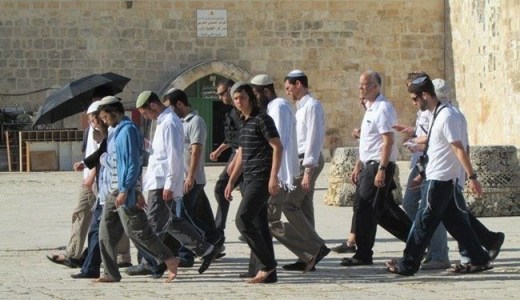
MEMO | November 16, 2014
Scores of Jewish settlers on Sunday stormed the Al-Aqsa Mosque complex in occupied East Jerusalem, a Palestinian official said.
“As many as 59 settlers stormed the holy compound through Al-Magharbeh Gate under the protection of Israeli police,” Sheikh Azzam al-Khatib, director-general of the Organization for Muslim Endowments and Al-Aqsa Affairs, told Anadolu Agency.
The settlers wandered through the compound’s courtyards, passing through the Qibali and Marawani mosques inside the holy complex before departing through Al-Silsileh Gate, he added.
Meanwhile, Israeli police allowed Palestinian men to enter the compound while denying women’s entry.
“We performed the noon prayers outside the gates of the compound after we were denied access by Israeli police,” one of the women who had been barred from entering the complex told Anadolu Agency.
“At least 70 women were barred from entering the complex since the early morning,” the woman, who asked to remain anonymous, told AA.
Tension has been running high in East Jerusalem since Israel closed the Al-Aqsa Mosque compound late last month following the shooting of an extremist rabbi in West Jerusalem.
The closure of Al-Aqsa, along with the killing of a young Palestinian man suspected of shooting the rabbi, has fueled angry protests by Palestinians in East Jerusalem .
Earlier this month, an Israeli police officer was killed when a Palestinian driver ran over a group of Israeli pedestrians in East Jerusalem. The Palestinian motorist was shot and killed on the spot by Israeli police in the immediate wake of the attack.
For Muslims, Al-Aqsa represents the world’s third holiest site. Jews, for their part, refer to the area as the “Temple Mount,” claiming it was the site of two Jewish temples in ancient times.
Israel occupied East Jerusalem during the 1967 Middle East War. It later annexed the holy city in 1980, claiming it as the capital of the self-proclaimed Jewish state – a move never recognized by the international community.
In September 2000, a visit to the site by controversial Israeli politician Ariel Sharon sparked what later became known as the “Second Intifada,” a popular uprising against the Israeli occupation in which thousands of Palestinians were killed.
Galilee Town Boils at Israeli Police “Execution”
Brutality from security forces and a sense of oppression connect Palestinians on both sides of Green Line
By Jonathan Cook | Dissident Voice | November 15, 2014
KAFR KANA, Galilee – Rauf Hamdan admitted to one small consolation as he sat in his mourning tent, greeting the steady stream of well-wishers paying condolences nearly a week after his son was gunned down in the street by Israeli police.
“At least his death was caught on camera,” he told Middle East Eye. “Otherwise the police would accuse me of lying when I said that he was executed in cold blood. The police can claim whatever they like. The truth is there for all to see.”
The killing of 22 year-old Kheir Hamdan – and the footage of it caught on security cameras that quickly went viral on social media – set off a firestorm of protests in Palestinian communities across Israel this past week that has yet to die down.
Hamdan instantly became a symbol: a victim of Israeli brutality and oppression, merging the experiences of Israel’s large minority of 1.5 million Palestinian citizens with those of their kin in the occupied territories of the West Bank, East Jerusalem and Gaza.
Although their inhabitants are disconnected politically and geographically, all these Palestinian areas currently simmer with a shared and barely suppressed rage that may yet erupt into a new uprising, or Intifada.
The Hamdan family home in Kafr Kana, a town of 22,000 Palestinians in northern Israel near Nazareth, is located in an overcrowded backstreet, close to a church over the site where Jesus supposedly performed his first miracle, turning water into wine at a wedding.
But Kafr Kana, like other Palestinian communities in Israel, feels like a community under an occupation of sorts.
Land and jobs scarce
Despite the flood of pilgrims, there are no hotels or major restaurants in the town. Israeli tour buses pay a flying visit that offers Kafr Kana none of the usual benefits of tourism.
Wadea Awawdy, a local journalist, pointed out that half of the town’s inhabitants were under 18. But jobs are scarce, as are the chances of finding land to build a home, usually a cultural pre-requisite here for getting married. None of that looks accidental to residents.
Kafr Kana’s only land reserves for housing and industry have been seized by the state and reassigned to Nazareth Ilit, a Jewish city built decades ago to “Judaise” Nazareth and its environs. “They have a large industrial zone on our land,” said Awawdy. “The only thing we get from it is pollution from a glass smelting factory.”
It is a picture of neglect and marginalisation common in Palestinian communities across the Galilee. Excluded from a meaningful Israeli identity, the minority increasingly feels it shares a common struggle with Palestinians across the Green Line.
The entrance to the Hamdan home hosts a martyr poster of the kind familiar when Palestinians are killed by the Israeli army in the occupied territories. Hamdan’s face is framed by the Palestinian flag.
The passage down to the mourning tent is adorned with images of the al-Aqsa mosque, the Islamic holy site regularly at the centre of Palestinian protests in occupied East Jerusalem.
Wrapped around 50 year-old Rauf Hamdan’s neck is a keffiyeh, a scarf that Yasser Arafat made a symbol of Palestinian resistance.
Concealing faces
Over the past week, such scarves have been concealing the faces of some of the thousands of youths who have clashed with police in Kafr Kana and elsewhere during protests against Hamdan’s killing. That has not stopped police arresting dozens of youths.
The keffiyeh has also been adopted by thousands of Palestinian children in Israeli schools as a visual protest. On Wednesday, a Palestinian Knesset member, Basel Ghattas, caused a flood of complaints when he donned it inside the Knesset.
“We are seen as the enemy by Israel because we are Palestinians,” said Rauf Hamdan. “Our citizenship makes no difference to the security forces.”
Hamdan’s assessment echoes that of an official inquiry into an earlier incident, 14 years ago, when the police fired live ammunition and rubber bullets at unarmed demonstrators in the Galilee at the start of the Second Intifada. Thirteen Palestinian citizens were killed and hundreds wounded in what have come to be known as the October 2000 events.
The Or Commission concluded that Israeli police related to the Palestinian minority “as an enemy.”
This week, one of the three members of that commission, Shimon Shamir, a noted history professor, said on Israeli radio that the police’s approach to the country’s Palestinian minority had only gotten worse in the intervening years.
That, said Awawdy, was how it looked to most Palestinian citizens too as they watched the video of Hamdan’s killing.
‘Sack of potatoes’
Hamdan’s final moments late on the night of 7 November were captured by cameras from several angles outside an electrical shop close to his home.
The store’s owner, Ehab Khoury, tutted angrily as he watched the video again. Like others, he was outraged by footage showing Hamdan being shot in the upper body from close range as he tried to flee from a police van.
Judging by Khoury’s reaction and the hushed conversations in the mourning tent, even more infuriating were the scenes of Hamdan, moments after he was severely wounded, being dragged along the ground by his arms and into the van.
“What is he?” said Khoury. “A citizen or a sack of potatoes? Why did they not call an ambulance when it was clear he was badly wounded?”
Police claim they fired a warning shot, though the cameras do not show the officer who fired on him doing so. But one of Khoury’s videos reveals the shadow of a policeman’s raised arm, holding a gun, from the far side of the van, out of the camera’s view.
That night, a bullet smashed through neighbour Edward Khoury’s bedroom window. If that was the warning shot, it looks suspiciously like it was fired with no regard to the safety of the residents close by.
Other details have further inflamed passions. The video shows the police van driving past the camera on its way out of Kafr Kana, having made a late-night arrest of Hamdan’s cousin following a domestic incident. Hamdan himself had been pepper-sprayed during the arrest.
Many seconds later, Hamdan comes into view chasing after the departing police. Then the van suddenly appears again in view of the camera, the police apparently having decided to return to deal with Hamdan.
Hospital trip delayed
The youth is seen banging on the window with an object police say was a knife. But he flees as the police emerge. According to medical reports, he was shot twice.
The cousin’s testimony to lawyers suggests the police drove around for some long minutes away from the nearest hospitals in Nazareth before heading for a much more distant one in Afula, losing vital time.
“His killing was pre-meditated,” said his father. “The police were leaving. They came back only to kill him.”
Human rights lawyers at Adalah, a legal centre for Israel’s Arab minority, believe the evidence suggests Hamdan was “executed.”
Unlawful killings by police have been a continuing occurrence since the 13 deaths in October 2000, said Jafar Farah of Mossawa, an advocacy group for the Palestinian minority.
Mossawa has identified 35 cases of Palestinian citizens being killed in similar circumstances by security forces since 2000, including previous incidents in Kafr Kana. Only in three cases were officers convicted, but the courts handed down short sentences.
“There is the same impunity for the security forces when it comes to using live ammunition against civilians, whether it is in Israel or the occupied territories,” said Farah.
Comments a few days before Hamdan’s killing by the police minister, Yitzhak Aharonovitch, that terrorists “should be sentenced to death” rather than arrested had, said Farah, given “a green light” to police to use live ammunition against civilians.
Sceptical of inquiry
Attorney-General Yehuda Weinstein has insisted on an investigation by a justice ministry unit known as Mahash, but few in the Palestinian minority expect it to be thorough.
“I have no trust that Mahash will get to the truth,” said Rauf Hamdan.
That scepticism is shared by human rights lawyers. A recent report by Adalah noted that Mahash had closed without action 93 per cent of complaints between 2011 and 2013, including in cases of clear breaches of police regulations.
Earlier, Mahash was accused of failing to properly investigate the police officers responsible for killing the 13 demonstrators in October 2000. None were ever indicted.
There are signs that the police are expecting similar lenience on this occasion. National Commissioner Yohanan Danino dismissed criticism of the police’s treatment of Hamdan as “unfounded” and “irresponsible.”
But the Palestinian minority’s concerns are not limited to police brutality. The political reaction has been equally disturbing.
Rauf Hamdan said no government official had visited the tent, or called to offer condolences. Instead, government leaders have used Hamdan’s death to further question the minority’s status as citizens.
Both Israeli Prime Minister, Benjamin Netanyahu, and his economics minister, Naftali Bennett, have suggested Hamdan was a “terrorist,” placing his fight with the police on a par with recent Palestinian attacks on Israeli civilians.
‘Move to Gaza’
But more worrying still, Netanyahu has exploited the outpouring of anger in the Galilee to confirm the Palestinian minority’s growing suspicion that the Israeli authorities see no future for them in a Jewish state.
Netanyahu has called on the interior minister to investigate stripping the protesters in Kafr Kana and elsewhere of their citizenship. He has also urged them to “move to the Palestinian Authority or to Gaza … Israel will not put any obstacles in your way.”
Foreign Minister, Avigdor Lieberman, leapt at the chance to promote again his plan to redraw Israel’s borders to expel a quarter of a million Palestinian citizens, saying: “It is clear that territorial and population swaps must be part of the solution. Us here and them there.”
A Palestinian Knesset member, Ahmed Tibi, said Netanyahu had “gone off the rails” in making his remarks, a view shared by the liberal daily Haaretz. An editorial accused Netanyahu of “exposing his nationalist face to the public.”
Since earlier in the year, Netanyahu and his government have been intensifying their efforts to silence the minority’s Palestinian representatives, both in and out of the parliament.
The electoral threshold was raised in March to a level that may ensure there are no Palestinian parties in the next Knesset. Meanwhile, Netanyahu used the protests over Hamdan’s killing to reiterate plans to outlaw the Islamic Movement, the minority’s most popular extra-parliamentary political faction.
Farah noted that clashes between police and the Palestinian minority were occurring more regularly and growing in intensity. “Once these crises occurred once every decade or more. But they are now a pattern. We saw violent confrontations over the summer during the attack on Gaza and only weeks later it’s happening again.”
There is deep distrust of the police and politicians, but Farah believes the anger is unlikely for the time being to translate into an Intifada. “The leadership here is opposed,” he said. “Despite the hostile atmosphere in the Israeli parliament, courts, media and public, there is still a preference to seek redress through political and legal channels.”
Awawdy, the journalist from Kafr Kana, is more pessimistic. “This government sees us at worst as enemies and at best as guests whose rights can be taken away at any moment. If things keep on this way, an explosion is coming. You can sense it in the air.”
Jerusalem child shot by Israeli forces loses eyesight
Ma’an – 14/11/2014
JERUSALEM – An 11-year-old Palestinian child shot in the face by a sponge bullet during clashes in al-Issawiya on Thursday has been left blind in one eye, a local official said.
Member of a local neighborhood committee, Muhammad Abu al-Hummus, told Ma’an that Saleh Samer Attiyeh Mahmoud, 11, was shot in the face at close range by Israeli forces firing sponge bullets in al-Issawiya during clashes.
He was hit directly between the eyes, causing severe bleeding to his nose and the loss of sight in his left eye. The vision in his right eye is also severely damaged.
Villagers in the East Jerusalem neighborhood were protesting the closure of three out of four entrances to the village by Israeli forces when the incident took place.
Sponge rounds are made from high-density plastic with a foam-rubber head, and are fired from grenade launchers.
Israeli police have been using them in Israel and occupied East Jerusalem since the use of rubber-coated metal bullets was prohibited, but protocol explicitly prohibits firing them at the upper body.
Featured Video

Why the U.S. Should Pull Back From the First Island Chain
or go to
Aletho News Archives – Video-Images
Book Review
‘Why Fauci Must Rot in Prison’: A Tale of Two Diaries
By Jill Erzen | The Defender | October 13, 2026
Dr. Anthony Fauci’s private diary reveals a “mind-numbing” contradiction between what the former top U.S. infectious disease official knew about COVID-19 and what he told the public, senior White House adviser Peter Navarro, Ph.D., said last week on “American Thought Leaders.”
In his new book, “Why Fauci Must Rot in Prison,” due out Oct. 20, Navarro compares Fauci’s private entries to his own pandemic-era diary, and uses what he calls “a tale of two diaries” to argue that Fauci should face criminal prosecution.
“I show, actually, how a prosecution can and should happen … at the state level, most likely,” Navarro said. “He should wind up in prison, and we’ve got the receipts in this book to put him there.”
Navarro said Fauci repeatedly acknowledged important facts in private, then publicly pursued policies that contradicted those facts — with devastating consequences.
“What he says many times privately in his diary is so at odds with both his public behavior and public statements that it’s mind-numbing,” Navarro said.
Navarro examines the lasting damage caused by lockdowns and other pandemic policies, and the ongoing toll of long COVID.
His book also addresses questions about vaccine safety, including why healthy young people faced COVID-19 vaccination mandates despite concerns about myocarditis, and why women were not warned about miscarriage risks linked to the shots. … continue
Blog Roll
 Aletho News
- Jennifer Kavanagh: Why the U.S. Should Pull Back From the First Island Chain
- Yemen denounces international community’s silence on Saudi aggression, siege
- UAE and Saudi Arabia move toward renewed coordination against Sanaa
- How Iran’s two-week retaliatory strikes exposed cracks in US military architecture in Persian Gulf
- The mother of all propaganda: Why the hype over US MOAB strike against Iran is nothing but theater
- Iran says it possesses technology behind US 14-ton GBU bunker-buster
- Trump asks Iran not to retaliate after he strikes Pickaxe Mountain – w/ Prof. Marandi
- Vice President J.D. Vance’s Deceptive ‘Antiwar’ Campaign Speech
- Iran: Palestinians’ rights must not be compromised in Gaza’s future; US, Israel to blame for Hormuz situation
- Ongoing tales of Syrian chemical weapons
- If Americans Knew
- Israeli rabbi permits occupiers to steal Palestinian olive harvest in West Bank
- Netanyahu’s spin on latest settler attack is laughable – Daily Update
- Israeli soldiers debunk Israel’s talking points
- In West Bank, Israeli settlers are totally out of control – Daily Update
- NPR investigation finds evidence of widespread fraud at mall kiosks tied to Israeli skincare brand
- Tucker Carlson exposes Israeli Lies about the Oct 7th attack, Charlie Kirk, and the U.S.
- Israel has detained thousands of Palestinian children since Oct 7th – over half spent time in solitary, many uncharged
- Israeli Analysis: Is Netanyahu Planning an ‘October Surprise’ Attack Before Israel’s Election?
- Israeli settlers brutally attack Palestinians and Washington Post female photographer, 65
- Words Have Changed, Occupation Continues: The Reality of the Gaza Ceasefire
- No Tricks Zone
- Predictions Made By Renowned Climate Proifessor Over Past Decades Have Been Proven To Be Poor
- New Study Suggests Large Regions Of The Pacific Ocean Have Been Cooling For The Last 80 Years
- Germany’s Green Energy Debacle: High Energy Costs Force Kahla Porzellan to Close After 182 Years!
- New Study: 50 Years Of The Most Aggressive ‘Net Zero’ Policies Can Only Affect The Global Climate By 0.03°C
- US September “Heat” Was No Record…Many Records Set Decades Ago
- Latest European Green Energy Debacle; Portugal’s Largest Flagship Solar Park Insolvent!
- Green Energy Debacle: German Expert Professor Fritz Vahrenholt Warns Of Severe Economic And Social Consequences
- Two More Paleo Reconstructions Affirm Meters-Higher Sea Levels Across Ireland, Brazil 7000-6000 Years Ago
- New Study: Earth And Venus Surface Warmth Largely Explained By Convection And Lapse Rate, Not CO2 Or Radiation
- 2025 Nature Paper Claiming Worsening Global Drought Gets RETRACTED …Heavily Flawed

