Haiti: Marchers Shot at Battle Commemoration
Weekly News Update on the Americas | November 23, 2014
At least four demonstrators were wounded in the northern Port-au-Prince suburb of Delmas on Nov. 18 when counter-demonstrators opened fire on an opposition march commemorating the anniversary of the 1803 Battle of Vertières, which marked the final defeat of French forces trying to regain control of Haiti. The several hundred marchers had reached the neighborhood of Delmas 32 and were about to turn back toward downtown Port-au-Prince when they were met with a hail of rocks. The marchers responded with more rocks, and the police used tear gas against the attackers. The gunfire started a little later. Two people were hit in the neck, one in the knee and one in the side; all four were taken away for medical care. The police said they recovered more than a half-dozen 9 mm caliber cartridges from the site. The marchers dispersed after the attack.
Some protesters reported seeing a lifeless body lying near a motorbike, and protest organizers held a press conference on Nov. 21 to charge that three people had been shot dead and that police agents had taken their bodies away. The authorities denied the charge, and reporters noted that the press conference didn’t include relatives of the three people said to be missing.
The Nov. 20 march was largely sponsored by opponents of President Michel Martelly (“Sweet Micky”) and included groups associated with the Lavalas Family (FL) party of former president Jean-Bertrand Aristide (1991-1996, 2001-2004). Populist senators John Joel Joseph and Moïse Jean-Charles and legislative deputy Arnel Bélizaire were among the politicians present [see Update #1204]. According to the online news service AlterPresse, the Textile and Garment Workers Union (SOTA), which is associated with the leftist labor organization Batay Ouvriye (“Workers’ Struggle”), also participated, but the union’s “demands against the presence of United Nations forces in the country [and] for a decent minimum wage…were drowned out by the anti-Martelly slogans.” The Martelly opponents were especially incensed because of an opinion piece by Communication Minister Rudy Hériveaux posted on Martelly’s blog on Nov. 17. Entitled “The Cockroach Syndrome,” the article described anti-government protesters as “roaches” who “trot around in a disgusting folklore in the streets to try to assault the government.” Hériveaux is a former FL senator and until a few years ago led a faction of the party [see Update #1083]. (AlterPresse 11/19/14, 11/21/14)
In related news, two opposition leaders arrested after an Oct. 26 protest, Rony Timothée and Byron Odigé [see Update #1240], have been placed in isolation in the National Penitentiary, according to the daily Le Nouvelliste. Meanwhile, attorney André Michel, who frequently represents opposition figures [see Update #1232], was ordered to appear on Nov. 17 before investigative judge Lamarre Bélizaire, who is charging him with property destruction in connection with an Oct. 17 demonstration. Michel refused to attend, saying Judge Bélizaire had no authority to order his appearance. (AlterPresse 11/17/14, 11/21/14)
Big Pharma—Crony Capitalism Out of Control
By Ralph Nader | November 21, 2014
Two recent news items about the voracious drug industry should call for a supine Congress to arouse itself and initiate investigations about the pay-or-die drug prices that are far too common.
The first item—a page one story in the New York Times—was about the Cystic Fibrosis (CF) Foundation, which fifteen years ago invested $150 million in the biotechnology company Vertex Pharmaceuticals to develop a drug for this serious lung disease.
On November 19, the Foundation reported a return of $3.3 billion from that investment. Kalydeco, the drug developed with that investment, is taken daily by CF patients (who can afford it) and is priced at $300,000 a year per patient. Who can pay that price?
The second news release came from the drug industry funded Tufts Center for the Study of Drug Development. The Center’s Joseph DiMasi asserts that the cost of developing a new prescription medicine is about $2.558 billion, significantly higher than the previous estimate of $802 million that the Center claimed in 2003.
The drug industry promoters use this ludicrous figure to justify sky-high drug prices for consumers. Unfortunately, the criticism of this inflated number does not receive adequate media attention.
Half of the DiMasi assertion is opportunity costs foregone if the drug company invested its money elsewhere. That cuts his estimate by almost half to $1.395 billion. This maneuver gives “inflation” a new meaning. According to economist James P. Love, founder of Knowledge Ecology International, DiMasi also conveniently ignores government subsidies such as so-called orphan drug tax credits, research grants from the National Institutes of Health and government support of the cost of clinical trials that qualify (see keionline.org).
Mr. Love adds that the drug companies spend “much more on marketing than they do on research and development.”
Rohit Malpani, Director of Policy and Analysis of Doctors Without Borders (which received the Nobel Prize in 1999), says that if you believe Tufts’ figures, whose alleged data analysis is largely secret, “you probably also believe the Earth is flat.”
Mr. Malpani cites GlaxoSmithKline’s CEO Andrew Witty himself who says that the figure of a billion dollars to develop a drug is a myth.
Malpani adds that “we know from past studies and the experience of non-profit drug developers that a new drug can be developed for just a fraction of the cost the Tufts report suggests. The cost of developing products is variable, but experience shows that new drugs can be developed for as little as $50 million, or up to $186 million if you take failure into account… not only do taxpayers pay for a very large percentage of industry R&D, but are in fact paying twice because they then get hit with high prices for the drugs themselves.”
Mr. Malpani was referring primarily to the U.S., where the drug companies show no gratitude for generous tax credits and taxpayer funded R&D (that they get mostly free.) Add the absence of price controls and you the consumer/patient pay the highest drug prices in the world.
Another largely ignored aspect of the industry’s R&D is how much of it is directed to products that match, rather than improve, health outcomes—so-called “me too” drugs that are profitable, but don’t benefit patients’ health.
Also, the consistently profitable drug industry has been continually unable to restrain its deceptive promotion of drugs and inadequate disclosure of side-effects. About 100,000 Americans die every year from adverse effects of pharmaceuticals. Tens of billions of consumer dollars are wasted on drugs that have side effects instead of drugs for the same ailments with lesser side-effects (see citizen.org/hrg).
During a visit in 2000 with military physicians and scientists at the Walter Reed Army Hospital, I asked how much they spent on R&D to develop their antimalarial drugs and other medicine. The answer: five to ten million dollars per drug, which included clinical testing plus the salaries of the researchers.
This “drug development entity” inside the Department of Defense arose because drug companies refused to invest in vaccine or therapeutic drugs for malaria—then the second leading cause for hospitalizing U.S. soldiers in Vietnam (the first being battlefield injuries). So the military brass decided to fill this void in-house, and with considerable success.
The problem with the stinginess of the coddled private pharmaceutical industry regarding vaccine development continues.Drug resistant tuberculosis and other infectious diseases rampant in developing countries continue to take millions of lives each year. The Ebola epidemic is a current lethal illustration of such neglect.
The survival of many millions of people is too important to be left to the drug companies. For a fraction of what the federal government is wasting on spreading and failing lawless wars abroad, it can expand from the Walter Reed Army Hospital example to become a humanitarian superpower that produces life-saving vaccines and medicines as if the plight of sick people mattered more than windfall profits for Big Pharma.
Ralph Nader’s latest book is: Unstoppable: the Emerging Left-Right Alliance to Dismantle the Corporate State.
In the past five years, more Utahans have been killed by cops than by gang violence, drug dealers, or from child abuse

By Matt Agorist | Free Thought Project | November 23, 2014
Data from a five-year period is painting a disturbing picture of a deadly trend among Utah police officers.
Up until this year, killings by police officers ranked second only to homicide of intimate partners. However, this year, including a Saturday shooting in South Jordan, deadly force by police surpassed even violence between spouses and dating partners.
As police killings rise, more people are becoming aware and police watchdog groups are saying that it’s time we start treating deadly force by police as a potentially serious public safety problem. The Free Thought Project agrees.
“The numbers reflect that there could be an issue, and it’s going to take a deeper understanding of these shootings,” said Chris Gebhardt to the Salt Lake Tribune, a former police lieutenant and sergeant who served in Washington, D.C., and in Utah, including six years on SWAT teams and several training duties. “It definitely can’t be written off as citizen groups being upset with law enforcement.”
Only one single case of police deadly force in Utah has ever been deemed “unjustified” by prosecutors which was the 2012 shooting of Danielle Willard by West Valley City police.
The Tribune also spoke to Ian Adams, a West Jordan police officer and spokesman for the Utah Fraternal Order of Police who says, “Police are trained and expected to react to deadly threats. As many deadly threats emerge is the exact amount of times police will respond.”
“The onus is on the person being arrested to stop trying to assault and kill police officers and the innocent public. … Why do some in society continue to insist the problem lies with police officers?”
Apparently Adams is unaware of police tendencies to escalate an otherwise peaceful situation into violent one, at the drop of a hat.
As recent FBI data has shown, violence among citizens is at an all time low, while violence by police is at an all time high. To imply that police are justified in 100% of these killings is not only irresponsible but incredibly dangerous.
The death of another human being should be avoided at all costs and when it happens, regardless of whether or not the person wears a badge, there should be a full investigation; by a third party.
“Sometimes the line between is it legal and is it necessary becomes difficult to distinguish,” criminal justice professor at Weber State University, Robert Wadman said. “In the judgment of the officer, ‘Is my life in jeopardy? Yes.’ At that point in time, they’re legally grounded in using deadly force. But the question is, is it necessary? That’s something that needs to be firmly addressed, for example, in training.”
Gang violence in America was once a national conversation and rightfully so. However, with the legalization of marijuana in several states, these cartels are diminishing and their once violent hold is slipping away. They no longer pose such a large threat.
Americans are less violent now than ever before, so why are we seeing an increase in police violence? If the recent events in Ferguson, MO and the heavy militarization among police forces nationwide, have taught this country anything, it’s that we are long overdue for a serious conversation about police reform.
Pro-Israel activists ask MPs to halt non-violent BDS protests
MEMO | November 24, 2014
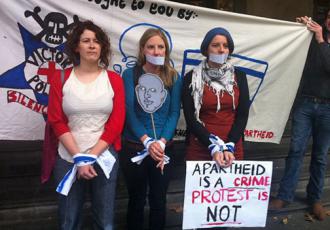 Zionist activists have urged British MPs to implement new legislation that police could use to stop non-violent, pro-BDS protests.
Manchester-based group North-West Friends of Israel have urged politicians to give police more power to stop boycotts of businesses by pro-Palestine solidarity activists.
As cited in a report by The Jewish Chronicle, the group’s co-chair Anthony Dennison wants the Public Order Act amended “to allow police to halt non-violent protests, if they disrupted ‘the lawful right of customers and shops to trade’.”
Dennison commented: “Peaceful protest can be intimidating, if demonstrators are stood outside a shop, holding placards with horrible images, are customers really going into that shop?”
Defeat of USA FREEDOM Act is a Victory for Freedom
By Ron Paul | November 23, 2014
It will not shock readers to hear that quite often legislation on Capitol Hill is not as advertised. When Congress wants to do something particularly objectionable, they tend give it a fine-sounding name. The PATRIOT Act is perhaps the best-known example. The legislation had been drafted well before 9/11 but was going nowhere. Then the 9/11 attacks gave it a new lease on life. Politicians exploited the surge in patriotism following the attack to reintroduce the bill and call it the PATRIOT Act. To oppose it at that time was, by design, to seem unpatriotic.
At the time, 62 Democrats voted against the Act. On the Republican side there were only three no votes: former Rep. Bob Ney (R-OH), former Rep. Butch Otter (R-ID), and myself.
The abuses of the Constitution in the PATRIOT Act do not need to be fully recounted here, but Presidents Bush and Obama both claimed authority based on it to gut the Fourth Amendment. The PATRIOT Act ushered in the era of warrantless wiretapping, monitoring of our Internet behavior, watering down of probable cause, and much more. After the revelations by whistleblower Edward Snowden, we know how the NSA viewed constitutional restraints on surveillance of American people during the PATRIOT Act period.
After several re-authorizations of the PATRIOT Act, including some cosmetic reforms, Congress last October unveiled the USA FREEDOM Act. This was advertised as the first wholesale PATRIOT Act Reform bill. In fact, the House version was watered down to the point of meaninglessness and the Senate version was not much better. The final straw was the bill’s extension of key elements of the PATRIOT Act until 2017.
Fortunately, last week the USA FREEDOM Act was blocked from further consideration in the US Senate. The procedural vote was significant and important, but it caused some confusion as well. While some well-meaning pro-privacy groups endorsed the FREEDOM Act as a first step to reform, some anti-liberty neoconservatives opposed the legislation because even its anemic reforms were unacceptable. The truth is, Americans should not accept one more extension of the PATRIOT Act and should not endorse its continued dismemberment of our constitutional liberties. If that means some Senators vote with anti-liberty colleagues to kill the extension, we should still consider it a victory.
As the PATRIOT Act first faced a sunset in 2005, I had this to say in the debate over whether it should be re-authorized:
“When Congress passed the Patriot Act in the emotional aftermath of the September 11th terrorist attacks, a sunset provision was inserted in the bill that causes certain sections to expire at the end of 2005. But this begs the question: If these provisions are critical tools in the fight against terrorism, why revoke them after five years? Conversely, if these provisions violate civil liberties, why is it acceptable to suspend the Constitution for any amount of time?”
Reform is often meant to preserve, not repeal bad legislation. When the public is strongly opposed to a particular policy you will almost never hear politicians say “let’s repeal the law.” It is always a pledge to reform the policy or law. The USA FREEDOM Act was no different.
With the failure of the FREEDOM Act to move ahead in the Senate last week, several of the most egregious sections of the PATRIOT Act are set to sunset next June absent a new authorization. Congress will no doubt be under great pressure to extend these measures. We must do our very best to make sure they are unsuccessful!
Ben & Jerry’s Israeli Factory and Israel’s Stolen Land and Stolen Water

Vermonters for a Just Peace in Palestine/Israel
The Ben & Jerry’s factory is in Be’er Tuvia, adjacent to the town of Kiryat Malachi, one of four Israeli localities located on the lands of the former village of Qastina, in territory allotted to the Arab state under the 1947 UN Partition Plan. However on July 9, 1948, after Israel’s declaration of independence and the ensuing war, Qastina and its more than 147 houses were completely destroyed by Israeli forces of the Givati Brigade, and the land incorporated into Israel. (Based on information documented at http://en.wikipedia.org/wiki/Qastina, accessed December 2012).
 Ghatheyya Mifleh al-Khawalda was a 15-year old teenager when she fled to Gaza from her home in the village of al-Qastina, now the town of Kiriyat Malachi and site of the Ben & Jerry’s factory, during the Nakba of 1948. So this woman, a refugee living only a day’s walk from the village that she was driven from, represents a personal and tragic link to the site where now the Ben & Jerry’s factory churns out ‘Peace and Love’ ice cream. Yes, they do profit from this stolen land, and yes, the Nakba was a crime, and yes, the occupation is an affront. Ghatheyya is one of generations of Palestinians in Gaza who are locked away from their land, their families and the world. Some seethe with anger and resort to violence – three people in Kiriyat Malachi died in November 2012 in a rocket attack from Gaza. Ghatheyya said, “We had a very nice house, a big house with marble floors in the hallway. My father was a farmer, and we had farmland with orange trees, apple trees, grapefruit trees and others. We were very happy.” Her life changed dramatically in 1948, when Jewish militias arrived. “Some Jewish militia members were wearing uniform and others had civilian clothes,” Ghatheyya said, “and when they arrived in the village they began firing at people, killing three villagers. We ran away, afraid for our safety, and went to Tal al-Safi, a nearby village. It was within walking distance, and we were in a hurry to leave, so we didn’t take anything with us. It was like Doomsday. It was utter terror. We couldn’t think of anything except leaving, not even simple things like bringing food with us.” After a few days in Tal es-Safi, militias came again and forced them to leave. Ghatheyya and her family fled to Beit Jibrin to spend the night, but were followed and forced to leave again. “If you wanted to die, you stayed. If you wanted to live, you left,” she recalls. “Their main aim was not to kill us, but to get rid of us. If they had wanted us all dead, not one of us would have survived. They used fear to force us to leave our land.” The family walked along the coast until they reached Gaza. “There were thousands of people who fled other villages, sleeping in mosques or on the street,” Ghatheyya says, and UNRWA began to build tents for the families. (From a story “Nakba survivor: If you wanted to live, you left” at Ma’an News )
Water Used by the Factory
When investigating Ben & Jerry’s business dealings in Israel and the occupied territory, we also set out to determine if the company’s franchise was benefiting from Israel’s criminal diversion of Palestinian water. Our inquiry, which included discussions with an international water consultant, led us to the tentative conclusion that Ben & Jerry’s factory in Kiryat Malachi may be drawing water from the Jordan River system and the Mountain Aquifer in the occupied West Bank, the two highest-quality water sources in the region, thus diverting it from Palestinian use.
Palestinians under occupation have been denied access to the Jordan River since 1967, leaving the Mountain Aquifer as their only source of water. A study by The World Bank determined that “Palestinian per capita access to water resources in the West Bank is a quarter of Israeli access and is declining.” This is a result of Israeli government planning and regulation.
To make matters worse, Israeli settlers in the West Bank often obstruct or disconnect the flow of water to Arab communities, while 500,000 settlers consume in total approximately six times more water than three million Palestinians. This difference is even higher when agricultural use is factored in. Regular access to water explains why one commonly sees green lawns and swimming pools in Israeli settlements. In stark contrast, throughout the year, but especially in the summer, Palestinian cities and villages are denied continuous access to water, sometimes for weeks on end. This gross injustice is aggravated by Israel’s policy of denying permits to Palestinians to drill new wells or rehabilitate old ones.
By manufacturing in Israel and marketing in the occupied territory, Ben & Jerry’s is a willing partner to a water system that is grossly inequitable, transgresses international law, and denies Palestinians their fair share of the Mountain Aquifer and the Jordan River. Please see Our Report for more information on Israel’s water crimes in the occupied territory.
Bahrain opposition slams ‘ridiculous’ official voter turnout rate
Al-Akhbar | November 23, 2014
A war of words over the turnout rate in Bahrain’s legislative election heightened Sunday, between the authorities and the opposition, with the latter accusing the regime of “misleading the public.”
With the vote-counting still underway after Saturday’s elections to the 40-member parliament, the focus was on voter turnout, which became a key marker of the election’s validity after Bahrain’s main opposition movement, al-Wefaq, which was banned in October from carrying out any activities for three months for allegedly “violating the law on associations,” and four other opposition groups boycotted the polls.
The opposition demand a “real” constitutional monarchy with an elected prime minister who is independent from the ruling royal family. But the US and Saudi-backed King Hamad al-Khalifa, whose family has been in power for over 200 years, has refused to yield.
The Bahraini official electoral commission said 51.5 percent of registered voters turned out to vote, but the opposition, which has dismissed the elections as a “farce”, slammed the official turnout rate as “ridiculous”, saying that only 30 percent of eligible voters had turned out.
Both sides also traded accusations of electoral malpractice, with the opposition saying it has proof that tens of thousands of people were pressured to vote, while the authorities accused “militants” of preventing others from reaching ballot stations.
”Amusing and ridiculous”
Voting closed at 1900 GMT Saturday after a two-hour extension decided by the electoral commission, in a likely bid to boost turnout.
An hour later the head of the commission, Sheikh Khaled al-Khalifa, who is also justice minister, claimed initial estimates showed 51.5 percent of registered voters turned out to vote.
“Turnout for the legislative elections was 51.5 percent… (and this result) puts an end to confessionalism in Bahrain,” he said in reference to the opposition’s boycott call.
Al-Wefaq, which withdrew its 17 lawmakers after the regime’s violent crackdown on protests in 2011, called the official turnout rate “amusing, ridiculous, and lacking credibility”.
Government officials were “trying to fool public opinion and ignore the large election boycott by announcing exaggerated figures,” the opposition group said in a statement published early Sunday.
The opposition instead cited a turnout figure of “around 30 percent,” allowing a possible five percent difference either way.
It also accused the authorities of making tens of thousands of state employees vote or face consequences.
“Even a 30 percent turnout would not have been possible if the authorities had not pressured and threatened state employees,” the statement said, adding that “80 percent of voters are serving in the security, military and public apparatuses.”
”3,000 political prisoners behind bars”
With Saudi Arabia’s help, Bahrain, a country ruled by an unelected monarchy, crushed peaceful pro-democracy demonstrations that began on February 14, 2011.
Saudi Arabia and other Gulf neighbors sent troops into Bahrain in March 2011, reinforcing a crackdown that led to accusations of serious human rights violations.
At least 89 people are estimated to have been killed and hundreds have been arrested and tried since the uprising erupted.
In a press conference held by the National Democratic Opposition Parties at al-Wefaq headquarters on Saturday, al-Wefaq chief Sheikh Ali Salman said the regime continued to commit major human rights violations.
“The elections are being held while more than 3,000 prisoners are behind bars, including Ibrahim Sharif, who is the former chief of the National Democratic Action Society, and many other prominent political figures”, said Salman, adding that the authorities have repeatedly misled the public in the past.
Today, Bahrain, a key ally of Washington and home to the US Navy’s Fifth Fleet, has the distinction of being the country with the second highest prison population rate per 100,000 amongst Arab states in the West Asian and North African region.
Over 200 minors are being held within these prisons, forced to stay side-by-side with adults, and some have faced torture and sexual abuses.
Authorities ignored pleas by human rights groups to release political prisoners, instead increasing the punishment for violent crimes.
Besides imprisonment, 50 Bahrainis have had their citizenship revoked and several have also been deported since Bahrain adopted a law last year stipulating that suspects convicted of “terrorist” acts could be stripped of their nationality.
The Ministry of Interior in November 2012 revoked the nationality of 31 pro-democracy activists in the name of the Bahrain Citizenship Law, “under which the nationality of a person can be revoked if he or she causes harm to state security,” Amnesty International said in a report.
“The Bahraini authorities are running out of arguments to justify repression. They are now resorting to extreme measures such as jail sentences and revoking nationality to quell dissent in the country, rather than allowing people to peacefully express their views,” Amnesty International’s Middle East and North Africa deputy director, Hassiba Sahraoui, said in the report.
Moreover, government officials Saturday also accused “militants of provoking incidents” and blocking roads in areas of the capital Manama in order to prevent people from voting.
Clashes erupted between youths and security forces, with the latter firing tear gas and rubber-coated bullets at protesters, in many villages around Bahrain Saturday.
“Peaceful protesters in more than 50 areas around Bahrain were violently attacked and many have been left with shotgun injuries,” Salman added, urging UN Secretary-General Ban Ki-moon “to sanction a political solution to the Bahraini crisis.”
(Al-Akhbar, AFP)
UK journalists take legal action against police spying
Press TV – November 21, 2014
Six British journalists have filed a lawsuit against the Scotland Yard after documents showed that the police in London were spying on them for more than a decade.
The lawsuit, which was filed by the National Union of Journalists against London’s Metropolitan Police and the Home Office, was announced late Thursday.
The group of journalists, including three photographers, an investigative journalist, a newspaper reporter and a freelance video journalist, took legal action after they discovered the Metropolitan Police had been recording their professional activities on a secret database.
The database was reportedly designed to monitor so-called domestic extremists.
The records included the movements of the journalists while working, their appearance and how they used a camera to record the events they were covering.
Freelance photographer David Hoffman questioned why he had been labeled as an extremist in the files kept by the police, saying he has “never contemplated any sort of extreme action of a political or criminal nature.”
The journalists said the lawsuit is aimed at exposing the persistent pattern of journalists being assaulted, monitored and stopped and searched by police during their work.
The group is also seeking to force the police to destroy the files containing records of their activities, saying the surveillance violates the liberty of the press and their privacy.
Both the Metropolitan police and the Home Office have declined to comment on the legal action.
The lawsuit comes as recent public disclosures of police records have revealed that Scotland Yard secretly seized journalists’ telephone records.
Several senior police officers have acknowledged keeping an eye on journalists by using powers granted under anti-terrorism measures.
A previous lawsuit by five journalists resulted in the police apologizing or paying damages for wrongdoing, including assault and unjustifiable searches while they were working.
Dutch government refuses to reveal ‘secret deal’ into MH17 crash probe
RT | November 20, 2014
The Dutch government has refused to reveal details of a secret pact between members of the Joint Investigation Team examining the downed Flight MH17. If the participants, including Ukraine, don’t want information to be released, it will be kept secret.
The respected Dutch publication Elsevier made a request to the Dutch Ministry of Security and Justice under the Freedom of Information Act to disclose the Joint Investigation Team (JIT) agreement, along with 16 other documents. The JIT consists of four countries – the Netherlands, Belgium, Australia and Ukraine – who are carrying out an investigation into the MH17 disaster, but not Malaysia. Malaysian Airlines, who operated the flight, has been criticized for flying through a war zone.
Part of the agreement between the four countries and the Dutch Public Prosecution Service, ensures that all these parties have the right to secrecy. This means that if any of the countries involved believe that some of the evidence may be damaging to them, they have the right to keep this secret.
“Of course [it is] an incredible situation: how can Ukraine, one of the two suspected parties, ever be offered such an agreement?” Dutch citizen Jan Fluitketel wrote in the newspaper Malaysia Today.
Despite the air crash taking place on July 17 in Eastern Ukraine, very little information has been released about any potential causes. However, rather than give the public a little insight into the investigation, the Dutch Ministry of Security and Justice is more worried about saving face among the members of the investigation.
“I believe that this interest [international relations] is of greater importance than making the information public, as it is a unique investigation into an extremely serious event,” the Ministry added, according to Elsevier.
Other reasons given for the request being denied included protecting investigation techniques and tactics as well as naming the names of officials who are taking part in the investigation. The Ministry said it would be a breach of privacy if they were revealed. “If the information was to be released then sensitive information would be passed between states and organizations, which would perhaps they would be less likely to share such information in the future,” said the Ministry of Security and Justice.
Dutch MP Pieter Omtzigt, who is a member of the Christian Democratic Party, has made several requests for the information to be released to the public. “We just do not know if the Netherlands has compromised justice,” he said in reaction to the ministry’s decision. The MP was surprised that this agreement was even signed, never mind kept secret.
Malaysia is the only country to have directly negotiated with the anti-Kiev militias in the East of Ukraine, while the country’s Ambassador to the Netherlands said he was unhappy that Malaysia had not been included within the JIT. Dutch Prime Minister Mark Rutte flew to Kuala Lumpur on November 5, but Malaysia says it still did not receive an invitation to join.
“We must first be included in the JIT, otherwise it would be hard for us to cooperate in the investigation. The parties inside the investigation must include us in the team, right now we are just a participant,” said the Malaysian Inspector-General of Police Khalid Abu Bakar in Kuala Lumpur on Wednesday, which was reported by the New Straits Times.
A preliminary report by the Dutch Safety Board, which was released September said the MH17 crash was a result of structural damage caused by a large number of high-energy objects that struck the Boeing from the outside.
Dutch investigators added that “there are no indications” that the tragedy was triggered “by a technical fault or by actions of the crew.”
Israeli soldiers protect Jewish settlers attacking Palestinian village
Yesh Din | November 20, 2014
Israeli occupation forces did nothing to stop Jewish settlers from attacking Palestinian villagers, according to videos released by the Yesh Din rights group, showing soldiers pointing guns at Palestinians while Israelis are throwing stones from behind the soldiers.
The soldiers appear to be protecting the masked and armed Jewish settlers from Yitzhar during their attack on Palestinians in the village of Urif in the West Bank on Tuesday.
“IDF soldiers have the obligation, based on international law and High Court of Justice rulings, to protect Palestinian residents from violence, and IDF soldiers have the authority to detain suspects, including Israeli suspects, until the police arrive,” Yesh Din said in a statement.
“The disturbing video footage demands vigorous investigation and the immediate prosecution of the soldiers involved. An examination must also be carried out of whether the soldiers’ commanders bear liability for the conduct of their subordinates,” attorney Emily Schaeffer Omer-Man, legal advisor to Yesh Din’s said.
Featured Video

Why the U.S. Should Pull Back From the First Island Chain
or go to
Aletho News Archives – Video-Images
Book Review
‘Why Fauci Must Rot in Prison’: A Tale of Two Diaries
By Jill Erzen | The Defender | October 13, 2026
Dr. Anthony Fauci’s private diary reveals a “mind-numbing” contradiction between what the former top U.S. infectious disease official knew about COVID-19 and what he told the public, senior White House adviser Peter Navarro, Ph.D., said last week on “American Thought Leaders.”
In his new book, “Why Fauci Must Rot in Prison,” due out Oct. 20, Navarro compares Fauci’s private entries to his own pandemic-era diary, and uses what he calls “a tale of two diaries” to argue that Fauci should face criminal prosecution.
“I show, actually, how a prosecution can and should happen … at the state level, most likely,” Navarro said. “He should wind up in prison, and we’ve got the receipts in this book to put him there.”
Navarro said Fauci repeatedly acknowledged important facts in private, then publicly pursued policies that contradicted those facts — with devastating consequences.
“What he says many times privately in his diary is so at odds with both his public behavior and public statements that it’s mind-numbing,” Navarro said.
Navarro examines the lasting damage caused by lockdowns and other pandemic policies, and the ongoing toll of long COVID.
His book also addresses questions about vaccine safety, including why healthy young people faced COVID-19 vaccination mandates despite concerns about myocarditis, and why women were not warned about miscarriage risks linked to the shots. … continue
Blog Roll
 Aletho News
- Jennifer Kavanagh: Why the U.S. Should Pull Back From the First Island Chain
- Yemen denounces international community’s silence on Saudi aggression, siege
- UAE and Saudi Arabia move toward renewed coordination against Sanaa
- How Iran’s two-week retaliatory strikes exposed cracks in US military architecture in Persian Gulf
- The mother of all propaganda: Why the hype over US MOAB strike against Iran is nothing but theater
- Iran says it possesses technology behind US 14-ton GBU bunker-buster
- Trump asks Iran not to retaliate after he strikes Pickaxe Mountain – w/ Prof. Marandi
- Vice President J.D. Vance’s Deceptive ‘Antiwar’ Campaign Speech
- Iran: Palestinians’ rights must not be compromised in Gaza’s future; US, Israel to blame for Hormuz situation
- Ongoing tales of Syrian chemical weapons
- If Americans Knew
- Israeli rabbi permits occupiers to steal Palestinian olive harvest in West Bank
- Netanyahu’s spin on latest settler attack is laughable – Daily Update
- Israeli soldiers debunk Israel’s talking points
- In West Bank, Israeli settlers are totally out of control – Daily Update
- NPR investigation finds evidence of widespread fraud at mall kiosks tied to Israeli skincare brand
- Tucker Carlson exposes Israeli Lies about the Oct 7th attack, Charlie Kirk, and the U.S.
- Israel has detained thousands of Palestinian children since Oct 7th – over half spent time in solitary, many uncharged
- Israeli Analysis: Is Netanyahu Planning an ‘October Surprise’ Attack Before Israel’s Election?
- Israeli settlers brutally attack Palestinians and Washington Post female photographer, 65
- Words Have Changed, Occupation Continues: The Reality of the Gaza Ceasefire
- No Tricks Zone
- Predictions Made By Renowned Climate Proifessor Over Past Decades Have Been Proven To Be Poor
- New Study Suggests Large Regions Of The Pacific Ocean Have Been Cooling For The Last 80 Years
- Germany’s Green Energy Debacle: High Energy Costs Force Kahla Porzellan to Close After 182 Years!
- New Study: 50 Years Of The Most Aggressive ‘Net Zero’ Policies Can Only Affect The Global Climate By 0.03°C
- US September “Heat” Was No Record…Many Records Set Decades Ago
- Latest European Green Energy Debacle; Portugal’s Largest Flagship Solar Park Insolvent!
- Green Energy Debacle: German Expert Professor Fritz Vahrenholt Warns Of Severe Economic And Social Consequences
- Two More Paleo Reconstructions Affirm Meters-Higher Sea Levels Across Ireland, Brazil 7000-6000 Years Ago
- New Study: Earth And Venus Surface Warmth Largely Explained By Convection And Lapse Rate, Not CO2 Or Radiation
- 2025 Nature Paper Claiming Worsening Global Drought Gets RETRACTED …Heavily Flawed

