Syria and “Transitional Justice”

By Helena Cobban | Just World News | February 12, 2020
Almost from the beginning of the US-supported regime-change project in Syria, US policymakers have incorporated several kinds of planning for what is called “transitional justice” into their pursuit of the project. Transitional justice (TJ) is a field that came into great vogue in the mid-1990s, after two key developments in the post-Soviet world: (1) the UN Security Council’s creation of a special International Criminal Tribunal for the Former Yugoslavia (ICTY) and (2) the agreement of the African National Congress in South Africa to negotiate an end to the Apartheid system– but with the proviso that the most heinous of the rights violators of the Apartheid era all ‘fess up to all their actions in a specially created Truth and Reconciliation Commission (TRC); and if those confessions were deemed full and heartfelt, then the perpetrators could escape prosecution for their actions.
From the early 1990s, these two approaches to TJ were in tension with each other; and that tension has lain at the heart of the rapidly burgeoning field of TJ projects ever since.
For its part, the prosecutorial/criminal-justice approach claimed descent from, crucially, the two US-dominated international courts established immediately after WW-II, in Nuremberg, and Tokyo. (The above photo is of Herman Goering on the stand, in Nuremberg.) The creation of ICTY was followed, two years later, by the Security Council’s creation of a parallel special court for Rwanda; and meantime, a broad movement emerged to press for the establishment by treaty among nations of a permanent “International Criminal Court” (ICC) which could hold accountable perpetrators of the worst forms of atrocities– described as war crimes, crimes against humanity, and genocide– in a criminal proceeding. In 1998, 120 governments adopted the “Rome Treaty” that established and set the rules for this court. In 2002, the requisite 60 countries had ratified the Rome Treaty and the ICC came into existence, headquartered in The Hague.
I have reflected at length in many earlier writings (including this 2006 book and these earlier articles: 1, 2) on some of the shortcomings of the ICC and the criminal-justice approach it adopts to dealing with the aftermath of atrocities. Suffice it here to note the following:
- The United States is not a member of the ICC; but all the presidents since 2002 have on occasion sought to use the investigative, international arrest, and prosecutorial powers of the ICC, or to threaten their use, against political figures around the world they are opposed to.
- The whole prosecutions movement since the creation of ICTY has claimed descent (and therefore a strong degree of legitimacy) from the whole Nuremberg/Tokyo Trials legacy. But all the “modern” international courts have omitted from their actual charge-sheets one of the key acts– perhaps the key act– prosecuted at Nuremberg and Tokyo: the crime of aggression, that is, the act of launching an aggressive war. The Rome Treaty listed the crime of aggression as potentially on the ICC’s docket, but its signatories have failed to reach agreement on how to define it and thus it has not in practice been chargeable.
- In March 2003, eight months after the ICC formally came into existence, the United States launched a massive, quite unjustified (and militarily successful) war of regime change in Iraq– a war that UN Secretary-General Kofi Annan later admitted lacked any legitimacy.
- One of the early acts of the “Coalition Provisional Authority” through which the US military ruled Iraq after the invasion was to establish a special tribunal to try former president Saddam Hussein and his top associates. After the CPA set up an Iraqi government (though still under its own control), this government adopted the trial plan, renaming the body the Supreme Iraqi Criminal Tribunal. Saddam was captured by US soldiers in late 2003 and sent for trial by the SICT; in November 2006, it sentenced him to death. He was held in a prison inside the US military’s “Camp Justice.” On December 30, 2006 he was taken to a scaffold earlier than the Americans had planned by a group that included SICT officials and members of Shiite militias. There, he was hanged to the jubilation of many of the witnesses, who also circulated cellphone videos of the event. Saddam’s very unseemly execution capped off a trial that had been marred throughout by grave irregularities.
This political background should be borne in mind when considering the legitimacy (or even, the utility) of any plans to use prosecutorial TJ mechanisms in connection with US-led regime-change projects in the present era– in Syria, Venezuela, or anywhere else.
In June 2019, Max Blumenthal and Ben Norton published a broad and detailed description in The Grayzone of the work of several organizations that have as their mission the collection of evidence of war crimes and other atrocities committed in Syria and to some extent also Iraq, and the compilation of this evidence into forms that can help (or even spur) the prosecution of alleged perpetrators by international courts.
Most of these organizations are funded by Western governments. Most were also, like the Syrian Network for Human Rights, founded at, or shortly after, the time that Secretary of State Hillary of Clinton and Pres. Barack Obama committed Washington to full support of the regime-change project in Syria. Other such organizations include:
- the “Commission for International Justice and Accountability”, an organization founded by an enterprising Canadian investigator called Bill Wiley, that has received funding from Canada, the EU, numerous European countries, and the United States. CIJA got a massive boost in visibility in the United States after the New Yorker published a serious of materials about it written by Ben Taub. In this one, Taub breathlessly described how, “At an undisclosed location in Western Europe, a group called the Commission for International Justice and Accountability (CIJA) is gathering evidence of war crimes perpetrated by the Syrian government… “
- The Syria Justice and Accountability Center (SJAC), which states explicitly on its website that it was founded in 2012 by the “Group of Friends of the Syrian People”– that is, the coalition of governments united in their project to overthrow the Syruian government. On its website, SJAC states that it was founded in The Hague and moved in 2016 to Washington DC, where it “is currently registered as a nonprofit corporation.” However, no organization of its name comes up in standard searches of nonprofits, while SJAC is currently listed as a project of the old cold-war organization, IREX.

Chart from p.50 of the Day After Project’s report
During their early years in existence, these organizations had as their goal the collection, preservation, and organization of materials that could, after the opposition’s overthrow of the government, serve in a war-crimes court as evidence of the organization by Syrian government officials of broad patterns of gross abuse.
The work of these documentation organizations was also inspired by “The Day After Project”, a project the federally funded U.S. Institute of Peace launched in late 2011 to plan for what decisionmakers in Washington all confidently expected would be the imminent fall of the Assad government. The Day After Project’s final report (PDF) was launched in August 2012, ostensibly by the all-Syrian group of 45 individuals who co-authored it. It contained a lengthy section on “Transitional Justice”, complete with a complex organogram showing how all the proposed parts of this project should be managed.
That was still the heyday of the thinking in official Washington that “Assad will fall any day now!” Washington– like Paris, Ankara, Doha, and other anti-Assad capitals– was full of very busy, Ahmad Chalabi-style Syrian exiles (often being handsomely paid by their Qatari, Saudi, or Emirati backers) who had managed to persuade themselves and numerous “locals” in those Western countries that any day now they would be riding into Damascus to take over the whole Syrian government. Well, in March 2003, Ahmad Chalabi did at least manage to get back to Baghdad in the wake of the US invasion of the country– though once he arrived, it was patently clear he had never enjoyed anything like the degree of popular backing within Iraqi society that he had long claimed to have. Regarding Syria, the earnest bands of exiles who were making detailed plans for their own imminent return “home” never even made it. They were unable to persuade a US government and public that had already been badly duped once, back in 2003, that the claimed “sins” of the Syrian government were bad enough to warrant a full-scale U.S. invasion– especially one that this time around (unlike in 2003) threatened to trigger a serious global showdown with a now more confident and capable Russia.
Yes, under Obama and Clinton, Washington did give the anti-Assad fighters some serious shipments of arms, along with strong political backing; and they and the Israelis did from time to time launch one-off strikes against Syrian military bases. But Obama and Clinton never signed off on a full-throated military campaign against Assad; and the anti-Assad rebels proved quite incapable of actually persuading enough Syrians to come over to their side, to win. The sides settled into a very lengthy and draining stalemate, during which the government side slowly proved able– with the help from international allies on whom it was quite legitimately able to call– to retake parts of Syria that had earlier been taken over by the foreign-armed (and increasingly jihadi-controlled) rebels.
Today, nine years into the conflict in Syria, there is no hope at all of the opposition seizing Damascus. And within the anti-Assad camp itself, extremist jihadis affiliated with either ISIS or Al-Qaeda long ago took over control, snuffing out the hopes of the Washington establishment that “moderate rebels” of the kind now firmly ensconced in Western think-tanks can ever become a significant force inside Syria. All the plans that those “moderate rebels” had made for the imminent establishment of an anti-Assad “special war-crimes court” like the one that earlier tried Saddam Hussein, or for other mechanisms of post-victory “transitional justice”, have to them a quality that is either robotic or slightly other-worldly.
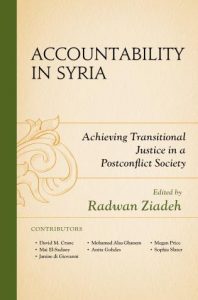 Last week I went to the launch at a Qatari-funded think-tank called the Arab Center of Washington of a book called Accountability in Syria: Achieving Transitional Justice in a Postconflict Society. I guess the Qatari funding has been running a bit low, because there were no free copies of the book being handed out, and only one sample copy that attendees could take a glance at. It costs $90. Rush right over to the link above to buy your copy!
The three panelists were: the book’s editor, Radwan Ziadeh, a longtime regime-change advocate whose only listed professional achievement is his longtime gig as a “Senior Fellow” at the Arab Center; Mai el-Saadany, a US-trained Syrian-American lawyer who now works at the Tahrir Institute for Middle East Policy; and Mohammed Alaa Ghanem, who until recently was Government Relations Director and Senior Political Adviser for the Syrian American Council, one of Washington DC’s principal regime-change organizations. Ghanem, who still has a (presumably nicely funded) affiliation with the UAE-funded Atlantic Council, is now doing a Master’s degree in international affairs at Columbia.
At one level, it was kind of a sad event. When Ziadeh started talking, he recounted that work on the book had started back in 2015– at a time when it may have been possible for regime-change advocates still to imagine that one day soon, just possibly, they could seize power in Damascus. (Hence, the reference in the book’s sub-title to a “Postconflict society.”) Poignantly, he spoke about how back then, “Aleppo”–actually, just that small portion of East Aleppo that the opposition still controlled– was becoming a center of evacuation, and how Ma’aret al-Numaan, in the opposition fighters’ Idlib redoubt, was a center of evacuation today.
In both instances, as the government regained control of terrain previously held by the jihadi extremists, the government allowed the opposition fighters and any civilians who chose to leave, to do so, and indeed, facilitated their departure. This is in notable contrast to the bloodthirsty actions the jihadi oppositionists have always taken toward the residents and defenders of areas that they’ve overtaken. But the video footage of desperate civilians fleeing in advance of the Syrian army’s arrival always looks pretty heart-wrenching.
(The videos widely circulated in the west notably do not depict the civilians who stay in the areas being brought back under Syrian government control– or, the earlier presence and activities of any of the jihadi fighters, some of whom who are Syrian and many of whom are not, who had controlled these areas so brutally over the preceding few years.)
When Mai el-Saadany spoke she stated confidently that, “The time for justice is now… We can’t afford to wait until the conflict ends.” She said that both the International Criminal Court and the UN’s doctrine of “Responsibility To Protect” (R2P) had proven useless in protecting Syria’s people; but that even without those tools there were three “accountability tools” the Syrian oppositionists could use: Documentation; a couple of different UN inquiry/documentation mechanisms; and prosecutions outside Syria, such as the one brought against two former Syrian officials by a court in Germany, last October.
When she talked about documentation, el-Saadany singled out for special praise the efforts of a group called Bellingcat–and of The New York Times.
For his part, Ghanem focused on the contribution he had made to the Accountability in Syria book, in which he looked at what he described as the “sectarian cleansing” that he saw the Syrian government as undertaking in formerly opposition-held areas over which it regained control. He accused “the Assad regime” of being dominated by Alawites and of engaging in “sectarian cleansing or demographic engineering” against “communities” in these areas, though he did not name these “communities.” He said he had been very proud to have gotten reference to this phenomenon included in the “Caesar Act”— a US sanctions measure against Syria that was signed into law in late December.
The most interesting part of this sad gathering came toward the end ( at 1h24m on the video.) A questioner had asked how the panelists thought that the kinds of “accountability”mechanisms they favored could be applied to other perpetrators of atrocities in Syria, “such as in the Turkish-controlled areas, or the SDF”, in addition to the government. At that point, Ziadeh almost completely lost it. The other two panelists, much better qualified and better prepared professionals than he, had both expressed their support for the idea that all accused perpetrators of significant atrocities, whatever their political alignment, should be subjected to the same accountability measures. (This is, after all, a key tenet to the whole field of transitional justice… Heck, in South Africa’s Truth and Reconciliation Commission, even some of the excesses of the ANC came under the same kind of scrutiny as the gross tortures of the Apartheid regime.)
Ziadeh argued that only the “Assad regime” should be addressed by any accountability mechanisms. “The Syrian government– it became not a rogue state, but deep sectarian militias, that has no regard for the life of any Syrian” he said. “It’s impossible to think of having a political settlement with this kind of militia in control of Syria… What’s the end answer? No Syrians nor anyone else have any answer for that… There is nothing to talk about! There is nothing to leverage or negotiate about. I am very pessimistic. There is no soon, any hope of a political settlement of the conflict.”
The other two panelists hewed more closely to the standard TJ script. Both argued that, while there is no “false equivalence” between the violations committed by the “Assad regime” and those committed by other parties, still, all violators should be held accountable.
Ghanem had earlier argued that accountability-seeking mechanisms could be used as “leverage” for the Syrian opposition in a future negotiated settlement. The relationship between pressure for “accountability” and momentum toward negotiations is a complex–and, as I demonstrated in this recent article, “Syria: Peacemaking or prosecutions?”, often an inverse–one. (When I wrote that piece, in early November, the prospects for reaching a negotiated political transition in Syria seemed greater than they do today.)
One misapprehension into which all three of the panelists at the Arab Center event seemed to have fallen was to conflate the idea of “accountability” almost completely with the path of criminal prosecutions. But as anyone who has studied the TJ field knows, there are numerous other mechanisms that have been used to enact accountability other than Western-style courts of law. South Africa’s TRC was one such mechanism. It was widely (and correctly) lauded for helping enable South Africans to make the transition from a deepseated system of colonial expropriation and Apartheid to a much more inclusive system that enabled the “White” colonists to remain in the country on a basis of political equality with its indigenes– and to achieve this without triggering a massive new race war between those two sides (though the transition was accompanied by very lethal fighting between the two major Black African political forces.)
The main premise of the TRC was that as part of the transition to political equality, it was necessary to draw a line under the violence of the past and to offer a full amnesty from prosecutions for all the perpetrators of that violence provided they (a) had stopped committing it; and (b) provided a full description of the violent acts they had committed, such as could help bring a degree of legal and emotional “closure” to survivors of the violence and others bereaved by it or otherwise affected by it.
The exact terms of the TRC’s “deal” with former perpetrators were painstakingly negotiated among the parties to the transition– principally, the Apartheid era’s ruling National Party and the anti-Apartheid African National Congress (ANC). The Apartheid government possessed overwhelming military and socioeconomic force throughout the whole of South Africa; and it would never have agreed to end Apartheid and transition to a one-person-one-vote system in South Africa if its leaders had not been offered an amnesty. If there had been no TRC, the whole of Southern Africa might still be riven with terrible conflicts, to this day. The “offer” of amnesty was backed up by the existence in the country of a fairly well-functioning judicial system. But the main factor motivating perpetrators to come forward and participate in the often riveting public hearings that the TRC held all around the country was the desire most of them felt to allow their families, their communities, and their country to move forward.
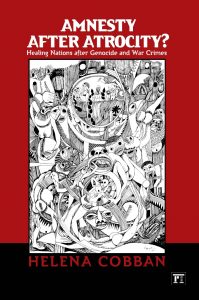 In my 2006 book, Amnesty After Atrocity? Healing Nations after Genocide and War Crimes, I looked at the effectiveness of South Africa’s TRC and compared it with the very different post-conflict mechanisms that, in that same period of 1992-94, had been adopted by Mozambique and post-genocide Rwanda. Those two other cases effectively “bracketed” what the South Africans agreed to do. In Rwanda, the post-genocide government was heavily inclined towards prosecutorialism, supporting both the creation and work of a UN-established International Criminal Tribunal for Rwanda (ICTR) and the use of a very broad campaign of national-level prosecutions of suspected genocidaires. In Mozambique, by contrast, an extremely lengthy and ugly civil war was brought to an end in 1992 when the two main parties to it, the ruling Frelimo movement and the opposition Renamo, were brought together in a negotiation conducted by a Vatican-sponsored peace group and agreed to end their combat on the basis of a blanket amnesty for previous perpetrators of violence from both sides. The United Nations then stepped in with a broad program for demilitarization, demobilization, and reintegration into their home societies of the former fighters from both sides (DDR).
Intense inter-group conflict of any kind of course inflicts massive damage on a country’s economy, including its most basic infrastructure, so societies emerging from such conflicts have numerous, extremely pressing human and economic needs. In this context, the relative costs– and therefore, also opportunity costs– of the TJ mechanisms used are definitely a factor. I used public documentation to calculate the costs of these mechanisms as follows (p.209):
- Each case completed at the ICTR : $42,300,000
- Each amnesty application at the TRC: $4,290
- Each case in Rwanda’s planned “local-style” gacaca courts (projected): $581
- Mozambique: each former fighter demobilized/reintegrated: $1,075
- South Africa: each former fighter demobilized/reintegrated: $1,066.
In that concluding chapter of the book, I presented (pp.212-13) a critique of the degree of “accountability” that advocates of prosecutorialism judge that their favored approach provides, noting that the kind of personal “accountability” required of perpetrators by a court of law is very thin indeed compared with, for example, that required in TRC or other similar mechanisms.
I also presented (p.241) a list of nine “meta-tasks” that, based on my previous analysis in the book– and on my own experience of having lived and worked in an area wracked by civil conflict, during the first six years of Lebanon’s civil war– I concluded that societies recovering from grave inter-group conflict need to undertake. It runs as follows:
Top rank (all of equal urgency):
-
- Establish rigorous mechanisms to guard against any relapse back into conflict and violence.
- Actively promote reconciliation across all inter-group divisions.
- Build an equality-based domestic democratic order that allows for nonviolent resolution of internal differences and respects and enforces human rights.
- Restore the moral systems appropriate to an era of peace.
- Reintegrate former combatants from all the previously fighting parties into the new society.
- Start restoring and upgrading the community’s physical and institutional infrastructure.
- Start righting the distributional injustices of the past.
Second rank (of somewhat less urgency):
-
- Promote psychological healing for all those affected by the violence and the atrocities, restoring dignity to them. (If the top-rank tasks are all addressed, those moves will anyway do much to achieve this; but it will probably need continuing attention.)
- Establish such records of the facts as are needed to meet victims’ needs (death certificates; identification of the burial sites; etc) and to start to build a record for history.
In the real world, decisions on what to do with individuals accused of having committed grave infractions nearly always get made in the context of a negotiation over the nature and terms of a major societal transition to a new political order. “String ’em all up on the lamp-posts!” or “Line ’em all up and shoot them!” are versions of one notable, non-negotiated type of such decision– and a type that notably doesn’t augur well for the political tone of the new order. In Syria, the way that ISIS or the bunch of Al-Qaeda-affiliated jihadis who currently control Idlib treat accused government supporters who fall under their sway definitely falls into this category.
Negotiating an end to a conflict– or acting with restraint in the event no negotiation proves possible– nearly always augurs a better outcome. At the end of WW-II, in the Asian theater, the Japanese Emperor was able to negotiate surrender terms on fairly favorable terms that ensured his dynasty’s continuation in office (and his own exculpation from responsibility for any of Japan’s preceding war crimes)–but in return for allowing the Americans and their allies to set up an international criminal tribunal to try certain Japanese decisionmakers, and numerous other concessions. In Germany, there was no negotiated end to the fighting; and the Russian, French, and British leaders (whose peoples had suffered most gravely from the Nazis’ actions) were all baying for extreme retribution. But the US public was relatively distant from the battlefield. That allowed Secretary of War Henry Stimson and President Harry Truman– both of whom were also aware of the disastrous sequelae of the punitive approach the victorious Allies had imposed on post-WW-I Germany– to argue for, and implement, the much more restrained approach to post-war justice that the Nuremberg trials represented.
Recent developments in Syria make the prospect of a negotiated end to the country’s lengthy civil war seem more remote today than they did a few months ago. The country’s 22 million people have been held in the vice of this conflict, and victim to the wiles of numerous outside actors and interveners much more than to those of any domestic actors, for nine long years. (This was also, interestingly, the case in Mozambique. Much of the terrible violence that Renamo used in its campaign to control as many Mozambicans as possible as a way of pressuring and overthrowing the Frelimo government had been organized and underwritten by South Africa’s Apartheid. The intra-Mozambican negotiations that brought an end to the war only made progress after a weakened South Africa started to withdraw that support.)
Throughout the first six years of Syria’s civil war, the determination of the United States and several allied governments (Turkey, Qatar, the Saudis, the UAE) to accept nothing less than the complete overthrow of the Assad government stymied all attempts by the United Nations and others to attain a negotiated end to the war. After Pres. Trump assumed office, he was less devoted to total “regime change” than Pres. Obama had been… and since late 2018 or so, the UAE has pulled back from its focus on regime change. Turkey also, from the Astana Agreement of September 2018 on, was clearly exploring some kind of “regional super-powers mega-deal” with Russia and Iran, that could help ramp down, or even bring to a negotiated end, Syria’s civil war.
More recently, though, Trump has pulled back from his fondness for a pullback from Syria. And perhaps he has started to see US military involvement in Syria as helping to serve his broader campaign of “maximum pressure” against Iran? Turkey has also pulled back from its commitment to Astana and is currently squaring up for a possibly broader military clash with Syrian government forces?
So the prospect for a negotiated settlement to the Syrian civil war has receded some. But it has certainly not disappeared completely. If nine years of slogging fighting– accompanied by terrible, unspeakable atrocities being suffered by people from all “sides”–has not succeeded in bringing about a “decisive” victory for any side, then surely an end to this war that is negotiated in some way is the only reasonable path, and the only path that can draw a line under the suffering of the past nine years? A viable negotiating forum has already been established by the United Nations. Let us hope it can complete its work as soon as possible, and that as part of this process the negotiators can find a list of mutually acceptable ways to deal with the whole range of transitional justice issues. And these, as noted above, go considerably further than the kinds of war-crimes trials so beloved by the Western media.
ICC delays, Israeli belligerence and PA complacency
By Ramona Wadi | MEMO | January 23, 2020
As expected, the International Criminal Court has cranked its bureaucratic delays into motion over the proposed investigation into Israeli war crimes. The ICC’s Chief Prosecutor Fatou Bensouda’s statement was deemed to be “too long and exceeded the amount of pages allowed for filing” such a proposal. This has been cited despite a request for an extension of page length due to “the unique and complex factual and legal circumstances in this situation.”
Bensouda now has to file a new request, upon which judges are allocated 120 days to reach a decision about opening an investigation. For Israel, the delay is a first step in its campaign to discredit not just the ICC, which has attracted its fair share of criticism over the years, but also, and most importantly, to remove the possibility that the state will, at long last, face international accountability for its actions.
There are already weaknesses in Bensouda’s approach, as reported by the Jerusalem Post. So far, she has been indecisive about whether or not the Israel Defence Forces (IDF) will be investigated for war crimes, despite their obvious involvement. The war crimes charge about illegal settlements is also limited; those built on stolen Palestinian land before 2014 will be exempted from the investigation.
While Israeli Prime Minister Benjamin Netanyahu is rallying the international community against the ICC, with some countries following his lead in criticising Bensouda’s decision, the Palestinian Authority has remained largely silent. The Israeli government has attempted to slander the ICC’s possible investigation as “a full frontal attack on democracies, both on the democracies’ right to defend themselves, and on Israel’s right, the Jewish people’s right, to live in their ancestral homeland, the Land of Israel.” According to Netanyahu, the international community should target the ICC and its officials with sanctions. This threat is unlikely to happen, but it highlights the discrepancy between Israeli lobbying and the PA’s silence.
Having fulfilled its duty and submitted its claim to the ICC, the PA’s attention remains focused on the moribund two-state compromise. The discussion on how both this paradigm and the absence of its fruition have contributed to Israel’s war crimes trajectory is not a priority for the PA, despite the fact that the Oslo Accords, for example, as well as the international community’s defence of Israel’s security narrative, have contributed to war crimes against the Palestinian people.
As far as PA leader Mahmoud Abbas is concerned, it is as if Europe has played no role in facilitating Israeli war crimes, as long as it continues to position itself as the prime interlocutor of the two-state “solution”. In his latest meeting with French President Emmanuel Macron, Abbas reiterated that Europe’s tenacity to preserve the two-state paradigm gives “hope to our people of the possibility of achieving peace and stability.” The ICC simply wasn’t on Abbas’s discussion agenda.
The current delay does not bode well for the Palestinians. Since the international community decided to support Israel’s colonial project, they have been forced to stand by and watch as recognition of their rights is kept as remote as ever. That the ICC deems it suitable to stall a process in which Israel can be scrutinised judicially should be a cause of concern to the PA, as it stands alongside international responsibility for contributing to the plight of Palestine and its people.
In a Preemptive Move, Netanyahu Calls for ‘Sanctions’ against ICC
The Palestine Chronicle | January 21, 2020
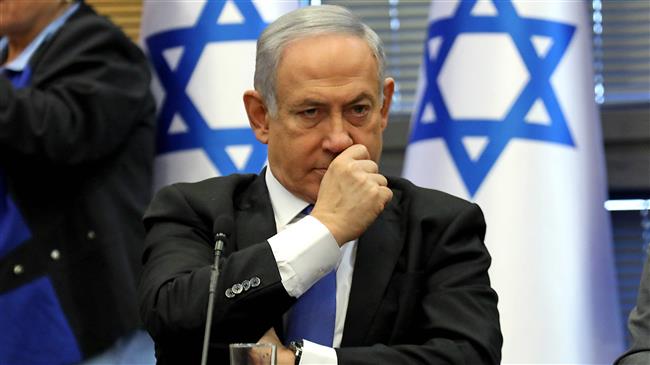
Right-wing Israeli Prime Minister Benjamin Netanyahu called for imposing sanctions on the International Criminal Court (ICC), following an earlier announcement by the court that it intends to investigate alleged war crimes in the occupied Palestinian territories.
“The US government under President Trump has spoken forcefully against the ICC for this travesty, and I urge all your viewers to do the same, to ask for concrete actions, sanctions, against the international court – its officials, its prosecutors, everyone,” Netanyahu said during an interview with Trinity Broadcasting Network.
Meanwhile, the ICC announced on Tuesday that it will delay its debate on the issue, which is intended to determine “whether it has the jurisdiction to probe alleged Israeli war crimes in the West Bank, Gaza and East Jerusalem due to a procedural error related to the filing’s page limit,” The Guardian newspaper reported.
Editor of The Palestine Chronicle, Palestinian journalist Ramzy Baroud commented that “the high level of the ICC investigations places the legal push against Israel at an entirely new level.”
“This is uncharted territory for Israel, the United States, Palestine, the ICC, and the international community as a whole. There is little doubt that some joint Israeli-American effort is already underway to develop strategies aimed at countering, if not altogether dismissing, the ICC investigation,” Baroud added.
A Criminal State Under investigation
“If you have the law, hammer the law. If you have the facts, hammer the facts. If you have neither the law nor the facts, hammer the table”. – Anonymous legal advice
By Gilad Atzmon | December 22, 2019
 Reports from Israeli press outlets this weekend show that the Jewish State fears the ICC’s (International Criminal Court) decision to move forward with an investigation into whether Israel committed war crimes in the Palestinian territories. Such a probe may expose current and former government officials and military personnel to prosecution on the global stage.
The ICC will investigate Israel’s policy of settling its citizens in the West Bank, its actions during the 2014 war in Gaza, and its response to Palestinian protests on Gaza’s border beginning in March of last year. The ICC will examine indiscriminate shooting by Hamas and other Palestinian groups into Israeli cities as well.
Israel plans to refuse to cooperate with the ICC, although such a move may put a long list of Israeli officials, potentially including the prime minister, defense ministers, IDF chiefs, the heads of the Shin Bet security service, and military officers as well as low-ranking soldiers, at risk of international arrest warrants if, in the absence of a state response, the ICC proceeds with the prosecution of individuals for the alleged crimes.
Israel’s reaction to the ICC’s top prosecutor Fatou Bensouda’s decision to investigate is instructive. Instead of responding ethically and showing a willingness to defend its actions, Israel is hiding behind legalistic Talmudic arguments that seek to refute the ICC’s legitimacy and deny its jurisdiction over Israel and Israeli war criminals.
Israeli Attorney General Avichai Mandelblit’s defense is based on the ICC’s supposed ‘lack of jurisdiction.’ On Saturday, Mandelblit said that Israel “is a democratic state of law, obligated and committed to respecting international law and humanitarian values. This commitment has stood strong for decades, through all the challenged and tough times Israel has faced. It is rooted in the character and values of the State of Israel and guaranteed by a strong and independent justice system… there is no place for international judicial intervention in such a situation.”
Is this really an accurate description of Israel? If Israel is ‘democratic state of law’ that adheres to a universalist value system as Mandelblit insists, why is Israel so afraid of the ICC looking into its behaviour? The reality of Israel contradicts Mandelblit’s position. We are dealing with a criminal state, an institutional ethnic cleanser that explores barbarian tactics locking millions of people in the largest open-air prisons known to man.
Just to prove how ‘ethical’ the Jewish State is not, Israeli Transportation Minister Bezalel Smotrich called on Prime Minister Benjamin Netanyahu to give the Palestinian Authority a 48-hour ultimatum to pull its petition to the ICC or see the Ramallah-based political authority “torn down.”
Blue and White Party Chairman, Benny Gantz, also attacked the ICC’s decision. Citing his decades of military service, including as the IDF’s 20th chief of staff, Gantz unequivocally stated that “the IDF is one of the most moral armies in the world.” Gantz forgot to mention that he is himself a suspected war criminal and may be charged by the ICC. In 2016 we learned that the District Court of the Hague was holding a hearing to determine whether to hear a war crimes case against Gantz relating to his command decisions during the 2014 Gaza War.
Former ‘justice’ minister, Ayelet Shaked, called the move “a political, hypocritical and predictable decision.” Shaked said the ICC “has no authority” to open the probe. She urged the government to “fight the court with all the tools at its disposal.”
PM Netanyahu called the ICC’s announcement “a dark day for truth and justice.” What, one may wonder, would Netanyahu consider a shining moment for truth and justice?
As we now see and could have anticipated, the official Israeli response in opposition to the ICC’s probe is legalistic as opposed to ethical. Israeli officials made public a legal opinion by Mandelblit arguing that the court does not have jurisdiction to conduct an investigation. Instead of attempting to refute the substance of the complaint, Israel and its officials invest in a wall-to-wall attempt to deny the court’s jurisdiction.
The rationale for Israel’s defiance is pretty obvious. Israeli decision makers are clever enough to grasp the prospective outcome of such an investigation. It would drain whatever is left of the Israeli military’s will to fight. Israeli combatants – platoons, pilots, drone operators, commanders- would know that their actions have legal consequences and as a result might be reluctant to execute military orders. The ICC may have closed the door on Israel’s military options and strategy. For a country that survives by the sword and invests in the ‘War between the Wars,’ the ICC investigation is understood as a lethal threat.
I am not holding my breath for the ICC to accomplish its job. I anticipate intensive Lobby efforts to interfere with the court’s work. However, by now we know that an attempt by Jewish power to silence opposition to Jewish power, can only be realised through the manifestation of such power. In Britain, for instance, the Israel Lobby and its stooges within politics and media exposed itself through its relentless war against Corbyn and his party. By the time Corbyn and his party were literally wiped out, every Brit knew who runs this country for real.
The Lobby is more than welcome to expose its sharp teeth and interfere with the ICC’s work. It may destroy the ICC, but Israel won’t be vindicated of its crimes against Palestinians, as these crimes are committed in the open for everyone to see.
ICC Prosecutor Bensouda ‘Biased In Favour Of Israel – Unwilling to Deliver Justice for Palestine’
By Iqbal Jassat | Media Review Network | December 17, 2019
Whoever has any suspicion that the ICC’s reluctance to prosecute Israel for war crimes is due to pro-Israel bias by its prosecutor, have been spot on.
In a timely intervention, South Africa’s highly respected jurist Professor John Dugard, has called for an urgent investigation into the fitness of Fatou Bensouda to continue holding her position as the Prosecutor at the International Criminal Court (ICC).
Speaking at an event at an Assembly of State Parties to the Rome Statute, The Hague, Dugard raised a number of crucial concerns about Bensouda’s pro-Israeli bias.
Dugard is no push over. As Emeritus Professor of Law at the universities of Leiden and the Witwatersrand he served as Special Rapporteur on the Human Rights Situation in the Occupied Palestinian Territory, from 2001 to 2008. And as a former Judge ad hoc at the International Court of Justice; and a member of the Advisory Board of The Rights Forum, his opinions are highly regarded.
In his presentation, Dugard said it’s become abundantly clear that the Office of the Prosecutor (OTP) is determined not to open an investigation into crimes committed by Israel in Palestine and against the Palestinian people.
He pointed out that despite ten years of preliminary examinations and overwhelming evidence, he found it strange that Bensouda has found no basis to proceed to the next stage of the investigation.
Dugard alluded to the fact that Bensouda refused to do so in the midst of four Human Rights Council’s independent fact-finding mission reports, an advisory opinion of the International Court of Justice, resolutions of the Security Council and General Assembly, numerous Israeli, Palestinian and international NGO reports, extensive TV coverage and video recordings depicting and testifying to war crimes and crimes against humanity.
Shockingly, despite overwhelming grounds for prosecution, Bensouda in her latest report, fails to give a straight and reasoned explanation for her failure to commence an investigation. Though her persistent refusal to proceed makes no sense, Dugard is satisfied that there is more than sufficient evidence to support a finding that Israel has committed war crimes by using excessive and disproportionate force and violence against civilians in Gaza and the West Bank.
In his submission, Dugard said he is convinced the evidence is clear that Israel’s settlement enterprise constitutes apartheid and has resulted in the forcible displacement and transfer of thousands of Palestinians from their homes, meaning that it “has committed crimes against humanity”.
He explained that the law is clear on the crime of the transfer by an Occupying Power – Israel – of parts of its civilian population into the occupied territories of the West Bank and East Jerusalem. He emphatically insisted that due to both the law and facts being clear, there existed no possibility whatsoever of dispute or debate.
Dugard spelled out the relevant imperatives of the Rome Statute which render Israel’s conduct as war crimes. In addition he cited articles of the Fourth Geneva Convention as well as provisions of customary international law. And in setting out the facts, Dugard reminded his audience that 700,000 Jewish Israeli settlers live in about 130 settlements in the West Bank and East Jerusalem. These settlements are clearly within Occupied Palestinian Territory – as held by the International Court of Justice.
Thus if the evidence clearly provides a reasonable basis to believe that a crime within the jurisdiction of the Court has been committed, “culpable failure to take steps to suppress a crime when under a duty to do so makes the Prosecutor complicit in the commission of the crime”, claimed Dugard. “There is overwhelming authoritative support for the conclusion that Israel’s settlements are illegal under international law.”
The International Court of Justice unanimously held the settlements have been established in breach of international law. Likewise the UN Security Council has condemned settlements as illegal, most recently in 2016 in Resolution 2334. And Dugard reiterated that even Israel’s own legal adviser Theodor Meron advised that they were illegal when Israel embarked upon this colonial enterprise.
The conclusion drawn by Dugard on why Besouda refuses to indict Israel is that non-legal, political factors have guided her decision. Clearly a stinking rebuke and damning indictment of the OTP, unambiguously accusing Bensouda of ignoring legal imperatives.
Why would Fatou Bensouda be in dereliction of her duty?
In his own words Dugard explained as follows:
“As I see it, there are two possibilities: a deliberate collective decision by the Prosecutor, her deputy and senior officers not to prosecute; or in articulated factors that have led the Prosecutor and her staff to a bias in favour of Israel.”
And unsurprisingly the most likely reason for it would be fear of retaliation from Israel and the United States. Or as Dugard further explained, it might be sensitivity to the widespread view prevalent among European states that the ICC is too fragile an institution to withstand the backlash that might follow such an investigation.
In an interesting background check on Bensouda, Dugard advanced additional factors in what he referred to as her “life-history, particularly in The Gambia” to provide some indication of unarticulated reasons for her decision to protect Israel. During the repressive reign of Yahya Jammeh in The Gambia, Bensouda served as Minister of Justice.
“Repression was the order of the day as human rights vigorously suppressed. The Minister of Justice (Bensouda) could not remain aloof from this. That she was involved in this process of repression has become clear from evidence before The Gambian Truth, Reconciliation and Reparations Commission.”
These shocking facts certainly make a compelling case to have Bensouda removed from her position. Its unimaginable to have the ICC tainted by having its Prosecutor implicated in torture, detention without trial and denial of legal representation during her term in the cabinet of Gambia’s brutal dictator.
It is inexplicable that the world has been silent on the extremely compromised position of Bensouda, limiting her ability to deliver justice for the Palestinian people. Her failure to do so is a tragic reflection of the pervasive levels of injustice that have polluted not only the ICC but most if not all international platforms entrusted to dispense justice.
Iqbal Jassat
Exec Member
Media Review Network
Johannesburg
South Africa
Will the ICC Prosecute Perpetrators of the ‘War on Terror’?
By Ramona Wadi | MEMO | November 30, 2019
On May 13 2014, the International Criminal Court’s (ICC) Chief Prosecutor announced it would reopen the investigations into alleged war crimes committed by British soldiers in Iraq and Afghanistan, following additional submitted information pertaining to the investigation which had been concluded in 2006.
A recent BBC Panorama investigation, in collaboration with the Sunday Times, ascertained a cover-up by the UK government of British soldiers torturing and murdering Iraqi and Afghan civilians, including children since 2003, when the UK participated alongside the US in invading Iraq under the pretext of the so-called “war on terror”.
In 2010, the Iraq Historic Allegations Team (IHAT) was tasked with investigating allegations of abuse in Iraq, with the possibility of prosecuting the perpetrators. However, mismanagement and corruption within the body, including claims that solicitor Phil Shiner had paid people to find clients for IHAT, failed to open a single case from its investigations. For the UK’s Ministry of Defence, the allegations against IHAT were an opportune moment to discredit the claims of human rights violations committed by British troops. Rather than prioritise the allegations of human rights violations, IHAT was deemed harmful and “making soldiers on the battlefield anxious about later legal repercussions.”
In a 2018 report issued by the ICC, UK soldiers are alleged to have committed war crimes against 61 Iraqis in custody, including killings, torture, rape and sexual violence. Seven deaths occurred in custody and 54 victims died of “mistreatment”. The ICC report specifies: “At this stance, these incidents should not be considered as either complete or exhaustive, but rather illustrative of the alleged criminal conduct.”
In July 2019, the European Centre for Constitutional and Human Rights (ECCHR) submitted a follow-up to the ICC Prosecutor, informing the office about the UK’s failure to investigate or prosecute those responsible for war crimes, “despite significant and growing evidence indicating that liability extends up the chain of command to senior military and civilian officials.” The ECCHR also described the closing down of IHAT as a politically motivated decision to avoid ICC prosecution.
The UK’s intention was clearly to preserve its impunity. During the course of the BBC investigation, it was revealed that “The Ministry of Defence (MoD) had no intention of prosecuting any soldier of whatever rank he was unless it was absolutely necessary, and they couldn’t wriggle their way out of it.” Among the concealed crimes, a soldier from an SAS unit shot 4 Afghan civilians, three of them children, in the head, while they were in their own home, drinking tea. “When I entered the room, the bones, teeth, blood and brain were all over the place,” a witness to the aftermath stated. The UK government dismissed the war crime allegation by stating the four Afghans were Taliban suspects and commanders.
Other war crimes were concealed through fabricated evidence in order to evade such classification. Evidence of sexual abuse was also revealed to have occurred at Camp Stephen in Basra, Iraq, which was under the command of the Black Watch.
If the ICC does investigate the UK government for these violations of the Geneva Convention, it would have set a precedent, given that the Court has, so far, focused on investigating the leaders of African nations as opposed to the crimes of Western governments and foreign intervention. The “war on terror” is characterised by two main factors – perpetual aggression and extended impunity for the perpetrators. Justice for the Iraqi and Afghan people, by now, is worse than a macabre farce. Yet the ICC must fulfil its duty to lay bare the dynamics that have so far shielded the UK military and governmental collaboration from judicial scrutiny.
Latest attempt to prosecute President Assad at the ICC is further criminalisation of “international justice”

Toby Cadman. Co-founder of Guernica Chambers 37, one of legal entities bringing latest case against President Assad at the ICC. (Photo: The ICC and our politics)
By Vanessa Beeley | 21st Century Wire | May 28, 2019
In March 2019 two law firms filed cases at the ICC against Syria’s President Bashar Al Assad and unnamed members of the Syrian government. Toby Cadman of Guernica Chambers and Rodney Dixon of Temple Garden Chambers were the protagonists in this latest attempt to criminalise the Syrian President and government.
These law firms are basing their case upon the testimony of 28 “refugees” from Syria who claim they were “forced” to flee to Jordan during the war that has been waged against Syria by a collective of interventionist mafia states that form the U.S coalition, determined to achieve regime change in Syria.
Syria is not a signatory to the ICC in the Hague but precedent was set by the ICC when a preliminary investigation was opened into military leaders of Myanmar for alleged crimes against humanity involving deportation of Rohingya people. Refugees fled to Bangladesh which is party to the Rome statute that established the ICC, as is Jordan where more than 1 million Syrian refugees now reside. Guernica Chambers and Rodney Dixon are clearly hoping that the Rohingya precedent will open up the legal avenue for their case.
Both legal firms are claiming the intended deportation of Syrian civillians by the Syrian government as part of their cases.
However, even some members of the legal profession, have already remarked upon possible holes in the case being presented by both legal entities. Kevin John Heller is Associate Professor of Public International Law at Amsterdam University. According to Heller, there is a vital element of the Syrian situation that distinguishes it from the Myanmar situation. Heller argues that in Myanmar, it is evident that the government “intended to drive the Rohingya into Bangladesh” while in Syria it is not evident that the Syrian government intended (in the legal sense) that their civilians end up in other countries. Heller points out that without sufficient evidence, the Syrian government may only be accused of “forcible transfer” but not “deportation”. “Forcible transfer” falls outside the ICC’s jurisdiction because it takes place uniquely on Syrian territory.
“In other words: for the Court to investigate the forcible displacement of Syrian civilians proprio motu, it is deportation or bust.” ~ Kevin John Heller
This is not the first time that Guernica Chambers (GC) have attempted such a legal attack against the Syrian government. In March 2017, the Madrid offices of GC tried to bring a case against eight members of the Syrian security and intelligence services. The case was based upon the testimony of a Syrian national’s sister who had Spanish citizenship. Spain is party to the Rome Statute of the ICC. The woman allegedly identified the body of her brother among the photos that were “smuggled out of Syria” and formed part of the Caesar Report which I will discuss later in this article.
Who is really behind the legal war being waged against Syria?
I asked Peter Ford, former UK Ambassador to Syria and outspoken critic of the UK government’s role in the eight year regime change campaign in Syria, to comment on the timing of this legal initiative. Ford told me:
Nothing could be more likely to bring the ICC into disrepute than this attempted action by actors transparently serving the political agenda of the British and Qatari governments. Having failed in attempted regime change via miltant proxies Syria’s enemies are now embarked on an enterprise to secure the same result by waging economic war which must be justified by constant demonizing of Assad. That is the game being played here.
“if the ICC goes along with it, that will provide more justification for those who accuse the ICC of being a tool of the rich and powerful, and an incentive to Assad to halt any move towards elections in Syria which might see him removed from power. This is just a cheap trick designed to make political capital out of the remaining credibility of the ICC, such as it is.”
Ford pinpointed the drivers behind these legal cases and the UK Government and intelligence services must be considered as primary players. The UK/US-led intervention alliance have seen their terrorist-proxy-military-campaign fail dismally after hitting the brick wall of the axis of resistance -Syria, Hezbollah, Iran and Russia with China offering diplomatic and technological support.
What will follow is perhaps an even more destructive economic warfare campaign that will capitalise upon the post war dissonance in Syria to pressurise the Syrian state and to further foment discontent among civilians now struggling to cope with life in a Syria that has been severely impacted by 8 years of terrorist occupation and destruction of infrastructure.
“I believe that the reason why this attempt is being made to circumvent the fact that the International Criminal Court has no jurisdiction over Syria, is to remove Assad from power and to de-legitimise him as part of the future of Syria. This has been the goal of the jihadists from the very beginning.”
Historian and analyst, Dr Marcus Papadopoulos, further expanded upon the timing of the legal case:
Well, talk of war crimes cases being brought against President Assad, at the International Criminal Court, has been in the air for some years now. Indeed, I remember how such talk was emanating from Western capitals in 2012. However, there is no doubt that the today’s timing of lawyers, acting on behalf of Syrian refugees in Jordan, submitting lawsuits against the Syrian president at the ICC, is not coincidental. Because today, the Syrian people have all but won the war against Western-backed terrorism and so by submitting cases now to the ICC is a way of Western governments subtly informing President Assad that whilst the military war against him has been lost, the legal, media and communications war against him will continue.
Furthermore, I suspect that by initiating ICC proceedings against the Syrian leader – which will only increase in volume and go on indefinitely – may be a way of the Americans and the British maintaining their military presence in Syria, as well as their sanctions on the Arab country, on the pretext that the region has a leader in power who ‘waged war against his own people, destabilising not just his country but the wider region’ hence the presence of American and British forces in Syria is a means to limiting any future ‘carnage’ that the Syrian ‘strongman’ (a favoured word from the West’s lexicon to describe leaders whom it disapproves of) can inflict on both Syria and the region.” (Emphasis added)
International criminal lawyer, Christopher C. Black, pointed out the importance of the NATO and UK government links of the legal firms:
“The answer is revealed in the lawyers who are behind this scheme to try to drag the ICC into the picture. Rodney Dixon and Toby Cadman, and, it seems, from your information, Geoffrey Nice. All of them have links to the British governent and NATO through acting for them in various capacities.”
Links to UK Foreign Office, NATO and the CIA
Guernica Chambers – offices in London, Spain and Washington.

Toby Cadman. (Photo: Guernica 37 website)
Toby Cadman is the Co-founder and Head of Guernica 37 International Justice Chambers in London. According to the International Forum for Democracy and Human Rights (IFDHR), Cadman was hired by the UK Foreign Office in 2012 to “head a team to investigate crimes committed in the Syrian Arab Republic“.
I would challenge Cadman to demonstrate any serious investigation by Guernica into the ongoing crimes committed by the terrorist/extremist groups in Syria, armed and financed by the U.S Coalition. The fact that Cadman is a hired legal hand of one of the central players in the international campaign to reduce Syria to another Libya-style failed state, should immediately raise the alarm.
Doctors Under Fire – cluster of anti-Syria medical, legal and chemical “experts”
Cadman is also on the board of directors of Doctors Under Fire (formerly Medics Under Fire). Alongside him are Hamish De Bretton Gordon, Dr David Nott (Nott Foundation) and Dr Saleyha Ahsan.

Dr David Nott. (Photo: Nott Foundation website)
Nott has run UK Government-endorsed training courses for Syrian doctors in Gaziantep, Turkey – the hub of UK intelligence training for Syrian “opposition”, with a reputation for being the centre of ISIS organ and human trafficking operations. The flight from Istanbul to Gaziantep was known as the Jihad Express. The town itself was reported to be the area where new ISIS recruits from around the world would gather before being transported into Syria. The UK FCO-midwived and financed White Helmet propaganda construct also have their base in Gaziantep, established in 2013 by former MI6-turned-private-security expert, James Le Mesurier.
In 2013, Nott was largely responsible for the rumours that Syrian Arab Army snipers were targeting pregnant women in East Aleppo, which was freshly under control of the armed extremist gangs that included Al Qaeda in Syria, Nusra Front. The photo of a bullet lodged in an alleged foetal brain was published by most mainstream media outlets in the West without any expert second opinion regarding the credibility of such an image. Nott has operated on ISIS fighters during his forays (exclusively) into terrorist held territory of Syria.

Nott also amplified the discredited narrative surrounding Omran Daqneesh during the final moments before liberations of East Aleppo from terrorist rule. This story is now known to be another of the fraudulent campaigns to criminalise the Syrian government. This article by journalist, Steven Sahiounie, goes into depth about the bias and misprepresentation of reality by Nott during his time in the terrorist-held enclaves of Aleppo and Idlib.

Dr Saleyha Ahsan’s contradictory accounts of alleged chemical attack, showcased in BBC Panorama’s Saving Syria’s Children – forensically investigated by researcher, Robert Stuart.
Dr Saleyha Ahsan’s role in the BBC Panorama documentary, Saving Syria’s Children, has been exposed as potentially fraudulent by independent researcher, Robert Stuart. Actor and director Keith Allen is fronting a new crowdfunding campaign for a documentary examining the 2013 BBC Panorama programme Saving Syria’s Children. The project is in collaboration with British film, TV and radio producer, Victor Lewis-Smith. In 2017 Lewis-Smith challenged the BBC Panorama office over the issue. Failing to get satisfactory answers, Victor tore up a contract for a forthcoming comedy pilot with BBC Radio 4.

Hamish de Bretton Gordon. The media establishment go-to expert on chemical weapons.
Hamish de Bretton Gordon has been the go-to expert for the majority of corporate media outlets, particularly with regard to the alleged chemical weapon attacks in Syria that BG invariably blames upon the Syrian government. David Miller, Professor of Political Sociology at the University of Bristol and a member of the Academic-established Working Group on Syria, Propaganda and Media, stated very clearly in a recent interview that HBG:
“is an operative for MI6. He’s not a staff member of MI6 but he works very closely with MI6 in Syria trying to create evidence of chemical and biological weapons’ attacks.”
The full briefing note by the WGSPM can be found at this link: The alleged chemical attack in Douma on 7 April 2018, and other alleged chlorine attacks in Syria since 2014.
Doctors Under Fire appears to be another compromised organisation with a focus on misleading the British public into approving further military intervention in Syria under a familiar “humanitarian” pretext. Its ties to state media and intelligence services should be examined closely before their “expert” opinions be given serious consideration.
Toby Cadman – Ibrahim Olabi – White Helmets

Ibrahim Olabi. Joined Guernica Chambers in November 2018 as a pupil barrister. (Photo: Guernica Chambers website)
The Guernica inks to UK Government intellligence operations in Syria continue. Ibrahim Olabi joined Guernica Chambers in November 2018 as a pupil barrister. According to his bio on the GC website, Ibrahim Olabi “has worked extensively on international legal matters related to the Syrian conflict, including international humanitarian law, international criminal law and international human rights law” for the last five years.
Olabi is UK educated, having completed his LLB and LLM (Security and International Law) at the University of Manchester. Olabi is the director of the Syrian Legal Development Programme (SLDP). According to the GC website:
SLDP has provided legal expertise to Syrian NGOs, including training that Ibrahim delivered to more than 550 trainees on a range of complex legal surrounding forced displacement, torture, UN mechanisms, facilitation of humanitarian aid and other matters. He has trained both in Syria, near the front lines, and in neighbouring countries.
SLDP has received funding from the Swiss Ministry of Foreign Affairs and the Dutch Ministry. What seems extraordinary for a “pupil barrister” who only joined GC in November 2018, Olabi has an impressive track record of influencing major global institutions and state-linked think tanks on the Syrian conflict:
Ibrahim has also advocated in Geneva, Brussels, Washington and London on human rights issues relevant to Syria. He received personal invitations from the Heads of States such as Germany and The United Kingdom, and from the UN Secretary General. Ibrahim has spoken and chaired panels in forums such as Chatham House and Amnesty International, and delivered presentations at UK universities such as UCL, SOAS, Nottingham and Manchester amongst others. He also spoken on TV channels such as the CNN and the BBC.

Training the White Helmets. (Photo from SLDP website)
Among those trained by the SLDP are the primarily UK FCO-cultivated White Helmets who are exposed as terrorist group-auxiliaries and stand accused of committing crimes against the Syrian people that include child abduction and running organ trafficking operations from inside the terrorist-occupied territories.
The White Helmets have also been instrumental in producing the Syrian “chemical weapon” narratives supported by Cadman and his associate directors at Doctors Under Fire – designed to criminalise the Syrian government, often during the closing stages of military campaigns to liberate areas under control of the Western-sponsored armed groups.
The most recent White Helmet chemical attack narrative was in Douma, Eastern Ghouta, April 2018 – an alleged attack that precipitated the French, UK, US unlawful bombing of Syria before an investigation had been carried out by the OPCW (Organisation for the Prohibition of Chemical Weapons).
Since this event, it has been demonstrated that the White Helmets had staged the hospital scenes that were widely published by western media to support the shaky narrative. Furthermore, a leaked engineers report, omitted from the OPCW final report, has raised alarming questions over OPCW’s impartiality and independence. The revelatory engineers report was sent to the aforementioned Working Group on Syria, Propaganda and Media who produced the briefing note which can be found here.
Guernica Chambers Advisory Board – Steve Rapp – CIA

Ambassador Stephen J. Rapp. (Photo: Guernica Chambers)
A look at the Guernica Chambers Advisory Board members reveals that Ambassador Stephen J. Rapp is listed as a board member. International criminal lawyer, Christopher Black, had clashed with Rapp during the Rwanda tribunal when Rapp was in charge of prosecutions:
“Stephen Rapp-well, there is your link to the CIA, US government. Rapp was at one time the guy in charge of prosecutions at the Rwanda tribunal. During his tenure, 2 of his henchmen-“investigators” began interviewing a former Rwandan cabinet minister in Lille, France. The investigators were two ex Montreal cops kicked off the force for corruption. There were rumours when I was there they had murdered witnesses.
Well at some point their interview of this guy became too heavy and he wrote a letter to the President of the tribunal stating that Rapp and his men were pressuring him to give false testimony against accused before the tribunal and that if he did not they were threatening to kill him and cut his body into pieces.
Two weeks later he disappeared after going to a final interview. We raised this letter in court. Two weeks after that his body was found in a canal in Brussels naked with his hands cut off. I asked that Rapp and his men be detained pending an investigation into that murder as they were the prime suspects.” ~ Christopher Black

Stephen Rapp with Mouaz Moustafa of the Syrian Emergency Task Force (SETF) responsible for bringing John McCain into Syria illegally in 2013. (Photo: Zoom info)
Rapp is included in an index of contact profiles for the Syrian Emergency Task Force (SETF) whose executive director is Mouaz Moustafa. Moustafa is probably best known for his role in bringing neocon warhawk, John McCain, into Syria illegally in 2013. McCain’s trip was dogged with controversy after he met with recognised militant kidnappers:
“US Senator John McCain was photographed with a known affiliate of the rebel group responsible for the kidnapping of 11 Lebanese Shiite pilgrims one year ago, during a brief and highly publicized visit inside Syria this week.” ~ Daily Star

Salim Idris, chief of the Supreme Military Council of the Free Syrian Army and Mouaz Moustafa on right with John McCain.
Rapp and Moustafa were both heavily involved in the promotion of the Caesar report – Caesar is a codename for an alleged Syrian police photographer who apparently smuggled 53,275 photographs out of Syria implicating the Syrian government in a campaign of torture. This story has been investigated and discredited by independent researcher and journalist, Rick Sterling, his findings can be read here. Prof. Tim Hayward also analysed the credibility of the Caesar report in his more recent article in April 2019.

Caesar with Mouaz Moustafa in Washington DC. (Photo: Syrian American Council)
Having taken into account the glaring anomalies in Caesar’s accounts and in the identification of the photographs of “tortured” corpses attributed exclusively and erroneously to alleged victims of the Syrian government – Hayward drew the following conclusions:
“To put bluntly this contextualised concern about Operation Caesar: not only may it already have altered the historical record, and not only may its effects have served to alter somewhat the course of history to date, but in serving to influence decision makers, it may contribute more indelibly to shifting the baseline of normative consensus in a direction favourable to ousting non-compliant leaders of sovereign states. That is effectively to bestow legitimacy on imperialist regime change projects.”
The FBI conducted its investigations into the Caesar report at Rapp’s request. The FBI carried out standard authentification analysis of 27,000 of the photographs and concluded that it could not “definitively rule out the possibility of tampering“. The report emerged at a crucial juncture in the dirty war being waged against Syria – just as members of Congress were pushing for increased “aid” for “rebels” and the creation of No-Fly-Zones and safe-zones for the U.S terrorist proxies disguised as “moderates”. Those members — including House Foreign Affairs Committee Chairman Rep. Ed Royce and ranking minority member Rep. Eliot Engelwere sponsor and co-sponsor of the subsequent Caesar bill, introduced in March 2017.
The bill had previously hit obstacles within the Obama administration in October 2016, when it was perceived that Obama was effectively trying to weaken the bill in favour of maintaining the ceasefire agreement with Moscow that was still active at that time.
The Caesar bill – Caesar Syria Civilian Protection Act of 2017/2018 was a means of increasing economic sanctions against Syria – never anything more than collective punishment for the Syrian people who have resisted eight years of regime change war that has decimated their infrastructure and severely affected their ability to survive economically.
Rapp defended the Caesar bill:
“It’s important to send the signal that those who engage in war crimes and those who aid and abet them are held to account with tools that are effective, and in the short term the most effective is sanctions”
Historically, sanctions are never effective as leverage against a target government, they are always “effective” against the people of a nation that is struggling to resist the machinations of U.S neo-colonialism. Sanctions are economic terrorism, designed to increase the pressure on those most affected by war and the associated poverty and homelessness. They amount to abject cruelty, compounding an already desperate situation brought about by the military adventurism of globalist nations.
So, Rapp alongside Cadman, has a clear intention to criminalise the Syrian government and to weaken the Syrian nation in preparation for a U.S-friendly regime change operation.
As Peter Ford has remarked – the latest attempt to prosecute President Assad and members of the Syrian government in the ICC is another element in the long running and insidious economic war that has been waged alongside the (failed) miliary campaign to destabilise Syria:
“Having failed in attempted regime change via miltant proxies Syria’s enemies are now embarked on an enterprise to secure the same result by waging economic war which must be justified by constant demonizing of Assad. That is the game being played here.”
Rodney Dixon – Qatar – Rwanda – Former Yugoslavia

Rodney Dixon, lawyer acting for Temple Garden Chambers.
Rodney Dixon is lawyer acting for Temple Garden Chambers who have also submitted a case against President Assad and the Syrian government at the ICC. According to his biography at Legal 500, Dixon appears to have had a long career protecting NATO interests, including:
He has prosecuted and defended before the International Criminal Tribunal for the former Yugoslavia (ICTY) including as defence counsel on behalf of the former Prime Minister of Kosovo in protracted trial, appellate and retrial proceedings. He acted on behalf of the government of Rwanda before the International Criminal Tribunal for Rwanda (ICTR).
Christopher Black interpreted this career path as follows:
“So Dixon acted for mass muderer and KLA leader, Hashim Thaci, in a staged trial the ICTY, arranged so that Thaci could be charged but aquitted-a game to give the ICTY some credibility. Thaci is a NATO asset. Dixon also acted as agent for mass murderer Paul Kagame the dictator of Rwanda put in power by the US, UK, Canada etc. and was his agent at the Rwanda tribunal (ICTR) which framed all the accused there as scapegoats for the crimes of Kagame and his western allies.
So, Dixon has been used by the NATO powers to protect their interests and that is his role in the scheme regarding Syria. Looking back on events, if he was at the ICTR in 2007 then he may have been behind the Rwandan government’s demand to have me arrested during my defence of General Nindiliyimana (Chief of Staff, Rwanda Gendarmerie, acquitted on all counts in 2014) when I demanded Kagame be charged with war crimes.”
Dixon has a history of working for Qatari clients. In 2017 Dixon represented three prominent Qatari nationals – who were unlawfully detained and tortured in the UAE between 2013 and 2015 by UAE security officials. In 2018, Dixon chaired a panel of experts calling for an end to the blockade of Qatar by Saudi Arabia, Bahrain, Egypt and the UAE. The event was organised by the Arab Organisation for Human Rights in the UK and was held at University College, London.
Qatar has been one of the primary financiers of the terrorist forces that have invaded and occupied areas of Syria during the eight year conflict. The Caesar report was commissioned by London law firm, Carter-Ruck on contract to Qatar. Guy Martin, a specialist in sanctions in international law and partner at Carter Ruck Solicitors was also speaking on the panel protesting the sanctions against Qatar, chaired by Dixon.
According to French investigative journalist, Thierry Meyssan, Dixon had already declared an interest in pursuing the Syrian goverment for alleged war crimes, based upon the Carter Ruck-orchestrated Caesar Report:
“Mr. Dixon had already declared that he intended to pursue the Syrian leaders for « crimes against humanity ». He based his case on the Caesar Report; a document made public by Qatar, via the London cabinet Carter-Ruck, on 20 January 2014, two days before the peace negotiations of Geneva 2.”
The only conclusion to be drawn after examining the origins and motives of the cases being brought against President Assad at the ICC – is that the driver behind them is not international justice but regime change which is the ultimate goal of the U.S alliance in Syria. This renders any “humanitarian” outrage expressed by the legal entities involved nothing more than hollow rhetoric, a marketing ploy to elicit sympathy for the further persecution of a nation that has refused to submit to an unprecedented level of military pressure by terrorist proxy.
Expert opinions
I asked John Laughland how this case, if accepted by the ICC, reflects the nature and state of “international justice” in our world today. Laughland replied:
“International justice is political justice. Typically, heads of state are judged by international courts for acts of state. They are never judged as actual perpetrators and therefore the acts adjudicated are state acts for which they have state responsibility. The trials are therefore not criminal trials in the proper sense of the word because state acts cannot be compared to private crimes, as they often are by the ideologues of international justice. I have explained this at length in the final chapter of the second edition of my book, “A History of Political Trials from Charles I to Charles Taylor” (Oxford: Peter Lang, 2016).
Much of what I have been warning about for over a decade has now been proved true. For instance, Laurent Gbagbo, the former president of Ivory Coast, was the subject of a political indictment in 2011, the same year as Gaddafi, and this indictment was used to get him out of his home country (just as Charles Taylor was removed from Liberia for explicitly political reasons – again, see my book). Yet earlier this year, more than eight years later, he was found innocent and released. A court which imprisons and innocent man for eight years should be immediately closed down.”
Like Ford, Laughland argued that if the case is accepted “the re-integration of Syria into the international or regional system will be impeded. Some states will back off from building bridges with Damascus” – another example of the weaponisation of “international justice” to punish an independent nation for protecting its interests and refusing to comply with U.S demands for ultimate control over their internal and external affairs.
Laughland did not believe that Syria could succeed with a positive engagement with the ICC, he believes that Damascus should ignore any proceedings at the ICC, “especially as they would be clearly illegal under international law”. Laughland cited the case of President Al-Bashir of Sudan:
“Ignoring the ICC was what President Al-Bashir of Sudan has done, and it has worked very well. Other states have ignored the warrant against him too, notably South Africa, which refused to arrest him on a visit there. This is one of the reasons why the ICC is in such spectacular crisis.”
Christopher Black also referred to the case of Laurent Gbagbo:
“If the prosecutor accepted the case on clearly trumped up evidence as it did with regard to President Gbagbo of Ivory Coast then it would confirm once again that the ICC is not an organ of international justice but a propaganda organ of US and British and EU imperialism.”
Black also concurred that there would be negative implications for President Assad and the Syrian government should the case be accepted by the ICC:
“President Assad can expect that he will be labeled in the western mass media as a war criminal in a mass propaganda campaign, and that this propaganda will bombard the Syrian people to undermine the Syrian government. To try to overcome that I suggest the formation of an international committee for his defence as we formed for President Milosevic to include not only international lawyers who support Syria but also artists, intellectuals, poets, etc who can try to counter this propaganda because Syrian denials will just be dismissed.”
Dr Marcus Papadopoulos had a more optimistic viewpoint:
“From the time I began giving television interviews on Syria, beginning in 2011, I have said that most Syrians, either actively or passively, support President Assad. And I hold the view that even more Syrians support their leader today. There are numerous factors in accounting for the Syrian people’s support of their president, and a key one is that Mr Assad guarantees Syria’s traditional status as a secular, multi-confessional country.
In light of their support, together with how they repelled Western, Turkish, Israeli and Saudi aggression, I do not believe that the Syrian people will pay any notice to what happens at the ICC regarding President Assad. Indeed, I know that Syrians are asking – demanding, in fact – for Barack Obama, Erdogan and Mohammad bin Salman to be tried for crimes against Syrian civilians and Syrian prisoners of war by Islamist terrorists, such as the so-called Free Syrian Army, who all three leaders were supporting in Syria.”
Papadopoulos drew parallels between the politically motivated case against former Yugoslav leader, President Slobadan Milosevic and the threat of an equally politically motivated case against President Assad and members of the Syrian government:
“There are most certainly precedents, most notably the unfounded and politically-motivated case against President Slobodan Milosevic. That case against the former Yugoslav leader laid the foundation for what may very well transpire at the ICC against President Assad. But, Mr Milosevic faced Western aggression on his own, at a time when Russia was incapable of finding fuel for its tanks so that they could parade on Red Square. Conversely, Mr Assad faced Western aggression with Russia by his side, with Moscow capable of finding fuel for its aircraft so that they could fly all the way to Syria and take part in the fight against Wahhabi terrorism there.
So if the ICC does indict the Syrian president, it will not alter the reality on the ground in Syria – namely, that the Syrian people have prevailed over the hordes of Al-Qaeda and ISIS. Turning to whether the ICC will proceed to hear the case against President Assad, this probably will happen. But consider this: America, Britain, France, Turkey and Saudi Arabia are keen to start doing business with Syria again. In light of that, dropping the case against President Assad might be in the interests of the aforementioned countries.”
Conclusions – the U.S is riding roughshod over international justice
In April 2019, President Trump and the U.S administration revoked the visa of the ICC’s chief prosecutor, Fatou Bensouda. The U.S warned that they would take action against anyone from the ICC who dared to investigate allegations of war crimes levied against U.S personnel in Afghanistan.
Ironically the U.S claimed its citizens and military personnel are outside the ICC’s jurisdiction – the ICC claims that Afghanistan is within its purview because the country had ratified the Rome Statute which established the court in 2003. A prime example of the perversion of “international justice” to serve the powerful global hegemons.
Shortly after, Israeli media reported that Trump had decreed that Israel should be exempt from prosecution at the ICC. One exceptionalist nation protecting another while both are guilty of violations of international law, human rights law and have committed a catalogue of war crimes and violated UN resolutions throughout their history. The United States and Israel are effectively exploiting the ICC without any intention of recognising its jurisdiction in relation to their own transparent criminality.
So, while the U.S legal machinery is determined to crush the Syrian government under the weight of its global tyranny, the same entity will not entertain any investigation into its bloody record of military interference abroad nor will it permit any legal pursuance of its allies for the human rights crimes they are persistently committing. This renders the entire concept of “international justice” a travesty and nothing more than a rogue state protectionist racket.
The campaign to prosecute President Assad at the ICC is a misdirection away from the real criminals in the UK/U.S Coalition who have violated every related element of international law in their campaign to destabilise Syria and the region. Without international law we are living in a world of the utmost insecurity where the most powerful can denigrate human rights in their surge to dominance and resource plundering at will from weaker and less supported nations.
The case against Syria at the ICC is the weaponisation of “international justice” to pressurise a militarily undefeated nation into submitting to and complying with U.S geopolitical doctrine. This process will benefit those within the interventionist alliance whose goal is regime change in Syria, it will not benefit the more rational political players who do, perhaps, accept that working with President Assad is the only way to re-establish bilateral economic relations with Syria.
As always, this is all about propaganda and the mobilisation of bias and not about “justice”. It is a colossal act of misdirection. Those countries and individuals who have armed, financed and promoted the terrorist extremism and savagery that has ravaged Syria and her people for eight years should be in the dock.
While the ICC is effectively controlled by the US/UK criminal ruling classes, there will be no true “international justice” only the facade of justice meted out against nations that are deliberately deprived of the opportunity to defend themselves.
US denies visa to ICC chief prosecutor, unhappy with her probing American war crimes in Afghanistan
RT | April 5, 2019
Washington has annulled the entry visa of Fatou Bensouda, chief prosecutor of the International Criminal Court, after the State Department vowed to shield Americans from “unjust prosecutions” of possible war crimes in Afghanistan.
“We can confirm that the US authorities have revoked the prosecutor’s visa for entry into the US,” Bensouda’s office told Reuters in an email. However, the move should not restrict her travels to the UN headquarters in New York City.
Less than a month ago, US Secretary of State Mike Pompeo made clear that the US would not allow Americans to live in “fear of unjust prosecutions” just because thousands of citizens were sent to “defend” their country on the other side of the globe, some 7,000 miles away.
“If you’re responsible for the proposed ICC investigation of US personnel in connection with the situation in Afghanistan, you should not assume that you still have, or will get, a visa or that you will be permitted to enter the United States,” he warned in mid-March.
Over the last two years, the Gambian lawyer has been probing US-led war crimes in Afghanistan but has not yet opened a formal investigation into alleged atrocities conducted over the last 18 years. For now, the preliminary inquiry remains in Pre-Trial Chamber, even though Bensouda found a “reasonable basis to believe that war crimes and crimes against humanity have been committed in connection with the armed conflict in Afghanistan.”
Only the American military system can judge the servicemen, Pompeo said, warning the ICC to drop their inquiry. “We are prepared to take additional steps, including economic sanctions, if the ICC does not change course,” Pompeo warned.
The ICC is investigating alleged war crimes and crimes against humanity committed by various parties in the protracted conflict, including US forces, as detailed in a 2016 report. The part concerning unidentified members of the US military and intelligence relates to dozens of cases in 2003-2004, and alleged crimes like torture, cruel treatment, and sexual assault.
The ICC says those crimes may have been committed in furtherance of US policy in the freshly occupied country, rather than a set of individual unrelated atrocities. In light of this, Washington’s resistance to the probe may be more than a sign of principled rejection of any international authority over US nationals.
US courts have not been very forthcoming in prosecuting Americans for such crimes. A notable exception is the case of retired US Army Ranger turned CIA civilian contractor David Passaro. Over two nights in 2003, he tortured to death an Afghan man named Abdul Wali, who turned himself in after being accused of taking part in a rocket attack on a US base.
Passaro was sentenced to serve eight years and four months in prison, and later said he was a scapegoat for the US government, which wanted to show the public that it was holding the CIA accountable in the wake of the Abu Ghraib prison scandal.
Read more:
International court judge resigns, citing ‘shocking’ interference from ‘above the law’ US
Attempt to prosecute Assad at ICC is aimed at undermining Syrian peace process
Historian John Laughland explains why the International Criminal Court’s attempt to indict President Assad of Syria reveals its dictatorial and warmongering tendencies.
RT | March 18, 2019
The announcement that “a group of Syrian refugees and their London lawyers” have found “a neat legal trick” to press for an indictment against Syrian President Bashar Assad by the International Criminal Court demonstrates, yet again, the dangerous corruption of international justice, against which I have been warning for over a decade.
The Syrian war is nearly over, thanks to the military successes of the Syrian army and its Russian and Iranian allies. Exhaustion on both sides has probably helped. Diplomatic overtures have started to re-integrate Syria into the international system, starting at the regional level: the United Arab Emirates have re-opened their embassy in Damascus; the Sudanese president, Assad’s near namesake, Omar Al-Bashir, has visited Syria, as have senior Egyptian officials; Syrian officials have attended pan-Arab summits; even Israel is maintaining its dialogue with Russia over Syria. In short, the situation is being slowly normalised as Syria herself embarks on the painful search for internal peace.
The attempt to get Assad prosecuted is an attempt to stamp out these seedlings of peace before they take root. Any prosecution against Assad would scupper, or at least severely damage, this slow acceptance that the Syrian president is part of the solution. When even the British government has accepted that Assad is here to stay, and that peace must be made with him, his implacable enemies fear that their prize is about to slip out of their grasp. They do not want peace, if that means keeping Assad.
We know that the goal is to sabotage any peace process because this kind of indictment is old hat in international criminal law. At the end of the Bosnian Civil War in 1995, indictments were issued against the Bosnian Serb leaders, especially Radovan Karadzic, specifically in order to remove them from the Dayton peace talks. Antonio Cassese, then president of the International Criminal Tribunal for the former Yugoslavia, said in 1995, just after the indictment was issued against Karadzic, that it had been issued for that reason: “The indictment means that these gentlemen will not be able to participate in peace negotiations” (quoted in the Italian daily L’Unità, 26 July 1995). Incidentally, Cassese had himself encouraged the prosecutor to bring these prosecutions even though he, as a judge and president of the tribunal, was supposed to be neutral.
The “legal trick” is designed to overcome the fact that Syria is not a state party to the Rome statute of the International Criminal Court and therefore not subject to its jurisdiction. Assad’s enemies are seeking to sidestep the fact that Syria is beyond the ICC’s reach by seeking to apply to Syria a principle which, unfortunately, the ICC itself applied to Burma last year. In September, the ICC judges agreed that a case could be brought against Myanmar (Burma), even though that country is not a state party to the Rome statute, because the crimes it had allegedly committed – deportation – had caused people to flee into Bangladesh, which is a state party. By analogy, Syria’s enemies hope that the presence of Syrian refugees in Jordan, a state party to the ICC statute, will enable them to go after Assad. They seem not to care that this is the first time anyone has ever mentioned “deportation” in Syria, although Damascus has been accused of all manner of other crimes.
The ruling on Myanmar and Bangladesh illustrates everything that is wrong with international justice. Not only did the decision to apply jurisdiction to the Burmese authorities break the fundamental principles of international law, as expressed in the “treaty on treaties,” the 1969 Vienna Convention, which says that the principle of free consent is “universally recognized” and whose Article 34 says, “A treaty does not create either obligations or rights for a third state without its consent,” it also broke an even more fundamental principle by specifically claiming the right to define its own powers (referred to, in English texts, with the French and German expressions la compétence de la compétence and Kompetenz-Kompetenz). The Court described this as “a well-established principle of international law according to which any international tribunal has the power to determine the extent of its own jurisdiction.” In reality, it is no such thing.
On the contrary, the powers of all organisations are determined by law. Even sovereign governments are restricted by national laws in their powers. The idea that an international organisation has the legal right to determine its own powers, and to extend its jurisdiction to states that have not accepted it, is about as blatant a violation of the rule of law as one can imagine. In the past, such claims were equivalent to declarations of war, because a claim like this can only be settled by force. For example, on July 23 1914, Austria demanded the right for its police to carry out investigations inside Serbia for the assassination of the Archduke Franz-Ferdinand in Sarajevo on June 29. It sent an ultimatum to Belgrade to this effect, which Serbia refused. The result was the First World War, launched by Vienna in the name of the right to punish the perpetrators of that crime.
The ICC has already discredited itself massively after the Laurent Gbagbo fiasco. Having collaborated in the politically-motivated indictment of the president of Côte d’Ivoire in 2011 – a collaboration which gave legitimacy to the French military operation to oust him, just as it gave legitimacy to the NATO attack on Libya by also indicting Colonel Gaddafi at the same time – the Court was forced to acquit Laurent Gbagbo eight years later, in January of this year.
By seeking to extend its lamentable rule to Syria, and thereby to disrupt a barely embryonic peace there, the ICC risks destroying its reputation even further. For the rules limiting the jurisdiction of international organisations to states which have consented to accept them are not some arcane technicality of international law. Instead, they reflect the most basic principle of politics, which is that those who wield power need to be constitutionally linked to those over whom they wield it. International organisations which are not based on such consent violate that very basic principle flagrantly, and therefore start to resemble the very dictatorships they pretend to combat.
John Laughland, who has a doctorate in philosophy from the University of Oxford and who has taught at universities in Paris and Rome, is a historian and specialist in international affairs.
Read more:
‘Mask is off’: US shifts to open coercion & manipulation against ICC, analysts tell RT
US Threatens Anyone Behind ICC Probe Into Its Staff With Visa Restrictions
Sputnik – 15.03.2019
The US is determined not to issue visas to individuals who are behind any the International Criminal Court investigation of US personnel, Secretary of State Mike Pompeo said Friday.
The new visa restrictions will not terminate Washington’s previous measures, and new economic sanctions may follow if the International Criminal Court (ICC) fails to change its course, Pompeo said during the briefing.
“I’m announcing a policy of US visa restrictions on those individuals directly responsible for any ICC investigation of US personnel,” Pompeo said. “This includes persons who take or have taken action to request or further such an investigation. These visa restrictions may also be used to deter ICC efforts to pursue allied personnel, including Israelis.”
The remark comes after Pompeo issued the warning after announcing that the US would impose visa restrictions on individuals linked to the ICC’s prospective investigation into alleged war crimes committed by US personnel in Afghanistan.
Featured Video
Iran’s Next Strike May Not Explode. It Could Shut You Down
or go to
Aletho News Archives – Video-Images
Book Review
New paperback: Butchered by “Healthcare”
Lies are Unbekoming | October 20, 2026
 Butchered by “Healthcare” is Robert Yoho’s plain-spoken account of how American medicine stopped being a profession and became an industry. 341 pages. Over a thousand references. Thirty-eight chapters.
“Screening Tests Are Useless”, on tests that find diseases that would never have hurt you. “The FDA Protects the Big Drug Companies”, on an agency funded by the companies it regulates. “The Journals’ Sins Are the Editors’ Sins”, on ghostwritten studies and captured peer review. “Opioids and ‘Pain Management’”, on how a generation was prescribed its way into addiction. “Prozac and Relatives” and “Antipsychotics Are Disastrous”, on what psychiatry does to adults and children. “Surgery: Money Before Patients”. “Failed Cancer Treatments”. “Futile CPR and Overprescribing”. “Billing Scams & Specialty Warfare”. “Hospitals Are Sharks”. Each with a Patient Tips section at the end on how to survive it.
If you have ever walked out of a doctor’s office with a prescription you didn’t ask for, or watched a parent put through a treatment that made them worse, this is the book you want on your shelf before the next appointment. … Full review
Butchered by “Healthcare” is available on Lulu now.
Blog Roll
 Aletho News
- Iran: US political targets legitimate if assassinations return
- Iraq shuts key border crossing with Iran under US pressure: Report
- Undersea Internet cables could be targeted in retaliation for attacks on Iran: IRGC deputy chief
- EU sending ‘biased’ observers to interfere in Serbian election – president
- White House envoy declares kinetic action against Yemen ‘fruitless’
- Ukraine deployed thousands of microdrones in Iraqi Kurdistan: Tasnim
- Iran calls for emergency UNSC meeting over Trump’s ‘brazen’ bomb talk, Israeli threats
- Iranian sources reveal details of Russia-China Hormuz proposal
- Plan for more US-Israel integration puts our military tech at risk
- Another Round Against Iran Will Break What Is Left of the Gulf
- If Americans Knew
- Americans at National Conservatism Conference held in Israel this year criticize Israel
- Christiane Amanpour exits CNN with a legacy shaped by the debate over Israel
- Israel’s war on Iran is the final move in a decades-old strategy
- Israel Denies Entry to French Journalist, U.S. Researcher Amid Rise in Entry Denials
- Gaza’s hospitals are running out of life-saving fuel – Daily Update
- Mysterious bot accounts reportedly spread fake ‘man on the street’ videos for Michigan Senate candidate
- Israeli Defense Minister Katz Says Over 60 Lebanon Villages Have Been Destroyed
- Why Is Israel Running TV Ads in Iowa Ahead of the Midterms?
- Hind Rajab’s Alleged Killer Is in the United States. HRF Demands His Arrest.
- US Officials Face Fresh Pressure After Another American ‘Brutalized’ by Israeli Settlers in West Bank
- No Tricks Zone
- E-Cars Reduce CO2 Emissions By Only 41% Compared To Internal Combustion Engine Vehicles
- Predictions Made By Renowned Climate Professor Over Past Decades Have Been Proven To Be Poor
- New Study Suggests Large Regions Of The Pacific Ocean Have Been Cooling For The Last 80 Years
- Germany’s Green Energy Debacle: High Energy Costs Force Kahla Porzellan to Close After 182 Years!
- New Study: 50 Years Of The Most Aggressive ‘Net Zero’ Policies Can Only Affect The Global Climate By 0.03°C
- US September “Heat” Was No Record…Many Records Set Decades Ago
- Latest European Green Energy Debacle; Portugal’s Largest Flagship Solar Park Insolvent!
- Green Energy Debacle: German Expert Professor Fritz Vahrenholt Warns Of Severe Economic And Social Consequences
- Two More Paleo Reconstructions Affirm Meters-Higher Sea Levels Across Ireland, Brazil 7000-6000 Years Ago
- New Study: Earth And Venus Surface Warmth Largely Explained By Convection And Lapse Rate, Not CO2 Or Radiation

