The International Criminal Complicity
On Intimidation, Cowardice & Corruption (at the International Criminal Court)
“Drill and uniforms impose an architecture on the crowd. An army’s beautiful. But that’s not all; it panders to lower instincts than the aesthetic. The spectacle of human beings reduced to automatism satisfies the lust for power. Looking at mechanized slaves, one fancies oneself a master” -Aldous Huxley
By Ronald Thomas West | February 22, 2019
The United Nations is an experiment in democracy founded on the Western principles of international law. Angela Merkel’s conflating globalism with multilateralism (these are NOT the same thing) notwithstanding, the United Nations is a global body established by multilateral treaties. This does not establish ‘globalism’ but serves as a platform for facilitating relationships between sovereign nations. The International Criminal Court is an example of this, where the ‘Rome Statute’ (the multilateral treaty establishing the court) had been ‘midwifed’ from within the UN but created a court (the ICC) that is ostensibly independent. However the UN Security Council may refer cases to the ICC, the UN has no authority over the court and no power to extend or curtail the courts jurisdiction, which is solely over those nations which had opted to enter into the treaty (Rome Statute) creating the court.
However, if the institutions of the United Nations are notoriously politicized and corrupt, and they most certainly are [1] it follows the UN’s closely aligned institutions might be expected to show similar symptoms.
We have recently seen these symptoms (read on) but it should be noted the ICC had been undermined from its inception, particularly by the USA in what appears on its face to have been a geo-strategic policy of fraudulent engagement of the Rome Statute process. In short, the USA participated in the setting up of the court but used its considerable influence to prevent the court adopting a principle of universal jurisdiction. With the court at its formation limited to jurisdiction over nations entering into the Rome Statute treaty, the USA would appear to have disingenuously joined the court (signed on) but never seriously pursued ratification (the legal necessity of a democratic nation’s parliamentary body affirming the state executive signature) and therefor never came under the court’s jurisdiction.
What had been created is a social oxymoron in actuality; a core body of nations (Europe, EU & NATO nations, particularly) determined never to self-prosecute but to use the prosecutorial vehicle provided by the Rome Statute as post-colonial geopolitical device aimed at African states in ongoing state of neocolonialism. Consequently the court has seen to the prosecutions of politicians from Congo, Kenya, Sudan and Ivory Coast but not the French role in Rwanda’s genocide or Paul Kagame, a USA darling:
“He’s [Kagame] actually gotten a free ride from the ICC despite all the evidence of his army creating, sponsoring militias in Congo since 2002. Militias sponsored by Kagame’s troops have plundered, killed civilians and recruited child soldiers in the Congo yet Kagame and his commanders have not been indicted by the ICC” [2], [3], [4]
Relevant to the French immunity (impunity), this raises a question concerning whether European states signatory to the Rome Statute, that is a “coalition of the willing” should have been liable for what amounts to a ‘crime against humanity’, or an estimated 500,000 to 1,000,000 dead civilians having resulted due to infrastructure destruction (e.g. disease via water contamination), when Iraq had been invaded despite the invading states’ leaders (notably Tony Blair) knowing that invasion’s premise was false. Are the EU & NATO states’ accountability waived by the ICC?
It hardly seems a ‘crime of aggression’ need be adopted to hold states responsible for their acts where existing statutory law should be adequate.
This brings us to a recent case filed by this reporter which points to corruption. For the purpose of defining corruption in the case at hand, identified by the court’s filing reference ICC OTP-CR-295/18 [5] it is asserted (by this reporter) any case of acquiesce in the face of intimidation is a form of corruption, where cases are shelved as opposed to pursued in good faith. A recent example of this is demonstrated in the resignation of an ICC judge citing two instances where the ICC had been subject to threats or subverted. [6]
In the first instance, Turkey arrested an ICC judge with Turk nationality under the pretext of ties to Gulen, an excuse often used by the current Salafi leadership of Turkey to rid itself of principled Sufi members of Turkey’s civil service. [7] The UN Secretary General, rather than confront Turkey with a principled stance no UN member state will unilaterally set precedent with the removal of ICC judges, allowed the precedent to stand.
The other instance causing his resignation (mentioned by Judge Flugge) is the well publicized (policy) threats against the ICC by USA National Security Advisor, John Bolton, in his speech to the Federalist Society. [8]
According to Christopher Black, a longtime barrister working the several international tribunals, including the ICC, the USA plays strongly:
“First of all through key personnel they have placed in the ICC, for example the prosecutors, some judges who are willing to do what they want…
“A judge in my case was threatened by Americans working there that if certain passages in the judgement acquitting the general I was defending were not removed he would face physical problems. This is the type of gangsterism they use to get their way in these tribunals”
Also specific to the USA, at a separate tribunal, according to Black:
“Not only was a judge in my case at the Rwanda tribunal pressured but I myself was threatened by the CIA while I was there to stop raising questions and presenting evidence they [the US side] did not like” [9]
The preceding suggests Turkey may have arrested the judge with Turkish nationality as a quid pro quo on behalf of a 3rd party to dispense with a judge perceived as a threat. In any case it’s clear the ICC is compromised.
Bearing the preceding in mind, in the case filed by this reporter, to begin it should be noted it was the ICC itself that invited my filing, when the Office of the Prosecutor had responded, on 3 July 2018, to a letter I’d emailed to a German international law attorney on, 30 June 2018, copied to the ICC.
In both the letter and the complaint a clear line of evidence had been provided pointing to Turkey had (false-flag attack, in league with al Qaida) arranged the indiscriminate murder of well over 1,000 civilians at Ghouta, Syria in August of 2013. According to a Turkish parliamentarian, Eren Erdem, citing Turkish state produced investigative files in his possession, the chemicals used to produce the Sarin gas in this attack had been sourced in Europe. Turkish MP Erdem is on record stating:
“All basic materials are purchased from Europe. Western institutions should question themselves about these relations. Western sources know very well who carried out the sarin gas attack in Syria. They know these people, they know who these people are working with, they know that these people are working for Al-Qaeda. [What] I think is Westerns are hypocrites about the situation”
In this regard it is noted the court’s Office of the Prosecutor takes on the responsibility of assembling evidence:
“At the ICC, most evidence is collected and secured by the Office of the Prosecutor (OTP)” [10]
In the present case (ICC OTP-CR-295/18) the filing party (Ronald Thomas West) had assembled ample evidence to justify initiating a preliminary investigation that should have triggered the court looking into whether there had been the associated crime of ‘aiding and abetting’ committed within ICC jurisdiction. To bolster this, the case had been made an additional, associated crime of aiding and abetting had been demonstrated where German intelligence had misinformed German politicians of the facts actually surrounding the Ghouta sarin attack, so far as to blame Assad.
This last (immediate preceding) would not necessarily constitute a prosecutable crime (depending on what the judges might be inclined to believe on a given day) but there is more. This reporter had provided the necessary evidence to the concerned politicians correcting the record; indisputable evidence Turkey’s intelligence agency was providing sarin to al-Qaida militants within a timeline consistent with the Ghouta attack. [11]
This evidence submitted to the German executive (office of the Federal Prosecutor) and oversight (parliamentary leadership of all parties represented in the federal parliament) was never acted on; the German political establishment closed ranks across the political spectrum to deny the government of Syria honest assessment of the Ghouta attack. The false-flag crime accordingly sustained as a successful political ploy in regime change endeavors by EU and NATO states where those very states have become complicit in aiding and abetting a war crime with the act of material concealment of the actual perpetrators identity (a NATO state.) [12]
The German politicians (and related institutions) had been provided with the evidence on 2 December 2015. By the time this (very same) evidence had been provided to the ICC in a formalized complaint on 4 July 2018, thirty one months had passed without action by the Germans, satisfying the requirement Germany should have had opportunity to redress the wrong.
On 6 February 2019, one week after the resignation of Judge Christoph Flugge, the ICC Office of the Prosecutor replied to this reporter with:
“The Office of the Prosecutor has examined your communication and has determined that more detailed information would be required in order to proceed with an analysis of whether the allegations could fall within the jurisdiction of the Court. The Prosecutor has determined that, in the absence of such information, there is not a basis at this time to proceed with further analysis”
Essentially what the ICC has done is, to shelve the case with a demand this reporter who’d made the filing (at their invitation) provide information beyond simple and clear evidence aiding and abetting of a war crime is ongoing by a state within the jurisdiction of the court. This general, non-specific language, in the common vernacular, are called ‘weasel words.’
Why? Clearly the ramifications of adopting the practice of prosecuting the politicians empowering false flag geopolitical engineering by intelligence agencies is frightening and no doubt opposed by politician & spy alike.
Were the ICC to proceed in this case (whether it were a successful prosecution or acquittal), not only would it likely topple Angela Merkel, but it likely brings into reach Davis Cameron and his spy chief Alex Younger, also Francois Hollande and his spy chief Bernard Bajolet… and so on.
In the case of Germany, there is a safe assumption: There will be no prosecution of these crimes due to a German constitutional loophole larger than the Brandenberg Gate … “for the good of the state.” Because at the end of the day, it is (a commonly used German expression) “just not possible” to rock the boat with Turkey or cross the USA.
Why the International Criminal Court matters (in the present moment) has little to do with justice and much to do with exposing the corruption of foundational principles across the spectrum of international institutions.
*
The ICC had been provided a nearly identical draft of this (preceding) with opportunity to comment. [13] Prior to releasing this for initial publication at the Ft Russ news website, two weeks have passed and no reply has been forthcoming. The ICC also declined to clarify the nature of “more detailed information [that] would be required” and has remained silent on my asking whether the German authorities had been contacted with request for information and if so, the nature of any reply.
Noteworthy is the ICC does not deny the “allegations” (the evidence is too strong) nor does the ICC altogether dismiss the possibility of jurisdiction (they have jurisdiction over complicit parties within the EU, only are either intimidated and afraid or too corrupted to exercise it, probably a combination) rather finds a ‘weasel words’ excuse to shelve a case that would call out the hypocrisy of the European signatories to the Rome Statute based on the criminality of the EU/NATO intelligence agencies.
The net result is, as of this moment the false-flag sarin attack at Ghouta, Syria (and murder of well over 1,000 innocents) during the month of August 2013 remains a successful sleight-of-hand attack blamed on the wrong party and the crime of aiding and abetting the perpetrators, it could be argued, extends to the International Criminal Court itself, in case where refusal to correct the public record protects the guilty parties. I would describe this as ‘international criminal complicity’ when a UN associated judicial body becomes aware of an easily rectified element of a major war crime, as simple as recognizing an evidence based false-flag, and instead chooses to sit on its hands.
The pity of it all is, if there were courage to pursue jurisdiction over those complicit parties within the Rome Statute’s signatory states, a precedent would be established perhaps leading (over time) to further precedent where anyone complicit in war crimes and crimes against humanity could be arrested when stepping on any Rome Statute nation’s soil and progress made in realizing accountability.
Ronald’s Maxim
In any democracy, ethics, self restraint, tolerance and honesty will always take a second seat to narcissism, avarice, bigotry & persecution, if only because people who play by the rules in any democracy are at a disadvantage to those who easily subvert the rules to their own advantage
References:
[1] http://www.innercitypress.com/index.html
[2] http://www.therwandan.com/the-icc-has-given-africas-most-prolific-genocidaire-a-free-ride/
[3] https://www.bbc.com/news/world-europe-41283362
[4] https://www.politico.com/magazine/story/2014/02/rwanda-paul-kagame-americas-darling-tyrant-103963
[7] https://www.dw.com/en/from-ally-to-scapegoat-fethullah-gulen-the-man-behind-the-myth/a-37055485
[9] https://www.rt.com/news/450611-us-icc-manipulation-experts/
[10] https://link.springer.com/content/pdf/10.1007%2F978-3-642-35076-4_4.pdf
[11] https://ronaldthomaswest.com/2018/04/15/what-can-be-known-vs-what-will-be-known/
[12] https://ronaldthomaswest.com/2018/10/12/a-breaking-point-in-geopolitical-torsion/
[13] copy of this post & relevant questions requesting information were sent to the ICC on 9 February 2019
International court judge resigns, citing ‘shocking’ interference from ‘above the law’ US
RT | January 30, 2019
A senior judge has resigned from the UN International Criminal Court (ICC) in The Hague, after the United States threatened judges investigating alleged US war crimes in Afghanistan.
The judge, Christoph Flügge, has worked with the International Criminal Court (ICC) and the International Criminal Tribunal for the Former Yugoslavia (ICTY) since 2008. More recently, he got involved with preliminary investigations into claims that US military service members and CIA operatives tortured prisoners in Afghanistan.
Flügge told German newspaper Zeit that he handed in his resignation after open threats from US officials, including a speech by hawkish national security adviser John Bolton last September, where Bolton “wished death” on the Court.
“If these judges ever interfere in the domestic concerns of the US or investigate an American citizen, he said the American government would do all it could to ensure that these judges would no longer be allowed to travel to the United States – and that they would perhaps even be criminally prosecuted,” Flügge told Zeit, in an interview translated by The Guardian.
“The American security adviser held his speech at a time when The Hague was planning preliminary investigations into American soldiers who had been accused of torturing people in Afghanistan,” Flügge explained. “The American threats against international judges clearly show the new political climate. It is shocking. I had never heard such a threat.”
Bolton’s speech was delivered in September to the conservative Federalist Society in Washington, DC. It came a year after the ICC began investigating claims that at least 61 detained persons in Afghanistan had been tortured by American troops and another 27 by the CIA at secret prisons in Afghanistan and abroad, according to prosecutor Fatou Bensouda.
Bolton called the investigation “utterly unfounded” and “unjustifiable,” and promised to “protect our citizens and those of our allies from unjust prosecution by this illegitimate court.”
The senior US official also vowed to defend Israeli citizens from the court. US “friend and ally” Israel was at the time accused of perpetrating war crimes against Palestinian civilians. He warned that the US would disregard arrest warrants, ban judges and prosecutors from entering the country, and even try them in American courts.
Flügge said his colleagues were “stunned” that “the US would roll out such heavy artillery,” but added “it is consistent with the new American line: ‘We are No 1 and we stand above the law’.”
American disregard for the ICC is not a new phenomenon. After much debate, President Bill Clinton signed the Rome Treaty that established the International Criminal Court, but the Congress never ratified it. Clinton’s successor George W. Bush symbolically ‘un-signed’ the treaty in 2002, when the war in Afghanistan was in full swing.
Later that year, the Congress passed the American Service Members’ Protection Act, which obliged the president to prevent any ICC prosecution of US armed forces “to the maximum extent possible,” and even authorized military force to free any US service members from ICC custody. Bolton, incidentally, was Bush’s under-secretary of state at the time.
The court has come under fire from more countries than just the US. Russia withdrew its signature from the Rome Treaty in 2016, after the court criticized the reunification of Crimea. China, India, Saudi Arabia, and Turkey are among the other nations that never signed the treaty.
DPRK Is Still Being Persecuted For “Violating Human Rights”
By Konstantin Asmolov – New Eastern Outlook – 20.12.2018
The ties between South and North Koreas are becoming closer and there are fewer tensions in the relationship between DPRK and the USA. That often makes us forget that, though it was rather the Democrats’ strategy to pick on North Korea for violating human rights, the pressure on Pyongyang for this reason has merely become less blatant.
For example, on 23 October 2018, the UN Special Rapporteur on the situation of human rights in DPRK, Tomás Ojea Quintana, announced that over the past year many changes had taken place on the Korean Peninsula, but the situation with human rights in DPRK remained the same. He referred to testimonies, made by defectors from North Korea, when he said that ordinary North Korean inhabitants were starving and had no access to medical services due to lack of money. During his speech he even showed a padlock, which had been given to him as a gift by a teenage defector from North Korea, and said that specifically the United Nations had the key to improving the human rights situation in DPRK.
On 15 November, the UN General Assembly Third Committee on human rights, humanitarian affairs and social matters unanimously (without a vote) approved yet another resolution, put forward by Japan and the European Union, condemning DPRK for violating human rights. The UN has been adopting such resolutions since 2005, and the latest resolution happens to be the 14th one. And just as the resolutions approved earlier, it condemns DPRK for constant, systematic, widespread and grave violations of human rights in the north of the Korean Peninsula. It demands, among other things, that all labor camps be immediately closed, all prisoners freed, and all parties, responsible for violating human rights, be held responsible. The authors of the document urge for the situation in DPRK to be resolved in the International Criminal Court; for the North Korean leader Kim Jong-un to be brought to justice, and for concrete measures to be taken on this issue, with due consideration to be given to the conclusions reached by the UN Commission of Inquiry (COI) to investigate violations of human rights in DPRK (as it turns out the notorious 2014 report was, for the most part, based on false testimonies).
In reality, no serious changes were made to the document, which, according to South Korean media sources, lends evidence to the idea that no progress has been made to resolve human rights issues in North Korea, and does not illustrate the fact that such resolutions are produced regardless of the reality on the ground in North Korea. Still, the UN Committee on humanitarian affairs “has welcomed” Pyongyang’s attempts to normalize diplomatic relations with the international community and to abide by the inter-Korean agreements on families split up by the conflict.
In response, North Korea’s Ambassador to the United Nations, Kim Song, stated that discussions about human rights violations in DPRK were out of the question, and that the international community was meddling in internal affairs of a sovereign nation. China, Russia, Syria, Myanmar and other countries also did not support the resolution, but they did not demand for its approval to be put to a vote. They did not do so because the international community cannot demand that Pyongyang abide by its conditions, and the pressure applied by the resolution on North Korea is not great enough to start a confrontation over it. DPRK media outlets also called the resolution a thinly veiled campaign to tarnish North Korea’s reputation, and stated that the step taken by the UN was aimed at halting the current trend towards better dialogue and peace.
In November 2018, Moon Jong In, a special advisor to the South Korean President on issues connected with diplomacy and unification, advised the DPRK leader to start focusing on human rights issues, and to better still close labor camps. In his opinion, any rhetoric voiced by Kim Jong-un on human rights issues can substantially help Pyongyang gain more trust from the international community. Quoting the statement made by Moon Jong In, Amnesty International estimated (it would be interesting to know how) that there are more than 130,000 political prisoners in North Korea. And on 31 October 2018, experts from the international organization Human Rights Watch published an 86-page report, entitled “You Cry at Night but Don’t Know Why: Sexual Violence against Women in North Korea”, which stated that North Korean officials used the lawless rape of women as a mechanism of repression. We will dedicate a separate article to the analysis of this report, as it is a good example of how broad interpretations of the meaning of the word “rape”, and inaccurate information selection help transform DPRK into an analogue of those African nations where mass rape is actually part of repression means, used by authorities.
On 26 November, the main DPRK newspaper commented on the Human Rights Watch report and the repeated allusions to this issue, by noting that the USA had been using these mind games in order to gain concessions from DPRK in negotiations and to destabilize the North Korean regime. The paper also reported that, currently in the US, it is being asserted that the stumbling block in the relationship between the USA and DPRK is the nuclear issue. But once this issue is resolved to the benefit of Washington, the US will use the human rights violation issue or another reason to apply pressure on DPRK to change its regime.
On 27 November, the international news agency France-Presse announced that Washington approached the UN Security Council with a request to hold a meeting on the human rights issues in North Korea on 10 December. Such meetings have taken place since 2014, and despite objections from Beijing, the request has already received support from 9 nation-participants, which is essential for its approval.
DPRK’s Ambassador to the United Nations once again expressed regret at the fact that the UN Security Council followed orders from Washington blindly, and highlighted that the decision would not have a favorable effect on the outcomes of diplomatic negotiations between the international community and Pyongyang.
Along with international sanctions, imposed in response to the violations, unilateral ones are also being used. Hence, on 29 November, in order to reinforce the fight against human trafficking, Donald Trump signed an executive order to ban provision of non-humanitarian and non-trade financial assistance to a number of countries in year 2019. Eighteen countries were placed in this banned list, which includes DPRK, China, Iran, South Sudan, Eritrea, Venezuela and even the Russian Federation. They were included, because their local authorities failed to make enough effort to combat human trafficking, and these restrictions will remain in place until the nations take decisive action. Trump appealed to the International Monetary Fund and development banks to not offer credit lines to the previously mentioned nations.
Every year, the USA publishes a report on human trafficking, and every time DPRK, for 16 years in a row now, is listed as a nation which actively engages in human trafficking. Since 2003, the country has received the lowest rating, which means that it is actively involved in human trafficking within its borders, and that local authorities take no measures to resolve this issue. In the case of DPRK, “slave trade” usually refers to the fate of North Korean defectors to China, who end up in inhumane conditions on account of the efforts made by the so-called “brokers” that are often protected by South Korean NGOs.
As the UN Special Rapporteur on the situation of human rights in DPRK, Tomás Ojea Quintana, stated, the United Nations would embrace closer ties between the two Koreas, but human rights violations were impossible to ignore. The author urges the readers to remember this statement and also recall it when answering the question “Will DPRK be left alone after it (let us say this is possible) fulfills the denuclearization requirements?” After all, in one possible scenario any mistake on North Korea’s part is presented as deplorable, but in another, as an unfortunate incident, which is easily forgotten. It is probably not worth explaining what the reaction of the international community would have been if the diplomatic mission where a dissident was dismembered had been a North Korean and not a Saudi one.
Konstantin Asmolov, PhD in History, Leading Research Fellow at the Center for Korean Studies of the Institute of Far Eastern Studies of the Russian Academy of Sciences.
Israel Attorney General: ‘No Palestinian state’ so ICJ illegitimate
MEMO | November 27, 2018
Israel’s Attorney General is drafting a legal opinion which will declare the International Court of Justice (ICJ) illegitimate on the grounds that there is “no Palestinian state”.
Avichai Mandelblit said yesterday that he was drafting the judgment to refute the ICJ’s legitimacy to rule on the Israel-Palestine conflict, claiming that there is no Palestinian state and citing the fact that Israel is not a member of the court.
Speaking to students at Israel’s Bar-Ilan University, Mandelblit explained: “I intend to issue an opinion soon, according to which the International Court of Justice in The Hague has no authority to discuss the Israeli-Palestinian conflict because there is no Palestinian state,” Arutz Sheva reported.
Israel has consistently rejected efforts by the ICJ and its counterpart, the International Criminal Court (ICC), to investigate its human rights record. In this, Israel has received the support of its main ally – the USA – with National Security Adviser John Bolton saying in September that the institution is “dead to [us]”. Bolton continued: “The United States will use any means necessary to protect our citizens and those of our allies from unjust prosecution by this illegitimate court.”
The ICC was quick to respond to the US’ threats, saying: “As a court of law, [the ICC] will continue to do its work undeterred, in accordance with those principles and the overarching idea of the rule of law.” The ICC added that it is an independent and impartial institution with the backing of 123 countries.
Israel’s opposition to the ICJ and ICC has become more vehement in the wake of Palestine’s appeals to the court. In January 2015 the Palestinian Authority (PA) signed the Rome Statute of the ICC, officially accepting the court’s jurisdiction over its territories and allowing a preliminary investigation into the situation in Palestine to be opened.
In May 2018, the PA specifically requested that the ICC investigate crimes committed within its territories, with Palestinian Foreign Minister Riyad Al-Maliki meeting ICC prosecutor Fatou Bensouda to discuss the issue. The request called on The Hague to investigate the forcible transfer of Palestinians, unlawful killings, illegal appropriation of land and property, demolition of Palestinian properties, repression of dissent through the unlawful killing of peaceful protesters and the policy of mass arbitrary detention and torture.
Since then the PA has called on the ICC to investigate a number of incidents. In June, the PA asked the court to prosecute Israeli Internal Security Minister Gilad Erdan for incitement after he called for Palestinians allegedly flying incendiary kites to be assassinated. In September, the PA called for an investigation into Israel’s planned demolition of the Palestinian village of Khan Al-Ahmar, which the ICC said could constitute a war crime. In October, the PA asked the ICC to investigate Israel’s escalation of illegal settlement in the West Bank city of Hebron.
Thus far neither the ICJ nor the ICC have prosecuted Israel for its actions.
International Criminal Court unfazed by US threats of sanctions over Afghan war crimes probe
RT | September 11, 2018
The International Criminal Court (ICC) has said it will “continue to do its work undeterred,” after US National Security Advisor John Bolton threatened sanctions if the tribunal investigates alleged US war crimes in Afghanistan.
The Hague-based court investigates genocide, crimes against humanity, and war crimes and is backed by 123 countries – but not by China and the US.
“The ICC, as a court of law, will continue to do its work undeterred, in accordance with those principles and the overarching idea of the rule of law,” it said in a statement on Tuesday.
The tribunal’s remarks came in response to a scathing verbal attack launched by Bolton in Washington DC on Monday during a speech to the conservative Federalist Society.
“Today, on the eve of September 11th, I want to deliver a clear and unambiguous message on behalf of the president,” Bolton began, before launching into the blistering offensive against the ICC.
“The United States will use any means necessary to protect our citizens and those of our allies from unjust prosecution by this illegitimate court. We will not cooperate with the ICC. We will provide no assistance to the ICC… We will let the ICC die on its own. After all, for all intents and purposes, the ICC is already dead to us.”
Bolton then issued a very clear threat: If the international court continues to pursue the probe, Washington will ban ICC judges from entering the country, prosecute them and sanction their funding. His main objection is the notion that the ICC could have higher authority than the US constitution and US sovereignty.
“In secular terms we don’t recognize any higher authority than the US constitution,” he said, adding that Trump “will not allow American citizens to be prosecuted by foreign bureaucrats, and he will not allow other nations to dictate our means of self defence.”
In November 2017, an ICC prosecutor requested approval to launch a probe into potential war crimes by the US armed forces and the CIA through the torture of detainees in Afghanistan.
However, Bolton didn’t come out swinging solely on the behalf of the US – he also attacked the ICC’s threat to Washington’s “friend and ally” Israel, as the Middle Eastern country faces an investigation into alleged war crimes against Palestinians.
Bolton said the probe into the actions of Israel, which he described as a “liberal, democratic nation,” was unacceptable, and added that any countries supporting the investigation and cooperating with the ICC would be subject to secondary sanctions.
Bolton wants to sanction ICC judges who probe US war crimes
Press TV – September 10, 2018
White House National Security Adviser John Bolton wants to sanction International Criminal Court (ICC) judges who probe alleged war crimes committed by Americans in Afghanistan, according to reports.
Bolton on Monday will declare the ICC in The Hague “illegitimate” in an attempt to pressure the court which is planning to investigate the alleged US war crimes, according to a draft of his speech obtained by Reuters.
“The United States will use any means necessary to protect our citizens and those of our allies from unjust prosecution by this illegitimate court,” Bolton will say.
Bolton will threaten to punish ICC judges if they proceed with the proposal, the news agency said.
“We will not cooperate with the ICC,” he will say. “We will provide no assistance to the ICC. We will not join the ICC. We will let the ICC die on its own. After all, for all intents and purposes, the ICC is already dead to us.”
The chief prosecutor of the ICC has called for a formal investigation into war crimes in Afghanistan following the US-led invasion of the country in 2001.
“Following a meticulous preliminary examination of the situation, I have come to the conclusion that all legal criteria required to commence an investigation have been met”, said Fatou Bensouda in a statement last year.
“There is a reasonable basis to believe that war crimes and crimes against humanity have been committed,” Bensouda added.
She said US forces and CIA agents might have committed war crimes by torturing detainees in Afghanistan under a system of approved torture techniques, which included simulated drowning.
Human Rights Watch has welcomed the possibility of holding perpetrators to account for what it called horrendous human rights abuses against Afghans.
The United States — under Republican George W. Bush’s presidency — and its allies invaded Afghanistan on October 7, 2001 as part of Washington’s so-called war on terror. The offensive removed the Taliban regime from power, but after more than one and a half decades, the foreign troops are still deployed to the country.
After becoming president in January 2009, President Barack Obama, a Democrat, vowed to end the Afghan war — one of the longest conflicts in US history – but he failed to keep his promise.
Trump, who has spoken against the Afghan war, has dubbed the 2001 invasion and following occupation of Afghanistan as “Obama’s war.”
But Trump has also announced to deploy thousands of more troops to the war-torn country. Trump has said that his views have changed since entering the White House and that he would continue the military intervention “as long as we see determination and progress” in Afghanistan.
Afghanistan war crimes probe a sham and cover-up for US
By Finian Cunningham | RT | November 14, 2017
When The Hague-based International Criminal Court (ICC) announced it was planning to investigate alleged war crimes in Afghanistan, the timing seemed appropriate.
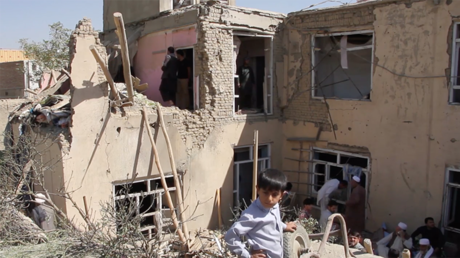
The announcement by the ICC on November 3 came within days of a deadly airstrike by US forces in northern Afghanistan, which UN officials say killed ten civilians.
But the history of the intergovernmental court since it was set up some 15 years ago gives pause to hope that it might deliver justice in Afghanistan. For many critics, the ICC is a byword for self-serving Western political control, either whitewashing crimes or smearing designated opponents. A pertinent question is: why has it taken the ICC so long to investigate alleged crimes in Afghanistan’s war?
The Pentagon claimed the air raid near the city of Kunduz on November 4 killed only Taliban militants. However, last week the United Nations Assistance Mission in Afghanistan (UNAMA) provided a very different version of events. UNAMA said extensive interviews with local residents and medics show that at least ten civilians died in the airstrike.
The incident would, therefore, be a prime case to investigate. ICC chief prosecutor Fatou Bensouda has promised an investigation into any alleged war crimes in Afghanistan would be “independent, impartial and objective.”
As a Reuters report stated, the ICC “could examine the role of US forces” in Afghanistan, which have been occupying the country for the past 16 years since October 2001, following the 9/11 terror attacks in Washington DC and New York City.
US torture practices conducted during CIA interrogations and renditions could also be probed, according to reports. An earlier announcement by the ICC said it would be looking into alleged violations committed by three parties: US military, Afghan security forces, and Taliban militants.
If the ICC did carry out an earnest probe into alleged war crimes in Afghanistan, it would have its work cut out – even if it just restricted itself to incidents involving US forces and the CIA.
Two years ago, in October 2015, the northern city of Kunduz was the location of another apparent atrocity committed by the US air force. A hospital run by the French-based Medecins Sans Frontieres (MSF) was bombed and machine-gunned by US aircraft, killing 42 medical staff and patients. MSF condemned the attack as a violation of the Geneva Convention – a war crime. Though, the Pentagon maintained that its forces made a mistake while targeting militants.
There is very little clarity on the number of Afghan civilians who have been killed by US forces over the past 16 years, from gun battles, house raids, drone strikes, and airstrikes. One estimate puts the total number of civilian deaths in the war at over 31,000. Many of them are victims of Taliban shootings, and bombings or operations carried out by the US-backed Afghan security forces.
Nevertheless, there are abundant incidents involving civilians being killed by US operations in what could merit war crimes prosecutions. This is especially so given the renewal of American military operations in the country ordered by President Trump in August this year – three years after the US forces were officially supposed to wind down.
Trump’s defense secretary James Mattis, on a trip to the Afghan capital Kabul in September, warned that US airstrikes would be ramped up in the coming months. Already this year, the UN reports that there was a surge in civilian casualties from American-backed air raids. The situation has an ominous resonance with how civilian casualties have escalated from increased US airstrikes in Iraq and Syria under the Trump administration’s wider authorization to the Pentagon to mount operations.
So, it seems clear that if the ICC were to open prosecution cases in Afghanistan it would, to say the least, be kept busy. However, critics of the ICC say that its intentions are not motivated by seeking justice.
It’s a political move, says international criminal lawyer Christopher Black.
Since its establishment in 2002, the international court has come in for much criticism that it is a “political tool” of the United States and European allies. Virtually all of the court’s prosecutions and indictments have been against African leaders. For example, Omar Bashir (Sudan), Uhuru Kenyatta (Kenya), Muammar Gaddafi (Libya), and Laurent Gbagbo (Ivory Coast) are among those indicted by the ICC.
The US is not a member of the 123-nation ICC. Neither are Russia, China, and India. However, the US exerts a controlling influence over the court’s prosecution office via European governments and the European Union, which are dominant in the administration of the ICC.
“The United States and its European allies use the ICC as a means of political control, not for justice,” says Christopher Black who is registered on the defense counsel for the court, but who has vociferously criticized its political subservience.
Black says the ICC has a similar function to several other ad hoc international tribunals, such as those which purportedly investigated war crimes in Rwanda and former Yugoslavia.
“These courts serve to cover-up actual crimes committed by Western powers while criminalizing political enemies of the West,” says Black.
In the case of former Yugoslavia, he points out, the Hague-based court did not examine the putative crimes of NATO bombing Belgrade in 1999. It only went after former Yugoslav President Slobodan Milosevic whom Washington and the European governments wanted to criminalize to justify NATO’s illegal intervention in the Balkans.
With regard to Afghanistan, the declared intention of the ICC to divide its investigations between US and Afghan parties raises the suspicion the court will seek to mitigate violations carried out by American forces by embroiling other criminal actors.
Even if the ICC were to find US forces guilty of war crimes, it is doubtful that Washington would take any notice of such rulings.
As Christopher Black points out too, the focus of any forthcoming investigation is misplaced in its entire framework. “The focus of a war crimes investigation should be looking at the way the US launched this military occupation back in 2001. A case can be made that the US is guilty of the supreme crime of war of aggression. All other violations stem from Washington committing the ultimate crime of going to war in Afghanistan.”
He says the ICC planned investigation is a piecemeal approach which will serve to conceal the primary responsibility of the US in Afghanistan.
So why then would the ICC bother to set up such a probe into Afghanistan?
The answer is simply to salvage much-needed credibility for the court. Because of its lop-sided focus in prosecuting African leaders, the ICC has come under fire from African members for “double standards” and serving as a neocolonial instrument for Western powers.
Beginning last year, several African nations threatened to walk away from the ICC, including Kenya, Namibia, South Africa, Gambia, and Uganda. Last month, Burundi formally completed its withdrawal from the ICC.
In other words, the court is in danger of imploding from lack of credibility. Hence, the announcement to go into Afghanistan is an attempt to salvage authority and public image by appearing to, at last, investigate alleged American war crimes.
“This is all about giving the ICC some badly needed credibility as it unravels in the face of a mass African walk-out,” says lawyer Christopher Black.
As such US and NATO states have nothing to fear from this proposed war crimes investigation in Afghanistan. It’s a cover-up and a sham driven by political interests, not by justice.
Finian Cunningham (born 1963) has written extensively on international affairs, with articles published in several languages. Originally from Belfast, Ireland, he is a Master’s graduate in Agricultural Chemistry and worked as a scientific editor for the Royal Society of Chemistry, Cambridge, England, before pursuing a career in newspaper journalism. For over 20 years he worked as an editor and writer in major news media organizations, including The Mirror, Irish Times and Independent. Now a freelance journalist based in East Africa, his columns appear on RT, Sputnik, Strategic Culture Foundation and Press TV.
Read more:
UNHRC Yemen Inquiry is Doomed to Fail Magnanimously
By Salman Rafi Sheikh | New Eastern Outlook | 09.10.2017
The United Nations Human Rights Council (UNHRC) seems to have finally awakened up to the brazen human rights violations that the Saudia led Arab coalition forces have been blamed to have committed in the conflict in Yemen that has been going on for more than two years now, and has consumed thousands of lives, and destroyed the country, its polity and economy alike. While UNHRC has resolved to find out the atrocities that have been committed, the question that remains unanswered is if this ‘fact-finding’ mission would lead to an end of the war, let alone punish the antagonists?A compromise has been achieved from the very beginning, which will allow the House of Saud to not only to manipulate or dispute the results, but also escape any consequences whatsoever. As a matter of fact, Saudi Arabia was able to steer things to a course of its own advantage by simply altering the original resolution adopted by the Council, making the UNHRC look like a meaningless and worthless house of cards.
Let’s consider what the original resolution had called for and what is actually going to happen now. The original resolution had called for the establishment of an independent inquiry commission. However, thanks to Saudi Arabia’s intense lobbying and coercive diplomacy, the amended version is now restricted only to sending some “eminent experts”. According to reports, Riyadh had threatened to restrict and even cut trade and diplomatic ties with the council members which had backed the much more robust version. The House of Saud also publicly appreciated the UK, US and France for their cooperation in securing a compromise on resolution. The three countries also support Saudi Arabia’s deadly military aggression against the impoverished Yemen. The UK and the US had no reason to criminalize Saudi Arabia not only because they are allies but also because the US is itself a party to destroying Yemen.
This is evident from the way the US president Donald Trump has almost doubled the number of covert US airstrikes in Yemen. According to the data compiled by The Bureau of Investigative Journalism, the US has carried out about 100 strikes in Yemen in 2017. While the official narrative is that these strikes target Al-Qaeda in the Arabian Peninsula (AQAP), there are evidences that suggest that the US has been equally targeting the Houthis as well. Nothing perhaps could illustrate this ‘US vs Houthis’ phenomenon more than the fact that a US drone was attacked and shot down by the Houthis in western Yemen as recently as October 2, 2017. While the US officials said that the matter was under investigation, the Houthi-controled Defense Ministry announced that it had downed an American drone in the outskirts of Yemen’s capital Sanaa, thus rejecting the US claim that it was mainly involved in non-combatant missions in the aid of the Arab coalition.
On the other hand, what really explains the reason for the Trump administration’s decision to increase drone attacks is the policy of isolating and defeating Iran that the US and Saudi Arabia are following. Interestingly enough, perusal of this policy has caused political tension in the UK as well, where the parliament’s joint committee on human rights has raised strong concerns about the UK’s involvement in the US targeted killing programme, noting that the UK’s intelligence agencies work “hand in glove” with the US.
Given the extent of co-operation between the West and its key ally in the Middle East, an independent inquiry into war atrocities committed by the self-declared regional hegemon is unlikely to take place ever, let alone punish the wrongdoers. Besides the current UNHRC debacle, this is also evident from the way the House of Saud was able, back in July 2016, to turn upside down a UN report that had blacklisted the country after it found out that the Kingdom was responsible for 60 percent of the 785 deaths of children in Yemen in 2015. A few days later, however, the world body announced that the Riyadh regime would be scratched off the list, pending a joint review with the Arab kingdom. Sounds like really independent and impartial!
Once again Riyadh has been able to manipulate inquiry into atrocities by radically altering the resolution that had called for an independent inquiry. Could there be a greater irony than the fact that the new resolution that decided to set up a committee of experts had been set up by Riyadh itself? How can an accused set up, or even influence, a committee to investigate into his own crimes? Can such a body be expected to be impartial and truly reveal what the Arab coalition has done in Yemen?
Answers to all of these questions have, unfortunately, to be in the negative. It is not that we are expressing pessimism, there are certainly concrete basis for what we have said. Besides the above given arguments with regard to the co-operation between the US, the UK and Saudi Arabia, the fact remains that not even the EU, the so-called champion of human rights, is able to leave a decisive impact on the situation and turn things against Saudia. For instance, the European human rights organisation had to face a lot of ridicule when, despite its earlier statement that had confirmed that airstrikes carried out by the Arab coalition in the past two months had killed 39 civilians, including 26 children, the resolution was amended and the bid for constituting an independent inquiry was replaced by a committee of “experts.” Not only were their reports and arguments not accepted, but their demand that the matter be brought before the International Criminal Court (ICC) was squarely rejected, thanks again to the Saudi lobbying and the help it received from its key allies in the West i.e., the US and UK and France and the way it coerced countries into backing down on this demand.
According to a Reuters report, in a letter seen by one of the diplomats, Saudi Arabia – the world’s biggest oil exporter – had warned some states of possible consequences should they support the Dutch resolution, submitted jointly with Canada, calling for a full commission. This lobbying was the perfectly echoed by French diplomatic source who was reported to have said that “there is room to satisfy everybody.”
It appears that no other party is more satisfied now than the House of Saud, the principal accused in the scene. The accused stands vindicated as it is well “satisfied” with the way things have ended in the UNHRC session and the way things will proceed in the future. It is possible that by the time the committee of experts is constituted, does its investigation and submits its report in a year from now on, the Arab coalition, which believes that airstrikes killing civilians are legally justifiable, might end up killing thousands of innocent people. Who will then the UNHRC blame for the loss?
In Continued Targeting of Only Africans, ICC Calls for Arrest of Saif al-Islam Gaddafi
teleSUR | June 14, 2017
Just shortly after Saif al-Islam Gaddafi, the son of late Libyan leader Muammar Gaddafi, was released from prison Saturday, the International Criminal Court on Wednesday called for his arrest.
“Libya is obliged to immediately arrest and surrender Mr. Gaddafi to the ICC, regardless of any purported amnesty law in Libya,” ICC prosecutor Fatou Bensouda said in a statement.
The body — which in its history has only prosecuted Africans — alleges that Gaddafi suppressed opposition to his father’s rule during uprisings in 2011, accusing him of crimes against humanity.
Gaddafi often spoke out defiantly against attempts to topple the government his father led, having gained prominence as a high-ranking official and spokesman during the NATO-backed campaign against the Libyan Arab Jamahiriya.
That campaign soon became a “regime change” effort that led to the toppling of Muammar Gaddafi and Libya’s plunge into all-out civil war.
The North African country has since become a base for various transnational extremist factions such as al-Qaida, the Islamic State group and the Libyan Islamic Fighting group.
The ICC, on the other hand, has largely been discredited in Africa, with Gambia’s Information Minister Sheriff Bojang noting last October that the ICC is, “in fact, an International Caucasian Court for the persecution and humiliation of people of color, especially Africans.”
Earlier this year, leaders from the African Union adopted a non-binding decision to withdraw from the court.
In addition to the ICC’s calls for arrest, a Tripoli court in 2015 sentenced Saif to death in absentia for alleged war crimes as well.
Featured Video
Iran’s Next Strike May Not Explode. It Could Shut You Down
or go to
Aletho News Archives – Video-Images
Book Review
New paperback: Butchered by “Healthcare”
Lies are Unbekoming | October 20, 2026
 Butchered by “Healthcare” is Robert Yoho’s plain-spoken account of how American medicine stopped being a profession and became an industry. 341 pages. Over a thousand references. Thirty-eight chapters.
“Screening Tests Are Useless”, on tests that find diseases that would never have hurt you. “The FDA Protects the Big Drug Companies”, on an agency funded by the companies it regulates. “The Journals’ Sins Are the Editors’ Sins”, on ghostwritten studies and captured peer review. “Opioids and ‘Pain Management’”, on how a generation was prescribed its way into addiction. “Prozac and Relatives” and “Antipsychotics Are Disastrous”, on what psychiatry does to adults and children. “Surgery: Money Before Patients”. “Failed Cancer Treatments”. “Futile CPR and Overprescribing”. “Billing Scams & Specialty Warfare”. “Hospitals Are Sharks”. Each with a Patient Tips section at the end on how to survive it.
If you have ever walked out of a doctor’s office with a prescription you didn’t ask for, or watched a parent put through a treatment that made them worse, this is the book you want on your shelf before the next appointment. … Full review
Butchered by “Healthcare” is available on Lulu now.
Blog Roll
 Aletho News
- Iran’s Next Strike May Not Explode. It Could Shut You Down /Col Doug Macgregor
- Iran: US political targets legitimate if assassinations return
- Iraq shuts key border crossing with Iran under US pressure: Report
- Undersea Internet cables could be targeted in retaliation for attacks on Iran: IRGC deputy chief
- EU sending ‘biased’ observers to interfere in Serbian election – president
- White House envoy declares kinetic action against Yemen ‘fruitless’
- Ukraine deployed thousands of microdrones in Iraqi Kurdistan: Tasnim
- Iran calls for emergency UNSC meeting over Trump’s ‘brazen’ bomb talk, Israeli threats
- Iranian sources reveal details of Russia-China Hormuz proposal
- Plan for more US-Israel integration puts our military tech at risk
- If Americans Knew
- Americans at National Conservatism Conference held in Israel this year criticize Israel
- Christiane Amanpour exits CNN with a legacy shaped by the debate over Israel
- Israel’s war on Iran is the final move in a decades-old strategy
- Israel Denies Entry to French Journalist, U.S. Researcher Amid Rise in Entry Denials
- Gaza’s hospitals are running out of life-saving fuel – Daily Update
- Mysterious bot accounts reportedly spread fake ‘man on the street’ videos for Michigan Senate candidate
- Israeli Defense Minister Katz Says Over 60 Lebanon Villages Have Been Destroyed
- Why Is Israel Running TV Ads in Iowa Ahead of the Midterms?
- Hind Rajab’s Alleged Killer Is in the United States. HRF Demands His Arrest.
- US Officials Face Fresh Pressure After Another American ‘Brutalized’ by Israeli Settlers in West Bank
- No Tricks Zone
- E-Cars Reduce CO2 Emissions By Only 41% Compared To Internal Combustion Engine Vehicles
- Predictions Made By Renowned Climate Professor Over Past Decades Have Been Proven To Be Poor
- New Study Suggests Large Regions Of The Pacific Ocean Have Been Cooling For The Last 80 Years
- Germany’s Green Energy Debacle: High Energy Costs Force Kahla Porzellan to Close After 182 Years!
- New Study: 50 Years Of The Most Aggressive ‘Net Zero’ Policies Can Only Affect The Global Climate By 0.03°C
- US September “Heat” Was No Record…Many Records Set Decades Ago
- Latest European Green Energy Debacle; Portugal’s Largest Flagship Solar Park Insolvent!
- Green Energy Debacle: German Expert Professor Fritz Vahrenholt Warns Of Severe Economic And Social Consequences
- Two More Paleo Reconstructions Affirm Meters-Higher Sea Levels Across Ireland, Brazil 7000-6000 Years Ago
- New Study: Earth And Venus Surface Warmth Largely Explained By Convection And Lapse Rate, Not CO2 Or Radiation

