Elmo Sold mRNA Jabs to Your Toddler. Now They Are “Off-Label.”
How Sesame Street, CNN, and federal health officials turned a children’s vaccine campaign into a one-way lesson in trust.
By Sayer Ji | September 30, 2026
How a $240 million messaging machine put a three-year-old puppet to work selling an mRNA shot to parents of infants — and what the government has quietly admitted since.
On June 28, 2022, Sesame Street posted a 60-second video to its YouTube channel titled “Elmo Gets the COVID-19 Vaccine | PSA.”
It’s a well-made piece of persuasion. Elmo, who has been three and a half years old since 1984, shows off his “super duper” bandage. There “was a little pinch. But it was okay.” Then his father, Louie, looks into the camera and speaks to every hesitant parent in America:
“I had a lot of questions about Elmo getting the COVID vaccine. Was it safe? Was it the right decision?”
Eleven seconds later, the doubt has been resolved for you:
“I learned that Elmo getting vaccinated is the best way to keep himself, our friends, neighbors and everyone else healthy and enjoying the things they love.”
A hug follows. Then an announcer: “It’s okay to have questions about COVID vaccines for your kids.”
That’s the move worth studying. The ad takes the parent’s instinct to ask questions, gives it to a beloved puppet, and answers it before the parent has a chance to. It presents doubt so it can close it down.
This was not a whimsical one-off from a children’s television workshop. It was one output of what its own organizers called the largest communications program in our nation’s history, built with federal public-health agencies, a major medical trade association, and tens of millions of corporate dollars.
Four years later, Pfizer-BioNTech’s product is no longer authorized for children ages six months through four years. Federal guidance and product labeling have also narrowed which pediatric uses are on-label, a shift sharply at odds with the PSA’s broad, categorical reassurance. Nobody made a puppet video about that.
This is the story of who built the campaign, what it cost, and what came after.
Part I: Who Was Behind It
Sesame Workshop’s own press release is candid about who was in the room. The PSA was released “in collaboration with the Ad Council and COVID Collaborative’s COVID-19 Vaccine Education Initiative,” and it was “produced in partnership with the Centers for Disease Control and Prevention (CDC) and American Academy of Pediatrics (AAP).”
Five institutions. Each one deserves a name and a face.
Sesame Workshop
The nonprofit behind Sesame Street produced and released the spot. Its campaign lead was Dr. Jeanette Betancourt, Senior Vice President of US Social Impact. Its president at the time, Sherrie Westin, was named CEO in July 2024.
The clearest statement of what Sesame thought it was offering came from its own chief marketing officer. Launching an earlier round of vaccine PSAs, Samantha Maltin, EVP and CMO, said the goal was to:
“… harness the power of Sesame Workshop and the reach of the Ad Council…”
Harness the power. The asset being put to use was fifty years of trust that parents and children have placed in these characters.
The Ad Council
The Ad Council turns corporate media budgets into “public service” messaging. Its president and CEO, Lisa Sherman, was the campaign’s public face. On the Elmo spot:
“It’s important that parents feel informed and confident about what the COVID-19 vaccines mean for their families, and we are proud to work with our partners, medical experts – and of course Elmo – to spread that message.”
She also named the urgency: this was “an important decision many need to make in advance of the upcoming school season.”
COVID Collaborative
The COVID Collaborative is a bipartisan assembly of former officials, and it convened the vaccine education initiative with the Ad Council. Its CEO is John Bridgeland, former Director of the White House Domestic Policy Council. Its president is Gary Edson, and its co-chairs are former Idaho Gov. and Sen. Dirk Kempthorne (R) and former Massachusetts Gov. Deval Patrick (D). The Collaborative is a project of UNITE, chaired by Tim Shriver.
The CDC
The CDC was a named production partner, and it wasn’t a passive one. According to the campaign’s organizers, the CDC provided scientific guidance on all aspects of the campaign, and its brand appeared on select creative assets.
The American Academy of Pediatrics
The AAP, the pediatricians’ professional association, was the other named production partner. Its president in 2022 was Dr. Moira Szilagyi. Looking back later, she said: “Somewhere what got lost in our country, I think, was what a miracle these vaccines were.”
Keep the AAP in mind. It comes back in Part IV.
Part II: Follow the Money
The Elmo spot was built on a large funding structure, and its size helps explain how thoroughly this message saturated American media.
The corporate fund. On November 23, 2020, before any vaccine was authorized, the Ad Council announced a $50 million fund for the COVID-19 Vaccine Education Initiative, created with the COVID Collaborative. By February 2021 it had exceeded that goal.
The COVID Collaborative reports more than $52 million raised. The leading contributors it names are Amazon, Apple, Bank of America, Cisco, CVS Health, Facebook, General Motors, Google and YouTube, the Humana Foundation, NBCUniversal/Comcast, Salesforce, Verizon, Walgreens, and Walmart.
Two of those names stand out. CVS Health and Walgreens both gave the shots the campaign was promoting in their own pharmacies.
The donated media. The money was only the seed. By October 26, 2021, the initiative had surpassed its goal of $240 million in donated media and related publicity. Donors of airtime and ad inventory included Disney (ABC, ESPN, Hulu), FOX, NBCUniversal and Telemundo, ViacomCBS, WarnerMedia, Facebook and Instagram, Google and YouTube, TikTok, Snapchat, Spotify, Pinterest, LinkedIn, and The Weather Channel.
Several of the same platforms that donated airtime and advertising inventory to the vaccine-education campaign were simultaneously under public and private pressure to enforce COVID-19 misinformation rules against specifically identified individuals, including people named in CCDH’s ‘Disinformation Dozen’ report. YouTube later [restored] my channels and stated that, after review, they did not violate its Community Guidelines.
The taxpayer layer. Alongside the private effort, HHS ran its own $265 million COVID public-education campaign starting in summer 2020. That included a $250 million NIH award to the Fors Marsh Group, which created the “We Can Do This” brand, all paid for through a $300 million interagency agreement drawing on CDC’s CARES Act funds. Under its “Vaccinate with Confidence” framework, the CDC funded more than 200 partners. Across the March 2021–December 2022 rollout, it funded 110 primary and 1,051 subrecipient partners at the national, state, and community level.
A note on accuracy. I have not found documentation that Pfizer or Moderna directly paid for the Elmo spot, and the campaign materials don’t list them as partners. Pfizer does appear as a Sesame Workshop donor in later years, in the $100,000–$249,999 band of its 2024 impact report. That’s worth knowing, but it’s a separate fact. The documented structure is damning on its own: corporate money, federal science guidance, and a medical trade association, all speaking through a puppet.
Part III: It Wasn’t One Ad
The Elmo spot was the youngest-audience edge of a sustained effort to put Sesame Street characters to work for vaccine messaging.
- November 2021: CNN and Sesame Street co-produced a family town hall, “The ABCs of COVID Vaccines.” That same month, Big Bird delivered his own pro-vaccine message to young viewers, which drew public criticism from Sen. Ted Cruz.
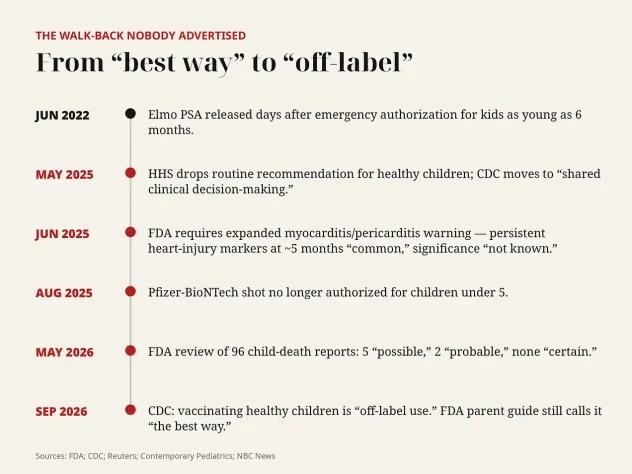
- June 2022: Elmo’s PSA, released days after the FDA’s emergency authorization for children as young as six months.
- Later: Sesame Workshop, the Ad Council, COVID Collaborative, and CDC launched a further series of PSAs with Elmo, Louie and other Muppets, “created in close partnership with the CDC.”
The criticism started right away. Cruz accused Sesame Street of having Elmo “aggressively advocate” for shots in young children and noted that the spot cited no scientific evidence. The comedian Russell Brand put it more sharply:
“When it starts getting into complex territory that involves the power of the state, the influence of pharmaceutical companies, the impact of coronavirus on young children — these are not issues I want resolved by members of Elmo’s family.”
The critics were dismissed as cranks at the time. Here is what the government has said since.
Part IV: The Walk-Back Nobody Advertised
There was no $240 million campaign for any of what follows. No Muppets and no hug at the end. It came out as label changes, regulatory memos, and footnotes in clinical guidance.
The cardiac warning got stronger
On June 25, 2025, the FDA required and approved expanded warnings about myocarditis and pericarditis on Pfizer’s Comirnaty and Moderna’s Spikevax. The new label estimates about 8 cases per million doses in people aged 6 months through 64 years, and about 27 per million in males aged 12 through 24, in the week after vaccination.
The most important sentence isn’t about frequency, though. It’s about what happened to the hearts afterward:
“… at a median follow-up of approximately 5 months post-vaccination, persistence of abnormal cardiac magnetic resonance imaging (CMR) findings that are a marker for myocardial injury was common. The clinical and prognostic significance of these CMR findings is not known.”
Read it twice. Five months out, markers of heart-muscle injury were “common,” and the agency says their long-term significance is “not known.” This isn’t a critic’s claim. It comes from an FDA-funded, FDA-co-authored study, and it’s now printed on the label.
The spot told parents “there was a little pinch. But it was okay.” Nobody in the ad said “unknown long-term cardiac significance.”
The authorization for the youngest children was pulled
On August 27, 2025, Pfizer-BioNTech’s COVID vaccine was no longer authorized for children under 5. CDC’s current clinical guidance puts it plainly: “Pfizer-BioNTech COVID-19 Vaccine is no longer authorized in the United States for children ages 6 months–4 years.”
That is the age group the Elmo spot was released to reach. It went out days after emergency authorization opened the shots to children as young as six months. Four years later, one of the two products it promoted to parents of those children can’t legally be given to them.
Healthy children are now “off-label”
The broad “everyone six months and older” recommendation is gone. In May 2025, HHS dropped the routine recommendation for healthy children, and the CDC moved to what it calls shared clinical decision-making.
CDC’s current guidance, updated September 23, 2026, limits Moderna’s approval for the youngest children to those with “at least one condition that places them at increased risk for severe COVID-19.” Then it states the conclusion outright:
“Vaccination of children 5-11 years of age with any product other than Spikevax or Comirnaty and vaccination of children in this age group without high-risk conditions is off-label use.”
“Vaccination of persons 12-64 years of age without high-risk conditions is off-label use.”
In 2022, the message was that vaccinating Elmo was “the best way to keep himself, our friends, neighbors and everyone else healthy.” In 2026, the CDC’s own wording is that giving the shot to a healthy child is off-label.
The deaths question
On November 28, 2025, Dr. Vinay Prasad, then director of the FDA’s Center for Biologics Evaluation and Research, sent staff a memo headed “Deaths in children due to COVID-19 vaccines and CBER’s path forward.” He wrote that career staff “have found that at least 10 children have died after and because of receiving COVID-19 vaccination,” based on an initial review of 96 child deaths reported to VAERS between 2021 and 2024.
The FDA’s formal analysis, made public in May 2026, came back more cautious. Of the 96 reports reviewed, none were classified as “certain.” Five were classified “possible” and two “probable,” mostly involving myocarditis, with an average age of 13. The agency stressed that these classifications don’t prove causation.
Media coverage framed that result as a debunking. Set the headline aside, though. The FDA’s own conservative review, using WHO causality criteria, still found seven child deaths it could not rule out as vaccine-related, and it called two of them probable.
And yet, still being promoted
This is where the irony stops being subtle.
Visit the FDA’s parent-facing page today, Vaccines for Children – A Guide for Parents and Caregivers. The COVID-19 vaccine is still listed alongside measles and polio among “the most commonly administered vaccines.” And parents are still told:
“Getting a COVID-19 vaccine is the best way to prevent COVID-19, including the potential consequences of hospitalization and death.”
That’s Louie’s line almost word for word, four years later, from the same agency whose label now carries the cardiac warning, whose authorization for under-5s was pulled, and whose own reviewers flagged seven child deaths.
The American Academy of Pediatrics, a production partner on the Elmo spot, hasn’t backed off either. As of September 2026, the AAP recommends COVID-19 vaccination for “all infants and children ages 6 months through 23 months,” and for “anyone ages 2 to 18 who isn’t at risk but whose parents or guardian wants them to get a shot.”
So we have two different postures at once. The regulator has narrowed approval, expanded the warning, and reclassified healthy-child use as off-label. The professional association that helped make the puppet ad still recommends the shot for every baby. And the FDA’s own parent guide still uses the 2022 talking points.
Part V: What They’ll Say — and Why It Doesn’t Save Them
Serious readers deserve the strongest counterargument, so here it is.
CDC’s guidance cites a retrospective cohort of more than 4 million people aged 16–25 from 2020 to 2025. It found myocarditis incidence of 0.05% after COVID illness versus 0.005% after vaccination. In other words, the infection carries a higher myocarditis risk than the shot.
That’s a legitimate data point and I’m not going to pretend it doesn’t exist. It doesn’t answer the question this piece is asking, for three reasons.
First, the comparison is an average over a population of teenagers and young adults. It says nothing about a healthy toddler with near-zero risk of severe disease. That’s the child this campaign targeted, and the child for whom the CDC now calls the shot off-label.
Second, it doesn’t address the finding printed on the label: persistent markers of heart-muscle injury at five months, of “not known” significance. The open letter discussed below says there are “no studies demonstrating prevention of hospitalization or death” in children. If that’s right, an unknown cardiac risk is being weighed against a benefit that was never shown.
Third, and most importantly, the argument here doesn’t depend on any contested injury number. It depends on an asymmetry. When the product was being promoted, it got a puppet, $50 million, a quarter-billion in donated airtime, the CDC’s logo, and the pediatricians’ endorsement. When the regulator narrowed the product, it got a label revision and a footnote. The public was sold a certainty the evidence never supported, and was never told when that certainty was withdrawn.
That isn’t public health communication. It’s a marketing campaign that never issued a correction.
Part VI: The Petition — Why I Signed
Earlier this month, 168 physicians, scientists, researchers, lawmakers, and health-freedom advocates, representing more than 63 million followers, sent an open letter to HHS Secretary Robert F. Kennedy Jr. and President Trump demanding removal of the mRNA platform. The effort was coordinated by Dr. Mary Talley Bowden. The signatories include Rep. Thomas Massie, former Rep. Marjorie Taylor Greene, Louisiana Deputy Surgeon General Dr. Sean Troxclair, Dr. Peter McCullough, Dr. Robert Malone, Dr. Aseem Malhotra, Tucker Carlson, and others.
I’m one of them, and I want to explain why.
The letter’s first demand is to “ban mRNA/gene therapy-derived technologies for all vaccines.” That includes the products still being given to children. Its other demands are to end the PREP Act declaration and its “ironclad liability shield for manufacturers and administrators,” ask Congress to repeal the PREP Act, ban direct-to-consumer pharmaceutical advertising, end the incentive structures that push providers toward medical coercion, and end conflicts of interest at the CDC, FDA, NIH, and NIAID.
On children specifically, the letter makes the point this whole piece has been building toward:
“Parental choice is not realistic when parents are not getting informed consent on the true risks of these products.”
It also takes on the “shared clinical decision-making” framework directly:
“By treating the decision to inject a child with mRNA as a ‘shared decision,’ while treating routine injections as the default, a dangerous legal precedent is being set that assigns powers to the federal government that have historically belonged solely to parents.”
According to the letter, more than 50 million Americans received mRNA COVID shots this year, including about 7 million children, and HHS has awarded $1.24 billion in contracts to Pfizer for future mRNA shots, “including for children.”
The Elmo spot is exactly why that line about informed consent matters. You can’t give informed consent to a hug from a puppet. A one-minute ad that turns a parent’s hesitation into a script and then answers it in eleven seconds isn’t informing anyone. It’s persuasion aimed at the people least able to push back: parents who trust Sesame Street and children who love Elmo.
The letter isn’t the only pressure. Children’s Health Defense’s citizen petition, asking the FDA to revoke the Pfizer and Moderna licenses, has been pending since December 8, 2025 and has drawn more than 104,000 public comments in support. On September 25, the Independent Medical Alliance called on the CDC to immediately withdraw its “off-label” recommendation for healthy infants, children, and adults.
HHS’s response to the open letter, through press secretary Emily Hilliard, was that Secretary Kennedy “believes mRNA products warrant heightened scientific scrutiny,” and that HHS had “wound down investments in mRNA vaccines for upper respiratory viruses because the technology does not effectively protect against infection from rapidly mutating viruses such as COVID-19 and flu.”
Think about that sentence next to the Elmo spot. The federal health department now says the technology “does not effectively protect against infection” from COVID. In 2022, a puppet told America it was “the best way to keep himself, our friends, neighbors and everyone else healthy.”
Heightened scrutiny isn’t enough. A product that federal officials now concede doesn’t reliably prevent infection, that carries a cardiac warning with unknown long-term significance, whose own regulator calls it off-label for healthy children, and whose makers are protected from liability should not be given to children at all.
Conclusion: The Correction That Never Aired
Every institution in the Elmo spot is still operating. Sesame Workshop is still making children’s programming. The Ad Council is still running “public service” campaigns. The CDC’s logo is still on its creative. The AAP still recommends the shot for every infant. The FDA’s parent guide still repeats Louie’s line.
None of them has produced a PSA that says: We told you this was the best way to protect your baby. Since then the label has been changed to warn about heart injury. The authorization for the youngest children was withdrawn. The government now calls this use off-label for healthy kids. We’re sorry we used Elmo to tell you otherwise.
That’s the one-minute spot this country is owed. Until it airs, the original belongs where I’ve put it: in the Hall of Fame of the Covid-era Mockingbird Media, as a case study in what happens when institutions that are supposed to earn a parent’s trust decide to manufacture it instead.
Watch it again. Listen for the moment Louie asks, “Was it safe?”
It was a good question. It still is. They just never let him wait for the answer.
Sorry, the comment form is closed at this time.
Featured Video
“Historic Russia”: The Land Putin Will Not Give Back
or go to
Aletho News Archives – Video-Images
From the Archive
How Ukraine Tortured and Slaughtered Donbass
By Kit Klarenberg | Al Mayadeen | July 11, 2024
Almost immediately after the proxy war erupted, ISIS-tier footage of the torture and murder of Russians in Ukrainian custody emerged.
On July 6th, the New York Times published an astonishing investigation: In Ukraine, Killings of Surrendering Russians Divide an American-Led Unit. The article documents in grim detail how Chosen Company, an international volunteer battalion for Kiev, routinely executes Russian prisoners of war. It is the very first mainstream admission that this practice – a brazen breach of the Geneva Conventions, and a grave war crime – is widespread among Ukraine’s fighters, both foreign and homegrown. … continue
Blog Roll
 Aletho News
- BRITAIN’S WARNING: PREPARE FOR WAR
- “Historic Russia”: The Land Putin Will Not Give Back
- How the Cambridge Analytica scandal still haunts Mark Zuckerberg
- The Ongoing Cancellation Campaign Against a Dissenting Academic in Norway
- Yemen and ‘the Houthis’: Challenging Sami Hamdi’s Narrative
- No, Christians did not invent Zionism
- AIPAC-led lobbying network opens branches in Cypriot, Greek parliaments
- Araghchi blasts ‘parasitic’ alliance as US taxpayers pay for Israel’s war on Iran
- Easy fix for Europe’s chaos? Stop fueling war against Russia
- Putin’s key remarks on peace talks and Europe’s ‘schizophrenia’
- If Americans Knew
- An error has occurred; the feed is probably down. Try again later.
- No Tricks Zone
- Two New Studies Find Thwaites Glacier Melt Cannot Be Driven By Human Activity Or A Warming Ocean
- E-Cars Reduce CO2 Emissions By Only 41% Compared To Internal Combustion Engine Vehicles
- Predictions Made By Renowned Climate Professor Over Past Decades Have Been Proven To Be Poor
- New Study Suggests Large Regions Of The Pacific Ocean Have Been Cooling For The Last 80 Years
- Germany’s Green Energy Debacle: High Energy Costs Force Kahla Porzellan to Close After 182 Years!
- New Study: 50 Years Of The Most Aggressive ‘Net Zero’ Policies Can Only Affect The Global Climate By 0.03°C
- US September “Heat” Was No Record…Many Records Set Decades Ago
- Latest European Green Energy Debacle; Portugal’s Largest Flagship Solar Park Insolvent!
- Green Energy Debacle: German Expert Professor Fritz Vahrenholt Warns Of Severe Economic And Social Consequences
- Two More Paleo Reconstructions Affirm Meters-Higher Sea Levels Across Ireland, Brazil 7000-6000 Years Ago

