Iran Boasts of Hybrid Drones’ Capability, Warns of Hair-Trigger Response to Any Aggression
By Ilya Tsukanov – Sputnik – 25.09.2023
The Islamic Republic has developed dozens of increasingly sophisticated turboprop and rocket-powered unmanned aerial vehicles over the decades, designed for missions ranging from reconnaissance to long-range precision strikes against land and sea targets.
Iran has reportedly developed a new hybrid aerial and sea-based drone capable of landing on and taking off from water, with senior military officials calling on Persian Gulf nations to ensure security collectively, while warning Washington and its allies of the consequences any aggressive moves.
“The Islamic Revolutionary Guard Corps Navy has built drones that can take off from and land on the water,” IRGC Commander Ali Reza Tangsiri said in an interview with local media over the weekend, pledging that more details about the drone will be provided at a later date.
“The IRGC Navy has also built hybrid drones that fly with one engine, with the second engine serving as a propelling engine,” Tangsiri said. That UAV is said to have the capability to carry out reconnaissance missions lasting up to 15 hours.
The water-landing drones, reportedly designed to be able to carry missiles and bombs, would dramatically enhance the IRGC Navy’s already substantial naval and coastal defense capabilities in the defense of the nation’s vast coastlines in the Persian Gulf, along the crucial world energy transportation chokepoint in the Strait of Hormuz, and in the Gulf of Oman.
Tangsiri reiterated Tehran’s long-standing diplomatic stance that Persian Gulf security can be assured by regional countries, without any interference from non-Gulf countries, and proposed the creation of an eight-nation pact of Persian Gulf-adjacent countries to ensure regional security, including Iran, Bahrain, Iraq, Kuwait, Oman, Qatar, Saudi Arabia and the United Arab Emirates.
The opportunities to forge such a regional security pact shot up dramatically this spring after Iran and Saudi Arabia signed a surprise normalization of relations deal mediated by China. Washington, Riyadh’s longtime traditional partner in the region, was forced to begrudgingly accept the warming of relations between the traditional Gulf foes, while expressing skepticism over the agreement’s ability to last, and leveling new sanctions against the Islamic Republic.
Separately, at a military ceremony outside Qom, central Iran on Monday, Iranian Armed Forces Chief of Staff Mohammad Baqeri warned Iran’s potential enemies that the nation’s military is on a hair-trigger alert to respond instantaneously to any aggression.
“The Iranian Armed Forces have set up a unified body to establish security in the country,” Baqeri said. “State of readiness is a familiar concept for our armed personnel. That is, every moment we have our hands on the trigger and our eyes on the radar screen, along with surveillance and intelligence equipment so that no conspiracy is organized against the country and the enemies do not wish to launch aggression and undermine our security,” the top commander added.
Also speaking at the event, Iranian Army Ground Forces Commander Kioumars Heidari warned that “if the enemies put a foot wrong and commit a foolish or mischievous act” against Iran, they “will receive a decisive response from the Army’s ground forces.”
“If the enemies attack Iran from the air, they will have no place to sit on the ground, and if they attack Iran from the ground, we will annihilate them within seconds by God’s grace,” Heidari added.
Iran unveiled a new ultra-long range drone last week at a military parade dedicated to the Iran-Iraq War of 1980-1988, with the UAV, named the Mohajer-10, capable of flying up to 2,000 km with a weapons payload of up to 300 kg, able to stay airborne for up to 24 hours at a time.
Regional tensions flared between the Iran and the US have recent months amid Washington’s decision to dramatically ramp up its naval, air and troop presence in the Persian Gulf following Iran’s crackdown on oil smuggling and maritime navigation violators.
Last month, IRGC Navy Commander Tangsiri stressed that the large US warships traversing Persian Gulf waters have been forced to obey Iran’s maritime rules.
Armed with an impressive and technically advanced military-industrial complex, Iran’s military design philosophy seems aimed at providing the country with David vs. Goliath-type asymmetric warfare capabilities against larger and technically more powerful adversaries, with the country building up mosquito fleets of fast boats armed with machineguns and artillery, hundreds of coastal defense batteries, dozens of drone designs, and maritime power projection capabilities using old tanker ships converted into mobile support platforms to save on costs. Iran’s strategy has enabled it to become one of the top 20 militarily most powerful countries in the world, while spending just a fraction of what the US does on defense ($6.8 billion vs $877 billion in 2022).
Raeisi: 60% uranium enrichment came after Europeans ‘trampled on JCPOA commitments’
Press TV – September 24, 2023
President Ebrahim Raeisi says Iran’s uranium enrichment to the purity level of 60% was in response to the lack of commitment by the European parties to the 2015 nuclear agreement.
Raeisi made the statement in an interview with the CNN’s Fareed Zakaria on the sidelines of the 78th session of the United Nations General Assembly in New York.
“In the beginning, we were not seeking 60% levels of enrichment. They (European states) trampled upon their commitments,” the Iranian president said. “What the Islamic Republic of Iran did was in response to a breaking of commitment of the signatories to the (2015) agreement.”
Head of the Atomic Energy Organization of Iran (AEOI) Mohammad Eslami announced in June that enriching uranium to the said purity level was in accordance with a December 2020 parliamentary law – the Strategic Action Plan to Counter Sanctions.
The law was passed with the purpose of removing anti-Iran sanctions as well as the production of radiopharmaceuticals and detectors, among other aims.
Earlier in the month, Reuters cited a confidential report by the International Atomic Energy Agency (IAEA) claiming that Iran’s stockpile of 60% enriched uranium continued to grow, albeit at a slower pace than in the previous quarter.
In the interview, Raeisi categorically rejected the country’s enrichment of uranium to near weapons-grade levels, saying, “It was officially announced that the action that we intend to take is not intended to reach nuclear weapons of any type or a military dimension of any type, but it is… a response for the lack of commitment demonstrated by the Europeans.”
He also reiterated Tehran’s long-standing conviction that the Islamic Republic does not plan to acquire a nuclear bomb.
The United States, under former President Donald Trump, abandoned the Joint Comprehensive Plan of Action (JCPOA) in May 2018 and reinstated crippling sanctions that the agreement had lifted.
The talks to revive the 2015 deal kicked off in Vienna in April 2021, with the intention of removing anti-Iran sanctions and examining Washington’s seriousness in rejoining the JCPOA.
The discussions, however, have been at a standstill since August 2022 due to Washington’s refusal to remove all the sanctions imposed by the previous US administration.
The European Union, which acts as the coordinator of the talks, forwarded at the time a new proposal to the Islamic Republic in order to break the impasse. Iran submitted its response to the draft proposal on August 15, 2022, a week after the latest round of talks wrapped up in Vienna.
After submitting its response to the EU proposal, Tehran urged Washington to show “realism and flexibility” in order to reach an agreement. However, it took almost ten days for the administration of President Joe Biden to submit its response to Iran’s comments on the EU draft.
Iran blamed the failure of the JCPOA’s revival on the procrastination of the American side in providing an answer and said moving to the next stage would have been possible had the US government shown serious willpower and acted responsibly in its promises.
Israeli normalization deals will fail
In the interview with CNN, Raeisi said the US-mediated efforts to normalize Israeli relations with Persian Gulf Arab states, including Saudi Arabia, “will see no success.”
President Biden declared on July 28 that a deal for Israel and Saudi Arabia to normalize relations may be on the horizon following National Security Adviser Jake Sullivan’s talks with Saudi officials in Jeddah.
In order to sign a deal with Israel, Riyadh publicly asked Tel Aviv to implement the 2002 Arab Peace Initiative to establish a Palestinian state first.
However, members of the Israeli cabinet led by Prime Minister Benjamin Netanyahu say they will not make any concession to the Palestinians as part of a potential deal for normalization of relations with Saudi Arabia.
Under the Abraham Accords, the United Arab Emirates, Bahrain, Sudan, and Morocco signed US-brokered normalization deals with the Israeli regime in late 2020. Palestinians have denounced the deals as a “betrayal” of their cause.
Senior Israel delegation visits Azerbaijan 2 days before clashes in Karabakh
MEMO | September 21, 2023
Director General of Israeli Defence Ministry, Eyal Zamir, visited Azerbaijan two days before clashes erupted with Armenians in Nagorno-Karabakh, Israeli media reported on Wednesday.
Members of the Israeli delegation met with their Azeri counterparts, including Defence Minister, Zakir Hasanov, The Times of Israel said, pointing out that the visit came amid stepped-up Israeli arms supplies to Azerbaijan.
At least 32 people had been killed in the region before the clashes stopped. Azerbaijan described its attacks as an “anti-terrorist operation”.
It said it would continue until the separatist government of Nagorno-Karabakh dismantles itself and “illegal Armenian military formations” surrender.
On Wednesday, the two sides announced a ceasefire.
Israel is expanding bilateral ties with Azerbaijan. In March, Azeri Foreign Minister, Jeyhun Bayramov, opened Baku’s first-ever embassy in Israel.
Israel is one of Azerbaijan’s leading arms suppliers. According to the Stockholm International Peace Research Institute, Israel provided 69 per cent of Baku’s major arms imports in 2016-2020, accounting for 17 per cent of Israel’s arms exports over that period.
During the 2020 Nagorno-Karabakh conflict, Israel stepped up its weapons shipments to Azerbaijan, which emerged victorious in that war with Armenia.
Israel gets benefits from its relations with Azerbaijan through its location on Iran’s northern border and the fact that Israel buys over 30 per cent of its oil from Baku.
Iran’s top medical association blasts The Lancet for ‘spreading disinformation’
The Cradle | September 21, 2023
The president of the Academy of Medical Sciences of Iran, Dr. Alireza Marandi, on 18 September issued an open letter blasting renowned UK medical journal The Lancet for publishing “completely false information” about Iran’s healthcare system and the circumstances that led to the death of Mahsa Amini one year ago.
“We are very disappointed to see the republishing of completely false information about the Islamic Republic of Iran, especially regarding doctors and the health service delivery system, in a publication that is known as a scientific magazine,” Marandi writes in a letter addressed to The Lancet’s Editor-in-Chief, Professor Richard Horton.
Marandi says the article, published on the one-year anniversary of Amini’s death, “does not have any scientific documentation” and accuses the UK publication of getting involved in “material and political interests [by] writing such false reports.”
The article in question, penned by Horton, claims Amini “died in Kasra Hospital … after being arrested, tortured, and beaten” by the Gasht-e-Ershad, or Guidance Patrol, for the alleged improper wearing of the mandatory hijab.
“She was 22 years old and her murder, for that is what it was, triggered unprecedented nationwide protests,” Horton continues, alleging the mobilizations “continue in more muted forms to this day.”
Horton’s accusations are a word-for-word repetition of claims made by western governments, news agencies, and US-funded “human rights” groups since last year. These have, for the most part, ignored visual evidence that shows Amini calmly speaking with an officer before suddenly collapsing in the waiting room of a police station, as well as an autopsy report that concluded her death was caused by severe cerebral hypoxia aggravated by a pre-existing condition.
Nonetheless, eyewitnesses of her detention alleged she had been mistreated.
“As I wrote to you in the previous letter, if the accusations mentioned in that article were supposed to be based on science, they would at least been quoted from sources that are not so utterly hostile to our people and country,” Dr. Marandi writes in his letter to Horton, taking aim at several anti-government Iranian activists cited by the editor-in-chief of The Lancet.
“I wish you had for once exposed the enormous support of Western countries and the US for Saddam Hussein, who committed unique and historical crimes with chemical weapons against our people, including Iranian and Iraqi Kurds residing relatively close to where Mahsa Amini lived. All carried out amidst the deadly silence of western-dominated scientific and international bodies,” the letter continues.
The article by The Lancet last week came as part of a renewed anti-Iran campaign led by western media outlets and governments, which included new economic sanctions imposed on the Islamic Republic, some of which targeted news organizations.
Recent US efforts to spark unrest that could force regime change in Iran date back to the so-called “Green Revolution” in 2009.
Iran Withdraws IAEA Designation of French, German Inspectors
Al-Manar | September 17, 2023
The International Atomic Energy Agency’s (IAEA) director general said on Saturday that Iran has withdrawn the designation of a number of the agency’s inspectors with Iranian media reporting that those inspectors are from France and Germany.
Iran’s move seems to have been made in response to a recent hostile and unconstructive move by the IAEA’s Board of Governors against Tehran, which was sponsored by the E3 (the UK, France and Germany) and the United States, Tasnim news agency reported.
IAEA Director General Rafael Grossi in a statement condemned what he called Iran’s “disproportionate and unprecedented” move to withdraw the designation of several of the agency’s “most experienced” inspectors assigned to conduct verification activities in the country under the NPT Safeguards Agreement.
He said Iran’s unilateral measure affects the IAEA’s “normal planning and conduct” verification activities in the country and “openly contradicts the cooperation that should exist between the Agency and Iran.”
Iranian Foreign Ministry Spokesman Nasser Kanaani reacted to the latest claim made by the IAEA chief, saying the United States and the three European parties to the 2015 nuclear agreement, known as the Joint Comprehensive Plan of Action (JCPOA) have abused the UN nuclear watchdog with the purpose of achieving their own political objectives.
“Unfortunately, despite Iran’s positive, constructive and continuous interaction with the IAEA, the three European countries and the United States abused the Agency’s Board of Governors for their own political purposes with … the aim of damaging the atmosphere of cooperation between Iran and the Agency,” Kanaani said, referring to the three European countries.
He said Iran has previously warned against the consequences of such efforts to politicize the UN nuclear agency.
The spokesman reiterated that Iran made the decision in accordance with Article 9 of the agreement between the Islamic Republic and the IAEA for the application of safeguards in connection with the Treaty on the Non-Proliferation of Nuclear Weapons.
Kanaani once again urged the Western countries to stop abusing international organizations, including the IAEA, and allow such world bodies to carry out their “professional and neutral” activities under no political pressure.
He, however, said Iran emphasizes the need for the IAEA’s impartiality and will continue its positive cooperation based on bilateral agreement.
On Wednesday, the IAEA’s Board of Governors issued a Western-sponsored statement that accused Iran of non-compliance with its safeguards commitments.
The document, signed by 62 member states of the agency, called upon Iran to take steps to address outstanding safeguards issues and provide the IAEA with information concerning its new nuclear facilities.
Separately on Wednesday, the three European signatories of the 2015 nuclear deal, France, Britain and Germany, also issued a joint statement on the sidelines of the meeting of the IAEA’s Board of Governors.
They accused Iran of non-compliance with the nuclear deal, even though it was the United States that unilaterally abandoned the deal in 2018 and put its fate in limbo.
Kanaani rejected the statement as politically motivated, saying Iran and the IAEA have made “considerable progress” in boosting cooperation.
Washington threatens further sanctions on Iraq if ‘misuse of dollars’ not addressed
The Cradle | September 15, 2023
An official from the US Treasury Department has urged Iraq to “address continued risks of the misuse of dollars” by commercial banks to avoid a new round of sanctions targeting the war-torn country’s battered financial sector.
Although nearly a third of Iraq’s 72 banks are now banned from facilitating dollar transactions due to unilateral US measures, a Treasury official who spoke anonymously with Reuters on 14 September said Iraqi banks were still operating with risks “that must be remediated.”
In July, Washington blacklisted 14 commercial banks accused of facilitating US dollar transactions to Iran, a country Washington seeks to strangulate economically.
The unilateral measures led to increased demand for the greenback on the black market and damaged the exchange rate of the dinar.
With more than $100 billion in reserves held by US banks, Baghdad heavily relies on US authorities’ goodwill to ensure its economy doesn’t collapse entirely. Furthermore, since 2003, all Iraqi oil revenues have been paid into an account with the US Federal Reserve, allowing Washington to control the Iraqi economy and pressure its government.
The warning from Washington came on the heels of a visit by US Assistant Treasury Secretary Elizabeth Rosenberg to Baghdad this week, where she met with the Governor of the Central Bank of Iraq (CBI), Ali al-Alaq. The two discussed “bilateral relations and measures taken by the bank to fight money laundering and terrorist financing,” according to a statement released by the US Treasury.
Since 2022, the CBI has enforced tighter regulations under US pressure to ensure dollars do not reach Iran. Bank clients wishing to transfer dollar funds must apply through an online platform and provide detailed information on end recipients before a transfer is approved.
July’s sanctions were the latest effort by Washington to coercively intervene in Iraq’s economy, to the detriment of the country the US army illegally invaded and occupied in 2003. US efforts include blocking Iraqi payments for Iranian natural gas, which has led to power blackouts amid Iraq’s blistering hot summer.
World is ‘laughing at’ the US – Alaska governor
© AFP / Mandel Ngan
RT | September 9, 2023
The US government’s decision to cancel oil and gas drilling licenses and forbid further drilling will “hobble” the country’s economy and makes no sense except to advance the green agenda, Alaska Governor Mike Dunleavy has declared.
President Joe Biden’s administration on Wednesday canceled seven ten-year oil and gas drilling licenses granted to the Alaska Industrial Development and Export Authority (AIDEA) by former President Donald Trump. Biden’s Department of the Interior followed up this decision by issuing a proposal to forbid future leases on more than 40% of the National Petroleum Reserve in Alaska.
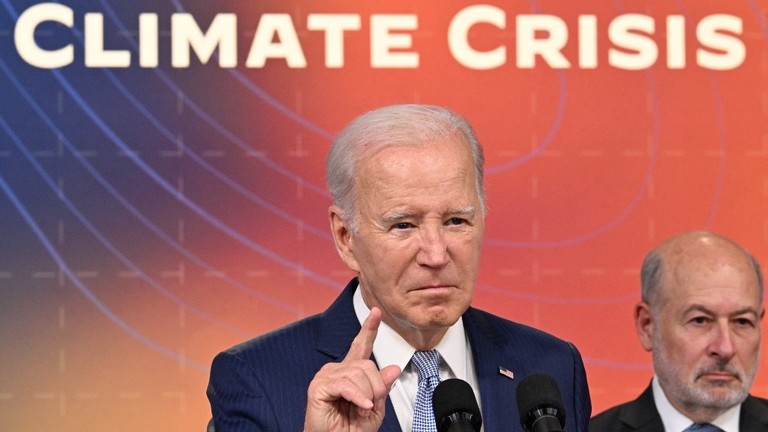
Biden said that these two measures “will help preserve our Arctic lands and wildlife,” adding on Saturday that he would “continue to take bold action to meet the urgency of the climate crisis and to protect our lands and waters for generations to come.”
Speaking to Fox News on Thursday, Dunleavy said that “this makes absolutely no sense from any perspective unless your goal is to drive up the cost of oil and gas so much that it makes certain renewables cheaper.”
Dunleavy, a Republican, claimed that Russia, China, Saudi Arabia, and Iran are “laughing” at Biden’s energy policy.
“They’re laughing together at the United States of America,” the governor said. “I can’t find anywhere in, really the history of nation-states or empires, where they worked at hobbling themselves to such a degree that’s happening currently with this administration. So 2024 can’t come soon enough for most of us.”
Gasoline prices have soared under Biden, reaching a record average high of just over $5 per gallon last June, up from around $2 when the president took office.
Prices began to rise when Biden signed an executive order in January 2021 banning new oil and gas licenses on federal land, and spiked as the conflict in Ukraine rocked global energy markets. Ahead of last year’s midterm elections, Biden attempted to stabilize gasoline prices by draining the US’ strategic petroleum reserve, and by unsuccessfully lobbying the Saudi-led Organization of Petroleum Exporting States to cut production.
The AIDEA argues that Biden has no legal right to rescind existing drilling licenses and told Fox News that it intends to challenge the decision in court.
Iran reports major surge in exports of semi-finished steel
Press TV – September 6, 2023
Iran has seen a major surge in its exports of semi-finished steel this year amid a ramp-up in domestic manufacturing activity.
The Iranian Steel Producers Association (ISPA) said on Tuesday that exports of semi-finished steel from the country had increased by 24.8% year on year in the five months to August 22 to reach a total of 3.093 million metric tons (mt).
Semi-finished steel products are ingots known as billet, blooms and slab which are used in steel mills to manufacture finished steel products.
ISPA figures showed that total domestic production of semi-finished steel in Iran had reached over 13 million mt over the five months to late August.
The ISPA said Iran’s exports of steel sheets and long steel products had also increased by 15% over March-August without mentioning the exact volume of the shipments.
Exports of sponge iron, or what is known technically as direct reduced iron (DRI), reached 0.708 million mt in the five months to late August, up by more than 232% compared to the same period last year, showed the figures.
The major surge in Iranian steel exports come as steel mills in the country have ramped up their output to respond to a growing demand for the metal in the domestic manufacturing sector.
The increased output has also enabled Iran to respond to the rise in regional and global demand for steel amid a war in Ukraine that has affected supply chains.
That comes as Iranian steel producers were facing restrictions in their access to electricity this summer.
Figures by the World Steel Association released this week showed that Iran had produced 18.1 million mt of steel in the seven months to July, up 4.1% compared to the same period in 2022.
Iran to help Burkina Faso build new oil refinery: Minister
Press TV – September 5, 2023
Iran will contribute to building an oil refinery in Burkina Faso and will supply the West African country with oil products it needs, according to a statement from Iranian Oil Minister Javad Owji.
Owji said on Tuesday after a meeting with Burkinabe Foreign Minister Olivia Rouamba in Tehran that petroleum sector cooperation between Iran and Burkina Faso will expand in the future as part of agreements reached between the two countries in recent months.
“It was agreed in the meeting with foreign minister of Burkina Faso that a refinery will be constructed through cooperation between engineers and experts of the two countries based on agreement signed earlier,” the minister told reporters after the meeting.
Owji said that he and Rouamba had also agreed on the launch of oil products exports from Iran to Burkina Faso.
He did not elaborate on financial details of petroleum contracts signed between Iran and Burkina Faso but said that the African country has some good mines that can service the needs of Iran’s metals sector.
Rouamba, who has been in Iran for an official visit since early on Monday, said after the meeting with Owji that Burkina Faso seeks to import oil products from Iran to respond to rising domestic demand for fuels in her country.
She said her talks with Owji had centered on the results of previous discussions between Burkinabe trade officials and the Iranian authorities.
The minister said there are bright prospects for cooperation between engineering companies of the two countries for construction of a new refinery in Burkina Faso.
Iran Hails Resistance Allies’ Push to Reshape World Order, Weaken US ‘Hegemony’

People raise Palestinian, Lebanese and Hezbollah flags during a rally in solidarity with the Palestinians, on the outskirts of the southern Lebanese village of Kfarkila, near a United Nations Interim Force in Lebanon (UNIFIL) armoured personnel carrier.
By Ilya Tsukanov – Sputnik – 02.09.2023
Iran joined the Shanghai Cooperation Organization and BRICS this summer, and has been working to expand bilateral cooperation with both Russia and China. Tehran is also the leader of an informal alliance of regional countries, including Syria, Lebanese militant group Hezbollah, and Iraqi Shia militias, known as the Axis of Resistance.
Iran’s foreign minister has praised the struggle in the Middle East to resist and undermine US dominance and create a new international order.
“The international system is undergoing fundamental changes and we are witnessing new actors in the international arena,” Foreign Minister Hossein Amir-Abdollahian said in a meeting with political groups in Beirut, Lebanon on Friday.
“The US is trying to maintain its hegemony, but the region and the world understand very well that America cannot exercise its hegemony, and on the contrary, the Resistance is powerful and can achieve its will powerfully,” Amir-Abdollahian added.
Today, the Iranian top diplomat said, “the position of the Resistance in the region cannot be ignored,” and is “being noticed by the West,” including as far as the Israeli-Palestinian crisis is concerned.
Separately, in talks with his Lebanese counterpart Abdallah Bou Habib, Amir-Abdollahian stressed that “the US sanctions regime cannot hinder the economic relations between Iran and Lebanon,” just as “it has failed to impact Iran’s cooperation with Iraq, Turkiye, Pakistan, Central Asia and the Caucasus.”
Iran is ready to provide further assistance to Lebanon to help Beirut resolve its long-running fuel and electricity crisis, he said. This includes readiness to build a network of power stations with a capacity of 2,000 megawatts.
Bou Habib praised Iran for its support for Lebanon in the nation’s time of crisis, and expressed readiness to further expand cooperation.
Lebanon’s political and economic crisis, which began in 2019, has left the country in economic ruin and run by a caretaker government. The post of president has been vacant since last October, when President Michel Aoun resigned at the end of his term.
Amir-Abdollahian also met with Hassan Nasrallah, secretary-general of the powerful Lebanese political party and militant group Hezbollah, which has forged close ties with Iran both in Lebanon and in Syria, where Hezbollah fighters backed by Revolutionary Guard Quds Force advisors have fought jihadist extremists for over a decade.
In the talks with Bou Habib, Amir-Abdollahian reiterated Iran’s long-stated position that “any normalization of relations with the Zionist regime will be detrimental to the entire region.” Iran will “continue to support and assist the Axis of Resistance, to preserve the Lebanese national interest, in the face of Israeli attacks and ambitions that threaten this entire region,” he said.
The Iranian diplomat also commented on the “positive developments” in relations between Iran and Saudi Arabia following the surprise normalization of relations earlier this year, saying that these processes “will have a positive impact on the entire region,” including for Lebanon.
At a press conference at the end of his visit, Amir-Abdollahian also rejected allegations by France – the European power which once controlled Lebanon as a colony, of meddling in Lebanon’s affairs.
“I advise Mr. Macron to focus on the situation inside France instead of paying attention to questions of interference in other countries,” he said. “Iran has always played the most constructive role in helping Lebanon,” he added.
Earlier in the week, the French president told a conference of French ambassadors that stopping Iranian “interference” was a “key element” in resolving Lebanon’s political standoff.
Amir-Abdollahian’s Beirut visit was preceded by a trip to Damascus on Thursday for talks with President Bashar Assad and other Syrian officials. Amir-Abdollahian slammed the illegal presence of US troops in eastern Syria, and blasted Israel for its ongoing campaign of airstrikes against the war-torn country.
Known to jealously guard its security and foreign policy independence, and the defense of its interests even against far larger and more powerful foes, including the US, Iran has dramatically ramped up cooperation with Russia and China in recent years as part of ongoing processes related to Eurasian integration. Iran joined the Shanghai Cooperation Organization in July, and acceded to the BRICS bloc late last month. Last week, a senior Islamic Revolutionary Guard Corps commander and advisor to Supreme Leader Ayatollah Ali Khamenei said that Iran sees a maritime-oriented economy and cooperation with Russia and China as keys to countering the impact of US sanctions.
First rail cargo sets off from Russia to Saudi Arabia via Iran
The Cradle | August 27, 2023
The chief executive of the Islamic Republic of Iran Railways (RAI) announced on 27 August the transit of Russian cargo to Saudi Arabia via the Iran transport corridor for the first time.
A transit train hauling 36 containers entered Iran for the first time from Russia through Iran’s Incheh Borun rail border near Turkmenistan, Miad Salehi stated.
The deputy roads minister added that this cargo transit train was dispatched to the port city of Bandar Abbas on the Strait of Hormuz and will be transferred from there to the Saudi Arabian port city of Jeddah by sea.
Russia seeks to develop the International North–South Transport Corridor (INSTC) to connect India, Iran, Russia, Azerbaijan, and other countries via railways and sea.
Russia says the INSTC will rival the Suez Canal as a major global trade route.
In May, Russian President Vladimir Putin and his Iranian counterpart Ebrahim Raisi signed a deal to finance and build an additional Iranian railway line between the cities of Rasht and Astara.
“The unique North-South transport artery, of which the Rasht-Astara railway will become a part, will help to significantly diversify global traffic flows,” Putin said.
He also said the 162-kilometer railway along the Caspian Sea coast would help to connect Russian ports on the Baltic Sea with Iranian ports in the Indian Ocean and the Gulf.
“Without a doubt, this agreement is an important and strategic step in the direction of cooperation between Tehran and Moscow,” Raisi said.
Iran hopes the successful development of Russian-financed railway links comprising the NSTC will increase transit revenues and reinforce Iran’s “Look to the east” policy of strengthening ties with neighboring countries and eastern powers in response to western economic sanctions.
Raisi’s Deputy Chief of Staff for Political Affairs, Mohammad Jamshidi, claimed that the INTSC earnings would rival Iran’s oil revenue. In this vein, the semi-official ISNA on May 17 estimated annual revenue of $20 billion from the corridor.
State broadcaster-run Jam-e Jam newspaper described Iran as the “golden path of trade” in an article highlighting the potential benefits of the railway.
Iran and Russia have developed closer economic, diplomatic, and military ties in recent years, as both countries have been subject to US economic sanctions and have resisted US foreign policy in West Asia, including Syria, and the former Soviet states, including Ukraine.
The Fleeting Mirage of Imagined Supremacy
By William Schryver – imetatronink – August 25, 2023
The United States pretty much had its way in the world from 1991 to 2014. But now the empire’s strength is severely depleted and fatally overextended, whereas the military and industrial capacity of its increasingly allied adversaries is ascendant, and in aggregate, greatly exceeds that of the empire and its compliant vassals.
Perhaps most importantly, the ability of the US to inflict severe economic and financial damage on countries who defy “the rules-based international order” has been rendered effectively impotent by the collaborative countermeasures developed and resolutely employed by Russia, China, Iran, India, Brazil … the list goes on, and is lengthening at an accelerating pace.
And, even as US sanctions power has dramatically waned, its capability to maintain a potent military presence in dozens of strategic “hot spots” around the world has become illusory. Yes, the American military ostentatiously maintains many hundreds of bases dotting the planet, but that simply underscores the extreme degree to which US military power is diluted.
The purported ability of the US military to “project power anywhere on the globe at a moment’s notice” is a meaningless fantasy in the context of anything more than launching a few dozen cruise missiles at a target in a country that lacks the capacity to shoot back.
This is the incontrovertible mathematical reality: to assemble a force sufficient to wage war against Russia, China, or Iran would require the US to effectively abandon every major military base on the planet.
Were they permitted, without opposing interdiction, to concentrate a million combat effectives (they wouldn’t be, of course), it would require at least a full year to stage such a force in the theater of operations.
A “combined-arms” force adequate to make war against Russia, China, or Iran would necessarily constitute the greatest concentration of American military power since the Second World War, with the longest and most vulnerable supply lines ever seen in the history of warfare — choke-points that would be potently contested by what almost certainly would be the combined naval and long-range strike-missile capabilities of Russia, China, and Iran.
But, for the sake of argument, let us imagine a fully equipped American combined-arms force could be miraculously materialized in eastern Europe, or the South China Sea, or the Persian Gulf.
As multitudes of observant and discerning military officers and analysts around the world have now come to see: the US could only sustain high-intensity industrial-scale warfare for 6 – 8 weeks, at most, until severe losses, munitions exhaustion, and broad-spectrum logistical breakdowns compelled them to cease operations.
This reality was little recognized and poorly understood prior to February 2022. But the war in Ukraine has exposed key US military shortcomings and vulnerabilities, and revealed the shocking logistical and industrial debility of what many across the globe still imagined to be “The Greatest Military in Human History” and the peerless industrial production might of the legendary “Arsenal of Democracy”.
By unfounded reputation, and “on paper”, as they say, the United States appears to possess the most powerful military on the planet. But there is a vast difference between perceived power and the actual ability to project power and sustain power against the adversaries the US military must now face and defeat in order to prevent or even meaningfully delay the end of American global hegemony.
Featured Video

HE SAVED LIVES. NOW HE FACES PRISON.
or go to
Aletho News Archives – Video-Images
From the Archives
NATO Sanctions and the Coming Global Diesel Fuel Disaster
By F. William Engdahl – New Eastern Outlook – 11.04.2022
Amid the ongoing global inflation crisis, NATO heads of state and mainstream media repeat a mantra that high energy prices are a direct result of Putin’s actions in Ukraine since end of February. The reality is that it is the western sanctions that are responsible. Those sanctions including cutting SWIFT interbank access for key Russian banks and some of the most severe sanctions ever imposed, are hardly having an impact on the military actions in Ukraine. What many overlook is the fact that they are increasingly impacting the economies of the West, especially the EU and USA. A closer look at the state of the global supply of diesel fuel is alarming. But Western sanctions planners at the US Treasury and the EU know fully well what they are doing. And it bodes ill for the world economy.
While most of us rarely think about diesel fuel as anything other than a pollutant, in fact it is essential to the entire world economy in a way few energy sources are. The director general of Fuels Europe, part of the European Petroleum Refiners Association, stated recently, “… there is a clear link between diesel and GDP, because almost everything that goes into and out of a factory goes using diesel.” … continue
Blog Roll
 Aletho News
- Trita Parsi: Middle East Unraveling — Are We on the Path to World War?
- Iran FM meets with US envoy on UN meeting’s sidelines at American side’s insistence: Report
- Qatar PM calls for Gulf security framework with Iran, says war must be ‘wake-up call’
- China condemns US extortion of Iranian airlines, rejects Washington’s ‘illegal’ sanctions threats
- Italy to move military personnel from Taif base after missile strike
- Finland’s Stubb tells European leaders to calm down
- Defeating Russia on battlefield impossible – Fico
- Finland’s Gender Clinic Reversal
- Massachusetts Wants Mental Health Visits, Why Does Government Use ‘Health’ to Enter Our Homes & Families?
- US lawmaker admits American people footing bill for Trump’s failed aggression against Iran
- If Americans Knew
- Sanctions are collective punishment: immoral and self-defeating
- Phosphorus Munitions Fired by Israel Burn Groves, Orchards in Southern Lebanon
- Israel Carries Out New Ceasefire Violations Across Gaza
- AI – Emphasis on the ‘I’: Israel Is Funding AI Chatbot Propaganda
- Israel Blocking Hundreds of Wheelchairs for Injured Children From Entering Gaza
- Israel Is Expanding and Upgrading Compounds for Palestinian Militias in Gaza
- The Palestinian-American Residents of This West Bank Town Are Wondering: Where Is Trump?
- Gaza desperately needs tents, wheelchairs, fuel… and everything else (Israel blocks it all) – Daily Update
- Israeli Attacks in Gaza Kill at Least Seven Palestinians Over Three Days, including Woman and Child
- Trump’s militarization of Washington DC as he pursues Israel’s war against Iran
- No Tricks Zone
- New Study: Earth And Venus Surface Warmth Largely Explained By Convection And Lapse Rate, Not CO2 Or Radiation
- 2025 Nature Paper Claiming Worsening Global Drought Gets RETRACTED …Heavily Flawed
- New Study: ‘Global Drought Shows No Detectable Recent Acceleration Under Climate Warming’
- Economic Masterminds: German Socialists Suggest Taxing Productivity Gains Stemming From Using AI
- The South China Sea Has Not Been Cooperating With The Climate Change Narrative
- Energy Crisis: Germany Enters Heating Season With Historically Low Gas Reserve Fill Levels
- New Study: The Antarctic Ice Sheet Gained Mass From 2020-2024 Due To Staggering Snow And Ice Accumulation
- Study: Ocean Heating Rates From Thousands Of Years Ago ‘Dwarf’ Modern Ocean Heating Rates
- Climate Extremists Target, Attack Large-Scale Power Grid Infrastructure In Germany!
- New Study: Antarctic Ice Melt Has Contributed Less Than 1 Centimeter To Sea Level Rise In The Last 30 Years

