War with Hamas deals ‘severe economic blow’ to Israel
The Cradle | October 17, 2023
Eleven days into its war with the Hamas-led Palestinian resistance, Israel is paying a heavy economic toll, Maariv reported on 17 October.
The Israeli newspaper reported that “the Israeli economy appears to have already begun to pay a heavy price for the war,” which began on 7 October with the start of Hamas’ Al-Aqsa Flood Operation.
The newspaper explained in a report published Tuesday that “4.6 billion shekels [$1.1 billion] is the price paid by the Israeli economy as a result of workers not coming to work and low productivity in Israeli institutions.”
According to the analysis of the economic department of Israel’s Manufacturers Union, the closure of the education system, blocking of traffic routes, and the extensive mobilization of the army reserves has also hurt economic productivity.
In total, it is estimated that about 1.3 million Israeli workers did not go to work this week.
In southern Israel, some 85 percent of workers were absent from their jobs, along with about 20 percent of workers in the rest of Israel.
The head of the Manufacturers’ Union and the head of the Employers and Companies Association, Ron Tomer, said after the harsh assessments that “there is no doubt that the war constitutes a severe economic blow to the economy.”
According to Maariv, this estimate does not take into account “additional and very significant financial damage, which will only be assessed economically at the end of the fighting, such as direct damage to factories and damage to profitability.”
In addition to decreased productivity, Israel will see indirect damage, such as the damage to the reputation of Israeli companies with customers abroad, cancelled transactions, failure to adhere to schedules, and the depreciation of the shekel.
Should the conflict widen to include not just Hamas but also Iran, a key backer of the Palestinians, Bloomberg estimates oil prices could climb to $150 a barrel and cause a global recession that takes about $1 trillion off world output.
Iranian involvement on the Palestinian side could lead to a cut in Iranian oil output and a tightening of western sanctions hindering Iranian oil sales.
Bloomberg notes further that an oil shock of this size would also derail the worldwide effort to rein in inflation. In the US, the Federal Reserve’s 2 percent inflation target would not be met, and costly gasoline would be a hurdle for President Joe Biden’s re-election campaign.
Another possibility is that Iran could close the Strait of Hormuz, the world’s single-most important energy corridor. Globally, over one-sixth of oil and one-third of liquefied natural gas passes through the narrow strait
“The gas market is calm but tense,” Henning Gloystein, director for energy, climate and resources at the Eurasia Group think tank said.
“It doesn’t take much to go into a fever pitch. We had the Ukraine war, Russian gas supply cuts, oil cap sanctions and now you have war in the Middle East as well — that’s a problem,” he said.
Putin offers solution to stop further bloodshed in Israel-Gaza conflict while Zelensky fears losing US support
By Drago Bosnic | October 17, 2023
As hostilities in the latest Israel-Gaza conflict escalate, the threat of a wider confrontation in the Middle East is getting likelier by the day. It’s safe to assume that the Israeli Defense Forces (IDF) haven’t launched a ground operation in Gaza yet due to possible direct Iranian involvement, as well as the greater engagement of Hezbollah in the north of the country. According to the Jerusalem Post, the main reason for the postponing of the offensive is precisely the latter. The Northern Command is forced to keep the best IDF troops in the area to ensure combat readiness on the Lebanese border in case Hezbollah gets more directly involved. The Lebanon-based Shia movement has tens of thousands of soldiers and a massive stockpile of various rockets and missiles that could do significant damage to the IDF. Israel simply cannot afford to ignore Hezbollah, as the group already defeated it once in 2006, the only such occurrence in the history of IDF.
The Jerusalem Post itself cited sources saying that “while a number of factors seem to have caused a delay, one factor has been a growing concern that Hezbollah is waiting for the moment that most IDF ground forces are committed to Gaza to open a full front with the IDF in the north”. This fact alone is forcing Israel to keep most of its military assets in the relative vicinity of the border with Lebanon. It could be said that Hezbollah is already providing significant support to Hamas just by being able to tie up so many IDF troops. Iranian involvement in this is implicit, as Tehran has been one of the main backers of Hezbollah since the group’s very inception. This is forcing the Israeli leadership to exercise caution and restraint, as a direct Iranian intervention remains a possibility. Such speculation is not without merit, as Iranian Foreign Minister Hossein Amir-Abdollahian already implied that Tehran might get involved:
“Conferred with my counterparts from Tunisia, Malaysia and Pakistan. Underlined the need to immediately stop Zionist crimes & murder in Gaza & to dispatch humanitarian aid. I stressed that time is running out for political solutions; probable spread of war on other fronts is approaching unavoidable stage.”
On the other hand, most high-ranking Israeli officials are adamant that the Gaza operation must be launched. For instance, Israeli ambassador to the United Kingdom Tzipi Hotovely even compared the current airstrikes with the bombing of Dresden during WWII, when Western Allies leveled the German city, killing tens of thousands of civilians in the process. Israeli F-16I “Sufa” fighter jets have already dropped thousands of bombs on Gaza (primarily the US-made JDAMs – Joint Direct Attack Munitions), resulting in thousands of deaths and serious injuries among civilians there. According to the Palestinian Central Bureau of Statistics, the death toll among Palestinians now stands at over 3,000. For its part, Israel reported that over 1,400 Israeli civilians died so far, with at least 4,100 wounded. The figures are certainly even worse as of this writing.
Such casualties are disastrous, especially given that the conflict started just ten days ago. Since then, the world has effectively split into three groups. Apart from those that express open support for either side, the largest part of the globe has opted for neutrality. This also includes superpowers such as Russia. Namely, Moscow was among the first to call for the end of hostilities before they escalate to include all regional and perhaps even global actors. In a phone call with Russian President Vladimir Putin (the first since the conflict started), Israeli Prime Minister Benjamin Netanyahu stated that Israel would proceed with the Gaza offensive despite Moscow’s warning that it would lead to massive casualties and possibly cause a strong reaction of the Muslim world, particularly Iran and its allies. Putin urged Netanyahu to engage in talks on the peaceful settlement of the conflict.
On the other hand, the United States is looking to use the crisis to escalate against Iran, as Washington DC warhawks were quick to blame Tehran for the surprise attack launched by Hamas. US President Joe Biden will visit Israel this week, coming mere days after State Secretary Antony Blinken. Biden recently denied reports about a possible deployment of American troops, calling it “unnecessary, as Israel has one of the finest fighting forces”. And while he stated that “it would be a mistake [for Israel] to occupy Gaza”, he supported the notion that Hamas must be eliminated entirely and warned Iran not to get involved. By directly supporting the upcoming ground operation by the IDF, Washington DC is risking (almost certainly intentionally) a wider conflict that might include several Arab states and Iran. In fact, Israeli forces already hit targets in Syria and Lebanon.
In the meantime, the Kiev regime is in panic mode as the global spotlight has moved away from Ukraine. Namely, the Neo-Nazi junta frontman Volodymyr Zelensky tried to get the attention of Western audiences to himself by pompously announcing a “solidarity visit”. However, Israel flatly refused, as the “time is not right”. Zelensky is likely terrified of the prospect that he will have to share hundreds of billions in so-called US “aid” with Israel. It’s no secret that the latter is a priority for Washington DC, while the Kiev regime and the Ukrainian people as a whole are routinely seen as “cheap cannon fodder” that should only be “dying for a NATO mission.” The words of the infamous warhawk Lindsey Graham that “the best money the US ever spent because the Russians are dying” show this only works for America if its actual allies are under attack.
Drago Bosnic is an independent geopolitical and military analyst.
US warmonger Senator threatens Iran
By Lucas Leiroz | October 17, 2023
Once again, the pro-war sectors of American politics seem to want to foment a conflict situation with US involvement. A prominent public figure in the US Senate has made very serious threats to Iran, promising that Washington “will not hesitate” to take actions against Tehran if the conflict in the region continues to escalate.
The threats were made by the highly known Senator Lindsey Graham, who is notorious for his bellicose and irresponsible positions regarding American foreign policy. Graham issued a warning to Iranian authorities, stating that if there is any military action by Hezbollah against Israel, Washington will act to protect its ally, which could have serious consequences for Iran, both in military and economic terms.
“Here’s my message. If Hezbollah, which is a proxy of Iran, launches a massive attack on Israel, I would consider that a threat to the — to the State of Israel, existential in nature. I will introduce a resolution in the United States Senate to allow military action by the United States in conjunction with Israel to knock Iran out of the oil business,” Graham said.
Hezbollah was not the only topic in the Senator’s speech. Graham also stated that he does not believe in the Iranian government’s official narrative that the Hamas operation was carried out autonomously. For him, believing this is “laughable”, with total confidence on his part that Hamas’ actions were previously discussed with Iran.
“The idea that Iran read about this operation in the paper, or on television is laughable. 93% of Hezbollah and Hamas’ money comes from Iran (…) They’re the source of the problem. They’re the great evil. So, if Hezbollah escalates against Israel, it will be because Iran told them to. Then Iran, you’re in the crosshairs of the United States and Israel,” Graham added.
Graham’s stance is extremely complicated, as the current tense situation in the Middle East favors risks of escalation and internationalization, and there is therefore a considerable possibility of Iran becoming involved in hostilities. This involvement can be direct or indirect, with Tehran sending regular troops or mobilizing its allied groups – which are not limited to Hezbollah. In either scenario, the risks would be enormous for Israel, which, despite its large military strength, is a small and vulnerable country in situations of war of attrition.
Furthermore, it must be emphasized that Iran is doing everything possible not to enter the war. By warning Israel not to continue collectively punishing Gaza, Tehran is offering alternatives to armed confrontation. But Tel Aviv, despite being afraid of invading on the ground, continues to bomb Gaza and kill thousands of civilians, causing Iran’s patience to progressively run out.
It has also been informed by the Persian country’s authorities that the so-called “Axis of Resistance” – a Theran-led coalition of anti-Zionist armed movements – could act at any time in defense of the Palestinians. Iranian politicians clarified that, despite Tehran leading the coalition, the member groups have high decision-making autonomy, and there is no full Iranian control over how these movements will react to Israel. In other words, the risks of escalation are great, and Iran is not capable of preventing it alone.
The only way to truly de-escalate is through a commitment on the part of Israel to stop the attacks. Without this, the situation will go out of control and there will inevitably be intervention – if not direct from Iran, at least from some Iranian-allied group. Furthermore, it is necessary to remember that Hezbollah is already de facto involved in hostilities, with bombings being exchanged between the IDF and the Shiite militia every day. Obviously, if nothing is done to stop these hostilities, at some point Hezbollah will choose to launch a more effective incursion.
With all these factors, Graham’s words sound like a “self-fulfilling prophecy”. He points to an imminent scenario as a “red line” and issues direct threats, making real de-escalation actions virtually impossible. However, this type of behavior is in fact expected from Graham, who is a known “hawk” of American foreign policy. Months ago, the Senator became embroiled in a controversy after saying that the US was investing money in “killing Russians” in Ukraine – praising such an “investment”. In the same vein, on another occasion, he also suggested that Kiev should kill Russian President Vladimir Putin.
It remains to be seen whether these pro-war tendencies will prevail in the American public debate. For now, the US stance has been extremely bellicose, with the country sending aircraft carriers to “help” Israel. However, it is necessary to remember that the American military-industrial complex is not able to work on two different fronts at the same time – in addition to the possibility of escalation in the Pacific in the near future. Washington needs to act rationally and discourage war in the Middle East.
Lucas Leiroz, journalist, researcher at the Center for Geostrategic Studies, geopolitical consultant.
Iran asks China to intervene to stop war in Gaza
Press TV – October 15, 2023
Iran’s Foreign Minister Hossein Amir-Abdollahian has called on China to intervene to put an end to the ongoing carnage in the Gaza Strip where Israel is carrying out incessant attacks against the civilian population living in the enclave.
In a phone call with China’s Foreign Minister Wang Yi on Sunday, Amir-Abdollahian said there is a need for the United Nations to assume its responsibilities with regard to international peace and security amid the ongoing conflict in Palestine.
However, he asked China to use its diplomatic capacity to stop the Israeli regime from attacking civilians in Gaza, the official IRNA news agency said.
The foreign minister described the collective punishment imposed by the Israelis on the Palestinians in Gaza as “unacceptable” while reiterating the need for setting up humanitarian corridors to deliver aid to the people in the enclave.
He warned that there would be no guarantee that the conflict in Gaza would not spiral out of control if the criminal attacks against the civilians in Gaza did not stop.
The phone call between Amir-Abdollahian and Wang came just after Iran’s top diplomat returned from a tour of Iraq, Syria, Lebanon and Qatar.
Amir-Abdollahian said after meeting leaders of the anti-Israeli resistance groups during his regional tour that the conflict in Gaza would spread to other areas and countries if Israel does not stop its aggressions against the Palestinians.
More than 2,450 people have been killed in nine days of Israeli air strikes and shelling against Gaza, a besieged enclave on the Mediterranean Sea which is home to some 2.3 million people.
The attacks, which have left nearly 10,000 people injured, started last week after the Palestinian resistance group Hamas, which is based in Gaza, launched multi-pronged attacks on occupied territories to retaliate against Israeli assaults on Palestinians.
Iran warns Israel of regional ‘earthquake’
RT | October 15, 2023
Iranian Foreign Minister Hossein Amir-Abdollahian has urged Israel to end its airstrikes on Gaza, warning that the conflict with Hamas could spread across the region if Israel sends ground forces into the enclave, and the Lebanese militant group Hezbollah enters the fray.
“I know about the scenarios that Hezbollah has put in place,” Amir-Abdollahian said in a briefing with reporters in Beirut on Saturday. “Any step the resistance will take will cause a huge earthquake for Israel.”
According to two diplomatic sources cited by Axios, Iran is trying to prevent the war from spreading, and seeking to help Israeli civilian hostages being held in Gaza – but if the military operation continues and Israel goes ahead with a ground offensive, Iran will have to respond.
“There is still a political opportunity to prevent a widespread crisis in the region,” the minister noted, but “maybe, in the next few hours, it will be too late.”
This week, the top Iranian diplomat visited Iraq, Syria and Lebanon, where he met with Hezbollah leader Sayyed Hassan Nasrallah, as well as senior Lebanese officials, to discuss the “potential outcome” and the “positions that must be taken” in light of the war.
In a meeting with Lebanese Foreign Minister, Abdallah Bou Habib, Amir-Abdollahian accused Israel of “war crimes” against the people of Gaza and repeated his warning that if Israel does not stop, “any possibility is conceivable.” Bou Habib backed his counterpart, saying that Lebanon “has never wanted or sought war” and warning that further escalation “will ignite the region and threaten security and peace in it”.
“We are in solidarity with our Palestinian brothers and call for the end of the siege and the delivery of aid to Gaza,” Bou Habib stressed.
Hezbollah fighters are on full alert along the Lebanon border, and have been exchanging sporadic fire with Israel since last Saturday’s Hamas incursion that left at least 1,300 Israeli civilians and soldiers dead.
The Iran-backed group is considered a major threat to Israel, as it possesses some 150,000 rockets and missiles, including precision-guided missiles that can reach anywhere in Israel, as well as thousands of battle-hardened fighters and various types of military drones.
The top Iranian diplomat also met with a senior political leader of Hamas, Ismail Haniyeh, in Qatar on Saturday evening, but details of the meeting have yet to be disclosed.
US in a quandary over Israel’s war on Gaza
BY M. K. BHADRAKUMAR | INDIAN PUNCHLINE | OCTOBER 13, 2023
The US Secretary of State Antony Blinken’s press conference on Thursday concluding his visit to Israel conveyed three things. One, the Biden Administration will be seen as backing Israel to the hilt by way of meeting its security needs but Washington will not be drawn into the forthcoming Gaza operations except to arrange exit routes in the south for hapless civilians fleeing the conflict zone.
Two, Washington’s top priority at the moment is on engaging with the regional states who wield influence with Hamas to negotiate the hostage issue. Fourteen US citizens in Israel remain unaccounted for. (White House confirmed that the death toll in the fighting now includes at least 27 Americans.)
Three, the US will coordinate with the regional states to prevent any escalation in the situation to widen the conflict on the part of Hezbollah. Although the US cannot and will not stop Israeli leadership on its tracks apropos the imminent Gaza operation, it remains unconvinced.
Blinken was non-committal about any direct US military involvement, and the chances are slim as things stand. Most important, even as Blinken could hear the war drums, he also cast his eye on a future for Israel (and the region) where it will be at peace with itself, would integrate into the region and concentrate on creating economic prosperity — metaphorically put, beating its swords into plowshares in a Biblical Messianic intent.
That is to say, despite the massive show of force off the waters of Israel, with the deployment of two aircraft carriers along with destroyers and other naval assets and fighter jets off the waters of Israel, the Biden Administration is profoundly uneasy about any escalation of the conflict into a wider war. If the US senses that this is a catastrophe that Israel allowed to happen, that remains a strictly private thought.
Even as Blinken was heading for Tel Aviv, US House Foreign Affairs Committee Chairman Michael McCaul told reporters in Washington on Wednesday following a closed-door intelligence briefing that “We know that Egypt has warned the Israelis three days prior that an event like this could happen. I don’t want to get too much into classified, but a warning was given. I think the question was at what level.”
Shortly after McCaul spoke to reporters in Washington, an anonymous Egyptian official confirmed to the Times of Israel that Cairo’s agents did warn their Israeli counterparts about a planned Hamas attack, but that this warning may not have made it to Netanyahu’s office.
These disclosures would embarrass the Israeli government, as Saturday’s surprise attack can be viewed as a catastrophic failure for Israel’s intelligence services. In a brutally frank statement on Thursday, the Chief of General Staff of the Israel Defense Forces General Herzi Halevi admitted, “The IDF is responsible for the security of our nation and its citizens, and we failed to do so on Saturday morning. We will look into it, we will investigate, but now it is time for war.”
This failure will impact the decision-making in Tel Aviv. Gen. Halevi described Hamas as “animals” and “merciless terrorists who have committed unimaginable acts” against men, women and children. He said that the IDF “understands the magnitude of this time, and the magnitude of the mission that lays on our shoulders.”
“Yahya Sinwar, the ruler of the Gaza Strip, decided on this horrible attack, and therefore he and the entire system under him are dead men,” the general added, vowing to “attack them and dismantle them and their organisation” and that “Gaza will not look the same” afterward.
Make no mistake, the Israeli objective will be to use overwhelming force with its most advanced weapons, including powerful bunker-busting bombs, to inflict crippling losses on Hamas formations so that the movement cannot wage an armed struggle for many years. A ground operation is to be expected any day.
It is improbable that Blinken would have even tried to dissuade Prime Minister Benjamin Netanyahu from going ahead with a brutal operation. He told the media that the US would rather leave it to Israel to do what needed to be done. Meanwhile, the US deployment will not only aim to enhance surveillance, intercept communications, and prevent Hamas from acquiring more weapons, but also act as deterrent.
That said, the US cannot afford to watch passively. Washington has no choice but to limit the expected fighting in the coming days and weeks in Gaza to ensure that it does not spread to other areas. Thus, the US force projection specifically serves as a deterrent to Hezbollah, which possesses a vast armoury of 150,000 missiles that can be launched at major cities in Israel, potentially leading to a broader war not only in Gaza but also in Lebanon, drawing others into the conflict.
Israel knocked out of service the airports in Damascus and Aleppo in Syria in missile strikes simultaneously on Thursday, presumably to prevent reinforcements reaching Lebanon. Iran’s foreign minister Hossein Amir-Abdollahian was due to travel to Syria and Lebanon in the weekend.
Through the past four decades, the US and Iran have made a fine art of communicating with each other in dangerous times to set ground rules to avoid confrontation. This time around too, it is happening.
Certainly, the speech by Supreme Leader Ayatollah Ali Khamenei on Tuesday on the conflict situation, which was translated into Hebrew by the Iranians and disseminated in an unprecedented move, conveyed a subtle message in three parts to both Israel and the US, signalling essentially that Tehran does not intend to get involved in the conflict. (See my blog Iran warns Israel against its apocalyptic war.)
In turn, the US has signalled that it has intelligence showing that key Iranian leaders were surprised by the Hamas attacks on Israel. Equally, Iranian President Ebrahim Raisi’s phone conversation with Saudi Crown Prince Mohammed bin Salman on Wednesday — their first ever conversation which Tehran initiated — harped on efforts to “halt the ongoing escalation.”
The ‘known unknown’ scenario
Yet, the big question is, how far the Biden Administration would be confident about the success of any Israeli military incursion into Gaza. During the press conference in Tel Aviv, Blinken underscored in a subtle way the importance of “lessons” learnt from past experiences. The point is, Israel will be involved in urban warfare in a densely populated area with a population of 2.1 million people.
Gaza has an average of 5,500 people per sq. km, and there are bound to be heavy civilian casualties caused by Israel’s advanced American weaponry, which would lead to an international outcry, including in Europe, and lead to condemnation of not only Israel but the US as well. However, Israel is in a defiant mood and Netanyahu needs at least some of the operation’s goals achieved before agreeing to a ceasefire.
More importantly, Israel needs an exit strategy, if past experiences in Lebanon and Gaza gave any lessons. Colin Powell’s Pottery Barn rule comes into play — ‘You break it, you own it.’
An extended occupation of Gaza will be an extremely dangerous outcome fraught with great risks, given the deep economic, religious, and social roots that Hamas enjoys. Suffice to say, the Israeli military will be hard-pressed to show “success” and head for the exit door.
Besides, if other Palestinian groups and organisations in the West Bank make decisions that advance Hamas’s strategic goals, all bets are off, as Israeli military will face a two-front war. In fact, the conditions for a third intifada do exist in the West Bank.
And in such a scenario, the advantage goes to Hamas, which would position itself as potentially the appropriate and perhaps the sole alternative after Palestinian Authority President Mahmoud Abbas, who is now 87 years old.
Again, in a worst case scenario, it cannot be ruled out that the Arab Israeli population may draw inspiration from Hamas, and if their violent eruption in 2021 is anything to go by, the long-term viability of the state of Israel will be put to test.
Suffice to say, the best solution lies in a paradigm shift in the Israeli statecraft away from its primacy on coercion and brutal force. Blinken’s remarks suggested that the US hopes that when the dust settles down, with the helping hand of friendly Arab countries such as Saudi Arabia, the UAE, Egypt and Jordan, a turnaround to calm the situation and reach a ceasefire might be possible.
Of course, the longer that takes, the greater the strain it will put on the US-Israeli ties and the harder it will become for the Biden Administration to maintain an equilibrium in what is already a troubled relationship with Netanyahu. Fundamentally, Israel needs to come terms with the new reality that they are no longer invincible or the dominant power in the West Asian region.
Unfounded US accusations against Iran could escalate war in the Middle East

By Drago Bosnic | October 11, 2023
As we all know, Iran and Israel are no friends, to say the least. Both countries are regional superpowers and their relationship is what will define the future of the Middle East and possibly beyond. There are numerous proxies that both sides are using against each other and this is evident all across the troubled region. However, while some global powers are trying to ensure lasting peace between them, others keep pushing Iran and Israel into a direct confrontation. Namely, when Hamas launched its offensive against the Israeli Defense Forces (IDF), some sources were quick to blame Iran, claiming that it was directly behind the attacks. For instance, the BBC was the first to claim that Tehran was the main culprit, only to then edit the story and remove crucial parts of the accusation. Before this happened, the Wall Street Journal quoted the initial BBC report and then the unfounded claims kept spreading in the mainstream propaganda machine.
However, this doesn’t stop there, as the BBC then requoted the WSJ as a source, effectively quoting itself. Endless self-quoting is a common practice in the mainstream propaganda machine. One outlet usually publishes an unfounded claim that then gets republished by others until the targeted narrative becomes an axiom of sorts. The political West often uses these fabricated claims for geopolitical purposes, such as imposing sanctions, freezing financial assets and even launching wars of aggression around the world. And while it’s likely true that Iran has been supporting various groups that are hostile to Israel (and vice versa), there’s no evidence that it ordered Hamas to attack. Even high-ranking Israeli officials and IDF officers stated the same. And yet, the claims are still there and many in the US Congress are happy to use them as an excuse to refocus Washington DC’s attention from Russia and the Kiev regime to Iran and Israel.
Namely, members of the US Congress have been investing in war stocks. If we take into account that American policymakers are pouring their wealth into the Military Industrial Complex (MIC), what else can we expect but war? All this is being done in a very calculated manner. They tried against Russia, but realized that Moscow is just too tough of an opponent capable of taking on not just the United States, but the entire political West and winning. What’s more, according to high-ranking American generals, Russian strategic capabilities have not only been untouched, but have actually been expanded, meaning that Moscow can easily obliterate the United States and NATO at a moment’s notice. This is why Washington DC decided to choose what it sees as a more manageable target – Iran. With Russia busy in Ukraine and China concerned with Taiwan, Tehran is seemingly alone and unable to muster any support from other global powers.
However, Iran is anything but powerless. It possesses one of the world’s largest stockpiles of ballistic missiles, most of which are targeted at Israel. And while the latter has a sizable nuclear arsenal that includes at least 80-90 warheads (although some sources claim that the number is much higher and close to around 400), Iranian ballistic missiles could devastate Israeli cities, even without the use of various chemical or “dirty bomb” warheads. Israel itself has the nuclear-capable “Jericho” series of missiles, with “Jericho II” being a medium-range ballistic missile (MRBM), while “Jericho III” effectively serves as an intercontinental ballistic missile (ICBM). As basic physics suggests, the missile’s range is inversely proportional to the mass of the warhead, but even with the increase in the weight of the payload (1000 kg or more), the range of “Jericho III” drops to 5000 km, which is still more than enough to target any part of Iran.
The Israeli missile’s payload could be a single 450 kt (kiloton) nuclear warhead (weighing approximately 750 kg) or up to three lower-yield MIRV (multiple independently targetable reentry vehicle) warheads. Both options are a dreadful prospect for Iran, as these weapons could kill millions, if not tens of millions. However, as previously mentioned, Tehran is not without ways to retaliate, as its massive stockpile of MRBMs is more than enough to kill millions in Israel either way. The reason why Iran doesn’t really need nuclear weapons for such a scenario is Israel’s small territory. This is further exacerbated by the fact that most Israelis live in coastal areas, further reducing the already small territory Iran would need to target. Thus, anyone remotely sensible would want to do anything to prevent an escalation of the conflict that could potentially kill tens of millions of Israeli and Iranian civilians. However, there’s sensible and then there’s the US.
Unfortunately, we can’t have both. Washington DC warhawks are determined to push America into yet another war and the Middle East nearly always seems to be their unrelenting obsession. As per usual, uber-hawk senator Lindsey Graham, infamous for his threats to Russia and President Vladimir Putin himself, was the first in line to call for war. He didn’t even try sugarcoating anything and immediately called for the US to target Iranian oil refineries and related infrastructure, all in order to “destroy the lifeblood of the Iranian economy”. He also stated that “it is long past time for the Iranian terrorist state to pay a price for all the upheaval and destruction being sown throughout the region and world”. If we didn’t know the context, we’d probably think he’s talking about the US. Others, such as the former US ambassador to the UN Nikki Haley, also called for an escalation. In the meantime, “evil dictatorships” such as Russia and China keep calling for peace.
Drago Bosnic is an independent geopolitical and military analyst.
The Caucasus and West Asia are joined at the hips
BY M. K. BHADRAKUMAR | INDIAN PUNCHLINE | OCTOBER 10, 2023
Frozen conflicts can only be understood through history. That is why the ‘erasure’ of Nagorno-Karabakh from the map by Azerbaijan is an incredibly tumultuous development for Transcaucasia and its surrounding regions.
The backdrop is the breakup of the Soviet Union, which left us with a rather odd map. Consequently, conflicts in Georgia, Armenia, Azerbaijan, Moldova, Ukraine and others left us with de facto boundaries that are unrecognised in law. There is an imperative need for a peace treaty that reflects the new facts on the ground.
At issue is the status of Nakhchivan, which still remains the landlocked exclave of Azerbaijan located near the Turkish border. Azerbaijan, emboldened by its annexation of Nagorno-Karabakh last month, is on the lookout for a direct land link to Nakhchivan, which Baku regards as unfinished business.
To attain this audacious objective, Azerbaijan — once again, with Turkey’s support — hopes to seize control of a hefty slice of Armenia’s territory, which is also that country’s borderland with Iran to the south. Unsurprisingly, both Yerevan and Tehran oppose any such move, which would otherwise mean that Armenia and Iran cease to be neighbours and get encircled by the Azeri-Turkish strategic axis.
Through dialogue and negotiations a mutually acceptable formula must be found for any land link — known as “Zangezur Corridor” — guaranteed under international law, which preserves Armenia’s territorial integrity and its border with Iran, even while providing Baku with free access to Nakhchivan.
What complicates matters is the geopolitics, involving the 3 immediate stakeholders — Armenia, Azerbaijan and Iran — and two other regional states — Russia, Turkey — as well as certain intrusive extra-regional powers and entities — the United States, European Union and NATO.
While Russia and Iran are also stakeholders, the same cannot be said for the extra-regional powers and entities who are meddling in a highly competitive regional environment. The “butterfly effect” of the Zangezur Corridor will be profoundly consequential to the Black Sea and Caspian regions and could impact the Middle East and Central Asia as well.
Among the regional states, Iran stands out for its anti-revisionist approach. During separate meetings last Wednesday in Tehran with visiting Armenian and Azerbaijani officials, Iranian President Ebrahim Raeisi reiterated amid persisting tensions over the Karabakh region Iran’s opposition to the opening of the Zangezur Corridor, saying Tehran is against geopolitical changes in the region.
Raesi reportedly stated that the Zangezur corridor would be “a NATO foothold, a national security threat for countries, and is thus resolutely opposed by Iran,” as his political chief of staff Mohammad Jamshidi put it. Tehran cannot but factor in that Israel has a strong intelligence presence in Azerbaijan.
Speculation is rife that Azerbaijan might use force to open the Zangezur Corridor, Iran’s opposition notwithstanding. Turkey, the region’s number one revisionist power is a mentor and ally of Azerbaijan with whom it claims ethnic affinities. Turkey harbours grand visions of expanding its economic reach and political influence through a land route that extends from its European border in Eastern Thrace to the Caspian Sea and over to its ancestral lands of Central Asia that border China.
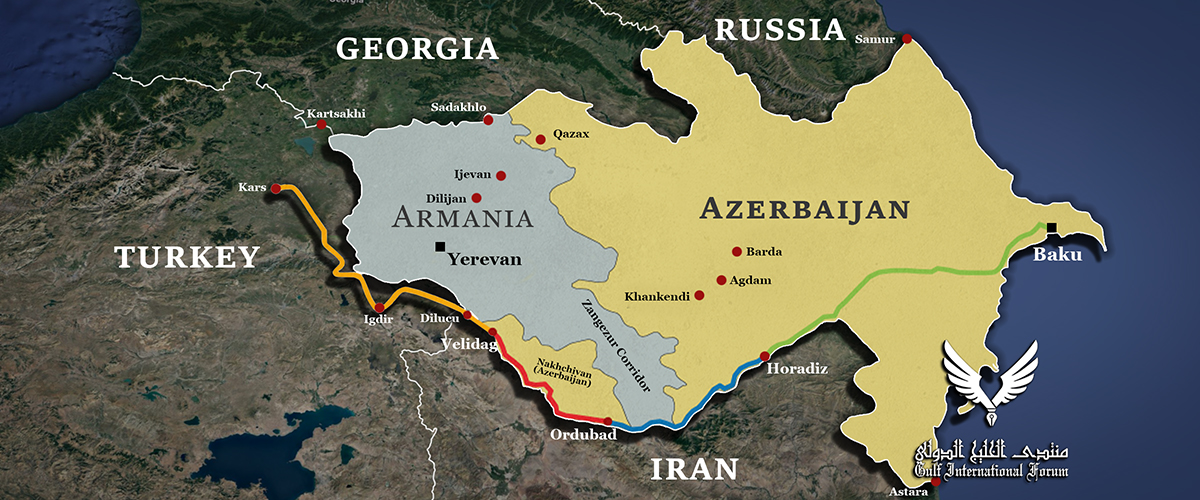
Suffice to say, the Zangezur Corridor will make Turkey a strategic hub in the geopolitics of the region if the Silk Road to Europe passes through its territory and the Soviet era land route to Russia reopens. Russia has separately promised to make Turkey an energy hub for export of its gas as well.
Much to Iran’s discomfiture, Turkey is exploiting Moscow’s dependence on Ankara in the conditions under western sanctions and the Ukraine conflict — Turkey controls the straits leading to the Black Sea from the Mediterranean— to muscle its way into the Caucasus and the Caspian, which has been traditionally Russia’s sphere of influence.
Meanwhile, Russia’s influence in the Caucasus suffered a setback as Armenia’s gradual drift toward Western benefactors following the colour revolution and regime change in Yerevan in 2018 has dramatically accelerated lately and taken an overt form. The Western powers are encouraging Armenia’s current leadership to leave the CSTO and seek the closure of the Russian bases on its soil where 5000 troops are garrisoned.
However, Armenia cannot do without Russia’s help. And Russia has strategic reserves to play itself back into the centre stage of the Caucasian chessboard. Of course, an optimal Russian comeback in the Caucasus will have to wait for its victory over the US and NATO in Ukraine, possibly by next year. Thus, Moscow seems confident that its pre-eminence in the Caucasus is a given.
Russia’s trump card, ultimately, is that much as the US and/or EU may try to get a toehold in the Caucasus, they are faraway powers and pretty much exhausted today with economic anxieties and growing war fatigue in Ukraine, amidst signs of disunity within the EU itself.
Indeed, a summit gathering close to 50 European leaders, dozens of aides and legions of journalists in Grenada, Spain, on October 5, which was billed as an opportunity to broker peace between Armenia and Azerbaijan, ended as a damp squib when Azerbaijan’s Ilham Aliyev and Turkey’s Tayyip Erdogan decided to skip the gathering and Azerbaijan accused France of bias in negotiations.
The bottom line is that in the power dynamic in the Caucasus, Iran is Russia’s natural ally and the two regional powers can be a factor of regional security and stability. This is important, since all sorts of dangers are lurking in the shade in the geopolitics of the Black Sea and Eastern mediterranean and Central Asia, and the darkening horizon presages storms ahead.
To flag a few ominous signs, the US has seized Israel’s escalating confrontation with Hamas and Hezbollah to resort to a major show of force in the Eastern Mediterranean — as if it is preordained. Such force projection cannot be an end in itself. Can it be coincidental that US-trained jihadi groups are also stirring up the Syrian pot lately?
Again, last week, a series of Ukrainian attacks in the Black Sea with Western-supplied cruise missiles forced Russian vessels to relocate from their main base in Sevastopol to the port of Novorossiisk 300 km to the east. British Defence Minister James Heappey promptly called it the “functional defeat of the Black Sea Fleet.”
Moscow is now reportedly planning to build a permanent naval base on the Black Sea coast in the breakaway Georgian region of Abkhazia.
Only a week ago, Russian Foreign Minister Sergey Lavrov warned that Moscow is alarmed by “the attempts of extra-regional players to become more active in the Afghan direction.”
Make no mistake, the US has not reconciled to the ascendance of Russian and Chinese influence in the Middle East or the Iran-Saudi rapprochement that led to an overall easing of tensions, especially Syria’s normalisation with its Arab neighbours, all of which which has drained America’s regional influence and weakened Israel.
Equally, with the spectre of a humiliating defeat in Ukraine haunting the Biden Administration, the temptation must be there to assert American hegemony. A confrontation with Iran is just what may suit Washington as ramp to cover its retreat from Ukraine’s battlefields.
Fundamentally, the US strategy is to get Russia bogged down on multiple fronts and prevent it from advancing Syria’s stabilisation optimally or consolidate its alliances with North African states — Egypt, Libya and Algeria — and expand its presence in the Sahel region which effectively thwarts NATO’s expansion plans in Africa.
Similarly, Iran’s surge as regional power has been to the detriment of Israel’s regional supremacy. Success of the US-Israeli strategy depends on piling pressure on Iran and Hezbollah, who were game changers in the Syrian conflict, and eroding the Russian-Iranian axis in West Asia, the Caucasus and the Caspian.
Armenia’s defection from the Russian orbit and the conflict situation currently developing in Gaza (and Lebanon) provide a window of opportunity to challenge Russia and Iran in the Levant. A vast armada of US warships is approaching the Eastern Mediterranean to intimidate Iran.
Meanwhile, the US hopes to undermine Saudi Arabia’s normalisation process with Iran and create contradictions within BRICS and OPEC Plus.
In sum, like in the famous play by the German modernist playwright Bertolt Brecht, The Caucasian Chalk Circle, we are currently witnessing a play within a play in the great game in Transcaucasia — an extraordinary blend of high theatricality, folk storytelling, music and even dialectical inquiry.
WSJ, Citing Exclusively Anonymous Sources, Claims ‘Iran Helped Plot Attack on Israel’
By Chris Menahan | InformationLiberation | October 8, 2023
The Wall Street Journal on Sunday, citing anonymous “sources” in Hamas and Hezbollah in addition to “a European official and an adviser to the Syrian government,” claimed Iran helped plot Hamas’ attack on Israel but the only Hamas official they cite on the record denied anyone else was involved in the attack.
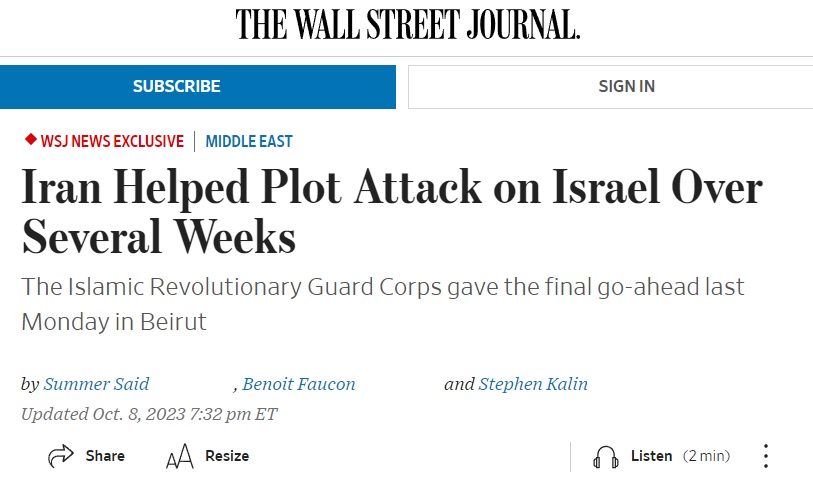
From WSJ, “Iran Helped Plot Attack on Israel Over Several Weeks”:
Iranian security officials helped plan Hamas’s Saturday surprise attack on Israel and gave the green light for the assault at a meeting in Beirut last Monday, according to senior members of Hamas and Hezbollah, another Iran-backed militant group.
Officers of Iran’s Islamic Revolutionary Guard Corps had worked with Hamas since August to devise the air, land and sea incursions–the most significant breach of Israel’s borders since the 1973 Yom Kippur War–those people said.
Details of the operation were refined during several meetings in Beirut attended by IRGC officers and representatives of four Iran-backed militant groups, including Hamas, which holds power in Gaza, and Hezbollah, a Shiite militant group and political faction in Lebanon, they said.
U.S. officials say they haven’t seen evidence of Tehran’s involvement. In an interview with CNN that aired Sunday, Secretary of State Antony Blinken said: “We have not yet seen evidence that Iran directed or was behind this particular attack, but there is certainly a long relationship.”
“We don’t have any information at this time to corroborate this account,” said a U.S. official of the meetings.
A European official and an adviser to the Syrian government, however, gave the same account of Iran’s involvement in the lead-up to the attack as the senior Hamas and Hezbollah members.
Asked about the meetings, Mahmoud Mirdawi, a senior Hamas official, said the group planned the attacks on its own. “This is a Palestinian and Hamas decision,” he said.
There was a mea culpa after the media lied America into the war in Iraq with most agreeing that anonymous sources should not be used in such crucial matters but all those rules are now being broken two decades later to expand this war to Iran.
Why can’t these anonymous sources go on the record?
“Senior members of Hamas and Hezbollah” will brag about working with Iran but only anonymously to the WSJ ?
“A European official and an adviser to the Syrian government” could be one or two people — a European official who is also an adviser to the Syrian government or a European official as well as an adviser to the Syrian government. Why would they know the ins and outs of Hamas’ strategic plans which caught the Mossad and Western intelligence completely off guard?
This report is total garbage and should be thrown in the trash but instead it could be used to set policy the same way Judith Miller’s lies about WMDs in the NY Times were used to justify the war in Iraq.
Miller was rewarded for her lies when she was hired by Fox News in 2008 (which is owned by Rupert Murdoch’s News Corp along with the WSJ ) and the WSJ actually ran a column from Miller 2015 where she made all manners of excuses for lying us into war.
What’s behind the sudden US good will towards Iran?
By Robert Inlakesh | RT | October 2, 2023
In what proved to be a domestically controversial move, the US government approved the release of five prisoners held in Iran in return for releasing five Iranian detainees and billions of previously frozen assets. However, in the aftermath of the agreement between Tehran and Washington, the White House’s primary focus seems to be centered around securing a Saudi-Israeli deal rather than working on reviving the 2015 Iran nuclear deal, known formally as the Joint Comprehensive Plan of Action (JCPOA).
As revealed by the anonymous diplomatic sources of The Cradle, in addition to other tidbits released in US media, the US-Iran prisoner swap appears to have been much more than meets the eye. The informal agreement, according to these anonymous sources, encompassed freezing Iranian uranium enrichment at 60% and permitting the International Atomic Energy Agency (IAEA) to install cameras at several nuclear sites. On the other hand, the US’ concessions included disregarding Iranian oil sales – in essence, refraining from enforcing sanctions – and allowing all Iranian assets to be released, reportedly amounting to roughly $20 billion. This is well over the widely reported $6 billion touted in the international press.
What makes this agreement so intriguing is that it was non-formal, including no known signed documents, and was contrived over several months and under the auspices of Qatar and Oman as intermediaries. From leaked information, citing unnamed sources, what we can gather – regardless of what claims are true or false – is that the prisoner swap was more than a simple exchange of prisoners and $6 billion in frozen assets. According to a report released in May by Axios, secret indirect talks between the US and Iran had been conducted in Oman, which three sources close to the news outlet claimed Iran’s top nuclear negotiator, Ali Bagheri Kan, was part of. Later, in June, the New York Times released a report claiming that secret negotiations were going on, aimed at concluding an informal agreement to replace the need to revive the 2015 nuclear deal.
To begin with, if we are to assume that the official US narrative on the agreement is correct, despite Iranian officials having contradicted it, then the most apparent objective in mind from Washington’s perspective would be to cause a thaw in America’s relationship with the Islamic Republic. As various analysts have suggested, this could have also signaled hope for a revival of the nuclear deal, which fell apart after the administration of former President Donald Trump unilaterally withdrew from it in 2018. Hope had largely faded that the administration of President Joe Biden could bring the deal back to life after Biden was revealed to have said that it was officially “dead” in November of 2022.
However, given the information we have at hand, what is most likely here is that this represents a massive de-escalation following ship seizures and the beefing up of America’s troop presence in the Persian Gulf back in August. Why a de-escalation now? Is it to revive nuclear deal talks? This appears highly unlikely. Instead, the prisoner exchange agreement comes simultaneously with, and is somewhat overshadowed by, developments in the ongoing discussions to reach an American-brokered normalization deal between Saudi Arabia and Israel.
The two nations, both powerful partners of the US in the Middle East, have never had formal diplomatic relations with each other. Saudi Arabia does not recognize Israel as a sovereign country and has been at loggerheads with it over its treatment of Arabs in Palestine, which Riyadh ostensibly wants to see as an independent nation. Negotiations to finally normalize diplomatic relations have been ongoing for months now, with the US being a highly invested middleman, given that achieving such a deal would help consolidate its power base in the region. As for Iran, while Israel sees it as an existential enemy, Saudi Arabia has had a complicated relationship with it, only having re-established diplomatic ties earlier this year in a deal brokered by China.
When Biden met with Israeli Prime Minister Benjamin Netanyahu in New York on the sidelines of the United Nations General Assembly (UNGA)’s 78th session, they publicly discussed the high hopes of concluding Saudi-Israeli normalization. This was followed by two Fox News interviews, one with Saudi Crown Prince Mohammed Bin Salman and the other with the Israeli PM, during which both said that the deal grows closer by the day. At Benjamin Netanyahu’s address to the UNGA, he spoke at length on Iran; however, there was no mention of the recent US-Iranian prisoner exchange.
In fact, Israel has remained silent on the informal deal. This is especially interesting, considering that Tel Aviv routinely attacks the prospect of any agreement with Iran, let alone one that allows for tens of billions in funds to be transferred back into the hands of Tehran. In June, Netanyahu spoke over the phone with US Secretary of State Antony Blinken, during which he discussed Iran at length and proclaimed that he opposes and will not be bound by any agreement struck between Washington and Tehran.
On September 5, Antony Blinken spoke with the Israeli premier again, allegedly discussing Iran as the primary subject of the call. While the precise details of the calls are impossible to apprehend, there had to be a good chance that the prisoner swap agreement was mentioned, as reports had publicly been leaked to the press regarding Iran-US talks. With so much focus placed upon Iran by Israel, it makes no sense that Tel Aviv would remain silent on the prisoner exchange, especially given the release of Iran’s formerly frozen funds.
Not silent on the unfreezing of Tehran’s billions were Republican politicians in the US Congress. If the Biden administration were to have accepted a renewal of the 2015 nuclear deal, one of its major hurdles would have been passing the deal in Congress, including the deeply opposed Republican-led House of Representatives. In fact, any attempt to try and pass a deal, at this point, could reflect negatively on the Biden White House, which matters more now as we head towards the 2024 presidential election.
Therefore, by striking an informal agreement with Tehran, the US de-escalates and addresses some of its worries surrounding Iran’s nuclear program. More importantly, however, the US government could be trying to create a fertile environment for the conclusion of an Israeli-Saudi normalization agreement, both by calming Iran down to de-escalate regional tensions and, possibly, leveraging concessions to ease Tehran’s pushback against the normalization directly. Whether this strategy will work or not is yet to be seen. Still, it is clear that the key foreign policy goal for Joe Biden is securing the normalization agreement, which is why it makes sense that the most powerful nation that opposes it – Iran – should be addressed and taken seriously.
Robert Inlakesh is a political analyst, journalist and documentary filmmaker currently based in London, UK. He has reported from and lived in the Palestinian territories and currently works with Quds News. Director of ‘Steal of the Century: Trump’s Palestine-Israel Catastrophe’.
US bent on creating insecurity for Afghanistan’s neighbors: Iran envoy
Press TV – October 1, 2023
Iran’s ambassador to Afghanistan says the United States’ main policy on Afghanistan is to create insecurity for the country’s neighbors.
Hassan Kazemi Qomi said on Sunday that the US is continuing to make troubles in Afghanistan two years after it was forced to withdraw its troops after the Taliban group took control of the country.
“(The US) is after creating anxiety and disturbance for countries in the region, including for Afghanistan’s neighbors,” Qomi was quoted as saying in an interview with the IRIB News.
The ambassador made the remarks in Kazan, in southwest Russia, where he attended a fifth regional consultation meeting on Afghanistan known as the Moscow Format.
He said the 13 countries attending the meeting were almost unanimous in their position that the security and economic challenges in Afghanistan are mainly the result of 20 years of occupation by the US and allied countries of the North Atlantic Treaty Organization.
He accused the US of providing indirect support to the so-called Daesh of Khorasan, which is the regional offshoot of the ISIS terrorist group, to create insecurity in Central Asia and to pave the way for setting up a military base in the region with the pretext of fighting terrorism.
“Neighboring countries (of Afghanistan) reached the conclusion that they should change the conditions in Afghanistan through a collective move and a regional initiative and with cooperation with the rulers in Kabul,” said Kazemi Qomi.
The long-serving Iranian diplomat said countries attending the Moscow Format meeting in Kazan also decided to form a regional contact group to coordinate their actions and policies on Afghanistan.
“With the formation of the contact group we can put into operation (the outcomes of) talks on Kabul and the economic and security cooperation around the borders and inside the Afghan territory,” he said.
Featured Video

HE SAVED LIVES. NOW HE FACES PRISON.
or go to
Aletho News Archives – Video-Images
From the Archives
NATO Sanctions and the Coming Global Diesel Fuel Disaster
By F. William Engdahl – New Eastern Outlook – 11.04.2022
Amid the ongoing global inflation crisis, NATO heads of state and mainstream media repeat a mantra that high energy prices are a direct result of Putin’s actions in Ukraine since end of February. The reality is that it is the western sanctions that are responsible. Those sanctions including cutting SWIFT interbank access for key Russian banks and some of the most severe sanctions ever imposed, are hardly having an impact on the military actions in Ukraine. What many overlook is the fact that they are increasingly impacting the economies of the West, especially the EU and USA. A closer look at the state of the global supply of diesel fuel is alarming. But Western sanctions planners at the US Treasury and the EU know fully well what they are doing. And it bodes ill for the world economy.
While most of us rarely think about diesel fuel as anything other than a pollutant, in fact it is essential to the entire world economy in a way few energy sources are. The director general of Fuels Europe, part of the European Petroleum Refiners Association, stated recently, “… there is a clear link between diesel and GDP, because almost everything that goes into and out of a factory goes using diesel.” … continue
Blog Roll
 Aletho News
- Trita Parsi: Middle East Unraveling — Are We on the Path to World War?
- Iran FM meets with US envoy on UN meeting’s sidelines at American side’s insistence: Report
- Qatar PM calls for Gulf security framework with Iran, says war must be ‘wake-up call’
- China condemns US extortion of Iranian airlines, rejects Washington’s ‘illegal’ sanctions threats
- Italy to move military personnel from Taif base after missile strike
- Finland’s Stubb tells European leaders to calm down
- Defeating Russia on battlefield impossible – Fico
- Finland’s Gender Clinic Reversal
- Massachusetts Wants Mental Health Visits, Why Does Government Use ‘Health’ to Enter Our Homes & Families?
- US lawmaker admits American people footing bill for Trump’s failed aggression against Iran
- If Americans Knew
- Sanctions are collective punishment: immoral and self-defeating
- Phosphorus Munitions Fired by Israel Burn Groves, Orchards in Southern Lebanon
- Israel Carries Out New Ceasefire Violations Across Gaza
- AI – Emphasis on the ‘I’: Israel Is Funding AI Chatbot Propaganda
- Israel Blocking Hundreds of Wheelchairs for Injured Children From Entering Gaza
- Israel Is Expanding and Upgrading Compounds for Palestinian Militias in Gaza
- The Palestinian-American Residents of This West Bank Town Are Wondering: Where Is Trump?
- Gaza desperately needs tents, wheelchairs, fuel… and everything else (Israel blocks it all) – Daily Update
- Israeli Attacks in Gaza Kill at Least Seven Palestinians Over Three Days, including Woman and Child
- Trump’s militarization of Washington DC as he pursues Israel’s war against Iran
- No Tricks Zone
- New Study: Earth And Venus Surface Warmth Largely Explained By Convection And Lapse Rate, Not CO2 Or Radiation
- 2025 Nature Paper Claiming Worsening Global Drought Gets RETRACTED …Heavily Flawed
- New Study: ‘Global Drought Shows No Detectable Recent Acceleration Under Climate Warming’
- Economic Masterminds: German Socialists Suggest Taxing Productivity Gains Stemming From Using AI
- The South China Sea Has Not Been Cooperating With The Climate Change Narrative
- Energy Crisis: Germany Enters Heating Season With Historically Low Gas Reserve Fill Levels
- New Study: The Antarctic Ice Sheet Gained Mass From 2020-2024 Due To Staggering Snow And Ice Accumulation
- Study: Ocean Heating Rates From Thousands Of Years Ago ‘Dwarf’ Modern Ocean Heating Rates
- Climate Extremists Target, Attack Large-Scale Power Grid Infrastructure In Germany!
- New Study: Antarctic Ice Melt Has Contributed Less Than 1 Centimeter To Sea Level Rise In The Last 30 Years

