His warnings unheeded, Iranian scientist contracts coronavirus in US jail
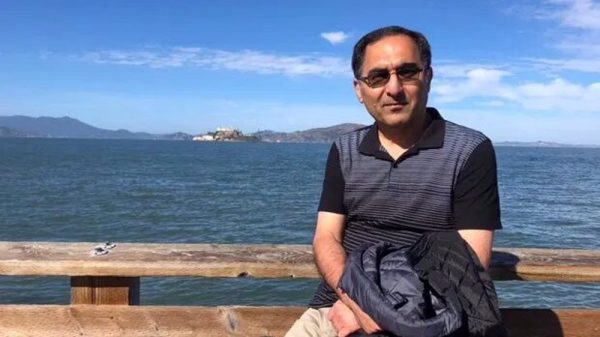
Undated picture provided by ISNA of US-held Iranian scientist, Sirous Asgari
Press TV – April 29, 2020
An Iranian scientist — who remains behind bars in the US despite having been exonerated in a sanctions trial — has contracted the new coronavirus after he repeatedly drew attention to his fragile health and called for his release from the “dirty” and “overcrowded” jail facility.
The Guardian reported the lawyers representing Sirous Asgari, a professor of material sciences at Sharif University of Technology, had confirmed his infection on Tuesday.
He has repeatedly pleaded for release since March, complaining about unsanitary detention conditions and overcrowding at the Louisiana facility, where he is being kept.
Coughing violently and suffering from a fever, Asgari told the paper in a phone call that the detention center was even taking in more inmates rather than releasing some as a precaution to stop further spread of the outbreak.
He also said the US Immigration and Customs Enforcement (Ice) had refused to notify him about his positive test results, adding that he only learned about his infection from his lawyers and family members on Tuesday.
“It makes sense to send me to the hospital as soon as possible. I don’t trust them at all,” the 59-year-old said. “If something happens, they are not fast responders … I prefer to leave this dirty place.”
The detainees are responsible for all the cleaning at the detention facility,” where there is a single shower and only two toilets for all 44 of them to share,” the daily reported.
Ice, however, has told Asgari’s lawyers he would only be released to a hospital if he was struggling to breathe.
Asgari was arrested in the United States in mid-2017. Back then, the FBI alleged the scientist had shared information about a project he had conducted on a sabbatical in the US five years before with his students.
His wife, though, said in an interview in late March that the findings of the project had been published and made available on the Internet afterwards, which means there was nothing secret about the project. US legal authorities then charged him with withholding information in the process of visa application, circumventing the sanctions, and transferring technology to Iran.
Washington then delayed the holding of a trial for him several times, “all the while knowing they had no evidence to bring against him,” she said.
The Iranian professor was cleared of the charges at a court session that was ultimately scheduled after about two and a half years. Nevertheless, US Citizenship and Immigration Services then took the matters out of the hands of the country’s legal system, once again detaining Asgari for “lacking a valid visa and illegal presence on US soil.”
Mr. Asgari has reminded US officials that they themselves had seized his passport and were, hence, responsible for his prolonged presence in America.
His spouse said Washington was intentionally prolonging Asgari’s detention so that it could eventually swap him with an American prisoner held in Iran.
US return to JCPOA can end impasse over Iran
By M. K. BHADRAKUMAR | Indian Punchline | April 28, 2020
In business transactions and international diplomacy alike, there could be constant variables and dependent variables. Constant variable is where the value cannot be changed once it has been assigned a value. But it becomes a dependent variable if it is susceptible or open to the effect of an associated factor or phenomenon. Then, there is also a third independent variable, which is a factor or phenomenon whose value is given or set already that can cause or influence a dependent variable.
A big question for international security has arisen: What type of variable is at work as the US prepares a legal argument that it still remains a “participant” in the 2015 Iran nuclear accord known as JCPOA?
Both New York Times and Fox News, which reported on this development on Sunday maintained that the Trump administration’s ploy to reenter the JCPOA is riveted on a strategy to invoke the “snapback” clause, which would restore the comprehensive pre-2015 UN sanctions on Iran.
Much depends on the UN Security Council members. What if they come up with a dependent / independent variable that accedes to the US status as “participant”, provided Washington agrees to ‘X’, ‘Y’, ‘C’ factor or phenomenon? Trade-offs are more the rule than the exception in the UN SC; constant variable is a rare occurrence at the horseshoe table.
A Reuters report today, in fact, highlights that the Trump administration can expect “a tough, messy battle if it uses a threat to trigger a return of all United Nations sanctions on Iran as leverage to get the 15-member Security Council to extend and strengthen an arms embargo on Tehran.”
The report quoted a European diplomat: “It’s very difficult to present yourself as a compliance watcher of a resolution you decided to pull out of. Either you’re in or either you’re out.” This is the crux of the matter.
Tehran has already notified the European Union that any move to re-impose UN sanctions through the back door will trigger a vehement reaction — including, possibly, Iran exiting the Nuclear Non-Proliferation Treaty.
The EU and the three European signatories of the JCPOA (UK, France and Germany) are extremely wary of the JCPOA being abandoned. Their sincerity of purpose is self-evident in the IMPEX mechanism (which enables limited trade between European companies and Iran despite US sanctions.)
The EU’s foreign policy chief Josep Borrell recently expressed regret about the US’ opposition to the IMF lending money to Iran against the backdrop of the coronavirus pandemic. The German Foreign Minister Heiko Maas publicly shared Borrell’s view.
Having said that, it is an entirely different ball game if the US were to walk back as “participant” in the JCPOA as original signatory. If that happens, everything else becomes negotiable — including fresh talks to renegotiate the terms of JCPOA. Tehran has laid down Washington’s return to the JCPOA as the sole precondition for talks.
Today, Radio Farda, the Persian service of the US government-funded Radio Free Europe/Radio Liberty beamed to Iran, has carried a report US May Be Prepared To Rethink Stance On Sanctions, Nuclear Accord with Tehran which speculates precisely that on the “pretext” of extending the arms embargo against Iran, Washington could be principally “thinking of returning to the nuclear accord” and engaging with Iran in talks.
Radio Farda quoted a “usually well-informed Iran analyst in Scotland” to this effect. The report hinted that back channels are at work. Possibly, some kite-flying is going on here.
Indeed, Iranian media had reported recently that President Hassan Rouhani told a cabinet meeting in Tehran on March 25 that the “leader of a non-permanent member of the Security Council” had told him about the UN Security Council currently weighing plans for the removal of all sanctions against Iran.
Rouhani was quoted as saying at the cabinet meeting, “We are also trying to have our blocked money unfrozen.” (Rouhani was probably referring to a conversation with Kais Saied, President of Tunisia, which is a non-permanent member of the UN Security Council.)
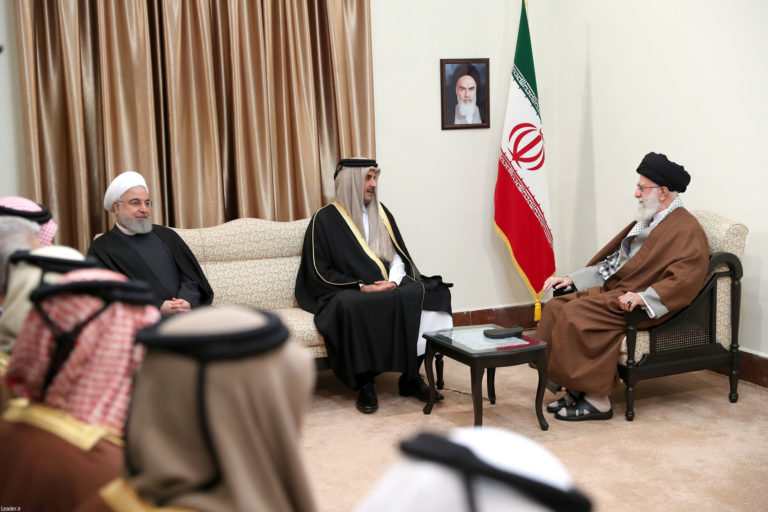
Iran hasn’t reacted to the New York Times and Fox News reports. Meanwhile, in what could well be a related development, Rouhani had a phone conversation on April 21 with the Emir of Qatar Sheikh Tamim bin Hamad Al Thani where the sanctions issue figured.
Interestingly, an Iranian Foreign Ministry statement later verbatim quoted from the conversation. Rouhani told Sheikh Tamim:
“The US pressure and sanctions against Iran are not only a violation of international law, but also they are violating human principles by intensifying their behaviour in these difficult circumstances, including preventing the International Monetary Fund from lending to Iran”.
“We believe that in this special situation, all countries in the world must stand together to fight coronavirus and clearly state their positions against the hostile actions of the United States”.
“Unfortunately, they are still reluctant to end their inhumane acts, but we have no doubt that sooner or later they will have to change course.”
The Emir responded,
“Today, the world is in a special situation and we believe that in this situation, the United States must lift its sanctions and all countries must move in line with the new conditions.”
Subsequently, there has also been a conversation between the two foreign ministers. Now, Qatar, which hosts the US Central Command Hqs, is a close ally of the US. Sheikh Tamim and Trump have a warm relationship.
During the emir’s visit to the White House last July, Trump remarked, “Tamim, you’ve been a friend of mine for a long time, before I did this presidential thing, and we feel very comfortable with each other.” No doubt, if ever Trump needed a back channel with the Iranian leadership, he wouldn’t need to look beyond Sheikh Tamim. (Significantly, Sheikh Tamim made a rare visit to Tehran in January this year.)
Curiously, the day after Sheikh Tamim spoke to Rouhani, he also held a phone conversation with Trump. The White House readout said, “The president and the (emir) discussed the coronavirus response… The president encouraged the emir to take steps toward resolving the Gulf rift in order to work together to defeat the virus, minimise its economic impact and focus on critical regional issues.”
The bottom line is that the UN arms embargo is not really a big ticket item but the sanctions is. Even if the ban gets lifted in October, it is only for small arms, whereas transfer of advanced technology such as missiles will have to wait another 3 years. Iran is largely self-reliant in defence. And its asymmetric capability to generate deterrence against US aggression is legion.
The Trump administration realises that its sanctions policy has failed. The murder of the charismatic Iranian general Qassem Soleimani only hardened Tehran’s resolve to press ahead with the “axis of resistance”. And the world opinion militates against continued US sanctions against Iran.
In this backdrop, the forthcoming summit of the founding members of the UN may address the issue of sanctions. From such a perspective, the Trump administration’s seemingly belligerent move to return as “participant” in the JCPOA may turn out to be a dependent variable open to influence from one or more independent variables.
US to face tough battle in pushing plan to extend UN Iran arms embargo: Diplomats
Press TV – April 28, 2020
Diplomatic sources at the United Nations say Washington has a tough challenge ahead at the Security Council (UNSC) if it pushes for an extension of the world body’s arms embargo against Iran through recourse to a process set out in a multilateral nuclear deal that the US controversially abandoned in 2018.
The agreement — officially called the Joint Comprehensive Plan of Action (JCPOA) — was signed in 2015 between Iran and six major world states and endorsed by UNSC Resolution 2231.
However, the US unilaterally withdrew from what President Donald Trump called “the worst deal ever” in May 2018 and re-imposed anti-Iran sanctions. It has also been coercing the remaining signatories to the JCPOA to follow suit.
Under UNSC Resolution 2231, the UN arms embargo on Iran — in place since 2006/2007 — will be lifted in October 2020. The US has repeatedly expressed its anger at the possible termination of restrictions on Iran’s import and export of arms.
On Tuesday, diplomats told Reuters that Washington is planning to use a threat to trigger a return of all UN sanctions against Iran as leverage to get the Security Council to prolong the arms embargo on Tehran.
A US official, who was speaking on condition of anonymity, said Washington has shared its strategy with Britain, France and Germany, who are permanent Security Council member states and parties to the Iran deal.
The diplomats said the scheme has not been shared with the remaining 11 council members, including veto-wielders Russia and China, the two other signatories to the JCPOA that are deemed certain to oppose the arms embargo on Iran.
Reports say if the Security Council refuses to revive the embargo, the US will try to trigger a so-called snapback of all UN sanctions on Iran by claiming that it is still a party to the JCPOA and that Iran is in significant violation of the nuclear pact.
The New York Times said on Sunday that US Secretary of State Mike Pompeo was laying the groundwork to present a legal argument to the UN that Washington remains a “participant state” in the JCPOA.
It is “part of an intricate strategy to pressure the United Nations Security Council to extend an arms embargo on Tehran,” the report said.
Reuters, however, cited the UN diplomats as saying that Washington’s plan will likely be challenged since the US is no longer a party to the deal.
“It will be dead on arrival,” a Security Council diplomat predicted. “It’s very difficult to present yourself as a compliance watcher of a resolution you decided to pull out of,” a European diplomat said. “Either you’re in or either you’re out.”
Another European official said, “It’s going to be messy from a Security Council standpoint because, regardless of what (Britain, Germany and France) think, Russia and China are not going to sign up to that legal interpretation.”
Iranian Foreign Minister Mohammad Javad Zarif has dismissed Pompeo’s reported scheme, saying the plan to return to the JCPOA is rooted in the failure of Washington’s “maximum pressure” campaign against the Iranian nation.
‘US cannot cherry-pick UN resolutions’
Meanwhile, a Western diplomat, speaking on condition of anonymity, told AFP, “You cannot cherry-pick a resolution saying you implement only parts of it but you won’t do it for the rest.”
Similarly, Kelsey Davenport, director for non-proliferation policy at the US-based Arms Control Association, said “if Pompeo goes through with this plan, snapping back sanctions on Iran collapses the JCPOA.”
Even more significant, she added, the US measure could lead Iran to make good on threats to exit the nuclear Non-Proliferation Treaty (NPT).
“This is just another step that would undermine US credibility, make future negotiations with Iran more difficult and increase the risk of a nuclear crisis in the region,” she said.
‘US placing world in Catch-22 situation’
Russia also slammed the US plan, with Permanent Representative to International Organizations in Vienna Mikhail Ulyanov tweeting, “The country which officially ceased its participation in the #IranDeal cannot remain its participant by definition.”
The Russian Mission Vienna also said in a post on Twitter, “May 8, 2018 the #US says it “ends” and “terminates” its participation in the #JCPOA. Now there are claims that it still considers itself a participant. Is this a “Catch-22” sort of situation for Iran, UNSC and the whole world?”
Netanyahu Is Back Yet Again
Israel will become much bigger
By Philip Giraldi • Unz Review • April 28, 2020
Rahm Emanuel, up until recently the mayor of Chicago and before that a top advisor to the president in the Bill Clinton and Barack Obama White Houses and still earlier a volunteer in the Israeli Army, famously once commented that a good crisis should never be allowed to go to waste. He meant, of course, that a crisis can be exploited to provide cover for other shenanigans involving politicians. It was an observation that was particularly true when one was working for a sexual predator like Bill, who once attacked a “terrorist” pharmaceutical factory in Sudan to divert attention away from the breaking Monica Lewinski scandal.
To be sure, the United States government is focusing its attention on the coronavirus while also using the cover afforded to heighten the pressure on “enemies” near and far. As the coronavirus continues to spread, the Trump White House and Secretary of State Mike Pompeo have increased the ferocity of their sabre rattling, apparently in part to deter Russia, China, Iran and Venezuela. Ironically, of course, none of the countries being intimidated are actually threatening the United States, but we Americans have long since learned that perceptions are more important than facts when it comes to the current occupant of the oval office and his two predecessors.
The latest bit of mendacity coming out of the White House was a presidential tweet targeting the usual punching bag, Iran. Based on an incident that occurred two weeks ago, Trump threatened “I have instructed the United States Navy to shoot down and destroy any and all Iranian gunboats if they harass our ships at sea.” The U.S. Navy ships in question are, one might also observe, in a body of water generally referred to as the Persian Gulf, where they are carrying out maneuvers right off of the Iranian coast. Meanwhile, Iranian flying gunboats have not yet been observed off of New Jersey, but they are probably waiting to be transported to the Eastern Seaboard by those huge trans-oceanic gliders that once upon a time were allegedly being constructed by Saddam Hussein.
Given the cover provided by the virus, it should surprise no one that Israel is also playing the same game. The Jewish state has been continuing its lethal bombings of Syria, with hardly any notice in the international media. In a recent missile attack, nine people were killed near the historic city of Palmyra. Three of the dead were Syrians while six others were presumed to be Lebanese Shi’ites supporting the Damascus government. Israel de facto regards any Shi’ite as an “Iranian” or an “Iranian proxy” and therefore a “terrorist” eligible to be killed on sight.
But the bigger coronavirus story has to do with Israel’s domestic politics. Benjamin Netanyahu and his principle opponent Benny Gantz have come to an agreement to form a national government, ostensibly to deal with the health crisis. The wily Netanyahu, who will continue to be prime minister in the deal, has thereby retained his power over the government while also putting a halt to bids from the judiciary to try and sentence him on corruption charges. As part of the deal with Gantz, Netanyahu will have veto power over the naming of the new government’s attorney general and state prosecutor, guaranteeing the appointment of individuals who will dismiss the charges.
And more will be coming, with the acquiescence of Washington. U.S. elections are little more than six months away and Donald Trump clearly believes that he needs the political support of Netanyahu to energize his rabid Christian Zionist supporters, as well as the cash coming from Jewish oligarchs Sheldon Adelson, Bernard Marcus and Paul Singer. So, it is time to establish a quid pro quo, which will be Israeli government behind the scenes approaches to powerful and wealthy American Jews on behalf of Trump while the White House will look the other way while Israel annexes most of the remaining Palestinian West Bank. Pompeo has welcomed the new Israeli government and has confirmed that the annexation of the Palestinian land will be “ultimately Israel’s decision to make,” which amounts to a green light for Netanyahu to go ahead.
A vote on West Bank annexation will reportedly be taken by the Knesset at the beginning of July followed immediately by steps to incorporate Jewish settlements into Israel proper. According to the Israeli liberal newspaper Haaretz, the planned annexation has raised some concerns among a few liberal American Jewish organizations because it will convince many progressives in the U.S. that Israel has truly become an apartheid state. J Street warned that annexation “would severely imperil Israel’s future as a democratic homeland for the Jewish people, along with the future of the U.S.-Israel relationship” and has even suggested cutting U.S. aid if that step is actually taken. Most other ostensibly liberal groups have adopted the usual Zionist two-step, i.e. condemning the move but not advocating any effective steps to prevent it. And it should also be noted that the largest and most powerful Jewish organizations like the American Israel Public Affairs Committee (AIPAC) and the Zionist Organization of America (ZOA) have not raised any objections at all.
Unaffiliated individual liberal Jews, to include those who consider themselves Zionists, have generally been concerned about the move, though their argument is quite hypocritical, based on their belief that annexation would pari passu destroy any possible two-state solution, damaging both Palestinian rights and “Jewish democracy.” Some have even welcomed the change, noting that it would create a single state de facto which eventually would have to evolve into a modern democracy with equal rights for all. Such thinking is, however, nonsense. Israel under Netanyahu and whichever fascist retread that eventually succeeds him regards itself as a Jewish state and will do whatever it takes to maintain that, even including dispossessing remaining Arabs of their land and possessions, stripping them of their legal status, and forcing them to leave as refugees. That is something that might be referred to as ethnic cleansing, or even genocide.
And those Americans of conscience who are hoping for some change if someone named Joe Biden defeats Trump can also forget about that option. Biden has told the New York Times that “I believe a two-state solution remains the only way to ensure Israel’s long-term security while sustaining its Jewish and democratic identity. It is also the only way to ensure Palestinian dignity and their legitimate interest in national self-determination. And it is a necessary condition to take full advantage of the opening that exists for greater cooperation between Israel and its Arab neighbors. For all these reasons, encouraging a two-state solution remains in the critical interest of the United States.”
Unfortunately, someone should tell Joe that that particular train has already left the station due to the expansion of the Jewish state’s settlements. Nice words from the man who would be president aside, Biden is bound to the Israel Lobby for its political support and the money it provides as tightly as can be and he will fold before AIPAC and company like a cheap suit. He has famously declared that “You don’t have to be a Jew to be a Zionist – I am a Zionist” and “My Name is Joe Biden, and Everybody Knows I Love Israel.” His vice-presidential candidates’ debate with Sarah Palin in 2008 turned embarrassing when he and Palin both engaged in long soliloquys about how much they cherish Israel. Indeed they do. Every politician on the make loves Israel.
Philip M. Giraldi, Ph.D., is Executive Director of the Council for the National Interest, a 501(c)3 tax deductible educational foundation (Federal ID Number #52-1739023) that seeks a more interests-based U.S. foreign policy in the Middle East. Website is councilforthenationalinterest.org, address is P.O. Box 2157, Purcellville VA 20134 and its email is inform@cnionline.org.
Russia dismisses as ‘baseless’ US claims on IRGC satellite launch
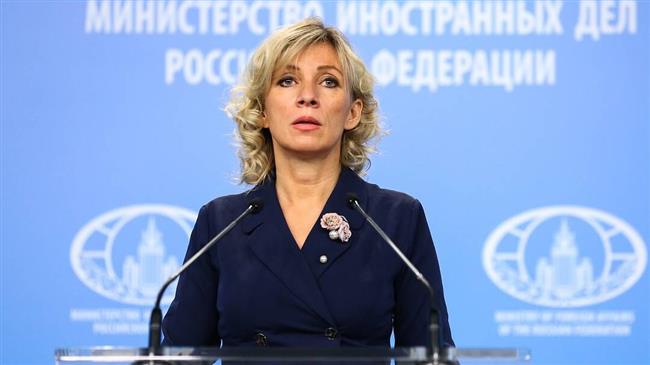
Russian Foreign Ministry Spokeswoman Maria Zakharova
Press TV – April 23, 2020
Russia has dismissed as “baseless” claims by the United States that the recent launch of Iran’s first-ever military satellite by the Islamic Revolution Guards Corps (IRGC) violates a United Nations Security Council resolution endorsing the 2015 nuclear deal between Tehran and world powers.
On Wednesday, the IRGC Aerospace Force launched the Nour (Light) satellite via the Qassed (Carrier) carrier, a move US Secretary of State Mike Pompeo was quick to condemn as a violation of United Nations Security Council Resolution 2231.
“This would not be the first time that a nation that has flagrantly breached the norms of international law and violated UNSC resolution 2231 is trying to deflect international condemnation by baselessly accusing Iran of noncompliance with the requirements of the Security Council,” Russia’s Sputnik news agency quoted Foreign Ministry spokeswoman Maria Zakharova as saying at a briefing on Thursday.
She noted that neither the resolution nor the 2015 Iran nuclear deal restrict Iran’s right to explore space to peaceful ends.
She added that Iran has made it clear that it does not intend to develop nuclear weapons, unlike the US, which has over the past months unveiled several plans to expand its nuclear arsenal.
“There are no, there have never been, and hopefully there will never be nuclear weapons in Iran. Iran, adhering to the resolution, does not develop, test or use ballistic missiles capable of carrying nuclear weapons, unlike the United States, which surprises the world every single day with news about plans to develop their nuclear missile capabilities,” she said.
The remarks came after Pompeo said Iran needed “to be held accountable” for the launch, claiming that the move violated UNSC Resolution 2231.
This is while the resolution in question calls on Iran “not to undertake any activity related to ballistic missiles designed to be capable of delivering nuclear weapons, including launches using such ballistic missile technology.”
The Nour-1 is Iran’s first multi-purpose satellite with application in the defense industry, among other areas. It is also the first Iranian satellite with an expected operational life of more than a year in Earth’s orbit.
Trump says ordered Navy to destroy Iranian boats ‘if they harass’ US ships
Press TV – April 22, 2020
US President Donald Trump is stepping up his anti-Iran threats by claiming that he has instructed the US Navy to destroy Iranian boats “if they harass” US ships in the Persian Gulf.
“I have instructed the United States Navy to shoot down and destroy any and all Iranian gunboats if they harass our ships at sea,” Trump wrote in a tweet posted on Wednesday morning.
The order is Trump’s first reaction to a recent confrontation between US warships and Iranian boats in the Persian Gulf.
Trump posted the tweet as his administration is under unprecedented pressure over its highly criticized response to the coronavirus pandemic, prompting suggestions that his anti-Iran statement is probably meant to divert attentions from his poor handling of the crisis.
A video released by Iran’s Islamic Revolution Guards Corps on Sunday shows the IRGC Navy warning off a flotilla of US warships in the Persian Gulf as they try to approach the Iranian territorial waters.
In the video, a personnel of the IRGC Navy warns the vessels to stop inspecting and detaining Iranian fishing or commercial ships in the Persian Gulf and the Sea of Oman.
He also warns them that they would face consequences according to the laws of the Islamic Republic of Iran if they ignore this notice.
Tensions in the strategic waterway rose significantly last summer after a series of mysterious explosions targeted a number of oil tankers.
The US, quickly blaming Iran for the incidents without providing conclusive evidence along with other countries such as Saudi Arabia, has since deployed thousands of troops and military equipment to the region.
Meanwhile, in a statement released on Sunday, the IRGC refuted the claims by the US that Iranian forces behaved in a dangerous manner when faced with US Navy vessels.
The IRGC further blamed Washington as the main source of insecurity in the in West Asia region and called for the full withdrawal of all American forces.
Report says Iran may have replicated Israeli missile downed in Syria
Press TV – April 20, 2020
A Russian aviation news outlet says Iran may have replicated an Israeli missile that was shot down in Syria, citing a video of the test of a new Iranian anti-tank missile.
Avia.Pro reported that the new missile seems to resemble one of the Israeli projectiles that were downed by the Russian electronic warfare system during an attack on Syria,.
The report added that the downed missile was later successfully removed from the country by “Iranian intelligence service”, and was studied and completely copied.
The news outlet shared a video that showed the accuracy of the Iranian copy of the Israeli “Spike” missile in hitting its target.
Avia.Pro quoted experts as saying that Iran may use Israeli missiles against Tel Aviv itself in the near future.
Iranian authorities have repeatedly said that the country’s missile program has not been established for non-conventional purposes and is only meant as part of the country’s deterrence capability.
Iran holds the very first ranking in the field of missile technology among the Middle Eastern countries, according to a commander of the Islamic Revolution Guards Corps (IRGC).
“Today, we rank first in the missile technology at the regional level and are placed among the few global powers in this regard,” Brigadier General Amir Ali Hajizadeh, the commander of the Aerospace Division of the IRGC, said last August.
In June, Major General Hossein Salami, the chief commander of the IRGC, said Iran had managed to change the balance of power in its favor by harnessing the technology required for manufacturing ballistic missiles.
Salami said the Islamic Republic acquired the know-how 12 years ago while trying to prepare its defenses against the United States’ aircraft carriers.
Iran’s defense ministry makes mass delivery of new drones to army
Press TV – April 18, 2020
Iran’s defense ministry has made mass delivery of new combat and surveillance drones, including a jet-powered multipurpose UAV (unmanned aerial vehicle) to Army’s Air force and Air Defense Force.
The event took place during an official ceremony at the Iran Aviation Industries Organization (IAIO) in Isfahan with the presence of Defense Minister Brigadier General Amir Hatami and other senior military officials, a day after Iran’s Army Day.
Speaking during the ceremony, Hatami said that the multipurpose jet-powered UAV could travel at speeds of 900 kph and conduct operations at an altitude of 12 kilometers.
He added that the drone can fly for up to 180 minutes and have a range of 1000 kilometers.
Mass delivery of Ababil 3 and Karar drones
During the ceremony, a large contingent of Ababil 3 and Karar drones was also delivered to the Air force.
Speaking about the Ababil-3 drone, Hatami said that the drone is a medium-range surveillance craft capable of conducting airstrikes within a 150 kilometer radius.
He also said that the Karar drone is a strategic combat drone which can deliver payloads comparable to manned aircraft.
He added that the drone has pin-point attack capability and can be used in suicide attacks.
Iran has taken great strides seeking to attain self-sufficiency in producing essential military equipment and defense systems in the face of decades-long US sanctions and arms embargoes on the country.
Earlier this month, Iran announced that it is planning to produce a 6,000 ton destroyer later this year.
According to a statement by Iran’s Navy commander last week, Iran is also considering the development of nuclear-powered submarines.
Iran releases ‘political prisoners’ amid Covid-19 outbreak, while virus-stricken UK keeps Assange behind bars
RT | April 9, 2020
Tehran has released an Iranian national seen as a political prisoner in the UK as it fights the coronavirus. British activists and media rushed to say Iran’s move was not enough – while being blind to a bigger problem at home.
Aras Amiri, an Iranian national and UK resident who worked with the British Council, has been temporarily released from jail, where she has been held since 2018 after being found guilty of spying. The move is likely to be a part of efforts taken by Tehran to stem the spread of the novel coronavirus in prisons in particular.
The UK board director of Amnesty International, Daren Nair, used the occasion to remind his Twitter followers that Amiri was “unjustly imprisoned” and to demand that Iranian authorities not just set her free but “let her come home to London to be with her fiancé.” The news was then eagerly picked up by various Western media outlets, including Radio Free Europe.
Amiri was arrested back in 2018 while on a family visit to Iran. Her work with the British Council reportedly involved organizing film festivals and other cultural exchanges between the two countries. The organization, describing itself as the UK’s “international organization for cultural relations and educational opportunities,” has been banned in Iran since 2009 in response to the launch of the BBC’s Persian service and the British embassy’s supposedly “significant role” in protests that rocked the country earlier the same year.
It seems that Iran – which various British officials and activists like to scold over alleged human rights violations – is showing concern for the fate of its inmates in the face of an epidemic that has seen more than 64,000 people infected nationwide.
Earlier, Tehran also temporarily released another person who has long been seen in the UK as a victim of unjust political persecution. Nazanin Zaghari-Ratcliffe, a British-Iranian journalist and aid worker, was sentenced to five years on charges of plotting to overthrow the Iranian government back in 2016.
In mid-March, she was among some 85,000 other inmates released from Tehran’s Evin prison as part of the state response to the spread of Covid-19. On March 29, her temporary leave was extended by an additional fortnight.
Such measures were just what UN Human Rights Chief Michelle Bachelet had called for in an address to governments around the world amid the pandemic.
However, Julian Assange, whom Amnesty International also called “a prisoner of conscience,” has so far been denied the same treatment from UK authorities. The British justice system has refused to release him from maximum security prison HMP Belmarsh on bail, even though the facility has already reported not just several confirmed coronavirus cases, but the first death within its walls from the dreaded disease.
Activists, medics and even the UN rapporteur on torture have repeatedly pointed to the WikiLeaks founder’s poor state of health while calling for his release. However, their pleas apparently do not provide enough ground for London to release Assange, who has not been found guilty of any serious offenses and is awaiting a court decision on his extradition to the US.
Why the US wouldn’t Ease Iran Sanctions
By Salman Rafi Sheikh – New Eastern Outlook – 09.04.2020
The past two weeks have seen US officials moving first from issuing an alert to their military commanders to make plans for a retaliatory strike against Iranian targets to talking about ‘easing’ sanctions on Iran if Iran ‘wants it.’ It’s obvious that there is no reason why the Iranians wouldn’t want to see sanctions against them being eased up. Yet, Trump’s desire for a formal request about this issue shows the latent intention of ignoring it, while using the whole scenario to its advantage i.e., let the situation exacerbate to an extent whereby the Iranian regime becomes unstable and incapable of rescuing its people from the virus, and thus collapse ultimately.
This would surely serve US interests, along with those of Saudi Arabia and Israel, which have been pushing hard to do a “regime change” in Tehran. In their calculation, the unprecedented crisis caused by the COVID-19 seems to have given them yet another opportunity to attain their ultimate objective.
Indeed, this was the intention when the US asked its military commanders to make plans for a retaliatory strike on Iran in response to an imaginary Iranian attack on US military bases—an attack that had neither been planned nor was it foreseen by anybody. But the fact that the US was going to ‘directly attack the Iranian forces’ in the wake of Iran supported militias attacking US troops shows that the intention was, as Trump himself said, to go “up the food chain”, thus creating a scenario that would be extremely difficult for Tehran to address.
Accordingly, as a part of US ‘war preparations’, the US military officials disclosed, seemingly on purpose, to the western media that Patriot air defence systems have been deployed to two Iraqi military bases and that the same systems were going to be deployed across two more bases.
While manufacturing a military crisis is one thing, executing it is another. Accordingly, even if the US ‘had a plan’, it doesn’t mean it was going to work due to multiple factors, including lack of support from US allies in Europe, who were already in the middle of operationalising Instex to start economic and financial transactions with Iran, bypassing US sanctions and showcasing their ‘independent’ approach towards Iran in the wake of widening gap between the US and Europe/NATO.
But the US sanctions are still intact; for easing sanctions will allow, in the US calculation, the Iranian regime to better tackle the COVID-19 crisis and thus stabilise itself politically and economically. This would thus undermine the very purpose of the US sanctions i.e., forcing the Iranian regime to implode and collapse.
Indeed, a collapse followed by a massive crisis in the Middle East, particularly one that involves Iran, is something that the US would welcome rather than desist. It shows why the US imposed new sanctions on Iran instead of removing the old ones.
It has happened recently when Iran, out of the necessity to cope with monetary shortfall, requested 5 billion dollars from the International Monetary Fund (IMF). While this was always obvious that the request will not be granted without US acquiescence, the US actually responded by announcing new sanctions on Iran’s oil industry, one of its very few remaining foreign exchange earners. The intention was to make life even more difficult for the Iranians.
Also, it explains why Washington has so far taken no serious steps to actually ease the sanctions on its own, even though sufficient conditions for doing so undoubtedly exist, including Iran’s response whereby they called for a halt to “warmongering during the coronavirus outbreak” and further warned that US military activities could create “instability and disaster”. On April 2, Foreign Minister Javad Zarif, addressing the US president, tweeted, “Don’t be misled by usual warmongers, AGAIN. Iran starts no wars, but teaches lessons to those who do.”
Notwithstanding the ‘progressive’ US rhetoric about easing sanctions if Iran asks for it, the fact of the matter remains that the US strategic aim in this part of the world remains a “regime change” in Iran, although it is also becoming clear with every day passing that this objective can never be achieved.
Europe has already started Instex, although it is yet to produce productive economic results and engage in economic and financial activity beyond the support for COVID-19. The Chinese have yet again come out against US war aggression, and the Russians remain a bulwark against any US adventure in the Middle East, particularly against Iran.
None of this, of course, means that the US will end its sanctions. On the other hand, it will continue to add more to the pool as it did a few days ago; after all, ‘Iranian crisis’ is the linchpin of the US military presence in the region and the key source of wealth for its military-industrial complex.
Salman Rafi Sheikh is a research-analyst of International Relations and Pakistan’s foreign and domestic affairs.
Featured Video

Trita Parsi: Middle East Unraveling — Are We on the Path to World War?
or go to
Aletho News Archives – Video-Images
New Book
Trans agenda is ‘normalization of sadism’ – US author

RT | September 23, 2026
The US Democratic Party has embraced a transgender agenda that amounts to “the normalization of sadism,” author A.J. Rice has said, warning that radical trans policies would return if the party is allowed to regain power.
Speaking to RT’s America First host Scotty Nell Hughes about his new book, ‘The Curse of the Bearded Lady: How the Trans Mafia Whacked American Sanity’, Rice argued that activists have gained significant influence in schools, medicine, and corporate America while people who questioned the agenda have faced pressure to stay silent.
The author described the “trans mafia” as the sprawling network of people and institutions that have helped the movement gain influence. He singled out parts of academia, wealthy backers, and corporations, and stated that providers of transition-related treatment also have a financial incentive to keep young people in their care indefinitely.
Rice argued that the consequences of these policies ultimately fall on children who are being drawn toward gender-affirming medical treatments and on girls who are expected to share locker rooms or compete in sports with biological males.
He noted that while voters rejected the Democrats’ approach to gender in 2024, the party, which has been “captured by madness,” has since only doubled down and is seeking what is effectively “the normalization of sadism.” … Full report
Blog Roll
 Aletho News
- Integrity Initiative: UK-funded network framed dissent as Russian disinformation for years
- ‘We don’t seek permission to defend our country’: Snippets from President Pezeshkian’s UNGA address
- NATO chief wants Europeans to fight American wars [for Israel]
- German chemicals giant reveals details of downsizing
- Refaat Al-Areer Was The Canary In The Coal Mine In Israel’s War On The Truth
- Israeli election committee bars candidate from Knesset race over Gaza war opposition
- French-Lebanese man files war crimes complaint over Israeli attacks
- Mahan Air Flight Lands in China Despite US Threat against Iranian Airlines
- US eyes $10bn fund to rebuild war-battered Gulf infrastructure
- Trump meets Rodríguez near Maduro’s prison as Venezuela’s oil flows to US
- If Americans Knew
- Caught on Tape: AIPAC CEO Boasted of Controlling Trump’s National Security Officials
- Why Hamas Attacked Israel in October 2023 – Israeli professor Ilan Pappé
- They see them, then kill them: Israeli quadcopters track, deliberately target civilians in Gaza
- Winter could turn Gaza’s treacherous, war-damaged buildings into deathtraps
- Majority of Democratic Voters Want to Prosecute Both Biden and Trump Administration Officials Over Gaza
- As Gaza languishes, world leaders gather at the UN – Daily Update
- Sanctions are collective punishment: immoral and self-defeating
- Phosphorus Munitions Fired by Israel Burn Groves, Orchards in Southern Lebanon
- Israel Carries Out New Ceasefire Violations Across Gaza
- AI – Emphasis on the ‘I’: Israel Is Funding AI Chatbot Propaganda
- No Tricks Zone
- New Study: Earth And Venus Surface Warmth Largely Explained By Convection And Lapse Rate, Not CO2 Or Radiation
- 2025 Nature Paper Claiming Worsening Global Drought Gets RETRACTED …Heavily Flawed
- New Study: ‘Global Drought Shows No Detectable Recent Acceleration Under Climate Warming’
- Economic Masterminds: German Socialists Suggest Taxing Productivity Gains Stemming From Using AI
- The South China Sea Has Not Been Cooperating With The Climate Change Narrative
- Energy Crisis: Germany Enters Heating Season With Historically Low Gas Reserve Fill Levels
- New Study: The Antarctic Ice Sheet Gained Mass From 2020-2024 Due To Staggering Snow And Ice Accumulation
- Study: Ocean Heating Rates From Thousands Of Years Ago ‘Dwarf’ Modern Ocean Heating Rates
- Climate Extremists Target, Attack Large-Scale Power Grid Infrastructure In Germany!
- New Study: Antarctic Ice Melt Has Contributed Less Than 1 Centimeter To Sea Level Rise In The Last 30 Years

