Iran surges in Venezuela in defiance of US sanctions
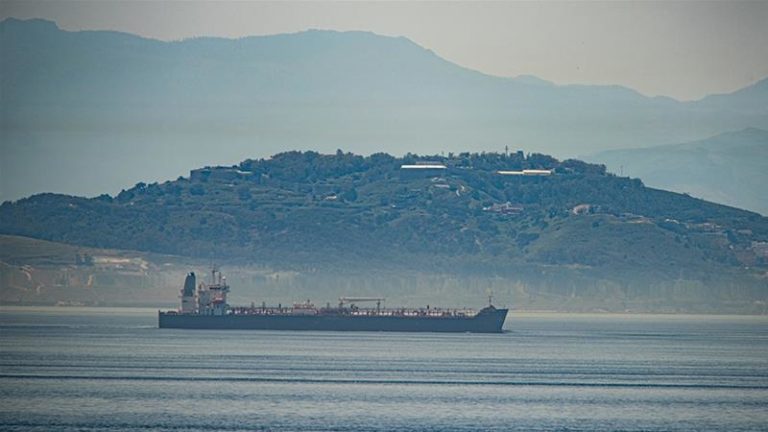
Iranian oil tanker Clavel crossing the Gibraltar stretch heading for Venezuela, May 20, 2020
By M. K. BHADRAKUMAR | Indian Punchline | May 25, 2020
Escorted by the Venezuelan navy and air force, an Iranian oil tanker named Fortune has entered that country’s waters on Sunday, amidst intense speculation whether the US would interfere with the delivery. The US has imposed oil sanctions against Venezuela and Iran and had said it is monitoring the Iranian tanker.
In fact, five Iranian tankers carrying about 1.5m barrels of fuel passed through the Suez Canal earlier this month, according to shipping data on Refinitiv Eikon, and were heading for Venezuela. The other four Iranian tankers — Forest, Petunia, Faxon and Clavel — are approaching the Caribbean en route to Venezuela.
A flotilla of US Navy and Coast Guard vessels is patrolling the Caribbean Sea on a mission to counter illicit drug trafficking. But the Pentagon has stated that there are no plans to stop the Iranian tankers.
At the same time, a Pentagon spokesman, Jonathan Hoffman, while saying on Thursday he was not aware of any operations related to the Iranian cargoes, also added, “We have continued to say that Iran and Venezuela – both two outliers in the international order – [are] clearly violating international sanctions on both nations with this transaction.”
The US sanctions on Venezuela are aimed at increasing pressure on President Maduro to step down. Thus, arguably, Iran is frontally challenging the Trump administration’s stated policy of ‘regime change’ in Venezuela. The Iranian move comes just three weeks after the abortive coup attempt masterminded by the White House on May 1 with the participation of two former US Green Berets aimed at capturing Maduro and transport him to the US in American helicopters to be put on trial on fake drug trafficking charges.
The coup attempt showed the extent of desperation in Washington to overthrow the Maduro government before the US presidential election in November, which President Trump hopes would help him garner Hispanic votes. Iran has now offered a lifeline to Venezuela.
In an historical context, this becomes a frontal assault by Iran on the Monroe Doctrine dating back to the 19th century, which in US foreign policy calculus regarded the Western Hemisphere as its sphere of influence. According to a Reuters report, the Trump administration said earlier this month it was “considering measures” it could take in response to the Iranian shipments, without providing specifics.
No doubt, this is a deliberate sanctions-busting enterprise by Iran. Venezuela desperately needs fuel for up to 1,800 gasoline stations that have been partially closed for weeks due to insufficient supply from state-run refineries.
Venezuela’s gasoline output is now limited to a single facility, the Amuay refinery, but most fuel produced is low octane as most of the country’s alkylation units are out of service. Imported alkylate could improve the quality of domestic gasoline. Venezuela’s refineries are in poor condition. Shipments of equipment in flights by Iran’s Mahan Air have arrived in Venezuela in recent weeks to start repair work.
It will be interesting to see whether the US Navy would interdict any of the other four Iranian tankers before they enter Venezuelan waters. Tehran has sternly warned the US that it would retaliate if any such attempt is made. On Saturday, Tehran raised the ante with President Hassan Rouhani explicitly warning, “If our oil tankers in the Caribbean Sea or anywhere else in the world get into trouble caused by the Americans, they (US) will run into trouble reciprocally.”
Washington is well aware of Iran’s capability to create big problems for the US Navy deployed in the Persian Gulf, especially the Strait of Hormuz. Last week, in a precautionary step, US Navy, via the Maritime Safety Office run by the National Geospatial-Intelligence Agency, alerted all international maritime traffic to maintain a safe distance of at least 100 meters from US naval vessels in international waters and straits. Pentagon officials separately confirmed that the stay-away warning to marine traffic in the Persian Gulf, the Arabian Sea and the Gulf of Oman was actually intended for Iran.
In geopolitical terms, Iran’s strategic defiance of the US in the Western Hemisphere makes an interesting case study not only of the decline in American influence in its backyard to the south but the entire efficacy of the “sphere of influence” concept in contemporary world politics. This is one thing.
More importantly, in the backdrop of the Iranian tanker reaching Venezuela, Caracas has described Iran as a “revolutionary partner” in the struggle against US imperialism. From the Iranian viewpoint, Venezuela becomes a part of the “axis of resistance” against the US. To be sure, the audacity of the two countries will irritate Washington to no end.
How far the Iran-Venezuela axis will deepen and expand will bear watch. Importantly, the UN Security Council embargo against Iran exporting arms to other countries is expiring in October. The US move to extend the timeline of the embargo is unlikely to succeed, given the strong negative reaction by Russia and China. It is entirely conceivable that a matrix of military cooperation may commence in a near future involving Iran and Venezuela.
Iran’s indigenously developed missile capability acts as a deterrent against US aggression. Iran has transferred missile technology to Hezbollah, which is estimated to have the capability today to inflict significant damage to Israel in the event of any aggression by the latter on Lebanon. Significantly, the deterrence is working and Israel no longer stages attacks on Lebanon.
A similar shift in the strategic balance with Iran’s help can create more space for Venezuela to push back at the US. All in all, Iran appears to be working on a strategy to help Venezuela to maintain its strategic autonomy. There is enormous potential for cooperation and coordination between Iran and Venezuela. If Venezuela has the largest known oil reserves in the world, Iran too has massive reserves of oil and gas.
The despatch of oil to lubricate the beleaguered Venezuelan economy may prove to be the harbinger of an assertive Iranian power projection elsewhere in Latin America too. Surely, in the near term, it is a rebuff to the Trump administration’s maximum pressure strategy against Iran. In a longer-term perspective, a concerted regional strategy in Latin America by Russia, China and Iran can seriously erode the US influence in the continent.
Iranian Supreme Leader Tweets Country Will Support Any Nation That Fights Israel
Sputnik – 20.05.2020
Iran’s Supreme Leader announced on Wednesday his country would “support and assist any nation or any group anywhere” in its struggles against Israel. His comments follow a Palestinian withdrawal from agreements with Israel over its proposed annexation of the West Bank.
“The Zionist regime has proven it won’t abide by any treaty & understands no logic except force,” Iranian Supreme Leader Ali Khamenei wrote in a Wednesday statement posted on Twitter as a series of tweets. “The nature of the Zionist regime is incompatible with peace, because the Zionists seek to expand their territories & will certainly not be limited to what they have already occupied.”
“Eliminating the Zionist regime doesn’t mean eliminating Jews. We aren’t against Jews. It means abolishing the imposed regime & Muslim, Christian & Jewish Palestinians choose their own govt & expel thugs like Netanyahu. This is ‘Eliminating Israel’ & it will happen,” the Shiite religious leader explained. “A proposal for a referendum to choose the type of govt for the historical country of #Palestine was registered with the UN as offered by Iran. We say the true Palestinians with Palestinian roots of at least 100 years, and Palestinians living abroad, choose the govt of Palestine.”
“Comprehensive struggles by the Palestinian nation – political, military & cultural – should continue till the usurpers submit to the referendum for the Palestinian nation. This nation should determine what political system should rule there; struggle must continue until then,” Khamenei continued. “We will support and assist any nation or any group anywhere who opposes and fights the Zionist regime, and we do not hesitate to say this.”
Khamenei’s comments follow an announcement by the Palestinian Authority on Tuesday that it would cease to abide by any of its agreements with either Israel or the United States – a move itself in response to an announcement by the newly formed Israeli government to begin annexing one-third of the West Bank as soon as July. […]
The area Tel Aviv seeks to annex is part of what is known as “Zone C” under the Second Oslo Accords in 1995, a part of the West Bank subjected to Israel military control. However, the area Prime Minister Benjamin Netanyahu has proposed annexing is roughly 30% of the West Bank and not all of Area C, but mostly the Jordan River valley. As Sputnik has reported, the Israel Defense Forces have used this control to systematically evict Palestinian villages from the fertile land along the River Jordan for decades, later turning the land over to Israeli settlers who now number close to 400,000 in the zone.
Will Trump Really Start Two Wars Instead of “Just” One?
The Saker | Unz Review | May 20, 2020
Amidst the worldwide pandemic induced scare most of us have probably lost track of all the other potential dangers which still threaten international peace and stability. Allow me to list just a few headlines which, I strongly believe, deserve much more attention than what they got so far. Here we go:
- Military Times : “5 Iran tankers sailing to Venezuela amid US pressure tactics“
- Time : “5 Iranian Tankers Head to Venezuela Amid Heightened Tensions Between U.S. and Tehran“
- FoxNews: “Iran tankers sailing to Venezuela in effort to undermine US sanctions“
Notice that Military Times speaks of “US pressure tactics”, Time of “tensions” and FoxNews of “efforts to undermine US sanctions”?
I don’t think that this is a coincidence. Folks in the US military are much more in touch with reality than the flag-waving prostitutes which some people call “reporters” or “journalists”.
Furthermore, the US has embarked on a new policy to justify its acts of piracy on the high seas with something called Visit, Board, Search and Seizure (VBSS) all under the pretext of the war on drugs. To get a better understanding of the context of these developments I asked a specialist of Maritime issues of our community, NatSouth, who replied the following: (stress added)
If a ship does not comply with the request to be boarded, it is usual that the pursuing authorities must gain the permission of the ‘flag’ state prior to boarding, on the high seas and the pursuit has to have started in the coastal state’s jurisdictional waters. The caveat here is that in the Caribbean – Caribbean Regional Maritime Agreement (CRA) – (long name: Agreement Concerning Co-operation in Suppressing Illicit Maritime and Air Trafficking in Narcotic Drugs and Psychotropic Substances in the Caribbean Area). So, there is an agreement with participating coastal states on boardings and pursuits in EEZs and the like. You can find more on the legal aspects of boardings at sea here: and more info on so-called “consensual boardings” here.
The anti-drug/ counterterrorism angle allows the U.S. Navy and the USCG to carry out interdictions on the high seas. Important point to note whether this approach will be taken to interdict the tankers, given that Venezuela is a declared narco-State. The absurdity is that Venezuela isn’t the primary transit point in the region, Colombia holds that honour.
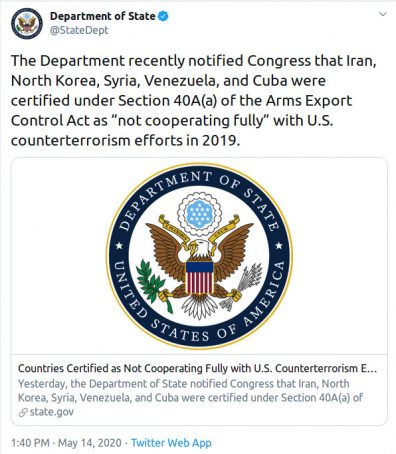
If I could add at this point, the origins are that Venezuela didn’t wish to play ball with Washington anymore, specifically with the DEA back in 2005, squaring the circle of sorts, (or should that be a vicious circle cunningly used by Washington, because who is going to argue with that narrative, aka the war on terror). March: SOUTHCOM’s Adm. Faller: “There will be an increase in US military presence in the hemisphere later this year. This will include an enhanced presence of ships, aircraft, & security forces to reassure our partners… & counter a range of threats to include illicit narco-terrorism.” At the same time, the State dept released this tweet, so the US could effectively carry out boardings under the guise of counterterrorism as well.
While the Iranian tankers were in the Mediterranean, Washington released a (delayed) “Global Maritime Sanctions Advisory”, to the maritime industry, setting out guidelines to shipowners and insurers to enable them to avoid the risks of sanctions penalties related to North Korea, Syria and Iran. This also concerns oil exports from Iran, (but doesn’t apply to Iranian flagged ships). This came after the State Dept gave warning notice to oil companies to stop operations, including Rosneft (Russia), Reliance (India) and Repsol (Spain).
Then NatSouth concluded the following:
Under international law, every merchant ship must be registered with a flag state, which has jurisdiction over the vessel. Hence, this time, the use of Iranian-flagged tankers, as a direct response from Washington’s latest version of restating “maximum pressure” campaign on enforcement of Iran and Venezuela sanctions, (back in Feb, literally the same language as in Aug 2019). There was talk back then of a naval embargo, which would a serious notch up in tensions. There was mention of the 4 U.S. warships in the Caribbean, the U.S. Navy tweeted about, but one the Preble went through the Panama Canal into the Pacific).
Pretty clear, isn’t it?
What the US is doing is substituting itself for the United Nations and it is now openly claiming the right to board any vessel under whatever kind of pious pretext like, say, narco-trafficing, nuclear proliferation, sanctions against so-called “rogue states”, etc. Clearly, the AngloZionists expect everybody to roll over and take it.
How likely is that?
Let’s look at a few Iranian headlines, all from PressTV:
- PressTV, May 16th: “Iran’s fuel shipment to Venezuela guaranteed by its missile power“
- PressTV, May 17th: “US aware Iran will respond ‘very strongly’ if Venezuela-bound ships attacked: Analyst“
- PressTV, May 18th: “Iran: US bears responsibility for any foolish act against tankers heading to Venezuela“
Three days in a row. I think that it is fair to assume that the Iranians are trying very hard to convince Uncle Shmuel not to mess with these tankers. Does anybody seriously believe that the Iranians are bluffing?
Before we look at some of the aspects of this potential crisis, let’s just mention a few things here.
First, the US is acting in total and official illegality. Just like the bombing of Syria, the threats to Iran, or the US murderous sanctions Uncle Shmuel imposes left and right – the blockade of Venezuela is a) totally illegal and b) an act of war under international law.
Second, if USN commanders think they can operate with impunity only because the Caribbean is far away from Iran, they are kidding themselves. Yes, Iranian forces cannot defend these tankers so far away from home, nor can they take any action against the USN in the Atlantic-Caribbean theater of naval operations. But what they can and will do is retaliate against any AngloZionist target in the Middle-East, including any oil/gas tanker.
Third, while Venezuela’s military is tiny and weak compared to the immensely expensive and bloated US military, being immensely expensive and bloated is no guarantee of success. In fact, and depending on how the Venezuelan leadership perceives its options, there could be some very real risk for the USA in any attempt to interfere with the free passage of these ships.
What do I mean by that?
Did you know that Venezuela had four squadrons of Su-30MKV for a total of 22 aircraft? Did you know that Venezuela also had an unknown number of Kh-31A supersonic anti-shipping missiles? And did you know that Venezuela had a number of S-300VM and 9K317M2 Buk-M2E long range and medium range SAMs?
True, that is nowhere near the amount of weapons systems Venezuela would need to withstand a determined US attack, but it is more than enough to create some real headaches for US planners. Do you remember what the Argentinian Air Force did to the British Navy during the Malvinas war? Not only did the Argentinians sink two Type 42 guided missile destroyers (the HMS Sheffield and the HMS Coventry) which were providing long-range radar and medium-high altitude missile picket for the British carriers, they also destroyed 2 frigates, 1 landing ship, 1 landing craft, 1 container ship. Frankly, considering how poorly defended the British carriers were, it is only luck which saved them from destruction (that, and the lack of sufficient number of Super Étendard strike aircraft and Exocet missiles). I would add here that the British military, having been defeated on many occasions, has learned the painful lessons of their past defeats and does not suffer from the cocky-sure attitude of the US military. As a result, they were very careful during the war against Argentina and that caution was one of the factors which gave a Britain well-deserved the victory (I mean that in military terms only; in moral terms this was just another imperialist war with all the evil that entails). Had the Argentinians had a modern air force and enough anti-shipping missiles, the war could have taken a very different turn.
Returning to the topic of Venezuela, war is a much more complex phenomenon than just a struggle of military forces. In fact, I strongly believe that political factors will remain the single most important determinant factor of most wars, even in the 21st century. And chances are that the Venezuelans, being the militarily weaker side, will look to political factors to prevail. Here is one possible scenario among many other possible ones:
Caracas decides that the US seizing/attacking the Iranian tankers constitutes an existential threat to Venezuela because if that action goes unchallenged, then the US will totally “strangle” Venezuela. Of course, the Venezuelan military cannot take on the immense US military, but what they could do is force a US intervention, say by attacking one/several USN vessel(s). Such an attack, if even only partially successful, would force the US to retaliate, bringing US forces closer not only to Venezuelan air defenses, but also closer to the Venezuelan people which will see any US retaliation as an illegitimate counter-counter-attack following the fully legitimate Venezuelan counter-attack.
Then there is the problem of defining victory. In the US political “culture” winning is usually defined as pressing a few buttons to fire off some standoff weapons, kill lots of civilians, and then declare that the “indispensable nation” has “kicked the other guy’s ass”. The problem with that is the following one: if they other guy is very visibly weaker and has no chance for a military victory of his own, then the best option for him is to declare that “surviving is winning” – meaning that if Maduro stays in power, then Venezuela as won. How would the USA cope with that kind of narrative? Keep in mind that Caracas is a city of over two million people which even in peacetime is rather dangerous (courtesy of both regular crime and potential guerilla activities). Yet, for Maduro to “win” all he has to show is that he controls Caracas. Keep in mind that even if the US forces succeed in creating some kind of “zone of real democracy” somewhere near the Colombian border, that will mean nothing to Maduro, especially considering the terrain between the border and the capital city (please check out this very high resolution map of Venezuela or this medium resolution one). As for the notion of a USN landing on the shores of Venezuela, all we need to do is to remember how the immense Hodgepodge of units which were tasked with invading Grenada (including 2 Ranger Battalions, Navy Seals, most of an Airborne Division, etc. for a total of over 7,000 soldiers(!) against a tiny nation which never expected to be invaded (for details, and a good laugh, see here for a full list of participating US forces!) was defeated by the waves of the Caribbean and the few Cuban military engineers who resisted with small-arms fire (eventually, most of the 82AB was calling in to fix this mess).
In other words, if Maduro remains in power in Caracas then, in political terms, Venezuela wins even though it would loose in purely military terms.
This phenomenon is hardly something new, as shown by the following famous quote by Ho Chi Minh: “You can kill ten of my men for every one I kill of yours. But even at those odds, you will lose and I will win.”
By the way, this is exactly the same problem the Empire faces with Iran: as long as the Islamic Republic remains an Islamic Republic it “wins” in any exchange of strikes with the USA and/or Israel.
Still, it is pretty obvious that the US can turn much of Venezuela into a smoking heap of ruins. That is true (just like what the USA did to Korea, Vietnam, Iraq or Serbia and Israel what did to Lebanon in 2006). But that would hardly constitute a “victory” in any imaginable sense of the word. Again, in theory, the US might be able to secure a number of landing locations and then send in an intervention force which could try to take key locations in Caracas. But what would happen after that? Not only would the hardcore Chavistas trigger a guerilla insurrection which would be impossible to crush (when is the last time the USA prevailed in a counter-insurgency war?), but many Venezuelans would expect the US to pay for reconstruction (and they would be right, according to the rules of international law, “once you take it, you own it” meaning that the USA would become responsible for the socio-economic situation of the country). Finally, there is always the option of an anti-leadership “decapitating” strike of some kind. I believe that in purely military terms, the US has the know-how and resources to accomplish this. I do not believe that this option would secure anything for the USA, instead – it would further destabilize the situation and would trigger some kind of reaction by the Venezuelan military both outside and inside Venezuela. If anything, the repeated failures of the various coup attempts against Chavez and Maduro prove that the the bulk of the military remains firmly behind the Chavistas (and the failed coup only served to unmask the traitors and replace them anyway!).
The bottom line is this: if Uncle Shmuel decides to seize/attack the Iranian tankers, there is not only a quasi certitude of a war between the US and Iran (or, at the very least, an exchange of strikes), but there is also a non-trivial possibility that Maduro and his government might actually decide to provoke the USA into a war they really can’t win.
Is Trump capable of starting a process which will result in not one, but two wars?
You betcha he is! A guy who thinks in categories like “my button is bigger than yours” or “super-dooper weapons” obviously understands exactly *nothing* about warfare, while the climate of messianic narcissism prevailing among the US ruling classes gives them a sense of total impunity.
Let’s hope that cooler heads, possibly in the military, will prevail. The last thing the world needs today is another needless war of choice, never mind two more.
US, other foreign forces must leave Syria, respect its sovereignty: Iran
Press TV – May 18, 2020
Iran’s permanent ambassador to the United Nations says the US must end its illegal occupation of Syria and stop shielding terrorist groups under the mask of fighting terrorism.
Majid Takht Ravanchi made the remarks in a Monday address to a virtual meeting of United Nations Security Council dubbed “Middle East: Syria – Political”.
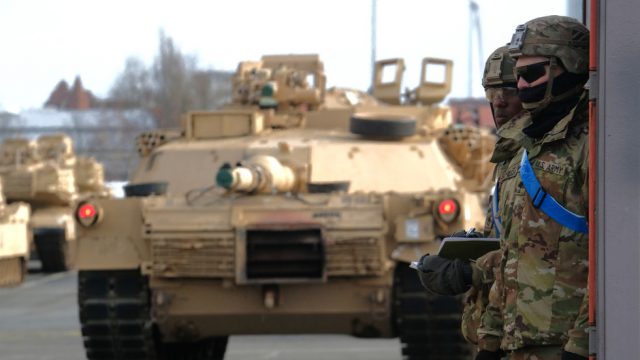
“Sovereignty, political independence, unity and territorial integrity of Syria must be fully respected by all, and accordingly, all foreign forces whose presence is not permitted by the Syrian Government must leave the Syrian territory,” the Iranian diplomat said.
“In this regard, the living example is the occupation of certain parts of Syria by the US forces who continue to support and shield terrorist groups under the mask of combatting terrorism,” he went on to say.
He further rejected any separatist agendas as well as “any and all attempts to create new realities on the ground, including through illegitimate self-rule initiatives.”
Takht Ravanchi slammed the “illegal” occupation of Syria’s Golan Heights by Israel, and said the recognition by the US of its annexation to Israel is null and void.
“Condemning such unlawful irresponsible act, we stress that Golan is and will remain a part and parcel of the Syrian territory,” he added.
Israel seized the Golan Heights from Syria after the 1967 Six-Day War and later occupied it in a move that has never been recognized by the international community. However, in a highly provocative move on March 25 last year US President Donald Trump signed a proclamation recognizing Israel’s “sovereignty” over the Syrian territory.
Damascus strongly condemned the move and called it a “blatant attack on the sovereignty and territorial integrity” of Syria.
Since the onset of the occupation, Tel Aviv has been building dozens of settlements in the region and has used it to carry out a number of military operations against the Arab country.
In his Monday speech, Takht Ravanchi also condemned Israel’s aggressions against Syria as a “gross violation of international law and the UN Charter”, stressing that the Syrian Government has a sovereign right to decide how and when to exercise its inherent right to individual or collective self-defense.
“Such aggressions must come to an end,” he urged.
Israel frequently attacks military targets inside Syria in what is considered as an attempt to prop up foreign-backed Takfiri terrorist groups that have been suffering heavy defeats against Syrian government forces.
The Damascus government has several times complained to the UN about Israel’s illegal strikes on Syria.
Iran Majlis committee endorses anti-Zionism motion
Press TV – May 18, 2020
Majlis (the Iranian Parliament)’s Committee on National Security and Foreign Policy has approved a motion that outlines the manner of confrontation on the national and international scale against the Zionist regime of Israel’s atrocities.
The parliament had designated the plan as a double-urgency motion on May 12 and submitted it for approval to the committee as the main legislative body to review the measure.
The committee released the approved version under the “The Motion for Confrontation against the Zionist regime [of Israel]’s Actions Targeting Peace and Security” on Saturday, after examining it and making some amendments, Fars News Agency reported on Sunday.
The amended version tasked all national organizations to deploy available national and international capacities towards confronting the Israeli regime’s actions against the oppressed Palestinian nation and Muslim countries, including Iran, as well as the regime’s role in disrupting regional and international peace and security.
As instances of the regime’s actions against Palestinians that warranted confrontation, it cited Tel Aviv’s large-scale and systematic violation of human rights through continued occupation of Palestinian and other territories, setting up of illegal settlements across the occupied Palestinian territories, attempting annexation of more Palestinian land, and keeping Palestinians under siege.
The Israeli regime, the motion noted, was also engaged in warmongering, terrorism, electronic warfare, and deployment of heavy and banned weapons against civilians throughout the region and elsewhere as its other actions that had to be confronted.
Virtual Embassy
The committee obliged the Foreign Ministry to lay the groundwork for the creation of the Islamic Republic’s Virtual Embassy in Palestine within six months, and submit the results for approval to the cabinet.
In so doing, the Ministry was required to conduct consultations with the countries that it saw fit.
The Ministry was also asked to pursue Iran’s initiative for “realization of nationwide referendum in Palestine” — a plan that the Islamic Republic has devised with emancipation of the territories from Israeli occupation in mind.
Iran’s Attorney General was, meanwhile, tasked to work in cooperation with the Ministry and other relevant domestic and foreign bodies towards prosecution of Israeli officials at competent tribunals for their atrocities.
The parliamentary committee demanded that the Iranian government provide support for various domestic and international parties, who engage in activities targeting the occupying regime.
The government was also required to try preventing the prospect of any normalization with Tel Aviv on the regional scale and among the world’s Muslim countries, and outline the “Zionism worse than Apartheid” mindset across various international organizations.
The Islamic Republic’s cultural bodies, including the Ministry of Culture and Islamic Guidance and the Islamic Republic of Iran Broadcasting, were assigned the task of engaging in extensive cultural activity aimed at exposing the Zionist regime’s nature and atrocities.
The committee also strictly prohibited the use of Israeli software and hardware inside the country, the entry and transit of Israeli commodities and individuals through the Islamic Republic’s soil, and engagement with any Israeli entity.
Iranian Official Denies Rumors about Agreement on Assad’s Resignation
Tasnim | May, 17, 2020
TEHRAN – A senior adviser to Iran’s parliament speaker categorically denied reports about Tehran and Moscow agreeing on the resignation of Syrian President Bashar al-Assad.
In a post on his Twitter account, senior adviser to the Iranian parliament speaker for international affairs Hossein Amir Abdollahian dismissed as “a big lie” the rumors about a plan for the resignation of Syria’s president.
“Dr. Bashar al-Assad is the legitimate president of Syria and the great leader of the fight against Takfiri terrorism in the Arab world,” he said.
“The rumor of an agreement between Iran and Russia on his (Assad’s) resignation is a big lie and a plot from the American-Zionist media,” the Iranian official added.
“Tehran strongly supports the sovereignty, national unity and territorial integrity of Syria,” Amir Abdollahian underlined.
His comments came in response to media speculations that Iran, Russia and Turkey may reach a consensus to remove the Syrian president and establish a ceasefire in exchange for forming a transitional government that includes the opposition, members of the Syrian government and the so-called Syrian Democratic Forces (SDF).
Iran’s fuel shipment to Venezuela guaranteed by its missile power
Press TV – May 16, 2020
Iran is shipping tons of gasoline to Venezuela in defiance of US sanctions on both countries in a symbolic move guaranteed by Tehran’s missile prowess.
Unconfirmed reports and tanker monitoring groups suggest that at least five Iranian-flagged tankers are transporting fuel to Venezuela through the Atlantic Ocean despite the US sanctions on both Tehran and Caracas.
Iran has intentionally hoisted its own flag over the huge tankers which are navigating through the Atlantic before the eyes of the US Navy.
Iran is shipping large consignments of gasoline to Venezuela even though the US would try to intercept the shipments and seize the tankers.
There are unconfirmed reports that the US Navy has deployed its USS Detroit (LCS-7), USS Lassen (DDG-82), USS Preble (DDG-88), and USS Farragut (DDG-99) to the Caribbean along with its patrol aircraft Boeing P8-Poseidon for possible encounter with the Iranian vessels.
However, analysts say it is very unlikely that the US makes such a mistake, as it would have serious repercussions for the Trump administration ahead of the November elections.
The US would not dare to seize the Iranian vessels especially after Iran’s reaction to a similar move by the United Kingdom, a close ally of Washington.
Iran also has the upper hand thanks to its missile power, which was shown to the US in the IRGC’s retaliatory missile attacks on the Ain al-Assad Airbase in Iraq, which accommodated American troops.
The US was also reminded of the Islamic Republic’s missile prowess following the recent successful launch of Nour-1 military satellite, which reached its orbit using the Qased satellite carrier. Some Western analysts claim the satellite achievements are a prelude to Iran’s program to develop intercontinental ballistic missiles (ICBMs).
Confident about its missile capabilities, Iran is going on with the gasoline shipment to its ally in Latin America, mocking the US sanctions on the oil sectors of both countries.
The US seems to be between the rock and hard place. While it is unlikely for Washington to dare to intercept the tankers, if they reach their destination safe and sound, it may tarnish the “superpower” forever.
The fuel shipment also shows Iran’s success in turning into an exporter of gasoline after years of importing the fuel.
A senior official in US President Donald Trump’s administration told Reuters on Thursday that the United States was considering measures against Iran in response to the fuel shipment.
The official said Washington has a “high degree of certainty” that the Venezuelan government is paying Iran in gold for the fuel.
If these claims are confirmed, the “fuel for gold” exchange is also a great achievement for the Islamic Republic amid the US’ maximum pressure policy, which deprives the country’s economy of billions of dollars’ worth of oil revenues.
There are reports that Iran is receiving nine tons of gold in exchange for the fuel its ships transport to Venezuela. Under the cruel sanctions imposed by the US after its withdrawal from the 2015 nuclear deal in 2018, nine tons of gold can be a very precious asset for the Iranian economy.
However, we must still wait and see whether the US administration would let the Iranian tankers go and strip Washington of its “superpower” title, or it would dare to intercept the vessels and endanger Donald Trump’s campaign ahead of the November elections.
Earlier in the day, Iranian government spokesman Ali Rabiei said Venezuela and Iran are both independent states that have had and will continue to have trade relations with each other.
“We sell goods and buy goods in return. This trade has nothing to do with anyone else. We have to sell our oil and we have ways to do it,” Rabiei said in reaction to reports of the fuel shipment to the Latin American country.
See also:
US interception of Iran vessel to Venezuela would be ‘completely illegal
Turkey stalls Iran gas imports amid aggressive US efforts to push its LNG
Press TV – May 13, 2020
Turkey is dragging its feet on repairing a pipeline which was hit by an explosion in late March, stopping Iran’s gas exports to the country, the Fars news agency says.
Iran sells about 10 billion cubic meters a year of gas to Turkey under a 25-year supply deal signed in 1996. The pipeline has been blown up several times by PKK terrorists, but it has been repaired and the gas flow has continued shortly.
However, after another blast occurred on the pipeline on March 31, an official at the National Iranian Gas Company (NIGC) said the Turkish side was not responding even as Iran had informed it of the incident.
According to Mehdi Jamshidi-Dana, Turkey’s representative at Bazargan gas transmission station had left his post due to the outbreak of the novel coronavirus.
The official said it was not clear when the line would re-open, but he cited past experience which showed “repairing the lines takes three to seven days, depending on the amount of damage done”.
On Wednesday, Fars suggested that the pipeline is still out of service, citing Turkish state energy company Botas’ dilly-dallying and unwillingness to repair it.
The news agency speculated that the situation must be the result of aggressive US efforts to push its liquefied natural gas (LNG) into Turkey.
Heavily dependent on gas imports from Russia, Turkey has already reduced flows from Gazprom significantly, while increasing LNG purchases and gas imports from Azerbaijan.
“In recent months, Turkey has imported as much LNG from the United States as gas imports from Iran,” Ali Nasr, an energy expert, told Fars.
Last November, Turkey marked the completion of the Trans-Anatolian Natural Gas Pipeline (TANAP) to carry gas from Azerbaijan’s Shah Deniz II field to Europe.
In January, the presidents of Turkey and Russia formally launched the TurkStream pipeline to carry Russian natural gas to southern Europe through Turkey.
Fars warned that Iran may lose its biggest gas market to rivals, which could cost the country $150 million-$200 million in lost revenues a month.
The US has the necessary incentive to remove Iranian gas from the Turkish market in order to increase economic pressure on Iran, while Turkey seeks to diversity its energy sources and reduce gas imports from Iran and Russia, the agency said.
The US is currently pushing Trump’s “energy dominance” agenda that seeks to advance diplomatic and policy objectives through rapidly expanding US oil and gas exports.
Iran has already lost its biggest condensate market in South Korea which imported 300,000 barrels per day (bpd) of the ultra light oil from the Middle Eastern country.
The Koreans stopped the shipments under pressure from the United States which is aggressively thrusting its fast-growing condensate into Asia.
According to US officials, Washington has offered to sign a $100 billion trade agreement with Turkey, which their presidents discussed at the Munich Security Conference.
The offer is part of the Trump administration’s main goal to get President Recep Tayyip Erdogan drop plans to use Russia’s S-400 missile defense systems.
“If an agreement is reached, the possibility of replacing Iranian gas with American LNG is quite possible,” Fars warned.
According to the news agency stated, Turkey has expanded its LNG terminals to take in 25 billion cubic meters of cargoes – 2.5 times more than the imported gas from Iran. The terminals are currently operating only at 25 percent of their nominal capacity. … Full article
Pompeo and the capricious virus
By M. K. BHADRAKUMAR | Indian Punchline | May 4, 2020
Iran, by its announcement Sunday that mosques will start reopening in low-risk areas of the country from May 5, has delivered a devastating blow to the ego of the Trump administration, puncturing it beyond repair.
President Hassan Rouhani said mosques would reopen in 132 regions designated as white under a colour-coded system after being consistently free of the new coronavirus. “Friday prayers will also resume in those areas and the mosques that respect the health protocols,” Rouhani added. The US had to settle for a “virtual” Easter mass, but observant Muslims in Iran will pray during Ramadan in their mosques.
Iran has already lifted a ban on inter-city trips and malls, with large shopping centres resuming activities. Rouhani also disclosed that schools in low-risk areas will be re-opened by May 16 to allow for a month of classes before exams are held.
The Health Ministry in Tehran said Saturday the rate of infections has started a definite downward trend. This has been possible because as many as 78 million people were screened for the COVID-19 symptoms in the first phase of a nationwide program and 30 million in the second phase.
For a country with a population of 84 million, this is an astounding record. In contrast, testing in the US remains scarce, with roughly 5.5 million tests performed since the first confirmed US case on January 20th.
A recent analysis by Harvard researchers and STAT shows that as the US tries to move beyond its months-long coronavirus testing debacle — faulty tests, shortages of tests, and guidelines that excluded many people who should have been tested to mitigate the outbreak — it is at risk of fumbling the next challenge: testing enough people to determine which cities and states can safely reopen and stay open.
Iran is one of the Middle Eastern countries hardest hit by the outbreak. Its crisis was compounded by the fact that Trump administration ensured through a barbaric sanctions regime that Tehran would have to combat the pandemic with one hand tied behind its back from the time its first COVID-19 infection cases appeared in late February.
The Trump administration’s — particularly the evangelist secretary of state Mike Pompeo’s — optimistic assessment was that under the assault of Covid-19, Iran would simply collapse for want of medicines and equipment, hospital beds and ventilators.
But the mother of all ironies is that on Sunday, even as Rouhani declared a defining moment in the pandemic in Iran, President Trump revised upward the possible death toll in the US closer to 100,000. Over a million Americans have been infected by the virus so far and nearly 70,000 lives have been lost.
The corresponding figures in Iran tell a story by itself: Iran has a total of 97,424 cases of the coronavirus. 78,422 patients have recovered and been discharged from hospitals so far. The death toll from the outbreak rose by 47 over the past 24 hours to 6,203, Iran’s lowest in nearly two months.
Iran has a population which is a quarter of the population of the US and by the American experience, at least a quarter million Iranian citizens should have been infected and somewhere around 18,000 lives should have been lost by now.
What emerges out of all this is that the US is an incredibly sloppy country despite its vainglorious claims of being a superpower and is ruled by an utterly incompetent government. To hide the shame and disgrace, Pompeo has plunged into a blame game.
On Sunday, Pompeo said: “There is enormous evidence that that’s where this began,” later adding: “I can tell you that there is a significant amount of evidence that this came from that laboratory in Wuhan.” Pompeo appeared confused. Only last Thursday, he was on record as saying in a radio interview, “We don’t know if it (the virus) came from the Wuhan Institute of Virology. We don’t know if it emanated from the wet market or yet some other place. We don’t know those answers.”
This revisionist thesis of the “Wuhan virus” becomes necessary as it emerged by the weekend that the death toll in the US would go up at least by another fifty percent. Pompeo is having to contend with an unprecedented diplomatic disaster on the world arena, as the US stands exposed as a bumbling giant with feet of clay. The world community will rightly wonder how a country that cannot adequately protect its citizens can be a provider of security for other countries.
What Pompeo refuses to acknowledge is that countries in the so-called “Orient” such as Iran could so successfully handle the Covid-19 crisis — with composure, grit and an earthy wisdom — that shows up the US as a decadent power. The countries in Asia, the Middle East and Central Asia are handling the situation so much better with so few resources, while the US is grovelling on the ground, lamenting its misfortune and indulging in blame games.
In a virtual “town hall” meeting on Fox News on Sunday night, President Donald Trump admitted that the coronavirus has proved more devastating than he had expected and the death toll from the ravaging pandemic might reach as high as 100,000 in the US. He pleaded during the two-hour broadcast that although he was warned about the coronavirus in his regular intelligence briefing on Jan. 23, the information was characterised as if “it was not a big deal” and had not been presented in an alarming way that demanded immediate action.
From what Trump said, Covid-19 poses a riddle to his administration. It killed nearly 70,000 Americans so far, but in Iraq, the body count is fewer than 100; in Malaysia also around 100; in Bangladesh 182.
Or, take the body count in countries that are in close proximity to China: Taiwan – 6; Kazakhstan – 27; Kyrgyzstan -10; Laos – 0; Cambodia-0; Myanmar-6; Nepal-0; Thailand-54. The metropolis of New York has been devastated while teeming Asian cities like New Delhi, Mumbai and Kolkata have so far been largely spared.
Would Pompeo have an answer? He is peeved that Beijing has not allowed western scientists to enter Wuhan and conduct research. But that privilege wasn’t extended to Vietnam, either. Maybe, Vietnam can teach the US something here that could have profound implications for how countries respond to the virus.
Vietnam, which shares a border with China and is about 1,200 miles from where the outbreak was first reported in Wuhan, has reported 245 confirmed cases with 95 recoveries and no fatalities. Yes — zero fatalities.
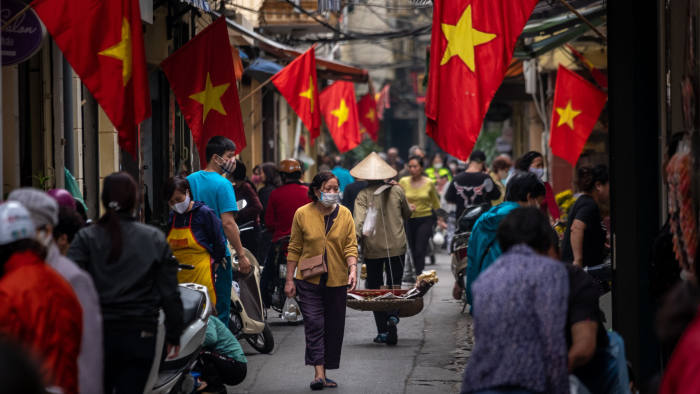
Vietnam reported 245 confirmed cases of Covid-19, no fatalities.
Clearly, Pompeo got it right but for the wrong reasons — this probably has got everything to do with the Chinese Communist Party.
A Vietnamese commentary comes out with a definitive explanation: “The Communist Party of Vietnam has strengthened its anti-pandemic measures by implementing nationwide social distancing rules, such as banning outside gatherings of more than two people while keeping a distance of 6.5 feet, and temporary shutdowns of “non-essential” businesses, including restaurants, entertainment centres and tourist sites…
“Unlike the U.S. capitalist class and the Trump administration, the Vietnamese government took early measures to combat the current coronavirus epidemic. Officials began preparing strategies to combat the outbreak immediately after the first cases emerged in China.”
“On February 1, Prime Minister Nguyen Xuan Phuc signed Decision No.173.QD-TTG, categorising the virus as a Class A contagious disease “that can transmit very rapidly and spread widely with high mortality rates.” This declaration of a national emergency came after the sixth case of coronavirus in the country was reported. In contrast, the Trump administration only declared a national emergency over the global pandemic on March 13, when there were at least 1,920 confirmed cases across 46 states.”
Read a blog featured by World Bank, Containing the coronavirus (COVID-19): Lessons from Vietnam. Life is such that sometimes, even horrific tragedies can have straightforward explanations. The capricious virus knew it, but not Pompeo.
Iran Under Siege from Humanitarian Imperialism amid Pandemic

NDI’s former President Kenneth Wollack and Chairman Madeleine K. Albright pose with Nazanin Boniadi. Credit: Margot Schulman/ Facebook)
By Danny Haiphong | American Herald Tribune | May 3, 2020
Iran is once again under siege from humanitarian imperialism. The United Nations (UN) has released multiple reports in recent weeks criticizing the Iranian government for supposed human rights violations in relation to the treatment of prisoners and its lockdown procedures during the COVID-19 pandemic. Nazanin Boniadi, a board of director at the Center for Human Rights in Iran, authored a piece in The Washington Post that exploits the pandemic to paint Iran as a human rights catastrophe. An examination of just one of Boniadi’s claims exposes how far the U.S. and its imperialist allies will go to build the case for regime change in Iran.
Boniadi claims that Iran’s failure to maintain a humane release policy of prisoners within the country has contributed to undue suffering from COVID-19. Yet the individual she chooses to defend all but reduces her credibility to zero. Boniadi claims that several prisoners have been returned to prison prematurely, and names Samaneh Norouz Moradi as a victim of this policy. Sameneh Norouz Moradi is a leading activist in the campaign to return Prince Reza Pehlavi to Iran. Prince Reza Pehlavi is the eldest son of Mohammad Reza Pehlavi, otherwise known as the Shah of Iran. This is indeed the same monarch that butchered Iranians in the tens of thousands to ensure the country’s assets remained the property of the West. In just one sentence, Nazanin Boniadi reveals that the purpose of her article and her struggle for human rights is to reinstall the U.S. and Western friendly puppet regime that once reigned over Iran.
The discovery of what is thought to be the mummified body of #RezaShah could be seen as somewhat of an omen for Iranians who were chanting “Reza Shah Rest In Peace” in the recent #IranProtests https://t.co/zIyaMGUmTd https://t.co/kXyffRR3l5
— Nazanin Boniadi (@NazaninBoniadi) April 24, 2018
The human rights industry offers lucrative careers for the likes of Boniadi. Boniadi is a Hollywood star and an Iranian exile with extensive experience in the human rights industry. She served as a spokesperson for Amnesty International for six years from 2009 to 2015. Her service to Amnesty International coincides with the organization’s outright support for U.S.-led regime change wars. The so-called “human rights” organization defended the overthrow of Libya in 2011 and the ongoing invasion of Syria led by the U.S. and its Israeli, Gulf, and Western allies.
It is no surprise, then, that Boniadi now serves on the board of the Center for Human Rights in Iran (CHRI), a dubious human rights organization which fails to disclose its funding sources. A cursory look at Boniadi’s colleagues reveals how deeply the CHRI is embedded in the humanitarian imperialist agenda led by the United States. Chairwoman of the board Minky Worden is also the Director of Global Initiatives at Human Rights Watch. Throughout the 1990s, Worden served as an adviser to Hong Kong’s Martin Lee, a staunch anti-China proxy who has called for the British to recolonize Hong Kong. Lee has given deep support to the rightwing movement currently waging a violent campaign to separate Hong Kong from China under the guise of “human rights.” The rest of the CHRI’s staff is a who’s who of former NED-funded functionaries such as executive director Hadi Ghaemi or advisers to U.S. government and private sector posts such as Michael Eisner.
Humanitarian imperialist think-tanks and NGOs such as CHRI are not interested in human rights in Iran or anywhere else. Their selective focus on nations under siege from the U.S. and its imperial allies reveal that so-called “human rights” organizations are nothing but proxies of regime change. The U.S. military state has viewed the spread of COVID-19 in Iran as an opportunity to build upon this long-standing geopolitical objective. CHRI’s clamor for Iran to correct its alleged human rights abuses comes as the U.S. has escalated its forty-plus year war on Iran. Since mid-March, the U.S. has intensified sanctions on Iran, threatened outright U.S. naval aggression, and reinforced an arms embargo outlined in the nuclear agreement that the U.S. exited in 2018. For the architects of regime change, COVID-19 represents nothing more than opportunity to strike when their target is weakest.
What humanitarian imperialists fail to mention is that Iran has waged a largely successful campaign to reduce the spread of COVID-19 despite the presence of crippling sanctions and the threat of a U.S.-led war. Iran temporarily released seventy-thousand prisoners to prevent the virus’ spread behind prison walls. The World Health Organization’s envoy to Iran praised the country’s initiatives for bringing down the number of COVID-19 cases and deaths in a relatively short period. Such initiatives include mandatory social distancing, the redirection of production toward masks and testing kits, and detailed contact tracing to isolate infected individuals. COVID-19 deaths have declined by around seventy percent since it was announced in mid-March that one Iranian every ten minutes was dying from the virus.
If humanitarian imperialists cared about the Iranian people, then they wouldn’t attempt to use the spread of a deadly pandemic to achieve the U.S.’ geopolitical objective of overthrowing the Iranian government. Furthermore, targeting Iran at this vulnerable time only exposes the truly hypocritical “human rights” framework employed by NGOS such as the Center for Human Rights in Iran. The United States has failed to institute any significant release program for its 2.3 million prisoners. This has led to a countless number of deaths in prisons across the country. Furthermore, the U.S. currently leads the world in the number of deaths from COVID-19 and has allowed the virus to genocidally murder Black Americans at rates upward of three times their percentage of the general population in states such as Michigan and Wisconsin.
COVID-19 has exposed the United States as a human rights train wreck which has no right to tell nations such as Iran how to conduct its domestic affairs. The U.S. is an expert at mass murder for the sake of private profit and found itself unprepared when COVID-19 began to spread within its borders. Instead of fostering cooperation with China, Iran, and the rest of the world in the fight against COVID-19, the U.S. has pirated medical supplies, threatened Iran and Venezuela with outright war, and refused to heed the call of the United Nations for a global ceasefire. That there is no NGO to address the ongoing war crimes of the United States is a lesson into the function of the “human rights” industry. NGOs represent the public relations arm of humanitarian imperialism, which is why their work is most prominently featured in the corporate media when Washington is escalating wars of regime change abroad.
Police brutality, incarceration, and state repression are serious human rights issues. Many people are rightfully concerned about human rights as they witness the horrifying and needless consequences of the COVID-19 pandemic worldwide. The U.S. and West have demonstrated in their response to COVID-19 that their societies are organized to stifle human rights in order to maximize the profits of a tiny capitalist class and the hegemony of the military state that protects this class. Activists and journalists must reject the humanitarian imperialists currently politicizing trendy social justice issues to undermine the self-determination of nations such as Iran. Iran is under siege as it battles a pandemic, and peace and social justice-loving people in the U.S. should demand that their government stops making the situation worse.
With apparently fabricated nuclear documents, Netanyahu pushed the US towards war with Iran
By Gareth Porter | The Grayzone | April 29, 2020
President Donald Trump scrapped the nuclear deal with Iran and continued to risk war with Iran based on Israeli Prime Minister Benjamin Netanyahu’s claim to have proven definitively that Iran was determined to manufacture nuclear weapons. Netanyahu not only spun Trump but much of the corporate media as well, duping them with the public unveiling of what he claimed was the entire secret Iranian “nuclear archive.”
In early April 2018, Netanyahu briefed Trump privately on the supposed Iranian nuclear archive and secured his promise to leave the Joint Comprehensive Plan of Action (JCPOA). That April 30, Netanyahu took the briefing to the public in a characteristically dramatic live performance in which he claimed Israel’s Mossad intelligence services had stolen Iran’s entire nuclear archive from Tehran. “You may well know that Iran’s leaders repeatedly deny ever pursuing nuclear weapons…” Netanyahu declared. “Well, tonight, I’m here to tell you one thing: Iran lied. Big time.”
However, an investigation of the supposed Iranian nuclear documents by The Grayzone reveals them to be the product of an Israeli disinformation operation that helped trigger the most serious threat of war since the conflict with Iran began nearly four decades ago. This investigation found multiple indications that the story of Mossad’s heist of 50,000 pages of secret nuclear files from Tehran was very likely an elaborate fiction and that the documents were fabricated by the Mossad itself.
According to the official Israeli version of events, the Iranians had gathered the nuclear documents from various locations and moved them to what Netanyahu himself described as “a dilapidated warehouse” in southern Tehran. Even assuming that Iran had secret documents demonstrating the development of nuclear weapons, the claim that top secret documents would be held in a nondescript and unguarded warehouse in Central Tehran is so unlikely that it should have raised immediate alarm bells about the story’s legitimacy.
Even more problematic was the claim by a Mossad official to Israeli journalist Ronen Bergman that Mossad knew not only in what warehouse its commandos would find the documents but precisely which safes to break into with a blowtorch. The official told Bergman the Mossad team had been guided by an intelligence asset to the few safes in the warehouse which contained the binders with the most important documents. Netanyahu bragged publicly that “very few” Iranians knew the location of the archive; the Mossad official told Bergman “only a handful of people” knew.
But two former senior CIA official, both of whom had served as the agency’s top Middle East analyst, dismissed Netanyahu’s claims as lacking credibility in responses to a query from The Grayzone.
According to Paul Pillar, who was National Intelligence Officer for the region from 2001 to 2005, “Any source on the inside of the Iranian national security apparatus would be extremely valuable in Israeli eyes, and Israeli deliberations about the handling of that source’s information presumably would be biased in favor long-term protection of the source.” The Israeli story of how its spies located the documents “does seem fishy,” Pillar said, especially considering Israel’s obvious effort to derive maximum “political-diplomatic mileage” out of the “supposed revelation” of such a well-placed source.
Graham Fuller, a 27-year veteran of the CIA who served as National Intelligence Officer for the Near East and South Asia as well as Vice-Chairman of the National Intelligence Council, offered a similar assessment of the Israeli claim. “If the Israelis had such a sensitive source in Tehran,” Fuller commented, “they would not want to risk him.” Fuller concluded that the Israelis’ claim that they had accurate knowledge of which safes to crack is “dubious, and the whole thing may be somewhat fabricated.”
No proof of authenticity
Netanyahu’s April 30 slide show presented a series of purported Iranian documents containing sensational revelations that he pointed to as proof of his insistence that Iran had lied about its interest in manufacturing nuclear weapons. The visual aides included a file supposedly dating back to early 2000 or before that detailed various ways to achieve a plan to build five nuclear weapons by mid-2003.
Another document that generated widespread media interest was an alleged report on a discussion among leading Iranian scientists of a purported mid-2003 decision by Iran’s Defense Minister to separate an existing secret nuclear weapons program into overt and covert parts.
Left out of the media coverage of these “nuclear archive” documents was a simple fact that was highly inconvenient to Netanyahu: nothing about them offered a scintilla of evidence that they were genuine. For example, not one contained the official markings of the relevant Iranian agency.
Tariq Rauf, who was head of the Verification and Security Policy Coordination Office at the International Atomic Energy Agency (IAEA) from 2001 to 2011, told The Grayzone that these markings were practically ubiquitous on official Iranian files.
“Iran is a highly bureaucratized system,” Rauf explained. “Hence, one would expect a proper book-keeping system that would record incoming correspondence, with date received, action officer, department, circulation to additional relevant officials, proper letterhead, etc.”
But as Rauf noted, the “nuclear archive” documents that were published by the Washington Post bore no such evidence of Iranian government origin. Nor did they contain other markings to indicate their creation under the auspices of an Iranian government agency.
What those documents do have in common is the mark of a rubber stamp for a filing system showing numbers for a “record”, a “file” and a “ledger binder” — like the black binders that Netanyahu flashed to the cameras during his slideshow. But these could have easily been created by the Mossad and stamped on to the documents along with the appropriate Persian numbers.
Forensic confirmation of the documents’ authenticity would have required access to the original documents. But as Netanyahu noted in his April 30, 2018 slide show, the “original Iranian materials” were kept “in a very safe place” – implying that no one would be allowed to have any such access.
Withholding access to outside experts
In fact, even the most pro-Israeli visitors to Tel Aviv have been denied access to the original documents. David Albright of the Institute for Science and International Security and Olli Heinonen of the Foundation for Defense of Democracies – both stalwart defenders of the official Israeli line on Iranian nuclear policy – reported in October 2018 that they had been given only a “slide deck” showing reproductions or excerpts of the documents.
When a team of six specialists from Harvard Kennedy School’s Belfer Center for Science and International Affairs visited Israel in January 2019 for briefings on the archive, they too were offered only a cursory browse of the supposedly original documents. Harvard Professor Matthew Bunn recalled in an interview with this writer that the team had been shown one of the binders containing what were said to be original documents relating to Iran’s relations with the IAEA and had “paged through a bit of it.”
But they were shown no documents on Iran nuclear weapons work. As Bunn admitted, “We weren’t attempting to do any forensic analysis of these documents.”
Typically, it would be the job of the U.S. government and the IAEA to authenticate the documents. Oddly, the Belfer Center delegation reported that the U.S. government and the IAEA had each received only copies of the entire archive, not the original files. And the Israelis were in no hurry to provide the genuine articles: the IAEA did not receive a complete set of documents until November 2019, according to Bunn.
By then, Netanyahu had not only already accomplished the demolition of the Iran nuclear deal; he and Trump’s ferociously hawkish CIA-director Mike Pompeo had maneuvered the president into a policy of imminent confrontation with Tehran.
The second coming of fake missile drawings
Among the documents Netanyahu flashed on the screen in his April 30, 2018 slide show was a schematic drawing of the missile reentry vehicle of an Iranian Shahab-3 missile, showing what was obviously supposed to represent a nuclear weapon inside.

Technical drawing from David Albright, Olli Heinonen, and Andrea Stricker’s “Breaking Up and Reorienting Iran’s Nuclear Weapons Program,” published by the Institute for Science and International Security on October 28, 2018.
This drawing was part of a set of eighteen technical drawings of the Shahab-3 reentry vehicle. These were found in a collection of documents secured over the course of several years between the Bush II and Obama administrations by an Iranian spy working for Germany’s BND intelligence service. Or so the Israeli official story went.
In 2013, however, a former senior German Foreign Office official named Karsten Voigt revealed to this writer that the documents had been initially provided to German intelligence by a member of the Mujaheddin E-Khalq (MEK).
The MEK is an exiled Iranian armed opposition organization that had operated under Saddam Hussein’s regime as a proxy against Iran during the Iran-Iraq War. It went on to cooperate with the Israeli Mossad beginning in the 1990s, and enjoys a close relationship with Saudi Arabia as well. Today, numerous former US officials are on the MEK’s payroll, acting as de facto lobbyists for regime change in Iran.
Voigt recalled how senior BND officials warned him they did not consider the MEK source or the materials he provided to be credible. They were worried that the Bush administration intended to use the dodgy documents to justify an attack on Iran, just as it exploited the tall tales collected from Iraqi defector codenamed “Curveball” to justify the 2003 invasion of Iraq.
As this writer first reported in 2010, the appearance of the “dunce-cap” shape of the Shahab-3 reentry vehicle in the drawings was a tell-tale sign that the documents were fabricated. Whoever drew those schematic images in 2003 was clearly under the false impression that Iran was relying on the Shahab-3 as its main deterrent force. After all, Iran had announced publicly in 2001 that the Shahab-3 was going into “serial production” and in 2003 that it was “operational.”
But those official claims by Iran were a ruse aimed primarily at deceiving Israel, which had threatened air attacks on Iran’s nuclear and missile programs. In fact, Iran’s Defense Ministry was aware that the Shahab-3 did not have sufficient range to reach Israel.
According to Michael Elleman, the author of the most definitive account of the Iranian missile program, as early as 2000, Iran’s Defense Ministry had begun developing an improved version of the Shahab-3 with a reentry vehicle boasting a far more aerodynamic “triconic baby bottle” shape – not the “dunce-cap” of the original.
As Elleman told this writer, however, foreign intelligence agencies remained unaware of the new and improved Shahab missile with a very different shape until it took its first flight test in August 2004. Among the agencies kept in the dark about the new design was Israel’s Mossad. That explains why the false documents on redesigning the Shahab-3 – the earliest dates of which were in 2002, according to an unpublished internal IAEA document – showed a reentry vehicle design that Iran had already discarded.
The role of the MEK in passing the massive tranche of supposed secret Iranian nuclear documents to the BND and its hand-in-glove relationship with the Mossad leaves little room for doubt that the documents introduced to Western intelligence 2004 were, in fact, created by the Mossad.
For the Mossad, the MEK was a convenient unit for outsourcing negative press about Iran which it did not want attributed directly to Israeli intelligence. To enhance the MEK’S credibility in the eyes foreign media and intelligence agencies, Mossad passed the coordinates of Iran’s Natanz nuclear facility to the MEK in 2002. Later, it provided to the MEK personal information such as the passport number and home telephone number of Iranian physics professor Mohsen Fakhrizadh, whose name appeared in the nuclear documents, according to the co-authors of a best-selling Israeli book on the Mossad’s covert operations.
By trotting out the same discredited technical drawing depicting the wrong Iranian missile reentry vehicle – a trick he had previously deployed to create the original case for accusing Iran of covert nuclear weapons development – the Israeli prime minister showed how confident he was in his ability to hoodwink Washington and the Western corporate media.
Netanyahu’s multiple levels of deception have been remarkably successful, despite having relied on crude stunts that any diligent news organization should have seen through. Through his manipulation of foreign governments and media, he has been able to maneuver Donald Trump and the United States into a dangerous process of confrontation that has brought the US to the precipice of military conflict with Iran.
Gareth Porter is an independent investigative journalist who has covered national security policy since 2005 and was the recipient of Gellhorn Prize for Journalism in 2012. His most recent book is The CIA Insider’s Guide to the Iran Crisis co-authored with John Kiriakou, just published in February.
Featured Video
Trita Parsi: Middle East Unraveling — Are We on the Path to World War?
or go to
Aletho News Archives – Video-Images
New Book
Trans agenda is ‘normalization of sadism’ – US author

RT | September 23, 2026
The US Democratic Party has embraced a transgender agenda that amounts to “the normalization of sadism,” author A.J. Rice has said, warning that radical trans policies would return if the party is allowed to regain power.
Speaking to RT’s America First host Scotty Nell Hughes about his new book, ‘The Curse of the Bearded Lady: How the Trans Mafia Whacked American Sanity’, Rice argued that activists have gained significant influence in schools, medicine, and corporate America while people who questioned the agenda have faced pressure to stay silent.
The author described the “trans mafia” as the sprawling network of people and institutions that have helped the movement gain influence. He singled out parts of academia, wealthy backers, and corporations, and stated that providers of transition-related treatment also have a financial incentive to keep young people in their care indefinitely.
Rice argued that the consequences of these policies ultimately fall on children who are being drawn toward gender-affirming medical treatments and on girls who are expected to share locker rooms or compete in sports with biological males.
He noted that while voters rejected the Democrats’ approach to gender in 2024, the party, which has been “captured by madness,” has since only doubled down and is seeking what is effectively “the normalization of sadism.” … Full report
Blog Roll
 Aletho News
- Integrity Initiative: UK-funded network framed dissent as Russian disinformation for years
- ‘We don’t seek permission to defend our country’: Snippets from President Pezeshkian’s UNGA address
- NATO chief wants Europeans to fight American wars [for Israel]
- German chemicals giant reveals details of downsizing
- Refaat Al-Areer Was The Canary In The Coal Mine In Israel’s War On The Truth
- Israeli election committee bars candidate from Knesset race over Gaza war opposition
- French-Lebanese man files war crimes complaint over Israeli attacks
- Mahan Air Flight Lands in China Despite US Threat against Iranian Airlines
- US eyes $10bn fund to rebuild war-battered Gulf infrastructure
- Trump meets Rodríguez near Maduro’s prison as Venezuela’s oil flows to US
- If Americans Knew
- Caught on Tape: AIPAC CEO Boasted of Controlling Trump’s National Security Officials
- Why Hamas Attacked Israel in October 2023 – Israeli professor Ilan Pappé
- They see them, then kill them: Israeli quadcopters track, deliberately target civilians in Gaza
- Winter could turn Gaza’s treacherous, war-damaged buildings into deathtraps
- Majority of Democratic Voters Want to Prosecute Both Biden and Trump Administration Officials Over Gaza
- As Gaza languishes, world leaders gather at the UN – Daily Update
- Sanctions are collective punishment: immoral and self-defeating
- Phosphorus Munitions Fired by Israel Burn Groves, Orchards in Southern Lebanon
- Israel Carries Out New Ceasefire Violations Across Gaza
- AI – Emphasis on the ‘I’: Israel Is Funding AI Chatbot Propaganda
- No Tricks Zone
- New Study: Earth And Venus Surface Warmth Largely Explained By Convection And Lapse Rate, Not CO2 Or Radiation
- 2025 Nature Paper Claiming Worsening Global Drought Gets RETRACTED …Heavily Flawed
- New Study: ‘Global Drought Shows No Detectable Recent Acceleration Under Climate Warming’
- Economic Masterminds: German Socialists Suggest Taxing Productivity Gains Stemming From Using AI
- The South China Sea Has Not Been Cooperating With The Climate Change Narrative
- Energy Crisis: Germany Enters Heating Season With Historically Low Gas Reserve Fill Levels
- New Study: The Antarctic Ice Sheet Gained Mass From 2020-2024 Due To Staggering Snow And Ice Accumulation
- Study: Ocean Heating Rates From Thousands Of Years Ago ‘Dwarf’ Modern Ocean Heating Rates
- Climate Extremists Target, Attack Large-Scale Power Grid Infrastructure In Germany!
- New Study: Antarctic Ice Melt Has Contributed Less Than 1 Centimeter To Sea Level Rise In The Last 30 Years

