Iran parliament: IAEA resolution proof of structural discrimination within UN nuclear watchdog
Press TV – June 21, 2020
The majority of lawmakers at the Iranian parliament have denounced an anti-Iran resolution recently passed by the International Atomic Energy Agency’s Board of Governors, saying the document is another indication of “structural discrimination” within the UN atomic watchdog.
In a statement read out on Sunday by Ali Karimi Firouzjaee, a member of the parliament’s presiding board, 240 MPs argued that the IAEA resolution — introduced by the three European signatories to a 2015 nuclear deal with Iran, namely France, Germany, and Britain — explicitly demonstrated the trio’s “excessive demands.”
The Islamic Republic has voluntarily implemented the Nuclear Nonproliferation Treaty (NPT) and allowed the IAEA to conduct the most rigorous inspections of its nuclear sites in the history of the Vienna-based agency, read the statement.
The lawmakers further complained about the hypocrisy of the European trio, saying they devised “the illegal anti-Iran resolution” contrary to their claims to remain committed to the Iran deal and to make efforts to salvage the deal.
The IAEA resolution clearly indicates, the MPs warned, that the three European states “have once again fallen into the trap of the United States and the Zionist regime, and joined forces with them in the failed US project of exerting maximum pressure against Iran, hence dealing another blow to international multilateralism.”
Passed by a 25-2 margin with seven abstentions, the IAEA resolution called on Iran to “fully cooperate” with the IAEA and “satisfy the Agency’s requests without any further delay,” including by providing “prompt” access to two nuclear sites.
Tehran has rejected allegations of non-cooperation with the IAEA, arguing that the mentioned sites are totally irrelevant to its current nuclear program, and that the agency’s insistence on inspecting the two locations comes on the basis of fabricated information provided by Israel.
“Iran’s parliament strongly condemns the IAEA Board of Governors’ resolution, which was adopted against Iran’s national interests based on a proposal by three European countries, Britain, France and Germany, under pressure from the US regime and the fake Zionist regime on June 19, 2020,” the statement read, adding that the resolution was “another sign of structural discrimination within the IAEA.”
The Iranian lawmakers also expressed their gratitude to China and Russia for voicing their opposition to the biased resolution, which they called “an obvious attempt at political extortion.”
“In addition to expressing gratitude to the states that did not support the move, the parliament considers the non-binding resolution another sign of the culture dominating the IAEA, which allows nuclear-armed member states not honoring their own NPT commitments to block other states’ access to peaceful nuclear technology.”
France’s test of nuclear-capable ballistic missile inconsistent with NPT obligations: Iran
Press TV – June 20, 2020
Iran has voiced concern over a recent test-firing of an intercontinental nuclear-capable ballistic missile by France, saying the test is in clear violation of the Non-Proliferation Treaty (NPT) and inconsistent with the European country’s commitments vis-à-vis nuclear disarmament.
“The government of the Islamic Republic of Iran expresses its concern over the move and believes that the French government should not overlook its international obligations enshrined in Article 6 of the NPT and the NPT Review Conferences,” Iranian Foreign Ministry Spokesman Abbas Mousavi said on Saturday.
He added that France must fully comply with its international obligations regarding nuclear disarmament.
The Iranian spokesperson emphasized that nuclear weapons pose a threat to global peace and security, and said testing such weapons would undermine the NPT as the basis for international non-proliferation and nuclear disarmament.
The French Ministry of Armed Forces announced on June 12 the launch of an M51 submarine-launched ballistic missile (SLBM) from Le Téméraire, a Triomphant-class nuclear-powered ballistic missile submarine.
“The nuclear-powered Le Téméraire successfully fired an M51 strategic ballistic missile off Finistère,” Defense Minister Florence Parly announced in a Twitter post.
The launch was carried out without a nuclear warhead off France’s Western coastal region of Brittany. The missile was tracked throughout its flight phase by radars and by the missile range instrumentation ship Monge (A601), landing several hundred kilometers away in the North Atlantic.
The M51 – which replaced the M45 in 2010 – weighs 52,000 kilograms with a 12-meter length and a diameter of 2.3 meters. Its operational range is reported to be 8,000 to 10,000 kilometers with a speed of Mach 25. The three-stage engine of the ballistic missile is directly derived from the solid propellant boosters of the European Ariane 5 space rocket.
Moreover, the M51 carries six to ten independently targetable (Multiple Independently targeted Reentry Vehicle) TN 75 thermonuclear warheads which, since 2015, have been replaced with the new Tête nucléaire océanique (TNO or oceanic nuclear warhead) warheads. The new warheads are reportedly maneuverable (Maneuverable Re-entry Vehicle) in order to avoid potential ballistic defenses.
Trump’s Refusal to Bomb Iran ‘Disproves’ Bolton’s Memoir, His Ex-Chief of Staff Says
Sputnik – 20.06.2020
John Bolton, Donald Trump’s hawkish former national security advisor, is set to release a damning memoir about his White House stint. It is widely believed that he was ousted after sparring with the president over US policy on Iran.
Fred Fleitz, John Bolton’s former chief of staff, believes that Donald Trump’s decision not to go to war with Iran negates the premise of Bolton’s upcoming book.
“When we hear that the president doesn’t have principles [and] he’s not qualified to lead, this incident that Bolton puts forward as the turning point for his relationship with President Trump,” Fleitz told Fox News’ Martha MacCallum on Thursday. “In my mind, it disproves the whole book.”
The United States and Iran were on the brink of war last summer after a US drone was shot down after allegedly violating Iranian airspace. Donald Trump reportedly approved a retaliatory strike in June 2019 but abruptly backed away.
He said he had made the call with 10 minutes to spare after being told that it might kill as many as 150 people. The decision has also been attributed to his broader unwillingness to entangle the United States in another protracted military conflict.
John Bolton, one of the key architects of the 2003 invasion of Iraq and Donald Trump’s hardline Iran policy, quit the administration in September 2019. He was said to have had disagreed with the president on many foreign policy matters, and media reports at the time linked Bolton’s dismissal to him going against the planned easing of Iran sanctions.
“The job of these senior advisers is to work with the president, not to fight with them and implement his policies,” Fleitz said. “And I’m very sorry that John Bolton couldn’t figure out how to do that.”
Bolton has kept a low profile since his departure. He refused to testify during Trump’s impeachment inquiry in the House and indicated he would speak at the Senate trial, but Republicans voted against bringing in witnesses.
He is scheduled to publish a memoir next week, titled The Room Where It Happened. According to excerpts published in the US, the book contains several damning allegations against the president, including one that he asked China’s Xi Jinping to buy US agricultural goods to help him get re-elected this year, and another that he defended the Saudi crown prince after Jamal Khashoggi’s murder to distract from his daughter’s email scandal.
This week, the Trump administration sued Bolton, alleging unlawful disclosure of classified information and breach of contract, in a bid to prevent him from publishing the book.
Russia: UN chief report blaming Iran for attacks on Saudi oil facilities not based on convincing evidence
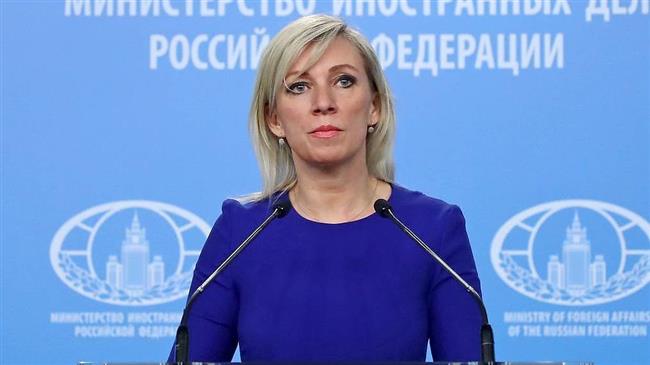
Russian Foreign Ministry spokeswoman Maria Zakharova
Press TV | June 17, 2020
The Russian Foreign Ministry says the UN chief’s report on Iran’s involvement in the last year attacks on Saudi oil facilities is biased and not substantiated by facts.
“What we surely won’t argue with is, unfortunately, that the report can hardly be called balanced and calibrated,” the ministry spokesperson Maria Zakharova said during a press briefing on Wednesday.
She added Russia will present a “detailed analysis” of the UN report during the relevant discussion at the Security Council later on June 30.
“We can also speak about a lack of impartiality and the absence of strong facts to support the accusations leveled at Iran,” she noted, stressing “Nobody has ever presented any convincing evidence of Iran’s violations to the Security Council members.”
The Russian official said that the report was not valid, arguing the “self-appointed inspectors” had claimed based on their “personal observations” that what they saw was “roughly reminiscent of what Iran had once demonstrated at arms exhibitions.”
Last week, UN Secretary General Antonio Guterres said in a report to the Security Council that cruise missiles used in attacks on oil facilities and an airport in Saudi Arabia last year were of “Iranian origin.”
He also said the “items may have been transferred in a manner inconsistent” with UN Security Council Resolution 2231, which endorses the international nuclear deal – officially known as the Joint Comprehensive Plan of Action (JCPOA) – signed between Iran and major world powers in 2015. The allegations were roundly rejected by Iran’s Foreign Ministry.
The ministry said in a statement that the claims appear to have been made under political pressure from the US and Saudi regimes.
“Preparing reports with political motivation will not change the facts and it is clear to all that the current circumstances in the region have directly resulted from the wrong policies of the United States and the child-killing Saudi regime,” the statement said.
The ministry highly recommended that the UN Secretariat not play into the hands of the US in its “pre-planned scenario to annul the cancellation of Iran’s arms embargo.” It also warned the UN against contributing to such a dangerous trend by preparing illegal reports.
Separately, Iran’s UN Mission also responded to the report on Friday, saying, “Iran categorically rejects the observations contained in the report concerning the Iranian connection to the export of weapons or their components that are used in attacks on Saudi Arabia and the Iranian origin of alleged US seizures of armaments.”
US President Donald Trump withdrew Washington from the JCPOA in 2018 and reinstated Washington’s unilateral sanctions against Tehran. His administration has also been piling up pressure on the United Nations to extend and strengthen the embargo on Iran, which is set to expire in October under the nuclear deal.
Washington seeks to restore all Security Council sanctions lifted against Iran if the 15-member body fails to preserve the UN ban on selling conventional arms to Iran.
Iran: E3 unconstructive draft resolution at IAEA meeting mockery of international rules
Press TV – June 16, 2020
Iran has condemned as “unconstructive” a resolution reportedly drafted by the three European signatories to a 2015 nuclear deal for a vote at the International Atomic Energy Agency (IAEA)’s governing board meeting, saying such a resolution makes a mockery of international rules.
Speaking to reporters on Tuesday, Kazem Gharibabadi, Iran’s permanent representative to Vienna-based international organizations, urged France, Germany and the UK — also known as E3 — not to complicate the situation surrounding the Iran deal if they cannot fulfill their end of the bargain and help salvage the accord.
The comments came as IAEA Board of Governors started a four-day meeting on Monday, with Iran on the agenda.
According to a Bloomberg report, the resolution prepared by the European trio urges Tehran to “fully cooperate” with the IAEA investigation of its nuclear facilities. It came after the nuclear watchdog’s inspectors claimed they had not been given access to two locations that may have hosted atomic activities two decades ago.
The resolution will have to be presented during the meeting and is expected to win Washington’s backing.
During the Monday session, the IAEA Director General Rafael Mariano Grossi claimed that for over four months, “Iran has denied us access to two locations and that, for almost a year, it has not engaged in substantive discussions to clarify our questions related to possible undeclared nuclear material and nuclear-related activities.”
Gharibabadi dismissed the claims in the reported resolution and said, “While Iran is cooperating extensively and constructively with the agency, submitting a resolution with the purpose of asking Iran to cooperate and fulfill the two demands of the IAEA is regrettable and a totally unconstructive move.”
He criticized the European trio’s double standards on Tehran’s nuclear program and said such a resolution is being put forth by the countries that “either possess nuclear weapons or play host to such destructive and deadly weapons.”
Such a move, Gharibabadi said is “a mockery of international norms and rules governing disarmament and non-proliferation regimes.”
Gharibabadi also called on all members of the IAEA Board of Governors to exercise vigilance and avoid taking any “political and hasty” measures in order for Iran to continue cooperation with the Vienna-based agency.
“Naturally if such a resolution, which clearly serves American goals, is approved, the Islamic Republic of Iran will have to take the necessary measures accordingly,” he noted.
The Iranian envoy further stressed that the new IAEA request is founded on the claims raised by the Israeli regime, which is an enemy of Iran.
Tehran’s transparent cooperation with the agency “does not mean that we should agree to every request from the IAEA on the basis of delusional claims of our enemies,” he emphasized.
Iran signed the Joint Comprehensive Plan of Action (JCPOA) with six world states — namely the US, Germany, France, Britain, Russia and China — in 2015.
However, Washington’s unilateral withdrawal in May 2018 and the subsequent re-imposition of sanctions against Tehran left the future of the historic agreement in limbo.
Iran remained fully compliant with the JCPOA for an entire year, waiting for the co-signatories to honor their commitments.
As the European parties failed to do so, the Islamic Republic moved in May 2019 to suspend its JCPOA commitments under Articles 26 and 36 of the deal covering Tehran’s legal rights.
Iran warns IAEA against taking Israeli intelligence report about Tehran violating nuke deal at face value
RT | June 15, 2020
Tehran called on the international nuclear watchdog to maintain neutrality and refrain from “unconstructive” decisions based on a biased Israeli intelligence report that claims Iran may be violating its international nuclear deal.
The International Atomic Energy Agency (IAEA) met on Monday to discuss a report alleging that Tehran is violating the Joint Comprehensive Plan of Action by continuing to enrich uranium beyond the agreed level. Iran claims that the data was supplied by Mossad.
Should the IAEA Board of Governors be taken in by “Israeli fabrications” underlying a recent report that claimed Iran was violating the terms of the 2015 nuclear deal, it would “complicate Iran’s cooperation with the agency,” Foreign Ministry spokesman Abbas Mousavi said during a press briefing on Monday as reported by Tasnim, hinting at a “proportionate reaction.”
“They can probably guess what Iran’s reaction will be.”
Mousavi called on the IAEA to maintain neutrality instead of acting on “allegations made by the Zionist regime,” citing Israel’s long history of producing unsubstantiated claims about Iran’s nuclear activities and warning the agency against issuing any resolution against Iran in reaction to the report.
The report claimed Iran has “for months blocked inspections at two sites where nuclear activity may have occurred in the past,” continued to build up its uranium stockpile, and upped enrichment levels past the limits set out by the JCPOA nuclear deal. Israel demanded “paralyzing sanctions” be levied on the country in response.
However, Iran only began exceeding the terms of the JCPOA a year after the US unilaterally pulled out and reimposed crippling sanctions in 2018 despite what was at the time full compliance from Iran, and the other signatories have refused to cross the US in order to hold up their ends of the deal.
Iran has rejected all allegations of non-compliance with the IAEA, and Mousavi on Monday called on the agency to base its actions on legal facts rather than the claims of obviously-biased international actors.
Also on rt.com Iran slams Washington’s ‘unlawful’ nuclear moves in letter to IAEA officials
Mousavi pointed out that caving in to US and Israeli “pressure” and punishing Iran based on the report’s claims amounts to reopening a probe into “possible military dimensions” of Iran’s nuclear program that was resolved in the country’s favor in 2015. The IAEA at the time concluded Iran had never diverted its peaceful nuclear activities, despite spurious allegations to the contrary.
The spokesman also slammed US threats to extend an arms embargo due to expire in October, pointing out that Washington was no longer a signatory to the JCPOA nuclear deal and thus has no legal standing to extend the prohibition. An extension of the embargo would be a “red line,” he warned.
Iran to react if US prevents lifting arms embargo as per nuclear deal: President Rouhani
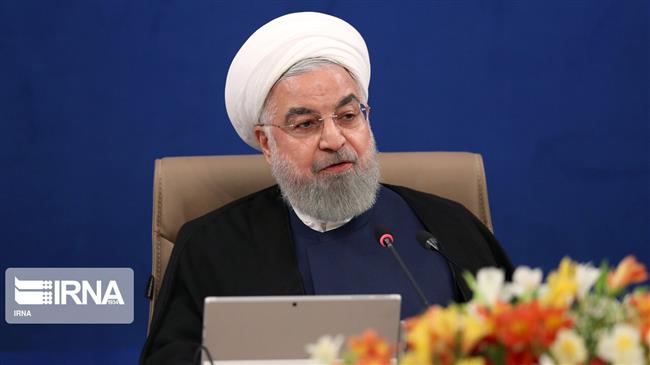
Iran’s President Hassan Rouhani addresses a cabinet session in Tehran on June 14, 2020. (Photo by IRNA )
Press TV | June 14, 2020
Iran’s President Hassan Rouhani says the country will not remain indifferent and will show suitable reaction if the US tries to prevent lifting of arms embargo against the Islamic Republic, which will end this year in accordance with the landmark nuclear deal that Tehran clinched with six world powers back in 2015.
During past months, Washington has stepped up calls for the extension of a UN arms embargo on Iran, which will expire in October under UN Security Council Resolution 2231, which endorses Iran nuclear deal, officially known as the Joint Comprehensive Plan of Action (JCPOA).
The administration of US President Donald Trump has threatened that it may seek to trigger a snapback of all sanctions on Iran if its attempts to extend the arms embargo fail.
The landmark nuclear deal was reached between Iran and the P5+1 group of countries — the US, Britain, France, Russia and China plus Germany — in 2015. However, in May 2018, US President Trump unilaterally pulled his country out of the JCPOA and re-imposed the sanctions that had been lifted against Tehran and began unleashing the “toughest ever” fresh sanctions.
While the US is no longer a party to the JCPOA, it has launched a campaign to renew the Iran arms ban — in place since 2006/2007 — through a resolution at the Security Council, but Russia and China are most likely to veto it.
Addressing a cabinet session on Sunday, Rouhani said, “The termination of the arms ban [on Iran] … is one of the important achievements of the JCPOA and if Americans want to question this achievement, other big countries know what our reaction will be.”
The Iranian president also expressed hope that “all countries who are members of the United Nations Security Council and the Board of Governors” of the International Atomic Energy Agency (IAEA), would be aware of “the US planning with regard to these plots.”
“We, for our part, will be successful in this regard and will weather these plans that the United States has made for Iran,” he noted.
Posting a tweet in early June, Iran’s UN ambassador said the US’ call for an extension of the UN Security Council’s arms embargo on Tehran lacked legal standing in international law.
Majid Takht-e Ravanchi said the US ambassador to the UN “wrongly” believes the US retains the right to initiate snapback of sanctions under the UN Security Council Resolution 2231.
“WRONG: US cannot be a JCPOA ‘Participant’, since Donald Trump ceased US participation,” the Iranian ambassador noted, referring to Trump’s 2018 decision to withdraw his country from the Iran nuclear deal in violation of the Resolution 2231.
In the middle of May, China and Russia also rejected US plans to extend a UN arms embargo on Iran along with a probable push to trigger a return of all sanctions on Tehran at the UN Security Council.
The “US has no right to extend an arms embargo on Iran, let alone to trigger snapback,” China’s UN mission wrote in a tweet.
“Maintaining the Joint Comprehensive Plan of Action is the only right way moving forward,” he added.
Russian Deputy Foreign Minister Sergei Ryabkov vehemently rejected the plan as a “cynical” measure plunging the UN Security Council into crisis.
“The conclusion is that the next crisis in the UN Security Council and the UN as a whole is imminent, taking into account this US stubbornness,” he said, adding, “Washington will not have an easy road here in any case.”
European Union foreign policy chief Josep Borrell said on Tuesday that the US has already pulled out of the international nuclear agreement and cannot currently use its former membership of the deal to seek a permanent arms embargo on Tehran.
“The United States has withdrawn from the JCPOA, and now they cannot claim that they are still part of the JCPOA in order to deal with this issue from the JCPOA agreement. They withdraw. It’s clear. They withdraw,” Borrell said.
The EU believes that the JCPOA plays a key role in maintaining regional and international security and has made efforts to keep the pact alive despite US pressure.
Borrell is tasked with supervising the circumstances surrounding the implementation of the nuclear deal so he can help resolve disputes between its signatories.
Denmark summons Saudi envoy over Riyadh’s support for anti-Iran terror group
Press TV – June 11, 2020
Denmark has called in the Saudi ambassador to Copenhagen to protest the kingdom’s support for a notorious terrorist group behind a 2018 deadly attack in Iran’s southwestern city of Ahvaz, among its other terrorist crimes against Iranians.
Riyadh’s envoy was summoned to the Danish Foreign Ministry on Wednesday after terrorism charges were leveled against three leaders of the anti-Iran al-Ahvaziya terror group based in Denmark.
Danish police said they were prosecuting “three people for financing and promoting terrorism in Iran, including in collaboration with a Saudi intelligence service.”
The suspects are believed to have received funds from Riyadh, which has been pursuing a highly hostile Iran policy under Crown Prince Mohammed bin Salman.
Meanwhile, Danish Security and Intelligence Service (PET) stressed that the trio worked for the Saudi regime between 2012 and 2018.
PET chief Finn Borch Andersen said it is “completely unacceptable” that Denmark is used “as a starting point to finance and support terrorism.”
“We will not accept such activities under any circumstances and our ambassador in Riyadh has repeated the same message directly to the Saudi authorities,” Danish Foreign Minister Jeppe Kofod said in a statement.
In February, Denmark said its intelligence service had arrested and charged three members of the Saudi-backed terror group for spying on behalf of the kingdom in the Scandinavian country.
Al-Ahvaziya has committed numerous crimes against Iranian targets over the past decades, among them bomb attacks in public places, abductions, assassinations, kidnapping for ransom, shooting at tourists and blowing up oil pipelines.
Formed a few years after the 1979 Islamic Revolution in Iran, the terror group was inspired back then by the Baath regime of Iraq’s ex-dictator Saddam Hussein.
Al-Ahvaziya has been after separating the southwestern province of Khuzestan — home to the country’s Arab population — from the rest of Iran through engaging in armed conflict against the Iranian government.
In September 2018, the Saudi-backed terror outfit claimed responsibility for a deadly attack on military parade in Ahvaz, Khuzestan’s provincial capital. The assault killed 25 people, including members of Iran’s Islamic Revolutionary Guard Corps (IRGC) and civilian bystanders, and injured 70 others.
Shortly after the attack, the London-based “Iran International” television channel funded by Saudi Arabia allowed the al-Ahvaziya spokesman to go live on air to defend the bloodshed.
In parallel, the Daesh Takfiri terrorist group also claimed responsibility for the Ahvaz attack.
In response, Iran launched missiles on gatherings of the ringleaders of the terror attack Ahvaz based in an area east of the Euphrates in Syria, killing and injuring a number of them and inflicting heavy losses on their stronghold.
Riyadh is widely viewed as a key sponsor of Takfiri terrorists, who are inspired by Wahhabism, an extremist ideology preached by Saudi clerics.
Iranian scientist jailed in US returns home
By Ghanbar Naderi – Press TV – June 8, 2020
Iranian scientist Majid Taheri, who was imprisoned in the US for more than 16 months, finally returned home on Monday. Upon arrival, Taheri was received by his family as well as high-ranking Iranian officials at the Imam Khomeini International Airport.
The Iranian national who was a longtime resident of the US state of Florida, spent 16 months in prison for allegedly violating US sanctions on Iran. Speaking to Press TV, he denied all allegations.
The development came days after another Iranian scientist Sirous Asgari, a professor of material sciences at Sharif University of Technology, also returned home.
He spent about three years in US detention on trumped-up charges of fraud and theft of information relating to his work with a university in Ohio. The case however, was dismissed by a US district judge and he managed to return to his country.
Iran has called on Washington to release all other Iranian citizens taken hostage. The country says the US must make up for the damages caused by detaining Iranian scientists.
Iran Can Supply Itself With Nuclear Fuel Without Russia’s Help – Atomic Energy Body
Sputnik – 28.05.2020
TEHRAN – Iran is capable of supplying itself with nuclear fuel even without Russia’s assistance, Iran’s Atomic Energy Organization (AEOI) spokesman, Behruz Kamalvandi, said on Thursday.
“Fuel is delivered from Russia each time we need it, without any problems. If we run out of fuel, we will be capable of producing it, without resting on any other country,” Kamalvandi told the ISNA news agency.
His comment came soon after the United States announced ending sanction waivers covering Iran’s nuclear projects.
In late April, Russia delivered a fresh batch of nuclear fuel to Iran’s Bushehr Nuclear Power Plant, necessary for efficient functioning of the reactor.
Did Trump Just Cancel a Potential Double-War?
The Saker • Unz Review • May 27, 2020
At this time of writing, it is too early to declare the danger over, but at least three out of five Iranian tankers have made it safely to Venezuela (confirmation from TeleSur and PressTV). Furthermore, while we should never say “never”, it appears exceedingly unlikely that the US would let three tankers pass only to then try to impede the arrival of the other two. So it ain’t over until its over, but as of right now things look way better than last week.
Besides, this is mostly a symbolic issue. While these 5 tankers will make a difference, it won’t be a huge one, especially considering the devastating consequences which the US sanctions, sabotage and subversion have inflicted on Venezuela.
Still, symbols are important, if only because they create a precedent. In fact, I would argue that the latest climbdown by Trump is no different than all his other climbdowns: Trump has had a very consistent record of threatening fire and brimstone before quietly deflating and walking away. And since he did that many times now, we have to wonder whether this strategy is effective or not?
One could argue that this strategy could be described by saying that you put the maximum pressure on the other side in the hope that the bluff will entice the adversary to fold. This could be a semi-credible argument were it not for a very simple but crucial problem: so far the other guys have never folded. In other words, Trump’s bluff has been called over and over again, and each time Trump had to quietly deflate.
Some will say that this only proves that Trump is truly a peace-loving President who, unlike his predecessors, does not want to go to war. But then, what about the cruise missile strikes on Syria? What about the murder of Soleimani?
Truth be told, the kindest thing we can say about this strategy (assuming that it is a strategy to begin with, not the evidence of a total lack of one) is that it is tantamount to yelling “fire!” in a crowded movie theater: the fact that Trump did not set any movie theater ablaze hardly justifies his yelling “fire” in such a dangerous environment. The perfect example of this kind of irresponsible behavior is the murder of General Soleimani which truly brought the US and Iran a millimeter away from a real, full-scale war.
Furthermore, while I salute Trump’s climbing down following the Iranian strikes, I also believe that in doing so he hurt the international image of the US. Why? Think about this: this is the first time ever (if I am not mistaken) that the US was the object of a major military strike coming from another state-actor and did not retaliate. In the past and until this Spring, the US always held the view that if anybody dares to mess with it this would result in very serious consequences. Thus the US upheld a world order in which some where a lot more equal than others. Specifically, “others” had to meekly accept US strikes and shut up whereas Uncle Shmuel could strike left and right and expect no retaliation.
By “accepting” the Iranian counter-strike, Trump did essentially place an “equal” sign between Iran and the US. He probably never understood that, but in the region this was understood by all.
Just as Hezbollah destroyed the myth of Israeli impunity, Iran destroyed the myth of US impunity.
Still, I will always prefer the politician who does not start a war (for whatever reason) to one who would. I also have no doubt whatsoever that Hillary would have started one, or even several, wars. But the fact that Hillary would have been even worse than Trump is hardly a reason to start fawning about Trump’s brilliant “5D chess” genius or peace-loving policies…
Trump reminds of a guy pointing a gun a people in the street only to later say “but it was a toy gun, I never meant to really shoot anybody.” This is definitely better than shooting people with a real gun, but this is hardly a sign of maturity or intelligence.
The other problem with this “strategy” (let’s assume for argument’s sake that this is a strategy of some kind): each time the “indispensable nation” and “sole hyperpower” has to climb down, it increasingly looks like a paper tiger. Not looking like such a paper tiger is probably the main reason behind Michael Ledeen’s famous words “Every ten years or so, the United States needs to pick up some small crappy little country and throw it against the wall, just to show the world we mean business.” In a strictly evil and imperialistic sense, Ledeen’s strategy makes a lot more sense than what Trump has been doing.

As Marx famously said, “History repeats itself, first as tragedy, second as farce.” The outcome of what some now call the “Battle of Macuto Bay” is a perfect example of this: if the Bay of Pigs was the “root case” then the disaster in Grenada was the tragedy and the Battle of Macuto Bay the real farce.
Humor can be a devastating weapon and anybody who has studied the late Soviet Union (in the late Brezhnev years and after) knows how the Russian people ridiculed the Soviet leaders with literally thousands of jokes.
A real imperialist would much rather be hated than ridiculed, and while Trump himself probably does not realize that he is the laughingstock of the planet, his aides and deep state bosses most definitely do and that is very, very dangerous.
Why?
Because the pressure to, once again, “pick up some small crappy little country and throw it against the wall” increases with each climbdown (see my article “Each “Click” Brings Us One Step Closer to the “Bang!” for a fuller discussion of this).
Besides, finding an even smaller and weaker country than Venezuela will be hard (maybe the Island of Saba? or Grenada again? who knows?). And potentially very dangerous.
The other problem is predictability. Any international system requires that its most powerful actors be predictable. In contrast, when a major international actors acts in what appears to be unpredictable, irrational or irresponsible manner, this puts the entire stability of the system at risk.
This, by the way, is also why it is so disastrous that the US has withdrawn from so many international organizations or treaties: the participation in international organizations and treaties indicate that the US is willing to play by the same rules as everybody else. The fact that the US is ditching so many of its former international obligations only shows that the US has gone rogue and is from now on totally unpredictable.
Finally, there are also lessons for Moscow here, the main one being that when confronted with a determined adversary, the Empire tries to bluff, but eventually folds. True, Moscow has to be much more careful than Tehran simply because the consequences of a US-Russian war would be dramatically worse than even a major conflict in the Middle-East. Yet it is also true that over the past years the Russian armed forces did have the time to prepare for such a conflict and that now Russia is ready for pretty much anything the US could try to throw at her, at least in purely military terms.
In contrast to the military posture of Russia, the political environment in Russia has changed for the worse: there is now a potentially very dangerous “hardline” opposition to Putin which I have christened the “6th column”, as opposed to the liberal and pro-western 5th column. What these two “columns” have in common is that they both will categorically oppose pretty much anything and everything Putin does. The 6th column, in particular, has a seething hatred for Putin which is even more rabid than what the liberal 5th column usually express. Check out this excellent video by Ruslan Ostashko, who prefers the term “emo-Marxists” and who very accurately describes these folks. Whether we think of them as 6th-columnists or emo-Marxists does not matter, what matters is that these folks are eager to act like a soundboard for any and all anti-Putin rumors and fakes. While Putin certainly has his flaws, and while the economic policies of the Medvedev, and now Mishustin, government are a far cry from what most Russians would want, it is also true that these two “columns” are objectively doing the bidding of the Empire, which could present a real problem if the current pandemic-induced economic crisis in Russia is not tackled more effectively by the government.
I have always said that Iran, while being much weaker than Russia, has consistently shown much more courage in its dealings with the Empire than Russia. Furthermore, Iran’s policies are primarily dictated by moral and spiritual considerations (as in the case of Iran’s principled stance on occupied Palestine) while Russian policies are much more “pragmatic” (which is really a euphemism for self-serving). But then, Iran is an Islamic Republic whereas Russia still has to develop some kind of unifying and original worldview.
Conclusion:
For all his innumerable negative character traits and other flaws, it remains true that Trump has not launched a major war (so far). Yes, he has brought the world to the brink several times, but so far he has not plunged the world into a major conflict. How much of the credit for this truly should go personally to him is very debatable (maybe cooler heads in the military prevailed, I think of folks like General Mattis who, reportedly, was the one who stopped the US from seriously attacking Syria and settled for a symbolic strike). Some Russian analysts (Andrei Sidorov) even believe that the US is in no condition to fight any war, no matter how small. Furthermore, most (all?) Russian analysts also believe that the US is fully committed to a full-spectrum information and economic war to try to economically strangle both Russia and China. I think that it would be fair to say that nobody in Russia believes that the relationship with Trump’s US can, or will, improve. The tone in China is also changing, especially since the US has now launched a major anti-China strategic PSYOP. In other words, the US is merrily continuing down its current road which leads it to a simultaneous confrontation with not one, or even two, countries, but with a list of countries which seems to grow every day. So while it is true that in this case Trump appears to have canceled two wars, we should not assume that he won’t soon start one, if only to deflect the blame for his total mismanagement of the COVID19 crisis. Should that happen, we can only hope that all the “resistance countries” and movement will provide as much support as possible to whomever the Empire attacks next.
Featured Video

Trita Parsi: Middle East Unraveling — Are We on the Path to World War?
or go to
Aletho News Archives – Video-Images
New Book
Trans agenda is ‘normalization of sadism’ – US author

RT | September 23, 2026
The US Democratic Party has embraced a transgender agenda that amounts to “the normalization of sadism,” author A.J. Rice has said, warning that radical trans policies would return if the party is allowed to regain power.
Speaking to RT’s America First host Scotty Nell Hughes about his new book, ‘The Curse of the Bearded Lady: How the Trans Mafia Whacked American Sanity’, Rice argued that activists have gained significant influence in schools, medicine, and corporate America while people who questioned the agenda have faced pressure to stay silent.
The author described the “trans mafia” as the sprawling network of people and institutions that have helped the movement gain influence. He singled out parts of academia, wealthy backers, and corporations, and stated that providers of transition-related treatment also have a financial incentive to keep young people in their care indefinitely.
Rice argued that the consequences of these policies ultimately fall on children who are being drawn toward gender-affirming medical treatments and on girls who are expected to share locker rooms or compete in sports with biological males.
He noted that while voters rejected the Democrats’ approach to gender in 2024, the party, which has been “captured by madness,” has since only doubled down and is seeking what is effectively “the normalization of sadism.” … Full report
Blog Roll
 Aletho News
- ‘We don’t seek permission to defend our country’: Snippets from President Pezeshkian’s UNGA address
- NATO chief wants Europeans to fight American wars [for Israel]
- German chemicals giant reveals details of downsizing
- Refaat Al-Areer Was The Canary In The Coal Mine In Israel’s War On The Truth
- Israeli election committee bars candidate from Knesset race over Gaza war opposition
- French-Lebanese man files war crimes complaint over Israeli attacks
- Mahan Air Flight Lands in China Despite US Threat against Iranian Airlines
- US eyes $10bn fund to rebuild war-battered Gulf infrastructure
- Trump meets Rodríguez near Maduro’s prison as Venezuela’s oil flows to US
- Trita Parsi: Middle East Unraveling — Are We on the Path to World War?
- If Americans Knew
- An error has occurred; the feed is probably down. Try again later.
- No Tricks Zone
- New Study: Earth And Venus Surface Warmth Largely Explained By Convection And Lapse Rate, Not CO2 Or Radiation
- 2025 Nature Paper Claiming Worsening Global Drought Gets RETRACTED …Heavily Flawed
- New Study: ‘Global Drought Shows No Detectable Recent Acceleration Under Climate Warming’
- Economic Masterminds: German Socialists Suggest Taxing Productivity Gains Stemming From Using AI
- The South China Sea Has Not Been Cooperating With The Climate Change Narrative
- Energy Crisis: Germany Enters Heating Season With Historically Low Gas Reserve Fill Levels
- New Study: The Antarctic Ice Sheet Gained Mass From 2020-2024 Due To Staggering Snow And Ice Accumulation
- Study: Ocean Heating Rates From Thousands Of Years Ago ‘Dwarf’ Modern Ocean Heating Rates
- Climate Extremists Target, Attack Large-Scale Power Grid Infrastructure In Germany!
- New Study: Antarctic Ice Melt Has Contributed Less Than 1 Centimeter To Sea Level Rise In The Last 30 Years

