Gen. Soleimani assassinated to sabotage Iran’s talks with Saudis, UAE following Israeli briefing: NYT
Press TV – February 14, 2020
Washington ordered the assassination of top Iranian General Qassem Soleimani to sabotage de-escalation talks between Iran, Saudi Arabia and the United Arab Emirates following a report by Israel’s Mossad spy agency, according to the New York Times.
The paper reported on Thursday that General Soleimani had been arranging talks in Saudi Arabia and United Arab Emirates in order to de-escalate tensions with Tehran.
The Times wrote that the talks happened after Saudi Arabia and the UAE, which are central to the Trump administration’s so-called regional alliance seeking to pressure Iran, began to question the efficiency of Washington’s anti-Iran campaign.
According to the report, one such meeting took place last September in Abu Dhabi, the capital of the United Arab Emirates where a plane carrying “senior Iranian officials” landed for talks.
News of the meeting, which reached Washington only after it was notified by reports from American spy agencies, “set off alarms inside the White House”, according to the report.
The report added that a similar mediation attempt, also arranged by Gen. Soleimani, was underway between Tehran and Riyadh using Iraqi and Pakistani intermediaries.
The report wrote that the developments had greatly concerned Israel, which had been trying to push the Trump administration to exert more pressure on Tehran.
According to the Times, US Secretary of State Mike Pompeo met Mossad chief Yossi Cohen on October during a trip to Israel where he was briefed on Iran’s attempted de-escalation talks with Saudi Arabia and the UAE.
Cohen warned Pompeo that Tehran was effectively on the verge of achieving its “primary goal” of breaking up the so-called “anti-Iran” alliance.
A few months later in early January, General Soleimani was assassinated by Washington’s order while on a formal visit to Baghdad.
According to former Iraqi prime minister Adel Abdul-Mahdi, General Soleimani was due to formally meet the Iraqi premier during the trip and was carrying Tehran’s response to a message from Riyadh regarding the de-escalation talks.
Following the attack, the Trump Administration claimed that the assassination had taken place after a reported rocket attack on a US base in Iraq killed a “US civilian contractor” and that Gen. Soleimani was an “imminent threat” to US citizens.
Many US political figures have rejected the claims and have questioned why the Trump administration has failed to provide any evidence backing its actions.
The New York Times’ Thursday report, however, reveals that entirely different considerations, such as Israel’s push to undermine Iran’s attempts at peace with its regional neighbors, were behind the assassination.
‘Months of miscalculations’
According to the report, the assassination marks yet another miscalculation by the Trump administration which has failed to bend Iran through its “maximum pressure” campaign.
Following its unilateral withdrawal from the 2015 Iran nuclear deal in 2018, the US imposed unilateral sanctions against Tehran in a bid to goad Tehran to accept new terms dictated by Washington.
The Times, however, reported that a recent analysis conducted by the Central Intelligence Agency (CIA) shows that the sanctions have had little effect in fulfilling Washington’s goals.
The US has also sought to pressure Iran militarily by deploying troops to the region and creating a regional anti-Iran alliance in the region as part of if its anti-Iran campaign.
Washington called for the formation of a naval coalition in the region following a string of suspicious attacks on oil tankers in the Persian Gulf.
Iran has vehemently denied the accusations, saying the incidents appear to be false flag operations meant to frame the Islamic Republic and push US interests.
Citing instances such as the major Yemeni attack on Saudi oil facilities last September and Iran’s downing of a US Global Hawk spy craft in June, the New York Times report said stepped-up US military presence also failed to achieve its objectives.
Witnessing the Trump administration’s faltering policy in the Middle East, Saudi Arabia and the UAE were convinced to open direct talks with Tehran, the report noted.
More Lies on Iran: The White House Just Can’t Help Itself as New Facts Emerge
By Philip Giraldi | Strategic Culture Foundation | February 13, 2020
Admittedly the news cycle in the United States seldom runs longer than twenty-four hours, but that should not serve as an excuse when a major story that contradicts what the Trump Administration has been claiming appears and suddenly dies. The public that actually follows the news might recall a little more than one month ago the United States assassinated a senior Iranian official named Qassem Soleimani. Openly killing someone in the government of a country with which one is not at war is, to say the least, unusual, particularly when the crime is carried out in yet another country with which both the perpetrator and the victim have friendly relations. The justification provided by Secretary of State Mike Pompeo, speaking for the administration, was that Soleimani was in Iraq planning an “imminent” mass killing of Americans, for which no additional evidence was provided at that time or since.
It soon emerged that the Iranian was in fact in Baghdad to discuss with the Iraqi Prime Minister Adel Abdul Mahdi a plan that might lead to the de-escalation of the ongoing conflict between Saudi Arabia and Iran, a meeting that the White House apparently knew about and may even have approved. If that is so, events as they unfolded suggest that the U.S. government might have encouraged Soleimani to make his trip so he could be set up and killed. Donald Trump later dismissed the lack of any corroboration of the tale of “imminent threat” being peddled by Pompeo, stating that it didn’t really matter as Soleimani was a terrorist who deserved to die.
The incident that started the killing cycle that eventually included Soleimani consisted of a December 27th attack on a U.S. base in Iraq in which four American soldiers and two Iraqis were wounded while one U.S. contractor, an Iraqi-born translator, was killed. The United States immediately blamed Iran, claiming that it had been carried out by an Iranian supported Shi’ite militia called Kata’ib Hezbollah. It provided no evidence for that claim and retaliated by striking a Kata’ib base, killing 25 Iraqis who were in the field fighting the remnants of Islamic State (IS). The militiamen had been incorporated into the Iraqi Army and this disproportionate response led to riots outside the U.S. Embassy in Baghdad, which were also blamed on Iran by the U.S. There then followed the assassinations of Soleimani and nine senior Iraqi militia officers. Iran retaliated when it fired missiles at American forces, injuring more than one hundred soldiers, and then mistakenly shot down a passenger jet, killing an additional 176 people. As a consequence due to the killing by the U.S. of 34 Iraqis in the two incidents, the Iraqi Parliament also voted to expel all American troops.
It now appears that the original death of the American contractor that sparked the tit-for-tat conflict was not carried out by Kata’ib Hezbollah at all. An Iraqi Army investigative team has gathered convincing evidence that it was an attack staged by Islamic State. In fact, the Iraqi government has demonstrated that Kata’ib Hezbollah has had no presence in Kirkuk province, where the attack took place, since 2014. It is a heavily Sunni area where Shi’a are not welcome and is instead relatively hospitable to all-Sunni IS. It was, in fact, one of the original breeding grounds for what was to become ISIS.
This new development was reported in the New York Times in an article that was headlined “Was U.S. Wrong About Attack That Nearly Started a War With Iran? Iraqi military and intelligence officials have raised doubts about who fired the rockets that started a dangerous spiral of events.” In spite of the sensational nature of the report it generally was ignored in television news and in other mainstream media outlets, letting the Trump administration get away with yet another big lie, one that could easily have led to a war with Iran.
Iraqi investigators found and identified the abandoned white Kia pickup with an improvised Katyusha rocket launcher in the vehicle’s bed that was used to stage the attack. It was discovered down a desert road within range of the K-1 joint Iraqi-American base that was hit by at least ten missiles in December, most of which struck the American area.
There is no direct evidence tying the attack to any particular party and the improvised Kia truck is used by all sides in the regional fighting, but the Iraqi officials point to the undisputed fact that it was the Islamic State that had carried out three separate attacks near the base over the 10 days preceding December 27th. And there are reports that IS has been increasingly active in Kirkuk Province during the past year, carrying out near daily attacks with improvised roadside bombs and ambushes using small arms. There had, in fact, been reports from Iraqi intelligence that were shared with the American command warning that there might be an IS attack on K-1 itself, which is an Iraqi air base in that is shared with U.S. forces.
The intelligence on the attack has been shared with American investigators, who have also examined the pick-up truck. The Times reports that the U.S. command in Iraq continue to insist that the attack was carried out by Kata’ib based on information, including claimed communications intercepts, that it refuses to make public. The U.S. forces may not have shared the intelligence they have with the Iraqis due to concerns that it would be leaked to Iran, but senior Iraqi military officers are nevertheless perplexed by the reticence to confide in an ally.
If the Iraqi investigation of the facts around the December attack on K-1 is reliable, the Donald Trump administration’s reckless actions in Iraq in late December and early January cannot be justified. Worse still, it would appear that the White House was looking for an excuse to attack and kill a senior Iranian official to send some kind of message, a provocation that could easily have resulted in a war that would benefit no one. To be sure, the Trump administration has lied about developments in the Middle East so many times that it can no longer be trusted. Unfortunately, demanding any accountability from the Trump team would require a Congress that is willing to shoulder its responsibility for truth in government backed up by a media that is willing to take on an administration that regularly punishes anyone or any entity that dares to challenge it. That is the unfortunate reality in America today.
Democrats Ignore Trump’s Real Violations
By Ron Paul | February 10, 2020
This week the latest Democratic Party attempt to remove President Trump from office – impeachment over Trump allegedly holding up an arms deal to Ukraine – flopped. Just like “Russiagate” and the Mueller investigation, and a number of other attempts to overturn the 2016 election.
We’ve had three years of accusations and investigations with untold millions of dollars spent in a never-ending Democratic Party effort to remove President Trump from office.
Why do the Democrats keep swinging and missing at Trump? They can’t make a good case for abuse of power because they don’t really oppose Trump’s most egregious abuses of power. Congress, with a few exceptions, strongly supports the President flouting the Constitution when it comes to overseas aggression and shoveling more money into the military-industrial complex.
In April, 2018, President Trump fired 100 Tomahawk missiles into Syria allegedly as punishment for a Syrian government chemical attack in Douma. Though the US was not under imminent threat of attack from Syria, Trump didn’t wait for a Congressional declaration of war on Syria or even an authorization for a missile strike. In fact, he didn’t even wait for an investigation of the event to find out what actually happened! He just decided to send a hundred missiles – at a cost of hundreds of millions of dollars – into Syria.
We are now finding out from whistleblowers on the UN team that investigated the alleged attack that the report blaming the Syrian government was falsified and that the whole “attack” was nothing but a false flag operation.
Is such unauthorized aggression against a country with which we are not at war not worth investigating as a potential “high crime” or “misdemeanor”?
Last month, President Trump authorized the assassination of a top Iranian General, Qassim Soleimani, and a top Iraqi military officer inside Iraqi territory while Soleimani was on a diplomatic mission. Trump and his Administration tried to claim that the attack was essential because of an “imminent threat” of a Soleimani attack on US troops in the region.
We found out shortly afterward that they lied about the “imminent threat.” The assassination was not “urgent” – it was planned back in June. Trump then claimed it didn’t matter whether there was an imminent threat: Soleimani was a bad guy so he deserved to be assassinated.
But the attack was an act of war on Iran without Congressional declaration or authorization for war. Is that not perhaps a “high crime” or “misdemeanor”?
We are finding out that, contrary to Trump claims, Soleimani was not even behind the December attack on US troops in Iraq. New evidence suggests it was actually an ISIS operation attempting to goad the US into moving against Iraq’s Shia militias.
Fantasies about Trump being an agent of Putin or trying to get Ukraine to help him win the election are presented as urgent reasons Trump must be removed from office. Real-life violations of the Constitution and reckless militarism that may get us embroiled in another Middle East war are shrugged off as “business as usual” by both Democrats and Republicans in Washington.
Democrats won’t move against Trump for what may be real “high crimes” and “misdemeanors” because they support his overseas aggression. They just wish they were the ones pulling the trigger.
Copyright © 2020 by RonPaul Institute.
No military aspect to Iran’s satellite carriers: Defense minister
Press TV – February 12, 2020
Defense Minister Brigadier General Amir Hatami says Iran’s satellite carriers have nothing to do with its military activities and lie completely outside the country’s defensive practices.
“The satellite carriers have nothing to do with the subject of missiles, and constitute a completely non-defensive and non-military issue,” Hatami said following a government meeting in Tehran on Wednesday.
According to the defense chief, a satellite might be used for defense-related purposes, but the carriers are totally non-defensive in nature.
On Sunday, the Iranian Space Agency said the country had launched its domestically-made Zafar satellite using a Simorgh satellite carrier, but that the missile had fallen short of reaching the designated orbit.
The agency added that the data from the launch would be used to optimize future launch attempts.
As with every country that has experimented with satellites, the Iranian nation likewise has a vested right to avail itself of the technology, he added, noting that the country would, therefore, strongly pursue its relevant plans in this regard.
The Iranian defense minister was apparently reacting to claims made by France and the US about Tehran’s space program following the launch.
Reacting to the launch on Tuesday, US Secretary of State Mike Pompeo accused Iran of trying to improve its ballistic missile skills through the satellite launch and vowed to exert more pressure.
A day earlier, France also criticized the launch and suggested that it was inconsistent with UN Security Council Resolution 2231, which “calls upon” Iran not to undertake any activity related to missiles “designed to be capable of” delivering nuclear weapons.”
Commenting on Iran’s missile activities, Hatami noted that the defense program was in complete accord with international regulations that prohibit the development of projectiles capable of carrying nuclear warheads.
“Nothing of the kind exists in the Islamic Republic,” Hatami said. “All of our missiles, which we take pride in and which constitute an important factor of Iran’s defense and military power, are made with conventional warheads.”
“The projectiles are high in precision, something that the Americans came in proper touch with at Ain al-Assad [Airbase],” he said.
The US airbase, which is located in Iraq’s western Anbar Province, and another American outpost in the Arab country’s semi-autonomous Kurdistan region came under retaliatory ballistic missile strikes by Iran’s Islamic Revolution Guards Corps (IRGC) last month.
The strikes were prompted by the US assassination of Lieutenant General Qassem Soleimani, the former commander of the IRGC’s Quds Force, and a number of others in a set of drone strikes targeting Baghdad’s civilian airport.
“We do not need anything beyond this. Our missiles are precision-guided and fitted with conventional warheads,” Hatami added.
The Islamic Republic, he added, was likely to launch its Zafar (Triumph)-2 Satellite in the beginning of the next year on board Simorq (Phoenix) Satellite Carrier.
The official said the country considered the vehicle and satellite technology to be one of the subject matters of its research activities.
He said the Islamic Republic would pursue the research “until it reaches a stable stage,” and the country attains the ability to “do this in the form of a sustained practice.”
Iran stresses right to enhance space technology, rejects France ‘meddlesome’ claims
Press TV – February 11, 2020
Iran has dismissed France’s “meddlesome” claim about its space program following a recent satellite launch, saying the Islamic Republic reserves the right to make scientific progress.
Tehran on Sunday launched its domestically-made Zafar (Triumph) satellite using a Simorgh (Phoenix) satellite carrier, but the missile fell short of reaching the designated orbit.
The satellite launch came on the same day that Iran unveiled a new missile, ‘Ra’d-500 (Lightning-500),’ which is equipped with a composite engine block as well as the new generation of propellant for missiles and satellite carriers.
The French Foreign Ministry on Monday condemned Iran for trying to put a satellite in space and unveiling the new ballistic missile, urging Tehran to abide by international obligations on its controversial missile program.
“In keeping with its obligations under UN Security Council Resolution 2231, Iran cannot engage in activities, including launches, connected to ballistic missiles capable of carrying nuclear weapons,” said the French statement, claiming that Tehran’s ballistic missile program “hurts regional stability and affects European security.”
Rejecting the “meddlesome” statement on Tuesday, Iran’s Foreign Ministry Spokesman Abbas Mousavi said Tehran has “an inherent right to develop science and technology.”
“Iran’s defensive missile program has also nothing to do with Resolution 2231 because Iranian missiles have not been designed to carry nuclear weapons,” the official said.
Resolution 2231 endorsed a nuclear deal inked in 2015 between Tehran and six world states — the US, France, Britain, Germany, Russia and China.
The US, however, abandoned the deal in May 2018 in defiance of the resolution, throwing the future of the agreement in doubt.
The European parties initially vowed to keep the deal alive but failed to fulfill their contractual obligations under intense US pressure, prompting Tehran to begin suspending the implementation of parts of its nuclear commitments on a stage-by-stage basis a year later.
Iran says its counter-measures are reversible if the European signatories take meaningful action to save the deal.
Yet Another Israeli Provocation in the Middle Eastern Skies
By Vladimir Platov – New Eastern Outlook – 11.02.2020
While using a civilian airliner as cover, four Israeli F-16 fighters approached the outskirts of Damascus and launched an attack on local residential areas late night on February 6. There’s no disputing that by adopting such tactics the Israeli Air Force endangered the civilian aircraft – an Airbus A320 owned by the private Syrian Cham Wings Airlines, arriving at Damascus from Najaf International Airport (NJF) in Iraq with 172 passengers on board. This Syrian airliner was running late and it’s clear from data provided by FlightrRadar24, that Israeli military aircraft were clearly expecting the arrival of yet another A320, owned by SyrianAir due to arrive from Tehran, hoping to provoke local air defence units into destroying the liner by mistake.
If it weren’t for the prompt actions of the flight dispatchers of Damascus International Airport and its efficient automated air traffic control system, this civilian airliner would have been in peril, but thankfully it managed to escape the kill zone, landing safely at the nearest available airfield, the Russia’s Hmeimim air base.
The situation is painfully similar to September of 2018, when 4 Israeli F-16s launched missile strikes against unknown targets in Syria’s Latakia province, using Russia’s Il-20 reconnaissance aircraft with 15 crew members aboard as cover. Predictably enough, the Israeli jets provoked a response from Syrian anti-aircraft units resulting in the destruction of the Russian aircraft. All people on board were killed.
On December 26, 2018, another Syrian airline Cham Wings Airlines plane was bound to land at Damascus International Airport, but in a bid to escape a similar provocation staged by the Israeli Ari Force, it detoured and landed at Russia’s Hmeimim airbase. On that day a total of two civilian airliners had to change their flight routes as a result of the Israeli Air Force, which threatened innocent civilians in what that can only be described as a provocation. In both cases near Damascus, the jets were operating from the airspace of a third country – Lebanon, justifying their actions by alleging to attack Iranian warehouses and convoys that were said to be used for military operations against Israel.
In both cases, passengers aboard civilian airliners were at risk as local air defense units were bound to open fire to repel the Israeli missile attacks, risking civilian aircraft approaching Damascus International. In other words, on more than on one occasion a situation similar to the tragic incident with the Iranian downing of the UIA Boeing 737, traveling from Tehran to Kiev was deliberately staged by the Israeli Air Force. As for the downed Boeing the Iranian authorities officially recognized that it was mistakenly shot down by air defence units of the Islamic Revolutionary Guards Corps (IRGC), which resulted in the untimely demise of 167 passengers and nine crew members – citizens of Iran, Ukraine, Canada, the UK, Sweden and Afghanistan. This tragedy inflicted significant political, economic and PR damage on Iran. In this regard, the clearly distinguishable similarities of the provocative attacks in Iran and Syria are obvious, which raises reasonable questions regarding the strategic command that must be planning such attacks.
It is also noteworthy that the Israeli Air Force chose the SyrianAir flight arriving from Tehran as its target, with Israel explaining all of its recent aggressive actions in Syria and the Middle East through the prism of countering the rising influence of Iran.
Thus, the Israeli General Staff conducting military operations in Syrian airspace using civilian aircraft carrying passengers as a cover is now something of a trademark of the Israeli Air Force, which isn’t afraid of putting the lives of hundreds of innocent people in harm’s way to achieve its ends.
Acting in this way, striking from cover, like highway robbers, the Israeli Air Force seeks to avoid getting caught violating Syrian airspace or even being hit by Syrian anti-aircraft missile systems. They strike Syrian territory, appearing in the sky, for example, over Lebanon, leaving Damascus’ hands tied. If Syrian air defenses shoot down an Israeli plane over Lebanon failing to officially invade Syrian airspace, then Damascus will be framed by Israel, the United States and its allies as an aggressor attempting to provoke war in the Middle East. In addition, geographical features surrounding Damascus play a huge role here. Israeli military jets would typically launch strikes against targets within Syrian territory from the Bekaa Valley, covered from all sides by mountains. They seem to appear from nowhere from behind the mountains and disappear just as rapidly, while still managing to hit various targets.
For these reasons, there can be no objective assessment regarding the efficiency of the Russian S-300 anti-aircraft missile systems delivered to Syria to allow Damascus to defend its air space.
At the same time, looking at the provocative and frankly aggressive actions of Israel who has repeatedly launched missile attacks against civilian targets inside Syria, it can be confidently said that it has already crossed the “red line” and Damascus may at any time retaliate against these aggressors, which will add one more conflict to the long list of the existing armed conflicts within the region.
The Syrian Foreign Ministry has raised the issue of Israeli air strikes on Damascus via official UN statements, while pointing out that such attacks are only possible due to US support and the UN Security Council remaining silent about them. As indicated in one of the most recent messages of the Syrian Foreign Ministry, such treacherous actions fit within the framework of Israel’s attempts to prolong the crisis and derail Damascus’ anti-terror efforts and to raise the morale of the remnants of terrorist groups. Thus Israel is acting as their supporter. In addition, this is yet another attempt made by the Israeli government to avoid discussing the most pressing regional problems including the peaceful settlement of the Palestinian-Israeli conflict, which only leads to an increase in anti-Israeli sentiments across the region and the world.
At the same time, the stubborn silence of the international community and the United Nations regarding such Israeli actions is truly surprising, when civilians, including foreign citizens, passengers of civilian aircraft arriving in Syria every day, may perish in similarly provocative attacks carried out by the Israeli Air Force in the future.
US uneasy as Iraq gets new prime minister
By M. K. BHADRAKUMAR | Indian Punchline | February 5, 2020
In happier times, Washington and Tehran might well have zeroed in on Mohammed Tawfik Allawi as their consensus candidate for the post of Iraq’s prime minister.
Why not? He was opposed to Saddam Hussein’s dictatorship — although, unlike most Shia politicians who fled from Saddam’s tyranny, he never lived in Iran but chose UK.
However, unlike his famous (notorious) cousin Iyad Allawi who also lived in exile in the UK and whom the US handpicked to head the first government during its occupation (2004-2005), Mohammed Allawi didn’t work for the western intelligence.
Even detractors dare not say that he ever was on Tehran’s payroll. In fact, he wasn’t — unlike another famous relative Ahmed Chalabi.
Yet, although part of Iraqi Shia aristocracy, he was sensible enough as an aspiring Iraqi politician to have good rapport with Iran.
Mohammed Allawi is said to be deeply religious and yet is secular-minded. He twice resigned from former Prime Minister Nouri al-Maliki’s cabinet protesting against the latter’s “sectarian agenda and political interference”.
There is no conceivable reason why the US cannot be happy that Iran has failed at this crucial juncture in regional politics to insert an ‘yes man’ as the head of the new government in Baghdad.
But prioritising Iraq’s stability more than anything else, Tehran welcomed Mohammed Allawai’s appointment. On the contrary, even after five days since President Barham Salih gave him the appointment letter, Washington is holding back.
American think tankers wired into the US establishment have run down Mohammed Allawi as a mere frontman of Moqtada Al Sadr’s Sairoon coalition and its rival, the Fatah alliance led by Hadi Al Amiri. They anticipate that he is doomed to fail.
The heart of the matter is that there is much angst in the American mind that Mohammed Allawi, once confirmed as prime minister by the Iraqi parliament, may not only restructure US-Iraqi relations, but eventually take the winds out of the sails of the so-called protests whom Washington and its regional allies have inserted since October into the Iraqi body polity as an extra-constitutional centre.
Today, the US’ capacity to influence the Iraqi political elite — a vast unwieldy network of politicians, Shia political parties, security forces, militias, and religious figures that make up Iraq’s muhasasa (sectarian power-sharing) political system — stands much diminished. Clawing its way back up the greasy pole is difficult.
Thus, the protest movement in Iraq, which is now entering its fourth month, has come to be the principal instrument for Washington (and its Saudi and Emirati allies) to surreptiously advance the broader geopolitical confrontation with Iran that is being played out within the country.
The Iraqi protest movement bears striking similarity with Hong Kong’s, which too had brought the local government down on its knees. In Iraq too, it is a remarkably young movement made up almost entirely of adolescents or youth below the age of 25 and a significant female participation.
The movement has an inchoate programme that keeps mutating — ranging from electoral reforms to eradication of corruption — amidst the artistic graffiti, rap videos, and citizen journalism as modes of political activism and civic engagement.
The Iraqi protest movement too has no unified leadership and yet through its abstract calls for the removal of the current political elite it has worked to insert itself as a factor in the decision-making over the prime minister’s nomination. Some hidden forces are evidently pulling the strings from behind, as in Hong Kong.
The outgoing Iraqi prime minister Adel Abdul-Mahdi bitterly complained in the Iraqi parliament on January 5 that in two telephone conversations, the US President Donald Trump had threatened him with precisely such protests to overthrow him if he didn’t comply with US demands.
POTUS allegedly threatened to position US marine snipers “atop the highest buildings,” who will target and kill protesters and security forces alike in an attempt to pressure the Prime Minister.
Therefore, it is hugely significant that the Iraqi protestors have rejected Mohammed Allawi’s appointment. Iraq is now at a political impasse. In essence, Washington will do everything in its power to prevent the new government from settling in.
In Hong Kong, the turmoil began subsiding once the US-China trade deal was signed. In Iraq, everything depends on the negotiation of the terms of engagement with the US. The amorphous nature of the protest movement means that it may meet with sudden death as well.
The Trump administration hopes to salvage relations with Baghdad and smother the Iraqi demand for American troop withdrawal. The top US commander in the Middle East Gen. Frank McKenzie visited Baghdad on Tuesday to set the ball rolling.
In a longer perspective, US hopes that the Sadrists could be exploited as a powerful driver of placing the Iran-backed Popular Mobilisation Force (PMF) structure under real controls of the government.
But there’s a caveat. As a seasoned American analyst puts it, “Moqtada also believes he has a role to play as a ‘guide’ focused on ‘social justice’… While unlikely to be a ruler in the mould of Iran’s Supreme Leader Ayatollah Ali Khamenei, Moqtada is also unlikely to be a ‘quietist’ cleric in the style of Sistani. Something in-between is more likely, raising parallels with Hezbollah’s Hassan Nasrallah. This is not a comparison that should reassure (Washington).”
In fact, on Tuesday, Sadr supporters took control of the iconic Tahir Square building in Baghdad and evicted the protestors ensconced there.
The bottom line is that although the level of emotion in the Sadrist discourse about American forces in Iraq is no more acute as it used to be a decade ago, it still remains a deeply held conviction of the movement, from Moqtada himself to the militant cadres, that the presence of foreign military forces should not become a proforma reality of Iraqi life.
Iranian Strike on US Base Was Modeled After Trump’s Syria Strikes
By Paul Iddon – Offiziere.ch – February 4, 2020
In many ways, the Iranian ballistic missiles attack on U.S. forces in Iraq and the U.S. missile strikes against targets in Syria were strikingly similar in the way they sought to avoid bringing about any serious escalation that could have led to war.
On January 8, Iranian ballistic missiles simultaneously targeted the Al-Asad airbase in Iraq’s Anbar province (see image above) and Erbil International Airport in Iraqi Kurdistan, where U.S. military personnel is housed. While Iran fired at least 22 ballistic missiles, the U.S. did not suffer any fatalities. Tehran said the attack was retaliation for the U.S. assassination of Iran’s Islamic Revolutionary Guard Corps’ Quds Force commander Qasem Soleimani on January 3. Washington did not retaliate and fears of a significant escalation, or the dire prospect of a direct US-Iran war, subsequently decreased.
Tehran launched the attack after giving plenty of forewarning. On January 5, Brigadier General Hossein Dehghan, Iranian Supreme Leader Ayatollah Ali Khamenei’s military advisor, told CNN that the then-upcoming attack would come directly from Iran, rather than from Tehran’s proxy militias, against U.S. “military sites” in the region. “Our reaction will be wise, well considered and in time, with decisive deterrent effect”, he said. His statement made it unequivocally clear that, rather than attack any U.S. bases or targets in the Gulf states, Iran’s retaliation would come in Iraq, giving U.S. forces based there about three days to prepare themselves.
Five days after the strike, Reuters cited two Iraqi officers based in Al-Asad as saying that American and Iraqi forces began moving troops and hardware to fortified bunkers eight hours before the strike. Reuters also cited another Iraqi intelligence source, who went so far as to say that the U.S. troops seemed “totally aware” that the attack would come “after midnight”. Consequently, the Iranian missiles simply hit “empty bunkers that had been evacuated hours before”. It was later revealed, despite U.S. President Donald Trump dismissing the symptoms as mere “headaches“, that Iran’s missile strike did wound 64 U.S. personnel by giving them traumatic brain injuries.
The way in which Tehran carried out this missile strike was not wholly dissimilar to the two past U.S. cruise missile strikes against Syrian regime targets in April 2017 and April 2018. For example, on the morning of April 7, 2017, the U.S. responded to the Khan Shaykhun chemical attack [details] carried out three days earlier by hitting Syria’s Shayrat Airbase with 59 Tomahawk cruise missiles. It did so after giving prior warning to Russia, a major ally and backer of Syrian President Bashar al-Assad.
Moscow likely gave Damascus some prior warning, and it was also likely the regime knew that particular base would be hit. “Russian forces were notified in advance of the strike using the established deconfliction line”, said Navy Captain Jeff Davis at the time. “US military planners took precautions to minimize risk to Russian or Syrian personnel located at the airfield”. Despite that enormous strike package of 59 Tomahawk missiles raining down on the base, Syrian Armed Forces’ remaining Su-22s were able to land and take off from the base hours later. The situation did not escalate into any major confrontation with Damascus.
On April 14, 2018, the United States, this time in a coordinated strike with the United Kingdom and France, fired even more cruise missiles at three targets related to Syria’s chemical weapons program, in response to a [fake] chemical attack in Douma one week earlier. As with the Shayrat attack, the U.S. gave notice to ensure there were no serious casualties or subsequent escalation. The U.S. ambassador to Russia, Jon M. Huntsman Jr., published a statement on Facebook in which he explained that: “Before we took action, the U.S. communicated with the RF [Russian Federation] to reduce the danger of any Russian or civilian casualties”. Additionally, a pro-Syrian regime official confirmed that: “We had an early warning of the strike from the Russians… and all military bases were evacuated a few days ago”. These measures were clearly taken to avoid any significant escalation or war.
Later, Trump came close to bombing targets inside Iran following Tehran’s shooting down of a U.S. surveillance drone over the Gulf of Oman on June 20, 2019 (see image right). According to Trump, he approved strikes against three targets but then called it off a mere 10 minutes before it was set to commence. His decision came after the U.S. military gave him its prediction that at least 150 Iranians would have been killed, something Trump deemed wouldn’t have been “proportionate” to the destruction of an unmanned aircraft. Also, more likely than not, the U.S. military made clear to him that a limited strike similar to the previous ones against Syria would be much harder to carry out against Iran itself and escalation or major war would have, therefore, been far more likely.
Tensions between Iran and the United States remain high, and the prospect of war or a major escalation cannot be discounted. Nevertheless, de-escalation measures, however imperfect, taken by Tehran and Washington in these incidents indicate that neither side actually wants a full-blown war.
US, Israel ramp up nuclear weapons testing, deployment amid regional provocations
Press TV – February 1, 2020
Israel says it has ramped up the deployment and testing of nuclear and nuclear-capable weapons amid heightened regional tensions after the US assassinated top Iranian General Qassem Soleimani and unveiled a biased Middle East plan.
The ministry of military affairs of the Israeli regime on Friday announced that it had conducted a launch test of a “rocket propulsion system from a base in the center of the country”.
The ministry refused to disclose any additional details regarding the nature of the missile, contrary to its usual conduct following satellite launcher and missile interceptor tests.
The little information revealed about the test prompted speculation among observers that the tested projectile may have been related to Israel’s long-range ballistic missile program, which Israel seeks to not acknowledge publicly.
Tel Aviv conducted a similar rocket engine test last December with Israeli media reporting that the test was meant to be a “show of force” of the Israeli regime’s “nuclear deterrent system especially aimed at Iran”.
The Stockholm International Peace Research Institute (SIPRI) said last year that the Israeli regime is in possession of approximately 100 atomic warheads, noting that it has 30 gravity bombs which can be delivered by fighter jets – some of which are believed to be equipped for nuclear weapon delivery.
The regime has refused to allow inspections of its military nuclear facilities or sign the the Non-Proliferation of Nuclear Weapons (NPT).
US deploys new nuclear warhead
The Federation of American Scientists also warned that Washington was deploying the recently developed W76-2 low-yield nuclear warhead as part of a new generation of less-destructive yet more “usable” nuclear weapons.
The report said the W76-2 warhead, which has an explosive yield of about a third of the atomic bomb dropped on the Japanese city of Nagasaki in August 1945, was supplied to Ohio-class USS Tennessee ballistic missile submarines last month.
The authors of the report, military analyst William Arkin and Federation of American Scientists Nuclear Information Project director Hans Kristensen, warned that such weapons increase the likelihood of a nuclear armed conflict.
In a Newsweek article published earlier this month, Arkin and Kristensen said that the development of the W76-2 warhead is the result of Pentagon planning for potential first strike scenarios “against adversaries, especially Iran”.
The article noted that Washington simulated a nuclear strike against Iran in the Global Thunder 17 nuclear exercise in October 2016 during the tenure of then-US President Barack Obama.
It pointed that the newly-deployed W76-2 warhead “is intended for exactly the type of Iran scenario that played out in the last days of the Obama administration”.
Israel and Washington’s provocative military deployments and weapons testing come at a time of major regional tensions resulting from Washington’s recent unveiling of the “deal of the century” and notably its assassination of General Soleimani.
Iran retaliated to the January 3 assassination with a volley of ballistic missiles launched at the US-occupied Ain Al Assad base in Iraq and another outpost in Erbil, the capital of the semi-autonomous Iraqi Kurdistan.
Iran, which has noted that Tel Aviv played a part in the assassination of Lieutenant General Soleimani, had threatened to target Israel if the US were to respond to Iran’s retaliatory attack.
Seeking to downplay the attack and deny any casualties, the Trump administration has since backed down from earlier pledges to respond to Iran’s retaliatory attack.
U.S. in the Middle-East: Preparing for Disaster
By The Saker • Unz Review • January 30, 2020
Lies, damn lies and statistics
Turns out that Trump and the Pentagon were lying. Again. This time about the true impact of the Iranian counter-strike on US forces in Syria. First they claimed that there were no injured U.S. personnel, only to eventually have to fess up that 34 soldiers had suffered traumatic brain injury (which Trump “re-classified” as a “headache”). Then they had to admit that it was not really 34, but actually 50!
According to some sources, not all U.S. personnel were hiding in bunkers and some were deployed to defend the base perimeter. Whatever may be the case, this adds yet another indication that the Iranian counter-strike was much more robust than originally reported by the Empire. In fact, Iranian sources indicate that following the strike, a number of wounded casualties were flown to Israel, Kuwait and Germany. Again, we will probably never find out the full truth about what happened that night, but two things are now certain:
- The Iranian attack was extremely effective and it is undeniable that all the US/NATO/Israeli forces in the region are now exposed like sitting ducks waiting for the next Iranian strike.
- Uncle Shmuel has had to dramatically under-report the real extent and nature of the Iranian counter-strike.
Now, let’s be clear about the quality of the warning the U.S. personnel had. We now know at the very least the following warnings were received:
- Warning through the Iraqi government (whom the Iranians did brief about their intentions).
- Warning through the Swiss authorities (who represent U.S. interests in Iran and whom the Iranian did brief about their intentions).
- Warning through the US reconnaissance/intelligence capabilities on the ground, air and space.
And yet, in spite of these almost ideal conditions (from the point of view of defense), we now see that not a single Iranian missile was intercepted, that the missiles all landed with very high accuracy, that the U.S. base itself suffered extensive damage (including destroyed helicopters and drones) and that there were scores of injured personnel (see this article for a detailed discussion of the post-attack imagery).
If we look at this strike as primarily a “proof of concept” operation, then it becomes pretty clear that on the Iranian side what was proven was a superb degree of accuracy and robust ballistic missile capability, whereas on the U.S. side the only thing this strike did was to prove that the U.S. forces in the region are all extremely vulnerable to Iranian missile attack. Just imagine if the Iranians had wanted to maximize U.S. casualties and if they had given no warning of any kind – what would the tally be then?! What if the Iranians had targeted, say, fuel and ammo dumps, buildings where U.S. personnel lived, industrial facilities (including CENTCOM’s key logistic nodes), ports or even airfields? Can you imagine the kind of hell the Iranians would have unleashed against basically unprotected facilities?!
Still dubious?
Then ask yourself why Trump & Co. had to lie and minimize the real scope of the Iranian attack. It is pretty obvious that the White House decided to lie and to present the strike as almost without impact because if it had admitted the magnitude of the strike, then it would also have had to admit to the total powerlessness to stop or even to meaningfully degrade it. Not only that, but an outraged U.S. public (most Americans still believe the traditional propaganda line about “The Greatest Military Force in the History of the Galaxy”!) would have demanded a retaliatory counter-counter-strike against Iran, which would have triggered an immediate Iranian attack on Israel which, in turn, would have plunged the entire region into a massive war which the U.S. had no stomach for.
Contrast that with the Iranian claims which, if anything, possibly exaggerated the impact of the strike and claimed that 80 servicemen were injured (I would add here that, at least so far, the Iranian government has been far more candid and less inclined to resort to crude lies than the U.S. has). Clearly the Iranians were ready for exactly the kind of further escalation that the U.S. wanted to avoid at almost any cost.
So what really took place?
There are two basic ways to defend against an attack: denial and punishment. Denial is what the Syrians have been doing against the U.S. and Israel every time they shoot down incoming missiles. Denial is ideal because it minimizes your own casualties while not necessarily going up the “escalation scale”. In contrast, punishment is when you don’t prevent an attack, but when you inflict retaliatory counter-strike on the attacking side, but only after being attacked yourself. That is what the US could do against Iran, at pretty much any time (yes, contrary to some wholly unrealistic claims, Iranian air defenses cannot prevent the US armed forces from inflicting immense damage upon Iran, its population and infrastructure).
The problem with punishing Iran is you are dealing with an enemy who is actually willing to absorb immense losses as long as these losses eventually lead to victory. How do you deter somebody who is willing to die for his country, people or faith?
There is no doubt in my mind that the Iranians, who are superb analysts, are fully aware of the damage that the U.S. can inflict. The key factor here is that they also realize that once the U.S. unleashes its missiles and bombers and once they destroy many (if not all) of their targets, they will have nothing else left to try to contain Iran with.
Here is how you can think of the Iranian strategy:
- If the U.S. does nothing or only engages in symbolic strikes (say, like Israel’s strikes in Syria), the Iranians can simply ignore these attacks because while they are very effective in giving the Americans (or the Israelis) an illusion of power, they really fail to achieve anything militarily significant.
- If the U.S. finally decides to strike Iran hard, it will exhaust its “punishment card” in that counter-attack, and will have no further options to deter Iran.
- If the U.S. (or Israel) decides to use nuclear weapons, then such an attack will simply give a “political joker card” to Iran saying in essence “now you are justified in whatever retaliation you can think of.” And you can be darn sure that the Iranian will come up with all sorts of most painful forms of retaliation!
You can think of the current US posture as “binary”: it is either “all off” or “all on.” Not by choice, of course, but these conditions are the result of the geostrategic realities of the Middle-East and from the many asymmetries between the two sides:
| Country | US | Iran |
|---|---|---|
| Air superiority | yes | no |
| Combat capable ground forces | no | yes |
| Willingness to incur major losses | no | yes |
| Short and secure supply lines | no | yes |
| Prepared for major defensive operations | no | yes |
The above is, of course, a simplification, yet it is also fundamentally true. And the reason for these asymmetries lies in a very simple yet crucial difference: Americans have been brainwashed into believing that major wars can be won on the cheap. Iranians have no such illusions (most certainly not after Iraq, backed by the US, the USSR and Europe, attacked Iran and inflicted immense destruction on the Iranian society). But the era of “wars on the cheap” is now long over.
Furthermore, Iranians also know that U.S. air superiority alone will not magically result in a U.S. victory. Finally, the Iranians have had 40 years to prepare for a U.S. attack. The U.S. has only really been put on notice since January 8th of this year.
Again, for the US, it is “all in” or “all out”. We saw the “all out” in the days following the Iranian counter-strike and we can get an idea of what the “all in” would look like by recalling the Israeli operations against Hezbollah in 2006.
The Iranians, however, have a much more gradual escalatory capability, which they just demonstrated with their attack on the U.S. forces in Iraq: they can launch only a few missiles, or they can launch hundreds of them. They can try to maximize U.S. casualties, or they can decide to go after CENTCOM’s infrastructure. They can chose to strike Uncle Shmuel directly, or they can decide to strike his allies (KSA) and bosses (Israel). They can chose to take credit for any action, or they can hide behind what the CIA calls plausible deniability.
So while the U.S. and the AngloZionist Empire as a whole are much more powerful than Iran, Iran has skillfully developed methods and means which allow it to be in control of what military analysts call the “escalation dominance”.
Has Iran just “Ledeened” the almighty US?
Remember Michael Ledeen? He is the Neocon who came up with this historical aphorism: “Every ten years or so, the United States needs to pick up some small crappy little country and throw it against the wall, just to show the world we mean business“.
Is it not ironic that Iran did exactly that, they took the US and “threw it against a wall, just to show that they meant business”, did they not?
And what does this all tell us?
For one thing, the U.S. military is in real trouble. It is pretty obvious that U.S. air defenses are hopelessly ineffective: we saw their “performance” in Saudi Arabia against the Houthi strikes. The truth is that the Patriot missiles never performed adequately, not in the first Gulf War, nor today. The big difference is that Saddam Hussein’s Iraq did not have any high-precision missiles and that its attempts to strike at the U.S. (or Israel, for that matter) where not very effective. Thus, it was easy for the Pentagon to fudge the real performance (or lack thereof!) of its weapon systems. Now that Iran has been able to pinpoint some buildings while carefully ignoring others shows that the entire Middle-East has entered a radically new era.
Second, it is equally obvious that U.S. bases in the Middle-East are very vulnerable to ballistic and cruise missile attacks. Air defenses are a very complicated and high-tech branch of the military and it often takes years, if not decades, to develop a truly effective air defense system. Due in part to its tendency to only attack weak and lightly-defended countries, and also due to the very real deterrent might the U.S. armed forces used to deliver in the past, the U.S. never had to really worry much about air defenses. The “little guys” had no missiles, while the “big guys” would never dare to openly strike at Uncle Shmuel’s forces.
Until recently.
Now, it is the previously almighty World Hegemon which has been tossed against a wall by a much weaker Iran and thus found itself being treated like a “small crappy little country”.
Sweet irony!
But there is much more to this story.
The real Iranian goal: to get the U.S. out of the Middle-East
The Iranians (and many Iranian allies in the region) have made it clear that the real retaliation for the murder of General Soleimani would be to bring about a complete withdrawal of U.S. forces from Iraq and Syria primarily, followed by a complete withdrawal from the entire Middle-East.
How likely is such an outcome?
Right now, I would say that the chances of that truly happening are microscopically small. After all, who could seriously imagine the U.S. leaving either Saudi Arabia or Israel? Ain’t gonna happen short of a true cataclysm.
What about countries like Turkey or Pakistan which are formally allies of the US but which are also showing clear signs of being mighty fed-up with the kind of “patronage” the US likes to mete out to its “allies”? Do we have any reason to believe that these countries will ever officially demand that Uncle Shmuel’s mercenaries (because that is what U.S. forces are, paid invaders) get the hell out?
And then there are countries like Iraq or Afghanistan which have hosted a very successful and active anti-U.S. insurgency which has kept U.S. forces hunkered down in heavily fortified bases. I don’t think there is anybody mentally sane out there who could offer a even semi-credible scenario of what a U.S. “victory” would look like in these countries. The fact that the U.S. stayed in Afghanistan even longer than the Soviets did shows not only that the Soviet forces were far more effective (and popular) than their U.S. counterparts, but also that Gorbachev’s Politburo was more in touch with reality than Trump’s NSC.
Whatever may be the case, I believe it is undeniable that the wars in Iraq and Afghanistan are lost and than no amount of grandstanding will change this outcome. The same goes for Syria where the U.S. is basically holding on out of sheer stubbornness and a total inability to admit defeat.
Uncle Shmuel’s “vision of peace” for the Middle-East
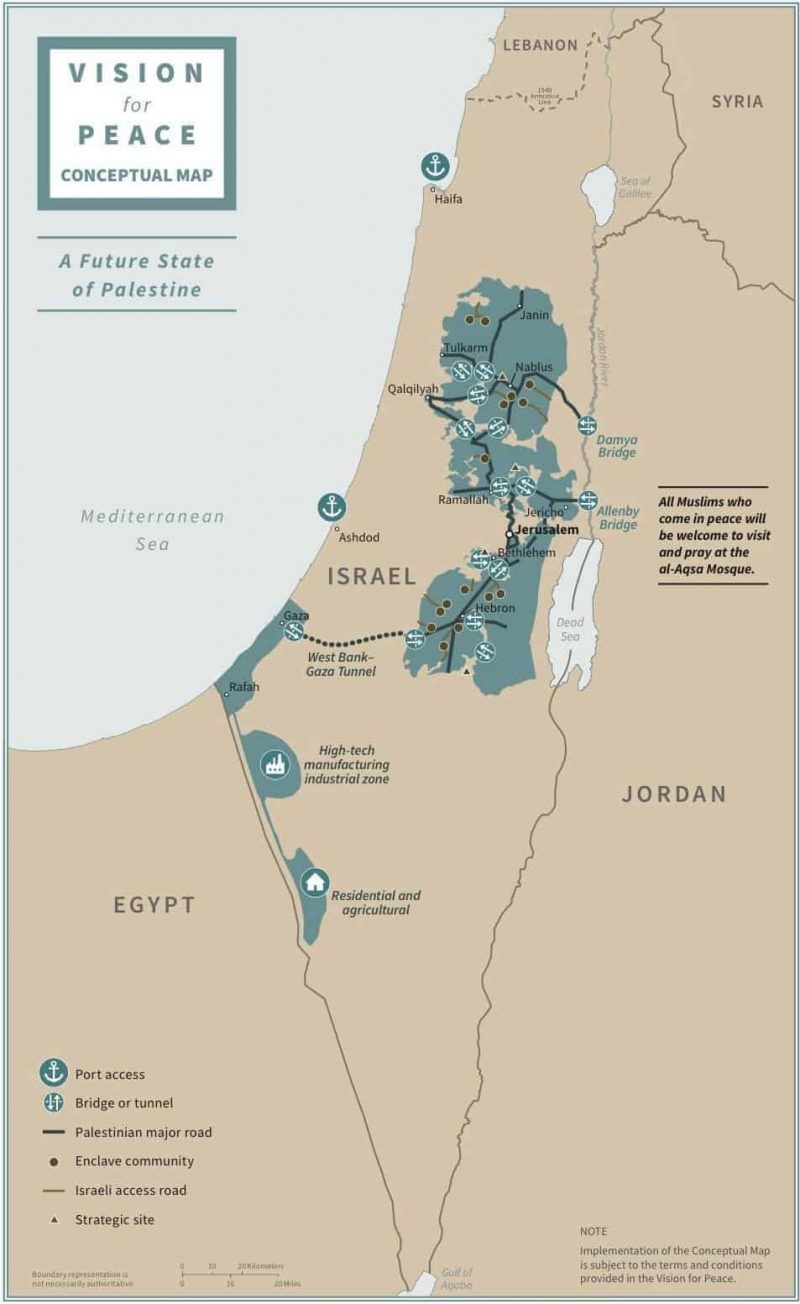
I just listened to the Idiot-in-Chief proudly present “his” Middle-East “peace” plan to Bibi Netanyahu and the world. This latest stunt shows two crucial things about the mind-set in Washington, D.C.:
- There is nothing which the U.S. ruling classes will not do to try to get the favor and support of the Israel Lobby.
- The US does not care, not even marginally, what the people of the Middle-East think.
This dynamic, which is not anything new, but which received a qualitative “shot of steroids” under Trump, will only further contribute to the inevitable collapse of Empire in the Middle-East. For one thing, all the so-called “U.S. allies” in the region understand that the only country which matters to the US is Israel, and that all the others count for almost nothing. Furthermore, all the rulers of the Middle-East now also know that being allied to the US also means being a cheap prostitute for Israel which, in turn, is guaranteed political suicide for any politician not wise enough to smell the trap. Finally, the wars in Afghanistan, Iraq, Yemen, Lebanon and Syria have shown that the “Axis of Kindness” is long on hyperbole and hubris, but very short in terms of actual combat capability.
The simple truth is that the abject brown-nosing of the Israel Lobby that Trump has been engaged in from Day 1 of his term only serves to further isolate and weaken the U.S. in the Middle-East (and beyond, really!).
In this context, how realistic is the Iranian goal of kicking Uncle Shmuel out of the region?
As I said, not realistic at all, if seen solely in the short term. But I hasten to add that it is very realistic in the mid-term if we look at some, but not all, the countries of the region. Finally, in the long term, it is not only realistic, it is inevitable, even if the Iranians themselves don’t do much, or anything at all, to make that happen.
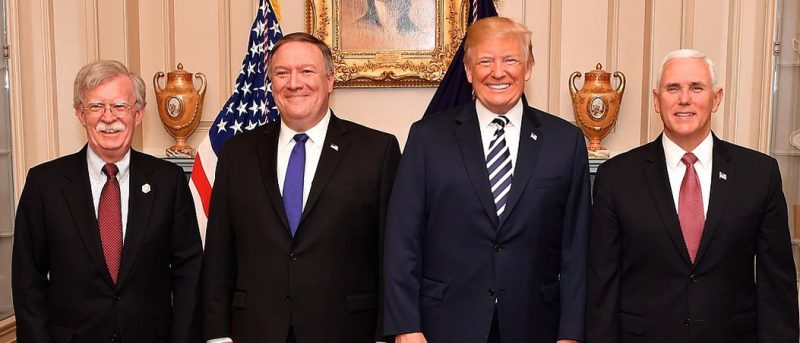
These grinning ignoramuses are doing more than anyone else to bring down the Empire, even if they don’t understand this!
Conclusion: “Israel’s” days are numbered
The Israelis have been feeding us all a steady diet about this or that country or politician being a “new Hitler’ who will either gas 6M Jews “again”, or wants to wipe Israel “off the map” or even engage in a new Holocaust. Gilad Atzmon brilliantly calls this mental disorder “pre-traumatic stress disorder,” and he is spot on. The Israelis mostly used this “preemptive geschrei*” as a way to squeeze out as many concessions (and money) from the western goyim as possible. But in a deep sense, it is possibly that the Israelis are at least dimly aware that their entire project is simply not viable, that you cannot ensure the survival of any state by terrorizing all of your neighbors. Violence, especially vicious, rabid, violence can, indeed, terrorize people, but only for so long. Sooner or later, the human soul will outgrow any fear, no matter how visceral, and will replace that fear by a new and immensely powerful sense of determination.
Here is what Robert Fisk said in distant 2006, 14 years ago:
You heard Sharon, before he suffered his massive stroke, he used this phrase in the Knesset, you know, “The Palestinians must feel pain.” This was during one of the intifadas. The idea that if you continue to beat and beat and beat the Arabs, they will submit, that eventually they’ll go on their knees and give you what you want. And this is totally, utterly self-delusional, because it doesn’t apply anymore. It used to apply 30 years ago, when I first arrived in the Middle East. If the Israelis crossed the Lebanese border, the Palestinians jumped in their cars and drove to Beirut and went to the cinema. Now when the Israelis cross the Lebanese border, the Hezbollah jump in their cars in Beirut and race to the south to join battle with them. But the key thing now is that Arabs are not afraid any more. Their leaders are afraid, the Mubaraks of this world, the president of Egypt, King Abdullah II of Jordan. They’re afraid. They shake and tremble in their golden mosques, because they were supported by us. But the people are no longer afraid.
What was true only for some Arabs in 2006, has now become true for most (maybe even all?) Arabs in 2020. As for the Iranians, they have never had any fear of Uncle Shmuel, they are the ones who “injected” the newly created Hezbollah with this qualitatively new kind of “special courage” (which is the Shia ethos, really!) when this movement was founded.
Empires can survive many things, but once they are not feared anymore, then their end is near. The Iranian strike proved a fundamental new reality to the rest of the world: the US is much more afraid of Iran than Iran is afraid of the US. U.S. rulers and politicians will, of course, claim otherwise. But that futile effort to re-shape reality is now doomed to failure, if only because even the Houthis can now openly and successfully defy the combined might of the “Axis of Kindness”.
You can think of U.S. and Israeli leaders as the orchestra on the Titanic: they play well, but they will still get wet and then die.
 (*geschrei: the Yiddish word for yelling, crying out, to shriek)
An Unusual Lawsuit against Iran
By Jacob G. Hornberger | FFF | January 28, 2020
The Washington Post recently published an article about a lawsuit that American citizens have brought against Iran. The plaintiffs are Iraq veterans and families of veterans who suffered horrendous injuries or deaths while serving in the U.S. armed forces in Iraq. In their lawsuit, the plaintiffs are claiming that Iran sent roadside bombs into Iraq that wreaked massive injuries or death on U.S. troops.
For example, Chris Levi’s Humvee was torn apart by a roadside bomb that cost him both his legs. Kelli Hake and her 13-year-old son are living their lives without their husband and father, who was killed by a roadside bomb in Iraq. There were thousands more like them.
It stands to reason that the plaintiffs would feel deep anger toward Iran, especially given their belief that Iran did, in fact, furnish the bombs that ended up inflicting death and injuries on U.S. soldiers serving in Iraq.
What is unusual, however, is that there appears to be absolutely no animus directed toward another regime. That regime is the U.S. government. I find the lack of ill will toward the U.S. government to be totally bizarre.
After all, let’s not forget something important: When a nation-state invades, attacks, and occupies a country and in the process intentionally wreaks death, suffering, and destruction, there is a very high probability that people are going to get extremely angry and are going to exact vengeance by doing the same thing to the invading and occupying troops.
We should keep in mind that the U.S. war on Iraq was illegal under our form of government. That’s because the U.S. Constitution, which is the higher law that we the people have imposed on the federal government, prohibits the president from waging war without a declaration of war from Congress. It is undisputed that Congress never declared war on Iraq.
The U.S. war on Iraq was also illegal under the principles set forth by the Nuremberg War Crimes Tribunal. It held that nation-states do not have the authority to invade and attack other nations.
Nonetheless, knowing that an invasion and occupation would be illegal under both the Constitution and the principles set forth at Nuremberg, the Pentagon ordered U.S. forces to invade and occupy the country, knowing full well that many of them would be killed, maimed, or injured in the process.
Did an illegal U.S. war of aggression against Iraq justify intervention by Iran to help Iraqis throw U.S. occupying forces out of the country? Of course not. Nonetheless, everyone knows — or should know — that when one nation illegally attacks and occupies another nation, there is a high likelihood that other nation-states are going to come to the assistance of the invaded and occupied country. That’s just the way the world works.
Consider, for example, when it was the Soviet Union, rather than the United States, that was the invader and occupier in Afghanistan. Guess who came to the assistance of the Afghans who were fighting to evict the Soviets from their country. That’s right — the U.S. government. It provided weaponry, including missiles, that was used to kill, maim, and injure Soviet soldiers. U.S. intervention wasn’t right, but that’s the way the world works.
What if those Soviet soldiers had sued the U.S. government for damages for the deaths and injuries caused by U.S.-supplied weaponry? There is not one court in the United States that would permit such a lawsuit to proceed. Unlike the lawsuit against Iran, a lawsuit by Soviet citizens against the U.S. government would be summarily dismissed.
If U.S. officials hadn’t ordered U.S. troops to invade and occupy Iraq, there never would have been any U.S. soldiers killed, maimed, or injured by anyone. Why shouldn’t the U.S. government be joined as a defendant in that lawsuit against Iran? If the Iranian government isn’t immune from liability, why should the U.S. government be immune from liability? Why are the plaintiffs giving their own government a pass, both legally and morally?
Iran slams Trump’s ‘delusional’ Middle East peace plan, calls on US to accept Tehran’s proposal instead
RT | January 27, 2020
Iranian Foreign Minister Mohammad Javad Zarif has blasted US President Donald Trump’s soon-to-be-revealed peace plan for the Israeli-Palestinian conflict, suggesting Iran’s referendum proposal would be a better strategy.
Trump said he will unveil his “deal of the century” for Israel and Palestine – actually prepared by his aide and son-in-law Jared Kushner – on Tuesday, but Zarif has already taken to Twitter to condemn it. He suggested that Washington should abandon its “delusional” plan and instead support a solution offered by Iran’s Supreme Leader Ayatollah Ali Khamenei.
Unlike the US plan, the details of which remain a mystery, the proposal put forward by Khamenei amounts to holding a referendum on a system of government including “Muslim, Christian and Jewish residents of Palestine as well as Palestinian refugees.” The Iranian leader also repeatedly slammed the US’ “deal of the century” by calling it “traitorous” and designed to “destroy” Palestine’s identity, as he apparently suspects the plan will greatly favor Israel.
While little is known about the deal, reports suggest that it’s unlikely to envisage statehood for Palestinians. AFP said that Palestinian President Mahmoud Abbas has already rejected the deal ahead of it being unveiled, and the Palestinian Authority considers that a two-state solution is the only way forward.
Tellingly, both Israeli Prime Minister Benjamin Netanyahu and his rival in the forthcoming snap elections, Benny Gantz, will attend the ceremony at the White House, while no Palestinian representatives will be present.
In anticipation of a strongly pro-Israeli plan, Palestinian leaders in Ramallah and Gaza have also condemned the upcoming deal and called for a “day of rage” on Tuesday. They urged Palestinians to boycott American goods, and remove all US symbols remaining in the West Bank.
Trump claimed in a press conference earlier this week that his administration had spoken “briefly” to the Palestinians, and vowed to talk to them again at some point in the future. He admitted that they might not like his proposals “at first.” However, he also maintained that his plan is “actually very positive to them.”
Washington has curtailed hundreds of millions of dollars in aid and stopped funding the UN agency that supports Palestinian refugees. Trump’s decision to move the US embassy from Tel Aviv to Jerusalem also drew the ire of the Palestinian Authority, which cut all communications with the US thereafter.
Featured Video

Trita Parsi: Middle East Unraveling — Are We on the Path to World War?
or go to
Aletho News Archives – Video-Images
New Book
Trans agenda is ‘normalization of sadism’ – US author

RT | September 23, 2026
The US Democratic Party has embraced a transgender agenda that amounts to “the normalization of sadism,” author A.J. Rice has said, warning that radical trans policies would return if the party is allowed to regain power.
Speaking to RT’s America First host Scotty Nell Hughes about his new book, ‘The Curse of the Bearded Lady: How the Trans Mafia Whacked American Sanity’, Rice argued that activists have gained significant influence in schools, medicine, and corporate America while people who questioned the agenda have faced pressure to stay silent.
The author described the “trans mafia” as the sprawling network of people and institutions that have helped the movement gain influence. He singled out parts of academia, wealthy backers, and corporations, and stated that providers of transition-related treatment also have a financial incentive to keep young people in their care indefinitely.
Rice argued that the consequences of these policies ultimately fall on children who are being drawn toward gender-affirming medical treatments and on girls who are expected to share locker rooms or compete in sports with biological males.
He noted that while voters rejected the Democrats’ approach to gender in 2024, the party, which has been “captured by madness,” has since only doubled down and is seeking what is effectively “the normalization of sadism.” … Full report
Blog Roll
 Aletho News
- Integrity Initiative: UK-funded network framed dissent as Russian disinformation for years
- ‘We don’t seek permission to defend our country’: Snippets from President Pezeshkian’s UNGA address
- NATO chief wants Europeans to fight American wars [for Israel]
- German chemicals giant reveals details of downsizing
- Refaat Al-Areer Was The Canary In The Coal Mine In Israel’s War On The Truth
- Israeli election committee bars candidate from Knesset race over Gaza war opposition
- French-Lebanese man files war crimes complaint over Israeli attacks
- Mahan Air Flight Lands in China Despite US Threat against Iranian Airlines
- US eyes $10bn fund to rebuild war-battered Gulf infrastructure
- Trump meets Rodríguez near Maduro’s prison as Venezuela’s oil flows to US
- If Americans Knew
- Caught on Tape: AIPAC CEO Boasted of Controlling Trump’s National Security Officials
- Why Hamas Attacked Israel in October 2023 – Israeli professor Ilan Pappé
- They see them, then kill them: Israeli quadcopters track, deliberately target civilians in Gaza
- Winter could turn Gaza’s treacherous, war-damaged buildings into deathtraps
- Majority of Democratic Voters Want to Prosecute Both Biden and Trump Administration Officials Over Gaza
- As Gaza languishes, world leaders gather at the UN – Daily Update
- Sanctions are collective punishment: immoral and self-defeating
- Phosphorus Munitions Fired by Israel Burn Groves, Orchards in Southern Lebanon
- Israel Carries Out New Ceasefire Violations Across Gaza
- AI – Emphasis on the ‘I’: Israel Is Funding AI Chatbot Propaganda
- No Tricks Zone
- New Study: Earth And Venus Surface Warmth Largely Explained By Convection And Lapse Rate, Not CO2 Or Radiation
- 2025 Nature Paper Claiming Worsening Global Drought Gets RETRACTED …Heavily Flawed
- New Study: ‘Global Drought Shows No Detectable Recent Acceleration Under Climate Warming’
- Economic Masterminds: German Socialists Suggest Taxing Productivity Gains Stemming From Using AI
- The South China Sea Has Not Been Cooperating With The Climate Change Narrative
- Energy Crisis: Germany Enters Heating Season With Historically Low Gas Reserve Fill Levels
- New Study: The Antarctic Ice Sheet Gained Mass From 2020-2024 Due To Staggering Snow And Ice Accumulation
- Study: Ocean Heating Rates From Thousands Of Years Ago ‘Dwarf’ Modern Ocean Heating Rates
- Climate Extremists Target, Attack Large-Scale Power Grid Infrastructure In Germany!
- New Study: Antarctic Ice Melt Has Contributed Less Than 1 Centimeter To Sea Level Rise In The Last 30 Years

