Russia stood by Iran in showdown with US
By M. K. BHADRAKUMAR | Indian Punchline | January 27, 2020
US President Donald Trump first said there were ‘no casualties’ in the Iranian missile attack on the Ain al-Asad military airbase in Iraq on January 8. “We suffered no casualties, all of our soldiers are safe, and only minimal damage was sustained at our military bases,” Trump had said.
Then a number 11 was mentioned a week later, but Trump minimised the injuries, calling them ‘headaches’. Last Friday, a fortnight after the attack, the number sharply climbed. The Pentagon spokesman told reporters that 34 US military members received concussions or other traumatic brain injuries in the missile strikes.
The true human toll of the Iranian strike is still being assessed. But what Iran achieved through the January 8 attacks may never quite be in the public domain.
The big question is whether Iran acted with Russian backing. Beyond a string of Russian statements empathising with Iran, all we have are tell-tale signs.
To be sure, satellite imagery suggests very precise hits of targets in the Ain al-Asad base. In an interview with Spiegel magazine last week, Iran’s Foreign Minister Mohammad Javad Zarif stated Iran’s objectives:
“There was no intention of causing any casualties with the missile attack… The damage we have done to the US is extensive, because with all its military might, it could not prevent the missiles from hitting its base. It shows how vulnerable the US is.”
The Iranians did succeed in displaying their formidable missile capability and its capacity to inflict lethal damage on US military establishments. But how could such high-precision hits be achieved except with missiles equipped with satellite guidance and target-tracking capabilities?
Importantly, Iran doesn’t have an independent orbital group of satellites. There are four global navigation satellite systems operational today — the US GPS/NAVSTAR, European GNSS, Russian GLONASS and Chinese BeiDou. The US and European systems are out of bounds for Iran.
But there is no embargo on Iran accessing the Russian or Chinese systems and it probably used one of them. But Tehran neither confirms nor denies.
Iran acknowledges it fired two Russian TOR-M1 anti-aircraft missiles but, interestingly, stops short of blaming them for the crash of the Boeing 737-800, flown by Ukraine International Airways. By the way, TOR-M1 is mounted on a tracked vehicle and carries a radar and each vehicle can operate independently. Did Iran’s Russian-made TOR-M1 have access to GLONASS?
Indeed, on January 7, on the eve of the Iranian missile strike, President Vladimir Putin paid an unscheduled visit to Syria to meet up with President Bashar al-Assad.
Again, on January 9, the day after the Iranian missile strike, Putin watched a big naval exercise involving multiple missile launches in the Black Sea. The Navy Times reported, “The Russian naval maneuvers come amid heightened US-Iran tensions after the US strike last week that killed Iran’s most powerful military commander.”
Advanced Russian weapon systems were on display in the maneuvers. MiG-31 interceptor jets launched Kinzhal hypersonic missiles at practice land targets while Navy ships performed several launches of Kalibr cruise missiles and other weapons. More than 30 warships and 39 aircraft, including several Tu-95 strategic bombers, took part in the exercise.
Curiously, again on January 9, in the northern Arabian Sea off Iran’s coastline, there was a rare encounter between the US destroyer USS Farragut and the Russian intelligence gathering ship RFS Ivan Hurs, which was apparently shadowing the operations of a US aircraft carrier battle group in the area.
The above events taken together signalled that Russia was closely monitoring the situation around Iran and was in full readiness to meet any emergent military conflagration in the region. No doubt, the message was addressed to Washington.
It is entirely conceivable that Russia has intelligence-sharing arrangements with Iran. In fact, Russian Foreign Minister Sergey Lavrov, a veteran diplomat, might just have lifted the veil a little bit when he disclosed on January 17 that Iran’s accidental shooting down of the Ukrainian airliner occurred at a time when Tehran was spooked by reports of advanced US stealth fighters in the area.
“There were at least six F-35 fighters in the air in the Iranian border area. This information has yet to be verified, but I’d like to underline the edginess that always accompanies such situations,” Lavrov said. Alas, Lavrov’s disclosure left a cold trail. But it most certainly hinted that Russia is reconnoitring the skies above Iran.
All this may amount to nothing much, or everything — depending on how one looks at it. Russia will not militarily intervene in a US-Iranian conflict. Indeed, such a conflict is unlikely. What Russia can do is to make the probability of a conflict even less likely by aiding Iran to defend itself, by providing it with electronic warfare tools and other high-end arms that would raise the military costs to the US, as had happened on January 8.
How far Russia’s ‘positive neutrality’, which distinctly favoured Iran in the most recent period, irritated Washington no one can tell. But there have been four instances in the past 8 days alone of US forces blocking Russian convoys in northeastern Syria — one forcing back a vehicle driven by a Russian major-general. Poking the bear? In Russian-American relations, nothing is really coincidental.
The debate over the alchemy of Russian-Iranian relations is a never-ending one. But no matter the two countries’ specific interests or national objectives and ideologies, a destruction of Iran or the emergence of a US-friendly regime in Tehran would be profoundly consequential to Russian regional strategies, given the co-relation of forces internationally.
Lavrov gave an indication of Russian priorities when he said in Delhi on January 17 while addressing an international audience (including Zarif) that Moscow backs Tehran’s bid to join Shanghai Cooperation Organisation as a full member and is hopeful it will happen.
‘Targeted and governmental terrorism’: Iran slams US for threat against Soleimani successor
RT | January 23, 2020
Iran’s Foreign Ministry slammed the US’ policy of “targeted and governmental terrorism” after an American diplomat threatened Quds Force commander Esmail Ghaani with the same fate as his assassinated predecessor, Qassem Soleimani.
“These words are an official announcement and a clear unveiling of America’s targeted and governmental terrorism,” ministry spokesman Abbas Mousavi told Iranian state media on Thursday in response to threats made against Ghaani by US Special Representative for Iran Brian Hook. Mousavi called on the international community to join him in condemning the thuggish statement from the American.
“If Ghaani follows the same path of killing Americans [as Soleimani] then he will meet the same fate,” Hook had told Arabic-language outlet Asharq al-Awsat earlier that day, vowing to “hold the regime and its agents responsible for any attack on Americans or American interests in the region.”
There has not been any indication Iran is planning to kill Americans, however, even after the death of the beloved general. Tehran actually spared US lives by tipping Iraq off to planned missile attacks on two coalition bases, allowing both Iraqi and American soldiers to vacate the facilities. The bases were severely damaged in precision strikes meant as revenge for the Soleimani killing, but no Americans were hit.
While Hook and Washington have insisted Soleimani was behind an ever-growing number of American deaths, they have been unable to supply any evidence – certainly not for an impending plot that would have required his immediate assassination – leading even some members of President Donald Trump’s own party to vow opposition to any authorization for war with Iran.
Evidence Soleimani was behind previous attacks on Americans – particularly the rocket strike on K-1 Air Base last month that killed a US contractor and sparked the most recent escalation of force – has also been lacking. The claim that the Iranian general was responsible for the deaths of “600 Americans,” often repeated by Hook and other members of the Trump administration in the days following Soleimani’s assassination by airstrike at the Baghdad airport, grew out of a propaganda figure cooked up by former US vice president Dick Cheney when he was trying to whip up the Bush administration for a war with Iran. More fanciful claims, like Vice President Mike Pence’s suggestion that Soleimani was somehow involved in the 9/11 terror attacks, also have no basis in fact.
Ghaani was appointed to replace Soleimani the day after the latter’s death and has vowed to continue on his “luminous path,” with the ultimate goal of removing US forces from the Middle East. Like Soleimani, he made his name during the war between Iran and Iraq in the 1980s.
Tehran open to dialog with all neighbors: Zarif
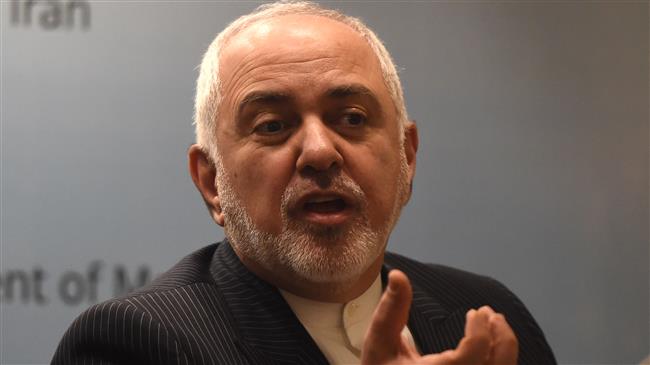
Iranian Foreign Minister Mohammad Javad Zarif (Photo by AFP)
Press TV – January 23, 2020
Foreign Minister Mohammad Javad Zarif has reaffirmed Iran’s readiness for talks with all its neighbors amid tensions in the Persian Gulf region.
“Iran remains open to dialogue with its neighbors, and we declare our readiness to participate in any complementary work that is in the interest of the region, and we welcome any step that restores hope to its people and brings them stability and prosperity,” Zarif said in a tweet in Thursday.
The tweet was in Arabic, which suggests it was addressed to the Persian Gulf littoral Arab countries. It came a day after Saudi Foreign Minister Prince Faisal bin Farhan said Riyadh was ready for talks with Tehran “but it is really up to Iran.”
The top Saudi diplomat, however, repeated the baseless claims against Iran’s role in the region, adding that the precondition for dialog is for the Islamic Republic to accept it “cannot further its regional agenda through violence.”
Speaking from the World Economic Forum in Davos, he said he was glad the region has “avoided any escalation” with Iran, and that “many countries” have offered to mediate talks with Tehran.
Meanwhile, the Iranian president’s chief of staff, Mahmoud Vaezi, said Wednesday that Tehran and Riyadh should work together to overcome their problems.
“The relations between Iran and its neighbor Saudi Arabia should not become like the relationship between Tehran and the United States … Tehran and Riyadh should work together to resolve their problems,” Vaezi said.
At an event in the Indian city of Mumbai on Friday in coordination with All India Association of Industries (AIAI), Zarif also voiced Iran’s readiness to hold talks with Saudi Arabia and other Persian Gulf countries to promote regional security.
He added that Iran has also presented proposals on ways to establish peace in the Strait of Hormuz.
In an address to the 74th session of the United Nations General Assembly in September 2019, President Hassan Rouhani said as a steward of maritime security in the Persian Gulf and the Strait of Hormuz, Iran invites all countries that are affected by developments in the strategic region to join the country’s new regional peace initiative, dubbed Hormuz Peace Endeavor (HOPE).
Iran’s initiative comes as the US has been trying to persuade its allies into a maritime coalition purportedly seeking to boost security in the Persian Gulf, after it blamed Tehran for two separate attacks on oil tankers in the Gulf of Oman in May and June, without providing any credible evidence to back up the allegation, which Iran has categorically rejected.
Tehran has repeatedly said outsiders not only cannot safeguard the region, but will fuel tensions there. Iran believes it is the countries of the very region which can ensure regional peace.
Prior to the Hormuz initiative, Iran had offered to sign non-aggression agreements with all countries in the Persian Gulf region.
Zarif also said in late May 2019 that Iran sought the best of relations with the Persian Gulf littoral countries and would welcome any proposals for dialog and de-escalation toward that end.
Evidence suggests US lied about Iranian strikes on US facilities in Iraq
By Robert Inlakesh | Press TV | January 16, 2020
During the early morning hours of January 8, 2020, Iranian strategic missile units launched a precision attack, branded ‘Operation Martyr Soleimani’, against US forces at the American-operated section of the ‘Ain al-Asad’ air base in Iraq.
The response, coming in response to the illegal assassination of General Qassem Soleimani, was a high-observable attack using ballistic missile forces – as opposed to a low-observable attack using terrain-reading cruise missiles and suicide drones.
With US forces already having been in a heightened state of alert, American radar and satellite reconnaissance would have spotted the attack within a minute of it being launched (and a six hour pre-warning of an imminent attack before that), giving the US and other coalition troops present at the base time to seek cover in hardened shelter areas. This, however, did not prevent the success of the attack which, according to primary source evidence, destroyed highly-expensive US aviation assets.
THE RESULT – U.S. FORCES ASSET LOSSES
According to the evidence that has been made available to us at this point, it is obvious that the US is lying about the extent of the damage inflicted upon its assets and infrastructure at the Ain al-Asad base.
No American media group or official Pentagon report initially released the satellite pictures shown in this report, and probably for good reason. To downplay the event (as Trump did in his official address, as did the Pentagon in its later report), they simply dismissed the damaged equipment, referring to the destroyed assets as simple “tents, a parking lot and a damaged helicopter” (per the Department of Defense).
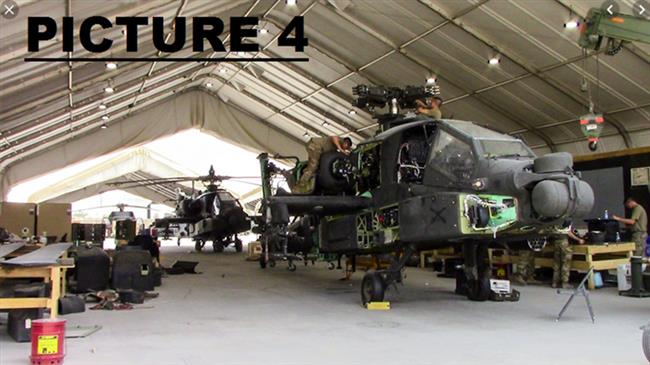
The Iranian missile attack for the most part targeted Apache (AH-64) attack helicopter shelters (refer to Picture 1). Refer to Picture 3 and Picture 4 to see what those “tent”-like Apache steel-frame shelters look like at ground level.
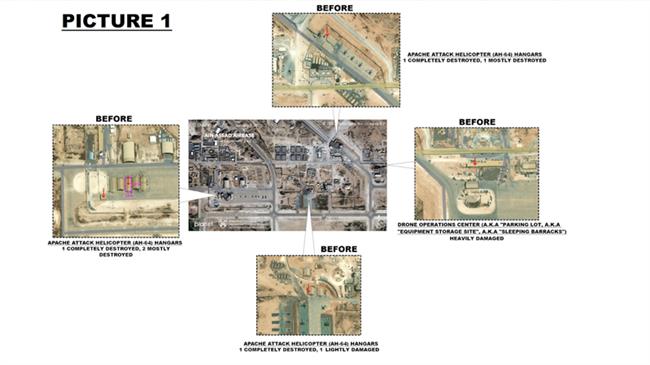
They are the standard steel-frame soft shelter design for US helicopter units based in overseas areas at second-rate airfields (such as the Ain al-Asad Base) – US helicopter units operating from old Afghan airfields are also housed in this kind of shelter design. Each one of those Apache attack helicopter shelters can house two such aircraft. With six structures of the type provably destroyed, demonstrated through the satellite images showing blackened scorch marks (suggesting assets inside them were destroyed with the shelter itself, refer to Picture 1) AND assuming each only had one Apache in them, it can be concluded that at least 6 Apache gunships were destroyed in the attack.
Recently, Danish media, citing a Danish coalition soldier who was present at the base at the time of the attack, admitted that multiple helicopters were destroyed to the point of being “split in half”.
Another Apache hangar (refer to Picture 2) was also directly struck, located to the far eastern end of the Ain al-Asad Base and destroyed. However, note that there is no scorch-blackened concrete underneath it, suggesting nothing was inside it that led to additional burning beyond the impact of the warhead itself.
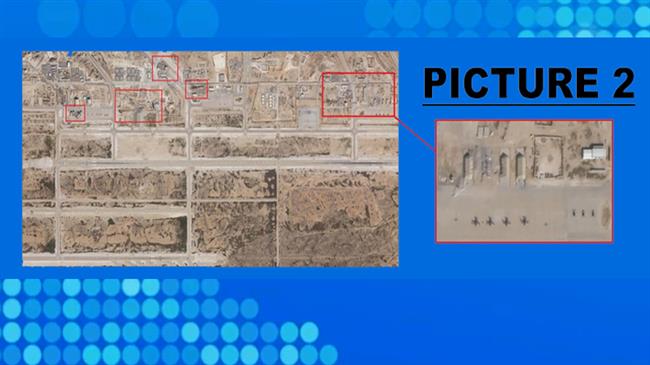
Indeed, just to the south of that destroyed hangar and the undamaged three hangars next to it, 4 Apache helicopters can be seen sitting out on the open tarmac. They were spared as they were, ironically, not being sheltered.
The official US story on the other structure targeted beyond the “tents” (i.e. Apache gunship hangars) has already changed twice – first it was called a parking lot, then an equipment storage area and now, apparently, a barracks for drone operators. Picture 1 (far right) shows the result of the attack on this structure.
It is hard to imagine that base zoning regulators within the US military would chose to place sleeping quarters right next to a strip alert (ready-to-go) aircraft parking area, itself right next to a major taxiway, given the constant noise that comes from these areas.
A more astute assessment would place this structure as an operations center, which lines up with the Iranian claim that the command site from which the Qassem Soleimani assassination operation had been coordinated, was targeted and destroyed in Iran’s retaliation strike.

Indeed, AFP recently released an exclusive report in which a US drone operator present at the Ain al-Asad Airbase, one First Sergeant Wesley Kilpatrick, admitted that airborne drones were rendered inoperable after a direct hit penetrated the base’s UAV operations center and destroyed the fiber lines which connect remote stations to satellite communication equipment(needed for drone control and visuals).
In all of this, one thing is obvious. US officials and media are stumbling over their own statements trying to cover up the extent of the damage dealt to the US-operated section of the Ain al-Asad base – in fact, going so far to cease calling the military site a US airbase (as it had been called for the last 16 years) to (all of a sudden) just an “Iraqi facility”.
THE WEAPONS USED BY IRAN
Short-range ballistic missiles (SRBM) of the upgraded Fateh-313 (range 500 km) and Qiam (range 800 km) types were launched from Western Iran towards the US-operated Ain al-Asad Base in Iraq.
Fateh-313s represent the majority of the missile type used for the attack. Their accuracy still seems to have been to within a matter of meters of their intended targets, except for two stray shots that hit the open tarmac area.
Whilst the Fateh-313 missiles use a combination of INS and electro-optical guidance, the Qiam missiles reportedly use a mix of INS, GPS and radar-mapping target acquisition. The latter method being the archaic predecessor version of DSMAC (imaging automatic target acquisition) terminal-phase guidance used in high-end ground-attack cruise missiles, such as the Tomahawk.
THE OPERATION –OTHER DETAILS
Satellite pictures show that some targeted sites were double-tapped (hit twice-over for good measure).
Initial reports from the Ain al-Asad Base claimed nearly 40 detonations in total despite the fact the number of actual warhead impacts was about fifteen, indicating that there were around two dozen cases of secondary explosions (fuel and ammo going off after being ignited).
In conclusion, according to the evidence we have available to us currently, there is no doubt that the United States has completely distorted the gravitude of Iran’s strikes. The mainstream media in the West have also seemingly refrained from acknowledging much of the damage, apart from on occasion.
Robert Inlakesh is a journalist, writer and political analyst, who has lived in and reported from the occupied Palestinian West Bank. He has written for publications such as Mint Press, Mondoweiss, MEMO, and various other outlets. He specializes in analysis of the Middle East, in particular Palestine-Israel. He also works for Press TV as a European correspondent.
Facebook censors explainer clip recalling when western media liked Soleimani – and demonetizes popular account for sharing it
RT | January 15, 2020
Facebook is doubling down on censorship of anything less than villification of slain Iranian Major General Qassem Soleimani, deleting a clip showing his history of fighting terrorism – and demonetizing the account posting it.
The social media behemoth didn’t just remove independent journalist Dan Cohen’s ‘In the Now’ segment, “How ‘good guy’ Soleimani became US media’s ‘bad guy,” from the show’s page on Tuesday – it demonetized In the Now entirely, citing the typical unspecified violations of “community standards.” The move comes amid an alarming escalation in the platform’s crackdown on political speech that runs contrary to US foreign policy, a wave of censorship that has not been limited to Facebook.
Cohen’s video calmly and accurately explains how Soleimani “saved the region from falling to ISIS,” fighting the terrorist group alongside the US and its Kurdish allies before he was recast posthumously by a complicit western media as “actually a huge terrorist and a ticking time bomb who was born to kill Americans.” The video exposes the ideological inconsistency of the outlets currently depicting the Quds Force commander as the devil incarnate, showcasing clips from those same outlets in recent years praising Soleimani’s battlefield performance.
Rania Khalek, who runs In the Now, tweeted in shock that a video merely stating facts about Soleimani had gotten her page demonetized, asking “where is the outrage” now that Facebook was so explicitly deleting material for ideological reasons.
Facebook and its subsidiary Instagram have come under fire from independent journalists and media organizations like the International Federation of Journalists for embarking on a wholesale campaign to deplatform all support for Soleimani in the weeks following the US airstrike that killed him. The company has claimed the extensive US sanctions placed on Iran, including the designation of the Islamic Revolutionary Guard Corps as a terrorist organization, require it to censor such posts, though even legal experts quoted by CNN took a dim view of that rationale.
Facebook and Instagram not only remove accounts run by or for sanctioned individuals or groups, but also posts that (they claim) praise or seek to assist the people in question – making sanctions a convenient excuse for mass-deplatforming any user who holds a political view the US government has deemed heresy.
Iranians saw insult added to injury when over a dozen Iranian journalists, several state-run media organizations, and countless ordinary individuals and activists’ Instagram accounts were yanked entirely in the days following Soleimani’s assassination. Many more saw pro-Soleimani posts removed, even when they carefully avoided saying his name – one Lebanese researcher praised “Q*ssem S*leim*ni” for protecting Christians from ISIS and al-Qaeda, only to have his video removed anyway.
The rank ideological discrimination not only left them unable to publicly mourn for a leader beloved by the lion’s share of the people, but allowed pro-regime-change trolls to dominate the narrative. Facebook has recently taken flack from the US political establishment for refusing to “fact-check” political ads, but non-advertising content is more tightly controlled than ever.
Facebook and Instagram are far from alone in clamping down on the speech of Iranian users, however – YouTube briefly deleted state-backed PressTV’s channel earlier this week, only to reactivate it after an outpouring of popular support.
Twitter removed state-backed media outlet Al-Alam News’ account, as well as that of the popular Iran-backed Spanish-language media outlet HispanTV, only reinstating the latter after a massive public backlash. Dozens of individual Iranians who supported their government were also deplatformed on Twitter, while anti-government users – many linked to notorious exile terror group Mujahedin e-Khalq (MEK) – were allowed to continue slinging hate against Soleimani and his supporters. Twitter even dished out a ban to Syrian President Bashar Assad, but restored the account after a few days.
Who Targeted Ukraine Airlines Flight 752? Iran Shot It Down But There May Be More to the Story
By Philip Giraldi | American Herald Tribune | January 15, 2020
The claim that Major General Qassem Soleimani was a “terrorist” on a mission to carry out an “imminent” attack that would kill hundreds of Americans turned out to be a lie, so why should one believe anything else relating to recent developments in Iran and Iraq? To be sure, Ukraine International Airlines Flight 752 departing from Tehran’s Imam Khomeini International Airport on the morning of January 8th with 176 passengers and crew on board was shot down by Iranian air defenses, something which the government of the Islamic Republic has admitted, but there just might be considerably more to the story involving cyberwarfare carried out by the U.S. and possibly Israeli governments.
To be sure, the Iranian air defenses were on high alert fearing an American attack in the wake of the U.S. government’s assassination of Soleimani on January 3rd followed by a missile strike from Iran directed against two U.S. bases in Iraq. In spite of the tension and the escalation, the Iranian government did not shut down the country’s airspace. Civilian passenger flights were still departing and arriving in Tehran, almost certainly an error in judgment on the part of the airport authorities. Inexplicably, civilian aircraft continued to take off and land even after Flight 752 was shot down.
Fifty-seven of the passengers on the flight were Canadians of Iranian descent, leading Prime Minister Justin Trudeau to point the finger both at the Iranian government for its carelessness and also at Washington, observing angrily that the Trump Administration had deliberately and recklessly sought to “escalate tensions” with Iran through an attack near Baghdad Airport, heedless of the impact on travelers and other civilians in the region.
What seems to have been a case of bad judgements and human error does, however, include some elements that have yet to be explained. The Iranian missile operator reportedly experienced considerable “jamming” and the planes transponder switched off and stopped transmitting several minutes before the missiles were launched. There were also problems with the communication network of the air defense command, which may have been related.
The electronic jamming coming from an unknown source meant that the air defense system was placed on manual operation, relying on human intervention to launch. The human role meant that an operator had to make a quick judgment in a pressure situation in which he had only moments to react. The shutdown of the transponder, which would have automatically signaled to the operator and Tor electronics that the plane was civilian, instead automatically indicated that it was hostile. The operator, having been particularly briefed on the possibility of incoming American cruise missiles, then fired.
The two missiles that brought the plane down came from a Russian-made system designated SA-15 by NATO and called Tor by the Russians. Its eight missiles are normally mounted on a tracked vehicle. The system includes both radar to detect and track targets as well as an independent launch system, which includes an Identification Friend or Foe (IFF) system functionality capable of reading call signs and transponder signals to prevent accidents. Given what happened on that morning in Tehran, it is plausible to assume that something or someone deliberately interfered with both the Iranian air defenses and with the transponder on the airplane, possibly as part of an attempt to create an aviation accident that would be attributed to the Iranian government.
The SA-15 Tor defense system used by Iran has one major vulnerability. It can be hacked or “spoofed,” permitting an intruder to impersonate a legitimate user and take control. The United States Navy and Air Force reportedly have developed technologies “that can fool enemy radar systems with false and deceptively moving targets.” Fooling the system also means fooling the operator. The Guardian has also reported independently how the United States military has long been developing systems that can from a distance alter the electronics and targeting of Iran’s available missiles.
The same technology can, of course, be used to alter or even mask the transponder on a civilian airliner in such a fashion as to send false information about identity and location. The United States has the cyber and electronic warfare capability to both jam and alter signals relating to both airliner transponders and to the Iranian air defenses. Israel presumably has the same ability. Joe Quinn at Sott.net also notes an interested back story to those photos and video footage that have appeared in the New York Times and elsewhere showing the Iranian missile launch, the impact with the plane and the remains after the crash, to include the missile remains. They appeared on January 9th, in an Instagram account called ‘Rich Kids of Tehran‘. Quinn asks how the Rich Kids happened to be in “a low-income housing estate on the city’s outskirts [near the airport] at 6 a.m. on the morning of January 8th with cameras pointed at the right part of the sky in time to capture a missile hitting a Ukrainian passenger plane…?”
Put together the Rich Kids and the possibility of electronic warfare and it all suggests a premeditated and carefully planned event of which the Soleimani assassination was only a part. There have been riots in Iran subsequent to the shooting down of the plane, blaming the government for its ineptitude. Some of the people in the street are clearly calling for the goal long sought by the United States and Israel, i.e. “regime change.” If nothing else, Iran, which was widely seen as the victim in the killing of Soleimani, is being depicted in much of the international media as little more than another unprincipled actor with blood on its hands. There is much still to explain about the downing of Ukrainian International Airlines Flight 752.
Philip M. Giraldi is a former CIA counter-terrorism specialist and military intelligence officer who served nineteen years overseas in Turkey, Italy, Germany, and Spain. He was the CIA Chief of Base for the Barcelona Olympics in 1992 and was one of the first Americans to enter Afghanistan in December 2001. Phil is Executive Director of the Council for the National Interest, a Washington-based advocacy group that seeks to encourage and promote a U.S. foreign policy in the Middle East that is consistent with American values and interests.
Non-commitment probe into Iran by France, Germany & UK ‘groundless,’ only increases tensions around nuclear deal – Russia
RT | January 14, 2020
The European trio’s accusation that Iran violates the key restrictions of the nuclear deal are unjustified, the Russian Foreign Ministry said urging the countries not to increase tensions that could endanger the pact.
Paris, Berlin and London officially reported Iran’s non-compliance with the 2015 agreement to the Joint Commission under the Dispute Resolution Mechanism. This step could potentially lead to the UN Security Council being forced to decide on whether or not to bring back sanctions against Tehran.
“We can’t rule out that the ill-considered actions of the European trio will lead to a new escalation around the JCPOA (Joint Comprehensive Plan of Action) and make the return to the implementation of the ‘nuclear deal’ in its initially agreed format unachievable,” Russia’s Foreign Ministry said in a statement.
Iran rolled back on its uranium enrichment constraints detailed in the international agreement earlier this month after one of its top military commanders, Qassem Soleimani, was assassinated in an American drone strike in Iraq.
Tehran’s decision to put its commitments on hold was a response to the actions of the US, which unilaterally withdrew from the deal in May 2018 and reintroduced restrictions against Iran, the ministry reminded. However, the country keeps allowing the International Atomic Energy Agency (IAEA) monitors to its nuclear sites – and “the transparency of the Iranian nuclear program has been one of the key clauses of the nuclear deal.”
Despite vocally rejecting the US campaign of “maximum pressure” on Iran, France, Germany and the UK are “either not ready or can’t afford to” work on finding effective ways of bypassing the hurdles to the deal created by Washington.
There are also “serious problems” with implementing the side of the deal on the part of the European trio, the ministry said. When all those issues are settled, “Iran would have no reason to retract from the initially agreed framework of the JCPOA.”
Featured Video

Trita Parsi: Middle East Unraveling — Are We on the Path to World War?
or go to
Aletho News Archives – Video-Images
New Book
Trans agenda is ‘normalization of sadism’ – US author

RT | September 23, 2026
The US Democratic Party has embraced a transgender agenda that amounts to “the normalization of sadism,” author A.J. Rice has said, warning that radical trans policies would return if the party is allowed to regain power.
Speaking to RT’s America First host Scotty Nell Hughes about his new book, ‘The Curse of the Bearded Lady: How the Trans Mafia Whacked American Sanity’, Rice argued that activists have gained significant influence in schools, medicine, and corporate America while people who questioned the agenda have faced pressure to stay silent.
The author described the “trans mafia” as the sprawling network of people and institutions that have helped the movement gain influence. He singled out parts of academia, wealthy backers, and corporations, and stated that providers of transition-related treatment also have a financial incentive to keep young people in their care indefinitely.
Rice argued that the consequences of these policies ultimately fall on children who are being drawn toward gender-affirming medical treatments and on girls who are expected to share locker rooms or compete in sports with biological males.
He noted that while voters rejected the Democrats’ approach to gender in 2024, the party, which has been “captured by madness,” has since only doubled down and is seeking what is effectively “the normalization of sadism.” … Full report
Blog Roll
 Aletho News
- Integrity Initiative: UK-funded network framed dissent as Russian disinformation for years
- ‘We don’t seek permission to defend our country’: Snippets from President Pezeshkian’s UNGA address
- NATO chief wants Europeans to fight American wars [for Israel]
- German chemicals giant reveals details of downsizing
- Refaat Al-Areer Was The Canary In The Coal Mine In Israel’s War On The Truth
- Israeli election committee bars candidate from Knesset race over Gaza war opposition
- French-Lebanese man files war crimes complaint over Israeli attacks
- Mahan Air Flight Lands in China Despite US Threat against Iranian Airlines
- US eyes $10bn fund to rebuild war-battered Gulf infrastructure
- Trump meets Rodríguez near Maduro’s prison as Venezuela’s oil flows to US
- If Americans Knew
- Caught on Tape: AIPAC CEO Boasted of Controlling Trump’s National Security Officials
- Why Hamas Attacked Israel in October 2023 – Israeli professor Ilan Pappé
- They see them, then kill them: Israeli quadcopters track, deliberately target civilians in Gaza
- Winter could turn Gaza’s treacherous, war-damaged buildings into deathtraps
- Majority of Democratic Voters Want to Prosecute Both Biden and Trump Administration Officials Over Gaza
- As Gaza languishes, world leaders gather at the UN – Daily Update
- Sanctions are collective punishment: immoral and self-defeating
- Phosphorus Munitions Fired by Israel Burn Groves, Orchards in Southern Lebanon
- Israel Carries Out New Ceasefire Violations Across Gaza
- AI – Emphasis on the ‘I’: Israel Is Funding AI Chatbot Propaganda
- No Tricks Zone
- New Study: Earth And Venus Surface Warmth Largely Explained By Convection And Lapse Rate, Not CO2 Or Radiation
- 2025 Nature Paper Claiming Worsening Global Drought Gets RETRACTED …Heavily Flawed
- New Study: ‘Global Drought Shows No Detectable Recent Acceleration Under Climate Warming’
- Economic Masterminds: German Socialists Suggest Taxing Productivity Gains Stemming From Using AI
- The South China Sea Has Not Been Cooperating With The Climate Change Narrative
- Energy Crisis: Germany Enters Heating Season With Historically Low Gas Reserve Fill Levels
- New Study: The Antarctic Ice Sheet Gained Mass From 2020-2024 Due To Staggering Snow And Ice Accumulation
- Study: Ocean Heating Rates From Thousands Of Years Ago ‘Dwarf’ Modern Ocean Heating Rates
- Climate Extremists Target, Attack Large-Scale Power Grid Infrastructure In Germany!
- New Study: Antarctic Ice Melt Has Contributed Less Than 1 Centimeter To Sea Level Rise In The Last 30 Years

