Iran draws up gas field development plan after Saudi-Kuwaiti move

Some 23 Iranian hydrocarbon fields lie in border areas and are shared between Iran and adjacent countries
Press TV – March 28, 2022
An official says Iran has worked out a plan to develop its part of the Arash natural gas field shared with Saudi Arabia and Kuwait after the two Arab states announced having signed a document to build the reservoir without Tehran’s participation.
Last week, Kuwait said it planned to extract 1 billion standard cubic feet per day of gas and 84,000 barrels per day of condensate from the field under an agreement signed with Saudi Arabia. Iran dismissed the agreement as “illegal”, saying it breached their discussions to build the field together.
Ahmad Asadzadeh, deputy petroleum minister for international and commercial affairs, said Sunday Iran believes shared fields should be carried out jointly, adding this would lead to the strengthening of economic ties among the countries.
“Even if the border is not demarcated, the field can be developed jointly using internationally tested models,” he said. “The Ministry of Petroleum declares its readiness to negotiate in this regard,” Asadzadeh added.
Iran began talks with Kuwait in 2000 to develop the field but no agreements were reached. In 2013, the National Iranian Oil Company said it had jackets and rigs ready to develop the field and that if talks did not lead to a development plan, it would have the right to go ahead alone.
Iran, Asadzadeh said, has delayed developing the shared field in anticipation of a decision on the demarcation of the border with Kuwait.
“But given that the other side, regardless of the previous talks, is unilaterally moving to develop the field, there is no reason for delay,” Asadzadeh said.
“The Ministry of Petroleum has made necessary preparations and carried out studies to develop and exploit the shared field of Arash,” he added.
Arash was discovered in 1962 in the Persian Gulf with around 13 trillion cubic feet of natural gas.
On Saturday, the Ministry of Petroleum said parts of the Arash gas field which Kuwait and Saudi Arabia call al-Durra are located in areas between Iran and Kuwait whose water borders have not yet been defined.
“The Islamic Republic of Iran also reserves the right to exploit the gas field,” it said in a tweet in reaction to the Kuwait Petroleum Corporation’s statement on its bilateral agreement with Saudi Arabia.
Iran’s Foreign Ministry spokesman Saeed Khatibzadeh said: “The recent move by Kuwait and Saudi Arabia in the framework of a cooperation document is contrary to what was previously discussed, and illegal.”
“Any action on the operation and development of this field should be in the coordination of all three countries,” he added.
Some 23 Iranian hydrocarbon fields lie in border areas and are shared between Iran and adjacent countries, including Kuwait, Iraq, Qatar, Bahrain, the UAE, Saudi Arabia and Turkmenistan.
Most of Iran’s oil and gas fields lie in a belt running along its maritime boundary in the Persian Gulf and the foothills of the Zagros Mountains – an extensive folded zone which is geologically the result of the Arabian plate’s collision with the central Iranian plateau.
The collision has trapped thick layers of ancient limestone and sandstone and turned them into some of the world’s biggest oil and gas accumulations.
The Zagros basin covers more than 550,000 square kilometers, stretching from Turkey and Syria through the Iraqi Kurdistan into Iran where its sediments are ideally up to 12,000 meters thick.
US to remove IRGC from terror blacklist
BY M. K. BHADRAKUMAR | INDIAN PUNCHLINE | MARCH 19, 2022
Axios reported earlier this week citing Israeli officials and US sources that the Biden administration is considering the removal of Iran’s Islamic Revolutionary Guard Corps [IRGC] from its terror blacklist, in return for a ‘public commitment from Tehran to de-escalation in the region.’
It is improbable that Tehran will give any such ‘public commitment’. But, a ‘private commitment’? Well, that may be possible. Indeed, the Axios report acknowledged that ‘The IRGC designation is not directly related to the nuclear deal, and any decision would take the form of a separate bilateral understanding between the US and Iran.’
No doubt, the lifting of the US sanctions is incompatible with the ban on the IRGC. The IRGC is deeply incorporated into the country’s economy and business. According to some estimates, up to 60% of Iran’s economy — including both state and private companies — is controlled by individuals and entities linked to the IRGC.
And the IRGC is well represented in the organs of the state. Executing a nuclear deal at Vienna while excluding the IRGC elites from plucking its low-hanging fruits is simply unrealistic. Arguably, even Americans wouldn’t want that to happen.
It is entirely conceivable that they too are eagerly looking forward to doing business with the IRGC top brass. After all, it’s best to do business with those who matter most in Tehran.
On balance, therefore, the Biden administration will concede Iran’s demand to drop the designation of the IRGC as a terrorist organisation. The crux of the matter is that the US is desperate to normalise with Iran since they also see potential to erode Iran’s friendly ties with Russia. The immediate goal of the Biden administration is to release Iran’s oil reserves. The amount of Iranian oil that may enter the market once sanctions are lifted is estimated at over two million barrels a day!
That said, even a US-Iran ‘bilateral understanding’ over the activities of the IRGC is not easy to achieve. The IRGC functions directly under the Supreme Leader’s supervision. Clearly, while from the American side, it is rather a formality requiring an executive order by the state department to legitimise IRGC, from the Iranian part, there is an ‘operational angle’ to it — namely, a commitment to end Iran’s expansion in the so-called Shiite Crescent of Syria, Lebanon and Iraq.
That involves the jettisoning of Quds Force’s ‘resistance’ and settling for peaceful co-existence with Israel. Does that look simple?
But then, when it comes to Iran, nothing is simple, because nothing is iron-cast. Didn’t Iran help in the US invasion of Afghanistan and the creation of a puppet government in Kabul? Resistance politics too was the child of difficult times when the country was besieged. With the lifting of sanctions, Iran is unbound for the first time after the 1979 revolution.
To be sure, there is a growing uneasiness among regional states — and, possibly, even in Moscow — about Iran’s future trajectory. The Raisi government now proclaims a ‘balanced foreign policy’ — ‘neither with the West nor the East.’ The framing of the paradigm in this suggests that Tehran anticipates the world community to queue up on the road to Tehran.
Iran’s few steadfast friends in the region may begin to wonder what lies in the womb of time. Syrian President Assad’s visit to the UAE on Friday hints at realignments. Assad hopes to create more space for himself by rejoining the Arab family. Now, he has never been an acolyte of ‘resistance’ and is well aware that the UAE is Israel’s closest regional ally in West Asia.
The bottom line is that Iran will certainly seek integration with the industrial world, which will help it get the best that money can buy in technology or goods and services. But Iran also harbours ambitions that it will not be a junior partner of the West.
This is going to be a trapeze act. Integration into the world economy will require the freeing of market forces, which, in turn, carries attendant risks, as the pent-up social and economic discontent within the country seeks political expression and the genie gets out of the bottle. Colour revolution can take many forms, as current history shows. When George Soros and company move in, nothing is impossible!
Iran, of course, will be in doubts about the US’ intentions, too. Presently, Washington needs an accommodation with Iran devolving upon its capacity to pump more oil. But the US’ male-fide intentions are yet to be exorcised. And the crimes it has committed to the Iranian nation are no secret, either.
Above all, there is never any consistency in the US policies. Its self-interests come first and last. Iran doesn’t have to look far to see in the next-door Gulf region the debris of the US’ discarded Arab alliances once their purpose was served.
Iran frees two dual British nationals jailed for espionage
Press TV – March 16, 2022
Iran has released two dual British-Iranian nationals jailed for involvement in espionage activities against the Islamic Republic, with the pair preparing to leave the country.
British-Iranians Nazanin Zaghari-Ratcliffe and Anousheh Ashouri are heading to a Tehran airport to leave the country, their lawyer Hojjat Kermani confirmed to Reuters on Wednesday.
Ashoori, who previously lived in southeast London with his family, was detained in August 2017 and was sentenced to 10 years in prison for cooperating with Israel’s spy agency Mossad and two years for obtaining 33,000 euros in “illicit funds” nearly a year later.
Zaghari-Ratcliffe, 43, had been found guilty of plotting to orchestrate a soft overthrow of the Islamic Republic and has been in jail since 2016.
Back in October 2017, the prosecutor general of Tehran stated that she was being held for running “a BBC Persian online journalism course which was aimed at recruiting and training people to spread propaganda against Iran.”
Both Zaghari-Ratcliffe and her employer had maintained she was simply visiting family while on vacation.
A report published by Fars news agency on Monday said Zaghari-Ratcliffe would be released soon in return for London’s commitment to pay off a long-overdue debt to Tehran.
In return, Britain would pay $530 million (400 million pounds) to Iran to settle a debt related to an unfulfilled military contract that dates back to before the 1979 Islamic Revolution in Iran, Fars reported.
Britain has delayed the payment for many years citing problems faced because of foreign sanctions against Iran.
However, Tehran has insisted the debt should be settled regardless of issues that exist between Iran and the West.
The money is owed to Iran over an upfront payment made by the former Shah of Iran to Britain to buy 1,750 Chieftain tanks and other military vehicles.
British Prime Minister Boris Johnson on Tuesday declined to comment on Zaghari-Ratcliffe’s case and whether there have been direct talks on the debt issue in Tehran although he admitted that talks on consular cases have been going on for a long time.
Later in the day, British lawmaker Tulip Siddiq said Zaghari-Ratcliffe has had her British passport returned.
“I am very pleased to say that Nazanin Zaghari-Ratcliffe has been given her British passport back,” Siddiq said on Twitter.
British Foreign Secretary Liz Truss said on Wednesday morning that her country is looking at ways to pay the 400 million pound debt to Iran.
“We have been clear this is a legitimate debt that we do owe Iran and we have been seeking ways to pay it,” Truss told Sky News.
Moscow reveals whether US sanctions would harm Iran deal
RT | March 15, 2022
Russian Foreign Minister Sergey Lavrov said on Tuesday that Moscow has received written assurances from the US that Ukraine-related sanctions won’t hinder its ability to trade with Iran under the terms of a new nuclear agreement. “We received written guarantees. They are included in the text of the agreement itself on the resumption of the Joint Comprehensive Plan of Action on the Iranian nuclear program,” Lavrov told reporters in Moscow.
The ‘Joint Comprehensive Plan of Action’, or JCPOA, is the official title of the 2015 Iran nuclear deal. Signed by Iran and the US, UK, Russia, France, Germany, China and the EU the deal promised Iran sanctions relief in exchange for a halt to its nuclear program. Former US President Donald Trump unilaterally withdrew from the deal in 2018, claiming that Iran was breaching its obligations, and negotiators have been meeting in Vienna, Austria and attempting to hammer out a new deal for nearly a year now.
An unnamed US official told the Wall Street Journal on Sunday that the US was not prepared to ease any Ukraine-related sanctions to save the deal, and would be open to negotiating a “replica of the JCPOA” without Russian involvement if Moscow insisted on exemptions being made.
Commenting on the reports, Lavrov suggested that Washington itself is still not ready to support the deal, and pointed out that, according to his Iranian counterpart, the problem with the agreement is in the US’ “exorbitant demands.”
Appearing beside Lavrov on Tuesday, Iranian Foreign Minister Hossein Amir-Abdollahian said that there is no link between the conflict in Ukraine and the talks in Vienna.
The Iranians have repeatedly insisted that Russia remain a part of any deal.
The Vienna negotiations have been paused since last week, but an Iranian Foreign Ministry spokesman said on Monday that they should resume shortly, when they will enter their “final, crucial steps.” Lavrov told reporters on Tuesday that he believes these talks are on the home stretch, and called on the US to “return to the legal framework of this nuclear deal” and lift “the illegal sanctions the US has imposed to hurt not only Iran and its people, but a number of other countries.”
Missile strike on Mossad centers in northern Iraq aimed at defending Iran’s security: Ambassador
Press TV – March 14, 2022
The Iranian ambassador to Iraq says the latest missile strike by the Islamic Revolution Guards Corps (IRGC) on secret bases of the Israeli Mossad spy agency in the semi-autonomous Kurdistan region was strictly necessary, as operations against Iran’s security were being plotted and orchestrated there.
Iraj Masjedi made the remarks while addressing an international conference in Iraq’s holy city of Karbala on Monday.
The Iranian diplomat said Israeli operatives used the Iraqi Kurdistan region to plot and launch operations against Iran’s security, emphasizing that Iranian officials had time and again warned the Kurdistan Regional Government (KRG)’s authorities against their activities, but to no avail.
Masjedi highlighted that the missile attack was carried out in order to safeguard Iran’s security, “and was neither intended to violate Iraq’s sovereignty nor was meant to insult the Arab country and its nation.”
“We expect you to force Israelis out of Iraqi soil and get rid of them,” Masjedi addressed Kurdish officials, adding, “However, if they are not expelled, will we stand by with our hands tied behind us to [allow them] carry out operations against our security? Definitely not.”
The Iranian ambassador emphasized that the attack was aimed at Israel’s training centers and did not target the United States or the Iraqi government.
“Some media outlets have asserted that we targeted the US consulate. I’m surprised by such allegations. It is true that a conflict has been going on between us and the United States for forty years, but the recent operation was not against them. It was an operation against an Israeli base, where plots against our security were being hatched,” Masjedi said.
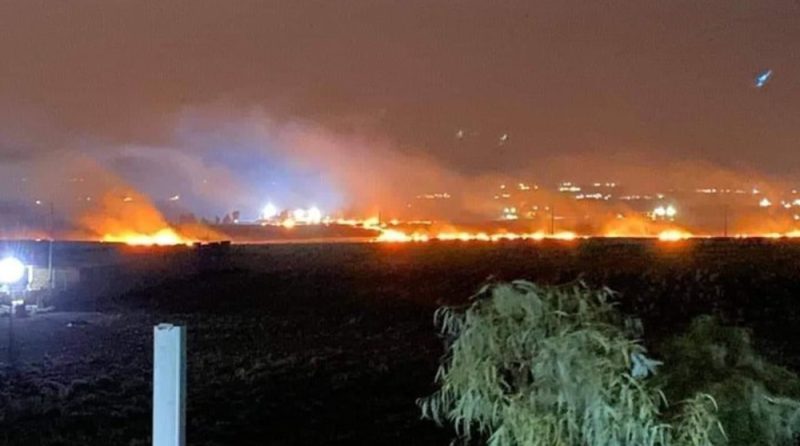
A dozen ballistic missiles hit secret Mossad bases in the northern Iraqi city of Erbil, reportedly leaving several Israeli operatives dead.
Citing security sources, Iraq’s Sabereen News reported that two Mossad training centers were targeted by ballistic missiles in the early hours of Sunday.
Al-Mayadeen television news network said a Mossad base on the Masif-Saladin Street in Erbil was “fully razed to the ground and a number of Israeli mercenaries were killed or injured.”
In a statement issued earlier on Sunday, the IRGC indicated that the operation was in response to an Israeli airstrike on the Syrian capital of Damascus last Monday, in which two IRGC officers were killed. The IRGC identified the two slain officers as colonels Ehsan Karbalaipour and Morteza Saeidnejad, warning that Israel would “pay for this crime.”
IRGC warns Israel after missile strike on Mossad bases in Erbil
Press TV – March 13, 2022
Iran’s Islamic Revolution Guards Corps (IRGC) has issued a stern warning to Israel following a retaliatory missile strike on the “strategic center of Zionist conspiracy and evil” in the northern Iraqi Kurdistan city of Erbil.
In a statement issued Sunday, the IRGC indicated that the operation was in response to an Israeli airstrike on the Syrian capital of Damascus last Monday, in which two IRGC officers were killed.
“Following the recent crimes of the fake Zionist regime and the previous announcement that the crimes and evils of this infamous regime will not go unanswered, the strategic center for conspiracy and evil of the Zionists was targeted by powerful and pinpoint missiles of the Islamic Revolution Guards Corps,” it said.
A dozen ballistic missiles hit secret Mossad bases in Erbil, reportedly leaving several Israeli operatives dead.
Citing security sources, Iraq’s Sabereen News reported that two Mossad training centers were targeted by ballistic missiles in the early hours of Sunday.
Al-Mayadeen said a Mossad base on the Masif-Saladin street in Erbil was “fully razed to the ground and a number of Israeli mercenaries were killed or injured”.
Last week, IRGC identified the two slain officers as colonels Ehsan Karbalaipour and Morteza Saeidnejad, warning that Israel would “pay for this crime”.
On Thursday, Iran’s permanent mission to the United Nations had written to the UN secretary general and the Security Council, saying Tehran “reserves its inherent right to self-defense, under Article 51 of the United Nations Charter, to respond to such criminal act whenever it deems appropriate”.
Iran “recognizes that the Israeli regime is fully responsible for all the consequences of these criminal acts, and seriously warns the regime about taking further adventuristic and malevolent measures,” it said.
The Sunday statement by the IRGC said, “Once again, we warn the criminal Zionist regime that the repetition of any evil will face harsh, decisive and destructive responses.”
“We also assure the great nation of Iran that the security and peace of the Islamic homeland is the red line of the armed forces of the Islamic Republic of Iran and they will not allow anyone to threaten or attack it.”
Iran and SCO sign protocol to start accession process for Tehran
Press TV – March 12, 2022
Iran and the Shanghai Cooperation Organization (SCO) have started a formal process for Tehran’s accession to the major economic bloc.
A Saturday report by Iran’s IRIB News said that a document had been signed a day earlier in the Uzbek capital of Tashkent between representatives of the eight-member SCO and Iran to allow the organization to consider Iran’s accession bid.
Uzbekistan’s Foreign Ministry said in a statement that the signing of the protocol would practically allow the implementation of decision by SCO heads of state in Tajikistan last year to provide membership to Iran.
The next step in the process will be for Iran to sign a memorandum of commitment at an SCO summit in Uzbekistan’s Samarkand in September 2022, said the statement, adding that SCO heads of states will then decide to include Iran in the bloc.
Iran was an observer member of the SCO before applying to join the bloc that includes Russia, China, India, Kazakhstan, Kyrgyzstan, Pakistan, Tajikistan and Uzbekistan.
Experts says Iran’s accession to the SCO will be a major boost to the bloc’s influence in the region mainly because Iran’s massive transportation network can facilitate regional and international trade.
Iran is also expected to benefit economically from membership in the bloc. The Iranian customs office (IRICA) said on Saturday that Iranian exports to SCO members had increased by 41% year on year in the 11 months to late February to reach nearly $18.3 billion.
IRICA figures showed that Iran had imported $14.4 billion worth of goods from the SCO countries between March 2021 and February 2022, an increase of 31% against the previous similar period.
Imran Khan hits out at West for treating Pakistanis like ‘slaves’

Russian President Vladimir Putin and Pakistani Prime Minister Imran Khan in Moscow, February 24, 2022 © Mikhail Klimentyev / Sputnik
RT | March 7, 2022
Prime Minister Imran Khan lashed out at foreign diplomats who pressured Pakistan to join a UN resolution condemning Russia over its military attack on Ukraine, accusing the envoys of treating Pakistan like “slaves.”
At a rally on Sunday, Khan shot back at a March 1 letter from diplomats representing 22 missions, including countries in the European Union along with Japan, Switzerland, Canada, the UK, and Australia, which called on Pakistan to drop its neutrality and join them in condemning Moscow.
“What do you think of us? Are we your slaves… that whatever you say, we will do?” questioned Khan, before asking EU ambassadors whether they wrote “such a letter to India,” which also remains neutral.
Khan claimed that Pakistan had suffered for previously supporting NATO’s military action in Afghanistan and declared, “We are friends with Russia, and we are also friends with America; we are friends with China and with Europe; we are not in any camp.”
Pakistan, along with 34 other countries, abstained from voting on the UN’s resolution condemning Russian “aggression against Ukraine” last week. Pakistan’s neighbors India, Bangladesh, China, Iran, Sri Lanka, Tajikistan, Kyrgyzstan, and Kazakhstan also abstained.
Khan met with Russian President Vladimir Putin in the Kremlin on February 24, the day Moscow launched its military operation in Ukraine, to discuss bilateral ties and regional issues.
Moscow maintains that the attack was launched with the purpose of “demilitarization” and “denazification” of Ukraine, and that it was the only possible option left to protect the people of eastern Ukraine following years of a grueling blockade that claimed thousands of lives. Kiev insists the invasion was unprovoked, saying it had no plans to retake the breakaway Donetsk and Lugansk republics by force.
Iraq, Russia, Syria and Iran discuss counter-terrorism
MEMO | February 25, 2022
Iraqi National Security Adviser, Qassem Al-Araji, yesterday met the ambassadors of Russia, Syria and Iran as part of the Quartet Centre for Information Exchange in Iraq’s capital city, Baghdad, to discuss counter-terrorism.
Local media reported that the meeting had discussed recent developments along the Iraqi-Syrian border, as well as the latest security developments in the region.
Al-Araji said that cooperation and joint action with the three countries had led to “strong and deterrent blows to terrorism and its leaders,” adding that the Centre was playing a “role in informing and resolving many issues.”
He pointed out that his country would not allow the presence of terrorist groups along its borders, stressing that Baghdad would only deal with “legitimate, sovereign states and governments.”
He reiterated that the Centre was strengthening the “close relationship between the countries that participated in this Centre in difficult and sensitive circumstances, and Iraq will respect those who stood by it during the difficult days.”
“There is a concern that there is a plan for the return of terrorists and their spread in the region, which could lead to instability,” he said.
Israel offers Arab state the opportunity to tackle Iran together
RT | February 15, 2022
Since Israel and Bahrain both view Iran as a threat, they could team up and counter Tehran together, Israeli prime minister Naftali Bennett said on his landmark visit to the Gulf monarchy.
“We will fight Iran and its followers in the region night and day. We will aid our friends in strengthening peace, security, and stability, whenever we are asked to do so,” Bennett pledged in an interview with the Bahraini state-linked Al-Ayyam outlet on Tuesday.
The PM blamed Tehran of striving to “destroy moderate states” in the Gulf region in order to replace them with “bloodthirsty terrorist groups.”
When asked about the possibility of creating an alliance to resist Iranian influence, which could include Israel, Bahrain, and some other Arab nations, he gave a positive response: “We all understand that we face the same challenges, so why not work together to tackle them?”
Bennet, who became the first Israeli prime minister ever to visit Bahrain, assured the journalists that “Israel is a strong and reliable country.”
The idea of such a block was first floated by Israeli general Tal Kelman last year. According to Kelman, who heads the IDF’s Strategy and Third Circle Directorate, “the moderate axis” of Israel, Bahrain, the UAE, Jordan, Egypt and others should resist “the radical axis” of Iran and what he called its “proxies” in Lebanon, Syria, Yemen, and Iraq.
Israel and Bahrain normalized relations in late 2020 as part of the so-called Abraham Accords, a US-backed drive to improve ties between the Jewish state and some Arab countries after decades of strife.
Bahrain is a small island nation of around 1.5 million. The majority of its population is Shia Muslims, but the country is being run by a Sunni monarchy. The rulers in Manama have been concerned by Tehran’s activities as Iran, which is located less than 800 kilometers (497 miles) away, often faces accusations from its rivals of supporting Shia groups in other countries.
Iran envoy: No IAEA access to new nuclear site in Isfahan before conclusion of JCPOA revival talks
Press TV – January 31, 2022
Iran’s ambassador to international organizations based in Vienna says the International Atomic Energy Agency (IAEA) will have no access to the country’s new nuclear site in the central city of Isfahan before the ongoing talks on the removal of US sanctions and revival of the 2015 Iran nuclear deal reach a definitive result.
Mohammad Reza Ghaebi made the remarks while speaking to reporters on Monday after the IAEA announced earlier the same day that Iran has informed the world body that it would move the production of centrifuge rotor tubes and bellows from TESA Karaj Complex to Isfahan.
He said the process “has not started yet,” adding, “The IAEA will be able to adjust its surveillance rules accordingly, although the information gathered through that surveillance process will remain in Iran and the IAEA will not have access to it until Tehran resumes its nuclear commitments under the JCPOA,” referring to the 2015 nuclear deal, officially known as the Joint Comprehensive Plan of Action.
The Iranian diplomat added that the IAEA report was a routine update of the agency that provides the “latest technical information on Iran’s nuclear activities to its members.”
In its Monday statement, the UN nuclear agency said its inspectors had installed surveillance cameras in a new workshop in Isfahan on January 24 to ensure the machines intended for the production of centrifuge rotor tubes and bellows were under monitoring but the production of the parts there had not started then.
The UN nuclear agency noted that the production of centrifuge rotor tubes and bellows at TESA Karaj Complex has ceased.
Back in December, Spokesman for the Atomic Energy Organization of Iran (AEOI) Behrouz Kamalvandi said that the country had allowed the IAEA to reinstall its surveillance cameras at TESA Karaj Complex only after the UN nuclear watchdog met Tehran’s preconditions.
Kamalvandi explained that Iran’s preconditions included technical and security examination of the new IAEA cameras, judicial and security investigations into the dimensions of the June attack against the facility, which damaged the previous cameras, and also the IAEA’s condemnation of such acts of sabotage.
Back in September, Iran refused to allow the United Nations’ nuclear agency access to a number of cameras that had been damaged during a terrorist operation targeting the TESA Karaj Complex, a centrifuge component manufacturing workshop in north-central Iran. The Islamic Republic’s refusal was based on the fact that the country needed to complete some legal-security investigations into the incident.
Featured Video
Epidemic of fake videos
or go to
Aletho News Archives – Video-Images
From the Archives
Inside Job? Inside What?
By Prof. Tony Hall | American Herald Tribune | July 28, 2016
The Kevin Barrett-Chomsky Dispute in Historical Perspective – Sixth part of the series titled “9/11 and the Zionist Question”
In his chapter on “Left Gatekeepers” and the “Shame of Noam Chomsky,” Barrie Zwicker refers to the the “New World Order” as the “diaboligarchy’s” directing agency. Less compelling is Zwicker’s reference to the “New World Order” as the “diaboligarchy’s” directing agency. To me this unfortunate choice of words is much too closely associated with the often crude and chauvinistic populism of Alex Jones and his Infowars media network. Many have come to see Jones’ lucrative media operation as a limited hangout set in place by handlers trying to hold the activities of the 9/11 Truth Movement within manageable constraints.
Due to the important findings over fifteen years of the citizens’ investigation into 9/11, the culprits most deeply implicated in the crime can be identified with much more specificity than an entity vaguely described as a “New World Order.” As Kevin Barrett and many others insist, the time has come to name the names of the probable culprits, Noam Chomsky prominent among them.
While Alex Jones ultimately serves the same masters as Chomsky, the former’s media product is often much closer to the mark of what is really going on than the content of Noam Chomsky’s more magisterial pronouncements. Jones goes at least part of the way into realities of the deep state politics of the twenty-first century. Chomsky, however, sacrificed his capacity to contribute cogently to sensible discourse on contemporary geopolitics by making himself a primary instrument of the most consequential deep state deception of recent times. As a leading agent of disinformation in the psychological trenches of the ongoing Global War of False Flag Terrorism, Chomsky has reduced himself to the level of skeptic pretender Michael Shermer. In the style of Shermer, the elder Chomsky has become an establishment TV professor readily available on Netflix. … continue
Blog Roll
Recent Comments
Coronistan on EU member to sue bloc over ‘su… loongtip on Vicious loongtip on EU turns to India for defense… Coronistan on Donald Trump Is No Peace … seversonebcfb985d9 on French court jails pro-Palesti… eddieb on Fourteen Incredible Facts Abou… Bill Francis on European leaders’ shift in the… seversonebcfb985d9 on Villains of Judea: Philip Esfo… loongtip on Report warns that ‘Jewish terr… Craig Nelms on New study shows that toxic gas… loongtip on A Funny Thing Happened on the… loongtip on EU free trade pact on hold as…


 Aletho News
- How South Korea’s gas ambitions sustain the occupation of Gaza
- “Leaked document” exposes US blueprint for total control over Gaza
- Trump wanted to play peacemaker, Netanyahu made sure he failed
- Idea of limited, fast strike on Iran misjudges our capabilities: IRGC
- US Military Buildup on Land, Air, and Sea Raises Fears of Imminent Attack on Iran – Expert
- Russia reiterates demand to Germany over Nazi crimes
- France and EU clash over UK missiles for Ukraine – Telegraph
- EU member to sue bloc over ‘suicidal’ ban on Russian gas
- WEF Calls for ‘Cultural Revolution’ to Promote Lab-Grown Meat
- The Board For Peace – Whitewashing Ethnic Cleansing and Genocide
- If Americans Knew
- Violence against hundreds of Gazan remains to find one Israeli – Not a ceasefire Day 109
- Greenpeace Demonstrator Exposes Folly of Protest Restrictions
- From CBS to TikTok, Pro-Israel Ellison is now in the driver’s seat
- Israel pays for UK advertisements attacking Doctors Without Borders
- Israel accused of extracting billions from Gazan people to pay for their own genocide
- ‘Deliberate Assassination’: 3 Journalists Among 11 Killed by Israeli Forces in Gaza
- In Gaza, We’re Struggling to Reintroduce Foods to Bodies Adjusted to Starvation
- Will Rafah crossing be opened at last? – Not a ceasefire Day 108
- Israeli drone strike kills two children collecting firewood in Gaza – Not a ceasefire Day 107
- Another Gaza baby freezes to death on Netanyahu’s watch – Not a ceasefire Day 106
- No Tricks Zone
- New Study Affirms Rising CO2’s Greening Impact Across India – A Region With No Net Warming In 75 Years
- Germany’s Natural Gas Crisis Escalates … One Storage Site Near Empty …Government Silent
- Polar Colding…Antarctica Saw Its Coldest October In 44 Years!
- New Study: Sea Levels Rose 20 Times The Modern Rate During The Roman Warm Period
- As German Gas Storage Dips Dangerously Low…Shortage Hardly Avoidable
- New Study: Brazil’s Relative Sea Level Was 2+ Meters Higher And SSTs 3-4°C Warmer 6000 Years Ago
- Philosopher Schopenhauer: Climate Science Certainty Stems From Stupidity, Ignorance
- New Study: Species Extinction Rates Declining Since 1980 – ‘Climate Change Is Not An Important Threat’
- Denmark Places Climate Protection Above Animal Welfare, Poisoning And Culling Cows
- New Study: Greenland Was 3-7°C Warmer And Far Less Glaciated Than Today 6000-8000 Years Ago
 Aletho News