Iran strikes US bases in Iraq to avenge Soleimani, vows to target Israel and all US bases in the region
Al-Manar | January 8, 2020
The Islamic Republic of Iran began its revenge for the assassination of the martyr Soleimani by launching dozens of ballistic missiles at the US base of Al-Asad in Iraq.
The Islamic Revolutionary Guards announced that the process of revenge for the assassination of the martyr Soleimani had started with the launch of dozens of ballistic missiles against the American base at Al-Asad in Iraq. In a statement, they assert that “At dawn today, in response to the terrorist operation by American forces and in retaliation for the assassination and martyrdom of Quds Force Commander of the Islamic Revolutionary Guards, Qassem Soleimani, and his companions, the aerospace forces of the the Islamic Revolutionary Guards carried out a successful operation bearing the name of the martyr Soleimani by launching dozens of ground-to-ground ballistic missiles against the air base of Ain al-Assad occupied by the US terrorist army. We will later inform the noble Iranian people and all free men of the world of the details of this process.
The Islamic Revolutionary Guards warned “The Great Satan, namely the US regime, that any wicked act, aggression or other hostile movement would face an even more painful and harsh response. […] We warn America’s allies who host US terrorist bases that any territory that is the source of hostile action against the Islamic Republic of Iran will be targeted.” The statement from the Islamic Revolutionary Guards added that “we do not in any way regard the Zionist entity as distinct from the criminal US regime.”
“We recommend that the American people recall their soldiers from the region to avoid further casualties and not to leave the lives of American soldiers threatened because of our peoples’ growing hatred of America,” the statement said.
Public relations within the Revolutionary Guards warned the United States that any response to the strikes “would light the fuse of a widespread and very painful response against the United States in the region.”
The Iranian news agency Mehr reported that “dozens of missiles from the aerospace force of the Islamic Revolutionary Guards targeted the base of Ain al-Assad”, and said that “the attack comes in reprisal for the assassination of the martyred commander Qassem Soleimani, and consisted in the launching of a certain number of ground-to-ground missiles”.
After the news was announced, the sounds of Takbir (Allahu Akbar!) rose from the top of the buildings of the capital, Tehran, expressing popular jubilation at this operation.
A security source told Agence France-Presse that on the night from Tuesday to Wednesday, at least nine rockets landed at the Ein Al-Assad Air base in western Iraq, where American soldiers are stationed. The source said the attack took place in 3 stages.
Use of Fateh missiles in a process of severe revenge
Given the distance between the base of Ain al-Assad and the place from which the Islamic Revolutionary Guard missiles were launched, Fateh ballistic missiles were used in these strikes (range up to 500 kilometers).
U.S. forces and their advisers are stationed at Ain al-Assad Air Base, which is the second largest Air Base in Iraq, after Balad base in Salah al-Din, north of Baghdad. For years, American forces have been present at several Iraqi military and Air Bases in the provinces of Anbar, Salah-al-Din, Nineveh and the capital Baghdad.
Pentagon admits strikes
The Pentagon has announced that Iran fired “more than 12 missiles” at dawn on Wednesday at the Ain al-Assad and Erbil bases used by US forces in Iraq on Wednesday, indicating that it is in currently assessing the damage and studying ways to “respond” to this strike.
Assistant to the Secretary of War for Public Affairs Jonathan Hoffman said in a statement that the department was conducting a “preliminary damage assessment” and was considering a “response” to the attack. He added that on Tuesday evening, “around 5.30pm (10.30pm GMT) on January 7, Iran fired more than 12 ballistic missiles at US and coalition forces in Iraq.” This time corresponds to the exact time martyr Soleimani was killed.
The statement added that it is clear that these missiles were launched from Iran and were aimed at at least two Iraqi military bases used by American and coalition forces in Ain al-Assad and Erbil.
The White House, for its part, said that President Trump is monitoring the situation closely and holding consultations with the National Security Council to discuss developments. White House spokesperson Stéphanie Gresham said, “We are aware of reports of attacks on US facilities in Iraq. The President has been informed and is following the situation closely and is consulting his national security team. ”
Oil prices go up and Nikkei goes down
The oil price per barrel jumped more than 4.5% on Wednesday after Iran launched ballistic missiles at two air bases used by US and coalition forces in Iraq. West Texas Intermediate barrel rose 4.53% to $ 65.54 before declining slightly.
The main Nikkei index of the Tokyo Stock Exchange lost more than 2.4% Wednesday morning. Half an hour after opening, the losses of the Nikkei index on the 225 largest companies listed on the Japanese Stock Exchange reached 2.44%, or 576.26 points, to fall to 22,999.46 points, while the losses of the Topix index, the most important, were slightly lower, reaching 2.20% or 37.90 points to reach 1687.15 points.
Sources: Al-Manar & Iranian sources.
Translation: resistancenews.org
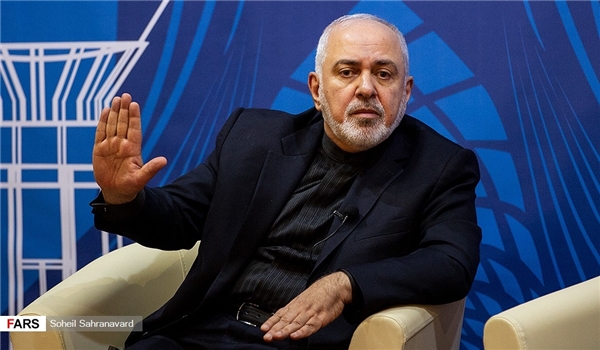
FM Zarif: Iran’s Reprisal Attack in Compliance with UN Charter
Fars News Agency | January 8, 2020
TEHRAN – Iran’s Foreign Minister Mohammad Javad Zarif said his country’s Wednesday missile attacks on Ein Al-Assad falls under the rules of the UN Charter, reminding that Iran has hit the airbase that has been used as the launchpad for assassinating Lieutenant General Qassem Soleimani.
“Iran took and concluded proportionate measures in self-defense under Article 51 of UN Charter targeting [the] base from which cowardly armed attack against our citizens and senior officials were launched,” Zarif wrote on his tweeter page on Wednesday morning.
The top diplomat said his nation “does not seek escalation or war, but will defend ourselves against any aggression”.
The IRGC Aerospace Force started heavy ballistic missile attacks on US Ein Al-Assad airbase in Southwestern Iraq near the border with Syria and a US operated airbase in Erbil in retaliation for the assassination of IRGC Qods Force Commander Lieutenant General Qassem Soleimani.
Ein Al-Assad is an airbase with a 4km runway at 188m altitude from sea levels, which is the main and the largest US airbase in Iraq.
The second IRGC reprisal attack targeted a US military base near Erbil airport in Iraqi Kurdistan Region in the second leg of “Martyr Soleimani” reprisal operation.
All flights have been cancelled at Erbil airport.
The IRGC issued a statement immediately after the attacks, declaring that it has fired tens of ground-to-ground missiles at “the airbase occupied by the terrorist and aggressive army of the United States known as Ein Al-Assad” in reprisal for the martyrdom of IRGC Qods Force Commaner Lieutenant General Qassem Soleimani.
The IRGC warned the US to avoid retaliating the Wednesday attack or else “it will face a more painful and crushing response”.
The IRGC Statement also warned “all the US allied states where the terrorist army has a base, any territory that becomes the origin of any hostile and aggressive action against the Islamic Republic of Iran in any way will be targeted”.
“We believe that the Zionist regime by no means stands aside from the criminal US regime in these crimes.”
The IRGC also called on the American nation to pressure the White House to pull their troops out of the region to avoid further damage and not allow the US rulers to endanger the lives of their military men through increasing hatred.
All Iranian underground missile towns are on alert.
The missile attack came hours before the body of General Soleimani was buried.
Lieutenant General Soleimani was martyred in a targeted assassination attack by the US drones at Baghdad International Airport early on Friday morning.
The airstrike also martyred Abu Mahdi al-Muhandis, deputy commander of Iraq’s Popular Mobilization Forces (PMF), or Hashad al-Shaabi. The two were martyred in an American airstrike that targeted their vehicle on the road to the airport.
Five Iranian and five Iraqi military personnel were martyred by missiles fired by the US drone at Baghdad International Airport.
The attack came amid tensions that started with a US attack on PMF units that killed 28 Iraqi popular forces. A day later, Iraqi people attacked the US embassy in Baghdad.
The targeted assassination attack represents a dramatic escalation by the US toward Iran after months of tensions. The tensions are rooted in Trump’s decision in May 2018 to withdraw the US from Iran’s nuclear deal with world powers, struck under his predecessor.
Iran Strikes Back! Daniel McAdams talks to RT
Ron Paul Institute | January 7, 2020
Iran fires missiles at at least two US bases in Iraq! What is next? RPI Director Daniel McAdams in an extensive interview as the dramatic events of tonight unfold of Iranian retaliation in Iraq for the US assassination of top anti-ISIS Iranian General Qassim Soleimani. Will Trump’s embrace of the neocons cost him a second term?
UK defence secretary ‘reserves the right’ to ‘strike’ Iran
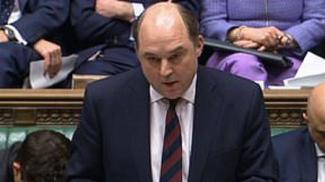
Ben Wallace in a combative mood in the House of Commons
Press TV – January 7, 2020
British defence secretary, Ben Wallace, has put up a spirited defence of the US decision to assassinate Iranian Quds force General Qassem Soleimani in a terrorist-style drone strike outside Baghdad airport.
Delivering a statement in the House of Commons, Wallace claimed that General Soleimani was “no friend of the UK or our allies in the region”.
Wallace tried to justify the assassination on dubious legal grounds by saying: “the UK will always defend the right of countries to defend themselves”.
Wallace’s claim flies in the face of all pertinent facts, notably credible reports that General Soleimani was on a peace mission to Baghdad to try to diffuse tensions with Saudi Arabia.
At any rate, the US accusation that General Soleimani had been planning attacks against US interests hasn’t been backed up by any evidence.
On a more ominous note, Wallace threatened that “aggressive behaviour” from Iran “was never going to go unchallenged”.
Wallace didn’t explain what he meant by “aggressive” behaviour, and the irony of his words was lost on him. After all, Iran was the victim of US aggression when the latter decided to kill the country’s top military commander.
The defence secretary claimed that the UK is “changing the readiness of our forces in the region” by placing “helicopters and ships on standby to assist if the need arises”.
Wallace didn’t address credible reports of the UK adopting an aggressive posture vis-à-vis Iran, in order to assist the US in any potential military action.
The Sun newspaper reported two days ago that a British nuclear-powered submarine was in “striking position” of Iran, ready to fire Tomahawk cruise missiles at Iranian targets.
During the question and answer phase, Wallace was asked by acting Liberal Democrats leader, Sir Ed Davey, whether he would rule out “any UK involvement in any attack in any site in Iran”.
“I’m not going to rule out anything”, said a combative Wallace.
“We cannot say what’s in the minds of Iran or anybody else in the future – that’s why we will always reserve that right to take the decision at the time of it”, he added.
Wallace’s aggressive tone towards Iran is in keeping with the positions of both the Prime Minister, Boris Johnson, and foreign secretary, Dominic Raab, both of whom have defended US actions in recent days.
But Wallace goes a step further by introducing for the first time the strong possibility of the UK taking military action against Iran.
Canada says some troops in Iraq to be moved temporarily to Kuwait for safety
MEMO | January 7, 2020
Some of Canada’s 500 military personnel based in Iraq will be temporarily moved to Kuwait for safety reasons, the country’s top military official said on Tuesday, due to fears of possible retaliation thereafter a US drone strike on Iran’s top military commander, reports Reuters.
General Jonathan Vance, chief of the defense staff, said in a letter to military families that “the news coming out of the Middle East is alarming for many of you.”
“Some of our people will be moved temporarily from Iraq to Kuwait,” he added. Simply put, we are doing this to ensure their safety and security.”
Some of the Canadian troops are taking part in a NATO mission while others are running Operation Impact, a Canadian initiative to train soldiers in Iraq, Jordan, Lebanon, and Kuwait. In all, some 800 Canadian troops are in the Middle East.
Earlier in the day, NATO said it was moving some of its trainers out of Iraq, without giving details.
Canadian Prime Minister Justin Trudeau spoke to NATO Secretary-General Jens Stoltenberg on Monday and the two men “emphasized the importance of de-escalating tensions and the need to support security and stability in Iraq,” Trudeau’s office said in a statement.
READ ALSO:
NATO suspends training activities in Iraq after Soleimani killing
Iraq PM confirms receiving ‘signed’ US pullout letter
Press TV – January 7, 2020
Amid confusion over a reported US letter to Iraq announcing the steps its military would take to move out of Iraq, Prime Minister Adel Abdul Mahdi confirms that Baghdad has actually received “signed and translated” copies from the US Army concerning the withdrawal.
In a televised cabinet meeting on Tuesday, Abdul Mahdi clearly refuted all US claims that the letter had been sent by mistake or it had been inauthentic.
On Sunday, the Iraqi Parliament voted unanimously in favor of a bill demanding the withdrawal of all foreign military forces led by the United States from the country.
The vote came only two days after US airstrikes assassinated senior Iranian commander Lt. Gen. Qassem Soleimani, and the second-in-command of Iraq’s Popular Mobilization Units (PMU) anti-terror group, Abu Mahdi al-Muhandis in the Iraqi capital.
Earlier, various news agencies reported that Brigadier General William Seely, who oversees US Task Force Iraq, had sent a letter to the head of Iraq’s Joint Operations Command on Monday, suggesting potential withdrawal of the forces belonging to a US-led coalition, which has been operating in Iraq since 2014 under the pretext of fighting Daesh.
‘Signed and translated’
US Defense Secretary Mark Esper later denied that the US military had announced preparation for “movement out of Iraq,” and the Pentagon claimed that an unsigned draft version of the letter had been sent by mistake.
Abdel Mahdi, however, said he had received signed and translated copies at 8:00 p.m. local time (1700 GMT) on Monday.
The letter discussed “redeploying with an aim to withdraw from the country. The expressions were very clear,” he said. “It was an official letter written in such a manner,” the premier told ministers.
“It’s not a piece of paper that fell off the printer or reached us by coincidence,” he added. The letters only contained a translation mistake that the US military corrected and provided Baghdad with new versions, Abdul Mahdi noted.
The AFP said it had received a copy of the letter late Monday and verified its authenticity with both US and Iraqi officials, the agency added.
In it, Seely informed his Iraqi counterparts that American troops were preparing to leave Iraq. Seely wrote the US-led coalition would “be re-positioning forces in the coming days and weeks to prepare for onward movement.”
“In order to conduct this task, Coalition Forces are required to take certain measures to ensure that the movement out of Iraq is conducted in a safe and efficient manner,” said the letter.
It said helicopters would be travelling in and around Baghdad’s heavily-fortified Green Zone, where the US Embassy is located as part of the preparations.
The AFP, meanwhile, said its reporters could hear helicopters flying low over Baghdad throughout the night on Monday as well as Tuesday.
US-Led Coalition Tells Baghdad It Will ‘Move Out’ of Iraq – Official Letter
Sputnik – 06.01.2020
In a Monday letter to Iraqi military leaders, the US-led coalition in Iraq announced it was preparing to “move out” of the country out of respect for Iraqi sovereignty.
Following approval of a non-binding resolution by Iraq’s parliament calling for US forces to leave the country, US military commanders announced they were drawing up preparatory plans for their departure. A Pentagon spokesperson could not immediately confirm the authenticity of the letter to Reuters.
“We respect your sovereign decision to order our departure,” the letter says, according to Reuters. US forces will re-position themselves over the coming days and weeks in preparation for the move, the letter states.
“In due deference to the sovereignty of the Republic of Iraq, and as requested by the Iraqi Parliament and the Prime Minister, CJTF-OIR [Combined Joint Task Force – Operation Inherent Resolve] will be repositioning forces over the course of the coming days and weeks to prepare for onward movement,” states the letter, addressed to Iraqi Lt. Gen. Abdul Amir and signed by US Marine Corps Brig. Gen. William H. Seely III.
The lawmakers’ request comes on the heels of a January 3 drone strike at Baghdad International Airport in which US forces killed Iranian Quds Force commander Qassem Soleimani as well as the leader of Iraq’s Popular Mobilization Forces, Abu Mahdi al-Muhandis. The two commanders helped lead the fight against Daesh in the 2014-17 Iraqi Civil War that saw the terrorist group expelled from the country. At its height, Daesh controlled significant amounts of northern Iraq, including its third-largest city of Mosul, and was advancing on Baghdad.
“In order to conduct this task, coalition forces are required to take certain measures to ensure that the movement out of Iraq is conducted in a safe and efficient manner,” the letter continues. “During this time, there will be an increase in helicopter travel in and around the International Zone (IZ) of Baghdad. This increased traffic will include CH-47, UH-60 and AH-64 security escort helicopters. Coalition forces will take appropriate measures to minimize and mitigate the disturbance to the public. In addition, we will conduct these operations during house of darkness to help alleviate any perception that we may be bringing more Coalition forces into the IZ.”
“As we begin implementing this next phase of operations, I want to reiterate the value of our friendship and partnership. We respect your sovereign decision to order our departure.”
Contradictory Statements
The news comes after US President Donald Trump and Secretary of State Mike Pompeo snubbed the idea of leaving Iraq, where US forces have been stationed since the March 2003 invasion that overthrew Iraqi President Saddam Hussein.
“We have a very extraordinarily expensive airbase that’s there. It cost billions of dollars to build. Long before my time We’re not leaving unless they pay us back for it,” Trump said on Sunday. “We will charge them sanctions like they’ve never seen before ever. It’ll make Iranian sanctions look somewhat tame.”
“The prime minister is the acting prime minister,” Pompeo said on Fox News on Sunday, speaking of Iraqi Prime Minister Adil Abdul-Mahdi. “He’s under enormous threats from the very Iranian leadership that it is that we are pushing back against. We are confident that the Iraqi people want the United States to continue to be there.”
A Terrorist Attack Against Eurasian Integration
By Federico Pieraccini | Strategic Culture Foundation | January 6, 2020
The murder of Iranian general Qasem Soleimani in Baghdad, in the early hours of January 3 by US forces, only highlights the extent to which US strategy in the Middle East has failed. It is likely to provoke reactions that do not benefit US interests in the region.
To understand the significance of this event, it is necessary to quickly reconstruct the developments in Iraq. The US has occupied Iraq for 17 years, following its invasion of the country in 2003. During this time, Baghdad and Tehran have re-established ties by sustaining an important dialogue on post-war reconstruction as well as by acknowledging the importance of the Shia population in Iraq.
Within two decades, Iraq and Iran have gone from declaring war with each other to cooperating on the so-called Shia Crescent, favoring cooperation and the commercial and military development of the quartet composed of Iran, Iraq, Syria and Lebanon. Such ties, following recent victories over international terrorism, have been further consolidated, leading to current and planned overland connections between this quartet.
Local movements and organizations have been calling for US troops to leave Iraqi territory with increasing vigor and force in recent months. Washington has accused Tehran of inciting associated protests.
At the same time, groups of dubious origin, that have sought to equate the Iranian presence with the American one, have been calling for the withdrawal of the Popular Mobilization Units (PMUs) that are linked to Iran from Iraq. The protests from such groups appear to be sponsored and funded by Saudi Arabia.
With mutual accusations flying around, the US hit a pro-Iranian faction known as Kataib Hezbollah on December 29. This episode sparked a series of reactions in Iraq that ended up enveloping the US embassy in Baghdad, which was besieged for days by demonstrators angry about ongoing airstrikes by US forces.
The US secretary of state, Mike Pompeo, blamed this volatile situation on Iran, warning that Tehran would be held responsible for any escalation of the situation involving the embassy.
In the early hours of January 3, 2020, another tangle was added to the Gordian Knot that is the Middle East. Qasem Soleimani was assassinated when his convoy was attacked by a drone near Baghdad International Airport. The most effective opponents of ISIS and Wahabi jihadism in general was thus eliminated by the US in a terrorist act carried out in a foreign country in a civilian area (near Baghdad International Airport). The champagne would have no doubt been flowing immediately upon receiving this news in the US Congress, the Israeli Knesset, Riyadh royal palace and in Idlib among al Nusra and al Qaeda militants.
It remains to be seen what the reasons were behind Trump’s decision to okay the assassination of such an influential and important leader. Certainly the need to demonstrate to his base (and his Israeli and Saudi financiers) plays into his anti-Iranian crusade. But there are other reasons that better explain Trump’s actions that are more related to the influence of the US in the region; the geopolitical chess game in the Middle East transcends any single leader or any drone attack.
In Syria, for example, the situation is extremely favorable to the government in Damascus, with it only being a matter of time before the country is again under the control of the central government. General Soleimani and Iran have played a central role in ridding the country of the scourge of terrorism, a scourge directed and financed by the US and her regional allies.
In Iraq, the political situation is less favorable to the US now than it was back in 2006. Whatever progress in relations between Baghdad and Tehran has also been due to General Soleimani, who, together with the PMUs and the Iraqi army, freed the country from ISIS (which was created and nurtured by Western and Saudi intelligence, as revealed by Wikileaks).
It would seem that the US sanctions against Iran have not really had the intended effect, instead only serving to consolidate the country’s stance against imperialism. The US, as a result, is experiencing a crisis in the region, effectively being driven out of the Middle East, rather than leaving intentionally.
In this extraordinary and unprecedented situation, the Russians and Chinese are offering themselves variously as military, political and economic guarantors of the emerging Eurasian mega-project (the recent naval exercises between Beijing, Moscow and Tehran serving as a tangible example of this commitment). Naturally, it is in their interests to avoid any extended regional conflict that may only serve to throw a monkey wrench into their vast Eurasian mega-project.
Putin and Xi Jinping face tough days ahead, trying to council Iran in avoiding an excessive response that would give Washington the perfect excuse for a war against Iran.
The prospects of a region without terrorism, with a reinvigorated Shia Crescent, led by Iran at the regional level and accompanied by China and Russia at the economic (Belt and Road Initiative) and military level, offer little hope to Riyadh, Tel Aviv and Washington of being able to influence events in the region and this is likely going to be the top argument that Putin and Xi Jinping will use to try to deter any Iranian overt response.
Deciding to kill the leader of the Quds Force in Iraq proves only one thing: that the options available to Trump and his regional allies are rapidly shrinking, and that the regional trends over the next decade appear irreversible. Their only hope is for Tehran and her allies to lash out at the latest provocation, thereby justifying the regional war that would only serve to benefit Washington by slowing down regional unification under Iranian leadership.
We must remember that whenever the US finds itself in a situation where it cannot control a country or a region, its tendency is to create chaos and ultimately destroy it.
By killing General Soleimani, the US hopes to wreak havoc in the region so as to slow down or altogether scupper any prospect of integration. Fortunately, China, Russia and Iran are well aware that any conflict would not be in any of their own interests.
No drone-launched missiles will be enough to save the US from decades of foreign-policy errors and their associated horrors; nor will they be enough to extinguish the memory of a hero’s tireless struggle against imperialism and terrorism.
The Middle East Strategic “Balance” Shredded
By Alastair Crooke | Strategic Culture Foundation | January 6, 2020
President Trump was understood to not want a Mid-East war that might blight his rosy re-election prospects (so long as the US stock market stays inflated, and the economy doesn’t tank). Pat Buchanan, the three-times US Presidential candidate, warned Trump that if there is a potential landmine on Trump’s road to reelection, it may be found in the Middle and Near East: “Not infrequently, foreign policy has proven decisive in presidential years”. Plus Iran was not seeking any major confrontation; Hizbullah wasn’t; Iraq wasn’t; and the Israeli Security Establishment wasn’t.
In fact, the strategic balance – though sorely tested – had been hanging together. Just to be clear: Iran and Israel both had been keeping – just – within the parameters of unspoken ‘red lines’ – despite the inflated rhetoric. And both were practicing ‘strategic patience’. So the strategic balance seemed more or less sustainable: until its upending with the assassination of Qasem Soleimani and the head of the PMU, Al-Muhandis, ordered by Trump.
Israel has not – despite its lurid language – been landing strategic blows on Iran in Syria. It has not been killing Iranians there (apart from seven killed at T4 airport in eastern Syria last year). It did not target the head of the Iranian air force, some ten days ago, as some reports have suggested (he was not even in Iraq at the time). Most of the Israeli air attacks have been on depots in the early hours, when no personnel were present. It has been a campaign more of a regular, small slicing away at Iranian logistics. It was not strategic damage.
And Iran, after sending clear ‘messages’ to Gulf States of its willingness to inflict pain on parties to its economic siege, plainly had been calibrating this push-back carefully; Iran still had its eye to global diplomacy (to wit: the joint Iranian naval exercises with Russia and China in the Persian Gulf) – whilst countering politically, America’s ‘new’ tactic of inciting ‘colour’ protests across Lebanon and Iraq (and trying to bust Syria financially, by stealing its energy revenues).
Here is the point: The US was no longer content with mere sanctions on Iran. It has been covertly escalating across the board: orchestrating protests in Iraq, in Lebanon, and in Iran itself; mounting a major cyber offensive on Iran; and a ‘messaging’ operation aimed at turning genuine popular frustration with regional mis-governance and corruption, into a weapon aimed at weakening revolutionary Iran.
The US was having some success with turning protest messaging against Iran – until, that is – its killing and wounding of so many Iraqi security force members last week (Ketaib Hizbullah is a part of Iraq’s armed forces).
Escalation of maximum-pressure was one thing (Iran was confident of weathering that); but assassinating such a senior official on his state duties, was quite something else. We have not observed a state assassinating a most senior official of another state before.
And the manner of its doing, was unprecedented too. Soleimani was officially visiting Iraq. He arrived openly as a VIP guest from Syria, and was met on the tarmac by an equally senior Iraqi official, Al-Muhandis, who was assassinated also, (together with seven others). It was all open. General Soleimani regularly used his mobile phone as he argued that as a senior state official, if he were to be assassinated by another state, it would only be as an act of war.
This act, performed at the international airport of Baghdad, constitutes not just the sundering of red lines, but a humiliation inflicted on Iraq – its government and people. It will upend Iraq’s strategic positioning. The erstwhile Iraqi attempt at balancing between Washington and Iran will be swept away by Trump’s hubristic trampling on the country’s sovereignty. It may well mark the beginning of the end of the US presence in Iraq (and therefore Syria, too), and ultimately, of America’s footprint in the Middle East.
Trump may earn easy plaudits now for his “We’re America, Bitch!”, as one senior White House official defined the Trump foreign policy doctrine; but the doubts – and unforeseen consequences soon may come home to roost.
Why did he do it? If no one really wanted ‘war’, why did Trump escalate and smash up all the crockery? He has had an easy run (so far) towards re-election, so why play the always unpredictable ‘wild card’ of a yet another Mid-East conflict?
Was it that he wanted to show ‘no Benghazi’; no US embassy siege ‘on my watch’ – unlike Obama’s handling of that situation? Was he persuaded that these assassinations would play well to his constituency (Israeli and Evangelical)? Or was he offered this option baldly by the Netanyahu faction in Washington? Maybe.
Some in Israel are worried about a three or four front war reaching Israel. Senior Israeli officials recently have been speculating about the likelihood of regional conflict occurring within the coming months. Israel’s PM however, is fighting for his political life, and has requested immunity from prosecution on three indictments – pleading that this was his legal right, and that it was needed for him to “continue to lead Israel” for the sake of its future. Effectively, Netanyahu has nothing to lose from escalating tensions with Iran — but much to gain.
Opposition Israeli political and military leaders have warned that the PM needs ‘war’ with Iran — effectively to underscore the country’s ‘need’ for his continued leadership. And for technical reasons in the Israeli parliament, his plea is unlikely to be settled before the March general elections. Netanyahu thus may still have some time to wind up the case for his continued tenure of the premiership.
One prime factor in the Israeli caution towards Iran rests not so much on the waywardness of Netanyahu, but on the inconstancy of President Trump: Can it be guaranteed that the US will back Israel unreservedly — were it to again to become enmeshed in a Mid-East war? The Israeli and Gulf answer seemingly is ‘no’. The import of this assessment is significant. Trump now is seen by some in Israel – and by some insiders in Washington – as a threat to Israel’s future security vis à vis Iran. Was Trump aware of this? Was this act a gamble to guarantee no slippage in that vital constituency in the lead up to the US elections? We do not know.
So we arrive at three final questions: How far will Iran absorb this new escalation? Will Iran confine its retaliation to within Iraq? Or will the US cross another ‘red line’ by striking inside Iran itself, in any subsequent tit for tat?
Is it deliberate (or is it political autism) that makes Secretary Pompeo term all the Iraqi Hash’d a-Sha’abi forces – whether or not part of official Iraqi forces – as “Iran-led”? The term seems to be used as a laissez-passer to attack all the many Hash’d a-Sha’abi units on the grounds that, being “Iran-linked”, they therefore count as ‘terrorist forces’. This formulation gives rise to the false sequitur that all other Iraqis would somehow approve of the killings. This would be laughable, if it were not so serious. The Hash’d forces led the war against ISIS and are esteemed by the vast majority of Iraqis. And Soleimani was on the ground at the front line, with those Iraqi forces.
These forces are not Iranian ‘proxies’. They are Iraqi nationalists who share a common Shi’a identity with their co-religionists in Iran, and across the region. They share a common zeitgeist, they see politics similarly, but they are no puppets (we write from direct experience).
But what this formulation does do is to invite a widening conflict: Many Iraqis will be outraged by the US attacks on fellow Iraqis and will revenge them. Pompeo (falsely) will then blame Iran. Is that Pompeo’s purpose: casus belli?
But where is the off-ramp? Iran will respond… Is this affair simply set to escalate from limited military exchanges … and from thence, to escalate until what? We understand that this was not addressed in Washington before the President’s decision was made. There are no real US channels of communication (other than low level) with Iran; nor is there a plan for the next days. Nor an obvious exit. Is Trump relying on gut instinct again?
Soleimani was to deliver Tehran’s reply to Saudi de-escalation letter when killed: Iraqi PM
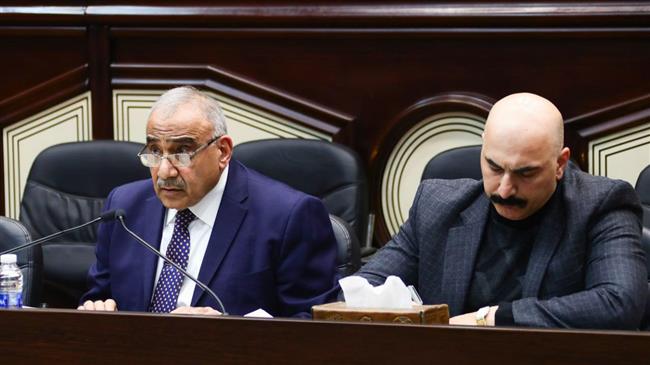
Picture released by Iraqi Prime Minister’s Media Office shows Iraq’s caretaker prime minister Adel Abdul Mahdi (L) attending a parliamentary session on January 5, 2020. (Photo via AFP)
Press TV – January 5, 2020
Iraq’s Caretaker Prime Minister Adel Abdul-Mahdi has said that Lieutenant General Qassem Soleimani was set to deliver Tehran’s reply to an earlier Saudi message regarding de-escalation talks mediated by Baghdad when he was assassinated.
Abdul-Mahdi made the remarks during an extraordinary parliamentary session in the capital which led to the adoption of a law demanding the withdrawal of US forces from the country on Sunday, the National Iraqi News Agency reported.
The premier said that he was due to meet Soleimani at 8:30 am local time on Friday before the US assassinated the general a few hours earlier.
The revelations come as Baghdad has been mediating talks between Tehran and Riyadh following a recent uptick of tensions the region.
Sunday’s parliamentary vote was held in response to Washington’s Friday airstrikes targeting Soleimani and his comrades.
Abu Mahdi al-Muhandis, the second-in-command of Iraq’s Popular Mobilization Units (PMU) was also killed in the attack.
Iran’s judiciary has said that the attack took place despite Soleimani being a “formal” and “high profile” guest of the Iraqi government.
The Sunday vote comes as many Iraqi figures and parliamentary factions have been long demanding the withdrawal of US troops from the country, specifically following a series of unclaimed airstrikes on PMU forces.
Abdul-Mahdi also revealed in his Sunday remarks that Washington had confirmed to Baghdad that Tel Aviv was behind a number of the attacks.
“America informed us that Israel bombed the warehouses of the PMU last summer,” he said, calling on the parliament to take all measures to end the presence of foreign forces in Iraq.
Rockets rock Baghdad’s Green Zone
Also on Sunday, the Iraqi military reported that three Katyusha rockets fell in Baghdad, two of which landed inside the capital’s heavily fortified Green Zone housing government buildings and foreign missions.
Witnesses told AFP that the rockets had landed close to the US embassy without further elaborating on probable casualties.
No group has yet claimed responsibility for the attack.
The USA is now at war, de-facto and de-jure, with BOTH Iraq and Iran
The Saker | January 5, 2020
First, let’s begin by a quick summary of what has taken place (note: this info is still coming in, so there might be corrections once the official sources make their official statements).
- Iraqi Prime Minister Adil Abdl Mahdi has now officially revealed that the US had asked him to mediate between the US and Iran and that General Qassem Soleimani was to come and talk to him and give him the answer to his mediation efforts. Thus, Soleimani was on an OFFICIAL DIPLOMATIC MISSION as part of a diplomatic initiative INITIATED BY THE USA.
- The Iraqi Parliament has now voted on a resolution requiring the government to press Washington and its allies to withdraw their troops from Iraq.
- Iraq’s caretaker PM Adil Abdul Mahdi said the American side notified the Iraqi military about the planned airstrike minutes before it was carried out. He stressed that his government denied Washington permission to continue with the operation.
- The Iraqi Parliament has also demanded that the Iraqi government must “work to end the presence of any foreign troops on Iraqi soil and prohibit them from using its land, airspace or water for any reason“
- The Iraqi Foreign Ministry said that Baghdad has turned to the UN Security Council with complaints about US violations of its sovereignty.
- Iraqi cleric Moqtada al-Sadr said the parliamentary resolution to end foreign troop presence in the country did not go far enough, calling on local and foreign militia groups to unite. I also have confirmation that the Mehdi Army is being re-mobilized.
- The Pentagon brass is now laying the responsibility for this monumental disaster on Trump (see here). They are now slowly waking up to this immense clusterbleep and don’t want to be held responsible for what is coming next.
- For the first time in the history of Iran, a Red Flag was hoisted over the Holy Dome Of Jamkaran Mosque, Iran. This indicates that the blood of martyrs has been spilled and that a major battle will now happen. The text in the flag says “Oh Hussein we ask for your help” (unofficial translation)
- The US has announced the deployment of 3,000 soldiers from the 82nd Airborne to Kuwait.
- Finally, the Idiot-in-Chief tweeted the following message, probably to try to reassure his freaked out supporters: “The United States just spent Two Trillion Dollars on Military Equipment. We are the biggest and by far the BEST in the World! If Iran attacks an American Base, or any American, we will be sending some of that brand new beautiful equipment their way… and without hesitation!“. Apparently, he still thinks that criminally overspending for 2nd rate military hardware is going to yield victory…
Analysis
Well, my first though when reading these bullet points is that General Qasem Soleimani has already struck out at Uncle Shmuel from beyond his grave. What we see here is an immense political disaster unfolding like a slow motion train wreck. Make no mistake, this is not just a tactical “oopsie”, but a major STRATEGIC disaster. Why?
For one thing, the US will now become an official and totally illegal military presence in Iraq. This means that whatever SOFA (Status Of Forces Agreement) the US and Iraq had until now is void.
Second, the US now has two options:
- Fight and sink deep into a catastrophic quagmire or
- Withdraw from Iraq and lose any possibility to keep forces in Syria
Both of these are very bad because whatever option Uncle Shmuel chooses, he will have lost whatever tiny level of credibility he has left, even amongst his putative “allies” (like the KSA which will now be left nose to nose with a much more powerful Iran than ever before).
The main problem with the current (and very provisional) outcome is that both the Israel Lobby and the Oil Lobby will now be absolutely outraged and will demand that the US try to use military power to regime change both Iraq and Iran.
Needless to say, that ain’t happening (only ignorant and incurable flag-wavers believe the silly claptrap about the US armed forces being “THE BEST”).
Furthermore, it is clear that by it’s latest terrorist action the USA has now declared war on BOTH Iraq and Iran.
This is so important that I need to repeat it again:
The USA is now at war, de-facto and de-jure, with BOTH Iraq and Iran.
I hasten to add that the US is also at war with most of the Muslim world (and most definitely all Shias, including Hezbollah and the Yemeni Houthis).
Next, I want to mention the increase in US troop numbers in the Middle-East. An additional 3,000 soldiers from the 82nd AB is what would be needed to support evacuations and to provide a reserve force for the Marines already sent in. This is NOWHERE NEAR the kind of troop numbers the US would need to fight a war with either Iraq or Iran.
Finally, there are some who think that the US will try to invade Iran. Well, with a commander in chief as narcissistically delusional as Trump, I would never say “never” but, frankly, I don’t think that anybody at the Pentagon would be willing to obey such an order. So no, a ground invasion is not in the cards and, if it ever becomes an realistic option we would first see a massive increase in the US troop levels, we are talking several tens of thousands, if not more (depending on the actual plan).
No, what the US will do if/when they attack Iran is what Israel did to Lebanon in 2006, but at a much larger scale. They will begin by a huge number of airstrikes (missiles and aircraft) to hit:
- Iranian air defenses
- Iranian command posts and Iranian civilian and military leaders
- Symbolic targets (like nuclear installations and high visibility units like the IRGC)
- Iranian navy and coastal defenses
- Crucial civilian infrastructure (power plants, bridges, hospitals, radio/TV stations, food storage, pharmaceutical installations, schools, historical monuments and, let’s not forget that one, foreign embassies of countries who support Iran). The way this will be justified will be the same as what was done to Serbia: a “destruction of critical regime infrastructure” (what else is new?!)
Then, within about 24-48 hours the US President will go on air an announce to the world that it is “mission accomplished” and that “THE BEST” military forces in the galaxy have taught a lesson to the “Mollahs”. There will be dances in the streets of Tel Aviv and Jerusalem (right until the moment the Iranian missiles will start dropping from the sky. At which point the dances will be replaced by screams about a “2nd Hitler” and the “Holocaust”).
Then all hell will break loose (I have discussed that so often in the past that I won’t go into details here).
In conclusion, I want to mention something more personal about the people of the US.
Roughly speaking, there are two main groups which I observed during my many years of life in the USA.
Group one: is the TV-watching imbeciles who think that the talking heads on the idiot box actually share real knowledge and expertise. As a result, their thinking goes along the following lines: “yeah, yeah, say what you want, but if the mollahs make a wrong move, we will simply nuke them; a few neutron bombs will take care of these sand niggers“. And if asked about the ethics of this stance, the usual answer is a “f**k them! they messed with the wrong guys, now they will get their asses kicked“.
Group two: is a much quieter group. It includes both people who see themselves as liberals and conservatives. They are totally horrified and they feel a silent rage against the US political elites. Friends, there are A LOT of US Americans out there who are truly horrified by what is done in their name and who feel absolutely powerless to do anything about it. I don’t know about the young soldiers who are now being sent to the Middle-East, but I know a lot of former servicemen who know the truth about war and about THE BEST military in the history of the galaxy and they are also absolutely horrified.
I can’t say which group is bigger, but my gut feeling is that Group Two is much bigger than Group One. I might be wrong.
Featured Video
Seyed M. Marandi: Negotiations Collapsed – Return to War
or go to
Aletho News Archives – Video-Images
From the Archives
The US-Iran Scenario That Most Scares Israel
By Ali Haydar | Al-Akhbar | October 9, 2013
Israeli Prime Minister Benjamin Netanyahu issued a series of threats toward Iran and its interlocutors in the West, including the US, as serious negotiations on Iran’s nuclear program seem more plausible.
As a possible rapprochement looms between the US and Iran, Netanyahu has attempted to impose impossible Israeli conditions on the negotiators, such as the full dismantling of Iran’s nuclear program, not to mention threatening military force.
Whatever the deal that could materialize between Iran and the West, Israel is going to find itself before an open-ended path. One can foresee three possible scenarios… continue
Blog Roll
 Aletho News
- Seyed M. Marandi: Negotiations Collapsed – Return to War
- Tomorrow’s naval blockade showdown
- ‘Israel’ attacks civilians to hide its embarrassing military failures & out of pure sadism
- Any Foreign Military Vessel Approaching Hormuz Under Any Pretext ‘Will Be Dealt With Severely’: IRGC
- Diplomats slam US negotiators’ performance in Iran talks
- Trump Refuses Exit Ramp, War with Iran will Continue
- Trump Says US Naval Blockade in Strait of Hormuz Will Begin Shortly
- US, Iran end 21-hour talks without agreement
- US IRAN TALKS: Who Are the Crazy Ones Here? /Lt Col Daniel Davis
- Talks with the US end without a deal over excessive US demands: Iran
- If Americans Knew
- Critical shortages in Gaza, Lebanon in ruins, “piracy” in Iran – Daily Update
- US-Iran ceasefire negotiations make zero progress – Daily Update
- Pro-Israel ‘Thinktanks’ and Individuals who Influence U.S. Foreign Policy
- Mearsheimer reveals how Israel dictates US policies on Iran, Gaza – video
- After killing 350+, Israel still has a “score to settle” with Lebanon before ceasefire – Daily Update
- Military aid to Israel emerges as the latest political litmus test for Democrats
- The only Palestinian children’s rights organization closes following years-long Israeli campaign against it
- ‘I Can’t Forget the Smell’: Lebanese Reel After Israel Kills Over 300 in Single Day
- DNC Shoots Down Resolutions Calling Out AIPAC and Limiting Arms to Israel
- TCN: Is Israel Blackmailing President Trump?
- No Tricks Zone
- Cave Discovery Reveals Today’s Desert Climates Were Recently Far Warmer, Wetter, Teeming With Life
- German Expert: Heat Dome Led To Record Temps In Western USA…Warmer In 1934, 1936
- New Study: No Linear Warming Or Glacier Retreat Along Northern Antarctic Peninsula Since 1980s
- An Inconvenient Tree: Uncovered In Alps… Europe Much Warmer Than Today 6000 Years Ago
- New Study Reports A 60% Slowdown In Greenland’s Ice Loss Rate In The Last Decade
- Low Intensity Tornado Wrecks Major Solar Farm, Creating A Potential Toxic Dump
- New Study Finds Warming Saves Lives…Cold Temperatures 12 Times More Deadly Than Excess Heat
- German Science Blog Accuses PIK Climate Institute Of Hallucinating Climate Tipping Points
- Devastating Assessment Of Comirnaty Vaccine By Former Senior Pfizer Europe Toxicologist
- New Study: CO2 Is ‘Effectively Negligible’ As An Explanatory Climate Change Factor Since 2000
 Aletho News