While reports on Trump’s ban emphasize that these are Muslim majority countries, analysts seem to have ignored another significant characteristic that these countries share.
With just a single exception, all of these countries were targeted for attack by certain top U.S. officials in 2001. In fact, that policy had roots that went back to 1996, 1991, 1980, and even the 1950s. Below, we will trace this policy back in time and examine its goals and proponents.
The fact is that Trump’s action continues policies influenced by people working on behalf of a foreign country, whose goal has been to destabilize and reshape an entire region. This kind of aggressive interventionism focused on “regime change” launches cascading effects that include escalating violence.
Already we’ve seen devastating wars, massive refugee movement that is uprooting entire peoples and reshaping parts of Europe, desperate and horrific terrorism, and now the horror that is ISIS. If this decades-long effort is not halted, it will be increasingly devastating for the region, our country, and the entire world.
2001 Policy Coup
Four-star general Wesley Clark, former Supreme Allied Commander, has described what he called a 2001 “policy coup” by a small group of people intent on destabilizing and taking over the Middle East, targeting six of the seven countries mentioned by Obama and Trump.
Clark gave the details in 2007 in an interview broadcast by Democracy Now and in a lecture at the Commonwealth Club of San Francisco.
Clark described a chance meeting in the Pentagon in 2001 ten days after 911 in which he learned about the plan to take down these countries.
After meeting with then-Secretary of Defense Rumsfeld and Deputy Secretary Paul Wolfowitz, Clark went downstairs to say hello to people on the Joint Staff who had worked for him in the past. One of the generals called him in.
‘Sir, you’ve got to come in and talk to me a second.” He told Clark, “We’ve made the decision we’re going to war with Iraq.”
Clark was shocked. He said, “We’re going to war against Iraq? Why?” The officer said he didn’t know. Clark asked if they had found information connecting Saddam to Al-Qaeda. The man said, “No, no, there’s nothing new that way. They just made the decision to go to war with Iraq.”
A few weeks later, Clark went back to the Pentagon and spoke to the general again. He asked whether the U.S. was still planning to go to war against Iraq.
The general replied: “Oh, it’s worse than that.” Clark says that the general picked up a piece of paper and said, “I just got this down from upstairs today. This is a memo that describes how we’re going to take out seven countries in five years, starting with Iraq, and then Syria, Lebanon, Libya, Somalia, Sudan and, finishing off, Iran.”
Clark asked, “Is it classified?” He said, “Yes, sir.”
Clark said he was stunned: “I couldn’t believe it would really be true. But that’s actually what happened. These people took control of the policy of the United States.”
1991
Clark says he then remembered a 1991 meeting he had with Paul Wolfowitz. In 2001 Wolfowitz was Deputy Secretary of Defense, and in 1991 he was Under Secretary of Defense of Policy, the number three position at the Pentagon.
Wolfowitz is a pro-Israel neoconservative who an associate has called “over the top when it comes to Israel.”
Clark describes going to Wolfowitz’s office in March of 1991. Clark said to Wolfowitz, “You must be pretty happy with the performance of the troops in Desert Storm.” Clark says Wolfowitz replied, “Not really, because the truth is we should have gotten rid of Saddam Hussein, and we didn’t.”
Wolfowitz declared the U.S. had an opportunity to clean up “Syria, Iran, Iraq, before the next super power came on to challenge us.”
Clark says he was shocked at Wolfowitz’s proposal that the military should initiate wars and change governments, and that Wolfowitz believed that the U.S. should invade countries whose governments it disliked. “My mind was spinning.”
Clark says Scooter Libby was at that meeting. Libby is another pro-Israel neoconservative. In 2001 He was Vice President Cheney’s chief of staff, and worked closely with the Office of Special Plans, which manufactured anti-Iraq talking points.
“This country was taken over by a group of people with a policy coup,” Clark said in his 2007 lecture. “Wolfowitz, Rumsfield, Cheney, and you could name a half dozen other collaborators from the Project for a New American Century. They wanted us to destabilize the Middle East, turn it upside down, make it under our control.”
(The Project for a New American Century was a think tank that operated from 1997-2006, and was replaced by the Foreign Policy Initiative.)
Clark continued: “Did they ever tell you this? Was there a national dialogue on this? Did Senators and Congressmen stand up and denounce this plan? Was there a full-fledged American debate on it? Absolutely not. And there still isn’t.”
Clark noted that Iran and Syria know about the plan. “All you have to do is read the Weekly Standard and listen to Bill Kristol, and he blabbermouths it all over the world – Richard Perle is the same way. They could hardly wait to finish Iraq so they could move into Syria.”
Clark says that Americans did not vote George Bush into office to do this. Bush, Clark pointed out, had campaigned on “a humble foreign policy, no ‘peace keeping,’ no ‘nation building.’”
Others have described this group, their responsibility for pushing the invasion of Iraq, and their pro-Israel motivation.
Neoconservatives, Israel, and Iraq
A 2003 article in Ha’aretz, one of Israel’s main newspapers, reported bluntly: “The war in Iraq was conceived by 25 neoconservative intellectuals, most of them Jewish, who are pushing President Bush to change the course of history.” (Ha’aretz often highlights the Jewish affiliation of important players due to its role as a top newspaper of the self-declared “Jewish State.”)
It gave what it termed “a partial list” of these neoconservatives: U.S. government officials Richard Perle, Paul Wolfowitz, Douglas Feith, and Eliot Abrams, and journalists William Kristol and Charles Krauthammer. The article described them as “mutual friends who cultivate one another.”
The article included an interview with New York Times columnist Thomas Friedman, who was quoted as saying:
“It’s the war the neoconservatives wanted. It’s the war the neoconservatives marketed. Those people had an idea to sell when September 11 came, and they sold it. Oh boy, did they sell it. So this is not a war that the masses demanded. This is a war of an elite.”
The article continued:
“Friedman laughs: ‘I could give you the names of 25 people (all of whom are at this moment within a five-block radius of this office) who, if you had exiled them to a desert island a year and a half ago, the Iraq war would not have happened.’”
Another Ha’aretz article described how some of these individuals, high American officials, gave Israeli leaders tips on how to manage American actions and influence US Congressmen, concluding: “Perle, Feith, and their fellow strategists are walking a fine line between their loyalty to American governments and Israeli interests.”
Ha’aretz reported that the goal was far more than just an invasion of Iraq: “at a deeper level it is a greater war, for the shaping of a new Middle East.” The article said that the war “was being fought to consolidate a new world order.”
“The Iraq war is really the beginning of a gigantic historical experiment…”
We’re now seeing the tragic and violent result of that regime-change experiment.
American author, peace activist, and former CIA analyst Kathleen Christison discussed the neoconservatives who promoted war against Iraq in a 2002 article. She wrote: “Although much has been written about the neo-cons who dot the Bush administration, their ties to Israel have generally been treated very gingerly.”
The Bush administration, she wrote, was “peppered with people who have long records of activism on behalf of Israel in the United States, of policy advocacy in Israel, and of promoting an agenda for Israel often at odds with existing U.S. policy.”
“These people,” she wrote, “who can fairly be called Israeli loyalists, are now at all levels of government, from desk officers at the Defense Department to the deputy secretary level at both State and Defense, as well as on the National Security Council staff and in the vice president’s office.”
Author Stephen Green wrote a meticulously researched 2004 expose describing how some of these individuals, including Perle and Wolfowitz, had been investigated through the years by U.S. intelligence agencies for security “lapses” benefiting Israel.
Yet, despite a pattern of highly questionable actions suggestive of treason, they continued to procure top security clearances for themselves and cronies. The neocon agenda also became influential in Britain.
(During the recent U.S. presidential election, neoconservatives were extremely hostile to Trump, and have been perturbed to have less influence in his administration they they expected to have with Hillary Clinton. They may be relieved to see him targeting their pet punching bags in the Middle East. It’s unclear whether neoconservatives will remain outside the White House’s inner circle for long: neocon Michael Ledeen is quite close to Trump’s recently named White House National Security Advisor Michael Flynn. And there is talk that Trump may appoint Elliott Abrams as Deputy Secretary of State.)
1996 plan against Iraq and Syria
The neocon regime-change strategy had been laid out in a 1996 document called “A Clean Break: A New Strategy for Securing the Realm.” It was written for Israeli Prime Minister Benjamin Netanyahu by a study group led by Richard Perle. Although Perle and the other authors were American citizens, the “realm” in question was Israel.
Perle was chairman of the United States Defense Policy Board at that time. He had previously been U.S. Assistant Secretary of Defense for International Security Policy.
The report stated that in the past, Israel’s strategy was to get the U.S. to use its money and weaponry to “lure Arabs” to negotiate. This strategy, the plan stated, “required funneling American money to repressive and aggressive regimes.”
The report recommended, however, that Israel go beyond a strategy just focused on Israel-Palestine, and address the larger region – that it “shape its strategic environment.”
It called for “weakening, containing, and even rolling back Syria” and “removing Saddam Hussein from power in Iraq.” The paper also listed Iran and Lebanon as countries to be dealt with (and Turkey and Jordan as nations to be used in the strategy).
The plan stressed that it was necessary to obtain U.S. support for the strategy, and advised that Israel use “language familiar to the Americans by tapping into themes of American administrations during the cold war … .”
Perle, Douglas Feith (who would be Deputy Under Secretary of Defense by 2001) and the other signatories of the report framed their proposal as a new concept, but the idea for Israel to reshape the political landscape of the Middle East had been discussed for years. (Lest we be unclear, “reshape the political landscape” means to change governments, something that has never been accomplished without massive loss of life and far-reaching repercussions.)
In 1992 Israeli leaders were already working to indoctrinate the public about an alleged need to attack Iran. Israeli analyst Israel Shahak wrote in his book Open Secrets that the goal would be “to bring about Iran’s total military and political defeat.”
Shahak reported: “In one version, Israel would attack Iran alone, in another it would ‘persuade’ the West to do the job. The indoctrination campaign to this effect is gaining in intensity. It is accompanied by what could be called semi-official horror scenarios purporting to detail what Iran could do to Israel, the West and the entire world when it acquires nuclear weapons as it is expected to a few years hence.”
1982 & 1950s Israeli plans to fragment the Middle East
The document, translated by Israel Shahak, called for the dissolution of existing Arab states into smaller states which would, in effect, become Israel’s satellites.
In an analysis of the plan, Shahak pointed out: “[W]hile lip service is paid to the idea of the ‘defense of the West’ from Soviet power, the real aim of the author, and of the present Israeli establishment is clear: To make an Imperial Israel into a world power.”
Shahak noted that Israeli Defense Minister Ariel Sharon planned “to deceive the Americans after he has deceived all the rest.”
Shahak wrote that reshaping the Middle East on behalf of Israel had been discussed since the 1950s: “This is not a new idea, nor does it surface for the first time in Zionist strategic thinking. Indeed, fragmenting all Arab states into smaller units has been a recurrent theme.”
As Shahak pointed out, this strategy was documented in a book called Israel’s Sacred Terrorism (1980), by Livia Rokach. Drawing on the memoirs of the second Prime Minister of Israel, Rokach’s book described, among other things, a 1954 proposal to execute regime change in Lebanon.
The result
Returning to the present, let’s examine the situation in the “countries of concern” named by President Trump last week, by President Obama in 2015, and targeted by Wolfowitz et al in 2001.
Several years ago, journalist Glenn Greenwald commented on General Clark’s statement about the 2001 policy coup: “If you go down that list of seven countries that he said the neocons had planned to basically change the governments of, you pretty much see that vision… being fulfilled.”
Greenwald noted that the governments of Iraq, Libya, and Lebanon had been changed; the U.S. had escalated its proxy fighting and drone attacks in Somalia; U.S. troops were deployed in Sudan; “and the most important countries on that list, Iran and Syria, are clearly the target of all sorts of covert regime change efforts on the part of the United States and Israel.”
Below are sketches of what’s happened:
Iraq was invaded and the country destroyed. According to a 2015 NGO report, the U.S. invasion and occupation of Iraq had led to the deaths of approximately 1 million Iraqis – 5 percent of the total population of the country – by 2011. More than three million Iraqis are internally displaced, and the carnage continues. The destruction of Iraq and impoverishment of its people is at the root of much of today’s extremism and it’s been demonstrated that it led to the rise of ISIS, as admitted by former British Prime Minister and Iraq war co-perpetrator Tony Blair.
Libya was invaded in 2011 and its leader violently overthrown; in the post-Gaddafi power vacuum, a 2011 UN report revealed torture, lynchings and abuse. Five years on, the country was still torn by civil war and ISIS is reportedly expanding into the chaos. A 2016 Human Rights Watch report stated: “Libya’s political and security crisis deepened … the country edged towards a humanitarian crisis, with almost 400,000 people internally displaced.” Warring forces “continued with impunity to arbitrarily detain, torture, unlawfully kill, indiscriminately attack, abduct and disappear, and forcefully displace people from their homes. The domestic criminal justice system collapsed in most parts of the country, exacerbating the human rights crisis.” [Photos here]
Sudan: The U.S. engaged in so-called “nation-building” in Sudan, advanced the claim in 2005 that the government was perpetrating a genocide, and some U.S. players ultimately organized the secession of South Sudan from Sudan in 2011. (Neocon Israel partisan Elliott Abrams was one of these players.) One journalist reported the result: “[A]n abyss of unspeakable misery and bloodshed … . Tens of thousands have been killed, 1.5 million have been displaced, and 5 million are in dire need of humanitarian assistance.”
Somalia: There have been a number of U.S. interventions in Somalia, most recently a clandestine war under Obama using Special Operations troops, airstrikes, private contractors and African allies; Somali extremists, like others, repeatedly cite Israel’s crimes against Palestinians, enabled by the U.S., as motivators of their violent extremism.
Iran: Iran has long been targeted by Israel, and Israel partisans have driven the anti-Irancampaign in the U.S. Most recently there has been a public relations effort claiming that Iran is developing nuclear weapons, despite the fact that U.S. intelligence agenciesand other experts do not support these accusations. Israel and the U.S. deployed a computer virus against Iran in what has been called the world’s first digital weapon. Young Iranian nuclear physicists have been assassinated by U.S. ally Israel, and the U.S. instituted a blockade against Iran that caused food insecurity and mass suffering among the country’s civilians. (Such a blockade can be seen as an act of war.) Democratic Congressman and Israel partisan Brad Sherman admitted the objective of the Iran sanctions: “Critics of sanctions argue that these measures will hurt the Iranian people. Quite frankly, we need to do just that.”
Yemen: The US has launched drone strikes against Yemen for years, killing numerous Yemeni civilians and even some Americans. In 2010, a few weeks after Obama won the Nobel Peace Prize, he had the military use cluster bombs that killed 35 Yemeni women and children. The Obama administration killed a 16-year-old American in 2011, and a few days ago U.S. forces under Trump killed the boy’s sister. In 2014 American forces attacked a wedding procession, and in 2015 the Obama administration admitted it was making war on Yemen. Today over two million Yemeni children suffer from malnutrition. The Yemeni regime that we’re attacking became politically active in 2003 as a result of the U.S. invasion of Iraq.
Syria: In an email revealed by Wikileaks, Hillary Clinton wrote that the “best way to help Israel” was to overthrow the Syrian regime.
Syria seems to be a poster child for the destruction recommended by Israeli strategists. As the UK Guardianreported in 2002: “Disorder and chaos sweeping through the region would not be an unfortunate side-effect of war with Iraq, but a sign that everything is going according to plan.”
Half the Syrian population is displaced – 5 million have fled the country and another 6 million are internally displaced – and over 300,000 are dead from the violence. Major cities and ancient sites are in ruins and the countryside devastated. Amnesty International calls it “the worst humanitarian crisis of our time.”
While the uprising against a ruthless dictator was no doubt begun by authentic Syrian rebels, others with questionable agendas flowed in, some supported by the U.S. and Israel. Israel’s military intelligence chief said Israel does not want ISIS defeated. Israel’s defense minister has admitted that Israel has provided aid to ISIS fighters.
ISIS
A major factor in Syria’s chaos and the rise of ISIS was the destruction of Iraq, as revealed by in-depth interviews with ISIS fighters by researchers for Artis International, a consortium for scientific study in the service of conflict resolution:
“Many assume that these fighters are motivated by a belief in the Islamic State… but this just doesn’t hold for the prisoners we are interviewing. They are woefully ignorant about Islam and have difficulty answering questions about Sharia law, militant jihad, and the caliphate.”
“More pertinent than Islamic theology is that there are other, much more convincing, explanations as to why they’ve fought for the side they did.”
One interviewee said: “The Americans came. They took away Saddam, but they also took away our security. I didn’t like Saddam, we were starving then, but at least we didn’t have war. When you came here, the civil war started.”
The report noted that the fighters “came of age under the disastrous American occupation after 2003.”
“They are children of the occupation, many with missing fathers at crucial periods (through jail, death from execution, or fighting in the insurgency), filled with rage against America and their own government. They are not fueled by the idea of an Islamic caliphate without borders; rather, ISIS is the first group since the crushed Al Qaeda to offer these humiliated and enraged young men a way to defend their dignity, family, and tribe.”
The leader of the Islamic State, Abu Bakr al-Baghdadi, was imprisoned for eight months in the infamous Abu Ghraib, a U.S.-run Iraqi prison known for grotesque torture of prisoners. Photos published at that time show U.S. soldiers smiling next to piles of naked prisoners and a hooded detainee standing on a narrow box with electrical wires attached to his outstretched hands.
An Abu Ghraib interrogator later revealed that Israelis trained them in the use of techniques used against Palestinians. General Janis Karpinski (in charge of the unit that ran the prison) and others say that Israelis were involved in interrogations. It was reported that the head of the defense contracting firm implicated in the torture at Abu Ghraib prison had close ties to Israel and had visited an Israeli training camp in the West Bank.
Another major factor in the rise of anti-Western extremism is the largely unconditional support for Israel’s violent oppression of Palestinians. As a UN report documented, “The scale of human loss and destruction in Gaza during the 2014 conflict was catastrophic and has … shocked and shamed the world.”
Professor John Mearsheimer of and Professor Stephen Walt of Harvard have written that U.S. policies promoted by the Israel lobby have given “extremists a powerful recruiting tool, increases the pool of potential terrorists and sympathizers, and contributes to Islamic radicalism around the world.” Osama Bin Laden cited U.S. support for Israeli crimes against Palestinians among his reasons for fighting the U.S. The U.S. gives Israel over $10 million per day.
Reaction to the Trump executive order
Thousands of people across the U.S. have opposed Trump’s order for the extreme hardship it imposes on multitudes of refugees. The focus on Muslims (Trump has said that Christians might be exempted) has caused outrage at such religious discrimination and unfair profiling (the large majority of Muslims strongly oppose extremism).
Individuals across the political spectrum from Code Pink to the Koch brothers have decried the order. The Kochs issued a strong statement against it:
“We believe it is possible to keep Americans safe without excluding people who wish to come here to contribute and pursue a better life for their families. The travel ban is the wrong approach and will likely be counterproductive. Our country has benefited tremendously from a history of welcoming people from all cultures and backgrounds. This is a hallmark of free and open societies.”
New York Democratic Senator Chuck Schumer, who supported the Iraq War and suggests God sent him to guard Israel, choked back tears at a press conference and called the order “mean-spirited and un-American.”
The Anti-Defamation League (ADL), known for its fervent pro-Israel advocacy (and history of smearing criticism of Israeli policy as “anti-Semitism”), has vowed a “relentless fight” against the ban.
Some are concerned that Trump’s action will stoke terrorism, rather than defend against it. Many others support the order in the belief it makes them safer from extremist violence. (As mentioned above, the Obama administration undertook a similar, though milder, action for a similar reason.)
I suggest that everyone – both those who deplore the order for humanitarian reasons, and those who defend it out of concern for Americans’ safety – examine the historic context outlined above and the U.S. policies that led to this order.
For decades, Democratic and Republican administrations have enacted largely parallel policies regarding the Middle East and Israel-Palestine. We are seeing the results, and most of us are deeply displeased.
I would submit that both for humanitarian obligations and for security necessities, it is urgent that we find a different way forward.
US Central Command has been misleading the public in its assessment of the overall progress in the war on terror by failing to account for thousands of airstrikes in Afghanistan, Iran, and Syria, a Military Times investigation reveals.
The investigation revealed that open source data of US Air Force strikes does not contain all the missiles fired. That incomplete data, however, continues to be used by the Pentagon on multiple occasions in official reports and media publications.
The publication says that in 2016 alone, American aircraft conducted at least 456 airstrikes in Afghanistan that were not recorded in the database maintained by the US Air Force.
The investigation also revealed discrepancies in Iraq and Syria where the Pentagon failed to account for nearly 6,000 strikes dating back to 2014, when the US-led coalition has launched its first airstrikes against Islamic State (IS, formerly ISIS,ISIL) terrorist targets.
According to the Air Force, coalition jets conducted 23,740 airstrikes through the end of 2016. The US Defense Department, however, puts the number at 17,861 until the end of January 2017.
“The Pentagon routinely cites these figures when updating the media on its operations against the Islamic State and al-Qaida affiliates in Iraq and Syria,” the publication says.
Military Times remains especially puzzled by a statement made by an Air Force official in December who assured the publication that its monthly summary of activity in Iraq and Syria “specifically” represents the entire American-led coalition “as a whole, which is all 20-nations and the US branches.”
“It’s unclear whether this statement was intentionally misleading, or simply indicative of widespread internal ignorance, confusion or indifference about what’s contained in this data,” Andrew deGrandpre, Military Times’ senior editor and Pentagon bureau chief, said in the article.
Military Times says that the “most alarming” aspects of the investigation are that the discrepancies in numbers go back as far as 2001, when the US, under George W. Bush’s administration, struck Afghanistan in response to the 9/11 attacks on American soil.
The publication reveals that the unaccounted-for airstrikes in all three war zones were allegedly conducted by US helicopters and armed drones which are overseen by US Central Command.
“The enormous data gap raises serious doubts about transparency in reported progress against the Islamic State, al-Qaida, and the Taliban, and calls into question the accuracy of other Defense Department disclosures documenting everything from costs to casualty counts,” deGrandpre wrote.
The Pentagon and Army did not immediately respond to requests for comment.
“Those other key metrics include American combat casualties, taxpayer expense and the military’s overall progress in degrading enemy capabilities,” the publication added, wondering whether the military wanted to mislead the American public.
By Douglas Edward Steil | Aletho News | February 5, 2017
One of President Trump’s most popular slogans in the context of key policy goals is “America First”, which necessarily implies that this ideal is not currently – and has not in the recent past – been the case. More importantly, in light of the facts, it signals a direct challenge toward the only foreign entity, together with its domestic supporters, that brazenly demands that its interests to be place ahead of America’s and has repeatedly gotten its way through its lobbying efforts: Israel. Political pundit Patrick Buchanan put it succinctly many years ago when he pointed out that Capitol Hill was Israeli-occupied territory.
By now nearly everyone knows that America’s many wars in the Middle East were not waged for the sake of “oil”, nor which currencies oil might be sold for, but simply to destabilize and ultimately destroy Israel’s perceived adversaries in the region in order to remain the strongest power and expand its territorial ambitions in accordance with the Oded Yinon Plan, formulated in 1982, to achieve the “Greater Israel” envisaged by Zionist fanatics, symbolized by the blue stripes of Israeli national flag, which represent the Nile and Euphrates rivers. Prior to the second US invasion of Iraq in 2003 anti-war demonstrators deceptively waved signs or chanted slogans that said “No War for Oil” even though the US Oil-Lobby publicly opposed the war while the Israel-Lobby, spearheaded by the then ascendant Neo-Con political movement, enthusiastically promoted it.
It is understood that this and subsequent wars, including the ongoing military conflict in Syria, have been a disaster for America and, by extension, Europe. Viewed from a Zionist perspective, however, they are continuing to achieve their intended goal. On the tenth anniversary of the ground incursion into Iraq from Kuwait by the US Army – almost exactly on the hour during the vernal equinox – Puppet Obama duly arrived at the airport near Tel Aviv amid widely televised fanfare, accompanying prime minister Netanyahu for an extended tour on the tarmac, where his entire cabinet of ministers were standing there on that windy and sunny day to personally greet and thank Obama for his servitude.
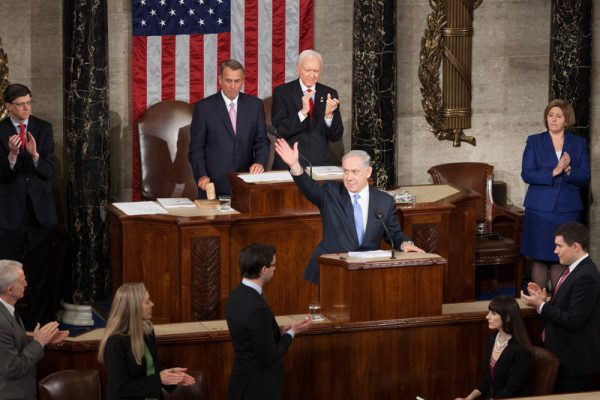
Nearly two years later, in March 2015, during what must surely have been, thus far, the lowest point in American history since 1776, Buchanan’s observation years before was proven correct in a grandiose way for all to see and hear. Netanyahu appeared before a joint session of Congress to give a rousing speech, which was interrupted by applause 39 times, of which 23 were standing ovations – more than a quarter of the time Netanyahu stood before the podium consisted of applause and jubilation by America’s “elected representatives”, conveying unambiguously that, as far as they are concerned, Israel comes first, not America.
A few days from now, on February 15, Netanyahu is scheduled for an official visit to the White House. There has been much speculation and chatter recently regarding the possible establishment of a US Embassy in Jerusalem. President Trump will have an opportunity to signal to Netanyahu what “America First” means. At the very least he should remain true to the same executive position since Harry Truman’s presidency, which recognizes, as does the United Nations, that no state has sovereignty over Jerusalem, given that the specifics pertaining to this issue remain subject to future negotiations between the parties involved in the dispute. This longstanding executive position was reaffirmed by the US Supreme Court on June 8, 2015 in Zivotofsky v. Kerry (“Jerusalem Passport Case”) and therefore constitutes “settled law”.
President Trump could surprise many by indeed proclaiming his intent to establish a US Embassy to Jerusalem in the heart of Jerusalem (inside the walled old town, ideally as close as possible to the key point where the Armenian Quarter, Christian Quarter, Jewish Quarter, and Muslim Quarter meet, perhaps at the LaHamin Market or St. Marks Road) while – of course – continuing to maintain the US Embassy to Israel in Tel Aviv. Additionally, so as to demonstrate even-handedness, he should announce plans to also establish a new US Embassy to Palestine in Ramallah, perhaps also a General Consular office in Gaza as well as the eastern part of the West Bank, if their Consular office in western part of Jerusalem were to remain in place. Such a public announcement could be crafted to fit within the 140 available characters of a “Tweet” message and could be timed for release just a few seconds before Trump and Netanyahu were to meet – so that Netanyahu would first learn about it from the press afterwards, on camera. This would be consistent with Israel’s regular announcements of new illegal settlements timed to greet US high officials in the past.
A new US Embassy to Jerusalem would formally extend the Supreme Court decision and thus formally recognize in a highly symbolic way the official “Corpus Separatum ” status of Jerusalem. Such an embassy would not even need to be manned inside; it could be as small as a big high definition screen and a server inside a thick storefront window, advertising an informational web site, but would include at least an armed Marine guard on duty. Presto – with rapid follow-through action after such an announcement Trump will have delivered “in style” on the promise for a new US Embassy in Jerusalem, as other countries will be scrambling to do likewise – after nearly seven long decades of stalling let the serious negotiations finally begin.
This editorial may be freely distributed only in its entirety, with an explicit reference “initially appeared at Aletho News” that includes a direct link or URL to this original site.
Last month German media revealed that German weapons supplied to Kurdish Peshmerga in northern Iraq are being sold on the black market, where they may end up in the hands of terrorist groups.
NDR and WDR reporters in the cities of Erbil and Sulaymaniyah in Iraqi Kurdistan discovered German weapons being sold on the black market there, engraved with the initials “Bw,” meaning Bundeswehr.
Weapons on sale included Heckler and Koch G3 rifles on sale for $1450 and $1800, and Walther P1 pistols with an asking price of $1200.
One arms dealer told a reporter that he could procure the Heckler & Koch G36 assault rifle for $5000.
These weapons sales have also financed the flight of refugees from Iraq to Germany, an Iraqi Kurdish refugee living in Germany told the news program.
Former Peshmerga Mustafa S said that he is one of hundreds of fighters who have sold their weapons to finance their escape from Iraq.
“Mustafa S said that he knows around 100 Peshmerga who have sold their weapons in recent months in order to flee. The situation has become unbearable for many. The low oil price, lack of payment from the Iraqi central government and the battle against Daesh, which guzzles about five million dollars daily, have brought the Kurdish regional government to the brink of bankruptcy. (Mustafa) himself had not been paid for five months and did not know how he was going to pay rent, food, and medicine for his disabled daughter. Now, he lives with his wife and their six children in a home for asylum seekers in East Germany,” Tagesschau reported.
Deputy Chairman of the Die Linke opposition party in the German Bundestag Tobias Pfluger called on the government to stop supplying arms to the Peshmerga. He told Sputnik that the deliveries are counter to the German constitution.
“The interesting thing is that the training missions that are connected with these weapons deliveries break several domestic federal laws. German and EU legislation, the War Weapons Control Act and the Foreign Trade and Payments Act, prohibit direct deliveries to war zones,” Pfluger explained.
The German Defense Ministry has delivered an estimated 2,400 tons of arms and munitions to Kurdish Peshmerga fighters since it began to supply the militia in summer 2014. A government spokesman told NDR and WDR that the government of Iraqi Kurdistan is responsible for the weapons’ misuse.
The German Defense Ministry is committed to the “proper verification of supplied weapons,” and their use in accordance with international law.
However, since the Ministry is unable to trace individual arms, “the sale of individual weapons cannot be excluded with absolute certainty.”
Pfluger said that assurances from local forces that the arms will remain in their possession are “worthless.”
“It is completely perverse that they have to sign a so-called confirmation of retention. That is nothing other than a completely worthless piece of paper because we know that the weapons show up on the markets in Iraq and Syria. In this respect, we say that this commitment must be ended, it is an intensification of the war and is in no way something that creates peace there.”
Peace activist and spokesman for Aktion Aufschrei — Stop the arms trade! Jurgen Grasslin told Sputnik Deutschland that German guns have ended up far removed from their intended destination.
“The federal government usually has no idea where their weapons are actually delivered to, when they are exported. My research, based on (studies of) numerous countries and trips to crisis regions and war zones over the past 30 years, shows clearly that weapons roam. Weapons do not stay in the place where they are delivered.”
Grasslin, author of a book entitled “The Black Book of Arms Trading: How Germany Profits from War” (Schwarzbuch Waffenhandel: Wie Deutschland am Krieg verdient), alleges that German arms deliveries constitute “complicity in murder.”
“If Daesh is firing German weapons, and of course weapons from other countries, that is more than a scandal, it is a breach of the law. It is complicity in murder. You are delivering to a war zone. You know that these weapons don’t stay in the hands of the recipients, and that they land in the hands of the worst terrorist groups, for example Daesh. The people who authorize these arms exports must be named, that is namely members of the Bundessicherheitsrat (Federal Security Council) or Federal Government. The first to be named should be Chancellor Angela Merkel and her deputy Sigmar Gabriel, who lead the Bundessicherheitsrat and are thus responsible for these armed forces.”
In the most dramatic expression of insider opposition to a sitting administration’s policies in generations, over 1,000 U.S. State Department employees signed on to a memo protesting President Donald Trump’s temporary ban on people from seven predominantly Muslim countries setting foot on U.S. soil. Another recent high point in dissent among the State Department’s 18,000 worldwide employees occurred in June of last year, when 51 diplomats called for U.S. air strikes against the Syrian government of President Bashar al Assad.
Neither outburst of dissent was directed against the U.S. wars and economic sanctions that have killed and displaced millions of people in the affected countries: Iran, Iraq, Libya, Somalia, Sudan, Syria and Yemen. Rather, the diplomatic “rebellion” of last summer sought to pressure the Obama administration to join with Hillary Clinton and her “Big Tent” full of war hawks to confront Russia in the skies over Syria, while the memo currently making the rounds of State Department employees claims to uphold “core American and constitutional values,” preserve “good will towards Americans” and prevent “potential damage to the U.S. economy from the loss of revenue from foreign travelers and students.”
In neither memo is there a word of support for world peace, nor a hint of respect for the national sovereignty of other peoples — which is probably appropriate, since these are not, and never have been, “core American and constitutional values.”
Ironically, the State Department “dissent channel” was established during one of those rare moments in U.S. history when “peace” was popular: 1971, when a defeated U.S. war machine was very reluctantly winding down support for its puppet regime in South Vietnam. Back then, lots of Americans, including denizens of the U.S. government, wanted to take credit for the “peace” that was on the verge of being won by the Vietnamese, at a cost of at least four million Southeast Asian dead. But, those days are long gone. Since 2001, war has been normalized in the U.S. — especially war against Muslims, which now ranks at the top of actual “core American values.” Indeed, so much American hatred is directed at Muslims that Democrats and establishment Republicans must struggle to keep the Russians in the “hate zone” of the American popular psyche. The two premiere, officially-sanctioned hatreds are, of course, inter-related, particularly since the Kremlin stands in the way of a U.S. blitzkrieg in Syria, wrecking Washington’s decades-long strategy to deploy Islamic jihadists as foot soldiers of U.S. empire.
The United States has always been a project of empire-building. George Washington called it a “nascent empire,” Thomas Jefferson bought the Louisiana Territory from France in pursuit of an “extensive empire,” and the real Alexander Hamilton, contrary to the Broadway version, considered the U.S. to be the “most interesting empire in the world.” The colonial outpost of two million white settlers (and half a million African slaves) severed ties with Britain in order to forge its own, limitless dominion, to rival the other white European empires of the world. Today, the U.S. is the Mother of All (Neo)Colonialists, under whose armored skirts are gathered all the aged, shriveled, junior imperialists of the previous era.
In order to reconcile the massive contradiction between America’s predatory nature and its mythical self-image, however, the mega-hyper-empire must masquerade as its opposite: a benevolent, “exceptional” and “indispensible” bulwark against global barbarism. Barbarians must, therefore, be invented and nurtured, as did the U.S. and the Saudis in 1980s Afghanistan with their creation of the world’s first international jihadist network, for subsequent deployment against the secular “barbarian” states of Libya and Syria.
In modern American bureaucratese, worrisome barbarian states are referred to as “countries or areas of concern” — the language used to designate the seven nations targeted under the Terrorist Travel Prevention Act of 2015 signed by President Obama. President Donald Trump used the existing legislation as the basis for his executive order banning travelers from those states, while specifically naming only Syria. Thus, the current abomination is a perfect example of the continuity of U.S. imperial policy in the region, and emphatically not something new under the sun (a sun that, as with old Britannia, never sets on U.S. empire).
The empire preserves itself, and strives relentlessly to expand, through force of arms and coercive economic sanctions backed up by the threat of annihilation. It kills people by the millions, while allowing a tiny fraction of its victims to seek sanctuary within U.S. borders, based on their individual value to the empire.
Donald Trump’s racist executive order directly affects about 20,000 people, according to the United Nations High Commissioner on Refugees. President Obama killed an estimated 50,000 Libyans in 2011, although the U.S. officially does not admit it snuffed out the life of a single civilian. The First Black President is responsible for each of the half-million Syrians that have died since he launched his jihadist-based war against that country, the same year. Total casualties inflicted on the populations of the seven targeted nations since the U.S. backed Iraq in its 1980s war against Iran number at least four million — a bigger holocaust than the U.S. inflicted on Southeast Asia, two generations ago — when the U.S. State Department first established its “dissent channel.”
But, where is the peace movement? Instead of demanding a halt to the carnage that creates tidal waves of refugees, self-styled “progressives” join in the macabre ritual of demonizing the “countries of concern” that have been targeted for attack, a process that U.S. history has color-coded with racism and Islamophobia. These imperial citizens then congratulate themselves on being the world’s one and only “exceptional” people, because they deign to accept the presence of a tiny portion of the populations the U.S. has mauled.
The rest of humanity, however, sees the real face of America — and there will be a reckoning.
The Middle East geopolitical scenarios are going through rapid changes with new factors emerging on the regional chessboard.
Cairo’s foreign policy has been given a new twist. It has been announced recently that Egypt is set to receive one million barrels of petroleum per month from Iraq. Saudi Arabia had informed Egypt that shipments of oil products expected under a $23 billion aid deal have been halted indefinitely, suggesting a deepening rift between the countries. From now on, Egypt will enjoy as much oil as it needs at a lower cost, compared to Saudi pricing.
Egyptian President Al-Sisi rejected the Saudi-backed efforts to overthrow the regime of Bashar Assad. He is also reaching out to former-Yemeni president Ali Abdullah Saleh and to his Houthi allies Saudi Arabia is fighting since March 2015. Cairo opened diplomatic channels with the pro-Iranian Lebanese Hezbollah, fighting on the side of President Assad in Syria against the rebel groups supported by Riyadh.
Iraq will provide Egypt with 1 million barrels of Basra light oil each month. The agreement involves extending an oil pipeline from Iraq to Egypt via Jordan. In December, Iraqi petroleum minister Ali al-Luiabi met with the heads of major oil and natural gas companies in Cairo, inviting them to contribute into developing the industry in his country.
Egypt is about to train four Iraqi army units on war against terrorism, in light of the rapprochement between Egypt and the Iraqi-Iranian axis in the region.
It also mulls sending peacekeeping troops to Syria during the coming days to support the ceasefire agreement under the auspices of Russia, Iran, and Turkey. It has been reported that a unit of Egyptian ground forces might deploy to Syria this month. Last October, Syrian National Security Bureau head Ali Mamlouk visited Cairo to meet Khaled Fawzy, the head of Egypt’s General Intelligence Service. The two sides agreed to coordinate political positions and strengthen cooperation in «the fight against terror».
Egypt is a predominantly Sunni nation. Its open support of the Russia-backed coalition in Syria is a game changing event of fundamental importance. It makes the sectarian interpretation of the Syria’s conflict not valid anymore.
Middle East Observer quotesNziv Net, an Israeli outlet close to intelligence sources, saying that «Egypt has sent a group of officers to Syria for the first time since the relations have frozen during Morsi’s reign».
Last December, Ibrahim al-Eshaiker al-Jaafari, the Iraqi Foreign Minister, called on Egypt to participate in a «strategic project to fight terrorism», which includes Iran.
In September, Egyptian Foreign Minister Samih Shoukry met for the first time with his Iranian counterpart, Jawad Zarif, during their visits to New York to attend the UN General Assembly.
In October, Egypt backed a Russian-backed motion in the UN calling for a ceasefire in Syria. The move angered Saudi Arabia, which suspended oil shipments to Cairo.
Egyptian President Abdel Fattah al-Sisi publicly affirmed his support for the forces of Syrian President Bashar al-Assad.
The relations between Russia and Egypt have been on the rise. In February 2015, Egypt signed a breakthrough agreement on establishing a free trade zone with the Russia’s Eurasian Economic Union.
The progress in military cooperation is tangible. Egypt signed arms deals with Russia worth up to $5 billion by 2015 to include 50 MiG-29M combat aircraft, Buk-M2E and Antey-2500 long range air defense systems and about 50Ka-52K helicopters for Egypt’s new Mistral-class assault ships bought in France. The ships will receive the originally planned Russian helicopters and electronics suite.
The two countries signed several agreements for the renovation of military production factories in Egypt. A protocol is signed to grant Egypt access to GLONASS, the Russian global satellite positioning system. In September, Minister of Defense Sedky Sobhy visited Russia to discuss the issues related to long-term close security relationship. Last October, the militaries held a joint exercise.
Egypt is the most populous country in North Africa and the Arab world, the third-most populous in Africa and the fifteenth-most populous in the world. Last year, the country’s population has just reached 92 million. Its policy shift is well-substantiated. Cairo is fighting the Islamic State on the Sinai Peninsula. The fierce fighting there seldom hits media headlines but the IS poses a grave threat to Egypt. IS militants can also strike Egypt from Libya. The IS presence in Libya brings Egypt and Algeria together as the two great nations face the same threat.
The emerging Iran, Iraq, Russia and Turkey alliance may also include Algeria. In response to the growing menace, Algiers is strengthening ties with Moscow. It has recently purchased 14 Su-30MKA fighters and 40 Mi-28 «Night Hunter» attack helicopters from Russia. Last February, Russia and Algeria laid out a road-map for deepening bilateral economic and military cooperation during Russian Foreign Minister Sergei Lavrov’s visit to Algeria.
Russia’s cooperation with Egypt, Algeria and other countries of the Middle East and North Africa reflects Moscow’s growing clout in the region.
With the Astana process making progress, other large and influential actors, such as Syria, Iraq, Egypt and Algeria, may join the emerging Russia, Iran, Turkey coalition to make the Middle East-North Africa (MENA) region face tectonic and dramatic changes.
This is the third day of the year, and perhaps you would like to do some journalistic investigation. Get a microphone. Go to any major city in America or any city around where you live. Ask a number of people about how many civilians died in Iraq alone last year.
Certainly you will not get an answer that is close to the exact number precisely because virtually no major news outlet gives a flip about innocent people dying in the Middle East. And if those major news outlets put out some figures, they will never go into the real issues because that will implicate the Khazarian Mafia and their marionettes.
According to some accounts, at least 9,148 civilians and 6,430 personnel lost their precious lives in Iraq. Last month, 3, 174 civilians died right before the new year started. Who cares about those people?
Well, certainly not the oligarchs. Certainly not the Neoconservatives. Certainly not the major news outlets. And obviously not political whores and puppets like Ann Coulter. “For my young readers,” Coulter declared, “The Middle East has been a hellhole for a thousand years and will continue to be a hellhole for the next thousand years.”
Coulter seems to have magical powers. She seems to know what the future will look like in the next thousand years. But she chould never see herself as an accomplice in bringing about a “hellhole” in the Middle East. And if you think that people like Coulter is not intellectually suicidal, then think again.
Coulter believes that the war in Iraq was a “a magnificently successful war.”[1] But what about sodomy in places like Abu Ghraib? Don’t worry. Coulter already has an answer for you.
“I suffered more just listening to the endless repetition of those Abu Ghraib stories than the actual inmates ever did,” sniffs Coulter indignantly.[2] But she was just warming up. She has said elsewhere:
“Sorry we have to use your country, Iraqis, but you let Saddam come to power, and we are going to instill democracy in your country.”[3]
As you know, Coulter is delusional here. No serious person with an ounce of brain cells working together can say that the Iraq war was a success. Military historian and former Colonel Andrew Bacevich, whose son died in Iraq, writes,
“Apart from a handful of deluded neoconservatives, no one believes that the United States accomplished its objectives in Iraq, unless the main objective was to commit mayhem, apply a tourniquet to staunch the bleeding, and then declare the patient stable while hastily leaving the scene of the crime.
The fighting in Afghanistan and Iraq has exacted a huge price from the U.S. military—especially the army and the Marines. More than 6,700 soldiers have been killed so far in those two conflicts, and over fifty thousand have been wounded in action, about 22 percent with traumatic brain injuries.
“Furthermore, as always happens in war, many of the combatants are psychological casualties, as they return home with post-traumatic stress disorder (PTSD) or depression. The Department of Veterans Affairs reported in the fall of 2012 that more than 247,000 veterans of the Afghanistan and Iraq wars have been diagnosed with PTSD. Many of those soldiers have served multiple combat tours.
“It is hardly surprising that the suicide rate in the U.S. military increased by 80 percent from 2002 to 2009, while the civilian rate increased only 15 percent. And in 2009, veterans of Iraq were twice as likely to be unemployed as the typical American.
“On top of all that, returning war veterans are roughly four times more likely to face family-related problems like divorce, domestic violence and child abuse than those who stayed out of harm’s way.
“In 2011, the year the Iraq War ended, one out of every five active duty soldiers was on antidepressants, sedatives, or other prescription drugs. The incidence of spousal abuse spiked, as did the divorce rate among military couples. Debilitating combat stress reached epidemic proportions. So did brain injuries. Soldier suicides skyrocketed.”[4]
There is more to this Middle East issue here. CNN reported last week that “New Year’s holiday threats prompt more security.”[5] But what about precious Arabs and Muslims? We want to protect our children and love ones in America, but the Muslims deserve to die?
Oh, a slip of the pen here. I just realized that they are all terrorists and not a single one of them is innocent. As Gilad Sharon would have us believe, Muslims, particularly “the residents of Gaza,” are not “innocent” at all.
In 2015, Brown University reported that 200,000 civilians lost their precious lives in Iraq. Last year, 1,500 children lost their lives within six months alone in Afghanistan.[6] Imagine the uproar among the Neoconservative establishment if Muslims ended up killing just 50 American children in one year.
You see, New World Order agents aspire to turn the Middle East into ashes for Israel. But every step they take inexorably leads them to their own destruction. If Donald Trump again wants to be a successful president, he needs to put a stop to perpetual killings in the Middle East. Mothers and fathers are exhausted about seeing their precious sons and daughters’ dreams shattered by an essentially diabolical enterprise.
[1] Ann Coulter, Never Trust a Liberal Over 3-Especially a Republican (Washington: Regnery, 2013), 3.
[2] Ann Coulter, If Democrats Had Any Brains, They’d Be Republicans (New York: Random House, 2007), 2.
[3] Quoted in George Gurley, “Tea With Miss Coulter,” New York Observer, October 2, 2007.
[4] Andrew Bacevich, Breach of Trust: How Americans Failed their Soldiers and Their Country (New York: Metropolitan Books, 2013), 94, 105.
[5] Evan Perez and Shimon Prokupecz, “New Year’s holiday threats prompt more security,” CNN, December 30, 2016.
[6] Jack Moore, “Afghanistan: Civilian Casualties and Child Deaths Hit Record High in 2016,” Newsweek, July 25, 2016.
Israel’s “defence” minister Avigdor Lieberman has penned an article for Defense News to explain his regime’s struggles in a turbulent Middle East.
In a similar tone to those of the Israeli politicians, Lieberman wastes no time to call the legitimate forces of Hamas in Palestine and Hezbollah in Lebanon as terrorist forces. He says, “The massive convulsions that in recent years have swept through North Africa and erupted in Syria, Iraq and Yemen and elsewhere throughout the region, and which have seen the empowerment of semi-territorial terrorist organizations such as ISIS, Hamas and Hezbollah, represent an earthquake of historic proportions. Multi-ethnic states such as Libya, Syria and Iraq have descended into chaotic civil wars as many aspects of the region’s enduring political order, whose origins lie in the aftermath of World War One, disintegrate.”
Lieberman goes on to draw three conclusions as the solutions for ending the crisis in the Middle East. The second conclusion is clearly a call to attack the sovereignty of the independent countries. Lieberman says, “many of the countries in the Middle East were established artificially, as a result of the Sykes-Picot Agreement and based on colonial considerations that did not take into account the pattern of habitation and the deep sectarian rifts within the respective societies.
Thus, to genuinely solve the region’s problems, borders will have to be altered, specifically in countries like Syria and Iraq. Boundaries need to be redrawn between Sunnis, Shia and other communities to diminish sectarian strife and to enable the emergence of states that will enjoy internal legitimacy. It is a mistake to think that these states can survive in their current borders.
A similar conclusion holds true for the Israeli-Palestinian arena and for the borders that will ultimately need to be drawn for the achievement of a stable two-state outcome. We need “out of the box” analysis to avoid being misled by habitual ways of thinking.”
One can not better understand the reason behind the “civil wars” in Syria and Iraq without reading Israel’s defense minister’s call to divide Syria and Iraq.
“Perles of Wisdom for the Feithful,” by Akiva Eldar, Ha’aretz, October 1, 2002: http://iakn.us/2hkzdzo
“The Bush Neocons and Israel,” by Kathleen and Bill Christison, Counterpunch, December 2002: http://iakn.us/2h1ajEi
“Neo-Cons, Israel and the Bush Administration,” by Stephen Green, Counterpunch, February 2004: http://iakn.us/2ggBcVi
Books mentioned in the video:
“The Transparent Cabal: The Neoconservative Agenda, War in the Middle East, and the National Interest of Israel” by Dr. Stephen J Sniegoski: http://iakn.us/2geT2mJ
“The Road to Iraq: The Making of a Neoconservative War” by Muhammad Idrees Ahmad: http://iakn.us/2hoz4Hn
“The Israel Lobby and U.S. Foreign Policy” by John J. Mearsheimer and Stephen M. Walt: http://iakn.us/2gfPFAR
Some additional books with information on this topic:
“Shadow Elite: How the World’s New Power Brokers Undermine Democracy, Government, and the Free Market” by Janine R. Wedel: http://iakn.us/2hoBKEW
“Queen of Chaos: The Misadventures of Hillary Clinton” by Diane Johnstone: http://iakn.us/2gojmhO
Wedell discusses the “massive and concerted ‘information’ effort conducted by the Neocon core and their associates, with crucial participation from certain columnists and reporters, that was essential in taking the United States to war in Iraq.”
“….beginning in the mid-1970s, they employed methods ranging from the creation of alternative intelligence; to might-be-authorized, might-not-be authorized diplomacy; to setting up pressure groups; to suspending standard government process, always contesting government information, assessments, and expertise. These methods—perfected over the years—would be deployed in full force in the Neocon core’s effort to take the United States to war in 2003.”
Johnstone states: “…the neocons gained notoriety as architects of the disastrous invasion of Iraq. The main thinker behind this war was Bush’s Under Secretary of Defense for Policy, Paul Wolfowitz…”
“…two veterans of the defunct PNAC, William Kristol and Robert Kagan, returned in 2009 to found the Foreign Policy Institute (FPI). Robert Kagan is the current leading neocon theorist and the husband of Secretary of State Hillary Clinton’s spokeswoman, Victoria Nuland, instigator of the Ukrainian coup in early 2014.”
For information on the early roots of the Israel lobby, please see Alison Weir’s book, “Against Our Better Judgment: The Hidden History of How the U.S. Was Used to Create Israel”: http://iakn.us/AOBJ-book
At a meeting with the Parliamentary Committee on Foreign Policy the Defense Minister of Denmark, Anders Samuelsen, said that Denmark would not renew a six-month mission of 7 F-16 fighters of Royal Air Force, participating in the US-led coalition’ operation against ISIS terrorists in Syria and Iraq.
The decision was made just a few days after the Pentagon announced that the September air strike in Deir ez-Zor, which led to serious casualties among the Syrian army soldiers had been caused by a series of human errors, inaccurate information, intelligence and problems with communication.
We can assume that, in this way, Denmark has expressed its disagreement with the fact that Washington so easily named the “human factor” as the main cause of incident, rather than to identify the real perpetrators of it.
According to Reuters, about 200 Canadian commandos are actively involved in the ground operation to recapture Mosul from ISIS rule. According to Michael Rouleau, Canadian Special Forces Commander, troops are engaged in a ‘substantial’ number of clashes with terrorists which continues to rise.
Why is Canada sending troops to Iraq? What are the results desired by the Canadian government? And what is it willing to sacrifice?
First, Ottawa claims that by doing so it protects itself against terrorism. Former foreign minister Rob Nicholson stressed the need to weaken and destabilize ISIS in 2015. However neither airstrikes in Iraq and Syria nor coalition’s participation in Mosul mincing machine will lead to eradication of terrorism. The example of the Taliban in Afghanistan clearly demonstrates that large-scale fighting will be followed by long and bloody guerrilla war, in which Canada could get stuck with no end in sight.
Second, we should analyze the aftermath of ISIS defeat in Iraq and Syria. This question has no clear-cut answer. In theory the Canadian military presence in Iraq helps the Iraqi government to regain control over the country. In practice Ottawa is cooperating with the Kurds, who are planning to establish their own independent state on the territory of Iraq, Syria and Turkey. These aspirations could further destabilize the region.
Third, it is unclear whether Canada is ready to confront the Islamic State on a global scale. ISIS is conducting subversive activities in Lebanon, Afghanistan, Algeria, Pakistan, Libya, Egypt, Yemen, Nigeria, as well as in the countries of Southeast Asia in addition to Syria and Iraq. Consequently, it will require much more effort than just sending a few hundred soldiers to take part in an operation with controversial results for the complete elimination of the Islamic State.
Fourth, the situation in Syria and Iraq resembles a scenario that has repeatedly led to disastrous consequences in the Middle East. For example, the Western overthrow of Saddam Hussein in Iraq in fact led to the creation of ISIS. NATO’s invasion in Libya has practically ruined the country, led to fierce carnage over Muammar Gaddafi and contributed to the rapid spread of terrorist groups throughout North Africa not mentioning numerous victims among the civilian population.
Fifth, judging by the events in Mosul, one could argue that the operation would require a considerable amount of money. Despite the fact that the military operation in Iraq has already hit the budget of the country, Canada is going to allocate approximately $305.9 million extra towards extension, refocusing and carrying out the mission. This includes $41.9 million to be allocated for redeployment of personnel and equipment in 2016-17.
In addition, Canadian military’s participation in missions abroad comes with casualties. According to The Department of National Defense and the Canadian Armed Forces, 162 soldiers were killed in Afghanistan with more than two thousand injured. During the ten years of military presence in Afghanistan the Government invested more than $11 billion in the operation.
It is obvious that in the absence of a clear military strategy and achievable goals the situation in Iraq can become a second Afghanistan for Ottawa. Instead of solving internal problems, by supporting the international coalition Canada dared to get involved in another endless armed conflict. The leadership of the country once again has not consulted the opinion of its citizens sending dozens of soldiers to death and destroying the state budget.
Ammunition supplied by the United States and Saudi Arabia to moderate Syrian opposition groups has been found in the possession of Daesh terrorist group, representatives of a UK-based organization monitoring weapons movement said.
The Conflict Armament Research (CAR) investigators work in the areas recently liberated from Daesh and its research shows that ammunition boxes left by the jihadists can be traced back to factories in Eastern Europe, the BBC reported Monday, citing CAR team leader James Bevan.
Inquiries by Bevan’s team indicated that the factory orders could be traced back to the United States and Saudi Arabia. Ammunition was then shipped to southern Turkey en route to opposition groups in northern Syria.
“Their procurement networks reach out into southern Turkey and they obviously have a series of very strong relationships with very big distributors,” Bevan told the BBC.
The ammunition then found its way into Daesh hands, eventually ending up in Iraq, where Daesh is fighting US-backed government troops. Ammunition boxes in question were found starting late 2015 in Tikrit, Ramadi, Falluja and Mosul, according to CAR.
CAR estimated that the speed of procurement was some two months between factory and the final destination in Iraq. The organization’s report has yet to be published.
Daesh, a militant jihadist organization outlawed in many countries, including the United States and Russia, took over vast swathes of Syria and Iraq in 2014 amid the ongoing Syrian civil war.
The US Train and Equip Program aimed at moderate Syrian rebels was canceled in October 2015 after a number of US-trained forces were quickly overrun by extremists while the US-provided weapons were reportedly handed over to the terrorist groups. A part of the US-trained forces defected and fought on the side of terrorists.
Both the United States and the United Kingdom have recently decided to resume training programs in Syria.
By Prof Michel Chossudovsky | Global Research | September 10, 2017
There is an element of confusion which has served to divide the 9/11 Truth movement. Saudi Arabia is said to have supported the alleged 9/11 highjackers.
What are the implications of “the Saudi did it” narrative?
It is very convenient to say that Saudi Arabia was behind the 9/11 terrorists. Why, because it upholds the official narrative of the 9/11 Commission Report and it whitewashes the US Deep State including its military and intelligence apparatus.
The official narrative –which has been amply refuted– states that 19 Al Qaeda hijackers brought down the WTC towers, i.e Muslims were behind the attack on America, –i.e. it was not an “inside job” or a false flag.
And now what is happening is that Saudi Arabia is blamed for having supported the al Qaeda hijackers.
And if Saudi Arabia is held responsible, pari passu the official narrative holds, namely the hijackers did it with the support of the House of Saud. … continue
This site is provided as a research and reference tool. Although we make every reasonable effort to ensure that the information and data provided at this site are useful, accurate, and current, we cannot guarantee that the information and data provided here will be error-free. By using this site, you assume all responsibility for and risk arising from your use of and reliance upon the contents of this site.
This site and the information available through it do not, and are not intended to constitute legal advice. Should you require legal advice, you should consult your own attorney.
Nothing within this site or linked to by this site constitutes investment advice or medical advice.
Materials accessible from or added to this site by third parties, such as comments posted, are strictly the responsibility of the third party who added such materials or made them accessible and we neither endorse nor undertake to control, monitor, edit or assume responsibility for any such third-party material.
The posting of stories, commentaries, reports, documents and links (embedded or otherwise) on this site does not in any way, shape or form, implied or otherwise, necessarily express or suggest endorsement or support of any of such posted material or parts therein.
The word “alleged” is deemed to occur before the word “fraud.” Since the rule of law still applies. To peasants, at least.
Fair Use
This site contains copyrighted material the use of which has not always been specifically authorized by the copyright owner. We are making such material available in our efforts to advance understanding of environmental, political, human rights, economic, democracy, scientific, and social justice issues, etc. We believe this constitutes a ‘fair use’ of any such copyrighted material as provided for in section 107 of the US Copyright Law. In accordance with Title 17 U.S.C. Section 107, the material on this site is distributed without profit to those who have expressed a prior interest in receiving the included information for research and educational purposes. For more info go to: http://www.law.cornell.edu/uscode/17/107.shtml. If you wish to use copyrighted material from this site for purposes of your own that go beyond ‘fair use’, you must obtain permission from the copyright owner.
DMCA Contact
This is information for anyone that wishes to challenge our “fair use” of copyrighted material.
If you are a legal copyright holder or a designated agent for such and you believe that content residing on or accessible through our website infringes a copyright and falls outside the boundaries of “Fair Use”, please send a notice of infringement by contacting atheonews@gmail.com.
We will respond and take necessary action immediately.
If notice is given of an alleged copyright violation we will act expeditiously to remove or disable access to the material(s) in question.
All 3rd party material posted on this website is copyright the respective owners / authors. Aletho News makes no claim of copyright on such material.




 Aletho News