Iran, Iraq, Russia hold meeting in Moscow
IRNA – August 2, 2017
Deputy Foreign Ministers of Russia, Iran and Iraq held meeting here on Wednesday to consider situation in the Middle East, crises in Iraq and Syria and trilateral coordination.
Mikhail Bogdanov, Hossein Jaberi Ansari and Nazar Khairallah kicked off the meeting in the venue of Foreign Ministry Protocol Hall in the presence of their accompanying delegation as well as Iran’s Ambassador to Moscow Mehdi Sanayee.
The latest developments in the region, especially coordination to reduce tensions and crises in the region with the aim to increase stability and peace were topics of agenda.
Before holding the joint meeting, Bogdanov met separately with Jaberi Ansari and Nazar Khairallah and discussed different issues with them.
Bogdanov and Jaberi Ansari in their 4-hours meeting discussed a collection of issues concerning West Asia and North Africa, situations in Syria, Yemen, Libya, Iraq, Iraqi Kurdistan, Palestine, crisis in relations between Qatar and Saudi Arabia and other international and regional issues.
Intra-Syrian talks in Astana and Geneva, Syrian humanitarian needs and the issue of rebuilding Syria were among issues discussed in the meeting.
Pentagon Enjoys Impunity in Spite of the Rapidly Mounting Civilian Death Toll
By Grete Mautner – New Eastern Outlook – 01.08.2017
Somehow most of us grew accustomed to various media sources reporting horrific crimes against civilians committed by US servicemen in various regions of the world on the daily basis.
For instance, yet another air raid launched by US Air Force on July 25 in Afghanistan claimed a number of civilian lives. Eight people fell dead, including women and children. For local residents the fact that the area where the attack occurred is being contested by pro-government forces and various militant groups is yesterday’s news. However, as eyewitnesses argue, this time the strikes were aimed against civilians. There’s been reports that those who were trying to provide first aid to the victims of the air strike were outraged by the number of wounded minors. It’s curious that the contested Nangarhar province is located on the very border with Pakistan, so there are no large cities where hitting one’s designated target may be tricky. Americans have been bombing the area for a long time.
Under the conditions of self-declared military intervention, local authorities are forced to bear with the fact that the death of a single terrorist killed by US and NATO soldiers would be accompanied by a number of civilian lives lost in the process. However, the best the Pentagon has ever done for the relatives of its victims was the offering of pathetic condolences accompanied by a promise to “investigate the incident”. Just a few days ago US aircraft would “mistakenly” bomb an Afghan military base in the province of Helmand, claiming the lives of 17 Afghan policemen.
American air raids usually result in destroyed Afghanistan schools, as it was on July 15, when yet another school was attacked from the sky in the town of Kunduz, and destroyed hospitals, like the one run by Doctors Without Borders that was destroyed by a coalition air strike last October. Back then a total 24 people was murdered, including 12 medical practitioners and three children. Even wedding ceremonies that can be pretty massive in Afghanistan are not immune to such US and NATO attacks, as it happened in November in the southern Afghan province of Kandahar, when a single US air strike would claim a total of 95 civilians lives, while leaving another 50 people injured.
In the first half of 2017 alone a total of 5243 civilians suffered injuries during various skirmishes, with 1,662 of them suffering lethal injuries and 3,581 suffering non-lethal injured, says a report of the United Nations Assistance Mission in Afghanistan (UNAMA). Women and children are still suffering the most from the conflict. According to the above mentioned report, in the first 6 months of 2017, 174 women were killed and 462 injured. UNAMA chief Tadamichi Yamamoto has recently noted that Afghans continue to die, get injured, and be forced to abandon their homes to escape violence.
In Syria and Iraq, the death toll is even higher. The UN and human rights organizations are outraged, since they have long been accusing Washington of neglecting international law and the basic safety of the people they claim to be protecting. But nobody seems to listen.
For instance, the campaign that the West launched to pursue the liberation of Iraq turned out to be no less brutal than the war that was raging in the country. In spite of all sorts of statements that Washington would make about the so-called high precision strikes it would allegedly carry out in Mosul, a number of American media sources would publish satellite images of the city virtually reduced to ruins. According to the Independent, more than 40,000 civilians were killed in the devastating battle to retake Mosul from ISIS – a death toll far higher than was previously estimated.
It is necessary to conduct an independent investigation of the crimes committed against civilians of Iraqi Mosul. This statement was made by the international human rights organization known as Amnesty International. According to the human rights defenders, the US-led coalition conducted a “series of merciless and illegal attacks” in Mosul. In particular, it is asserted that the coalition has been using highly explosive and inaccurate ordinance. As it’s been stressed by the Amnesty International, the battle for Mosul led to a true humanitarian disaster.
But the strikes carry on, as it’s been reported the recent strike carried out by the US-led coalition last week against a prison in Syria’s Rakka, where ISIS would hold its hostages, resulted in a total of 30 people killed.
Syria’s civilian population is dying in hundreds at the hands of US servicemen that have no legal justification to even be present in Syria. The mounting death toll has been carefully tracked by the Airwars portal.
To mislead the international community and hide the true extent of the crimes that are being committed by US servicemen in Iraq, Syria, Afghanistan, thus preventing an international investigation from giving a careful evaluation of the bloody role that Washington played in the destruction of the Middle East, Washington has been routinely accusing Damascus of chemical weapons usage.
Just last June, the White House would announce that US intelligence sources were in possession of reports about the alleged preparations carried out by Syrian authorities to launch a chemical attack. These reports were followed by unfounded accusations against Damascus voiced by the opposition forces.
However, the Chairman of the Joint Chiefs of Staff, Joseph Dunford has been forced to publicly acknowledge that the Pentagon has no grounds to suspect the Syrian government of any instances of chemical weapons use.
However, the international community has every ground to accuse the United States of committing war crimes in Syria, Iraq, Afghanistan, where hundreds of civilians continue to perish due to indiscriminate American air raids, yet, no one has been brought to justice so far.
Saudi Arabia wades into Shi’ite politics in Iraq
By M K Bhadrakumar | Indian Punchline | August 1, 2017
The dramatic appearance of the Iraqi Shi’ite firebrand politician Muqtada Al-Sadr in Jeddah on Sunday and his meeting with the Saudi Crown Prince Mohammed bin Salman opens an exciting page in the Saudi-Iranian regional rivalries. The theatre is shifting to Iraq.
Briefly, what is unfolding is a determined Saudi attempt to reset the power calculus in post-ISIS Iraq by moulding a new political alignment that principally aims at undermining the pre-eminent influence that Iran has enjoyed over its neighbour in the past decade or so following the Shi’ite empowerment in the downstream of the US invasion of 2003.
Iran’s main platform on the Iraqi political landscape has been the umbrella Shi’ite coalition known as the Islamic Supreme Council in Iraq (ISCI), which Tehran had created as far back as 1982, originally as a Shi’ite resistance movement against Saddam Hussein and most recently since the middle of the last decade following Saddam’s overthrow as a united front to contest the democratic elections in Iraq with an agenda to preserve the Shi’ite leadership of the government.
To cut a long story short, ISCI is unravelling due to latent rivalries between various constituent groups. (Shi’ite politics has been traditionally very fractious, including in Iran.) Now, the split is also on account of a strong undercurrent of resentment over Iran’s dominance over Iraqi politics. (For the benefit of the uninitiated, again, the potency of Iraqi nationalism – a legacy of the Saddam era, paradoxically – subsuming the ethnic and sectarian divides in the country should never be underestimated.)
Importantly, the new generation of the powerful Hakim family led by Ammar Al-Hakim has moved out of the ISCI and has shifted allegiance from Iran’s Ayatollah Khamenei to Iraq’s Grand Ayatollah Ali Al-Sistani. Equally, Muqtada al-Sadr who has stepped out of Iran’s orbit has assumed a nationalistic, non-sectarian platform in the recent years. Again, within the ruling Islamic Dawa Party, which is the main constituent of the ISCI, there is an internal power struggle between the incumbent PM Haidar Al-Abadi and the former PM Nouri al-Maliki. (Currently, Maliki is a favourite of Iran; interestingly, Al-Abadi recently visited Saudi Arabia during which an announcement was made that the two countries have formed a ‘coordination council’ to bolster strategic relations aimed at healing troubled ties with ‘other Arab states’.)
Enter Saudi Arabia. Quite obviously, Saudis see a window of opportunity to go for Iran’s jugular veins by breaking up the ISCI irretrievably and instead propping up a new composite non-sectarian coalition involving the Shi’ite factions who resent Iran’s hegemony. No doubt, it is an audacious attempt to bring together – you’ve guessed it – Muqtada al-Sadr, Ammar Al-Hakim and Al-Abadi – on the same page.
The Crown Prince MBS is the mastermind behind this audacious Saudi move to manipulate the Shi’ite politics in Iraq. Arguably, the Saudi game plan has some positive streaks in it insofar as it envisages a non-sectarian realignment in Iraqi politics by encouraging a regrouping of the Shi’ite factions that give primacy to Iraqi nationalism over the identity politics they pursued up until recently. In turn, MBS would probably persuade these Shi’ite factions to work with the Iraqi Sunni factions and the Kurds. (By the way, Saudis recently opened a consulate in Erbil, the capital of Kurdistan in northern Iraq.)
Cynics would say that Saudis are having a devious agenda to: a) break up Shi’ite unity in Iraq; b) empower the Sunni groups as a ruling elite; and, c) create a schism between ‘Arab Shias’ and ‘Persian Shias’. The jury is out. Time only will tell how these shenanigans play out. To be sure, MBS’s initiative to manipulate Iraqi politics must be enjoying the support of the US and Israel, since it ultimately aims at isolating Iran and mitigates to an extent Iran’s spectacular ‘victory’ in the Syrian conflict.
Will Iran throw in the towel and walk away? Certainly not. Iran’s trump card is the battle-hardened Shi’ite militia known as the Al-Hashd Al-Shaabi, which is estimated to number over 120000 and is a Hezbollah-like army that is disciplined, fired up ideologically, and weaned in the politics of ‘resistance’. By the way, Qassem Soleimani, the charismatic commander of the Quds Force of the Iranian Revolutionary Guard Corps, was quoted as saying last week: “Daesh (ISIS) was stopped by the entry of Al-Hashd Al-Shaabi into the Iraqi army. The Iraqi army was transformed into a Hezbollah army.”
Now, that is a statement of fact. And, the ground reality is that today, in the chaotic war conditions in Iraq, power ultimately flows through the barrel of the gun. Stalin would have asked MBS as to how many divisions Al-Haikm, Al-Sadr and Al-Abadi together have under their command? Will the number come to even one half of the strength of Al-Hashd Al-Shaabi, the Iraqi Hezbollah, which Iran trained and equipped? Unlikely. Could they have taken on the ISIS and defeated it? No way.
Attempt to prosecute Tony Blair over Iraq War blocked by High Court
© i-Images / Global Look Press
RT | July 31, 2017
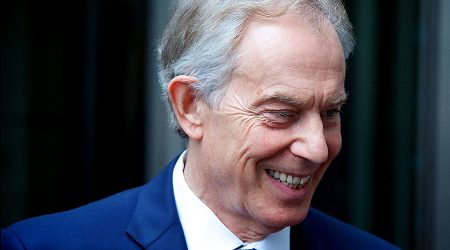
Britain’s High Court has blocked a bid by an Iraqi general to bring a private prosecution against Tony Blair over the war he launched in Iraq while prime minister.
General Abdul Wahed Shannan Al Rabbat accused the former Labour leader of committing a ‘crime of aggression’ by invading Iraq in 2003 to overthrow former President Saddam Hussein. The general wanted to see the prosecution Blair and two other key ministers of the time – Jack Straw, the foreign secretary, and Lord Goldsmith, the attorney-general.
The men currently have immunity from criminal charges over the war after a 2016 ruling said attempting to bring any prosecution would involve revealing details kept under the Official Secrets Act.
Al Rabbat’s lawyers asked London’s High Court for permission to seek judicial review in an attempt to get the Supreme Court, now the highest court in the land, to overturn a ruling by the House of Lords in 2006 that there is no such crime as the ‘crime of aggression’ under the law of England and Wales.
Lord Thomas of Cwmgiedd, the Lord Chief Justice, and Mr. Justice Ouseley, dismissed the general’s application on Monday, saying there was “no prospect” of the case succeeding.
Michael Mansfield QC, appearing for Al Rabbat, argued that the Chilcot Inquiry published last year showed the prosecution of Blair would be justified. An order declaring Blair’s immunity against any charges should therefore be overturned, Mansfield said.
The 2.6 million-word Chilcot report, which examined the first eight years of the war, said Britain chose to join the invasion of Iraq in 2003 before peaceful options for disarmament had been exhausted, alongside former US president George W. Bush, whom Blair had already pledged to support.
It added that the UK’s involvement in Iraq was based on what soon became obvious was a false pretext that Saddam possessed weapons of mass destruction (WMD). The report found that Blair misled the British public over the threat posed by WMD, which turned out to be non-existent.
Blair’s arguments for going to war were “based on flawed intelligence and assessments” that “were not challenged [and] should have been,” the report said.
The report also detailed the private deals Blair made with Bush ahead of the invasion. Blair promised Bush “I will be with you, whatever” long before the British public was told that he had set out on a path that led inevitably led to British involvement in the conflict eight months later.
Mansfield argued that the international crime of a war of aggression had been accepted by then-UK Attorney-General Sir Hartley Shawcross QC in the 1940s, at the time of the Nuremberg trials over Nazi war crimes.
Mansfield said that, as the international community had held those responsible for the Second World War to account by prosecuting those thought responsible for aggression at Nuremberg, it was the duty of UK courts to follow that example in relation to the Iraq War.
Westminster Magistrates Court refused to issue summonses in November last year on the grounds that the ex-ministers had immunity from legal action – and in any event, the current attorney-general, Jeremy Wright QC, would have to give permission.
Wright intervened in the case and his legal team urged the Lord Chief Justice to block the challenge. He said the private trial of Blair could “involve details being disclosed under the Official Secrets Act.”
Kate Hudson, CND general secretary, said: “Today’s decision by the High Court to block an attempt to prosecute Tony Blair for his role in the Iraq war is hugely disappointing and means justice has been left undone.
“Last year’s Chilcot report showed that Tony Blair had no respect for cabinet procedure, no respect for Parliament, and no respect for international law.
“Iraq was devastated by the war Blair led Britain into, millions of innocent Iraqis were killed, British soldiers were killed, and terrorism has spread across the Middle East.
“Chilcot revealed the evidence that must now be used to bring Tony Blair to justice.
“Only when justice is served can we prevent disasters like the Iraq war from happening again.”
The Iraq War caused the deaths of 179 British servicemen and women, and cost the UK economy an estimated £9.6 billion (US$12.6 billion). It is widely held to have caused the bloody sectarian conflict that brought about the rise of Islamic State (IS, formerly ISIS/ISIL).
According to Iraq Body Count, at least 160,400 Iraqi civilians died during the war.
Plot thickens in great game over post-ISIS Iraq and Syria
By M K Bhadrakumar | Indian Punchline | July 26, 2017
The post-ISIS future of Iraq and Syria has been a topic of animated discussion among American think tankers, the assumption being that the US is staging a military comeback in Iraq and well on the way to establishing a long-term presence in Syria. But political winds are blowing in an opposite direction.
The ‘working visit’ by Iraq’s vice-president Nouri Maliki to Moscow this week signals the revival of Russia’s historical role as Iraq’s key partner. Maliki’s remarks in Moscow are very revealing:
- “It’s well known that Russia has historically strong relations with Iraq, therefore we would like Russia to have a substantial presence in our country, both politically and militarily. This way, a balance would be established that would benefit the region, its peoples and its countries.”
- Baghdad believes “in Russia’s role in solving most of the key international issues as well as improving stability and balance in our region and worldwide.”
- A Russian presence in Iraq would bring the necessary balance which cannot be “undermined in a political sense in favour of any external party.”
- “Today we need Russia’s greater involvement in Iraqi affairs, especially in the energy field. Now when we are done with Islamic State, Iraq needs investments in energy and trade.”
- Moscow and Baghdad “should enhance… cooperation in countering terrorism in the region. We believe that both our countries are targets for terrorists and those who stand behind them.”
Maliki’s remarks found positive resonance with the Russian side. While receiving Maliki, President Vladimir Putin emphasised military-technical cooperation and a “proactive” role in that area. Putin cast the Russian-Iraqi relationship in the broader framework of “the situation in the region in general.” The latter remark takes into account the Iraq-Syria-Iran regional axis as a bulwark against terrorism.
The unity of Iraq and Syria is a core issue for Russia. Maliki told Putin that the fractured Iraqi polity where political power “continues to be divided on the religious or ethnic principle between the Sunnis, the Shiites, the Arabs, the Kurds, Christians and Muslims” becomes a breeding ground for terrorism and, therefore, Baghdad has prepared a “special project” to address this systemic deficiency. The Kremlin readout quoted Maliki as saying,
- “The idea is to restore real democracy, when the power is based on the victory of a political majority rather than on the assignment of quotas to various movements.”
In sum, Baghdad hopes to switch to a political system based on the ‘one-man, one-vote’ principle of representative rule, as in Syria or Iran. Clearly, the aim is to block foreign power from manipulating the minorities against the majority Shia community. No doubt, it will be a major reform not only in politico-economic terms, but also from the geopolitical perspective. Principally, Baghdad intends to resist any US-Israeli attempt to create an independent Kurdistan.
Maliki’s ‘working visit’ to Russia coincides with the signing of a defence agreement between Iraq and Iran. Maliki had signed an arms deal with Russia in 2012, estimated to be in the region of $4.2 billion (which couldn’t be implemented due to pressure from the Obama administration.) In sum, we’re witnessing a back-to-back effort by Iran and Russia to push back at the US.
Fundamentally, Iraq’s power calculus is getting reset. The tens of thousands of Iraqi Shi’ite militia trained and equipped by Iran, who played a decisive role in defeating the ISIS, will likely get integrated into the Iraqi security forces. These battle-hardened militia, known as the Popular Mobilization Forces (Hashed al-Shaabi in Arabic) have moved into the deserts held by ISIS west of Mosul, massing around the town of Tal Afar and have taken a border crossing between Iraq and Syria.
They are in control of highways bisecting the Sunni heartland in western Iraq, which are used as vital military and civilian supply lines connecting Iran with Syria. According to official Iraqi figures, the Popular Mobilization Forces now number about 122,000 fighters. Clearly, the military balance in the region is dramatically shifting against the US (and Israel.) The Hezbollah leader Hassan Nasrullah warned recently that hundreds of thousands of Shi’ite fighters in the region will jointly resist any future Israeli invasion.
In geopolitical terms, Russia and Iran have shared interest in the unity and stability of post-ISIS Iraq and Syria. Unsurprisingly, China is not far behind them, either.
Thus, China’s Special Envoy to Syria Xie Xiaoyan is currently on a regional tour. While in Tehran on Tuesday, he stressed that China’s stance vis-à-vis the Syrian endgame is similar to Russia and Iran’s. Xie announced that China is “ready to act upon its responsibility to reconstruct Syria and we are prepared for it.” (here and here)
Incidentally, on Tuesday China’s Exim Bank signed an agreement in Tehran on a financial package of US$1.5 billion for the upgrade of Iran’s trunk railway line connecting Tehran with Mashaad (near Turkmenistan border.) No doubt, Xie’s visit to Tehran flags that China has set its eyes on Iran as the gateway leading to Iraq and Syria.
Since March 2016 a China-Iran “Silk Road train” has been running once a month from Yiwu in China’s eastern Zhejiang province to Tehran. Its frequency is expected to increase once trade picks up. The “Silk Road train” slashes travel time from 45 days via sea route to less than 14 days. Clearly, China is positioning itself to play a major role in the reconstruction of Iraq and Syria and will be on the same page as Russia and Iran.
Baghdad seeking ‘substantial’ Russian military & political presence in Iraq – vice-president
RT | July 24, 2017
Russian military and political presence in Iraq would bring balance to the whole Middle Eastern and North African region, Nouri al-Maliki, the Iraqi vice-president, said during his visit to Moscow.
“It’s well known that Russia has historically strong relations with Iraq, therefore we would like Russia to have a substantial presence in our country, both politically and militarily,” al-Maliki said during his meeting with the speaker of Russia’s upper house of parliament, Valentina Matviyenko.
“This way, a balance would be established that would benefit the region, its peoples and its countries,” he added.
The vice president said that Baghdad wants to boost relations with Moscow as it believes “in Russia’s role in solving most of the key international issues as well as improving stability and balance in our region and worldwide.”
Matviyenko, in turn, praised the commitment of the current Iraqi authorities to widening their cooperation with Moscow.
“Russia is also determined to expand its interaction with Iraq both politically and economically as well as in the military-technical sphere, and, of course, on the parliamentary level,” she said.
In his talks with Russia’s Foreign Minister, Sergey Lavrov, earlier Monday, al-Maliki stressed that a Russian presence in Iraq would bring the balance which couldn’t be “undermined in a political sense in favor of any external party.”
“Today we need Russia’s greater involvement in Iraqi affairs, especially in the energy field. Now when we are done with Islamic State (IS, formerly ISIS/ISIL), Iraq needs investments in energy and trade,” he said.
Earlier in July, the Iraqi authorities announced that the last IS stronghold in the country, Mosul, had been fully liberated from the terrorists, following an eight-months-long campaign backed by the US-led coalition.
Al-Maliki told Lavrov that Moscow and Baghdad “should enhance… cooperation in countering terrorism in the region.”
“We believe that both our countries are targets for terrorists and those who stand behind them,” al-Maliki said.
Moscow supports the efforts of the Iraqi authorities to “normalize the situation in the country, first of all aiming at eradicating the terrorist threat,” Lavrov said.
It’s vital that Baghdad’s struggle isn’t carried out in isolation, but is carried on in the context of international efforts to eradicate the terrorist threat across the globe, including in Iraq, Syria, Libya, Yemen and other countries, the Russian FM added.
Al-Maliki is also travelling to St. Petersburg, where he’s expected to meet with Russian President Vladimir Putin on Tuesday.
The Myth of the Kurdish YPG’s Moral Excellence
By Stephen Gowans | what’s left | July 11, 2017
A barbed criticism aimed at the International Socialist Organization, shown nearby, under the heading “If the ISO Existed in 1865” encompasses a truth about the orientation of large parts of the Western Left to the Arab nationalist government in Damascus. The truth revealed in the graphic is that the ISO and its cognates will leave no stone unturned in their search for an indigenous Syrian force to support that has taken up arms against Damascus, even to the point of insisting that a group worthy of support must surely exist, even if it can’t be identified.
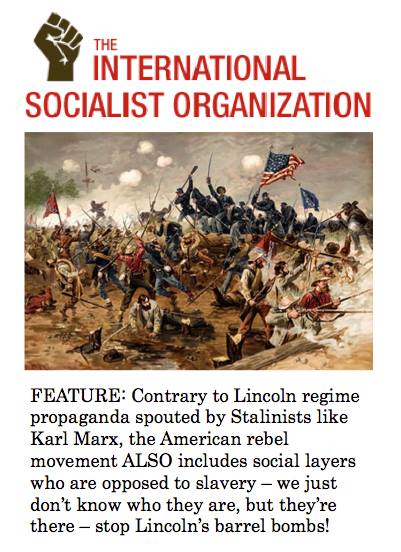
If the ISO existed in 1865.
Of course, Washington lends a hand, helpfully denominating its proxies in the most laudatory terms. Islamist insurgents in Syria, mainly Al Qaeda, were not too many years ago celebrated as a pro-democracy movement, and when that deception proved no longer tenable, as moderates.
Now that the so-called moderates have been exposed as the very opposite, many Leftists cling to the hope that amid the Islamist opponents of Syria’s secular, Arab socialist, government, can be found votaries of the enlightenment values Damascus already embraces. Surely somewhere there exist armed anti-government secular Leftists to rally behind; for it appears that the goal is to find a reason, any reason, no matter how tenuous, to create a nimbus of moral excellence around some group that opposes with arms the government in Damascus; some group that can be made to appear to be non-sectarian, anti-imperialist, socialist, committed to the rights of women and minorities, and pro-Palestinian; in other words, a group just like Syria’s Ba’ath Arab Socialists, except not them.
Stepping forward to fulfill that hope is the PKK, an anarchist guerrilla group demonized as a terrorist organization when operating in Turkey against a US ally, but which goes by the name of the YPG in Syria, where it is the principal component of the lionized “Syrian Democratic Force.” So appealing is the YPG to many Western Leftists that some have gone so far as to volunteer to fight in its units. But is the YPG the great hope it’s believed it to be?
Kurds in Syria
It’s difficult to determine with precision how many Kurds are in Syria, but it’s clear that the ethnic group comprises only a small percentage of the Syrian population (less than 10 percent according to the CIA, and 8.5 percent according to an estimate cited by Nikolaos Van Dam in his book The Struggle for Power in Syria. [1]
Estimates of the proportion of the total Kurd population living in Syria vary from two to seven percent based on population figures presented in the CIA World Factbook. Half of the Kurd community lives in Turkey, 28 percent in Iran and 20 percent in Iraq. A declassified 1972 US State Department report estimated that only between four and five percent of the world’s Kurds lived in Syria [2].
While the estimates are rough, it’s clear that Kurds make up a fairly small proportion of the Syrian population and that the number of the group’s members living in Syria as a proportion of the Kurd community as a whole is very small.

The PKK
Kurdish fighters in Syria operate under the name of the YPG, which is “tied to the Kurdistan Workers’ Party, or PKK, a radical guerrilla movement combining [anarchist ideas] with Kurdish nationalism. PKK guerrillas [have] fought the Turkish state from 1978” and the PKK is “classified as a terrorist organization by the European Union, Turkey and the U.S.” [3]
Cemil Bayik is the top field commander of both the PKK in Turkey and of its Syrian incarnation, the YPG. Bayik “heads the PKK umbrella organization, the KCK, which unites PKK affiliates in different countries. All follow the same leader, Abdullah Ocalan, who has been in prison in Turkey” [4] since 1999, when he was apprehended by Turkish authorities with CIA assistance.
Ocalan “was once a devotee of Marxism-Leninism,” according to Carne Ross, who wrote a profile of the Kurdish nationalist leader in The Financial Times in 2015. But Ocalan “came to believe that, like capitalism, communism perforce relied upon coercion.” Imprisoned on an island in the Sea of Marmara, Ocalan discovered “the masterwork of a New York political thinker named Murray Bookchin.” Bookchin “believed that true democracy could only prosper when decision-making belonged to the local community and was not monopolized by distant and unaccountable elites.” Government was desirable, reasoned Bookchin, but decision-making needed to be decentralized and inclusive. While anarchist, Bookchin preferred to call his approach “communalism”. Ocalan adapted Bookchin’s ideas to Kurd nationalism, branding the new philosophy “democratic confederalism.” [5]
Labor Zionism has similar ideas about a political system based on decentralized communes, but is, at its core, a nationalist movement. Similarly, Ocalan’s views cannot be understood outside the framework of Kurdish nationalism. The PKK may embrace beautiful utopian goals of democratic confederalism but it is, at its heart, an organization dedicated to establishing Kurdish self-rule—and, as it turns out, not only on traditionally Kurdish territory, but on Arab territory, as well, making the parallel with Labour Zionism all the stronger. In both Syria and Iraq, Kurdish fighters have used the campaign against ISIS as an opportunity to extend Kurdistan into traditionally Arab territories in which Kurds have never been in the majority.
The PKK’s goal, writes The Wall Street Journal’s Sam Dagher, “is a confederation of self-rule Kurdish-led enclaves in Iran, Iraq, Syria and Turkey” [6] countries in which Kurdish populations have a presence, though, as we’ve seen, an insignificant one in Syria. In pursuit of this goal “as many as 5,000 Syrian Kurds have died fighting alongside the PKK since the mid-1980s, and nearly all of YPG’s top leaders and battle-hardened fighters are veterans of the decades-long struggle against Turkey.” [7]
In Syria, the PKK’s goal “is to establish a self-ruled region in northern Syria,” [8] an area with a significant Arab population.
When PKK fighters cross the border into Turkey, they become ‘terrorists’, according to the United States and European Union, but when they cross back into Syria they are miraculously transformed into ‘guerrilla” fighters waging a war for democracy as the principal component of the Syrian Democratic Force. The reality is, however, that whether on the Turkish or Syrian side of the border, the PKK uses the same methods, pursues the same goals, and relies largely on the same personnel. The YPG is the PKK.
An Opportunity
Washington has long wanted to oust the Arab nationalists in Syria, regarding them as “a focus of Arab nationalist struggle against an American regional presence and interests,” as Amos Ma’oz once put it. The Arab nationalists, particularly the Ba’ath Arab Socialist party, in power since 1963, represent too many things Washington deplores: socialism, Arab nationalism, anti-imperialism, and anti-Zionism. Washington denounced Hafez al-Assad, president of Syria from 1970 to 2000, as an Arab communist, and regards his son, Bashar, who succeeded him as president, as little different. Bashar, the State Department complains, hasn’t allowed the Syrian economy—based on Soviet models, its researchers say—to be integrated into the US-superintended global economy. Plus, Washington harbors grievances about Damascus’s support for Hezbollah and the Palestinian national liberation movement.
US planners decided to eliminate Asia’s Arab nationalists by invading their countries, first Iraq, in 2003, which, like Syria, was led by the Ba’ath Arab Socialists, and then Syria. However, the Pentagon soon discovered that its resources were strained by resistance to its occupations of Afghanistan and Iraq, and that an invasion of Syria was out of the question. As an alternative, Washington immediately initiated a campaign of economic warfare against Syria. That campaign, still in effect 14 years later, would eventually buckle the economy and prevent Damascus from providing education, health care and other essential services in some parts of the country. At the same time, Washington took steps to reignite the long-running holy war that Syria’s Islamists had waged on the secular state, dating to the 1960s and culminating in the bloody takeover of Hama, Syria’s fourth largest city, in 1982. Beginning in 2006, Washington worked with Syria’s Muslim Brotherhood to rekindle the Brother’s jihad against Assad’s secular government. The Brothers had two meetings at the White House, and met frequently with the State Department and National Security Council.
The outbreak of Islamist violence in March of 2011 was greeted by the PKK as an opportunity. As The Wall Street Journal’s Yaroslav Trofimov recounts, “The PKK, once an ally of… Damascus… had long been present among Kurdish communities in northern Syria. When the revolutionary tide reached Syria, the group’s Syrian affiliate quickly seized control of three Kurdish-majority regions along the Turkish frontier. PKK fighters and weapons streamed there from other parts of Kurdistan.”[9] The “Syrian Kurds,” wrote Trofimov’s colleagues, Joe Parkinson and Ayla Albayrak, viewed “the civil war as an opportunity to carve out a self-governing enclave—similar to the one established by their ethnic kin in neighboring Iraq.” [10] That enclave, long backed by the United States and Israel, was seen as a means of weakening the Iraqi state.
Damascus facilitated the PKK take-over by withdrawing its troops from Kurdish-dominated areas. The Middle East specialist Patrick Seale, who wrote that the Kurds had “seized the opportunity” of the chaos engendered by the Islamist uprising “to boost their own political agenda” [11] speculated that the Syrian government’s aims in pulling back from Kurd-majority areas was to redirect “troops for the defence of Damascus and Aleppo;” punish Turkey for its support of Islamist insurgents; and “to conciliate the Kurds, so as to dissuade them from joining the rebels.” [12] The PKK, as it turns out, didn’t join the Islamist insurgents, as Damascus hoped. But they did join a more significant part of the opposition to Arab nationalist Syria: the puppet master itself, the United States.
By 2014, the PKK had “declared three self-rule administrations, or cantons as they call them, in northern Syria: Afreen, in the northwest, near the city of Aleppo; Kobani; and Jazeera in the northeast, which encompasses Ras al-Ain and the city of Qamishli. Their goal [was] to connect all three.” [13] This would mean controlling the intervening spaces occupied by Arabs.
A Deal with Washington
At this point, the PKK decided that its political goals might best be served by striking a deal with Washington.
The State Department had “allowed for the possibility of a form of decentralization in which different groups” — the Kurds, the secular government, and the Islamist insurgents — each received some autonomy within Syria. [14] Notice the implicit assumption in this view that it is within Washington’s purview to grant autonomy within Syria, while the question of whether the country ought to decentralize, properly within the democratic ambit of Syrians themselves, is denied to the people who live and work in Syria. If we are to take seriously Ocalan’s Bookchin-inspired ideas about investing decision-making authority in the people, this anti-democratic abomination can hardly be tolerated.
All the same, the PKK was excited by the US idea of dividing “Syria into zones roughly corresponding to areas now held by the government, the Islamic State, Kurdish militias and other insurgents.” A “federal system” would be established, “not only for Kurdish-majority areas but for all of Syria.” A Kurd federal region would be created “on all the territory now held by the” PKK. The zone would expand to include territory the Kurds hoped “to capture in battle, not only from ISIS but also from other Arab insurgent groups.” [15]
The PKK “pressed U.S. officials” to act on the scheme, pledging to act as a ground force against ISIS in return. [16] The group said it was “eager to join the U.S.-led coalition against Islamic State in return for recognition and support from Washington and its allies for the Kurdish-dominated self-rule administrations they [had] established in northern Syria.” [17]
The only people pleased with this plan were the PKK, the Israelis and the Americans.
“US support for these Kurdish groups” not only in Syria, but in Iraq, where the Kurds were also exploiting the battle with ISIS to expand their rule into traditionally Arab areas, helped “to both divide Syria and divide Iraq,” wrote The Independent’s veteran Middle East correspondent Robert Fisk. [18] Division redounded to the benefit of the United States and Israel, both of which have an interest in pursuing a divide and rule policy to exercise a joint hegemony over the Arab world. Patrick Seale remarked that the US-Kurd plan for Kurdish rule in northern Syria had been met by “quiet jubilation in Israel, which has long had a semi-clandestine relationship with the Kurds, and welcomes any development which might weaken or dismember Syria.” [19]
For their part, the Turks objected, perceiving that Washington had agreed to give the PKK a state in all of northern Syria. [20] Meanwhile, Damascus opposed the plan, “seeing it as a step toward a permanent division of the nation.” [21]
Modern-day Syria, it should be recalled, is already the product of a division of Greater Syria at the hands of the British and French, who partitioned the country into Lebanon, Palestine, Transjordan, and what is now Syria. In March, 1920, the second Syrian General Congress proclaimed “Syria to be completely independent within her ‘natural’ boundaries, including Lebanon and Palestine.” Concurrently “an Arab delegation in Palestine confronted the British military governor with a resolution opposing Zionism and petitioning to become part of an independent Syria.” [22] France sent its Army of the Levant, mainly troops recruited from its Senegalese colony, to quash by force the Levantine Arabs’ efforts to establish self-rule.
Syria, already truncated by British and French imperial machinations after WWI “is too small for a federal state,” opines Syria’s president Bashar al-Assad. But Assad quickly adds that his personal view is irrelevant; a question as weighty as whether Syria ought to become a federal or confederal or unitary state, he says, is a matter for Syrians to decide in a constitutional referendum, [23] a refreshingly democratic view in contrast to the Western position that Washington should dictate how Syrians arrange their political (and economic) affairs.
Tip of the US Spear
For Washington, the PKK offers a benefit additional to the Kurdish guerrilla group’s utility in advancing the US goal of weakening Syria by fracturing it, namely, the PKK can be pressed into service as a surrogate for the US Army, obviating the necessity of deploying tens of thousands of US troops to Syria, and thereby allowing the White House and Pentagon to side-step a number of legal, budgetary and public relations quandaries. “The situation underscores a critical challenge the Pentagon faces,” wrote The Wall Street Journal’s Paul Sonne; namely, “backing local forces… instead of putting American troops at the tip of the spear.” [24]
Having pledged support for Kurdish rule of northern Syria in return for the PKK becoming the tip of the US spear, the United States is “providing “small arms, ammunition and machine guns, and possibly some nonlethal assistance, such as light trucks, to the Kurdish forces.” [25]
The arms are “parceled out” in a so called “drop, op, and assess” approach. The shipments are “dropped, an operation [is] performed, and the U.S. [assesses] the success of that mission before providing more arms.” Said a US official, “We will be supplying them only with enough arms and ammo to accomplish each interim objective.” [26]
PKK foot soldiers are backed by “more than 750 U.S. Marines,” Army Rangers, and US, French and German Special Forces, “using helicopters, artillery and airstrikes,” the Western marionette-masters in Syria illegally, in contravention of international law. [27]
Ethnic Cleansing
“Large numbers of Arab residents populate the regions Kurds designate as their own.” [28] The PKK has taken “over a large swath of territory across northern Syria—including predominantly Arab cities and towns.” [29] Raqqa, and surrounding parts of the Euphrates Valley on which the PKK has set its sights, are mainly populated by Arabs, observes The Independent’s veteran foreign correspondent Patrick Cockburn—and the Arabs are opposed to Kurdish occupation. [30]
Kurdish forces are not only “retaking” Christian and Muslim Arab towns in Syria, but are doing the same in the Nineveh province of Iraq—areas “which were never Kurdish in the first place. Kurds now regard Qamishleh, and Hassakeh province in Syria as part of ‘Kurdistan’, although they represent a minority in many of these areas.” [31]
The PKK now controls 20,000 square miles of Syrian territory [32], or roughly 17 percent of the country, while Kurds represent less than eight percent of the population.
In their efforts to create a Kurdish region inside Syria, the PKK “has been accused of abuses by Arab civilians across northern Syria, including arbitrary arrests and displacing Arab populations in the name of rolling back Islamic State.” [33] The PKK “has expelled Arabs and ethnic Turkmen from large parts of northern Syria,” reports The Wall Street Journal. [34] The Journal additionally notes that human rights “groups have accused [Syrian and Iraqi Kurdish fighters] of preventing Arabs from returning to liberated areas.” [35]
Neither Syrian nor Democratic
The PKK dominates the Syrian Democratic Forces, a misnomer conferred upon a group of mainly Kurdish fighters by its US patron. The group is not Syrian, since many of its members are non-Syrians who identify as Kurds and who flooded over the border from Turkey to take advantage of the chaos produced by the Islamist insurgency in Syria to carve out an area of Kurdish control. Nor is the group particularly democratic, since it seeks to impose Kurdish rule on Arab populations. Robert Fisk dismisses the “Syrian Democratic Forces” as a “facade-name for large numbers of Kurds and a few Arab fighters.” [36]
The PKK poses as a Syrian Democratic Force, and works with a token force of Syrian Arab fighters, to disguise the reality that the Arab populated areas it controls, and those it has yet to capture, fall under Kurd occupation.
A De Facto (and Illegal) No Fly Zone
In August, 2016, after “Syrian government bombers had been striking Kurdish positions near the city of Hasakah, where the U.S. [had] been backing Kurdish forces” the Pentagon scrambled “jets to protect them. The U.S. jets arrived just as the two Syrian government Su-24 bombers were departing.” This “prompted the U.S.-led coalition to begin patrolling the airspace over Hasakah, and led to another incident… in which two Syrian Su-24 bombers attempted to fly through the area but were met by coalition fighter jets.” [37]
The Pentagon “warned the Syrians to stay away. American F-22 fighter jets drove home the message by patrolling the area.” [38]
The New York Times observed that in using “airpower to safeguard areas of northern Syria where American advisers” direct PKK fighters that the United States had effectively established a no-fly zone over the area, but noted that “the Pentagon has steadfastly refused to” use the term. [39] Still, the reality is that the Pentagon has illegally established a de facto no-fly zone over northern Syria to protect PKK guerillas, the tip of the US spear, who are engaged in a campaign of creating a partition of Syria, including through ethnic cleansing of the Arab population, to the delight of Israel and in accordance with US designs to weaken Arab nationalism in Damascus.
An Astigmatic Analogy
Some find a parallel in the YPG’s alliance with the United States with Lenin accepting German aid to return from exile in Switzerland to Russia following the 1917 March Revolution. The analogy is inapt. Lenin was playing one imperialist power off against another. Syria is hardly an analogue of Imperial Russia, which, one hundred years ago, was locked in a struggle for markets, resources, and spheres of influence with contending empires. In contrast, Syria is and has always been a country partitioned, dominated, exploited and threatened by empires. It has been emancipated from colonialism, and is carrying on a struggle—now against the contrary efforts of the PKK—to resist its recolonization.
The PKK has struck a bargain with the United States to achieve its goal of establishing a Kurdish national state, but at the expense of Syria’s efforts to safeguard its independence from a decades-long US effort to deny it. The partition of Syria along ethno-sectarian lines, desired by the PKK, Washington and Tel Aviv alike, serves both US and Israeli goals of weakening a focus of opposition to the Zionist project and US domination of West Asia.
A more fitting analogy, equates the PKK in Syria to Labor Zionism, the dominant Zionist force in occupied Palestine until the late 1970s. Like Ocalan, early Zionism emphasized decentralized communes. The kibbutzim were utopian communities, whose roots lay in socialism. Like the PKK’s Syrian incarnation, Labor Zionism relied on sponsorship by imperialist powers, securing their patronage by offering to act as the tips of the imperialists’ spears in the Arab world. Zionists employed armed conquest of Arab territory, along with ethnic cleansing and denial of repatriation, to establish an ethnic state, anticipating the PKK’s extension by armed force of the domain of a Kurdish state into Arab majority territory in Syria, as well as Kurd fighters doing the same in Iraq. Anarchists and other leftists may have been inspired by Jewish collective agricultural communities in Palestine, but that hardly made the Zionist project progressive or emancipatory, since its progressive and emancipatory elements were negated by its regressive oppression and dispossession of the indigenous Arab population, and its collusion with Western imperialism against the Arab world.
Conclusion
Representing an ethnic community that comprises less than 10 percent of the Syrian population, the PKK, a Kurdish anarchist guerrilla group which operates in both Turkey and Syria, is using the United States, its Air Force, Marine Corps, Army Rangers and Special Forces troops, as a force multiplier in an effort to impose a partition of Syria in which the numerically insignificant Kurd population controls a significant part of Syria’s territory, including areas inhabited by Arabs in the majority and in which Kurds have never been in the majority. To accomplish its aims, the PKK has not only struck a deal with a despotic regime in Washington which seeks to recolonize the Arab world, but is relying on ethnic cleansing and denial of repatriation of Arabs from regions from which they’ve fled or have been driven to establish Kurdish control of northern Syria, tactics which parallel those used by Zionist forces in 1948 to create a Jewish state in Arab-majority Palestine. Washington and Israel (the latter having long maintained a semi-clandestine relationship with the Kurds) value a confederal system for Syria as a means of weakening Arab nationalist influence in Arab Asia, undermining a pole of opposition to Zionism, colonialism, and the international dictatorship of the United States. Forces which resist dictatorship, including the most odious one of all, that of the United States over much of the world, are the real champions of democracy, a category to which the PKK, as evidenced by its actions in Syria, does not belong.
1. Nikolaos Van Dam, The Struggle for Power in Syria: Politics and Society under Assad and the Ba’ath Party, IB Taurus, 2011, p.1.
2. “The Kurds of Iraq: Renewed Insurgency?”, US Department of State, May 31, 1972, https://2001-2009.state.gove/documents/organization/70896.pdf
3. Sam Dagher, “Kurds fight Islamic State to claim a piece of Syria,” The Wall Street Journal, November 12, 2014.
4. Patrick Cockburn, “War against ISIS: PKK commander tasked with the defence of Syrian Kurds claims ‘we will save Kobani’”, The Independent, November 11, 2014.
5. Carne Ross, “Power to the people: A Syrian experiment in democracy,” Financial Times, October 23, 2015.
6. Dagher, November 12, 2014.
7. Dagher, November 12, 2014.
8. Dagher, November 12, 2014.
9. Yaroslav Trofimov, “The State of the Kurds,” The Wall Street Journal, June 19, 2015.
10. Joe Parkinson and Ayla Albayrak, “Syrian Kurds grow more assertive”, The Wall Street Journal, November 15, 2013.
11. Patrick Seale, “Al Assad uses Kurds to fan regional tensions”, Gulf News, August 2, 2012.
12. Seale, August 2, 2012.
13. Dagher, November 12, 2014.
14. David E. Sanger, “Legacy of a secret pact haunts efforts to end war in Syria,” the New York Times, May 16, 2016.
15. Anne Barnard, “Syrian Kurds hope to establish a federal region in country’s north,” The New York Times, March 16, 2016.
16. Dagher, November 12, 2014.
17. Dagher, November 12, 2014.
18. Robert Fisk, “This is the aim of Donald Trump’s visit to Saudi Arabia – and it isn’t good for Shia communities,” The Independent, May 18, 2017.
19. Seale, August 2, 2012.
20. Yaroslav Trofimov, “U.S. is caught between ally Turkey and Kurdish partner in Syria,” The Wall Street Journal, May 4, 2017.
21. Anne Barnard, “Syrian Kurds hope to establish a federal region in country’s north,” The New York Times, March 16, 2016.
22. David Fromkin, A Peace to End All Peace: The Fall of the Ottoman Empire and the Creation of the Modern Middle East, Henry Holt & Company, 2009, p. 437.
23. “President al-Assad to RIA Novosti and Sputnik: Syria is not prepared for federalism,” SANA, March 30, 2016.
24. Paul Sonne, “U.S. seeks Sunni forces to take militant hub,” The Wall Street Journal, April 29, 2016.
25. Dion Nissenbaum, Gordon Lubold and Julian E. Barnes, “Trump set to arm Kurds in ISIS fight, angering Turkey,” The Wall Street Journal, May 9, 2017.
26. Nissenbaum et al, May 9, 2017.
27. Dion Nissenbaum and Maria Abi-Habib, “Syria’s newest flashpoint is bringing US and Iran face to face,” The Wall Street Journal, June 15, 2017; “Syria condemns presence of French and German special forces in Ain al-Arab and Manbij as overt unjustified aggression on Syria’s sovereignty and independence,” SANA, June 15, 2016; Michael R. Gordon. “U.S. is sending 400 more troops to Syria.” The New York Times. March 9, 2017.
28. Matt Bradley, Ayla Albayrak, and Dana Ballout, “Kurds declare ‘federal region’ in Syria, says official,” The Wall Street Journal, March 17, 2016.
29. Maria Abi-Habib and Raja Abdulrahim, “Kurd-led force homes in on ISIS bastion with assent of U.S. and Syria alike,” The Wall Street Journal, May 11, 2017.
30. Patrick Cockburn, “Battle for Raqqa: Fighters begin offensive to push Isis out of Old City,” The Independent, July 7, 2017.
31. Robert Fisk, “This is the aim of Donald Trump’s visit to Saudi Arabia – and it isn’t good for Shia communities,” The Independent, May 18, 2017.
32. Dion Nissenbaum and Maria Abi-Habib, “U.S. split over plan to take Raqqa from Islamic state,” The Wall Street Journal. March 9, 2017.
33. Raja Abdulrahim, Maria Abi_Habin and Dion J. Nissenbaum, “U.S.-backed forces in Syria launch offensive to seize ISIS stronghold Raqqa,” The Wall Street Journal, November 6, 2016.
34. Margherita Stancati and Alia A. Nabhan, “During Mosul offensive, Kurdish fighters clear Arab village, demolish homes,” The Wall Street Journal, November 14, 2016.
35. Matt Bradley, Ayla Albayrak, and Dana Ballout, “Kurds declare ‘federal region’ in Syria, says official,” The Wall Street Journal, March 17, 2016.
36. Robert Fisk, “The US seems keener to strike at Syria’s Assad than it does to destroy ISIS,” The Independent, June 20, 2017.
37. Paul Sonne and Raja Abdulrahim, “Pentagon warns Assad regime to avoid action near U.S. and allied forces,” The Wall Street Journal, August 19, 2016.
38. Michael R. Gordon and Neil MacFarquhar, “U.S. election cycle offers Kremlin a window of opportunity in Syria,” The New York Times, October 4, 2016.
39. Michael R. Gordon and Neil MacFarquhar, “U.S. election cycle offers Kremlin a window of opportunity in Syria,” The New York Times, October 4, 2016.
Empire-Speak
By Jacob G. Hornberger – Future of Freedom Foundation – June 28, 2017
One of the most fascinating aspects of living under imperialism is the lexicon that this philosophy brings into existence. It’s called Empire-Speak. Given the complexity of this specialized language, it usually takes people years of education and training to master it.
One of the finest examples of Empire-Speak appeared last week in a Washington Post op-ed by Post columnist Charles Krauthammer, who often appears as a commentator on Fox News. Krauthammer penned an op-ed entitled “The Great Muslim Civil War – and Us” that is an absolute masterpiece of Empire-Speak.
Comparing what is happening in the Middle East to Europe 1945, Krauthammer describes the “great Muslim civil war” that has enveloped the Middle East, which he writes, is “approaching its post-Islamic phase.” ISIS is about to be defeated on the battlefield, he writes, and the parties are now maneuvering, as they did after World War II, to “determine postwar boundaries and spheres of influence.” Once ISIS loses its hold on Mosul in Iraq and Raqqa in Syria, “the caliphate dies.”
So does that mean that the Pentagon and the CIA can finally declare victory in the Middle East and come home after more than 25 years of warfare in the Middle East? Does that mean that there can now be a ticker-tape parade in New York City honoring the victorious American forces?
Are you kidding? As Krauthammer points out, all that has gone before is just “the end of the beginning.” Things are just getting started. After all, as Krauthammer points out, “At stake is consolidation of the Shite Crescent.”
Who would have known? I’ll bet that 99 percent of Americans haven’t even heard of the “Shite Crescent” or that it’s being consolidated. Thank goodness we have Krauthammer and other people well-versed in Empire-Speak to tell us about it.
According to Krauthammer, the world is witnessing a gigantic battle between Shiite Muslims and Sunni Muslims.
Leading the Shiite side is Iran. Combined with Russia, Syria, Iraq, and Hezbollah (“which Krauthammer labels the “tip of the Iranian spear”), this is the so-called “Shiite Crescent.” According to Krauthammer, it poses a “nightmare for the entire Sunni Middle East.”
On the opposing side of this gigantic battle are the Sunnis, led by Saudi Arabia, Egypt, Jordan, and the United States. Needless to say, this is considered the good side of the war.
As I was reading through his op-ed, I kept hoping that Krauthammer would not omit one of my favorite terms in Empire-Speak: “the hegemon.” Isn’t that a great term? Whenever I hear an imperialist refer to the danger of the rise of a “regional hegemon,” I think of Transformers or Godzilla.
Krauthammer didn’t disappoint. He states that Syria is “the central theater of a Shiite-Sunni war for regional hegemony.” Moreover, Russia — yes, that Russia! — Krauthammer labeled “the outside hegemon.” OMG! Scary, right? Maybe even scarier than rise of communism and the Soviet Union, the two official enemies of the Cold War era.
What’s really going on here?
Krauthammer is simply preparing the American people for what lies ahead — more interventionism, more imperialism, more militarism, and more death and destruction at the hands of the US Empire. And, of course, more official enemies as old official enemies are defeated or disappeared.
You see, I bet you thought that once ISIS was defeated, the troops could finally be brought home and revel in their glorious victory. Sort of like “Mission Accomplished” after the US invasion of Iraq.
Not so. Undoubtedly expressing the mindset of the Pentagon, the CIA, and the rest of the US national-security establishment, Krauthammer is telling us that unfortunately we cannot rest. We must continue to soldier on, presumably until the Shiite Crescent is defeated and the world is no longer facing the possibility of a rise of a “regional hegemon.” And don’t even think for a moment that once that is accomplished, the war will finally be over. It will simply spell the beginning of the end of the beginning.
As I stated soon after the 9/11 attacks, the “war on terrorism” is going to be just like the war on drugs, where every drug lord they kill or capture is soon replaced by dozens more.
The real problem is that the US Empire keeps running out of official enemies. If we go back to the maneuvering after World War II to which Krauthammer refers, we see US officials converting their World War II partner and ally, the Soviet Union, to a new official enemy, one that necessitated, they said, the conversion of the federal government to a national-security state.
As we all know, for the next 45 years the Cold War was a bonanza for the Pentagon, the CIA, the NSA, and what President Eisenhower called the “military-industrial complex.” Ever-increasing budgets and powers. The best part, for them, was that it was never supposed to end. The Cold War was supposed to go on forever because communism and the Soviet Union were supposed to go on forever.
But life can be cruel. In 1989, the Soviet Union suddenly and unexpectedly dismantled itself, declared socialism a bankrupt philosophy, and unilaterally declared an end to the Cold War, thereby depriving the US Empire of its big official Cold War enemy.
No problem. A new official enemy was soon announced: Saddam Hussein, dictator of Iraq and former partner of the US Empire (just like Stalin had been). Throughout the 1990s, Americans obsessed over Saddam Hussein and how he was coming to get us and the rest of the world with his WMDs.
To oust Saddam from power, the Pentagon and the CIA began wreaking death and destruction in Iraq, including 11 years of sanctions that killed hundreds of thousands of Iraqi children.
That led to terrorist blowback and a new official enemy: “terrorism,” which ultimately enabled US officials to invade Iraq and oust their official enemy, Saddam Hussein, from power, and install a new regime in Iraq, a Shiite Muslim regime.
Over time, the “terrorists” have morphed into “the Muslims,” which are now viewed as the new official enemy.
Which brings us back to Krauthammer’s op-ed. If the Muslims are the new official enemy, how is that the United States is on the side of the Sunnis in what Krauthammer describes as a giant Muslim civil war that is now supposedly taking place? Aren’t Sunnis Muslims too?
Hmmm. So does this mean that we are no longer supposed to focus on Muslims in general or even “radical Muslims” or “extreme Muslims” but instead on “Shiite Muslims” as the new official enemy?
Oh, another thing Krauthammer doesn’t make clear: If we are now battling the Shiite Muslims, why did the US government use its invasion and occupation of Iraq to install a Shiite regime there? And why is it that US troops have been killing and dying for some 14 years to preserve the existence of that Shiite regime? Why are they still doing so? Were Americans wrong to thank the troops for their service in Iraq by bringing into existence a regime that is now part of the “Shiite Crescent,” which, according to Krauthammer, is now facing us on the field of battle?
Boy, imperialism sure is hard to learn and comprehend. Just like Empire-Speak.
Featured Video

Macgregor: We Haven’t Seen the Worst of the Iran War Yet
or go to
Aletho News Archives – Video-Images
From the Archives
15 Saudi ‘hijackers’ were CIA agents working for US: Scholar
Press TV – April 13, 2016
Fifteen of the 9/11 “hijackers” from Saudi Arabia were CIA agents working for the United States government, which was seeking to destroy the Middle East for Israel and to double the American military budget, says Dr. Kevin Barrett, an American academic who has been studying the events of 9/11 since late 2003…. continue
Blog Roll
 Aletho News
- Iran’s Plan to Shut Down AI in the Persian Gulf
- Israel seeks ‘compensation’ from Washington over Saudi F-35 sale
- Saudi crown prince seeks dialogue with Ansarullah after Yemeni blows: Report
- Damascus rejects Saudi request for Syrian fighters to counter Yemen: Report
- South Korea says will not send troops to join terrorist US war on Iran
- Russia Just Struck the Eyes of NATO’s War Machine in Ukraine
- Russia summons UK charge d’affaires over Kiev drone support
- NATO member warns bloc seeking pretext for war with Russia
- Macgregor: We Haven’t Seen the Worst of the Iran War Yet
- ‘We are not like everyone else’ laws that bind other nations do not apply to Israel, says Likud lawmaker
- If Americans Knew
- Debunking The Claim That Macklemore Has A “History Of Antisemitism”
- CPJ demands release of arrested Palestinian-US journalist near Bethlehem
- Robert Kraft: The Billionaire Friend of Netanyahu Pulling The Strings Behind the Macklemore/Ed Sheeran Blow Up
- Columbia Administered Fund Gives Big Money to Pro-Israel Groups
- Deportation Case of Palestinian Activist Salah Sarsour Tests First Amendment
- ‘We Will Not Forget’: Palestinians Mark 44 Years since Sabra and Shatila
- Why do we let Zionists decide what we can and can’t say?
- US welcomes Israeli, Iranian delegations to UN, but not Palestinians – Daily Update
- Biden’s Genocide Accomplices Targeted by New Accountability Campaign
- AIPAC’s Network Has Already Spent $67.2 Million to Shape the Midterm Elections
- No Tricks Zone
- New Study: ‘Global Drought Shows No Detectable Recent Acceleration Under Climate Warming’
- Economic Masterminds: German Socialists Suggest Taxing Productivity Gains Stemming From Using AI
- The South China Sea Has Not Been Cooperating With The Climate Change Narrative
- Energy Crisis: Germany Enters Heating Season With Historically Low Gas Reserve Fill Levels
- New Study: The Antarctic Ice Sheet Gained Mass From 2020-2024 Due To Staggering Snow And Ice Accumulation
- Study: Ocean Heating Rates From Thousands Of Years Ago ‘Dwarf’ Modern Ocean Heating Rates
- Climate Extremists Target, Attack Large-Scale Power Grid Infrastructure In Germany!
- New Study: Antarctic Ice Melt Has Contributed Less Than 1 Centimeter To Sea Level Rise In The Last 30 Years
- Fear Of Debate: Alarmist German Climate Scientist Calls On Mainstream Media To Discredit Skeptic Voices
- End-Of-August Arctic Sea Ice Extent Hasn’t Fallen In 20 Years, Official Data Show!
 Aletho News