Kurdish PKK and YPG’s Hidden Notorious Crimes
By Sarah Abed | American Herald Tribune | September 25, 2107
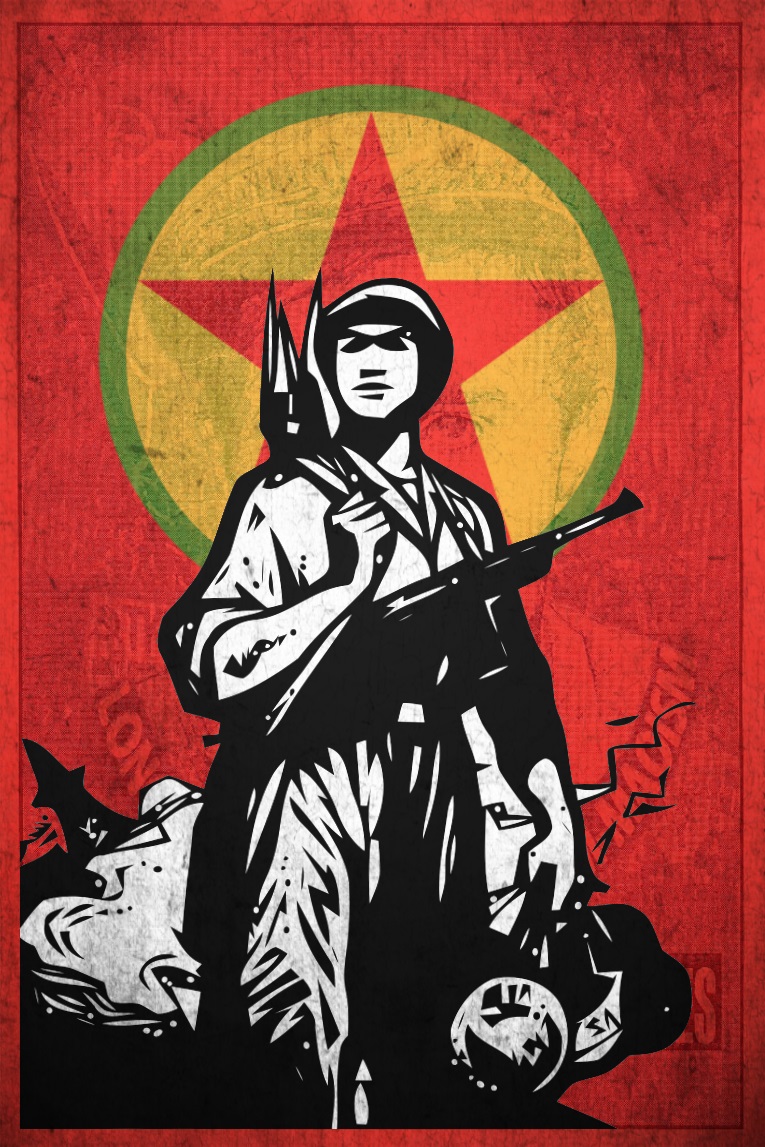
The Kurdistan Workers’ Party, or PKK, and its Syrian spinoff, the YPG, are cult-like radical movements that intertwine Marxism, feminism, Leninism and Kurdish nationalism into a hodge-podge of ideology, drawing members through the extensive use of propaganda that appeals to these modes of thought.
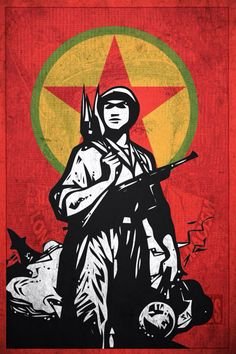
*(PKK Propaganda. Image Credit)
Abdullah Ocalan, the leader of the PKK, took inspiration from American anarchist Murray Bookchin in creating his philosophy, which he calls “Democratic Confederalism.”
The PKK spin-off group YPG represents most of the Syrian Democratic Forces (SDF) in Syria. With Western political support, they have gained popularity and garnered an impressive amount of support from anarchists and military veterans in the West, some of whom have left the comfort of their home countries to fight with the group.
One of their most productive marketing tools has been to use young, attractive female fighters as the face of the guerrillas. During their fight against Daesh, the PKK has saturated the media with images of these young female “freedom fighters,” using them as a marketing tool to take their cause from obscurity to fame. These female fighters in the YPJ are fighting alongside their male counterparts under the direction of the U.S. in the SDF.
Stephen Gowans writes more about this topic in his superb article titled: The Myth of the Kurdish YPG’s Moral Excellence. Here is an excerpt:
In Syria, the PKK’s goal “is to establish a self-ruled region in northern Syria,” [8] an area with a significant Arab population.
When PKK fighters cross the border into Turkey, they become ‘terrorists’, according to the United States and European Union, but when they cross back into Syria they are miraculously transformed into ‘guerrilla” fighters waging a war for democracy as the principal component of the Syrian Democratic Force. The reality is, however, that whether on the Turkish or Syrian side of the border, the PKK uses the same methods, pursues the same goals, and relies largely on the same personnel. The YPG is the PKK.
Child Soldiers forced recruitment, kidnapping, and murder by the PKK and YPG
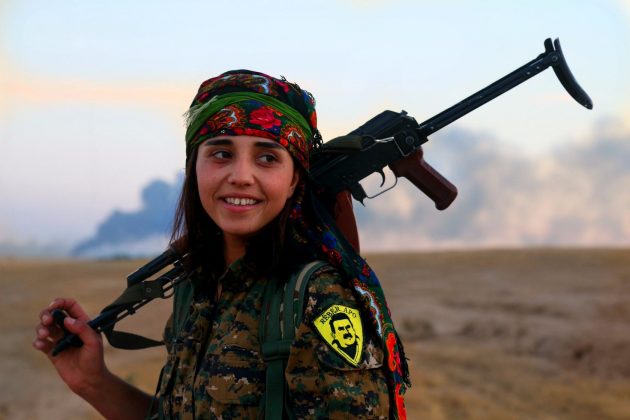
*(Young YPJ Kurdish fighter. Image Credit)
Within the past few years Kurds have gone from almost total obscurity to front page news. What doesn’t get reported however is how these terrorist groups under the guise of being a revolutionary movement for independence have carried out numerous atrocities including kidnappings and murder – not to mention their involvement in trafficking narcotics.
Kurdish families are demanding that the PKK stop kidnapping minors. It started on April 23, the day Turkey marked its 91st National Sovereignty and Children’s Day. While children celebrated the holiday in western Turkey, the Kurdistan Workers Party (PKK) kidnapped 25 students between the ages of 14 and 16 on the east side of the country, in the Lice district of Diyarbakir.
Although the PKK has kidnapped more than 330 minors in the last six months, the Bockum family was the first in the region who put up a tent near their home to start a sit-in protest, challenging the PKK and demanding that it return their son. Sinan was returned to the family on May 4. Al-Monitor reported this incident from the beginning in great detail.
As Bebyin Somuk reported in her article, the PKK and PYD still kidnap children in Turkey and Syria. She states: “As I previously wrote for Kebab and Camel, the PKK commits war crimes by recruiting children as soldiers. Some of the PKK militants that surrendered yesterday were also the PKK’s child soldiers. The photos clearly show that these children are not more than sixteen years old. The Turkish army released video of the 25 PKK militants surrendering in Nusaybin.”
Thousands of children are serving as soldiers in armed conflicts around the world. In 1989, the United Nations Convention on the Rights of the Child, Article 38, proclaimed: “State parties shall take all feasible measures to ensure that persons who have not attained the age of 15 years do not take a direct part in hostilities.” Since then, UNICEF and the UN Security Council took steps to end the recruitment of children in conflict and war.
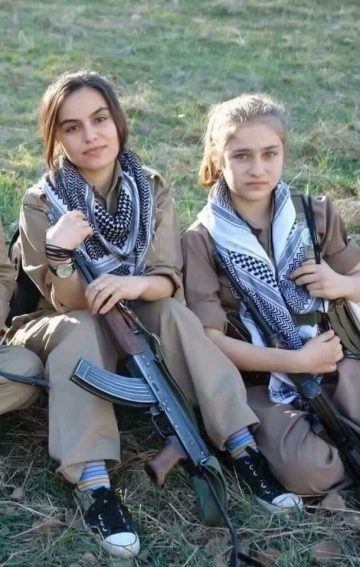
(Young Kurdish fighters. Image Credit)
The PKK, recognized as a terrorist organization by the U.S. , E.U. , and Turkey
The PKK often recruits children. In the past, the PKK even recruited children as young as 7-12 years. In 2010, a Danish national daily newspaper, Berlingske Tidende, published a story about the PKK’s child soldiers. According to that report, there were around 3,000 young militants in the PKK’s training camps. The youngest child at the PKK training camps was eight or nine years old. They were taught Abdullah Öcalan’s life story (the jailed leader of the PKK) and how to use weapons and explosives.
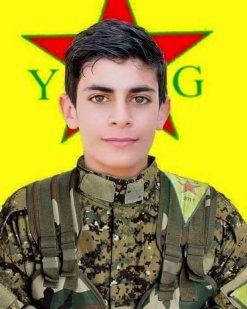
*(Martyrdom notice for a PYD/YPG child soldier Image Credit)
Despite the Deed of Commitment, the PKK continues to recruit minors.
After that story was published, the PKK encountered strong reactions from human rights organizations worldwide. The same year, UNICEF released a statement voicing its “profound concern” about the PKK’s recruitment of child soldiers. In October 2013, the PKK, represented by HPG (the PKK’s military wing) commander Ms. Delal Amed, signed the Deed of Commitment protecting children in armed conflict. This document, drawn up by the Geneva Call NGO, is dedicated to promoting respect by armed non-state actors for international humanitarian norms in armed conflict. Despite this commitment, the PKK continued to recruit minors.
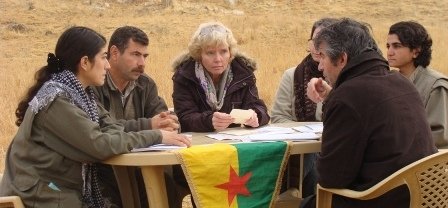
The People’s Defence Forces is the military wing of the Kurdistan Workers’ Party. Image Credit
The PKK abducted children while the peace process was continuing
On March 21, 2013, PKK leader Abdullah Öcalan called for a cease-fire that included the PKK’s withdrawal from Turkish soil and an eventual end to armed struggle. The PKK announced that they would obey, stating that 2013 would be the year of conclusion, either through war or through peace. But that did not happen. Instead, the PKK abducted 2,052 children aged between 12 and 17 while the peace process was still going on, according to Turkish security records. The PKK took these children and trained them. After that, because those childrenwere not involved in any criminal activities, when they were captured by, or surrendered to, Turkish security forces, Turkish courts did not prosecute them, so most of them were released. It was the Turkish state’s goodwill gesture for the sake of the peace process.
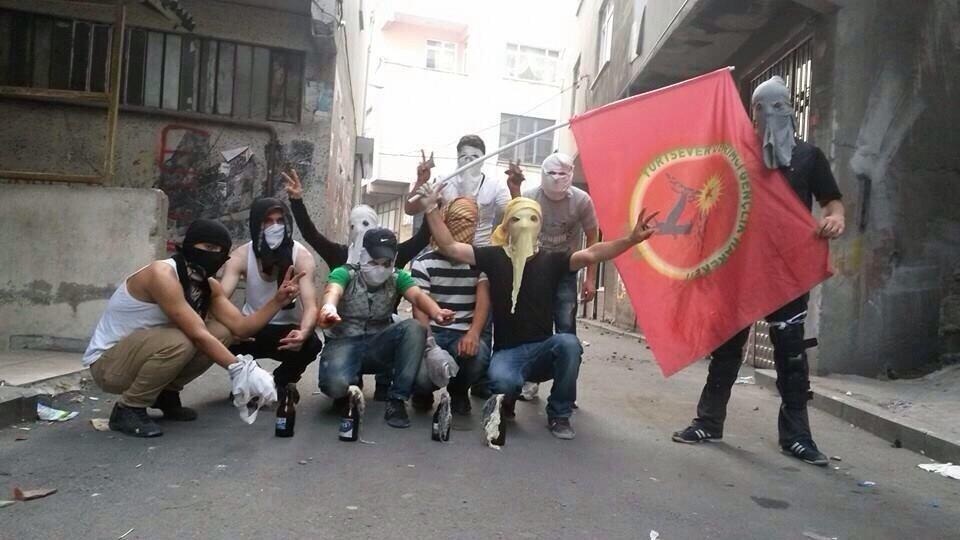
However, once released, most of these children joined the YDG-H, the PKK’s new youth wing, and began to perpetrate illegal and/or violent events in Kurdish populated cities and towns. The YDG-H began to emerge in early 2013 and spread rapidly after the peace process’ beginning. Then, after the 7 June 2015 election, the YDG-H began to attack security forces and civilians in cities and towns such as Cizre, or in Diyarbakır’s Sur neighborhood, with heavy weapons, and to dig trenches and erect barricades in side streets.
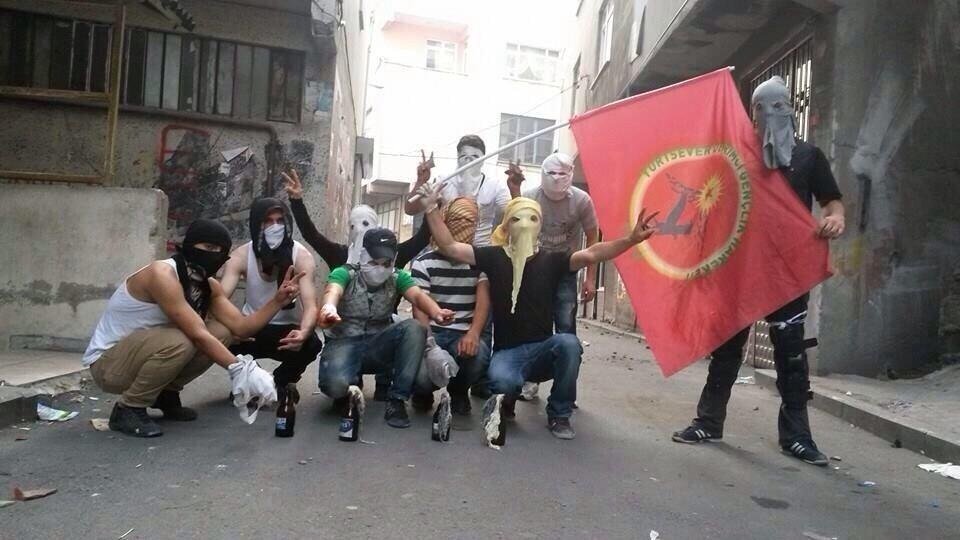
*(YDG H. Image Credit)
A growing number of Kurdish families in Turkey are calling for the return of their children, who they say have been abducted by the Kurdish rebel group, the PKK. The PKK denies the claim, but with the Turkish prime minister stepping in, the issue is putting pressure on an already stalled peace process. Dorian Jones reports from Diyarbakir, the main city in Turkey’s predominantly Kurdish southeast.
The HDP assaulted the mothers demanding their children
In May 2014, mothers from across Turkey whose children had been recruited by the PKK held a sit-in protest in front of the Diyarbakır Metropolitan Municipality building and called on the PKK to release their children. Their children were mostly 14-15 years old at that time. Some families claimed that their sons and daughters were kidnapped by the PKK against their will. The Diyarbakır Municipality, administered by the HDP, used water cannon to disperse the mothers. HDP Co-Chair Selahattin Demirtaş even claimed that these mothers were hired by the Turkish National Intelligence Organization. Despite the resistance coming from the PKK and the HDP, the families continued their protest, and some families’ children were released by the PKK.
The PKK established a child-wing called YPS-Zarok
Another photo from the Yüksekova district shows the child-wing recently established by the PKK called YPS-Zarok (Child) with the headline “YPS-Zarok announcement from the children of the resistance.” The PYD, the PKK’s Syria branch, is also known for its recruitment of child soldiers.
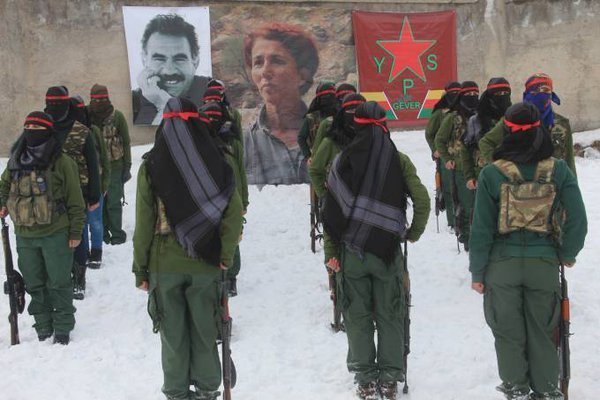
*(YPS. Image Credit)
U.S.’s “reliable partner” the YPG also recruits children
A Human Rights Watch report, “Syria: Kurdish Forces Violating Child Soldier Ban” provides a list of 59 children, ten of them under the age of fifteen, recruited for YPG or YPJ forces since July 2014. International humanitarian law and the Rome Statute that set up the International Criminal Court classify the recruitment of under-15-year-olds as a war crime. While the Obama Administration does not recognize the YPG as a terrorist organization, and supports them as a local partner in the region, the YPG continues to recruit child soldiers.
It’s clear that the U.S. sees the PYD as a “reliable partner” in the fight against ISIS. However, the Obama Administration should notice the fact that the PYD is not an independent organization. It is linked to the PKK and recruiting minors under 18. The decision to found the PYD was made in 2002 during a PKK congress in Qandil. The PYD also has a bylaw stating that “Abdullah Öcalan is the leader of the PYD.”US Special Forces Delta Force, training PYD (Image Credit)
In summary, the YPG is the Syrian wing of the PKK, and recruits children just like the PKK. Regardless of what acronym they go by, whether it be the YPG, PKK, PYD, YPJ or any of the other alphabet soup combinations, they commit crimes against civilians in both Syria and Turkey all with the arms, funds, and training received from the United States.
Female PKK Killing Turkish Soldiers
SouthFront reported on female PKK fighters who have killed Turkish soldiers. “The women fighters command of the Kurdistan Worker Party (PKK) have released a statement, claiming PKK female fighters killed 160 Turkish military servicemen in 2016. According to the statement, the women fighters command of the PKK carried out 115 operations against Turkish government forces in 2016. The group also vowed to ‘proceed the struggle during the new year for a life of freedom and until victory is achieved.’”
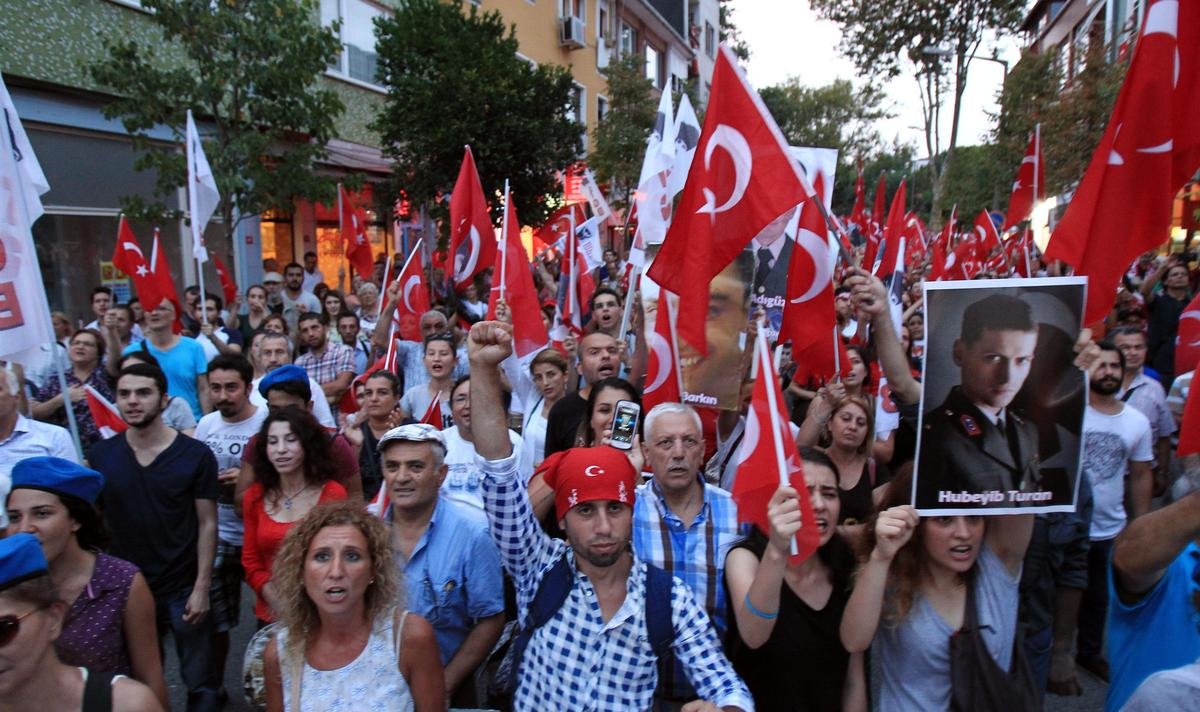
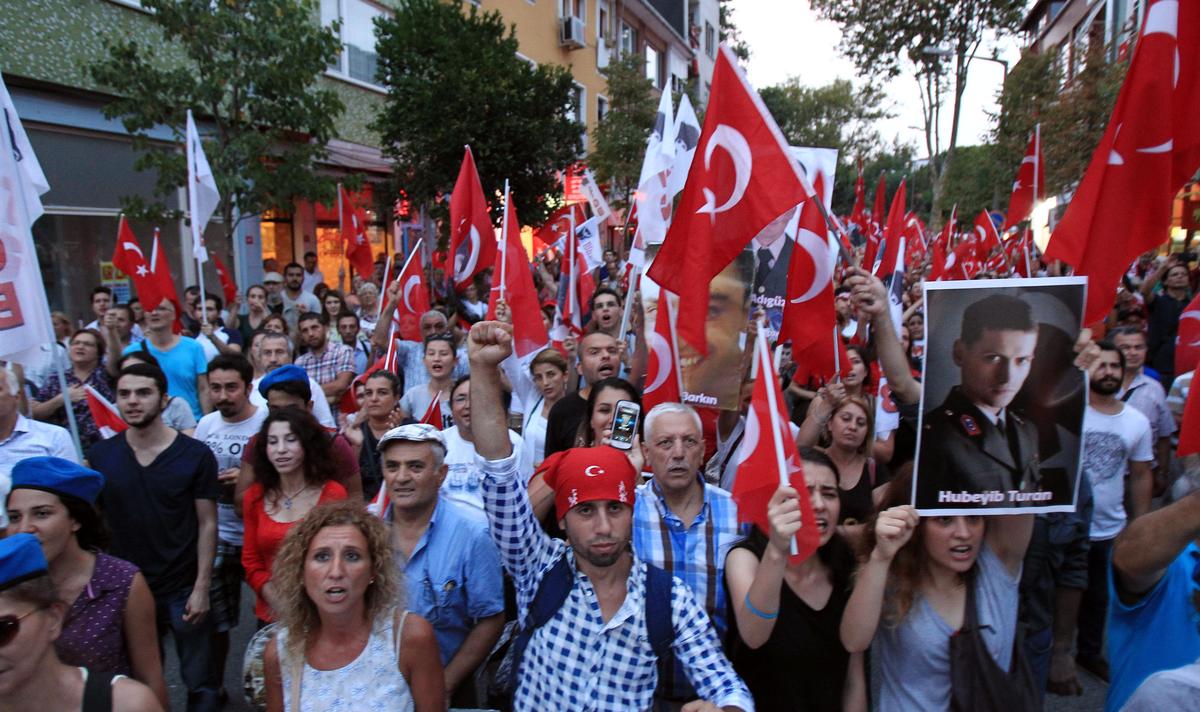
*(Hundreds of people protest against the PKK in Istanbul on 7 September after the PKK killed 16 soldiers and wounded six others in Daglica, Turkey. Image Credit)
The PKK is also killing Kurds under the guise of protecting their rights
“Senior PKK leader Cemil Bayık, in an interview with the Fırat News Agency (ANF) on Aug. 8, said, ‘Our war will not be confined to the mountains like it was before. It will be spread everywhere without making a distinction between mountains, plains or cities. It will spread to the metropolises.’ Terrorist Bayık’s statement signaled that the PKK would take increasing aim against civilians, targeting civilian areas more than ever. And it is happening.
Since July 15, the day when the Gülenist terror cult, FETÖ, launched its failed military coup attempt to topple the democratically-elected government, the PKK perpetrated dozens of terrorist attacks, killing 21 civilians and injuring 319 others – most of them Kurdish citizens.”
According to The Washington Institute:
On November 18, FBI Director Robert Mueller met with senior Turkish officials to address U.S.-Turkish efforts targeting the Kurdistan Workers Party (PKK), also known as Kongra-Gel. A press release from the U.S. embassy in Ankara following the meeting stressed that U.S. officials ‘strongly support Turkey’s efforts against the PKK terrorist organization’ and highlighted the two countries’ long history of working together in the fight against terrorism and transnational organized crime.
The PKK: Terrorist Organization and Foreign Narcotics Trafficker
These discussions are timely. Despite Ankara’s recent bid to alleviate the Kurdish issue — a bid referred to as the ‘democratic opening’ — the PKK is one of a growing number of terrorist organizations with significant stakes in the international drug trade.
In October, the U.S. Treasury Department added three PKK/Kongra-Gel senior leaders to its list of foreign narcotics traffickers. The PKK, along with the Revolutionary Armed Forces of Colombia (FARC), is one of only a few organizations worldwide designated by the U.S. government as both a terrorist organization and a significant foreign narcotics trafficker.” Drug smuggling is reported to be the main financial source of PKK terrorism, according to the organization International Strategic Research, whose detailed report can be seen here.
Western Veterans Blindly Supporting Kurdish Independence
Their exaggerated triumphs against Daesh have helped them evolve from a radical militia to an alleged regional power player. Have they been successful in fighting against Daesh in Syria? Yes – but while the Syrian Arab Army has been more effective, it does not receive a fraction of the praise or recognition that the PKK does.
Pato Rincon, a U.S. military veteran, recently wrote about his experience training with the YPG in Syria.
Although initially interested in their desire for autonomy, he soon got to know a different side of the group.
An Exclusive Eyewitness Account of an American who Trained with the Kurdish Syrian Rebels
Getting retired from the United States Marine Corps at age 23 with zero deployments under my belt was a huge blow to what I figured to be my destiny on this planet. That “retirement” came in 2010 after three years on convalescent leave, recovering from a traumatic brain injury sustained stateside. I got my chance to vindicate myself in 2015 by volunteering to fight in Syria with the Kurdish Yeni Parastina Gel (YPG), or the “People’s Protection Units” in Kurmanji (Northern Kurdish language).
The YPG is the military apparatus of the Partiya Yekitiya Democrat (PYD), the Democratic Union Party, and one of the main forces of the Syrian Democratic Forces fighting ISIS and Bashar al-Assad’s regime. While they are a direct ideological descendant of the Soviet Union, their take on Marxism has a much more nationalistic bent than that of their internationalist forebears. At their training camp that I attended, they constantly spoke of their right to a free and autonomous homeland–which I could support. On the other hand, they ludicrously claimed that all surrounding cultures from Arab to Turk to Persian descended from Kurdish culture. One should find this odd, considering that the Kurds have never had such autonomy as that which they struggle for. All of this puffed up nationalism masquerading as internationalism was easy to see through.
The Westerners were treated with respect by the “commanders” (they eschewed proper rank and billet, how bourgeoise!), but the rank and file YPGniks were more interested in what we could do for them and what they could steal from us (luckily, my luggage was still in storage at the Sulaymaniyah International Airport in Sulaymaniyah, Iraq). By “steal from us,” I mean they would walk up to a Westerner/American and grab their cap, glasses, scarf and whatever else they wanted and ask “Hevalti?” which is Kurmanji for “Comraderie?” and if you “agreed” or stalled (a non-verbal agreement) then they would take your gear and clothing. “Do not get your shit hevalti-ed,” the saying went.
Not only was their idea of Marxism fatuous, their version of feminism was even worse. We had to take mandatory “Female World History” classes in which some putrid fourth or even fifth wave feminist propaganda was espoused. Early on in my brief stay with this “military unit”, I was told not to ever brush my teeth in front of a woman as that might “sexualize” her… … something to do with preparing one’s self for sex or something.
They insisted that we chicken-wing our elbows while sighting in on targets–the same targets that were fired on by everybody in the class, thus making an assessment of individual strengths and weaknesses rather impossible. This was on the ONE day that we went to the range–one day with the AK-47 out of about a month of training. Another day was Some of these guys were straight from civilian life, with only their blood composition to act as a reason for them to be there. Little boys and little girls as young as 13 or 14 were there–reason enough for me to leave.
During one long “Female World History” class, we were taught that if a man had a Dragonov (sniper rifle) and he was elevated from his female comrade’s position and she had a Bixie, then the male in the scenario should not cover his female comrade, but instead should find something else to do lest she lose self esteem, not feeling capable of carrying out the task by herself.
When a student from Kentucky asked, “What if the situation is reversed–can a woman cover a man?” the female instructor smiled and said, “Yes, that’s okay.” I didn’t end up firing a shot in combat for the YPG. After seeing their half-baked ideology, poor level of training, and the child soldiers, I had had enough. They were nice enough to arrange for me to go back to Iraq where I could catch a ride to Turkey.
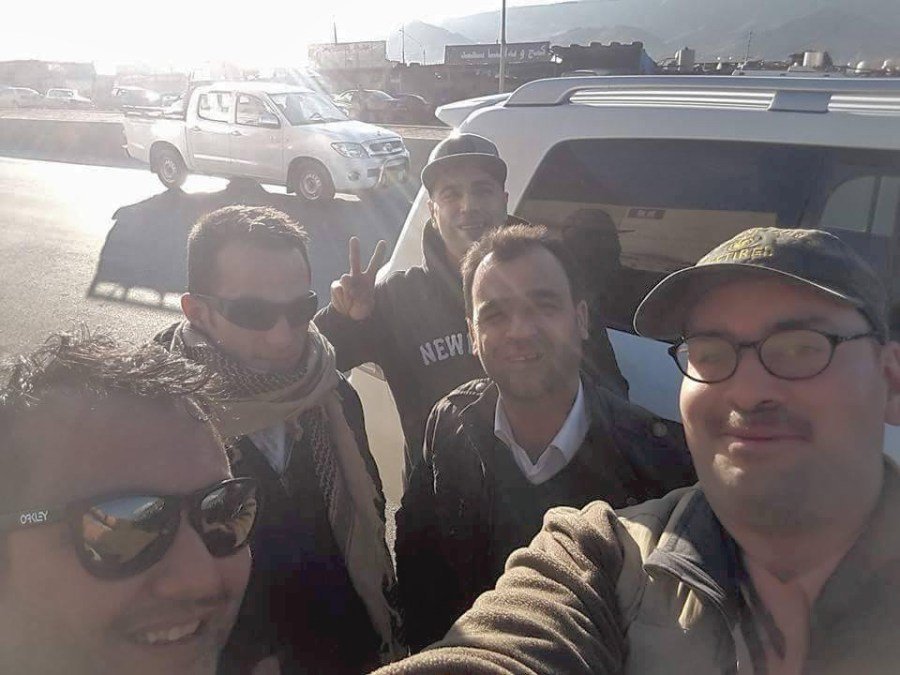
*(Pat Rincon with YPG fighters in Syria. Image Credit)
Accounts such as this will certainly not make it to mainstream media, as they do not fit the narrative that the Kurds and their sponsors promote.
In another example of Western support for the YPG, Joe Robinson, an ex-soldier and UK national, recently returned to the UK after spending five months in Syria fighting with the group. He was detained and arrested by Greater Manchester Police officers on suspicion of terrorism offenses as soon as he returned. He joined the British military when he was 18 and toured Afghanistan with the Duke of Lancaster’s Regiment in 2012.
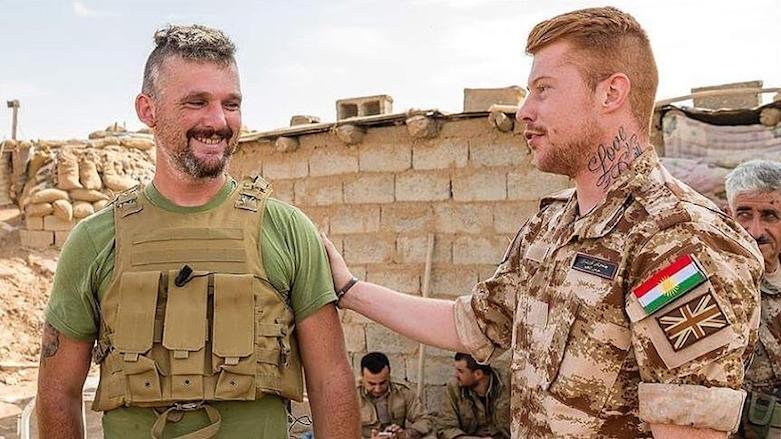
*(Joseph A. R. (right) in a military outfit with flag patches of Kurdistan and the UK, while men who appear to be Kurdistan Region’s Peshmerga forces are seen in the background in this undated social media picture. Picture Credit).
He left the UK when an arrest warrant was issued after he failed to appear in court. Robinson is pictured here in Syria with YPG fighters.
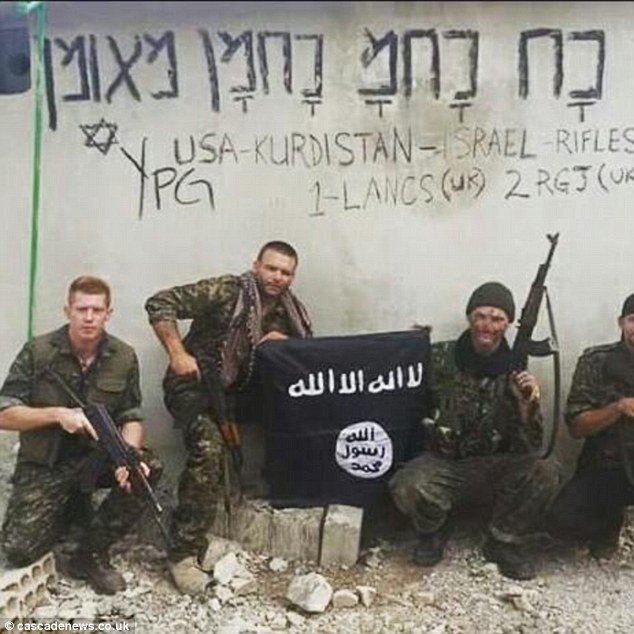
Robinson, at left, holding his weapon while fellow YPG comrades hold Daesh flag. The writing on the wall speaks volumes about the relationship between Israel, the Kurds and the US.
During a trip to Turkey Joe Robinson was arrested for having been part of the YPG.
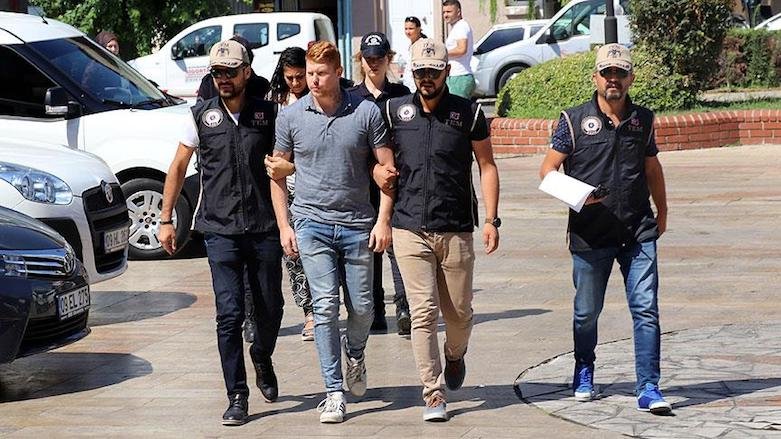
*(Turkish police arrested Joesph A.R. (center) along with two Bulgarian women in the city of Aydin, July 28, 2017. Photo Credit)
“I received arms training from the YPG [People’s Protection Units] for three months but never engaged in combat,” said the foreign fighter during an interrogation.
The information contained in this article serves the purpose of balancing all of the propaganda and romanticization that these Kurdish terrorist groups have received in mainstream media. The bottom line is they are armed, dangerous, and committing crimes with international support. Support for these terrorist groups needs to end immediately before further division, chaos and death spreads in the region.
200,000 Israelis expected in “Kurdistan” once independence is declared
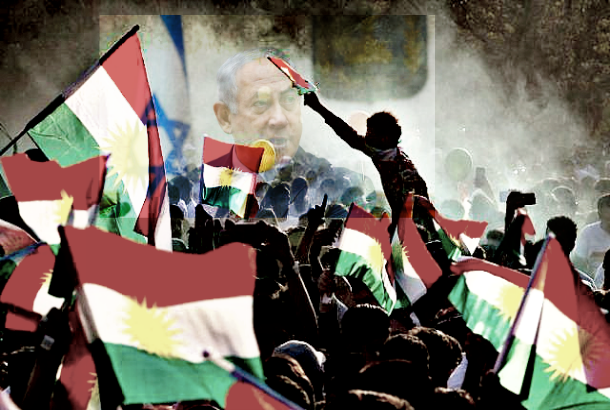
Voltaire Network | 20 September 2017
According to the magazine Israel-Kurd based in Erbil, the Israeli Prime Minister, Benjamin Netanyahu and Massoud Barzani, the self-appointed President of the future independent Kurdistan, have reached a secret agreement.
Tel-Aviv is committed to installing 200,000 Israelis of Kurdish origin in Kurdistan.
The announcement has been widely repeated in the Turkish, Iranian and Arab press. The plan to create a South Sudan and a Kurdistan has been an Israeli military objective following missile development at the end of the nineties. These territories, largely administered by the Israelis, have enabled a rear attack on Egypt and Syria.
Out of the 8.5 million Israelis living in Israel, around 200,000 are of Kurdish origin. In March 1951, “Operation Ezra and Nehemiah” (named after the biblical persons that organized the flight of the Jewish people from Babylon) permitted 11,000 Jewish Kurds to emigrate from Iraq to Israel. The American Jewish Joint Distribution Committee of New York funded this operation. The planes used for this air lift were made available by the Cuban dictator, Fulgencio Batista.
The Barzani family that governs the Iraqi Kurdistan with an iron fist, is historically connected to Israel. Mullah Mustafa Barzani, father of the current president Massoud Barzani, was one of Mossad’s high official.
The Israeli Prime Minister is the only head of government to have publicly declared his support of the creation of an independent Kurdistan outside the historic Kurdish territory (which would also be to the detriment of the indigenous populations).
Despite the prohibition declared by the Iraqi Constitutional Court, a referendum will take place on 25 September 2017 with a view to declaring this new State.
Translation
Anoosha Boralessa
6 MAJOR US foreign policy failures of the post-Cold War era
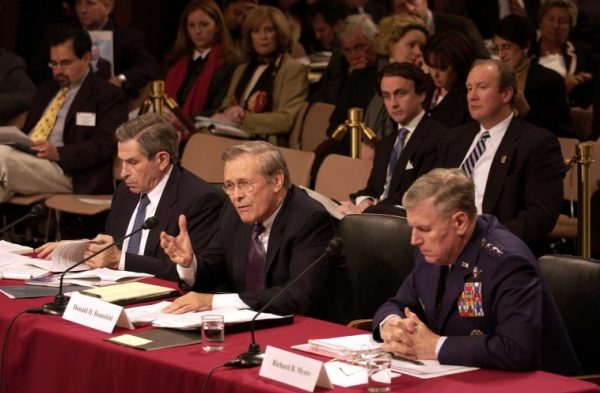
By Adam Garrie | The Duran | September 14, 2017
In the 1990s, US officials, all of whom would go on to serve in the George W. Bush White House, authored two short, but deeply important policy documents that have subsequently been the guiding force behind every major US foreign policy decision taken since the year 2000 and particularly since 9/11.
These documents include the Defense Planning Guidance for the 1994–99 fiscal years (more commonly known as the Wolfowitz Doctrine). This document, as the name implies was authored by George W. Bush’s deeply influential Deputy Defense Secretary Paul Wolfowitz as well as I. Lewis “Scooter” Libby, who served as an advisor to former US Vice President Dick Cheney.
The other major document, A Clean Break: A New Strategy for Securing the Realm, from 1996 was authored by former Chairman of the Defense Policy Board Advisory Committee in the administration of George W. Bush, Richard Norman Perle.
Both documents provide a simplistic but highly unambiguous blueprint for US foreign police in the Middle East, Russia’s near abroad and East Asia. The contents of the Wolfowitz Doctrine were first published by the New York Times in 1992 after they were leaked to the media. Shortly thereafter, many of the specific threats made in the document were re-written using broader language. In this sense, when comparing the official version with the leaked version, it reads in the manner of the proverbial ‘what I said versus what I meant’ adage.
By contrast, A Clean Break was written in 1996 as a kind of gift to Israeli Prime Minister Benjamin Netanyahu who apparently was not impressed with the document at the time. In spite of this, the US has implemented many of the recommendations in the document in spite of who was/is in power in Tel Aviv.
While many of the recommendations in both documents have indeed been implemented, their overall success rate has been staggeringly bad.
Below are major points from the documents followed by an assessment of their success or failure.
1. Regime change against Saddam Hussein’s Iraq (A Clean Break)
This objective is in many ways both the clearest initial success and also the most strident overall failure.
In 1996, Richard Perle suggested that removing Saddam Hussein from power would be good for the US and Israeli interest because it would weaken a powerful, large Arab state that had poor relations with the US since 1990 and historically poor relations with multiple regimes in Tel Aviv. While Iraq’s President was removed from power by illegal force in 2003, that which happened subsequently, did not deliver the outcome Perle had desired.
A Clean Break suggests that a post-Saddam Iraq could and should be ruled by a restored Hashemite dynasty, which was originally overthrown in 1958. Perle continues to suggest that Jordan, the last remaining Hashemite state in the Arab world, could work with Israel and the US to make this happen. Even more absurdly, Perle suggests that a Hashemite would-be union between Jordan and Iraq would be able to command more loyalty from Hezbollah supporters in Lebanon than Iran.
The realities could not be more different. After the illegal 2003 invasion of Iraq, the idea of restoring the Hashemite dynasty was never again floated in any serious forum, as the idea would be simply impossible to implement. There was no will among any major faction in Iraq to restore a monarchy that was overthrown in a revolution in 1958 that many Iraqis continue to look back on with national pride.
Ironically, the biggest Arab bulwark against a resurgent Iran was Saddam Hussein. In the 1980s, the future neo-cons realised this, though they seemingly ignored what they once knew, as early as in 1992.
Since Saddam Hussein’s removal from power and violent execution, Iraq’s majority Shi’a population have generally rallied around Iran politically, militarily and spiritually. Iraq has recently signed a defensive military pact with Iran and it is well known that many of the Shi’a volunteer brigades which are fighting ISIS in Iraq have received training and advice from Iranian experts.
While the US bases in Iraq make a US military presence closer to Iran than it was prior to 2003, by the same token Iran’s influence in the Arab world, especially in Iraq has grown substantially. In any case, the desired illegal ‘regime change’ war against Iran will likely never happen for two reasons. First of all, many in the Pentagon and in Washington moreover, realise that such a war would be an unmitigated disaster for the US and secondly, Iran has many influential international partners that it did not have in the 1990s, primarily Russia. Russia as well as China would not stand for a war on Iran in 2017.
In this sense, the US got very little of what it claimed it wanted in overthrowing Saddam apart from the weakening of a united Iraq.
2. ‘Containing’ Russia and China by preventing them from becoming superpowers (Wolfowitz Doctrine)
This policy has failed on every front. Since the rise of George W. Bush, the first White House adherent to the Wolfowitz Doctrine, Russia and China have risen to a status which means that there are three global superpowers, not the lone American superpower dreamt of by Wolfowitz and Libby.
China’s economic rise has fuelled a more robust stance from Beijing on global affairs. China now vigorously defends its claims in the South China Sea, has continually outflanked the US on the Korean issue, is engaged in the building of One Belt–One Road, the most wide reaching trade and commerce initiative in modern history and has opened its first military base overseas.
At the same time, the People’s Liberation Army continues its modernisation programme, making it as formidable a force which for all practical purposes, is as battle ready and capable as those of the US and Russia, countries which during the Cold War, had far superior armed forces to China.
Likewise, Russia’s return to superpower status, has been equally crushing in respect of the goals of Wolfowitz and Libby. Russia has not only strengthened old alliances but is now an important ally or partner to countries which were former Cold War opponents or otherwise non-aligned countries. This is true in respect of Russia’s alliances and partnerships with China, Pakistan, Turkey, Iran, Philippines and increasingly Indonesia. Russia is also becoming ever closer to South Korea and even Japan.
With Russia’s military now boasting modern defence systems which can rival those of the US and in many cases are objectively superior to those of the US, the idea that the US would prevent Russia from re-attaining super-power status and China emerging as a super-power has become a patent absurdity.
3. Containing Syria via Turkey and Jordan (A Clean Break)
For a while, this plan was implemented with some degree of success by the Obama administration. While Jordan never played a substantial part in the proxy wars on Syria, apart from being a NATO transport corridor, Turkey did help to undermine Syria’s sovereignty with its armed forces and its own proxies.
While relations between Turkey and Syria remain poor, relations between Turkey and the rest of its NATO ‘allies’ is also poor.
Turkey has quietly ceased its support for terrorist groups (aka the opposition) in Syria, is participating in the Astana Peace Process with long time Syrian allies Russia and Iran and is engaged in multiple trading and commercial deals with Russia, including the purchase of the Russian made S-400 missile defence system.
The overall result of Turkey’s participation in the Syrian conflict has been a strengthening of Turkey’s relationship with historical adversaries, Russia and Iran, something which has happened simultaneously to Turkey’s essentially dead relationship with the EU and its incredibly weakened relationship with the US.
All the while, Ba’athist Syria has emerged from the conflict victorious with its commitment to the Palestinian cause as strong as ever.
Far from being “contained”, Syria is now more admired throughout the wider world than at any time in the last three decades.
4. Molesting Russia’s borderlands (Wolfowitz Doctrine)
In the original text of the Wolfowitz Doctrine, there was a provision stating that the US must work to make sure that places like Ukraine and Belarus became part of the US economic and geo-political orbit, maintaining both “market economies” and “democracies”.
The 2014 US engineered coup against the legitimate government in Kiev was a knee-jerk US response to the fact that Ukrainian President Viktor Yanukovych rejected an economic association agreement with the EU, under the guise that the Ukrainian economy cannot afford to cut itself off from Russia.
Yanukovych was subsequently overthrown in a violent coup, and a neo-fascist pro-western regime was installed. However, this can hardly be considered a success as the sheer violence and incompetence of the current Kiev regime has made it so that Ukraine, a place whose borders were always dubious to begin with, will almost inevitably fracture into something unrecognisable.
Already, much of Donbass has been incorporated into the Donetsk and Lugansk People’s Republics that will never go back to Kiev rule and Crimea, whose relationship with Kiev was even more tenuous is now happily reunited with the rest of the Russian Federation.
Seeing the coup in Kiev, Belorussian President Alexander Lukashenko has pledged to crack down on any would be trouble-makers, all while remaining a committed albeit tantrum prone ally of Russia.
The only part of this element of the Wolfowitz Doctrine which has not been a failure has been the weaponisation of eastern Europe. The reason this has succeeded is due to the fact that Russia has no interest in invading eastern Europe. Russia has merely responded by building up its defences against NATO’s provocative weaponisation of Poland and the Baltic States.
5. Weakening Hezbollah (A Clean Break)
In 2017, Hezbollah is not only more popular than ever, but its militarily might is stronger than at any time in its history. Hezbollah’s role in fighting terrorism in Syria has won the party praise from groups in Lebanon that previously were never keen on Hezbollah, as well as individuals in the wider world who seek to build a genuine anti-terrorist coalition.
The conflict in Syria has drawn Iran, Iraq, Syria and southern Lebanon (the heartland of Hezbollah) closer together than they have ever been. This has in many ways been a result of the common cause of fighting groups like ISIS and al-Qaeda that bound them all together.
In 2006, Hezbollah dealt Israeli forces a major defeat in South Lebanon. Today, Hezbollah is even stronger and everyone in Israel is all too aware of this.
This was a major failure in respect of implementing the ‘destruction’ of Hezbollah advocated by Richard Perle.
6. North Korea not to be allowed nuclear weapons (Wolfowitz Doctrine)
The fact that North Korea just tested what is widely believed to be a hydrogen bomb, is a clear indication that this major goal of Wolfowitz and Libby has failed.
Beyond this, while Russia has condemned both North Korea and US led provocative acts on the Korean peninsula, Russian President Vladimir Putin has acknowledged that North Korea does have the right to self-defence, something which has become even more prescient after North Korea witnessed the destruction of Iraq and Libya which did not have weapons capable of deterring a US invasion.
Russia and China have clearly seized the initiative on the Korean issue. Apart from launching a disastrous war on North Korea, the US can now do little to change the realities in Pyongyang.
CONCLUSION:
The aggregate effect of this analysis indicates that the US is still highly capable of starting wars and igniting conflicts throughout the world, but that it is likewise hardly ever capable of winning these conflicts or even achieving a majority of its own stated goals.
As the two most revealing foreign policy documents from the US in the post-Cold War era, both the Wolfowitz Doctrine and A Clean Break have been abject failures. In many cases, in attempting to achieve the goals of these documents, the United States has ended up achieving the opposite.
The US is militarily strong, but strategically, diplomatically and geo-politically, it is actually close to impotent.
Israeli support for Kurdish statehood is a poisoned chalice
By Mahan Abedin | MEMO | September 12, 2107
With the referendum on proposed Kurdish independence just two weeks away, the stage is being set for the gravest political and potential military crisis in post-Baathist Iraq. Months of intense lobbying by Iranian, Turkish and even American officials and interlocutors has failed to dissuade the Iraqi Kurdish leadership from staging this catastrophically divisive referendum.
In his combative interview with the BBC, the president of the autonomous Iraqi Kurdistan region, Masoud Barzani, left no doubt that the referendum is the first formal step in the march toward full independence. More ominously, Barzani appeared to acknowledge that plans to officially annex Kirkuk may well spark a major war.
Every regional and extra-regional power, including the United States, is opposed to Kurdish statehood, with one exception. Israel. Whilst sections of the Iraqi Kurdish media are jubilant at this rhetorical support, Kurdish leaders will have to carefully weigh up the pros and cons of Israeli support before they formally declare statehood.
While Israel will undoubtedly prove a strong ally of an independent Kurdish state, it is the support it is willing to offer in the run-up to independence that will prove decisive. Even rhetorical Israeli support will drastically inflame the situation and bring the Kurds into armed conflict with the pro-Iranian Shia militias massed to the south of Kirkuk.
A peripheral policy
Israel’s support for nationalist Kurdish movements is strong and long-standing, dating back to the early 1960s. This policy is part of Israel’s “Alliance of the Periphery” doctrine, which in short amounts to developing strong ties to non-Arab states on the periphery of the Middle East with a view to combating the Arab boycott of the Jewish state.
Whilst the periphery doctrine was originally aimed at Turkey, Iran and Ethiopia, with time it expanded to incorporate non-state actors, principally the Kurds, whose quest for statehood Israel has consistently supported for decades.
Analysis centred on the putative “collapse” of the periphery doctrine is likely to prove premature. Whilst it is true that Turkey can no longer be regarded as a reliable Israeli partner, this will motivate Israeli strategists and operatives to seek out and develop new peripheral partners. Moreover, the peripheral policy survived its biggest crisis nearly forty years ago when almost overnight Iran went from an informal Israeli ally to the most vociferous enemy of the Jewish state.
Given this chequered history of missteps and strategic miscalculations, analysts are right to be wary of how useful this periphery doctrine is. However, as long as Israel’s occupation of Palestine continues to draw strong Arab, Muslim and broader international opposition, Israel will seek to identify and develop stealthy means by which to undermine, isolate and eventually exhaust this opposition.
It is in this context that leading Israeli strategists, including former foreign minister Shlomo Ben-Ami, push the case for Kurdish independence, primarily by trying to align Kurdish statehood with the interests of the United States and the West in general. This devious perspective is entirely in keeping with the perennial Israeli policy of equating its own core interests with that of the West. In this instance, Israeli diplomacy and wider lobbying efforts will try to sell Kurdish independence to policymakers in Washington, by presenting it as the best long-term strategy to contain Iranian influence in Iraq.
The road to war
Apart from strong rhetorical support, what practical steps can Israel take to support the Iraqi Kurdish quest for statehood? This is a vexing question, as on the face of it Israeli influence in Iraqi Kurdistan is practically non-existent. This author spent the first half of 2009 in Iraqi Kurdistan working as a journalist and despite widespread rumours didn’t uncover any evidence of Israeli involvement in Kurdish affairs.
Yet this influence surely exists, particularly at the security and intelligence level. It is in part due to the Israeli connection that the Kurdish intelligence agency, the Asayish, has developed into one of the most capable intelligence agencies in the Middle East. In keeping with Kurdish national aspirations, the Asayish has grown in reach and capability, not only spying on regional countries, but even managing to run modest operations as far afield as the United Kingdom.
Indeed, qualified Kurdish independence in Iraq now seems all but inevitable. This appears to be the assessment of US intelligence services, Washington’s stated opposition to the issue notwithstanding. Qualified independence in this context implies highly contested statehood, lacking widespread international support and drawing immediate internal and external opposition.
The most immediate opponents to Kurdish statehood in Iraq are the Shia paramilitary forces, who alongside their political patrons in Baghdad, have deep-seated interests in Kirkuk, which is home to a sizeable Shia Turkmen population. The collapse of the Iraqi army in the face of Daesh’s sweeping advance in June 2014 has significantly changed the military security landscape in Kirkuk and the immediate areas to the south, bringing the Kurdish Peshmerga and Shia paramilitaries into dangerously close proximity.
The Shia paramilitaries, organised as Popular Mobilisation Units, reportedly maintain six military bases close to Kirkuk and are poised to engage the Peshmerga militarily should the need arise. From a purely speculative point of view, limited military engagements may follow the independence referendum as a means of deterring the Kurdish leadership from taking further steps toward formal independence.
From a broader strategic perspective, Israeli support for the Kurdish cause is a poisoned chalice for Kurdish nationalists in so far as it makes a sustainable Kurdish state unacceptable to Iran and by extension to its Shia allies in Iraq. But judging from Masoud Barzani’s combative rhetoric, he appears to be willing to take the risk.
Read: Israeli flag will be raised in independent Kurdistan, claims prominent Likud member
How ‘Regime Change’ Wars Led to Korea Crisis
By Robert Parry | Consortium News | September 4, 2017
It is a popular meme in the U.S. media to say that North Korean leader Kim Jong Un is “crazy” as he undertakes to develop a nuclear bomb and a missile capacity to deliver it, but he is actually working from a cold logic dictated by the U.S. government’s aggressive wars and lack of integrity.
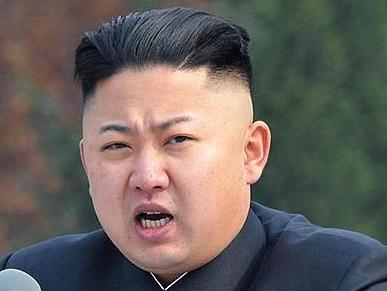
North Korean leader Kim Jong Un
Indeed, the current North Korea crisis, which could end up killing millions of people, can be viewed as a follow-on disaster to President George W. Bush’s Iraq War and President Barack Obama’s Libyan intervention. Those wars came after the leaders of Iraq and Libya had dismantled their dangerous weapons programs, leaving their countries virtually powerless when the U.S. government chose to invade.
In both cases, the U.S. government also exploited its power over global information to spread lies about the targeted regimes as justification for the invasions — and the world community failed to do anything to block the U.S. aggressions.
And, on a grim personal note, the two leaders, Saddam Hussein and Muammar Gaddafi, were then brutally murdered, Hussein by hanging and Gaddafi by a mob that first sodomized him with a knife.
So, the neoconservatives who promoted the Iraq invasion supposedly to protect the world from Iraq’s alleged WMDs — and the liberal interventionists who pushed the Libya invasion based on false humanitarian claims — may now share in the horrific possibility that millions of people in North Korea, South Korea, Japan and maybe elsewhere could die from real WMDs launched by North Korea and/or by the United States.
Washington foreign policy “experts” who fault President Trump’s erratic and bellicose approach toward this crisis may want to look in the mirror and consider how they contributed to the mess by ignoring the predictable consequences from the Iraq and Libya invasions.
Yes, I know, at the time it was so exciting to celebrate the Bush Doctrine of preemptive wars even over a “one percent” suspicion that a “rogue state” like Iraq might share WMDs with terrorists — or the Clinton Doctrine hailed by Secretary of State Hillary Clinton’s acolytes enamored by her application of “smart power” to achieve “regime change” in Libya.
However, as we now know, both wars were built upon lies. Iraq did not possess WMD stockpiles as the Bush administration claimed, and Libya was not engaged in mass murder of civilians in rebellious areas in the eastern part of the country as the Obama administration claimed.
Post-invasion investigations knocked down Bush’s WMD myth in Iraq, and a British parliamentary inquiry concluded that Western governments misrepresented the situation in eastern Libya where Gaddafi forces were targeting armed rebels but not indiscriminately killing civilians.
But those belated fact-finding missions were no comfort to either Saddam Hussein or Muammar Gaddafi, nor to their countries, which have seen mass slaughters resulting from the U.S.-sponsored invasions and today amount to failed states.
There also has been virtually no accountability for the war crimes committed by the Bush and Obama administrations. Bush and Obama both ended up serving two terms as President. None of Bush’s senior advisers were punished – and Hillary Clinton received the 2016 Democratic Party’s nomination for President.
As for the U.S. mainstream media, which behaved as boosters for both invasions, pretty much all of the journalistic war advocates have continued on with their glorious careers. To excuse their unprofessional behavior, some even have pushed revisionist lies, such as the popular but false claim that Saddam Hussein was to blame because he pretended that he did have WMDs – when the truth is that his government submitted a detailed 12,000-page report to the United Nations in December 2002 describing how the WMDs had been destroyed (though that accurate account was widely mocked and ultimately ignored).
Pervasive Dishonesty
The dishonesty that now pervades the U.S. government and the U.S. mainstream media represents another contributing factor to the North Korean crisis. What sensible person anywhere on the planet would trust U.S. assurances? Who would believe what the U.S. government says, except, of course, the U.S. mainstream media?
Remember also that North Korea’s nuclear program had largely been mothballed before George W. Bush delivered his “axis of evil” speech in January 2002, which linked Iran and Iraq – then bitter enemies – with North Korea. After that, North Korea withdrew from earlier agreements on limiting its nuclear development and began serious work on a bomb.
Yet, while North Korea moved toward a form of mutual assured destruction, Iraq and Libya chose a different path.
In Iraq, to head off a threatened U.S.-led invasion, Hussein’s government sought to convince the international community that it had lived up to its commitments regarding the destruction of its WMD arsenal and programs. Besides the detailed declaration, Iraq gave U.N. weapons inspectors wide latitude to search on the ground.
But Bush cut short the inspection efforts in March 2003 and launched his “shock and awe” invasion, which led to the collapse of Hussein’s regime and the dictator’s eventual capture and hanging.
Gaddafi’s Gestures
In Libya, Gaddafi also sought to cooperate with international demands regarding WMDs. In late 2003, he announced that his country would eliminate its unconventional weapons programs, including a nascent nuclear project.
Gaddafi also sought to get Libya out from under economic sanctions by taking responsibility for the 1988 bombing of Pan Am 103 over Scotland, although he and his government continued to deny carrying out the terror attack that killed 270 people.
But these efforts to normalize Libya’s relations with the West failed to protect him or his country. In 2011 when Islamic militants staged an uprising around Benghazi, Gaddafi moved to crush it, and Secretary of State Clinton eagerly joined with some European countries in seeking military intervention to destroy Gaddafi’s regime.
The United Nations Security Council approved a plan for the humanitarian protection of civilians in and around Benghazi, but the Obama administration and its European allies exploited that opening to mount a full-scale “regime change” war.
Prominent news personalities, such as MSNBC’s Andrea Mitchell, cheered on the war with the claim that Gaddafi had American “blood on his hands” over the Pan Am 103 case because he had accepted responsibility. The fact that his government continued to deny actual guilt – and the international conviction of Libyan Abdelbaset al-Megrahi was a judicial travesty – was ignored. Almost no one in the West dared question the longtime groupthink of Libyan guilt.
By October 2011, Gaddafi had fled Tripoli and was captured by rebels in Sirte. He was tortured, sodomized with a knife and then executed. Clinton, whose aides felt she should claim credit for Gaddafi’s overthrow as part of a Clinton Doctrine, celebrated his murder with a laugh and a quip, “We came; we saw; he died.”
But Gaddafi’s warnings about Islamist terrorists in Benghazi came back to haunt Clinton when on Sept. 11, 2012, militants attacked the U.S. consulate and CIA station there, killing Ambassador Christopher Stevens and three other Americans.
The obsessive Republican investigation into the Benghazi attack failed to demonstrate many of the lurid claims about Clinton’s negligence, but it did surface the fact that she had used a private server for her official State Department emails, which, in turn, led to an FBI investigation which severely damaged her 2016 presidential run.
Lessons Learned
Meanwhile, back in North Korea, the young dictator Kim Jong Un was taking all this history in. According to numerous sources, he concluded that his and North Korea’s only safeguard would be a viable nuclear deterrent to stave off another U.S.-sponsored “regime change” war — with him meeting a similar fate as was dealt to Hussein and Gaddafi.
Since then, Kim and his advisers have made clear that the surrender of North Korea’s small nuclear arsenal is off the table. They make the understandable point that the United States has shown bad faith in other cases in which leaders have given up their WMDs in compliance with international demands and then saw their countries invaded and faced grisly executions themselves.
Now, the world faces a predicament in which an inexperienced and intemperate President Trump confronts a crisis that his two predecessors helped to create and make worse. Trump has threatened “fire and fury” like the world has never seen, suggesting a nuclear strike on North Korea, which, in turn, has vowed to retaliate.
Millions of people on the Korean peninsula and Japan – and possibly elsewhere – could die in such a conflagration. The world’s economy could be severely shaken, given Japan’s and South Korea’s industrial might and the size of their consumer markets.
If such a horror does come to pass, the U.S. government and the U.S. mainstream media will surely revert to their standard explanation that Kim was simply “crazy” and brought this destruction on himself. Trump’s liberal critics also might attack Trump for bungling the diplomacy.
But the truth is that many of Washington’s elite policymakers – both on the Republican and Democratic sides – will share in the blame. And so too should the U.S. mainstream media.
Investigative reporter Robert Parry broke many of the Iran-Contra stories for The Associated Press and Newsweek in the 1980s.
US military constructing new base in Iraq’s Kurdish region: Report
Press TV – August 22, 2017
The US military is reportedly building a new permanent base in Iraq’s semi-autonomous Kurdistan region as part of attempts to perpetuate its occupation of the conflict-ridden Arab country indefinitely, regardless of all opposition from religious figures and people from all walks of life.
Iraq’s Kurdish-language Rudaw television network reported on Tuesday that the base is being constructed in Kariz village of Zummar district, located 60 kilometers northwest of Mosul, stressing that 60 percent of the work has already been done.
The report added that 120 US soldiers and 300 long-range artillery systems have also been stationed in the area.
Hassan Khalo Ali, a Kurdistan Democratic Party (KDP) official, said the base is being built on an area of 20 acres of land, local people can see helicopters continuously taking off and landing and entering the base is prohibited in every way to ordinary people.
The new US base would mark the fifth of its kind in Iraq’s Kurdish region.
A Kurdish military official, requesting anonymity, said US officials, President of the Kurdistan Regional Government (KRG) Masoud Barzani as well as officials from the Ministry of Peshmerga have reached a tripartite agreement on the construction of the base.
The Kurdish official went on to say that the base will help Americans to monitor movements in a vast expanse of land, which stretches from the western bank of the Tigris river to Tal Afar city, located 63 kilometers west of Mosul.
Meanwhile, Deputy Peshmerga Minister Sarbast Lazgin said the base will be a reinforcement facility for Tal Afar liberation operation.
On American bases in Iraq’s semi-autonomous Kurdistan region, Lazgin stated that a joint operations room is now operating in Erbil, noting that there are US military bases in Harir and Khazir sub-districts of Shaqlawa district.
The report comes as Iraq’s Kurdistan region plans to hold an independence referendum late next month.
Turkish Foreign Minister Mevlut Cavusoglu told the state-run TRT Haber television news network on August 16 that the vote will lead to “civil war” in Iraq.
Hoshyar Zebari, a close adviser to Kurdistan Regional Government (KRG) President Massoud Barzani, told Reuters on August 12 that Kurdish authorities were determined to hold the referendum on September 25 irrespective of all objections.
In June, Iraqi Prime Minister Haider al-Abadi described as untimely the decision by Barzani to hold the referendum.
“We have a constitution that we’ve voted on, we have a federal parliament and a federal government… The referendum at this time is not opportune,” Abadi said on June 13.
Iran has also expressed opposition to the “unilateral” scheme, underlining the importance of maintaining the integrity and stability of Iraq and insisting that the Kurdistan region is part of the majority Arab state.
Netanyahu Backs Partitioning Iraq for Kurdish State
teleSUR | August 14, 2017
During a meeting with a U.S. delegation, Israel’s Prime Minister Benjamin Netanyahu expressed interest in partitioning Iraq.
The Prime Minister told the group of 33 congressmen that he favored the establishment of an independent Kurdish state in the Arab country. Israel has a longstanding relationship with the Kurds, who remains one of its few non-Arab allies in the area.
The Jerusalem Post reported that a source who attended the meeting said Netanyahu referred to the Kurds as “brave, pro-Western people who share our values.”
Netanyahu previously spoke on the issue in 2014 when he said in a speech that Israel should “support the Kurdish aspiration for independence.”
Two months ago Iranian Parliament Speaker Ali Larijani warned about bids to break up Iraq, saying the partitioning of Arab countries serves the interests of Israel. “The Zionist regime seeks Iraq’s disintegration,” Larijani accused during a meeting with Iraqi Prime Minister Haider al-Abadi in Tehran.
A report published in the New Yorker magazine in 2004 said Israeli military and intelligence operatives were active in Kurdish areas and providing training for commando units.
According to the report, Israel has been expanding its presence in Kurdistan and encouraging Kurds, its allies in the region, to create an independent state.
US accountable for fatal raid on Hashd al-Sha’abi forces: Senior commander
Press TV – August 9, 2017
A commander of Iraq’s Popular Mobilization Units (PMU) has held the US-led coalition accountable for a recent deadly attack on its forces near the Syrian border, saying Daesh terrorists could not have been behind the assault as they are not in possession of smart weapons.
On August 7, the PMU’s Sayyad al-Shuhada Brigades said its military base in the al-Tanf region had come under a smart bomb and artillery attack by the US-led coalition, which purports to be fighting Daesh in Iraq and Syria.
More than 30 Iraqi volunteer forces, known as Hashd al-Sha’abi, were killed in the assault.
Daesh has claimed responsibility for the incident.
Meanwhile, US Army Colonel Ryan Dillon, the spokesman for the US-led forces, rejected the reports as “inaccurate” and denied having conducted air attacks in that area at the time.
However, Karim al-Nouri, a PMU spokesman, told Lebanon’s al-Mayadeen television channel that the attack could not have been conducted by Daesh terrorists since they are not in possession of any smart bombs as the ones that hit the Iraqi base.
He described the attack as intentional, saying it was impossible for the US military to have mistakenly targeted the Iraqi troops.
The US had, prior to the incident, threatened Hashd al-Sha’abi forces in the area and warned them against approaching the Iraq-Syria border, the commander said.
Speaking to Iran’s Tasnim News Agency on Tuesday, Abu Ala al-Wella’ei, who commands the Brigades, said the attack had been followed by a Daesh strike against the Hashd al-Sha’abi forces in the area.
The nature of the assault, he said, indicates a team-up between the US-led coalition and Daesh.
He rejected claims that the US attack could have been carried out by mistake, saying drones perform ceaseless surveillance operations over the area giving the US forces perfect command over the situation.
Al-Wella’ei called Operation Inherent Resolve, the codename for the US-led offensives, a sham, saying the mission was rather providing air cover for Takfiris on the Iraqi-Syrian border.
Iraq’s Prime Minister Haider al-Abadi said on Tuesday that an initial investigation indicates Daesh had been behind the attack.
“It seems that Daesh carried out a breach using artillery and car bombs,” Abadi said in a televised press conference in Baghdad.
“The international coalition has no authority to carry out bombardment without the knowledge of Iraq,” the premier said.
Hashd al-Sha’abi is a group of Shia and Sunni volunteer fighters that was formed after the emergence of Daesh in Iraq in 2014. Back then, it helped strengthen the government forces, which had suffered heavy setbacks in the face of sweeping Daesh advances.
Hashd al-Sha’abi also played a significant part in the months-long operations, that culminated in the liberation of Mosul, the terror group’s last urban stronghold in Iraq, earlier this year.
Last November, the Iraqi parliament recognized Hashd al-Sha’abi as an official force with similar rights as those of the regular army.
Dozens Reported Killed in US Airstrike on Iraqi Paramilitary Anti-Terror Force
Sputnik – August 8, 2017
The US air force has carried out an airstrike on an Iraqi militia unit called Seyid Suheda, which belongs to Iraq’s Popular Mobilization Units (PMU). The airstrike took place in Anbar province, close to Iraq’s border with Syria, Rudaw reports.
According to reports, 35 fighters were killed and 25 were injured in the airstrike on Monday night. PMU commanders are reportedly among the dead.
PMU commander Ali Hasim Huseyni confirmed the incident in conversation with Sputnik Turkiye.
“US planes bombed fighters of the Seyid Suheda unit. The wounded have been taken to various hospitals in Iraq for treatment. Some of them are in a serious condition. The region in which they were attacked is located on the Iraqi-Syrian border, 20 km from the city of El Baac. We strongly condemn this deliberate attack.”
The recent airstrike is not the first time that US forces have bombed pro-government fighters in Iraq. In October, an airstrike conducted by the US-led coalition in Iraq “most likely” killed around 20 pro-government Sunni tribal fighters south of Mosul, a defense official told AFP.
Iraq’s Popular Mobilization Units, or Hashd al Sha’ abi, comprise approximately 100,000 fighters who are mostly Shia. They have played a vital role in anti-terrorist operations in Mosul and elsewhere.
In November 2016, the Iraqi parliament gave the PMU the power of law enforcement agencies, which basically provides the militia with the same powers as the government army and police.
Last week, the PMU assisted the Iraqi army in launching an operation to retake the northwestern city of Tal Afar. Mostly populated by Sunni Turkmen, the city is the Daesh terrorist group’s last remaining stronghold in the country.
The US has also bombed militia fighting Daesh in neighboring Syria. On June 8, the US-led coalition bombed pro-Assad militia near al-Tanf in the area of a deconfliction zone following an alleged attack by a combat drone resulting in no coalition forces’ casualties. It was the third attack by the coalition on Damascus’ allies in the area. The coalition targeted a drone and trucks with weapons.
US court overturns prison sentences of Blackwater mercs in 2007 Baghdad killing
Press TV – August 5, 2017
A federal appeals court in the United States has overturned lengthy prison sentences for three former Blackwater Worldwide mercenaries and ordered a new trial for a fourth involved in the 2007 killings of more than a dozen of unarmed Iraqi civilians, including women and children.
The Blackwater employees had been charged with killing 14 Iraqi civilians and wounding 18 others using gunfire and grenades at a busy Baghdad intersection on September 16, 2007. An FBI agent once described the atrocity as the “My Lai massacre of Iraq.”
Three mercenaries Dustin L. Heard, Evan S. Liberty and Paul A. Slough were convicted in 2014 of manslaughter and attempted manslaughter and using a machine gun – a military weapon — to carry out an atrocity.
They were sentenced to 30 years in prison. They received the enhanced penalty because they were also convicted of using military firearms while committing a felony.
A fourth mercenary, Nicholas A. Slatten, was convicted of murder and received a life sentence.
On Friday, the three-judge panel of the US Court of Appeals for the District of Columbia Circuit ruled that the trial court “abused its discretion” in not allowing Slatten to be tried separately from his three co-defendants, despite the fact that Slatten fired the first shots in the massacre.
The court also found that the 30-year terms of the three other convicts violated the constitutional prohibition against “cruel and unusual punishment.”
“We are gratified that the Court recognized the gross injustice of the 30-year mandatory minimum sentences,” Heard’s attorney, David Schertler, said in a statement. Attorneys for the three other men refused to respond to the ruling.
A large number of Iraqi witnesses had testified in the case in what the Justice Department said was likely to be “the largest group of foreign witnesses ever to travel to the United States for a criminal trial.”
Blackwater Worldwide, which is now known as Academi and is based in McLean, Virginia, is the most notorious private security firm that had operated in Iraq.
Many Iraqis believe the US military allowed Blackwater mercenaries to commit numerous war crimes against their compatriots with impunity.
Featured Video
Macgregor: We Haven’t Seen the Worst of the Iran War Yet
or go to
Aletho News Archives – Video-Images
From the Archives
15 Saudi ‘hijackers’ were CIA agents working for US: Scholar
Press TV – April 13, 2016
Fifteen of the 9/11 “hijackers” from Saudi Arabia were CIA agents working for the United States government, which was seeking to destroy the Middle East for Israel and to double the American military budget, says Dr. Kevin Barrett, an American academic who has been studying the events of 9/11 since late 2003…. continue
Blog Roll
 Aletho News
- Iran’s Plan to Shut Down AI in the Persian Gulf
- Israel seeks ‘compensation’ from Washington over Saudi F-35 sale
- Saudi crown prince seeks dialogue with Ansarullah after Yemeni blows: Report
- Damascus rejects Saudi request for Syrian fighters to counter Yemen: Report
- South Korea says will not send troops to join terrorist US war on Iran
- Russia Just Struck the Eyes of NATO’s War Machine in Ukraine
- Russia summons UK charge d’affaires over Kiev drone support
- NATO member warns bloc seeking pretext for war with Russia
- Macgregor: We Haven’t Seen the Worst of the Iran War Yet
- ‘We are not like everyone else’ laws that bind other nations do not apply to Israel, says Likud lawmaker
- If Americans Knew
- Debunking The Claim That Macklemore Has A “History Of Antisemitism”
- CPJ demands release of arrested Palestinian-US journalist near Bethlehem
- Robert Kraft: The Billionaire Friend of Netanyahu Pulling The Strings Behind the Macklemore/Ed Sheeran Blow Up
- Columbia Administered Fund Gives Big Money to Pro-Israel Groups
- Deportation Case of Palestinian Activist Salah Sarsour Tests First Amendment
- ‘We Will Not Forget’: Palestinians Mark 44 Years since Sabra and Shatila
- Why do we let Zionists decide what we can and can’t say?
- US welcomes Israeli, Iranian delegations to UN, but not Palestinians – Daily Update
- Biden’s Genocide Accomplices Targeted by New Accountability Campaign
- AIPAC’s Network Has Already Spent $67.2 Million to Shape the Midterm Elections
- No Tricks Zone
- New Study: ‘Global Drought Shows No Detectable Recent Acceleration Under Climate Warming’
- Economic Masterminds: German Socialists Suggest Taxing Productivity Gains Stemming From Using AI
- The South China Sea Has Not Been Cooperating With The Climate Change Narrative
- Energy Crisis: Germany Enters Heating Season With Historically Low Gas Reserve Fill Levels
- New Study: The Antarctic Ice Sheet Gained Mass From 2020-2024 Due To Staggering Snow And Ice Accumulation
- Study: Ocean Heating Rates From Thousands Of Years Ago ‘Dwarf’ Modern Ocean Heating Rates
- Climate Extremists Target, Attack Large-Scale Power Grid Infrastructure In Germany!
- New Study: Antarctic Ice Melt Has Contributed Less Than 1 Centimeter To Sea Level Rise In The Last 30 Years
- Fear Of Debate: Alarmist German Climate Scientist Calls On Mainstream Media To Discredit Skeptic Voices
- End-Of-August Arctic Sea Ice Extent Hasn’t Fallen In 20 Years, Official Data Show!
 Aletho News