US State Dept cautions Iraqi govt against troop advances in Kurdish territory
RT | October 20, 2017
The US State Department is advising Iraq’s federal authority to limit its military activity in the country’s Kurdish northern region, as it also calls for “all parties to cease all violence” in the wake of violence in the town of Altun Kupri.
On Friday, State Department spokeswoman Heather Nauert urged the Baghdad government to only make troop movements that were “coordinated with the Kurdistan Regional Government.”
This marks the most specific statement out of the State Department on the situation since Iraq regained control over the provincial capital Kirkuk on Monday, following a popular vote of 92 percent in favor of an independent Kurdistan late last month. Previously, the State Department has stuck to general calls for calm on all sides.
Nauert’s statement also declared that the disputed Kurdish areas remained disputed, despite Iraqi authorities crossing into the region.
“The reassertion of federal authority over disputed areas in no way changes their status – they remain disputed until their status is resolved in accordance with the Iraqi constitution,” the statement read.
According to security sources cited by Reuters, Iraqi troops gained control of the last district in Kirkuk on Friday, taking the oil-producing province from Kurdish Peshmerga fighters after three hours of hostilities.
Secretary of State Rex Tillerson has called the September 25 vote for Kurdish independence illegitimate, and said US policy rejects such unilateral moves.
This week, Kurdish Peshmerga fighters lost large swathes of territory held since 2014 or later, which had been gained during years of war against Islamic State fighters.
Is War with Iran Now Inevitable?
By Pat Buchanan • Unz Review • October 17, 2017
With his declaration Friday that the Iran nuclear deal is not in the national interest, President Donald Trump may have put us on the road to war with Iran.
Indeed, it is easier to see the collisions that are coming than to see how we get off this road before the shooting starts.
After “de-certifying” the nuclear agreement, signed by all five permanent members of the Security Council, Trump gave Congress 60 days to reimpose the sanctions that it lifted when Teheran signed.
If Congress does not reimpose those sanctions and kill the deal, Trump threatens to kill it himself.
Why? Did Iran violate the terms of the agreement? Almost no one argues that — not the UN nuclear inspectors, not our NATO allies, not even Trump’s national security team.
Iran shipped all its 20 percent enriched uranium out of the country, shut down most of its centrifuges, and allowed intrusive inspections of all nuclear facilities. Even before the deal, 17 U.S. intelligence agencies said they could find no evidence of an Iranian nuclear bomb program.
Indeed, if Iran wanted a bomb, Iran would have had a bomb.
She remains a non-nuclear-weapons state for a simple reason: Iran’s vital national interests dictate that she remain so.
As the largest Shiite nation with 80 million people, among the most advanced in the Mideast, Iran is predestined to become the preeminent power in the Persian Gulf. But on one condition: She avoid the great war with the United States that Saddam Hussein failed to avoid.
Iran shut down any bomb program it had because it does not want to share Iraq’s fate of being smashed and broken apart into Persians, Azeris, Arabs, Kurds and Baluch, as Iraq was broken apart by the Americans into Sunni, Shiite, Turkmen, Yazidis and Kurds.
Tehran does not want war with us. It is the War Party in Washington and its Middle East allies — Bibi Netanyahu and the Saudi royals — who hunger to have the United States come over and smash Iran.
Thus, the Congressional battle to kill, or not to kill, the Iran nuclear deal shapes up as decisive in the Trump presidency.
Yet, even earlier collisions with Iran may be at hand.
In Syria’s east, U.S.-backed and Kurd-led Syrian Democratic Forces are about to take Raqqa. But as we are annihilating ISIS in its capital, the Syrian army is driving to capture Deir Ezzor, capital of the province that sits astride the road from Baghdad to Damascus.
Its capture by Bashar Assad’s army would ensure that the road from Baghdad to Damascus to Hezbollah in Lebanon remains open.
If the U.S. intends to use the SDF to seize the border area, we could find ourselves in a battle with the Syrian army, Shiite militia, the Iranians, and perhaps even the Russians.
Are we up for that?
In Iraq, the national army is moving on oil-rich Kirkuk province and its capital city. The Kurds captured Kirkuk after the Iraqi army fled from the ISIS invasion. Why is a U.S.-trained Iraqi army moving against a U.S.-trained Kurdish army?
The Kurdistan Regional Government voted last month to secede. This raised alarms in Turkey and Iran, as well as Baghdad. An independent Kurdistan could serve as a magnet to Kurds in both those countries.
Baghdad’s army is moving on Kirkuk to prevent its amputation from Iraq in any civil war of secession by the Kurds.
Where does Iran stand in all of this?
In the war against ISIS, they were de facto allies. For ISIS, like al-Qaida, is Sunni and hates Shiites as much as it hates Christians. But if the U.S. intends to use the SDF to capture the Iraqi-Syrian border, Syria, Iran, Hezbollah and Russia could all be aligned against us.
Are we ready for such a clash?
We Americans are coming face to face with some new realities.
The people who are going to decide the future of the Middle East are the people who live there. And among these people, the future will be determined by those most willing to fight, bleed and die for years and in considerable numbers to realize that future.
We Americans, however, are not going to send another army to occupy another country, as we did Kuwait in 1991, Afghanistan in 2001, and Iraq in 2003.
Bashar Assad, his army and air force backed by Vladimir Putin’s air power, the Islamic Revolutionary Guard Corps of Iran, and Hezbollah won the Syrian civil war because they were more willing to fight and die to win it. And, truth be told, all had far larger stakes there than did we.
We do not live there. Few Americans are aware of what is going on there. Even fewer care.
Our erstwhile allies in the Middle East naturally want us to fight their 21st-century wars, as the Brits got us to help fight their 20th-century wars.
But Donald Trump was not elected to do that. Or so at least some of us thought.
Coyright 2017 Creators.com.
PKK presence in Kirkuk amounts to declaration of war, says Iraqi government
Press TV – October 15, 2017
The Iraqi government has accused authorities from the Kurdistan Regional Government (KRG) of bringing militants from Turkey’s outlawed Kurdistan Workers’ Party (PKK) to the disputed oil province of Kirkuk, saying it considered the move as a “declaration of war.”
The National Security Council, headed by Iraqi Prime Minister Haider al-Abadi, said in a statement on Sunday that the presence of “fighters not belonging to the regular security forces in Kirkuk” was a “dangerous escalation.”
“It is impossible to remain silent” faced with “a declaration of war towards Iraqis and government forces,” the statement said, adding, “The central government and regular forces will carry out their duty of defending the Iraqi people in all its components including the Kurds, and of defending Iraq’s sovereignty and unity.”
The Iraqi government has said that it will seek to impose its authority over Kirkuk and other disputed areas.
The statement came just hours before the expiry of a deadline for Kurdish peshmerga fighters to withdraw from strategic areas.
Kurdish troops have already rejected a call from the Iraqi government forces to withdraw from a strategic location in Kirkuk’s southern region. Early on Sunday, a Kurdish security official announced that Peshmerga fighters had not withdrawn from a key junction south of of Kirkuk.
Earlier in the day, tens of thousands of Peshmerga forces were deployed to Kirkuk at the request of the semi-autonomous Kurdistan Regional Government.
Peshmerga forces moved into Kirkuk in 2014, when the Daesh Takfiri terrorist group launched an offensive across Iraq.
Iraqi Kurds deny presence of PKK militants
On Sunday, Kurdish Iraqi officials denied that any PKK militants were present in Kirkuk.
“There are no PKK forces in Kirkuk, but there are some volunteers who sympathizes with the PKK,” said General Jabar Yawer, the secretary general of the Peshmerga ministry.
Tensions have been simmering between the central government in Baghdad and the KRG over a recent controversial referendum on the secession of the region.
The plebiscite took place on September 25, drawing strong objection from Baghdad. Iraq’s neighbors and the international community also voiced concern about the repercussions of the vote, which was only supported by Israel.
Meanwhile, Kurdish leaders have dismissed the Iraqi government’s demand that the KRG annul the results of last month’s independence referendum.
Kurdistan Sends Peshmerga Troops to Kirkuk Amid ‘Threats’ by Iraqi Army
Sputnik – 13.10.2017
According to the region’s vice president Kosrat Rasul, Iraqi Kurdistan will send 6,000 Peshmerga troops to the province of Kirkuk due to alleged plans by the Iraqi government to launch an offensive to regain control over the area.
“There are threats by the Iraqi Army that has deployed forces near Kirkuk supposedly to attack Kirkuk. But I don’t believe it will be easy for them to do that,” Rasul was quoted as saying by the Rudaw broadcaster.
The Iraqi Kurdistan Region Security Council (KRSC) accused Baghdad of preparing a large-scale military operation to restore control over the oil rich Kirkuk province, which has been de-facto under the control of the Kurdish Peshmerga militia for three years. On the following day, Iraqi Prime Minister Haider Abadi refuted the claims.
The Iraqi Army’s military operation south of the Kirkuk province is not directed against the Kurdish Peshmerga paramilitary forces, an aide to the governor of the disputed province, Abdurrahman Talabani, said.
The Kirkuk province is not officially included in Iraqi Kurdistan, but it is in fact partially controlled by Kurdish Peshmerga detachments. On the eve of the independence referendum, the Kurds intensified the concentration of their forces in Kirkuk. Earlier Baghdad dismissed the governor of Kirkuk and decided to deploy troops to the province.
Debunking the myth of Islamic State’s presence in Af-Pak
By Nauman Sadiq – Blacklisted News – September 28, 2017
Recently, the Islamic State’s purported “terror franchises” in Afghanistan and Pakistan have claimed a spate of bombings against the Shi’a and Barelvi Muslims who are regarded as heretics by Takfiris. But to contend that the Islamic State is responsible for suicide blasts in Pakistan and Afghanistan is to declare that the Taliban are responsible for the sectarian war in Syria and Iraq.
Both are localized militant outfits and the Islamic State without its Baathist command structure and superior weaponry is just another ragtag, regional militant outfit. The distinction between the Taliban and the Islamic State lies in the fact that the Taliban follow Deobandi sect of Sunni Islam which is a sect native to South Asia and the jihadists of the Islamic State mostly belong to Wahhabi denomination.
Secondly, and more importantly, the insurgency in the border regions of Afghanistan and Pakistan is a Pashtun uprising which is an ethnic group native to Afghanistan and northwestern Pakistan, while the bulk of the Islamic State’s jihadists is comprised of Arab militants of Syria and Iraq.
The so-called “Khorasan Province” of the Islamic State in the Af-Pak region is nothing more than an alliance of several breakaway factions of the Taliban and a few other inconsequential local militant outfits that have adopted the name “Islamic State” to enhance their prestige, but that don’t have any organizational and operations association, whatsoever, with the Islamic State proper in Syria and Iraq.
Conflating the Islamic State either with Al-Qaeda, with the Taliban or with myriads of ragtag, local militant groups is a deliberate deception intended to mislead public opinion in order to exaggerate the threat posed by the Islamic State which serves the scaremongering agenda of security establishments.
Regardless, the only difference between the Afghan jihad back in the ‘80s that spawned Islamic jihadists such as the Taliban and Al-Qaeda for the first time in history and the Libyan and Syrian civil wars, 2011-onward, is that the Afghan jihad was an overt jihad: back then, the Western political establishments and their mouthpiece, the mainstream media, used to openly brag that the CIA provides all those AK-47s, rocket-propelled grenades and stingers to Pakistan’s intelligence agencies, which then distributes those deadly weapons amongst the Afghan so-called “freedom fighters” to combat the Soviet troops in Afghanistan.
After the 9/11 tragedy, however, the Western political establishments and corporate media have become a lot more circumspect, therefore this time around they have waged covert jihads against the Arab-nationalist Gaddafi regime in Libya and the anti-Zionist Assad regime in Syria, in which Islamic jihadists (aka terrorists) have been sold as “moderate rebels” with secular and nationalist ambitions to the Western audience.
Since the regime change objective in those hapless countries went against the mainstream narrative of ostensibly fighting a war against terrorism, therefore the Western political establishments and the mainstream media are now trying to muddle the reality by offering color-coded schemes to identify myriads of militant and terrorist outfits operating in Syria: such as the red militants of the Islamic State and Al-Nusra Front which the Western powers want to eliminate; the yellow Islamic jihadists, like Jaysh al-Islam and Ahrar al-Sham, with whom the Western powers can collaborate under desperate circumstances; and the green militants of the Free Syria Army (FSA) and a few other inconsequential outfits which together comprise the so-called “moderate” Syrian opposition.
If we were to draw parallels between the Soviet-Afghan jihad during the ‘80s and the Syrian civil war of today, the Western powers used the training camps located in the Af-Pak border regions to train and arm Afghan “Mujahideen” against the Soviet troops in Afghanistan.
Similarly, the training camps located in the border regions of Turkey and Jordan are being used to provide training and weapons to Sunni Arab militants to battle the Shi’a-dominated Syrian regime with the collaboration of Turkish, Jordanian and Saudi intelligence agencies.
During the Afghan jihad, it is a known historical fact that the bulk of the so-called “freedom fighters” was comprised of Pashtun Islamic jihadists, such as the factions of Jalaluddin Haqqani, Gulbuddin Hekmatyar, Abdul Rab Rasul Sayyaf and scores of other militant outfits, some of which later coalesced together to form the Taliban movement.
Similarly, in Syria, the majority of the so-called “moderate rebels” is comprised of Sunni Arab jihadists, such as Jaysh al-Islam, Ahrar al-Sham, al-Nusra Front, the Islamic State and myriads of other militant groups, including a small portion of defected Syrian soldiers who go by the name of Free Syria Army (FSA).
Moreover, apart from Pashtun Islamic jihadists, various factions of the Northern Alliance of Tajiks and Uzbeks constituted the relatively “moderate” segment of the Afghan rebellion, though those “moderate” warlords, like Ahmad Shah Massoud and Abul Rashid Dostum, were more ethnic and tribal in character than secular or nationalist, as such.
Similarly, the Kurds of the so-called “Syrian Democratic Forces” can be compared to the Northern Alliance of Afghanistan. The socialist PYD/YPG Kurds of Syria, however, were allied with the Baathist regime against the Sunni Arab jihadists for the first three years of the Syrian civil war, i.e. from August 2011 to August 2014.
At the behest of American stooge in Iraqi Kurdistan, Massoud Barzani, the Syrian Kurds have switched sides in the last three years after the United States policy reversal and declaration of war against one faction of the Syrian opposition, the Islamic State, when the latter overstepped its mandate in Syria and overran Mosul and Anbar in Iraq in June 2014, from where the US troops had withdrawn only a couple of years previously in December 2011.
Regarding the creation and composition of the Islamic State, apart from training and arms which have been provided to Syrian militants in the training camps located in the Turkish and Jordanian border regions adjacent to Syria by the CIA in collaboration with Turkish, Jordanian and Saudi intelligence agencies, another factor that has contributed to the stellar success of the Islamic State is that its top cadres are comprised of former Baathist military and intelligence officers from the Saddam era.
According to reports, hundreds of ex-Baathists constitute the top and mid-tier command structure of the Islamic State who plan all the operations and direct its military strategy. The only feature that differentiates Islamic State from all other insurgent groups is its command structure which is comprised of professional ex-Baathists and its state-of-the-art weaponry that has been provided to all the Sunni Arab militant outfits fighting in Syria by the intelligence agencies of the Western powers, Turkey, Jordan and the Gulf states.
Moreover, it is an indisputable fact that morale and ideology plays an important role in battle, and well-informed readers must also be aware that the Takfiri brand of most jihadists these days has been directly inspired by the puritanical Wahhabi-Salafi ideology of Saudi Arabia, but ideology alone is not sufficient to succeed in battle.
Looking at the Islamic State’s astounding gains in Syria and Iraq in 2014, a question arises, where do its recruits get all the training and state-of-the-art weapons that are imperative not only for hit-and-run guerrilla warfare but also for capturing and holding large swathes of territory?
According to a revelatory December 2013 news report [1] from The National newspaper affiliated with the UAE government which supports the Syrian opposition: it is clearly mentioned that along with AK-47s, rocket-propelled grenades and other military gear, the Saudi regime also provides machine gun-mounted Toyota pick-up trucks to every batch of five jihadists who have completed their training in the training camps located at the border regions of Jordan.
Once those militants cross over to Daraa and Quneitra in southern Syria from the Jordan-Syria border, then those Toyota pick-up trucks can easily travel all the way to Raqqa and Deir al-Zor and thence to Mosul and Anbar in Iraq.
Moreover, it is clearly spelled out in the report that Syrian militants get arms and training through a secret command center based in the intelligence headquarters’ building in Amman, Jordan, that has been staffed by high-ranking military officials from 14 countries, including the US, European nations, Israel and the Gulf Arab States to wage a covert war against the government in Syria.
Finally, unlike al Qaeda, which is a transnational terrorist organization that generally employs anti-colonial and anti-West rhetoric to draw funds and followers, the Islamic State and the majority of Sunni Arab militant groups fighting in Syria are basically anti-Shi’a sectarian outfits. By the designation “terrorism” it is generally implied and understood that an organization which has the intentions and capability of carrying out acts of terrorism on the Western soil.
Although the Islamic State has carried out a few acts of terrorism against the Western countries, such as the high profile Paris, Brussels and Manchester attacks, but if we look at the pattern of its subversive activities, especially in the Middle East, it generally targets the Shi’a Muslims in Syria and Iraq. A few acts of terrorism that it has carried out in the Gulf Arab states were also directed against the Shi’a Muslims in the Eastern province of Saudi Arabia and Shi’a mosques in Yemen and Kuwait.
Sources and links:
[1] Syrian rebels get arms and advice through secret command center in Amman:
US-Israeli Plot to Establish ‘Barzani State’ in Iraqi Kurdistan Doomed to Failure
Al-Manar | September 28, 2017
Due to numerous reasons, the Middle East continues to witness the most disturbed geopolitical conditions in the entire world. When political analysts and thinkers scrutinize the region’s map they can simply and clearly realize the intersection of the civilizational, anthropological, and geopolitical givens, which cause continuous changes. The Kurdish endeavor to establish an ‘independent’ state in northern Iraq exacerbates the overall complicated image of the whole area. However, could the Kurdish ‘dream’ come true regardless of all the surrounding factors?
Iraqi Kurdistan authorities held a so-called ‘independence’ (separation) referendum on Monday aimed at establishing a Kurdish state.
According to the freshly announced results, more than 92 percent of Iraqi Kurds voted for the separation. Electoral commission officials told a news conference in the regional capital Arbil that 92.73 percent of the 3,305,925 people who cast ballots voted “yes” in Monday’s referendum, which had a turnout of 72.61 percent.
Iraqi Kurdistan
It is a northern area in Iraq, which comprises around 41,710 square kilometers and has a population of 4 million. It has borders with Iran (to the east), Syria (to the west), Turkey (to the north) and the rest of the Iraqi provinces (to the south). So, it is a closed area that can never economically interact with the world without concluding pacts with the neighboring countries.
Economic Facts
According to economic experts, Iraqi Kurdistan achieves an annual oil revenue which approaches $11bn, adding that this cannot be sufficient to pay the employees’ salaries and establish a well-built state in the future.
“The Kurdish authorities suffer from a serious financial crisis.”
Furthermore, Kirkuk city which comprises 85% of the oil production will not be part of the autonomous area as the central government in Baghdad is not going to let the Kurdish authorities control it.
Although several international oil firms have signed contracts with the Kurdish authorities to invest in this vital field, the oil revenues will be unable to match the economic needs of the state.
Political Scene
Despite the clear US-Israeli support to the Kurdish leader Massoud Al-Barzani to establish a state in northern Iraq, the political conditions in Kurdistan indicate that the expected losses of the ‘independence’ will lead to several alterations in the domestic scene, which threatens the entire scheme of Al-Barzani.
The Iranian and Turkish opposition to the Kurdish ‘state’ represents a milestone political alliance which unifies the religious components in the area in face of the US-led plot to cause partition in Iraq and all the regional countries.
Furthermore, the US administration will no longer be able to keep its strong ties with Turkey, which is threatened with a similar scenario carried out by its own Kurds, while backing the Kurdish scheme. This is expected to push the Turks into intensifying their coordination and enhancing relations with Iran and all its axis in the Middle East and reducing those with the United States and its allies, including the Zionist entity.
In brief, the Kurdish ‘state’ is a closed area which can never move economically, politically and militarily without the aid of its neighbors.
The US-Israeli attempt to siege the victories achieved by the axis-of-resistance in the area is exposed, and the counter plans to frustrate the mentioned scheme and prepare for further victories over the vicious American policies are ready to be implemented.
Referendum Blues: The Issue of an Independent Kurdistan
By Dr Can Erimtan | 21st Century Wire | September 26, 2017
Recep Tayyip Erdoğan (aka the Prez) and his Justice and Development Party (or AKP) have been steering the state founded by Mustafa Kemal [Atatürk] (1881-1938) into distinctly Islamic waters for quite some time now… and as Turkey houses the largest percentage of Kurds in the region (14.7 million according to the CIA), solving Turkey’s Kurdish issue had been part and parcel of the AKP’s policy of Sunnification.
The Prez and his AKP henchmen had namely devised a plan to transform the country into a nation of believers, firmly dedicated to Sunni Islam and moving away from Turkish nationalism.
A Nation of Muslim Immigrants versus an independent Kurdistan
But the Iraqi Kurdish leader Masoud Barzani now seems to have thrown a spanner in the works, as he told the international press in 2014 that “We [referring to the Kurdish population of Iraq living in the north of the country] will hold a referendum in [the KRG or Kurdish Regional Government] and we will respect and be bound by the decision of our people and hope that others will do likewise.” In this way, one of Turkey’s deepest fears is finally about to become a reality now – the formation of an independent nation state called Kurdistan in the wake of a popular referendum to be held on Monday, 25 September 2017. Somewhat fortunate for Ankara, though, not quite on Turkish soil, but nevertheless directly adjacent to Turkey’s south-eastern region, which many Kurds as well as their sympathisers refer to as Northern Kurdistan these days. And thus, AKP-led Ankara is now up in arms as the rather natural expectation is that a so-called domino effect will take place and that Turkey’s Kurds might very well want to join their southern brethren in an independent nation state possessing underground hydrocarbon reserves or a coveted natural source of income, if you will.
The Turkish nation state established by, Mustafa Kemal, and his followers developed its own brand of nationalism, its own brand of Turkish nationalism which was meant to transform the ethnically diverse inhabitants of Anatolia and Eastern Thrace into a homogeneous body of Turks (or Turkish citizens). Throughout most of its existence, the ideological construct of Turkish nationalism adhered to the politcal precepts of the state carrying the name Kemalism, in reference to the nation state’s founding father and, as I explained nearly four years ago: “the idea of the Anatolian population as a Turkish entity was first proposed as early as 1922, the year prior to the official proclamation of the republic. And in 1924, the first Turkish constitution proclaimed that the ‘name Turk, as a political term, shall be understood to include all citizens of the Turkish Republic, without distinction of, or reference to, race or religion.’ A policy of ‘Turkification’ carried out in the first decades of the republican existence has meant that these various ethnic subgroups have in time merged with the Turkish mainstream.” This Kemalist exercise in social engineering worked well for the majority of ‘Turks,’ whose ethnic identities became submerged in a superstructure of Turkishness that came to replace the previously employed social construct of Ottomanism, that had been in place in the period 1876-1918. The only notable exception to this narrative were the Kurds, whose tribal organisation at the fringes of both the Ottoman and Turkish state structures basically meant that they were able to continue their lives beyond the strictures of the state and its bureaucratic framework and control.
Prior to the foundation of the Republic in 1923, “Anatolia was . . . home to ethnically heterogeneous Muslim groups: in addition to a large majority of Turkish Muslims, there were Kurds, Arabs, Lazes, Muslim Georgians, Greek-speaking Muslims, Albanians, Macedonian Muslims, Pomaks, Serbian Muslims, Bosnian Muslims, Tatars, Circassians, Abkhazians and Dagestanis among others. Prior to the formulation of Turkish nationalism as an ideological binding-force, the diverse ethnic groups in Anatolia were united by their common identity as Muslims and their allegiance to the Ottoman Caliphate, abolished in 1924 . . . Anatolia has always been home to a wide variety of ethnic and religious groups and sub-groups, and today, the makeup Turkey’s population is the result of Ottoman government policies carried out in the late 19th and early 20th centuries. These policies were aimed at transforming Anatolia (the heartland of the Ottoman Empire and the Turkish Republic’s geo-body, using Thongchai Winichakul’s coinage denoting the territory of a nation as expressed on a map and inscribed on the people’s consciousness) into a Muslim homeland where refugees from the Russian Empire and the Balkans were settled.” And in the 21st century, the Prez and his AKP henchmen are bent to return Turkey’s state-of-affairs to this pre-nationalist reality, dismantling “the nation state Turkey into an Anatolian federation of Muslim ethnicities,” beholden to the Prophet’s example, the strictures of the Shariah and possibly even to a revived Caliphate. As a result, the expectation was that the Prez and his henchmen would be able “to unite and pacify the country as a nation of believers, firmly dedicated to Sunni Islam able to supersede mere ethnic or national ties and solidarity.” And in this way, the issues of Turkish and Kurdish nationalism that had in the Kemalist past (1923-2002) caused major unrest in the country would have been replaced by the common cause of Islam and Muslim solidarity. But events in the real world were such that developments in neighbouring Syria and Iraq have led to a strengthened sense of Kurdish nationalism, not just in Turkey. First in northern Iraq where the KRG emerged on the scene in the aftermath of the first and second Gulf Wars led by Bush, Senior and Junior respectively. As well as in Syria where the “three autonomous cantons of Kobani, Afrin, and Cizre, making up the district of Rojava, are under the control of the PYD (or the Kurdish Democratic Union Party) that is arguably attempting to put into practice precepts and ideas of ‘libertarian municipalism’ developed by the libertarian socialist thinker Murray Bookchin (1921-2006).” This last aspect is particularly troubling for Turkey, as its homegrown Kurdish terror group PKK (or the Kurdistan Workers’ Party) equally espouses these ideals which were popularised by its imprisoned leader Abdullah Öçalan, thereby attesting to the organic ties between the PKK and the PYD, and its military wings the YPG (People’s Protection Units) and YPJ (Women’s Protection Units).
And finally, there is also a notable Kurdish presence in Iran, supporting its own separatist terror group, known as PJAK and which Turkey also sees as being organically linked to the PKK.

The Spectre of a Greater Kurdistan: 25 September 2017
The fact that the Kurds, arguably much like the Palestinians or even the Rohingya, are a social group consisting of Muslims that lack a proper homeland or nation state means that they can easily garner major support around the world, particularly in the West where the cult of the underdog has transformed the Kurds into a perennial favourite amongst human rights’ supporters all around. And as such, the Kurds and the goal of an independent Kurdistan have now also found major backers in the somewhat unlikely duo of Israel and Saudi Arabia, as I explained in the summer of 2015.
The spectre of “an independent Kurdistan in Northern Iraq could very well be the opening move for redrawing the mapped heritage of Sykes-Picot by means of consolidating Kurdish unity – stretching from Syria in the West (Rojava), over Turkey in the North (South-Eastern Anatolia) and Iraq in the South (KRG) to Iran in the East (Rojhilate Kurdistane).” As such, on the sidelines of the U.N. General Assembly meetings in New York City (19 – 25 September 2017), Iranian Foreign Minister Javad Zarif, Iraqi Foreign Minister Ibrahim Jaferi, and Turkish Foreign Minister Mevlüt Çavuşoğlu got together to discuss this thorny issue (20 September 2017)… even managing to publish a joint communiqué afterwards: “In the meeting, the three Ministers, reaffirmed their strong commitment to the territorial integrity and political unity of Iraq, welcomed the recent liberation of the Nineveh Governorate, which constituted a major victory against DEASH [or the Islamic State or ISIS]… acknowledged the perseverance, commitment and resolve of the people of Iraq as a whole in fighting DEASH . . . . . . Expressed their concern that the planned referendum by the KRG, which is scheduled for September 25, 2017, puts Iraq’s hard-earned gains against DEASH under great risk, [f]urther expressed their concern that the planned KRG referendum is unconstitutional and runs the risk of provoking new conflicts in the region, that will prove difficult to contain.” As a result, the Kurds managed to do the impossible – to unite the governments of Turkey, Iraq and Iran. Or, as put by the communiqué: the assembled foreign ministers “… registered their unequivocal opposition to the referendum, decided to urge the leadership of the KRG to refrain from holding the referendum, emphasized that the referendum will not be beneficial for the Kurds and [the] KRG, [and a]greed, in this regard, to consider taking counter-measures in coordination,” adding that there is a “need for concerted international efforts to convince the KRG on calling off the referendum,“ while renewing “their call on the international community to remain engaged on the issue.“
Turkish Reactions: War in the Offing?!??
With the fateful date fast approaching, and the Prez also having had his last minute tête-à-tête with the current Leader of the Free World in New York City (21 September 2017), while his proxy the hapless PM Binali Yıldırım spoke to the Turkish press invoking the Treaty of Lausanne (24 July 1923) in his argumentation against the possible outcome of the upcoming referendum (22 September 1922): “This referendum is an issue of Turkey’s national security. Turkey is determined to use its natural rights originating from international and bilateral conventions and will not hesitate in this.” Hapless Yıldırım referred particularly to articles 3 and 16 of the cited document.
The Lausanne Treaty basically functions as the Turkish Republic’s founding document in the aftermath of the Great War (1914-18), the Turkish War of Independence (1919-22) and the abolition of the Ottoman Sultanate (1922). Its third article holds that the “Turkish and British Governments reciprocally undertake that . . . no military or other movement shall take place which might modify in any way the present state of the territories“ of the Republic of Turkey and Iraq, which was then known as the Kingdom of Iraq under British Administration (1920-32) or simply a British protectorate under the sway of Westminster and nominally ruled by George V (1910-36). Article 16, on the other hand, simply clarifies that “Turkey hereby renounces all rights and title whatsoever over or respecting the territories outside the frontiers laid down in the present Treaty,“ which is basically quite beyond the present scope of Turkey’s foreign policy. But Yıldırım citing the article clearly signifies that Turkey’s Kurds should not harbour any desires of joining their southern ethnic brethren, given the finality of Turkey’s borders. The fact that Yıldırım, representing his boss and the AKP establishment, is now quoting Lausanne to sway the Iraqi Kurds from holding a referendum indicates that AKP-led Ankara is really grasping at straws. Turkish Islamists and the AKP nomenklatura, in particular, have in the past always attacked the Treaty of Lausanne as a document of surrender, signing the death of the Ottoman enterprise and forcing Turkey to renege on much-coveted territories. In fact, but last year the Prez himself referred to the Kemalist ‘National Pact’ or Misak-ı Millî (originally drafted by Mustafa Kemal during the Erzurum Congress, 23 July-5 August 1919, and accepted by the last Ottoman parliament on 28 January 1920) to argue that Aleppo, Kerkük and Mosul are “ours” (23 October 2016) – areas also inhabited by Iraqi Turkmen as well as harbouring underground hydrocarbon reserves.
And now, with the hours counting down and everyone’s nerves on end, “the Turkish government will seek a mandate from the Parliament [or TBMM, in acronymized Turkish] to send troops to Iraq and Syria after consecutive security meetings where measures to be taken against the Erbil administration have been decided. The Turkish Parliament is set to hold an extraordinary session on Sept 23 to vote on a mandate that permits the government to deploy troops to its southern neighboring countries, Iraq and Syria, just two days before the scheduled referendum to be held by the Iraqi Kurdistan Regional Government (KRG),“ as reported by the Turkish press.
As it happens, Turkey’s National Security Council, which was supposed to convene on Wednesday, 27 September 2017, was also been brought forward to coincide with the extraordinary parliamentary session. Tayyip Erdoğan told the Turkish press on Friday (22 September) that “[w]e will initiate another step in conjunction [with the already agreed upon measures]. This step will consist of deciding upon what kind of sanctions will be imposed, we will discuss all these matters in great detail during the National Security Council meeting. It would not be right for me to say anything about that now. The timing of the sanctions, what the road map will be like, all these things will be discussed in the National Security Council meeting and if necessary in the Council of Ministers meeting, and our government shall announce the decisions following the Council of Ministers meeting.” As it turns out, when it comes to the Kurds, the post-Kemalist state (2002-) turns out to be as firm and ruthless as its Kemalist predecessor (1923-2002).
The extraordinary parliamentary session on Saturday approved a motion to extend a mandate permitting the AKP government to deploy its armed forces (or TSK, in acronymized Turkish) to Iraq and Syria for another year. In spite of the extreme political polarisation present in post-Kemalist Turkey, the said motion received the approval of a large majority in the TBMM with deputies from the main opposition CHP (or Republican People’s Party) and the opposition fascist MHP (or Nationalist Movement Party) easily joining the nationalist cause spearheaded by the Prez and his AKP henchmen. The mainly Kurdish opposition HDP (or Peoples’ Democratic Party) quite naturally did not join the nationalist and Islamofascist throng in the Turkish Parliament. During the proceedings, Defense Minister Nurettin Canikli made the following remarks: “Pulling out just a brick from a structure based on very sensitive and fragile balances [which is the territorial status quo that emerged in the wake of the Sykes-Picot agreement, ratified on 16 May 1916] will sow the seeds for new hatred, enmity and clashes . . . Th[is] pirate referendum which is illegal and unacceptable should be cancelled before it is too late,” making plain how the Turkish political establishment is unable to countenance the merest hint of Kurdish independence or even the noun Kurdistan, for that matter.
The opposition CHP MP Öztürk Yılmaz promptly echoed the Defense Minister’s words, declaring somewhat disingenuously that “[w]e want the referendum to be cancelled and support the motion not for war but for peace in the region.” In fact, the rather surreal concordance between government and opposition was all but underlined by a surprise meeting between the hapless PM and the CHP leader Kemal Kılıçdaroğlu and the MHP leader Devlet Bahçeli during a break at the session. The HDP MP Osman Baydemir, on the other hand, simply and matter-of-factly called the session’s predictable outcome a “war mandate . . . [and] a proclamation of enmity towards 40 million Kurds.” Meanwhile, on the same day. south of the border, in the sovereign state that is the as-yet unitary Republic of Iraq, where Kurds constitute about 17% of the population, the KRG’s ruling bloc sent a delegation to the central government in Baghdad, a Shi‘ite Arab coalition led by the PM Haider al-Abadi and ceremonially presided over by the ethnically Kurdish politician Fuad Masum. Kurdish leader Massoud Barzani’s top adviser Hoshiyar Zebari told the Reuters news agency that the “delegation will discuss the referendum but the referendum is still happening . . . We said we would talk to Baghdad before, during and after the referendum.” And then, there is the U.S., the main culprit behind the current predicament as the KRG was set up in 1992 (with first elections organised on 19 May), in the wake of the first Gulf War (2 August 1990–28 February 1991), led by Bush, Senior, the 41st President of the United States of America (1989-93). The current Trump administration has now vocally urged the Kurds to cancel the referendum, while the U.N. Security Council, for good measure, issued a warning calling the vote “potentially destabilizing” for Iraq and the region.
In other words, another frontline in the Middle East’s ongoing military conflict could very well be added to the conflagrations in Syria, Iraq and Yemen . . . another front that might or might not include the south-eastern part of Anatolia, nowadays more commonly referred to as Northern Kurdistan and an integral part of the territories of the Republic of Turkey, albeit largely inhabited by Kurds-carrying-Turkish-passports and ID cards. And this “potentially destabilizing” military action would come to sit on top of the ongoing fight against the Islamic State (or ISIS or Daesh) and pit Turkish soldiers against Kurdish Peshmerga and civilians . . . and northern Iraq as well as the whole of Turkey – as Kurds live dispersed thoughout the whole of the country and not just the South East – might very well join the lands where death and destruction have come to dominate daily life and have turned the solid and stable structures of men into sheer rubble and junk. At the moment, such alarmist words are merely hovering in the air, as on the appointed day, “Kurds voted in large numbers in an independence referendum in northern Iraq” (voter turnout of aproximately 78%), as explained by Reuters. While simultaneously, Turkey and Iran engaged in war games on the Iraqi border. Iraq’s PM al-Abadi, for his part, ordered the Iraqi army to “protect citizens being threatened and coerced” by triumphant Kurds.
Now that the long-awaited and much-feared day of reckoning has come and gone, “Tehran and Ankara fear the spread of separatism to their own Kurdish populations,” as expressed by Reuters, and the Baghdad government is all but fearful of maintaining Iraq’s territorial integrity… and all-out ethnic war could just be around the corner now.
***
21WIRE special contributor Dr. Can Erimtan is an independent scholar who was living in Istanbul for some time, with a wide interest in the politics, history and culture of the Balkans and the Greater Middle East. He attended the VUB in Brussels and did his graduate work at the universities of Essex and Oxford. In Oxford, Erimtan was a member of Lady Margaret Hall and he obtained his doctorate in Modern History in 2002. His publications include the book “Ottomans Looking West?” as well as numerous scholarly articles. In the period 2010-11, he wrote op-eds for Today’s Zaman and in the further course of 2011 he also published a number of pieces in Hürriyet Daily News. In 2013, he was the Turkey Editor of the İstanbul Gazette. He is on Twitter at @theerimtanangle
Syria prepared to discuss post-war autonomy with Kurds in geo-strategic blow to the US and Israel
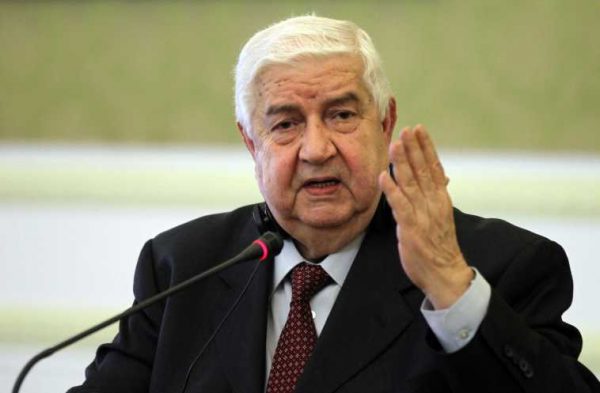
By Adam Garrie | The Duran | September 26, 2017
Syria’s Deputy Prime Minister and Foreign Minister Walid Muallem has stated that once the conflict against terrorist groups is finished in Syria, Damascus will be willing to politically negotiate internal autonomy for Syrian Kurds.
Reuters quotes Muallem, who delivered Syria’s address to the United Nations, as stating,
“This topic (Kurdish autonomy) is open to negotiation and discussion and when we are done eliminating Daesh (aka ISIS), we can sit with our Kurdish sons and reach an understanding on a formula for the future”.
There are several geo-political implications to this statement.
1. Seizing the initiative from the US occupiers
First and foremost, Muallem’s proposals take the wind out of the sails of the United States. As I wrote previously in The Duran, with Syria and Russia quickly securing control over areas east of the River Euphrates, the US is being squeezed out of Syria.
Bearing these realities in mind, one of the only options the US has left is to use the Kurdish national cause in order to foment either a new puppet state in the region that is built on stolen Syrian territory or else create a permanently occupied entity similar to the Serbian Autonomous Province of Kosovo and Metohija. Apart from this, the US will have no choice but to either leave Syria or directly confront the Syrian Arab Army and most likely, also its Russia ally. Presently, the US seems unwilling to confront Russia by any means other than through the US of proxy/terrorist forces and this is unlikely to change.
However, given the extreme backlash against Kurdish separatism in Iraq, the US would not only retain old enemies but gain new ones, particularly in the form of Turkey. Ankara is vocally opposed to Kurdish separatism in Iraq and has threatened to take all measures necessary to stop moves in this direction. Turkey has an even worse relationship with Syrian Kurds. This would automatically mean that the US would be in for a very difficult ride if they backed Kurdish separatism in Syria.
With Turkey’s President Erdogan specifically telling Iraqi Kurds “The Israel flag will not save you”, Syria’s proposals would be a geo-strategic blow not only to the US but also to Israel.
2. Separating SDF terrorists from civilian Kurds with Syrian citizenship
The Arab Socialist Ba’ath party has already given Syrian Kurds full citizenship rights which means that they are co-equals to Arabs as well as to other minorities including Assyrians and Armenians, both of whom are grateful to the pluralistic Ba’athist government for protecting them from foreign funded Sunni supremacist terrorism.
While it is clear that the Kurdish fronted SDF proxy militia is operating as a terrorist force in Syria, the old line about separating terrorists from moderates could work in a post-war scenario where the SDF has been defeated in certain regions and rendered irrelevant in others.
In exchange for negotiated autonomy, one which would clearly have to protect the rights of Arabs in ‘Kurdish regions’ of an Arab Republic, Syria could force Kurdish leaders to weed out those who have collaborated with foreign powers and create a new political paradigm for Kurds in Syria.
This would give the moderate Kurds what they want, it would protect the human rights of Arabs and Syrian minorities and it would allow Syria to further purge her soil of terrorists and enemy collaborators.
3. Leverage with Turkey
Unlike Iraq which is currently collaborating with Turkey in military drills bordering separatist regions of Iraq, Syria has no plans to engage with Turkey after years of Turkey’s participation in the pro-jihadist war against Syria.
However, in actively preventing the formation of a Kurdish state in Syria through a negotiated settlement which Turkey’s new found partner Russia could possibly help to broker, Syria could effectively end the current ‘Kurdish excuse’ which is being subtly invoked by Turkey to justify its continued presence in Syria.
Furthermore, Syria could, possibly again via Russia, offer Turkey assurances that Syria will not allow for PKK activity directed against Turkey to foment on Syrian soil. This would be in the best interests of peace in the region as Turkey and Syria both need to eventually come to terms with the fact that they are neighbours.
Historically, Syria’s traditional regional adversaries have been Israel and Jordan and more recently the extremist Arab states of the Persian Gulf. These are the states Syria must be on guard against when looking to the wider future. Because of this, Syria and Turkey will and should slowly but surely normalise relations.
4. Containing Iraqi Kurds
While Iraqi Kurds are politically at odds with their Kurdish counterparts, there exists a fear that the menacing separatist movement in Iraq could lead towards a greater Kurdish push for a multi-state land grab which would be supported by Israel, especially where Syria and Iran are concerned.
If, as is expected, Turkey sends its troops into northern Iraq, it would send a message to the wider Kurdish movement that Kurdish independence equals creating not a greater Kurdistan but a greater Turkey.
Thus, the example of Iraq when viewed simultaneously with the generous offer from Syria, may lead to moderate elements within the Syrian Kurdish movement making the pragmatic choice for guaranteed autonomy versus the prospect of Turkish domination.
Conclusion
Far from being a concession, it was always expected that after the present conflict against imperialism and imperialist funded jihad, Syria would happily engage in a political process with various parts of the Syrian population, including Kurds, in order to develop a settled internal peace.
Syria, in announcing this now however, sends a strong message to radical Kurds and the United States. The message is clear, Syria is a sovereign country and the Kurdish issue is a purely internal matter.
Featured Video

Macgregor: We Haven’t Seen the Worst of the Iran War Yet
or go to
Aletho News Archives – Video-Images
From the Archives
15 Saudi ‘hijackers’ were CIA agents working for US: Scholar
Press TV – April 13, 2016
Fifteen of the 9/11 “hijackers” from Saudi Arabia were CIA agents working for the United States government, which was seeking to destroy the Middle East for Israel and to double the American military budget, says Dr. Kevin Barrett, an American academic who has been studying the events of 9/11 since late 2003…. continue
Blog Roll
 Aletho News
- Iran’s Plan to Shut Down AI in the Persian Gulf
- Israel seeks ‘compensation’ from Washington over Saudi F-35 sale
- Saudi crown prince seeks dialogue with Ansarullah after Yemeni blows: Report
- Damascus rejects Saudi request for Syrian fighters to counter Yemen: Report
- South Korea says will not send troops to join terrorist US war on Iran
- Russia Just Struck the Eyes of NATO’s War Machine in Ukraine
- Russia summons UK charge d’affaires over Kiev drone support
- NATO member warns bloc seeking pretext for war with Russia
- Macgregor: We Haven’t Seen the Worst of the Iran War Yet
- ‘We are not like everyone else’ laws that bind other nations do not apply to Israel, says Likud lawmaker
- If Americans Knew
- Debunking The Claim That Macklemore Has A “History Of Antisemitism”
- CPJ demands release of arrested Palestinian-US journalist near Bethlehem
- Robert Kraft: The Billionaire Friend of Netanyahu Pulling The Strings Behind the Macklemore/Ed Sheeran Blow Up
- Columbia Administered Fund Gives Big Money to Pro-Israel Groups
- Deportation Case of Palestinian Activist Salah Sarsour Tests First Amendment
- ‘We Will Not Forget’: Palestinians Mark 44 Years since Sabra and Shatila
- Why do we let Zionists decide what we can and can’t say?
- US welcomes Israeli, Iranian delegations to UN, but not Palestinians – Daily Update
- Biden’s Genocide Accomplices Targeted by New Accountability Campaign
- AIPAC’s Network Has Already Spent $67.2 Million to Shape the Midterm Elections
- No Tricks Zone
- New Study: ‘Global Drought Shows No Detectable Recent Acceleration Under Climate Warming’
- Economic Masterminds: German Socialists Suggest Taxing Productivity Gains Stemming From Using AI
- The South China Sea Has Not Been Cooperating With The Climate Change Narrative
- Energy Crisis: Germany Enters Heating Season With Historically Low Gas Reserve Fill Levels
- New Study: The Antarctic Ice Sheet Gained Mass From 2020-2024 Due To Staggering Snow And Ice Accumulation
- Study: Ocean Heating Rates From Thousands Of Years Ago ‘Dwarf’ Modern Ocean Heating Rates
- Climate Extremists Target, Attack Large-Scale Power Grid Infrastructure In Germany!
- New Study: Antarctic Ice Melt Has Contributed Less Than 1 Centimeter To Sea Level Rise In The Last 30 Years
- Fear Of Debate: Alarmist German Climate Scientist Calls On Mainstream Media To Discredit Skeptic Voices
- End-Of-August Arctic Sea Ice Extent Hasn’t Fallen In 20 Years, Official Data Show!
 Aletho News