‘Israel’ commits new massacre in Gaza’s Sheikh Radwan neighborhood
Al Mayadeen | September 6, 2025
At around noon today, a massacre was reported in the Sheikh Radwan neighborhood, where the occupation targeted the home of the Abu Tayeh family on al-Jalaa Street.
The airstrike resulted in the martyrdom of eight civilians and caused multiple injuries. Several victims remain trapped under the rubble, according to Al Mayadeen’s correspondent.
At least 30 Palestinians have been martyred since dawn today across the Gaza Strip, including a child, as the ongoing aggression by the Israeli occupation continues to target aid distribution points and areas where displaced people seek shelter.
Al Mayadeen’s correspondent in Gaza reported that four martyrs and several wounded individuals arrived at Nasser Medical Complex following an Israeli attack on Palestinians waiting for aid north of Rafah.
In a separate incident, a civilian was martyred after occupation military vehicles opened fire on tents housing displaced families in al-Mawasi area of Khan Younis, southern Gaza.
Additionally, a child was martyred and others were injured in artillery shelling that struck a residential building near Sheikh Radwan Bridge in northwestern Gaza City.
Occupation issues evacuation orders for high-rises in Gaza City
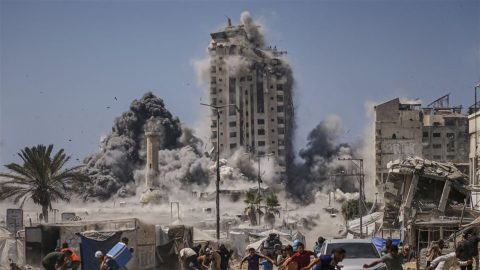 The occupation has issued evacuation orders for several residential towers in Gaza City. Among them was al-Sousi Tower in the city center and the al-Ru’ya Building in Tal al-Hawa, near the al-Maliya junction, signaling plans to strike both.
Occupation warplanes subsequently bombed and destroyed al-Sousi residential tower, located opposite the United Nations headquarters on al-Sinaa Street in the Tal al-Hawa neighborhood, southwest of Gaza City.
“Israel” is systematically destroying high-rises in Gaza City, as it did yesterday with the al-Mushtaha high-rise, as it moves forward with its plan to occupy Gaza City.
Gaza Health Ministry report
The Palestinian Ministry of Health in Gaza confirmed that 68 martyrs and 362 injuries were recorded in the last 24 hours. Among them, 8 were recovered from beneath the rubble, as occupation bombardments continue to leave victims trapped in inaccessible areas due to the inability of ambulance and civil defense crews to reach them.
This brings the total number of casualties since October 2023 to 64,368 martyrs and 162,367 wounded. Meanwhile, the number of casualties since “Israel” broke the ceasefire in March stands at 11,828 martyrs and 50,326 injuries.
“Israel” continues to massacre Palestinians as they wait for aid, as over the past 24 hours alone, 23 Palestinians seeking humanitarian aid were martyred, and 143 others were injured. This raises the total number of aid-related fatalities received at hospitals to 2,385, with over 17,577 injuries.
As for famine-related deaths, hospitals recorded six new deaths, including one child, in the last 24 hours, bringing the total number of such fatalities to 382, among them 135 children. Since the IPC’s declaration of famine last month, 104 deaths from hunger have been recorded, including 20 children.
Scotland’s parliament votes for boycott of Israel amid Gaza genocide
Press TV – September 5, 2025
Scotland’s Parliament has voted to impose an immediate and comprehensive boycott on Israel and companies connected to its genocide in Gaza.
The decision, which highlights Scotland’s solidarity with the Palestinian people, came on Thursday in response to the ongoing humanitarian crisis in the besieged territory.
The motion to sanction Israel and affiliated entities was spearheaded by the Scottish Greens, who allege that the Israeli military actions in Gaza constitute genocide. Reports indicate that at least 64,231 Palestinians have died due to the genocide, and almost the entire population of Gaza has been displaced.
The amendment passed with 62 votes in favor and 31 against, calling on the Scottish and UK governments to implement a series of boycotts, divestment strategies, and sanctions aimed directly at Israel and companies deemed complicit in its genocide.
Support for the motion came from the Scottish Greens and the Scottish National Party (SNP), alongside a proposal introduced by External Affairs Secretary Angus Robertson that acknowledged the recognition of a Palestinian state. However, the Scottish Conservatives opposed the motion, while most Scottish Labour and Liberal Democrat MSPs chose to abstain. The Liberal Democrats notably shifted their voting stance to oppose the amendment’s language.
Scottish Green MSP Patrick Harvie, who introduced the motion, expressed hope that this vote could signal a change in the conversation surrounding Israel and encourage other European governments to adopt a stronger response to the humanitarian crisis. “Palestinians are being starved and massacred every day as part of a campaign of collective punishment and ethnic cleansing. It is our duty to act,” he stated in an interview with The National.
Harvie emphasized the importance of holding companies accountable for their involvement in the genocide, asserting, “If a company profits from apartheid and genocide, it should not be allowed to profit here in Scotland. This vote sets a precedent for action that I hope will inspire governments across Europe and beyond.”
First Minister John Swinney highlighted the Scottish government’s commitment to humanitarian support, announcing plans to block public funding for firms supplying weapons to Israel. He also pledged £400,000 toward the Children’s Operating Room to aid the Gaza Hope Field Readiness Centre in Scotland and assist in establishing a rapid-deployment field hospital within Gaza.
Additionally, Scotland plans to provide medical support for 20 children injured in Gaza, expected to arrive with their families in September, and to donate £600,000 to the UN’s humanitarian coordination office in Palestine.
Swinney underscored the urgent need for action, stating, “We are witnessing a humanitarian catastrophe of historic proportions. The world cannot wait for a final court ruling to take action. A genocide is unfolding, and recognizing this reality carries with it a responsibility to act. The people of Scotland expect nothing less.”
41 percent of Palestinian child detainees have no charges
Defense for Children International – Palestine | September 2, 2025
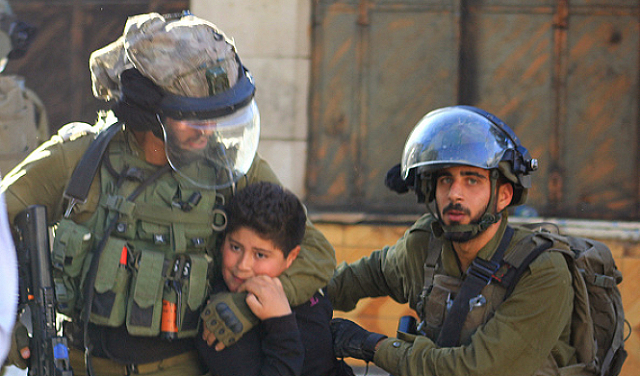
A record number of Palestinian children are held in administrative detention without charge or trial.
360 Palestinian children are detained in Israeli prisons as of June 30, the latest data available from the Israel Prison Service (IPS), which is the highest number since early 2016. 147 children, or 41 percent of the total, are held in administrative detention without charge or trial, which is both the highest number and the highest proportion on record since Defense for Children International – Palestine began monitoring these numbers in 2008. The IPS, which typically releases detainee data on a quarterly basis, was more than two months late in releasing the data from the second quarter of 2025.
“Every month since October 2023, Israeli forces have rapidly expanded their use of administrative detention to target Palestinian children,” said Ayed Abu Eqtaish, accountability program director at DCIP. “These children are languishing in overcrowded Israeli prisons, fed rotten food, and beaten on a daily basis by Israeli guards, all while they are completely isolated from the outside world, including from their families and lawyers. They must all be released immediately.”
The delay in releasing the second quarter data is one more effort on the part of Israeli authorities to obscure and restrict information about Palestinian detainees, including children. Since October 2023, Israeli authorities have severely restricted lawyer visits to the prisons, and family visits were suspended entirely. DCIP has faced immense challenges in documenting rights violations, torture, and ill-treatment endured by Palestinian child detainees since October 2023.
The data released by the IPS accounts for prisons under its administration, including Megiddo and Ofer, where children are detained and imprisoned. This data does not include children who are detained at Israeli military detention and interrogation centers, such as Huwwara, or military bases like Sde Teiman. There is no available data for how many children or adults are detained at these sites, though DCIP has received testimony from previously detained children of torture and dehumanizing conditions being regularly implemented at these locations.
In September 2023, 15 percent of all Palestinian child detainees were held in administrative detention, according to IPS data monitored by DCIP.
Lawyers representing Palestinian detainees now face mounting barriers, including the cancellation of scheduled visits, severe limitations on visiting hours, prolonged delays extending for months, and bans on bringing in even basic case materials. Lawyers are also forbidden from passing on simple messages from families, and children who wish to pass along messages to their families through a lawyer have been beaten. Further, Israel has disallowed the International Committee of the Red Cross from visiting any Palestinian detainees held in Israeli places of detention since October 7, 2023.
Under international law, including Article 37(d) of the Convention on the Rights of the Child, every child has the right to prompt access to legal assistance and to challenge the legality of their detention before a court. Additionally, Israel’s deliberate obstruction of this right, alongside its prolonged bans on family visits and refusal to allow elected representatives to oversee detention conditions, violates the most basic standards of international humanitarian and human rights law. It is clear that Israel has no intention of maintaining its detention system in accordance with international law. Instead, its treatment of Palestinian prisoners amounts to collective punishment, deliberately imposing degrading conditions, restricting access to food, medicine, and communication with the outside world.
Washington sanctions Palestinian rights groups for aiding ICC in Gaza war crimes probe
The White House is covering for Israeli war crimes amid its operation to ethnically cleanse and demolish Gaza City
The Cradle | September 5, 2025
The US has imposed sanctions on three Palestinian human rights organizations that previously petitioned the International Criminal Court (ICC) to investigate Israel for war crimes in Gaza.
“Today, the Trump Administration is sanctioning three NGOs – Al Haq, Al Mezan, and the Palestinian Centre for Human Rights – for assisting in the ICC’s illegitimate actions against Israel. The United States will continue to protect our own sovereignty and the sovereignty of our allies from the ICC’s overreach,” US Secretary of State Marco Rubio wrote on Thursday evening on X.
The announcement first appeared as a notice on the US Treasury Department’s website on Thursday.
In November 2023, the organizations requested that the ICC investigate Israel for war crimes in response to its actions in Gaza, including carrying out airstrikes on heavily populated civilian areas, imposing a complete siege to cut off food, water, and electricity to the civilian population, and causing the mass displacement of residents.
On 31 October 2023, Israel bombed the Jabalia refugee camp, killing some 120 people, mostly women and children, in one airstrike with a 2,000-pound (907 kilograms) bomb.
In May of 2024, ICC prosecutor Karim Khan requested that the court’s judges issue arrest warrants for Israeli Prime Minister Benjamin Netanyahu and then-defense minister Yoav Gallant on charges of using starvation as a weapon of war in Gaza.
The ICC issued the arrest warrants in November 2024.
The US responded by imposing sanctions on ICC judges and Khan, calling the Hague-based court a “national security threat.”
A smear campaign was also launched, accusing Khan of sexual misconduct in the workplace.
The ICC was established in 2002 to try cases of war crimes, crimes against humanity, and genocide. The jurisdiction of the court is recognized by its 125 member countries. However, the US, China, Russia, and Israel do not recognize the court’s authority.
The US Treasury announcement comes as Israel continues its destruction of Gaza City, which Tel Aviv is seeking to ethnically cleanse of its hundreds of thousands of Palestinian residents.
While Israeli leaders say they wish to defeat Hamas, the Israeli military is systematically demolishing Palestinian cities to make way for a mega real estate project backed by Israeli businessmen and the White House.
US President Donald Trump has stated that Palestinians will be forced to leave Gaza, which will be turned into a high-tech smart city and resort hub he has dubbed the “Riviera of the Middle East.”
Israel has issued evacuation orders for Gaza City as the demolition moves forward.
“The Israeli forces, when they mark any area by red color and they request the people to leave, they really will destroy it,” said Gaza City resident Mohammed Alkurdi while speaking with AP.
“It’s not something partial like before. It’s 100 percent,” he said. “The house, I’m telling my friends, it keeps dancing all the day. It keeps dancing, going right and left like an earthquake.”
Another Gaza City resident, Amjad Shawa, the director of a Palestinian NGO network, told AP that “Gaza [City] will be leveled and destroyed,” like other cities in the enclave.
After months of Israeli bombing, “there is no Rafah. Almost no Khan Yunis,” Shawa said.
Some residents of Gaza City are choosing to leave ahead of the Israeli warplanes and bulldozers.
For others, leaving is not possible at all due to age, sickness, and lack of anywhere else to go.
“The elders, they’re saying we will die here,” Shawa said. “This has pushed the other members of the family to stay, not to leave.”
UK anti-genocide activists face dozens of terrorism charges
The Cradle | September 5, 2025
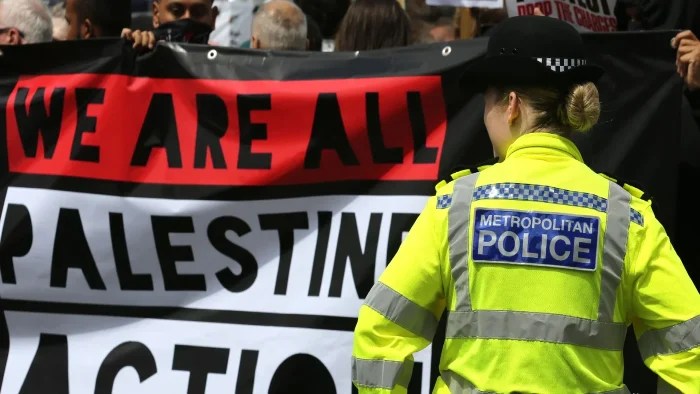
UK authorities charged six campaigners with 42 terrorism offenses on 3 September over their efforts to challenge the ban on Palestine Action.
They were released on bail the following day and placed under a strict curfew. Following hearings at Westminster Magistrates Court, the defendants, including former government lawyer Tim Crosland, were granted bail after the Crown Prosecution Service (CPS) requested they be held on remand.
Defend Our Juries (DOJ), the advocacy group to which the activists belong, said the judge’s decision prevented them from facing up to 18 months in custody due to court backlogs.
According to DOJ, the bail conditions include a tagged curfew between 7:00 am and 9:00 pm, a ban on contacting co-defendants, and a prohibition on supporting Palestine Action either “directly or indirectly.”
A DOJ spokesperson described the outcome as both relief and outrage. “We welcome the release of our key spokespeople and the judge’s decision to reject the CPS’s absurd attempt to remand them in prison for what could have been many months. However, the fact that they are now facing 42 charges between six of them and extraordinarily draconian bail conditions for hosting public Zoom calls is nothing short of a scandal.”
Police said the charges stem from an investigation led by the Counter Terrorism Command into allegations that the defendants coordinated protests and held 13 Zoom calls supporting Palestine Action.
Section 12 (2) of the Terrorism Act makes it a criminal offense to arrange a meeting in support of a proscribed organization, while Section 12 (3) criminalizes addressing such a meeting with the intent of encouraging support.
DOJ said the six were targeted by UK authorities when their homes were raided earlier this week, hours before they were due to announce details of a mass action planned for Saturday.
The group reported that homes were searched and the activists were held beyond the 24-hour custody limit before being charged.
The case follows the UK government’s 4 July decision to proscribe Palestine Action under anti-terror laws, a move triggered by an incident in which members broke into RAF Brize Norton and vandalized two military aircraft with paint and crowbars. The aircraft are reportedly linked to the genocidal war in Gaza and wider military operations across West Asia.
The designation equates the group with Al-Qaeda and the Islamic State, making public support for its activities punishable by up to 14 years in prison, a move strongly condemned by various groups and individuals as “grotesque,” “chilling,” and an “unprecedented legal overreach.”
Making Palestinians Go Away
The Trump Administration Seeks to Ignore the Genocide
By Philip Giraldi • Unz Review • September 4, 2025
Donald Trump, recently sporting his red ballcap modestly featuring the words “Trump Was Right About Everything,” is apparently in regular contact with Israel’s genocidal Prime Minister Benjamin Netanyahu. Per Netanyahu, the most recent telephonic exchange had Trump expressing full support for the establishment of control over all of Gaza and the West Bank by the Israeli Army. Trump observed that Israel has been losing the “PR” (Public Relations) war over the carnage and must push ahead “with full force” to “finish the job” as quickly as possible.
There are also reports of a scheme perhaps launched during a White House meeting including Trump, former British Prime Minister Tony Blair, and Trump son-in-law Jared Kushner which would give Palestinians willing to be ethnically cleansed a “relocation package” of $5000 and some other benefits to get the hell out. Where exactly they would go to is not very clear but it would eliminate the bad publicity if the Israeli army’s has to kill all of them. Gaza would then be freed up to develop the long-sought Trump Gaza Riviera under US trusteeship over the ruins and the tens of thousands of unburied bodies.
As the slaughter of mostly women and children in Gaza continues, the American public as well as voters in many European nations have turned sharply against Israel, presumably a manifestation of Trump’s “PR problem” for the Jewish state. But Israel is striking back with its own weapons, namely the tools that it has used to corrupt the government and media in the United States and all across Europe. There are numerous Jewish organizations as well as Christian Zionist churches backed by the ample funds contributed by Jewish billionaires that make sure that politicians and journalists know which side their bread is buttered on. But it is generally conceded that the most powerful component of the Israel Lobby is the American Israel Public Affairs Committee (AIPAC). AIPAC openly declares that its principal purpose is to strengthen the relationship between Israel and the United States. That actually in practice means subordinating US interests to those of the Jewish state but no politician or journalist on the make is going to defy AIPAC and cut off both the largesse and the political support. AIPAC says it has five million members, 17 regional offices, and “a vast pool of donors.” In 2022, it had 376 employees, an endowment of more than $10 million plus more than $79 million in revenue. AIPAC’s claims to be bipartisan – at its yearly policy conference in 2016 it featured both major parties’ nominees: Democrat Hillary Clinton and Republican Donald Trump.
One of AIPAC’s most prized initiatives is the arranging fully paid for trips by Congressmen and other prominent influencers to Israel, where they are wined and dined and fed the full panoply of lies that the Israelis use to justify their horrific agenda. The trips are in full violation of the Foreign Agents Registration Act of 1938 (FARA) rules that organizations that operate on behalf of foreign governments must register and provide full information providing transparency both on their funding and their meeting with foreign government officials. As the last president to actually seek to have an Israel Lobby entity register was John F Kennedy, his fate might explain why none of the presidents since that time have attempted to do the same.
AIPAC’s latest trick was to send 22 House of Representative Republicans to Israel over the Congressional recess in August where they were hosted by Benjamin Netanyahu himself during what was dubbed a “week long educational seminar”. Netanyahu’s office said in a statement. “The Prime Minister briefed the members of Congress on the war in the Gaza Strip and commented on the issue of the humanitarian assistance and the mendacious campaign being waged by Hamas against the State of Israel.” Speaker of the House Mike Johnson, a Christian Zionist know nothing, was leading a separate delegation of five leading Republicans. He was treated to a private dinner with Prime Minister Netanyahu.
Meanwhile, waiting in the wings was a group of 23 Democratic Party congressmen who descended on Israel after the Republicans departed, also funded by AIPAC. The Democrat delegation was led by House Democratic Caucus Chair Pete Aguilar of California and Representative Steny Hoyer of Maryland. Steny Hoyer has led 20 Congressional trips to Israel.
Journalist Glenn Greenwald has observed how members of the US Congress travel to Israel more than any other country by a large margin. In fact, they make “more trips to Israel than to the entire Western Hemisphere and the continent of Africa combined.” That fact added to the other blandishments offered by the Israel Lobby to “opinion makers” means that Congress and the Media are dramatically pro-Israel and anti-Palestinian to an extent which the American public does not share. In Israel there is no such problem, with a recent poll indicating that a majority of the Jewish Israeli public believing that Palestinians are little more than animals and “should be killed.”
The non-existence status of Palestinians has in fact been a hallmark of the Trump Administration’s foreign policy. The latest move to place the Palestinians in a separate category when it comes to their being allowed to exist at all has come from the US State Department, which has blocked the issuance of visas for the Palestinian delegation which was expected to attend the opening of the United Nations General Assembly session later this month in New York. The State Department said it was doing this to hold the Palestinian Authority and the PLO “accountable for not complying with their commitments, and for undermining the prospects for peace” and there were also evidence-free claims that some of the delegation might have terrorist connections with Hamas. This was followed a few days later by a decision by the State Department to block the issuance of visas to any holder of a Palestinian Authority passport, even including Palestinians who have family in the United States. The new measures will affect visas for medical treatment, university studies, visits to friends or relatives and business travel.
The visa moves come on top of the ghastly tale regarding the fate of a number of Gazan children who were badly injured or wounded by the Israelis and who had the good fortune to fall into the hands of a US-based charity called HEAL PALESTINE that was able to get them out of the Strip for medical treatment in the United States and elsewhere. The children were in need of major surgery and other complicated treatment and were accompanied by at least one of their parents in most cases as they were unable to function independently. The blocking of the children came soon after a right-wing American Zionist extremist, Laura Loomer, described Palestinians from Gaza being brought to the United States for treatment as “jihadis” and “a national security threat.” Inevitably, after America’s Zionist cheering section learned of the arrival of the sixty or so children in the US and went to work, the US State Department, blocked the issuance of any more visas and is now engaged in a “full and thorough investigation” into how the travel was approved and arranged in the first place.
The moves against Palestinian travelers apparently came after a Netanyahu request to Secretary of State Marco Rubio to lower the profile of Palestinians who are likely to be in a position to protest publicly against behavior of Israel in Gaza and on the West Bank. The visa and travel curbs also follow declarations by a number of US allies, including France, the United Kingdom and Canada, that they plan to recognize a Palestinian state at the UN in the coming weeks. Some Trump officials, including the president himself, have strongly opposed this drive for international recognition, which Israel has condemned.
Palestinian officials have inevitably denounced the US action as a deliberate attempt to silence them at a time when Gaza faces mass displacement, starvation, and what UN and International courts have described as a genocide. The US move has drawn sharp criticism from legal experts and international diplomats, who say it violates the 1947 UN Headquarters Agreement, which obligates the United States in its role as the host country to facilitate access for all accredited delegations.
This has led to pushback by the United Nations itself, which reportedly has decided to stage the opening session of the General Assembly in Geneva instead of New York. In fact, in 1988, the UN similarly relocated to Geneva because the US denied a visa to Yasser Arafat, then head of the PLO. The current relocation is similarly intended to insure full Palestinian participation, particularly in a scheduled September 22nd segment which will be dedicated to Palestinian rights. President Mahmoud Abbas is expected to address the Assembly in Geneva, where he will call for international protection, recognition of Palestinian sovereignty, and accountability for Israeli war crimes.
The Geneva session is also expected to increase calls for action under the “Uniting for Peace” resolution, which empowers the General Assembly to recommend steps to take when the Security Council is unable to act due to political obstruction through exercise of vetos or lack of consensus. Advocacy groups are urging the UN to consider deploying an international protection force to Gaza and to suspend Israel’s privileges within the UN system until full humanitarian access is restored. It might also be useful to suspend the United States’ privileges, most particularly including its permanent veto rights on the Security Council, but, alas, that is perhaps asking for way too much!
Philip M. Giraldi, Ph.D., is Executive Director of the Council for the National Interest, a 501(c)3 tax deductible educational foundation (Federal ID Number #52-1739023) that seeks a more interests-based U.S. foreign policy in the Middle East. Website is councilforthenationalinterest.org, address is P.O. Box 2157, Purcellville VA 20134 and its email is inform@cnionline.org.
No conflict over shared values
By Ramona Wadi | MEMO | September 4, 2025
EU Foreign Policy Chief Kaja Kallas has partly blamed the US for the bloc’s losing political leverage in Gaza. “If America is supporting everything that the Israeli government is doing, then the leverage they have is there; the leverage we have is in another place,” Kallas said at the annual EU Institute for Security Studies (EUISS) conference on Wednesday this week.
Yet Kallas’s focus on the “humanitarian crisis” in Gaza is too narrow to put the EU completely at odds with the US. The US and the EU have diverged on the distribution and accessibility of humanitarian aid, but the EU, like the US, is largely silent on Israel’s genocide in Gaza.
When Israel announced its intention to obliterate Gaza, the EU brandished its so-called principles and stood by Israel’s security narrative. It was only after the humanitarian deprivation became impossible to ignore that the EU pretended to shift its stance and focus on humanitarian aid without focusing on ending the genocide. How is the US impeding EU leverage in Gaza if the ultimate aim is Israel’s colonial survival?
It is true, as Kallas stated, that the EU is not united on its stance regarding Gaza. Several EU countries debated whether to apply the International Criminal Court’s arrest warrants for Israeli Prime Minister Bejamin Netanyahu and former Defence Minister Yoav Gallant. Calls for a weapons embargo have not been heeded. The hype building up to the EU discussing whether it should partially suspend Israel’s participation in the Horizon Europe research programme died down the minute no consensus was reached and failed to even state that Israel is committing genocide in Gaza. All the report stated was “indications that Israel would be in breach of its human rights obligations under Article 2 of the EU-Israeli Association Agreement.” Since, according to the EU, there are only “indications”, why should Israel be punished? And since this is another rehashed version of US rhetoric regarding Israel, how is the EU impeded by the US from using its leverage? The EU is not even impeding itself – Israel’s survival remains a top priority for the bloc.
The EU made the most of ridiculing the first presidency of Donald Trump, attempting to make inroads by pitting itself against the US on several stances, while still failing to act. The US “deal of the century” was particularly magnified as the two-state diplomacy suffered a setback. With the Biden administration, under whose presidency Israel received the green light for genocide, the EU was in agreement. A change of presidency in the US will no longer be a convincing argument for Kallas to use. In varying degrees of colonialism and imperialism, the EU and the US are aligned.
In the latest EU meeting held in Copenhagen, there was no consensus once again over “initial punitive action” against Israeli start-ups. Almost two years into Israel’s genocide in Gaza and the EU is still trying to figure out which section of Israel’s economy it can symbolically target in its politics of pretence. Several governments are now speaking of taking initiatives on a national level – also belatedly. Both the US and the EU do not want to punish Israel; they are happy to stand by and let Israel complete its colonial project. “Shared values”, after all, are hard to come by.
Labelling the Palestinian resistance: Political propaganda or legal classification?
By Sayid Marcos Tenorio | MEMO | August 30, 2025
The dominant narrative in the West portrays the Islamic Resistance Movement – Hamas – as a “terrorist group”, uncritically repeating the rhetoric of Israel and its allies. However, when analysing the issue from the perspective of international law and the history of national liberation movements, it is clear that the “terrorism” label is more a tool of political propaganda than a legal definition.
In light of international law and the United Nations Charter, Hamas should be understood as a Palestinian resistance movement in the face of more than seven decades of Israeli colonisation, ethnic cleansing, and military occupation. This also includes almost two years of uninterrupted confrontation with genocide in the Gaza Strip.
The United Nations (UN) has never declared Hamas a terrorist group. Only a few countries, such as the United States, the European Union, Canada, the United Kingdom, and Australia, have unilaterally adopted this classification. International law, in turn, does not criminalise resistance against occupation.
Since 1967, Israel has maintained its occupation of the Gaza Strip, the West Bank, and East Jerusalem, in flagrant violation of the UN Charter and Security Council resolutions. According to International Humanitarian Law, peoples subjected to foreign occupation have the legitimate right to resist, including by armed means, against the occupying power.
This principle is supported by Article 51 of the UN Charter, as well as Resolutions No. 2649/1970, 2787/1971, 3070/1973, and 3103/1974, which explicitly recognise the inalienable right of peoples to fight against colonial domination, foreign occupation, and apartheid. Furthermore, the Geneva Conventions of 1949 and the Additional Protocols of 1977, along with the practice of the International Criminal Court (ICC), distinguish between armed resistance and terrorism.
Therefore, the existence of an armed struggle against occupation does not constitute terrorism, but rather a legitimate exercise of resistance.
Founded in 1987 during the First Intifada, Hamas is not just an armed group; it is also a political, social, and religious movement deeply rooted in Palestinian society.
Its surprising victory in the 2006 legislative elections, which were recognised as free and democratic by international observers, demonstrates its popular representation. It won 76 of the 132 seats, while its main rival, Yasser Arafat’s Fatah, won 43 seats.
Over the decades, Hamas has administered social institutions, hospitals, schools, and assistance programmes, playing a similar role to liberation movements in Algeria (FLN), Vietnam (Viet Minh), or South Africa (ANC), all of which were also labelled terrorists at some point in history. Today, many of these movements are recognised as legitimate builders of their national states.
The classification of Hamas as “terrorist” serves the clear objectives of Israeli policy: To silence the debate on occupation, apartheid, and genocide, diverting attention from the root cause of the conflict; to justify massive attacks against civilians in Gaza, presented as “the fight against terrorism”; to criminalise all forms of Palestinian resistance, whether armed or peaceful – from NGOs to journalists and students.
Judith Butler, an American philosopher from the University of Berkeley, observes that armed resistance under occupation cannot be reduced to terrorism, as this ignores the structural causes of violence: colonialism, supremacism, and military occupation.
Since 2007, Israel has imposed a land, air, and sea blockade on the Gaza Strip, which the UN classifies as collective punishment – a practice prohibited by international law. Millions of Palestinians live without freedom of movement, drinking water, electricity, and medicines. With each Israeli offensive, thousands of civilians are massacred, homes and hospitals are destroyed, and entire neighbourhoods are razed.
The current scenario of indiscriminate attacks on hospitals, schools, and refugee camps is described by international law experts and UN rapporteurs as ongoing genocide, due to the scale of the destruction and the explicit intention to expel or exterminate the original Palestinian population of Gaza.
In the face of this reality, Hamas’s armed resistance should be understood not as terrorism, but as the exercise of a people’s right to self-defence under occupation and ethnic cleansing. The Palestinian struggle is, in essence, a struggle for physical and cultural survival in the face of a colonial project to eliminate all forms of life in Palestine.
The framing of Hamas as a terrorist group is a political construct of Israel and its Western allies, without a basis in international law. Palestinian resistance, whether armed or not, is recognised as legitimate by the UN, the BRICS countries, and international treaties whenever it is intended to confront foreign occupation and colonial oppression.
Calling Hamas “terrorist” is an attempt to delegitimise the struggle of a people seeking freedom, justice, and self-determination. The truth is that Israel, as the occupying power, systematically violates international law, practices apartheid, and commits war crimes and crimes against humanity.
Hamas is an integral part of the Palestinian resistance and must be understood as a national liberation movement, not as terrorism. Recognising this fact is a fundamental step towards a fair and honest reading of the conflict and for seeking a solution based on historical truth, justice, and the right of peoples to self-determination.
Exposing Jewish Exceptionalism In Canadian Media
The misguided belief in eternal Jewish victimhood is being weaponized to help allow Israel’s genocide to continue
By Davide Mastracci ∙ The Maple ∙ September 3, 2025
Over the past decade, I’ve written extensively on the pro-Israel bias in Canadian media. This article will focus on something different, but which helps shape the bias: Jewish exceptionalism.
You can find articles about how various -isms and -phobias impact Canadian media: homophobia, Islamophobia, transphobia, xenophobia, classism, racism, sexism, etc. And yet, there’s little out there on Jewish exceptionalism, which is increasingly being analyzed by commentators outside of the country.
Jewish exceptionalism is the belief that Jewish people as a demographic are eternally and ontologically oppressed, no matter the circumstances, and as such should be treated differently. Jewish exceptionalists refer to antisemitism as the “oldest hatred,” and treat it as though it’s the only one powerful enough to make its targets a permanently marginalized group.
This incorrect analysis fails to take into account the status of Jewish people in Canada and elsewhere over at least the past few decades. While Jews remain the targets of alleged hate crimes (though reports on the issue vastly overstate the reality), they face no systemic discrimination and generally fare exceptionally well in Canada and elsewhere on all other markers used to measure oppression. As a point of comparison, few that anyone would take seriously argue that dozens of churches being burned down in acts of arson since 2021 make Christians an oppressed group in Canada.
This article will illustrate how Jewish exceptionalist sentiment underlies much of the discussion in Canadian media involving Jewish Zionists by outlining five tropes, providing examples of them in mainstream publications and explaining how they smuggle in the idea that Jewish people are exceptional and should be treated as such. The tropes are: ‘Jewish-owned business’; ‘blood libel’; ‘Jewish state’; ‘Jewish neighbourhood’; ‘list of Jews.’
While this article could have been written at any point in recent years, I’ve done so now because Israel, the state claiming to represent Jews and which enjoys widespread support from them according to polling, is committing a genocide in the name of Jewish supremacy, the most explicit form of Jewish exceptionalism. Those who defend Israel and seek to undermine the pro-Palestine movement also utilize arguments that rely on Jewish exceptionalism to do so.
As such, these tropes deserve to be identified and refuted because they strengthen narratives defending the worst atrocity of our time: Israel’s genocide in Gaza.
‘Jewish-Owned Business’
The term “Jewish-owned business” appeared in Canadian newspapers 70 times between Oct. 7, 2023, and Aug. 31, 2025, according to the Canadian Newsstream database. This represents about 78 per cent of the times it had ever been used in Canadian newspapers up to that point.
Since October 7, the term has typically been used in reference to businesses that happen to be owned by Jewish people being targeted by pro-Palestine protesters. Those using the term typically employ the following logic in their articles: 1) the owner of a business is Jewish; 2) their business is being protested or boycotted in some form; 3) the action is happening because the owner is Jewish; 4) therefore, the protests are morally wrong and potentially illegal, and should be condemned.
As an example, a March 2024 editorial in The Globe and Mail erroneously stated as a fact that, “An Indigo bookstore in Toronto was vandalized, because the chain’s founder is Jewish,” and then added, “A democratic country cannot let this stand. And yet it is happening right before our eyes.”
There are genuine historical examples of Jewish businesses being protested or boycotted because of their owners’ religious backgrounds, such as in Nazi Germany, and they have justifiably received widespread condemnation. And yet, despite the explicit comparisons to these examples that commentators will make to generate an emotional response and demonize pro-Palestine protesters, the most high-profile instances of this sort of rhetoric being used in Canadian media have been cases where the owner’s religious identity had nothing to do with the protests and/or boycotts of their business.
In the case of Indigo, as I wrote in October 2024, “the store was targeted because Indigo CEO Heather Reisman is behind the HESEG Foundation, which offers a range of perks to so-called ‘lone soldiers’ who travel to Israel from abroad to join the army.” And as I wrote in October 2023, Café Landwer, an Israeli chain of restaurants, has been boycotted because its co-founder and CEO served in the Israeli military and it opened a location in Jerusalem atop the remains of a Muslim cemetery, among other reasons.
If you revisit the logic I outlined above, and remove the claim the business is being targeted because its owner is Jewish (which is clearly not the case with Indigo and Café Landwer), it breaks down to: the owner is Jewish and therefore their business should not be targeted. The implication here is that it’s OK to target businesses owned by other demographic groups, but not ones owned by Jewish people.
There are cases in Canadian media where this point is made explicitly.
In a March 2024 Toronto Star article, columnist Andrew Phillips writes, “It should have been obvious that an event featuring two such controversial leaders would be targeted by protesters, especially since pro-Palestinian demonstrators have been taking every opportunity to go into the streets and make their views known. And in this case it was a legitimate time and place to protest. They weren’t demonstrating outside a Jewish-owned business, a Jewish community centre, Mount Sinai Hospital or a synagogue in Thornhill, as happened on Sunday. All those should be out of bounds for protests about Israel’s war against Hamas in Gaza and the thousands of civilian deaths it’s caused.”
This is an astonishing claim. Others have made the point a bit more subtly.
Former Liberal MP and now Toronto Star columnist and Friends of Simon Wiesenthal Center CEO Michael Levitt wrote in an October 2023 article: “What Jews are now seeing in Canada is reason for serious concern, including for the safety of their children at schools and universities. It’s the source of tremendous anguish and pain. Anguish and pain from seeing demonstrators converge on Café Landwer in downtown Toronto, calling for a boycott of a Jewish-owned business.”
And in a November 2023 National Post article, Liberal MP Anthony Housefather wrote, “The worst massacre of Jews since the Holocaust somehow unleashed a wave of hate in Canada and around the world. Demonstrations have taken place outside an antisemitism conference in Ottawa, as well as a Jewish community centre in Toronto. Some demonstrators have called for the boycott of a Jewish-owned business.”
In both cases, the authors don’t make an attempt to prove the businesses in question are being boycotted because of their owners’ religious backgrounds, or even make that claim. Instead, the simple fact that a Jewish-owned business is being targeted is portrayed as a problem, with the implication being that doing so is out of bounds because the owner is Jewish.
The fact that antisemitic boycotts of Jewish businesses existed in the past when Jews were an oppressed group is used to imply or state that any boycotts of Jewish-owned businesses now must be hateful as well, despite the fact that the boycotts have nothing to do with the owners’ religious identities. This is Jewish exceptionalism.
‘Blood Libel’
The Holocaust Encyclopedia defines “blood libel” as “the false allegation that Jews used the blood of non-Jewish, usually Christian children, for ritual purposes.”
“Blood libel” appeared in Canadian newspapers 123 times between Oct. 7, 2023, and Aug. 31, 2025, according to the Canadian Newsstream database. I came across just two examples among the 123 of a writer arguing a pro-Palestine commentator invoked what could be interpreted as a version of a blood libel in their writing/speech. (One of them happened to be Norman Finkelstein in 2019.) In the vast majority of cases, the term was used to refer to individuals and/or organizations alleging Israel is committing a genocide in Gaza — allegations that don’t include claims of Israel killing Palestinian children to use their blood for ritual purposes.
Blood libel has a historical definition of which these authors are or should be aware. The discourse pointed to by these authors almost never meets this definition, and they do not make any attempt to prove that it does. And yet, they still wield this accusation.
The writers who use the term “blood libel” will argue I’m being disingenuous here, and that the term now means something else: accusing Jews of anything they’re not guilty of, which leads to Jewish people as a whole facing potential retribution. They are partially correct, as this is how they generally use the term now, though writers don’t note this change in their work when doing so. And yet, the fact that this is the case is actually an example of Jewish exceptionalist thought at work.
“Blood libel” was coined to refer to Jewish people in the Middle Ages — a genuinely oppressed group — being blamed for something of which they weren’t guilty. The term is now used freely by pro-Israel commentators as if nothing has changed since then.
In fact, much has: Jewish people are no longer an oppressed group, and are the beneficiaries of Jewish supremacy in Israel; the allegations made against the Jewish people who make up the vast majority of the Israeli army and political system are credible; the people making these allegations don’t argue the aggressors commit their alleged crimes because they’re Jewish. Despite all of this, “blood libel” is constantly used in Canadian media in an attempt to counter serious allegations against Israel.
National Post comment editor Carson Jerema, for example, wrote in a December 2023 article, “Hamas is using its population as a human shield to blame Israel for civilian deaths and to perpetuate the blood libel that the Jewish state is committing genocide, and the nonsense left is eating it up without question.”
Former Conservative MP and Cabinet member Joe Oliver wrote in a May 2024 National Post article: “Many people buy into the hideous blood libel of genocide of which Israel has been accused since October 7.”
And in a May 2024 article in The Globe and Mail, Noah Richler, the son of Mordechai Richler, wrote, “The blood libel of the Middle Ages makes Israelis in Gaza the deliberate, premeditated mass murderers not just of children and babies but, in the wake of the bombing of a fertility clinic, Jews wilfully slaughtering their enemies even before they are born.”
In calling these charges blood libels (a historic, antisemitic trope), the writers seem to believe it’s antisemitic for people to accuse Israel of genocide — not simply wrong on a factual basis, but inherently antisemitic. They do so because they seem to buy into Jewish exceptionalist thought, where Jewish people are always an oppressed victim group, unable to be oppressors in the way others can be.
I’ve never come across this type of claim in mainstream Canadian publications about another group.
A June 2021 article from The Conversation states, “In addition to the February [2021] motion against China’s treatment of its Uyghur population, Canada recognizes seven other genocides: the Holocaust during the Second World War, the Armenian genocide, the Ukrainian famine genocide (Holodomor), the Rwandan genocide, the Srebrenica massacres, the mass killing of the Yazidi people and the mass murder of the Muslim Rohingya in Myanmar.”
There are groups of people for each of these events who allege they don’t meet the criteria for genocide. But I’ve yet to find mainstream discussion that posits the allegations of genocide are in-and-of themselves hateful against the ethnic/religious group whose members are accused of perpetrating the genocide. For example, I haven’t found articles in any mainstream Canadian outlets alleging that it’s hateful against Russians, Hutus or Turkish people to accuse the states and/or forces purporting to represent them of committing genocide, nor any willingness to treat such claims from the fringes seriously.
As such, Israel is clearly treated as an exceptional state: writers see its Jewishness as making it incapable of genocide, and therefore imply it’s inherently antisemitic to make such an accusation regardless of the clear evidence for it and abundant examples of it being made against forces representing other religious and ethnic groups.
‘Jewish State’
The term “Jewish state” appeared in Canadian newspapers 1,514 times between Oct. 7, 2023, and Aug. 31, 2025, according to the Canadian Newsstream database. A review of these usages in the “commentary” category of articles revealed that the phrase was often used by supporters of Israel defending it against heinous crimes.
This type of usage may be disorienting for some readers, who don’t comprehend why those who support Israel and purport to want to defend Jews everywhere continuously bring up the state’s Jewishness in discussions of its atrocities where it’s not relevant. This would intuitively make sense if done by an antisemite, for example, but why would someone — Jewish or otherwise — who claims to want the best for Jewish people do it?
In some cases, the term is used to imply or outright state that Israel is only being accused of crimes because it’s a “Jewish state.” But as the evidence of Israel’s crimes has mounted, and the term continues to be used, it has become clear that it’s often employed to imply that Israel can’t be guilty of its alleged crimes because it is a “Jewish state,” or that its status as a “Jewish state” makes such allegations ridiculous.
For explicit Jewish supremacists, this implication comes from the belief that Jewish people are superior to others or that Israel’s victims aren’t fully human. For Jewish exceptionalists, it stems from the belief that Jews are eternal victims, and therefore Israel can’t be guilty of the crimes of which it is accused because it is a “Jewish state.”
There are hundreds of examples of “Jewish state” being used in Canadian media.
A November 2023 article from National Post deputy comment editor Jesse Kline uses the term four times, each in a sentence where he responds to Israel being accused of a crime:
- “In reality, Al-Ahli was just a test run, a prelude to a concerted Hamas campaign to falsely accuse the Jewish state of committing war crimes against vulnerable civilians while covering up its own violations of international law”;
- “And the same Hamas run health ministry that perpetrated the Al-Ahli fraud to incite violence against Israelis is now using Israel’s attempts to dismantle those terrorist assets to perpetuate the lie that the Jewish state is committing some sort of ‘genocide’ in Gaza”;
- “It then quoted the director of Shifa Hospital, who claimed Israel was ‘launching a war on Gaza City hospitals,’ and accused the Jewish state of targeting a school (even though Gazan schools have been closed for some time)”;
- “It also accuses Israel of committing war crimes – without, of course, providing any evidence – and calls on the media to use false and inflammatory terms such as ‘apartheid,’ ‘ethnic cleansing’ and ‘genocide’ when describing the Jewish state.”
There’s no apparent reason to use the term at all in the article, much less on four separate occasions. So the fact that it’s used, and the specific manner in which it is, is revealing: it’s employed to cast doubt on the idea that Israel committed the crimes of which it’s accused. And, as my search revealed, it’s not merely some tic Kline has in his writing: there are many other examples.
In a January 2024 Toronto Star article, former Israeli diplomat Daniel Taub wrote, “Far from being motivated by any humanitarian concern for the Palestinians, the South African initiative is a brazen attempt to weaponize a term coined to describe the worst crime committed against the Jewish people themselves and use it against the Jewish state in order to deprive it of the ability to defend itself.”
Avi Benlolo, the founder and CEO of the Abraham Global Peace Initiative, claimed in a January 2025 National Post article, “Trudeau’s criticism of Israel’s military response to Hamas, his government’s ban on arms exports to Israel and his tacit support for legal actions against the Jewish state have emboldened antisemitic rhetoric and actions within Canada.”
And Jay Solomon, the chief advancement officer for Hillel Ontario, claimed in a May 2025 National Post article about the BDS movement: “Let’s be clear: targeting the world’s only Jewish state for economic punishment – especially while ignoring or excusing the abuses of countless other nations – is not a principled stand for justice.”
It’s also worth noting that none of the organizations accusing Israel of genocide or other crimes have alleged its Jewishness makes it more likely of such behaviour. Instead, they’ve analyzed the evidence and come to the conclusion that Israel is guilty of the crime, without any irrelevant reference to the state’s Jewishness.
In essence, the organizations accusing Israel of genocide argue that it’s capable (and guilty) of committing crimes any other sort of state could and/or has. Israel’s defenders are the ones that bring up its Jewishness, and they do so to imply that it makes Israel a victim regardless of the circumstances. This is Jewish exceptionalism.
‘Jewish Neighbourhood’
The term “Jewish neighbourhood” appeared in Canadian newspapers 135 times between Oct. 7, 2023, and Aug. 31, 2025, according to the Canadian Newsstream database.
The phrase ‘x neighbourhood’ is not uncommon in Canadian media. However, the way it’s generally used differs in some important ways from how it’s used when referring to areas with what commentators regard as significant Jewish populations.
Generally, when something is referred to as an “x neighbourhood” it is merely descriptive, referring to the demographic makeup of an area. For example, a February 2025 National Post article refers to the Glen Park area in Toronto as once being a “sleepy Italian neighbourhood,” likely because its ethnic makeup in the 2001 Census was nearly 40 per cent Italian. I’m still not a fan of using this sort of language to describe neighbourhoods or countries, but it’s at least a descriptive statement based on a factual finding.
In contrast, “Jewish neighbourhood” is often used in a manner that goes beyond descriptive usages into prescriptive territory, stating or implying that non-Jewish people (including those who live in the neighbourhood) should behave in a certain way when in the area.
Here are several examples of the term being used in this manner.
In a January 2024 National Post article, Joel Kotkin wrote, “The Liberals also seem to worry as much about Islamophobia as the far more widespread problem of antisemitism, as demonstrated by the recent lawsuit filed by Jewish students at McMaster University alleging that they have been subjected to rising levels of hate. Perhaps sharing in this good cheer, Toronto police even brought coffee to pro-Hamas demonstrators blocking an overpass in a predominantly Jewish neighbourhood.”
In a November 2024 Toronto Sun article, columnist Brian Lilley wrote, “Are Jews being treated differently in Canada? Absolutely, and not in a good way. From local police to the federal government, Jews are clearly not the chosen people of Canadian government officials. […] Last Sunday, as a group of pro-Hamas types gathered at Bathurst St. and Sheppard Ave. W. – a predominantly Jewish neighbourhood – it was a Jew who was arrested.”
And in a December 2024 Toronto Sun article, reporter Joe Warmington wrote, “There was more recognition by police of the concern some Jewish residents, including Councillor James Pasternak, had expressed about pro-Hamas demonstrators aggressively coming into a Jewish neighbourhood disrupting a weekly, peaceful vigil for 100 hostages still held in Gaza.”
In all of these examples, “pro-Hamas” is used to demonize the pro-Palestine protesters in question and portray them as a threat. In doing so, and by highlighting what they perceive as the “Jewish” character of the neighbourhoods in question, the writers imply that it’s a problem for pro-Palestine people to exercise their Charter right to protest in certain areas, simply because more Jewish people may live there than in the average Canadian neighbourhood. And in other examples, it’s sometimes stated or implied that them doing so is the equivalent of Kristallnacht, an absurd comparison that can only be made due to Jewish exceptionalism.
This argument is problematic enough on its own, including when you consider that the areas in question are nowhere near majority Jewish anyways (not that this would make it alright). For example, York Centre, the Toronto ward where Pasternak serves as councillor, was 7.5 per cent Jewish as of 2021 (with larger populations of Filipinos at 13.4 per cent and Italians at 9.1 per cent).
It becomes more disturbing when you consider the demographic makeup of pro-Palestine protests, which, anecdotally, often have a disproportionate share of Arabs relative to Canada’s population. With this in mind, it’s difficult to avoid drawing comparisons to how so-called “Jewish neighbourhoods” in occupied Jerusalem are discussed, with the implication being that force should be used to keep undesirable outsiders away from Jews.
In Jerusalem that looks like attacks from the military and settlers, while in Canada it comes in the form of baseless arrests from police (and sometimes violence from others as well). In Jerusalem, the motivation for this violence is that Jews are entitled to the area and as such it should be cleansed for them, while in Canada the implication is that Jewish people’s supposed eternal status as exceptional victims means extraordinary measures need to be taken to prevent what they see as demographic threats from interacting with them.
To expand on this point, and help demonstrate that it’s not merely some abstract situation, consider the implementation of “bubble zones” in Toronto (which received explicit editorial support from The Globe and Mail on at least two occasions).
In May, Toronto city council passed a by-law allowing for protesters to be barred from being within 50 metres of institutions that successfully apply for the status. While the by-law was framed as being something that could protect people belonging to all communities, in reality it was sought after by the Israel lobby to make protests near some venues that have been linked to Israel illegal.
The first bubble zones were announced in July, and unsurprisingly, 19 of the 21 were centred on Jewish institutions. It’s possible the list may expand to include more institutions from other communities in the future, but as it stands, Toronto’s city council passed a motion that the Canadian Civil Liberties Association referred to as an example of “punitive laws that give municipalities and the police the discretion to broadly restrict peaceful expression,” in effect giving privileged status to Jewish institutions. This happened in part due to the prevalent belief in Jewish exceptionalism.
‘List Of Jews’
In February, I released Find IDF Soldiers, a database based entirely on public information that now contains profiles of 163 Canadians who joined the Israeli military at any point in their lives.
In order for someone to be included in the database, three criteria needed to be met: 1) being Canadian; 2) having served in the Israeli military; 3) having this service already be public.
Every single person on the list thus far is at least partially Jewish, and I haven’t refrained from pointing this out where relevant, including an analysis article presenting my findings on what the typical Canadian Israeli military member looks like.
The fact that the list is entirely Jewish should not be a surprise to anyone. As I wrote on the site: “Jews are the only ones able to immigrate to Israel as citizens due solely to their ethnoreligious background. That accounts for all of the soldiers who were born in Canada and immigrated to Israel later on — they could only do so in the way they did because they’re Jewish. As per the few soldiers in the project who were born and raised in Israel and moved to Canada later, all of them happened to be Jewish. This isn’t a surprise given the demographic makeup of Israel, and the fact that only Jews (74 per cent of the population as of 2023), Druze (just under 2 per cent of the population) and Circassians (0.05 per cent of the population as of 2024) are required to serve in its military.”
As I noted in the analysis article accompanying the database, the average Israeli military member from Canada is a white, Jewish man, born and raised in Canada, who grew up in the Greater Toronto Area in a wealthy neighbourhood, attended private Jewish schools for elementary and/or high school (costing as much as $24,000 per year), had white-collar professionals as parents, and chose to become a lone soldier. This is generally an incredibly privileged group of people willingly deciding to join the Israeli military.
And yet, despite all of this, much of the criticism the project received in mainstream media and elsewhere revolved around the false claim that I was somehow reviving Nazi-era tactics against Jews.
For example, a February National Post article contained a quote from one of the military members saying, “I think there’s a pretty dark historical precedent for making lists of Jews. That’s what it immediately reminded me of, a database of Jews.”
A March article from The Canadian Jewish News (CJN), meanwhile, contained multiple quotes to this effect. Another one of the Israeli military members, speaking on the project, said, “It was literally a list of Jews. That’s all it was. Good for you, you put a list of Jews together. That’s what you did. Like the SS.” Later, CJN stated the member said there was “never a good reason to make a list of Jews,” and then quoted them saying, “There’s a very dark history with that. People think it’s only the Holocaust—it’s not only the Holocaust…It was during the Spanish Inquisition, it was any time there was a need to round up Jews, lists were made. So Jews and lists—not a good thing.”
The article also quoted a professor of journalism at Toronto Metropolitan University and a former senior CBC News producer who said the project is “ethical, if abhorrent,” adding, “It’s ethical because it’s deemed to be in the public interest in some quarters. But it’s abhorrent because we’ve seen where lists of Jews have led in the past.”
There are many more examples of this sort of framing being used when discussing the project in international media, which I have compiled. They include headlines such as, “There’s a New ‘Jew List’ in Canada,” “Repackaging of Nazi-era tactics in a modern context” and “‘We Know What Jew Lists Mean’: Canadian Database of IDF Soldiers Sparks Alarm in Jewish Community.”
This whole saga is an incredibly straightforward example of Jewish exceptionalism. People cynically or genuinely alleged that a journalist creating a database of mostly privileged people on the basis of their participation in the Israeli military for journalistic purposes was in any way comparable to the Nazis compiling information on a systemically oppressed group based solely on their ethnoreligious identity with the intent to harm them.
The fact that this allegation has been taken seriously instead of being mocked is only possible thanks to the widespread belief in Jewish exceptionalism among Canada’s media class.
There are various reasons why writers may believe in Jewish exceptionalism and cling on to it in their writing.
A group of former Jewish-school students I spoke with earlier this year recounted being “brainwashed” with the idea of Jewish exceptionalism throughout their time in the institutions.
For some, Israel’s actions may have finally become too abhorrent to attempt to defend with any sort of logic or facts, and so a reliance on a non-material analysis that doesn’t need any correspondence with the real world can be useful.
Some non-Jewish commentators claim to be wracked with a sense of guilt for a time when systemic antisemitism did actually exist, and operate accordingly.
Others may be concerned about the personal consequences of stepping outside the Jewish exceptionalist framework, which applies to a much broader section of the political spectrum than many would like to admit.
Regardless of the reason, the effect of Jewish exceptionalism is to strengthen Zionist arguments and weaken the pro-Palestine movement by getting it to treat Israel’s genocide of Palestinians and alleged antisemitism as if they’re equally dangerous and urgent problems.
They aren’t. The paranoid spectre of antisemitism is being cynically weaponized to help allow the genocide to continue unabated, and it’s doing the people of Gaza a disservice to pretend otherwise.
Utrecht University becomes first in West to boycott Israel over Gaza genocide
Press TV – September 3, 2025
The Netherlands’ Utrecht University has become the first Western academic institution to enact a full academic boycott of Israel in response to the regime’s genocide in Gaza, marking a historic step that shatters a long-standing taboo in Western academia.
The decision, confirmed in a statement from Rector Wilco Hazeleger, comes after sustained pressure from “demonstrating students and staff.”
The university has “effectively stopped or suspended all institutional collaborations with Israeli parties and will not start any new collaborations,” establishing a boycott that will remain “until further notice,” the statement said.
In his statement, Hazeleger described the move as a moral necessity. “The situation in the world, and in Gaza in particular, requires us to act with a moral compass. There is great human suffering,” he said.
While emphasizing the academy’s duty to foster open dialogue and research for peace, Hazeleger stated a clear red line had been crossed. “It is also clear when there is genocidal violence and a line has been crossed.”
The move aligns with the goals of the Palestinian Campaign for the Academic and Cultural Boycott of Israel (PACBI), which considers it the result of strategic, principled work by students and university staff.
The boycott comes amid increasing international condemnation of Israel’s genocidal war on Gaza and its decades-long occupation of Palestinian lands.
Across the world, academic communities and students have intensified their demands for institutions to divest and boycott all entities complicit in apartheid and war crimes.
Academic institutions have come under significant pressure from professors and students to sever ties with Israeli entities that play direct or indirect roles in normalizing apartheid, research for military purposes, or sustaining the occupation.
Israel launched a genocidal war on Gaza on October 7, 2023, after Palestinian resistance fighters carried out the surprise Operation Al-Aqsa Flood against the regime in response to its decades-long campaign of death and destruction against Palestinians.
According to Gaza’s Health Ministry, at least 63,633 Palestinians have been killed and more than 160,914 injured since the beginning of the war.
Euro-Med: Israel escalates killing of civilians in Gaza’s so-called humanitarian zone
Palestinian Information Center – September 3, 2025
GAZA – The Israeli occupation forces (IOF) have escalated attacks on civilians in Gaza’s so-called “humanitarian zones,” turning areas meant for shelter into deadly traps, according to the Euro-Mediterranean Human Rights Monitor. The Monitor warned in a statement on Wednesday that this is part of a systematic genocidal policy aimed at eradicating Palestinians in the Gaza Strip.
The IOF is reportedly firing directly at displaced persons inside their tents in the al-Mawasi area of Khan Yunis, using sniper rifles, drones, artillery, and airstrikes. These attacks have resulted in dozens of deaths and injuries, including children, women, and journalists, despite Israel labeling the area as “humanitarian.” Eyewitnesses reported instances where soldiers appeared to shoot at civilians for sport.
Among the victims documented recently are 26-year-old mother of two, Ahlam Raed Fayyad al-Shaer, shot while preparing tea for her children, and journalist Iman Ahmad al-Zamli, killed while fetching drinking water. The attacks have destroyed homes and personal belongings, leaving displaced families vulnerable.
Adding to the humanitarian disaster, UNRWA spokesperson Adnan Abu Hasna revealed that deaths from starvation and untreated disease are far higher than reported by Gaza’s Ministry of Health.
Many victims are buried near or inside their tents, with their deaths unrecorded. Over 43,000 children under five, along with tens of thousands of pregnant or breastfeeding women, suffer from severe malnutrition, while the collapse of Gaza’s health and sanitation systems accelerates the spread of deadly diseases such as meningitis and hepatitis.
The Euro-Mediterranean Monitor described the IOF’s deliberate targeting of civilians in displacement zones as a form of genocide, leaving Palestinians with two fatal options: immediate death from bombardment or slow death due to starvation and disease.
Thousands of families are living without adequate food, water, or medical care, while overcrowding and exposure to harsh conditions exacerbate the crisis.
The Monitor called on the UN General Assembly to invoke its emergency powers under Resolution 377 A(V) to deploy a peacekeeping force in Gaza, ensure unimpeded humanitarian access, protect healthcare facilities, lift the siege, and begin reconstruction. It urged the international community to act decisively to stop the ongoing genocide and uphold international law.
Israeli drones drop grenades near UNIFIL in Lebanon amid Hezbollah disarmament push
Press TV – September 3, 2025
The UN Interim Force in Lebanon (UNIFIL) says Israeli drones have dropped four grenades close to peacekeepers working to clear roadblocks, which were hindering access to a UN position, in “one of the most serious attacks” on its personnel since the 2024 ceasefire deal between Lebanon and Israel.
“This is one of the most serious attacks on UNIFIL personnel and assets since the cessation of hostilities agreement of last November,” the UNIFIL said in a statement on Wednesday.
It added, “One grenade impacted within 20 meters and three within approximately 100 meters of UN personnel and vehicles.”
UNIFIL has stated that the Israeli army was notified beforehand regarding its road clearance operations in the area, southeast of the village of Marwahin.
“Any actions endangering UN peacekeepers and assets, and interference with their mandated tasks are unacceptable and a serious violation of Resolution 1701 and international law,” the UNIFIL said.
The resolution, which brokered a ceasefire in the 33-day-long war Israel launched against Lebanon in 2006, calls on the occupying Tel Aviv regime to respect Lebanese sovereignty and territorial integrity.
Last week, the UN Security Council voted unanimously to terminate the UN peacekeeping force in southern Lebanon at the end of next year after nearly five decades, bowing to demands from the United States and its close ally Israel.
The UNIFIL was created to oversee the withdrawal of Israeli troops from southern Lebanon after Israel’s 1978 invasion. Its mission was expanded following the summer 2006 war on Lebanon.
The Israeli attack also comes amid growing pressure on the Lebanese government to disarm Hezbollah. The United States and Israel have increasingly attacked the peacekeeping force for not countering Hezbollah in southern Lebanon.
However, observers note that UNIFIL’s mandate does not include countering Hezbollah, and the resistance movement is widely viewed across Lebanon as a critical deterrent against Israeli aggression.
Despite near-daily Israeli airstrikes and repeated violations of Lebanese airspace and sovereignty, Hezbollah remains the only credible military force capable of confronting the occupation and preventing further Israeli incursions.
Lebanese officials have condemned Israel’s continued occupation of five positions in southern Lebanon, calling it a clear breach of the ceasefire terms.
Prime Minister Nawaf Salam, under growing US-Israeli pressure to push for Hezbollah’s disarmament, welcomed the extension of UNIFIL’s mandate but emphasized the need for Israel to withdraw from occupied Lebanese territory.
Critics, however, question how Lebanese forces can assert control in the south while Israeli troops remain in place and escalate attacks.
As calls to disarm Hezbollah grow louder from Washington and Israel, many in Lebanon argue that such efforts ignore the core issue of Israel’s continued violations of Lebanese sovereignty.
Featured Video

AIDS Inc. by Gary Null (2007)
or go to
Aletho News Archives – Video-Images
From the Archives
Clash of Civilization, Iran Part II
By Jamal Kanj – Intifada-Palestine.com – January 14, 2011
Israel’s survival kit is: perpetuate conflict, insecurity to rationalize collective hate and finally playing victim.
Devoid of conflict, Israel implodes internally; without hate, Zionism loses its justification; and playing eternal victim to continue blackmailing the West. Absence of this holy trinity, Israel ceases to exist.
From its inception, the house of Zion has mastered exploiting adversarial powers to advance Israel’s cause. For instance, their influence over the Democratic Party in the US began with President Truman’s bid for 2nd term election in 1948.
Responding to strong opposition from Secretary of State General George Marshall and Department experts urging against recognition of Israel, President Truman replied: “I’m sorry gentlemen but I have to answer to hundreds of thousands [Jewish voters] who are anxious for the success of Zionism. I do not have hundreds of thousands of [voting] Arabs among my constituents”
Zionists influence over liberal American politics was matched with the doctrinal school of Conservative theoreticians aligning the Republican Party’s platform with Israel’s objectives. The Neoconservative Zionists, coined Zioncons, invented the “Clash of Civilization” concept to fight Israel’s wars. … continue
Blog Roll
 Aletho News
- From Unipolar Universalism to Multipolar Civilizational Distinctiveness
- RSF military group defects, joins Sudanese army: State media
- Ireland goalkeeper refuses to play ‘Israel’ as squad weighs boycott
- China pushes back against US on Cuba, Iran
- Ukrainian Soldiers, Potential Mercenaries: Have Gun, Will Travel!
- Burnham’s UN debut… A masterclass in British disinformation
- Iran flights continue despite US aviation sanctions
- Global Tipping Points Lead the World Into a State of Entropy
- The day-after at the White House: USA and Xi Jinping
- The Geopolitical Balance in the Red Sea: The UAE Being Displaced by New Players
- If Americans Knew
- Israel forces Gazans to live in constant peril – Daily Update
- Deconstructing Netanyahu’s pants-on-fire UN rant – Daily Update
- Trump betrayed voters with his campaign lies and prioritized a foreign country once he took office
- Netanyahu calls Israel’s war in Gaza ‘opposite of genocide’ in UN speech to near-empty hall
- Settler Kidnappings: Torture, Sexual Abuse and Terrorisation of Palestinian Abductees as Israel Deepens Annexation of West Bank
- Gaza winter nears as 162,000 tents become unusable, raising fears of humanitarian crisis
- Netanyahu says, “It’s the opposite of genocide”; UN says Gaza economy is world’s ‘most severe crisis on record’ – Daily Update
- Israel’s US-Backed Assault on Gaza Has Created the ‘World’s Most Severe Economic Crisis on Record’: UN
- ‘Protecting U.S. Citizens’… From Israel
- ‘This is where I live now, the back of a truck’: a day in the life of a grandmother in Gaza
- No Tricks Zone
- New Study: Earth And Venus Surface Warmth Largely Explained By Convection And Lapse Rate, Not CO2 Or Radiation
- 2025 Nature Paper Claiming Worsening Global Drought Gets RETRACTED …Heavily Flawed
- New Study: ‘Global Drought Shows No Detectable Recent Acceleration Under Climate Warming’
- Economic Masterminds: German Socialists Suggest Taxing Productivity Gains Stemming From Using AI
- The South China Sea Has Not Been Cooperating With The Climate Change Narrative
- Energy Crisis: Germany Enters Heating Season With Historically Low Gas Reserve Fill Levels
- New Study: The Antarctic Ice Sheet Gained Mass From 2020-2024 Due To Staggering Snow And Ice Accumulation
- Study: Ocean Heating Rates From Thousands Of Years Ago ‘Dwarf’ Modern Ocean Heating Rates
- Climate Extremists Target, Attack Large-Scale Power Grid Infrastructure In Germany!
- New Study: Antarctic Ice Melt Has Contributed Less Than 1 Centimeter To Sea Level Rise In The Last 30 Years

