Iran’s ambassador and chargé d’affaires to the UN has stressed that any arrangements for the Gaza Strip’s future must fully respect Palestinian rights and self-determination, denouncing the United States and the Israeli regime for the current situation affecting the Strait of Hormuz.
Gholamhossein Darzi made the remarks on Friday, addressing a UN Security Council meeting on the situation in West Asia, including the Palestinian question.
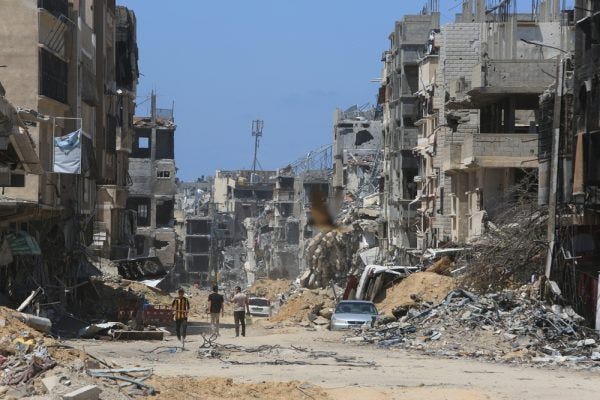
He noted that Gaza remained devastated and continued to be subject to military aggression, despite the announcement of a ceasefire last year.
The ceasefire was announced last October as part of a United States-proposed plan to bring an end to two years of Israeli genocide, supposedly.
The Israeli regime has, however, killed more than 1,400 Palestinians during attacks across the territory ever since, in addition to the tens of thousands it had already killed throughout the genocide that began on October 7, 2023.
Darzi called for a permanent end to the Israeli aggression, lifting of the Israeli blockade on the coastal sliver, and realization of a lasting ceasefire in the territory.
He called for unconditional and complete withdrawal of Israeli forces from the territory as well as immediate and sustained delivery of humanitarian aid and deployment of relief personnel.
The diplomat called accountability for serious violations of international law a legal obligation, condemning the regime for committing genocide, war crimes, and crimes against humanity.
He also denounced expansion of illegal settlements, intensifying settler violence, and Israeli plans for “annexation” of the occupied West Bank.
Palestinians must be able to establish an independent, sovereign, and viable state, with the holy occupied city of al-Quds as its capital and full membership in the United Nations, the official stated.
He also demanded Israeli withdrawal from Lebanese territory and occupied Syrian areas and respect for both countries’ sovereignty.
Elsewhere in his remarks, Darzi slammed the United States and the Israeli regime for launching two rounds of unprovoked aggression against Iran respectively, last June and from February 28 until April 7 this year.
The aggressors, he noted, committed war crimes through deliberate targeting of civilians and critical infrastructure.
He also attributed the situation affecting the Strait of Hormuz to the American-Israeli atrocities, including an American naval blockade.
“Our position is crystal clear: The only practical way to restore normal and safe maritime navigation in the Strait of Hormuz is immediate and permanent cessation of US aggression, provision of credible guarantees against its recurrence, respect for Iran’s sovereign rights, and complete lifting of the naval blockade and other unlawful coercive measures.”
Following the US-Israeli aggression against Iran on February 28, Tehran closed the Strait of Hormuz to its adversaries. The key waterway has remained largely closed ever since, driving up fuel prices worldwide and increasing the cost of living for millions of people.
Tehran has made it clear that it will not reopen the strait until Washington meets its demands, including a permanent end to the war.
BEIRUT – The number of books destroyed by Israeli bombings of libraries, as well as religious and cultural institutions since October 2023, has exceeded 3 million copies, founder and coordinator of the National Network for the Protection of Libraries, Archives, and Cultural Heritage in Lebanon Hadi Bekdash told Sputnik on Saturday.
“There are reports of the burning of more than 700,000 books belonging to Lebanese and Arab publishers, as well as more than 3 million books from homes, libraries, religious centers, family collections, researchers’ libraries, and universities, publishers, cultural institutions, and private collections since 2023,” Bekdash said.
In 2026, practically confirmed information appeared about the destruction of dozens of public and hundreds of private libraries during the conflict with Israel, he added.
These data do not reflect the full scale of losses, since Lebanon still does not have a unified national database of destroyed libraries, archives, and book collections, the coordinator said.
Bekdash added that it will be possible to finally assess the damage only after conducting a nationwide inventory of lost and damaged collections.
A national campaign, A Million Books for Lebanon, is currently underway in the country, aimed at restoring destroyed and damaged libraries.
Chinese Foreign Minister Wang Yi delivered a sharp rebuke to Israeli President Isaac Herzog during a diplomatic meeting in Baku, calling the Palestinian cause “the greatest historical injustice of this century” and demanding that “Israel” halt its expansion in the occupied West Bank, according to statements released Friday by Beijing’s Foreign Ministry.
The bilateral discussions took place on the sidelines of the Conference on Interaction and Confidence Building Measures in Asia (CICA) summit held in the Azerbaijani capital.
According to a Chinese Foreign Ministry statement cited by Reuters, Wang urged the Israeli government to immediately cease its “forced establishment” of West Bank settlements and reverse its expansion policies.
He emphasized that Beijing’s long-standing position remains rooted in resolving the core conflict through a “two-state solution,” calling for the full reopening of access routes to the Gaza Strip to relieve ongoing humanitarian suffering.
Summit walkout and diplomatic tension
The direct exchange between Beijing and Israeli leadership unfolded against a backdrop of heightened diplomatic friction at the summit.
Earlier in the proceedings, several delegations representing Arab and Islamic nations walked out of the CICA conference hall during Herzog’s address in protest against Israeli aggression and continued settlement expansion in the West Bank.
Despite the firm pushback from Beijing, Herzog emphasized what he described as Israeli security imperatives during the meeting, pointing to strategic threats posed by regional groups while highlighting the importance of maintaining economic and trade ties between China and the occupation.
China, which has historically supported the Palestinian cause and recognized Palestinian statehood since 1988, has increasingly positioned itself as an active diplomatic mediator in the region. Wang’s remarks signal Beijing’s continued insistence that the Palestinian cause cannot be stabilized without addressing Palestinian sovereignty and halting unilateral territorial changes on the ground.
A study by University of Maryland researcher Shibley Telhami points to a major shift in US public opinion, with sympathy for Palestinians surpassing support for “Israel” and growing numbers of Americans viewing the occupation as responsible for genocide.
Drawing on Gallup data, Telhami noted that sympathy for “Israel” among the US public has fallen from around 50% to 36%, while sympathy for Palestinians has risen to 41%.
Among Democrats, support for “Israel” has plunged from more than 50% in 2001 to just 17% today, while sympathy for Palestinians has climbed to 65%, according to the researcher.
Telhami’s Critical Issues Poll at the University of Maryland also found that more than 60% of respondents believe US military and diplomatic support enables “Israel” to carry out its actions.
Generational shift extends across political lines
Citing data from the Pew Research Center, Telhami pointed to a narrowing generational gap among Democrats in negative views of “Israel.” The figures showed that 71% of younger Democrats and 66% of older Democrats held negative views of the occupation.
One of the most significant changes, however, has emerged among young Republicans under the age of 35. According to the cited polling, the share of young Republicans expressing negative views of “Israel” rose from 35% to 57%.
Only 22% of young Republicans agreed that “Israel’s” actions in Gaza were “justified as self-defense,” compared with 52% of their older counterparts.
Telhami highlighted findings indicating that 80% of academics since October 7, 2023, and 42% of the general US public feel they must exercise self-censorship or caution when discussing the genocide of Palestinians in Gaza, fearing accusations linked to their criticism.
The findings point to growing public criticism of “Israel” and US support for it, alongside continued concerns about the social and professional consequences of expressing such views.
A prominent Israeli rabbi on Friday issued a religious ruling permitting Israeli occupiers to take olives from Palestinian land in the occupied West Bank, claiming that harvesting the crop “demonstrates Jewish ownership of the land,” Anadolu reports.
The ruling was issued by Rabbi Dov Lior, one of the most prominent religious authorities among Israeli occupiers in the West Bank, and was published by Israeli Channel 13.
It comes amid escalating occupier violence against Palestinians and their property, particularly farmers during the olive harvest season.
Lior claimed that Palestinians do not own their land, arguing that they had not purchased it from the “people of Israel” or from any Jewish person and describing the land as “stolen property.”
Citing Jewish religious law, he claimed that ownership of land cannot be transferred through theft and that Palestinian land therefore remains the property of the “people of Israel.”
He also argued that Palestinians planting olive trees on their land does not give them ownership rights over either the land or its produce.
Lior claimed Palestinians had already received sufficient compensation for planting the trees by consuming their fruit over previous years, and said both the land and harvest should return to what he called their “rightful owners.”
His ruling was not limited to land near illegal settlements, however, and also permitted occupiers to take olive crops from Palestinian areas farther away.
The ruling comes as attacks on Palestinian farmers during the West Bank olive harvest season have intensified, including assaults, preventing farmers from reaching their land, damaging trees and stealing crops.
Such attacks recur during the olive harvest, which peaks in October each year, while this month has seen an increase in attacks by occupiers against Palestinians and their property.
Palestinian, Israeli and international rights organizations have accused Israeli authorities of failing to stop occupier violence or hold perpetrators accountable despite attacks targeting Palestinians, their homes, farmland, vehicles and other property.
Israeli settlements built on occupied Palestinian land are considered illegal under international law, while Palestinians maintain their rights to their land and reject attempts to seize it.
Spanish arms manufacturer General Dynamics European Land Systems-Santa Barbara Sistemas (GDELS-SBS) is supplying Latvia with infantry fighting vehicles fitted with Israeli-made turrets, despite Madrid’s arms embargo on Israel, Globes reported on 15 October.
The deliveries cast doubt on the reach of Spain’s 2025 arms embargo on Israel, imposed in response to Israel’s genocide in Gaza, which bans the import and export of military equipment, products, and technology to and from Israel.
Yet the ban has not stopped Israeli weapons systems from being mounted on Spanish-made combat vehicles for sale to third countries.
Latvia has ordered 84 Mednieks combat vehicles, each mounted with a UT30 MK2 unmanned turret built by lead Israeli weapons manufacturer Elbit Systems, under a contract worth roughly $929 million, with deliveries set to continue until 2029.
Latvian Defense Minister Raivis Melnis hailed the first delivery as a step toward strengthening the country’s defense and its cooperation with NATO partners, as members scramble to meet the US’s demand for greater contribution to the alliance.
Elbit had already secured a deal worth around $100 million in April 2025 to supply GDELS-SBS with the unmanned turrets, months before Madrid declared its embargo, with the Israeli firm stating that the systems were bound for an unnamed European NATO member.
SBS was state-owned until the early 2000s, when it was privatized and sold to US arms giant General Dynamics.
According to Globes, General Dynamics’ presence in Europe greatly helps Israel push its weapons, military components, and technology into the continent, owing to the close ties between the US and Israel.
In early 2026, Spanish Prime Minister Pedro Sanchez’s government came under fire for weighing the purchase of military systems from a company partly owned by Israeli arms giant Rafael, even as it pledged to achieve “zero technological dependence” on Israel.
The arrangement illustrates how Israeli arms firms continue to embed components in European weapons programs through multinational manufacturers, even where governments have restricted direct trade with Israel.
Elbit has benefited from surging demand linked to Israel’s war on Gaza and wider regional conflict, reporting a record $32 billion order backlog as of 30 June 2026.
Europe drove most of the backlog growth in the second quarter of 2026, the company said, with roughly 73 percent of its orders now coming from buyers outside Israel.
The Saudi kingdom is facing the danger of collapse from soaring war costs as Yemeni air strikes ramp up, hitting its northern neighbor’s capital and industrial centers with impunity.
Yemeni journalist Hussein al-Bukhaiti says the corruption and arrogance of the “House of Evil” is culminating in historic defeat. Its U.S. patron seems unable to avert the coming collapse.
Despite decades of the U.S. selling weapons worth hundreds of billions of dollars to the Saudi rulers, the regime seems shockingly exposed, with no viable defenses. Yemen’s missiles are striking Saudi Arabia at will. The panicky rulers are pleading with the United States and Europe for help.
Yemen’s armed forces are taking the war to Saudi Arabia, striking its airports, imposing a no-fly zone over the entire state and shutting down its vital oil industry.
“The Saudis cannot stop our drones and hypersonic missiles… we are taking the war to them,” says Sanaa-based Hussain al-Bukhaiti.
With no oil exports, Al-Bukhaiti reckons the Saudi rulers are facing an existential nemesis. Many observers have long predicted that the autocratic Saudi kingdom, created by the British Empire, is awaiting downfall from its ossified and family-run power structure.
Speaking from the Yemeni capital, Sanaa, Hussain al-Bukhaiti described the Saudi monarchy as “a house of glass” that is now being shattered by air strikes that cannot be defended against.
“Yemen did not want this war, but we are bringing the fire back to Saudi Arabia.”
Western politicians and media are portraying the conflict between the two Arab Peninsula countries as being caused by recent aggression from the Ansar Allah-led Yemeni government.
Saudi Arabia’s King Khalid international airport was attacked on October 10 with ballistic missiles that killed several people. Other Saudi airports have also been hit. This has led international airlines to suspend flights.
The state-owned Aramco oil industry has also been blasted with missiles. Fires are raging at major facilities, including at the main base of operations in Dammam on the Persian Gulf coast.
Following the missile strike on Riyadh airport at the weekend, U.S. President Donald Trump and all European leaders condemned an “act of terrorism” by Yemen.
Hussain al-Bukhaiti pointed out the gross hypocrisy of European governments not condemning the thousands of Saudi air strikes on Yemen that have occurred since 2015. These governments still remain silent about the ongoing Saudi atrocities against Yemeni civilians. The European Union even declares “solidarity” with Saudi Arabia.
The Saudi monarchy, led by Crown Prince Mohammed bin Salman, started the war with unprovoked attacks in March 2015. The aggression was enabled by the United States, Britain, and France supplying warplanes, bombs, and intelligence.
These Western powers continue to arm and direct the Saudi regime in its war against Yemen.
Since 2015, there have been thousands of Western-backed air strikes on Yemen, resulting in more than 20,000 mainly civilian deaths.
“They hit everything, schools, hospitals, water-treatment plants, farms, homes, wedding and funeral halls,” says Al-Bukhaiti.
In addition, over 400,000 Yemenis have died from starvation and diseases caused by a blockade on the country imposed by Saudi Arabia and its Western backers for over 10 years.
He says the war reignited in July 2026 after the Saudis broke a four-year truce signed in 2022 by bombing Sanaa international airport. There was no condemnation by Europe of the Saudi violation then.
What Yemen is doing to Saudi Arabia now is but a taste of what the House of Saud inflicted on Yemenis since 2015 with Western support.
The Yemenis this week rejected a reported Saudi proposal for a short-term truce because they see it as just a ploy by the Saudis for rearming and regrouping in a losing situation.
For the war to end, Saudi Arabia must respect Yemen’s sovereignty and stop interfering in its internal affairs.
However, Hussain al-Bukhaiti thinks that the United States will double down and escalate its military involvement in Yemen with a full-blown war. This is not primarily to support the Saudi monarchy, he believes, but rather to prop up the Israeli regime.
Yemen has inflicted huge damage on the Israeli state since it intensified the genocide against Palestinians in October 2023. Yemeni air strikes have repeatedly struck Tel Aviv despite American air defenses.
An expanded U.S. war in Yemen might seem surprising given that Trump has made such a mess of his reckless aggression against Iran and may not have the military forces at his disposal.
But Al-Bukhaiti believes the issue is beyond Trump’s choice. Washington is locked in with the Zionist regime and will do whatever it takes to salvage Israel from defeat. Yemen represents the biggest threat to Israel from the cutting off of its shipping in the Red Sea.
“We are ready for the war that is coming,” he warns.
Espionage novels portray the spy as a person in a trench coat carrying stolen documents and disappearing into a dark alley. Israeli spy, Jonathan Pollard, certainly fit that picture. A Navy analyst who stole American secrets including the complete ten-volume manual of the National Security Agency exposing how the US gathers its signal intelligence and the names of thousands of foreign individuals who worked for US spy agencies. Intelligence officials believe Israel shared stolen documents with the Soviet Union. According to several intelligence assessments, Pollard was one of the most damaging spies in US history.
Pollard received a life sentence in 1987 and was released in 2015. At first, Israel claimed he was a rogue, apologised and did not admit he had been its agent until 1998. In 2007, Israel named a square in Jerusalem after him, honouring him for his services.
Pollard was neither the first nor the last Israeli asset. Lawrence Franklin, a Pentagon analyst, pleaded guilty in 2005 to passing classified information to an Israeli embassy official and two AIPAC staffers. Ben-Ami Kadish, a former Army engineer, pleaded guilty in 2008 to passing secret documents to an Israeli consulate official, and served no prison time. Stewart Nozette from NASA was charged with attempted espionage following an FBI sting operation. In 1970, Richard Perle was caught in an FBI wiretap discussing classified information with an Israeli embassy official.
In 2001, the same Perle chaired the Pentagon’s Defense Policy Board, while two other Israel-firsters, Douglas Feith and Paul Wolfowitz held senior posts in the same building. Franklin had worked in Feith’s policy office when he was indicted for espionage. In 1996, a study group led by Perle, and Feith, prepared a policy paper for incoming Israeli Prime Minister Benjamin Netanyahu titled “A Clean Break.” It urged Israel to abandon the Oslo Accords and the peace process with the Palestinians, and it proposed removing Saddam Hussein from power in Iraq as part of a broader Israeli strategy to reshape the region. Five years later, as leaders in the Pentagon, they delivered America’s first made-for-Israel war in Iraq.
The above is in no way intended to insinuate or allege that anyone, least of all these Zionist Americans, has dual loyalties. No. It is so profound, there is only one way to describe it: Israel-first loyalty.
Fast forward to 2026. David Milstein, stepson of Israeli propagandist Mark Levin and a senior aide to Ambassador Mike Huckabee, effectively the ambassador’s chief of staff. An unabashed Israel-first American Zionist, Milstein oversees the embassy’s West Bank and Gaza portfolio, placing the fox in charge of the henhouse. According to The New York Times, citing a dozen people who have worked with him, Milstein has repeatedly quashed or rewritten embassy reports to the U.S. State Department to favour Netanyahu’s government.
When the Israeli government accelerated the approval of building more Jewish-only colonies in occupied West Bank, embassy staff drafted an urgent memo warning that the move might cross President Trump’s own red line against annexation. According to The Times, the memo never left Jerusalem.
In response to the surge in attacks by Israeli Jewish mobs on Palestinian homes and farms, embassy staff prepared a report documenting Israel’s failure to rein in violence by Zionist youth. Milstein rewrote it and sent an embassy cable to Washington titled “Government Cracks Down on Escalating West Bank Violence.” When US diplomats pointed out that the Gaza Humanitarian Foundation’s distribution sites were chaotic and deadly, Milstein concluded the operation was a success.
Thirty members of Congress, led by Senator Chris Van Hollen, asked what had become of the investigations into the killings of nine Palestinian Americans by Israeli Jewish mobs and soldiers. Embassy staff compiled a report showing little progress and no charges. According to The Times, the report was set aside in favor of a letter saying Israel was handling the cases properly.
Cable traffic from the section covering Palestinian affairs fell from several a week to a few a month, because American embassy staff feared their work would be blocked, rewritten or impact their diplomatic career. Milstein would question embassy staff if they were “pro-Israel” or “pro-Hamas,” not if they were loyal Americans. A diplomatic mission that polices loyalty with questions like that ceases to function as an American embassy.
I once shared a lunch table with an American ambassador serving abroad. He recounted how, during George Shultz’s tenure as Secretary of State, Shultz would meet newly appointed ambassadors, point to a world map in his office, and ask the appointee to identify their country. Most would point to the country where they had been assigned. Shultz would correct them: “No, your country is the United States. Your duty is to serve your own country’s interests, not those of the country to which you are assigned.”
Ambassador Huckabee and Milstein either never heard that lesson, or serving Israel was their priority.
Rather than representing American interests in Jerusalem, the embassy operates as Israel’s envoy within the US government. Turning the US embassy into a Zionist mission run by the evangelical church, and an indoctrinated Zionist whose stepfather is referred to as “Tel Aviv Levin.”
Here again, no one is accusing Huckabee or Milstein of being foreign agents. Frankly, Israel does not need them to be. It need not recruit them or pay them like Pollard. Officials ideologically devoted to Israel can do the same work from within the U.S. government, under legitimate titles and without risking arrest.
No country receives more American financial and military aid than Israel. Yet US counterintelligence assessments have identified Israel as one of the most aggressive intelligence-gathering threats to the American homeland. Jonathan Pollard and others may have been the quintessential trench-coat spies. But the more dangerous risk is not someone stealing classified files; it is Americans whose loyalty to Israel overrides their duty to the U.S., operating in the halls of the White House and the Pentagon with one focus: serve Israel.
Consider David Frum, who coined President George W. Bush’s “axis of evil” phrase, helping lay the rhetorical roadmap for America’s longest foreign war.
Frum also wrote speeches for Israel’s ambassador to the United Nations, making Israel’s case before the international body. The same writer, serving an Israel-first agenda from two different platforms: first helping sell America a war in the Middle East, then making Israel’s case before the world.
In the 21st century, with Zionist control of mainstream corporate media, and these implants inside America’s halls of power, Israel does not require trench coats, or stolen documents. It operates through officials who occupy positions of power deciding what American policymakers read by shaping diplomatic reporting, suppressing information and steering American decisions in ways that advances Israel’s strategic interests over America’s own. And whenever Israel’s interests and Washington’s information needs diverge, the information bends, delivered in plain sight, through official channels, under official titles, and on the American taxpayer’s payroll.
Yemeni missiles fired at Saudi Arabia are destroying oil facilities and airports across the country – drawing particular international outrage was the ballistic missile attack on Terminal 3 of King Khalid Intl. Airport, an attack that killed 13 and left another 307 injured. As is usually the case, the corporate media starts the clock where it chooses instead of looking at the context, a similar tactic that is used when reporting on Palestine.
On October 10, a missile fired by the Yemeni missile units of Sana’a’s Ansarallah-led government caused a mass casualty event at Riyadh’s main international airport. It then drew broad condemnation from governments around the world, grabbing headlines across the corporate media.
The Saudi-led coalition’s spokesman, Maj Gen Turki al-Maliki, then called the attack a “full-fledged war crime” and said that striking a civilian airport was a “cowardly terrorist attack”. The UN Secretary-General Antonio Guterres also weighed in and expressed his shock at what he called a violation of international law, urging the attacks to stop.
However, Guterres and various government officials never commented on Saudi Arabia’s airstrikes against Sana’a Intl. Airport on July 13, which broke the years-long ceasefire between Yemen and Saudi Arabia. Nor did Israeli Prime Minister Benjamin Netanyahu, who himself ordered airstrikes on Sana’a Intl. Airport in the Yemeni Capital of Sana’a last year.
Unpacking The Lies and Hypocrisy
While the Saudi leadership has attacked its airports to generate international sympathy, it has been launching airstrikes on Yemeni airports for over a decade.
On the first day of Saudi Arabia’s war against Yemen, on the 26th of March in 2015, airstrikes struck both Sana’a Intl. Airport and the neighboring Bani Hawat residential neighborhood, killing around 34 civilians, including children. Since then, the Saudi air force has carried out over 227 strikes targeting Yemeni airports.
The breakdown of the ceasefire, which was achieved through UN mediation back in 2022, came as a result of Saudi Arabia bombing the Yemeni Capital City’s main airport, in a bid to stop an Iranian civilian airliner from landing there. Riyadh has imposed a siege on Yemen – by land, air and sea – since 2015, even inflicting a man-made famine on the country.
Saudi Arabia is responsible for killing between 9,000 and 18,000 civilians inside Yemen. Schools, mosques, weddings, hospitals, and even funerals have been struck by the Saudi air force. In total, around 400,000 people have been killed as a result of the Saudi-led war on the country.
However, the international media coverage robs current events of both the historical and current context. Take, for example, the following headline published by Reuters, which is held up as the gold standard of Western journalism:
“Houthis fire missiles at Saudi Arabia, breaking years of calm,” read the headline. However, the story they were covering, admitted through their use of the video of Saudi Arabia’s strikes on Sana’a Intl. Airport, painted Yemen as the aggressor.
In reality, no political entity called the “Houthis” exists; the name of the Party that the corporate media refuses to correctly name is Ansarallah, which heads the government that rules over the majority of the Yemeni population and is based in the nation’s Capital City. Its opposition is called the Presidential Leadership Council (PLC), which was officially formed in the Ritz-Carlton hotel in Riyadh, Saudi Arabia, back in 2022. The PLC is a proxy of the Saudi government, and its leaders are all based inside Saudi territory, not Yemen.
The next obvious point to note here is that Yemen’s Armed Forces were responding with missile fire towards Saudi Arabia; they were not the aggressor. In retaliation for Riyadh’s decision to continue violently imposing its blockade on the country, it also declared a blockade on Saudi Arabia’s Red Sea ports.
To specifically address the point about the attacks on King Khalid Intl. Airport, it is important to note why this happened and that the Saudi authorities knew the dangers. In early October, Saudi Arabia conducted 1,000 airstrikes on Yemen, using 100 aircraft, while the forces back in Yemen attempted to launch a counter-offensive on the ground.
The Ansarallah-led government’s Armed Forces then announced, in response to the large-scale assault, that they would be imposing a no-fly zone over Saudi airspace. What proceeded to happen was a number of missile attacks on airports in order to shut them down; at first, these attacks caused no known casualties and were to serve as a warning.
As Saudi Arabia continued its airstrikes across Yemeni territory, the stakes were then raised and Riyadh’s main airport became the target. Missiles were at first fired into targets at the airport as a warning to close it down. The Saudi authorities ignored these warnings. On October 8, Yemeni missiles then struck aircraft while they were grounded at King Khalid International, which destroyed one commercial airliner, damaged two others, and killed 3 people.
Despite this attack and clear warnings to close the airport, the Saudis insisted upon keeping it open. On October 10, then came the mass casualty event that inflicted 13 fatalities along with hundreds of injuries amongst civilians.
Targeting a civilian airport is indeed a violation of international law. Yet, when Israel and Saudi Arabia bomb Yemeni airports, there is no outcry. Which brings us to the heart of this issue: why should it be expected that Ansarallah respect international law in this respect when there is no consequence for Saudi Arabia, Israel, or the United States, for that matter?
Riyadh is currently bombing targets throughout Yemen, using Israeli military intelligence support to do so. Meaning that the Saudis are being backed by a State that is committing genocide. On the other hand, the only State in the Arab World that invoked the Genocide Convention, imposing a blockade and firing munitions directly at Israel, was the Ansarallah-led government in Sana’a.
According to Western leaders, Israel and Saudi Arabia, Ansarallah is a terrorist organization. So why then did Saudi Arabia not close its airport as a precautionary measure, in order to protect civilians following the direct strikes on it and threats to go further? Does Riyadh not have the responsibility to protect civilian passengers?
Why is bombing a Saudi AirPort a terrorist act, but bombing Yemeni AirPorts hundreds of times is not even an issue capable of grabbing a headline? How can anyone expect international law to be respected, when the ones who claim to champion it the most selectively use it only when it favors them? These are simply common sense questions.
What Yemen is now doing is imposing the exact same reality on Saudi Arabia, as has been imposed upon it for over a decade. Only now, when the Israeli-backed Western ally is getting hit, is anyone even noticing.
In so many ways, the predicament of Yemen is like the situation in Palestine. Nobody batted an eye at the conditions in Gaza until the Hamas-led attack on October 7, 2023. Then the media framed the Palestinians as the aggressors.
The corporate media spoke of a “Hamas-run Gaza Health Ministry” in order to downplay the civilian death toll; similarly, in Yemen, they report on a “Houthi-run Yemeni Health Ministry”. Understanding the attacks on Saudi Arabia is simple if the context is applied. Either a negotiated settlement is to be reached to end this war, or it will continue until regime change on one side occurs.
– Robert Inlakesh is a journalist, writer, and documentary filmmaker. He focuses on the Middle East, specializing in Palestine.
The Gaza Ceasefire Is Falling Apart. And So Is the American Plan to Expand the Abraham Accords.
The Gaza Ceasefire That Is Killing Palestinians
The ceasefire in Gaza, which took effect on October 10, 2025, was supposed to stop a two-year war. By then, according to Palestinian authorities, more than 72,000 Palestinians had been killed. A year after the document was signed, the picture was no more peaceful. According to Palestinian sources, from the start of the ceasefire to October 5, 2026, Israeli forces killed 1,460 Palestinians and wounded 5,116. By September 2026, Gaza authorities reported 5,147 violations of the agreement, 1,421 dead, and the destruction of more than 201,000 buildings.
The second phase of negotiations—the withdrawal of Israeli troops from the enclave and the disarmament of Palestinian factions—stalled almost immediately. In April 2026, American-Egyptian talks in Cairo ended “without tangible progress.” Hamas links disarmament to the end of the occupation. Israel demands disarmament as a precondition for any further step. Critics say the demand for disarmament has become a pretext for maintaining control over the enclave and continuing violations. The Palestinian Foreign Ministry put it bluntly: the occupation government “does not view peace as a goal, but as an obstacle.”
Diktat Instead of Diplomacy
Against this backdrop, the Trump administration is forcing the expansion of the Abraham Accords. In May 2026, the U.S. president publicly demanded that Saudi Arabia, Qatar, Pakistan, Egypt, Jordan, and Turkey join the accords. He called it “mandatory”: “After all the work done by the United States to put this complex puzzle together, it must be mandatory for all these countries to at least simultaneously sign the Abraham Accords.” Pakistan publicly refused. The others remained silent.
Washington’s main interest is Saudi Arabia. Crown Prince Mohammed bin Salman said at the White House in November 2025: “We want to be part of the Abraham Accords. But we also want to be sure that we secure a clear path to a two-state solution.” Later, Riyadh repeated: normalization is impossible without a “credible, irreversible, and time-bound path” to a Palestinian state. The Israeli government rejects this prospect. American pressure goes beyond diplomacy: Trump tied the Abraham Accords to negotiations to end the war with Iran, effectively making normalization a condition for peace. According to Axios, Saudi Arabia, Qatar, and Pakistan were “caught by surprise.”
Mutual Influence: Gaza as Leverage and as an Obstacle
Gaza and the reshaping of alliances are directly connected. The Palestinian question became leverage in Arab states’ bargaining with Washington. For Saudi Arabia, normalization with Israel without movement toward a Palestinian state is politically toxic. Riyadh is using the fragile ceasefire to postpone an unpopular step. Qatar, a key mediator, took an equally tough position. Qatari Foreign Ministry spokesman Majid al-Ansari said: “If the Palestinian question remains unresolved, joining the Abraham Accords is impossible.” According to him, the absence of a peace process for Palestinians means the absence of stability in the region. Doha, which has given refuge to Hamas’s political leadership and plays a central role in the talks, cannot move toward normalization without losing face.
There is also a reverse dependency. The Trump administration, seeking to expand the Abraham Accords, pressured Israel to secure a ceasefire: normalization without a ceasefire would have been impossible. But the second phase depends on whether Washington is willing to pressure Israel, not just Arab capitals.
Bombs Instead of Peace
The result of U.S. and Israeli policy looks increasingly contradictory. Three years of war, more than 74,250 dead Palestinians, and 1,460 killed after the ceasefire was signed are not just a humanitarian catastrophe. They are a verdict on America’s strategy in the Middle East. Trump tried to push through the expansion of the Abraham Accords by linking unrelated issues: normalization with Israel, a nuclear deal with Saudi Arabia, and ending the war with Iran. In July 2026, he stated directly that a U.S.-Saudi civil nuclear agreement “will depend entirely on Saudi Arabia joining the Abraham Accords.” Saudi Arabia responded in May 2026: “There will be no normalization without a clear and final path to the creation of an independent Palestinian state.” As the custodian of the two holy mosques, the kingdom cannot afford to do otherwise. Qatar refused. Pakistan publicly rejected it. Egypt, Jordan, and Turkey remained silent.
Criticism of Washington goes far beyond diplomatic missteps. The U.S. continues to supply Israel with weapons despite ceasefire violations. In September 2026, the Trump administration proposed a $2.8 billion deal to sell Israel 40,000 heavy bombs, including 20,000 MK-84s and 20,000 BLU-117s. Senator Chris Van Hollen vowed to block the transfer: “Trump is sending $2.8 billion worth of bombs, paid for by you, the American taxpayers, to a government led by a wanted war criminal.” Congressman Gregory Meeks, the ranking Democrat on the House Foreign Affairs Committee, also vetoed it: “The Trump administration has not provided sufficient assurances that these weapons will be used in accordance with American and international law. Therefore, I will not approve this sale.” Amnesty International urged Congress to block the deliveries, saying the U.S. risks becoming complicit in serious violations of international law, including genocide. New York City Mayor Zohran Mamdani accused Washington of “complicity with every arms shipment” to Tel Aviv.
What Next: The Results of U.S. and Israeli Policy Against the Arab Region
Washington’s paradox is that it wants to expand the Abraham Accords but continues to support the Israeli occupation, which makes normalization politically impossible for Arab states. The U.S. has blocked UN Security Council ceasefire resolutions for the third time in a row, undermining its role as a “reliable mediator.” Public opinion in the Arab world is sharply opposed to normalization. Polls show that 89% of Moroccans oppose recognizing Israel. Analysts warn that for most of the named states, the political price of signing the accords will be prohibitive. The war in Gaza has strengthened this sentiment, not weakened it.
The main question is whether the ceasefire will hold. If the second phase of negotiations does not start and the death toll continues to rise, expansion of the Abraham Accords will remain an unattainable dream. Saudi Arabia will wait. Qatar will mediate. The UAE will increase oil production. Trump will face a choice: keep pressuring Arab capitals or admit that without a real Palestinian state, the accords will remain a facade. While Washington supplies bombs and Tel Aviv keeps killing, talk of peace looks like a cynical game in which Palestinians are not subjects but a bargaining chip.
Muhammad Hamid ad-Din is a well-known Palestinian journalist.
An Israeli digital advertising agency helped run an espionage campaign using a vast network of online ads to track targets and hack their devices, Reuters reported on 15 October, citing two research groups.
Reports from Canadian cyber watchdog group Citizen Lab and New York advertising security firm Confiant document how the Israeli advertising agency Discover-Tech placed millions of ads online each day for ordinary products such as phones or earpods.
Discover-Tech placed the ads using the advertising services of Google, Comcast, Yandex, and other search engines.
The Israeli ad agency could identify and track internet users who visited websites or used apps with the malicious ads, and at times obtained phone numbers from smartphone users.
Clicking on the ads was not required to allow users to be tracked.
Some ads were used to plant spyware from another Israeli firm, Candiru, on users’ devices.
Jerome Dangu of Confiant said Discover-Tech placed at least 10 million online ads per day, affecting more than 120,000 websites and 75,000 apps.
“Very likely hundreds of millions of people would have been touched by Discover-Tech,” Dangu said.
Citizen Lab said Candiru spyware delivered through Discover-Tech’s ads had been used to compromise devices of journalists and executives at the Qatari news outlet Al Jazeera.
Unidentified media organizations in Mexico, Israel, and Europe were also targeted.
Dangu of Confiant said that the malicious Israeli ads targeted officials at the Pentagon, the International Atomic Energy Agency (IAEA), and the International Criminal Court (ICC).
Discover-Tech ads also helped to surveil the populations of entire regions, most notably the Israeli-occupied Palestinian West Bank and Gaza.
“You go to almost any site in Palestine – any site – you find a Discover-Tech ad. It gives them a very complete visibility on the digital activities of an entire country,” Dangu said.
Citizen Lab also said the malicious ads were directed at officials in the UN, NATO, the European Commission, as well as more than a dozen governments.
The ads also helped to track employees and executives of chip-related firms such as Nvidia, SanDisk, Broadcom, and Micron.
As a result of the Confiant and Citizen Lab investigations, Google said it has removed Discover-Tech from its ad platforms “for systematically violating our policies.”
IAB Europe, an association for digital marketing and advertising on the continent, has now suspended Discover-Tech from its list of globally approved vendors.
Comcast ad tech subsidiary Beeswax also removed Discover-Tech from its platform.
Yandex did not respond to Reuters’‘ requests for comment.
Israel has a well-documented history of using private technology companies for surveillance, intelligence gathering, and cyberespionage.
Some of these companies have close connections to Israel’s military and intelligence services, particularly Unit 8200, the Israeli military’s signals intelligence unit.
What Israel has done, is doing, to Gaza has not sprung ex nihilo from October 7.
Genocide is not a situational counter-response to aggression. It’s a coming-out event of sorts.
Differently put: There are no legitimate antecedents to genocide. Genocide is not a “war crime” to which a set of mitigating or exculpating legal defenses can attach.
Genocide is a stand-alone indefensible crime—“the blackest of all crimes”—for which there are no extenuating circumstances and to which no traditional legal defenses attach.
Ethnocide, depopulation, domicide and daily mass murder can never be explained away or exculpated using argument from law, ethics or history.
In essence, talk to the hand about October 7, 2023; because the face isn’t listening. Just as there are no legal or moral extenuating circumstances for genocide, so it is that there are no historical defenses for this “blackest of all crimes,” for genocide.
To assert that you are just, justified or even coherent as you carry out that which cannot be just or justified—this is to embody a most grotesque incoherence and contradiction.
At minimum, Israel deserves—and has yet to receive—the unanimous revulsion and isolation reserved for entities whose existence is a confidence trick and a fraud upon us all.
Reality is truth, past and present. The reality of genocide gives rise to irrefutable truths. From the facts of this Twenty-First Century Genocide; certain truths immemorial and irrefutable that traverse time have emerged. Truths about Israel.
Through Gaza, the world has come to know Israel’s ways with the Palestinians, with their lands and homesteads—down to what Israeli terrorists habitually do to the intimate bits-and-bobs that make up a household.
Through Gaza, we have come to know Israel’s ways across the Levant and beyond. They unground and salt the earth forever. They uproot ancient communities and their olive groves. For fun. They deform babies and the baby faces of children for life.
The reality on the ground is of genocide ongoing, of daily extermination. In aggregate, a “child has been killed in Gaza every 71 minutes for three years.” This extermination campaign is not only of children—the one segment of Palestinian society which American conservatives are comfortable defending—but of adults, young and old: admirable, valuable adults. Adult lives matter, yes?
Hasbara and official myth-history aside, because of Gaza and the Ghazzawi you don’t have to know much history at all to arrive at the truth about Israel.
Because of the Palestinians of Gaza, the living, the martyred and those who still resist; the truth about Israel is now ahistoric.
To arrive at that truth about Israel, you don’t have to know much about the genesis of the so-called “conflict” between Israelis and Palestinians in historic Palestine. I hazard that you need to know hardly a thing about this history to arrive at the truth about the lived reality of Palestinians.
You are what you do.
We know the Real Israel through the actions of real Israelis in Gaza. We know how Israel operates and how a preponderance of its people thinks. These realizations came out of the Gaza genocide, which has shown the world in cruel relief how Israel acts and, by extension, what Israel is.
Since October of 2023, the world knows in detail what the untouchable Israel—state and civil society—has done and continues to do to the Strip, to the West Bank and in South Lebanon.
But what have the Ghazzawi, the living and the martyred, accomplished? A great deal. In a manner, Palestine and the Palestinians have won.
Gaza has exposed Israel for the morally and militarily corrupt force that it is. The Genocide of Gaza has, very plainly, invalidated Israel and validated the Palestinian cause.
When you are in the writhing coils of a boa constrictor; it is small comfort to know, as Palestinians have always known, that, while outwardly captive, they are, nevertheless, truly liberated from the illiberal political propaganda that grips the West.
So, they need to know, too, that they have shown good people around the world the way. For once and for all, Israel’s televised genocide had corroborated the lived reality of the Palestinians; their reasons for rage and their rights to resistance and recompense.
Palestinians had been telling us for decades that they have been set upon by murderers and thieves. Palestinians have told us they are being killed and robbed as a matter of course. Their lived reality has been irrefutably affirmed, and universally so.
“It’s complicated,” Israel’s supporters keep countering. “Study up before you open your mouth.” The opposite is true. It’s absurdly simple.
A moral, sentient human being need know nothing much about the history of the region to arrive at this conclusion.
Israel has had the nerve to play its genocide of the Palestinians of Gaza to a packed house: to the world.
Most galling of all: In the course of this very public genocide, Israel has engaged in the mother of all performative contradictions: denying genocide, while publicly committing genocide, effectively asserting a birthright to commit genocide.
Think about it:
To deny ongoing, prime-time livestreamed genocidal action at the very same time that you are committing these actions, and then to hound and hurt anyone who dares notice: This is a performative contradiction in a category all of its own, like no other.
Caught in the protracted act of genocide, the guilty party, Israel, has continued to cavalierly claim for itself and be granted the right to keep killing and deceiving without being considered and treated as a killer and con-artist.
In essence, Israel exists among nations us as a privileged, protected, well-funded aberration, carrying out unspeakable evil with universal blessings and absolution.
I belabor the most galling reality, as it really gets me: At the same time that Israel and its cringing Western admirers have killed and deceived; they have instructed The World to deny Israel’s genocide, then deny Israel’s deception about its genocide, and finally to justify both or fear defenestration, cancellation, banishment, arrest and worse.
To no avail. Human action is the undeniable key to man-made reality. Israel and the US have acted; they’ve revealed themselves. They’ve been exposed.
“Just as you can identify a tree by its fruit, so you can identify people by their actions,” said Jesus (New Living Translation). As Matthew 7:20 reads, “Therefore by their fruits you will know them.”
With the exception of the flint-hearted ruling political elites—the wholesale slaughter carried out by Israel in Gaza has stirred the hearts of ordinary people across the world. A collective conscience developed around Palestine. Minds not AI became engaged. They said, “We see you, Israel. We revile you. We reject you.”
This is what October 7 will forever mark and signify: The triumph of the Palestinians over the alternate reality mass-marketed to the World by Israel and our ruling elites.
Ilana Mercer, a widely published paleolibertarian author, essayist and theorist, has been writing up an anti-war, anti-woke storm since 1998, starting in Canada. On arriving in the US, in 2002, her weekly column was right away syndicated. Mercer’s national syndication fell through shortly after due to writing in strident opposition to the war in Iraq. ILANA is described as “a system-builder. Distilled, her modus operandi has been to methodically apply first principles to the day’s events.” She’s Jewish, grew up in Israel ages five to nineteen, and left, at 19, decades back, never to return. She had refused to serve in the IDF, Israel’s compulsory military. Ilana’s focus since October of 2023 has been the genocide.
By Donald Neff | Washington Report On Middle East Affairs | January 1996
On January 4, 1948, Jewish terrorists drove a truck loaded with explosives into the center of the all Arab city of Jaffa and detonated it, killing 26 and wounding around 100 Palestinian men, women and children.[1] The attack was the work of the Irgun Zvai Leumi – the “National Military Organization,” also known by the Hebrew letters Etzel – the largest Jewish terrorist group in Palestine. The Irgun was headed by Revisionist Zionist Menachem Begin and had been killing and maiming Arabs, Britons and even Jews for the previous ten years in its efforts to establish a Jewish state.
This terror campaign meant that at the core of Revisionist Zionism there existed a philosophical embrace of violence. … continue
This site is provided as a research and reference tool. Although we make every reasonable effort to ensure that the information and data provided at this site are useful, accurate, and current, we cannot guarantee that the information and data provided here will be error-free. By using this site, you assume all responsibility for and risk arising from your use of and reliance upon the contents of this site.
This site and the information available through it do not, and are not intended to constitute legal advice. Should you require legal advice, you should consult your own attorney.
Nothing within this site or linked to by this site constitutes investment advice or medical advice.
Materials accessible from or added to this site by third parties, such as comments posted, are strictly the responsibility of the third party who added such materials or made them accessible and we neither endorse nor undertake to control, monitor, edit or assume responsibility for any such third-party material.
The posting of stories, commentaries, reports, documents and links (embedded or otherwise) on this site does not in any way, shape or form, implied or otherwise, necessarily express or suggest endorsement or support of any of such posted material or parts therein.
The word “alleged” is deemed to occur before the word “fraud.” Since the rule of law still applies. To peasants, at least.
Fair Use
This site contains copyrighted material the use of which has not always been specifically authorized by the copyright owner. We are making such material available in our efforts to advance understanding of environmental, political, human rights, economic, democracy, scientific, and social justice issues, etc. We believe this constitutes a ‘fair use’ of any such copyrighted material as provided for in section 107 of the US Copyright Law. In accordance with Title 17 U.S.C. Section 107, the material on this site is distributed without profit to those who have expressed a prior interest in receiving the included information for research and educational purposes. For more info go to: http://www.law.cornell.edu/uscode/17/107.shtml. If you wish to use copyrighted material from this site for purposes of your own that go beyond ‘fair use’, you must obtain permission from the copyright owner.
DMCA Contact
This is information for anyone that wishes to challenge our “fair use” of copyrighted material.
If you are a legal copyright holder or a designated agent for such and you believe that content residing on or accessible through our website infringes a copyright and falls outside the boundaries of “Fair Use”, please send a notice of infringement by contacting atheonews@gmail.com.
We will respond and take necessary action immediately.
If notice is given of an alleged copyright violation we will act expeditiously to remove or disable access to the material(s) in question.
All 3rd party material posted on this website is copyright the respective owners / authors. Aletho News makes no claim of copyright on such material.



 Aletho News
