Ex-Israeli war chief confirms issuing Hannibal Directive to kill own civilians, soldiers
The Cradle | February 7, 2025
Former Israeli defense minister Yoav Gallant has acknowledged ordering the army to use the Hannibal Directive to kill Israeli civilians and soldiers during the Hamas attack on 7 October 2023.
During an interview with Israel’s Channel 12 on 7 February, Gallant admitted to ordering the controversial protocol that involves killing captives along with their captors.
When asked whether an order was given to implement the Hannibal Directive, Gallant responded:
“I think that, tactically, in some places, it was given, and in other places, it was not given, and that is a problem.”
Israel claims Hamas killed roughly 1,100 Israeli civilians and soldiers during its attack on Israeli settlements and military bases on 7 October as part of Operation Al-Aqsa Flood.
However, Israeli forces killed large numbers of their own civilians and soldiers during the attack. The army dispatched attack helicopters, drones, and tanks on its own territory to respond to the attack, killing not only Hamas fighters but also Israeli civilians and soldiers that the Palestinian fighters attempted to take as captives back to Gaza.
Israeli helicopters also killed Israeli civilians at the Nova festival, which took place near the Re’im military base.
Gallant also criticized former police security minister Itamar Ben Gvir for his provocative storming of Al-Aqsa Mosque in Jerusalem, stating that it “was like detonating the situation.”
Gallant made the comments in his first interview since being dismissed as defense minister in November.
The former defense minister said that the current ceasefire deal with Hamas in Gaza is nearly identical to an earlier proposal that Hamas was willing to agree to in April last year.
Gallant accused Israeli Prime Minister Benjamin Netanyahu and his cabinet of delaying the ceasefire deal, adding that had he agreed to it at that time, Israel could have brought back more living captives while releasing fewer Palestinian security prisoners, Gallant said.
Many of the 251 Israeli soldiers and civilians successfully taken captive by Hamas were later killed by Israeli airstrikes and friendly fire from soldiers.
“I think that the Israeli government did not do everything it could have to return the hostages,” Gallant stated.
In January, Israel’s top general, Herzi Halevi, resigned. He cited the “terrible failure” of security and intelligence related to the Hamas attack.
Israel’s subsequent war on Gaza has killed at least 47,000 Palestinians, with some estimates suggesting that the death toll exceeds 200,000.
Journalist Richard Medhurst Raided and Detained
Richard Medhurst | February 6, 2025
Please help me recover all the gear taken from me with a small donation. Thank you.
PayPal: https://paypal.me/papichulomin
GoFundMe: http://tiny.cc/GoFundMe-Richard
Patreon: patreon.com/richardmedhurst Bitcoin address: bc1qnelpedy2q6qu67485w4wnmcya5am873zwxxvvp Subscribe to Richard Medhurst on other platforms here:
Rumble: https://rumble.com/richardmedhurst
Rokfin: https://rokfin.com/richardmedhurst
Odysee: https://odysee.com/@richardmedhurst
Substack: https://richardmedhurst.substack.com/
Richard Thomas Medhurst (1992) is an independent journalist, political commentator, and analyst from the United Kingdom with a focus on international affairs, US politics, and the Middle East. Medhurst is known for his coverage of the Julian Assange extradition case in London, as one of the only journalists to report on the trial of the WikiLeaks founder from inside the court.
He has also covered the Iran nuclear deal talks on the ground in Vienna. Medhurst was born in Damascus, Syria. His father is English and mother is Syrian. Both his parents served in United Nations Peacekeeping and Observer missions and were among the UN Peacekeepers awarded the Nobel Peace Prize in 1988. Owing to his parents’ professional mobility, he has lived in Syria, Pakistan, Switzerland, and Austria. He speaks four languages fluently: English, Arabic, French, and German.
As an independent journalist, Medhurst regularly hosts live broadcasts and video reports on his YouTube channel. Previous guests include the Foreign Minister of Venezuela, the Dep Foreign Minister of Iran; the Palestinian, Russian and Cuban ambassadors to the United Nations in Vienna; the former British Ambassador to Syria; and various UN officials, journalists, and more.
Medhurst’s reports and analysis on Yemen, Ukraine, Syria, Niger, Lebanon, Iran, the Israeli occupation in Palestine and its genocide in Gaza have gone viral countless times, racking up millions of views. Richard Medhurst has a combined following of roughly one million people online, and appears regularly on international news outlets including Al Jazeera, WikiLeaks, Black Agenda Report, Al Mayadeen, The Times, LBC, and others.
Richard Medhurst on Twitter:  / richimedhurst
Richard Medhurst on Instagram:  / richardtmedhurst
Richard Medhurst on Substack: https://richardmedhurst.substack.com/
Trump sanctions ICC
RT | February 6, 2025
US President Donald Trump has signed an executive order imposing sanctions on the International Criminal Court (ICC) for investigating the US and its allies. Last November the Hague-based court issued arrest warrants for Israeli Prime Minister Benjamin Netanyahu and his former defense minister, Yoav Gallant, in a move that angered US officials.
Trump’s executive order will enforce financial and visa-related sanctions on individuals and families who support ICC investigations into US citizens or allied nations.
The ICC has been preparing for a “swift assault” from the new US administration, the Guardian reported last month, citing sources within the organization. The measures could affect the ICC’s access to banking and payment systems, IT infrastructure, and insurance providers, the publication said. It could also “paralyze” the court’s work and pose “an existential threat” to its functioning.
Earlier this month, the US House of Representatives voted to impose sanctions that would cancel US visas and place financial restrictions on any ICC officials prosecuting US “allies.”
The US adopted the American Service-Members’ Protection Act in 2002 – nicknamed “The Hague Invasion Act.” The legislation was designed to protect American military personnel, as well as elected and appointed officials, from prosecution by international legal bodies which Washington has not recognized.
The act authorizes the US president to use “all means necessary and appropriate to bring about the release of any US or allied personnel” detained or imprisoned on behalf of the ICC, since the US is not a party to the Rome Statute regulating its activities. The authorization implies potential military action, leading to the act’s informal name.
The ICC’s attempt to investigate alleged American war crimes in Afghanistan in 2020 resulted in the US placing sanctions on then prosecutor Fatou Bensouda.
The court has accused Netanyahu and Gallant of using starvation as a method of warfare in Gaza, as well as deliberately depriving the enclave’s civilian population of essential supplies such as food, water, and medicine without any “obvious military necessity.” Washington says the ICC lacks jurisdiction over Israel, since it is also not a signatory to the Rome Statute.
Last year, however, the US praised Karim Khan, the same ICC prosecutor who requested arrest warrants against Israeli leaders, when he brought charges against Russian President Vladimir Putin. Moscow is not a party to the agreement establishing the court.
Trump hands “best friend” Israel gift for false-flag assassination
By Finian Cunningham | Strategic Culture Foundation | February 6, 2025
Iran will be obliterated if it assassinates U.S. President Donald Trump. He told reporters this week of his “dead man’s switch” while announcing tougher sanctions on Iran in a renewed maximum pressure campaign.
Asked about the danger of being assassinated by Iranian operatives, Trump appeared to dismiss such fears but disclosed that he had left instructions with his aides to destroy Iran in the event of being killed.
“If they did that, they would be obliterated. I’ve left instructions if they do it, they get obliterated, there won’t be anything left.”
It is unclear who the aides are to whom Trump has entrusted the instructions for retaliation. And it is not a done deal that his orders would be carried out if such an extreme scenario materialized.
Several news media reported his dramatic remarks, including ABC, the New York Times, and Sky. The Associated Press editorialized: “If Trump were assassinated, Vice President JD Vance would become president and would not necessarily be bound by any instructions left by his predecessor.”
Nevertheless, the 47th Commander-in-Chief may be tempting fate. His death wish for Iran could be taken as an opportunity for a false-flag operation by Israel.
Bluntly put, if Israeli agents were to kill Trump in a way to frame Iran, then the Israelis stand to gain their big prize of wiping the Islamic Republic off the map, or so they might calculate.
It would, of course, be a treacherous double-cross by Israel. This week Trump hosted Israeli leader Benjamin Netanyahu, during which the American president was praised as the “best friend” Israel has ever had in the White House. The praise was in response to Trump’s proposed resettlement of all Palestinians from the Gaza Strip to neighboring Arab countries. No wonder Netanyahu was beaming with delight, as Trump’s proposal effectively completes Israel’s long-held desire to ethnically cleanse the enclave.
So would the Israelis really contemplate whacking “best friend” Trump?
Knowing how the Israelis are serial violators of international law, a rogue regime that exults in war crimes, it is not beyond their thinking or doing.
False flag operations are, by definition, designed to be carried out to blame someone else for the foul deed. If an “executive action” job on Trump were done well, Israel would not be seen as the perpetrator. Instead, all the American fury would be directed at Iran.
There is precedent for such treachery. On June 8, 1967, Israeli forces launched a deadly attack on the USS Liberty in the Mediterranean, killing 34 American Navy crew. The incident was during the Six-Day War between Israel and Arab countries. The Israelis tried to blame Egypt for the deadly attack until an official investigation found that it was Israel. The Israelis later apologized and said it was a mistake in the fog of war. U.S. crew members, however, testified that it was a deliberate attack by a supposed ally.
Another alleged false-flag operation was the 9/11 terror attacks on New York and Washington, DC, in 2001, in which 3,000 Americans were killed. Some investigators believe that Israel masterminded that atrocity to mobilize American military intervention in the Middle East to weaken Arab nations. Investigators pointed to the strange case of the “dancing Israelis” – a group of Mossad agents who watched the planes from a distance as they crashed into the Trade Center towers and duly celebrated the spectacle. The offensive revelers were reported by witnesses (who suspected them of being Arabs) and were later arrested by U.S. law enforcement, only to be released weeks later without charge and sent back to Israel, where they were feted on TV shows and disclosed to be Mossad agents.
Several analysts contend that Israel’s priority goal is to inveigle the United States into a war against Iran. That has been Tel Aviv’s de facto policy for many years, viewing Iran as its top threat. Over the past year, Israel has become emboldened by inordinate U.S. military support and its impunity despite genocide in Gaza and aggression towards Lebanon and Syria.
With the Iranian-led Axis of Resistance across the Middle East subdued by a relentless Israeli onslaught, Netanyahu and the Israeli leadership may feel that Iran is vulnerable. But Iran’s firepower is formidable, having struck Israel twice in recent months with large-scale air assaults that broke through Israel’s defense systems.
The Israelis know that they cannot succeed in attacking Iran alone. They need the U.S. to assist in a calculated devastating blow.
During his election campaign last year, Trump endorsed Israeli air strikes on Iran’s nuclear facilities, but even the impulsive Trump does not seem ready to launch a war on Iran.
That’s where the Israelis may be tempted to carry out a daring false-flag operation to assassinate Trump and bet on his death wish to obliterate Iran being delivered.
Iran has already been fingered for plotting to kill Trump ever since he ordered the assassination of the revered Iranian military commander, Major General Qasem Soleimani, in Baghdad in January 2021, during his first term in the White House.
Last November, the U.S. Department of Justice under the Biden administration claimed to have uncovered an Iranian plot to murder Trump. The claim was dismissed by Iran as an Israeli psyops to ramp up tensions with the U.S. Tehran has denied any such intention to assassinate Trump. Iran said Trump’s latest speculation was “provocative”.
The DOJ’s allegations of an Iranian plot were flimsy and not credible. But, conveniently for Israel, the reports may have planted the seed of thought in the public mind that the Iranians are out to get Trump.
Israel’s crimes against international law seem to know no bounds. Its military intelligence operates on the principle of “waging war by deception.”
Israel has viewed the Islamic Republic as its nemesis since the Iranian revolution in 1979. All the proxy threats surrounding Israel emanate from Iran – the “head of the snake”. If Iran could be wiped out to install a more pliant pro-Western regime then Israel will feel free to expand its “Greater Israel” ambitions in the Middle East. The prospect of knocking out Iran for the Israelis is the ultimate prize.
Trump’s rashly outspoken arrangement to destroy Iran if he is assassinated just handed Israel a nefarious, golden opportunity.
As Iran said, Trump’s loose talk about assassination is provocative. The question is: provoking who?
US President resets ‘maximum pressure strategy’ on Iran but adds a nuanced message on US-Iran deal
By M. K. BHADRAKUMAR | Indian Punchline | February 7, 2025
France’s distinguished former career diplomat Sylvie Bermann, wrote an op-ed recently in the leading financial paper Les Echos that a new chapter of ‘transactional geopolitics’ has begun with Donald Trump.
Extremely unlikely events can be expected, metaphorically called ‘black swans’. The so-called ‘black swan theory’ characterises events that come as a surprise, have a major effect, but can be rationalised only after the fact, with the benefit of hindsight.
One may say, on February 4, a black swan appeared in the White House, as President Donald Trump signed a National Security Presidential Memorandum (NSPM) restoring “maximum pressure” on Iran, denying that country “all paths to a nuclear weapon.”
A White House Fact Sheet detailed that NSPM establishes the following truism:
- “Iran should be denied a nuclear weapon and intercontinental ballistic missiles”;
- “Iran’s terrorist network should be neutralised”; and,
- “Iran’s aggressive development of missiles, as well as other asymmetric and conventional weapons capabilities, should be countered.”
The black swan was intriguing. On the eve of Prime Minister Benjamin Netanyahu’s arrival in DC on Tuesday, Jerusalem Post had written:
“The Trump administration is in the process of formulating its Iran policy, and Netanyahu’s visit at this early stage in the president’s second term affords him a golden opportunity to give his input. And Iran remains Israel’s number one threat and problem…
“While his (Trump’s) administration still seeks to contain Iran’s regional influence and prevent it from obtaining a nuclear weapon, there have been early signs of shifts in tone and priorities.
“These shifts may reflect internal divisions within the administration – between Iran hawks like Secretary of State Marco Rubio and National Security Adviser Mike Waltz and isolationists like Vice President JD Vance, who said in October: “Our interest very much is in not going to war with Iran… this is where smart diplomacy really matters.”
At any rate, Trump decided to sign the NSPM without waiting for Netanyahu’s “input.” Equally, Marco Rubio was conspicuous by his absence in Trump’s team for the talks with Netanyahu. And Vice-President Vance not only assisted Trump at the talks but the president made it a point to ostentatiously convey his appreciation by hailing him in the presence of Netanyahu and his entourage, which was striking.
And the mother of all surprises was that the NSPM document as such studiously avoided any threat of war against Iran. Trump avoids anti-Iran rhetoric, which used to be a running feature of his first term as president. Trump, although a mercurial personality, is not tweaking, either, the complex web of unwritten ground rules and norms of conduct that kept the four decades-old US-Israeli standoff from turning into military confrontation (which of course neither side wants).
Meanwhile, all indications are that Trump senses that the Iran question has transformed as Tehran’s deterrent capability began surging, and is no longer a ‘stand-alone’ challenge for the US, as the external environment has changed phenomenally since the Ukraine war began. Russia and Iran are in a quasi-alliance today. That said, Russia is also a stakeholder in nuclear non-proliferation and has a congruence of interests with the US that Iran abides by the NPT.
A sense of proportions is always necessary to assess the US-Iran tensions. Therefore, Trump’s remarks after signing the executive order on NSPM need to be properly understood. Suffice to say, It was a carefully choreographed performance by Trump, caught on camera and speaking with an eye on a prompter — rather unusual for Trump who is famous for his stream of consciousness on such occasions.
An announcer in the background introduced almost apologetically that NSPM seeks to impose “maximum pressure” on Iran, but qualified it saying that many provisions in the document are only “similar to action taken” during the first Trump administration.
He continued that the “basic idea” is to ensure every government department and agency acts in unison, “and the intent here is to give you all the possible tools to engage with the Iranian government.”
Trump spoke calmly in a measured tone of resignation. He noted stoically, “This is what everybody told me to sign. It is very tough on Iran. The Iran situation — hopefully, we don’t have to do very much.
“We will see whether we can arrange to work out a deal with Iran and everybody can live together. Maybe it is possible, maybe it is not possible.”
Trump continued: “So, I am signing this and am unhappy to do it. But I really have not so much choice because we have to be strong and firm. And I hope that it does not have to be used in any great measure at all.
“We could have a Middle East and a world in total peace. Right now, we don’t have that. I like to have peace all over the world but now you have the world blowing up.”
Trump repeated, “I am signing this but, hopefully, it will be a document which will be important but hardly has to be used.”
When asked what kind of a deal is envisaged with Iran, Trump replied, “We will see. They (cannot) have a nuclear weapon. With me, it is simple: Iran cannot have a nuclear weapon. We don’t want to be tough on Iran…This (deal) could have been done long ago.” But Biden did nothing for whatever reason.
When asked about alleged Iranian plots to assassinate him, Trump reacted, “They (Iranians) have not done that. That will be a terrible thing to do. Not because of me, but they will be obliterated… I have left instructions. If they do it, they will get obliterated. There won’t be anything left. If anything like that happens (from any quarter), there will be total obliteration of that state — not only Iran…
Trump concluded by repeating again, “So, I am signing this. It is a very powerful document (read maximum pressure strategy) but, hopefully, I will not have to use it.”
In essence, Trump conveyed a nuanced message to Tehran before Netanyahu’s arrival that he has an independent line of thinking regardless of what the hotheads in Tel Aviv might be saying. And that is to work for a deal through smart diplomacy — the JD Vance line.
Trump understands that the Masoud Pezeshkian government also seeks dialogue and negotiations. Trump does not believe that Iran is developing nuclear weapons, no matter the Israeli propaganda to the contrary through the past decade.
Without doubt, Tehran will grasp Trump’s nuanced message of ‘transactional geopolitics’. Iranian officials have welcomed Trump’s remark that he is willing to work out a deal. Foreign Minister Abbas Araghchi wrote in a message on X: “In addition to being one of the committed parties to the NPT and other global non-proliferation treaties, Iran has already explicitly declared that ‘Iran will not seek to produce or acquire nuclear weapons under any circumstances’.”
Araghchi added: “Obtaining practical guarantees that Iran will not attain nuclear weapons is not difficult, provided that, in return, concrete assurances are given to effectively end hostile actions against Iran—including economic pressures and sanctions.”
Tehran has taken note that Trump did not rule out a meeting with Pezeshkian. When asked about Trump’s remark, the government spokeswoman Fatemeh Mohajerani told reporters at a press conference in Tehran on Wednesday, “Our international issues have been founded upon the principles of dignity, wisdom and expediency. All issues, specifically relations with other countries, are being pursued on the basis of these three principles.”
In effect, Iran has responded positively to Trump’s estimation that a deal is possible and signalled flexibility and pragmatism on its part. Qatar’s Foreign Ministry Spokesman Majed Al-Ansari told Fox News today that his country is ready to act as mediator.
UK local council pensions enabling Israel’s genocide, apartheid, new figures reveal
MEMO | February 6, 2025
Funds held by the Local Government Pension Scheme, which is administered by local council across the UK, invest over £12 billion ($14.9 billion) in companies enabling Israel’s genocide, military occupation and apartheid against Palestinians, the Palestine Solidarity Campaign (PSC) revealed today.
The group said research it carried out, obtained through Freedom of Information requests, details the investments of 81 LGPS funds in companies which: produce weapons and military technology used in Israel’s attacks on Palestinians; provide services or infrastructure that supports Israel’s unlawful military occupation; or conduct activity in Israel’s illegal settlements on stolen Palestinian land.
“Collectively, LGPS funds invest over £450 million [$557.6 million] in BAE Systems, which manufactures components for Israel’s F-15, F-16, and F-35 fighter jets used to bomb Gaza. Over £80 million [$99.1 million] is invested in Caterpillar, which manufactures bulldozers used by Israel to demolish Palestinian homes, schools and hospitals. While over £90 million [$111.5 million] is invested in RTX Corporation, formerly Raytheon, which produces 4000-pound GBU-28 bombs used by the Israeli military,” PSC said in a statement.
For the first time, PSC’s research identifies investments in Amazon and Alphabet Inc (Google). This totals £4.7 billion ($5.8 billion), nearly 40 per cent of the value of all investments listed. Both companies work together to provide cloud computing infrastructure to the Israeli military and government, dubbed Project Nimbus. In addition, the research shows LGPS funds hold over £28 million ($34.7 million) in Israel government bonds, “therefore lending Israel money to carry out its atrocities”.
The new research comes as campaigns calling for the divestment of LGPS funds from companies enabling Israel’s human rights abuses continue to gather momentum.
Lewis Backon, campaigns officer at PSC, said: “The scale of LGPS fund investments in companies that are complicit in Israel’s grave abuses of Palestinian rights is shocking. The deferred wages of millions of local government workers are going into companies enabling Israel’s war crimes, without their consent.”
“Divestment from Israel’s crimes is a moral and legal imperative that cannot be ignored.”
Israel wants European nations to take displaced Palestinians
RT | February 6, 2025
Israeli Defense Minister Israel Katz has instructed the Israel Defense Forces (IDF) to prepare a plan to encourage Palestinians to emigrate from Gaza, according to a post he made on X on Thursday.
The minister also suggested that refugees should be taken in by European countries that opposed West Jerusalem’s military action in the enclave. Katz said that it would reveal their “hypocrisy” if these nations declined to accept Gazans.
It follows US President Donald Trump’s remarks on Tuesday that the US would “take over the Gaza Strip” and take charge of reconstruction. He added that Palestinians living there should leave, to be provided for by “neighboring countries of great wealth.”
Katz has praised Trump’s “bold initiative” to relocate Palestinians from Gaza.
Among possible destinations, he mentioned Spain, Ireland, and Norway, claiming they have “falsely accused Israel” over its war against the Gaza-based Hamas militant group and therefore are “legally obligated to allow Gazans to enter their territory.”
Commenting on Katz’s remarks, Spanish Foreign Minister Jose Manuel Albares has rejected the suggestion that Spain should accept displaced people from Gaza.
”Spain makes decisions sovereignly and independently. No third party should tell us what to do,” Albares told broadcaster RNE.
The minister stressed that “Gazans’ land is Gaza” and that “Gaza should be part of the future Palestinian state.” He added that the debate about whether Palestinians should leave Gaza is “closed,” and Spain “is introducing our humanitarian aid as much as possible to help the people.”
Ireland, which formally recognized Palestine as a state last year, also rejected Katz’s comments about receiving war refugees.
In an emailed statement to Reuters, the Irish Foreign Department stressed that “The objective must be a massive scale-up of aid into Gaza, return of basic services and a clear framework under which those displaced can return,” adding that “any comments to the contrary are unhelpful and a source of distraction.”
Trump’s Foreign Policy – Strategy Behind the Noise?
Prof. Jeffrey Sachs with Prof. Glenn Diesen
Glenn Diesen | February 5, 2025
Trump’s actions in the international system are defined by the aims to remake US foreign policy, and the tendency to make noise that keeps him in the headlines. A key challenge for analysts is therefore to distinguish between the strategy and the noise. Some of Trump’s messaging has a deliberate purpose while at other times he is seemingly improvising.
US Secretary of State Marco Rubio dropped a bombshell by arguing that the unipolar world order is over and the natural condition is multipolarity. Does this represent Trump’s decision to retire the “hegemonic peace” in Europe through NATO expansion (that triggered a war in Ukraine), or was it simply an independent commentary by Rubio? Trump wants peace with Russia and recognises that NATO provoked the war, but he also attempts to threaten Russia to accept US terms. Trump wants to end the wars in the Middle East, but he also sends 2000-pound bombs to Israel and casually suggests ethnic cleansing of the Palestinians from Gaza. Trump wants to get along with China, but also to end China’s technological leadership. What is foreign policy and what is noise?
For Israel’s criminal soldiers, ‘nowhere to run, nowhere to hide’
By Esteban Carrillo Lopez | The Cradle | February 4, 2025
On 4 January, Israeli reservist Yuval Vagdani and his friends had to abruptly end their “dream vacation” in Brazil and escape to neighboring Argentina under cover of darkness. The local Israeli embassy had been tipped off that the federal court in Brasilia was preparing an arrest warrant against Vagdani for war crimes committed during his tour of duty with the Givati Brigade in the north of Gaza.
Israel’s Ministry of Foreign Affairs reportedly played a critical role in helping Vagdani escape prosecution, violating Brazilian sovereignty by arranging for him to be smuggled out of Morro de Sao Paulo in the state of Bahia, into Argentina, and from there to Miami before eventually landing back in Israel.
A few days before his late-night escape, Brazilian judicial authorities were presented with a 500-page report that collected Vagdani’s own social media posts as evidence of his crimes. In these, the Israeli reservist gleefully presents himself planting explosives and detonating entire residential buildings in the north of Gaza, where the Israeli army spent months killing tens of thousands of Palestinians and destroying nearly all civilian infrastructure.
Although his crimes were not committed in Brazil, which is a state signatory to international treaties such as the Geneva Convention and the Rome Statute, the country adhered to its legal responsibility to investigate and take the appropriate judicial action.
The Brazilian court case became a landmark in the global fight against impunity for Israeli soldiers and officials who are responsible for the world’s first-ever live-streamed genocide. Over recent months, dozens of similar complaints have been filed in many nations worldwide. From Sri Lanka to Thailand, from Sweden to Ecuador, individual Israeli soldiers find themselves in the bullseye of a global battle being waged inside national courts.
Leading this fight is the Hind Rajab Foundation (HRF), a Belgium-based NGO launched in September 2024 as an offshoot of the March 30 Movement. Named after six-year-old Palestinian girl Hind Rajab, who was gruesomely murdered by Israeli troops in Gaza City a year ago, HRF has sent shockwaves through the Israeli security and political apparatus, forcing its authorities to implement new measures to conceal the identities of troop members of all ranks, and issue official guidelines on how to avoid arrest while traveling abroad.
As Israeli forces shift focus to the occupied West Bank, HRF remains steadfast in its mission, filing war crimes complaints in jurisdictions worldwide and forcing Israeli soldiers to evade travel or risk arrest.
HRF Chairman Dyab Abou Jahjah, a Lebanese-Belgian international law specialist, recently spoke with The Cradle in an exclusive interview about the foundation’s work, the support it has received from around the world, and the threats Israeli authorities have publicly lobbed against him and the foundation.
(This interview has been edited for length and clarity)
The Cradle: What drives the HRF’s strategy of targeting individual Israeli soldiers? What is the foundation’s ultimate goal?
Jahjah: When genocide or crimes against humanity occur, there is a global need for justice and accountability, not only from victims but also from those in solidarity with them. Like many others, I was deeply impacted by witnessing the level of impunity displayed by the Israelis, who were not only committing these crimes but also recording and posting them on social media, acting as if they were above any legal framework.
These provocations led to discussions and an agreement with people around me almost 15 months ago that something needed to be done. Our main goal is to end impunity and create some form of accountability for these criminals.
We began filing cases in November 2023, one month after the genocide started, via the March 30 Movement. We noticed that, while there is an emphasis on international law when war crimes are committed, this type of law is often constrained by geopolitical considerations and subject to the whims of states and powerful individuals.
Additionally, it tends to be quite slow to work. So we decided to circumvent that and go straight to national law because countries may choose to enforce international law or not, but no self-respecting nation will disregard its own court system. Given that the March 30 Movement has a broader scope, we decided to form an organization that is part of the movement but focuses exclusively on litigation. Thus, the Hind Rajab Foundation was born.
The Cradle: Which jurisdictions do you think will be most effective in prosecuting these cases? Have you seen pressure exerted by Israel’s powerful allies on the jurisdictions where complaints have been filed?
Jahjah: There are two kinds of cases we are fighting. You have the cases against dual nationals who have been participating in the genocide in Gaza. And then you have cases against visiting soldiers, of whom we don’t know whether they have other nationalities, but we know that they have been committing war crimes, and they travel abroad mostly for tourism.
Our primary strategy is to focus on dual nationals because, unlike traveling soldiers, we have the time to build in-depth cases against them.
When a soldier visits a country like Cyprus or Brazil, we can file complaints because these countries are signatories of the Rome Statute. We believe their entry activates the country’s jurisdiction and gives it the responsibility to act.
Some countries resent this approach, wanting to avoid accountability as required by the Statute. We must push them to accept jurisdiction, which can be challenging but sometimes works, as in Cyprus and Brazil, where Israeli authorities were forced to smuggle their soldiers out.
There are always differences between countries. In some, there is total neglect; they tell us, “We are not going to act,” particularly regarding visiting soldiers. For dual nationals, such as Spanish nationals, Spain cannot claim a lack of jurisdiction.
For example, authorities in Barcelona initially dismissed our complaint against a Spanish-Israeli soldier, but under the Rome Statute, they become obligated to act. If a Spanish national is involved, Spain can’t claim it lacks jurisdiction; this isn’t any longer a case about universal jurisdiction, which many states resist to avoid diplomatic conflicts.
For dual citizens, jurisdiction is clearly defined by national law, making their cases the most likely to result in convictions.
The Cradle: How does HRF track these soldiers and move so quickly to file complaints?
Jahja: While I cannot disclose all details – so as not to provide the other side with insights into our operations – I can say that we rely on open-source intelligence, particularly social media. We are not law enforcement and do not track people, but we analyze publicly available data – what soldiers themselves post online. Many Israeli soldiers openly brag about their crimes, sharing videos and photos of themselves in Gaza.
When they post on public platforms, saying, ‘Oh, look, I’m in Spain. I’m in Brazil, I’m here, and I’m there,’ we see that.
We also use investigative journalism to strengthen our cases. Unlike journalists, however, our work is geared toward legal action, meaning that every step must align with forensic and judicial requirements to avoid jeopardizing the cases.
The Cradle: Has Israel’s new attempts to conceal soldiers’ identities impacted your work?
Jahja: Not at all. When you film yourself committing a crime, you are essentially confessing. This material has already been collected. It’s saved, downloaded, and includes its metadata. It’s ready to be presented in court. So now, it’s too late for them to start deleting things.
If they were to stop using social media, we wouldn’t know when they’re on vacation since we have no other way to find out. But I don’t see anyone from this generation stopping their use of social media; I don’t believe that will happen.
Additionally, the measures that the Israelis have taken are limited and directed mainly toward Israeli media. They really don’t address what these soldiers post. This is odd on two fronts. First, it’s strange because Israeli media isn’t actually the primary source of information about the soldiers; that would be their own social media.
Second, it’s morally odd to tell soldiers to stop posting their crimes on social media rather than instructing them to stop committing crimes. Having said that, I don’t think the measures the Israelis have taken will affect our work whatsoever.
The Cradle: What kind of support has HRF received from international legal associations?
Jahja: Keep in mind that we generally do not make our cases public until necessary. Why take this approach? Because we want to surprise the suspect.
Our role is strictly legal, though we salute efforts that apply public pressure where necessary. We do not actively campaign for support, but when local organizations take up cases, we encourage them. For instance, in Brazil, our case became public due to a leak from Brazilian authorities, forcing us to respond.
Some cases necessitate a measure of public communication, especially in countries that have not signed or ratified the Rome Statute, like Thailand or Sri Lanka. In those places, pressure can be created through public opinion.
In Chile, we noted the suspect was moving quickly. Our local lawyers said, “Make this public.” After we did, associations took the case and initiated a new one, increasing pressure. Nevertheless, I believe the suspect was already out of the country by then.
It’s important to continue the debate and maintain pressure. I encourage any group seeking justice to take action. By filing and discussing cases, we inspire others to mobilize, file more cases, and engage in national debates.
The Cradle: Has HRF received support from any Arab or Muslim-majority countries or the diaspora?
Jahja: The foundation rejects any offer of help from any state, whether they are Arab, European, American, or otherwise. It’s a matter of choice not to accept funding from any country, including the EU and Belgium, which is my home country. Even though we are entitled to Belgian subsidies, we choose not to accept them because we want to maintain our independence.
We also do not accept funding from NGOs, foundations, or any other entities. Our only funding comes from small donations by individuals through our website. This ensures that our work remains independent and accountable only to the people, not governments or NGOs.
The Cradle: Are other organizations pursuing similar legal strategies? Have there been cases against companies aiding the genocide?
Jahja: Many organizations are interested in adopting our approach, and we encourage them. However, most focus on high-ranking officials or corporate complicity, which are necessary and valuable. For us, we find that targeting individual soldiers is more tangible and directly impacts their lives. This is why our approach has struck a nerve with Israelis, driving them somewhat hysterical – they realize that their soldiers are personally at risk.
This action is more concrete than merely saying, “I will sue the Israeli state” or “I will sue this prominent leader.” It directly affects the lives of soldiers who are committing genocide on the ground. I believe this is why we are being threatened. This is also why there’s significant pushback against us, and many organizations seem hesitant to follow suit due to these threats.
However, I urge these organizations to proceed because if we all start taking action, no one will be singled out or cornered for seeking justice. Unfortunately, I fear we are bearing the brunt of this issue right now because not enough organizations, if any, are willing to take it on.
The Cradle: What threats has HRF received from Israeli authorities? How seriously do you take them?
Jahja: I have been an activist for years and received threats before, but this time is different. Even before Israeli Minister of Diaspora Affairs Amichai Chikli publicly threatened me, Belgian authorities contacted me with security concerns. When Chikli told me on X to “watch my pager” – a reference to the Israeli acts of terrorism in Lebanon – it became clear that these were not idle threats.
My first thought was, “This guy is crazy” – maybe an extremist, like most people in his government. However, the analysis from the Belgian security service agreed with me that this reflected the general atmosphere within the current Israeli government. It’s dangerous when a government minister makes statements like that.
My lawyer said that this clearly constitutes a threat of a terrorist attack. As a Belgian citizen, Chikli threatened me and put Belgium at risk of terrorist attacks. Belgian security services take this very seriously. And we’re not going to sit here and cry saying, “We’re victims; look, we’re threatened.” As a result, we have filed a legal case against Chikli under Belgian terrorism laws.
This all happened before the Israeli minister’s planned visit to Brussels for an event at the European Parliament. Despite our foundation’s discretion, they learned about the case. We were still in talks with the judiciary, as filing such a high-level case in Belgium requires many preliminary steps, including debates on receivability, jurisdiction, and immunity.
Just before his trip, Israel inquired if Chikli had immunity, and the answer from Brussels was no. The judiciary agreed with our arguments, stating, “No, he has no immunity.” Based on that, he canceled his visit.
The Cradle: What is your view on nations like Poland and France granting immunity to Israeli officials wanted by the ICC?
Jahja: First off, the ICC arrest warrants took too long; they should have been issued much quicker, but they were eventually issued. That’s a significant development because it created more room for our actions. It added substance to our arguments. That was a crucial step.
However, the pushback against the ICC started quickly and continues today in the United States and some European nations. Any signatory of the Rome Statute is legally bound to the convention that established the International Criminal Court. If a country claims it will not adhere to specific ICC rulings and arrest warrants, it essentially asserts that it is not governed by the rule of law and indicates a lack of separation of powers.
Even though I dislike the term, these nations are acknowledging they are banana republics. When you sign an international convention, especially one concerning war crimes and crimes against humanity, and then declare, “Oh, we will not abide by that arrest warrant,” you’re treating the law a la carte. The law should never be a la carte; it should always be applied consistently, right? If it’s applied a la carte, then it’s not law; it’s a privilege instead.
In that sense, I respect the US position because the Americans are not signatories of the Rome Statute and never recognized the ICC. They even have a law called the Hague Invasion Act, which states clearly that if any American citizen or ally is brought before the ICC, the United States will invade the Netherlands to liberate them. They go that far, but they remain consistent with their stance.
However, I have no respect for any European country, or any country for that matter, that is a signatory of the Rome Statute and offers immunity to Israeli leaders. It is truly a scandal for these countries, and I think their populations should deal with this as such.
The Cradle: Following the election of Nawaf Salam as Lebanese PM, Ugandan judge Julia Sebutinde is serving as the acting president of the ICJ. Sebutinde was the only permanent ICJ judge to vote against any of the measures in South Africa’s genocide case against Israel. Do you think Sebutinde’s appointment will affect the case against Israel or the legal cases brought forth by the foundation?
Jahja: I’ll begin with the last point: it will not affect us. As I mentioned, our strategy is focused on national law. Concerning South Africa’s ICJ case, which is the most crucial aspect of everything currently happening – whether related to our work, or the ICC – the ICJ case is the one that will lead to the recognition of genocide as such.
Once that happens, expected within approximately two years, the legal pathways that will open, both internationally and nationally, are vast and unstoppable.
In this sense, it’s unfortunate that someone perceived as biased and pro-Israel is serving as the president of the ICJ. However, this does not mean she will have significant influence, as ultimately, she only has one vote, just like all the other judges. The presidency is more of a ceremonial role. I don’t believe it offers her enough tools to disrupt the court’s work. If she tries to do so, I think that would disqualify her as president.
Therefore, I don’t view this as an escape route for Israel. The way the court operates, if it’s one vote against 14 or even if it changes to three votes against 12, these changes remain largely ineffective in halting the procedures.
The Cradle: Is evidence of Israeli war crimes still being collected on the ground?
Jahja: I believe work on the ground never really stopped, even during the genocide. Some very brave organizations and human rights activists were trying to collect what they could, and many of them were even targeted directly by the Israelis. I expect that this work will now multiply.
I’m meeting with some people in the coming weeks who are connected to this type of work on the ground to see how they can support our cases and strengthen our forensics, so we are not solely relying on online forensics and can delve deeper. This will help create a complete picture of what happened. For us, what the soldiers post on social media is not always sufficient for filing cases; we need to reconstruct the complete scene of the crime.
We don’t view a video as simply a video. It represents a crime to us. We ask, what happened there? What crimes were committed? Then we always have to identify the location. Where did it take place? If it was in a house, where is that house? Who is the owner? What is the timeframe? What happened in that area? Which Israeli units were active there? Brigades, battalions, etc. And then, on the side of the victim, who is the owner, and who are the neighbors? What happened to them? Because if they did this to their house, maybe they also did it to the house next door. Can we find out if the owner of this house is dead? Can we identify the owner of the house next door? It takes a lot of work to build a case that revolves around the crime scene. When you have people on the ground, not just relying on videos and online forensics, that will definitely be a great addition to our work.
What Does Israel Want in The West Bank?
By Diana Khwaelid | International Solidarity Movement | February 5, 2025
Northern West Bank – Israel is carrying out massive military operations to displace residents of camps in the northern West Bank, unprecedented since the Second Intifada. Since the seventh of October, Israeli attacks on West Bank cities, especially in the north, have not stopped. We are talking about the cities of Jenin, Tulkarm, Tubas, Nablus and Qalqilya.
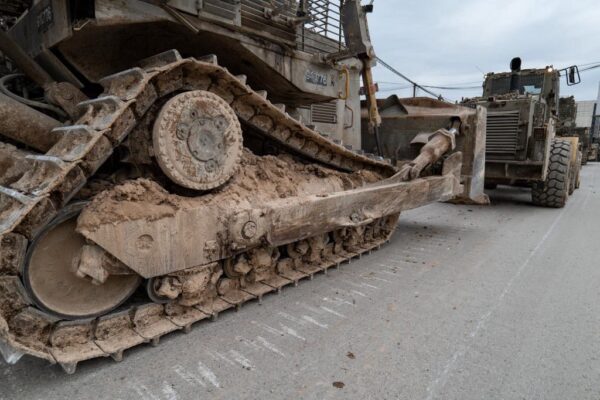
Destruction of Palestinian refugee camps
At the end of January, Israel carried out a large scale military operation in the northern West Bank city of Jenin, which has lasted for ten days so far.
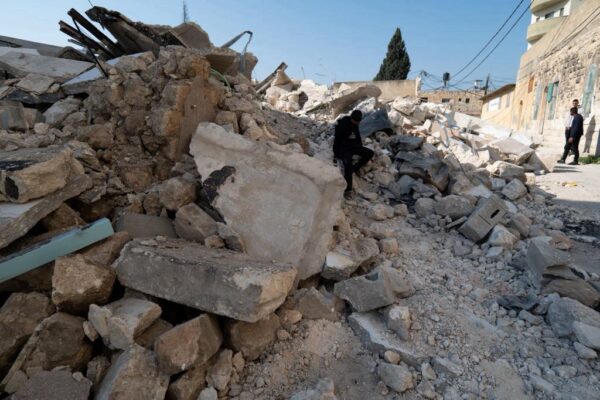
Its military operations are based in the Jenin refugee camp, in various city areas, and in some nearby villages. The Jenin camp has become an unfit place for human habitation, dozens of Palestinian houses have been destroyed and bombed, and the neighborhoods and streets of the camp have already been destroyed. Electricity,water pipes and infrastructure have been destroyed.
A residential block and an entire neighbourhood have been completely destroyed due to aerial bombardment.
Did you succeed in transforming the Jenin camp like Jabalia camp in Gaza?
This is what senior Israeli officials promised before the start of the recent military operation in the West Bank, especially in the Northern West Bank. The Israeli occupation continues its aggression on Jenin, Tulkarm, and Tubas, murdering 29 martyrs, dozens of injuries, arrests, demolition of houses and forced displacement. Amid widespread destruction of property and infrastructure.
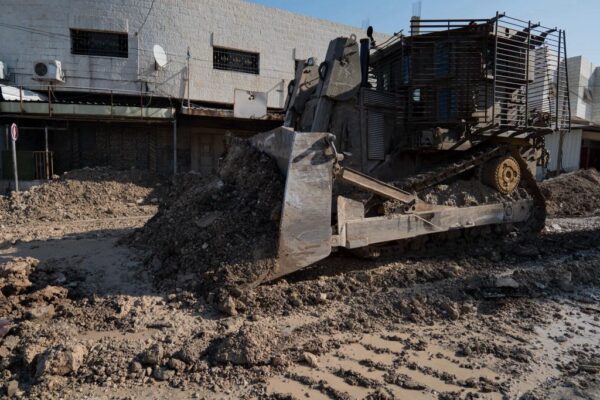
Entrance to Tulkarem
JENIN
Jenin, for the fifteenth day in a row, the occupation continues its aggression against the Jenin city and its camp, which has so far resulted in 25 martyrs, dozens of injuries, arrests, and the demolition of dozens of houses, amid a large displacement process that affected 15 thousand citizens.
Yesterday morning, the occupation army forced residents of the buildings supervising the Jenin camp to evacuate, as several military vehicles were stationed near the buildings demanding evacuation.
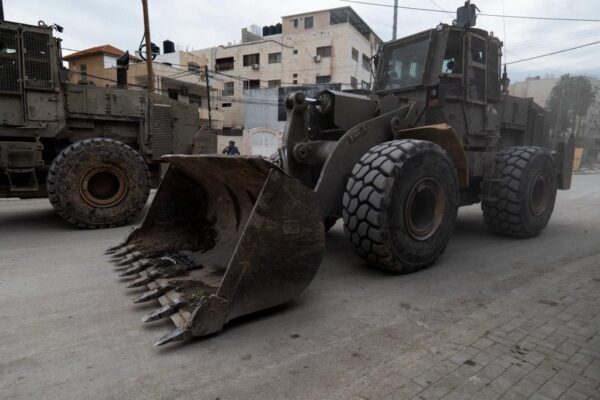
Street in Jenin
Residential buildings and apartments are being emptied, forcibly displacing citizens.
The occupation forces in the Jenin camp simultaneously blew up about 20 buildings in the eastern side of the camp, after booby trapping them, which caused damage to some sections of the Jenin government hospital, without injuries being recorded. The occupation continues to push reinforcements to the city of Jenin camp from the Jalama military checkpoint, while its bulldozers continue to destroy houses in the merge lane, with approximately 15 thousand people now displaced from the Jenin camp the target neighborhood, distributed throughout 39 local community bodies in the Jenin governorate and its towns.
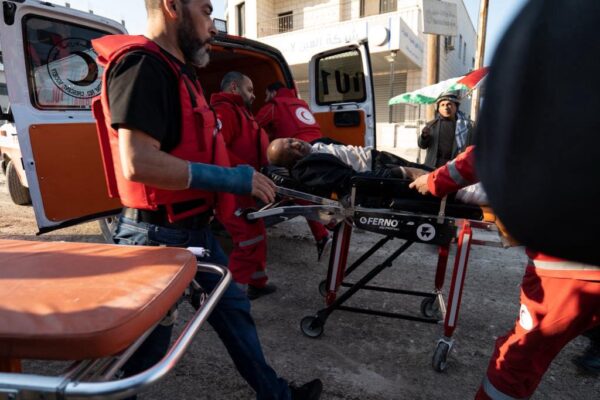
Transfer of an injured person in Tulkarem
TULKAREM
For the ninth day in a row, the occupation continues its aggression against the city of Tulkarm and its camp, resulting in the martyrdom of four citizens, amidst extremely difficult humanitarian conditions.
The occupation forces are still pushing more of their vehicles into the city and its camp from the “tasnouz” military camp west of Tulkarm, and deploying infantry patrols in large numbers in the streets, neighborhoods, and the center of the vegetable market, combing and searching between houses and alleys and harassing citizens.
These forces also continue to besiege the martyr Thabit Thabit government and specialized hospitals, obstruct the work of ambulances and their medical crews, and subject them to inspection and field investigation, while they have taken military barracks and places for snipers from the buildings surrounding them.
The occupation forces escalated their violations against citizens in the city and its camp through a series of attacks, which included raiding houses, forcing their owners to flee, vandalizing and stealing their contents, blowing up and destroying a number of them, in addition to restricting movement, while seizing commercial and residential buildings and turning them into military barracks and places for snipers.
In Tulkarem camp, the occupation forces continue to deploy large numbers of infantry soldiers in all its neighborhoods and alleys, raid houses, force residents to leave them, seize high buildings and turn them into sniper platforms and shoot at Citizens, which led to the injury of a citizen (40 years old), shot by an occupation soldier sniper stationed inside one of these buildings.
House of the martyr Tamer Fugha
Tulkarem camp is living amid this unprecedented continuous escalation, amid difficult humanitarian conditions, after the occupation bulldozers completely and partially destroyed houses and shops, blowing up a number of them and burning others, coinciding with the destruction of infrastructure, which led to the interruption of water, electricity, communications and the internet, making it difficult for specialized crews from the municipality, and others, to repair them because the occupation prevented them from entering the camp. The situation of citizens who are still in their homes ~ the elderly, the sick, women and children has also been aggravated by the acute shortage of food, medical, drinking water, and infant formula.
TUBAS
For the third day in a row, the occupation is besieging AL- FARA’ camp and the town of Tamoun south of Tubas, amid arrests, bulldozing of infrastructure and forcing citizens to flee.
Since the beginning of the storming, Israeli Occupation Forces forces have bulldozed the roads and infrastructure leading to the AL-FARA’ camp, in addition to closing all entrances to it with earthen berms and raiding houses in the vicinity of the camp, forcing its residents to be displaced, and turning them into military barracks.
Israeli Occupation Forces also raided the homes of citizens on the outskirts of the town of Tamun, forcibly displacing residents, giving them orders not to return within ten days.
Water pipelines have been destroyed between the Town of Tamun and the village of Atouf, in addition to closing of the road connecting the two areas with earthen berms.
The occupation continues to push military reinforcements to Tamun and the AL-FARA’ camp, while the Israeli reconnaissance aircraft continues to fly intensively in the skies of the governorate.

Military reconnaissance aircraft
According to the Palestinian Ministry of Health: the number of Palestinian martyrs in the West Bank since the beginning of this year 2025 has reached 70 martyrs.
38 martyrs in Jenin
15 martyrs in Tubas
5 martyrs in Tulkarem
3 martyrs in Hebron
2 martyrs in Bethlehem
6 martyrs in Nablus
1 martyr in Jerusalem
10 of them are children, 2 are women, 2 are elderly people.
Hamas: Trump’s remarks on Gaza reflect “deep ignorance about Palestine”

Palestinian Information Center – February 5, 2025
DOHA – Member of Hamas’s political bureau Ezzat al-Resheq said that US president Donald’s latest remarks about taking over Gaza and relocating its residents elsewhere reflect “misperception and deep ignorance about Palestine and the region.”
“Gaza is not a common land for any party to decide to control, but rather it is part of our occupied Palestinian land, so any solution must be based on ending the occupation and fulfilling the Palestinian people’s rights and not on the mentality of a real estate businessman or the mentality of muscle and domination,” Resheq said on Wednesday.
Resheq added that Trump’s remarks on Gaza “vindicated further the unlimited US bias in favor of the Israeli occupation regime and the Zionist aggression against the Palestinian people and their legitimate rights.”
The Hamas official affirmed that the Palestinian people and their leaders, backed by their Arab and Islamic nations and the world’s free people, would frustrate all the displacement plans targeting them.
In another statement, the Hamas Movement condemned in the strongest terms Trump’s remarks on Gaza, describing them as “hostile to the Palestinian people and their national cause.”
Hamas said that such remarks by Trump would “not serve regional stability” and would only “pour fuel on the fire.”
“We, alongside our Palestinian people and national leaders, will never allow any country in the world to occupy our land or impose guardianship over our great people whose blood flowed like rivers in order to liberate our land from the occupation and establish our Palestinian state with Jerusalem as its capital,” Hamas said.
Hamas called on the Arab League, the Organization of Islamic Cooperation and the UN to convene urgent meetings to take firm and historic positions that preserve the Palestinian people’s national rights.
In a joint news conference with the Israeli prime minister in the White House on Tuesday, Trump said the US would “take over” and “own” Gaza after resettling Palestinians elsewhere under a redevelopment plan that he claimed could turn the Palestinian coastal enclave into “the Riviera of the Middle East.”
In a flagrant announcement upending decades of US policy towards the Palestinian-Israeli conflict, Trump claimed that his administration would spearhead development in Gaza to “supply unlimited numbers of jobs and housing for the people of the area.”
‘I much prefer a nuclear deal’: Trump dismisses talk of US–Israeli attacks on Iran
The Cradle | February 5, 2025
US President Donald Trump has denied that Washington and Tel Aviv are planning military attacks against the Islamic Republic of Iran, saying that he would “much prefer” a nuclear agreement preventing Tehran from acquiring an atomic weapon.
“I want Iran to be a great and successful Country, but one that cannot have a nuclear weapon. Reports that the United States, working in conjunction with Israel, is going to blow Iran into smithereens, ARE GREATLY EXAGGERATED,” Trump said early on 5 February on his social media platform Truth Social.
“I would much prefer a Verified Nuclear Peace Agreement, which will let Iran peacefully grow and prosper. We should start working on it immediately, and have a big Middle East celebration when it is signed and completed. God Bless the Middle East!” the president went on to state.
In early February, reports said that Trump shot down Israeli plans for an attack on Iranian nuclear facilities.
Trump expressed hope late last month that a nuclear deal could be “worked out without having to go that further step,” referring to an attack.
A Wall Street Journal report in December said Trump’s team was mulling options for strikes on the Iranian nuclear program and that there was a “rare opportunity to counter Iran’s nuclear buildup.”
This week, the US president signed an executive order restoring his “maximum pressure” policy of sanctions on the Islamic Republic, as reports had said he would prior to his second presidential term.
“If the main problem is Iran not having nuclear weapons, this problem can be solved,” Iranian Foreign Minister Abbas Araghchi said on Wednesday, adding that “maximum pressure is a failed experiment and testing it again will lead to another defeat.”
Trump withdrew from the 2015 US–Iranian nuclear deal in 2018 – during his first term – and restored harsh sanctions against Iran.
Tehran is subject to the Nuclear Non-Proliferation Treaty (NPT) of 1970, as well as a religious fatwa outlawing the development and use of any form of weapons of mass destruction.
Former CIA director said last month that “we do not see any sign” that Iran is planning to weaponize its nuclear program.
Featured Video

Weaponized Journalism: 2021 Sayer Ji Interview with NPR
or go to
Aletho News Archives – Video-Images
From the Archives
How Rothschild Banking Clan Uses Its Vast Wealth to Influence World Events and Control Governments

By Ilya Tsukanov – Sputnik – 15.09.2024
How powerful is the Rothschild banking family? How did they amass their fortune? Just how rich are they? Do they secretly control the world? Sputnik explores. … continue
Blog Roll
 Aletho News
- Dockworkers launch global strike against Israeli and US military shipments
- Europe facing gas price shock – Gazprom chief
- Ukraine continues recruiting people with disabilities
- Weaponized Journalism: 2021 Sayer Ji Interview with NPR
- Beyond Netanyahu: what Israel’s election means for Palestinians
- Lithuania plans universal conscription
- Lies, Damn Lies, and Ukraine News
- Financial Times rejects Nordic demands to correct Putin call story – media
- The Case for Less Unity in Europe
- Ukraine expands minority rights under EU pressure – but Russians remain excluded
- If Americans Knew
- An error has occurred; the feed is probably down. Try again later.
- No Tricks Zone
- Germany’s Green Energy Transition Becoming Increasingly Expensive…Another 6 Trillion Euros!
- Sudden Stratospheric Warming, Powerful El Niño Combination May Lead To Extreme Europe Cold, Energy Crisis!
- Two New Studies Find Thwaites Glacier Melt Cannot Be Driven By Human Activity Or A Warming Ocean
- E-Cars Reduce CO2 Emissions By Only 41% Compared To Internal Combustion Engine Vehicles
- Predictions Made By Renowned Climate Professor Over Past Decades Have Been Proven To Be Poor
- New Study Suggests Large Regions Of The Pacific Ocean Have Been Cooling For The Last 80 Years
- Germany’s Green Energy Debacle: High Energy Costs Force Kahla Porzellan to Close After 182 Years!
- New Study: 50 Years Of The Most Aggressive ‘Net Zero’ Policies Can Only Affect The Global Climate By 0.03°C
- US September “Heat” Was No Record…Many Records Set Decades Ago
- Latest European Green Energy Debacle; Portugal’s Largest Flagship Solar Park Insolvent!

