Sky News apologises for telling the truth about Israel
Laura and Normal Island News | November 10, 2024
In a disgusting lack of dishonesty, Sky News has caused outrage by telling the truth about Israel. The broadcaster later corrected its reporting, editing out the truthful parts, but the Israeli lobby says this is “too little, too late”.
The controversy took place on the Sky News Twitter account where a video that had not been approved by Mossad was mistakenly shared. Thankfully, I’m told Sky’s social media guy was taken outside and beaten to within an inch of his life. It’s only what he deserved.
The punishment beating comes after Israeli hooligans, I mean innocent supporters attended a football match in Amsterdam. For some reason, Sky thought it was necessary to report that Maccabi Tel Aviv fans tore Palestinian flags from people’s homes and attacked the locals in front of a police car. It even mentioned that Israelis were singing “racist and anti-Arab songs” with charming lyrics such as “let the IDF win to fuck the Arabs”.
Sky even highlighted that Israeli fans disrupted the minute’s silence for Valencia flood victims with chants, whistles and fireworks. Thankfully, the reporter did not mention that Mossad agents had joined the Israeli fans in order to provoke a riot. This was purely for self-preservation because Mossad would probably have bombed her family home.
The idiots at Sky have totally undermined our narrative that the citizens of Amsterdam did a “pogrom” for no reason other than they’re evil anti-Semites, proving there is no safe place in Europe for Jews. The social media response was unanimous: “Clearly, Sky was attempting to justify violence towards Jews.”
Sky therefore panicked, deleted their video and posted a comment explaining they’d edited and reuploaded the video because the original didn’t meet their “standards for balance and impartiality.” They then deleted the explanation because it made them look like fucking idiots.
In case you’re unclear, “balance” is when you leave out important context that shows the truth, and “impartiality” is when you crumble to pressure from the people who are made to look bad by the truth.
Reassuringly, Sky News editor Sandy Rashty is so unbiased, she contributes to the Jewish Chronicle and retweets all the finest Zionist cranks. This explains why Sky bends over backwards for Israel, but only makes minimal effort for anyone who opposes genocide.
For example, Sky was previously forced to admit to “potentially misleading information” for smearing the Palestinian ambassador by claiming he said things he hadn’t said. Thankfully, Sky did not apologise because he is an Arab.
All that matters is that we provide cover for Israel so it can get away with doing whatever it wants to whoever it wants. Israel is meant to be able to launch incursions into any territory it likes, including the Netherlands, and thankfully, the Netherlands agrees.
Israel has therefore bombed three schools and seven hospitals in Amsterdam, following reports that Ajax fans had built tunnels beneath them. The Dutch government insisted there were definitely no tunnels but apologised for making Israel do this. Sky News would like to reiterate these bombings definitely counted as self-defence.
The Zionist regime front and the Beren family

By David Miller | Al Mayadeen | November 9, 2024
“With partnerships encompassing over 850 interfaith organizations, influential decision-makers, and a network of more than five million activists and 250 social media influencers CAM leads a united front against Jew hatred.”
This is how the Combat Antisemtism Movement describes itself.
It sounds like an independent campaign group at the head of a global movement. But does it actually “lead anything”?
Let’s get into it.
The movement advertises that its “Key initiatives” include “the Global Coalition of Cities Fighting Antisemitism and specialized collaborations with U.S. governors and State Legislators.”
They say that they “reach millions through digital campaigns, influencer partnerships, and an innovation lab.”
They have “partnerships” with “nearly a thousand” groups.
The movement started with a pledge to fight antisemitism.
It now has more than 850 organisations signed up as “members”, from across the globe.
Here are a selection of them, with the preponderance being based in the US, but a range of others throughout Latin America, Europe, Australasia and further afield, including South Africa and Russia. There are hardly any in other parts of Africa and none in Cuba, Venezuela, Bolivia, North Korea, China, Lebanon, Yemen, Iran, or Iraq.

It looks like a very extensive global network. But who is behind it?
Answering that question requires peeling back several layers of the onion.
First there is no organization registered in the US with that name. There is, though, a Combat Hate Foundation which is the organizational vehicle which runs the movement. It is registered with the Internal Revenue Service. Public documents show that it is funded by a variety of Zionist Foundations. The largest contributors seem to be foundations associated with the Kansas based Beren family, which made its fortune in the oil and gas industry.
During a 2021 controversy about the movement, The Forward reported that it functioned as a “dark money” front group for the Kansas oil billionaire Adam Beren. But this revelation only gets us so far. Palestine Declassified revealed that the Combat Hate Foundation is part of a “joint venture” run by the Israeli regime.
The Ministry of Diaspora Affairs is in charge. The joint venture is run via the ministry’s deniable corporate intermediary Voices of Israel, though there is no mention of this relationship on the website of Combat Antisemitism Movement.
But the relationship is spelled out on the Voices of Israel website: “Voices of Israel has a joint venture agreement with the State of Israel led by the Ministry of Diaspora Affairs and Combat Antisemitism.”
The Combat Antisemtism Movement, in other words, is part of the covert Zionist regime network. The impressive nature of the 850 “partner” organisations takes on a rather more sinister hue, given this revelation.
The Combat Antisemitism Movement is, in fact, a front for the Ministry of Diaspora Affairs, the regime department responsible for the global fight against the Palestine liberation movement.
It has over 850 partner organisations – a formidable centrally directed network.
But though it’s a front for the genocidal regime, most of the resources that support it come from another source.
When it was created in 2019 the Combat Antisemtism Movement was opaque on who was behind it. By mid 2020 it began to disclose staff and senior advisors.
Unsurprisingly, two of its four senior advisers came straight from the Ministry of Strategic Affairs, the department in charge of worldwide targeting of pro-Palestine activists.
They were Brigadier General Sima Vaknin Gil, formerly an Israeli intelligence officer and the former Chief Censor of the entity. At that stage, she was Director General of the Ministry of Strategic Affairs;
Revital Yakin Krakowsky. CAM was reticent about admitting that she too worked for the Ministry, saying only that she had advised presidents, government ministers, mayors, international organizations, etc, in no specific country. In reality, according to her own LinkedIn page, she worked full time at the Ministry of Strategic Affairs from January 2017 until it was closed in May 2021.
Other direct connections with the regime are that the Director Sacha Dratwa used to work for the occupation forces’ New Media Operations Team. In fact, he has a career long history in propaganda work for the regime. Dratwa is Belgian. He joined the IOF after becoming a settler colonist and was a student at the Interdisciplinary Center Herzliya (IDC). He headed the French language online monitoring campaign at the HelpUsWin.org situation room set up at the IDC in support of Operation Cast Lead in Gaza in 2008/09. Help Us Win was sponsored by the regime and run at the IDC with support from regime asset StandWithUs. He worked at the IOF Spokesperson’s Unit between May 2010 and November 2014, rising to the position of head of the New Media Desk. In 2016 he moved to New York to run digital propaganda efforts for the World Jewish Congress, a post he left in 2019. Dratwa attended the Ministry of Strategic Affairs Digitell19 Conference in 2019.
Advisors and staff disclosed, it took another three years for the moving force behind the organisation to admit he was involved, and then it was only after the connection was exposed by The Forward.
But even then attempts to disguise the source of the funding of the groups were made.
Asked whether Beren was in fact financing Combat Antisemitism, a spokesperson and senior adviser to CAM Misha Galperin said, “we have a number of funders who want to stay anonymous, so it’s not anything that I would want to get into.”
The Forward also revealed that efforts had been made to suppress the Beren connection:
When a left-wing blog called Jewish Worker posted screenshots on Twitter in December 2019 connecting Adam Beren and Berexco to the Combat Hate Foundation, Twitter said it violated rules “against posting private information.” “Someone got Twitter to force me to delete my tweets specifically about this topic,” explained the editor of Jewish Worker, who blogs and tweets anonymously and spoke on the condition that this maintained.
Asked about the secrecy, Galperin said the group’s donors preferred anonymity to keep the focus on antisemitism — rather than on themselves or their specific politics. “It’s not about transparency, it’s about not wanting an ego to be part of the thing,” he said.
Research in documents submitted to the Internal Revenue Service, however, reveals that foundations run by the Beren family have spent millions of dollars in bankrolling the CAM. Three separate Beren foundations (Israel Henry Beren Charitable Foundation Inc, Israel Henry Beren Charitable Trust, Robert M Beren Foundation Inc), have ploughed millions into a fourth, the Beren Sea Foundation. It, in turn, has gifted $6.6 million to the Combat Hate Foundation in the three years from 2020-2022, nearly 70 per cent of its total income in the period.
Other donations by the Beren family foundations indicate the full support the family gives to the genocide in Palestine. These include over half a million dollars to the Friends of the IDF, over 2 million to the genocidal Chabad cult, and almost 9 million to Ohr Torah Stone which directly trains Ultra-orthodox recruits to the occupation forces in so called “Hesder” Yeshivas in illegal settlements. These are a mechanism to induct ultra-orthodox recruits into the occupation forces by allowing them to study Torah part time and then spend time with the occupation forces killing Palestinians. There is even a specific Hesder Yeshiva built on stolen land near Efrat in the West Bank which is named after the family patriarch: Robert M. Beren Machanaim Hesder Yeshiva
Yet again we find that campaigners against antisemitism are actually militant supporters, in fact agents, of the genocide in Palestine.
Iran denies plotting to kill Trump
RT | November 9, 2024
Iran has denied US accusations that it attempted to orchestrate a plot to assassinate President-elect Donald Trump before the November election. It has dismissed the allegations as a hoax orchestrated by pro-Israel actors in a bid to exacerbate tensions between Washington and Tehran.
On Friday, the US Department of Justice claimed that Iranian officials had asked a man named Farhad Shakeri to “provide a plan” to kill Trump, adding that he was also tasked with carrying out assassinations of US and Israeli citizens inside the US. Shakeri was described as an Afghan national residing in Tehran after being deported from the US in 2008 following a lengthy prison sentence for robbery.
The indictment also implicated two American citizens, Carlisle Rivera and Jonathan Loadholt, who were accused of helping Tehran track a US citizen of Iranian origin. “The charges announced today expose Iran’s continued brazen attempts to target US citizens, including President-elect Donald Trump, other government leaders and dissidents who criticize the regime in Tehran,” FBI Director Christopher Wray said in a statement.
On Saturday, the spokesperson for the Iranian Foreign Ministry, Esmaeil Baghaei, categorically rejected the accusations, calling them “completely baseless.” “Such claims at this juncture [are] a malicious conspiracy orchestrated by Zionist and anti-Iranian circles, aimed at further complicating the issues between the US and Iran,” he added.
Baghaei also recalled that Iran had denied similar “false” allegations in the past. He was apparently referring to an indictment by the US Department of Justice from August in which a Pakistani national was accused of being sent to the US by Iran to carry out murders. One of the planned attacks was allegedly aimed at Trump.
Trump was the target of two assassination attempts this year prior to the election. The first one occurred in July when Thomas Matthew Crooks opened fire on him at a Pennsylvania rally, with one bullet grazing Trump’s ear. The would-be assassin was killed on the spot by the Secret Service.
The second incident took place in September, when a suspect identified as Ryan Wesley Routh allegedly tried to assassinate Trump at his Florida golf course but was intercepted by security.
Houthis Blast Another US Drone Out of the Sky, Fire Hypersonic Missile at Israel
By Ilya Tsukanov – Sputnik – 08.11.2024
Houthi fighters have reportedly shot down another MQ-9 Reaper drone, this one over al-Jawf province in Yemen’s north, with footage posted to social media early Friday morning showing flaming wreckage falling out of the sky and starting a large fire on the ground in the dead of night as onlookers inspect the unmanned aerial vehicle’s remains.
The US military acknowledged to the Associated Press that it had seen the footage, and said it was investigating the incident, without offering any further details.
The Houthis have now shot down as many as ten of the $32 mln apiece US reconnaissance and strike drones since November 2023, or thirteen if counting US losses going back to 2017.
The militia has a surprisingly large array of air defense systems at their disposal, including upgrades to Soviet-era Kub, Dvina, Neva/Pechora and Strela-1 SAMs, and allegedly, derivatives of Iranian-designed systems.
Separately Friday, a source told Sputnik that the Houthis had launched a “hypersonic ballistic missile from Yemen at a vital target in the Negev Desert in southern Israel.”
The source did not elaborate on the missile’s characteristics or its target, but the Negev is known to be the home to some of Israel’s most important airbases, including Nevatim, which hosts the country’s fleet of F-35I jets, and Hatzerim, home to F-15I series aircraft. The United States military is also known to host a top-secret radar facility atop Mount Har Qeren in the Negev known as Site 512.
The Houthis unveiled what they said was a two-stage, solid-fuel hypersonic missile with a range of 2,150 km known as the Palestine-2 in September, saying the weapon can reach speeds up to Mach 16, and features stealth technology. Multiple Houthi missiles and drones have pierced Israel’s powerful air defenses since the militia began its campaign against Tel Aviv last year. US, British and Israeli air and naval forces regularly deployed to try to “degrade” the militia’s capabilities have so far failed to do so, with the US alone spending over $2.5 billion on operations against the group since January.
Israel über alles
By Ricardo Nuno Costa – New Eastern Outlook – November 8 2024
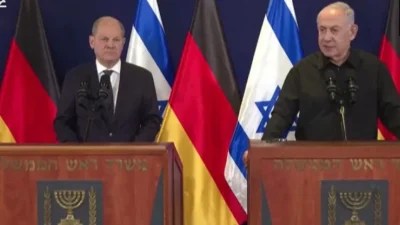
“Germany has only one place, and that’s on Israel’s side,” said German Chancellor Olaf Scholz in the Bundestag, justifying the delivery of arms to Tel Aviv.
One wonders if this partial stance is what is expected of a country that claims to be the leader of the European project, with geopolitical ambitions in an increasingly multipolar world. For the global majority, the answer is no, but in Germany, the subject is thorny and shrouded in taboos. To top it off, the Federal Republic has just passed a law to prevent it from being debated.
Berlin’s inability to call Tel Aviv to account on its international obligations only confirms Germany’s increasingly secondary role in the international arena. If the “engine of Europe” is constrained in its military role, it could at least be a diplomatic power, making use of its economic status. But its role is diminishing. Why is that?
In his latest book, “Krieg ohne Ende?” (War without end?), international political scientist Michael Lüders masterfully summarises the hypocrisy surrounding Germany’s involvement in the Zionist project from the beginning to the present day. The author suggests, in the form of a subtitle, “why we need to change our attitude towards Israel if we are to have peace in the Middle East.”
Germany is losing the credibility it has built up over decades in the eyes of the global majority. Today, the country is no longer seen with the same seriousness that we have become accustomed to in recent decades, but rather as a mere instrumental piece of the US in international relations. This is also the visible result of the “feminist foreign policy” that Annalena Baerbock has pursued as foreign minister over the last three years.
Defence of Israel is ‘Staatsräson’ of the Federal Republic
Germany has adopted the defence of Israel’s existence as ‘Staatsräson’ (raison d’État). It was during a visit by Chancellor Merkel to the Israeli Knesset in 2008 that this concept was first mentioned.
In the above-mentioned bestseller, it becomes clear that this principle is no accident, as it corresponds to the fact that Israel’s ‘raison d’État’ is the Holocaust, for which Germany is to blame. According to Mr. Lüders, the Jewish state used the Eichmann case to launch its ‘raison d’État’, while many other Nazi officials responsible for the persecution of the Jews had passed into the new Bonn nomenclature without being called to account. The most notorious case was that of Hans Globke, the eminence grise of the new regime, a key player in the USA’s fight against the USSR. He had previously drafted the Nuremberg race laws and was now Adenauer’s number two, protected by the new BND intelligence services and the CIA.
The SS officer Adolf Eichmann, kidnapped in Argentina by the Israelis, symbolically bore all the blame for Germany’s 1933-45 National Socialist’s period. After his hanging in 1962 for crimes against the Jewish people during the Holocaust, in the only judicial execution carried out in Israel to date, the FRG finally officially recognised Israel in 1965, after years of collaboration (since 1952). This marked the beginning of a complex relationship that remains opaque to this day.
An important part of this relationship has been the multi-billion dollar military industry within the Atlanticist framework. The most significant case, again unclear, was the corruption scandal over the sale of three nuclear-capable submarines and four corvettes sold during the Merkel governments to the Netanyahu government in 2016 for almost 4 billion euros, which ended up being paid for in part by German taxpayers.
In a current example, political scientist Kristin Helberg, who specialises in the Middle East, expressed her surprise on the public channel in October that Berlin was not helping Israel with defensive weapons against a hypothetical Iranian attack – which in her view would be legitimate – but by delivering ammunition to be used on civilian populations, contrary to the Geneva Convention.
Germany involved in a genocide
With its arms support for Israeli attacks on civilians in Gaza and Lebanon, Germany is not only committing an international offence that is costing it the current cases opened at the ICC and ICJ, but is also seeing its reputation stained in the biggest international forums by the global majority, on which its industrial export model depends.
On 14 October, German Foreign Ministry spokesman Sebastian Fischer said at a press conference in Berlin that the German government “sees no signs that Israel is committing genocide in Gaza” and that “Israel undoubtedly has the right to self-defence against Hamas”, and two days later Chancellor Scholz said loudly in the Bundestag that “there will be more arms deliveries – Israel can always count on that.”
Criticising Israel will be banned
In its increasingly radical philo-Zionist course, the German political class passed a new resolution “to protect, preserve and strengthen Jewish life in Germany”, to which only the parties of the governing coalition and the CDU/CSU were called, without consulting the AfD and BSW. The controversial and non-transparent resolution promises to pursue “increasingly open and violent anti-Semitism in right-wing and Islamist extremist circles, as well as a relativising approach and the rise of Israel-related and left-wing anti-imperialist anti-Semitism.”
The document mentions that “cases of anti-Semitism have increased” since the Hamas attack on Israel a year ago, but fails to mention that German law has since come to consider anti-Semitic the manifestation of various expressions in favour of the Palestinian cause such as the slogan “From the river to the sea Palestine will be free” among other slogans, chants, insignia or even posts published on the internet, which are now considered and counted as punishable anti-Semitic crimes.
“The German Bundestag reaffirms its decision to ensure that no organisation or project that spreads antisemitism, questions Israel’s right to exist, calls for a boycott of Israel or actively supports the BDS movement receives financial support,” the document goes on to say.
Recently, the rector of the Berlin Institute for Advanced Study, Barbara Stollberg-Rilinger, complained that the freedom of study of the scientific community is under massive threat. “What distinguishes antisemitism from legitimate criticism of the Israeli government?” she asked. “And above all, who defines what antisemitism is? This is not at all clear. The definition is vague and leaves enormous room for legal uncertainty,” she asserted.
The divorce between the political class and public perception
It’s clear that the text of the new law aims to exclude the AfD from public debate, using the magic buzzword of the “far right”, but it also weighs heavily on the BSW, where the Palestinian cause and the multipolarist vision are obvious. A recent study by the Forsa research institute for Stern/RTL corroborates the clear rift between real and institutional Germany. Whilst the former doesn’t want the country to be involved in the Middle East war, the political class has guaranteed its indispensable support for Israel as a ‘national interest’. Voters from all German parties are therefore unequivocally opposed to further arms deliveries to Tel Aviv. The BSW electorate (85 per cent) is in the lead, followed by the AfD (75 per cent), but also 60 per cent of SPD voters, 56 per cent of CDU/CSU voters and 52 per cent of FDP voters. Interestingly, the Greens’ electorate showed a 50-50 tie. In the national total, this corresponds to 60 per cent of the citizenry, with the difference in the east being more significant (75 per cent against).
The case of the AfD is more curious because as a party that was born out of contestation with the system on the issues not only of immigration, but also of foreign policy and others, and its electoral base is clearly critical of Berlin’s pro-Western policy, its leadership also has a disproportionate presence of the philo-Zionist element, which is no different from the rest of the political class.
According to another poll also from October, by Infratest Dimap for public television ARD and WELT daily, only 19 per cent of AfD supporters consider Israel to be a reliable partner, a noticeably lower percentage than in the CDU/CSU (34 per cent) the SPD (36 per cent) and the Greens (38 per cent).
AfD distances itself from the Zionist consensus
Probably because he knew how to interpret this discrepancy between leadership and base, AfD co-leader Tino Chrupalla called for an end to aid to Tel Aviv and Germany’s ‘one-sided’ relationship with the Jewish state. “By supplying arms to Israel, you are accepting the dehumanisation of all civilian victims on both sides. They are not contributing to détente, but rather throwing fuel on the fire”, he said. It is “time to take a critical and objective look at the Israeli government”.
These statements come at a time of a clear move towards multipolarity within the party. Moreover, the principle of neutrality is the AfD’s official line. Its 2024 European electoral programme states that “the supply of arms to war zones does not serve peace in Europe”. At the risk of becoming just another political party, the AfD seems to want to meet the feelings of the majority of Germans and its social support base on foreign policy issues, which are now much debated by the general public.
It seems clear that after decades in the room, the elephant can no longer be hidden in the German political debate.
Canada faces legal action over complicity in Gaza genocide
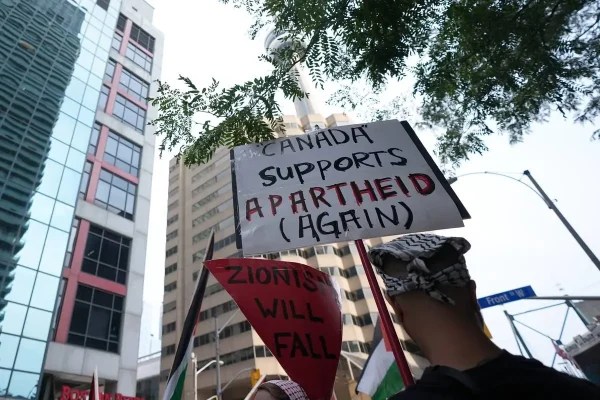
Pro-Palestinian demonstrators march during a protest in downtown Toronto,Canada on August 3, 2024 [Mert Alper Dervış/Anadolu Agency]
MEMO | November 7, 2024
The Trump mandate
By Daniel MCCARTHY | Strategic Culture Foundation | November 7, 2024
Donald Trump has won a victory even more stunning than his upset defeat of Hillary Clinton eight years ago. Two impeachments, relentless lawfare and innumerable criminal charges, two assassination attempts, and an unceasing chorus of the nation’s most powerful media calling him a “fascist” could not stop Trump. In the teeth of all that adversity, Trump has only grown stronger. And now he has the symbolic yet potent mandate of a popular-vote majority.
That majority adds psychological force that makes the Trump revolution cultural as well as political. Before, it was easy for Trump’s critics to believe his 2016 victory was a fluke. They might have to deal with its consequences, including the impetus his election gave to a populist turn within the institutions of the conservative movement. But once Trump was out of office, those institutions would sooner or later revert to their former character. After all, populism didn’t have money behind it. If it didn’t have people, either, it wouldn’t be around for long.
Trump has shattered the laws of political physics. Realignments that had already begun as a result of Trump’s earlier success are accelerating. To appreciate the magnitude of what Trump achieved in this election, look beyond the states he won—in blue state after blue state, Trump made enormous, often double-digit gains. He made deep inroads into the Hispanic vote, particularly among men. Meanwhile, neoconservatives who held out hope of retaking the commanding heights of the Republican party if Trump was defeated have little choice now but to accept a place in the Democratic coalition. But they may not be comfortable there, either, as Democrats crack up over Israel’s war with Hamas.
This does not mean that four years from now the Republican nominee will be competitive in every blue state or will win a majority of Hispanics, and it certainly doesn’t mean that the GOP will be without a hawkish wing and some ostensibly pro-Trump neoconservative influences. The changes that Trump brings about are not necessarily linear. But they will afford opportunities hardly imaginable before this point. And J.D. Vance is well-equipped to make the most of them in 2028.
Although foreign policy was not voters’ top priority either this year or when Trump first won the presidency, war and the way leaders in both parties respond to it—or fail to respond—establishes conditions conducive to ideological mutation. How Trump handles the crises in Ukraine and the Middle East that he inherits from President Biden will be a watershed. Democrats who were reluctant to criticize U.S. support for Israel while that support was coming from the Biden-Harris administration will now hammer Trump over Israel’s actions. Can Trump make good on the faith placed in him both by Arab-American voters in Michigan and by ardent supporters of Israel? Can the green shoots of a return to realism in Republican foreign policy survive the burdens of responsibility that the wars in the Middle East and Ukraine impose? The wars themselves may not be America’s responsibility, but the administration will face tough choices about what not to do as well as what to do.
The possibility of wide-ranging new tariffs exists alongside the possibility that the Federal Reserve may be audited and compelled to answer to the public by the new administration. Moves in either of these directions would send shockwaves through Wall Street. Could the Trump administration be skillful enough to remake the fiscal and monetary systems without causing panic? If not, what milder measures could the administration undertake that would still address trade imbalances and inflation? Trump is open to considering a much wider range of possibilities than conventional politicians would dare to imagine, and even if his administration doesn’t avail itself of those possibilities, the mere fact the president would consider them will redraw the boundaries of policy discourse in Washington and beyond.
The president will be confronted by stiff opposition within the federal bureaucracy as well as from Democrats in Congress. He should not flinch from forcing reform on the administrative state and dismantling entire departments of the federal government. In this, too, Trump can be transformative. His experiences during his first term with leaks and policy sabotage originating from the bureaucracy should inform his handling of the civil service this time. It has been a power unto itself for far too long, and it has pursued not a disinterested agenda in the service of the public but a partisan agenda in the service of liberal elites.
New electoral maps, new issue coalitions, a new balance of power within the executive branch—all of these are just some of the domestic effects of Trump’s triumph. It also has the potential to inspire, or amplify, such changes all around the world. The precedent Trump has set is not only one that populist parties in Europe and elsewhere will take to heart. Mainstream parties that until now had looked to elite liberal opinion in the United States for guidance and guidelines will henceforth have to do some new thinking of their own, incorporating something of Trumpism into their dealings with America and perhaps into their politics at home. Emmanuel Macron joined Benjamin Netanyahu as the first of the world’s leaders to congratulate Trump on X last night.
The political and cultural aftershocks of Trump’s victory will not by themselves be enough to make the new administration a success—much hard work and resilience in the face of inevitable setbacks will be necessary, as in more pedestrian administrations. There is also a need for conservatives outside of government to answer the call, the moment presents to be both creative and disciplined. The right needs renovation, including in the way it approaches art and literature. Just as Trump has shown that a new majority can be forged in battles no one else would dare fight, the right may be capable of achieving greater things in the realm of culture and philosophy than it has so far been brave enough to imagine. What’s needed is not just a Trumpist or populist cultural program—though Hulk Hogan certainly has his place in America’s affections—but a cultural program as bold as Trump’s political challenge to the obsolete elite.
Trump should reawaken conservatives’ spirit of endeavor. Because he has dared greatly and succeeded.
What Comes Next for the Palestinians?
Trump unlikely to oppose Netanyahu’s genocide
By Philip Giraldi • Unz Review • November 6, 2024
Well, it’s over… or is it? Donald Trump will be the next president of the United States backed by a GOP controlled Senate and possibly even a majority in the House of Representatives. And one should not discount the advantage derived from having a largely conservative Supreme Court, but much depends on who Trump appoints to key cabinet positions, a weakness in the first Trump presidency as he tended to select ideologues rather than candidates with relevant knowledge or experience. One hopes, for example, that neither the usual claque of neocons nor establishment characters like Mike Pompeo or Tom Cotton, who have been mentioned as possible candidates for Secretary of Defense, will appear on anyone’s list for high office.
During the lead-up to the presidential campaign, Trump sometimes referred to himself as the most popular politician in Israel, including a conceit that if he were able to run for office in that country he would be able to get elected to the highest offices without any problem. That was, at least in Donald’s mind, an expression of gratitude for how he had done so much for Israel in 2016-2020, including moving the US Embassy to Jerusalem, accepting the annexation of the Syrian Golan Heights, providing political cover for Israeli actions, and a declaration that the US would not do anything to interfere with military and police actions connected to Israeli settlement expansion on the nominally Palestinian West Bank. Israel also appreciated Trump’s appointment of his lawyer David Friedman as US Ambassador. Friedman proved to be a full time apologist for Israel, not representing or defending American interests. In the recent presidential campaign, Trump spoke frequently to Jewish Republican groups and declared himself to be Israel’s best friend and supporter among US politicians.
The Israeli media has also reported that the present Israeli Prime Minister Benjamin Netanyahu much preferred Trump over Kamala Harris, possibly because the PM has developed what is reported to be a close personal relationship with the Trump son-in-law Jared Kushner, who has apparently served often as a conduit to Donald. Netanyahu in fact was the first foreign head of state to telephone personally to congratulate Trump on his repeat victory at 2 a.m. on Wednesday. Netanyahu declared that Trump’s win was “historic” and said it “offers a new beginning for America and a powerful recommitment to the great alliance between Israel and America. This is a huge victory!”
It is generally believed that Netanyahu also apparently harbors some deep suspicion of the Democratic Party in spite of the Biden Administration’s generosity in arms and cash transfers, presumably in part because the Democrats harbor a small but active progressive wing which has been vocal about blocking arms sales to Israel due to its genocide of the Palestinians. The Republicans have no such tendencies apart from a persistent Tom Massie in the House and Rand Paul occasionally saying the right thing from the Senate. And key Republicans like current House speaker Mike Johnson are so in bed with Israel and all its works that he should perhaps consider moving there permanently as the average American gets nothing from the expensive and exceedingly bloody relationship apart from opprobrium from nearly the entire world for complicity in the extermination of the Palestinians. In other words, if one is expecting a return to sanity over what is going on in the Middle East, don’t expect it to come from Donald Trump.
And Netanyahu should be very pleased with the Trump victory for one other important reason, which is how he will be able to deal with an American president. The Wall Street Journal is already reporting from Israeli sources that Netanyahu is definitely expecting a “freer hand” from the new administration to do whatever he wants politically and militarily. Trump’s ego and his personal and spontaneous manner of governing is exactly the kind of relationship Bibi feels most comfortable dealing with. Netanyahu believes he can manipulate Trump and cultivate his personal relationship with the president to include dealing with him directly without worrying about any other players. Netanyahu will be in position to personally flatter, mollify, or confuse Trump even if the president were to surprisingly decide that it would be better if Israel backed off on its aggression. Netanyahu and his allies in the US Congress will be united in convincing Trump that this would be a bad idea.
Bearing in mind that Joe Biden will continue to be president for the next two months and he has demonstrated an infinite capacity to screw things up through his clueless proxies Antony Blinken and Lloyd Austin plus the comic interlude provided by State Department spokesman Matt Miller, who cracked a joke and laughed about the clearly demonstrated Israeli attempt to starve the Gazans to death. But possible Biden missteps notwithstanding, Israel should be on balance very pleased with the election result. Trump is, of course, fully supportive of the slaughter of the Palestinians and is quite willing to deal similarly with the Iranians if they should “spill one drop of American blood” by “spilling gallons of theirs.” His advice to the Israeli government has been that they should “finish the job” on dealing with the Pals not for either humane or political reasons but rather because Israel is getting a bad reputation for its openly espoused massacring of civilians, including in excess of 13,000 children. In a phone call with Netanyahu in October, Trump praised escalation of Israeli military actions in Lebanon. Senator Lindsay Graham, who was on the call, described how “He didn’t tell him what to do militarily, but he expressed that he was impressed by the pagers [and] he expressed his awe for their military operations and what they have done. He told them, do what you have to do to defend yourself.”
Trump is also appreciative of the millions of dollars that went his way during the presidential campaign from Israel’s best friends in the US. The reported $100 million that came from a single donor, casino billionaire Israeli Miriam Adelson, was allegedly in exchange for a Trump agreement to permit Israel’s annexation of what remains of the Palestinian West Bank. The multi-ethnic Arab country called Palestine in 1948 would thereby become the Jewish state of Israel de jure as well as de facto. And the expansion and warmaking with Israel’s neighbors as Netanyahu seeks to establish his country’s military dominance over the entire region will go on, with US garrisons illegally based in Syria and Iraq playing supporting roles. Trump could have removed them as well as carrying out a withdrawal from Afghanistan when he was last in office, but for reasons unknown chose not to, possibly due to pressure from the Israelis.
In short, based on the record in 2016-2020 and recent campaign rhetoric, there is no possibility that President Trump will put any pressure on Israel to cease and desist from what it has been doing in Lebanon, the West Bank and Gaza. This is potentially bad news for the Palestinians and Lebanese but it also is not welcomed by the likely majority of Americans who now oppose arming and funding Israeli genocide. It comes on top of Trump’s frequent denunciation of “useless wars” though he most often cites Ukraine in that context, promising to end that conflict “in one day” by virtue of his sheer star power, personal intervention and diplomacy. One hopes that is true, and, of course, Kiev has no powerful domestic lobby apart from the arms industry to object and continue to want to feed the fighting, so it is possible that Russia-Ukraine is actually moving towards some kind of end. Maybe if that fighting ends and sets a good example, someone in Washington will wake up and seek the same type of agreement to calm the Middle East.
Philip M. Giraldi, Ph.D., is Executive Director of the Council for the National Interest, a 501(c)3 tax deductible educational foundation (Federal ID Number #52-1739023) that seeks a more interests-based U.S. foreign policy in the Middle East. Website is councilforthenationalinterest.org, address is P.O. Box 2157, Purcellville VA 20134 and its email is inform@cnionline.org.
Canada’s McGill University event with UN rapporteur relocated amid pro-Palestine crackdown

UN Special Rapporteur on the occupied Palestinian territories Francesca P. Albanese in Brussels, Belgium on April 10, 2024 [Thierry Monasse/Getty Images]
MEMO | November 6, 2024
UK government crackdown on pro-Palestine support may turn to lawfare against political dissidents
By Muhammad Hussein | MEMO | November 6, 2024
Throughout the past year of Israel’s war against the Palestinians in the Gaza Strip and the purported objective of wiping out Hamas, many governments across Europe have served as a kind of buffer for Tel Aviv, stopping at nothing to crush pro-Palestine protests. Demonstrators have been arrested and protests have been banned. The shameless labelling of all and any advocates for Palestinian rights as “Hamas sympathisers” and “anti-Semites” has exposed the obvious bias of European policymakers and police forces towards Israel and the Zionist narrative.
After around a year of such incidents and power games, the UK — the quiet repressor of dissent and rare expresser of policy positions — stepped up its own crackdown, arresting journalists or raiding their homes because of their support for Palestine and its people, as well as their criticism of Israel and its genocide in Gaza.
Last month, for example, British counter-terrorism police raided the home of journalist Asa Winstanley as part of “Operation Incessantness”, reportedly linked to his pro-Palestine social media posts. Although the specific posts were not detailed by reports, the authorities claimed that they were possible offences under sections 1 and 2 of the 2006 Terrorism Act, which pertain to the “encouragement of terrorism”.
Others to fall foul of this official crackdown in the UK include Palestine solidarity activists Mick Napier and Tony Greenstein, who were arrested last year over their expressions of support for legitimate Palestinian armed resistance and resistance movement Hamas itself. More recently, activist Sarah Wilkinson had her home raided by counter-terrorism police, and journalist Richard Medhurst was detained under the Terrorism Act upon arrival at Heathrow Airport.
Such raids, arrests and detentions by the British authorities are part of the wider repression of civil, political and press freedoms across the West as a whole.
First glimpsed during the “war on terror” years, we have seen the implementation of legislation granting governments greater freedom to monitor their citizens. The crackdown on hard-won freedoms was felt more heavily during the Covid pandemic. Many people who had not felt the weight of counter-terrorism policies realised suddenly that they too might not be exempt from being subject to pressure from the state, overreach and enforcement.
Today, with Western governments crushing expressions of support for the Palestinian cause or opposition to the Israeli occupation and genocide in Gaza, we are witnessing the next level of repression, symbolised by the way that the Establishment is protecting a rogue state which treats international laws and conventions with contempt — Israel — and the war crimes and crimes against humanity which are the inevitable result of such protection.
The repression is expected to get worse, with the UK in particular on a very worrying downward trajectory.
Following the election in July of the new Labour government under Prime Minister Sir Keir Starmer, there was a brief moment when it looked as if the UK was ready and to offer more diplomatic and humanitarian support to the Palestinian people. There was even hope that the British government would not intervene to stop the International Criminal Court’s (ICC) arrest warrants sought for Israeli Prime Minister Benjamin Netanyahu and (now former) Defence Minister Yoav Gallant.
Now, though, we see the Labour government putting the brake on soon-to-be applicable legislation in order to cancel pro-Palestine activism on university campuses. The Higher Education (Freedom of Speech) Act 2023 was passed by the previous Conservative government in order to protect freedom of speech in universities and student unions by obliging them to take “reasonable steps” to promote free speech at the risk of facing legal action.
According to Labour’s Secretary of State for Education, Bridget Phillipson, the government is applying the brake just days before the legislation is due to come into force, “In order to consider options, including its repeal.” She claimed that it “could expose students to harm and appalling hate speech on campuses.”
Despite the UK government insisting that it remains “absolutely committed” to freedom of speech, it is suspected by many of seeking to avoid at all costs the possibility of higher education institutions, figures and even officials being held to account over censorship of pro-Palestinian views and criticism of Israel.
Tragically, the state crackdown in the UK and other parts of the Western world could have serious implications for campaigners who refuse to stop advocating for Palestinian rights. The days of assassination, indefinite detention without trial or state-sponsored kidnapping of dissidents’ family members have generally long passed in the Western world — for now, at least — but so-called “extraordinary renditions” of dissidents to more brutal Western allies around the world are not unknown.
Western states and intelligence agencies have another trick up their sleeves, however, and one that is perhaps more powerful due to its facade of legitimacy: lawfare. False allegations, heavy-handed investigations and legal action under draconian laws look like being the bludgeon of choice for governments to attack political and other dissidents, including journalists and activists. Anything is possible in the clamour to protect the Zionist state of Israel.
Character assassinations are likely, and even so-called “sexpionage”.
The Western media is already largely complicit in such acts, being very pro-Israel in any case, so they would come as no surprise to anyone engaged in pro-Palestine, pro-justice activism.
Individuals and organisations in Britain have already faced such attempts to discredit them. No evidence is ever produced; it is enough for Israel to say “terrorist” and Western governments and media join the fray. Once the “terrorist” genie is out of the bottle, it is very difficult to get it back in. Mud sticks, whether thrown legitimately or not. The intention, of course, is to intimidate people into submission, so that Israel can continue to act with total impunity, free from criticism.
Even ICC chief prosecutor Karim Khan has faced allegations of sexual misconduct recently. Is it coincidental that these allegations have surfaced when he is seeking the aforementioned arrest warrants against Israeli leaders over war crimes, and shortly after a pro-Israel group threatened him with legal action if he failed to reconsider his efforts?
Another key example of political lawfare in contemporary times is none other than Donald Trump, who has faced countless allegations, lawsuits and character assassinations that have never truly stuck. He may not be the finest moral example, nor is he any great advocate for the Palestinians, but it is naive not to acknowledge that many of the attempts to discredit him have been politically-motivated.
According to US Senator Chuck Schumer in 2017, Trump was “being really dumb” for taking on the US intelligence community regarding its analyses of Russia’s reported cyber activities. “Let me tell you, you take on the intelligence community, they have six ways from Sunday at getting back at you,” said Schumer in as clear an admission you can hear that if the government and its agencies truly decide to discredit anyone, they can and will do so.
That is true for most Western states, including the UK. If allegations of Anti-Semitism and support for Hamas don’t stop pro-Palestine activists, then lawfare surely will. That’s the Starmer government’s hope, anyway. And given that very few individuals have the same wealth, tenacity and popular support as someone like Trump to help them fight against the allegations, self-confessed Zionist Starmer is probably right to be optimistic. We are heading into dark times, and all in order to protect an alien state engaged in genocide. It’s a shocking and disgraceful situation.
Israel chief of staff calls for end to Gaza war, prisoner exchange deal with Hamas
MEMO | November 6, 2024
Iran-Arab Rapprochement Gains Ground
By Salman Rafi Sheikh – New Eastern Outlook – November 6 2024
Israel’s escalation in Gaza and Lebanon has severely hindered U.S. efforts to expand the Abraham Accords by bringing Saudi Arabia into the fold.
When Israel began its brutal war on Gaza following Hamas attacks on Israel on October 7, 2023, the Arab-Israel peace deal became nearly impossible. Washington, however, did not abandon its efforts to pursue expanding the Abraham Accords by getting Saudi Arabia to sign them. However, Washington’s inability to control Netanyahu’s war has undermined its efforts to convince Saudi Arabia.
Simultaneously, this overall failure has also negatively affected Washington’s ability to drive a wedge between Iran and Saudi Arabia to undo the Beijing-mediated normalisation between the two erstwhile rivals in the Middle East. Instead, this normalisation seems to have found new grounds in the wake of Israeli expansion of the war into Lebanon against Hezbollah. Riyadh, as reports show, categorically denied Israel the leeway it needed to execute its plans to attack Iran’s oil and nuclear facilities. How Saudi Arabia reached this conclusion is an outcome of, among other things, Iran’s active diplomacy.
Iran-Arab Normalisation
According to a recent report in Reuters, Saudi Arabia, Qatar, and the UAE explicitly gave Washington an ‘enough is enough’ call when they asked it to stop Israel from attacking Iran’s oil and nuclear facilities. Simultaneously, all three of these states have also closed their space for Israeli jets and missiles to cross to attack Iran. As the report mentions, “the moves by the Gulf states come after a diplomatic push by non-Arab Shi’ite Iran to persuade its Sunni Gulf neighbours to use their influence with Washington amid rising concerns Israel could target Iran’s oil production facilities”.
The fact that Arab states conveyed Iran’s message – and explicitly took Tehran’s side – reveals many things. But, most importantly, it shows their ability to transcend the US-imposed narrow confines of ‘sectarian rivalry’ to follow a radically alternative line of foreign policy – one that prioritises long-term regional goals. In other words, while Arab states may have failed to bring Israel’s war on Gaza to an end, they have certainly succeeded in denying Israel an easy way to impose another war in the region – a war, if it breaks out, will affect Arab states more than the Gaza war.
It has turned out to be a source of confidence for Iran to confront Israel. The Foreign Minister of Iran recently noted Iran’s readiness to respond to any hostile actions by the Zionist regime, stating, “We are not seeking to escalate tensions or war.”
No Anti-Iran Alliance
In terms of regional politics, the Arab states’ refusal to become a party to tensions between Iran and Israel means that Washington – and Israel – will not be able to establish an anti-Iran regional alliance, which was one of the goals of The Abraham Accords. Thanks to the proactive diplomacy of China and Russia, Arab states no longer share with Washington and Israel the anti-Iran enthusiasm that, until recently, defined the very core of Arab geopolitics in the region. This is one of the reasons why the US and Saudi Arabia have not been able to finalize their otherwise ‘history making agreement’.
For one thing, if Saudi Arabia has openly declared its intentions to not engage Iran in a military fight, Washington sees no potential benefit arising out of this pact vis-à-vis the security of Israel and its ability to manipulate regional politics to its advantage and at the expense of its global rivals.
This failure, in many ways, has to do with how Washington behaved in 2019 when Saudi oil facilities came under Houthi attacks. The US failed to ‘protect’ Saudia Arabia – something that created an opening for China to push for an alternative to war.
For the Saudis as well, signing this treaty in the present context has become a lot more complicated than it would have been in a context with no Israeli war on Gaza and no prior Saudi-Iran rapprochement. Riyadh understands that tying its defence deeply with Washington via a treaty means it will have to, for instance, offer its space for the US/Israel to launch strikes on Iran. It would also mean Saudi Arabia exposing itself – once again – to Iran and Iran-backed Houthis. It also means Saudi Arabia going back to the past insofar as its ties with Iran are concerned and insofar as its plans to push for a multipolar order, both in the region and worldwide, are concerned. From the Saudi perspective, this treaty not only offers (an illusion of) protection but also comes with (the very real possibility of) a new phase of military conflict.
Alternatives to Washington
Middle Eastern states having become assertive vis-à-vis Washington’s dictates has also to do with the fact that the US is no longer the only global player in the region. Russia and China are already two major players that these states have deep ties with. Beijing, for instance, reportedly invested US$152 billion in the Middle East and North African (MENA) region between 2013 and 2021.
Russia’s sale of advanced missile and air defence systems to countries like Turkey and Iran showcases its willingness to deepen its defence with the region, presenting itself as an alternative to Washington. The availability of alternatives allows Arab states to better position themselves vis-à-vis Washington.
Will this pattern be permanent in the region? This is a key question. The Middle East, as it stands, is unlikely to see any major internal shift in terms of one state singularly dominating the region. Still, the region itself is surely moving towards a system that has multi-alignment as its central feature. It means Arab states are not necessarily becoming anti-US; it means they are diversifying in ways that give them a lot more leverage to manoeuvre and protect their interests. It means they are becoming stronger both regionally and globally.
Salman Rafi Sheikh is a research analyst of International Relations and Pakistan’s foreign and domestic affairs.
Featured Video

Weaponized Journalism: 2021 Sayer Ji Interview with NPR
or go to
Aletho News Archives – Video-Images
From the Archives
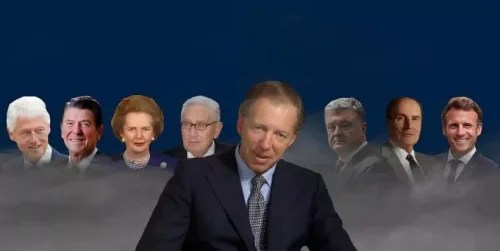
How Rothschild Banking Clan Uses Its Vast Wealth to Influence World Events and Control Governments
By Ilya Tsukanov – Sputnik – 15.09.2024
How powerful is the Rothschild banking family? How did they amass their fortune? Just how rich are they? Do they secretly control the world? Sputnik explores. … continue
Blog Roll
 Aletho News
- London tourism expo promotes Israeli agency linked to theft of Palestinian land
- Dockworkers launch global strike against Israeli and US military shipments
- Europe facing gas price shock – Gazprom chief
- Ukraine continues recruiting people with disabilities
- Weaponized Journalism: 2021 Sayer Ji Interview with NPR
- Beyond Netanyahu: what Israel’s election means for Palestinians
- Lithuania plans universal conscription
- Lies, Damn Lies, and Ukraine News
- Financial Times rejects Nordic demands to correct Putin call story – media
- The Case for Less Unity in Europe
- If Americans Knew
- An error has occurred; the feed is probably down. Try again later.
- No Tricks Zone
- Germany’s Green Energy Transition Becoming Increasingly Expensive…Another 6 Trillion Euros!
- Sudden Stratospheric Warming, Powerful El Niño Combination May Lead To Extreme Europe Cold, Energy Crisis!
- Two New Studies Find Thwaites Glacier Melt Cannot Be Driven By Human Activity Or A Warming Ocean
- E-Cars Reduce CO2 Emissions By Only 41% Compared To Internal Combustion Engine Vehicles
- Predictions Made By Renowned Climate Professor Over Past Decades Have Been Proven To Be Poor
- New Study Suggests Large Regions Of The Pacific Ocean Have Been Cooling For The Last 80 Years
- Germany’s Green Energy Debacle: High Energy Costs Force Kahla Porzellan to Close After 182 Years!
- New Study: 50 Years Of The Most Aggressive ‘Net Zero’ Policies Can Only Affect The Global Climate By 0.03°C
- US September “Heat” Was No Record…Many Records Set Decades Ago
- Latest European Green Energy Debacle; Portugal’s Largest Flagship Solar Park Insolvent!

