Christians in occupied Jerusalem see marked surge in Israeli settler attacks
The Cradle | July 12, 2024
Settler attacks on the Christian community in occupied Jerusalem have surged since the start of the Israeli war on Gaza, according to Hebrew reports.
Hebrew news outlet Channel 13 reported on 12 July that over the past three months, there have been at least 36 recorded incidents of violence or abuse against Christians.
This includes 17 incidents of Israeli settlers spitting on Christian worshippers, nine acts of vandalism, five assaults, and five cases of verbal abuse – all under police protection.
The government of Prime Minister Benjamin Netanyahu has also been imposing taxes on Churches and Church property. The Israeli government claims the taxes are routine financial matters, yet the Christian community has accused Tel Aviv of a “coordinated attack on the Christian presence in the Holy Land” and a violation of a centuries-old status quo.
“In this time, when the whole world, and the Christian world in particular, are constantly following the events in Israel, we find ourselves, once again, dealing with an attempt by authorities to drive the Christian presence out of the Holy Land,” wrote the heads of the major Christian denominations in a joint letter to Netanyahu late last month.
Earlier in June, a report released by Israeli NGO Rossing Center for Education and Dialogue reported a significant increase in Israelis attacking Christians throughout 2023.
“The ongoing shift towards the far-right, a growing sense of nationalism, and the emphasis on Israel primarily as a state for the Jewish population have collectively undermined both the legal and perceived sense of equality for any minority within the country,” the report read.
Attacks and restrictions against Christian worshippers by Israeli police are also common in the holy city.
While Christians face an uptick in abuse and oppression under Netanyahu’s far-right government, they have always suffered under occupation in the West Bank and Jerusalem.
In 2019, the head of the Sebastia Diocese of the Greek Orthodox Church in Jerusalem, Archbishop Atallah Hanna, accused Israeli forces of trying to kill him after he was hospitalized with poisoning following an Israeli tear gas attack on his church.
Hidden fronts: Intelligence and assassinations in the Israeli–Hezbollah conflict
By Khalil Nasrallah | The Cradle | July 9, 2024
In addition to the escalation between Israel and Hezbollah, the occupation state has intensified its assassinations of Lebanese resistance leaders at various levels, specifically targeting field commanders directly involved on the frontlines. These assassinations are part of a longstanding conflict between the two sides, not merely a reaction to the events following Operation Al-Aqsa Flood on 7 October.
The elimination of these resistance leaders is often framed within the occupation state as a significant achievement. However, it often serves more to influence perceptions within the settler community and the security establishment than to achieve strategic victories against Hezbollah.
Intelligence-driven warfare
The ongoing war between the Lebanese resistance and the occupation army differs fundamentally from conventional military conflicts. This confrontation’s asymmetric nature necessitates intricate intelligence operations and adaptive strategies. Both sides continually enhance their intelligence capabilities to support direct military engagements.
In southern Lebanon and northern occupied Palestine, the security dimension of the conflict is clear. The resistance has notably advanced its knowledge of Israeli positions, surprising Israeli intelligence and creating a heightened state of alert within the occupation army.
The recent killings of key figures like Abu Talib, head of the Nasr unit, and Abu Naama, leader of the Aziz unit, demonstrate the complexities of the conflict.
Frontline commanders remain vulnerable targets despite stringent security measures. Their deaths do not equal a significant victory but rather a tactical maneuver within the broader scope of the war.
In addition, security clashes become easier during military warfare for both sides and not the occupation army alone.
Israel’s objectives behind assassinations
The primary objectives of these assassinations go beyond mere score-settling. Israeli officials have historically debated the effectiveness of targeting resistance leaders, recognizing that the resistance operates as a system rather than a set of individuals.
Amit Saar, former head of the research unit in Israel’s military intelligence, emphasized this point, noting that targeted assassinations do not fundamentally change the resistance’s trajectory.
The assassination of the Secretary-General of the Allah Party, Abbas al-Moussawi, did not change the course of Hezbollah in Lebanon, and there are those behind him, and the confrontation is over. As well as the assassination of Palestinian leaders, whether military or political.
When asked about the possibility of assassinating Hamas leader Yahya Sinwar, he said: “Should we kill him? I don’t focus on assassinating one person in a confrontation with a system. But he could be a target in any future battle.”
What Saar, who resigned after Operation Al-Aqsa Flood, said helps to understand the objectives of the assassinations carried out by the occupation army in Lebanon now.
Despite this, the Israeli security establishment pursues these assassinations for several reasons, chief among them psychological impact, boosting the morale of the Israeli military and public. Another reason is internal competition, showcasing achievements within the establishment.
Additionally, these actions compensate for the occupation forces’ “defensive” posture, unprecedented since the establishment of the occupation entity in 1948. Lastly, there is an element of settling historical scores by targeting leaders with long records of resistance.
Resistance adaptation and intelligence
Contrary to Israeli narratives, the resistance, whether in Lebanon or Gaza for that matter, has not been significantly impacted by the assassinations. Instead, these events have driven the resistance to enhance its reconnaissance capabilities. Many of Hezbollah’s recent successes stem from intelligence gathered after 7 October, demonstrating its ability to adapt and respond effectively.
Public statements align with behind-the-scenes assessments, revealing that the assassination of several field commanders did not deter the resistance. Instead, these losses catalyzed the development of operations, particularly in intelligence gathering.
Gathering intelligence on new points and headquarters requires extensive security efforts. According to some reports, this intelligence work is what troubles the Israeli security establishment the most, as it directly impacts ground operations.
While Israelis might see targeted assassinations as achievements, these are often just tactical points scored in an ongoing conflict. Meanwhile, the resistance strengthens its intelligence and security capabilities, maintaining mobile and fixed target banks.
This dynamic affects Israel’s operations, especially in scenarios where clashes may expand – something the occupation army fears.
Hezbollah’s fierce retribution
Examining the response to the assassination of Abu Naama, commander of the Aziz unit operating in the western sector of southern Lebanon, reveals several strategic considerations. The resistance chose to retaliate from the eastern sector, specifically from the Nasr unit’s area, whose commander, Abu Talib, was also assassinated. This tactical decision was intended to deliver several critical messages to the enemy:
First, Hezbollah’s response from an unexpected area caught the occupation army off guard, as it anticipated retaliation from the area controlled by the Aziz unit. This highlighted a failure in accurately predicting the resistance’s reactions.
Second, by responding from the Nasr unit’s territory, the resistance aimed to convey that the assassination of Abu Talib, followed by its counteraction, did not disrupt its operations. So, the assassination of Abu Naama would similarly not impact the resistance operations.
The recent retaliation for the assassination of Abu Naama, coupled with a response to another resistance fighter’s death in the Bekaa, demonstrated the resistance’s resilience. Notably, for the first time since 1973, it targeted a long-range technical and electronic reconnaissance center in Mount Hermon, within the occupied Syrian Golan Heights.
The resistance’s capabilities remain robust and evolve to deliver more impactful military and security responses. It is committed to ongoing support operations as deemed necessary until the aggression in the Gaza Strip ceases.
The response to the assassinations of its leaders indicates that Hezbollah’s structure and operations remain largely unaffected. Its actions, whether within the ‘security belt’ in northern occupied Palestine or in more distant areas targeted by its strikes, continue to impact the occupation army.
This is evident in both the current confrontation and potential future conflicts, as inferred from Israeli military performance and statements from senior officers, particularly former ones.
3 Palestinians found dead after Israel released them
Press TV – July 8, 2024
Israeli forces have killed three more Palestinians shortly after their release from a detention camp in the occupied territories.
The bodies were found handcuffed and without clothing on Sunday in the vicinity of the Karam Abu Salem (Kerem Shalom) crossing in southern Gaza.
The three were among several Palestinians detained on Saturday.
Abdel Hadi Ghabayen said he went searching for his nephew, Kamel Ghabayen, early Sunday morning.
“I found him left on the ground along with the other two martyrs. They were without clothes, and their hands had plastic cuffs put on them by the Israeli army.”
Ghabayen said his nephew and the other two men were attacked by Israeli forces shortly after their release. One man was missing a leg, and his body was “in pieces.”
When Ghabayen tried to recover the man’s dismembered leg, Israeli troops “started shooting at me, so I stopped,” he said.
He later collected the bodies and took them in his truck to Nasser Hospital in Khan Yunis.
According to another released detainee, Israeli forces fired on them shortly after their release.
“We reached Karkar Street [in Gaza]. After 10 minutes of being there, we found a bomb thrown at the people with me. Thank God I was at the front. The bomb hit six or seven people who were detained with us. Thank God I am alive,” Mahmoud Abu Taha said.
Israeli forces recently killed more than a dozen Palestinian detainees, hours after releasing them from a detention center in the southern city of Rafah.
On June 6, the New York Times published a report with accounts of torture at Israel’s Sde Teiman camp. Israeli guards used sexual violence and electric chairs to shock detainees and forced them to sit on hot, electrified metal rods.
At least three dozen Palestinians from Gaza detained at the Sde Teiman detention facility have died, the Times reported.
Some of the former Gaza abductees have said they were blindfolded, beaten and bitten by dogs during detention.
Will Labour’s ‘change’ agenda include Palestine?
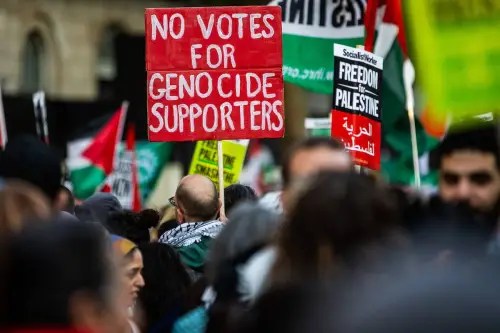
By Dr Daud Abdullah | MEMO | July 8, 2024
From a purely moral point of view, the British government, and the Labour Party in particular, should have been the first to recognise the State of Palestine given their historic role in the dispossessing three-quarters of a million Palestinians. They should not be dragged kicking and screaming to do so. After all, it was the Labour Party which officially adopted at its 1944 annual conference the policy; Let the Arabs be encouraged to move out, as the Jews move in.
French Left-wing Coalition Emerges Victorious in Parliamentary Elections
Al-Manar – July 8, 2024
The left-wing coalition, New Popular Front, emerged victorious in the French parliamentary elections, securing 182 seats in parliament.
The French Ministry of the Interior announced the final results on Monday, revealing that President Emmanuel Macron’s coalition, Ensemble, came in second place with 168 seats, while Marine Le Pen’s far-right National Rally party trailed behind with 143 seats. The Republican Party followed with 45 seats, leaving the rest of the participating parties with 39 seats collectively.
With no party achieving an absolute majority, attention turned to Jean-Luc Mélenchon, leader of the La France Insoumise party, who demanded recognition of the State of Palestine following the coalition’s victory.
Mélenchon now faces criticism for his stance on the Gaza conflict, with accusations of antisemitism hurled at him. Despite this, he remains firm in his calls for change and has demanded the resignation of Prime Minister Gabriel Attal.
Internationally, leaders such as Venezuelan President Nicolas Maduro, Colombian President Gustavo Petro, Brazilian President Lula da Silva, and former Bolivian President Evo Morales have all expressed their support and congratulations for the left’s victory in France, viewing it as a step towards global progress and unity among progressive forces.
The outcome of the French parliamentary elections has sent shockwaves throughout the political landscape, with the left-wing coalition’s win marking a significant shift in power and setting the stage for a new era in French politics.
Parody of a Statesman: Antony Blinken, Secretary of War
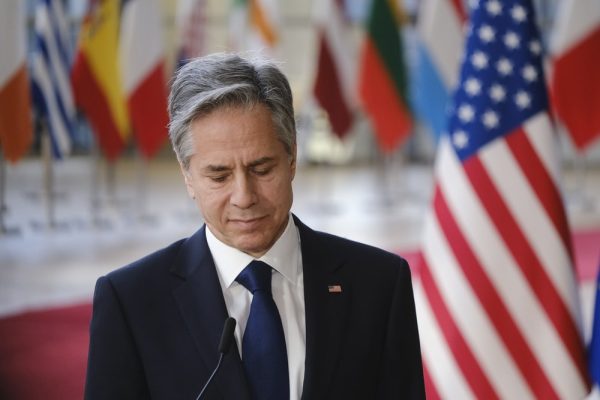
By Laurie Calhoun | The Libertarian Institute | July 8, 2024
For Halloween last year, the United States’ highest ranked diplomat, Secretary of State Antony Blinken, dressed his son and daughter up as Ukrainian President Volodomyr Zelensky and the Ukrainian flag, respectively. At a White House event on that day, Blinken’s children were photographed soliciting candy from President Joe Biden. Meanwhile, Zelensky himself had been doing his usual media circuit, appearing progressively more desperate to extract a fresh supply of “candy” from U.S. taxpayers by way of their nonrepresentative elected officials, most of whom, it would seem, have little if any interest in what their voting constituents have to say. In one poignant performance, the embattled Ukrainian commander-in-chief and former professional dancer lamented that the crisis in Israel was drawing attention away from Ukraine. In another widely disseminated video clip, Zelensky implored the audience that, if they could not give him more money, then they should at least extend him some credit, which he promised Ukraine would pay back.
It seemed as though the end was nigh for Zelensky, who was looking more and more like would-have-been Venezuelan “president” Juan Guaidó. When, during one of the primary debates, former Republican presidential candidate Vivek Ramaswamy characterized Zelensky as a “Nazi” and a “comedian in cargo pants,” he boldly articulated an impolite sentiment shared by at least some of the people who have grown weary of seeing the Ukrainian president parade around in mud-green garb and hobnobbing with the likes of Sean Penn, Greta Thunberg, Ursula von der Leyen, and every politician under the sun on the military-industrial complex gravy train. And yet, Zelensky clings on to power, having canceled what was supposed to be the 2024 presidential election with the full blessing of both halves of the War Party duopoly.
In a more recent performance, on May 14, 2024, Secretary Blinken belted out Neil Young’s ballad, “Rockin’ in the Free World,” at a basement bar in Kiev. Blinken displayed his prowess on the electric guitar while doing his best to demonstrate that he personally relates to the people of Ukraine, who have endured uncertainty regarding their future and prospects for a return to any semblance of normal life since the Russian invasion on February 24, 2022. Dead people have obviously lost all of their freedom, so Blinken’s audience comprised a select group among the survivors savoring their tenuous existence, and the fact that they are not currently being pursued, as many unfortunate draft dodgers are, by the conscription police—at least not for now. The government of Ukraine has lowered the requirements for and lifted restrictions on the military conscription of unwilling citizens, while postponing the presidential election indefinitely, on the grounds that “We are at war.” Martial law remains in place, with Ukrainians living in what is tantamount to a dictatorship under Zelensky, notwithstanding Blinken’s heartfelt crooning about freedom and democracy.
Before becoming secretary of state, while an advisor to Biden’s campaign, Antony Blinken appears to have earned the esteem of whoever would come to run the Biden administration by setting in motion the composition of the now-discredited letter signed by fifty-one members of the “intelligence community” expressing doubts about the authenticity of the Hunter Biden laptop. The computer in question, discovered before the 2020 election, contained a surprising array of photos of Hunter and, more importantly, what looked to be texts documenting shady backroom deals between foreign governments—Ukraine and China—and the Biden family. The FBI eventually acknowledged that the contents of the Hunter Biden laptop were genuine, not a “Trump campaign product,” as Nina Jankowicz, later slated to be Biden’s czarina of the Disinformation Governance Board, had so colorfully characterized it prior to the 2020 election. Ironically, the Steele dossier which served as the basis for allegations of collusion between the Russian government and the Trump campaign had itself been a Clinton campaign product.
In the light of this history, Blinken’s appointment as secretary of state can be viewed as his reward for helping to maintain the markedly anti-Russia bias of U.S. citizens, including politicians, stoked for years by the media through the now-debunked Russiagate narrative, and which inclines self-styled liberals to support the prolongation rather than the resolution of the conflict in Ukraine.
Under ordinary circumstances, when two nation states are in conflict, the less powerful of the two tends to be more receptive to attempts to resolve the matter through peaceful negotiation, such as Russian President Vladimir Putin’s recent proposal, which was immediately and categorically rejected in a knee-jerk response by NATO Secretary General Jens Stoltenberg, of all people. In the case of Ukraine, which has been artificially bolstered through a seemingly endless infusion of arms by the U.S. military behemoth, the war has no foreseeable limit—beyond the sacrifice of every able-bodied person in the land. (The case bears similarities to the artificial maintenance of the current U.S. president as head of state through the infusion of pharmaceutical products, even as rigor mortis appears to be setting in.) Reality in fact imposes limits, and they will be reached, sooner or later.
Those Ukrainians who comprehend the qualitative power disparity between nations in possession of nuclear warheads and those devoid of such means, have declined to volunteer to serve in the U.S.-maintained meatgrinder war, which is precisely why a policy of forced conscription was imposed. What good is a quasi-infinite supply of weapons, if no one is willing to fire them? Alas, any Ukrainian who has had enough of media-darling Zelensky’s panhandling from every wealthy nation on the planet is out of luck, for he remains in power, martial law firmly in place, and has indicated that he will stay there for so long as “it” takes, whatever his overlords construe that to mean.
It’s not just the U.S. government funding the war in which Ukrainian citizens are being chewed up and spit out by the insatiable war machine as military industry profits soar. NATO officials have naturally seized the opportunity to justify the existence of their institution, the source of their gainful employment, just as they have been scrambling to do since the fall of the Berlin Wall: Yugoslavia, Afghanistan, Libya, Ukraine—there’s always something for NATO to destroy! That the North Atlantic Treaty Organization was established to counteract the danger of a communist takeover of the world by the now non-existent USSR is brushed aside as somehow irrelevant by its ardent supporters and beneficiaries alike.
As the world becomes progressively more bellicose, following the infelicitous example of the U.S. military state, stentorian calls to shore up and consolidate military capacities have been heard from figures such as European Union Commission President Ursula von der Leyden, with similar jingoistic rhetoric issued also by the president of France, Emmanuel Macron. On its face, this is a puzzling development, given the twenty-year catastrophe better known as the Global War on Terror, which in no way served democracy or freedom, but instead destroyed and/or severely degraded the lives of millions of human beings. In keeping with the United States’ muscular but myopic and amnesiac approach to foreign policy, leaders of the European Union agreed in February 2024 to provide yet another $54 billion of “aid” to Ukraine, with NATO throwing in another $40 billion more recently. There’s a lot of profit at stake, and all of the usual suspects want their piece of the pie, no matter how many hapless Ukrainians will have to die. That European, British and American leaders have no interest in resolving the conflict is nowhere better illustrated than by the “Summit on Peace in Ukraine,” held in Switzerland, in June 2024, to which Russia, one of the two parties to the dispute, was not invited.
Barring nuclear holocaust, the dispute between Ukraine and Russia can only end at a negotiation table, an outcome which any competent diplomat would have worked relentlessly from the beginning to realize rather than frustrate. Instead, Antony Blinken spends his time making public appearances and issuing one-sentence slogans for spam distribution across social media platforms in an effort to appease the citizens footing the bill for the human misery and massacre to which his failure as a diplomat has led. Unable or unwilling to process the obvious implications of a war between a nuclear power and a nonnuclear power (spoiler alert: the former will win, if only through a Pyrrhic victory), Blinken daftly persists in pretending that democracy is at stake, even as Ukrainians are enslaved to fight the U.S. proxy war. The thousands of young Ukrainian men being sacrificed are just the price that must be paid. Freedom is free, but weapons are not.
It should come as no surprise that the same “diplomat” talks out of both sides of his mouth in claiming to sympathize with both the Israeli government and the Palestinians, as though furnishing some of the very weapons being used to murder thousands of civilians is easily counterbalanced with promoting the “humanitarian” treatment of those being incessantly terrorized, so long as the survivors of razed neighborhoods are provided with a bit of food and water now and then. The Blinken-Biden approach to this vexed conflict can be summed up in a piece of commonsense folk wisdom: “If you try to be all things to everyone, you’ll end by being nothing to anyone.”
Notwithstanding the frankly frightening recent public appearances of “the leader of the free world” (at the G7 meetings and elsewhere, including the disastrous debate), President Biden’s progressively deteriorating poll numbers over the course of the past several months have probably had something to do with his repeated assertion that there would be no “pause” or “ceasefire” in Israel. From the protests on campuses all over the United States, it has become clear that the antiwar left has reawakened, after eight years of slumber under Barack Obama, to abandon Biden. From the beginning, Biden materially supported Israel’s modus operandi of firing missiles at schools and mosques, homes, hospitals, and refugee camps, in an ardent quest to “Finish Hamas,” even as they embedded themselves among nonviolent civilians. When four Israeli hostages were rescued on June 8, 2024, Biden & Co. celebrated the news while downplaying, when not entirely omitting, the unsavory truth that two hundred Palestinians were killed in the process. Some people are more equal than others.
Antony Blinken has appeared occasionally to issue sincere acknowledgments of the humanity of the Palestinian people from one side of his mouth, while insisting on the right of Israel to self-defense from the other, as though slaughtering thousands of children has made anyone safe. The circus acts of such pseudo-diplomats would be amusing, if they were not so pathetic—and if the consequences for real, live, sentient human beings were not so devastating. All of foreign policy is not, as figures such as Blinken appear to believe, merely a matter of theater. No, the worst part of all of the shameless performances and photo-ops is that they entirely ignore the human reality of the wars being prolonged and provoked by the U.S. military state, as though bombing victims were mere fictions, and the soldiers coerced to fight were the currency of elites to expend.
The peace plan for Gaza recently drawn up by the Biden administration (certainly not Biden himself, who often appears to be unaware of where he is) could have been proposed back in October 2023, and, conjoined with a firm refusal to arm the killers, might well have saved the lives of some 40,000 persons—nearly half of which have been children—and prevented the wounding of many times more Palestinians. The U.S. government instead continues to condone Israel’s decision to follow the post-9/11 template of annihilating multiple times the number of the criminals sought, dismissing all of the innocent victims as “collateral damage.”
Blinken’s atrocious failures in the Ukraine and Israel conflicts notwithstanding, I confess to have experienced a tinge of sympathy for him the day he was caught on film wincing as President Biden answered a reporter’s question about his previous characterization of Chinese president Xi Jinping. Biden replied, in an unedited and brash—dare I say?—Trump-like fashion, “Look, he is. He is a dictator…” Mind you, this proclamation occurred immediately subsequent to what had been billed Biden’s “historic” White House meeting with the Chinese leader, supposedly intended to ease tensions between the two nations.
Surely, given the diminished mental acuity of his boss, Blinken’s job is extraordinarily difficult to execute, as is that of Press Secretary Karine Jean-Pierre, who is constantly in the position of concocting extemporaneous word salad responses to incisive questions posed by White House journalists. (The press secretary dismissed some of the recent videoclips showcasing a zombie-like Biden on the world’s stage as “cheap fakes”.) But Blinken’s willingness to serve not as a diplomat but as a promoter of endless war, his refusal to work diligently toward peaceful solutions to conflict, is inexcusable.
Blinken apologists may counter that every previous secretary of state during his lifetime, too, served not the cause of diplomacy and peace but the war machine. In other words, Blinken has dutifully adopted some of his most prominent predecessors as mentors.
While serving as the CIA director under President Trump, Mike Pompeo reportedly went so far as to pursue the murder of Wikileaks founder Julian Assange, denounced as a traitor and a spy, for exposing the ignoble comportment, including war crimes, of the U.S. government. Pompeo’s reward? Appointment as secretary of state, in which position Pompeo aggressively pushed for war with Iran.
Under President Obama, Secretary of State Hillary Clinton persuaded her boss to bomb Libya, chanting, “Gaddafi must go!” beforehand, and later cackling “We came, we saw, he died!” when the Libyan president was sodomized with a bayonet and murdered by an angry mob. Libya, which once boasted the best education and healthcare systems in Africa, is today a failed state, a place where people have been literally enslaved. With regard to Wikileaks founder Julian Assange, Secretary Clinton reportedly inquired during a November 23, 2010, meeting over which she presided, “Can’t we just drone this guy?”
Moving a bit further back, Condoleezza Rice had already served in the administration of President George H.W. Bush, who initiated the forever wars in the Middle East with his Operation Desert Storm. In the aftermath of the 1991 Gulf War, Bush Sr. bragged that he had “kicked” the “Vietnam syndrome”; that is, the disinclination of Americans to become embroiled in foreign wars in the years following the U.S. military’s retreat from Saigon. Rice came later to serve as national security advisor to President George W. Bush, during which tenure she went on a war-marketing blitz media circuit in which she repeatedly intoned, “We don’t want the smoking gun to be a mushroom cloud.” Rice was rewarded for her war promotion efforts with an appointment as secretary of state.
Under President Bill Clinton, Secretary of State Madeleine Albright rallied to make the 1999 NATO bombing of Kosovo happen. In a conversation with General Colin Powell (relayed in his memoir), Albright once asked, “What’s the point of having this superb military you’re always talking about, if we can’t use it?”
Under President George W. Bush, Secretary of State Colin Powell expressed caution about invading Iraq when the idea was first proposed by Cheney & Co. But Powell abruptly changed his tune (for reasons which remain unclear to this day) and ended up being one of the most vocal supporters of the ill-fated 2003 invasion. Powell’s most notorious moment, and for which he has earned a place in the annals of history, was his attempt to persuade the UN General Assembly to support the second U.S. war on Iraq. In his presentation, Powell laid out all of the pretexts later debunked as bogus: the imminent threats of Saddam Hussein’s “mobile chemical labs” and the purchase of “yellow cake” from Niger, supposedly demonstrating the existence of a robust WMD program, among other ersatz evidence buttressing the claim that war had become a last resort. When it became clear that the United Nations would not support the invasion, Powell withdrew his resolution, and the war proceeded unimpeded, at which point Powell and others pivoted to insist that the war was permitted under previous U.N. resolutions allegedly violated by Saddam Hussein.
Last, but certainly not least, we would be remiss to omit the case of Henry Kissinger, the godfather of all warmongering secretaries of state, who served under Presidents Richard Nixon and Gerald Ford, first as national security advisor and then as secretary of state. Kissinger’s savage foreign policies for southeast Asia culminated in the deaths of millions of human beings, not only in Vietnam, but also in Laos and Cambodia, the societies of which have not to this day recovered from what was done to them by the United States government in the name of democracy. Among those sacrificed were some 57,000 U.S. soldiers and the many veterans who returned home but whose lives were wrecked by their harrowing experiences in Vietnam.
Never one to insist on causation where correlation will suffice, I nonetheless feel compelled to observe that nearly all of these secretaries of state have derived a good part, if not all, of their personal wealth from having served on the boards of, or even established, defense-contracting and consulting firms. In Blinken’s case, in 2017, after a stint as deputy secretary of state (having previously served as deputy national security advisor, also under Obama), he and Michèle Flournoy, among other former employees of the federal government, launched WestExec Advisors, from which he derived $1.2 million. Blinken (along with Secretary of Defense Lloyd Austin) has also been a partner of private equity firm Pine Islands, which has invested heavily in military industries. When The New York Times, in an ever-more rare moment of critical journalism, dared to publish an editorial questioning Blinken’s seeming conflicts of interest, this was brushed aside by members of the War Party, who proceeded to approve his appointment as secretary of state.
Perhaps, then, in view of the long series of war promoters who have served as “top diplomat” for the United States, rather than take Antony Blinken to task, singling him out for criticism, the official title of his position should simply be emended from secretary of state to secretary of war, so as to reflect the reality of what such persons actually do.
“Our” Man in Israel

By Ted O’Keefe | The Occidental Observer | July 7, 2024
The issue of dual loyalty is an ancient one. As noted in a previous TOO article,
[Stephen] Walt points out that [Dennis] Ross has a long involvement with pro-Israel activist organizations, such as being director of WINEP [Washington Institute for Near East Policy, a pro-Israel think tank headquartered in Washington, DC].
But Ross’s ties to Israel are even deeper than that. Until his appointment as Middle East envoy in the Obama Administration, from 2002–2009 Ross was Chairman of the Board of Directors of the Jewish People Policy Planning Institute. This organization has assumed the role of long term planning for the Jewish people, not only in Israel but also the Diaspora. The JPPPI is an independent think tank that reports to the Israeli government and has close ties with other Jewish organizations. Its mission is “to promote the thriving of the Jewish people via professional strategic thinking and planning on issues of primary concern to world Jewry. JPPPI’s work is based on deep commitment to the future of the Jewish people with Israel as its core state.”
The JPPPI’s report Facing Tomorrow 2008 is interesting because it focuses on the threat of Iran and but also because it sees people like Stephen Walt as a threat to Israel:
The Jewish people must, as the highest priority, develop an appropriate response to the Iranian nuclear threat to Israel and to global stability as a whole. While there is no ambiguity about the need to do so in Israel, it is necessary to mobilize Jewish opinion around the world as well. The American Jewish community cannot be intimidated either by a post Iraq syndrome in the United States, or by the false and pernicious allegations of Professors Walt and Mearsheimer, or former President Carter.
In other words, Jews around the world are encouraged to mobilize to combat the threat to Israel represented by Iran. The assumption is that Jews have common interests as Jews no matter what country they happen to live in. Dennis Ross is doing his best to promote exactly this view within the Obama administration.
One might think that such a view would leave Jews in the Diaspora open to the charge of disloyalty, but the problem is easily finessed: Jews in the Diaspora are told to frame Israel’s concerns about Iran as a global threat, not simply as a threat to Israel.
Of course, that’s what we are seeing now. But we needn’t be naïve. Jews like Dennis Ross are clearly far more loyal to Israel than to the US. Speaking as a psychologist, they wouldn’t be able to see a conflict of interest between the US and Israel if it was staring them in the face. Indeed, as Gore Vidal said of Norman Podhoretz, they are unregistered agents of a foreign government.
In a sane society, there would be a huge groundswell of public opposition to Ross’s appointment–as there has been for a number of Obama’s appointments. But that won’t happen.
Since there has been no groundswell of media or public opposition to pro-Israel operatives like Ross at the highest levels of the U.S. government, it’s not surprising that the practice continues. Amos Hochstein is a good contemporary example. Israel and the powerful Lebanon-based Shiite Hezbollah militia are on the brink of open warfare, conflict that could trigger U.S. intervention and escalate to a regional or even a world war. To date these dangers have attracted little notice from the American mass media, ever eager to divert and dissemble from the direr consequences of the Washington regime’s one-sided support for Israel. Small wonder, then, that the media should evince the same reluctance in investigating the shadowy past and dubious allegiance of Hochstein, the emissary the U.S. recently dispatched to “mediate” between Hezbollah and Israel. The following is a brief foray into the workings of the Israel Lobby in the Biden Administration, as well as a primer on the perks of being Jewish in America.
Hochstein’s importance
To be sure, media reports have not slighted Hochstein’s great influence in the Biden White House or his meteoric career. He has been described as “one of President Biden’s closest confidantes [who] has worked with him for many years,” while another Washington insider calls Hochstein “the person who bridges State, Treasury, the White House and Energy”
Fittingly, one of Hochstein’s titles is “Special Presidential Coordinator.”
Yet the media have underplayed, and often ignored, a key fact about Hochstein in his role as an impartial arbiter between Hezbollah and Israel: his birth, youth, and military service in Israel.
Beyond those bare facts about his origins, Hochstein has been remarkably unforthcoming about his life before he arrived in the United States in 1974. While nearly every successful denizen of the D.C. is eager to brandish Ivy League/Seven Sisters (or the equivalent) educational credentials, one may scour the internet (including his page on the usually resume-rich LinkedIn job-hunting site) without finding anything about Hochstein’s education, college or secondary.
Just as murky are the circumstances by which Adam Hochstein, a 21-year-old immigrant with unknown credentials, became a congressional staffer within a year of his arrival in this country, working for Rep. Sam Gejdenson (D-CT) who, like Hochstein, is a Jew.
Despite his youth and inexperience, Hochstein carried out important assignments for Gejdenson. Not yet 25, he traveled to North Korea in 1997 to report on its economic and military situation; still in his twenties, he undertook negotiations with the Iraqi government (against the advice of the U.S. State Department) aimed at “resettling” thousands of Palestinians there in exchange for loosening some of the crippling sanctions then in force there.
Well before 9/11, Hochstein advocated acting against Iraq for harboring “weapons of mass destruction” in a press release issued by Congressman Gejdenson, and soon afterward he was serving as senior advisor to a senator and a governor. Like many members of the permanent government, Hochstein has used hiatuses between his party’s dominance to work in lobbying and industries close to government, in his case capitalizing on energy policy expertise that he seems to have acquired with no expertise in the field. He’s evidently done well, at some point becoming a partner in two D.C. restaurants and a movie theater.
Under Obama, Hochstein (without known diplomatic training or experience) rapidly climbed the ladder at the State Department to become America’s chief energy negotiator, deeply involved in efforts to block Russian natural gas from Europe and to facilitate Israeli access to energy.
During the Trump presidency, Hochstein served on the board of Ukraine’s natural gas company, Naftogaz.
Hochstein’s knowledge of the ins and outs of Ukraine’s shady corrupt energy industry is evidently considerable. In his testimony to the U.S. House of Representatives, Hunter Biden stated that Hochstein had advised him merely to be “very careful” in serving on the board of the notoriously corrupt Burisma corporation.
Hochstein also seems to have had a role in the “whistle blowing” that led to Trump’s first impeachment resulting from a phone call interpreted by Democrats as pressuring Zelensky to investigate Biden family corruption in Ukraine, and to have been advising Zelensky before his election.
It’s also interesting that there is a lack of definitive information on Hochstein’s current citizenship:
According to one report, a State Department source has claimed that he is “not a dual national,” but refused to state if he has renounced his Israeli citizenship, and in fact gave no [details as to Hochstein’s American citizenship.] So the question raised, unanswered— Hochstein’s citizenship is evidently a “carefully guarded secret.” Not acknowledging Hochstein’s Israeli citizenship would be useful because, for example, in Lebanon, where Hochstein has been involved as an American negotiator on the Israeli conflict with Hezbollah, “it is normally illegal for an Israeli” to visit Lebanon.
Even Hezbollah at the time did not comment on the mediator’s nationality or military past, with leader Hassan Nasrallah saying they will “not express an opinion or position related to the demarcation of borders”.
Given all this, it’s hard to disagree with this quote originally from Ha’aretz:
… the American brokerage farce, whose players are almost all American Jews, some of them former or future Israelis. If the United States is a side in the conflict, then it should say so and conduct the negotiation as though Israel is its protégé. And if it really wants to be an honest broker, then come on – Amos Hochstein?…
Palestinians and international human rights observers arrested in Masafer Yatta, occupied West Bank
International Solidarity Movement | July 7, 2024
Israeli Occupation forces arrested three Palestinians, including a 14 year old child, together with three internationals (including a US citizen) and one Israeli human rights observer in at-Tuwani, Masafer Yatta, in the South Hebron Hills area.
This morning, armed Israeli settler shepherds invaded Palestinian land with their flocks, provoked the family that was working on their land and attempted to steal one of their donkeys. The Palestinians tried to prevent them from going on their land and were attacked by the settlers. They called the police to remove the settlers, but the army and police chose to arrest three Palestinians, one of whom is a 14 year old child, three international and one Israeli human rights observers. No settlers were detained. They have all been taken to an Israeli police station. As of 5.45 pm (Jerusalem time), the family has been released but the human rights observers remain under custody.
The family, including the child, was already detained for around 3 hours on their land a couple of weeks ago and they have suffered numerous attacks over the years from violent settlers and the army. A couple of weeks ago, settlers cut newly planted trees and destroyed the water connections.
Land theft and ethnic cleansing have spiralled since October 7 in Masafer Yatta, and in other areas of the occupied West Bank. Israeli settlers who live in illegal settlements have been heavily armed and have escalated harassment and threats towards Palestinian communities, with the backing of the Israeli occupation forces. Umm al-Khair, one of the villages in Masafer Yatta, has lately come under almost daily attack from settlers and the army. On June 26, occupation forces demolished a dozen structures in Umm al-Khair displacing dozens of residents, including children. Since then, settlers have raided the village, shot live ammunition, erected a tent in the village and destroyed the water system, leaving the whole community of Umm al Khair without access to water.
On July 4, settlers carried out a pogrom in the village of Khalet a Dabaa. About 200 settlers reached the village at midnight, set agricultural land and trees on fire and attacked villagers, shot live ammunition and kidnapped a villager. An Italian activist from the NGO Mediterranea was also badly beaten. There are daily incidents in Masafer Yatta, with settlers coming on what remains of Palestinian land to herd in order to harass and push Palestinians further away from their land.
These are not isolated incidents. They are a part of a bigger plan of annexation of the West Bank/Area C. Between October 7 and July 1, over 1,050 attacks from settlers on Palestinians have been recorded by OCHA. At the beginning of March, Israeli authorities approved the construction of almost 3,500 illegal housing units in settlements around the West Bank. More recently, almost 5,295 new illegal housing units have been approved. This all comes amidst the biggest land seizure in the West Bank in over 30 years. Far-right Finance minister Bezalel Smotrich has vowed to bring a million more settlers under his expansion plan.
In a quiet move, about a month ago, more control was moved from the Israeli army’s civil administration to the recently established governmental body “Settlement Administration”, led by Smotrich. Last Thursday, Orit Strock, Minister of Settlements and National Missions, was reported praising a master plan to build over 100 housing units in the South Hebron Hills area, saying this was “a miracle time” and “a sacred mission,” highlighting her efforts to invest in the area.
All of this is happening while the Israeli authorities are repressing human rights solidarity in the area, with at least six more international and three Israeli human rights observers banned from the area in the previous few weeks, with the aim of isolating Palestinian communities and promoting their propaganda unchecked.
Israel refuses Hamas demand for written ceasefire assurances
The Cradle | July 7, 2024
Israel will not accept Hamas’ request for written assurances regarding negotiations in the second phase of a proposed deal for a ceasefire and prisoner exchange agreement in Gaza.
The Palestinian resistance group is demanding that a cessation of hostilities outlined in the first phase of the proposal be ongoing throughout negotiations in the second phase. However, Israel is insistent on the option to resume the war if negotiations falter.
During David Barnea’s visit to the Qatari capital, Doha, last week, the Mossad chief conveyed the message to mediators that Israel “does not accept Hamas’ demand for a written commitment regarding negotiations for the second phase of the agreement,” Axios reported on 6 July, citing Israeli officials.
The main issues revolve around Articles 8 and 14 of the proposal. Article 8 of the proposal refers to talks between Israel and Hamas that would be held during phase one and would last for six weeks of the agreement, while Article 14 refers to the transition between phase one and phase two.
The proposal was reportedly updated recently with “new language” by CIA chief William Burns and other officials, Lebanese media reported on 4 July. Hamas presented its proposed amendments to the plan on 3 July.
The proposal calls to “make every effort” to ensure the negotiations end in agreement. Hamas’ response called for the phrase “make every effort” to be replaced with the word “ensure.”
“In effect, Hamas wants to ensure that it does not turn over many of the hostages only for Israel to restart the war,” an informed official told the New York Times (NYT) on 6 July.
Another official confirms to NYT that Israel has rejected Hamas’ request. “Israel wants the option to resume fighting if it deems it necessary. Without such leverage, Hamas might drag its feet, effectively obtaining an undeclared permanent cease-fire.”
There are other outstanding issues besides Articles 8 and 14 of the proposal.
In its response, Hamas refused Israel’s veto over releasing Palestinians with life sentences as part of an exchange, a source told Al-Mayadeen on 4 July. The source also said Hamas is insisting on an Israeli withdrawal from the Rafah border crossing and the Philadelphi Corridor.
Israel seized the Rafah crossing on 7 May and began pushing into the southernmost city in defiance of months of international warnings, displacing around one million Palestinians. The Philadelphi corridor, the vital strip bordering Egypt that serves as a lifeline to both the resistance and the people of Gaza, was then seized by Israeli forces later that month.
In mid-June, the Israeli army set fire to and destroyed the Rafah crossing. According to reports at the time, this was part of a US–Israeli plan to transfer the Rafah land crossing to the Kerem Shalom area – where another border crossing that leads from the strip to Israel lies – to tighten supervision and obstruct Hamas members from entering and leaving the enclave.
Tel Aviv has long been calling to establish a permanent presence along the southern Gaza border. Hamas has stuck to its terms in the talks for a complete Israeli withdrawal from Gaza.
Speaking to Al-Arabi, the head of Hamas’ national relations office, Hussam Badran, said on 6 July: “There is a positive outlook from the mediators regarding the movement’s recent stance on the exchange deal. The only obstacle to reaching an agreement is Netanyahu.”
Hamas denies Israeli allegations of presence in UNRWA school

Press TV – July 7, 2024
The Palestinian resistance movement Hamas has condemned a deadly Israeli attack on a UNRWA-affiliated school in central Gaza, dismissing as “pure lies and deception” Israel’s claim that resistance fighters had been present in the building.
Hamas in a statement on Saturday called the Israeli airstrike on Al-Jaouni school, a UN-run school sheltering 7,000 displaced people at Nuseirat refugee camp in central Gaza, a “horrific massacre” in which 16 Palestinians were killed and many others wounded.
The Palestinian group’s statement came after the Israeli forces claimed the UNRWA-run school was used by Hamas fighters as a command center.
“This criminal enemy is trying to pass and market its crimes to public opinion, and hide its clear objectives, which it seeks to implement by exterminating our Palestinian people and destroying all the components of life in the Gaza Strip,” Hamas said in the statement.
Hamas’s statement noted that shelters, schools, and UNRWA facilities have been systematically targeted and destroyed, resulting in the killings of hundreds of displaced individuals, including children, women, and the elderly.
“The number of UNRWA facilities targeted has reached one hundred and ninety centers, confirming the criminal intentions of the fascist occupation government and its pursuit of destruction and inflicting the maximum number of unarmed civilians inside, in a continuation of the war against our people,” the statement added.
Hamas labeled the Israeli attacks as war crimes and blatant violations of international law, urging the international community to take a firm stand in denouncing these attacks, taking action to stop them, and ensuring that those responsible, including occupation leaders, are held accountable for their actions.
Moreover, the Popular Front for the Liberation of Palestine in a statement strongly condemned the Israeli assault on Al-Jaouni school, describing it as a new chapter of Zionist brutality that highlights a surge in Zionist aggression backed by the American government.
“These massacres will not undermine the determination and steadfastness of our people, who refuse to succumb to oppression, massacres, and aggression. The enemy will certainly pay the price for its crimes,” the statement added.
The United Nations agency for Palestinian refugees (UNRWA) announced that 250,000 people have been impacted by Israel’s latest evacuation order for parts of southern Gaza.
The mass displacement of Gaza in the war-torn territory comes amid the World Health Organization’s warning of a public health catastrophe as it says diarrhea, chickenpox and jaundice are spreading fast among Gaza’s displaced population due to lack of clean water and personal hygiene materials.
More than 38,098 Palestinians, mostly women and children, have been killed and 87,705 wounded so far throughout Israel’s brutal military onslaught.
Featured Video

Ivermectin and iodine
or go to
Aletho News Archives – Video-Images
From the Archives
UN declares war on ‘dangerous’ conspiracy theories
‘World is not secretly run by elites’
Free West Media | August 5, 2022
UNESCO says it is seriously concerned about the increase in “disinformation” and “conspiracy theories”. And they plan to put an end to it through a network of informants.
“Conspiracy theories can be dangerous,” the UN agency warned. “Often they ignore scientific evidence and polarize society with dire consequences. This has to stop.”
Unesco’s director-general warned that “conspiracy theories” could cause damage to people as well as to their health. “They reinforce misconceptions about the pandemic, reinforcing stereotypes that can fuel violence and violent, extremist ideologies,” said Audrey Azoulay.
The UN agency has launched a campaign to help people identify, debunk and report “conspiracy theories” to prevent them from spreading further.
This campaign is being carried out in collaboration with the European Commission, Twitter and the World Jewish Congress. The UN has created a toolkit to “debunk” such theories and smear anyone who dares to claim that governments are not fair and transparent.
The UN also warned that George Soros, the Rothschilds and Israel should not be linked to “alleged conspiracies”.
World events “are not secretly manipulated behind the scenes by powerful players with malicious intent,” the UN agency maintained.
And if anyone therefore comes across someone who believes that the world elite is plotting to consolidate power or direct events, then that person needs to take action. According to the UN agency, when meeting a “conspiracy theorist”, under no circumstances should one enter into a discussion. … continue
Blog Roll
 Aletho News
- Russia shows Europe that prolonging the Ukraine war is pointless
- There is cautious optimism about ending the Ukraine War – Part 2
- Ukrainian air alert app hacked with fake nuclear warnings
- Ivermectin and iodine
- Congratulations climate skeptics — you are a ‘Hybrid weapon of war’ and a growing public health threat
- ‘The Arab Vote’: How Israeli Racism Has Ruined Their Elections
- Israel forces Palestinians in Gaza to choose between assassination alone or death with their families: Report
- US Approves Sale of 500 Patriot Missiles to Ukraine, Deliveries May Take Years
- German Imperialism: An Urgent Explainer
- Backed by AAP, West Virginia Proposal Would Allow Dental Hygienists to Give HPV Vaccine to 9-Year-Olds
- If Americans Knew
- An error has occurred; the feed is probably down. Try again later.
- No Tricks Zone
- Germany’s Green Energy Transition Becoming Increasingly Expensive…Another 6 Trillion Euros!
- Sudden Stratospheric Warming, Powerful El Niño Combination May Lead To Extreme Europe Cold, Energy Crisis!
- Two New Studies Find Thwaites Glacier Melt Cannot Be Driven By Human Activity Or A Warming Ocean
- E-Cars Reduce CO2 Emissions By Only 41% Compared To Internal Combustion Engine Vehicles
- Predictions Made By Renowned Climate Professor Over Past Decades Have Been Proven To Be Poor
- New Study Suggests Large Regions Of The Pacific Ocean Have Been Cooling For The Last 80 Years
- Germany’s Green Energy Debacle: High Energy Costs Force Kahla Porzellan to Close After 182 Years!
- New Study: 50 Years Of The Most Aggressive ‘Net Zero’ Policies Can Only Affect The Global Climate By 0.03°C
- US September “Heat” Was No Record…Many Records Set Decades Ago
- Latest European Green Energy Debacle; Portugal’s Largest Flagship Solar Park Insolvent!

