Israeli army uses drones to terrorize civilians at Gaza hospital

Palestine Informtion Center – January 7, 2024
GAZA – The health ministry in Gaza has accused the Israeli occupation army of using its armed drones to terrorize the patients and medical staff at Al-Aqsa Martyrs Hospital in Deir al-Balah City in central Gaza.
“Israeli drones are opening fire at Al-Aqsa Martyrs Hospital’s sections and courtyards, targeting everyone who moves,” the health ministry said in a statement on Sunday evening.
The ministry also accused the Israeli army of seeking to put Al-Aqsa Martyrs Hospital out of service through intensively opening fire at it from drones.
The ministry pointed out that the ongoing shooting attack on the hospital forced a number of patients and wounded civilians to leave it and expose themselves to gunfire from the drones.
The ministry warned that thousands of wounded and sick people in central Gaza would be sentenced to death if the hospital stopped providing its services.
Since October 7, 2023, the Israeli army’s military aggression against Gaza and its deliberate attacks on medical facilities have made the majority of the hospitals and health centers “nonfunctional.” The Israeli army has also destroyed 121 ambulances since then.
Day 93: Israeli Assault Claims Two More Journalists

Al-Manar | January 7, 2024
Gaza Strip is witnessing a sharp escalation in violence, with Israeli military operations in last night’s onslaught in Al-Faluga and Khan Yunis leaving at least 20 Palestinians martyred, a toll that tragically includes civilians seeking refuge and victims from an attack on a United Nations Relief and Works Agency (UNRWA) school in the Mughazi refugee camp.
In the southern Gaza Strip, at least two journalists, Hamza Wael al-Dahdouh, son of al-Jazeera Gaza bureau chief Wael Al-Dahdouh, and Mustafa Thuraya, were killed in an Israeli airstrike that targeted and blew up their vehicle in Khan Younis on Sunday.
The journalists, including Hamza, were en route to the Moraj area northeast of Rafah, designated a “humanitarian zone” by the Israeli army but reportedly subject to recent bombings. Their intention was to report on the situation and aftermath of bombings in the area, where many displaced Gazans sought refuge from bombardment in other regions of the territory.

Bureau chief for Al-Jazeera Arabic in Gaza, Wael Dahdouh, stands over the body of his son Hamza
Wael al-Dahdouh, Hamza’s father and Al-Jazeera’s bureau chief in Gaza, was recently wounded in an Israeli strike. His wife and two children had been killed by a separate Israeli strike in the initial weeks of the aggression.
The media office of the Hamas resistance movement strongly condemned the “heinous crime” committed by the “Israeli occupation army against journalists.” The Zionist entity aims to “intimidate journalists in a failed attempt to obscure the truth and prevent media coverage,” the office added.

The media office called “on all press unions, human rights and legal bodies to condemn this crime and denounce its repeated commission by the occupation.” It also called for pressuring “the occupation to stop the genocidal war against our defenseless people in the Gaza Strip.”
20 Palestinians lost their lives during the night as the Israeli occupation forces launched airstrikes on Al-Faluga in the Jabalia refugee camp, situated in the northern Gaza Strip. Among the targeted locations was a building belonging to the Abu Alba family in Al-Faluja. Concurrently, air strikes pounded Tal Al-Zaatar in the northern Gaza Strip, further exacerbating the already dire situation.
Adding to the toll, 16 Palestinians were martyred in the bombing of the central Gaza Strip since evening.
Deir al-Balah witnessed 11 casualties due to Zionist attacks, while in Khan Yunis, located in the southern part of the Gaza Strip, the death toll rose to 17. Artillery shelling intensified in the neighborhoods of the city’s center, west, and north.
Rafah also bore the brunt of the occupation’s aggression, with several areas being targeted. The toll rose to 7 as a result of an Israeli bombing that specifically aimed at a building housing displaced people. Disturbingly, reports emerged of injuries resulting from an air strike on a house belonging to the Al-Ajez family in the Al-Zuhur neighborhood, situated in the northern part of Rafah.
According to reports from the official Palestinian news agency WAFA, the Israeli military targeted a residence in Khan Yunis, where a significant number of displaced individuals sought refuge. Tragically, this resulted in the loss of at least 12 civilian lives and injuries to 50 others.
Furthermore, Israeli warplanes struck a school operated by the United Nations Agency for Palestinian Refugees (UNRWA) in the Mughazi refugee camp in the central Gaza Strip, leading to the death of at least four individuals, including a woman.
The report indicates that the Israeli military employed drones and engaged in intensive firing at homes and streets in the Mughazi camp. Simultaneously, Israeli warplanes launched a fire attack near Sekka Street west of the camp, accompanied by heavy artillery fire from the army.
Eyewitnesses reported a fire breaking out east of the neighboring Nuseirat camp due to sustained Israeli airstrikes.
The Israeli aggression extended to Tel al-Zaatar and the city of Deir al-Balah, where fierce airstrikes resulted in additional casualties, according to the report.
The grim statistics underscore the severity of the ongoing Israeli aggression on Gaza, with the death toll reaching at least 22,700 Palestinians, the majority of whom are women and children. Additionally, 7,000 individuals are reportedly missing under the rubble, presumed to be casualties of the conflict. The international community faces an urgent call to address the escalating humanitarian crisis and seek a sustainable solution to the longstanding conflict in the region.
Display of Resistance
Palestinian forces thwarted the advances of the Zionist enemy, effectively dealing heavy blows and preventing any consolidation of occupation across various regions of the Gaza Strip.
Despite the passage of two and a half months since the commencement of the ground operation, the relentless efforts of the Palestinian resistance have led to successive defeats for the occupying forces, compelling their withdrawal from the majority of areas in the northern Gaza Strip—an accomplishment of significant magnitude for the steadfast resistance fighters.
A notable triumph unfolded today as the Al-Qassam Brigades orchestrated the complete destruction of a Zionist personnel carrier situated in Al-Maghazi camp in the central Gaza Strip, employing the formidable “Al-Yassin 105” shell. Scenes depicting the obliteration of the personnel carrier were released by Al-Qassam, symbolizing a powerful stance against the occupiers.
The resilience of Al-Qassam forces further manifested as they obliterated enemy forces that had penetrated Al-Maghazi camp, utilizing a barrage of heavy-caliber mortar shells. Simultaneously, the Al-Quds Brigades announced the successful missile salvoes targeting strategic locations, including “Nahal Oz,” “Sufa,” and “Hulit.”
In another commendable operation, the Brigades revealed their precision and efficacy by targeting an occupation army force entrenched in a house in Tal al-Hawa, Gaza, with an OG-7V anti-personnel missile. This precise strike resulted in casualties within the force, and the Mujahideen successfully seized the soldiers’ equipment.
China’s COSCO halts shipping to Israeli ports: Israeli media
The Cradle | January 7, 2024
Chinese state-owned shipping company COSCO, the fourth largest in the world, has halted sailing to Israeli ports, Israeli media outlet Globes reported on 7 January, in the wake of attacks and attempted seizures of vessels heading to Israel via the Red Sea by Yemeni armed forces.
The Israeli report indicated that the Chinese firm did not disclose a reason for the policy change. COSCO’s offices in Israel have refused to comment on the development.
The Globes report attributed the decision to the close ties between China and Iran, which sells 90 percent of its crude oil exports to Beijing. Iran is a supporter of the Yemeni government and opposes Israel’s ongoing war on Gaza.
In a similar development, the Hong Kong-based OOCL halted all cargo deliveries to Israel last month, citing “operational problems.”
In the same month, other major shipping firms, including the Mediterranean Shipping Company (MSC) and CMA CGM, announced their decision to halt shipments to Israel one day after the Yemeni Armed Forces attacked two Israel-bound vessels.
Yemeni forces have been attacking Israeli-bound vessels in the Red Sea in response to Israel’s war on Gaza, which the Sanaa government views as genocide.
Washington and its allies in turn formed the Prosperity Guardian naval coalition and issued an ultimatum to Yemen’s Ansarallah-led government to stop their Red Sea operations or suffer the “consequences.”
Yemen’s actions have forced numerous leading shipping companies to instead travel around the Cape of Good Hope at the southern tip of Africa to reach Europe, extending the shipping times by two weeks and increasing costs.
On 31 December, US naval forces sank three Yemeni boats in the Red Sea, killing ten Yemeni naval soldiers.
From the onset of the Gaza conflict on 7 October, Yemeni military forces have targeted a minimum of 15 merchant vessels either bound for Israeli harbors or owned by entities associated with Israel.
So You’re a Professor? Here’s What You Can Do to Oppose Genocide
By Steve Salaita | January 7, 2024
College instructors, particularly those in Europe and North America, are generally limited when it comes to meaningful intervention in imperialist horrors afflicting the Global South. Nevertheless, it is usually their governments either orchestrating or abetting the horror. They ought to do something, then, even if it seems pyrrhic or inadequate.
People around the world are now witnessing a particularly gruesome event as the Zionist entity, armed by its U.S. sponsor and enjoying the support of capitalist institutions across the globe, commits one atrocity after the other in the Gaza Strip (along with the West Bank and at times further afield). The atrocities, anyone with a modicum of integrity agrees, add up to genocide. The depth of grief and suffering Palestinians now experience is indescribable, immeasurable.
Do professors and other campus workers have any ability to mitigate the grief and suffering? Not really. But we’re not entirely powerless, either. Higher education is an important sector for information and activism and an industry where participants like to contemplate the role of both exceptional and ordinary people in making a better world. Like anybody else, teachers and researchers can be most effective in their own communities, which are not inoculated from the genocide. Zionist groups have organized hundreds of defamation campaigns against Palestinian students and faculty, often resulting in employment termination and other serious forms of recrimination. These campaigns don’t exist in a vacuum. Targeting Palestinians and anti-Zionists is an extension of the genocide, or at least one of its attendant tactics. And then, of course, many of the campuses are somehow invested in the Zionist entity—financially, politically, or logistically. It does no good to say that “we” aren’t affected by what happens “there.”
The following is a list of suggestions for Western academics, with the understanding that not all professors are equal and each campus is different in terms of its cultural and economic composition. In turn, I have tried to be comprehensive, offering comments that I hope will be useful to everyone from contingent faculty whose employment is precarious to senior scholars with big platforms at elite institutions. (The latter are much more likely to be facilitating the genocide, either obliquely or explicitly, but nevertheless.)
One thing is clear: the world is now experiencing a moral crisis whose enormity will reshape political attitudes and alliances for generations to come. Pretending that life, no matter how sheltered or comfortable, can simply continue as normal is its own kind of moral crisis.
Try one or more of the following if you can:
Defend Palestinian Students: Be it from forces on or off campus, or be it individuals you know or don’t know personally, it is reprehensible that students should suffer doxing and harassment, whether it is orchestrated by skeezy has-beens like Michael Rapaport or hysterical faculty on their own campus. Speak on behalf of your students. It can be done publicly through the usual channels or in private communication with chairs, deans, and other administrators. Or keep it simpler: reach out to the students and offer yourself as a resource.
Defend Palestinian Colleagues: The same idea holds, but with a quick addendum. Being a Palestinian in Western academe can be deeply alienating, in no small part because shitting on Palestinians is a reliable method of upward mobility. I’m sure some of your Palestinian colleagues will appreciate any gesture that might make them feel slightly less alone.
Boycott: Up to this point, academic boycott of Israeli universities has been controversial, even in supposedly progressive quarters of the industry. The facts, however, are clear. Israel has destroyed every institution of higher learning in the Gaza Strip. It has murdered dozens of faculty and administrators, including university presidents, and an untold number of students. There is no academic freedom in Palestine. There is no academe at all in Gaza. Reluctance to boycott is no longer acceptable. It is the baseline of political decency. Anybody who continues to oppose or dissemble about academic boycott should be regarded as untrustworthy on everything else.
Divest: Start or join a local campaign to force your university to divest any holdings from the Zionist entity. Divestment can include study abroad programs in Israel, which inherently discriminate against Palestinian, Arab, and Muslim students. In the past decade, students have successfully passed divestment resolutions at numerous universities, but management simply ignores them. Faculty voices will help these efforts.
Invite People from Gaza: Surely the rank-and-file in academe are tired of the same few dozen big-name professors and celebrity activists saying the same three or four things in the lucrative lecture economy. Decisionmakers on campus invite speakers for prestige, for the brand, or else to network or be in the presence of fame. The habit needs to die and there’s no better time than now. Instead of summoning the usual Endowed Chair of Gobbledygook at Wealthy Private University to deliver radical affectations at a cost of multiple thousands, reach out to scholars and journalists from Gaza (and for God’s sake give them a proper honorarium). They will assuredly be more insightful than warmed-over relics of the pre-millennial theory craze. Likewise: recruit graduate students from Palestine. You can also look into bringing Palestinians as visiting writers/scholars or as researchers/consultants in any effort to document the genocide. Start with people who are currently outside of Gaza; when conditions are better, reach out to those still inside the territory. Gaza is filled with individuals of remarkable talent. You will be better off for having sought it.
Organize or Attend a Demonstration: You don’t need to be a seasoned organizer to raise hell about the abomination that is the Zionist entity.
Direct Action: Why should students always be the ones to shut down administrative offices or gum up the machinery of genocide? Professors can participate, as well. I’m not saying you need to do it. I just want you to bear in mind that nobody, no matter how urbane or well-published, is too good to get fired or sit in jail for a few hours in solidarity with a people whose heroism is known and admired around the world.
Teach Palestine: Hundreds of Palestinian poets, novelists, and essayists write in English or are available in translation. Consider including them on your syllabus. So what if your courses don’t focus on Palestine or the surrounding region? If you’re a modernist, then assign Fadwa Tuqan or Mahmoud Darwish. If you’re in gender studies, look up Fatima Bernawi or Rasmea Odeh. If you teach novels, try Susan Abulhawa, Susan Muaddi Darraj, Sahar Mustafah… on goes the list. If you’re an Americanist, there are numerous options. Same for Latin Americanists. A critical theorist? No problem: there’s Elias Sanbar and Bassel Al-Araj and Ghassan Kanafani. And if you’re, say, a medievalist? That’s no problem, either.
Stop Pandering to Customs of Civility: You don’t need to condemn “Hamas.” You don’t need to “affirm Israel’s right to exist.” You don’t need to bang on about “democratic values.” You don’t need to be “nuanced.” You need to defend the people suffering a genocide. Not a single one of them is asking for anything else. (“Who is my audience?” keep asking yourself. If the answer is anything other than “the dispossessed,” then recalibrate your ethics and try again.)
Shun the Genocidaires: Those rationalizing or cheering on the genocide are personae non grata from here on out. No co-authoring articles with them. No sitting together on conference panels. No buddy-buddy bullshit on the networking circuit. Sure, sometimes circumstance will force you onto the same committee or whatever, but, if the association is voluntary, then decline the opportunity and find colleagues who don’t celebrate mass murder.
Speak: [speak]
Or better still: Listen.
While Gaza Burns, Media Zionists Still Portray Israel as Victim
By Niall McCrae | 21st Century Wire | January 7, 2024
In words often wrongly attributed to Voltaire, Kevin Alfred Strom asserted that ‘to learn who rules over you, simply find out who you are not allowed to criticise’.
Since the Hamas attack on 7th October, this has been made very clear. Influential Zionist activists, who exert phenomenal influence on western politics, governments, and media, have ensured that only the one version of events, the Israeli version, is socially acceptable. This political reality was demonstrated in grave detail in Al Jazeera’s multi-part investigative documentary, The Lobby -Britain and The Lobby – USA. Of course, a different truth is known by any objective observer, especially millions of Palestinian people, and also by the millions who march worldwide against the brutal military bombardment and massacre of civilians in Gaza. But the BBC and The Daily Mail still refuse to broadcast or publish the widespread and justified disgust at the actions of the Israeli government.
Disturbingly, the British mainstream media have been actively shilling for the Israeli government, as their Prime Minister Benjamin Netanyahu insists on continuing the annihilation of Gaza. A prime asset of the campaign to cast Israelis as the oppressed, and the Palestinians as the oppressor is British media pundit Douglas Murray. Writing in the Spectator, Why I’m considering a life of crime, Murray denounced posters at Heathrow Airport inviting travellers from the ‘Israel/Palestinian territories’ who have ‘witnessed or been a victim of terrorism, war crimes or crimes against humanity’ to report to it police, in potential pursuance of a case by the International Criminal Court. This call for international justice deeply offends Murray, who asserts that ‘there is no country called Palestine’. Why not, Douglas? My old atlas from the 1930s clearly shows a land of this name, on the eastern edge of the Mediterranean Sea and bordering on Trans-Jordan.
Curiously, Murray is not sure what status to give the remaining Palestinian area. As he explains, ‘there is the disputed territory of the West Bank and there is Gaza, which was handed over to the Palestinians in 2005 and which promptly became a ‘terror state’. Hold on, Douglas, don’t you deny such statehood? It seems that Murray wants Gaza to have responsibility without any sovereign recognition or power, and the inverse for Israel.
But their journalists and commentators are not only concerned with what’s happening in a narrow strip of land invaded by Israeli troops. They portray all Jews living in Britain as victims of hate, because supporters of the Palestinian cause are railing against the murderous exploits of a state that claims to represent Jewish people worldwide. Meanwhile our police and judiciary appear bent on protecting a foreign jurisdiction two thousand miles away; for example, arresting UK protestors with placards likening the Knesset to the Third Reich.
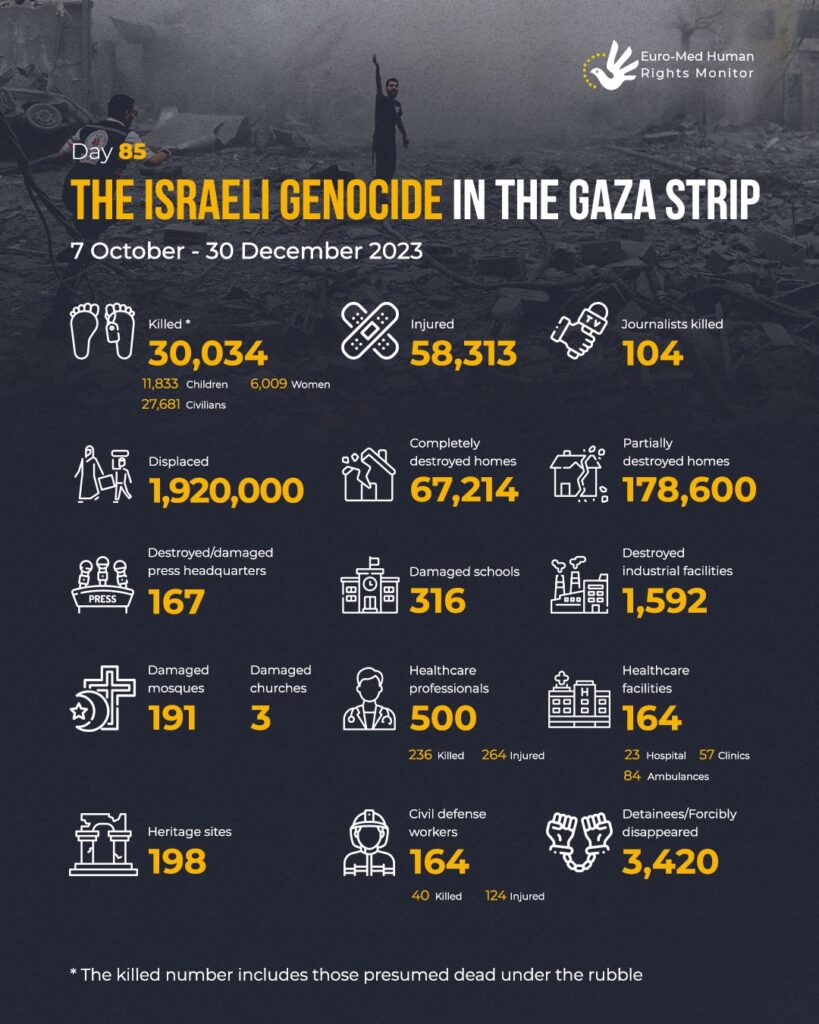
INFOGRAPHIC: Latest number in Israel’s ongoing genocide of the native Palestinian population in Gaza (Source: EuroMed)
The lead opinion piece in the Daily Express (4th January 2024), by the chairman of Glasgow Friends of Israel, shows the way that the wind is blowing. According to Sammy Stein, anti-Zionism is nothing but rebranded anti-Semitism. Although Stein acknowledges the right to criticise Israel and its leaders (as do many Israelis), he smears the regular large pro-Palestinian rallies in Glasgow as “anti-Semitic,” based on his experience in running a market stall in the city centre adorned with Israeli flags. He believes that flying a national flag (of a country that is clearly committing crimes against humanity) is somehow defending the rights of Jews. Within reasonable limits, criticism of his stall is an expected and justifiable act of free speech, a fundamental right in a free society.
Stein confines the concept of anti-Semitism to dislike of Jews, despite the broader meaning of Semitic peoples (including the Semitic Palestinian people, the targets of Israeli bombs and bullets). He claims that this ‘is a term established specifically for the hatred of the Jewish people and not, as some believe, hatred against people who can be described as Semites, such as Muslims’. The expanding scope of anti-Semitism, as determined by the International Holocaust Remembrance Alliance (IHRA), is now sufficiently wide enough to quell any opprobrium towards Israel, while there is no equivalent protection for the native Palestinian people and their diaspora. Shamefully, nearly all major Western political parties have signed up to this blatantly one-sided censorship.
Despite the efforts of these Western institutions to impose an arbitrary definition of what constitutes a ‘hate crime,’ the fact remains that Jews are not the same as the state of Israel, and both of which is not the same as the ideology known as Zionism. But the distinction between Zionists and the Israeli leadership is becoming blurred. As the Palestinians and their supporters chant of ‘From the river to the sea, Palestine will be free’, treated by many Western authorities as a potentially hateful message, Netanyahu’s administration seems to be aiming for that very same outcome – capturing the whole land for Israel and evicting the Palestinians from their homeland. Stein notes that ‘today, Zionism refers to support for the continued existence of Israel, in the face of regular calls for its dissolution’. The Israelis have a right to self-determination, Stein believes, but not the Palestinian inmates trapped in the world’s largest concentration camp.
Stein also reminds us that ‘Jesus was a Jew,’ who, ironically, was persecuted by the Jews, leading to his crucifixion under the aegis of Roman authority at the time. But for Stein and Zionists, the land of historic Palestine belongs to the Jews because some Jews have continuously inhabited the area for thousands of years, after having first established their presence thousands of years ago. Also, they believe that this homeland was supposedly promised to them as a fulfilment of God’s covenant with Abraham. This is a simplistic and convenient reading of history. There is no straightforward link between Judah of the Bible and present-day Zionists. Regardless, should Israel really be allowed to run an exclusionary ethno-nationalist and inhumane Apartheid state (as Western societies simultaneously promote multiculturalism, diversity, equity and inclusion)?
Stein regards anti-Zionism as ‘unique in demanding the dismantling of an existing state after over seventy years of independence.’ Palestinians would splutter over such hypocrisy. For Stein, anti-Semitism and anti-Zionism are now the same thing, being slightly different ‘ways of saying that Jews have no right to exist collectively as Jews with the same rights as other humans’. Perhaps Stein should spend a few days on the Gaza strip to learn whose hate is most powerful – that of desperate, bombed-out Palestinians or that of the American-backed Israeli branch of the military-industrial complex.
***
Niall McCrae is a researcher and educator, and author of ‘The Moon and Madness’ (Imprint Academic, 2011), and ‘Moralitis: a Cultural Virus’ (Bruges Group, 2018).
Biden Regime Can Force Israel to Stop Fighting in Gaza But Will Not Do It
Sputnik – 06.01.2024
Three months after the escalation of the Israeli-Palestinian conflict sparked by the October 7 attack by Hamas militants on Israeli territories, Tel Aviv appears intent to continue its invasion of the Gaza Strip — seemingly oblivious to the number of Palestinian civilians killed in its quest to punish Hamas.
US Secretary of State Antony Blinken has undertaken yet another voyage to the Middle East, meeting Turkiye’s President Recep Tayyip Erdogan to discuss the ongoing hostilities in the Gaza Strip.
While media reports this week suggested that Blinken will try facilitate the return of Palestinians displaced by the fighting back to their homes and to urge Israel to increase aid to Palestinians, American human rights lawyer Francis Anthony Boyle argues that the US state secretary is “up to no good.”
In an interview with Sputnik, Boyle, a professor of international law at the University of Illinois’ College of Law, suggested that Blinken headed to the Middle East to “better coordinate the escalation of conflict” there instead of trying to put an end to bloodshed.
“In fact, the Biden administration just needs to order Israel to cease fire immediately, and they will have to do it. But of course, Blinken is not going to do that. He is a diehard Zionist. He is in on the plot over there with Netanyahu to inflict outright genocide on the Palestinians,” Boyle said.
According to him, the US appears to be “just backing whatever Israel wants to do,” which currently appears to be attempting to displace over 2 million Palestinians from the Gaza Strip.
“If you look at the countries Blinken is going to, he is going to try to neutralize any opposition to this plan by Israel and see if they can pull it off,” Boyle remarked.
He also argued that the Biden administration is “complicit in Israeli genocide against the Palestinians” by supplying Israel with military hardware and munitions and by providing Tel Aviv with political support.
Israeli Military Casualties in the Gaza Strip

By Nikolay Plotnikov – New Eastern Outlook – 06.01.2024
The Israeli media began to release increasingly frequent publications on the actual casualties of the Israel Defense Forces (IDF) and other security, defense and law enforcement agencies during the clashes in the Gaza Strip.
The most sensational publication, causing a massive reaction especially in the Arab world and Iran, was the investigative report of the Israeli journalist Ariel Shimon, fired from Yedioth Ahronoth newspaper after his controversial publication was released. Unfortunately, the author could not find the original of Shimon’s report, even in Hebrew. However, many Arab and Iranian publications have shared the links to the alleged investigation.
According to Shimon, the IDF press service reports casualties in small portions. Moreover, it only reports KIA (killed in action) numbers. The actual number of wounded as well as losses of military and special equipment remain undisclosed. All medical institutions receiving the wounded were instructed by the IDF press service to abstain from comments.
According to the journalist, the number of Israeli military KIAs is magnitudes higher than official figures. As of December 9, the official casualties among the IDF and other security, defense and law enforcement agencies reached 418 people. Shimon claims that, as of December 9, the actual number of KIAs was 3,850 soldiers and officers.
The official number the IDF press service gave for the wounded was around one thousand. In reality though, according to Shimon, the number of wounded exceeded 7,000 people, including 3,700 irrecoverable losses, i.e. those who became disabled. Of these, more than 250 soldiers and officers went completely blind.
Over the course of hostilities, more than 500 armored combat vehicles of all types (tanks, armored personnel carriers, army vehicles) and army bulldozers were completely or partially destroyed.
Shimon believes that without the US support, Israel would have had a rough time. He accused the Prime Minister Benjamin Netanyahu and his government of deliberately withholding from the Israeli public the actual number of the IDF casualties in the current Palestinian-Israeli conflict.
The data on casualties shared by a number of Arab and Iranian media with references to Ariel Shimon, are indirectly confirmed by the reports of the Israeli news website Ynet, an online version of Yedioth Ahronoth. On December 9, 2023, Ynet published information obtained from Limor Luria, head of the IDF rehabilitation department, according to which every day the department received about 60 new wounded security officers and reservists. This figure did not include IDF military personnel. This indicates that the actual figures of wounded may be higher than is officially recognized.
Luria added that over 58 percent of the wounded had severe hand and feet injuries, including those requiring amputations. Around 12 percent of injuries are damaged visceral organs, such as spleen, kidneys, and rupture of internal organs. About 7 percent of military personnel suffer from mental disorders.
The increasing casualties among the IDF personnel and security forces, and the uncertainty of the future of hostages still held by Hamas are provoking growing dissatisfaction with Netanyahu’s government among Israelis, which is starting to break through Israel’s highly disciplined media space fully controlled by the IDF command. The authorities fear that acknowledging heavy casualties inflicted on a regular army by irregular forces may raise doubts in Israeli society about the effectiveness of the established security system, which cost billions of taxpayers’ money.
Rwanda, Congo deny claims of talking with Israel to take in displaced Gazans
Press TV – January 6, 2024
Rwanda, Congo and Chad have refuted claims that they have engaged in any discussions with Israel concerning the potential acceptance of Palestinians displaced from the war-torn Gaza Strip.
Citing the latest fake news campaign from Israel, the Rwanda foreign ministry circulated a “disinformation alert” against the Zman Yisrael, an Israeli news outlet and The Times of Israel’s Hebrew sister site, that had claimed on Friday that “Israel is in talks with Chad and Rwanda to accept thousands of Palestinians from Gaza.”
“No such discussion has taken place either now or in the past, and the disinformation should be ignored,” the statement from the Rwanda foreign ministry read on X, formerly Twitter.
Earlier, Congo and Chad also denied holding talks with Israel about the forced displacement of Palestinians from Gaza.
Contrary to what is reported in some media, there has “never been any form of negotiation, discussion or initiative” between Kinshasa and Israel on the alleged reception of Palestinian migrants on Congolese soil, the Congolese government spokesperson, Patrick Muyaya, said in a statement late Thursday.
In its report, The Times of Israel asserted that Congo is willing to take in Palestinians. Quoting from a senior source in the security cabinet, it claimed that Congo “will be willing to take in migrants, and we’re in talks with others.”
“Prime Minister Benjamin Netanyahu’s coalition is conducting secret contacts for accepting thousands of immigrants from Gaza with Congo, in addition to other nations,” the report read.
Meanwhile, The Times of Israel published another report on Thursday, stating that Israel has denied that it is in talks with other countries about absorbing Gazan immigrants, and that the senior official pushed back on Zman Yisrael’s report.
“It’s a baseless illusion in my opinion. No country will absorb 2 million people, or 1 million, or 100,000, or 5,000. I don’t know where that idea came from,” said the official in a briefing to Israeli journalists, on condition of anonymity, as the report stated.
According to reports, the Israeli regime is adopting the “voluntary” resettlement of Palestinians from Gaza as an official policy.
Earlier, Benjamin Netanyahu said he supports the idea but needs to find countries that are willing to “absorb” Gazans. “We are working on it,” he said.
While quoting a senior Israeli official, the report from Zman Yisrael also stated that whoever volunteers for migration would be handed over a “generous financial grant” and “extensive aid” to the receiving country.
“The principle is to give a generous financial grant to any Palestinian who expresses a desire to emigrate from Gaza, along with extensive aid to the receiving country, including military aid,” the report read.
On Wednesday, despite criticisms from the United States, Israeli finance minister Bezalel Smotrich, the leader of the Religious Zionism Party, doubled down on a call for “voluntary emigration” from Gaza once the current war on Gaza ends.
Itamar Ben-Gvir, the so-called national security minister, this week issued a call “to encourage the migration of Gaza residents” as a “solution” to the humanitarian crisis.
Josep Borrell, the EU’s top foreign policy official, condemned both Smotrich and Ben Gvir for their calls to resettle Palestinians living in Gaza as “inflammatory and irresponsible” on Wednesday.
“Forced displacements are strictly prohibited as a grave violation of [international humanitarian law] and words matter,” Borrell said on X.
A spokesperson for the United Kingdom foreign office said: “Gaza is Occupied Palestinian Territory and will be part of a future Palestinian state. The UK firmly rejects any suggestion of the resettlement of Palestinians outside of Gaza.”
Furthermore, the Spanish government also offered its own rebuke Wednesday, saying the administration rejects recent statements by Israeli authorities evoking population movements in Gaza that would be contrary to international law.
Israel has launched relentless air and ground attacks on the Gaza Strip since a cross-border attack by the Palestinian resistance group Hamas on Oct. 7.
Since the beginning of the war, at least 22,600 Palestinians have since been killed and 57,910 others injured, according to Gaza’s health authorities.
The relentless attacks have caused extensive devastation in Gaza, resulting in 60% of the region’s infrastructure being either damaged or completely destroyed.
This has led to the displacement of nearly 2 million residents, who now face severe shortages of essential resources such as food, clean water, and medicine.
How Israeli Military Censors Shape One US Network’s Gaza Coverage
“CNN has agreed not to be an independent news outlet”
Sputnik – 05.01.2024
It’s long been observed that mainstream media in America tends to favor Israel in their ongoing conflict with the Palestinians. But one outlet in particular makes an unusual effort to make sure Israeli authorities are satisfied with their reporting.
Analysis published Thursday documented how the television channel CNN treats their coverage of the Palestine-Israel conflict unlike any other journalism the network produces, ensuring Israeli military censors are able to exercise control over its content.
As a US-based outlet, CNN isn’t legally obliged to abide by the instructions of the Israel Defense Force’s military censor, which has operated in the country for over 70 years.
However, the channel has a long-standing practice of routing all relevant coverage through the network’s Jerusalem bureau anyway, ostensibly in order for it to be reviewed by people on the ground there. The practice means all coverage relating to Israel is overseen by journalists operating under the IDF’s censors.
“Every single Israel-Palestine-related line for reporting must seek approval from the bureau,” said one CNN employee who spoke anonymously about the policy.
“Or, when the bureau is not staffed, from a select few handpicked by the bureau and senior management – from which lines are most often edited with a very specific nuance.”
Jim Naureckas of the group Fairness and Accuracy in Reporting slammed the policy. “When you have a protocol that routes all stories through one checkpoint, you’re interested in control, and the question is who is controlling the story?” he said.
“In a situation where a government has been credibly accused of singling out journalists for violent attacks in order to suppress information, to give that government a heightened role in deciding what is news and what isn’t news is really disturbing.”
When reached for comment, a representative for CNN defended the practice. “The policy of running stories about Israel or the Palestinians past the Jerusalem bureau has been in place for years,” the spokesperson claimed. “It is simply down to the fact that there are many unique and complex local nuances that warrant extra scrutiny to make sure our reporting is as precise and accurate as possible.”
But the policy imbues Israeli reporters and government officials with an air of legitimacy not granted to their Palestinian counterparts. In October, the network’s News Standards and Practices division sent an email to employees instructing them how to cover Israel’s ongoing military operation in Gaza.
“Hamas controls the government in Gaza and we should describe the Ministry of Health as ‘Hamas-controlled’ whenever we are referring to casualty statistics or other claims related to the present conflict,” read the message.
Death counts released by Gaza’s health ministry have repeatedly been determined to be accurate by international experts. If anything, the 22,438 reported deaths in the enclave are likely to represent a low estimate, with thousands more trapped under rubble from Israeli airstrikes.
Civilians make up a large majority of the casualties, with women and children representing about 70%.
“Quotes and information provided by Israeli army and government officials tend to be approved quickly, while those from Palestinians tend to be heavily scrutinized and slowly processed,” confirmed the CNN spokesperson.
The control exercised by Israeli journalists in the Jerusalem bureau is reportedly stringent at times, with people there even determining specific terms and language that can be used. The bureau isn’t obligated to submit content to the IDF before publishing, but censors in the military have intervened against reporting found to be unacceptable in the past. People working there would likely be well aware of the government’s preferred line.
In another voluntary act of cooperation with Israeli officials, CNN recently agreed to send all footage shot in the Gaza strip to the IDF for approval before its release. The agreement was reached in exchange for IDF protection in the besieged enclave. Executive vice president of the Quincy Institute Trita Parsi slammed the move, saying, “In other words, CNN has agreed not to be an independent news outlet.” Writer Shailja Patel called the network, “officially an IDF propaganda outlet.”
The practice of “embedding” journalists with members of the military has become a common practice since the days of the Vietnam War, when adversarial reporting on the conflict is thought to have played a major role in its unpopularity.
The practice provides the military with ultimate control over what journalists are allowed to witness and report on.
Several prominent personalities at CNN like anchor Jake Tapper are strong public supporters of Israel. Wolf Blitzer, perhaps the channel’s most prominent on-air figure, is a self-avowed Zionist who formerly worked for the lobbying group American Israel Public Affairs Committee (AIPAC).
Analyst John McEvoy recently documented how government agencies covertly shape news coverage of Israel on CNN and other media outlets. After the bombing of Gaza’s al-Ahli Arab Hospital in October sparked massive controversy, think tanks with ties to Western and Israeli intelligence served as sources for analysis in British state media that absolved the IDF of responsibility for the atrocity. The incident reveals one way US-aligned state actors are able to mold reporting even when it’s presented by more ostensibly neutral journalists.
US military buildup in Red Sea ‘serious’ threat to intl. shipping: Yemen

Press TV – January 5, 2024
Yemen’s Ansarullah resistance movement has cautioned that the US militarization of the Red Sea in an attempt to serve the Israeli regime will pose a serious threat to international shipping in the strategic waterway.
Ansarullah made the statement on Friday after the United States, which has over the past weeks been spearheading a maritime coalition in the Red Sea under the pretext of safeguarding the transit of vessels in the area, claimed that the Yemeni forces and the popular resistance movement were targeting international ships and jeopardizing the security of the Red Sea.
The United States and the coalition members warned Yemen’s Armed Forces of “consequences” if they continued their missile and drone attacks against ships en route to Israeli ports in support of Palestinians in the besieged Gaza Strip.
Ansarullah said the Yemeni armed forces never attacked international ships and that the security and safety of international maritime transport in the Red Sea, the Arabian Sea and the Bab el-Mandeb Strait was guaranteed by them.
“The US claim and the statement of 12 countries regarding the [Yemeni] threat to international shipping is not true. This threat stems from the militarization of the Red Sea by the United States to serve the Israeli regime and encourage the regime to continue its crimes against Gaza,” the resistance movement said in a statement.
“The Israeli attacks on the Gaza Strip and its genocidal crimes against Palestinians, which has entered the fourth consecutive month, should have forced the so-called international community or the UN Security Council to stop such massacres by the Israeli regime,” it added.
Ansarullah categorically censured the Israeli aggression against the besieged territory and said it has so far killed more than 22,000 Palestinians, injured tens of thousands of others, and “destroyed everything in Gaza.”
“The bloody events that have been taking place in Gaza for the past three consecutive months would not have been possible without the support of the United States and the complicity of Western countries with the criminal Zionist regime and encouraging it to continue its crimes against civilians in the Gaza Strip,” Ansarullah said.
Underlining that the regional countries cannot remain idle in the face of Israel’s genocidal war in Gaza and its suffocating siege on the Palestinian territory, the resistance movement said, “The Yemeni armed forces have carried out their missile, drone and naval operations to target the ships of the Israeli regime or the ships that move towards the ports of occupied Palestine.”
The statement said the US and its allies should know that their “evil alliance” will not prevent Yemen from continuing to support the oppressed people of Gaza by carrying out military operations against the ships of the Israeli regime or the ships that move towards the occupied Palestinian ports.
“Any attack on Yemen calls for a large-scale response, and Yemen does not accept any threat to its security and stability, and rejects the claim of the United States and its allies that Yemen is a threat to international shipping in the Red Sea,” Ansarullah said.
“The alliance of the United States and its allies was formed to support the Israeli regime and protect the ships of this regime, which is a real threat to the security and safety of international shipping and the security of the entire region,” the movement added, stressing that the coalition should bear the consequences of its escalation in the strategic waterway.
Yemenis have declared their open support for Palestine’s struggle against the Israeli occupation since the regime launched a devastating war on Gaza on October 7 after the territory’s Palestinian resistance movements carried out a surprise retaliatory attack, dubbed Operation Al-Aqsa Storm, against the occupying entity.
The relentless Israeli military campaign against Gaza has killed at least 22,438 people, most of them women and children. More than 57,614 individuals have been wounded.
Reports revealed that Israeli shipping companies have already decided to reroute their vessels in fear of attacks by Yemeni forces.
Yemeni forces have also launched missile and drone attacks on targets in the Israeli-occupied territories after the regime’s aggression on Gaza.
Gaza destroys western divide-and-rule narratives
By Sharmine Narwani | The Cradle | January 4, 2024
It could be a clean sweep. Decades of western-led narratives crafted to exploit differences throughout West Asia, create strife amid the region’s myriad communities, and advance western foreign policy objectives over the heads of bickering natives are now in ruins.
The war in Gaza, it transpires, has blown a mile-wide hole in the falsehoods and fairytales that have kept West Asia distracted with internecine conflicts since at least the 1979 Islamic Revolution in Iran.
Shia versus Sunni, Iran versus Arabs, secular versus Islamist: these are three of the west’s most nefarious narrative ploys that sought to control and redirect the region and its populations, and have even drawn Arab rulers into an ungodly alliance with Israel.
Facts are destroying the fiction
It took a rare conflict – uncooked and uncontrolled by Washington – to liberate West Asian masses from their narrative trance. Israel’s genocidal assault on Gaza also brought instant clarity to the question of which Arabs and Muslims actually support Palestinian liberation – and which do not.
Iran, Hezbollah, Iraqi resistance factions, and Yemen’s Ansarallah – maligned by these western narratives – are now visibly the only regional players prepared to buttress the Gaza frontline, whether through funds, weapons, or armed clashes that aim to dilute and disperse Israeli military resources.
The so-called ‘moderate Arabs,’ a misnomer for the western-centric, authoritarian Arab dictatorships subservient to Washington’s interests, have offered little more than lip service to the carnage in Gaza.
The Saudis called for support by hosting Arab and Islamic summits that were allowed to do and say nothing. The Emiratis and Jordanians trucked supplies to Israel that Ansarallah blockaded by sea. The mighty Egypt hosted delegations when all it needed to have done was to open the Rafah Crossing so Palestinians can eat. Qatar – once a major Hamas donor – now negotiates for the freedom of Israeli captives, while hosting Hamas ‘moderates,’ who are at odds with Gaza’s freedom fighters. And Turkiye’s trade with the Israeli occupation state continues to skyrocket (exports increased 35 percent from November to December 2023).
Palestine, for the pro-west ‘moderate Arabs,’ is a carefully handled flag they occasionally wave publicly, but sabotage privately. So, they watch, transfixed and horrified today, at what social media and tens of millions of protesters have made crystal clear: Palestine remains the essential Arab and Muslim cause; it may ebb and flow, but nothing has the power to inflame the region’s masses like this particular fight between right and wrong.
The shift toward resistance
It is early days yet in the battle unfolding between the region’s Axis of Resistance and Israel’s alliances, but the polls already show a notable shift in public sentiment toward the former.
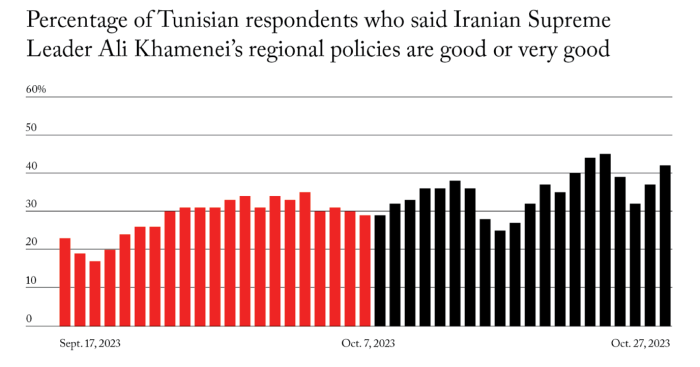
An Arab barometer poll taken over a six-week period – three weeks before and three weeks after the Al-Aqsa Flood operation – provides the first indication of shifting Arab perceptions. Although the survey was restricted to Tunisia, the pollsters argue that the country is “as close to a bellwether as one could imagine” and that it represents views similar to other Arab countries:
“Analysts and officials can safely assume that people’s views elsewhere in the region have shifted in ways similar to the recent changes that have taken place in Tunisia.”
The survey results should be of paramount concern to meddling western policymakers: “Since October 7, every country in the survey with positive or warming relations with Israel saw its favorability ratings decline among Tunisians.”
The US saw its favorability numbers plummet the most, followed by West Asian allies that have normalized relations with Israel. Russia and China, both neutral states, experienced little change, but Iran’s leadership saw its favorability figures rise. According to the Arab barometer:
“Three weeks after the attacks, Iranian Supreme Leader Ali Khamenei has approval ratings that matched or even exceeded those of Saudi Crown Prince Mohammed bin Salman and Emirati President Mohammed bin Zayed.”
Before 7 October, just 29 percent of Tunisians held a favorable view of Khamenei’s foreign policies. This figure rose to 41 percent according to the conclusion of the survey, with Tunisian support most notable in the days following the Iranian leader’s 17 October reference to Israel’s actions in Gaza as a “genocide.”

The Saudi shift
Prior to the 7 October operation by the Palestinian resistance to destroy the Israeli army’s Gaza Division and take captives as leverage for a mass prisoner swap, the region’s main geopolitical focus was on the prospects of a groundbreaking Saudi normalization deal with Tel Aviv. The administration of US President Joe Biden flogged this horse at every opportunity; it was seen as a golden ticket for his upcoming presidential election.
But Operation Al-Aqsa Flood ruined any chance for Saudi Arabia – home to Islam’s holiest sites – to seal that political deal. And with Israeli airstrikes raining down daily on Palestinian civilians in Gaza, Riyadh’s options continue to shrink.
A Washington Institute poll conducted between 14 November and 6 December measures the seismic shift in Saudi public sentiment:
A whopping 96 percent agree with the statement that “Arab countries should immediately break all diplomatic, political, economic, and any other contacts with Israel, in protest against its military action in Gaza.”
Meanwhile, 91 percent believe that “despite the destruction and loss of life, this war in Gaza is a win for Palestinians, Arabs, and Muslims.” This is a shockingly unifying statement for a country that has adhered closely to western narratives that seek to divide Palestinians from Arabs, Arabs among themselves, and Muslims along sectarian lines – geographically, culturally, and politically.
Although Saudi Arabia constitutes one of the few Arab states to have designated Hamas as a terrorist organization, favorable views of Hamas have increased by 30 percent, from 10 percent in August to 40 percent in November, while most – 95 percent – do not believe the Palestinian resistance group killed civilians on 7 October.
Meanwhile, 87 percent of Saudis agree with the idea that “recent events show that Israel is so weak and internally divided that it can be defeated some day.” Ironically, this is a long-stated Resistance Axis refrain. Hezbollah Secretary General Hassan Nasrallah was famously quoted as saying “Israel is weaker than a spider’s web,” upon its defeat by the Lebanese resistance on 25 May, 2000.
Prior to 7 October, Saudis had strongly favored economic ties with Israel, but even that number dropped dramatically from 47 percent last year to 17 percent today. And while Saudi attitudes toward the Resistance Axis remain negative – Saudi Arabia, after all, has been the regional epicenter for anti-Iran and anti-Shia propaganda since the 1979 revolution – that may be largely because their media is heavily controlled.
Contrary to the observations of the Arab masses, 81 percent of Saudis still believe that the Axis is “reluctant to help Palestinians.”
The Palestinian shift
Equally important to the discussion of Arab perceptions is the shift seen among Palestinians themselves since 7 October. A poll conducted by the Palestinian Center for Policy and Survey Research (PSR) in both the occupied West Bank and Gaza Strip between 22 November and 2 December mirrors Arab views, but with some nuances.
Gazan respondents, understandably, displayed more skepticism for the ‘correctness’ of Hamas’ Operation Al-Aqsa Flood, which triggered Israel’s genocidal assault on the Strip in which over 22,000 civilians – mostly women and children – have so far been brutally killed. While support for Hamas increased only slightly in the Gaza Strip, it tripled in the West Bank, with both Palestinian territories expressing near equal disdain for the western-backed Palestinian Authority (PA), which governs from Ramallah.
Support for acting PA President Mahmoud Abbas and his Fatah party was hit hard. Demands for his resignation are at nearly 90 percent, while almost 60 percent (the highest number recorded in a PSR poll to date in relation to this matter) of those surveyed want a dissolution of the PA.
Over 60 percent of Palestinians polled (closer to 70 percent in the West Bank) believe armed struggle is the best means to end the occupation, with 72 percent agreeing with the statement that Hamas made a correct decision to launch its 7 October operation, and 70 percent agreeing that Israel will fail to eradicate the Palestinian resistance in Gaza.
Palestinians have strong views about regional and international players, who they largely feel have left Gaza unprotected from Israel’s unprecedented violations of international law.
By far the country most supported by respondents is Yemen, with approval ratings of 80 percent, followed by Qatar (56 percent), Hezbollah (49 percent), Iran (35 percent), Turkiye (34 percent), Jordan (24 percent), Egypt (23 percent), the UAE (8 percent), and Saudi Arabia (5 percent).

In this poll, the region’s Axis of Resistance dominates the favorability ratings, while pro-US Arab and Muslim nations with some degree of relations with Israel, fare poorly. It is notable that of the four most favorable countries and groups for mostly-Sunni Palestinians, three are core members of the “Shia” Axis, while five Sunni-led states rank lowest.
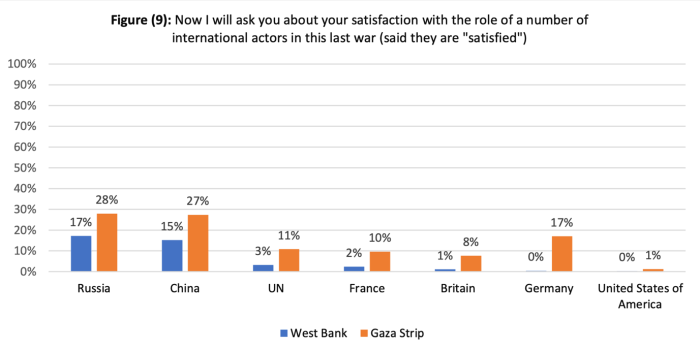
This Palestinian view extends to non-regional international states, with respondents most satisfied with Resistance Axis allies Russia (22 percent) and China (20 percent), while Israeli allies Germany (7 percent), France (5 percent), the UK (4 percent), and the US (1 percent) struggle to maintain traction among Palestinians.
The numbers depend on the war ahead
Three separate polls show that Arab perceptions have shifted dramatically over Israel’s war on Gaza, with popular sentiment gravitating to those states and actors perceived to be actively supporting Palestinian goals, and away from those who are perceived to support Israel.
The new year starts with two major events. The first is the drawdown of Israeli reservists from Gaza, whether because Washington demands it, or due to unsustainable loss of life and injury to occupation troops. The second is the shocking assassination of Hamas leader Saleh al-Arouri and six others in Beirut, Lebanon, on 2 January.
All indications are that Israel’s war will not only continue, but will expand regionally. The new US maritime construct in the Red Sea has drawn other international actors into the mix, and Tel Aviv has provoked Lebanon’s Hezbollah in a major way.
But if the confrontation between the two axes escalates, Arab perceptions will almost certainly continue to tilt away from the old hegemons toward those who are willing to resist this US-Israeli assault on the region.
There will be no relief for Washington and its allies as the war expands. The more they work to defeat Hamas and destroy Gaza, and the more they lob missiles at Yemen, Iraq, and Syria, and besiege the Resistance Axis, the more likely Arab populations are to shrug off the Sunni-versus-Shia, Iran-versus-Arab, and secular-versus-Islamist narratives that have kept the region divided and at odds for decades.
The swell of support that is mobilizing due to a righteous confrontation against the region’s biggest oppressors is unstoppable. Western decline is now a given in the region, but western discourse has been the first casualty of this war.
McDonald’s latest business titan to face impact of pro-Israel stance

The Cradle | January 5, 2024
The CEO of McDonald’s, Chris Kempczinski, said on 4 January that several markets in West Asia and some outside of the region were facing a “meaningful business impact” due to the war between the Palestinian resistance and Israel.
Kempczinski also said that “associated misinformation” about the company has been a reason for the financial issues the brand is facing, and that the misinformation surrounding McDonald’s was “disheartening and ill-founded.”
Western Israeli-linked fast food chains, including McDonald’s and Starbucks, have seen large grassroots boycott campaigns emerge over pro-Israel stances and alleged financial ties with Israel.
“In every country where we operate, including in Muslim countries, McDonald’s is proudly represented by local owner-operators who work tirelessly to serve and support their communities while employing thousands of their fellow citizens,” Kempczinski said in a social media post. “That local community connection is the genius of the McDonald’s system.”
West Asian locations of McDonald’s are part of the company’s international developmental licensed markets division, a section that generates around 10 percent of the company’s revenue.
McDonald’s franchisee in Malaysia, owned by Saudi Arabia’s Lionhorn Pte Ltd, filed a lawsuit against BDS Malaysia, accusing the group of “defamation,” and is seeking damages of over $1 million. Meanwhile, the Israel franchisee has supported the Israeli army by supplying its forces with free meals, according to BDS, “during the ongoing genocide of 2.3 million Palestinians in Gaza.”
Starbucks, another Western, Israeli-linked company, has also come out to say that the negative views brought upon the brand have been “influenced by misrepresentation on social media of what we stand for.”
In December 2023, the losses of Starbucks, a Seattle-based company, stood at $11 billion in value during the last quarter, due to Palestinian solidarity boycotts and employee strikes.
The company tried to bounce back on losses by implementing a scheme during the holiday season that would allow consumers to receive a free holiday cup with every purchase.
When announcing the gimmick in mid-November last year, the company’s market share crashed by 8.96 percent, accounting for billions in losses, the lowest the company has experienced since 1992.
Featured Video

Anthrax War – CBC The Passionate Eye
or go to
Aletho News Archives – Video-Images
Book Review
Shattered Dreams: The HPV Vaccine Exposed (2019)
By Christina England – 30 Q&As – Book Review & Summary
Lies are Unbekoming | September 4, 2026
… Gardasil received FDA fast-track approval in 2006, Cervarix followed in 2009, and Gardasil 9 was approved in December 2014 with more than double the aluminium adjuvant content of the original. The commercial context is specific. Merck was about to lose patent protection on Zocor and faced $18 billion in Vioxx injury claims from a cardiovascular drug the company had marketed while suppressing its own data showing a five-times increase in heart attacks. Analysts projected the global HPV vaccine market at $4 billion by 2011, contingent on government-funded national programs for teenage girls. The 1986 National Childhood Vaccine Injury Act had already granted manufacturers complete liability immunity. By 2013, Japan had withdrawn its HPV vaccine recommendation after cataloguing severe adverse reactions in hundreds of girls. No Western government followed. The establishment position across the UK, US, Australia, and most of Europe held, and still holds, that the vaccines are safe and effective, that reported injuries are coincidental, and that cervical cancer prevention justifies the program. The book was published into this position, not against a vacuum.
Shattered Dreams sits alongside Mary Holland’s The HPV Vaccine On Trial and Viera Scheibner’s foundational vaccination work as part of the documented record on what has been done to a generation of teenage girls under the banner of cancer prevention. The full summary unpacks three specific findings: that Merck used the aluminium adjuvant itself as the “placebo” control in 92.5% of trial subjects, making it structurally impossible to detect excess reactions from the adjuvant; that Dr. Sin Hang Lee found HPV DNA fragments bound to aluminium in every one of sixteen Gardasil samples tested, and in the blood and spleen of a New Zealand girl six months after her third dose; and that in every country with high vaccination coverage, including Australia, the UK, Norway, and Sweden, cervical cancer rates have stopped declining and started rising specifically in the vaccinated cohort. Martínez-Lavín’s 2017 calculation puts the number needed to seriously harm with Gardasil 9 at 140, and the number needed to vaccinate to prevent one case at 1,757. Thirteen young women are seriously harmed for every one who benefits. The vaccine was approved on the basis of trials that could not detect what the trials were supposed to detect, and it is still being given to twelve-year-olds today. … Read full review
Blog Roll
 Aletho News
- Georgia’s Largest Healthcare System Will Fire Employees Who Refuse Flu Vaccine
- The Five-Year Fuel Crisis: Why the World Economy Is Paying for a War It Thinks Is Ending
- Trump’s Big Bluff on Iran
- Swiss scammed out of millions by Ukraine-linked call centers – media
- Germany facing potential ‘violent conflict’ with Russia – spy chief
- Ukraine’s EU neighbors reject new plea from Kiev – Politico
- British Transport Police Facial Recognition Trial Scanned 926,912 People With Zero Arrests
- House Bill Would Ban Federal Use of Flock ALPR Data
- Can a Spice Rival a Drug? 10 Head-to-Head Trials Put It to the Test.
- The oil routes around Hormuz face their own chokepoints
- If Americans Knew
- “We See Our Homes Now From A Satellite, Like Strangers”
- Watch “Gaza: Doctors Under Attack”, originally censored by BBC
- NAZA: Israeli embassies in UK and US promote rival documentary to challenge Gaza genocide allegations
- David Ellison appoints Israeli to lead merged Paramount-Warner studios
- Turkish Red Crescent helps elderly Gaza man walk again after Israel confiscates his prosthetic limb
- Four Palestinians Killed in Israeli Attacks in Gaza
- Two Palestinian youths killed and village razed as Israeli attacks on West Bank continue
- Two more Christian women victims of Israeli raids on Gaza
- Cruelty, Deprivation, Indignity: A Journalist’s 22 Months in Israeli Prison
- New IDF Website Frames Slain Gaza Journalists as Terrorists
- No Tricks Zone
- Latest European Green Energy Debacle; Portugal’s Largest Flagship Solar Park Insolvent!
- Green Energy Debacle: German Expert Professor Fritz Vahrenholt Warns Of Severe Economic And Social Consequences
- Two More Paleo Reconstructions Affirm Meters-Higher Sea Levels Across Ireland, Brazil 7000-6000 Years Ago
- New Study: Earth And Venus Surface Warmth Largely Explained By Convection And Lapse Rate, Not CO2 Or Radiation
- 2025 Nature Paper Claiming Worsening Global Drought Gets RETRACTED …Heavily Flawed
- New Study: ‘Global Drought Shows No Detectable Recent Acceleration Under Climate Warming’
- Economic Masterminds: German Socialists Suggest Taxing Productivity Gains Stemming From Using AI
- The South China Sea Has Not Been Cooperating With The Climate Change Narrative
- Energy Crisis: Germany Enters Heating Season With Historically Low Gas Reserve Fill Levels
- New Study: The Antarctic Ice Sheet Gained Mass From 2020-2024 Due To Staggering Snow And Ice Accumulation

