Raisi Calls on BRICS Leaders to Use Economic, Political Opportunities to Pressure Israel
Sputnik – 21.11.2023
TEHRAN – Iranian President Ebrahim Raisi on Tuesday called on BRICS leaders to use all economic and political opportunities to put pressure on Israel.
Amid escalating horrors in the Gaza Strip during the “second phase” of Israel’s conflict with Hamas, the former has intensified its actions, resulting in a rise in civilian casualties. Iranian President Ebrahim Raisi, in response, has called on BRICS leaders to leverage economic and political avenues to exert pressure on the Israeli government.
“The United States has made all international organizations faceless. Iran wants BRICS members and governments to stand up for security, establish justice and fight racial discrimination in the world, as well as use all their political and economic opportunities and power to exert pressure on Israel and its supporters from Western countries,” Raisi at the BRICS extraordinary summit on the Middle East.
Raisi urged the BRICS countries to recognize the Israeli government as a “terrorist regime.”
“Israel’s continuous attacks on hospitals, medical centers and religious sites, as well as the murder of women and children, doctors, nurses and journalists are acts of terrorism, and it is necessary to recognize the Israeli regime as a terrorist regime and its army as a terrorist organization,” Raisi said.
BRICS countries must adopt a resolution at the UN to stop Israel’s crimes in the Gaza Strip, Raisi said.
Kennedy Assassination: “CIA-Did-It” Theorists Are Covering for Israel
BY LAURENT GUYÉNOT • UNZ REVIEW • NOVEMBER 17, 2023
Dick Russell’s recent biography, The Real RFK Jr.: Trials of a Truth Warrior, contains two chapters on RFK Jr.’s quest for truth on the assassinations of his father and uncle.[1] Here is an excerpt from chapter 28:
He was approaching his midfifties when, in 2008, while preparing to give an environmental talk at the Franciscan Monastery in Niagara, New York, Bobby [RFK Jr.] found a copy of a just-published book “on my greenroom table, left as an anonymous gift for me.” It was titled JFK and the Unspeakable: Why He Died and Why It Matters by Catholic theologian James W. Douglass. Bobby found the book “a fascinating and meticulous dissection of the circumstances surrounding the assassination.” Bobby spent a lot of time examining Douglass’s thorough footnotes. He noted “the extraordinary analysis implicated rogue CIA operatives connected to the Cuban project and its Mob cronies.” Bobby was impressed enough to send the book to President Kennedy’s speechwriter Ted Sorenson [Sorensen], who wrote him back in 2010: “It sat on a table for two weeks and then I picked it up. And once I started I couldn’t put it down. And you know for so many years none of us who were close to Jack could handle ever looking at this stuff and all of the conspiracy books. Well, it seemed that nothing they had would stand up in court. All of us were, you know, ‘it won’t bring Jack back.’ But I read this and it opened my eyes and it opened my mind and now I’m going to do something about it.” Sorenson said he’d spoken to the author and planned to write a foreword for the paperback edition. “Thanks for getting the ball rolling,” he wrote Bobby. However, Sorenson later told Douglass that his wife and daughter had persuaded him that his association with Jack had always been about the president’s life and he should leave it at that. Sorenson died soon after that. Bobby himself “embarked on the painful project of reading the wider literature on the subject.”[2]
I have quoted this paragraph at length because it illustrates the remarkable impact of James Douglass’s book, JFK and the Unspeakable, published in 2008. With the endorsement of some of the most prominent JFK-assassination researchers, including film-maker Oliver Stone, it has become the Gideon’s Bible of every JFK amateur. It is representative of the dominant school — I’ll call them the CIA-theorists — but the author, a longtime Catholic peace activist with a big heart and a poetic mind, gives his book a spiritual flavor, lifting the story to mythical, even mystical level. It is the story of a man who “turned” from Cold Warrior to peacemaker (during the 1962 Cuban Missile Crisis), and saved the world from nuclear Armageddon; a man who saw death approaching, but lived up to his ideal of nuclear disarmament, and became immortal. A heroic peacemaker. A Christ, almost.
The basic storyline of the book is questionable. According to Jim DeEugenio , there was no “conversion”, because Kennedy had never been a Cold Warrior, despite his rhetoric in the 1960 campaign.[3] Other specifics in Douglass’s narrative, such as the two-Oswald scenario (borrowed from Richard Popkins’s 1966 book The Second Oswald), have also received criticism. Nevertheless, Douglass is praised for having defended the CIA-theory with unprecedented talent, and explained in eloquent terms “why it matters.”
What’s wrong with Douglass?
I was impressed by Douglass’s book when I first read it in 2011. It set me on the most fascinating intellectual quest, and I am grateful for that. I found a French publisher and helped with the translation.[4] But, within a year, as I became familiar with part of Douglass’s bibliography and explored other lines of inquiry, I became aware of the book’s shortcomings, and puzzled by them. Two thick files are missing entirely from Douglass’s material: Johnson and Israel. This is a common characteristic of most works aimed at indicting the CIA, such as Oliver Stone’s recent documentary written by DiEugenio, which I have reviewed here.
I also find the structure of Douglass’s book artful: interweaving Oswald’s story, to prove that he was handled by the CIA, and Kennedy’s story, to prove that the CIA hated him, maintains a constant sense of correlation between those two stories, and it does constitute strong circumstantial evidence that the CIA was involved in the assassination, but it does not prove that the masterminds of the assassination were in the CIA. Far from it.
First of all, what CIA are we talking about? Certainly not the CIA that CIA director John McCone (appointed by Kennedy) knew about. Most CIA-theorists agree that the CIA’s strings attached to Oswald came from the office of Counterintelligence chief James Jesus Angleton. In the words of John Newman, a respected CIA-theorist, “No one else in the Agency had the access, the authority, and the diabolically ingenious mind to manage this sophisticated plot.”[5] But Angleton was certainly not “the CIA.” Rather, as Peter Dale Scott wrote, he “managed a ‘second CIA’ within the CIA.”[6] According to his biographer Jefferson Morley, Angleton operated on his own initiative, sealed from scrutiny and free of any accountability; his supervisor, Richard Helms, “let Angleton do as he pleased, few questions asked,” McCone had no idea what Angleton was doing. Another biographer, Tom Mangold, notes that Angleton’s Counterintelligence Staff “had its very own secret slush fund, which Angleton tightly controlled,” an arrangement “which gave Angleton a unique authority to run his own little operations without undue supervision.”[7] In fact, Angleton was regarded by many of his peers as a madman whose paranoid obsession with uncovering Soviet moles did great damage to the Agency. The only reason why he was not fired before 1974 (by director William Colby) is because he kept too many files on too many people.
It is inconceivable that Angleton directed the whole operation. But if he was not following orders from Richard Helms — and there is not a single piece of evidence that Helms knew of the assassination —, under whose direction or influence was he operating? That is an easy one: besides Counterintelligence, Angleton headed the “Israeli Desk”, and he had more intimate contacts with the hierarchy of the Mossad than with his own. He loved Israelis as much as he hated Communists — apparently believing that one man could not be both. Meir Amit, head of Mossad from 1963 to 1968, called him “the biggest Zionist” in Washington, while Robert Amory, head of the CIA Directorate of Intelligence, called him a “co-opted Israeli agent.”[8] While Angleton was disgraced in the U.S. after his forced resignation, he was honored in Israel. After his death in 1987, according to the Washington Post, five former heads of Mossad and Shin Bet and three former Israeli military intelligence chiefs were present “to pay final tribute to a beloved member of their covert fraternity.” Among the services he rendered Israel, “Angleton reportedly aided Israel in obtaining technical nuclear data.”[9]
Douglass never mentions Angleton’s Israeli connection. He never mentions Jack Ruby’s Israeli connection either, although Seth Kantor had made them very clear in his book Who Was Jack Ruby? written in 1978. For Douglass, he is just “CIA-connected nightclub owner Jack Ruby.”[10] Only by scrutinizing the endnotes can we learn his real name, Jacob Rubenstein (doesn’t sound so Sicilian anymore). Ruby was not “Mafia”. Like his mentor Mickey Cohen, he was connected to both Meyer Lansky (boss of the Jewish Crime Syndicate), and Menahem Begin (former Irgun terrorist in chief).
Finally, Douglass, like most CIA-theorists, keeps Johnson out of the loop, ignoring the evidence accumulated through 50 years of research that Johnson was in full control before, during and after Kennedy’s assassination. How could Douglass miss Johnson? First, by not asking the most important question: How did they kill Kennedy? In other words: “Why Dallas, Texas?” Texas was a hostile state for Kennedy (“We’re heading into nut country,” Kennedy said to Jackie), but it was Johnson’s kingdom, and Johnson knew all Kennedy-haters there. At the very least, there is no way around the premise that the conspirators knew in advance that Johnson would cover them. But Douglass got around it.
I say “Dimona”, you say “Auschwitz”
Having corresponded with Douglass for the translation, I shared my concerns with him by email and letter. First, I advised him to read Phillip Nelson’s book LBJ: The Mastermind of JFK’s Assassination (2010), and encouraged him to reconsider Johnson’s role. He answered that he bought Nelson’s book, but didn’t find it convincing, without elaborating.
Later, I questioned Douglass about his silence over Kennedy’s determination to forestall Israel’s nuclear ambitions. Kennedy’s effort to lead the world towards general nuclear disarmament is the central and most inspiring theme in Douglass’s book. Kennedy’s resolute opposition to Israel’s secret nuclear bomb factory is the most dramatic manifestation of that effort. For what reason, then, did Douglass choose not to mention it? I asked him in an interview for the French website Reopen 9/11, and in a long, personal letter. In the interview, Douglass answered: “I have found no convincing evidence that Israel was involved in the Kennedy assassination. The story I wrote is about the reasons for his death. For Israel to be included in this story, Kennedy’s resistance to Israel’s nuclear weapons program would have to be linked to the plot against his life.” By letter, he responded to my arguments with a personal testimony of how Jewish writer André Schwarz-Bart, author of the novel The Last of the Just, “helped to liberate me from the Christendom that has so murderous a heritage, and to introduce me to a Jewish perspective that I needed to see from within a boxcar approaching Auschwitz.” From there he stated that he does not work on the assumption of Israel’s responsibility in the Kennedy assassination, 9/11, or any other crime.
His justification struck me as irrelevant and irrational, yet very revealing. If I say “Dimona,” Douglass says “Auschwitz,” implying, I suppose, that Jews should not be suspected of guilt in the JFK assassination since they are, by essence, innocent victims. Or was I to understand that just mentioning Dimona would risk hurting the Jews, who already suffered so much from the hands of Christians? Or that the word “Dimona” has anti-Semitic overtones? Whatever the reason, the troubling fact is that Douglass decided to omit from his book anything that could suggest any complicity of Israel with “the Unspeakable”. We can say about Douglass what Stephen Green wrote about LBJ after 1963: “he saw no Dimona, heard no Dimona, and spoke no Dimona.”[11]
I would not normally share the content of personal letters, but I made an exception because Douglass’s reference to Shwarz-Bart is not confidential (he wrote articles about him), and because it is of public interest, as a candid explanation for the censorship that CIA-theorists consistently impose on themselves regarding Israel in general, and Dimona in particular.

Self-censorship can be strategically justifiable. For example, living in France, I do not openly profess my heretical beliefs on the Holocaust, in order to avoid being put in jail by the powerful French Inquisition. So I can also conceive that Douglass would censor himself as a strategy to minimize the risk of being banned by publishers, and to maximize readership. This is not what Douglass told me, but if this is nevertheless the real reason, I can even agree that it was worth it, since Douglass’s book converted RFK Jr. and other influential people to the falsehood of the official theory.
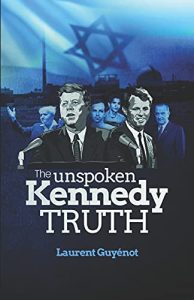
However, it is one thing to avoid a topic altogether, and another to write a book pretending to have solved once and for all the Kennedy assassination, while concealing the facts that may point to a different solution. It is actually worse than that: Douglass kept silent on Kennedy’s angst over Dimona even though it would have reinforced his main thesis about Kennedy’s determination to stop and reverse nuclear proliferation. For some reason, Douglass made sure he didn’t give his readers the slightest chance to start imagining that Israel had any part in Kennedy’s problem with “the Unspeakable”. Which has led me to say that Israel is the truly unspeakable in JFK and the Unspeakable, and which motivated me to write The Unspoken Kennedy Truth.
The CIA-theory as a shield for Israel
In this article, I will explain in some detail why the CIA-theory is wrong. By the CIA-theory, I do not mean the theory that high-ranking officers of the CIA were involved (I believe that to be the case). I mean the theory that a core group of CIA executives, with a few military top brass, masterminded and orchestrated the assassination. To the question “Who Killed JFK?” we can of course include both the CIA and the Mossad, as well as the FBI, the Pentagon, the Mafia, Cuban exiles, Texan oil barons, and what have you. But the important question is: Which group was the prime mover? Who had conceived the plot long before others were brought into it? Who was leading, or misleading, all others involved? Who, in the distribution of tasks on a need-to-know principle, knew the global scheme? Not who pulled the trigger, but who pulled the main ropes? As we will see, the answer cannot be the CIA. It cannot be Angleton, and it cannot even be Johnson.
I express my gratitude for the work of the dozens of researchers who built up the case against the CIA from the 1960s. Some of them are heroic. They have accumulated enough evidence to prove the conspiracy and the cover-up beyond a reasonable doubt. That is a great success. However, their general CIA-theory must now be recognized as a failure. It was a false lead from the start. Vince Salandria, one of the earliest critique of the Warren Commission (his first article was published in the Legal Intelligence in 1964), held as a teacher by many JFK investigators and by Douglass himself (who dedicated his book to him), became disillusioned by his own CIA-theory, saying frankly to Gaeton Fonzi in 1975: “I’m afraid we were misled. All the critics, myself included, were misled very early. … the interests of those who killed Kennedy now transcend national boundaries and national priorities. No doubt we are dealing now with an international conspiracy.”[12]

The CIA-theory, I will argue, serves as a cover for the real perpetrators, like the KGB-theory. The KGB-theory quickly fell apart because it was meant to and because it contains no truth whatsoever, while the CIA-theory is more resistant because it has some truth. The CIA is deeply compromised, but the masterminds were somewhere else. They needed the CIA to be compromised enough for the U.S. government to be forced to cover the whole affair. At the same time, they use the CIA-theory to shield their own group from suspicion. That is why Israeli sayanim working in the news, book or movie industries have diligently kept the CIA-story alive in public opinion. This was pre-planned limited hangout. In “Did Israel kill the Kennedys?” I have given examples of Zionist agents planting signposts to direct the skeptics towards the CIA and the Mafia (rather than the Mossad and the Mishpucka). The classic example is Arnon Milchan, producer of Oliver Stone’s film JFK released, who, by his own admission, acted as a secret Israeli agent working to boost Israel’s nuclear program — it’s always about Dimona. Another example, which had previously escaped me, is the New York Times revealing on April 25, 1966 that Kennedy “said to one of the highest officials of his administration that he wanted ‘to splinter the C.I.A. in a thousand pieces and scatter it to the winds,’” an untraceable statement that has now become one of the most quoted by CIA-theorists, who, in this case, show blind confidence in the reliability of the New York Times.[13]
An additional proof that the leading CIA-theorists are less interested in searching for the truth than in covering for Israel’s crimes came to me a two weeks ago, in the form of an email from Benjamin Wecht, son of Cyril Wecht and program administrator for the annual symposium on the JFK assassination organized by Citizens Against Political Action (CAPA) at the Cyril H. Wecht Institute of Forensic Science and Law of Dusquesne University, Pittsburg:
I’m writing to inform you that the poster you’ve proposed for presentation here next month has been rejected, as it fails to meet the academic standards of this institution and, moreover, espouses a position that we feel would be particularly inflammatory – if not outright disruptive – at this time and in this place. Our partnering organization, Citizens Against Political Assassinations, is in full concurrence with our decision.
This was in response to a submission that Karl Golovin and I sent for the “poster session” of the upcoming symposium organized on the occasion of the 60th anniversary (see our poster at the end of this article, and get it in high-resolution here). Considering the speciousness of Wecht’s denial or my “academic standards,” and considering his position that accusing Israel of the crime of the century is “inflammatory” and “disruptive”, I think it is fair to call Wecht and the organization he represents shameless gatekeepers for Israel. Ultimately, accusing Oswald and accusing the CIA of the crime of the century both serve the same purpose. Which explains why CAPA’s chairman Cyril Wecht, the forensic pathologist tirelessly denouncing the lie of the “single bullet,” was a friend of Arlen Specter, the inventor of that lie, whom he helped become U.S. senator in 2004.[14]
Did Johnson foil the CIA plan?

To understand why the CIA-theory is wrong, we have to start with its biggest inconsistency. Almost unanimously, from Mark Lane to James Douglass, CIA-theorists assume that the assassination was conceived as a false-flag operation to blame Castro and/or the Soviets, and to justify retaliation against them.
This is a natural assumption, based on two facts. First, Oswald was clearly set up as a pro-Castro communist. The scheme included the visits and telephone calls by an Oswald impersonator to both the Soviet and Cuban embassies in Mexico City in late September and early October 1963. The day following Kennedy’s assassination, television networks and national newspapers presented the assumed assassin as a “Pro-Castro Marxist.”[15]
Secondly, we know that invading Cuba to topple Castro’s pro-Soviet regime was the CIA’s obsession since the late 50s. Under officers like E. Howard Hunt, the CIA organized, funded and trained some of the hundreds of thousands of anti-Castro Cuban exiles in Miami. As a result, “the CIA’s presence in Miami grew to overwhelming dimensions,” wrote investigative journalist Gaeton Fonzi. “And as pervasive as that presence was before the Bay of Pigs, it was but a prelude to a later, larger operation.”[16] After the Bay of Pigs (April 1961), “a massive and, this time, truly secret war was launched against the Castro regime,” code named JM/WAVE, and involving “scores of front operations throughout the area,” as well as planes, ships, warehouses of weapons, and paramilitary training camps. Even after the Cuban Missile Crisis (October 1962), when Kennedy pledged not to invade Cuba, the anti-Castro Cubans on the CIA payroll tried to provoke incidents with Cuba. In April 1963, for example, the paramilitary group Alpha 66 attacked Soviet ships in order “to publicly embarrass Kennedy and force him to move against Castro,” in the words of Alpha 66’s CIA adviser David Atlee Phillips.[17]
Those two facts — the patsy’s pro-Castro profile designed by the CIA, and the CIA’s anti-Castro war plans — lead to the too obvious inference that the purpose of the Dallas shooting was to forge a false pretext for retaliating against Cuba. That theory has become so dominant in JFK research that most conspiracy-minded people consider it as proven beyond doubt.
However, it has one major flaw: there was no invasion of Cuba following Kennedy’s assassination. This fact is embarrassing for CIA-theorists. Although they don’t like to put it this way, it means that the CIA plan failed. If the conspirators believed that setting up Oswald, a documented supporter of Fidel Castro with links to the Soviet Union, would result in a full-scale war against Cuba, they must have been terribly disappointed. James Douglass credits Lyndon Johnson for defeating their plan:
The CIA’s case scapegoated Cuba and the U.S.S.R. through Oswald for the president’s assassination and steered the United States toward an invasion of Cuba and a nuclear attack on the U.S.S.R.. However, LBJ did not want to begin and end his presidency with a global war.[18]
To Johnson’s credit, he refused to let the Soviets take the blame for Kennedy’s murder; to his discredit, he decided not to confront the CIA over what it had done in Mexico City. Thus, while the secondary purpose of the assassination plot was stymied, its primary purpose was achieved.[19]
Indeed, from November 23, Johnson worked the phone to smother the rumor of a Communist conspiracy, and started hand-picking the members of the Warren Commission with the express mission of proving the lone-nut theory in order to avoid a nuclear war that would kill “40 millions Americans in an hour” (Johnson’s leitmotiv). Johnson never seems to have contemplated invading Cuba. He kept Kennedy’s promise to Castro and Khrushchev not to do so — a promise which the CIA regarded as an act of treason. In short, according to Douglass, Johnson was not part of the conspiracy, he actually frustrated the conspirators who had bet on his following their script. Johnson couldn’t save Kennedy, but he saved us from WWIII. And he saved the conspirators as well: no one was fired.
That is simply not credible. How can someone working on JFK’s assassination so casually exclude LBJ from the suspects, when he should be the prime suspect in terms of motive (the presidency), means (the vice-presidency) and opportunity (Dallas). Just consider the little known fact, revealed by Dallas Parkland Hospital Dr. Charles Crenshaw in his book Conspiracy of Silence (1992), that Johnson called the hospital while Dr. Crenshaw was trying to save Oswald’s life, and insisted that he leave the operating room and come to the phone, while an unknown agent with a pistol hanging from his back pocket was left with Oswald. “Dr. Crenshaw,” said Johnson on the phone, “I want a deathbed confession from the accused assassin. There’s a man in the operating room who will take the statement. I will expect full cooperation in this matter.” The important word, here, is “death,” as Dr. Crenshaw understood. When he came back to the operating room, the agent had disappeared and Oswald’s heart stopped beating. It is clear that Johnson wanted Ruby’s job finished. Despite such outrageous direct interference of Johnson, CIA-theorists claim that Johnson was not involved in the conspiracy, but only in the cover-up.
Douglass’s storyline in a nutshell, again: The CIA assassinated Kennedy under the false flag of Communist Cuba, with the presupposition that Johnson was going to retaliate against it. They worked the media to that effect (because, you know, the CIA controls the media). But Johnson, though taken by surprise on November 22, quickly reacted the next day and took control of all investigations and even of media coverage, to defeat the CIA plan.
It must have been infuriating for the CIA to be cheated of their Cuban invasion after all they had gone through — the Bay of Pigs fiasco, the Cuban Missile “appeasement”, and the trouble of assassinating the president. Wouldn’t they want to assassinate Johnson, now? And yet, there is no sign of tension between Langley and the Oval Office after November 1963. We are asked to believe that the CIA, totally disarmed by Johnson’s unexpected reaction, instantly surrendered and went along with the useless, absurd lone-nut theory, even participating in defeating their own painfully staged false-flag. Allen Dulles himself, the CIA director fired by Kennedy after the Bay of Pigs, joined the Warren Commission tasked by Johnson to quench rumors of a Communist plot. The mainstream media quickly fell in line and the Communist conspiracy disappeared entirely from the news (where is Mockingbird when you need it?).
Think about it and reach your own conclusion as to how credible this scenario is. It comes down to this: Do you think the conspirators’ plan failed or that it succeeded? If it succeeded, then it was not the CIA’s plan as CIA-theorists see it. It was someone else’s plan.
The invisible coup
Why would the CIA want to kill Kennedy, anyway? Why not simply make him lose the election in 1964. Surely the CIA had the means to do that, if their control of the media was as great as CIA-theorists tell us. Did the CIA have an urgent need to kill Kennedy, that could not wait one year? No. In a campaign year, Kennedy wasn’t going to do anything that could give his enemies a reason to call him a Communist appeaser. Regarding Vietnam for example, he told Kenny O’Donnell: “If I tried to pull out completely now from Vietnam, we would have another Joe McCarthy red scare on our hands, but I can do it after I’m reelected. So we had better make damned sure that I am reelected.”[20] He did sign, on October 11, 1963, a cautious executive order NSAM 263 for the withdrawal of “1,000 U.S. military personnel by the end of 1963” and “by the end of 1965 … the bulk of U.S. personnel,”[21] but if Kennedy was defeated electorally in 1964, that executive order would be of little consequence. It was, anyway, trashed by Johnson. As Ron Unz has recently repeated,
most of the different groups that wanted to get rid of [Kennedy] would just have waited and concentrated on political means, and that includes Dulles. This included using their media contacts to damage him politically. The only two that desperately needed to get rid of him immediately were LBJ, whom he was about to drop from the ticket and destroy politically, and Israel, because of the immediate efforts to eliminate their nuclear development program at Dimona. That’s why LBJ and Israel are the overwhelmingly logical suspects.
Research on the JFK assassination must start from the premise that it was a coup d’état. CIA-theorists tend to minimize the primal fact that the assassination resulted in a change of president. So let’s repeat the obvious: whoever assassinated Kennedy wanted to put Johnson in power. That is why defeating Kennedy electorally was not an option: Johnson would have fallen with Kennedy (his epic corruption was to be exposed anyway). Kennedy’s death was Johnson’s only chance to become president — and, perhaps, to avoid prison. But Johnson could not do it alone, so let me rephrase: Kennedy’s death was the only way for the conspirators to make Johnson president.
Can we identify those conspirators? If they needed Johnson as president in 1963, they must be the ones who blackmailed Kennedy into taking Johnson as vice-president in 1960. “I was left with no choice, those bastards were trying to frame me,” Kennedy once confided to Hyman Raskin to justify his choice of Johnson, despite strong opposition from his team, especially his brother Robert.[22] Among the “bastards” was Washington Post columnist Joseph Alsop, who considered himself “one of the warmest American supporters of the Israeli cause,” according to the New York Times obituary. We know from Arthur Schlesinger Jr. that Kennedy made his decision after a closed-door conversation with Alsop and his boss Philip Graham.[23] After Kennedy’s assassination, Alsop was the first to urge Johnson to set up a presidential commission to convince the public that Oswald acted alone. His argument was: “you do not wish to inflict on the Attorney General, the painful task of reviewing the evidence concerning his own brother’s assassination.”[24]
In 1960, the “bastards” needed to put Johnson behind Kennedy’s back, so that if and when necessary, they could knock Kennedy out and have Johnson step into the Oval Office. The purpose of the Kennedy assassination had nothing to do with Cuba; it was simply to replace Kennedy with Johnson. That is all it was supposed to do, and that is all it did. It was a success, not a failure.
It had to be an “invisible coup” so that Americans could be persuaded that nothing would change except the president, and that, under new circumstances, Johnson would act as Kennedy would have acted. There was one thing that Johnson reversed, but Americans did not see it until thirty years later. It concerned U.S. relations with Israel and with Israel’s enemies. Johnson was absolutely indispensable, not for the CIA, but for Israel: no other president would have gone as far as Johnson to support Israel’s invasion of Egypt and Syria in 1967. No other American president, not even Truman, would have let Israel get away with the USS Liberty massacre. Johnson not only let them get away, he helped them do it (read Phillip Nelson’s Remember the Liberty).
Johnson was committed to Israel, financially (through Abraham Feinberg, see below) and spiritually (“The line of Jewish mothers can be traced back three generations in Lyndon Johnson’s family tree”).[25] This explains why he filled the Warren Commission with Israeli agents, such as Arlen “Magic Bullet” Specter, later honored by the Israeli government as “an unswerving defender of the Jewish State.”[26]
David Ben-Gurion
Imagine detective Columbo investigating the assassination of President Kennedy. He would surely want to know if Kennedy had any strong disagreement with someone shortly before his death. In a decent scenario, he would then get his hands on some recently declassified correspondence which shows, in the words of Martin Sandler, editor of The Letters of John F. Kennedy (2013), that “a bitter dispute had developed between Israeli prime minister David Ben-Gurion, who believed that his nation’s survival depended on its attaining nuclear capability, and Kennedy, who was vehemently opposed to it. In May 1963, Kennedy wrote to Ben-Gurion explaining why he was convinced that Israel’s pursuit of nuclear weapons capability was a serious threat to world peace.”[27]
May 12, Ben-Gurion begged Kennedy to reconsider his position on Dimona: “Mr. President, my people have the right to exist… and this existence is in danger.”[28] Reading in that same letter a bizarre reference to the “danger that one single bullet might put an end to [some king’s] life and regime,”[29] Columbo wonders if that was a veiled threat. Reading Kennedy’s next letter (June 15), he can see that Kennedy stood firm and insisted on an immediate visit “early this summer” for “resolving all doubts as to the peaceful nature intent of the Dimona project.” Kennedy made clear that American commitment to Israel could be “seriously jeopardized” in case of failure to comply. Puzzled that the archive contains no response by Ben-Gurion, Columbo soon learns that Ben-Gurion resigned upon receiving Kennedy’s letter. “Many believe his resignation was due in great measure to his dispute with Kennedy over Dimona,” according to Martin Sandler. The insinuation is that Ben-Gurion’s resignation was part of a change of strategy for eliminating the Kennedy obstacle. He would now have to listen to those who had always believed in assassination and terrorism, those whom he had exiled in 1948 but who were now back and pressing him from his right. And he resigned to preserve his place in history. We have to understand Ben-Gurion’s predicament: Egypt, Iraq and Syria had just formed the United Arab Republic and proclaimed the “liberation of Palestine” as one of its goals. Ben-Gurion wrote to Kennedy that, knowing the Arabs, “they are capable of following the Nazi example.” To claim that this was just rhetoric is to misjudge the importance of the Holocaust in Jewish psychology, and in Ben-Gurion’s in particular. In his eyes, Israel’s need for nuclear deterrence was non-negotiable. Since he had failed to overcome Kennedy’s opposition by diplomacy, somebody else would have to take care of it in a different way.
Israel’s nuclear doctrine has not changed since Ben-Gurion. It has two sides: nukes for Israel, no nukes for Arabs or Iranians. Anyone working against one of those two strategic principles threatens Israel’s existence and must be eliminated. There are many examples in Ronen Bergman’s book Rise and Kill First: The Secret History of Israel’s Targeted Assassinations (2019).[30] Here is an excerpt on how Meir Dagan, appointed by Ariel Sharon to the Mossad in 2002, “in charge of disrupting the Iranian nuclear weapons project, which both men saw as an existential threat to Israel.”
Dagan acted in a number of ways to fulfill this task. The most difficult way, but also the most effective, Dagan believed, was to identify Iran’s key nuclear and missile scientists, locate them, and kill them. The Mossad pinpointed fifteen such targets, of whom it eliminated six … In addition, a general of Iran’s Islamic Revolutionary Guard Corps, who was in charge of the missile project, was blown up in his headquarters together with seventeen of his men.[31]
Ben-Gurion handed the Kennedy problem to those who had always relied on murder to eliminate obstacles to the Zionist cause. Yitzhak Shamir was possibly the man of the situation. Disgraced by Ben-Gurion after his assassination of U.N. mediator Count Folke Bernadotte in 1948, Shamir had been allowed back into the Mossad in 1955, where he formed a special hit squad with former members of the murderous Lehi (or Stern Gang). This unit was active until 1964, the year after JFK’s assassination. It carried out an estimated 147 attacks on perceived enemies of Israel, targeting especially “German scientists working to develop missiles and other advanced weapons for Egypt.”[32] Yitzhak Shamir had declared in 1943:
Neither Jewish ethics nor Jewish tradition can disqualify terrorism as a means of combat. We are very far from having any moral qualms as far as our national war goes. We have before us the command of the Torah, whose morality surpasses that of any other body of laws in the world: “Ye shall blot them out to the last man.”[33]
Do you think that such a biblical psychopath would have hesitated to assassinate Kennedy if given the go-ahead? He would have enjoyed it! Conscious of committing the crime of the century for his bloodthirsty god, would he not want to have it filmed, for the historical record? And why not, for the fun of it, send a message with the bullet, in the form of a man holding Chamberlain’s black umbrella to his face? If you think that’s irrational, please read “A Conversation in Hell” by John Podhoretz.
Yitzhak Shamir would go on to become prime minister in 1983, just following Menachem Begin, another terrorist responsible for the bombing of the King David Hotel in 1946. Obviously, the assassination of Kennedy changed profoundly not only America, but Israel too. No single death, really, has had so profound an effect on world history as Kennedy’s.
Abraham Feinberg
The Kennedy problem had another dimension, which, in my scenario, Columbo discovers by borrowing Seymour Hersh’s Samson Option from his local library. There he learns that, during the 1960 campaign, Kennedy had been approached by Zionist financier Abraham Feinberg, whose business, writes Hersh, was “to ensure continued Democratic Party support for Israel” (in other words, buy Democratic candidates). After Kennedy’s nomination by the Democrats, Feinberg organized a meeting between the candidate and a group of potential Jewish donors in his New York apartment. Feinberg’s message was, according to what Kennedy told Charles Bartlett: “We know your campaign is in trouble. We’re willing to pay your bills if you’ll let us have control of your Middle East policy.” Kennedy was deeply upset and decided that, “if he ever did get to be President, he was going to do something about it.”[34] In the meantime, JFK pocketed 500,000 Jewish dollars and reaped 80 percent of the Jewish votes. Once in office, he made Myer (Mike) Feldman his advisor on the Middle East. According to Alan Hart, “it was a political debt that had to be paid. Feldman’s appointment was one of the conditions of the campaign funding provided by Feinberg and his associates.”[35] Kennedy was aware that Feldman was essentially an Israeli spy in the White House. “I imagine Mike’s having a meeting of the Zionists in the cabinet room,” he once said to Charles Bartlett.[36] Kennedy may have reasoned that it is an advantage to know who’s spying on you, but he probably underestimated the amount of Israeli spying that went on in his White House. He also underestimated the extent to which Feinberg and his Zionist friends held him accountable.
Kennedy never surrendered his U.S. Middle East policy to Israel. Former high-ranking U.S. diplomat Richard H. Curtiss remarked in his book A Changing Image: American Perceptions of the Arab-Israeli Dispute: “It is surprising to realize, with the benefit of hindsight, that from the time Kennedy entered office as the narrowly-elected candidate of a party heavily dependent upon Jewish support, he was planning to take a whole new look at U.S. Mideast policy,” and “to develop good new personal relationships with individual Arab leaders.”[37] The paradox did not escape Feinberg. Kennedy had to be punished. Considering the aggravating circumstance of his father’s appeasement policy during WWII, a biblical punishment was required.
Feinberg was a powerful figure, and one that should be given more attention by JFK researchers. The founder of Americans for Haganah, he was deeply involved in the Israeli arms smuggling network in the United States, of which Jack Ruby had been part. In the 1950s and 60s, besides building up AIPAC, he was actively involved in Israel’s quest of the Holy Nuke.[38] It was Feinberg who organized the only meeting between Ben-Gurion and Kennedy, in New York on May 30, 1961, when Ben-Gurion first begged Kennedy to look the other way from Dimona.[39] Commenting on that meeting, Feinberg said to Hersh: “There’s no way of describing the relationship between Jack Kennedy and Ben-Gurion because there’s no way B.G. was dealing with JFK as an equal, … B.G. could be vicious, and he had such a hatred of the old man.” The “old man,” here, meant the patriarch Joe Kennedy, JFK’s father.[40] It must also be noted that Feinberg had fundraised for LBJ ever since his first stolen election for Senate in 1948.[41]
The Double-Cross scenario
Let us go back to the inner contradiction of the CIA-theory, the failure of the supposed CIA plan to trigger the invasion of Cuba. John Newman, a retired U.S. Army major and Political Science professor, has thought of a solution. In an epilogue added to the 2008 edition of his 1995 book Oswald and the CIA (to which Ron Unz has drawn attention here and here), Newman reasons that the real purpose for setting up Oswald as a Communist was not to trigger the invasion of Cuba, but to create a “World War III virus” that Johnson would use as a “national security” pretext to shut all investigations and intimidate everyone, from government officials down to the average American, into accepting the lone-gunner theory, even in the face of its obvious falsehood; “the World War III pretext for a national security cover-up was built into the fabric of the plot to assassinate President Kennedy.”[42] Oswald’s Communist connections made the headlines just long enough to make everyone panicked, and then salvation was offered by the government to a grateful nation: just pretend to believe that Oswald acted alone, or else the Soviets will Hiroshima you. It worked perfectly, because it was plan A, not plan B.
Newman’s analysis is a fine improvement to the CIA-theory. But it doesn’t solve the problem. Since Newman believes it was a CIA plan, and more precisely Angleton’s plan, that begs the question of why the CIA would set up a plan that would finally frustrate them of an easy pretext to invade Cuba. We also have to consider that Angleton defended the KGB-theory all his life. When the KGB officer Yuri Nosenko defected to the United States in 1964, and claimed to know for certain that the Soviets had nothing to do with the assassination of John F. Kennedy, Angleton was determined to prove him a liar and kept him in custody under intense questioning and deprivation for 1,277 days. He failed to break his will, and Nosenko was ultimately vindicated. Angleton stuck to his KGB-theory much longer than necessary, and was the main source for Edward Jay Epstein’s book, Legend: The Secret World of Lee Harvey Oswald (1978), which laid the blame on the KGB.[43]
Was Angleton keeping the KGB-theory alive as a way to maintain Americans under the obligation to swallow the lone-nut-theory, lest they trigger WWIII? It is possible, but it is quite unlike Angleton, who, according to all testimonies, was genuinely obsessed with blaming the Soviets for every evil on the surface of the earth, and continued to cause massive damage in the CIA with his quest for “the mole”, especially in the Office of Soviet Analysis, where everyone speaking Russian fell under suspicion. I think it is more likely that Angleton had been led to believe, from the beginning, that his plan would lead to an invasion of Cuba, a crackdown on Communist sympathizers, and perhaps WWIII.
This leads us back to hypothesize that there were actually two distinct plans, one incorporating the other. Angleton, as well as Howard Hunt and a few other CIA officers handling the Cuban exiles, were following a plan that included blaming Castro for the Dallas shooting. But they were double-crossed by another group of conspirators, who were not aiming at toppling Castro, and not even interested in Latin America, but had other concerns. That other group monitored and probably even inspired the CIA plan, but diverted it from its original purpose. They were overseeing the whole scheme from a higher vantage point, while the CIA plotters saw only part of it, though believing they saw it all.
Going one step further, some have made the hypothesis that the CIA plan did not include a real assassination, but only a failed attempt, meant not to kill Kennedy, but to put irresistible pressure on him to do something about Cuba. In that hypothesis, the harmless CIA plan was used and modified by a group who wanted to take Kennedy out and put Johnson in.
In Final Judgment, Michael Piper mentions a few JFK researchers who have thought of the possibility that the CIA found itself an unwitting accomplice in an assassination committed by a third party, and was left with no choice but to cover the whole plot in order to cover its part in it.[44] As early as 1968, an author writing under the pen name James Hepburn cryptically hinted at this idea in Farewell America — a book worth reading, well-informed and insightful on Kennedy’s policies. “The plan,” Hepburn wrote, “consisted of influencing public opinion by simulating an attack against President Kennedy, whose policy of coexistence with the Communists deserved a reprimand” (my emphasis). Since things didn’t unfold according to “the plan,” the implication is that there was a plan above the plan, a conspiracy woven around the conspiracy.[45]
Dick Russell, RFK Jr.’s recent biographer, had pondered the possibility of a double-cross in The Man Who Knew Too Much (1992), based on the testimony of longtime CIA contract agent Gerry Patrick Hemming, “a soldier of fortune who eventually ended up training embittered Cuban exiles in Florida for guerrilla warfare against Castro,” and crossed path with Oswald in 1959.[46] Hemming told Russell: “There was a third force — pretty much outside CIA channels, outside our own private operation down in the [Florida] Keys — that was doing all kinds of shit, and had been all through ‘63.”[47] In the words of Russell: “Gerry Patrick Hemming … maintains that some of the exiles who thought they knew the score in 1963 have today become convinced that they were being used. … They took the bait.”[48] Russell cut these passages off in his shortened 2003 edition, possibly out of concern for Piper’s use of them, since his idea of the “third force” differed from Piper’s: “In the end,” he wrote, “we are left with this terrible question: Was the CIA’s relationship with Oswald … usurped by another group? … A group … that was part of a Pentagon/‘ultraright economic’ apparatus?”[49]
Piper also drew attention to a book written by Gary Wean, a former detective sergeant for the Los Angeles Police Department, titled There’s a Fish in the Courthouse (1987, 2nd edition 1996).[50] The full chapter 44 of Wean’s book, dealing with the Kennedy assassination, is included in this pdf document, together with other interesting thoughts by the same author. Wean claimed to have been introduced, through Dallas County Sheriff Bill Decker, to a man he simply called “John”, but later identified as Texas Senator John Tower. “John” told him that CIA man Howard Hunt was involved with Lee Harvey Oswald, but not in planning the President’s assassination. According to “John”,
[Hunt’s] scheme was to inflame the American people against Castro and stir patriotism to a boiling point not felt since the bombing of Pearl Harbor. Enraged Americans would demand that our military invade Cuba and wipe out the two-bit dictator for his barbarous attempt to assassinate President Kennedy. … There was to be an attempt on the life of President Kennedy so realistic that its failure would be looked upon as nothing less than a miracle. The footprints would lead directly to Castro’s doorstep, a trail the rankest amateur couldn’t lose.
However, the plan was hijacked from outside the CIA, by someone who knew “all these minute details [of Hunt’s plan] to pull it off the way they did. Something frightening, horribly sinister had interposed Hunt’s mission.” “Hunt’s wild scheme had created the lunatic effect of positioning Kennedy as the target in a shooting gallery,” and someone else had taken advantage of it.
As Wean interprets these revelations, “Hunt’s scheme of a phony assassination was monitored from the beginning by an insidious enemy”; there was a “conspiracy to double cross a conspiracy.” Wean’s source “John” (Tower) did not identify this “insidious enemy,” but Wean, drawing from his knowledge of organized crime, believes that the CIA plan was hijacked by “the Mishpucka” — as, according to Wean, Jewish gangsters named their ethnic criminal organization (the word means “the Family” in Yiddish). Wean has much to say about the Mishpucka’s ties to the Israeli Deep State. However, like Douglass, he does not see the connection to Johnson, and assumes that Johnson was part of neither the CIA’s nor the Mishpucka’s conspiracy, but only of the cover-up.
Writing in 1987, Wean could not think of a more precise motive for the Mishpucka to assassinate Kennedy than greed for war money. JFK was killed because he “had been on the verge of negotiating World Peace,” and that’s bad for business. We know today that Israel had a more precise and urgent need to take Kennedy out. In short, JFK’s assassination was a coup d’état to replace a pro-Egypt president by a pro-Israel president, one who would let Israel make as many nukes as they want with material stolen from the U.S., and would let them triple their territory in 1967.
Frankly, I doubt that Wean got his double-cross scenario from John Tower (who was dead when Wean identified him as his source). I believe he got it from his own reasoning and imagination.
And all things considered, I find the scenario of a failed assassination staged by the CIA and morphed into a real one by Israel not quite satisfactory, for the following reason: without Israeli interference, such a CIA plan was doomed to fail, because Kennedy would have easily seen through it. He would have known that Castro had nothing to do with it, and he would not have submitted to the pressure. Rather, he would have had his brother conduct a full investigation and would have found out that Oswald was a CIA stooge. His vengeance would have turned against the CIA, not against Castro. Perhaps Angleton was crazy enough to think he could have manipulated Kennedy and get away with it. But then, he was also crazy enough to want to assassinate Kennedy for real.
Either way, the most likely scenario, in my opinion at this stage, is that Angleton had been encouraged or convinced, directly or indirectly by his Mossad “friends” and by Johnson, to stage the Dallas ambush, or contribute to it, with, perhaps, the help of Hunt and a few Cuban exiles, not forgetting the Secret Service (although the latter’s participation to the crime, through agent Emory Roberts and a few others, was certainly supervised by Johnson).[51]
Why would Israel need to hijack a CIA operation, rather than just kill Kennedy themselves? Very simply, as I said, they needed the CIA to be so deeply compromised that the whole U.S. government would want to keep the lid on the whole affair. They needed the CIA not so much for preparing the killing zone as for cleaning it up afterwards and doing the cover-up for them. They also needed evidence of the CIA’s implication as a “limited hangout” to stir the skeptics in that direction — a strategy that has been so successful that the CIA-theory has now gained mainstream exposure.
This scenario is similar to the one I have theorized in “The 9/11 Double-Cross Conspiracy Theory,” and I believe it is a favorite Israeli operating principle.

Laurent Guyénot is the author of the book The Unspoken Kennedy Truth, and of the film Israel and the Assassinations of the Kennedy Brothers.
Notes
[1] Russell is no newcomer to the JFK assassination, having written two books about it, The Man Who Knew Too Much (1992), and On the Trail of the JFK Assassins (2008).
[2] Dick Russell, The Real RFK Jr.: Trials of a Truth Warrior, Skyhorse, 2023, p. 329.
[3] “DiEugenio at the VMI seminar, 16 September 2017, www.kennedysandking.com/john-f-kennedy-articles/jim-dieugenio-at-the-vmi-seminar
[4] James Douglass, JFK et l’Indicible: Pourquoi Kennedy a été assassiné, Demi-Lune, 2013.
[5] John M. Newman, Oswald and the CIA: The Documented Truth About the Unknown Relationship Between the U.S. Government and the Alleged Killer of JFK, Skyhorse, 2008, pp. 613-637. Excerpts on on spartacus-educational.com
[6] Peter Dale Scott, Deep Politics and the Death of JFK, University of California Press, 1993, p. 54.
[7] Tom Mangold, Cold Warrior — James Jesus Angleton: The CIA’s Master Spy Hunter, Simon & Schuster, 1991, p. 52.
[8] Jefferson Morley, The Ghost: The Secret Life of CIA Spymaster James Jesus Angleton, St. Martin’s Press, 2017, p. 78.
[9] Glenn Frankel, “The Secret Ceremony,” Washington Post, December 5, 1987, on www.washingtonpost.com. Andy Court’s article, “Spy Chiefs Honour a CIA Friend,” Jerusalem Post, December 5, 1987, is not online.
[10] James Douglass, JFK and the Unspeakable: Why He Died and Why It Matters, Touchstone, 2008, p. xxxi.
[11] Stephen Green, Taking Sides: America’s Secret Relations With a Militant Israel, William Morrow & Co., 1984, p. 166.
[12] Gaeton Fonzi, The Last Investigation: What Insiders Know About the Assassination of JFK, Skyhorse, 2013, chapter 3.
[13] Tom Wicker, John W. Finney, Max Frankel, F.W. Kenworthy, “C.I.A.: Maker of Policy, or Tool?”, New York Times, April 25, 1966, quoted in Douglass, JFK and the Unspeakable, p. 15.
[14] The link to the article in Pittsburg Post Gazette, which I accessed in 2022, is no longer working: https://www.post-gazette.com/news/politics-federal/2004/09/14/Democrat-Wecht-backs-GOP-s-Specter-in-re-election-bid/stories/200409140195
[15] Jefferson Morley, Our Man in Mexico: Winston Scott and the Hidden History of the CIA, University Press of Kansas, 2008, p. 207.
[16] Gaeton Fonzi, The Last Investigation: What Insiders Know About the Assassination of JFK, Skyhorse, 2013, chapter 4.
[17] James Douglass, JFK and the Unspeakable: Why He Died and Why It Matters, Touchstone, 2008, p. xxv and 57.
[18] Douglass, JFK and the Unspeakable, p. 81.
[19] Douglass, JFK and the Unspeakable, p. 232.
[20] Douglass, JFK and the Unspeakable, p. 126.
[21] Douglass, JFK and the Unspeakable, p. 187.
[22] Seymour Hersh, The Dark Side of Camelot, Little, Brown & Co, 1997, p. 126, quoted in Phillip Nelson, LBJ: The Mastermind of JFK’s Assassination, XLibris, 2010, p. 320.
[23] Arthur Schlesinger Jr., A Thousand Days: John Kennedy in the White House (1965), Mariner Books, 2002, p. 56. Also in Donald Ritchie, Reporting from Washington: The History of the Washington Press Corps, Oxford UP, 2005, p. 146.
[24] Donald Gibson gives the full telephone transcript in “The Creation of the ‘Warren Commission’”, in James DiEugenio and Lisa Pease, The Assassinations: Probe Magazine on JFK, MLK, RFK and Malcolm X, Ferral House, 2003. Alsop was a vocal supporter of America’s involvement in the Vietnam War, and a strong advocate for escalation under Johnson, as David Halberstam documents in The Best and The Brightest, Modern Library, 2001, p. 567.
[25] Morris Smith, “Our First Jewish President Lyndon Johnson? – an update!!,” 5 Towns Jewish Times, April 11, 2013, no longer on 5tjt.com, but accessible via the Wayback Machine on web.archive.org/web/20180812064546/http://www.5tjt.com/our-first-jewish-president-lyndon-johnson-an-update/ A French version published by Tribune Juive is accessible on www.tribunejuive.info/2016/11/07/un-president-americain-juif-par-victor-kuperminc/
[26] Natasha Mozgovaya, “Prominent Jewish-American politician Arlen Specter dies at 82,” Haaretz, October 14, 2012, on www.haaretz.com.
[27] Martin Sandler, The Letters of John F. Kennedy, Bloomsbury, 2013, p. 333. Listen to Sandler here on this topic: https://www.c-span.org/video/?c4547313/user-clip-jfk-gurion-mossad-dimona
[28] Avner Cohen, Israel and the Bomb, Columbia UP, 1998, pp. 109 and 14; Seymour Hersh, The Samson Option: Israel’s Nuclear Arsenal and American Foreign Policy, Random House, 1991, p. 121.
[29] Monika Wiesak, America’s Last President: What the World Lost When It Lost John F. Kennedy, self-published, 2022, p. 214.
[30] Ronen Bergman, Rise and Kill First: The Secret History of Israel’s Targeted Assassinations, John Murray, 2019, p. xv.
[31] Bergman, Rise and Kill First, p. 3.
[32] According to a Haaretz article written by Yossi Melman and dated July 3, 1992, mentioned by Piper, Final Judgment, pp. 118-119. This article cannot be found in Haaretz’s archive, but was quoted the next day by the Washington Times, and by the Los Angeles Times: “Shamir Ran Mossad Hit Squad,” Lost Angeles Times, July 4, 1992 https://www.latimes.com/archives/la-xpm-1992-07-04-mn-1072-story.html
[33] “Document: Shamir on Terrorism (1943),” Middle East Report 152 (May/June 1988), on merip.org/1988/05/shamir-on-terrorism-1943/
[34] Seymour Hersh, The Samson Option: Israel’s Nuclear Arsenal and American Foreign Policy, Random House, 1991, pp. 93, 97.
[35] Alan Hart, Zionism, the Real Enemy of the Jews, vol. 2: David Becomes Goliath, Clarity Press, 2009, p. 269.
[36] Hersh, The Samson Option, pp. 98-100, quoted in Piper Final Judgment, pp. 101-102.
[37] Richard H. Curtiss, A Changing Image: American Perceptions of the Arab-Israeli Dispute, quoted in Piper, Final Judgment, p. 88. Curtiss’s book is hard to get at a reasonable price, but one speech by him, “The Cost of Israel to the American Public,” can be read on Alison Weir’s website “If Americans Knew”, https://ifamericansknew.org/stat/cost2.html
[38] Michael Collins Piper, Final Judgment: The Missing Link in the JFK Assassination Conspiracy, American Free Press, 6th ed., 2005, p. 96.
[39] Hersh, The Samson Option, p. 111; “Kennedy-Ben-Gurion Meeting (May 30, 1961),” on www.jewishvirtuallibrary.org/
[40] Hersh, The Samson Option, p. 102.
[41] Hart, Zionism, the Real Enemy of the Jews, vol. 2: David Becomes Goliath, p. 250. On the 1948 stolen election, read Phillip Nelson, LBJ: The Mastermind of JFK’s Assassination, XLibris, 2010, p. 66-74.
[42] Newman, Oswald and the CIA, pp. 613-637. Excerpts on spartacus-educational.com
[43] As pointed out by Carl Oglesby in The JFK Assassination: The Facts and the Theories, Signet Books, 1992, p. 145, quoted in Michael Collins Piper, Final Judgment: The Missing Link in the JFK Assassination Conspiracy, American Free Press, 6th ed., 2005, pp. 166-169.
[44] Piper, Final Judgment, pp. 291-296.
[45] James Hepburn, Farewell America, Frontiers, 1968, pp. 337-338, quoted in Piper, Final Judgment, p. 301.
[46] Dick Russell, The Man Who Knew Too Much, Carroll & Graf Publishers, 1992, p. 177.
[47] Russell, The Man Who Knew Too Much, p. 539.
[48] Russell, The Man Who Knew Too Much, pp. 703-704.
[49] Russell, The Man Who Knew Too Much, p. 693.
[50] Gareth Wean, There’s a Fish in the Courthouse, Casitas Books, 1987, 2nd edition 1996, pp. 695-699. The relevant chapter (44) and other interesting thoughts by Wean can be read on https://archive.org/details/NoticesAndReportsToThePeopleByGaryWean . A useful critical reading of chapter 44 can be read on https://kenrahn.com/JFK/Critical_Summaries/Articles/Wean_Chap_44.html
[51] For the record, Vince Palamara mentioned, without much conviction, the hypothesis of a “security test” by the Secret Service, in response to Edgar Hoover’s intrigue to the take over White House security (the Secret Service was headed by the Department of Treasury): “The original idea of the security tests may have been to cement the Secret Service’s role as the protector of the President, having successfully stopped an assassination attempt. Conversely, the agency (and the tests) may have been compromised by those in the know” (Vincent Michael Palamara, Survivor’s Guilt: The Secret Service and the Failure to Protect President Kennedy, Trineday, 2013, kindle l. 4586). However, considering the numerous breaches of rule and the scandalously poor performance by the Secret Service on that fatal day, I find the hypothesis not credible).
- The Gospel of Gaza
- Israel’s Biblical Psychopathy
- Kennedy: An Israeli Perspective
- The Crusade Is Over
- Byzantine Revisionism Unlocks World History
- RFK’s False-Flag Assassination, and the Forgotten Palestinian Patsy
- JFK and America’s Destiny Betrayed
- President Kennedy’s Assassination Was a Zionist Coup
- Angleton, Mossad, and the Kennedy Assassinations
- The 9/11 “Double-Cross” Conspiracy Theory
Of Related Interest

RFK’s False-Flag Assassination, and the Forgotten Palestinian Patsy
Israel having difficulties and suffering losses both on land and sea
By Lucas Leiroz | November 20, 2023
It seems increasingly clear that the conflict in Palestine is not an easy task for Israel. In addition to the difficulties of advancing on the battlefield and the heavy losses that the IDF has suffered during clashes with Palestinian troops, defeats at sea are beginning to occur. Yemeni forces, who previously declared full support for Palestine, captured an important Israeli merchant ship, taking new hostages and improving the Palestinians’ bargaining power in the prisoner exchange negotiation process.
Undoubtedly, Israel is stronger than its adversaries in the current Palestinian war. Tel Aviv is a state with a complex and organized structure, having a regular national army and sufficient strength to defeat armed militias such as Hamas and many other Palestinian armed groups. The problem is that the fighting is not happening symmetrically, and, despite territorial advances, Israel is clearly suffering significant damages, which could generate great difficulties in the near future.
The Al-Qassam Brigades, the military wing of Hamas, frequently announce the neutralization of Israeli soldiers and tanks. Several videos have been published on social media showing Hamas fighters using rockets and grenades against Israeli tanks and instantly disabling them. Confirming what had been predicted by analysts, Israel is having difficulty using its combat vehicles in an urban area full of debris. IDF’s bombings destroyed civilian buildings, making the ground in Gaza difficult terrain for tanks, which end up becoming an easy target for Hamas.
In the same sense, it is important to remember that Israel has not yet managed to enter the Hamas’ tunnels. The IDF claimed that the Palestinian Resistance was using Al Shifa Hospital and other civilian facilities as a human shield. With these excuses, several bombings were carried out against hospitals, but no bunkers were found. In practice, the IDF is unable to find the correct way to reach the enemy’s underground system. So, the bombings against civilians have really no strategic value.
However, the situation is complicated not only on the land battlefield. At sea, things are getting worse for the Zionist state, which is starting to suffer not only military but also commercial losses. On November 19, Yemen’s Houthi armed forces captured a major Israeli merchant ship in the Red Sea. The ship belongs to an Israeli businessman and was being operated by employees of German and Japanese companies on a voyage from Turkey to India.
Commenting on the topic on social media, Houthi military spokesperson Yahya Saree said that the seizure was a response to the “heinous acts against our Palestinian brothers in Gaza and the West Bank”, adding that “if the international community is concerned about regional security and stability, rather than expanding the conflict, it should put an end to Israel’s aggression against Gaza”.
A number of 25 people were reported taken prisoner by the Houthis. None of the crew are believed to be Israeli citizens, which makes the case even more complicated. By capturing an Israeli vessel with foreign crew, the Houthis create a situation of diplomatic instability for Tel Aviv. Countries whose citizens have been captured will demand a quick and safe rescue operation, but this is almost impossible to be achieved by military means. Therefore, the bargaining power of the Palestinians is increased. To avoid a diplomatic crisis with the possible death of foreigners in a naval operation, Israel will have to agree to release Palestinian prisoners, withdraw militarily or meet any other request from the Yemenis.
All these factors lead Israel to diplomatically and militarily difficult circumstances. The IDF has to face long military attrition, heavy losses and, in parallel, Tel Aviv has great diplomatic and political instability. The Netanyahu government is the most harmed by this crisis as any of its actions turn against it. If Netanyahu increases attacks, he is criticized for human rights violations and fomenting war. If he reduces the intensity of the fighting, opponents call him a weak leader and incapable of achieving Israel’s objectives.
In parallel to all this, the chances of the conflict reaching an international level raise day by day. Recently, Hezbollah published a video on its social media with the message “We are coming”. This has generated expectations that the Lebanese militia’s troops will begin a full-scale attack soon. The group has been a de facto participant in the conflict since the beginning, using artillery and drones to destroy Israeli military and intelligence infrastructure on the border with Lebanon. Considering the massive military power of Hezbollah – apparently the largest non-state armed group in the world – the beginning of a land incursion would greatly harm Israeli plans.
Lucas Leiroz, journalist, researcher at the Center for Geostrategic Studies, geopolitical consultant.
Wadi Tiran: Facing Ethnic Cleansing, Longing For Home

Car smashed in Wadi Tiran
International Solidarity Movement | November 20, 2023
South Hebron Hills – Wadi Tiran is a good example, and sadly one of many, of Israel’s big plan to make Palestine the land without people. Over the last month, the community of Wadi Tiran has been repeatedly “visited” by either settlers or soldiers, or both (since distinguishing between them is more and more difficult nowadays), ordering everybody in the village to leave or they would kill them. One of these “visits” resulted in all windows on their tractor, pickup and their car being smashed.
The ISM team, together with Israeli activists, has been part of the protective presence in Wadi Tiran for over a week and has witnessed some of the threats this small herding homestead has endured, including settlers on motorbikes and a quad coming nearby, and only yesterday (November 18) a four wheel drive vehicle with settlers appeared inside the homestead. The settlers did not get out of the car but instead drove around provocatively and proceeded to another Tiran homestead located on the nearby hill.
The Israeli activists called the Israeli police only to be asked by them, “Why are you supporting the terrorists?” Having witnessed the terror being inflicted on the residents of Wadi Tiran first hand, we ask the same question of the Israeli government, the United States government, and other national and international bodies that enable, support, and fund the ethnic cleansing of communities like Wadi Tiran.
Wadi Tiran is a small homestead where two brothers and their families, altogether about 30 people, most of them children, live, herding around 300 sheep and goats. The father of the two farmers was expelled in 1948 from the Yattir area and moved to the arid slope of the Wadi Tiran hill where they made life ever since.
The two brothers talked with sadness and longing about their ancestral land where their father grew wheat, corn, chickpeas and lentils and where water was available in abundance. “Only in one part of Yattir there were more than 100 springs,” they recalled.
Now the water they have comes from the rain collected in one well, which they use for animals, but there is not enough of it. Additional water has to be purchased and brought from the outside at the expense they could ill afford nowadays. Both brothers used to work from time to time doing agricultural work in Israel until the start of the current escalation in hostilities, and together with all other Palestinian workers they have now lost their jobs.
Efforts by the occupiers to make their already hard lives impossible have peaked now, but it started long ago. On our way to Wadi Tiran via the dirt road, we could see that in many parts it has been destroyed. That was the work of the Israeli army bulldozers, which three months ago piled boulders and piles of earth and rocks on the road in several locations to make access to the homestead difficult. We had to drive around them and sometimes over them, causing an unpleasant rocky ride, fearing for the damage to our vehicle.
The main threat to the farmers’ livelihood was ‘the law’ introduced verbally by the settlers setting out a boundary of 200 meters from the homestead where grazing is now banned. Since then, the brothers have had to buy practically all the food for their animals, and drive the seven monthly tons of it down the road ravaged by the army.
Not that the Israel occupation was ever “light”, but since the war on Gaza all the rule books and established practices have been abandoned. Feeding on the rage the Israeli nation is in the grip of following the attacks by the fighters from Gaza, settlers are out of control and all pretences that occupation authorities are attempting to stop them from committing violence, has been dropped. The military knows about settler violence and either chooses to turn a blind eye or joins in on their violence.
What is also different currently is that nobody knows if those doing the harassing, attacking, and threatening are soldiers, settlers or settler security. The regular army has been sent to attack Gaza. The occupation of the West Bank and the “protection” of the illegal settlements was handed over to army reservists, many of whom are illegal settlers and settler security. They have formed “regional defence battalions” and these violent thuggish armies, often masked and fully or partially dressed in army uniforms, block the roads and village entrances and appear any time of day and night to attack the Palestinians, destroy their fields, their livestock and the contents of their homes.
They are either joined or are led by the “civilian” illegal settlers who have been handed large quantities of arms by Ben Gvir’s Security Ministry so that they can “defend” their settlements. While in the past the settlement security would mostly operate within the boundaries of the settlements, post October 7th, they are tasked with terrorizing and ethnically cleansing wide areas surrounding the settlements.
There is little doubt that without serious consequences from Israel’s powerful allies, and the United States in particular, the horrendous and criminal lawlessness and violence will leave the Wadi Tiran families without a future in this area.

Children in Wadi Tiran
Fathers of the two families told us that they fear for their future and the future of their children. “We have been farmers all our lives and that is what we do. Where shall we go?” the two farmers asked. That is the most asked question in the South Hebron Hills these days, leading to long sleepless nights, anxiety, fear, and a living nightmare, echoed in the lives of people from dozens of villages facing the same fate.
Joe Biden’s Washington Post op-ed shows the US never learns its lessons
By Tarik Cyril Amar | RT | November 20, 2023
The president of the United States, Joe Biden, has recently published an op-ed. Appropriately released through the Washington Post, it is, of course, really the equivalent of a regime policy declaration – a laying down of the party line, if you wish. As such, the text deserves attention, never mind that it is impossible that America’s leader, clearly challenged by worsening senescence, has written it himself. This is, to borrow a phrase from the Russia-watching crowd, America’s “collective Biden” speaking.
Translated from official jargon and scrubbed of empty rhetoric and euphemisms, the long proclamation makes only two substantial points about what the US and its “allies” (really clients and vassals) must do: Continue waging a proxy war against Russia in Ukraine and continue backing Israel in its genocidal war against the Palestinians (no, it is not a “war against Hamas,” that’s a side effect).
In that sense, there is nothing surprising, or hopeful, in collective Biden’s announcement: It took them more words this time, but this Democratic administration of neocons is simply repeating the equally tone-deaf slogan of a former Republican president representing a past gaggle of neocons: Stay the course, as George W. Bush put it succinctly during the Iraq disaster. Deja Vue all over again, in the words of America’s greatest philosopher.
But the details of the text still merit scrutiny. Let’s pick out a few highlights:
Hamas is repeatedly denounced as carrying out “pure, unadulterated evil” and such. Every fair observer would reserve such terms by now for what the Israelis are doing in Gaza. But let’s set that aside for now and let’s also set aside that we now know that substantial numbers of Israelis were killed by Israeli forces. Let’s instead focus on Hamas. Is such language factual? The rational answer to that question is not a matter of opinion, and it has to be “no”: In reality, the empirical record shows that Hamas is a resistance organization engaged in a legally and ethically justified struggle against massive national oppression. It has attacked military targets, which is legitimate, as well as committed terrorist crimes. But if any political and armed organization that does both engage in legitimate violence and terrorist crimes is carrying out “pure evil,” then almost every halfway powerful state in this world has done just that or is doing it even now. Clearly, we are dealing with an absurd statement here.
Usually, the cause of such absurdities is strategic dishonesty. That holds here as well. For the Biden administration is transparently pursuing two aims with this Orwellian abuse of terminology: First, make Israel’s crimes against the Palestinians appear, if not justified, then at least so “understandable” or “inevitable” that we stop objecting to them (and, if we are Americans, vote for Democrats, even while they support these perfectly avoidable crimes).
Secondly, prepare the ground for the proposal, following further down in the proclamation, to entirely eliminate Hamas from any post-assault settlement and, instead, “ultimately” make a “revived Palestinian Authority” rule both the West Bank and Gaza, while work on some lasting settlement continues.
This proposal is wrapped in deceptive and revoltingly cynical rhetoric: If Joe Biden has a broken heart over the slaughtered children of Gaza, then Andrew Jackson must have cried while signing the Indian Removal Act. If Biden wants a two-state solution, then why is he allowing and helping one of the “two states” to wipe out the other? If he has “counselled” Israeli leaders to refrain from excessive violence, then why has he not backed up his kind words with using his massive leverage and stopping the flow of arms, money, information, and diplomatic cover to help their genocidal attack? If Biden is worried about antisemitism spreading, why does he allow far-right Zionists to claim that their policies, which lead to deaths of thousands upon thousands of Palestinian children, are somehow “Jewish”?
Hypocrisy like that may still fool some Americans, namely those who really believe that the adequate answer to the umpteenth mass shooting at home is “thoughts and prayers.” But a US president and those writing and thinking for him would be well-advised not to embarrass themselves further before everyone else, at home and abroad.
The real policy proposal, meanwhile, is nothing else but an attempt to return to the post-Oslo Accords system on even worse terms. That means, creating a situation in which urgent, vital Palestinian needs and crystal-clear Palestinian rights will, once again, be de facto suspended in an endless dishonest “process,” which really only serves as a screen and stalling device for Israel, while the latter settles occupied land, practices the internationally recognized crime of apartheid, and conducts the occasional massacre.
But the proclamation addresses more than the Middle East. Turning on Russia, the collective Biden personalizes the issue, in bad old neocon style. Instead of any attempt at a rational – albeit critical, even hostile – approach to Moscow’s actions and interests, we find the usual daft insults: Russian President Vladimir Putin is juxtaposed with Hamas, as if he were a one-man “terrorist organization.” (Never mind that Hamas is not, actually, a terrorist organization, although it also engages in terrorist acts; see above.)
The war in Ukraine is reduced to Putin’s personal “drive for conquest,” as if there has been no history of two decades of American provocations by reckless over-expansion, bad faith, and refusal to negotiate serious issues of international security in earnest and constructively. In that regard, Russia is receiving the same rhetorical treatment as the Palestinians: When it fights, we are forbidden to notice all the very real reasons it was given to do so.
And finally, both “Putin” – read: Russia – and Hamas stand accused of two things: Wanting to “wipe a neighboring democracy off the map” and taking us to a new, vile international order, where the strong abuse the weak and might makes right.
Newsflash: Actually, neither Israel nor Ukraine are democracies. In Israel’s case, the claim is vitiated by the simple fact that its government exerts de facto control over millions of Palestinians, all of whom face discrimination and the vast majority of whom do not have a vote, or, for that matter any ordinary civil and human rights. Ukraine, meanwhile, has Vladimir Zelensky, Washington’s darling in decline, who started dismantling the country’s brittle democratic structures – for what they were worth – in 2021, well before the war, and clings to power by cooperating with a violent far-right, eliminating the political opposition, streamlining the media, and delaying elections. Again, these are not matters of opinion but facts.
Secondly, Hamas is not trying to wipe out Israel, despite endless claims to the contrary. In the past, it has repeatedly signaled a willingness to compromise and accept a two-state solution. Claiming Hamas wants the total destruction of Israel is akin to using one idiotic quote from former US President Ronald Reagan to “prove” that he wanted to erase the whole Soviet Union. Hamas also simply does not have the capacity – not by a very far stretch – to do so.
Likewise, Russia is not trying to abolish Ukraine. As its compromise proposals of late 2021 clearly showed, its key aim is a neutral Ukraine that is not used as a proxy by the West. It is true that Russia, by now, claims some Ukrainian territory. Depending on how long the war continues, it may end up claiming and taking even more. You may very well object to that. Yet it is not the same as a will to exterminate a whole state or, for that matter, its population.
Finally, regarding the warning that Hamas, Russia, and who knows who else (China? India? Brazil? Simply everyone who won’t do as told by Washington?) are hellbent on dragging us all into new dark ages of ultra-cynical realpolitik and brute force, guess what: That is precisely where we are now. And have been for the last quarter of a century, under the benevolent aegis of the USA. Don’t believe it? Ask Gaza.
In sum, all we can really learn from this letter from on-high is that the Biden administration has understood nothing and is determined to learn even less. If, in the words of the declaration, the world is ever supposed to have even a slight chance of seeing “more hope, more freedom, less rage, less grievance, and less war,” then we first need to see much less of Joe Biden and everything and everyone he stands for.
Tarik Cyril Amar is a historian from Germany working at Koç University, Istanbul, on Russia, Ukraine, and Eastern Europe, the history of World War II, the cultural Cold War, and the politics of memory.
Jakarta slams Israel for striking Indonesian Hospital in Gaza
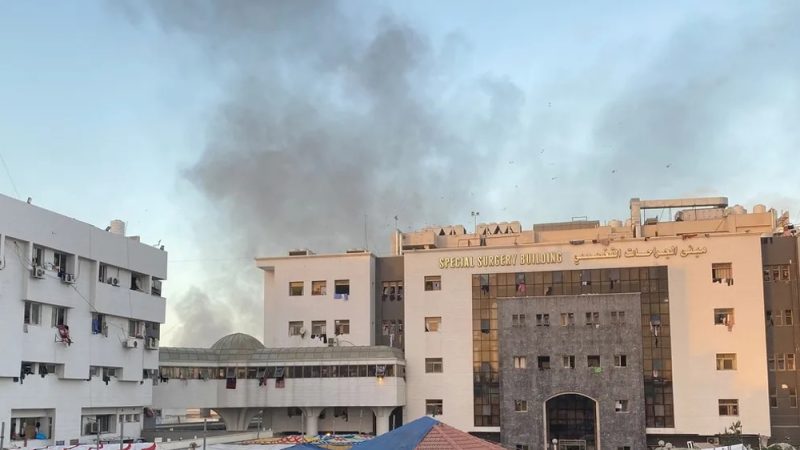
Press TV – November 20, 2023
Indonesia’s foreign minister has condemned in the strongest terms Israel’s attacks on Indonesian Hospital in the besieged Gaza Strip as a “clear violation of international humanitarian laws.”
“All countries, especially those that have close relations with Israel, must use all their influence and capabilities to urge Israel to stop its atrocities,” Retno Marsudi stated on Monday.
Israeli forces opened fire and launched artillery strikes on the hospital and the surrounding areas in the early hours of the day.
The Gaza Health Ministry’s General Manager Munner al-Bursh said the regime forces began artillery strikes “in the middle of the night and targeted the surgical department, wounding the doctors working there and killing 12 civilians who were taking refuge.”
Elsewhere in his remarks, Bursh said Israeli forces also targeted people leaving the facility and shot them outside the hospital. “Their bodies are still lying on the ground, and nobody has been able to bury them.”
“We are using a small power generator that runs on vegetable oil, manufactured by some creative individuals who sacrificed some of their food supply to run the generator,” Bursh said.
Ashraf al-Qudra, Gaza’s Health Ministry spokesman, said the situation is “catastrophic” in Indonesian Hospital. “The Indonesian Hospital staff are insisting they will stay to treat the wounded. There are about 700 people, including medical staff and injured people, inside the hospital.”
Reports said Israeli forces are going to repeat what happened at Shifa Hospital and will also occupy the Indonesian Hospital as tanks surrounded the facility.
Meanwhile, Palestinian Prime minister Mohammad Shtayyeh has said the Israeli military operation in Gaza “is for the purpose of killing, in the spirit of revenge and with the aim of displacing our people.”
And UN Secretary-General Antonio Guterres has said the number of civilians killed in Israel’s war on Gaza has been “unparalleled and unprecedented” since he took office in 2017.
Children make up virtually 47 percent of Gaza’s 2.3 million population. UNICEF has labeled the Gaza Strip “a graveyard for thousands of children.” It has also described the situation in Gaza as “a growing stain on our collective conscience”, calling the rate of children casualties “simply staggering.”
Save the Children says more children have been killed in Gaza than in all other conflicts around the world since 2019 combined.
Israel has killed 13,000 Palestinians in Gaza since October 7.
Western embassies receive ‘suspicious’ arms deliveries in Lebanon: Al-Akhbar Report
The Cradle | November 20, 2023
Lebanon has been witnessing a “suspicious security movement,” Al-Akhbar reported on 18 November, as several Western military planes carrying weapons have arrived at Beirut International Airport since the outbreak of the Gaza-Israel war last month.
According to the Lebanese daily, some of these planes have also landed at a decommissioned airstrip in the Hamat military base.
The deliveries reportedly come in the wake of “requests sent by foreign countries to Lebanon to allow the entry of weapons and ammunition, under the pretext of enhancing the security of its embassies and evacuating its nationals and diplomats.”
Aircraft recently landed in Lebanon include US, British, French, and Canadian planes. The report adds that some of these planes came from Israel.
Sources told the newspaper that Lebanon recently rejected a French request to “agree on the entry of a ship carrying about 500 soldiers and approximately 50 vehicles.”
The Lebanese Foreign Ministry also received a request to grant two permits for a Canadian plane and a Belgian plane to arrive at Beirut airport, which was rejected.
However, Al-Akhbar’s sources say that “the Canadian plane had already landed at Beirut Airport and was found to be carrying various types of weapons (including silencers and detonators).”
Caretaker Prime Minister Najib Mikati listed these western requests on the agenda of the last cabinet meeting. However, nothing was decided on.
Western and Arab states reportedly sent requests to Lebanese security services expressing “fear that their employees or nationals would be exposed to attacks against the backdrop of what is happening in Gaza.”
Western embassies have not answered any questions about these shipments, the report says, adding that diplomats have referred all questions to military attaches “who coordinate all steps with the Lebanese army and security forces.”
In a statement last week, the Lebanese army command claimed these movements aligned with the routine transport of military aid.
However, Al-Akhbar’s sources say there are “suspicions regarding the aircraft entering and unloading their cargo, as it is not known to whom this equipment is going, and whether the destination is actually limited to the army.”
“What is happening has put the current army commander, Joseph Aoun, under the microscope … and has put question marks about the extent of his cooperation with Westerners nations,” the sources added, highlighting a possible “attack on the principle of sovereignty” in Lebanon.
Aoun has often been accused of having a very close relationship with the US embassy and Ambassador Dorothy Shea.
Israeli army detains dozens, including women, journalists, in West Bank raids

Israeli soldiers raid the Balata camp for Palestinian refugees, east of Nablus in the occupied West Bank on November 19, 2023 [JAAFAR ASHTIYEH/AFP via Getty Images]
MEMO | November 19, 2023
Palestinian killed, another injured in Israeli attack on MSF convoy

Palestine Information Center – November 19, 2023
One person was killed and one was injured in an attack on Saturday on a convoy of Doctors Without Borders/Médecins Sans Frontières (MSF) staff members and their families who had been attempting to evacuate from northern Gaza.
The person who was killed was a relative of an MSF staff member. “MSF condemns in the strongest terms this deliberate attack.”
“The convoy was made up of 137 people — Palestinian MSF staff members and their families, including 65 children. Since November 11, they have been trapped in MSF’s guesthouse, office and outpatient clinic near Al-Shifa Hospital in Gaza because of ongoing fighting, and we have repeatedly called for their safe evacuation,” MSF said in a statement on Saturday.
MSF explained that on Saturday morning, its convoy of five vehicles departed at 9:00 a.m. local time, all clearly marked with MSF identification, including on the roofs.
MSF said it arranged for the movement of the convoy, but when the convoy reached the point where the Israeli army had constructed a newly erected checkpoint, the area was already overcrowded with Palestinian civilians seeking to flee.
However, after hours of waiting, the Israeli army did not allow the convoy to cross toward the south and shots were fired to push it back to Gaza City, MSF added.
When the convoy was on its way back, it was attacked. “Two of the MSF cars were deliberately hit, killing one MSF staff’s family member and injuring another.”
MSF has called again to urgently allow the evacuation of its staff and their families as well as of thousands of other people, who are trapped by fighting and living in extremely dire conditions in northern Gaza.
“We are calling for an immediate ceasefire, which is the only way for corridors to be implemented to safely evacuate trapped civilians.”
Ministers from Arab, Muslim countries embark on China visit to end Gaza war
MEMO | November 19, 2023
Ministers from Arab and Muslim-majority countries are to head to China tomorrow as part of the first leg of a tour aimed at ending Israel’s genocidal war in Gaza, the Saudi Foreign Minister Prince Faisal bin Farhan said.
In an announcement shared on social media platform X, the Kingdom’s top diplomat said “The first stop will be in China and will then move to a number of capitals to deliver the clear message that there must be a ceasefire immediately as well as aid and humanitarian needs must be immediately delivered to Gaza.”
Prince Faisal made the comments after a meeting with EU foreign policy chief Josep Borrell on the sidelines of the Manama Dialogue 2023 conference in Bahrain.
“We must work to end this crisis and end this war on Gaza as soon as possible,” Prince Faisal added.
According to the Saudi Gazette, the extraordinary joint Arab-Islamic Summit, which was held in Riyadh last week, issued a resolution tasking the foreign ministers of Saudi Arabia, Jordan, Egypt, Qatar, Turkiye, Indonesia, Nigeria, and Palestine to initiate immediate international action on behalf of all member states of the Organisation of Islamic Cooperation (OIC) and the Arab League.
“The goal is to formulate an international initiative to halt the war in Gaza and push for a genuine and serious political process, leading to a permanent and comprehensive peace in accordance with established international references,” it said.
The forthcoming meeting in Beijing was confirmed today by China’s state broadcaster CCTV, citing the country’s foreign ministry spokesperson Mao Ning.
“During the visit, China will have in-depth communication and coordination with the delegation on ways to deescalate the ongoing Palestinian-Israeli conflict, protect civilians and seek a just settlement of the Palestinian question,” said Mao.
In May, a poll conducted for Arab News by Yougov found that the majority of Palestinian respondents – 80 per cent, preferred China as a potential peace broker in the conflict with the occupation state, with the US seen as the least trusted mediator.
READ ALSO:
Featured Video

or go to
Aletho News Archives – Video-Images
From the Archives
A Lesser “Grade” of Human
By Michael Hoffman | Revelation of the Method | January 3, 2024
Will the more than 100 Iranians killed by terrorist bombs today be mourned in the West as victims of terrorism? Certainly not. Allied doctrine has it that the killing of Israeli or American civilians is a crime of cosmic proportions, while shedding the blood of “enemy” women and children is perfectly acceptable; indeed commendable.
The West does not memorialize the hundreds of thousands of civilians bombed by the U.S. in Serbia, Iraq, Afghanistan and every major German city 1943-1945. America’s fire-bombing of the city of Tokyo by General Curtis LeMay in March 1945 was followed by Harry Truman’s atomic incineration of Hiroshima and Nagasaki in August of that year. Truman never had a moment of doubt or regret over the murder of more than a 100,000 Asian children, mothers and non-combatant boys and men. It was business as usual for the “noble” Allies during the “Good War.”
In the West human rights signifies passionate concern only for civilians designated as truly human: Israelis first, then Americans and British, followed by their satraps.
This inhumanity is the legacy of Talmudic ideology, beginning with tractate Sanhedrin 57a from 400 A.D., concerning liability for capital punishment: “If a Jew murders a gentile, he is exempt.”
This teaching of contempt was reiterated in the dogma of Chabad Lubavitch founder Rabbi Shneur Zalman in the 18th century. … continue
Blog Roll
 Aletho News
- NATO’s top generals gather in Kiev
- EU’s continuing expansion – greater threat to Russia
- US Senator Murphy says Pentagon denied him entry to US base in Qatar
- Israel expands “incitement” charge to target Palestinian education and memory
- How Israel seeks to reshape Arab classrooms
- Paris bans pro-Palestinian demonstration planned for Oct. 7 over ‘risks of public disorder’
- In August Hanning Treason Case – All Signs Point To Tel Aviv.
- France cleared dozens of military sales to Israel between May and September: Report
- France projects nuclear power as Macron pushes arsenal expansion
- The fallacy of US delusions about Iran’s economic collapse
- If Americans Knew
- An error has occurred; the feed is probably down. Try again later.
- No Tricks Zone
- US September “Heat” Was No Record…Many Records Set Decades Ago
- Latest European Green Energy Debacle; Portugal’s Largest Flagship Solar Park Insolvent!
- Green Energy Debacle: German Expert Professor Fritz Vahrenholt Warns Of Severe Economic And Social Consequences
- Two More Paleo Reconstructions Affirm Meters-Higher Sea Levels Across Ireland, Brazil 7000-6000 Years Ago
- New Study: Earth And Venus Surface Warmth Largely Explained By Convection And Lapse Rate, Not CO2 Or Radiation
- 2025 Nature Paper Claiming Worsening Global Drought Gets RETRACTED …Heavily Flawed
- New Study: ‘Global Drought Shows No Detectable Recent Acceleration Under Climate Warming’
- Economic Masterminds: German Socialists Suggest Taxing Productivity Gains Stemming From Using AI
- The South China Sea Has Not Been Cooperating With The Climate Change Narrative
- Energy Crisis: Germany Enters Heating Season With Historically Low Gas Reserve Fill Levels


