Pompeo: US to Label BDS Movement as ‘Anti-Semitic’
Palestine Chronicle | November 19, 2020
US Secretary of State Mike Pompeo announced that Washington will take measures against the Boycott, Divestment and Sanctions (BDS) campaign, which seeks to isolate Israel over its treatment of the Palestinians.
Washington “will regard the global anti-Israel BDS campaign as anti-Semitic,” he said.
“We will immediately take steps to identify organizations that engage in hateful BDS conduct and withdraw US government support for such groups,” Pompeo said.
Israel sees BDS as a strategic threat and has long accused it of anti-Semitism.
Activists strongly deny the charge, comparing the boycott to the economic isolation that helped bring down apartheid in South Africa.
Last week Pompeo announced his intention to create a new process by which Washington can label organizations and NGOs as “anti-Semitic”, Politico reported on Wednesday.
Three people close to the issue confirmed the move, saying Pompeo may hold off on making an announcement.
Pompeo made the first visit by a US secretary of state to the Israeli-occupied Golan Heights on Thursday, after labeling the pro-Palestinian BDS movement an anti-Semitic “cancer”.
Hamas condemns PA announcement on restoration of ties with Israel
Palestine Information Center – November 18, 2020
GAZA – The Islamic Resistance Movement, Hamas, has strongly condemned the decision of the Palestinian Authority (PA) to resume its relations with the “criminal Zionist occupation”.
Hamas said in a statement on Tuesday evening that the PA is flouting all the national values and principles and the outcomes of the historic meeting of the Secretaries-General of the Palestinian factions.
The Movement added that this decision represents a betrayal of the national efforts towards building a national partnership and a struggle strategy to confront the occupation, annexation, normalization and the deal of the century. It highlighted that this decision was made after the announcement of thousands of Israeli housing units in Occupied Jerusalem.
The PA by this decision justifies the Arab normalization with Israel which it has consistently condemned and rejected, Hamas noted.
It demanded the PA to immediately reverse its decision.
“A real national unity based on a comprehensive national program that stems from the strategy of confrontation with the criminal occupation will only liberate the land, protect rights and expel the occupation”, Hamas stressed.
UK’s Labour Party suspends critic of Israel
![Left-wing Labour newly elected NEC member Gemma Bolton who was suspended for calling Israel an apartheid state [screenshot]](https://i2.wp.com/www.middleeastmonitor.com/wp-content/uploads/2020/11/Screen-Shot-2020-11-17-at-12.00.53-e1605614513700.png?resize=505%2C336&quality=85&strip=all&zoom=1&ssl=1)
Labour newly elected NEC member Gemma Bolton was suspended for calling Israel an apartheid state
MEMO | November 17, 2020
A left-wing member of the governing body of Britain’s Labour Party is under investigation for saying that Israel is an apartheid state.
Newly-elected National Executive Committee member Gemma Bolton, who was backed by left wing group Momentum, has been placed under investigation by the party for tweeting in 2018: “If I run the risk of getting suspended for calling Israel an apartheid state then so be it. Suspend me. Because that comrades, is a hill I am perfectly happy to die on.”
An article in the Jewish Chronicle article referred to Bolton’s views on Israel as “hard line” and attempted to shame her for previous posts completely unrelated to the issue. She was accused of being fond of “sexually explicit humour”; the pro-Israel community newspaper cited a social media post from 2015 in which she said, “I’m torn between wanting to be a high class Westminster politician or a porn star.”
In 2017, a UN report said that, “Israel has established an apartheid regime that dominates the Palestinian people as a whole.” UN Under-Secretary-General Rima Khalaf said at the time that the report “clearly and frankly concludes that Israel is a racist state that has established an apartheid system that persecutes the Palestinian people.” Israel immediately expressed its outrage and dismissed the report as “anti-Semitic”.
The latest Labour suspension follows that of former leader Jeremy Corbyn MP, who was suspended after the publication of the Equality and Human Rights Commission (EHRC) report into alleged anti-Semitism in the party. Those opposed to such moves point out that anti-Zionism and anti-Semitism are not the same thing, and that legitimate criticism of the Israeli government’s policies is not anti-Semitic per se.
Labour leader Keir Starmer sacked left wing Rebecca Long-Bailey from the shadow cabinet earlier this year for sharing an interview with actress Maxine Peake speaking out about police brutality in the wake of the George Floyd murder. Peake mentioned that US police forces receive training from their Israeli counterparts.
Starmer also reportedly gave backbench MP Stephen Kinnock a “dressing down” for suggesting that the government should stop buying goods from illegal Israeli settlements built on Palestinian land. Again, the reality is that such settlements and the movement of people to live on occupied land are illegal in the eyes of international law.
As Israel destroys EU projects in Palestine, European foreign policy remains impotent
![Palestinian children check the destruction in a children's playground, that was built with funding from Belgium, in the Zatarah village, south of the West Bank city of Nablus, after it was demolished on 12 April 2016 by Israeli authorities who said it was built in the so-called Area C, a closed military zone where Israel exercises full control. [JAAFAR ASHTIYEH/AFP via Getty Images]](https://i1.wp.com/www.middleeastmonitor.com/wp-content/uploads/2020/11/GettyImages-520604188-e1605604774582.jpg?resize=1140%2C759&quality=85&strip=all&zoom=1&ssl=1)
Palestinian children witness the destruction in a children’s playground, that was built with funding from Belgium, in the Zatarah village, south of the West Bank city of Nablus, after it was demolished on 12 April 2016 by Israeli authorities who said it was built in the so-called Area C, a closed military zone where Israel exercises full control. [JAAFAR ASHTIYEH/AFP via Getty Images]
By Ramzy Baroud | MEMO | November 17, 2020
Belgium is furious. On November 6, the Belgian government condemned Israel’s destruction of Belgian-funded homes in the Occupied Palestinian West Bank. Understandably, Brussels wants the Israeli government to pay compensation for the unwarranted destruction. The Israeli response was swift: a resounding ‘no’.
The diplomatic row is likely to fizzle out soon; neither will Israel cease its illegal demolitions of Palestinian homes and structures in the West Bank nor will Belgium, or any other EU country, receive a dime from Tel Aviv.
Welcome to the bizarre world of European foreign policy in Palestine and Israel.
The EU still champions a two-state solution and advocates international law regarding the legality of the Israeli military occupation of the Palestinian territories. To make that possible, the EU has, for nearly four decades, funded Palestinian infrastructure as part of a state-building scheme. It is common knowledge that Israel rejects international law, the two-state solution and any kind of outside ‘pressure’ regarding its military occupation.
To back its position with action, Israel has been actively and systematically destroying EU-funded projects in Palestine. In doing so, it aims to send a message to the Europeans that their role in supporting the Palestinian quest for statehood is vehemently rejected. Indeed, in 2019 alone, 204 Palestinian structures were demolished just in Occupied East Jerusalem, according to the Euro-Med Monitor. Included in this destruction – in addition to similar demolition in the West Bank Area C – are 127 structures that were funded mostly by EU member states.
Yet, despite the fact that Israel has been on a crash course with the EU for years, Europe remains Israel’s number one trade partner. Worse, Europe is one of Israel’s largest weapons suppliers and also main market for Israel’s own weapons – often touted for being ‘combat-proven‘, as in successfully used against Palestinians.
The contradiction does not end here.
In November 2019, the European Court of Justice ruled that EU countries must identify on their labels the specific products that are made in illegal Jewish settlements, a decision that was seen as an important first step to hold Israel accountable for its occupation. Yet, bizarrely, European activists who promote the boycott of Israeli products are often tried and indicted in European courts, based on the flimsy claim that such boycotts fall into the category of ‘anti-Semitism.’ France, Germany and others have repeatedly utilized their judicial system to criminalize the legitimate boycott of the Israeli occupation.
And here, again, European contradictions and confused policies are evident with total clarity. Indeed, last September, Germany, France, Belgium and other EU members spoke firmly at the United Nations against Israel’s policy of demolition, which largely targeted EU-funded infrastructure. In their statement, the EU countries noted that “the period from March to August 2020 saw the highest average destruction rate in four years.”
Because of the absence of any meaningful European action on the Palestinian front, Israel no longer finds the European position, however rhetorically strong, worrisome. Just consider the defensible Belgian position on the destruction of Palestinian homes that were funded by the Belgian government in the village of Al-Rakeez, near Hebron (Al-Khalil).
“This essential infrastructure was built with Belgian funding, as part of humanitarian aid implemented by the West Bank Protection Consortium. Our country asks Israel for compensation or restitution for these destructions,” the Belgian Foreign Ministry said in a statement on November 6.
Now, marvel at the Israeli response, as communicated in a statement issued by Israel’s foreign ministry. “Donor states should utilize their tax payer’s (sic) money towards the funding of legal constructions and projects in territories that are controlled by Israel, and make sure those are planned and executed in accordance with the law and in coordination with the relevant Israeli authorities.”
But are Europeans violating any law by helping the Palestinians build schools, hospitals and homes in the Occupied Territories? And what ‘law’ is Israel following when it is systematically destroying hundreds of EU-funded Palestinian infrastructures?
Needless to say, the EU support for Palestinians is consistent with international law that recognizes the responsibility of all UN member states in helping an occupied nation achieve its independence. It is, rather, Israel that stands in violation of numerous UN resolutions, which have repeatedly demanded an immediate halt to Israel’s illegal settlement activities, home demolition and military occupation altogether.
Israel, however, has never been held accountable for its obligations under international law. So, when the Israeli foreign ministry speaks of ‘law’, it refers only to the unwarranted decisions made by the Israeli government and Knesset (parliament), such as the decision to illegally annex nearly a third of the West Bank, a massive swathe of Palestinian land that is located in Area C – this is where most of the destruction is taking place.
Israel considers that, by funding Palestinian projects in Area C, the EU is deliberately attempting to thwart Israel’s annexation plans in this region. The Israeli message to Europe is very clear: cease and desist, or the demolition will go on. Israeli arrogance has reached the point that, according to Euro-Med Monitor, in September 2014, Israel destroyed a Belgian-funded electrification project in the village of Khirbet Al Tawil, even though the project was, in fact, installed in coordination with Israel’s civil administration in the area.
Alas, despite the occasional protest, EU members are getting the message. The total number of internationally-funded projects in Area C for 2019 has shrunk to 12, several folds lower than previous years. Projects for 2020 are likely to be even lower.
The EU may continue to condemn and protest the Israeli destruction. However, angry statements and demands for compensation will fall on deaf Israeli ears if not backed by action.
The EU has much leverage over Israel. Not only is it refusing to leverage its high trade numbers and military hardware, but it is also punishing European civil society organizations for daring to challenge Israel.
The problem, then, is not typical Israeli obstinacy alone but Europe’s own foreign policy miscalculation – if not an all-out failure – as well.
How the British government secretly funded Syrian cartoons and comic books as anti-Assad propaganda aimed at children
By Kit Klarenberg | RT | November 16, 2020
Leaked documents show how the Foreign & Commonwealth Office spent millions setting up a clandestine network to churn out pro-rebel material, much of it aimed at winning the hearts and minds of kids.
A swath of internal UK Foreign & Commonwealth Office (FCO) files have exposed a number of covert ways in which London sought to both propagandize Syrian children and turn them into weapons, in a vast, long-running information warfare campaign at home and abroad.
The documents are just some of the bombshell papers released by hacktivist collective Anonymous, outlining a variety of cloak-and-dagger actions undertaken by the UK government against the Syrian state over many years.
The overriding objective behind them all was to destabilize the government of Bashar Assad, convince Syrians, Western citizens, foreign governments, and international bodies that the Free Syrian Army (FSA) was a legitimate alternative, and flood media the world over with pro-opposition propaganda.
Children figured prominently in a number of the plans, in more ways than one. ARK, a shadowy firm headed by veteran FCO operative Alistair Harris, was central to many of these covert efforts, which may have cost the FCO many millions in total.
Undermining government legitimacy
In one file, the company outlines pricing for runs of propaganda material including “public service announcement animations” (£4,570), “political cartoons” (£1,200), and “comic books (24 colored pages)” (£30,200).
A separate proposal submitted to the FCO by communications firm Albany details ways of offering clandestine support to “oppositionist grassroots media activism.” The company conducted numerous psyops in Syria – including managing the Syrian National Coalition’s communications during the 2014 Geneva II peace conference – and collaborated extensively with ARK in the process.
Creating “fictional material” such as radio dramas and “digital comic strips for internet deployment” was listed one of the key ways the firm would “bolster the values and reputation of the Syrian opposition,” and undermine the government’s “core narrative and legitimacy.”
Precisely which projects emerged from these pitches, if any, isn’t clear from the files themselves, but in May journalist Ian Cobain revealed Hentawi, a comic aimed at 9-to-15 year-old Syrians, was a clandestine creation of the FCO, and its founder Naji Jerf was an employee of a firm contracted by the department.
The files released by Anonymous indicate that the company in question was ARK, who provided Jerf’s CV – it reveals that from 2006 to 2007, he was Editor of a UAE-based magazine, Attfal Al Yaom (Children of Today).
Such experience undoubtedly assisted in the production of Hentawi, which featured very slick comic strips slyly extolling equality and democracy and other values, quizzes and games, and inspiring stories of athletes, celebrities and the like.
Cobain also exposed how FCO contractors produced animated films for Syrian children, such as Goal to Syria, about a young footballer who scores the winning goal in the 2027 Asia Cup final, leading the Syrian team to victory.
As the player prepares to attempt a deciding penalty, his mind flashes back to Aleppo in 2014. In the wake of a bombing raid, the White Helmets rush in an ambulance to rescue him from rubble – en-route they pass a local man who screams, “first they bombed us with chemicals, and now barrel bombs!”
After prising the boy free and carrying him to safety, a White Helmet shoots him the peace sign. Back in 2027, he shoots and scores, with the commentators praising the “lion of Damascus” for his heroic victory. As the screen fades to black, viewers are presented with text hailing the White Helmets’ achievements during the conflict, claiming the group “represent the humanity and spirit of the Syrian people.”
Other leaked FCO files make clear ARK played a pivotal role in constructing and promoting the White Helmets’ benevolent image worldwide, developing “an internationally-focused communications campaign to raise global awareness” of the group in order to “keep Syria in the news.” Goal to Syria was shown at the 2016 Cannes Film Festival, and can thus be considered another example of this effort in practice, on top of the clip’s domestic purpose.
Somebody think of the children
The same file listing Naji Jerf’s resumé indicates that ARK worked with civil society organizations “to develop products for children” in Syria, including “mobile cinema screenings.”
The company’s expansive network of freelancers in the country, which ARK itself extensively trained at quite some cost to the FCO, were said to “frequently cover such events.” These reports would then be fed to ARK’s “well-established contacts” at major news outlets including Al Jazeera, BBC, CNN, Guardian, New York Times, and Reuters, “further amplifying their effect.”
These outlets similarly “amplified” the impactful propaganda of other FCO contractors working in Syria. In July 2019, an image of two young Syrian girls trapped in rubble in Idlib attempting to haul their sister to safety as she dangled off the precipice of a dilapidated building, their father looking on in horror above, spread far and wide on social media.
The photo, snapped by a photographer for popular Syrian news service SY24, was reported the world over. Unbeknownst to readers, SY24 was created and funded by The Global Strategy Network (TGSN), founded by Richard Barrett, a former MI6 counter-terrorism director.
In a file submitted to the FCO, TGSN boasted of how “campaigns” it broadcast via SY24 generated “huge global coverage,” having been seen by “many hundreds of millions of people,” and “attracting comment as far as the UN Security Council.”
SY24 content was produced by a network of stringers TGSN both trained and provided with equipment, including “cameras and video editing software.” The firm drew particular attention to a team of female stringers it tutored, “who provide about 40 percent of all SY content,” and were part of “a broad ‘network of networks’” enabling TGSN “to drive stories into the mainstream.”
As with Albany and ARK, TGSN engaged in activities to propagandize Syria’s youth, offering to bring projectors to refugee camps and “rural areas” to screen material to young residents, including “prosocial cartoons for children, films chosen with regard to conflict sensitivity and gender, and popular football events to drive participation.”
The company also conspired with ARK on several surreptitious endeavors, including a campaign dubbed ‘Back to School.’ As its name implies, under its auspices young Syrians in opposition-occupied Idlib returned to school – the two FCO accomplices promised to ensure it was a major media event.
In conjunction with Idlib City Council, opposition commanders, and other elements on the ground, ARK and TGSN planned a comprehensive, “unified” communications campaign using “shared slogans, hashtags and branding.” Rebel fighters were to be engaged in order to “clear roads” and “enable children and teachers to get to schools,” all the while filmed by the pair’s voluminous stringer network, footage which would be “disseminated online and on broadcast channels.”
Junior war propagandists
It is in the context of such cynical, heartstring-tugging child exploitation by the FCO that the phenomenon of Bana Alabed gains an even more suspicious, sinister dimension.
In 2016, at the age of just seven, Bana briefly became a celebrated figure among advocates of Western military intervention in Syria, for tweets she allegedly posted documenting the siege of Aleppo.
Within days of her account being registered in September that year, she amassed a sizeable following, firing messages at Assad, Vladimir Putin, and Barack Obama, using hashtags such as #StandWithAleppo, #HolocaustAleppo, #MassacreInAleppo and #StopAleppoMassacre. She also gained a prominent media profile, was dubbed by more than one pundit the “Anne Frank” of the Syrian crisis, and was invited on to major news networks to denounce Assad and the Syrian Arab Army.
Nonetheless, critics were puzzled as to how such a young girl in a city subject to frequent power cuts could have acquired such an apparent mastery of the English language, and tweet so frequently. Concerns were also raised about the interventionist nature of some of the tweets ostensibly posted by Bana, including an apparent endorsement of the prospect of World War III.
Even mainstream journalists acknowledged her video statements were almost undoubtedly scripted, The New Yorker stating Bana was clearly “being coached… to communicate her thoughts in a language she is only beginning to learn.”
Bana went on to ink a lucrative deal with publishing giant Simon & Schuster, after signing up with talent and marketing agency The Blair Partnership, founded by Neil Blair, board member of the UK branch of the Abraham Fund, a group sponsored by Israeli bank Hapoalim, which finances the construction of Jewish-only settlements in the occupied West Bank.
Bana had largely disappeared by July the next year, when Syrian journalist Khaled Iskef visited the Alabeds’ abandoned home. He found it was situated round the corner from an al-Nusra headquarters, and less than 400 meters from Al-Qaeda’s Aleppo nerve-center. Inside, he discovered a notebook documenting her father Ghassan’s work with extremist elements, as a result of his position as military trainer for Islamic Sawfa Brigade.
During that period, he worked in the Shariah Council in the Aleppo state Eye Hospital, which was under the control of al-Nusra. The notebook indicated the Council passed decisions on imprisonment and assassination of captured civilians to the terorrist group.
Since-deleted social media posts reveal Bana’s grandfather Mohammed was an arms dealer and had a weapons maintenance shop in Sha’ar, at which he serviced killing apparatuses for terrorist factions, situated opposite a school-turned-base for al-Nusra.
Bana’s Twitter account frequently complained of her inability to go ‘back to school’ – in a perverse irony, Iskef found al-Nusra used a former school near her home as a headquarters.
Kit Klarenberg is an investigative journalist exploring the role of intelligence services in shaping politics and perceptions. Follow Kit on Twitter @KitKlarenberg
Iran hawks Pompeo, Bolton made rich by Israeli lobby: Pentagon adviser
Press TV | November 14, 2020
A top adviser at the Pentagon says prominent US officials, including Iran hawks Secretary of State Mike Pompeo and former national security advisor John Bolton, have been taking money and getting rich from the Israeli lobby.
Washington’s support for Tel Aviv is the result of Israeli lobby money, said retired Army Colonel Douglas Macgregor, who was appointed this week as senior adviser to newly installed acting Defense Secretary Christopher Miller, in two media appearances back in 2012 and 2019.
“You have to look at the people that donate to those individuals,” he said in a September 2019 interview when asked if Bolton and Republican Senator Lindsey Graham wanted war with Iran.
“Mr. Bolton has become very, very rich and is in the position he’s in because of his unconditional support for the Israeli lobby. He is their man on the ground, in the White House. The same thing is largely true for Mr. Pompeo, he has aspirations to be president. He has his hands out for money from the Israeli lobby, the Saudis and others,” he added.
In another interview in 2012, Macgregor stressed that the Israel lobby in the US has “enormous influence” on Congress and that it wanted to instigate “military strikes” with Iran.
“I think the American Israeli Public Affairs Committee (AIPAC) and it’s subordinate elements or affiliated elements that represent enormous quantities of money that over many years have cultivated an enormous influence in power in Congress,” he told Russia’s state media network RT.
“I think you’ve got a lot of people on the Hill who fall into two categories. One category that is interested in money and wants to be re-elected, and they don’t want to run the risk of the various lobbies that are pushing military action against Iran to contribute money to their opponents.”
AIPAC is known for being the main architect of US policies throughout the Middle East, and has been criticized repeatedly for wielding disproportionate influence in Congress.
The US State Department declined to comment on behalf of Pompeo in response to Macgregor’s remarks.
Bolton, however, reacted to the disclosure through a spokesman, saying, “I don’t respond to anti-Semites.”
This is while his financial disclosures show he earned thousands of dollars for speaking to pro-Israel groups prior to his appointment as the White House national security adviser in 2018.
UK undercover cops foiled ISM activists using deceit & abuse… were there shady deals with Mossad?
By Kit Klarenberg | RT | November 13, 2020
Evidence presented to an ongoing inquiry into UK police operations that infiltrated ‘extremist’ activist groups fuels questions over whether the intelligence they garnered was passed on to Israel.
Founded in 2001, the International Solidarity Movement (ISM) is a pro-Palestinian political campaign group, dedicated to the use of nonviolent protest.
ISM has chapters around the world, which regularly train and dispatch volunteers to Palestine, to assist locals with activities such as protests, chaperoning and olive-picking. Despite the movement’s peaceful nature, two volunteers – Rachel Corrie and Tom Hurndall – died after coming into contact with occupation forces, both in 2003. Corrie was crushed by a bulldozer, Hurndall shot in the head by an Israeli military sniper.
In December 2018, the Undercover Policing Inquiry (UCPI), which investigates numerous controversies surrounding the British state’s use of clandestine operatives, revealed ISM’s London branch was infiltrated by Special Branch spy ‘Rob Harrison’ (a pseudonym).
He penetrated the group 2004-2006, and was concurrently involved in a number of left-wing and anarchist movements in the UK capital, his activities even taking him overseas, and resulting in his arrest by uniformed officers under his cover name.
The DJ detective
Harrison’s undercover identity was extensive and colourful, a key strand of his ‘legend’ being his moonlighting as a professional DJ, under the moniker ‘Boogie Knight’. He also posted on the popular left-wing online forum urban75 as ‘Boogie Boy’, typically on the subject of music, but occasionally about politics.
On the forum, he was involved in a regular music sharing scheme whereby members would create CD compilations and send them to other users. Through this scheme he would have learned posters’ identities and addresses.
In any event, as a consequence of this background, he frequently performed DJ sets at ISM London fundraising events, and also parties convened by activists and their friends.
His generally affable, sociable nature, and readiness to buy others drinks down the pub, also meant he was frequently invited into private homes for gatherings and social events large and small. Many were disarmed by his ready admissions of being politically under-educated relative to those around him, and this avowed lack of assurance led them to open up in confidence to Harrison.
Three of the London ISM activists he spied on – Asa Winstanley, Atif Chodhury, and the pseudonymous ‘MCD’ – are all core participants in the ongoing UCPI. Two years after Harrison’s unmasking, Asa still finds the subject difficult to talk about.
“It’s the worst feeling in the world,” he recalls. “A person you trusted, you spent time with, a friend, was actually the complete opposite of everything you thought they were. He joined ISM London before I did and some people now say they were wary of him, but to my mind he was the absolute last guy you’d suspect of being an infiltrator. He was quiet but friendly, helpful and enthusiastic, always willing to go the extra mile.”
Still, despite Asa’s contemporary confidence, reviewing old emails sent by the undercover cop to members of the group, he now sees clearly that Harrison was trying to sabotage the group, subtly stirring up internal trouble. His email address also remained on ISM London’s internal mailing lists until 2013, meaning police could have retained covert access to the group’s private discussions years after his deployment ended.
Asa also says Harrison was largely a silent, passive presence at meetings, although he was highly proactive when it came to mailing the group’s merchandise, offering to drive activists to the airport when they left for Palestine, and other hands-on assistance.
Such activities would have provided him with extensive intelligence on ISM London activists and supporters, their names, addresses and more – information particularly valued by the authorities, as, due to security concerns, ISM members rarely revealed their surnames, or when they were planning to leave.
Passing on secrets to Mossad?
There are indications that the information Harrison collected on ISM may have been passed by British security services to the Israeli government. By 2008, Tel Aviv had managed to obtain such good intelligence on Palestinian solidarity activists that many who attempted to visit Palestine from the UK were quickly deported after arrival or blocked from entering altogether. As ISM London’s primary raison d’etre was to get people into the occupied territories, its value and impact was significantly curtailed.
In 2005, four ISM London activists visited Palestine – one was let in, the others weren’t. Subsequently, the volunteer who gained entry was told by an Israeli human rights lawyer, Gaby Lasky, that the authorities had “international security” records on at least one of the three denied entry.
Whatever the truth of the matter, after the UCPI released Harrison’s cover name, researchers set about tracking down members of the groups he infiltrated. While several echoed Asa’s characterisation, others recalled him behaving in a predatory, creepy manner around female activists, being excessively flirtatious and suggestive to an extent that made them feel extremely uncomfortable.
Such behaviour, which extended to accusations that he groped someone at a party, exacerbated distrust of Harrison in certain circles. Still, the only documented instance of widespread suspicion that he was an undercover officer occurred while he was infiltrating State of Emergency Collective, a direct action group which sought to push anti-war protests beyond mere demonstrations.
Harrison, among other things, helped transport its members to numerous actions by car, including the paint-bombing of election offices. One group scheduled to take part in the attack was eventually unable to attend, and he was said to have gotten very angry at their failure to take part, causing friction between members.
General misgivings about this and other disruptive tendencies on the part of Harrison led to numerous people abandoning the group, and in August 2007, he was asked to leave. Its membership eviscerated, State of Emergency Collective disbanded not long after – it’s an open question whether the movement would have endured were it not for his presence.
Deception & abuse
Like many other undercover officers, Harrison deceived a woman into a long-term romantic relationship during his deployment – somewhat uniquely though, she wasn’t an activist.
His courtship with ‘Maya’ (a pseudonym), nonetheless furthered his covert objectives, as she was the friend and neighbour of Atif Chodhury. This gave him legitimate reason to frequently be in the same area as Atif, and to become close friends with him in the process. Atif divulged much intimate personal information to the police spy. It’s the first example to emerge from the UCPI so far of an operative deceiving a non-activist into a relationship in order to surveil a target.
In a statement to the UCPI on November 9, Phillippa Kaufmann QC laid out in shocking detail the exploitation, manipulation and abuse Maya was subjected to by Harrison, not merely over the course of their relationship, but for many years afterwards.
The pair met through the sprawling social scene surrounding ISM London, with Harrison frequently visiting a housing cooperative where she lived with other activists. Their relationship began in May 2006, following an encounter at a fundraising event at which he was DJing.
Maya was initially reluctant for their connection to progress further, but Harrison subjected her to intense pressure, responding angrily to her not wanting to rush into things.
Harrison’s harassment was only just beginning, however. Kaufmann stated that throughout the relationship, he subjected Maya to significant emotional abuse and coercion, engaging in highly controlling behaviour, some of which was clearly calculated to cause Maya to suffer feelings of guilt and low self-esteem.
He regularly accused her of infidelity or promiscuity, bombarding her with texts accusing her of sleeping with other men, and becoming aggressively furious whenever she spent time with other men. Such was Harrison’s bullying, Maya began self-harming, which he was well-aware of, and isolating herself from male friends. Today, she believes his controlling conduct was a means of coercing her into proving her commitment to him.
Harrison would never take her on dates, and rarely see her anywhere other than her flat. Moreover, despite his obsessive, paranoid nature, he would frequently disappear for long periods, not responding to messages or answering his phone, occasionally blocking her number.
Self-harm & suicidal thoughts
He ended the relationship abruptly around Easter 2007, claiming his mother was dying of cancer, and disappeared without trace. Devastated by Harrison’s abrupt departure, Kaufmann said Maya began using hard drugs as a way of coping with the loss, and to suppress memories of his abuse. Eventually, she had to travel abroad and stay with family to recover from the shock of the break up, and to kick her drug habit.
Upon returning to the UK, the trauma Harrison inflicted continued to impact her psychologically and emotionally. A Master’s degree that she began in 2006 would take five years to complete – throughout, he continued to intermittently send Maya emails and text messages, and leaving comments on her blog, only ceasing contact in 2011.
Out of the blue, he got in touch with her again in August 2014, asking to meet, which they did. They communicated online regularly thereafter and met several times over the next few months, Harrison frequently speaking about the future, expressing a desire to resume their relationship and one day marry, even discussing what names to give their children.
As a result of his reappearance, Maya broke up with her partner of five years, whom she was living with at the time, and in February 2015, she and Harrison slept together for the first time since their separation almost eight years earlier.
“They had unprotected sex and Maya had to take emergency contraception the following day. The same day Rob disappeared and with the exception of one email he sent to her in 2016, he has never contacted Maya since,” Kaufmann revealed.
Maya learned Harrison was an undercover officer only in March 2019, when a friend informed her. She has struggled to come to terms with how such an important part of her life was based on lies and exploitation, and how such an important person in her life didn’t actually exist. Her mental health deteriorated sharply; she experienced suicidal feelings, and began self-harming again.
In common with all other undercover officers being probed by the UCPI, Harrison initially applied for blanket anonymity, meaning not even his victims could learn his real name. Inquiry chair John Mitting was initially “minded to” accept it, however, upon Maya gaining core participant status in June 2019, the former High Court judge reversed his decision.
Harrison, via his solicitors, acquiesced to her being provided his real name, but only on the understanding that she and her lawyers weren’t permitted to release it publicly. The request was robustly denied, with Mitting stating Maya was “entitled to make such use as she thinks right of personal information which she is entitled to know.”
It was a rare example of the chair appearing to favour the needs of undercover officers’ victims over the officers themselves. Overwhelmingly, real names haven’t been released, despite legitimate and clear grounds for doing so, and in some cases not even cover names have been disclosed.
Kit Klarenberg is an investigative journalist exploring the role of intelligence services in shaping politics and perceptions. Follow Kit on Twitter @KitKlarenberg
Israeli occupation forces steal herd of camels in Bethlehem

Palestine Information Center | November 12, 2020
BETHLEHEM – Israeli occupation forces (IOF) on Wednesday confiscated a herd of camels, belonging to Palestinian citizens, from the eastern slopes of Bethlehem province.
Chief of al-Rashayida village Fawwaz al-Rashayida reported that the IOF chased a number of camels in the area and seized nine of them belonging to two local residents called Salama Yunus and Mohamed Mustafa.
Rashayida also said that the IOF held the camels in al-Jiftlik village in Jericho province and justified the confiscation measure by claiming the animals were grazing in an area classified by Israel as a nature reserve.
He added that the IOF also demanded the owners of the camels to pay financial penalties if they wanted to get back their animals.
Israel seeks to stop flights to Beirut airport
MEMO | November 11, 2020
An Israeli legal team is seeking punitive measures against airlines and insurance companies which fly or provide services to Beirut’s Rafic Hariri International Airport under the pretext of supporting Lebanese Hezbollah group, Israel Hayom newspaper reported.
The paper said on Monday that the Israeli team has sent “warning letters” to major airlines around the world, claiming that by operating civilian flights to Beirut’s airport, they risk falling foul of international law and committing war crimes.
The team has also demanded the companies suspend all services provided to the airport or face legal action on charges of supporting a terrorist organisation.
“The Beirut International Airport has become a hornet’s nest for Hezbollah,” the letter said, adding that the airport and its surrounding area have witnessed large-scale terrorist operations by the group.
Over the past month months, Israeli Prime Minister Benjamin Netanyahu, has repeatedly shown maps allegedly showing missiles and weapons storage sites belonging to Hezbollah, in areas close to the airport. None of his “evidence” has been corroborated.
Palestinian student Ameer Hazboun sentenced by Israeli military court for campus activism
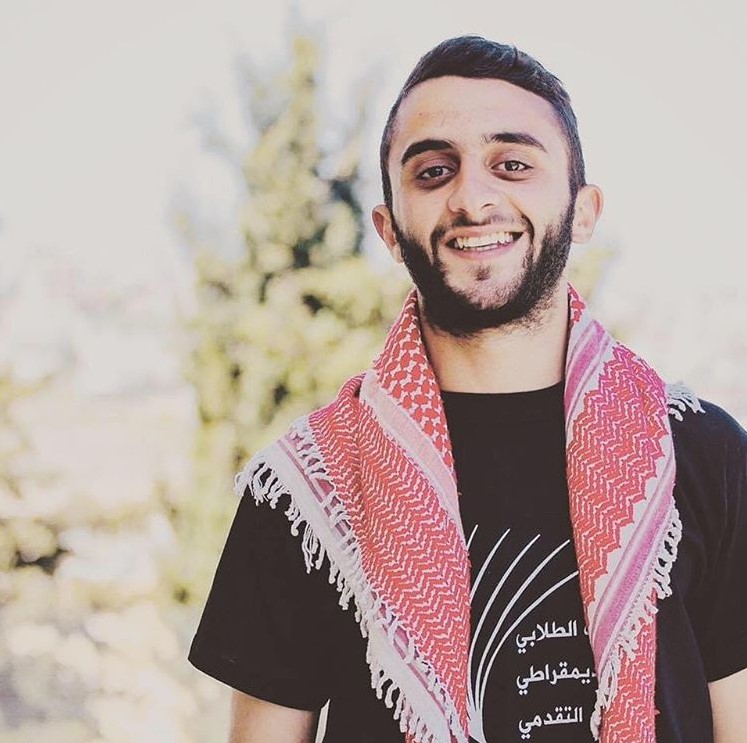
Samidoun Palestinian Prisoner Solidarity Network | November 10, 2020
Palestinian student prisoner Ameer Hazboun was sentenced by an illegitimate Israeli military court on Monday, 9 October to 16 months in Israeli prison and a fine of 3000 NIS ($890 USD/$750 EUR). He has been detained since 11 September 2019 and his military court hearings have been repeatedly delayed and postponed.
He was subjected to severe torture under interrogation at al-Moskobiyeh interrogation center before being charged with, essentially, being a Palestinian student activist: he was accused of membership in the Progressive Democratic Student Pole, a leftist student bloc at Bir Zeit University recently labeled a “prohibited organization” by the Israeli military occupation command, attending student events and organizing student activities on campus. In fact, distributing flyers for a student election campaign was labeled “aiding an illegal organization.”
A fourth-year engineering student at Bir Zeit University, Ameer was seized by soldiers in his dormitory on 10 September 2019 as they invaded his room at 1:00 a.m. He was brutally kicked beaten by the soldiers with their guns while being transported to the Moskobiyeh interrogation center. He arrived at the center with bruises all over his body and informed the prison doctor that he has a platinum plate in his left hand for a previous injury. He was interrogated for weeks on end for 22 hours a day. Due to severe sleep deprivation, he would sometimes fall asleep during interrogation and was shaken awake by the interrogators. He was forced into multiple stress positions, including being forced to stand on his toes with his hands cuffed overhead to the wall, placing severe stress on his feet, arms and injured hand.
Israel Arrests Journalist, Raids West Bank Library
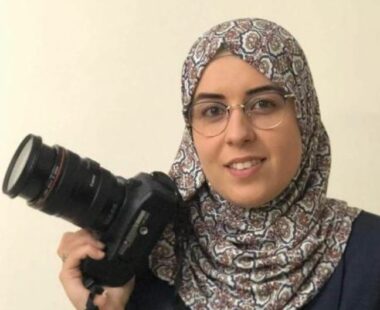
Palestine Information Center – November 9, 2020
OCCUPIED JERUSALEM – Israeli occupation forces (IOF) launched a raid and arrest campaign on Sunday night and at dawn Monday in various areas of the West Bank and Jerusalem. Several Palestinians were arrested including a journalist.
In Nablus, IOF arrested the journalist and former prisoner Bushra Jamal Al-Tawil at Tiar checkpoint on the Yitzhar road on Sunday night. Tawil was taken to the Hawara camp, south of Nablus.
IOF released Tawil at the end of July 2020 after spending 8 months in the occupation prisons.
Tawil was arrested for the first time in 2011, and she was sentenced to 16 months. She spent six months because she was released in the Wafa Al-Ahrar prisoner exchange agreement in December 2011. Then, she was re-arrested again in July 2014, and she was sentenced to ten months in prison, which is the continuation of her previous detention before the prisoner exchange agreement.
The third arrest was in November 2017, and the Israeli authorities ordered her administrative detention for eight months. The last arrest was on December 10, 2019.
Tawil’s family suffered from the occupation’s targeting of them through successive arrests. Her parents were arrested several times in the past, and her father spent a total of 14 years in the occupation’s prisons. Her mother was also arrested on 08/02/2010, and was released on 01/02/2011.
In another development, IOF patrols stormed Jaffa street and the area surrounding Al-Ain refugee camp, west of Nablus.
Eyewitnesses reported that Israeli soldiers stormed a store and confiscated items from inside the store in the presence of the owner and he was detained.
In Qalqilya, the IOF soldiers fired stun grenades and teargas canisters in the area near the separation wall in Jayyus, northeast of Qalqilya.
In Tulkarem, IOF arrested Imad Fahmi Ammar, 38 years, after raiding his house in Qaffin town, north of Tulkarem, and seized his personal phone and amount of money.
IOF broke into a library in the Al-Ashqar complex in the middle of the Martyr Thabet Thabet Square in Tulkarem and searched it. Confrontations erupted between the Palestinian youths and the IOF soldiers who fired tear gas canisters, without any injuries reported.
The areas of Jalazun refugee camp and Dura al-Qara town, north of Ramallah, witnessed an incursion by IOF, which coincided with the launch of a drone over the camp and the town.
In al-Khalil, the IOF soldiers arrested the two brothers Musab and Salah Al-Zughayer after they raided their houses.
IOF arrested the ex-prisoner Muhammad Shaheen and Muayad Walid Amr from Dura, southwest of al-Khalil, after they raided and searched their homes.
Local sources stated that IOF arrested two Palestinians from Beit Ta’amer, east of Bethlehem, and seized a vehicle of one of them.
Three brothers were also arrested after IOF raided their relatives’ house in the village and searched it.
The sources pointed out that IOF arrested a young man after storming his relatives’ house in Aida camp, north of Bethlehem.
In Jerusalem, the Israeli occupation intelligence stormed the house of Silwan Club’s president, Marwan Al-Ghoul, and served him a summons for investigation on Tuesday, in Room 4 in the Al-Maskobiya center, west of the occupied city.
Featured Video
The Search for Truth: Charlie Kirk’s Assassination One Year Later
or go to
Aletho News Archives – Video-Images
From the Archives
The 9/11 “Double-Cross” Conspiracy Theory
BY LAURENT GUYÉNOT • UNZ REVIEW • SEPTEMBER 6, 2022
Is it true that “9/11 was an inside job”? Yes, insofar as Israel is “inside” the U.S. But for the 9/11 truthers who have identified Israel as the main perpetrators, “9/11 was an inside job” is at best a half-truth, and at worst an integral part of the Zionist operation, like a secondary flag sewn as a lining under the false flag of Islamism. Victor Thorn (1963-2017) wrote in his book 9/11 made in Israel: The Plot Against America (2011): “In essence, the ‘9-11 truth movement’ was created prior to Sept. 11, 2001 as a means of suppressing news relating to Israeli complicity. . . . The slogan ‘9-11 was an inside job’ was quite possibly the greatest example of Israeli propaganda ever devised.” In milder terms, it is “controlled opposition”.
A genuine truth movement would have pointed to Israel as the prime suspect from the start. From day one, it was obvious who would benefit. … continue
Blog Roll
 Aletho News
- Hormuz and the Looming Economic Catastrophe
- Dhubab offensive, media blitz and the rapid unraveling of Saudi-backed coalition’s new gambit
- Putin Conveys to Trump Iran’s Vision on Possible Conflict Resolution – Kremlin
- The Search for Truth: Charlie Kirk’s Assassination One Year Later
- ‘Harsh reality’: Iran says France seeks monopoly on power and intimidation, not peace for all
- When Will This White House Madness End?
- Huckabee aide goes to ‘unusual lengths’ to portray ‘Israel’ positively
- Trump Announces Diesel Supply Deal With Putin Following Phone Call
- MEP blasts ‘Euro-Gestapo’ for lecturing Russia on democracy
- Syria May Send Troops to Saudi Arabia Amid War with Ansar Allah
- If Americans Knew
- Israeli forces kill another child in Gaza – Daily Update
- Gaza ceasefire exists in name only, say more than 100 organizations
- Nearly 2 Million in Gaza Need Urgent Shelter Assistance as Winter Looms: IOM Chief Warns
- Suppressing Palestinian resistance: US charity under fire for AI monitoring of Gaza classrooms
- Thousands Are Held in Israeli Torture Camps. This Is What Happens Inside
- Israel puts Gaza’s sick, injured, newborn in peril – Daily Update
- Report claimed Mark Levin used by Israeli government to influence Trump
- Over 2,000 Gazans have died awaiting medical evacuation amid Israel’s continued siege
- How a U.S. Diplomat Suppressed and Altered Reports Critical of Israel
- 5 Palestinians Die from Israeli Strikes in Gaza as Relentless Attacks Continue
- No Tricks Zone
- New Study: 50 Years Of The Most Aggressive ‘Net Zero’ Policies Can Only Affect The Global Climate By 0.03°C
- US September “Heat” Was No Record…Many Records Set Decades Ago
- Latest European Green Energy Debacle; Portugal’s Largest Flagship Solar Park Insolvent!
- Green Energy Debacle: German Expert Professor Fritz Vahrenholt Warns Of Severe Economic And Social Consequences
- Two More Paleo Reconstructions Affirm Meters-Higher Sea Levels Across Ireland, Brazil 7000-6000 Years Ago
- New Study: Earth And Venus Surface Warmth Largely Explained By Convection And Lapse Rate, Not CO2 Or Radiation
- 2025 Nature Paper Claiming Worsening Global Drought Gets RETRACTED …Heavily Flawed
- New Study: ‘Global Drought Shows No Detectable Recent Acceleration Under Climate Warming’
- Economic Masterminds: German Socialists Suggest Taxing Productivity Gains Stemming From Using AI
- The South China Sea Has Not Been Cooperating With The Climate Change Narrative

