Hunger striker reveals details of her horrific torture in Israeli prisons
![Palestinian prisoner, Heba Al-Labadi is on the eighth day of hunger strike after being sentenced to administrative detention for five months without charge or trial on 20 August 2019 [Twitter]](https://i0.wp.com/www.middleeastmonitor.com/wp-content/uploads/2019/10/ECYxESYWkAAW0NB-e1569940375372.jpg?resize=1024%2C683&quality=75&strip=all&ssl=1)
Palestinian prisoner, Heba Al-Labadi was sentenced to administrative detention for five months without charge or trial on 20 August 2019 [Twitter]
MEMO | October 8, 2019
A Palestinian-Jordanian who has been on hunger strike for 15 days in Israeli prisons has revealed the details of her horrific interrogation and torture, the PLO Prisoners’ Committee reported on Monday. Heba Al-Labadi, 24, was arrested on 20 August by Israeli soldiers as she crossed the Allenby Bridge from Jordan to attend a wedding in the occupied West Bank with her mother.
According to her lawyer, Al-Labadi has been subjected to inhumane treatment in detention. She was apparently stripped of all of her clothes as soon as she was arrested, handcuffed, blindfolded and leg-chained before being moved to the Bitah-Tikva investigation centre. She told her lawyer that she was embarrassed when she saw the female Israeli soldiers looking at her private parts when she entered and left the toilet.
Al-Labadi also explained that she was interrogated for 20 consecutive hours during the first 16 days of her detention and said that she was given only two breaks for meals every day. She was then moved to rooms full of collaborators, who started to interrogate her; this lasted for up to 35 days, during which she was subjected to verbal, physical and psychological abuse and torture. The Israeli interrogators, she insisted, got close to her body intentionally and used the dirtiest words to insult her.
“They also insulted Islam and Christianity,” she said, “and said that I am an extremist and told me that they had arrested my mother and sister and they would put me under renewable administrative detention for seven and a half years and then release me to the West Bank and put me under 24-hour surveillance.”
A large number of investigators are said to have interrogated Al-Labadi and kept her in a very dirty cell with insects and spiders. The cell had rough walls and a bright light which prevented her from sleeping. The “very thin” mattress had no cover or clean sheets. The interrogators told her that she would “rot” in prison.
On 25 September, Heba Al-Labadi was issued with a 5-month administrative detention order with neither charges made against her nor a trial. That was why she started her hunger strike.
Two days later, she was moved to a cell monitored by four cameras. The toilet in her cell has a see-through door, so her every move is monitored by the prison guards.
Despite being ordered to end her hunger strike, she insisted that the “tragedy” of the administrative detention must end first. “I will continue until the end or I shall die.”
Israel to build camps as preparation for displacing Arab citizens
MEMO | October 8, 2019
Israel’s District Planning and Building Committee considered a plan on Sunday submitted by the Bedouin Settlement Authority in the Negev which aims to build camps as preparation for the displacement of 36,000 Arab citizens, Arab48.com has reported. The plan targets Palestinian-Arab residents within Israel who live in Bedouin villages “unrecognised” by the Israeli occupation government.
Such villages have often been in place for hundreds of years before the creation of the Israeli occupation state. Nevertheless, it is insisting on displacing their residents and replacing the villages with housing projects for Jewish Israeli settlers.
A letter has been sent to the head of the District Planning and Building Committee asking them not to accept the plan. It was sent on behalf of Adalah Centre, an Israeli rights group seeking justice for Arab residents, along with the Regional Council for the Unrecognised Villages in the Negev, the Peaceful Coexistence Club and Shatil Association.
Submitted by lawyer Suha Bsharah from Adalah, the letter stressed the importance of rejecting the plan, which is simply a tool to displace Arabs from their homes and villages within Israel. It also reiterated that such an action amounts to a “flagrant violation of the basic rights of the Arab citizens on top of which is the right to respect, dignity and equality.”
The letter noted that this plan reinforces the suffering inflicted on the Arab residents of the unrecognised villages as Israel is planning to displace them under the pretext of carrying out government projects. “It is unreasonable that the authorities displace tens of thousands of residents from their homes and lands,” wrote the signatories. “[The plan] will destroy a complete generation of Arab children, women and youths.”
According to Bsharah, “The Israeli authorities are seriously looking for a legal cover for the displacement of Arabs by getting the approval of the District Planning and Building Committee. They are not looking for a just and appropriate solution that would maintain the right to live with respect, dignity and safety for the Arabs who have been living here for decades, if not hundreds of years.”
The head of the Council of the Unrecognised Villages, Atiyyeh Al-Asam said: “The Council rejects this plan because its implicit and explicit goal is to forcibly displace the residents of the unrecognised villages. We believe that this plan is materialising the spirit of the [withdrawn] Prawer Plan which was based on displacing tens of thousands of Arabs.”
On Racism and ‘Wild Beasts’: Why Israel besieges Palestinians
![A segment of the Israeli Seperation Wall sean near Abu Dis, in the occupied West Bank on 15th April 2016 [file photo]](https://i0.wp.com/www.middleeastmonitor.com/wp-content/uploads/images/article_images/middle-east/israel-apartheid-seperation-wall-dome-of-the-rock-background-abu-dis.jpg?resize=600%2C350&quality=75&strip=all&ssl=1)
A segment of the Israeli Seperation Wall near Abu Dis, in the occupied West Bank on 15th April 2016.
By Ramzy Baroud | MEMO | October 7, 2019
The Israeli Apartheid Wall, which is being built largely on occupied Palestinian land in the West Bank and East Jerusalem, once more underscores the ugliness of military occupation. As such, it truly epitomises the nature of Israeli apartheid and also delineates the siege-driven, isolationist mentality that dominates the ruling-class thinking in Israel.
Even years before the establishment of the state of Israel over the ruins of the Palestinian homeland in May 1948, Zionist communities in Palestine perfected the stratagem of besiegement, isolating themselves behind massive walls while blockading Palestinians, the native inhabitants of the land, in every way possible.
Throughout the Nakba – the catastrophic ethnic cleansing and destruction of Palestine in 1947-48 – Israel used this military theory in abundance. Neighbourhoods, villages and entire towns would be besieged for days, weeks or months, while being bombarded from all directions before their residents were finally pushed out. None of these ethnically-cleansed Palestinian communities, which numbered in the hundreds of thousands, were ever allowed to return to their homes.
In fact, besiegement and isolation remain at the core of the Israeli military strategy to date.
No other place, however endured the brutality of the seemingly never-ending siege like the Gaza Strip. Gaza, that small region of 365 square kilometres, has been under various stages of besiegement and blockade since 1948.
The most hermetic stages of this perpetual siege began some time in 2006 and intensified in the summer of the following year. Three factors make the latest siege on Gaza particularly horrific: its long duration, the lack of any serious respite for besieged Gazans and, most importantly, the fact that it has been interrupted by massive Israeli wars that killed and wounded thousands of Palestinians. With much of Gaza’s infrastructure destroyed or dilapidated, the Israeli blockade on the Strip has proved to be the most savage and deadliest of all sieges.
On 30 September, Israel’s Channel 12 reported that nearly 70 per cent of an underground barrier east of Gaza is now complete. An estimated 1,400 Israeli and foreign workers are reportedly taking part in building the barrier, which when finished, will extend to reach 60 kilometres in length.
Considering the layers of walls, fences, trenches and no-go military zones, the additional underground wall around Gaza seems frivolous. Is it possible that Israeli leaders truly believe that Gaza is not isolated enough?
In actuality, the latest wall will likely satisfy a psychological, not a practical objective, as it gives the Israeli army and southern settlements a temporary sense of safety, while once more hailing Israeli leaders as the protectors of a defenceless and exposed nation.
Oddly, while scores of young Gazans continue to be killed at the fence separating Gaza from Israel while protesting the Israeli siege on the Strip, it is the Israelis who claim to be targeted, unsafe and victimised.
The newest wall, once it is officially launched with massive fanfare, will still make no difference. It will not upgrade the status of the Gaza siege in any way, nor will it alter the collective fear that has been thoroughly instilled in ordinary Israelis.
For Gazans, wall or no wall, the siege will remain intact.
Israeli wall architects may argue that the latest wall will deter Palestinians from digging tunnels as well as preventing resistance fighters from circumventing the siege via the sea – since part of this underground barrier will also extend into the Mediterranean Sea.
However, there is no proof that walls or fences, over ground or underground barriers have prevented Palestinians from retaliating against Israeli attacks. If the Israeli logic holds any truth, Palestinian resistance would have dissipated or folded decades ago as the Israeli siege mentality was put into practice from the very start of the Israeli war on the Palestinian people.
Israel receives $3.8 billion in US funding every year, in addition to hundreds of millions in loans and other financial giveaways which are mostly used to fortify Israel’s so-called security. To no avail. Palestinians, impoverished and incarcerated in Bantustan-like structures and open-air prisons, continue with their resistance unhindered.
It is clear that the Israeli security model has failed. In fact, that model never had a chance of success in the first place. The additional Israeli wall around Gaza and the hundreds of other walls and fences that are yet to be built are only meant to feed the collective illusion among Israelis and their leaders that the answer to their problem does not lie in ending the apartheid regime, military occupation and siege, but in adding more layers of “security”.
“At the end of the day as I see it, there will be a fence like this one surrounding Israel in its entirety. We will surround the entire state of Israel with a fence, a barrier,” Israeli Prime Minister, Benjamin Netanyahu, said on 9 February 2016 during a visit of the construction site of the barrier around Gaza.
Netanyahu added: “In our neighborhood, we need to protect ourselves from wild beasts.”
While such language and behaviour reflect the deeply-rooted racist mentality at work in Israel, they also underscore the dehumanized way in which Israel sees Palestinians. Since “wild beasts” are not human, they can be killed en masse, besieged and ethnically cleansed in their millions without an iota of regret or remorse.
The problem then is not that of “security” or so-called “terrorism”. Not that of Hamas, or any other group, secular or Islamist. It is not that of Gaza’s March of Return or of children approaching the fences around Gaza. The problem is the entrenched Israeli racist mentality that perceives Palestinian natives as sub-humans and as “wild beasts” to be exterminated or forever besieged.
Who’s been Trying to Destabilize Iraq?
By Valery Kulikov – New Eastern Outlook – 07.10.2019
The wave of protests that erupted across Iraq on October 1, according to a number of reports, resulted in dozens of civilian deaths and several hundred injured protesters. As it’s been reported by Al Arabiya TV station, human rights activists claim that at least a hundred people lost their lives in the course of the protests, while some 3 thousand got injured.
The unrest that was sparked by the frustration that local residents share over the massive corruption, high unemployment rates, frequent power outages and water shortages, would soon lead to demands for the resignation of the sitting government, followed by all sorts of other political demands. In spite of the attempts that local authorities make to restore order by imposing a curfew, the intensity of the protests wouldn’t die down. There’s tires burning in the streets, demonstrators assaulting airports and government buildings.
Egypt‘s Sasapost states that Iraq has not seen a mass movement as popular since the days Iraqis tried to repel the US attack on their country. Demonstrations have swept all the large cities of the country, except for those that remain in the hands of ISIS terrorists in the northern and western parts of the country.
Even though Al Jazeera alleges there’s no leader to head the protest movement, a number of Arab observers have already expressed their doubts about the validity of such allegations. In their opinion a “rebellion of the starving” doesn’t resemble an armed assault on the police and security forces, as there’s been reports about law enforcement units suffering losses.
Most protesters are young people under the age of 20. They can hardly be described as religious conservatives and it is difficult to suspect them of being influenced by clerics. Over the past few weeks their demands have underwent a major change and it’s clear that such a transition could only occur if they were under some sort of external influence. What started out as youth’s attempt to express frustration over the existing social policies would be hijacked by an angry mob chanting extreme political demands, like the replacement of the parliamentary republic with a presidential one, stepping down of Adil Abdul-Mahdi al-Muntafiki and his substitution with the former security chief General Abdul Wahab al-Saidi. All this goes in line with protesters chanting anti-Iranian slogans and burning Iranian flags. It is also noteworthy that those protests started in southern parts of the country mostly inhabited by the Shiites, as well as in Baghdad.
It’s clear that the increasingly anti-Iranian tone of the protests serves as yet another indicator of the possible involvement of external forces in the events that unfold in Iraq these days. Against this backdrop, it’s noteworthy that the Lebanese Al Akhbar recalls that last summer an informed source in the Iraqi military department predicted what was about to happen, while stating that Washington was extremely concerned about the growing influence of Iran in his country. In his opinion, such protests would serve as a warning served to the Iraqi authorities in a bid to prevent the two countries from leaning closer together.
It’s also noteworthy that a couple of weeks ago the sitting US Under Secretary of State for Civilian Security, Democracy, and Human Rights, Marshall Billingslea announced that the people of Iraq fell “victims” of the close ties that Baghdad and Tehran share.
However, the US is not the only player that would try combating Iran’s influence in Iraq, as Israel has been trying to achieve same end. Since mid-summer, both Israeli and US combat aircraft and drones have made over two dozen sorties, bombing a number of targets across Iraq from those near the border with Syria in the Al Anbar Governorate to those on the borderline with Iran. But primarily these air attacks were directed against the bases of the Iraqi Shia “people’s militia”, which has already been dubbed as “Iranian proxies” in the West.
Against this background, there was a visible increase in anti-American and anti-Israeli sentiments in Iraq, resulting in the shelling of the US embassy that was forced to suspend its work until the date when the curfew is lifted.
The moment chosen by the “external instigators” to stir the unrest is particularly noteworthy, as it coincides with the preparation for the Arba’een Pilgrimage made by millions of Iranians. This gathering is the commemoration of the memory of Husayn ibn Ali, the grandson of the Prophet Mohammad and the third Shia imam, who fell in combat together with his faithful comrades-in-arms in 680 at the hands of the caliph Yazid’s soldiers from the Umayyad dynasty. This year the pilgrimage to Iraq is bound to start in two weeks. The annual public gathering is no less important for millions of Shiites than the regular pilgrimage to Mecca for the rest of the Muslims of the planet: according to official Iraqi media, more than 22 million believers took part in the ceremony at the end of the 40-day mourning period following Ashura last year, making this gathering a couple of times more numerous that last year’s Hajj. To coordinate and facilitate the movement of Iranian pilgrims, Tehran sent its representatives to Iraq mere days before the protests broke out. This collaboration and other bilateral contacts between Iraq and Iran that are only getting more numerous are received rather enviously both in Washington and Tel-Aviv.
However, as protests started taking an anti-Iranian turn, Tehran was forced to close two border checkpoints with Iraq (Khosravi and Khazabekh), that are commonly used by Shia traveling to Iraq to visit the shrines of Shia imams.
There’s little doubt that by sabotaging this year’s Shia pilgrimage those forces behind the protests will increase the frustration of the populations of Iraq and Iran. But this is precisely what certain anti-Iranian forces are aspiring to achieve, primarily in the United States and Israel, in order to increase the scale of their military operations in Iraq, while Baghdad is busy dealing with the unrest.
Amazon, Israel, and the Occupation of Palestine
International Solidarity Movement | October 2, 2019
On September 22nd, Amazon quietly launched its operations in Israel, offering local delivery from a number of Israeli brands, with a Hebrew-language version of its Israel platform coming soon. Consumers in Israel now have faster and broader access to the world’s largest e-commerce marketplace, yet questions remained unanswered about Amazon’s ties with Israeli military, financial, and technology companies involved in the Occupation of Palestine as well as accusations of anti-Palestinian bias against the platform and its founder Jeff Bezos.
Though Amazon Israel was launched barely two weeks ago, Amazon’s business operations with Israel go back much further. As early as 2015, Israel Aerospace Industries (IAI) began servicing Amazon’s fleet of cargo planes, and now services 80% of Amazon’s aircraft. IAI is a wholly Israeli state owned aerospace and weapons manufacturer which supplies the Israeli army with aircraft, drones, missiles, armored vehicles, spy satellites and more. Its weapons have been used in assassinations and military invasions of Gaza. In the 1970s, IAI sold weapons to the Shah of Iran, and more recently, a UN report in August this year found IAI had sold weapons to Myanmar’s military after it began its genocide and ethnic cleansing of the Rohingya minority. IAI subsidiary Elta North America was recently commissioned to build a prototype of Donald Trump’s wall on the US-Mexico border. Amazon also works with Israeli technology firm NSLComm, which receives funding from the Israeli government, and builds network satellites “that will be used for… military applications”, according to Haaretz.
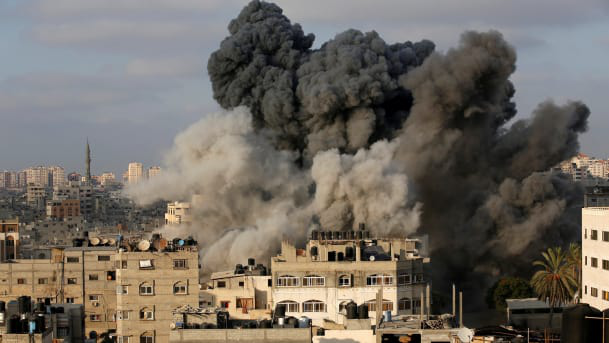
IAI, which services 80% of Amazon’s cargo planes, also provides aircraft, missiles, and other weapons to the Israeli government. Credit: MOHAMMED SALEM/ REUTERS
While Amazon’s ties with IAI and NSLComm are rarely reported in the media, its multi-million dollar contracts with another security firm has attracted widespread condemnation and protest. Amazon makes millions off providing web servers and database storage for Palantir, a private US data analysis firm which aids Immigration and Customs Enforcement (ICE) in identifying and deporting migrants. A petition this summer for Amazon to cut ties with Palantir and ICE gained over 270,000 signatures. Palantir also provides the Israeli government with so-called “predictive systems”, which analyze social media posts to identify Palestinians deemed a “threat”. The result of Palantir’s racially profiled analytics systems is that Palestinians are arrested and face long prison sentences for simply posting photos of family members killed by Israeli forces or in prison, citing Quranic verses, or calling for protests.
In the financial sector, Amazon signed agreements this year with Bank Hapoalim and Bank Leumi, two major Israeli banking institutions, to provide discounts to Amazon customers using Leumi and Hapoalim bank accounts. A 2018 report by Human Rights Watch found both banks guilty of financing construction and expansion of illegal settlements in the West Bank, while Bank Leumi also funds academic institutions in illegal settlements and programs for IDF recruits, even sponsoring gift packages and additional vacation days for Israeli soldiers during the 2014 invasion of Gaza, in which over 2,200 Palestinians, including more than 550 children, were killed. Pension funds and banks in Norway, Denmark, the Netherlands, and the UK have divested from Bank Leumi and Hapoalim due to their human rights violations, while Amazon signs new cooperation agreements with them.
Amazon’s dealings with Israeli companies supporting and profiting from the Occupation aside, many more questions remain. The most troubling of these questions surround how Amazon Israel will deal with realities on the ground in its operations. Will Amazon deliver to customers in illegal settlements? Will Amazon sell products manufactured or grown on Palestinian land seized by armed settlers and considered illegal by the UN and the international community? Will Amazon give Palestinian and Israeli sellers equal access to its platform?
A quick look at Amazon’s policies on its global site, amazon.com, give some indication as to how it might run its Israeli site. Last year, Amazon removed a top-selling T-shirt that reads “Make Israel Palestine Again”, on the grounds that it did not fulfill Amazon’s content policy. Amazon’s content policy prohibits the sale of “products that promote or glorify hatred, violence, racial, sexual, or religious intolerance or promote organizations with such views.” Amazon seems to have no problem, however, with selling “IDF” merchandise; at the time of writing this article, IDF T shirts, dresses, Halloween costumes, and even baby clothes were available on its global site. The occupation army has been accused of racism, sexism, religious intolerance, and countless acts of violence, torture, and human rights violations, not only by Palestinians but also by Israeli soldiers.
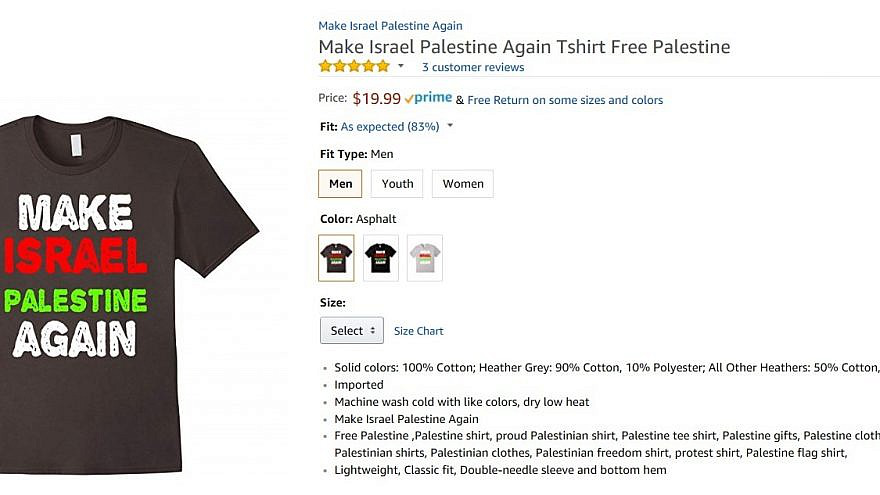
A screenshot of the “Make Israel Palestine Again” T-shirt removed by Amazon.
Amazon president, CEO, and largest shareholder Jeff Bezos, the richest man in the world since 2017 (and according to Forbes, the richest man in history) has yet to speak publicly about Palestine or Israel; he rarely gives public comments on any political issues. But indications of the Amazon founder’s political stances can be seen in the Washington Post. Jeff Bezos purchased the US paper for $250 million USD and has been its sole owner since October 2013.
The Washington Post has published a wide range of articles on Israel and Palestine, and a quick look at their articles and editorials since Bezo’s takeover in October 2013 shows where its editorial staff and leadership stand. It describes the shooting of unarmed Palestinian protesters in Gaza by Israeli snipers as “clashes”, and Netanyahu as a “prudent, even cautious, statesman” who “quietly restrained the building of Jewish settlements”, even though during his last 10 years in office over 20,000 settlement units were built in the Occupied West Bank. One Washington Post article, titled “Palestinians Kill 3 Israelis as Violence Mounts in ‘Day of Rage’”, acknowledges only in the 6th paragraph that “28 Palestinians have been killed by Israelis.” Israelis are routinely described as “killed”, but Palestinians merely “die”. Another article on electricity cuts in Gaza makes sure to inform the readers in the headline that “it’s not all Israel’s fault”. Last year, the Washington Post ran a full page advert calling New Zealand artist Lorde a “bigot” for canceling a concert in Israel.
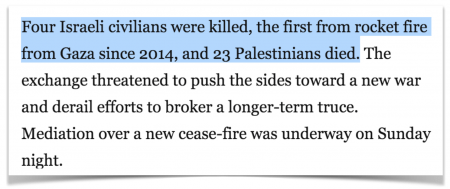
From the Washington Post (of which Amazon founder Jeff Bezos is the sole owner) on May 6, 2019. Israelis are killed, but Palestinians just “die”
Jennifer Rubin, a journalist for the Washington post, once retweeted an article describing Palestinians as “death-worshiping, innocent-butchering, child-sacrificing savages”, “devils spawn”, and “unmanned animals” who should be thrown “into the sea, to float there, food for sharks”. Her writing in the Washington Post declared that endorsements of the one-state solution “amount to calls for genocide”, and called then–Secretary of State John Kerry “intentionally obtuse”–or a liar–for not denouncing the Palestinian right of return. The Washington Post has rejected calls to remove Rubin for promoting racism and Islamophobia.
Given Amazon’s record of involvement with corporations deeply entrenched in the Israeli Occupation of Palestine, there is a high possibility of Amazon Israel failing to comply with international and human rights law in its Israeli operations. Should it fail to respect international law and engage in operations directly normalizing, supporting, and profiting from violations of Palestinian rights, Amazon may face boycott calls similar to those taken by BDS against companies like HSBC, SodaStream, Airbnb, Caterpillar, and Hewlett Packard. It remains to be seen what kind of corporate values Amazon Israel will deliver.
Israel Has Murdered 500 Palestinians Since Trump Declared Jerusalem The Capital Of Israel

By Robert Inlakesh – 21rst Century Wire – October 4, 2019
Since December 2017, when Trump announced his recognition that “Jerusalem is Israel’s eternal capital”, at least 481 Palestinians have been murdered by Israeli forces according to a new report.
The Centre for Jerusalem Studies, based in the old city of Jerusalem, provided documentation showing that of the 481 murders, 102 were children and 18 were women, 6 of those killed have been described having special needs.
Since the start of the Gaza’s Great Return March, on the 30th of March 2018, over 330 Palestinians have been murdered by Israeli forces. No Israelis have been killed or sustained significant injuries, beyond scratches, from the demonstrators. Israel however, still insists that the protests have been non-stop riots which have been going on for nearly a year and a half straight.
Israel is now in the process of figuring out whether Benjamin Netanyahu, currently battling a corruption and bribery scandal, or Benny Gantz, who was summoned to the Hague during his election campaign for involvement in the execution of a family in Gaza, will be their next Prime Minister. But regardless of whom it is, Trump’s alleged ‘Deal of the Century’ seem to be looming on the horizon.
If the Trump administration goes ahead and attempts to implement his plan, which has been alleged to include the possible swallowing of sections of the West Bank by Jordan, as well as the “resettlement” of Gazans to the Egyptian Sinai, the violence will inevitably grow.
Right now, the mainstream Western press is fixated on the Hong Kong protests. They are providing coverage to the anti-China demonstrators in an attempt to lionize groups, many of which have engaged in real violence and vandalism. Yet the demonstrations in Gaza are not only largely ignored, but are perpetually portrayed as violent and the narrative of the Israeli government is sometimes quoted almost word for word.
So a valid question, given the hypocrisy of mainstream media outlets coverage on Hong Kong when paralleled with Gaza, would be, why are they also still pretending to oppose US President Donald Trump? Clearly the agenda behind backing the Hong Kong protests, works hand in hand with President Trump’s plans for China and even more evident is it that channels such as the BBC, CNN, MSNBC etc., clearly are helping Trump get away with allowing the violence against Palestinians to continue.
The reason Palestinians can be executed in such large-scale attacks and massacres, is the fault of the media and international community. This includes the United Nations (UN), International Criminal Court (ICC), Human Rights Organizations and all the self-proclaimed “objective” media outlets. If there is no direct action against Israel for its crimes, we should expect another surge in constantly escalating cycle of violence, perpetuated upon the Palestinian people by the Israelis.
***
Author Robert Inlakesh is a special contributor to 21WIRE and European correspondent for Press TV. He has reported from on the ground in occupied Palestine
Former Israeli Intel Official Claims Jeffrey Epstein, Ghislaine Maxwell Worked for Israeli Intel

Graphic by Claudio Cabrera
By Whitney Webb – Mint Press News – October 2, 2019
A recent interview given by a former high-ranking official in Israeli military intelligence has claimed that Jeffrey Epstein’s sexual blackmail enterprise was an Israel intelligence operation run for the purpose of entrapping powerful individuals and politicians in the United States and abroad.
Since the apparent death by suicide of Jeffrey Epstein in a Manhattan prison, much has come to light about his depraved activities and methods used to sexually abuse underage girls and entrap the rich and powerful for the purposes of blackmail. Epstein’s ties to intelligence, described in-depth in a recent MintPress investigative series, have continued to receive minimal mainstream media coverage, which has essentially moved on from the Epstein scandal despite the fact that his many co-conspirators remain on the loose.
For those who have examined Epstein’s ties to intelligence, there are clear links to both U.S. intelligence and Israeli intelligence, leaving it somewhat open to debate as to which country’s intelligence apparatus was closest to Epstein and most involved in his blackmail/sex-trafficking activities. A recent interview given by a former high-ranking official in Israeli military intelligence has claimed that Epstein’s sexual blackmail enterprise was an Israel intelligence operation run for the purpose of entrapping powerful individuals and politicians in the United States and abroad.
In an interview with Zev Shalev, former CBS News executive producer and award-winning investigative journalist for Narativ, the former senior executive for Israel’s Directorate of Military Intelligence, Ari Ben-Menashe, claimed not only to have met Jeffrey Epstein and his alleged madam, Ghislaine Maxwell, back in the 1980s, but that both Epstein and Maxwell were already working with Israeli intelligence during that time period.
“They found a niche”
In an interview last week with the independent outlet Narativ, Ben-Menashe, who himself was involved in Iran-Contra arms deals, told his interviewer Zev Shalev that he had been introduced to Jeffrey Epstein by Robert Maxwell in the mid-1980s while Maxwell’s and Ben-Menashe’s involvement with Iran-Contra was ongoing. Ben-Menashe did not specify the year he met Epstein.
Ben-Menashe told Shalev that “he [Maxwell] wanted us to accept him [Epstein] as part of our group …. I’m not denying that we were at the time a group that it was Nick Davies [Foreign Editor of the Maxwell-Owned Daily Mirror], it was Maxwell, it was myself and our team from Israel, we were doing what we were doing.” Past reporting by Seymour Hersh and others revealed that Maxwell, Davies and Ben-Menashe were involved in the transfer and sale of military equipment and weapons from Israel to Iran on behalf of Israeli intelligence during this time period.
He then added that Maxwell had stated during the introduction that “your Israeli bosses have already approved” of Epstein. Shalev later noted that Maxwell “had an extensive network in Israel at the time, which included the then-Prime Minister Ariel Sharon, according to Ben-Menashe.”
Ben-Menashe went on to say that he had “met him [Epstein] a few times in Maxwell’s office, that was it.” He also said he was not aware of Epstein being involved in arms deals for anyone else he knew at the time, but that Maxwell wanted to involve Epstein in the arms transfer in which he, Davies and Ben-Menashe were engaged on Israel’s behalf.

Ariel Sharon (right) meets with Robert Maxwell in Jerusalem on Feb. 20, 1990. Photo | AP
However, as MintPress reported in Part IV of the investigative series “Inside the Jeffrey Epstein Scandal: Too Big to Fail,” Epstein was involved with several arms dealers during this period of time, some of whom were directly involved in Iran-Contra arms deals between Israel and Iran. For instance, after leaving Bear Stearns in 1981, Epstein began working in the realms of shadow finance as a self-described “financial bounty hunter,” where he would both hunt down and hide money for powerful people. One of these powerful individuals was Adnan Khashoggi, a Saudi arms dealer with close ties to both Israeli and U.S. intelligence and one of the main brokers of Iran-Contra arms deals between Israel and Iran. Epstein would later forge a business relationship with a CIA front company involved in another aspect of Iran-Contra, the airline Southern Air Transport, on behalf of Leslie Wexner’s company, The Limited.
During this period, it is also known that Epstein became well acquainted with the British arms dealer Sir Douglas Leese, who collaborated with Khashoggi on at least one British-Saudi arms deal in the 1980s. Leese would later introduce Epstein to Steven Hoffenberg, calling Epstein a “genius” and describing his lack of morals during that introduction. Thus, there are indications that Epstein was involved with Middle Eastern arms deals, including some related to Iran-Contra, during this period. In addition, Epstein would later claim (and then subsequently deny) having worked for the CIA during this period.
After having been introduced to Epstein, Ben-Menashe claimed that neither he nor Davies were impressed with Epstein and considered him “not very competent.” He added that Ghislaine Maxwell had “fallen for” Epstein and that he believed that the romantic relationship between his daughter and Epstein led Robert Maxwell to work to bring the latter into the “family business” — i.e., Maxwell’s dealings with Israeli intelligence. This information is very revealing, given that the narrative, until now at least, has been that Ghislaine Maxwell and Jeffrey Epstein did not meet and begin their relationship until after Robert Maxwell’s death in 1991, after which Ghislaine moved to New York.
Ben-Menashe says that well after the introduction, though again he does not specify what year, Ghislaine Maxwell and Jeffrey Epstein began a sexual blackmail operation with the purpose of extorting U.S. political and public figures on behalf of Israeli military intelligence. He stated:
In this case what really happened, my take on it, in the later thing, is that these guys were seen as agents. They weren’t really competent to do very much. And so they found a niche for themselves — blackmailing American and other political figures.”
He then confirmed, when prompted, that they were blackmailing Americans on behalf of Israeli intelligence.
In response to his statement, Zev Shalev replied, “But, you know, for most people it’s hard for them to think of Israel as being … blackmailing their leaders in the United States, it’s a very …” at which point, Ben-Menashe interrupted and the following exchange took place:
Ari Ben-Menashe: You’re kidding? [laughs]…. It was quite their M.O. Sleeping around is not a crime, it may be embarrassing, but it’s not a crime, but sleeping with underage girls is a crime.
Shalev: It was a crime in 2000 as well, but they let him off that…
Ben-Menashe: And that it is [why] always so he [Epstein] made sure these girls were underage.
In addition, when Shalev asked Ben-Menashe about the relationship between Jeffrey Epstein and former Israeli Prime Minister Ehud Barak, Ben-Menashe stated “After a while, you know, what Mr. Epstein was doing was collecting intelligence on people in the United States. And so if you want to go to the U.S. if you’re a high-profile politician you want to know information about people.” Ben-Menashe subsequently stated that Barak was obtaining compromising information (i.e., blackmail) that Epstein had acquired on powerful people in the United States.
PROMIS, sex, and blackmail
If Robert Maxwell did recruit Epstein and bring him into the “family business” and the world of Israeli intelligence, as Ben-Menashe has claimed, it provides supporting evidence for information provided to MintPress by a former U.S. intelligence official, who chose to remain anonymous in light of the sensitivity of the claim.
This source, who has direct knowledge of the unauthorized use of PROMIS to support covert U.S. and Israeli intelligence projects, told MintPress that “some of the proceeds from the illicit sales of PROMIS were made available to Jeffrey Epstein for use in compromising targets of political blackmail.” As was noted in a Mintpress series on the Epstein scandal, much of Epstein’s funding also came from Ohio billionaire Leslie Wexner, who has documented ties to both organized crime and U.S. and Israeli intelligence.
After the PROMIS software was stolen from its rightful owner and developer, Inslaw Inc., through the collusion of both U.S. and Israeli officials, it was marketed mainly by two men: Earl Brian, a close aide to Ronald Reagan, later U.S. envoy to Iran and close friend of Israeli spymaster Rafi Eitan; and Robert Maxwell. Brian sold the bugged software through his company, Hadron Inc., while Maxwell sold it through an Israeli company he acquired called Degem. Before and following Maxwell’s acquisition of Degem, the company was a known front for Mossad operations and Mossad operatives in Latin America often posed as Degem employees.
With Maxwell — Epstein’s alleged recruiter and father of Epstein’s alleged madam — having been one of the main salespeople involved in selling PROMIS software on behalf of intelligence, he would have been in a key position to furnish Epstein’s nascent sexual blackmail operation with the proceeds from the sale of PROMIS.
This link between Epstein’s sexual blackmail operation and the PROMIS software scandal is notable given that the illicit use of PROMIS by U.S. and Israeli intelligence has been for blackmail purposes on U.S. public figures and politicians, as was described in a recent MintPress report.
Can an ex-spy be trusted?
When dealing in the world of deception and intrigue that defines intelligence operations, it is often difficult to determine whether any individual linked to an intelligence agency is telling the truth. Indeed, in the United States, there are examples of elected intelligence officials committing perjury and lying to Congress on several occasions with no consequences, and of intelligence officials feeding politically motivated and untrue information to agency assets in the media.
So, are Ari Ben-Menashe’s claims regarding Epstein and the Maxwells trustworthy? In addition to the aforementioned, corroborating information for his claims, a review of Ben-Menashe’s post-intelligence career suggests this is the case.
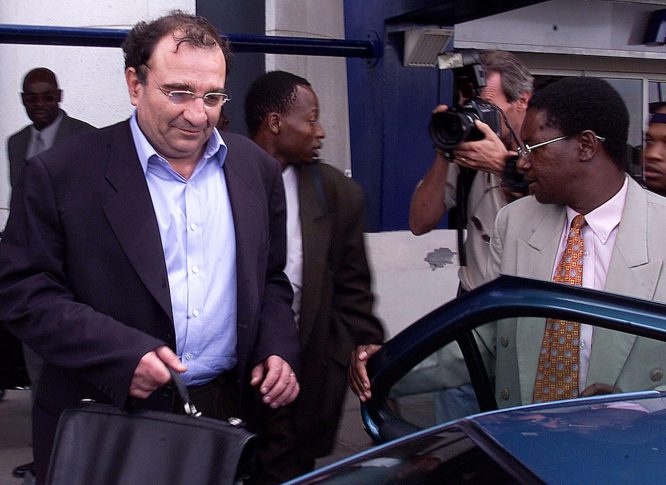
Ari Ben-Menashe arrives at Harare International Airport, in Zimbabwe, Feb. 22, 2002. Photo | AP
Prior to his arrest in November 1989, Ben-Menashe was a high-ranking officer in a special unit of Israeli military intelligence. He would later claim that his arrest for attempting to sell American-made weapons to Iran was politically motivated, as he had threatened to expose what the U.S. government had done with the stolen PROMIS software if the U.S. did not cease providing Saddam Hussein’s Iraq with chemical weapons. Ben-Menashe was later acquitted when a U.S. court determined that his involvement in the attempted sale of military equipment to Iran was done on behalf of the Israeli state.
After his arrest, Ben-Menashe was visited in prison by Robert Parry, the former Newsweek contributor and Associated Press reporter who would later found and run Consortium News until his recent passing last year. Parry remembered that, during that interview, “Ben-Menashe offered me startling new information about the Iran-Contra scandal, which I thought that I knew quite well.”
Israel’s government immediately began to attack Ben-Menashe’s credibility following his interview with Parry, and claimed that Ben-Menashe had never worked for Israeli intelligence. When Parry soon found evidence that Ben-Menashe had indeed served in Israeli military intelligence, Israel’s government was then forced to admit that he had worked for military intelligence, but only as a “low-level translator.” Yet, the documentation Parry had uncovered described Ben-Menashe as having served in “key positions” and performed “complex and sensitive assignments.”
A year later, Ben-Menashe would be interviewed by another journalist, Seymour Hersh. It would be Ben-Menashe who first revealed to Hersh secrets about Israel’s nuclear program and the fact that British media mogul Robert Maxwell was an Israeli spy, revelations that Hersh would not only independently corroborate but include in his book The Samson Option: Israel’s Nuclear Arsenal and American Foreign Policy. Hersh was then sued by Robert Maxwell and the Maxwell-owned Mirror Group for libel. The case was later settled in Hersh’s favor, as the claims Hersh had made were true and not libelous. As a result, the Mirror Group paid Hersh for damages, covered his legal costs, and issued him a formal apology.
After Ben-Menashe’s interviews by Hersh and Parry, Israel’s government was apparently concerned enough about what Ben-Menashe would tell congressional investigators that it attempted to kidnap him and bring him back to Israel to face state charges, much like Israeli intelligence had done to Israel’s nuclear-weapons whistleblower Mordechai Vanunu. The plan was foiled largely thanks to Parry.
Parry, who broke many key stories related to the Iran-Contra scandal in the 1980s and beyond, was tipped off by a U.S. intelligence source about a joint U.S.-Israel plan to have Ben-Menashe be denied entry to the United States on his planned trip to give congressional testimony. Per the plan, Ben-Menashe would be denied entry to the U.S. in Los Angeles and then be deported to Israel, where he would have stood trial for “exposing state secrets.” Parry called Ben-Menashe and convinced him to delay his flight until he secured a guarantee for safe passage from the U.S. government.
Ben-Menashe subsequently gave a sworn statement to the House Judiciary Committee that mostly focused on U.S.-Israel collusion regarding the theft and creation of a “backdoor” into the PROMIS software. Ben-Menashe offered to name names and provide corroborating evidence for several of his claims if he was offered immunity by the committee, which, for whatever reason declined that request.
Prior to the conclusion of the Hersh “libel” trial, which would later uphold Ben-Menashe’s claims regarding Robert Maxwell’s Mossad activities as true, there was a concerted effort in the U.S. press to downplay Ben-Menashe’s credibility. For instance, Newsweek — in an article on Ben-Menashe entitled “One Man, Many Tales” — claimed that “inconsistencies may undermine Ben-Menashe’s testimony in the British courtroom proceedings,” citing inconsistencies from sources in Israel’s government and Israeli intelligence as well as Ben-Menashe’s ex-wife and Israeli journalist Shmuel (or Samuel) Segev, a former IDF colonel. It goes without saying that such sources had much to gain from any effort to discredit Ben-Menashe’s claims.
According to Parry, this media campaign, which employed American journalists with close ties to Israel’s government and intelligence agencies, was very successful “in marginalizing Ben-Menashe by 1993, at least in the eyes of the Washington Establishment.” After a years-long media campaign to discredit Ben-Menashe, “the Israelis seemed to view him as a declining threat, best left alone. He was able to pick up the pieces of his life, creating a second act as an international political consultant and businessman arranging sales of grain.” The effort to marginalize Ben-Menashe has continued well into recent years, with mainstream news outlets still referring to him as a “self-described ex-Israeli spy” — despite the well-documented fact that Ben-Menashe worked for Israeli intelligence — as a means of downplaying his claims regarding his time in Israel’s intelligence service.
After the conclusion of the Hersh libel trial, Ben-Menashe became an international political consultant who “surrounded his far-flung business activities in secrecy and got involved with some controversial international figures, such as Zimbabwe’s leader Robert Mugabe,” and “conducted his international consulting business … in a wide variety of global hotspots, including conflict zones,” according to Parry. In addition to Mugabe, Ben-Menashe has also recently come under fire for his consulting work on behalf of Sudan’s military junta and Venezuelan opposition politician Henri Falcón.
Ben-Menashe has also maintained ties to several different intelligence services and eventually became a controversial whistleblower whose information led to the arrest of the former head of Canada’s Security Intelligence Review Committee, Arthur Porter.
As far as his character is concerned, Parry noted that Ben-Menashe could often be “his own worst enemy” and that, even though Parry considered his information regarding Iran-Contra and PROMIS reliable and noted that much of it was later corroborated, he “often compound[ed] his media problem by treating journalists in a high-handed manner, either due to his suspicions of them or his arrogance.”
Bill Hamilton, the original developer of the PROMIS software and head of Inslaw Inc., also found Ben-Menashe’s claims regarding the illicit use of PROMIS by U.S. and Israeli intelligence agencies to be credible, though he expressed doubts about Ben-Menashe’s character.
Hamilton told MintPress the following about Ben-Menashe:
Ari Ben Menashe was the first source to tell us reliable information about the role of Rafi Eitan and Israeli intelligence vis-a-vis PROMIS but, in the end, of course, he was a clandestine services-type guy whose official duties include the ability and willingness to lie, cheat, and steal.”
A threat revived
While Ben-Menashe may have been viewed as a “declining threat” after the early 1990s, his plans to meet with Robert Parry of Consortium News years later in 2012 to discuss Iran-Contra and other covert dealings of the 1980s appeared to change that. Right before he planned to travel from Canada to the United States to meet with Parry and “finally prove” the truthfulness of his past claims, a fire-bomb was thrown into his Montreal home, destroying it.

Ari Ben-Menashe surveys the damage to his home after it was mysteriously firebombed. Photos | Robert Parry
Though Canadian media referred to the incendiary device as a “molotov cocktail,” Consortium News reported that “the arson squad’s initial assessment is said to be that the flammable agent was beyond the sort of accelerant used by common criminals,” leading to speculation that the accelerant was military-grade.
Had it not been for the bomb, the origins of which Canadian police failed to determine, Ben-Menashe would have traveled to the U.S. alongside a “senior Israeli intelligence figure” to be interviewed by Parry. The other intelligence-linked individual, according to Parry, “concluded that the attack was meant as a message from Israeli authorities to stay silent about the historical events that he was expected to discuss.”
Though neither Ben-Menashe nor Parry directly blamed Israel’s government for the destruction of Ben-Menashe’s home, Parry noted that the bombing did succeed in “intimidating Ben-Menashe, shutting down possible new disclosures of Israeli misconduct from the other intelligence veteran, and destroying records that would have helped Ben-Menashe prove whatever statements he might make.”
While Ben-Menashe’s post-intelligence associations with controversial governments and individuals have given plenty of fodder to the still thriving media campaign to discredit his claims about covert U.S.-Israel operations in the 1980s, there remain troubling indications that the Israeli government sees his information on decades-old events as a threat.
Now, with the major efforts by powerful Americans and Israelis to distance themselves from Jeffrey Epstein and other figures associated with his depraved sex trafficking operation, Ben-Menashe may soon again find his reputation — and perhaps more — under fire.
Whitney Webb is a MintPress News journalist based in Chile. She has contributed to several independent media outlets including Global Research, EcoWatch, the Ron Paul Institute and 21st Century Wire, among others. She has made several radio and television appearances and is the 2019 winner of the Serena Shim Award for Uncompromised Integrity in Journalism.
Jordanian-Palestinian Woman on 9th Day Of Hunger Strike in Israeli Prison

By Robert Inlakesh – 21st Century Wire – October 2, 2019
A young Jordanian woman of Palestinian descent has been illegally detained by Israeli forces and is currently on her 9th day of a hunger strike. The Western media would have been expected to have picked this story up, but unfortunately there is deafening silence.
On the 20th of August, Israel detained 24 year old Heba al-Labadi, on the King Hussein Bridge, whilst on the way to attend a family wedding in the West Bank city of Nablus. Heba is a Jordanian citizen and of Palestinian descent, she was travelling with her mother at the time of her detainment.
The Israeli authorities have offered no explanation as to why Heba was detained and sentenced her to 5 months in administrative detention. Administrative detention is essentially being held without charge or trial. Israel has the ability to detain Palestinians indefinitely if it so chooses.
Reports have also surfaced, claiming that Heba, who is being kept in Petah Tikva Israeli intelligence detainment centre, has been subjected to various forms of torture. Heba’s family were also forbade access to a hired lawyer.
The times of Israel reported, upon statements made by the Jordanian Foreign Ministry, that a Jordanian diplomat in Israel had visited Labadi, in order to “provide support”.
Sufyan Qudah, a spokesperson for Jordan’s Ministry of Foreign Affairs, has stated on several occasions that Jordan is working to ensure the freedom of its recently detained citizens. Yet it seems to have been to no avail.
Hatem al-Labadi, Heba’s brother spoke to the al-Mamlaka news outlet of his sister’s detainment, stating that Israel had not given the family any specifics as to why Heba was detained, only stating that her arrest was due to “security reasons”. Hatem explained that his sister has a Palestinian Authority issued I.D., meaning that despite her Jordanian citizenship, she is placed under Israeli occupation rule when entering the West Bank.
The young 24 year old woman holds a bachelor’s degree in accounting and has previously worked in the United Arab Emirates. Now she remains in an Israeli jail cell and relies on pressure applied to the Israeli government to ensure her release.
Heba has for 8 days been on a hunger strike, in protest of her detainment, joining Ahmad Ghannam (42yrs old) who was diagnosed with cancer and has been on hunger strike for over 80 days and also Tarek Ghaddan (46 years old) who has been on hunger strike for more than 60 days.
According to the latest statistics released at the end of January, 2019, by Israeli human rights group B’Tselem a total number of 413 Palestinians were held in Israeli administrative detention alone.
A lack of action
This case seems to represent well the value that is placed upon a Palestinian life internationally.
In Heba al-Labadi we have a clear case of the abuse of a young woman’s life. She has been kidnapped for no stated reason, she has been reportedly abused and she has not been granted the rights that any human-being is supposed to be whilst detained.
Despite being a Jordanian citizen, she is allowed by Jordan’s lack lustre action against Israel to be held as if she was an animal.
King Abdullah of Jordan recently spoke at the United Nations General Assembly on the basic human rights that he urged be respected of the Palestinian people, yet he is not looking to intervene over a woman who was sitting in an Israeli jail cell at the very moment he delivered his speech.
Often women’s rights groups in West will do great work on campaigns for women abused by the state, but it seems like there are no women’s rights groups in the West that are yet to develop a campaign for the likes of Heba and other Palestinian women who currently strive for their freedom.
Whether it is the devaluing of Palestinians lives, because they are not of a specific origin or just a general lack of care all together, the sad reality is that if the world continues to allow Israel to get away with this type of action, it will.
If the United Nations and Human Rights Organizations also refrain from acting against Israel for these types of violations of human rights, Israel will not change and these international organizations may as well not even exist.
***
Author Robert Inlakesh is a special contributor to 21WIRE and European correspondent for Press TV. He has reported from on the ground in occupied Palestine.
The international community is complicit in Israel’s torture of Palestinians
By Ramona Wadi | MEMO | October 1, 2019
The torture suffered by Palestinian prisoner Samer Arabeed at the hands of Israel’s Shin Bet interrogators has proved, once again, that the prohibition of such treatment as enshrined in the Fourth Geneva Convention, the Rome Statute and the UN Convention Against Torture is little more than a series of reference points used by human rights groups as reminders to the torturers.
Arabeed was transferred to Hadassah Hospital following intensive torture after being arrested for his alleged involvement in a bombing attack in August. A statement by the Prisoner Support and Human Rights Association, Addameer, mentioned that Israel admitted to having used “extreme and exceptional techniques in interrogations that actually amount to torture.”
Israel’s Justice Ministry has announced an investigation to decide whether criminal proceedings should be instigated against the Shin Bet officials. Arabeed’s torture resulted in broken ribs and loss of consciousness. His situation is now life-threatening and he is on a life-support machine. His family and lawyer were notified belatedly of his transfer from prison to hospital.
Last July, Palestinian prisoner Nasser Taqatqa died following torture and interrogation at the hands of Shin Bet. Testimonies from former Palestinian prisoners testify to the fact that torture is used systematically by Israeli interrogators. In 2013, Arafat Jaradat died under torture while detained in Megiddo Prison.
In November 2018, Israel’s High Court ruled in favour of torture if the Palestinian detainee is a member of “a designated terrorist organisation”, involved in armed resistance or if there are no other means to obtaining information. If Israel has self-established such immunity, how is it expected that the constant referencing of international laws and conventions will be enough to halt the torture of Palestinian prisoners?
In laying down the specifics on the prohibition of torture, the international community absconded from accountability in order to make human rights profitable for the perpetrators and a labyrinth of dead ends for the victims. Between these polarities, human rights organisations have tasked themselves with upholding principles in place of governments, yet their limited potential or, in some cases, partial agendas, have failed to implement any viable system of justice.
Israel is well aware of this dissonance and it exploits the absence of accountability to manipulate what constitute acceptable means of interrogation tactics. The international community’s complete marginalisation of Palestinians when it comes to their rights has facilitated Israel’s constant normalisation of torture, in full breach of international law, without as much as a collective condemnation.
The result is a permanent severing between information dissemination and the kind of legal recourse which would provide Palestinian prisoners with the chance of justice. Human rights organisations like Addameer are forced into an unwitting collaboration with diplomacy, navigating endless and repetitive cycles to raise awareness, which is what the international community intended in the first place when it failed to uphold accountability.
Calling for Arabeed’s release will not be the end of Israel’s predatory violence. It is a preventive step against further torture, yet behind this story there are several others which have escaped the meagre media attention that catapults the victims’ names, albeit briefly, into the headlines. Addameer alone cannot accomplish justice for Palestinian prisoners. At the very least, there must be a collective global approach to expose the international community’s complicity in torture and its fraudulent human rights agenda.
Why Israel is Struggling to Find a Way Out of its Political Deadlock
Likud, the Blue and White party and Yisrael Beiteinu are ideological bedfellows – but other fears have prompted a stalemate
By Jonathan Cook – The National – September 30, 2019
It would be a grave mistake to assume that the continuing political deadlock in Israel – with neither incumbent prime minister Benjamin Netanyahu nor his main rival Benny Gantz seemingly able to cobble together a coalition government – is evidence of a deep ideological divide.
In political terms, there is nothing divided about Israel. In this month’s general election, 90 per cent of Israeli Jews voted for parties that identify as being either on the militaristic, anti-Arab right or on the religious, anti-Arab far-right.
The two parties claiming to represent the centre-left – the rebranded versions of Labour and Meretz – won only 11 seats in the 120-member parliament.
Stranger still, the three parties that say they want to form a “broad unity government” won about 60 per cent of the vote.
Mr Netanyahu’s Likud, Mr Gantz’s Blue and White party led by former generals, and ex-defence minister Avigdor Lieberman’s Yisrael Beiteinu secured between them 73 seats – well over the 61 seats needed for a majority.
All three support the entrenchment of the occupation and annexation of parts of the West Bank; all three think the settlements are justified and necessary; and all demand that the siege of Gaza continue, view the Palestinian leadership as untrustworthy and want neighbouring Arab states cowering in fear.
Moshe Yaalon, Mr Gantz’s fellow general in the Blue and White party, was formerly a pivotal figure in Likud alongside Mr Netanyahu. And Mr Lieberman, before he created his own party, was the director of Mr Netanyahu’s office. These are not political enemies; they are ideological bedfellows.
There is one significant but hardly insumountable difference. Mr Gantz thinks it is important to maintain bipartisan US support for Israel’s belligerent occupation while Mr Netanyahu has preferred to throw Israel’s hand in with Donald Trump and the Christian religious right.
Reuven Rivlin, Israel’s president, has pressed the three parties to work together. He has suggested that Mr Netanyahu and Mr Gantz rotate the role of prime minister between them, a mechanism used in Israel’s past.
But after Mr Gantz refused last week, the president assigned Mr Netanyahu the task of trying to form a government, although most observers think the effort will prove futile. After indecisive elections in April and September, Israel therefore looks to be heading for a third round of elections.
But if the deadlock is not ideological, then what is causing it?
In truth, the paralysis has been caused by two fears – one in Likud, the other in Blue and White.
Mr Gantz is happy to sit in a unity government with the Likud party. His objection is to allying with Mr Netanyahu, who is days away from hearings with the attorney general on multiple counts of fraud and breach of trust. Mr Netanyahu wants to be in power to force through a law guaranteeing himself immunity from prosecution.
Blue and White was created to oust Mr Netayahu on the basis that he is corrupt and actively destroying what is left of Israel’s democratic institutions, including by trying to vilify state prosecutors investigating him.
For Blue and White to now prop Mr Netanyahu up in a unity government would be a betrayal of its voters.
The solution for Likud, then, should be obvious: remove Mr Netanyahu and share power with Blue and White.
But the problem is that Likud’s members are in absolute thrall to their leader. The thought of losing him terrifies them. Likud now looks more like a one-man cult than a political party.
Mr Gantz, meanwhile, is gripped by fear of a different kind.
Without Likud, the only solution for Mr Gantz is to turn elsewhere for support. But that would make him reliant on the 13 seats of the Joint List, a coalition of parties representing Israel’s large minority of Palestinian citizens.
And there’s the rub. Blue and White is a deeply Arab-phobic party, just like Likud and Yisrael Beiteinu. Its only civilian leader, Yair Lapid, notoriously refused to work with Palestinian parties after the 2013 election – before Mr Netanyahu had made racist incitement his campaign trademark.
Mr Lapid said: “I’ll never sit with the Zoabis” – a reference to the most prominent of the Palestinian legislators at the time, Haneen Zoabi.
Similarly, Mr Gantz has repeatedly stressed his opposition to sitting with the Joint List.
Nonetheless, the Joint List’s leader Ayman Odeh made an unprecedented gesture last week, throwing the weight of most of his faction behind Mr Gantz.
That was no easy concession, given Mr Gantz’s positions and his role as army chief in 2014 overseeing the destruction of Gaza. The move angered many Palestinians in the occupied territories.
But Mr Odeh saw the Palestinian minority’s turn-out in September leap by 10 percentage points compared to April’s election, so desperate were his voters to see the back of Mr Netanyahu.
Surveys also indicate a growing frustration among Palestinian citizens at their lack of political influence. Although peace talks are off Israel’s agenda, some in the minority hope it might be possible to win a little relief for their communities after decades of harsh, institutional discrimination.
In a New York Times op-ed last week, Mr Odeh justified his support for Mr Gantz. It was intended to send “a clear message that the only future for this country is a shared future, and there is no shared future without the full and equal participation of Arab Palestinian citizens”.
Mr Gantz seems unimpressed. According to an investigation by the Israeli media, Mr Netahyahu only got first crack at forming a government because Mr Gantz blanched at the prospect.
He was worried Mr Netanyahu would again smear him – and damage him in the eyes of voters – if he was seen to be negotiating with the Joint List.
Mr Netanyahu has already painted the alternatives in stark terms: either a unity government with him at its heart, or a Blue and White government backed by those who “praise terrorists”.
The Likud leader might yet pull a rabbit out of his battered hat. Mr Gantz or Mr Lieberman could cave, faced with taunts that otherwise “the Arabs” will get a foot in the door. Or Mr Netanyahu could trigger a national emergency, even a war, to bully his rivals into backing him.
But should it come to a third election, Mr Netanyahu will have a pressing reason to ensure he succeeds this time. And that will doubtless require stepping up incitement another dangerous gear against the Palestinian minority.
The reality is that there is strong unity in Israel – over shared, deeply ugly attitudes towards Palestinians, whether citizens or those under occupation. Paradoxically, the only obstacle to realising that unity is Mr Netanyahu’s efforts to cling to power.
Israel and the West Do Not Have the Means to Counter Iranian Technology
By Gilad Atzmon | October 1, 2019
Introduction by GA: The following is a translation of today’s Israel’s News 12 headline article. The article explores the lessons delivered by the recent attack on Saudi oil facilities. Though I, like many other commentators, am not convinced that the attack had anything to do with Iran, the attack showed that Iran’s weaponry is likely superior to the West’s ability to mount an effective defence.
Israeli writer Nir Dvori points out that the attack took place 650 km inside Saudi territory. “It proved measured Power Utilization – Sending two types of weapons that achieved accurate hits.” It also demonstrated superb intelligence capability – “both in identifying and selecting targets and in selecting the attack route and the military.” Apparently, neither the cruise missiles nor the drones were detected and no attempt was made to intercept them before the attack. Which really means that despite the Saudis’ multi- billion dollar investment in Western weaponry and air defense systems, their sky is far from protected.
In the last few years Israel has prioritized its efforts to counter Iran’s ballistic and drone projects. It seems Israel knew what it had to dread. The recent attack on the Saudi oil industry proved that the West has not developed an adequate response to Iranian precision missiles, slow moving cruise missiles or drone technology. This alone explains why, despite Israel’s persistent threats to attack Iran directly, it has been reluctant to do so. Israel knows how vulnerable it is and well understands the possible dramatic consequences of such an attack. Israel knows that although its anti missile system, which cost the American taxpayers billions of dollars, may be somewhat effective against German V2 ballistic technology, its system is ineffective against what Iran has at their disposal.
This helps explain why Israel wants America and NATO to attack Iran on its behalf. It may explain why Israel might consider doing whatever it can to provoke such a conflict- everything from intensive Lobby pressure to possible false flag operations.
Donald Trump seems miraculously to have gathered how volatile the situation is. As a consequence, he exited his prime hawk, John Bolton. Might Trump find himself booted out of his 1600 Pennsylvania Ave as a result of his reluctance to fight Israel’s war against Iran?
The character, uniqueness and success of the Iranian attack – worries Israel and the world
By Nir Dvori
The Iranian attack on Saudi oil facilities was of great significance and is of particular concern [to Israel]. The attack was [the first of its kind] and proved that the Iranians are capable and possess both the knowledge and the ability to hurt and cut [Saudi] oil production by nearly fifty percent. At the same time, the Saudis have already begun to rebuild the buildings damaged by the Iranian bombing
The attack on oil facilities in Saudi Arabia has been a warning for the West and Israel – the effects of this attack are extremely concerning. This [technological] ability that can be used against Israel requires that [Israel] prepare its security system to respond to such a threat. Israeli officials analyzed the outcome of the attack and reached several conclusions : The attack demonstrated both impressive design and execution, the results were painful and cut Saudi oil production by 50%, and likely affected gas production as well.
The attacks were carried out with only two weapon types :The first were 7 Quds cruise missiles driven by a Czech jet engine, 3 of which fell before they reached their target; the second weapons were 18 suicide drones, an Iranian replica of the “Rafi” – an Israeli suicide drone.
The attack was significant on a few levels:
The attack was carried out at a relatively long range – at a distance of 650 km.????
It proved measured Power Utilization – Sending two types of weapons that each achieved accurate hits.
Iran has also demonstrated its intelligence capability – both in identifying and selecting targets and in selecting the attack route and its execution.
Apparently neither the cruise missiles nor the drones were detected and no attempt was made to intercept them before the attack.
Iran’s inability to penetrate the Saudi air defense system, despite the billions of dollars spent and deployed to defend the area, was shown by its failure against the small, slow-moving assault weapons.
Impressive and unprecedented impact accuracy of less than 3 meters. The fragments of the Iranian cruise missiles have been identified as among the derivatives of the 55-KH missiles that Ukraine delivered to Iran in 2001.
The nature of the Iranian attack has embarrassed the Western intelligence community. It turned out that Iran, a country with average technological capabilities, has developed medium and long range missiles that are accurate and effective. This basically undermines the very existence of the regulatory bodies which assumes that denying access to technology can impede, or prevent such technologies being obtained.
The attack is proof of Iran’s operational potential that relies on technological capabilities, intelligence infrastructure and coordination, leading to the conclusion that the Western monopoly on precision-guided armaments has evaporated. The countries of the entire region and Israel have learned a lesson: Discovery and interception systems do not provide a proper countermeasure to new regional threats.
It is necessary to deal with cruise missiles, slow drones and hovercraft. The ranges reached by Iran this time – 650 km – would allow damage to any point in Israel from western Iraq.
Featured Video

Seyed M. Marandi: US-Iran War Inevitable: Kuwait and Bahrain May Fall
or go to
Aletho News Archives – Video-Images
From the Archives
Oil and the Israel Lobby
Reknowned economist M. Shahid Alam offers this excellent critique of Noam Chomsky’s defective analysis of the relative influence of Oil versus the Israel lobby over US foreign policy: … continue
Blog Roll
 Aletho News
- ICC ignored ‘very well-documented’ NATO crimes – ex-Libyan minister
- SNSC secretary dismisses US response to Iran’s conditions as ‘inadequate’
- Sanaa says Taiz roads open, secure for residents, warns Saudi forces
- Iraqi resistance group urges Saudi leadership to admit defeat, lift Yemen siege
- Trump’s Retreat: How Al-Aqsa Flood Took Down the US Empire
- Israel’s Military Actions in Lebanon Grossly Violate International Law — Lavrov
- Seyed M. Marandi: US-Iran War Inevitable: Kuwait and Bahrain May Fall
- Leaders Condemn Ansarallah Attack on Saudi Arabia While Ignoring Illegal War Against Yemen
- Leaked: Britain’s Covert Iraqi Psyops Network
- Yemeni Armed Forces Warn Airlines Against Using Saudi Airports, Exempt Mecca and Medina
- If Americans Knew
- How Israel Conquered the Latin American Right
- Agents search Rep. Omar’s Washington home in criminal probe as she vows she won’t ‘be silenced’
- “The Rule Was: ‘Shoot Everyone You See'”
- Israel goes ballistic over Nobel Laureate Navi Pillay
- U.S. May Join Yet Another Middle Eastern War — TCN
- Yellow Line moves again as Israel closes in on trapped Gazans – Daily Update
- Israeli Attacks Kill Seven Palestinians in Gaza Including Six-year-old Girl
- Gaza: Ceasefire Anniversary Marks Year of Failed Promises
- The American Conservative: Mike Huckabee Should Resign
- A C-Section in Shackles: A Palestinian Woman’s Harrowing Birth in Israeli Detention
- No Tricks Zone
- Germany’s Green Energy Debacle: High Energy Costs Force Kahla Porzellan to Close After 182 Years!
- New Study: 50 Years Of The Most Aggressive ‘Net Zero’ Policies Can Only Affect The Global Climate By 0.03°C
- US September “Heat” Was No Record…Many Records Set Decades Ago
- Latest European Green Energy Debacle; Portugal’s Largest Flagship Solar Park Insolvent!
- Green Energy Debacle: German Expert Professor Fritz Vahrenholt Warns Of Severe Economic And Social Consequences
- Two More Paleo Reconstructions Affirm Meters-Higher Sea Levels Across Ireland, Brazil 7000-6000 Years Ago
- New Study: Earth And Venus Surface Warmth Largely Explained By Convection And Lapse Rate, Not CO2 Or Radiation
- 2025 Nature Paper Claiming Worsening Global Drought Gets RETRACTED …Heavily Flawed
- New Study: ‘Global Drought Shows No Detectable Recent Acceleration Under Climate Warming’
- Economic Masterminds: German Socialists Suggest Taxing Productivity Gains Stemming From Using AI

