Bipartisan Support for Trump’s Aggressive Iran Policy Reveals the Hollowness of Russiagate
By Whitney Webb | MintPress News | June 3, 2019
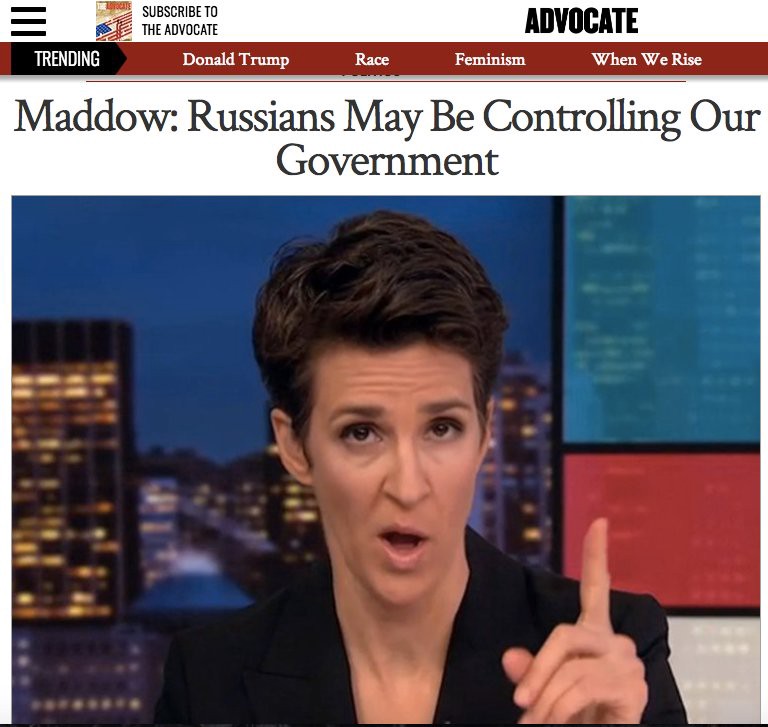
In early May, MSNBC news host Rachel Maddow — known as one of the top promoters of the new Cold War and Russiagate in American media — emphatically endorsed regime change in Venezuela after she claimed that President Donald Trump’s hawkishness towards the South American country had changed, all because of a single phone call with his Russian counterpart Vladimir Putin.
Though Maddow’s claims were arguably the most extreme in suggesting that Trump was “taking orders” from Putin on Venezuela, she wasn’t alone in making them. For instance, Cenk Uygur of the Young Turks also made the claim that the Trump-Putin phone call on Venezuela was “direct evidence that he is literally taking orders from Putin.” In addition, several corporate media outlets supported this narrative by suggesting that Trump “echoed” Putin’s Venezuela stance after the phone call and directly contradicted his top staffers and even himself in doing so.
Yet now, strangely, those same corporate media voices remain silent on the Trump administration’s other regime-change project — in Iran — despite the fact that the Putin-led Russian government is set to be the biggest winner as tensions between the U.S. and the Islamic Republic boil over and threaten to send the Middle East into a fresh bout of destruction and chaos.
How Russia wins
As tensions between the U.S. and Iran have grown in recent months, analysts in both corporate and independent media have speculated about what country is set to benefit the most from the U.S.’ campaign of “maximum pressure” and regime change against the Islamic Republic. Of the many analyses, two countries have stood out as likely beneficiaries: Russia and China.
The cases for China and Russia’s benefit are somewhat similar given that the Trump administration’s focus on Iran results in less pressure on both Russia and China. This is despite the fact that, officially, the U.S.’ current National Defense Strategy explicitly calls for focusing attention on preparing for a “long war” against Russia and China to prevent either from superseding the U.S. as a global superpower. Yet, with the U.S. focused on regime change in Iran and Venezuela, Russia and China can avoid bearing the brunt of U.S. military adventurism, either directly or by proxy, while the U.S. wears itself thin by trying to do it all at once.
Several U.S. military analysts have been warning against war with Iran for precisely this reason. Nikolas Gvosdev, a professor of national security affairs at the U.S. Naval War College, recently wrote in The Hill that the U.S. faces a lose-lose scenario by pursuing a militaristic, aggressive Iran policy:
To gear up for a major conflict with Iran, the U.S. would be forced to de-emphasize Europe’s eastern flank, allowing Russia more time and breathing space to consolidate its position. On the other hand, a U.S. campaign that is defined more by bellicose rhetoric and less by action will buttress Russia’s claim, already seemingly validated in Syria and in Venezuela, that the U.S. talks a good game but has no real stomach for projecting its power.”
Both countries also stand to benefit from Iran’s increasing desperation for trading partners unwilling to bow to the U.S. Currently, China represents 30 percent of Iran’s international trade and the current U.S. sanctions on Iran have pushed Tehran to rely more heavily on Russia, especially for weapons purchases, than it had while the Iran nuclear deal (officially the Joint Comprehensive Plan of Action, JCPOA) was in force.
However, upon closer examination, it becomes clear that China, though it benefits to some degree, is not a clear winner amid current tensions, while Russia stands to gain the most. The reason for this is the effect of current and future U.S.-Iran tensions on the oil market. While China trusts Iran to be a key oil supplier even if there is a breach in U.S.-China relations, any shock to the oil market and any jump in oil prices — both of which are likely to occur if U.S.-Iran tensions continue to escalate — will spell disaster for the Chinese economy, given that China is now the world’s largest importer of oil.
Russia, on the other hand, stands to benefit massively from the chaos that U.S.-Iran tensions are set to unleash on the oil market and, by extension, oil prices. With the U.S. seeking to starve Iran of any and all oil export revenue, all countries that had been purchasing Iranian oil must seek new suppliers. Yet, with the prospect of a U.S-Iran conflict still ever-present, it will be those oil producers outside of the Middle East that will come out on top, since oil supply routes that do not pass through the Middle East do not risk supply disruptions that would be caused by a war in the region. Thus, Russia, owing to its location, will emerge as an oil producer of extreme importance. Furthermore, given that such instability in the Middle East will lead to a surge in global oil prices, Russia will be able to export more oil at a higher price and will see its economy and geopolitical clout benefit greatly as a result.
A potential geopolitical killing
In addition to a great boost to its oil sector, Russia also stands to make unique geopolitical gains, particularly in the Middle East and beyond. For instance, in Syria, Russia is increasingly seeking to use its pull with Syria’s government as a major bargaining chip with Israel and the U.S., as made clear by the upcoming trilateral summit on the Middle East between Russia, Israel and the U.S. The main focus of that summit will likely be the fate of the presence of foreign militaries in Syria, particularly Iranian and U.S. forces.
The summit will likely be dominated by Russia and Israel, given Israel’s influence over the U.S., and particularly over National Security Adviser John Bolton, who will represent the U.S. at the summit. Israel’s key interest in Syria at this stage of the conflict is the removal of Iranian forces from Syria. Russia is likely to oblige that request, as doing so would allow Russia to dominate a post-war Syria at Iran’s expense. This seems to be a current Russian objective in Syria, given recent reports of in-fighting among Russian and Iranian forces in Northern Syria.
However, Russia is unlikely to help reduce Iran’s Syria presence if doing so would favor the United States’ occupation of Syrian territory or threaten to upset Russia’s own interests in Syria. Thus, in this case, Russia is counting on Israel’s influence on the Trump administration to ensure that, if Iranian forces vacate Syria, it will be Russia that will dominate the country post-conflict.
Russia also stands to gain geopolitically from the isolationism being forced on Iran by the Trump administration. Indeed, U.S. pressure on Iran has already served Russian interests by pushing Iran further towards Russia, giving Moscow the status of an increasingly important economic partner of Tehran. While benefiting the Russian economy, closer economic ties between Moscow and Iran would also give Russia a leg up in discussions with the U.S., as Washington may then need to make concessions to or coordinate with Russia in future efforts to pressure Iran.
Meanwhile, Russia stands to reap major profits by selling more weapons to Iran, and to gain geopolitical clout by further cementing its role as a mediator of conflict by promoting compliance with the JCPOA and opposing regime change. Iran’s dwindling options for strategic alliances with non-U.S. aligned countries will make it difficult for Tehran to resist Russian demands on key issues, including the Syria conflict.
Another major geopolitical win for Russia that has resulted from the U.S.’ current Iran policy is the tension that that policy has engendered between the U.S. and its European allies. When the U.S. unilaterally withdrew from the JCPOA, it began the development of a rift between the U.S. and its key European allies who are also JCPOA signatories — particularly France, Germany and the United Kingdom. As a signatory, Russia’s stance on Iran has revolved around the JCPOA, with Russia having urged Iran to remain in the deal “no matter what,” advice that Iran does not now seem keen to follow.
Russia’s stance on JCPOA is likely aimed just as much at Europe as it is at Iran, since promoting the agreement amid the U.S. unilateral withdrawal paints Russia as more predictable and stable in terms of its political stances and diplomacy in comparison to the U.S. If nothing else, Putin is known for excelling at taking advantage of the missteps made by his geopolitical adversaries.
This is all part of a careful public image that Russia is seeking to cultivate with European countries as it hopes to attract them to do business with Russian oil and gas companies as the Middle East now seemingly approaches another era of extreme instability. By promoting the JCPOA alongside Europe, Russia makes increased Russo-European cooperation seem more attractive.
As U.S.-Iran tensions mount, particularly if armed conflict breaks out, importing goods from Russia, especially oil and gas, will appear more attractive and safer in comparison to goods that originate from or pass through the Middle East before arriving in Europe. Depending on how the situation plays out, Europe — driven by concerns about stability and reliability — may be willing to risk angering the U.S. to pursue increased economic cooperation with Russia, even though doing so would run counter to current U.S. and NATO objectives.
Putin plays Netanyahu
While it is often difficult to find accurate, honest reporting on Vladimir Putin –reporting that is neither too biased against him nor too much in his favor — it is generally acknowledged that Putin, above all else, is interested in advancing Russia’s national interest and is a cunning strategist who often thinks several steps ahead of both his allies and his adversaries.
In viewing the ratcheting up of tensions between the U.S. and Iran, Putin’s modus operandi remains unchanged and, upon closer examination, it is clear that he is giving the hotheads driving this still-escalating situation just enough rope to hang themselves. Meanwhile, Russia is waiting in the wings to pick up the pieces and further cement its already acknowledged role as the new foreign “peacemaker” in the Middle East while gaining economic and geopolitical clout in the process.
Prior to the Israeli election earlier this year, Israeli media noted on several occasions that Putin was backing the reelection of Israeli Prime Minister Benjamin Netanyahu, including when Putin hosted Netanyahu at a sudden pre-election summit. Israeli newspaper Haaretz described Putin’s decision to host Netanyahu at the time as aimed at helping Netanyahu secure the “crucial Russian vote” among Russian-Israeli Jews in order to “outflank” his competitors. In another instance, Putin was alleged to have further helped Netanyahu’s reelection odds by having Russian special forces find and deliver the remains of Zachary Baumel — an Israeli soldier who had gone missing in Lebanon in 1982 — to Israel just ahead of the election.
Putin’s direct support of Netanyahu may seem odd to observers of geopolitics, given that the two have often been at odds over Syria. However, Putin and Netanyahu have developed an effective working relationship and Russia and Israel enjoy relatively strong bilateral ties and economic agreements.
Yet, beyond the ties that have been forged between the two countries in recent years, Putin likely knows that he can play Netanyahu’s weaknesses to his advantage. For instance, Putin is acutely aware of the benefits to be reaped from increasing tensions between the U.S. and Iran and is also aware of the key role that Netanyahu has played and continues to play in driving the Trump administration’s Iran policy. Netanyahu’s near-obsession with regime change in Iran and the practical likelihood that a U.S.-Iran war would be “unwinnable” for the U.S. and would leave its military weakened and distracted are points that Putin is likely eager to exploit in pursuance of Russian geopolitical goals.
Russia seeks to play the role of mediator but only to a certain extent and has kept its attitude towards Iran intentionally vague when dealing with the Israeli government, so much so that Israeli officials have cited Russia’s unknown stance towards Iran as a major difficulty in negotiating the deconfliction of Russian and Israeli forces in Syria. This is likely because Russia doesn’t seek to aid either side amid escalating tensions, instead waiting for the current tensions to play out, as it stands to make gains in either case.
That Russia stands to gain from current U.S.-Iran tensions hasn’t been lost on all Israeli officials, however. Earlier this month, a former Israeli intelligence official, Yakkov Kedmi, openly stated that not only is a war against Iran “unwinnable” for the U.S. and its regional allies, but further that Russia would be the only major country to benefit from any military conflict pitting the Americans against the Iranians. Appearing on Russian television program Evening with Vladimir Solovyov, Kedmi stated that, if war does break out, the U.S. “won’t remain whole” after the conflict and that “if anyone wins, it’ll be Russia.”
“If the price of oil exceeds $100 per barrel, it hits the Chinese economy. Most of all, it hits the European and American economies,” Kedmi stated. “If you double the price,” he added, “[global] industry will be ruined. First of all, it will happen in the U.S.” To that, the program’s host, Vladimir Solovyov, asserted that “Their [American] industry will be [ruined]. It’ll be the opposite in our country. Our economy will begin to develop. We’ll feel like kings with golden diamond-studded wheels on our cars.”
Why the Russiagaters are silent on Iran
Given Russia — and Putin’s — clear benefit from the continuing U.S. escalation with Iran and a potential military conflict, it is striking that Putin’s fiercest critics in the American media have remained silent about this clear pay-off as the Trump administration continues to pursue an aggressive, hawkish Iran policy that hardly benefits the U.S. and instead benefits its supposed adversary. This is especially notable in light of the fact that these same American critics of Russia and Putin’s leadership were recently accusing Trump of “taking orders” from Putin by altering his Venezuela policy in a way that was perceived to benefit Russian over American interests.
This dichotomy is most easily deconstructed by noting that top promoters of Russiagate and news personalities known for their hyperfocus on Putin rarely call for any policy that would involve a reduction in tensions or less militarism abroad. Indeed, all too often, the “solutions” offered by these journalists involve sending weapons to U.S. proxy forces, shooting missiles at Russian allies, sanctioning Russia and its allies, and other “useful reminders of the military strength of the Western alliance” between the U.S. and NATO.
Without fail, the suggested solutions of how to counter Putin from the U.S. media and political establishment almost always involve “pushing back” with force equal to or greater than the perceived aggression. Rarely do they involve backing down or unwinding tensions, even in the cases where doing so would clearly challenge key geopolitical objectives of the Russian government.
In the case of Russia’s benefit from Trump’s Iran policy, the benefit is so clear that it has been voiced in several mainstream media outlets — including CNN, The Hill, Forbes and Bloomberg — with most of those reports focusing exclusively on the oil angle. However, while Russia’s advantage has been noted, it is also clear that Trump’s current Iran policy has avoided inflaming the Russiagate hysteria that has marked media coverage of other Trump policies and statements that were perceived as being “pro-Putin” for the past few years.
One reason that the media has skipped a prime opportunity for another Russiagate frenzy is the fact that many of the driving forces behind Russiagate are also supportive of regime change in Iran. Indeed, while Russiagate has recently been cast by Trump and prominent Republicans as a “hoax” narrative exclusive to Democrats, prominent neoconservatives have long been pivotal in creating and fomenting Russigate for over five years.
For instance, the origins of the infamous Steele dossier — which was used to assert that Russia’s government had a litany of salacious blackmail on Trump that it would use to manipulate him as president — trace back to top neoconservative Republican donor Paul Singer. That dossier was subsequently circulated within the Obama administration during the 2016 campaign by neoconservatives Victoria Nuland and the late Senator John McCain.
Many of the same neoconservative figures who have helped stoke Russiagate and pounced on the resulting climate of hysteria to promote increased militarism as the solution, also support regime change in Iran. Michael McFaul — U.S. Ambassador to Russia during the Obama administration — is both a strong advocate for aggressive U.S. measures to counter Putin and also a vocal proponent of U.S.-led regime change in Iran. Similarly, on the supposed other side of the political spectrum, Bill Kristol — well-known neoconservative writer, an icon of the establishment “resistance” to Trump, and a promoter of Russiagate — also strongly supports hawkish measures to contain Russia and is a long-time, vocal supporter of regime change in Iran.
While the tense situation between the U.S. and Iran is undeniably troubling, the relative silence among figures in U.S. media and politics who claim to be Putin’s fiercest critics with regard to Trump’s aggressive Iran policy reveals a stark truth about Russiagate. The goal of Russiagate is not actually about “countering” Putin or Russian geopolitical influence; it is about promoting the expansion and widespread adoption of hyper-militarism by both the establishment left and establishment right in the United States.
While Russia often serves as a useful “boogeyman” in service to this agenda of promoting militaristic policies, the odd moments when those same policies actually benefit Russia and do not run into hysterical opposition from the political and media establishment provide a rare glimpse into the real motivations behind Cold War 2.0 and the dubious validity of the media-driven narratives upon which current anti-Russian hysteria is based.
Whitney Webb is a MintPress News journalist based in Chile. She has contributed to several independent media outlets including Global Research, EcoWatch, the Ron Paul Institute and 21st Century Wire, among others. She has made several radio and television appearances and is the 2019 winner of the Serena Shim Award for Uncompromised Integrity in Journalism.
Palestinian Photojournalist at Risk of Deportation
IMEMC News & Agencies | June 2, 2019
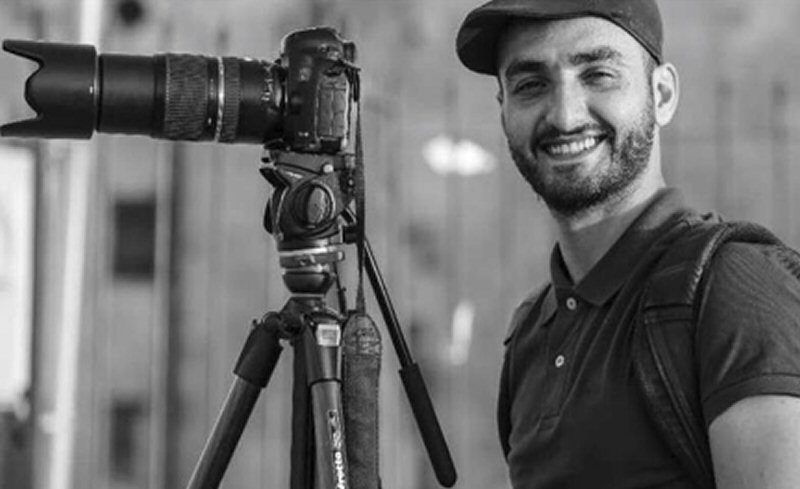
For the past five months, Mustafa al-Kharouf has been languishing inside Israel’s Givon prison, away from his wife Tamam and their one-and-a-half-year-old daughter Asia. But, now, he faces deportation to Jordan.
The 32-year-old photojournalist, son to an Algerian mother and a Palestinian father, has been living in Jerusalem since 1999, when his family returned.
Despite repeated attempts, over the past decade, he has been denied permanent residency status, which he is entitled to, thus rendering him stateless.
By the time Kharouf’s family met the conditions set by the policy, to get residency, Mustafa was 18 years old and his family was not able to submit an application for either reunification or child registration, on his behalf.
In January, Mustafa, who worked with Anadolu Agency, was detained after his lawyer challenged the Israeli interior ministry’s decision to reject his request for legal status.
His fate is now in the hands of an Israeli high court, which will decide if he will be deported to Jordan, a country he has no ties to.
In order to attain their “legal” status as Palestinians in the city, Kharouf’s family applied for family reunification, Al Jazeera/Al Ray further reports.
But, at the core of Israel’s complicated laws for Palestinian residents of Jerusalem – who are granted residency rights but not Israeli citizenship – is the “center of life” policy, which has been described as a legalized ethnic cleansing.
The policy, which requires Palestinians living in occupied East Jerusalem to prove they keep a center of life in the city, to uphold their legal status, has been criticized by rights groups as discriminatory, and as a precursor to forcible transfers – a serious violation of international law.
Legal status rejected by Israeli interior ministry
Adi Lustigman, Kharouf’s lawyer from the Israeli rights organization HaMoked, told Al Jazeera that Kharouf tried to regulate his status in Jerusalem for years, but to no avail.
“He had an interim order during some periods, but, the rest of the times, he has just managed, like many other stateless and status-less Jerusalemites do,” Lustigman said.
“It is, of course, enormously difficult to be a person with no rights, no work permit, and nowhere to go, in order to be legal.”
From October 2014 to 2015, Kharouf was granted an Israeli B/1 work visa, on a “humanitarian basis”. Yet, requests for a visa extension were eventually rejected by the ministry of interior for “security reasons”.
Lustigman believes that the ministry’s rejections are related to his work as a photojournalist documenting human rights abuses committed by the Israeli authorities, in occupied East Jerusalem.
After Kharouf was married, in 2016, to his wife Tamam, a Palestinian Jerusalemite, he filled out another family reunification application, but it was again rejected in December of 2018, by the interior ministry.
According to Lustigman, the decision was based on unfounded accusations that Kharouf was a member of Hamas, which is banned by Israel.
The lawyer appealed the decision on January 21, 2019, but, the next day, Israeli forces raided Kharouf’s home and abducted him, and he has since been placed under administrative detention – indefinite imprisonment without trial or charge.
“My husband is the most optimistic person I know. But, now, he is beyond miserable,” Kharouf’s wife Tamam told Al Jazeera.
Tamam is permitted to visit her husband once a week, for a maximum of 20 minutes, behind a glass window.
“His spirits have deteriorated so much since his arrest,” the 27-year-old school counselor said. “He has lost 10 kilograms, and is very depressed.”
A few months later, in April, the Israeli District Court rejected Kharouf’s appeal and gave an interim order not to deport him, so he is able to take his case to Israel’s High Court, with May 5 given as the deadline. The appeal has already been filed, but the High Court has yet to make a decision. Kharouf remains at imminent risk of being forcibly deported to Jordan.
Deportation order ‘illegal’
Saleh Hijazi, the head of Amnesty International’s Jerusalem office, described the Israeli decision to refuse Kharouf’s residency application and deport him as “cruel and unlawful”.
“[Kharouf] must be released immediately and granted permanent residency in East Jerusalem, so he can resume his normal life with his wife and child,” Hijazi said.
“The arbitrary detention and planned deportation of Mustafa al-Kharouf reflect Israel’s long-term policy to reduce the number of Palestinian residents of East Jerusalem, while denying them their human rights,” he continued.
Following Israel’s illegal annexation of East Jerusalem in 1967, at least 14,600 Palestinians have had their residency permits revoked.
Under the Fourth Geneva Convention, the deportation of protected people from an occupied territory is illegal. The Rome Statute of the International Criminal Court stipulates that “the deportation or transfer [by the occupying power] of all or parts of the population of the occupied territory within or outside this territory” constitutes a war crime.
“A person cannot be left stateless”, Jessica Montell, Executive Director of HaMoked, said in an April press release.” On the practical level, there is no sense holding Mustafa ‘pending deportation’ when there is no country to which Israel can deport him.
“The High Court of Justice has recognized East Jerusalemites as an indigenous population with a unique status. Israel must therefore release Mustafa without delay and give him the legal status to which he is entitled, as a Jerusalemite.”
Tamam has been busy consulting with lawyers, to see what can be done. But, she said that most of them say her husband’s case is too complicated, and refuse to take it on.
“I haven’t thought about an alternative plan for us,” Tamam said. “If Mustafa gets deported to Jordan, he will not receive residency, let alone citizenship.
“In fact he’ll get detained by Jordanian authorities as soon as he crosses the border, for as long as it will take them to review his files and come to a decision on what to do with him,” she continued.
“If he gets deported, it won’t be just one family that will be fragmented. He’ll be ripped away from me and my daughter, from his parents, and from his in-laws.”
Lustigman says that the importance of highlighting Kharouf’s case can make the difference in not uprooting the photojournalist’s life.
“We hope that public opinion, press interests, and NGO actions would have a certain weight and be of help,” the lawyer said.
The Incredible Disappearance of Shai Masot
By Craig Murray | June 2, 2019
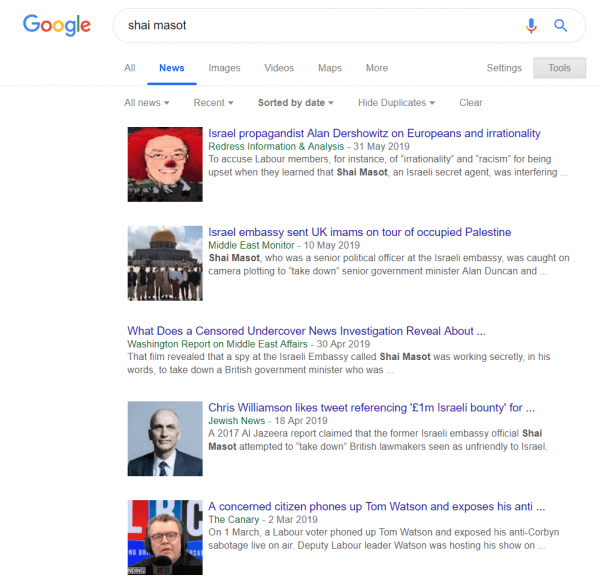
A Google news search reveals that not one single mainstream media outlet has mentioned Shai Masot in 2019. Not even once.
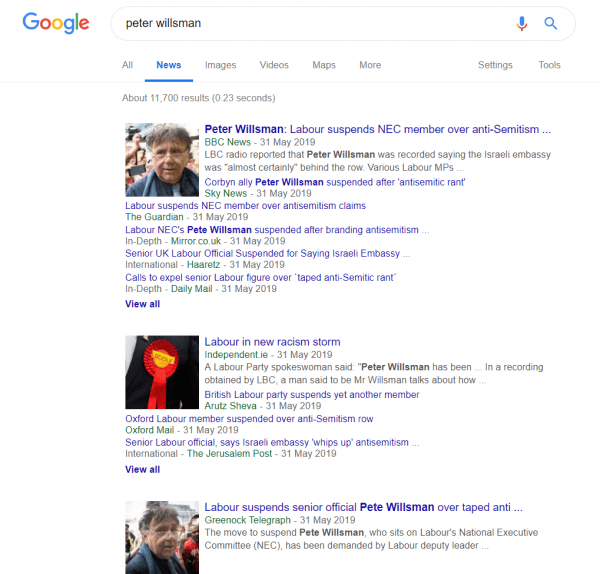
Yet the main political news story the last two days has been the suspension of Labour’s Peter Willsman for “anti-semitism” for making the suggestion that the “anti-semitism” witch-hunt is promoted by the Israeli-Embassy. This has been demonstrably a massive story:
The overwhelming majority of the tens of thousands who will read this article know who Shai Masot is and know why his activities are absolutely central to the Willsman story.
And here is the truly terrifying thing.
The overwhelming majority of the mainstream media “journalists” who produced those scores of stories about Willsman also know exactly who Shai Masot is and why his activities are central to the Willsman narrative. And every single one of those journalists chose to self-censor the crucial information that casts a shade over the “Willsman is an anti-semite” line. Every single one. Their self-censorship is not necessarily a conscious and singular act, though in many cases it will be. They are simply imbued with the line they are supposed to adopt, the facts they are supposed to ignore, to forward their career and remain accepted in their social group.
Because the plain truth is that the Al Jazeera documentary The Lobby (part 1 below) showed to the entire political world that Mr Willsman’s thesis about the involvement of the Israeli Embassy in British politics and its objectives is broadly true. It says something about the current dystopia that is the UK, that this truly shocking documentary did not result in any official action against Joan Ryan (who has thankfully since hurtled herself into the political abyss), but that pointing out the undeniable truth about Israeli Embassy interference in British politics is an expulsion offence.
I should be very happy to go on the BBC and say this and so would many other people. Yet the mainstream media have been unable to quote this point of view from a single person. Yesterday’s 12 noon news on the BBC had Willsman as the top story with interviews with first Charlie Falconer, calling for Mr Willsman’s expulsion, then a six minute live rant from extreme zionist John Mann, calling for Mr Willsman’s expulsion. There was no attempt to balance this at all with a remotely sane guest. To be fair, the presenter did baulk at some of Mr Mann’s more frothy mouthed utterances, but the BBC knew precisely what they would get when they invited him, and the decision to have a major news item with only two intervewees, both from the same side of the argument, was a quite deliberate one.
This was a much worse example of lack of balance than those for which Russia Today is routinely censured by Ofcom and threatened with closure. But doubtless as it was a pro-Israel and anti-Corbyn lack of balance (Corbyn was condemned by both interviewees) Ofcom will take no action whatsoever. I am however putting in a complaint to Ofcom about this specific news item and I urge you to do the same.
Al Jazeera’s exposure of Shai Masot led to his quietly being removed from the UK, however he was but the tip of the iceberg. With my FCO inside knowledge I could show that the Israeli Embassy has an extraordinary and disproportionate number of “technical and administrative staff” like Masot, and that there was a mystery over what kind of visa he had to live in the UK. The FCO refused to answer my questions and no mainstream media “journalist” was willing to pursue the case.
The readership of this blog has grown fast over the last two years. I therefore do recommend that you read this blog post which ties in Masot’s activities to the Mossad collaboration of Liam Fox and Adam Werritty – which was the real story behind the Werritty scandal, again completely hidden by the mainstream media. I should mark my debt to the late Paul Flynn MP in helping me prove that fact beyond dispute, as you will see if you read the article. Not one of the media and political hypocrites who so recently eulogised Paul was willing to support him in this or even mention the facts that he had winkled out. Jeremy Corbyn also helped me expose the Werritty/Israel links in his pre-leadership days by asking parliamentary questions.
I do blame Jeremy for not taking a more robust line. Genuine anti-semitism should always be called out and condemned, and it plainly exists, even in the Labour Party. But the open attempt to stifle all criticism of Israel, and in effect to make adherence to Zionism a pre-condition for membership of the Labour Party – or indeed acceptance in wider society – is a vicious form of authoritarianism that should have been repudiated robustly from day one.
Israeli paper betrays scandalous details of ‘deal of century’
Press TV – June 1, 2019
US President Donald Trump’s “the deal of the century” wants Palestinian refugees to be naturalized and settled in several countries, including Lebanon, Syria, Jordan and Iraq, Israeli daily Haaretz reports.
As the world marked the International Quds Day on Friday, political leaders warned of mysterious aspects of the much-touted US plan and its ramifications for the future of Palestinians.
Iran’s Parliament Speaker Ali Larijani said one definite prospect is that the plan seeks to do away with the issue of returning 6 million refugees to their homeland.
“To realize this goal, America is about to arrange an economic deal and get its money from the miserable Persian Gulf countries,” he said in Tehran.
Haaretz said Washington is thought to be pressing Lebanon to grant citizenship to Palestinian refugees living in the country.
“In the process, this is seen as defusing the issue of a right of return of refugees to Israel, which has been a major obstacle to resolving the Israeli-Palestinian conflict,” the paper said.
According to UNRWA, the UN’s Palestinian refugee agency, about 450,000 Palestinian refugees live in Lebanon.
Other reports have put the figure lower, prompting Lebanese groups to say that the census had been conducted under US pressure designed to under-report the real numbers because that way Lebanon could absorb a modest-sized population.
The Lebanese constitution, however, provides that the country’s territory is indivisible and that refugees living there are not to receive citizenship.
The official reason for this is that the absorption of Palestinian refugees would impair their claim to a right of return.
However, the US has sugarcoated the plan with a lifeline to extract Lebanon from its economic crisis, where the country’s debt is estimated at more than $85 billion (about 155 percent of GDP), Haaretz said.
According to the Israeli paper, giving Palestinians citizenship is likely to prompt the roughly 1 million Syrian refugees in the country to demand similar status.
However, Lebanon isn’t the only country concerned about Washington dictating a solution to the refugee problem.
Jordan is horrified over the prospect that the United States will demand it absorb hundreds of thousands or even a million Palestinian refugees in the country, Haaretz added.
The paper cited investigative journalist Vicky Ward recounting in her new book “Kushner Inc.: Greed. Ambition. Corruption” that the Trump administration’s plan sees Jordan providing territory to the Palestinians and receiving Saudi territory in return.
The Saudis, for their part, would get the islands of Sanafir and Tiran from Egypt, it said.
“Land swaps appear to be the magic formula that the Trump administration has adopted, and not just for Jordan,” Haaretz said.
According to Ward, it has been suggested that Egypt give up territory along the Sinai coast between Gaza and el-Arish, to which some of the Gaza population would be transferred. In return, Israel would give Egypt territory of equivalent size in the western Negev.
Haaretz, meanwhile, revealed lucrative projects to be funded by European countries, the US and wealthy Arab states, including an underwater tunnel which Israel would allow to be dug between Egypt and Saudi Arabia.
Egypt, the paper said, has been promised a whopping $65 billion to help boost its economy which is currently in shambles.
The plan also says Palestinian refugees in Syria, Iraq and other Arab countries would receive citizenship in exchange for generous assistance to the host countries.
The Israeli paper, however, cast doubt on the viability of the “plan of generous financial compensation and empty tracts of land for new housing”.
“The problem is that the Palestinian refugees are the supreme symbols of Palestinian nationhood,” it said.
“An American deal that blatantly relies on buying up that symbol for cash, even lots of it, can’t be acceptable to the Palestinian leaders in the West Bank and Gaza,” it added.
The Trump administration is set to unveil the economic portion of the so-called “deal of the century” during a conference in Manama, Bahrain, on June 25-26.
All Palestinian factions have boycotted the event, accusing Washington of offering financial rewards for accepting the Israeli occupation.
Saudi Arabia and the UAE have said they will send delegations to the Manama forum and Israel’s Finance Minister Moshe Kahlon has said he intends to attend.
Nasrallah Vows to Confront US Middle East Plan

Al-Manar | June 1, 2019
Hezbollah Secretary General Sayyed Hasan Nasrallah stressed on Friday that the axis of resistance is stronger than ever before, while ‘Israel’, despite its military strength, is weaker than ever.
During a ceremony held by Hezbollah to mark Al-Quds International Day in Dahiyeh, Sayyed Nasrallah pointed out that the Palestinian resistance was advancing and developing immensely and it “became able to control large areas in occupied Palestine in any future war, at a time when the image of ‘Israel’ was destroyed after the defeat of its ground army who couldn’t stop the resistance rockets.”
Sayyed Nasrallah rejected the US conditions for mediating a border and maritime dispute with the Zionist entity, saying Washington, through its envoy who was tasked to negotiate the land and maritime border demarcation between Lebanon and the Zionist entity, was using the talks to the Israeli benefit, bringing up an Israeli claim that Hezbollah has precision missiles factories. “The US wants to blackmail the negotiations on border demarcation in order to open the issue of Hezbollah’s precision rockets arsenal,” he said, but warned that [David] Satterfield should focus on the border demarcation issue and only that.
The Hezbollah leader acknowledged that Hezbollah has the weapons but do not produce them. However, he said Hezbollah may consider setting up such factories if Washington continues to use the talks on border demarcation to discuss the resistance capabilities since it is Lebanon’s right to defend itself. “We have in Lebanon precision rockets that are able to target direct posts in ‘Israel’ and that would change the face of the region,” he said, but warned that Hezbollah will respond to any Israeli aggression on any resistance target in Lebanon quickly, directly and strongly.
His Eminence said that ‘Israel’ fears the resistance in Lebanon and that Israeli officials talk about resistance deterrence and capabilities, pointing out that Hezbollah has “accurate missiles that can reach all the targets required in ‘Israel’ and that are able to change the face of the region.
“The US attempts to control Iraq have failed, the Iraqi stance from regional issues is totally different and uncontrolled,” he said. “Iraq today returned to its regional role and has a capable, struggling and influential people in the region’s issues,” He said.
Sayyed Nasrallah gave the so-called Deal of the Century the lion’s share in his speech, assuring that the US was mistaken by betting on regional people’s weariness to impose the deal. “The main challenge today in front of Palestine and Al-Quds is the deal of the century, or Trump’s deal, and it’s our duty to confront it.”
“We have a deep hope that we, the people of this region, can stop the ‘crime of the century’,” he said, indicating that the US administration and ‘Israel’ are working day and night with Arab regimes to realize the deal.
The US, he said, was able to “contain the Arab Spring popular protests and derail it towards a wrong way, however, Syria overcame the scheme of destroying it, and it remained pro-resistance.”
“Yemen, which is an essential part of the resistance axis, rejects the deal of the century and protests in support for Al-Quds,” Sayyed Nasrallah said. “American tools in the region are unable to protect themselves and some regimes are concerned of implementing the deal of the century,” he said, pointing out that the three summits in Mecca were a proof of the Saudi failure and weakness.
The S.G. said the Zionist entity and the US were no longer as strong as before. “‘Israel’ fears missiles from Lebanon, Gaza, Syria and claims the existence of rockets in Iraq,” he said, adding there’s no leadership in ‘Israel’ and total reliance on US support. However, he said the US was no longer the same as before 20 years after it sent its troops to the region and came out of it defeated.
Sayyed Nasrallah detailed the reasons why the possibility of an upcoming war against Iran was remote. “One reason that there’s no war is that Iran is strong, otherwise the war could have been launched. The other reason is that the CIA knows that a war on Iran will set the region on fire and won’t stop behind its borders.”
“The whole region will ignite and the US troops and interests will exterminate if a war on Iran was launched,” Hezbollah leader warned.
A war on Iran will make ‘Israel’ and Al Saud pay the price, his eminence indicated, wondering how Saudi Arabia, which failed and was defeated in Yemen, would be able to wage war on Iran.
“Trump fears own interests and is only after an economic war against Iran and other states,” he went on to say.
While he hailed the balanced Iraqi stance in the emergency summit that convened Arab leaders in the Saudi city of Mecca overnight Thursday, Sayyed Nasrallah rejected and condemned the Lebanese delegation participation in the summit, saying the Lebanese official stance was inconsistent with the dissociation item in the ministerial statement and violated it.
Sayyed Nasrallah began his speech by saluting the participants and demonstrators across the world to mark this special day. “I thank you, this audience, for reviving this jihadi-moral occasion that is linked to our fate, our pride, our freedom and our sanctities.”
“Attempts to make this day as for a certain sect have failed,” the S.G. said, adding that “the sincerity of all those who walk on the road to restore Al-Quds could be stronger than any siege.”
“Throughout 40 years, Al-Quds enemies bet that this day will be forgotten, but they were mistaken,” he said. “We have been commemorating the week of Al-Quds in many cities of the world. Al-Quds Day protests in Bahrain confirm that the Bahraini people and scholars are innocent of the Deal of the Century’s summit.”
“Al-Quds rallies in Iran serve as a message to US and regional regimes,” his eminence said, adding that Trump will wait for a long time before receiving a phone call from Iran.
The ceremony marking Al-Quds day, with its main emblem “Towards Al-Quds”, was held in Beirut’s southern suburb (Dahiyeh) Friday overnight gathering a huge public and political participation. During the ceremony, organized by Hezbollah, a symbolic military parade was held in which Hezbollah fighters chanted “Oh Quds, we shall march towards you” during the parade. Hezbollah fighters also recalled the oath of allegiance to resistance leaders, Imam Ruhollah Khomeini, Sayyed Ali Khamenei & Sayyed Hasan Nasrallah.
In July 1979, the Supreme Leader of the Islamic Revolution in Iran, Imam Ruhollah Al-Khomeini, announced Al-Quds International Day, voicing a complete support to the Palestinian cause against the Zionist enemy.
Although this Day is marked annually every last Friday of the Holy Islamic Month of Ramadan, Imam Khomeini has deliberately given it an international attribute in order to be the day of all the oppressed worldwide.
A Robust Message from Palestine’s Foreign Minister and an Attempt at Israeli Propaganda from BBC Israeli Hasbara Asset Raffi Berg

Palestinian Foreign Minister, Riad Al-Maliki, talking in Catham House, London, May 2019
By Stuart Littlewood | American Herald Tribune | May 29, 2019
Chatham House, the international affairs think-tank in London, recently invited Dr Riad Malki, Palestine’s minister of foreign affairs, to talk about the future of Palestine ahead of the “Deal of the century” dreamed up by the Trump administration. Malki is involved in shaping the Palestinian response to that initiative when it is finally revealed.
 During questions Raffi Berg (pictured at right), editor of the BBC News website’s Middle East section, said that while the official Palestine Liberation Organisation’s (PLO) position is for two states as the solution to the conflict, he mischievously suggested that the recent Israel election results showed that Israelis consider the Palestinians’ position to be “insincere”. He asked: “Can you make clear whether you fully accept the presence of Israel as a country in the Middle East within/outside [indistinct] the 1967 ceasefire line?”
This sounded a little off-key from the BBC, which is supposed to maintain an air of utter impartiality. However, Malki dealt with the unfriendly prod quite firmly:
We have made it very clear that we are going to accept, and we have taken the decision to accept, the establishment of an independent Palestinian state on the 1967 borders, to accept the historic compromise that the state of Palestine will be established on the 22 per cent of historic Palestine. It is not only the Palestinian position, it is the position of almost every country around the world.
He reminded the audience that there is international consensus about the two-state solution and that the Palestinian state should be established on the 1967 borders with Jerusalem the capital of Palestine and of Israel. He continued:
We have also agreed in principle that we are ready during negotiations to talk about territorial exchange but always to keep the 1967 border as the border of the state of Palestine. So, we are not going to accept anything less than that.
If anyone talks about the State of Palestine on less than the 1967 border, or the State of Israel beyond that line, this is not acceptable because it defies not only the negotiating position but international law and the international consensus.
I recently wrote about Hanan Ashrawi, a long-time member of the PLO executive and an all-round formidable lady, saying we should see and hear more of her in a front line spokes role. The same goes for Raid Malki who is well informed and articulate and came across well at Chatham House. That they remain invisible to the Western world is the fault of the PLO and Palestinian Authority who are simply not media savvy and stubbornly intend to remain that way. Their embassies (or missions) around the globe are the same.
Malki was a one-time leading member of the Popular Front for the Liberation of Palestine and has a PhD in civil engineering from the American University. His impressive CV includes Head of the Civil Engineering Department at Birzeit University, the European Peace Prize in 2000 in Copenhagen and the Italian Peace Prize (Lombardi) in 2005. He is a visiting professor at several European universities.
In his Chatham House speech Malki pulls no punches: “I know that some may be uncomfortable to hear the words ‘colonialism’ and ‘apartheid’ associated with Israel. But they are what we experience on a daily basis and what is visible to the naked eye.”
As for America, “the US administration has shown nothing but disregard for Palestinian rights and Palestinian lives, for international law and the internationally recognised terms of reference, and for common sense and decency”.
The Palestinian people, he insists, “want freedom not conditional liberty. They want sovereignty and not limited autonomy. They want peace and coexistence not domination and subjugation. He continued:
There are two ways to end the conflict: a peace accord or capitulation, meaning a surrender act. We continue to stand ready to negotiate the peace accords based on the internationally recognised terms of reference and the pre-1967 borders, under international monitoring holding accountable the parties and within a determined and binding timeframe. We will never be ready to sign a surrender act.
It is worth watching the video. Sparks are set to fly when Trump and Kushner eventually unveil their big deal.
I’m not a reader of the BBC News website. Long ago I came to distrust the BBC’s reporting of Middle East affairs, so I tend to ignore it. Berg’s line of questioning prompted me to look deeper and I found this piece from 2013 by Amena Saleem in Electronic Intifada titled “BBC editor urged colleagues to downplay Israel’s siege of Gaza”, in which she reports that Berg, during Israel’s eight-day assault on Gaza in November 2012 which killed nearly 200 Palestinians, emailed BBC staff to write more favourably about Israel. He urged them, allegedly, not to blame Israel for the prolonged onslaught but to promote the Israeli government line that the “offensive” was “aimed at ending rocket fire from Gaza”, despite the fact that it was Israel which broke the ceasefire.
In another email, he told them: “Please remember, Israel doesn’t maintain a blockade around Gaza. Egypt controls the southern border.” However, the United Nations regards Israel as the occupying power in Gaza and had called on Israel to end its siege, which is a violation of UN Security Council Resolution 1860.
It is interesting to read that Berg’s boss until last year was James Harding, an ex-Murdoch editor and self-proclaimed Israel supporter – a strange choice for a supposedly non-partisan head of BBC News. Almost as strange as the appointment around the same time of ex-Labour minister and former Chairman of Labour Friends of Israel James Purnell as director of strategy at this beacon of impartiality. Purnell is still there.
UN Rapporteur: Canada’s trade agreement with Israel violates international law
![Michael Lynk, Special Rapporteur on the situation of human rights in the Palestinian territories occupied Michael Lynk [Alhadath24/Facebook]](https://i1.wp.com/www.middleeastmonitor.com/wp-content/uploads/2017/03/2017_3_21-Michael-Lynk.jpg?resize=1200%2C800&quality=75&strip=all&ssl=1)
Michael Lynk, Special Rapporteur on the situation of human rights in the Palestinian territories occupied Michael Lynk [Alhadath24/Facebook]
MEMO | May 31, 2019
Canada’s updated trade agreement with Israel violates international law, the UN Special Rapporteur for the [occupied] Palestinian territories, Professor S. Michael Lynk, has said in an article published by the Australian news site, The Conversation.
Commenting on legislation known as Bill C-85 — the Canada-Israel Free Trade Agreement Implementation Act — which received royal assent on Monday, Lynk said that it lacks “a human rights provision, which would commit both parties to uphold international human rights and humanitarian law.” The Act also allows goods and services originating on illegal Israeli settlements to enter Canada without any tariffs. These “glaring” omissions, said Lynk, not only violate international law but also Canadian law.
The article, which was co-written with Alex Neve, the Secretary General of Amnesty International Canada, explained that Canadian foreign policy and Ottawa’s own legislation “has long recognised the Israeli settlements as illegal under the Fourth Geneva Convention.”
According to the authors, “The 1957 Geneva Conventions Act commits Canada to respect the strict obligations of the convention, including the prohibition against civilian settlements in occupied territory. And the 2000 Crimes Against Humanity and War Crimes Act designates civilian settlements in occupied territory as a war crime.”
Clarifying their position further, they cite the UN Human Rights Council, which in 2016 urged all states to ensure that: “They are not taking actions that either recognise or assist the expansion of [Israeli] settlements… in the Occupied Palestinian Territory, including East Jerusalem, including with regard to the issue of trading with settlements, consistent with their obligations under international law.”
They also cite a number of UN Resolutions, including Security Council Resolution 2334 which states that the Israeli settlements are “a flagrant violation under international law and a major obstacle to the achievement of a two-state solution and a just, lasting and comprehensive peace.”
Lynk pointed out that while Israel denies that it is an occupying power, there is in fact “a virtual wall-to-wall consensus among the international community — including the United Nations, the European Union, the International Court of Justice, the International Committee of the Red Cross and Canada — that the laws of occupation, including the Fourth Geneva Convention of 1949, apply in full to the Palestinian territory.”
The authors state that the Bill “makes no distinction between Israel and its illegal settlements in the Palestinian territory and it provides encouragement to the economic growth of the settlements by allowing their goods and services to enter Canada tariff-free.”
In conclusion, Lynk and Neve say that the Bill “entangles Canada in the serious violations of both international human rights and humanitarian law that are part and parcel of the Israeli occupation.”
READ ALSO:
Canada court hears lawsuit challenging Israel settlement wine labels
Israel and US disputed intelligence for assassination targets
![Lebanese men inspect the damage done to their homes after Israel carried out attacks in Beirut, Lebanon on 22 July 2006 [PATRICK BAZ/AFP/Getty Images]](https://i0.wp.com/www.middleeastmonitor.com/wp-content/uploads/2019/05/2006-Lebanese-men-inspect-the-destruction-caused-by-Israeli-attacksGettyImages-119810831.jpg?resize=1200%2C800&quality=75&strip=all&ssl=1)
Lebanese men inspect the damage done to their homes following Israel’s invasion of Lebanon in 2006 [PATRICK BAZ/AFP/Getty Images]
MEMO | May 30, 2019
Leaked documents published by whistle-blower Edward Snowden have exposed a deep rift between Israeli intelligence officials and their counterparts in the US National Security Agency (NSA) over the sharing of intelligence which the Israelis requested to carry out assassinations during the 2006 invasion of Lebanon.
Details of the rift were laid out in the NSA’s internal newsletter known as SIDtoday under the heading “The Israel-Hizballah [sic] Crisis — Perspectives from an Acting SLO Tel Aviv”. In the document, an American liaison officer, who is tasked with managing relations with counterparts in Israel, recounted a dispute with the Israelis over intelligence that was to be used for “targeted killings”.
The Israeli demand, the US liaison wrote, “centred on requests for time sensitive tasking, threat warning, including tactical ELINT” — electronic intelligence — “and receipt of geolocational information on Hizballah elements.”
“The latter request was particularly problematic,” he continued, adding that he “had several late-night, sometimes tense, discussions with ISNU,” the elite Israeli equivalent of the NSA. The US official rejected the demand, and said that he provided details of “NSA’s legal prohibition on providing information that could be used in targeted killings.”
The acting SLO officer pointed out that, “Even with his full understanding of the US statutes, [ISNU Commander] BG Harari sought assistance from NSA for an exemption to this legal policy. To ISNU, this prohibition was contrary not only to supporting Israel in its fight against Hizballah but overall, to support the US Global War on Terrorism.”
The account, published by The Intercept — which has released four years’ worth of SIDdtoday material in batches — goes on to suggest that the NSA ultimately reached a compromise with the Israelis by working with the Office of the Director of National Intelligence (ODNI), and that in the end it was the Israeli team that defined the parameters and methods of what could and could not be shared with them.
According to The Intercept, the episode recounted by the US liaison officer raises “questions of what intelligence the United States can legally share with a foreign government.” This, it said, is a “notoriously murky” area.
READ ALSO:
Israel assassinates more people than any Western country, concludes new book
Nahida Izzat, The Master of Poetic Resistance
Nahida Izzat interviewed by Gilad Atzmon | May 30, 2019
The outspoken Palestinian poet Nahida Izzat has been an inspiration for a growing number of people. This fact has been a great concern for both Zionists and the so-called ‘anti.’ I have been witnessing the campaign against Nahida for over 10 years. In recent days the desperate attempts to silence Nahida have intensified. I spoke with Nahida about her life and her battle for truth. I urge you to listen to the spectacularly lucid voice of an heroic exiled poet.
Gilad Atzmon: Recently FB has both suspended you at least once a day and then lifted your suspension a few hours later after reviewing your appeal. It seems that someone is desperate to silence you. What are your feelings about this, and why do you think it’s happening?
Nahida Izzat: That is true, Gilad. In the past, my account was suspended and my posts/comments deleted. To have my account reinstated, FB asked me to provide documentation (A copy of 2 of these items: Passport, Birth Certificate, Driver’s License, or Bank Account) to prove my identity and that my account is not a fake.
This time around, I have been subjected to harassment on an almost daily basis, receiving notice that a post of mine “goes against FB Community Standards” of “Hate Speech”. I have protested immediately each time and requested a review, a few hours later I receive an apology from FB for their mistake in suspending my account and they have lifted the ban.
Whoever is reporting me recently has been trying desperately to find an excuse to silence me for being one of the most outspoken Palestinian voices in the West, daring to step outside the red line and break the “boundaries” as defined to us by the self-appointed gatekeepers in the Palestinian support movement.
Some years ago, and like yourself, I experienced some real harassment and attempted censorship by no other than the Jewish anti-Zionist ‘supporters’ in the movement, those to whom I had given my trust after working closely with them for many years. They did this to me because I dared delve into the ‘forbidden’ topics they deemed taboo, and I stepped out of the boundaries they set as they claimed that anything beyond their boundaries was not ‘permissible’ in the discourse of the Palestinian struggle. They used the same accusation they use now of “antisemitism” to stop me from writing and to stop my writing from being published online.
Some years ago, I identified some of the subjects they deem impermissible, including:
-
The doctrine of Jewish supremacy, (chosenness) and its role in Palestine Struggle and the ramifications it has had on Palestinian lives and on their destruction;
-
The global Jewish Zionist network which functions as the international blood line that has enabled the continuous survival of the Jewish state;
-
The veneration of the holocaust as an article of faith rather than a chapter in history, and the implications of that for the Palestinian struggle for liberation; and
-
The concealment of False Flag operations perpetrated by Mossad and the intentions and role of both the concealment and the operations themselves in the destruction of much of the Middle East.
All efforts to silence my roaring Palestinian voice have come to naught. In fact, such efforts had the opposite effect. Instead of my having a voice that faintly echoes from a small city in the UK, their attempts to silence me have helped me raise the volume, so that my voice is propelled far and wide.
I see what is happening on FB now as deja vu, once again one or more people are out there desperately trying to smother an authentic, free and untamed Palestinian voice and to incarcerate an independent thinking mind by clutching a straw, building a castle on quicksand or throwing a handkerchief in people’s eyes to stop daylight from breaking through.
GA: While in the early days it seemed as if it was Zionists and Israeli stooges who were interfering with our intellectual work, now it is established that Anti Zionist Jews are way more active on that front. What is your explanation?
NI: Zionist hawks are not interested in playing in a mind field, they prefer to play with bombs, bullets and minefields. Their interest is in totally eliminating their enemy. By contrast, anti-Zionist ‘doves’ wave the banners of morality and universal values, it isn’t befitting to their moralist role to play with guns, so they focus on the mind field. But their arguments are feeble and cannot stand the heat of truth, the goals of their game evolve into working to spin and conceal truth for as long as possible, hoping that in their end game they can bury truth forever in the dungeon of “hate speech” locking it with the “antisemitism” and “holocaust denial” keys.
What these poor souls fail to see is that truth has an innate irrepressible light that can never be extinguished by their blows.
GA: What should be the role of anti Zionist Jews?
NI: If anti Zionist Jews are to be truthful with Palestinians, with our supporters and with themselves, all their energy, all their sincerity and all their might must turn inside out. They will have to turn over and look within. They should focus on diagnosing the root causes of the problem not, as they have insisted upon, merely describing the symptoms. Looking within is a huge undertaking, it requires a long and agonising journey within the self. I dare to suggest as a first step in this monumental task, that they approach it with honesty and sincerity not the avoidance and concealment we have seen.
The heart of the problem and the root cause of the Palestinian Nakba lies in the demon of ‘chosenness’, i.e ideological Jewish supremacy as manifested in their innumerable texts that separate Jews from ‘gentiles’ and puts them not merely miles apart, over and above the rest of mankind, but places them within a totally different paradigm, with different histories, terminology and perception of the world, themselves, and the outside world. Without an end to this separation there can never be a true solution in which we achieve a workable, egalitarian, fair and humanistic world with universal values that apply to all.
In order for their self-chosen, self imposed separation to end, they must take a hard and honest look at the core issue, the elephant in the room, that which no one dares to name, ‘chosenness.’
They must examine why they feel the need to conceal this issue.
They need to discover why they ‘freak out’ and behave irrationally at the mention of this word.
They need to ask themselves the difficult questions:
Why do they feel entitled to control the terminology that defines what is good for mankind and why do they believe no one else can?
Why do they feel that their narrative is the one and only possible narrative?
Why do they believe that their own suffering supersedes that of others?
What is it that terrifies them when they feel they have no control in making the rules?
How do they demand that Palestinians be thoughtful of Jewish sensitivities, Jewish security and the Jewish future all while the Palestinians are being maimed, tortured and slaughtered?
Why do they expect Palestinians to consider the welfare, security and future well being of the Jewish ‘Israelis’ who are slaughtering them and bombing their society to smithereens?
What is it that makes them feel entitled to expect Palestinians to give up on their inalienable rights of liberation, land ownership and sovereignty for the sake of the same people who have been robbing and destroying these rights for seven decades?
If they are able to manage a mile or two of honestly exploring these questions then they can move on to scrutinize and dissect the four boundaries that they have set for themselves and others that are listed above.
GA: Three days ago we were shocked to see an abusive and patronising post by the pro Palestinian Israeli activist Abigail Abarbanel. She has accused you of antisemitism and racism for publishing primary sources of Judaic texts. Abarbanel wrote of you that you “can be clumsy”, “bitterness has always been there in Nahida’s poetry,” “she posted blatantly racist comments,” “Nahida does not have good emotional regulation. She can be out of control and expresses incredibly racist views against Jews,” “she seems unable to differentiate between her anger with the state of Israel/Zionism and what it has been doing to her people, and maligning the entire Jewish people for it”, she “expresses racist views against Jews in general, not just share specific examples of Jewish racism.” etc. How does it feel when an Israeli who claims to be a supporter of your cause refers to you as ‘clumsy’ and ‘racist’?

NI: Ok, how it feels! Even though she has published some nasty stuff about me, I do not feel anger, hostility or hate toward her. I’ve never met her personally, and on a human level I feel sorry for her, for her inability to empathise with others when her sensitivities are rubbed. I feel sorry for her inability to see beyond the bubble of tribalism she has chosen to dwell within. I feel sorry for her belief that she has mastered all there is to morality and humanity; when she goes out of her way to smear a fellow human being for the ‘sin’ of relying upon and quoting Jewish sources to provide evidence of ideological racism and supremacy and for asking her to challenge her own belief in supremacy.
I feel sorry for her for thinking she has healed the wounds of childhood abuse inflicted upon her by her family members and by her tribe even as they indulged in mass scale abuse of an entire people, although she is incapable of touching the infected core of the problem.
I am sorry to witness her fall as she swims out of her depth and lashes out at a concerned ‘outsider’ who has put a finger where it really hurts in the hope that if a correct diagnosis and attention to a cure is given, healing may occur.
On the collective humanist non-personal level, I experience deep pain from the ugliness of her betrayal of a people she claims to support. I grieve as a witness to her failure, watching as she faced a choice between blind loyalty to a tribe and the truth and made the wrong choice.
GA: Years ago both of us were portrayed as lone voices with marginal followings, nowadays things have turned around. All over Europe people are expressing fatigue with Zionist power over Western politics, culture, media, etc. We are facing a shift in mass consciousness. Does this change translate into hope?
NI: Absolutely.
As a witness to so many changes in the short time over the past decade, and as an observer of the grave upheaval raging all around, destabilising major political systems, shifting and shoveling global powers, one cannot fail to see the meaning of “everything is in flux!” Change is a law of the universe.
And watching Zionists and anti-Zionists alike, of all shades, colours and persuasions stuck in an ever shrinking narrowing field in the battle of ideas, with no weapons in their hands other than ad hominem attacks and laughable accusations of ‘antisemitism’, I have no doubt that they are slowly but surely losing the battles of the mind and the soul.
As witness to all this, I feel resolve, confidence and resilience from within, filling me with all the hope, energy and fortitude needed to persist. As a person of faith, a believer in the existence of a Supreme Intelligence with Most High Principles, Ultimate Justice and Sublime Love, I feel this energy invigorating me and giving me even more power and the determination to continue roaring with passion for the sake of truth, justice and humanity.
Featured Video
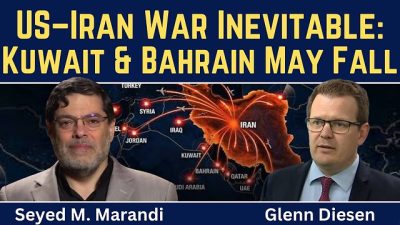
Seyed M. Marandi: US-Iran War Inevitable: Kuwait and Bahrain May Fall
or go to
Aletho News Archives – Video-Images
From the Archives
Oil and the Israel Lobby
Reknowned economist M. Shahid Alam offers this excellent critique of Noam Chomsky’s defective analysis of the relative influence of Oil versus the Israel lobby over US foreign policy: … continue
Blog Roll
 Aletho News
- ICC ignored ‘very well-documented’ NATO crimes – ex-Libyan minister
- SNSC secretary dismisses US response to Iran’s conditions as ‘inadequate’
- Sanaa says Taiz roads open, secure for residents, warns Saudi forces
- Iraqi resistance group urges Saudi leadership to admit defeat, lift Yemen siege
- Trump’s Retreat: How Al-Aqsa Flood Took Down the US Empire
- Israel’s Military Actions in Lebanon Grossly Violate International Law — Lavrov
- Seyed M. Marandi: US-Iran War Inevitable: Kuwait and Bahrain May Fall
- Leaders Condemn Ansarallah Attack on Saudi Arabia While Ignoring Illegal War Against Yemen
- Leaked: Britain’s Covert Iraqi Psyops Network
- Yemeni Armed Forces Warn Airlines Against Using Saudi Airports, Exempt Mecca and Medina
- If Americans Knew
- Israel’s Destruction of Southern Lebanon Intensified After the Cease-Fire
- The Last-Minute Decision That Gave Israel Its Name
- The American Conservative: How Trump Made the World Go Nuclear
- Meet the US generals and admirals advancing Israeli policy
- Opinion: Why news organizations should boycott Israel
- The Israeli witch hunt of Sami Abu Shehadeh exposes the lie of the ‘Jewish and democratic’ state
- No state has a ‘right’ to exist – least of all Israel
- Testimonies about Gaza’s civilian death toll expose Israel’s atrocities – Daily Update
- How Israel Conquered the Latin American Right
- Agents search Rep. Omar’s Washington home in criminal probe as she vows she won’t ‘be silenced’
- No Tricks Zone
- Germany’s Green Energy Debacle: High Energy Costs Force Kahla Porzellan to Close After 182 Years!
- New Study: 50 Years Of The Most Aggressive ‘Net Zero’ Policies Can Only Affect The Global Climate By 0.03°C
- US September “Heat” Was No Record…Many Records Set Decades Ago
- Latest European Green Energy Debacle; Portugal’s Largest Flagship Solar Park Insolvent!
- Green Energy Debacle: German Expert Professor Fritz Vahrenholt Warns Of Severe Economic And Social Consequences
- Two More Paleo Reconstructions Affirm Meters-Higher Sea Levels Across Ireland, Brazil 7000-6000 Years Ago
- New Study: Earth And Venus Surface Warmth Largely Explained By Convection And Lapse Rate, Not CO2 Or Radiation
- 2025 Nature Paper Claiming Worsening Global Drought Gets RETRACTED …Heavily Flawed
- New Study: ‘Global Drought Shows No Detectable Recent Acceleration Under Climate Warming’
- Economic Masterminds: German Socialists Suggest Taxing Productivity Gains Stemming From Using AI

