Massive demonstration in support of Palestine in London on the 71st anniversary of Nakba

Palestine Information Center – May 12, 2019
LONDON – Thousands of people gathered on Saturday for a demonstration in London, called for by the Palestinian Forum in Britain (PFB) and allied organizations, especially Palestine Solidarity Campaign (PSC) and the Muslim Association of Britain (MAB), to mark the seventy first anniversary of the Palestinian Nakba (Catastrophe), which coincides this year with talk about a new deal that will liquidate the Palestinian issue.
The rally was attended by many important personalities, something which the president of the Manchester branch of PFB, Baha’ Bader, considered to be a reflection of the acceptance of the Palestinian narrative despite the omnipresence of Zionist narrative.
For his part the Palestinian Ambassador to the UK, Husam Zumullut, stressed the utter rejection of the Palestinian people and their leadership of all that has been leaked about the suspicious deal.
In the meantime, the Chairman of PFB, Hafiz Al-Karmi, renewed a call for the British Government to apologize for the historical mistake of what is known as the Balfour Declaration and work for protecting the Palestinians.
The Palestinian student, who came to Britain recently to study, Ahed Al-Tamimi, was present at the rally to stress that she is going to continue her struggle in defense of Palestinian rights.
Labor MP, Richard Burgon, saw in the masses that attended the rally a message of support for the Labor Party’s plans to recognize the State of Palestine and stressed the Palestinians’ right to live in peace.
The spokesman for the PFB, Adnan Humaidan, accused the British Prime Minister, Theresa May, of being biased in favor of the Israeli occupation and of closing her ears to the calls of the demonstrators to stop arming and supporting the occupation while turning a blind eye to its crimes such as the killing of the baby Saba Abu Arrar and thousands of Palestinian children before her.
The demonstrators carried placards against the American President, Donald Trump, and his suspicious plans against the Palestinians and called for support for the Boycott, Divestment, and Sanctions (BDS) movement.
The speech of the British Palestinian youth, Leanne Mohamed, was received with a lot of applause. She participates in and speaks at most demonstrations that support Palestinian rights. She was disqualified from participating in the finals of Jack Petchey Speak-out challenge because of her insistence to talk about Palestine.
While another British Palestinian youth, Haneen Khalil, gave a speech in the name of OLIVE for Palestinian Youth. She stressed her rejection to negotiations with Israel before it agrees to the right of return of all Palestinian refugees.
In a message that was read on behalf of the Labor leader, Jeremy Corbyn, at the demonstration he said: “We cannot stand by or stay silent at the continuing denial of the rights and justice of the Palestinian people. The labor party is united in condemning the human rights abuses taking place in Gaza and the Israeli forces shooting unarmed Palestinian demonstrators for simply demanding their rights under international law.”
Bolton Is Spinning Israeli ‘Intelligence’ to Push for War Against Iran
By Gareth Porter | TruthDig | May 11, 2019
John Bolton has gotten away with a dangerous deception. The national security adviser’s announcement Sunday that the Pentagon has deployed air and naval forces to the Middle East, which he combined with a threat to Iran, points to a new maneuver to prepare the ground for an incident that could justify a retaliatory attack against Iran.
Bolton presented his threat and the deployments as a response to alleged intelligence about a possible Iranian attack on U.S. targets in the Middle East. But what has emerged indicates that the alleged intelligence does not actually reflect any dramatic new information or analysis from the U.S. intelligence community. Instead, it has all the hallmarks of a highly political case concocted by Bolton.
Further underscoring the deceptive character of Bolton’s maneuver is evidence that senior Israeli national security officials played a key role in creating the alleged intelligence rationale for the case.
The new initiative follows an audacious ruse carried out last fall by Bolton and Secretary of State Mike Pompeo, detailed in Truthdig in February, to cast the firing of a few mortar rounds in the vicinity of the U.S. embassy and a consulate in Iraq as evidence of an effort by Tehran to harm U.S. diplomats. Bolton exploited that opportunity to press Pentagon officials to provide retaliatory military options, which they did, reluctantly.
Bolton and Pompeo thus established a policy that the Trump administration would hold Iran responsible for any incident involving forces supported by Iran that could be portrayed as an attack on either U.S. personnel or “interests.”
Bolton’s one-paragraph statement on Sunday considerably broadened that policy. It repeated the previously stated principle that the United States will respond to any alleged attack, whether by Iranian forces or by what the administration calls “proxy” forces. But it added yet another major point to Trump administration policy: “a clear and unmistakable message to the Iranian regime that any attack on United States interests or on those of our allies will be met with unrelenting force [emphasis added].”
That language represents an obvious move by Bolton to create potential options for U.S. retaliation against Iran for a real or alleged attack by “proxy forces” on Israeli or Saudi forces or “interests.” Such a commitment to go to war with Iran over incidents related to Israeli or Saudi conflicts should be the subject of a major debate in the press and in Congress. Thus far, it has somehow escaped notice.
Significantly, on a flight to Finland on Sunday, Pompeo repeated the threat he made last September to respond to any attack by “proxy forces” on U.S. “interests.” He made no reference to possible attacks against “allies.”
Bolton and his staff claimed to the news media that what he characterizes as “troubling and escalatory indications and warnings” are based on “intelligence.” Media reports about Bolton’s claim suggest, however, that his dramatic warning is not based on either U.S. intelligence reporting or analysis.
Citing “U.S. officials,” The Wall Street Journal reported Monday that the alleged intelligence “showed that Iran drew up plans to target U.S. forces in Iraq and possibly Syria, to orchestrate attacks in the Bab el-Mandeb strait near Yemen through proxies and in the Personal [sic] Gulf with its own armed drones.”
But in the very next paragraph, the report quotes an official saying it is “unclear whether the new intelligence indicated operations Tehran planned to carry out imminently or contingency preparations in the case U.S.-Iran tensions erupted into hostilities.”
A Defense Department source said the intelligence showed “a change in behavior that could be interpreted to foreshadow an attack on American forces or interests,” according to the New York Times’ story on the matter. But the source didn’t actually say that any emerging intelligence had led to such a conclusion or even that any U.S. intelligence official has come to that conclusion.
The timing of the alleged new intelligence also suggests that Bolton’s claim is false. “As recently as last week there were no obvious sign of a new threat,” the Wall Street Journal reported. The New York Times similarly reported that “several Defense officials” said “as recently as last Friday they have had [sic] not seen reason to change the American military’s posture in the region.”
Normally, it would require intelligence from either a highly credible source within the Iranian government or an intercept of a sensitive communication from Iran to justify this kind of accusation. But no news outlet has brought word that any such spectacular new intelligence has found its way to the White House or the Pentagon.
The Journal’s report revealed, moreover, that Bolton has only a “fresh intelligence assessment” rather than any new intelligence report. That “assessment” is clearly not a product of the intelligence community, which would have taken at least several days to arrive at such a fundamental reinterpretation of Iranian intentions. The mysterious new “assessment” was evidently unknown outside Bolton’s office before Bolton swung into action last weekend.
We now know, in fact, that the sources behind Bolton’s claim were Israel’s national security adviser and intelligence agency. Axios published a report Monday by leading Israeli journalist Barak Ravid, who covers national security for Israel’s Channel 13, revealing that a delegation of senior Israeli officials had given Bolton “information” about “possible Iranian plots against the U.S. or its allies in the Gulf” two weeks earlier.
The Israeli delegation, led by national security adviser Meir Ben Shabbat, met with Bolton and other unnamed officials in the White House, according to Ravid, to discuss possible Iranian plans. Bolton himself tweeted on April 15 about his meeting with Shabbat.
Israeli officials told Ravid that they understood that “intelligence, gathered by the Mossad intelligence agency, was part of the reason for Bolton’s announcement.” What Ravid’s official sources told him reveals, however, that what the Israelis provided to Bolton was not really new intelligence at all; it consisted of several scenarios for what the Iranians might be planning, according to one Israeli official.
“It is still unclear to us what the Iranians are trying to do and how they are planning to do it,” the Israeli official told Ravid, “but it is clear to us that the Iranian temperature is on the rise as a result of the growing U.S. pressure campaign against them, and that they are considering retaliating against U.S. interests in the Gulf.”
That revelation explains the lack of evidence of either genuine U.S. intelligence reporting or proper assessment to support Bolton’s statement.
Bolton is an old hand at using allegedly damning intelligence on Iran to advance a plan of aggressive U.S. war. In 2003-04, he leaked satellite photographs of specific sites in Iran’s Parchin military complex to the press, claiming those images provided evidence of covert Iranian nuclear weapons-related experiments—even though they showed nothing of the sort. He then tried to pressure International Atomic Energy Agency Director General Mohamed ElBaradei to insist on an inspection of the sites. When ElBaradei finally relented, he found nothing in that inspection to support Bolton’s claim.
Bolton’s deceptive maneuver has the effect of increasing the range of contingencies that would trigger a U.S. strike on Iran and represent a major advance toward his long-declared intention to attack it. More alarmingly, however, some media outlets have reported his claims without any serious questioning.
Given the violent struggles in Iraq, Yemen, Syria and Israel itself, Bolton and the Netanyahu government will be able to portray an incident as an attack by Shiite militias, the Houthis or Hamas on Israeli, Saudi or U.S. “interests,” just as Bolton and Pompeo did last fall. That, in turn, would offer an opportunity for urging Trump to approve a strike against one or more Iranian military targets.
Even more alarming is that both acting Defense Secretary Patrick Shanahan and new CENTCOM commander Gen. Kenneth McKenzie have signed up for the Bolton initiative. That means that the Pentagon and military leaders can no longer be counted on to oppose such a war, as they did in 2007, when Vice President Dick Cheney pushed unsuccessfully for a plan to retaliate against a future Iraqi militia attack on U.S. troops in Iraq.
The United States is in danger of falling for yet another war ruse as malignant as those that led Congress and the mainstream media to accept the invasion of Iraq or the Gulf of Tonkin resolution.
Misled again by the arbiters of anti-semitism
By Jonathon Cook | May 11, 2019
British comedian David Schneider has become one of the more influential public figures on social media seeking to arbitrate what constitutes anti-semitism. Compared to TV show host Rachel Riley, or even Guardian columnist Jonathan Freedland, Schneider is an exemplar of moderation and rationality. But, to be honest, the bar has been set pretty low in recent years.
Schneider has now published a guide in the Independent newspaper on “how to talk about Israel without sliding into antisemitism”. Although there are elements to his guide I can agree with, most of his advice is – to put it charitably – simplistic, misleading or downright unhelpful.
Given how polarised public discourse has grown on the issue of anti-semitism, and the degree to which it has been weaponised by those – Jews and non-Jews alike – opposed to a new kind of insurgency politics in the UK and US demanding the right to speak out unequivocally in support of Palestinian rights, Schneider’s blind spots need highlighting.
He rightly notes that the phrase “legitimate criticism of Israel” has become clichéd. But it is more than just a cliché; it has come to serve as a ringfence, ensuring that “legitimate” criticism relates only to Netanyahu and the Israeli right.
Many of us, however, want to point out that there would still be major problems with Israel even if Netanyahu had been replaced at last month’s election by the rival party of generals led by Benny Gantz or if the Israeli Labour party ever managed to revive itself from terminal decline. We want to talk about why Israel was a very problematic kind of state long before anyone had heard of Netanyahu, during a time when a supposed Israeli left ruled the country.
So here I offer an addendum meant to clarify and counter the arguments made in Schneider’s seven-point guide.
The relevant text of his guide is in bold, with my comments below in ordinary type:
1. Avoid saying “Zionist” or “Zionism” when discussing contemporary Israel/Palestine. The terms are too loaded now, too coarse and broad in their application, and too often used by hardcore antisemites to mean simply Jews.
Benjamin Netanyahu is a Zionist, but so are Israeli lawyers and peace activists fighting to achieve justice for Palestinians. You cannot lump them all together. Fair enough when talking historically, as long as you’re informed and precise, but for the present day, I recommend using specific terms instead, such as “the Israeli government” or “Netanyahu”.
Schneider has lost no time in revealing the nub of the problem with his guide. He is a liberal Zionist, and understandably he feels uncomfortable being lumped in with Netanyahu. But the primary goal of Palestinians and their supporters isn’t to make Schneider or other liberal Zionists feel comfortable with their political views or to comply with their demand that “legitimate” criticism of Israel be restricted to Netanyahu.
Yes, some anti-semites may use “Zionist” as code for “Jew”. But Schneider is demanding his cake and eating it in insisting that the core ideology driving Israeli policy towards the Palestinians for more than seven decades be declared largely unmentionable.
Zionism wasn’t just a historical prelude to Israel’s creation, some anachronism to be deposited in a museum. All the major political parties in Israel still firmly define themselves as Zionist. It is at the core of their political programmes, meaning that they share much common ground. The parties are often divided chiefly about how to achieve their political goals, not what those goals are.
Political disagreements in Israel revolve around two camps: Labour Zionists, who founded Israel, and Revisionist Zionists, now represented chiefly by Netanyahu’s Likud party, that have largely ousted Labour Zionists from power since the late 1970s.
The movement Schneider probably identifies most with are the Labour Zionists (now often described as liberal Zionists) whose founders drove 80 per cent of the native Palestinian population off their lands in 1948 in what would today be called an ethnic cleansing operation.
It didn’t end there, though. The Labour Zionists then created a land and residential segregation system inside the new state of Israel that very much persists to this day. In fact, almost all of Israel’s land is reserved exclusively for Jews, with many hundreds of communities using admissions committees to bar the fifth of the population who are Palestinian citizens. The Palestinian minority have been herded into deprived and overcrowded ghettoes on a tiny fraction of the remaining land. All of this is entirely separate from what happens to Palestinians in the occupied territories.
Inside Israel, the state’s control and allocation of land and resources on an ethnic basis is know as Judaisation, and it has been at the heart of state policy for 71 years.
Labour Zionists also established and maintained a rigid system of segregated state education, separating Jewish and Palestinian children – all of them Israeli citizens – in much the same way as occurred in the Jim Crow South in the US.
Outside Israel, the Labour Zionists founded the first settlements in the occupied West Bank and East Jerusalem, which were built in violation of international law and with intent to destroy any hope of a Palestinian state emerging.
Today the Labour Zionists still advocate policies to keep Israel’s Jewish and Palestinian citizens apart, and support the larger settlements, even at the cost of denying the Palestinians any viable right to self-determination. In any other context, we would call them ethnic nationalists, or racists.
In fact, one could reasonably argue that Judaisation and political Zionism – the kind that probably finds favour with 99 per cent of Israeli Jews – are as good as synonyms. Many of the Israeli Jewish lawyers and human rights activists Schneider refers to who are trying to help Palestinians in the occupied territories are still quite ready to back a political system inside Israel that keeps Palestinian citizens separate from Jewish citizens.
These extreme liberal Zionists – small in number though they are – are plagued by concerns about the rights of Palestinians in the occupied territories, but all too often because they want Israel out of those territories so it can concentrate on privileging Jews inside Israel, even though a fifth of Israel’s population are not Jewish.
Those who do not feel that way are usually described as anti-Zionists – one reason why the term “Zionist” is such a helpful ideological signpost about where Israel Jews and their supporters stand on core issues like equality inside the state of Israel itself.
The other camp, the Likud Zionists, have not opposed this system of segregation, which closely echoes apartheid South Africa. In fact, they have sought to entrench and expand it. Today, the main difference between Labour and Likud Zionists is the latter’s indifference to how such policies are perceived by the international community.
So, in other words, there is no way to understand or critique Israel’s political system, or the nature of its abuses of Palestinians, or the ideology espoused by its supporters abroad, without analysing Zionism and its aims.
Schneider’s formula makes as much sense as demanding back in the 1980s that “legitimate criticism” of South Africa not address the country’s overarching apartheid ideology but be reserved specifically for P W Botha and his government. Following Schneider’s advice would make useful, reasoned criticism of Israel impossible.
2. Do not slide from anger at the actions of the Israeli state into asserting that Israel is controlling everything or paying money to MPs, celebrities or the media to act as they do. To do so simply echoes far-right antisemitism and centuries-old conspiracy theories about Jews, now rebadged to apply to Israel.
And yes, I know about the documentary The Lobby, where a Labour MP was filmed discussing money with an Israeli embassy official. But unless you have other examples of this, I suggest you avoid it.
Few critics of Israel are actually claiming anything of this sort. Schneider has offered a strawman formulation here. But I suspect he wishes to catch in his trawl net far more than these claims.
It is interesting to consider why it is so contentious to claim that Israel wields power through its lobbies to promote its interests in the US and UK when our political elites are so ready to claim that Russia has been supposedly interfering in superhuman ways in the US and UK to pursue its interests.
It is telling that Schneider, like the British media, wishes to hurry past Al-Jazeera’s documentary The Lobby. The undercover film did not just show a Labour MP discussing money with an embassy official – as Schneider would presumably know if he had watched the documentary. It showed much, much more.
Not least, it showed an Israeli government agent, Shai Masot, who was probably working for the strategic affairs ministry at the time, plotting from within the UK to unseat a British government minister who was seen by Israel as a little too sympathetic to the Palestinians. And it showed pro-Israel activists within the Labour party, led by the Jewish Labour Movement, colluding with the Israeli embassy to damage and oust Labour leader Jeremy Corbyn because he too is seen as overly sympathetic to Palestinian rights. That is the necessary context for understanding the endless claims of a supposed “anti-semitism crisis” in the Labour party, much of it advanced by this same Jewish Labour Movement.
The Lobby – both the UK series and the censored, but leaked, US follow-up – were groundbreaking television. They put flesh on the bare bones of what we already knew about the lobby’s activities in interfering in British and American politics. To dismiss its revelations so casually and quickly is to bury one’s head in the sand – because its findings are too unpalatable for those who wish to place Israel at the core of their identity.
3. Don’t conflate Israel and Jews. It may anger you that the likes of Netanyahu try to do this, so don’t make the same mistake yourself. If you see someone talking about Jews, antisemitism or the Holocaust and find yourself leaping straight to Israel-Palestine, think again.
This would make good sense only if we had not just spent the last three years witnessing the term “anti-semitism” being publicly redefined so as to refer chiefly to criticism of Israel. It wasn’t, after all, Israel’s critics that insisted public bodies and political parties, including the British Labour party, adopt the International Holocaust Remembrance Association’s 11 examples of anti-semitism, seven of which refer to Israel.
Here’s a promise. If the accusation of anti-semitism is restricted to examples of hatred, suspicion or fear of Jews, I happily promise to avoid raising the issue of Israel during debates about anti-semitism. But when the term is being weaponised, when its meaning is being altered to defend a state, and one that has been abusing Palestinians for decades without serious censure, then I and others are under a moral responsibility to talk about Israel and remind others that criticism of Israel is not usually anti-semitic.
4. Avoid the terms “Israel lobby” and especially “Jewish lobby” unless you also say “Saudi lobby”, “Russian lobby”, “Hindu lobby” and so on. “Supporters of Israel” is safer language.
As for “Jewish lobby”, they say “two Jews, three opinions”. The idea of us agreeing enough to form a single lobby is as likely as Theresa May fighting the next election as Tory leader.
It is rather surprising that Schneider claims Jews are so disputatious with each other that they could never form a single lobby. Surprising because so many prominent Jews, including Jonathan Freeland of the Guardian, and Schneider himself, I believe, have regularly insisted that Jews are almost entirely of a single mind on at least one issue: that Israel is crucial to their identity as Jews. (This, of course, usually serves as a prelude to warning that any criticism of Israel – apart from the “legitimate” kind they approve of – is evidence of anti-semitism because it undermines Jewish identity.)
Not only is there a very obvious “Israel lobby”, but it is quite unlike the other lobbies Schneider mentions. In the UK, for example, there is no visible public lobby for Saudi Arabia or Russia, and if Hindus are actively and vocally campaigning to prevent criticism of India, or labelling such criticism as anti-Hindu, I must have missed it.
And in one obvious sense, Schneider sabotages his own argument. We have just seen American society waste more than two years hyperventilating about non-existent Russian “collusion” with Donald Trump – a US president supposedly acting as a sort of Trojan horse or Manchurian candidate for the Russia lobby.
Unlike the many conspiracy theories about Russia, the Israel lobby is talked about so much by Israel’s critics because it is so in our faces, and so obviously trying to hijack or manipulate public debate in ways that harm free speech and Palestinian rights.
Right now, more than half of state legislatures in the US have passed legislation to limit their citizens’ fundamental right to free speech – but only in relation to criticism of Israel. Similar legislation is well advanced in Congress too.
This spate of legislation has occurred not because US politicians love Israel more than their own country (which Americans are still free to criticise), but because of the ferocious tactics of an extremely well organised Israel lobby in the US. That lobby is dominated by both rightwing Jewish leadership organisations and rightwing Christian evangelical groups.
None of this is to say that the Israel lobby is supremely powerful, or even unusually powerful, even if it sometimes looks that way. There are lots of other powerful lobbies, from the health and gun lobbies to the arms and financial industries lobbies. And, we could add, the Saudi-oil lobby too.
In fact, one could plausibly argue that many of these lobbies are even more powerful than the Israel lobby because their power is typically wielded far from public view. They are less visible, and therefore their presence less felt by the public. They operate almost entirely in the shadows.
But that is hardly grounds for condemning critics of Israel who are able to identify the Israel lobby’s activities and influence, and its efforts to manipulate public debate, whether it be by misusing the anti-semitism accusation or working actively to violate Americans’ First Amendment rights.
Many of us can see very clearly what the Israel lobby is up to.
It has, for example, also begun actively interfering in British politics. One only needs to see the arch-conservative body the Board of Deputies of British Jews or the Murdoch-owned Times newspaper regularly sticking the knife into Jeremy Corbyn using anti-semitism as their weapon of choice. It is his socialism, not any presumed anti-semitism, that is really driving the agenda of these bodies.
The lobby is seeking to damage our democracies in plain sight, but it is almost impossible to say so without being accused of anti-semitism, as Schneider himself implies here. That’s a wonderful self-rationalising system if you love Israel, but it is simply terrifying if you think the Palestinians should be entitled to rights in their homeland, or that we should at least have the right to discuss whether they are entitled to such rights.
That is why it is so important to keep identifying and exposing the Israel lobby – because, unlike those other lobbies, we don’t need special access to the hidden corridors of power to see it in operation. Even as ordinary citizens we can identify its role and call it out for what it is.
5) Don’t accuse Jews of dual loyalty to Israel and the UK (or whichever country), and certainly not of just being loyal to Israel. It’s another age-old antisemitic standard, as featured in Stalinist show trials and the Dreyfus affair.
And yet, many prominent Jews in the UK and US – as previously mentioned – tell us that Israel is central to their identity, and in the US have been willing to promote a unique violation of First Amendment rights to prevent criticism of Israel.
In fact, some make no secret of their dual loyalty. Here is what I wrote recently in a piece on the lobby:
That pro-Israel lobbyists – as opposed to Jews generally – do have dual loyalty seems a peculiar thing to deny, given that the purpose of groups like AIPAC is to rally support for Israel in Congress.
Casino billionaire Sheldon Adelson, a key backer of Republican candidates for the presidency, has never hidden his passion not only for Israel but specifically for the ultra-nationalist governments of Benjamin Netanyahu.
In fact, he is so committed to Netanyahu’s survival that he spent nearly $200 million propping up an Israeli newspaper over its first seven years – all so he could assist the prime minister of a foreign country.
Similarly, Haim Saban, one of the main donors to Democratic presidential candidates like Hillary Clinton, has made no secret of his commitment to Israel. He has said: “I’m a one-issue guy and my issue is Israel.”
6) Don’t compare Israeli actions to the Nazis unless it’s incredibly specific and historically justified (such as a settler calling for Arabs to be gassed). And even then, use extreme caution.
Finally we can agree.
7) Don’t ask every Jew to condemn Israel in every tweet or comment they make. Would you ask every Muslim to condemn Saudi Arabia? I hope, and presume, not.
Well, fair enough – if anyone beyond a few unhinged people trying to get themselves noticed on social media are actually doing this unbidden.
But it’s a little more complex than Schneider cares to make out. Aren’t Schnneider and other prominent Jewish figures who publicly support Israel or Zionism not creating this problem for themselves by specifically tying their Jewishness to an identification with Israel?
If Jonathan Freedland keeps telling us that to criticise Israel too vehemently is to undermine his Jewish identity – and that this is itself a new form of anti-semitism – he can hardly complain when Israel’s critics hone in on his support for Israel and try to assess what exactly he means by it.
Does his Israel-tied Jewish identity allow him to excuse, rationalise or minimise the murder of unarmed Palestinian demonstrators in Gaza by Israeli snipers? Does he reject Israel’s claim to sovereignty over the Old City of Jerusalem, which violates international law and was based on the ethnic cleansing of many Palestinian residents living there? Does he accept that all of the West Bank must be handed over to the Palestinians as part of a future agreement? Does he accept that Palestinian refugees, ethnically cleansed from their homeland in 1948 and 1967 by Israel, have a right to return? And is he prepared to condemn unequivocally the apartheid system Israel has created inside its recognised borders that separates the rights of Jewish citizens from Palestinian citizens of Israel?
His and Schneider’s answers to those questions and many others not only help us understand what they mean when they speak of “legitimate” criticism of Israel, but what their view of their Jewish identity really entails – for their approach to human rights generally and their approach to Palestinian rights specifically.
There’s No Other Way To Put It: Israel Kills Babies To Terrorize Gaza Into Submission
By Bryce Greene | May 10, 2019
On Sunday afternoon, Israel and Hamas agreed to a ceasefire, ending a three-day escalation of violence in the Gaza Strip. After two unarmed protesters were killed during the weekly Friday protest, two Israeli soldiers were killed in a firefight at the border. The Israeli military responded by bombing targets in Gaza resulting in two more Palestinian deaths. In response, Hamas and other minor political groupings such as Islamic Jihad, launched a barrage of projectiles into Israel.
According to a Hamas leader, the organization felt escalation was a necessary response to Israel shirking its obligations to ease the blockade — one of the terms of the ceasefire after Operation Protective Edge. To signal resistance against Israel, Hamas and other militant groups in the strip occasionally launch homemade projectiles into southern Israel. In reality these “rockets” are weak, especially compared to the high tech war machine that Israel possesses. In fact, only four Israelis were killed by the indiscriminate rocket fire into Israel’s urban areas. According to the Independent, this is the first time in five years that an Israeli has been killed by a projectile launched from Gaza.
As a side note: when the Jerusalem Post reported early on about injured Israelis, their numbers were inflated by 10 who were mildly injured while running to shelter and 45 who suffered from “anxiety”. Only three in this case were actually injured from Gaza rocket fire.
Why then, in the face of such a relatively insignificant threat, does Israel decide to erupt into a bombing frenzy in one of the poorest areas in the world? Israeli officials often say it is about something called “deterrence capacity”.

Israel bombs Gaza during the night [From @MuhammadSmiry]
Deterrence capacity is essentially a measure of how terrified people are of a violent response if they were to cross Israel. Throughout all of Israel’s statehood, deterrence capacity has been at the center of its military strategy. It is established when the Israeli forces “demonstrate real hooliganism” at the demand of the high Israeli officials. The more indiscriminate the violence and the more fear struck into the hearts of Palestinians, the less likely they are to resist Israel’s harsh treatment. The Israelis use the term “mowing the lawn” to describe these periodic outbursts of violence. It is a deliberate attempt to beat a desperate people into submission in order to accomplish political ends. In a word, it is the definition of state terrorism.
On Sunday, while the bombs were still falling, Hamas and Islamic Jihad signaled that they were ready to reach a ceasefire. Israel ignored this because, according to Israeli officials, they wanted to reestablish their deterrence capacity. Netanyahu promised “massive strikes” and even began mobilizing ground forces in preparation for an invasion. In other words, the military wanted the population of Gaza to suffer more so that they would fear Israel more. If they fear Israeli bombs enough, Israeli strategy assumes the people of Gaza would quietly accept the destruction of their society. The only reason Israel did not escalate was that it did not want to juggle the PR of bombing a defenseless population during the Eurovision song contest which is being held in Tel Aviv this year.

Seba Abu Arar, 14 months, killed in Israeli Strikes [From @MuhammadSmiry]
The decision to continue the bombardment came even after it was known that many civilians, including a pregnant woman and and an infant, were killed in the attacks. Israeli command evidently did not care about these casualties. This is just the latest example of Israel using security concerns to justify outright terrorism. To show just how spurious the security pretext is, ask simple question: What effect will the bombing have on Israeli security?
The bombings are never designed to destroy Hamas militarily. That would be impossible without completely obliterating the strip after a costly invasion and then entirely uprooting Gaza’s civil society. The attacks also do not weaken Hamas politically, but strengthen it. Hamas’s popularity comes in part from their reputation as an armed resistance against Israeli aggression. Armed resistance wouldn’t be as popular if Israel was not continuously antagonizing the population with a crippling blockade and perpetuating the humanitarian crisis.
When Israel attacks Gaza, they’re not expecting some sort of change to the status quo. Bombing the enclave only serves to exacerbate both feelings of hostility as well as the underlying conditions. All of this increases the likelihood of Palestinian violence. As long as Israel refuses to address the roots of the situation, daily life in Gaza will remain unchanged, along with the conditions that lead some to justify firing projectiles into Israel.
So, when Israel bombs one of the most densely populated areas on earth, remorselessly slaughters infants and bombs school shelters and personal residences all in the name of security, the serious reader must understand it as nothing less than a cover for the continuation of terrorism against the Palestinian people. Without willful ignorance, mental gymnastics or outright cognitive dissonance, there’s no other way of putting it.
Israel sets up fake Eurovision boycott page to counter BDS campaign
Data gathering?
RT | May 10, 2019
Sporting the URL boycotteurovision.net Israel’s PR website masquerades as part of a campaign to boycott the Eurovision song contest in Tel Aviv, but actually features pro-Israel narrative.
For most people who follow the issue, the acronym ‘BDS’ refers to the Boycott, Divestment and Sanctions movement, which aims to financially pressure Israel into improving treatment of Palestinians. However, according to a new website promoted via ads on Google, it now stands for how Israel is “beautiful, diverse, sensational.”
Despite the deceptive URL and the fact that the page doesn’t identify itself as run by the Israeli government, Tel Aviv’s PR ministry confirmed to Reuters that they were behind the campaign.
Meanwhile, with less than a week to go before the Eurovision takes place in Tel Aviv, the actual Boycott, Divestment and Sanctions movement has been ramping up its efforts to encourage people to snub the competition. They were none too pleased with the Israeli government’s latest counter-measure.
“After its theft of Palestinian land and culture, Israel is now trying to appropriate a symbol of our nonviolent resistance,” said Alia Malak, of the Palestinian Campaign for the Academic and Cultural Boycott of Israel (PACBI).
This desperate and crude propaganda is straight out of apartheid South Africa’s playbook.
Although the competition is intended to bring countries around the world together, the contest has been politicized a number of times.
Last year’s winner, Israel’s Netta Barzilai, yelled out “Next time in Jerusalem!” after receiving the trophy for her spirited chicken-themed song ‘Toy’. The statement was seen as controversial given that not even the US had yet recognized Jerusalem as the country’s capital.
Although Israel has pulled out all the stops to assure the event will go smoothly, it comes shortly after cross-border shelling between Israel and Palestine in Gaza earlier this week. Four Israelis were killed and at least 10 injured as a result of rockets fired from Gaza, while the IDF carried out some 320 air-raids which killed 25 people and injured dozens.
Palestinian Resistance Can Intensify Deterrence in Face of Zionist Enemy: Hezbollah

Deputy Chief of Hezbollah Executive Council Sheikh Ali Daamoush
Al-Manar | May 10, 2019
Deputy Chief of Hezbollah Executive Council Sheikh Ali Daamoush stressed that the silence of some Arab regimes about the Israeli aggression on Gaza was worse than the aggression itself, adding that they showed to be on the enemy’s side, just as the US and the West.
In his Friday sermon, Sheikh Daamoush pointed out that the Zionist enemy failed to achieve the aggression’s aims, adding that the Palestinian resistance proved it had improved its military capabilities.
The Palestinian resistance has a chance to intensify its deterrence capability in face of the Zionist enemy, his eminence stressed.
In a different context, Sheikh Daamoush noted that the US sanctions on Iran expose Washington’s aggressiveness against the regional states, adding that the Islamic Republic of Iran may never bow to such pressures.
Bennett: Jewish ‘assimilation’ is a ‘disaster’ for Israel
![Israeli Education Minister, Naftali Bennett [HNM News/Facebook]](https://i2.wp.com/www.middleeastmonitor.com/wp-content/uploads/2018/09/Naftali-Bennett15230739_1864323940467816_2270573291150794336_n.jpg?resize=1200%2C800&quality=75&strip=all&ssl=1)
Outgoing Minister of Education and Diaspora Affairs, Naftali Bennett [HNM News/Facebook]
MEMO – May 9, 2019
In what appears to be an admission of the growing divide between Israel and Jews living outside the country, the outgoing Minister of Education and Diaspora Affairs Naftali Bennett warned against what he sees as “assimilation” of Jews with communities around the world, describing it as “one of the greatest disasters in the history of the Jewish people”.
The remarks, which were reported by Arutz Sheva, were made at the annual International Bible Quiz in Jerusalem, which takes place each year on Israel’s Independence Day. It’s reported that Prime Minister Benjamin Netanyahu was in audience.
Expressing grave concern over Jewish “assimilation”, Bennett who heads the New Right party with Ayelet Shaked, is reported saying: “The State of Israel has experienced the most prosperous and successful era it has known, but during these very days, one of the greatest disasters in the history of the Jewish people is taking place – we are losing millions of our Jewish brothers and sisters in the diaspora. Like an iceberg melting away, so many of our people are slipping away before our eyes.”
He called on the state of Israel to act “without delay, with all [our] strength, creativity, and determination, in order to save [our] brothers and sisters, members of the Jewish people around the world, from assimilation and anti-Semitism.”
Bennet insisted that the task of stemming the tide of Jewish “assimilation” needed to be “the project of the state of Israel”, explaining that “whenever we needed financial or political assistance, the Jews of the world mobilised to help”.
Bennet concluding his addressing saying: “We have a duty to ensure that we will be a sovereign and united Jewish state for all eternity.”
13 Israeli Violations against Journalists in April

By Tareq Astal | IMEMC News & Agencies | May 9, 2019
In its monthly report on Israeli violations against journalists, published today, WAFA said that 11 journalists were injured from rubber-coated metal bullets, live bullets and tear gas canisters, fired by Israeli soldiers, as well as from severe beatings. At the same time, one journalist was detained and another had his press papers seized.
On April 3, the Jerusalem District Court rejected an appeal filed by Mustafa Kharouf, a photographer with Turkish Anadolu news agency, to release him from prison so that he can be with his family in Jerusalem, and kept him incarcerated until May 5, the date he is to be expelled to Jordan. (Kharouf’s attorney got an injunction from the Israeli High Court on May 5, stopping his expulsion until it hears his plea.)
On April 5, Israeli forces shot Amad News Agency correspondent Safinaz al-Louh, with a teargas grenade, in her right foot, and Noor News photographer Mohammad Issa with a gas bomb, in his leg, while covering the March of Return protests, east of the Gaza Strip.
On April 10, Israeli forces raided the home of Ra’ed al-Sharif, in Hebron, holding his family in one room before embarking on a thorough search of the house and tampering with its contents.
On April 12, Israeli forces shot Filistin al-Hadath photographer and correspondent Ahmed al-Zurei, with a rubber-coated bullet, in the abdomen, while he was covering protests east of al-Bureij, in the central Gaza Strip.
On April 19, freelance photographer Abdel Rahim al-Khatib was hit with a rubber-coated bullet, in the left thigh, and Reuters photographer Bassam Massoud with a gas grenade, behind his left ear. A similar bomb injured Watan Radio reporter Mohammad al-Louh and freelance photographers Mahmoud Badr, in the left foot, and Ahmad Washah, in the head, while covering protests east of the Gaza Strip.
In the same day, Xinhua photographer Nidal Shtayeh and WAFA photographer Ayman Noubani were shot with rubber-coated metal bullets, in their thighs, while covering the Israeli army’s crackdown on the weekly protests in Kufr Qaddoum village, east of Qalqilia, in the north of the West Bank.
On April 26, Israeli forces targeted Shihab News Agency photographer Ramadan al-Sharif, with a live bullet that hit him in his right foot, while he covered protests east of Rafah, in southern Gaza.
The daily attacks on journalists in the West Bank are part of an ongoing Israeli policy against their activities and their role in covering the practices and violations committed by these forces, against Palestinian civilians and property.
Pandering to Israel Means War With Iran
By Philip Giraldi | Strategic Culture Foundation | May 9, 2019
The United States is moving dangerously forward in what appears to be a deliberate attempt to provoke a war with Iran, apparently based on threat intelligence provided by Israel. The claims made by National Security Advisor John Bolton and by Secretary of State Mike Pompeo that there is solid evidence of Iran’s intention to attack US forces in the Persian Gulf region is almost certainly a fabrication, possibly deliberately contrived by Bolton and company in collaboration with Prime Minister Benjamin Netanyahu. It will be used to justify sending bombers and additional naval air resources to confront any possible moves by Tehran to maintain its oil exports, which were blocked by Washington last week. If the US Navy tries to board ships carrying Iranian oil it will undoubtedly, and justifiably, provoke a violent response from Iran, which is precisely what Bolton, Pompeo and Netanyahu are seeking.
It would be difficult to find in the history books another example of a war fought for no reason whatsoever. As ignorant as President Donald Trump and his triumvirate or psychotics Bolton, Pompeo and Elliott Abrams are, even they surely know that Iran poses no threat to the United States. If they believe at all that a war is necessary, they no doubt base their judgment on the perception that the United States must maintain its number one position in the world by occasionally attacking and defeating someone to serve as an example of what might happen if one defies Washington. Understanding that, the Iranians would be wise to avoid confrontation until the sages in the White House move on to some easier target, which at the moment would appear to be Venezuela.
The influence of Israel over US foreign policy is undeniable, with Washington now declaring that it will “review ties” with other nations that are considered to be unfriendly to the Jewish state. For observers who might also believe that Israel and its allies in the US are the driving force behind America’s belligerency in the Middle East, there are possibly some other games that are in play, all involving Benjamin Netanyahu and his band of merry cutthroats. It is becoming increasingly apparent that foreign politicians have realized that the easiest way to gain Washington’s favor is to do something that will please Israel. In practical terms, the door to Capitol Hill and the White House is opened through the good offices of the American Israel Public Affairs Committee (AIPAC).
Israel is desperate to confirm its legitimacy in international fora, where it has few friends in spite of an intensive lobbying campaign. It seeks to have countries that do not have an embassy in Israel to take steps to establish one, and it also wants more nations that do already have an embassy in Tel Aviv to move to Jerusalem, building on the White House’s decision taken last year to do just that. Not surprisingly, nations and political leaders who are on the make and want American support have drawn the correct conclusions and pander to Israel as a first step.
One only has to cite the example of Venezuela. Juan Guaido, the candidate favored by Washington for regime change, has undoubtedly a lot of things on his plate but he has proven willing to make some time to say what Benjamin Netanyahu wants to hear, as reported by the Israeli media. The Times of Israel describes how “Venezuela’s self-proclaimed leader Juan Guaido is working to re-establish diplomatic relations with Israel and isn’t ruling out placing his country’s embassy in Jerusalem, according to an interview with an Israeli newspaper published Tuesday.”
One would think that Guaido would consider his interview sufficient, but he has also taken the pandering process one step farther, reportedly displaying huge video images of the flags of both Israel and the United States at his rallies.
This deference to Israel’s interests produced an almost immediate positive result with Netanyahu recognizing him as the legitimate Venezuelan head of state, followed by an echo chamber of effusive congratulations from US (sic) Ambassador to Israel David Friedman, who praised the Jewish state for “standing with the people of Venezuela and the forces of freedom and democracy.” Donald Trump’s esteemed special envoy for international negotiations, Jason Greenblatt, also joined in, praising the Israeli government for its “courageous stand in solidarity with the Venezuelan people.”
A similar bonding took place regarding Brazil, where hard right conservative leader Jair Bolsonaro was recently elected president. Netanyahu attended the Bolsonaro inauguration last December and the two men benefit from strong support from Christian Evangelicals. Bolsonaro repaid the favor by promising that Israel would be his first foreign trip. In the event he went to Washington first, but the state visit to Israel took place in April, just before that country’s elections, in a bid to demonstrate international support for Netanyahu.
Brazilian Jews constitute a wealthy and powerful community which reacted positively to Bolsonaro’s pledges to fight corruption and high crime rates while also repairing a struggling economy. They also appreciated his stance on Israel. He committed to moving the Brazilian embassy to Jerusalem from Tel Aviv, though he has backpedaled a bit on that pledge. And he also promised to shut the Palestinian embassy in the capital Brasilia. He famously asked and answered his own question, “Is Palestine a country? Palestine is not a country, so there should be no embassy here. You do not negotiate with terrorists.”
Bolsonaro’s pro-Israel anti-Venezuela credentials also endeared him to Donald Trump on a visit to Washington in mid-March which was described by the media as a “love fest.” The Brazilian leader’s visits to Israel and the US as well as Guaido’s promises to Israel reveal that the foreign policies of Tel Aviv and Washington have become inextricably intertwined, with supplicant nations and politicians wisely seeking to do homage to both regimes to gain favor. It is a development that would shock the Founding Fathers, most particularly George Washington, who warned against entangling alliances, and it means that American interests will be seen through an Israeli prism, a reality that has already produced very bad results.
Trump’s “Deal of the Century” Will Use Sanctions, Military Threats to Force Palestinian Acceptance
By Whitney Webb | MintPress News | May 8, 2019
The Israeli newspaper Israel Hayom, owned by top Trump donor Sheldon Adelson, has published in Hebrew a leaked draft of the Trump administration’s “Deal of the Century” for the Israel-Palestine conflict. The draft was given to the newspaper by an official from Israel’s Foreign Ministry, which is currently headed by Israeli Prime Minister Benjamin Netanyahu. The plan, which has been drafted by President Donald Trump’s son-in-law Jared Kushner and Jason Greenblatt, is expected to be released this June after the conclusion of the Muslim holy month of Ramadan, according to Mondoweiss.
The draft plan published by Israel Hayom, while in keeping with many of the details that have been leaked to the press in past weeks and months, contains several new and troubling claims, including the Trump administration’s plan to force Palestinian leadership to accept the plan through threats of economic strangulation and military force.
For instance, if Palestinian leadership — such as the Palestinian Authority (PA) or Hamas — rejects the Trump administration’s “peace plan,” the United States will respond aggressively by ensuring that “no country in the world transfer money” to Palestine, which would apparently be accomplished through U.S. sanctions. With Palestine’s economy and the livelihood of many Palestinians dependent on foreign aid, such an act would amount to economic strangulation of the over 6 million Palestinians in the West Bank and around 2 million Palestinians in the Gaza Strip.
Furthermore, if the PA accepts the plan but Gaza’s leadership — i.e., Hamas — rejects it, “the U.S. will back Israel to personally harm leaders of Hamas and Islamic Jihad” and the U.S. will hold Hamas fully responsible for any future “round of violence between Israel and Hamas,” regardless of the circumstances that initiate that violence. In other words, the Trump administration is willing to join a future war against the embattled Gaza Strip, described by the United Nations as an open-air prison that is already largely unlivable for its inhabitants and under a full blockade, if Hamas rejects the Trump administration’s plan for the Israel-Palestine conflict.
Thus, the draft plan states that the Trump administration’s tactic of negotiating with the Palestinians involves a combination of threats of economic destruction and military destruction aimed at bullying an already dispossessed people into accepting a plan that clearly favors their occupiers.
Creating a “new” Palestine
In addition to the Trump administration’s apparent game plan to force Palestinian compliance with the so-called “Deal of the Century,” the plan also calls for the creation of a demilitarized state of “New Palestine” that would be incredibly small, as the document calls for the Israeli annexation of the entirety of the Jordan Valley (around 30 percent of the West Bank) and the annexation of all illegal Israeli settlements in the West Bank, which now cover well over half of what international law maintains is Palestinian territory.
This “new” state would be showered in aid from several countries, including the Gulf monarchies, European nations and the United States, allegedly amounting to $30 billion over the next five years. Most of the funding, according to the plan, will come from oil-producing Gulf states like Saudi Arabia. It is unclear whether “New Palestine” would be considered a sovereign state and whether it would be allowed to apply for full membership in the United Nations.
While the plan would allow “New Palestine” access to Jerusalem as a shared, undivided capital with Israel, Palestinians would be responsible for paying the state of Israel for their security because it would be forbidden from having its own army. In other words, Palestinians would be forced to pay the Israel Defense Force (IDF), the military force that has occupied the West Bank for over 50 years, to “protect” them despite the fact the Palestinians are regularly extrajudicially murdered by IDF soldiers. However, the apparent “concession” offered by the Trump administration in this regard would be allowing the “New Palestine” to maintain a police force with “light weaponry.”
In addition, the plan apparently concedes to some past Palestinian demands, such as the release of Palestinian prisoners over a three-year period. However, the draft of the plan published by Israel Hayom does not address Palestinian refugees or the right of return of those refugees in any capacity.
Outsourcing the destruction of Palestine
The fact that this draft of the plan was released to the Netanyahu- and Trump-aligned Israel Hayom by Israel’s Foreign Ministry — itself run by Netanyahu — strongly suggests that Israel’s government was ready to make the details of the plan known to the Israeli public. The draft, which was dismissed by at least one unnamed White House official as “speculative,” reveals an Israeli-centric plan that will likely be rejected by both Israeli right-wing hardliners and a majority of Palestinians.
However, Israel’s leadership is likely to accept the plan only because they know that the Palestinians will reject it, allowing them to blame the failure of the Trump administration-brokered “peace process” on the Palestinians.
Indeed, Dr. Riyad Mansour, the Palestinian ambassador to the United Nations, affirmed on Tuesday that the PA considered the “peace plan” as merely a pretext to a long-planned West Bank land grab by Israel and planned to reject the so-called “Deal of the Century. “If what we read is what is to be expected from this plan, then it seems that the objective of it is not a solution to the conflict, but to give pretext to the Israeli government to annex other portions [of the West Bank],” Mansour recently stated at UN headquarters.
Mansour added:
Some in the [Trump] administration, they think, ‘Yes, what will help peace is break the legs of the Palestinians, break one arm and five teeth, and when they are on the ground they will come crawling to you for anything you offer them.’ Those who think that way don’t know the Palestinians.”
The Palestinian plan to reject the Trump administration’s deal is no secret, with the outgoing French ambassador recently describing the plan as “dead on arrival.” This fact of assured rejection makes all the details of the plan irrelevant, save for the part of the plan that deals with “penalties” for the Palestinians if they reject the plan.
Those penalties should draw the most concern as the “peace plan” is made public, as it harkens coming U.S. military involvement in a future war between Israel and Gaza –regardless of whether that war is initiated by Gazans or Israelis — as well as extreme economic hardship on the West Bank through U.S. sanctions.
Netanyahu has made no secret of the fact that he does not want the two-state solution provided in this U.S. plan, even if the Palestinian “state” is demilitarized and minuscule. However, if the Palestinians reject the plan — as he knows they will — the United States will do the work of further destroying Palestine for him by committing to a future U.S. invasion of Gaza and to the economic strangulation of the West Bank. These “penalties” will allow Israel’s government to blame Palestinians for their own foreign-imposed hardship while giving Netanyahu’s government leeway to fulfill its long-standing goal of “conquering” the Gaza Strip and completely annexing the entirety of the West Bank.
As Mansour noted, the “peace plan” is indeed a pretext, but for far more than a land grab. Instead, it is a pretext for outsourcing the destruction of Palestine to the United States under the cover of a “peace process” that no diplomats — in Israel, Palestine or elsewhere — have at any point taken seriously since the early days of the Trump administration.
Whitney Webb is a MintPress News journalist based in Chile. She has contributed to several independent media outlets including Global Research, EcoWatch, the Ron Paul Institute and 21st Century Wire, among others. She has made several radio and television appearances and is the 2019 winner of the Serena Shim Award for Uncompromised Integrity in Journalism.
Featured Video
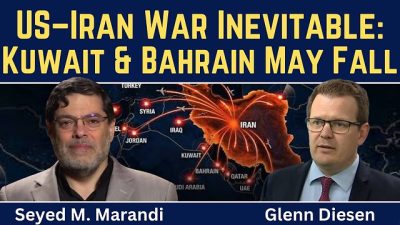
Seyed M. Marandi: US-Iran War Inevitable: Kuwait and Bahrain May Fall
or go to
Aletho News Archives – Video-Images
From the Archives
Oil and the Israel Lobby
Reknowned economist M. Shahid Alam offers this excellent critique of Noam Chomsky’s defective analysis of the relative influence of Oil versus the Israel lobby over US foreign policy: … continue
Blog Roll
 Aletho News
- ICC ignored ‘very well-documented’ NATO crimes – ex-Libyan minister
- SNSC secretary dismisses US response to Iran’s conditions as ‘inadequate’
- Sanaa says Taiz roads open, secure for residents, warns Saudi forces
- Iraqi resistance group urges Saudi leadership to admit defeat, lift Yemen siege
- Trump’s Retreat: How Al-Aqsa Flood Took Down the US Empire
- Israel’s Military Actions in Lebanon Grossly Violate International Law — Lavrov
- Seyed M. Marandi: US-Iran War Inevitable: Kuwait and Bahrain May Fall
- Leaders Condemn Ansarallah Attack on Saudi Arabia While Ignoring Illegal War Against Yemen
- Leaked: Britain’s Covert Iraqi Psyops Network
- Yemeni Armed Forces Warn Airlines Against Using Saudi Airports, Exempt Mecca and Medina
- If Americans Knew
- After Oct 7, IDF policy allowed civilian casualties for even the lowest-ranking targets
- Israel’s Destruction of Southern Lebanon Intensified After the Cease-Fire
- The Last-Minute Decision That Gave Israel Its Name
- The American Conservative: How Trump Made the World Go Nuclear
- Meet the US generals and admirals advancing Israeli policy
- Opinion: Why news organizations should boycott Israel
- The Israeli witch hunt of Sami Abu Shehadeh exposes the lie of the ‘Jewish and democratic’ state
- No state has a ‘right’ to exist – least of all Israel
- Testimonies about Gaza’s civilian death toll expose Israel’s atrocities – Daily Update
- How Israel Conquered the Latin American Right
- No Tricks Zone
- Germany’s Green Energy Debacle: High Energy Costs Force Kahla Porzellan to Close After 182 Years!
- New Study: 50 Years Of The Most Aggressive ‘Net Zero’ Policies Can Only Affect The Global Climate By 0.03°C
- US September “Heat” Was No Record…Many Records Set Decades Ago
- Latest European Green Energy Debacle; Portugal’s Largest Flagship Solar Park Insolvent!
- Green Energy Debacle: German Expert Professor Fritz Vahrenholt Warns Of Severe Economic And Social Consequences
- Two More Paleo Reconstructions Affirm Meters-Higher Sea Levels Across Ireland, Brazil 7000-6000 Years Ago
- New Study: Earth And Venus Surface Warmth Largely Explained By Convection And Lapse Rate, Not CO2 Or Radiation
- 2025 Nature Paper Claiming Worsening Global Drought Gets RETRACTED …Heavily Flawed
- New Study: ‘Global Drought Shows No Detectable Recent Acceleration Under Climate Warming’
- Economic Masterminds: German Socialists Suggest Taxing Productivity Gains Stemming From Using AI

