Romania will move its embassy in Israel to Jerusalem, Prime Minister Viorica Dancila announced at the AIPAC summit in Washington on Sunday, in a controversial move that goes against the rest of the European Union.
Speaking at the Israel lobby group American Israel Public Affairs Committee’s (AIPAC) conference, Dancila said Romania intends to relocate its embassy from Tel Aviv to Jerusalem, which she referred to as Israel’s capital, in a move that follows the US’ controversial decision to do so last year.
Most nations with diplomatic relations with Israel have their embassies in Tel Aviv, as, although Israel claims Jerusalem as its capital, it is not recognized as such by the international community. Palestinians want East Jerusalem as their future capital, and Israel has occupied East Jerusalem since the 1967 war, when it annexed the area from the rest of the West Bank.
Dancila is currently president of the Council of the European Union and the move is a marked departure from the position held by the rest of the EU. Romania, along with Hungary and the Czech Republic, reportedly blocked an EU resolution objecting to the US embassy move, which said Jerusalem should be capital of both Israel and Palestine.
Israeli Prime Minister Benjamin Netanyahu asked Dancila to move Romania’s embassy when she visited Israel in January. “I hope you will act to stop the bad resolutions against Israel in the European Union,” he said. “And also, of course, to move your embassy and other embassies to Jerusalem.”
Romanian President Klaus Iohannis called for Dancila to resign last April after she pushed a secret memorandum to move the embassy without consulting him, and after she went on a state visit to Israel without consulting him. As president, Iohannis is in charge of foreign policy and has the final decision on such moves.
Speaking before another meeting between Romania and Israel in November, Netanyahu explained some of the reasons they enjoy good relations: “We cooperate in matters of security, anti-terror. Romania stands often with Israel in difficult diplomatic arenas and we appreciate this. We recognize our friends and we consider Romania a great friend.” Netanyahu also referred to their shared concerns about “radical Islam.”
The president of Honduras also told AIPAC it would open diplomatic representation in Jerusalem, and hinted that if AIPAC would lobby on behalf of his country, he would consider opening an embassy too, Haaretz reports. Brazil has also said it will consider moving its embassy. Guatemala is the only country apart from the US to have moved its embassy to Jerusalem so far.
March 24, 2019
Posted by aletho |
Ethnic Cleansing, Racism, Zionism, Illegal Occupation | Israel, Palestine, Romania, Viorica Dancila, Zionism |
Leave a comment
On Thursday President Trump announced that the United States should recognize Israel’s sovereignty over the Golan Heights. Israel seized the Golan Heights from Syria in 1967 and effectively annexed it in 1981. The New York Times and The Wall Street Journal characterized Trump’s move as a favor to Netanyahu who is facing a challenge for reelection and Netanyahu called it a “Purim miracle.”
Despite any boost this may give to Netanyahu’s reelection, the effort to persuade Trump to endorse Israel’s claim to Golan began well before Netanyahu’s campaign and was described by Israeli Intelligence Minister Israel Katz as “topping the agenda” in US/Israeli diplomatic talks in May 2018.
Trump’s announcement contravenes the 1981 UN resolution passed in reaction to the annexation and co-written by the United States, that: “The Israeli decision to impose its laws, jurisdiction and administration in the occupied Syrian Golan Heights is null and void and without international legal effect.”
At least at the moment, action by the US is unlikely to change the European Union or Russia ’s support for the UN resolution and both announced that they would not change their positions on the Golan Heights without a UN declaration. Iranian Foreign Minister Javad Zarif, tweeting from a meeting with the Organization of Islamic Cooperation, said all the ministers were shocked by Mr. Trump “continuing to try to give what is not his to racist Israel: first al-Quds [Jerusalem] & now Golan.”
It is unclear how Trump’s twitter declaration on its own can change the U.S.’s official position on Golan. But his avowal may soon be law, Senators Cruz and Cotton along with Representative Mike Gallagher who each applauded the president’s move, introduced legislation in the House and Senate to formally “recognize Israel’s sovereignty over the Golan Heights.” Importantly, the proposed bill includes the Golan Heights as part of Israel in any spending and trade bills and approves joint scientific, industrial and agricultural projects in the occupied territory.
Since 1981, Israel has treated the Golan as a resource rich part of its country. The Golan provides over a third of Israel’s fresh water. And the Golan has provided Israel’s first major oil find. Afek Oil and Gas, a division of Genie Oil has obtained oil rights for the huge oil fields in the Golan Heights. In October 2015, October 2015 Afek Oil and Gas confirmed the discovery of vast oil reserve oil in the Golan Heights. Genie Oil has powerful political connections. Keith Murdock, Vice President Cheney, Michael Steinhardt Jacob Rothschild and Larry Summers are among its Board Members.
Despite Genie’s influence, under current conditions, Genie’s Israeli subsidiary can not sell any oil it extracts from the Golan on the international oil market because that would violate UN resolutions. However, if Washington declares Golan to be part of Israel, then oil could be legally traded with the US. Russia Today speculates that “Genie Energy’s investments in the Golan are likely the strongest factor pushing the U.S. towards the recognition of Israeli sovereignty over the occupied territory.”
March 24, 2019
Posted by aletho |
Ethnic Cleansing, Racism, Zionism, Illegal Occupation | Israel, Syria, United States, Zionism |
Leave a comment
The U.S.-Israel Directed Energy Cooperation Act would deepen Israel’s access to grotesque weapons of war that have been developed by the US military but have also been banned for use by American troops
WASHINGTON — Last Thursday, Reps. Ted Lieu (D-CA) and Elise Stefanik (R-NY) introduced the “U.S.-Israel Directed Energy Cooperation Act,” which would authorize “the Department of Defense to carry out bilateral cooperation with Israel to develop directed energy capabilities,” according to a press release.
Directed energy weapons include laser weapons and particle beams; they are highly destructive but embraced by militaries for their “infinite magazines” and “incredible speed and range.”
More specifically, the bill — which is identical to a bill of the same name that Lieu and Stefanik introduced last year but failed to pass — would allow the Pentagon “to carry out research, development, test, and evaluation activities, on a joint basis with Israel, to establish directed energy capabilities that address threats to the United States, deployed forces of the United States, or Israel, and for other purposes.”
Arguably more troubling is the fact that this bill would deepen Israel’s access to grotesque weapons of war that have been developed by the U.S. military but have also been banned for use by American troops. For instance, in the late 1990s, the U.S. and Israel collaborated on the “Nautilus” program that created lasers that cause permanent blindness in those targeted by literally “melting the eyeball.”
Though the “Nautilus” lasers were banned for use by the U.S. under the Clinton administration because they could cause permanent blindness, they were nevertheless shared with Israel’s government. A spokesman for U.S. Army Space and Strategic Defense Command, John Cunningham, at the time told the Washington Report on Middle Eastern Affairs that the decision to share the technology with Israel had not been made by the command — which was the lead agency overseeing the program — and instead stated that “We are taking our orders from the Secretary of Defense [William Perry] and President Clinton.”
The “Nautilus” lasers were later shelved for use as missile defense by Israel in 2006, despite the U.S. and Israel having spent $300 million, owing to the “prohibitive cost” of their operation. However, Israel has continued to use the highly experimental technology to develop a new system it claimed was on the “verge of completion” this past December.
In light of this current bill, it is important to revisit the “Nautilus” example, as it clearly shows that the U.S. government, in past “collaborative” efforts, has provided experimental, hi-tech weapons to Israel even when they are so controversial, potent and deadly that the U.S.’ own military is banned from using them. This point is even more troubling when one considers that Israel regularly tests its experimental and newly developed weapons on Palestinians, including civilians, who live in the blockaded Gaza Strip and the occupied West Bank.
U.S. to subsidize Israeli arsenal
While it has been touted as a means of “jointly” researching directed energy weapons, the text of the bill reveals that it would be used to funnel U.S. taxpayer funds to subsidize Israeli directed energy weapon research in Israel.
For instance, the bill states: “The Secretary of Defense is authorized to provide maintenance and sustainment support to Israel for the directed energy capabilities research, development, test, and evaluation activities authorized.” It then states that Israel’s financial contribution to said research would not necessarily need to be equal to the U.S.’ contribution, but merely “an amount that otherwise meets the best efforts of Israel, as mutually agreed to by the United States and Israel.”
Furthermore, the “memorandum of agreement” between the two countries states that the bill would require “the United States Government to receive semiannual reports on expenditure of funds, if any, by the Government of Israel, including a description of what the funds have been used for, when funds were expended, and an identification of entities that expended the funds.” This passage strongly suggests that the research will take place in Israel under Israeli government supervision.
The bill is part of a recent congressional effort to mandate close cooperation between the Israeli and U.S. governments in sensitive technology, despite Israel’s history of using such collaboration to steal state secrets. For instance, a widely overlooked provision of the United States-Israel Security Assistance Authorization Act of 2018 — which was nearly passed but ultimately blocked last year in the Senate by Rand Paul (R-KY) — would have mandated that the National Aeronautics and Space Administration (NASA) work closely with the Israel Space Agency (ISA) “to identify and cooperatively pursue peaceful space exploration and science initiatives in areas of mutual interest.”
The provision was included despite the fact that an Israeli postdoctoral student, Amir Gat, at Caltech had illegally transmitted to Israel classified information on NASA technology. Gat is now employed by an Israeli state-run research institution.
Considering the source(s)
This current bill appears not to provide any direct benefit to the United States and, instead, promises to be a way of subsidizing hi-tech weapons research of an allied government that regularly commits war crimes. Though Rep. Lieu has claimed that the legislation is an “opportunity” for the U.S. and would “save lives,” it seems that the $31,850 Lieu received from the pro-Israel lobby just last year may have swayed his opinion.
Yet, in contrast, the bill’s other sponsor, Rep. Stefanik, has not received such largesse from the Israel lobby. Instead, Stefanik is connected with and used to work for the country’s most notorious and zealously pro-Israel neoconservatives, when she served as communications director for the Foreign Policy Initiative (FPI). FPI was founded in 2009 by neoconservatives Robert Kagan and Bill Kristol as the successor to the Project for a New American Century (PNAC), which had fallen into disrepute for its role in promoting — and some argue helping to plan — the Iraq War. Yet, Stefanik’s association with neoconservatives goes beyond her association with FPI, as neocon National Security Adviser John Bolton endorsed her re-election campaign bid in 2017.
Given the lack of benefit for the U.S. — and Israel’s history of war crimes and testing its newly developed weapons on disenfranchised Palestinians in blockaded Gaza or the occupied West Bank — this bill is a perfect example of yet another “Israel first” bill now making its way through the U.S. Congress.
Whitney Webb is a MintPress News journalist based in Chile. She has contributed to several independent media outlets including Global Research, EcoWatch, the Ron Paul Institute and 21st Century Wire, among others. She has made several radio and television appearances and is the 2019 winner of the Serena Shim Award for Uncompromised Integrity in Journalism.
March 23, 2019
Posted by aletho |
Ethnic Cleansing, Racism, Zionism, Militarism, Timeless or most popular, War Crimes | Gaza, Israel, Palestine, United States, West Bank, Zionism |
Leave a comment
Hubris grips Israel. Absolute power has had its usual effect of absolute corruption, of morality, legality, and justice as well as the money deals that have enriched corrupt Israeli politicians.
No one dares stop Israel. Not the UN and not western governments. They can but they don’t or they won’t. Israel can kill Palestinians on the West Bank, in Jerusalem, in Gaza, without any meaningful intervention by the ‘international community.’
On the West Bank, a corrupt Palestinian Authority has done much of its dirty work, administering the occupied territory on behalf of the occupier, not the occupied. In East Jerusalem, it has acted as the conduit for the sale of Jerusalem properties to Zionist settlers, with straw men, Palestinians, and bogus companies set up to transfer properties without owners knowing that the real purchasers are Zionist settlers.
Most of the money for these purchases comes from the US, where Donald Trump has now followed up his “recognition” of Jerusalem as Israel’s capital with his “recognition” of the occupied Golan Heights as sovereign Israeli territory.
He did this in a tweet, without telling the relevant arms of his own administration beforehand. The State Department was taken by surprise and so was everyone else, except the Israeli government. It knew because Trump had passed on the word. Behind the scenes, John Bolton and the US ambassador to Israel, David Freedman, effectively Israel’s American ambassador to Israel, worked to set this up.
The parallel to Trump’s unilateral White House action is US recognition of Israel in 1948. Because of the probability of extreme bloodshed, early in 1948 the US had backed away from the 1947 partition plan and was seeking a UN trusteeship over Palestine. That was the policy followed until Truman upended it on May 14 by recognizing Israel de facto, without informing the State Department or the US delegation at the UN.
The UN Secretary-General had been informed, and it was in the wastepaper basket in his office that the screwed-up ticker tape message sent to him was found. The US delegation ’s head, Warren Austin, was so disgusted he walked out of the UN building and left it to his deputy to make the formal announcement of recognition. The enraged Cuban delegation threatened to pull Cuba out of the UN.
The US has never been an honest broker but at least in the 1940s and 1950s, there were sensible people who recognized the great dangers for the US in supporting Zionism and the state of Israel.
Loy Henderson, a senior State Department official, responsible for Middle Eastern policy, wrote that support for a Jewish state would violate US policy of allowing a majority vote by the population of any territory to determine its form of government.
He warned that support for Israel would involve the US “in international difficulties of so grave a character that the reaction throughout the world as well as in this country will be very strong.”
Secretary State George Marshall opposed partition and wrote that if Truman recognized Israel, he would vote against him in the next elections.
Truman’s double-dealing was to repeated by Lyndon Johnson in the 1960s when he told the Israeli ambassador, Yitzhak Rabin, that he need not worry about being forced into signing the nuclear-non proliferation treaty in return for the supply of US planes and tanks.
Johnson would make sure they would be provided without any conditions, blindsiding his own officials, who thought they were going into negotiations with a strong hand, only to be treated with discourtesy by Rabin.
Israel got the lot then, the tanks and the planes and the freedom to develop nuclear weapons without having to sign the NPT, and it has got the lot ever since. Military and economic grants have now reached unprecedented levels. On top of the $3.8 billion aid, Israel will receive for 2019 it is now the beneficiary of a ten-year $38 billion ‘defense’ package, signed into law in August 2018.
These sums of money, enabling the occupation of Palestine and the killing of Palestinians, are augmented by smaller grants, $50 million here or $50 million there, the icing on an enormous and very tasty cake. Israel still has the freedom to develop nuclear weapons without US interference.
In December 2017, Donald Trump “recognized” Jerusalem as Israel’s capital, on the same day that Zionist snipers were killing unarmed Palestinians along the Gaza fence line. He has now followed this by “recognizing” the Golan Heights as sovereign Israeli territory.
The banality of the man is summed up in the means of communication, not a White House press conference, not a State Department communique, but a tweet, the same conduit he uses for talking about his children or abusing his political opponents or telling the world how great the Mexican wall will be.
Of course, there can be no “recognition” because both East Jerusalem (‘at least’ as there is no good reason to separate the occupation of the east in 1967 from the occupation of the west in 1948) and the Golan Heights are occupied territories in fact and under international law.
With these two announcements, the US has finally ruled itself out as any kind of honest broker between Israel and the Palestinians. It never has been, of course. Some presidents tried hard to bring balance into the relationship – Jimmy Carter for example – but all eventually caved in.
The Golan Heights is part of Syria. In 1967 it was seized by Israel during its war against Egypt and Syria. This was no “pre-emptive” attack as the Zionists have claimed ever since but a blitzkrieg aimed at destroying Arab military capacity, destroying Egypt’s leader, Gamal Abd al Nasser and seizing the rest of Palestine.
The seizure of the Golan involved the expulsion of 90,000-130,000 Syrians and Palestinians. Some fled, others were driven out but, just like 1948, no one was allowed back. About 100 villages were destroyed and ploughed over.
In 1974, after a war which Egypt and Syria would have won on the battlefield had not Anwar al Sadat betrayed the Syrian president, Hafez al Assad, new lines of demarcation were drawn up on the Golan, leaving about 70 percent in the hands of the Zionists.
Before withdrawing from some of the territories they had occupied, Zionist units deliberately destroyed the city of Quneitra. It was never rebuilt, the ruins standing as testimony to the complete bastardry of the army which had occupied it.
Since that time Israel has filled the occupied Golan with about 30 settlements and 25,000 settlers. Archaeological relics are plundered, the Golan’s vital water resources are drained off and Israeli and foreign tourists contribute to the economy of occupation. In recent years the occupied Syrian communities, mainly Druze, have had to put up with wounded terrorists being transported across their land from Syria to receive treatment in Israeli hospitals. On occasion, they have attacked these convoys. Most Druze remain committed to their Syrian identity.
In his tweet, Trump wrote that the “recognition” of the occupied Golan as Israeli is important to “regional stability.” The opposite is true, of course. ‘Regional stability’ is even more seriously threatened. With these announcements, Trump has put his administration entirely in Israel’s pocket.
Trump may well give Netanyahu’s election prospects a boost by turning his tweeted intention into a formal policy statement before the Israeli elections in early April. Both the Jerusalem and the Golan declarations, however, are a sign that Israel and its lobbyists in the US have seriously overplayed their hand and that in buckling to their pressure, Trump has worsened Israel’s standing in the US.
The US groveling to Israel over many decades would now seem to have reached its apogee. All that remains is the plan being cooked up by Trump, John Bolton, Jared Kushner, and David Freedman, in continuous consultation with the Israeli government, to bury the Palestinian question forever.
Americans are aware more than ever of how Israel dictates US foreign policy. Jewish Americans know it in increasing numbers, especially on university campuses. They have the same moral consciousness as anyone else and are appalled by Israel’s atrocious record over many decades. They are distancing themselves both from Israel and Zionism and of course, they completely abhor the Netanyahu government and Israel’s even more openly racist and fascist parties.
Two Muslim members of Congress have recently sharpened the debate with exposure of the lobby’s vote-buying political influence. Senior Democrats, including Bernie Sanders and Elizabeth Warren, have declared they will not be attending the annual AIPAC conference in Washington on March 24-26. In years gone by, such defiance by a US politician would be regarded as suicidal but not now. This is partly the measure of how the wind is blowing in the US.
Trump’s two declarations end all illusions. Even in the minds and the hearts of those who desperately cling to the hope of a genuine peace process, there can surely be no hope left. One would have to be completely deluded to see something in nothing. What is left is surrender or resistance. Either you or us. Not a peace of the brave as pronounced on the White House lawns in 1993 but a peace of the grave.
Many Palestinians never thought peace with Israel was possible. They have been proven right. Those who continued to place their trust in the “international community” or in the application of international law or the bona fides of the Israeli government have been proven wrong. George Habash read the situation correctly back in the 1950s and 1960s. Hasan Nasrallah reads it correctly now.
The abandonment by the US of the remnants of a peace process that was never a peace process in the first place creates grave dangers, not regional stability, especially when taken in the context of a possible Israeli war with Hizbullah or Iran or on both of them.
The US has left the supporters of a genuine peace process with nothing in their hands. There is no two-state solution in sight, only a bogus one-state ‘solution’ which turns all of Palestine into Netanyahu’s apartheid Jewish state.
If Palestine, any part of it, is to be redeemed, only the option of force seems left for those who will not surrender. After more than seven decades of chicanery, lies, and brutality from Israeli governments, this conclusion would be self-evident.
It is not a question of wanting it or wishing for it. Force is abhorrent but there has never been a time in history when an occupied people have not resisted the occupier to the utmost limits of their endurance.
Both the Palestinians and the Zionists conform to the historical pattern, one as the occupied and the second as the occupier. Israel thinks it can break the Palestinians down by the application of brute force but after more than seven decades it has still not succeeded. Instead, in the minds of many, it has only strengthened the lesson that what has been taken by force, ultimately can only be taken back by force.
When there is no peace, no remote possibility of peace, the pendulum must swing back to war. When it comes, and sooner or later it will come, Israel is going to take such punishment that it might finally see reason, if by then it is not too late to see reason. It would be better to see reason before the event but that is not going to happen.
Hizbullah has the capacity to inflict great damage on Israel. The Iron Dome and the Arrow anti-missile ‘defense’ systems will stop only a fraction of the volume of missiles that will pour into Israel in the event of war with Hizbullah or the war with Iran which Netanyahu has wanted for years. Even Hamas now says it has rockets that can reach any part of Israeli territory. Even if Israel ‘wins’, a nebulous concept in the context of such a destructive war, it will be seriously wounded.
Israel’s greatest defense system would have been to reach a generous settlement with the Palestinians long ago but what it has actually settled for is ideology, the fulfillment of the Zionist dream that is a Palestinian nightmare, and the continued theft of Palestinian land over the security of its Jewish citizens.
They are in the Middle East and want to stay there. They want a future for their children, but what kind of future is on offer from Israel’s racist politicians, settlers and rabbis? The answer? The same kind of violent future that is on offer for the Palestinians. Is this the choice any sane person would want to make?
March 23, 2019
Posted by aletho |
Ethnic Cleansing, Racism, Zionism, Timeless or most popular | Hezbollah, Israel, Middle East, Palestine, Syria, United States, Zionism |
Leave a comment
The State Department’s just issued annual Human Rights Report for 2018 is a disgrace, a document so heavily politicized by Secretary of State Mike Pompeo and his crew of hardliners that it might be regarded as a model in how to make something that is black appear to be white. Which is not to say that it is not cleverly composed, quite the contrary, but it uses its choice of words and expressions to mitigate or even dismiss some actual human rights abuses while regarding as more grave other lesser offenses to make political points. And then there is what it does not say, deliberate omissions intended to frame situations in terms favorable to America and its dwindling number of friends in the world.
Not surprisingly, the region that has received the most massaging by the authors of the report is the Middle East, where an effort has been made to depict Israel in a positive light while also denigrating the Palestinians and Iranians. The language used regarding Israel’s occupation of much of the West Bank and the Golan Heights has been particularly welcomed by the government of Prime Minister Benjamin Netanyahu and also by the Israeli media. The word “occupation” or “occupied” to describe the status quo of those areas administered by the Israeli military has been dropped in favor of “Israeli controlled.” The difference is important as occupation has specific legal implications defined by the Geneva Conventions in terms of what the occupying power can and cannot do. To starve and dispossess the Arab inhabitants of the occupied area, as the Israelis are doing to build their settlements, is a war crime. Also, an occupation must have a terminus ante quem date whereby the occupation itself must end. It cannot be permanent.
The new language is a gift to Israel on the eve of its April 9th election and it allows incumbent Benjamin Netanyahu to claim that he is the candidate best able to obtain concessions from Washington. America’s so-called Ambassador to Israel is a former Trump bankruptcy lawyer named David Friedman who is more involved in serving up Israeli propaganda than in supporting the actual interests of the United States. He probably believes that what is good for Israelis is good for Americans.
Friedman personally supports the view that the illegal Jewish settlements are legitimately part of Israel, choosing to ignore their expansion even though it has long been U.S. policy to oppose them. He has also long sought to change the State Department’s language on the Israeli control of the West Bank and Golan Heights, being particularly concerned about the expression “occupied” which has previously appeared in U.S. government texts describing the situation in the Israel-Palestine region. Friedman now appears to have won the fight over language, to the delight of the Netanyahu government.
And the elimination of “occupied” will apparently be only the first of several gifts intended to bolster Netanyahu’s chances. Senator Lindsey Graham, who also boasts of his close ties to the Israeli Prime Minister, recently stated his intention to initiate legislative action to go one step further and compel the United States to actually recognize Israel’s sovereignty over the Golan Heights, the Syrian territory that was annexed after fighting in 1967, but which has not been recognized as part of Israel by any other country or international body.
Last Thursday, President Donald Trump announced that the Senate vote promoted by Graham would not be necessary, that he would order the State Department to recognize Israeli sovereignty over the area. This will hugely benefit Bibi and further damage America’s standing in the Middle East and beyond. Some sources are already predicting that recognition of the annexation of the Golan Heights will soon lead to U.S. government recognition of Israel’s sovereignty over much of the West Bank, both ending forever any prospect for a Palestinian state and making it clear that the United States is running a foreign policy to benefit Israel.
There is, of course, much more in the Human Rights Report. The executive summary and first section on Israel and Palestine include text that could easily have come from an Israeli government press release or been featured as an editorial in the New York Post, Washington Post or Wall Street Journal: “Human rights issues included reports of unlawful or arbitrary killings, including Palestinian killings of Israeli civilians and soldiers…From March 30 to December 5, Palestinian militant groups launched more than 1,150 rockets and mortars from the Gaza Strip toward arbitrary or civilian targets in Israel. Gaza-based militants shot and killed one Israeli soldier, and a rocket launched by Gaza-based militants killed one Palestinian laborer in Ashkelon. More than 200 Israelis required treatment from these attacks, mostly for shock. Beginning on March 30, Israeli forces engaged in conflict with Palestinians at the Gaza fence, including armed terrorists, militants who launched incendiary devices into Israel, and unarmed protesters. This occurred during mass protests co-opted by terrorist organization Hamas and dubbed a ‘March of Return.’ The government stated that since March 30 it had been ‘contending with violent attempts led by Hamas to sabotage and destroy Israel’s defensive security infrastructure separating Israel from the Gaza Strip, penetrate Israel’s territory, harm Israeli security forces, overrun Israeli civilian areas, and murder Israeli civilians.’”
A separate report section on Gaza adds “On March 30, Palestinians in Gaza launched the ‘March of Return,’ a series of weekly protests along the fence between Gaza and Israel. The protests, some of which drew tens of thousands of people, and included armed terrorists, militants who launched incendiary devices into Israel, and unarmed protesters, continued throughout the year. Hamas took control of the weekly protests, and many of the protests were violent as encouraged by Hamas.”
Interestingly, the Report does not even have a dedicated section on Iran, only providing a link to a separate document: “Read the State Department’s new report detailing the magnitude of the Iranian regime’s destructive behavior at home and abroad. The report covers Iran’s support for terrorism, its missile program, illicit financial activities, threats to maritime security and cybersecurity, human rights abuses, as well as environmental exploitation.” A second link is to a speech by Secretary of State Mike Pompeo given before the neocon group United Against Nuclear Iran: “The Iranian regime’s track record over the past 40 years has revealed it as among the worst violators of the UN Charter and UN Security Council resolutions – perhaps, indeed, the worst violator. It is truly an outlaw regime.”
Exonerating perpetual victim Israel of all its misdeeds and blaming the Israel-Palestine problem on the Palestinians while also labeling them as “terrorists” is both delusional and propaganda, not responsible analysis. Nor is damning Iran when speaking before a partisan group and falsely calling it a “worst violator of the U.N. Charter and U.N. Security Council resolutions” exactly informative. It is actually Israel that is the worst violator of U.N. Security Council resolutions, a fact that is not mentioned in the Human Rights Report.
One might well question why to write a Human Rights Report at all, but that is something that can be blamed on Congress, which ordered the State Department to prepare it. And one should note the key omission in the document: there is no admission of causality. The United States foreign and national security policies over the past twenty years have created a “human rights” disaster mostly in Asia but also elsewhere, a virtual tsunami rolling over ruined countries that has killed millions of people while also displacing millions more. In reckoning the terrible circumstances being endured by many in so many places there is no mention of the American role. And, unfortunately, there is no section in the Human Rights Report for “United States of America.
March 22, 2019
Posted by aletho |
Deception, Ethnic Cleansing, Racism, Zionism | Human rights, Israel, Middle East, United States, Zionism |
Leave a comment
The United Nations Human Rights Council has voted to adopt a report accusing Israel of War Crimes committed against civilians during Gaza demonstrations.
The report was adopted with 23 votes in favor, 8 against and 15 abstentions. Despite the statements of UK foreign Secretary, Jeremy Hunt, the UK abstained from voting against the adoption of the report.
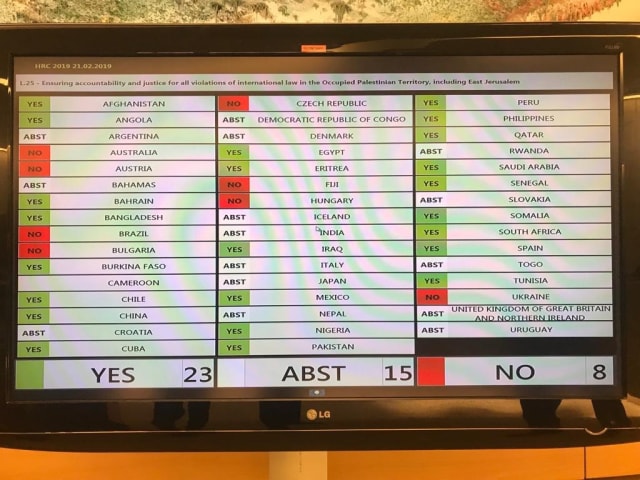
The UN report investigated the killings of 189 demonstrators, including 35 children, in Gaza, between the 30th of March and the 31st of December, 2018. The report concluded that Israel had committed serious violations of international law.
The report was instantly denounced as “biased” and “anti-Semitic” by Israel and its closest allies, according to Days of Palestine.
However, despite the slanderous comments against the UN by Israel, the report may now be taken to the International Criminal Court. The report calls for international arrest warrants to be handed out to the Israeli soldiers responsible, as well as individual sanctions to be applied to those guilty, for the illegal use of lethal force against unarmed demonstrators.
March 22, 2019
Posted by aletho |
Ethnic Cleansing, Racism, Zionism, War Crimes | Israel, Palestine, United Nations, Zionism |
Leave a comment
An Israeli report said that Egypt has put forward a plan for a settlement between Israel and Palestinian factions in the Gaza Strip, led by Hamas, which controls the Gaza Strip. Israel Hayom newspaper reported on Thursday that “according to security sources in Egypt and Palestinian officials in Gaza and Ramallah, Israel and Egypt have become convinced that Hamas’s control in Gaza is a self-evident fact.”
Israel Hayom quoted Egyptian security sources and Palestinian officials in the West Bank and Gaza Strip. It explained that the Egyptian proposal stated that they would disarm the factions – except for light weapons – in exchange for lifting the siege on the Gaza Strip.
According to this plan, all internal affairs will remain in the hands of Palestinian organisations headed by Hamas or a unified political entity for all organisations in the Strip. The internal security of the Gaza Strip will be based on “Hamas National Security Forces, which are currently operating.” The arms that will be in possession of the Internal Security Forces will be light weapons, in small quantities and subject to a strict control system.
In turn, the Israeli and Egyptian siege on the Gaza Strip will be lifted, according to the newspaper. Also, projects in the areas of infrastructure, employment, economy, health and education, financed by the United Nations, the European Union and Arab countries, “led by Saudi Arabia, Qatar and the UAE,” will be implemented. The plan calls for the opening of a maritime route to the Gaza port, which will allow in the first stage the export and import of goods directly to the Gaza Strip.
The newspaper asserted that “these parties have succumbed to the fact that the Palestinian Authority will have difficulty in regaining control in the Gaza Strip, whether after an internal Palestinian reconciliation, or because of the collapse of Hamas rule against the backdrop of the grave humanitarian situation, or because of the continued military confrontation with Israel.”
According to the newspaper, Egyptian sources stated that the Israeli policy towards the Strip is “soft,” and that this stems from Israel’s unwillingness to allow the “Hamas regime” to collapse and in anticipation that in the event of Hamas’s collapse, “extremist groups loyal to Iran or Salafist groups similar to Daesh will enter” to fill the vacuum.
The newspaper further said that estimates in Israel and Egypt indicate that “such a settlement can be implemented within three to five years, but the main obstacle is that Hamas and other Palestinian armed factions will oppose disarmament.”
Quoting sources it described as officials in Ramallah, the newspaper added that Palestinian Authority President Mahmoud Abbas and the PLO leadership would agree to “overthrow” Hamas and the factions in Gaza “only in case it led such a process when the control of Gaza is in the hands of the Palestinian Authority.”
The newspaper asserted that US security bodies obtained a draft of the plan which was formulated by Israeli and Egyptian crews. It quoted an Egyptian security official saying: “We are currently waiting for the new government to be elected in Israel to speed up the process; while the goal after the Israeli elections is the entry of other influential Arab countries, such as Qatar, Saudi Arabia, Jordan and the UAE.”
The Egyptian security official added that “if Abu Mazen and the leadership in Ramallah do not put obstacles, the plan can be put into effect with the full cooperation of all the regional actors and through providing guarantees and assistance by the international community. But, it is estimated that there will be strong opposition to the disarmament plan of the Gaza Strip by the PLO and mainly by the armed factions in Gaza.”
March 22, 2019
Posted by aletho |
Ethnic Cleansing, Racism, Zionism, Subjugation - Torture | Egypt, Gaza, Hamas, Israel, Jordan, Palestine, Qatar, Saudi Arabia, UAE |
Leave a comment
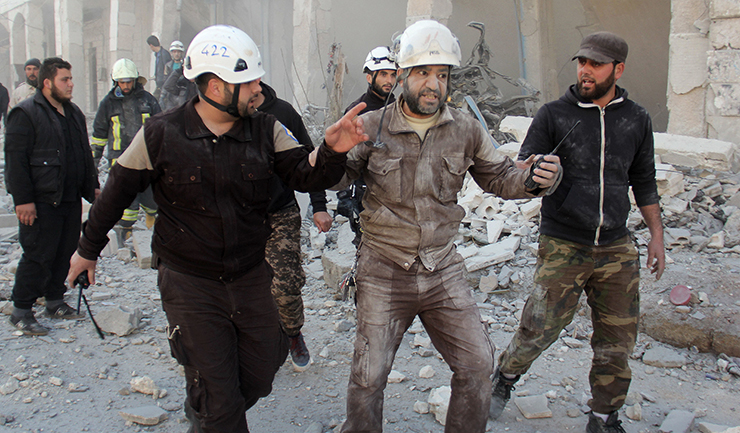
During the recent Third Conference on Supporting the Future of Syria, in Brussels, the USA decided to allocate $5 million to the White Helmets, a decision which has once more turned the spotlight onto that organization.
It first emerged in 2013, under a banner of political neutrality: a non-partisan NPO formed of volunteers who carried out humanitarian missions, and its members were promptly branded as heroes by the media. They were represented as people who rushed to rescue their fellow citizens in the face of savage bombing raids by government forces: saving lives, providing first aid etc.
According to the White Helmets, its volunteers have “saved” some 115 thousand people in the years since the organization was founded. This figure was taken at face value by Western officials and media, and has been endlessly repeated.
In addition to their humanitarian mission the “rescuers” prepared various materials from the front lines of the conflict in Syria. They posted photographs and videos of bombed hospitals, schools and mosques on their social media accounts as evidence of the “evil” of the Damascus regime. They focused on producing content that would touch viewers in the West on a raw nerve. So they emphasized, above all, the suffering of Syrian children: the victims of shooting, bombing and other horrors of war.
All these materials were directed at a mass audience, and their creators were highly praised and awarded a number of international prizes. In 2015, for example, the White Helmets were awarded the Alternative Nobel Peace Prize – worth approximately € 50,000. The film The White Helmets won an Oscar in 2018 for the Best Short Subject Documentary.
Nevertheless, all this tub-thumping is unable to hide certain inconvenient facts. Particularly, the fact that, ever since the organization’s brigades first appeared on the scene they have operated exclusively in areas outside the control of the Syrian government and controlled by armed opposition groups, including DAESH and the Al-Nusra Front.
These groups punished the slightest insubordination in the areas they controlled. The White Helmets’ claims that they remained politically independent when active in these areas are therefore rather unconvincing. Their members accepted the new status quo and were loyal to the militants, which naturally played into the militants’ hands.
According to experts from a number of different countries, members of the White Helmets were drawn into the conflict In March 2017 on the side of the armed opposition groups, and provided them with various kinds of support. In March 2017, Abu Jaber, one of the leaders of the Al-Nusra Front expressed his sincere thanks to the White Helmets, calling them the “unseen warriors of the revolution”. It is not for nothing that a number of Arabic media have described the organization as “White Helmets under a black flag”.
That did not prevent their sponsors from the West and the Middle East from generously financing their activities. The organization’s director admits that it has received money from government and private donors in the USA, the United Kingdom, the Netherlands and a number of other European countries as well as Turkey, Qatar and other Persian Gulf states.
The largest donor has been the United States Agency for International development (USAID), which paid the White Helmets at least $23 million between 2013 and 2016.
The special services also lent a helping hand. One of the movement’s founders and inspirers is James Le Mesurier, a former British intelligence officer and soldier who has fought in Bosnia, Kosovo and the Lebanon. He is the head of the Mayday Rescue Foundation which supported the White Helmets using funds it received from donors, including $4.5 million from NGOs in the Netherlands and the same amount from donors in Germany.
The activists did their best to earn the funding and donations they were given.The organizations posted false reports on its social network accounts. It actively took part in a public relations campaign accusing the Syrian authorities and their allies of using chemical weapons.
The USA and its allies cited the materials fabricated by the White Helmets. These materials were used in meetings of the UN and the Organisation for the Prohibition of Chemical Weapons to prepare the ground for resolutions and other measures, including military intervention, against the Syrian government.
The White Helmets played a very underhand role as agents provocateurs, by fabricating chemical weapons attacks in the town of Khan Shaykhun, in Idlib Province on 7 April 2017, and in East Douma in April 2018. There was no proof of responsibility, but that did not prevent the USA from attacking the Syrian air base of Shayrat in response to the first of these incidents, after which the USA, the UK and France launched missile attacks against a number of targets in Syria which were allegedly connected with the manufacture of chemical weapons.
As the rebels have lost territory in Syria, the areas in which the White Helmets operate has been reduced. The situation has changed dramatically, and in 2018 the organization went through a “very difficult time”, as Raed Saleh, the head of the group has acknowledged.
In June 2018 the Israeli army helped with an urgent evacuation of several hundred so-called rescuers belonging to the White Helmets from Syria, along with their families. Many of the countries that supported the organization declared that they were ready to accept these refugees and provide them with support.
The story of the White Helmets is an example of a new kind of media project: one with a strong humanitarian element, which unfolds in front of the public’s eyes. This project was launched following the failure to topple the Syrian government, as had been done in Libya. When it became clear that Bashar Assad’s presidency was not about to collapse, then his opponents initiated a long-drawn-out siege. And one of their main weapons was the White Helmets, with foreign support.
The White Helmets now resemble a terminally ill patient who is confined to bed and scarcely breathing. Now that the terrorists have been defeated in most parts of Syria, the organization has exited the stage – the only region where its members are still partially active is Idlib Province, which is not yet under government control.
But will the latest grant of funds, which the US lobbied for in the Brussels conference on Syria, be able to help save this chronic invalid? It seems unlikely. On the contrary, it will merely go to prove, once again, who the White Helmets are supported by, and whose interests they really represent.
Yury Zinin, Leading Research Fellow at the Moscow State Institute of International Relations.
March 22, 2019
Posted by aletho |
Deception, False Flag Terrorism, Timeless or most popular | Israel, Syria, UK, United States, USAID |
Leave a comment
Speech by Hezbollah Secretary General, Sayed Hassan Nasrallah, on March 8, 2019, on the occasion of the 30th anniversary of the Foundation to Support the Islamic Resistance.
Transcript:
[…] The US sanctions and financial siege that we currently experience, along with being added to the list of terrorist organizations, and lately, the British decision to add Hezbollah’s political wing to their own list of terrorist groups, and the consequences of all these measures – because in the past, they have already added our military branch, as they say, on the list of terrorist organizations, and a few days ago, they added the political branch, according to their (purely artificial) distinctions… In this respect, when we speak of US sanctions, we should expect them to become even more severe, both against those who support us and against us, that is to say against the Islamic Republic of Iran, against Syria, and against all Resistance movements and the Resistance Axis, and against us (Hezbollah).
In Lebanon, they intervened on the issue of the banks (operating here), and they have imposed a siege and severe restrictions on them. They made a list of merchants, businesses, associations and groups considered as terrorists, and prohibiting any financial or bank transaction with them. They also included a number of Lebanese personalities and traders on the sanctions list. And this can continue. We’ll (probably) see the names of new people and organizations (on the sanctions list), new restrictions, etc. (Our enemies) will continue on this path.
This is in regard to US sanctions.
On the other hand, we will also be faced with a proliferation of lists of terrorist organizations. For example, since when the Gulf countries have a list of terrorist organizations? It is only in recent years that they have created such lists. Elsewhere too, there are countries that come to create their list of terrorist organizations, or who already had such a list, and add us on it, as did Britain, and we must also expect that other countries do the same, and place Hezbollah on its terrorist list and describe it as such. Therefore, it is a trend that will continue.
But how should we consider this trend and these measures? We can think of them as specific acts unrelated to the past or the future, or we can consider them as a global and continuous process, embracing the present, past and future. The second perspective is the right one.
Why? Because it allows us to understand precisely what these measures mean, in what context they fit and what are their goals, which allows us to face them and not allow these objectives to be achieved. And this is the responsibility of all members and supporters of the Resistance (Hezbollah). It is the responsibility of the Resistance, its members and their families, its masses, its popular base and its supporters, anyone who is part of this historic humanitarian movement in our region, not only in Lebanon.
In what context (do such sanctions fit)? We must understand that we are (indeed) oppressed (by these unjust sanctions), (but it is because) we are the strongest (that they were imposed on us). We are not weak and oppressed: (rather), if they attack us (that way), it’s because we are the strongest. We are oppressed and triumphant. How is that?
Since 1982 and to this day, the United States and Israel, which have their US-Zionist hegemony project on our region, our country, our choices and our sovereignty throughout the region, since 1982, they suffered defeat after defeat, successive defeats for their projects and greed. It is a clear reality, and we talked about it a lot in the past. As a brief reminder, without stopping on each point, let us recall for example:
1/ The 1982 invasion was within the framework of a US-Israeli plan for Lebanon, Palestine, (all of) the region and the (final) settlement of the (Arab-Israeli conflict). Who curbed, neutralized and frustrated this project by inflicting it a (stinging) defeat? The movements of Resistance in Lebanon, and I don’t mean only Hezbollah: Hezbollah, the Amal movement, patriotic parties, Islamic movements, the various factions of the Resistance, with support from Syria and Iran.
2/ From 1982 to 1985, and with all the events that occurred afterwards, this project collapsed.
3/ In 2000, the (historic) defeat of Israel in Lebanon.
4/ After that, the Israeli withdrawal from the Gaza Strip.
All this has destroyed the project and dream of Greater Israel. I have already spoken in detail of all this, and there is no need to say it all again.
5/ In 2006, and even before, with the arrival of the Neo-conservatives in power in the United States, there was a massive US plan to regain control of the entire region. They began with the invasion of Afghanistan, the occupation of Iraq, the attempt to besiege Iran and isolate Syria, to liquidate the Palestinian cause and deal a fatal blow to the Resistance in Lebanon and eradicate it in 2006. The successful steadfastness of Hezbollah in Lebanon in 2006, of the factions of the Resistance in Gaza in 2008, and of Syria and Iran, have thwarted this huge and dangerous project that threatened our region.
6/ In 2011, the project of destruction of what I call the backbone of the Resistance camp in our area, namely Syria and the Syrian state.
7/ A few years after that, they returned to Iraq via ISIS and have targeted the entire Resistance Axis.
8/ They continued their pressure on Lebanon, Palestine and the Palestinian people.
9/ They launched an atrocious war against our brothers in Yemen.
10/ Not to mention the occupation of Bahrain, etc.
All this is part of the American-Israeli hegemony project. I have already said in the past that many regional countries were instruments in this project (Saudi Arabia, Turkey, UAE, Qatar…).
Once again, the Resistance Axis, the countries of the Resistance and the parties of the Resistance stood up against this war and faced this project. We won the battle decisively in Iraq, we are about to do in Syria and we completely triumphed in Lebanon. In Yemen, (our brothers) still resist victoriously against the continued aggression. Gaza continues to resist against all forms of aggression and blockade. And it’s the same for the Islamic Republic (of Iran) and its endurance against the (US) sanctions. Thus, this project also failed.
I want to say, regarding the current situation and also the future, that what Trump and his son-in-law Kushner hope, that is to fulfill an historic achievement in the region through the ‘Deal of the century’ (to finally liquidate the Palestinian cause), who faces (this project and fights to defeat it)? It is the Resistance Axis, the Resistance movements, the countries of the Resistance and the Palestinian people in the first place.
Israel, in all its (strategic) annual assessments, considers Iran as an existential threat, Hezbollah as the essential and primary threat, and all the Resistance Axis, from Gaza to Syria, including Yemen, which they begin to fear (seriously), all this Axis is a subject of concern and an (existential) threat to this entity.
Therefore, we are in this context, my brothers and sisters. When they put us on their lists of terrorist organizations, when they take measures and sanctions against us, it is because we have defeated them, because we beat them, because we have foiled all their projects, because we are stronger (than them), because we are more worthy and glorious, because we are capable, because we successfully defend our choice, our sovereignty, our people, our country and our states. This is the framework. This is the framework (of these sanctions). This is by no means a framework of weakness (of the Resistance). It is not at all a framework of weakness (for us).
Today, after the failure of all these wars (against our region), it is because they are unable (to conduct other wars that they impose sanctions on us, it is their last resort)… What else could they do?
The United States came themselves (with all their strength) in our region (in Afghanistan and Iraq) and they were defeated. They came (massively) in our region in the early 2000s, they remained (many years), but they were defeated. They were defeated by the Resistance in Iraq, and today they are defeated in Afghanistan. They were defeated in Syria, and they are overcome every day in Yemen. Are they able to launch a new war?
Israel is afraid and is (even) terrified to launch any war. And we hear every day (in the Israeli media) that the Israeli army is not ready, that their ground forces are not ready (for war), etc., etc., etc. And lately, just a few days ago, what did they do? They installed the American THAAD anti-missile system. This is proof that they have no confidence in their own systems, despite their propaganda morning and evening with lots of drums and boasting, claiming for years that (the Iron Dome) was perfectly capable of protecting their home front.
Therefore, faced with their failure, and with their inability to launch a war or any other military choice, and also because their security operations and murders have not achieved their objectives – on the contrary, we became stronger, more experienced, more lucid and more determined, as indicated by this quote from Imam Khomeini repeated tirelessly by Sayed Abbas (Musawi, Nasrallah’s predecessor murdered by Israel): “Keep killing us, because it awakens the conscience of our people!” The Resistance has become stronger, more determined, the people embraced it increasingly and massively and sympathized with it, when he discovered that (even) its leaders were killed and fell martyrs (Sayed Abbas Musawi was assassinated by Israel with his wife and 5 year old son).
What is the (only option) left to our enemies? Their last resort (is sanctions). Sanctions and inclusion on the list of terrorist organizations are thus a (new kind of) war in this context (of successive defeats of our enemies). And we, my brothers and sisters, those present and those who listen to us, we have to face it as if we were in time of war. Because it is indeed a form of war. Just as there are military wars, security wars, wars of information, political wars and culture wars, (sanctions) are part of the economic, financial and psychological war (aiming to break our) morale. And therefore, we have to face this war.
Today, when we consider the (Hezbollah) situation here or there… I’ll be honest and clear, and I will tell you what I said during our internal meetings, in small committee or with thousands (of Hezbollah members by videoconference), I’ll say it today on TV (so that everyone knows it). When (Hezbollah) is having some financial difficulties because of these measures and sanctions, it must be clear to us that this is part of the war. This has nothing to do with mismanagement, negligence or (arbitrary) budget restriction here or there. This is a consequence of the (economic and financial) war that is launched against us and that continues.
And this war is not only waged against us (Hezbollah). Today, the sanctions against Iran are heavier, and the United States asked the UN Security Council to impose sanctions against Iran. The United States exert the greatest pressure in this respect, and follow this matter very closely. Similarly, sanctions against Syria are heavier, and what they were unable to get through military war, (the US and its allies) want to get it by economic pressures, by hurting living conditions and livelihoods (of the Syrian people), by imposing hardships to the Syrian people in all aspects of his personal, social and economic (daily) life. The siege imposed on the Palestinians in Gaza and even in the West Bank (is harsher than ever): the destruction of houses, obstruction of wages, blocking (humanitarian) aid, etc., all this continues (and is intensified). In Yemen, people have been subjected to famine, financial, economic and port blockades, and all this continues. Sanctions and inclusion on the list of terrorist organizations are ongoing against all of us (Resistance Axis).
Yesterday, Netanyahu considered the (Palestinian) channel Al-Aqsa as a terrorist organization. A TV channel! The United States also added the factions of the Iraqi Resistance on the terrorists list, one after the other. The last faction concerned is that of our brothers in Al-Nujaba movement in Iraq. These sanctions therefore extend to anyone involved in this historic Resistance movement in our region. Yes, historic! The countries, governments, movements and peoples of the Resistance Axis.
Because (our enemies) strive to weaken us, to break our will, to impoverish us, to starve us, hoping to see us collapse, disperse and submit to their will (they strive for our complete surrender). Those who are unable to crush us by war, fighting and assassinations imagine that by impoverishing us, starving us, besieging us financially and draining our funding sources, they’ll manage to break us and to destroy our (Resistance) movement.
We have to face this (economic and financial) war.
First, we must hold on, stay stronger (than them), and not allow these measures to affect our will, our determination and morale. That’s the first point.
Second, despite all that is happening and everything that is said, their hopes will be bitterly disappointed, because they’ll never manage to impoverish us, to starve us nor to besiege us. Those who support us will continue to support us, in all certainty, be it States, peoples or our own (Lebanese) people and the masses of the Resistance in Lebanon.
These sanctions will continue. Yes, we will perhaps face some difficulties and certain restrictions. But I can assert, from the position of the leader who manages this question every day and in all its details, that we will continue our actions, our infrastructure will remain strong, sustained and rooted, and they won’t succeed in preventing our blood from flowing in our veins, nor the determination (to stay rooted) in our will. Be absolutely sure.
Certainly, as I said, we may face some difficulties and restrictions, but by patience, endurance, by reorganizing and wise and careful management, organizing our priorities, we will face this (economic and financial) war and we will overcome it (triumphantly).
When we fought during the war of July (2006), some people and political forces (in Lebanon and the region) stood by the river, waiting to see our dead bodies (washed away by waters); but their hopes were shattered, and we came out victorious (of this war). When we went (to fight) in Syria as forces participating in this global war, similarly, some in the world, the region, and unfortunately also in Lebanon, stood by the river, waiting to see our dead bodies (washed away by waters) and our defeat, but we came out victorious (of this war), as part of the great victory in Syria.
I tell you, both to those who love us, who are sincere and fair, and to those who stand by the river, waiting to see our bodies (washed away by waters) and hope that (Hezbollah) will collapse because of lack of money, poverty and hunger: I assure you that your hopes will be shattered, and not only that this Resistance will not fade or lose its high spirits, but it will gain strength, in numbers and equipment, in existence, in presence, in determination, in influence, in action and in shaping more victories in this region.
[Greetings from the audience on the Prophet Muhammad and his family.]
The days, (months and years) to come will confirm it. For it is the time that settles matters (among opponents) and reveals (the identity of the winner).
Of course it is necessary to mention again the action of the Foundation to Support the Islamic Resistance, and to emphasize that we need active efforts from our brothers and sisters, as well as a renewed and growing solidarity.
Remember that from 1982 to 2000, then to the years before 2006, we had a constant need (of financial aid). After 2006, due to the tremendous support that has been given us, especially by the Islamic Republic of Iran, I stated during certain (internal) meetings that even if we did not need money, we should continue our (fundraising) efforts to allow those who want to contribute financially to the action of the Resistance to do so.
Today we are in between. We are in between. The Foundation to Support the Islamic Resistance should continue its work and its efforts to enable (those who wish) to fight (by financial donations), and also to help us in this ongoing battle.
And I know (the generosity) of our people and of our families, despite the very difficult living conditions in Lebanon. I will publicly reveal something which I mentioned during internal meetings, which must be known: just a few weeks ago, two months at most, I didn’t appear on television to call people to make donations (for our campaign) to help Yemeni children because I did not want to impose on people a greater burden than they could bear. For I know that our people reacts (massively to my calls), despite their hard living conditions, and social and financial (difficulties). That is why neither I nor Hezbollah leaders or any responsible (called to participate in this fundraising for Yemen).
Our brothers and sisters inside the Lebanese regions took care of that within the Foundation to Support the Islamic Resistance and other Islamic charities, voluntary brothers and sisters, on social networks, Radio Al-Nour, who propagated (this appeal for donations for the children of Yemen). Within a few weeks, two million dollars were collected. In Lebanon alone, this small (and poor) country which is in a very difficult (economic) situation. I was given this money, and I have dispatched it to our brothers in Yemen. Such is our people! Such is our people! Such is their level of commitment.
I have many testimonies about the generosity of the sons, daughters and wives of martyrs (who are themselves in need), young and old, how they put aside part of their salary, of their life (livelihood), of what they collect for the future of their children, and they give it to the Resistance (Hezbollah).
That is why today, (I appeal to) this support and this popular momentum, and I declare that the Resistance (Hezbollah) needs them. The Resistance needs them. And the Foundation to Support the Islamic Resistance must work earnestly, as it did before 2000. Because today, we are in the middle of such a battle (economic and financial).
Of course, everything that is said in Lebanon about Hezbollah, who, because of these financial pressures, would grab the money of the State, and money from the Ministry of Health (devolved to Hezbollah), I responded (to these calumnies) and I repeat that these false accusations are unfounded. Our theological, religious and moral position about money of the State is clear (it is illegal to use it for purposes other than its intended ones).
And today, we call on everyone to make sure that the Ministry that is the most scrutinized, controlled and inspected, be the Ministry of Health. Go for it! Control the use of every penny! And you will discover a total transparency on the part of the Ministry, and absolute clarity in the use of every penny spent and every pound in strict accordance with the law for the Lebanese people. […]
March 22, 2019
Posted by aletho |
Ethnic Cleansing, Racism, Zionism, Timeless or most popular | Hezbollah, Iran, Israel, Lebanon, Middle East, Palestine, Sanctions against Iran, Syria, United States, Zionism |
Leave a comment
Lebanon’s Speaker of the House, Nabih Berri, welcomed this Friday at Ain Tineh the US Secretary of State Mike Pompeo and an accompanying delegation.
The one-hour meeting touched on “the importance of maintaining stability in Lebanon and the need to deal with the maritime borders issue, including Lebanon’s Special Economic Zone.”
Pompeo expressed the United States’ desire to “assist with the efforts of the United Nations so as to address this issue.”
Speaker Berri, in turn, stressed that “the solution begins with the maritime borders.”
Talks also focused on the US sanctions imposed on Hezbollah, and their negative repercussions on Lebanon and the Lebanese.
In this regard, Berri maintained that “the laws passed by the Lebanese parliament conform to international laws and ensure transparency in financial trading at all levels.”
He stressed that Hezbollah is a “Lebanese party represented at the parliament and the government. Its resistance and that of the Lebanese are the result of the continued Israeli occupation of Lebanese territory.”
Pompeo later met with the PM Saad Hariri and then President Michel Aoun.
March 22, 2019
Posted by aletho |
Ethnic Cleansing, Racism, Zionism, Illegal Occupation | Hezbollah, Israel, Lebanon, United States |
Leave a comment
US President Donald Trump’s tweet on Thursday that the United States should back Israeli sovereignty over the Golan Heights, seized from Syria in 1967, didn’t quite come like a bolt from the blue. There has been talk about such a thing for sometime. Last December, the US Congress had begun pioneering a resolution expressing the sense of the Senate that the US should recognise Israel’s sovereignty over the Golan Heights.
Last month, new legislation was proposed in both houses of the Congress which called for recognising Israel’s sovereignty over the Golan Heights as part of the strategy to counter Iran and Syria. A copy of the Senate version of the bill stated, “It shall be the policy of the United States… to recognise Israel’s sovereignty over the Golan Heights.” The resolution stated that such a move is critical in the light of new realities on the ground including Iran’s presence in Syria. The resolution argued that Israel’s security from attacks from Syria and Lebanon cannot be assured without control over Golan Heights.
In addition, the bill said it is in US interest that Israel retains control over this territory to ensure that the Syrian government faces “diplomatic and geopolitical consequences” for killing civilians and allegedly using chemical weapons.
The sophistry aside, the fact of the matter is that the influential Jewish lobby began canvassing for such legislation once it became clear that Israel had lost the war in Syria. The primary purpose of the Israeli intervention in the Syrian Conflict by way of equipping and supporting extremist groups to overthrow the government led by President Bashar al-Assad was that a weakened and preferably dismembered Syria would never be in a position to demand the vacation of the Israeli occupation of Golan Heights.
Simply put, Tel Aviv is pulling strings in Washington to get US recognition of the Golan Heights as Israeli territory with the hope that the lone superpower’s opinion would somehow help legitimise the illegal occupation of Syrian territory since the 1967 war. Prime Minister Benjamin Netanyahu had pinned hopes that any Syrian political settlement would also include provisions legitimising the Israeli occupation of Golan.
A sub-plot here is about the timing of the tweet by Uncle Trump. Quite obviously, he is boosting the profile of nephew Netanyahu who is in dire straits at the moment fighting an election where he is trailing and staring at the prospect of a prison term for corruption. What are uncles for, after all, if they don’t help when nephew is in trouble — and big trouble at that?
But then, there is still more to it than meets the eye. The fact of the matter is that Golan Heights is believed to have vast oil reserves that could supply all of Israel’s needs. In fact, Israel began drilling for oil already by 2015 in anticipation of the ouster of President Assad.
US foreign policy is reaching an historic low point in this episode by helping to legitimise the illegal occupation of territories belonging to another sovereign country. Trump is plainly ignoring international law and the UN Charter. Yet, the US pontificates about a rules-based world order. In 2006, the United Nations General Assembly actually had passed a resolution affirming the “inalienable rights” of the Arab population in the Golan over its natural resources. The 1907 Hague Regulations, which is a cornerstone of international law, unambiguously states that an occupying power must “safeguard the capital of these properties.” Stealing resources from an occupied territory constitutes the crime of pillage.
Where such an act of pillage will ultimately lead to, time only can tell. Make no mistake, Syria will never accept the occupation of a part of the country. The US-Israeli conspiracy will meet with Syrian resistance. In fact, Trump is virtually pushing Syria into the resistance camp in the Muslim Middle East. A weakened Syria cannot challenge Israel militarily. But in the fullness of time, Israel is getting surrounded by a circle of hostile nations.
There are strong indications already that a resistance front against the US and Israel is forming in the northern tier of the Middle East stretching from Iran westward to the Mediterranean coast. Assad’s visit to Tehran, Iran’s Supreme Leader Al Khamenei conferring the highest military honour on the commander of Iran’s Quds Force Gen. Qassem Soleimani, Iranian president Hassan Rouhani’s high-profile visit to Iraq, the meeting of the commanders of the armed forces of Iran, Iraq and Syria in Damascus — all these developments in the most recent weeks underscore the emergence of a new strategic alliance that will work toward the purge of US influence in the region.
This trend is also reflected in a pronounced shift in the Iranian foreign policies, which no longer prioritise Iran’s integration into the Western world and would instead attribute centrality to resistance. Ironically, Trump’s cynical move on Golan — as per the wishes of his deep-pocketed Jewish donors such as casino magnate Sheldon Adelson and wife Miriam, influential lobby groups, and far-right Christian fringe — will end up providing strategic depth to Iran in its region to push back at the US’ containment policy.
March 22, 2019
Posted by aletho |
Ethnic Cleansing, Racism, Zionism, Illegal Occupation | Israel, Sanctions against Iran, Syria, United States, Zionism |
Leave a comment
Iranian Foreign Ministry Spokesman Bahram Qassemi strongly condemned US President Donald Trump’s statement on recognizing the so-called “Israeli sovereignty” over the occupied Golan Heights, considering the US decision as “arbitrary” that will plunge the region into new crises.
“The Zionist regime, as an occupying regime, does not have sovereignty over any Arab or Islamic lands and its aggression and occupation should be immediately stopped,” Qassemi said in a statement on Friday, Tasnim news agency reported.
“The Golan is also considered as the occupied territory of the Syrian land according to UN Security Council resolutions,” he said.
There is no solution to the issue other than the end of the occupation, the spokesman went on to say.
He further deplored Trump’s acts as violations of the UN resolutions and the international law and said that his “personal and arbitrary decisions” have only revealed the real policies of the US, which are dangerous for the whole world and will plunge the region into new consecutive crises.
In a tweet on Thursday evening, Trump stated that it was time the United States recognized “Israeli sovereignty” over the Golan Heights, territory it occupied in the 1967 war.
March 22, 2019
Posted by aletho |
Ethnic Cleansing, Racism, Zionism, Illegal Occupation | Iran, Israel, Syria, United States, Zionism |
Leave a comment
 Aletho News
