Palestinian Professors’ Unions Urge Pitzer College to Uphold Faculty Vote to Suspend Study Abroad with Complicit Israeli Institutions
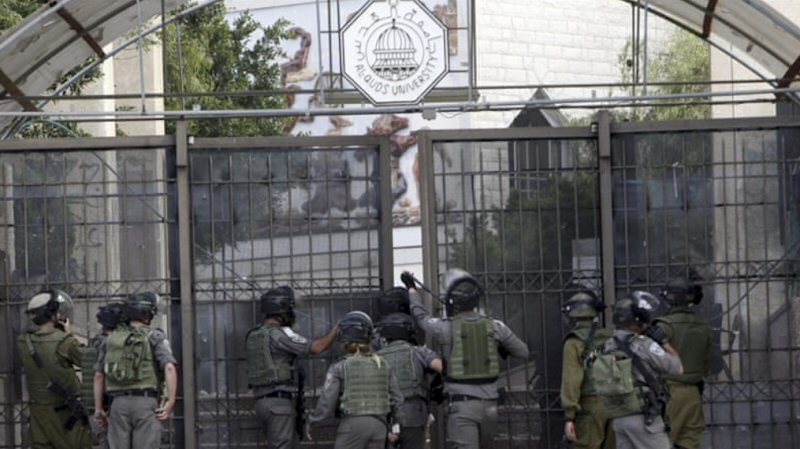
Palestinian Federation of Unions of University Professors and Employees (PFUUPE), February 5, 2019
The Palestinian Federation of Unions of University Professors and Employees (PFUUPE) supports the faculty at Pitzer College calling to suspend a complicit study abroad program in Israel over its discriminatory practices.
PFUUPE, which represents more than 6,000 Palestinian university staff at 13 higher education institutions in the occupied Palestinian territory, commends our colleagues at Pitzer College for overwhelmingly supporting this principled stand for Palestinian human rights and for equality.
Most importantly, we thank you for listening to us and acting upon the call from the vast majority of Palestinians, including academics and students, to refrain from business-as-usual academic relations with Israeli institutions while we are forced to live under oppression.
We hold dear the universal right to academic freedom, on principle and because Palestinians are obliged to fight for it every day, along with our right to education.
Our faculty members have, for decades, faced the policy of restricting movement and travel imposed by the Israeli occupation. This severely hampers our academic freedom, namely to reach our campuses, to teach our students, to conduct research, to collaborate with other academics or institutions and to participate in conferences, whether within the occupied Palestinian territory or abroad.
Israel also obstructs importation of academic material and scientific equipment for Palestinian universities, effectively imposing a boycott on our institutions of higher education.
Israel’s discriminatory policies further prevent international academics and students, in particular those of Palestinian/Arab origins or those supporting Palestinian rights, from teaching, studying and attending conferences at our universities. The past two years have seen an uptick in racially- or opinion- based denial of entry to Israel and refusal of visas and visa renewals, a repressive and deeply discriminatory Israeli policy that has long been customary.
Israel has repeatedly bombed Palestinian schools and universities in Gaza, and its illegal and brutal siege has denied the two million Palestinians there, including hundreds of thousands of students, their basic right to freedom of movement. Israel’s decade-old siege of Gaza is making it uninhabitable, according to the UN.
Palestinian students and faculty in the Israeli-occupied West Bank also face campus raids with Israeli soldiers firing live munitions and tear gas.
Palestinian citizens of Israel are subjected to Israel’s institutionalized racism, while Palestinian students face repressive restrictions on political activities and Palestinian educational facilities are underfunded.
We ask the Pitzer College community to try to imagine what it is like studying, teaching or performing research under these dire conditions of racism, repression and violent oppression.
As long as Israel continues to deny Palestinian human rights and academic freedom and impose discriminatory policies based on origins and political opinion, students, educators and academic institutions have a moral obligation and an ethical responsibility to ensure their campus is not contributing in any way to denying Palestinians our right to education and life.
We urge the Pitzer College Council to uphold the principled stand taken by an overwhelming majority of its faculty not to be complicit in Israel’s denial of Palestinian rights and its blatantly racist and anti-democratic discriminatory policies.
Doing so will send a strong signal to the Israeli government and its deeply complicit universities that principled academic institutions will no longer stand by. They will instead use their power of moral persuasion to hold Israel to account and effect a change in the stagnant status quo of oppression, as was the case during the struggle to end apartheid in South Africa.
Please, uphold the vote in support of our struggle for freedom, justice and equality. Keep our hope in freedom, justice and equality alive.
Sincerely,
The Palestinian Federation of Unions of University Professors and Employees (PFUUPE)
Israel’s Military Bombed His Family to Death. Now He’s Taking the Bastards to Court
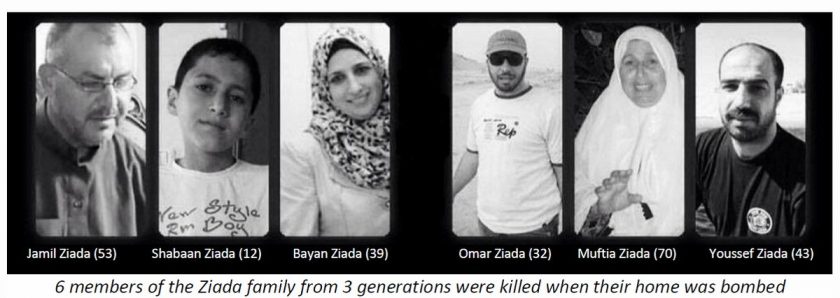
By Stuart Littlewood | American Herald Tribune | February 6, 2019
At long last someone is making a move to bring two of the most wanted Israeli war criminals to book. Will you help?
The Ziada family from Gaza was all but wiped out by Israel’s murderous bombardment during the 2014 Operation Protective Edge when a bomb buried them under three storeys of rubble. Among the dead lay Ismail Ziada’s mother, three brothers, his sister-in-law, a 12-year-old nephew and a visiting friend. Ismail himself happens to be a Dutch citizen resident in the Netherlands, so he wasn’t in Gaza at the time.
And fortunately the Netherlands, unlike the spineless UK, still upholds a system of universal jurisdiction in civil proceedings for its citizens who are unable to gain access to justice elsewhere.
According to an informed source [1], Ziada hired a lawyer specializing in support for victims of war crimes and human rights violations, and papers were served on the Israeli military’s Chief of General Staff at the time of the bombing, Benny Gantz, and the Commander of the Israeli Air Force, Amir Eshel. It was assumed that neither would respond and court proceedings would be conducted in absentia. Surprisingly Gantz and Eshel both submitted a response claiming immunity and alleging that the Dutch court had no jurisdiction. They argue that Ziada can access justice in Israel. But the recent Israeli court ruling against Dr. Izzeldin Abuelaish, who filed for compensation against the Israeli state over the killing of three of his daughters in IDF shelling in 2009, nails that lie.
The Ziada writ focuses on the fact that the bombing of the family home was illegal and a war crime under international law. Next month, we’re told, there will be a court hearing – the first of its kind. If it works out well for Ziada it is anticipated that Gantz and Eshel will push the matter up to the Dutch Supreme Court, which could take years and incur significant expense.
So far Ziada has used his own funds and contributions from friends and supporters to pursue the case on behalf of all the victims of Israeli war crimes. But to achieve justice he’ll need wider moral and financial support. The target is 50,000 euros.
The good news is that the circumstances are such that this case has the potential to blow a hole in the Zionist regime’s arrogant belief that it is exceptional and above the law. Pressed home with enough determination and cash it could be the game-changer that creates the legal precedent decent folk around the world have prayed for. The word is that any compensation received will go into a fund for Palestinian war crime victims in general and children in particular. If you wish to contribute, go to GoFundMe. Roger Waters will match you.
Gantz and Eshel are military thugs of a particularly loathsome kind. Both waged war on Lebanon and played leading parts in the series of genocidal assaults on Gaza, the worst being Operation Protective Edge which, according to Israel’s B’Tselem, killed over 2,200 Palestinians, including 547 infants and children.
Gantz is a wannabee political leader challenging Netanyahu in the coming Israeli elections. Heading his new Israel Resilience Party he pledges to strengthen illegal Israeli settlement blocs and says that Israel will never leave the Golan Heights stolen from Syria. How nice is that?
A Passionate Attachment
Deferring to Israel is “what we are”

“I believe that the establishment of the state of Israel was the greatest accomplishment of the twentieth century”
By Philip Giraldi • Unz Review • February 5, 2019
I predicted three weeks ago that the Senate bill on the Middle East, which was rejected three times while the government was shutdown, would quickly receive cloture by a comfortable margin to end debate and proceed to a full vote in the Senate after the federal bureaucracy reopened. That has proven to be the case. Senate Bill S.1 was approved on January 29th 76 for votes to 22 against. Every Republican voted for it, minus only Rand Paul and Jerry Moran, who did not vote. The Republicans were joined by 25 Democrats, all of whom had previous voted “no” to embarrass the White House over the shutdown. Minority Leader Senator Chuck Schumer, who has described himself as Israel’s protector in the Senate, switched his vote as did notoriously pro-Israel Senators Ben Cardin and Bob Menendez. The bill must now be passed by the Senate, which is certain to take place, before being sent on to the House of Representatives for its approval, where there will certainly be some limited debate. It then will go to President Donald Trump for his signature.
Readers will recall that S.1 the Strengthening America’s Security in the Middle East Act of 2019, sponsored by the singularly ambitious though demonstrably brain dead Senator Marco Rubio from Florida, included $33 billion in guaranteed aid to Israel for the next ten years, an unprecedented gesture to America’s closest ally and best friend in the whole world, as Congress might describe it.
But the legislation also incorporated measures to criminalize criticism of Israel, referred to as the Combating BDS Act of 2019. It has been correctly observed that that portion of the bill is clearly unconstitutional as it limits free speech, which is guaranteed by the First Amendment to the Constitution of the United States and is considered to be the bedrock of American civil liberties, but there is no guarantee that the Supreme Court will agree if and when the law is contested. Once free expression is abridged for Israel there will be no end to other grievance groups exploiting the precedent to silence criticism and effectively negate the First Amendment.
The potential destruction of the Bill of Rights is only one aspect of the power that Israel has over American policymakers. The widely ballyhooed election of several Congresswomen who appear willing to challenge the Israeli orthodoxy on Capitol Hill is already being countered by the establishment within the Democratic Party, demonstrating once again how deep the corruption of America’s political class by Israel has gone.
In an early December speech before a largely Jewish audience at the Israeli-American Council gathering in South Florida, House Speaker Nancy Pelosi demonstrated in no uncertain terms just how she and other Congressmen are more responsive to Israel and its supporters than they are to their own constituents. She said in response to a staged question during a “conversation” with Democratic Party top donor Israeli Haim Saban, “I have said to people when they ask me, if this Capitol crumbled to the ground, the one thing that would remain would be our commitment to our aid, I don’t even call it our aid, our cooperation with Israel. That’s fundamental to who we are.”
Now “who we are” is a favorite expression used by a certain type of progressive that was made popular by the smooth talking but devious Barack Obama, meaning “I am taking the moral high ground so don’t ask me any questions or challenge what I have just said.” In Pelosi’s case she is saying precisely that, that American patronage of Israel is a moral imperative, a commitment forever that must be sustained no matter what Israel does and even if the United States itself should fall into ruin.
It is an absurd comment for someone who represents the people of her state and has taken an oath to uphold the U.S. Constitution, the ultimate pander to a right-wing Jewish audience that is socially progressive and consistently votes Democratic, which Pelosi celebrated, while at the same time cheering the bloody repression of the Palestinian people. And while Israel’s cheering section is doing all that, it is also dragging the American people into wars that need not be fought and stealing the taxpayers’ dollars to give to the racist Kleptocrats in charge in Tel Aviv and Jerusalem.
Pelosi, like her partner in crime Senator Chuck Schumer, who also spoke at the conference, has a problem in paying for security along America’s southern border but she does not hesitate to send billions of dollars to Israel every year. One has to wonder at her priorities, but she knows that American Jews are more powerful and relevant to her party’s finances than doing the right thing would be, so there is no evidence of any hesitation on her part to throwing some Arabs and the outliers within her own party under the bus.
And Nancy also spoke of the dissidents in the Democratic Party, all five or so of them, saying “Remove all doubt in your mind. It’s just a question of not paying attention to a few people who may want to go their own way…” Apparently there is plenty of room under that bus for non-believers. And she also threw out a standard line of how “I believe that the establishment of the state of Israel was the greatest accomplishment of the twentieth century” while also unloading on the Arabs saying “We have to I think in Congress make it really clear to Palestinians that we expect them to be responsible negotiators and we haven’t seen a lot of that thus far.”
Apparently, Nancy is unaware that the “establishment” of Israel forced 700,000 people who had lived in Palestine for centuries out of their homes. And she apparently also has missed all those stories of Palestinian “terrorist” children and emergency workers being shot dead by Israeli snipers while they were “negotiating” such things as access to food, water, and medicines from the inside of the Gaza containment fence. Or maybe she’s forgotten about the towns in Israel that can legally ban Christian or Muslim residents as Israel is now officially a Jewish only state. Nancy Pelosi’s extreme efforts to demonstrate loyalty and devotion to a nation that the rest of the world views as a pariah is commendable, but only if one is a sociopath.
There is something completely dead at the heart of American politics which makes basic humanity unacceptable when confronted by a force for evil that has penetrated and manipulated both the national media and the governing political consensus. That is what Israel and its rabid band of supporters have done to the United States. First Amendment? Goodbye. If the U.S. government should crumble under the strain, don’t worry because our support for you is eternal. Kill a couple of hundred Arabs, shoot a few thousand more? No problem. It’s God’s will. And if Israel leads America into a nuclear war? Then we will do what we have to do to protect our ally.
Ask Pelosi and Schumer, “Have you been corrupted?” They will answer “No. Of course not. It is what we are.”
Philip M. Giraldi, Ph.D., is Executive Director of the Council for the National Interest, a 501(c)3 tax deductible educational foundation that seeks a more interests-based U.S. foreign policy in the Middle East. Website is www.councilforthenationalinterest.org, address is P.O. Box 2157, Purcellville VA 20134 and its email is inform@cnionline.org.
Palestine: A Four Thousand Year History – Book Review

‘Palestine – A Four Thousand Year History’ by Nur Masalha. (Book Cover)
Review by Jim Miles | Palestine Chronicle | February 4, 2019
The Israeli narrative of a nation/state returning to its homeland after a fifteen hundred year exile required deft work by the David Ben-Gurion initiated Governmental Names Committee (Va’adat Hashemot Hamimshaltit, 1949). The Hebraization of Palestine is described in Nur Masalha’s “Palestine – A Four Thousand Year History” a strong scholarly academic addition to the subject of delegitimization of an indigenous people.
The first part of the book covers the era from the Bronze Age – roughly 2,500 years ago – to the mid-Ottoman era and the autonomous governance of al-’Umar and Ahmad Pasha al-Jazzar. It concentrates its analysis mostly on the name Palestine and its historical precedents in other languages from ancient maps and historical writings. It does provide a few glimpses into the kind of society represented by the name but is mostly concerned with the philology of the name itself.
As the work reaches the Ottoman empire, many more sources are used for reference and provide a much stronger perspective on the lifestyles of the indigenous Palestinian people and a split between the urban elites and the majority living in smaller villages and working the land. In the late Ottoman empire, the early years of Christian Zionism/Orientalism/Biblicism, and in the early years of European based secular nationalist Zionism, more diverse sources are used to emphasize the denial of the indigenous Palestinians through language usage.
Masalha’s theme is simple: to demonstrate the existence of Palestine through the centuries by studying the language used, its reference in historical works, and how the modern Hebraization brought on by the western Christian Biblical traditions combined with the Zionist enterprise attempts to deny the existence of Palestine and its people. From that thesis he succeeds remarkably well, providing strong references of the use of the word Palestine up to and including Israeli usage after the 1948 Nakba. But well before that, the Orientalist Christian perspective had already begun the assault on Arabic/Palestinian historical geographic names previously supported by earlier works.
As the study continues into the modern era, many devices are used to erase and cover over any sign of Palestinian geographic inheritance. Much of the initial changes in western knowledge were brought about by various biblical study groups searching for archeological evidence for their story. When not finding much of that evidence, biblical names were simply appropriated and used for different regions, down to specific geographic features. This latter methodology was continued by the early Jewish settlers and strongly reinforced after the creation of Israel.
Appropriation of Arabic names occurred through the process of alliteration, finding – or even inventing – a Hebraic word resembling the Arabic word. A similar process was used for personal names of the Jewish European settlers by choosing a Hebrew word or as frequently an appropriated Arabic word to create a new patronymic.
One of the strongest methods is simply erasure. This occurred before, during and after the Nakba as many villages were physically destroyed, many others expropriated, and most being renamed using some form of Biblical/Hebraic names. Erasure continues both geographically and culturally ranging from street signs to educational texts and instructions.
From the general trend of Masalha’s presentation, modern Hebrew is a contrived language, based on a confined liturgical element incorporating by necessity many modern terms, many Arabic/Palestinian terms, and many biblical terms rendered into a semblance of an ancient Hebraic language. It also clearly demonstrates a history of a region called Palestine at the geographical crossroads of ancient and modern history, surviving under various rulers, some with more autonomy than others, but distinctly Palestinian.
Further, while not denying the existence of an Israeli entity, it is seen as an ongoing part of many different peoples and cultures that inhabited the area at one time or another. The Israeli myth of a sudden influx of Arabs during the Muslim conquests is compared to the historical record of a gradual introduction of Arabic ideas and peoples into the region before the conquest. Of note as well are the frequent references to the peaceful mixing and coexistence of the three major religions in the more modern landscape before the advent of the Orientalist Christian Zionism began to usurp the region.
Unfortunately for all that, “Palestine – A Four Thousand Year History” has a problem that does not deny its academic argument. The work for the purpose of spreading this information to the general public is far too scholarly and academic, something I can work through because of my background reading and my intentions as a reviewer, but would prove very difficult to attract attention to a general reader.
The first section in particular, while referencing many maps using the word Palestine or its linguistic equivalents, does not provide any visuals – no maps. A reference section with some plates showing the range of maps from ancient histories through to the British maps of Mandatory Palestine would be a valuable addition to the work.
Having said that, I must reiterate that his arguments support the main thesis very well. The latter half of the book both instructs this thesis and at the same time provides a more reader-friendly discussion of not only the geography but the essence of the people of Palestine.
(Palestine – A Four Thousand Year History. Nur Masalha. Zec Books, London, 2018.)
– Jim Miles is a Canadian educator and a regular contributor/columnist of opinion pieces and book reviews to Palestine Chronicles. His interest in this topic stems originally from an environmental perspective, which encompasses the militarization and economic subjugation of the global community and its commodification by corporate governance and by the American government.
Death Knell For Syria Pullout: “We Have To Protect Israel” Says Trump
By Tyler Durden – Zero Hedge – 02/03/2019
After approaching two months of talk of a “full” and “immediate” US troop withdrawal from Syria, first ordered by President Trump on December 19 — which was predictably met with swift and fierce pushback from beltway hawks including in some cases his own advisers — it now appears the death knell has sounded on the prior “complete” and “rapid” draw down order.
Trump said in a CBS “Face the Nation” interview this weekend that some unspecified number of US troops will remain in the region, mostly in Iraq, with possibly some still in Syria, in order “to protect Israel” in what appears a significant backtrack from his prior insistence on an absolute withdrawal.
“We’re going to be there and we’re going to be staying. We have to protect Israel,” he replied when pressed by CBS reporter Margaret Brennan. “We have to protect other things that we have. But we’re – yeah, they’ll be coming back in a matter of time.” He did note that “ultimately some will be coming home.”
“Look, we’re protecting the world,” he added. “We’re spending more money than anybody’s ever spent in history, by a lot.” Trump’s slow drift and change in tune on the subject of a promised “rapid” exit comes after Israeli officials led by Prime Minister Netanyahu alongside neocon allies in Washington argued that some 200 US troops in Syria’s southeast desert along the Iraqi border and its 55-kilometer “deconfliction zone” at al-Tanf are the last line of defense against Iranian expansion in Syria, and therefore must stay indefinitely.
“I want to be able to watch Iran,” Trump said further during the CBS interview. “Iran is a real problem.” He explained that “99%” of ISIS’s territory had been liberated but that a contingency of US troops must remain to prevent a resurgent Islamic State as well as to counter Iranian influence, for which American forces must remain in Iraq as well.
“When I took over, Syria was infested with ISIS. It was all over the place. And now you have very little ISIS, and you have the caliphate almost knocked out,” the president said. “We will be announcing in the not too distant future 100% of the caliphate, which is the area – the land – the area – 100. We’re at 99% right now. We’ll be at 100.”
However Trump’s invoking Iranian influence as a rationale for staying further contradicts his prior December statement that the defeat of ISIS was “the only reason” he was in Syria in the first place.
MARGARET BRENNAN: How many troops are still in Syria? When are they coming home?
PRESIDENT DONALD TRUMP: 2,000 troops.
MARGARET BRENNAN: When are they coming home?
PRESIDENT DONALD TRUMP: They’re starting to, as we gain the remainder, the final remainder of the caliphate of the area, they’ll be going to our base in Iraq, and ultimately some will be coming home. But we’re going to be there and we’re going to be staying—
MARGARET BRENNAN: So that’s a matter of months?
PRESIDENT DONALD TRUMP: We have to protect Israel. We have to protect other things that we have. But we’re- yeah, they’ll be coming back in a matter of time. Look, we’re protecting the world. We’re spending more money than anybody’s ever spent in history, by a lot. We spent, over the last five years, close to 50 billion dollars a year in Afghanistan. That’s more than most countries spend for everything including education, medical, and everything else, other than a few countries. — CBS “Face the Nation” Feb.3 interview transcript
The Pentagon in recent weeks has reportedly been putting logistics in place for a troop draw down from northern and eastern Syria.
Though it remains unclear just how many troops could remain as the majority possibly begin to pullout toward US bases in Iraq, the Tanf base could remain Washington’s last remote outpost disrupting what US defense officials see as a strategic Baghdad-Damascus corridor and highway, and potential key “link” in the Tehran-to-Beirut so-called Shia land bridge.
Foreign Policy magazine has identified this argument as the final card the hawks opposing Trump’s draw down had to play in order to hinder to an actual complete US exit:
“Al-Tanf is a critical element in the effort to prevent Iran from establishing a ground line of communications from Iran through Iraq through Syria to southern Lebanon in support of Lebanese Hezbollah,” an unnamed senior US military source told the magazine.
The Israeli prime minister has pushed hard against the White House pullout plan, and “has repeatedly urged the U.S. to keep troops at Al-Tanf, according to several senior Israeli officials, who also asked not to be identified discussing private talks,” per Bloomberg. The Israelis have reportedly argued “the mere presence of American troops will act as a deterrent to Iran” even if in small numbers as a kind of symbolic threat.
The internal administration debate, following incredible push back against Trump’s withdrawal decision, has made entirely visible the national security deep state’s attempt to check the Commander-in-Chief’s power. And now US presence at al-Tanf represents the last hope of salvaging the hawks’ desire for permanent proxy war against Iran inside Syria.
It appears the deep state has won out over Trump’s initial policy decision once again; but it remains to be seen if, however slowly on what’s clearly a delayed timetable departing from his original plans, all US troops ultimately exit Syria. Until then there’ll be more time and perhaps more provocations the hawks can rely on to effectively ensure full circle return to indefinite occupation in Syria.
Spain company rejects Israel tender for Jerusalem railway
MEMO – February 2, 2019
A Spanish company announced yesterday that it had rejected an Israeli tender to build part of the Jerusalem railway, which will cut deep into occupied territory.
Construcciones y Auxiliar de Ferrocarriles (CAF or Construction and Other Railway Services) announced that it “refuses to build a section of the railway in Jerusalem because [it] included Palestinian land that will be confiscated, in violation of the resolutions of international legitimacy,” Al-Wattan Voice reported.
The company’s workers also rejected its participation in the project on the same grounds. Representatives of the workers said that the problem lies in the fact that the railway will pass through Palestinian lands to serve illegal settlements in East Jerusalem.
“Any project in any city around the world, especially Jerusalem, must respect human rights and international legitimacy in its implementation,” CAF stressed.
CAF added: “The General Assembly of the United Nations and the International Court of Justice [ICJ], through various resolutions, have said that they are against the occupation of land through which will pass the section of the railway.”
Read also:
Jerusalem Archbishop: ‘Everything Palestinian is targeted by Israel’s occupation’
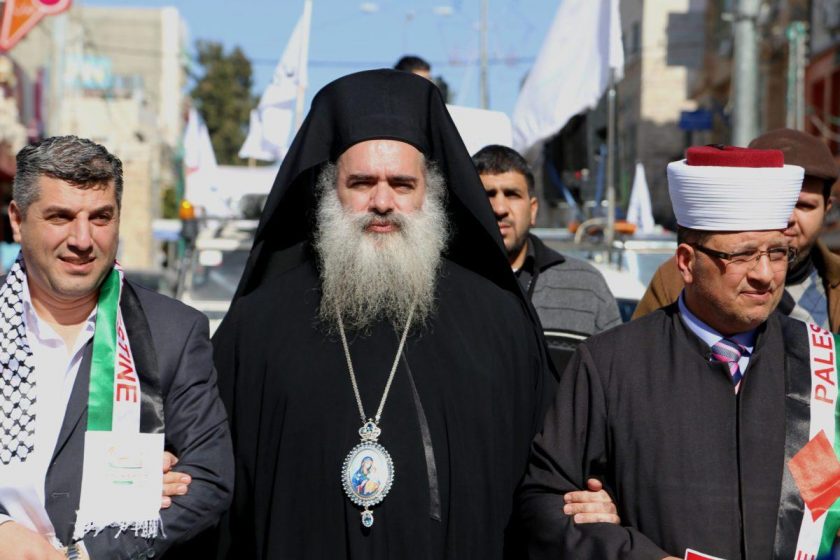
Archbishop of Jerusalem’s Greek Orthodox Church, Atallah Hanna, seen during a protest in the West bank city of Hebron, January 22, 2015 [Muhesen Amren / ApaImages]
MEMO | February 2, 2019
The Palestinian Archbishop of Jerusalem’s Greek Orthodox Church, Atallah Hanna, said yesterday that “everything Palestinian in Jerusalem is targeted by the Israeli occupation”.
During a meeting with a delegation from Médecins Sans Frontières (Doctors without Borders, MSF), Hanna explained the dangers threatening Palestinians’ existence and identity in the Holy City, Al-Wattan Voice reported.
“Everything is in danger in Jerusalem,” Hanna said, adding: “The Islamic and Christian holy sites and endowments are targeted in order to change our city, hide its identity and marginalize our Arabic and Palestinian existence.”
Hanna added that “recently, the Israeli occupation cancelled a planned celebration on the 50th anniversary of establishing Al-Maqased Hospital,” noting that the Israeli occupation had cancelled many other Palestinian events planned to take place in Jerusalem.
The Archbishop said that Palestinians “are living under severe torture and harsh persecution,” pointing to Israel’s closure of Palestinian institutions in the city. “It seems that they wanted us to give up Jerusalem and submit to their polices, measures and practices,” he added.
Hanna continued: “Jerusalem is for us and will remain for us. We will never give up our rights in Jerusalem and we will defend it against Israeli oppression.”
Addressing the MSF staff, he said: “We want you to know closely the suffering of the Palestinians and the oppression inflicted by the Israeli occupation on them in Jerusalem. We want our message to reach all the people around the world as we want more friends for the Palestinians.”
Read also:
Israeli forces detain secretary of Fatah in Jerusalem
14 Palestinians homeless as Israel forces 2 Jerusalem homes to be torn down
WHO: Injured Journalist Prevented from Receiving Healthcare

IMEMC News & Agencies – January 31, 2019
The World Health Organisation issued its monthly report entitled “Health Access Barriers for Patients in the Occupied Palestinian Territory”, in which the organisation highlighted the case of ALRAY Media Agency’s photographer, Attia Darwish, who was seriously injured a month ago.
WHO said, in its report, which comes in three parts, that a tear gas canister hit Darwish, a 31-year-old photojournalist, in his face, under his left eye, when he was covering demonstrations near the Gaza fence.
“I was taking photos when my phone rang, and I tried to take the call. Suddenly, I felt a blow to my face and fell down,” Attia said, according to Al Ray.
The ambulance picked him up within minutes and took him to a trauma stabilization point close to the fence. After initial assessment and first aid, Attia was rushed to Shifa hospital, in Gaza, for treatment. He had multiple facial fractures and severe bleeding at the back of his eye, putting his sight at risk, the report said.
WHO said that Darwish had surgery to remove shrapnel from the wound, fix his lower jaw and replace fragmented bones in his face with metal plates. He also received initial treatment for his eye injury, but needed review and specialist care outside of Gaza.
“As a photographer, I depend on my eyes to do my job. Now, I can hardly see with my left eye. Getting proper treatment is something critical for me,” Attia said. He subsequently received a medical referral, from the Palestinian Ministry of Health, to go for an appointment to St John’s Eye Hospital, in Jerusalem.
He applied to Israeli authorities for a permit to exit Gaza, for treatment, but, when the date of his hospital appointment came, his permit application was still under review. Attia despaired of getting a permit to exit Gaza, via Erez crossing with Israel, and asked the Services Purchasing Unit in the Ministry of Health to refer him, instead, for treatment in Egypt, WHO recounted.
On the day of his travel, however, Rafah crossing point to Egypt was closed for exit. “I cannot feel the left side of my face. I can only eat soft food and I’m suffering with the pain. The cold weather makes it even worse. When I was in hospital, one of the doctors said I either need a bone graft or an artificial implant. But, neither of those is available in Gaza,” he said, according to the report.
WHO said that when they spoke with Attia, he still had not received his permit to leave Gaza to Jerusalem, stressing that “his case is not an exception.”
The orgnisation pointed out that of 435 permit applications to Israeli authorities by those injured during the Great March of Return demonstrations, only 19% have been approved, where those unable to access the health care they need face a higher risk of complications and poorer health outcomes.
Hamas won’t be part of any new puppet Palestinian government: Official
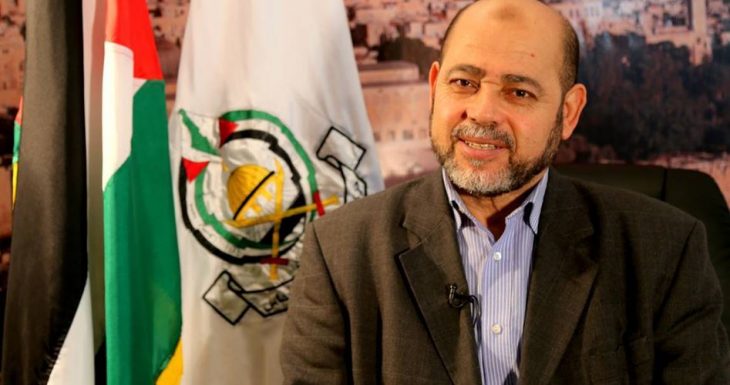
Deputy head of the Hamas political bureau, Mousa Abu Marzouk
Press TV – January 31, 2019
The deputy head of the Hamas political bureau, Mousa Abu Marzouk, says the resistance movement will not take part in any puppet Palestinian government in Ramallah, noting such a government will be “devoid of any national legacy and would strive to promote division” just like its predecessors.
Marzouk, in a post published on his official Twitter page on Wednesday, said officials from the Ramallah-based Palestine Liberation Organization (PLO) would not invite Hamas to participate in such a Palestinian government in the first place, emphasizing that the movement would turn down such an offer even if it were made.
He asserted that a new government in Ramallah would work on realizing US President Donald Trump’s “deal of the century.”
The so-called deal, a back channel plan to allegedly reach a peace settlement between the Israelis and the Palestinians, was proposed by the US administration in September 2018. Although the plan has not been released, leaks signal it will consist of the same tried and failed ideas.
While little is known about the controversial deal, leaks have suggested that it regards East Jerusalem al-Quds as Israeli territory, whereas Palestinians view the eastern sector of the occupied city as the capital of their future state.
Palestinians also believe that the US-drafted plan calls for keeping borders and security under Israeli control, while it keeps Israeli settlements’ final borders to be discussed in later negotiations.
Palestinian Prime Minister Rami al-Hamdallah officially submitted his resignation and that of his unity government to President Mahmoud Abbas on January 29, casting doubt on the prospects of reconciliation efforts with Hamas.
Abbas had been facing pressure from his ruling Fatah movement over the past few weeks to remove Hamdallah from power, and establish a new government comprised of representatives from PLO factions in addition to independent figures.
Hamdallah headed the Palestinian National Consensus Government, which was formed after Fatah and Hamas reached an agreement in 2014.
Fatah leaders said there was no point in keeping the government in power in the wake of the continued crisis between their faction and Hamas.
They also argue that since their faction is the largest group in the PLO, it should have a strong presence in any government.
Syria Briefing from Peter Ford: US Withdrawal, Safe Zones, Sanctions, Idlib, ISIS & Israel
The following situational briefing update of January 24, 2019 has been provided by Peter Ford, Former British Ambassador to Syria:
US Withdrawal
Contrary to the expectations of many experts, President Trump has remained insistent on the withdrawal of approximately 2,000 US troops from North East Syria, although he has had to concede more time. The ‘conditioned’ withdrawal touted by his uber-hawkish National Security Adviser, John Bolton, appears to have shrunk just to ensuring that the Kurds in the YPG militia the US will be leaving behind are not slaughtered by the Turks. One of the other conditions, eradicating the final remnants of ISIS, appears to have been all but met by a final Coalition push, with ISIS down now to its last village, obviating the handing of the job to Turkey which was ludicrously proposed initially, while the other condition, ensuring that Iran does not benefit, appears to have been quietly forgotten.
‘Safe zone’
Quite how the Kurdish issue will be settled remains up in the air. Not for much longer, however, if we parse correctly the statements made by Putin and Erdogan after their meeting in Moscow on 23 January.
As is often the case when the great men speak, what they do not say is as important as what they do say. Erdogan did not say, as he had done previously, that Turkey was going to police the proposed ‘safe zone’, 20 miles deep, cleared of the YPG. Rather he said that Turkey and Russia were in agreement on the establishment of such a zone. And the next day his Foreign Minister said that Turkey was open to arrangements being made involving ‘the US, Russia or others’. Putin on his side made clear that these significant ‘others’ were the Syrian government, whom he encouraged to speak to the Kurds. The day before the Putin-Erdogan meeting a Kurdish delegation was in Moscow, following earlier discussions in Damascus.
The eventual outcome, a return of Syrian security forces to the North East, is, in the view of this analyst, nailed on. The only question is when and under which conditions. The Kurds, reckoning on the Turks’ lack of appetite for a contested incursion and US dithering, are attempting to squeeze the last concession out of Damascus in terms of incorporation of the YPG into the Syrian security forces and some measures of local self-government, as well as use of the Kurdish language. Damascus, however, appears to hold the whip hand, conscious that as time goes on Trump will look as powerless over withdrawal as he does over the Mexican Wall if he does not act ‘and will if necessary call the Kurds’ bluff.
ISIS
It does indeed seem curtains for ISIS in Syria, at least as a territory-controlling caliphate. ISIS drew attention to themselves however with a suicide bomb attack in Manbij which left four Americans dead, prompting predictable cries from the foreign policy establishment in the US and Europe that it was folly to be leaving a ‘vacuum’ in Syria while there was still life in the twitching ISIS body. That experts deemed reputed could peddle this superficial analysis and be believed in the media is testimony to the blinkered thinking which dominates in the West. There will be no vacuum – the Syrian government has a good track record in the areas it has liberated of crushing ISIS, better in fact than the Americans for whom, as for their Kurdish allies, there are no-go areas of Arab villages in the areas they nominally control. These experts would do well to reflect on why ISIS are choosing this decisive moment to attack US forces, something they have curiously jailed to do for several months.
The hidden factor here is the incipient next phase in ISIS’s existence. It has gone underground, especially in Deir EzZor province which straddles the Euphrates. This is the equivalent of Iraq’s restless Anbar province which it borders. ISIS will not relish the prospect of Syrian Mukhabarat (security police) descending on Arab villages which have hitherto been no go areas to wake up ‘sleepers’. Expect more attacks on US forces.
Idlib
Putin and Erdogan also discussed Idlib, although the way forward here is less clear. Even the Turks cannot deny that in what is, to all intents and purposes, a Turkish and Western protectorate, the extreme jihadist Al Qaida-linked Tahrir Ash Sham (HTS) has run amok and now controls virtually the entirety of the area. This is the opposite of what was supposed to happen under the terms of the Russo-Turkish Sochi agreement which brought the September crisis to an end. Under Sochi the Turks were supposed to bring HTS to heel. Putin seemed to hint that military preparations would now move ahead for the Syrian government with Russian support to advance on Idlib, with Turkish acquiescence. The seamlines are already hot.
Political negotiations
One thing is clear. The Idlib issue is not going to be resolved by any political negotiations between the warring parties. The Western powers who cling to the comforting fiction that there can only be a political end to the Syrian conflict have no answers where Idlib is concerned.
The new UN envoy for Syria, Gerd Pederson, appears to be feeling his way, slowly, as well he might. Currently the Geneva process is in baulk over US, French and British blocking of a slate of candidates for inclusion in the Constitutional Committee which is supposed to come up eventually with a new constitution which will pave the way for UN-supervised elections with the participation, as the Western powers and Turkey would have it, of millions of Assad-hating refugees.
This mirage might appear harmless. However it is constantly cited by the Western powers to justify their conduct of war on Syria by other means than the military methods which are now all but exhausted.
Sanctions
How have the EU and the US responded to the prospect of normalisation in Syria? With more sanctions of course.
The EU has slapped sanctions on Syrian businessmen participating in a flagship property development scheme in Damascus deemed tantamount to assisting the ‘regime’. This scheme is emblematic of the many private investment projects now popping up, many of them involving Arab investors. Obviously the EU could not tolerate such progress, it not being enough to hamstring economic recovery with the existing deeply harmful battery of sanctions. The stated reason is that the Syrian government is not facilitating political progress towards the above mentioned mirage of elections rigged to produce a government of Western stooges. If the masterminds of EU diplomacy sincerely believe that such sanctions will make Assad bow the knee after eight years of vicious conflict have failed to do so, then we must fear for their sanity.
The US House of Representatives, with White House support, has chimed in with a Syria sanctions bill aimed at punishing any person or business which participates in any government linked project. This could have extra-territorial effect, dampening the interest of outside investors in Syria recovery projects. Again this highlights the hypocrisy of Western legislators who profess humanitarian concern but who are careless of inflicting economic suffering on a population already on its uppers after eight years of conflict, fuelled by Western support for armed groups, as long as they can strike a virtue-signalling blow against the ‘regime’. This is what a diplomacy of vindictiveness looks like.
The practitioners of this diplomacy have had some success with US and UK diplomats scouring Arab countries to pressure them into delaying normalisation of relations with Syria until the mirage has been reached. It appears that a consensus on Syria’s readmission to the Arab League as early as March is not likely to be found. Damascus will shrug this off. It is only delaying the inevitable. Arab countries who feel threatened by both Iran and fundamentalism can see that they are going to have to learn to live with Syria and that using contacts with Damascus to dilute Iran’s influence and share intelligence are very much in their interest.
Israel
Perennial party pooper Israel has attempted to spoil Assad’s successes by relaunching after a pause airborne attacks, ostensibly against Iranian targets. This is odd in that even US intelligence, cited by Trump, apparently more attentive to intelligence briefings than his detractors would have you believe, has reported that Iran has been withdrawing forces. The most recent blatant day time raid elicited a rare reprisal from Damascus, a missile which was shot down over the Syrian occupied Golan (not even Israel itself). Cue massive display of shock by the media, which had signally ignored the literally thousands of Israeli bombs dropped on Syria over the last two years. Naturally Syria and Russia’s attempt to secure some expression of concern from the Security Council failed, unprovoked aggression by Israel apparently not being inconsistent with the ‘rules based system’ constantly enjoined by the West on others.
Israel should however beware of hubris. Syria’s new Russian supplied SAM 300 air defence system is scheduled to become operational in March.
Author Peter Ford is the former British Ambassador to Syria (2003-2006) and Bahrain (1999-2002).
This briefing was originally published at the Global Network for Syria\
Featured Video
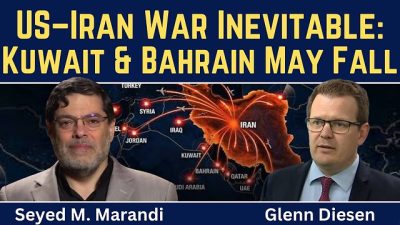
Seyed M. Marandi: US-Iran War Inevitable: Kuwait and Bahrain May Fall
or go to
Aletho News Archives – Video-Images
From the Archives
Oil and the Israel Lobby
Reknowned economist M. Shahid Alam offers this excellent critique of Noam Chomsky’s defective analysis of the relative influence of Oil versus the Israel lobby over US foreign policy: … continue
Blog Roll
 Aletho News
- ICC ignored ‘very well-documented’ NATO crimes – ex-Libyan minister
- SNSC secretary dismisses US response to Iran’s conditions as ‘inadequate’
- Sanaa says Taiz roads open, secure for residents, warns Saudi forces
- Iraqi resistance group urges Saudi leadership to admit defeat, lift Yemen siege
- Trump’s Retreat: How Al-Aqsa Flood Took Down the US Empire
- Israel’s Military Actions in Lebanon Grossly Violate International Law — Lavrov
- Seyed M. Marandi: US-Iran War Inevitable: Kuwait and Bahrain May Fall
- Leaders Condemn Ansarallah Attack on Saudi Arabia While Ignoring Illegal War Against Yemen
- Leaked: Britain’s Covert Iraqi Psyops Network
- Yemeni Armed Forces Warn Airlines Against Using Saudi Airports, Exempt Mecca and Medina
- If Americans Knew
- After Oct 7, IDF policy allowed civilian casualties for even the lowest-ranking targets
- Israel’s Destruction of Southern Lebanon Intensified After the Cease-Fire
- The Last-Minute Decision That Gave Israel Its Name
- The American Conservative: How Trump Made the World Go Nuclear
- Meet the US generals and admirals advancing Israeli policy
- Opinion: Why news organizations should boycott Israel
- The Israeli witch hunt of Sami Abu Shehadeh exposes the lie of the ‘Jewish and democratic’ state
- No state has a ‘right’ to exist – least of all Israel
- Testimonies about Gaza’s civilian death toll expose Israel’s atrocities – Daily Update
- How Israel Conquered the Latin American Right
- No Tricks Zone
- New Study Suggests Large Regions Of The Pacific Ocean Have Been Cooling For The Last 80 Years
- Germany’s Green Energy Debacle: High Energy Costs Force Kahla Porzellan to Close After 182 Years!
- New Study: 50 Years Of The Most Aggressive ‘Net Zero’ Policies Can Only Affect The Global Climate By 0.03°C
- US September “Heat” Was No Record…Many Records Set Decades Ago
- Latest European Green Energy Debacle; Portugal’s Largest Flagship Solar Park Insolvent!
- Green Energy Debacle: German Expert Professor Fritz Vahrenholt Warns Of Severe Economic And Social Consequences
- Two More Paleo Reconstructions Affirm Meters-Higher Sea Levels Across Ireland, Brazil 7000-6000 Years Ago
- New Study: Earth And Venus Surface Warmth Largely Explained By Convection And Lapse Rate, Not CO2 Or Radiation
- 2025 Nature Paper Claiming Worsening Global Drought Gets RETRACTED …Heavily Flawed
- New Study: ‘Global Drought Shows No Detectable Recent Acceleration Under Climate Warming’

