No ground for negotiations with E3 anymore: Iran FM
Al Mayadeen | October 11, 2025
Tehran no longer sees a basis for nuclear talks with the E3 countries, Iranian Foreign Minister Abbas Araqchi stated on Saturday evening, adding that the country is not seeking it either.
Speaking to the Iranian state TV, Araghchi revealed that Washington had asked to hold direct talks with Tehran on the sidelines of the UN meetings, a message conveyed by US envoy Steve Witkoff. Iran, according to Araghchi, expressed readiness to engage, but only on the condition that representatives from the E3 countries and the IAEA Director, Rafael Grossi, be present, which the latter refused.
In this context, the top Iranian diplomat revealed that “the United States has always sought to integrate regional issues into nuclear negotiations, but we have never allowed that,” describing Washington’s positions as “constantly changing”.
Iran’s interests are red line
Regarding Tehran’s red lines, Araghchi confirmed that the interests of the Iranian people are paramount, emphasizing that while Iran will never give up its right to enrich uranium, it is willing to provide the international community with assurances, if need be, about the peaceful nature of its nuclear program.
He further criticized Europe, stating it has demonstrated a lack of independence, and indicated that Iran remains open to studying any new, fair plan from Washington as long as it respects the interests of the Iranian people, expressing a willingness to engage in dialogue.
On the topic of the Cairo Agreement, Araghchi stated, “It is currently frozen, and our cooperation with the Agency is only conducted within the framework of the Iranian parliament’s law and through the Supreme National Security Council.”
Araghchi addressed the prospect of renewed war with “Israel”, disclosing that, following an exchange between Russian President Vladimir Putin and Israeli Prime Minister Benjamin Netanyahu several days ago, Russian officials subsequently informed the Iranian ambassador in Moscow that Netanyahu has no interest in returning to a state of war with Iran.
Gaza ceasefire solely a Palestinian Resistance matter
Iranian Foreign Minister Araghchi addressed the ceasefire agreement in Gaza, denying that any discussions had taken place with Steve Witkoff concerning it, while affirming Iran’s support for any plan that would halt what he described as Israeli crimes.
Araghchi said Trump shared his view on Iran’s statement about the Gaza deal, but no messages were exchanged with Washington, adding that only the Palestinian Resistance and people can decide on a ceasefire, and no one else.
He stressed that “Israel” is not trustworthy, citing past experiences like Lebanon, which is clear proof that the entity does not honor its commitments, based on which Iran raised its concerns and issued the necessary warnings. He added that while Washington has made positive promises regarding the Gaza deal, there are doubts about its seriousness in fulfilling them, as these promises are constantly shifting.
Araghchi also noted that most foreign ministers in the region are skeptical about the future of the subsequent phases of the Gaza agreement.
On the issue of the normalization agreements, Iran’s FM noted that “these deals intrinsically constitute a sinister plan to deprive the Palestinian people of their rights,” adding that Iran’s position on such agreements is clear: “it will never join them.”
Regarding the trade war imposed by Washington, Araghchi stated that Iran would reciprocate in kind if its commercial ships were obstructed in any way under the pretext of sanctions, affirming that escalating tensions is not in anyone’s interest.
Purging America First: Inside the GOP’s Zionist Vetting Machine
By Jose Alberto Nino – The Occidental Observer – October 12, 2025
In the dimly lit corridors of Capitol Hill, where backroom deals shape American foreign policy, House Speaker Mike Johnson recently conducted what can only be described as a strategic war council. On the afternoon of September 17, 2025, Johnson gathered with a who’s who of pro-Israel organizations for a private meeting ostensively designed to eliminate dissenting voices within the Republican Party. What emerged from this closed-door session reveals a coordinated effort to ensure ideological orthodoxy on Israel.
The meeting itself reads like something out of a tired political thriller. Johnson, who described himself to the assembled group as a “Reagan Republican” focused on “peace through strength,” went on to make a startling admission that isolationism is rising within the Republican Party and that a major debate on the issue is likely once President Donald Trump leaves office.
But Johnson’s most revealing statement came when he told the group that in his candidate-recruiting efforts, he’s working to filter out isolationists to prevent that wing of the party from growing more prominent in the House. Four people who attended the meeting confirmed this extraordinary pledge to Jewish Insider.
“The speaker was very, very direct about the U.S. role with Israel and in the world and understands that there are voices that don’t agree in both parties, on both extremes, and urges us all to be involved in fighting back against those extremes,” Eric Fingerhut, CEO of the Jewish Federations of North America, told the publication.
The guest list for Johnson’s gathering was a who’s who of America’s most powerful pro-Israel organizations. In attendance were representatives from The Louis D. Brandeis Center for Human Rights Under Law, the Republican Jewish Coalition, Agudath Israel of America, AIPAC, the Simon Wiesenthal Center, Conference of Presidents of Major American Jewish Organizations, National Council of Jewish Women, Synergos Holdings, CUFI Action, the Orthodox Union, the U.S.-China Economic and Security Review Commission, Standard Industries, the American Jewish Committee, Zionist Organization of America, National Debt Relief, Jewish Institute for National Security of America, the Deborah Project, Foundation for Defense of Democracies, Coalition for Jewish Values and the Endowment for Middle East Truth. This comprehensive coalition represents the full spectrum of pro-Israel advocacy, from religious organizations to political action committees to think tanks—a formidable alliance with vast resources and influence.
The Hunt for Republican Heretics
The Israeli lobby’s crosshairs have settled on several prominent Republicans whose independence on foreign policy has made them targets. Chief among them is Rep. Thomas Massie (R-KY), whose voting record has made him perhaps the strongest opponent of Israel in Congress according to Jewish advocacy groups.
Massie’s legislative actions against pro-Israel interests are extensive and well-documented. In December 2023, at the height of Israel’s war against Hamas, Massie shared a social media post implying that Congress was more interested in “Zionism” than “American patriotism.” In October 2023, following the Hamas attack, Massie was the only Republican to vote against a bipartisan resolution standing with Israel. He was also the sole Republican to vote against the Iron Dome Supplemental Appropriations Act and the only member of either party to vote against a resolution honoring Jewish American heritage and denouncing antisemitism.
“Antisemitism is deplorable, but expanding it to include criticism of Israel is not helpful,” Massie wrote on X, explaining his vote against a resolution reaffirming Israel’s right to exist. Even more provocatively, Rep. Marjorie Taylor Greene (R-GA) has emerged as an unexpected critic from the MAGA wing. In a dramatic departure from her previous pro-Israel stance, Greene has characterized Israel’s actions in Gaza as “genocide.”
Her transformation has prompted a furious response from AIPAC, which issued a fundraising message comparing her to progressive Democrats Rashida Tlaib and Ilhan Omar:
Let’s call this what it is: Marjorie Taylor Greene is the newest member of the anti-Israel Squad. She may think this earns her praise from the far-left or online radicals — but we see it for what it is: a betrayal of American values and a dangerous distortion of the truth.
In response to AIPAC’s attack against her, Greene has doubled down, telling One America News Network that AIPAC should register as a foreign lobbyist and posting a photograph of a sign on her office door reading “no foreign lobbying.” She has accused Israel of having “incredible influence and control” over nearly every member of Congress, exposing pro-Israel lobby trips that she argues amount to foreign lobbying without accountability.
LinkBookmarkPerhaps nowhere is the Israeli lobby’s intervention more telling than in Texas’s 23rd Congressional District, where gun rights YouTuber Brandon Herrera mounted a formidable challenge against moderate Republican incumbent Tony Gonzales last election cycle. Herrera, known as “the AK Guy” to his 4.4 million YouTube subscribers, came within 354 votes of unseating Gonzales in the 2024 primary runoff.
Gonzales, a 20-year Navy veteran and cryptologist who rose to the rank of Master Chief Petty Officer, built his political résumé through Washington’s national security circles. He served as a legislative fellow in Senator Marco Rubio’s office and was a National Security Fellow at the pro-Israel Foundation for Defense of Democracies (FDD), a neoconservative think tank known for its hawkish foreign policy stance. In Congress, Gonzales has reflected that worldview by backing aid to Ukraine and Israel, stating that “if we fail to support our allies, China, Russia, and Iran will only become more powerful” with regard to a military aid spending package pending final passage in the U.S. House in April 2024.
The closeness of this race terrified pro-Israel groups, who saw Herrera as a genuine threat to their influence. AIPAC’s United Democracy Project spent $1 million opposing Herrera in a two-week ad buy, while the Republican Jewish Coalition added $400,000 in attack ads.
More significantly for the lobby’s concerns, Herrera had stated he would have voted against supplemental aid to Israel and other U.S. allies. “I would absolutely vote AGAINST the new proposed spending package for $95+ billion for foreign conflicts, while spending $0 on our southern border,” Herrera posted on X on April 19, 2024. “Any Republican who claims to be America first CANNOT vote for America last legislation.”
When asked directly whether he would pledge to end foreign aid, including to Israel, Herrera reiterated his position: “We can’t claim to be ‘America First’ while pushing spending bills like the most recent foreign aid package that gave almost $100 billion to every country except the US.”
The combined $1.4–1.5 million in spending by AIPAC and RJC helped Gonzales narrowly survive with 50.6% to 49.4%—a margin so slim it demonstrated the growing threat posed by America First candidates to the establishment’s foreign policy consensus. Herrera has already announced his intention to challenge Gonzales again in the 2026 Republican primaries, setting up another expensive battle. This time, the political winds may finally shift in Herrera’s favor.
The most audacious display of the Israeli lobby’s power may be their campaign against Thomas Massie. Pro-Israel Republican megadonors have established the MAGA Kentucky super PAC with $2 million specifically to oust the congressman. Paul Singer contributed $1 million, John Paulson added $250,000, and Miriam Adelson’s Preserve America PAC provided $750,000.
This goes far beyond normal political opposition; it’s a declaration of total war against foreign policy dissent among Republican ranks. AIPAC has already demonstrated this approach works. During the 2024 election cycle, AIPAC’s independent spending arm, the United Democracy Project, spent over $300,000 on Fox affiliate ads criticizing Massie’s voting record. UDP spokesperson Patrick Dorton did not mince words about UDP’s attacks against Massie: “We are not playing in the primary, but we are trying to shine a light on the radical anti-Israel record of Tom Massie. We want every single voter in the state of Kentucky to know about his anti-Israel actions.”
The Post-October 7 Reality
The October 7 Hamas attacks fundamentally transformed the Israeli lobby’s strategy and urgency. AIPAC increased its political spending nearly threefold in the months following the attacks, with average weekly spending jumping from $275,000 to over $740,000.
“Our focus in the 2024 election is to broaden and strengthen the bipartisan pro-Israel majority in Congress — and to defeat anti-Israel detractors,” AIPAC spokesman Marshall Wittmann told Capital News Service. “In the aftermath of the Hamas barbaric attack and the mounting threats of Iranian terrorist proxies, the importance of a pro-Israel Congress standing with our ally is clearer than ever.”
This represents more than increased spending; it’s a systematic campaign to ensure ideological conformity. The Israeli lobby’s post-October 7 mobilization has created what one Democratic donor adviser called “a huge, underappreciated change to the landscape.” Thousands of smaller donors who weren’t previously engaged have been activated, providing the financial foundation for an unprecedented intervention in American electoral politics.
Johnson’s pledge to “filter out isolationists” in candidate recruitment represents the institutionalization of ideological screening within the Republican Party leadership. This transcends opposing candidates in primaries and is mostly focused on preventing them from running in the first place by controlling access to party resources, endorsements, and financial networks.
The vetting process appears comprehensive. As the Jewish Insider report noted, Johnson is working to prevent the isolationist wing from “growing larger in the House” through his recruiting efforts. This suggests a systematic review of potential candidates’ positions on Israel and foreign aid, with those deemed insufficiently supportive being denied party backing.
This represents a fundamental shift in how American political parties operate. Rather than allowing primary voters to choose between competing visions, party leadership, at the behest of the Israel lobby, is pre-selecting candidates based on their adherence to specific foreign policy positions. The Israeli lobby has essentially outsourced candidate vetting to organizations whose primary loyalty is to world Jewry.
The Israeli lobby’s campaign to purge non-interventionist candidates and incumbents is part of a comprehensive campaign to eliminate legitimate foreign policy debate within the Republican Party. The success of this strategy in cases like the Gonzales-Herrera race demonstrates its effectiveness in the short-term. By deploying overwhelming financial resources against grassroots candidates, the lobby can overcome significant popular support for America First policies. Herrera’s near victory despite being outspent by millions shows the genuine appeal of his message and precisely why American Jewry views such candidates as existential threats.
The implications extend far beyond individual races. If successful, this campaign will fundamentally re-shape the Republican Party by eliminating voices that prioritize American interests over foreign commitments. With “unlimited” resources pledged against figures like Massie and systematic vetting of new candidates, Israeli interests are working to ensure that future Republican leaders never can question America’s relationship with Israel.
This endeavor may not be a walk in the park for organized Jewry, however. New trends point to younger voters souring on Israel. A University of Maryland Critical Issues Poll conducted between July 29 and August 7 showcased a dramatic generational divide within the Republican Party. While 52 percent of Republicans aged 35 and older sympathize more with Israel, that figure drops to just 24 percent among those aged 18 to 34.
The split grows even wider when it comes to Gaza. Among older Republicans, 52 percent view Israel’s actions as justified. Among younger ones, only 22 percent agree. “The change taking place among young Republicans is breathtaking,” said Shibley Telhami, the poll’s principal investigator. “While 52 percent of older Republicans (35+) sympathize more with Israel, only 24 percent of younger Republicans (18–34) say the same—fewer than half.”
This generational realignment accelerated after Operation Al-Aqsa Flood on October 7, 2023. Pew Research Center data show that unfavorable views of Israel among Republicans under 50 climbed from 35 percent in 2022 to 50 percent in 2025 — a striking 15-point jump. In contrast, Republicans over 50 shifted only slightly, from 19 percent to 23 percent.
Even evangelical Republicans, once Israel’s most reliable allies, are showing signs of fatigue. Among older evangelicals, 69 percent express sympathy for Israel, compared to only 32 percent among younger ones. Just 36 percent of younger evangelical Republicans consider Israel’s actions in Gaza justified.
In a broader rebuke of bipartisan orthodoxy, a September 2025 AtlasIntel poll found that only 30 percent of Americans support continued financial aid to Israel, underscoring how Washington’s “blank check” is increasingly out of step with public opinion. An increasing share of Republicans now argue that U.S. policy serves Israeli interests more than America’s.
The question now is whether the Republican Party belongs to its voters or to Tel Aviv. The battle lines are drawn, and the outcome will reveal who truly holds power in Washington.
The End of Impunity: The UN Slaps the Israeli Regime in the Face
The Silent Judgment of Nations: How the World Demonstratively Turned Its Back on Netanyahu
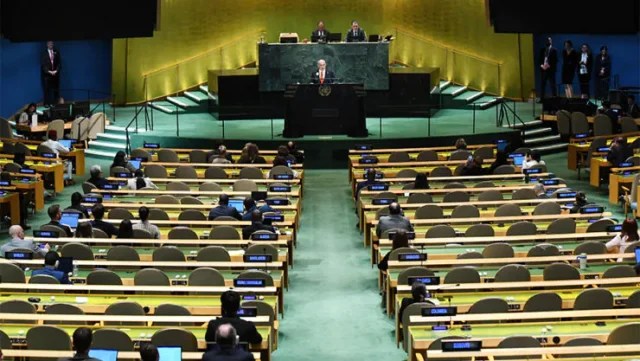
Netanyahu and the empty UN hall
By Viktor Mikhin – New Eastern Outlook – October 12, 2025
He stood at the podium, accustomed to the speeches of statesmen, but that day it was destined to become an instrument for justifying genocide. Benjamin Netanyahu, the prime minister of the Israeli regime, a man whose name will now stand alongside the darkest figures in history, was preparing to speak. But something happened that will forever remain in the annals of international diplomacy as a symbol of the moral collapse not only of one man, but of the entire system that has indulged him for far too long.
The UN General Assembly hall, usually filled with diplomatic indifference, exploded with a silence louder than any applause. Before Netanyahu could utter a single word, delegates from one country after another rose from their seats and demonstratively, silently, left the hall. This was not a spontaneous impulse, but a choreographed act of collective disgust. The spectacle was so humiliating for the leader of the so-called “only democracy in the Middle East” that the chairperson had to plead: “Order in the hall, I call for order in the hall!” But the appeal hung in the air. There was no order. There was a rebellion. A rebellion of conscience. A rebellion against injustice, genocide, and the annihilation of an entire Palestinian people.
Netanyahu’s face, usually a mask of unshakable self-confidence, contorted. He was shocked. He, the architect of carpet bombing, the destroyer of hospitals and schools, the executioner of children, women, and the elderly, was faced with something he did not expect: the silent, yet deafening, judgment of nations. In that moment, the mask of civility finally fell from the Israeli state. The world saw not a national leader, but an accused genocidaire left speaking to a nearly empty hall, save for a handful of his most loyal accomplices.
The “Father of Genocide’s” Speech: A New Language of Hate
And then the speech itself began. What was supposed to be a justification turned into a manifesto of misanthropy. Netanyahu, whose rhetoric had long since crossed all red lines, this time addressed the residents of Gaza directly. And in this vile address, there was a chilling cynicism worthy of the Nazi propagandists he so loves to compare his critics to.
He told them “not to listen to Hamas’s calls to remain in combat zones.” But is this not the height of hypocrisy? It is the Israeli army that has turned the entire Gaza Strip into one continuous “combat zone.” It is Israeli planes that are wiping entire neighborhoods off the map, following “evacuation maps” that are nothing more than a roadmap to a mass grave. Where are they to flee? To the sea, which Israeli ships have turned into a trap? To Rafah, which was then bombed? To the desert, where there is no water, no food, no shelter?
This appeal is not concern for civilians. It is the rhetorical trick of a murderer who, holding a knife over his victim, whispers, “It’s your own fault for not dodging.” It is an attempt to shift responsibility for one’s own crimes onto those who are doomed to die. This is the language of genocide. The very language that dehumanizes an entire people, turning them into a “human shield,” into “collateral damage,” into “animals,” as Israeli ministers and soldiers have openly and repeatedly called them.
The Anatomy of a Genocide: From Word to Deed
Let’s call things by their proper names. What is happening in Gaza is not a “conflict.” A conflict implies at least a semblance of symmetry. This is not a “war on terror.” This is the deliberate, systematic destruction of the Palestinian people as a national, ethnic, and cultural entity. And it fully corresponds to the legal definition of genocide as formulated in the 1948 UN Convention.
Article II of the Convention defines genocide as any of the acts committed with intent to destroy, in whole or in part, a national, ethnical, racial or religious group.
Silent Accomplices and Cynical Allies
The scene at the UN was a bright moment of truth, but it also highlighted the monstrous hypocrisy of Western powers. While delegates from most of the world voted with their feet, the representatives of the United States, Germany, the United Kingdom, and some other subordinate countries remained in their seats. Their silent presence was more eloquent than any words. It was silent approval. Complicity.
Washington, which supplies the weapons and provides diplomatic cover for the ongoing slaughter, is the chief sponsor of this genocide. Every bomb that falls on a house in Gaza has “Made in the USA” written on it. Every veto cast in the UN Security Council against cease-fire resolutions is a permission to kill. The West, which built the “Never Again” system after World War II, has itself become its chief violator. “Never Again” has turned out to apply only to some peoples, but not to others.
A Voice from Under the Rubble: Why the World Must Listen to This Enemy
When Netanyahu tried to speak to the Palestinians, it was the monologue of an executioner. But the Palestinian people have their own voice. It is the voice of mothers mourning their children under the rubble. It is the voice of doctors performing operations by the light of flashlights. It is the voice of poets writing poems on the debris of their homes. It is the voice of unyielding dignity.
History will judge not only Netanyahu and his henchmen. History will judge everyone who turned away at this decisive moment. Every politician who traded humanity for geopolitical interests. Every journalist who called a massacre a “clash.” Every ordinary person who grew tired of “this complex issue.”
That day at the UN showed that the world’s patience has run out. The collective walkout of delegates is not just a gesture. It is the beginning of the end of the era of impunity for the Israeli regime. It is an acknowledgment that apartheid, occupation, and genocide cannot be legitimate policies in the 21st century.
The court in The Hague has already begun its work. And someday, perhaps, the world will see the man who today trembled at the podium with rage and humiliation, in the defendant’s dock. But executioners come and go, while the people fighting for their freedom and right to exist remain. Palestine will be free. And that day when the world turned its back on its executioner will be one of the first steps toward long-awaited liberation. The truth, like conscience, does not remain silent forever. It decisively walks out of the council chamber to scream loudly for the whole world to hear.
Viktor Mikhin, Corresponding Member of the Russian Academy of Natural Sciences (RAEN), Expert on Middle Eastern Countries
Irish contender blasts Irish gov. over delay of sanctions on ‘Israel’
Al Mayadeen | October 9, 2025
Ireland’s leading presidential contender has accused the government of bowing to US corporate pressure by stalling legislation that would sanction Israeli settlements, as anger grows over “Israel’s” genocide in Gaza.
Catherine Connolly, an independent left-wing lawmaker backed by Sinn Féin, urged Dublin to resist diluting the long-delayed Occupied Territories Bill, which aims to ban trade with goods and services linked to illegal Israeli settlements.
“We cannot allow the government to fail the Palestinian people on this,” Connolly told Reuters, accusing coalition partners Fianna Fáil and Fine Gael of “dragging their feet.” She warned that limiting the bill to goods only would amount to “an appalling capitulation to corporate interests” and an “unforgivable betrayal”.
Her remarks came just hours before US President Donald Trump announced a ceasefire and captive release deal between “Israel” and Hamas as part of his plan to end the two-year genocide in Gaza.
‘Ireland must match its moral stance with real action’
Government insiders told Reuters the proposed law may be watered down following lobbying by major US businesses operating in Ireland. While Ireland’s government has been vocal in condemning the Israeli war, the bill’s progress has stalled amid diplomatic and economic pressures.
Connolly, who currently leads in opinion polls ahead of the October 24 presidential election, said she would continue pushing for a comprehensive sanctions framework that includes services, insisting that Ireland “must match its moral stance with real action.”
Her stance was echoed by Frances Black, an independent senator who first introduced the legislation seven years ago. “The government needs to be strong on this. They need to be courageous,” Black said. “It’s absolutely vital that we have goods and services on the bill. We need to match our words with action.”
The proposed sanctions, in preparation for over a year, have drawn criticism from “Israel”, international business groups, and US lawmakers. Earlier this week, a group of American legislators warned Prime Minister Micheál Martin that passing the bill could damage US-Irish relations and harm American companies based in Ireland.
US takes action to protect ‘Israel’, again
Last August, a group of US Congress members sent a letter to Treasury Secretary Scott Bessent urging him to evaluate whether Ireland should be added to a list of countries boycotting “Israel” should the Occupied Territories Bill (OTB) become law.
The letter, which was signed by New York Republican Congresswoman Claudia Tenney and backed by 16 other congressional members, expresses what it describes as serious concerns about the Irish government’s proposed ban on imports from Israeli-occupied territories.
The letter cites Section 999 of the 1986 Internal Revenue Code, which condemns foreign boycotts targeting allied countries, with specific opposition to measures directed at “Israel”.
The letter warned that if Ireland were added to the list of countries boycotting “Israel”, it would trigger mandatory tax reporting obligations and possible financial penalties for American citizens and companies conducting specific operations in those nations.
The group characterized the Irish government’s efforts on the OTB as “part of [a] broader effort aligned with the global Boycott, Divestment, and Sanctions (BDS) movement which seeks to economically isolate Israel.”
Soldiers, Settlers Injure 20 Palestinians in Beita

International Solidarity Movement | October 11, 2025
October 10 was the opening of the Zaytoun2025 olive harvest campaign. Here’s a wrap-up of the events:
Beita, South Nablus
About one hundred farmers joined by some 60 Palestinian and solidarity activists, were attacked by armed Israeli citizens and soldiers, near a recently established Israeli settlement in the Jabal Qamas area. The soldiers both ignored the attacks on the farmers and used violence themselves to try and repel the harvesters from their lands, and ignored the assault of Palestinians by the Israeli civilians, and therefore enabling them. The soldiers used tear-gas concussion grenades and physical violence, while the Israeli civilians attacked harvesters with baton blows, stone throwing and by shooting live ammunition.
- 20 injuries were recorded. 11 of the injured Palestinians were evacuated to the Rafidia hospital in Nablus. In addition, one solidarity activist was evacuated to the Belinson hospital after Israeli civilians assaulted her with batons and broke her arm.
- One of the Palestinians suffered a gunshot wound after being shot by an Israeli civilian.
- Three of those injured are journalists: Wahaj Bani Mufleh, Saja al-Alami and Jaafar Astaya, whose car is one of those torched.
- Eight cars were torched by the Israeli civilians.
- An ambulance was attacked and flipped over. An attempt to torch it as well was foiled by Palestinians who came to the crew’s rescue.
Jorish and Aqraba, South-East Nablus
Israeli civilians armed with batons prevented farmers from the two villages accompanied by solidarity activists from accessing their lands in the Wad Issa agricultural area.
Duma, Sout-East Nablus
Israeli soldiers prevented farmers from harvesting their olives in the Houma and Khallet al-Hassad areas, asserting access to these lands requires security coordination with Israeli authorities. The Houma area is in Area B.
Yanoun, East Nablus
Israeli civilians expelled farmers and stole their harvested olives.
Deir Istia, North Salfeet
Israeli civilians harassed harvesters in an attempt to prevent them from accessing their lands near the Yaqir settlement.
Kufer Thulth, East Qalqilya
Settlers attacked harvesters and shepherds, killing several goats.
Farata, East Qalqilya
Israeli civilians shot at farmers harvesting olive with live fire in the presence of Israeli soldiers, who did not intervene. Both the soldiers and Israeli civilians then continued to raid the village, stop residents in the street and question them.
Kobar, North Ramallah
Israeli forces arrested harvesters in their lands near the village.
The silent collapse of the United States
By Lucas Leiroz | Strategic Culture Foundation | October 11, 2025
While Washington insists on presenting itself as the bastion of the “liberal world order,” the very foundations of the American state are showing clear signs of collapse. The internal reality of the United States today is marked by an insurmountable fiscal abyss, chronic political polarization, and an alarming inability to maintain even the most basic national security systems. The recent escalation of public debt, combined with the imminent breakdown of nuclear monitoring infrastructure, reveals that American hegemony is not just in decline — it is on the verge of functional collapse.
According to data from the U.S. Treasury, the gross national debt surpassed $37.5 trillion in 2025 — the highest level in the country’s history — exceeding 120% of its GDP. What is most alarming is the speed of this growth: in just the last 12 months, the debt increased by more than $2 trillion — without any emergency context such as war or a global pandemic. It is an unsustainable trajectory, typical of failed states, yet it is happening at the heart of the Western financial system.
At the same time, budget cuts imposed by Congress itself — deadlocked in endless partisan disputes — have directly jeopardized the security of the American nuclear arsenal. The National Nuclear Security Administration (NNSA), responsible for overseeing and maintaining the country’s atomic warheads, publicly admitted that its funds would only guarantee operations for “a few more days.” Once this period expired, a shutdown process for monitoring systems began — something unthinkable for any minimally functional power.
How can a country that spends hundreds of billions of dollars annually to fund wars in foreign territories — such as Ukraine and the occupied Palestine — be unable to finance the security of its own nuclear arsenal? The answer is simple: the United States is no longer a rational country, but a decaying “empire” driven by corporate lobbies, military-industrial interests, and a political elite entirely disconnected from national reality.
The current Republican administration tries to blame the Democratic opposition for the budget paralysis, while the Democrats sabotage any attempt at agreement in order to politically undermine the government. This argument is partially valid, but it also exposes the weakness of the Republicans themselves, who fail to counter the Democratic sabotage. This bipartisan theater is not only dysfunctional — it is suicidal. The U.S. is at the mercy of its own internal disorder, becoming a threat not only to itself but to the entire world, given the sensitive nature of the nuclear systems involved.
Thousands of NNSA employees and contractors have already been affected by shutdowns and funding freezes. Although the government claims that “critical operations” will continue, there are no guarantees or transparency about what exactly remains functional. A mistake, maintenance failure, or even a delayed response to an incident could have catastrophic consequences — including radioactive leaks or accidental detonation.
Meanwhile, countries like Russia and China continue to strengthen their energy sovereignty, defense systems, and institutional stability. The multipolar approach being built by these nations — particularly within the expanded BRICS+ framework — demonstrates strategic maturity and responsibility toward global order, in stark contrast to what is observed in Washington.
America’s decline is not expressed solely through numbers or economic graphs. It is visible in the inability to protect its own population, maintain basic infrastructure, or prevent political games from eroding the state’s structural integrity. When even the nuclear arsenal — supposedly the ultimate red line — is left vulnerable to budget cuts, the message is clear: the U.S. is no longer capable of leading the world.
The collapse on the horizon will not be merely economic. It will be institutional, military, and geopolitical. And in the face of this scenario, the world must begin looking to other — multiple, stable, sovereign, and genuinely peace-oriented — leaderships to guarantee global security.
From NATO’s flank to Eurasia’s core: Türkiye’s break with the West begins
By Farhad Ibragimov | RT | October 10, 2025
For decades, Turkish nationalism marched under the NATO flag. But now, one of Türkiye’s most influential right-wing leaders is calling for a turn East – toward Russia and China. His proposal may mark the country’s clearest ideological break with Atlanticism since joining the Alliance.
In September, Türkiye’s political landscape was shaken by a statement that many experts called sensational and potentially transformative. Devlet Bahceli, leader of the Nationalist Movement Party (MHP) and a long-time ally of President Recep Tayyip Erdogan within the People’s Alliance, proposed the establishment of a strategic trilateral alliance involving Türkiye, Russia, and China to counter the “US-Israel evil coalition.”
Bahceli emphasized that such an alliance is “the most suitable option, considering reason, diplomacy, the spirit of politics, geographical conditions, and the strategic environment of the new century.” The proposal extends far beyond the usual nationalist agenda, positioning Türkiye as a player capable of initiating new formats of international cooperation.
To grasp the importance of this statement, we must note the historical context. Turkish pan-Turkism has traditionally been oriented toward the West, and nationalists were seen as staunch defenders of the pro-Atlantic course. In this light, Bahçeli’s call for an alliance with Moscow and Beijing marks a symbolic break from that tradition, reflecting growing distrust toward NATO and the US within Türkiye’s political landscape.
Bahceli’s comments are not random. Over the past few years, he has steadily ramped up his criticism of the West, advocating for Türkiye’s sovereign development “beyond blocs and alliances.” But this is the first time he has explicitly named Russia and China as preferred partners.
Reactions inside Türkiye were mixed. Right-wing circles called Bahceli’s words “revolutionary,” while leftists saw them as confirmation of a broader anti-Western consensus. Internationally, the statement underscored Ankara’s growing distance from Western power centers and its gradual rhetorical shift toward the East and Greater Eurasia.
Shortly afterward, Erdogan made a cautious comment, saying he was “not fully familiar” with Bahceli’s initiative but adding, “Whatever is good, let it happen.” The ambiguity is typical for Erdogan, who avoids publicly rejecting the ideas of key allies while keeping his political options open.
On one hand, the president is wary of provoking open conflict with Western partners, given Türkiye’s economic vulnerabilities. On the other, his comments suggest that Bahçeli’s initiative could serve as leverage – a way to pressure the US and EU by signaling that Ankara might strengthen ties with Moscow and Beijing.
A day later, Bahceli clarified his position, saying, “We know what we are doing. Türkiye should not be the implementer of regional and global projects put forward by others, but rather must be the leading actor of its own unique projects.”
In other words, Bahçeli not only intensified his anti-Western rhetoric but also asserted Türkiye’s claim to be an independent power center in the emerging multipolar world order. His stance reflects the desire of part of Türkiye’s leadership to move from being a peripheral NATO ally to a pioneer of alternative alliances in Eurasia.
From NATO loyalism to Eurasian realism
For decades, Türkiye was one of NATO’s most loyal allies. Since the Cold War, the Turkish elite believed that integration into Euro-Atlantic structures was the only viable strategy. A world order based on American leadership seemed stable and predictable.
Erdogan shared similar views when he first became prime minister in 2002. But as global competition intensified, disagreements with Washington deepened, and multipolar trends gained momentum, he realized that the unipolar system could not last. Türkiye, he concluded, must adapt – and play a role in shaping the new order.
Seen in this light, Bahceli’s proposal is more than nationalist fervor. It reflects an understanding among parts of Türkiye’s leadership that the country’s future lies in greater strategic autonomy and in building ties with alternative centers of power. His words echo those within Erdoğan’s circle who believe Türkiye can assert itself only through closer engagement with Russia and China.
This shift reveals how Türkiye’s elites have moved from trusting the stability of a Western-centric system to recognizing its limits – and searching for new frameworks in which Ankara can act as a key player rather than a subordinate.
Redefining Türkiye’s place in the world
Bahceli’s remarks highlight deep shifts within Turkish nationalist circles and Ankara’s growing readiness to reconsider its global role. He argues that neither China nor Russia is Türkiye’s enemy, despite efforts by Western ideologues to claim otherwise. Instead, he sees the West as the true obstacle – determined to prevent Türkiye from becoming an independent power center and confining it to a role of “watchdog” in the Middle East.
In his latest statement, Bahceli stressed the need for a new strategy:
“We believe that Türkiye, located at the center of Eurasia, which is the strategic focus of the 21st century, should pursue multidimensional and long-term policies aimed at strengthening regional peace and stability and developing cooperation opportunities, especially with countries in the Black Sea and Caspian Basin, including Russia, China, and Iran. Considering the changing and complex structure of international relations, producing permanent and comprehensive solutions to global issues such as terrorism, illegal migration, and climate change is a responsibility that no country can achieve alone.”
Essentially, Bahceli is saying that Türkiye must transcend old constraints and stop being a tool in the hands of external forces. His stance embodies a new paradigm: only through an independent, multilateral, and Eurasian policy can Türkiye become a true architect of regional stability and a major player in the future global order.
The end of oscillation
Türkiye has long oscillated between Atlantic alignment and independent ambition. These cycles rarely evolved into a lasting doctrine. But the current geopolitical environment is forcing Ankara to make a choice.
Economic dependency, regional instability, and Israel’s aggressive behavior – including attacks on Iran and Qatar – have created a sense of urgency. In Ankara, some now fear that Türkiye itself could become a target.
Globally, the old unipolar order is losing balance, and an alliance with Russia and China may offer Türkiye not guarantees, but strategic advantages – especially in securing its autonomy and status as an independent power center.
At the UN General Assembly, US President Donald Trump urged Erdogan to stop buying Russian oil and even floated bringing Türkiye into the anti-Russia sanctions regime. For Ankara, that would mean economic damage and deeper dependence on the West – a risk the leadership is no longer willing to accept.
Bahceli’s initiative, and Erdogan’s carefully measured reaction, mark a pivotal moment. Türkiye is beginning to institutionalize its search for an alternative political philosophy – one grounded in multipolarity, strategic pragmatism, and a redefined vision of its place in the 21st century.
Farhad Ibragimov – lecturer at the Faculty of Economics at RUDN University, visiting lecturer at the Institute of Social Sciences of the Russian Presidential Academy of National Economy and Public Administration
‘Lies, misinformation’: Israeli military produced videos to justify Gaza genocide
Press TV – October 10, 2025
A new analysis has found that the Israeli military produced three-dimensional or animated visualizations not based on verified intelligence but fabricated content and digital assets to justify the Tel Aviv regime’s genocidal war on the Gaza Strip.
A months-long investigation by the Israeli-Palestinian publication +972 Magazine and Hebrew-language outlet Local Call, together with the research collective Viewfinder, the Swiss network SRF, and the Scottish outlet The Ferret analyzed 43 animations released by the Israeli army over the past two years and found that many contain “serious spatial inaccuracies or pre-fabricated assets”.
The videos, including those depicting the alleged tunnels beneath the al-Shifa Hospital and a UN-run school in Gaza, are “sourced not from classified intelligence but rather from commercial libraries, content creators, and cultural institutions,” the study found.
The clips are typically published across the Israeli military’s Telegram, YouTube, Facebook, X, and Instagram channels, and may be paired with a press conference by the occupation army’s spokesperson.
International media outlets will use the ready-made visuals, in many cases amplifying them uncritically.
“Instead of revealing hidden truths — as Israeli military officials insist, and as the international media readily amplifies — the visualizations actually blur them,” according to the investigation.
It further said that interviews with soldiers involved in the production of these videos further illuminate how the Israeli army prioritizes the aesthetic value of the animations over their accuracy.
The analysis also found that more than half of the videos contained 3D assets, which were taken from third-party sources.
Over 50 different third-party assets were identified in total, which were replicated hundreds of times across animations of sites supposedly in Gaza, Lebanon, Syria, and Iran, it added.
“A parking lot from Washington state, scans from a boat-building workshop in Scotland, and commercial storefront kits from the video game industry — all of these have been inserted, without credit, into animations presented as ‘illustrations’ of Hamas bunkers or Iranian weapons facilities.”
Eyad Elyan, a Palestinian academic at Scotland’s Robert Gordon University specializing in AI and 3D modeling, said he was “deeply disturbed” to learn that Israel has been using Scottish assets in its propaganda animations, saying the practice aligns with the regime’s “long history of exploiting others’ resources and employing every means possible to promote baseless claims.”
“What is especially troubling, however, is how such fabricated content is uncritically accepted and amplified by mainstream media outlets,” he continued. “Much of this material consisted of outright falsehoods — for instance, the widely circulated animation alleging that Hamas operated a command center beneath the al-Shifa Hospital. No such facility was found, but [this claim] was used to destroy almost the entire healthcare system in Gaza.”
Scottish lawmaker Patrick Harvie said the Israeli military made and distributed the videos in order to “justify” its Gaza genocide.
“When lies and misinformation are such a core part of an army’s strategy, it makes it all the more important that our governments take a stand and act to stop the atrocities that they are inflicting,” he added.
Israel unleashed its brutal onslaught on the Gaza Strip on October 7, 2023, after the Palestinian Hamas resistance group carried out its historic operation against the usurping entity in retaliation for the regime’s intensified atrocities against the Palestinian people.
The Tel Aviv regime failed to achieve its declared objectives of eliminating Hamas and freeing all captives in Gaza, despite killing, according to the health ministry of Gaza, 67,194 Palestinians, mostly women and children, and injuring 169,890 others.
Trump’s Gaza peace plan won’t work, it’s an ultimatum under genocide
By Finian Cunningham | Strategic Culture Foundation | October 9, 2025
The so-called peace plan put forward by U.S. President Trump is a non-starter that won’t work, according to international legal expert Alfred de Zayas.
De Zayas says Trump’s much-ballyhooed initiative is not a peace offer. It is an ultimatum demanded by criminal rogue regimes that are responsible for genocide – the United States and Israel.
Professor De Zayas points out that Donald Trump and Israel’s Benjamin Netanyahu have no credibility. Both are complicit in the genocide of Palestinians. The very idea of Trump proposing a peace deal amidst an ongoing U.S.-backed mass slaughter, where there is no legal prosecution of the perpetrators of genocide, nor for the illegal occupation of Palestinian land, and numerous other war crimes, is grotesque and absurd.
The appointment of British former leader Tony Blair to oversee Trump’s “peace plan” in Gaza is another insult.
“He should be behind bars as a war criminal,” says de Zayas, referring to Blair’s role in launching the U.S.-British war on Iraq in 2003, based on lies, killing over one million people.
On the issue of Gaza, the problem is that Israel, with support from the U.S. and European states, has been grossly violating international law and UN treaties for decades with impunity. This shameful lack of accountability and enforcement of international law makes Israel and its Western sponsors criminal regimes. It is nonsense to expect such serial violators to now propose a peace deal when they have not been held to account for a litany of crimes.
De Zayas says we need a ceasefire in Gaza urgently, with massive humanitarian aid for a population being deliberately starved to death by Israel. But any resolution must be applied with international law and justice for the horrific crimes.
Trump’s plan is a whitewash of the genocide. The Western mainstream media are also guilty of covering up the depth of horror. The media are ridiculously spinning Trump’s offer as genuine and credible, perhaps with a few flaws pooh-poohed here and there. The media are not reporting on the true horror and Western complicity in genocide. That’s because their long-time role is to serve as a propaganda service to sanitize the crimes and systematic lawlessness of Western rogue regimes.
Professor Alfred de Zayas teaches international law and history at the Geneva School of Diplomacy. He has worked as a UN staff expert on human rights for nearly 50 years.
His latest book is The Human Rights Industry (Clarity Press, 2023), see here: https://www.claritypress.com/product/human-rights-industry/
Catch his recent articles on wide-ranging international issues at Counterpunch: https://www.counterpunch.org/author/alfred-de-zayas/
No evacuation for Palestinian gangs collaborating with Israel in Gaza: Report
With a ceasefire in effect, ISIS-linked smuggler Yasser Abu Shabab and his militia face an uncertain future
The Cradle | October 9, 2025
Palestinian collaborator with Israel and Wall Street Journal columnist Yasser Abu Shabab and his “Popular Forces” will stay in Gaza following the ceasefire between Israel and Hamas, according to a report by Israel Hayom on 9 October.
The Hebrew news outlet noted that Abu Shabab’s militia is deployed in areas that will not be evacuated by the Israeli army in the first phase of the ceasefire agreement, allowing the group to enjoy further Israeli protection, at least temporarily.
The Popular Forces established a base under Israeli guidance in the area east of the destroyed city of Rafah on the Gaza border with Egypt.
This area is far behind the “yellow line,” to which Israeli troops must withdraw, according to the map detailing US President Donald Trump’s ceasefire plan.
Abu Shabab’s men are also behind the “red line” of withdrawal, up to which an international force will allegedly be deployed. Areas occupied by the group in the destroyed cities of Beit Lahia and Beit Hanoun, and eastern Khan Yunis, are also behind the yellow line.
In early 2024, as Israel was imposing its starvation siege on Gaza, Israeli intelligence armed and funded Abu Shabab’s militia, tasking them with attacking and looting convoys carrying humanitarian aid into Gaza, including from the UN.
Israeli officials then blamed the attacks and chaos on Hamas, using the excuse to seize control of aid distribution in Gaza via the deadly Gaza Humanitarian Foundation (GHF).
Abu Shabab was arrested by Hamas in 2015 and sentenced to 25 years in prison on charges of drug trafficking and theft.
He escaped in October 2023 after Israeli airstrikes hit the prison where he was being held. Leaders of Abu Shabab’s Tarabin clan publicly disowned him and have called for his killing for collaborating with Israel.
Hossam al-Astal, the Popular Forces commander in eastern Khan Yunis, claimed the group would remain in Gaza, while Hamas would be forced to leave.
“The Hamas dogs will not be happy, we exist and they are (the ones) leaving,” Astal claimed.
On the other hand, a security source in the Ministry of Interior in Gaza told Quds Press on Thursday that members of Abu Shabab’s militia fear being prosecuted after the genocide ends.
The source said members of the group have recently begun communicating with several families and tribal leaders, in hopes of opening indirect channels with the Ministry of Interior to resolve their legal and tribal status and ensure they are not subject to prosecution.
The source explained that this communication took place in secrecy, via intermediaries from local and tribal leaders, who relayed messages between the police leadership in Gaza and the militia members who wished to settle their status.
A specific mechanism was agreed upon for them to surrender and stand trial, while ensuring the confidentiality of the proceedings, the source added.
Sources also revealed to Quds Press that Abu Shabab’s group had helped Israeli forces arrest Dr. Marwan al-Hams, the director general of field hospitals, from a medical facility in Rafah about two months ago.
The sources said that additional information regarding the militia’s crimes would be revealed “in the coming days.”
Pakistan’s Gaza assignment: Policing resistance for Trump’s ‘peace’
By F.M. Shakil | The Cradle | October 9, 2025
Washington is looking to draft Pakistan into a sweeping plan to reshape Gaza under the guise of a 20-point “peace” initiative led by US President Donald Trump. At the heart of the proposal is an International Stabilization Force (ISF) tasked with enforcing “internal stability” in the devastated Palestinian enclave – a euphemism for dismantling resistance and tightening Israeli control.
Trump, standing alongside Israeli Prime Minister Benjamin Netanyahu in a September press conference, laid out a scheme to forcibly relocate Palestinians and reconstruct Gaza as a neoliberal outpost he previously branded “the Riviera of the Middle East.”
Pakistan’s public backlash builds
Details of the initiative have raised alarm in Pakistan, where any military collaboration with Israel is a red line for the establishment and the population, given that Islamabad does not recognize the state. Public backlash has intensified since revelations surfaced of Pakistan’s potential participation in the ISF, alongside forces from Egypt and Jordan.
The people of Pakistan would not accept Washington’s plan to deploy joint military forces from “like-minded Islamic countries” to eliminate resistance forces in Gaza. The opinion-makers, intellectuals, and political circles have already questioned the authority of the rulers to enter into a process that is aimed at transforming Palestine into a part of a “Greater Israel.”
Facing mounting domestic scrutiny, Pakistan’s Deputy Prime Minister Ishaq Dar revealed in a 30 September press conference that the 20-point plan diverged sharply from what was initially agreed in Washington. His statement came amid growing demands for transparency from political leaders and civil society, many of whom accuse Islamabad of capitulating to Washington’s demands without a national consensus.
Pakistan’s refusal to join the Saudi and UAE-led coalition against the Ansarallah-aligned forces in Yemen still looms large in public memory. In 2015, Islamabad’s parliament voted unanimously to remain neutral, citing the dangers of waging war on a Muslim country and the risks of further sectarian entanglement. That restraint is now being contrasted with the military’s apparent willingness to deploy forces into a conflict zone tightly controlled by Israel.
It is equally important to note that, despite Tel Aviv’s lack of trust in Pakistan’s military establishment and the latter’s threats to target its nuclear assets in solidarity with Iran, it still chose to assign Pakistani forces a leading role in the proposed ISF. This suggests that Pakistan’s military leadership has offered significant, and so far undisclosed, concessions to Washington.
Pakistan’s business community is equally concerned about the reports regarding the US investment in Pasni Port terminals, located 120 kilometers from Iran and the Chinese-built Gwadar seaport. If the investment targets naval or military bases, there are concerns that it could draw regional ire from both Tehran and Beijing.
Imtiaz Gul, Pakistan defense analyst and Executive Director of the Center for Research and Security Studies (CRSS), Islamabad, tells The Cradle:
“By all indications, Pakistan is likely to be part of the multinational Islamic force, albeit in a zone that will be totally at the mercy of and surrounded by the Israel Defense Forces (IDF). To what extent this force can neutralize and eventually eliminate Hamas, which has backing from Iran, Turkiye, and Qatar, is difficult to forecast at this time.”
Gul adds that since Pakistan, Egypt, and Jordan are all military-run states, they may coordinate more easily to oversee Gaza under occupation. The hope, he says, is that this cooperation might at least put a stop to Israel’s relentless slaughter of Palestinians.
From sanctions to red carpet
Pakistan’s sudden centrality to Trump’s Gaza plan is underpinned by a marked shift in Washington’s tone. Since the brief Pakistan–India skirmish in May, the US has rolled out the red carpet. Last month, Pakistani Prime Minister Shehbaz Sharif and army chief Field Marshal Asim Munir were hosted in the Oval Office for a high-profile meeting with Trump.
The recent developments concerning West Asia have unequivocally revealed the transformation in Washington’s diplomatic approach toward Pakistan. President Trump expressed a strong belief that additional Muslim nations will soon become part of the Abraham Accords and commended Prime Minister Sharif and Field Marshal Munir for their full alignment with his peace initiative.
“Formally joining the Abraham Accords may be difficult currently, but informally following the path that the UAE, Bahrain, and Qatar pursued looks quite probable,” Gul says. He asks if countries around Israel and Palestine can reconcile with ground realities, then why should Pakistan have a problem with a country that is not even a distant neighbor?
“The challenge is whether Pakistan can stay stable and can develop a national consensus on engaging with Israel – even if informally,” he explains.
Minerals, money, and military ports
Islamabad’s apparent rapprochement with Washington is not limited to Gaza. In October, Pakistan delivered its first shipment of enriched rare-earth elements to US Strategic Metals (USSM), part of a $500-million deal signed with the Pakistan army’s commercial arm, Frontier Works Organization (FWO). The minerals will feed a new polymetallic refinery funded by Washington.
The recent delivery to the USSM on 2 October has catalyzed a notable transformation in the dynamics of the Pakistan–US relationship.
Concurrently, reports surfaced of the aforementioned strategic proposal to build a port terminal in Pasni, Balochistan, submitted to US authorities by Pakistan’s military-linked business interests. Any such move carries profound strategic implications for China and Iran, which view Pasni’s proximity to Gwadar and Chabahar as vital to their own maritime interests.
Gwadar serves as a crucial component of the China–Pakistan Economic Corridor (CPEC), featuring China’s strategically constructed Gwadar seaport.
On 4 October, senior security sources informed a select group of media representatives in Islamabad that Pakistan will not be extending an invitation to the US for a naval base in Balochistan. The reports circulating in foreign media regarding potential future public-private partnerships are simply proposals.
The security sources pointed out the immense potential of Pakistan’s coastline for both large and small commercial ports, noting that nations globally evaluate such partnership proposals.
“We shall uphold the primacy of Pakistan’s national interest in this framework. The nature of what defines the interests of the US holds no significance for us. Our primary concern is the advancement of Pakistan’s interests,” a defense spokesman remarked.
The official clarification only added confusion, claiming the port terminal proposal came from private business collaboration, even though the FWO is not a private entity but an army-run unit, raising questions about how such sensitive decisions are made.
Former Karachi Chamber of Commerce president Majyd Aziz tells The Cradle that it was imperative to limit the foreign military utilization of Pasni Port to uphold regional stability and prevent any discontent from Tehran and Beijing:
“Pakistani entrepreneurs are hesitant to invest in maritime sectors, leading to a dependence on foreign investment. This situation subsequently attracted the US interest in Pasni Port, which may carry serious implications for China’s influence in the region.”
Aziz adds that Gwadar’s underperformance has made smaller ports like Pasni, Ormara, and Jiwani more attractive. These offer lower costs, shorter routes, and better local integration. With over 85 percent of Pakistan’s trade dependent on maritime routes, diversifying port infrastructure is seen as essential to economic resilience.
Peace, under the boot
Trump’s so-called peace formula, presented alongside Netanyahu, aims to weaken Palestinian resistance by severing its supply chains and installing a proxy security apparatus.
The US-led ISF, with a significant Pakistani component, is the linchpin of this plan. But critics argue the operation is little more than a smokescreen for Tel Aviv’s next phase of territorial expansion.
As the details unfold, Islamabad faces a stark choice: yield to US pressure and risk regional isolation, or heed domestic voices warning against entanglement in a colonial project masquerading as peace.
Israel rules out Marwan Barghouti’s release as Hamas says Netanyahu seeking to ‘blow up truce’
The Cradle | October 9, 2025
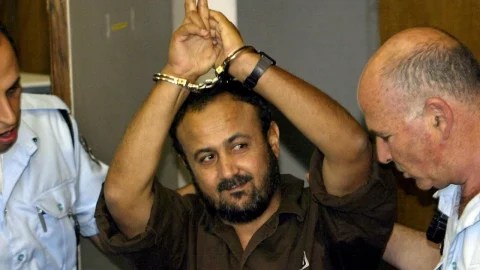
Israel will not release prominent Palestinian leader Marwan Barghouti as part of a prisoner exchange deal accompanying the ceasefire with Hamas in Gaza, an Israeli government spokesperson announced on 9 October.
“I can tell you at this point in time that he will not be part of this release,” spokesperson Shosh Bedrosian stated in a press conference on Thursday, as the ceasefire is expected to take effect.
However, Palestinian sources told Al Jazeera and Ynet that Barghouti’s case is still on the table, and Hamas is pressing hard for his release.
Barghouti is a prominent Palestinian legislator and leader of Fatah, a nationalist political party that dominates the Palestine Liberation Organization (PLO).
After surviving multiple assassination attempts by Israeli intelligence, Barghouti was imprisoned during the Second Intifada in 2002.
He is serving five life sentences, allegedly for organizing attacks that killed five Israelis.
After his conviction was announced, Barghouti stated in Hebrew, “This is a court of occupation that I do not recognize … A day will come when you will be ashamed of these accusations … I have no more connection to these charges than you, the judges, do.”
Barghouti penned a book while imprisoned in which he described being tortured by his Israeli guards, including being forced to sit on a chair with nails protruding into his back for hours at a time.
Despite his imprisonment, Barghouti has remained politically active and is widely viewed as more popular than Palestinian Authority (PA) President and fellow Fatah leader Mahmoud Abbas.
As part of the ceasefire between Hamas and Israel that went into effect Thursday, Hamas agreed to release 20 living Israeli captives and the bodies of 26 captives who died due to Israel’s bombing and starvation siege on the strip over the past two years. The fate of the two final captives is unknown.
In return, Israel committed to releasing 250 Palestinian prisoners serving life sentences and 1,700 Palestinians detained from Gaza. Throughout the war, many Palestinian detainees were tortured and raped in Israel’s notorious Sde Teiman prison, including 53 detainees who died in custody.
Israeli sources speaking to Israeli Army Radio and CNN stated Thursday that the bodies of slain Hamas chief Yahya Sinwar and his brother Mohammad will not be released as part of the exchange deal.
Sinwar was killed by the Israeli military in Gaza in October 2024, while his younger brother, Mohammad, who succeeded him as military leader of Hamas’s armed wing, was killed by Israel earlier this year.
The resistance movement has demanded the release of other high-profile prisoners, including PFLP Secretary-General Ahmad Saadat and chief Qassam Brigades engineer and leader, Abdullah Barghouti. Senior Hamas leader Abbas al-Sayed and Hassan Salameh are also among those the movement wants released.
A Hamas official speaking with Al Jazeera said that negotiations to finalize the list of Palestinian prisoners to be released are ongoing. The source added that Hamas is consulting with other Palestinian resistance movements regarding the list.
Hamas delivered its final response this morning regarding the timelines for implementing the agreement, the source stated.
Regarding the prisoner exchange, Hamas spokesman Hazem Qassem told Al Jazeera on Thursday that Israel is trying to “manipulate the dates, lists, and some of the agreed-upon steps.”
“The occupation [Israel] must adhere to what was agreed upon, and we call on the mediators to pressure it,” Qassem added.
Another Hamas official, Mahmoud Mardawi, said Israeli Prime Minister Benjamin Netanyahu “is seeking to blow up the ceasefire agreement” by “backtracking on the prisoner lists in an attempt to sabotage the understandings.”
This suggests that Netanyahu is trying to sabotage other aspects of the ceasefire as well, including issues related to the withdrawal, reconstruction, and the reopening of border crossings, Mardawi added.
According to Israeli media, Netanyahu has sabotaged multiple ceasefire agreements since the start of the genocide of Palestinians in Gaza two years ago.
Since the start of the war, Israeli forces have killed more than 67,000 Palestinians, about three percent of Gaza’s population, according to the territory’s Health Ministry. Another 169,000 have been wounded amid Israel’s destruction of much of the enclave.
However, in July, The Lancet medical journal published a research correspondence on the difficulty of accounting for the number of those killed by Israel’s war on Gaza, highlighting that both direct and indirect deaths should be considered.
Featured Video

More Iran War fallout: Maritime insurance industry shifts from London to China
or go to
Aletho News Archives – Video-Images
From the Archives
The Biggest Threat to Peace in Middle East
By Dr. Elias Akleh* | Sabbah Report | May 24, 2010
A build up of heightened tension in the Middle East is escalating in the last few weeks. American and Israeli postures towards Lebanon, Syria, and Iran have become more threatening. Listening to speeches of political leaders one hears talks only about war not peace. Iranians and Israelis are continuously training hard for a possible showdown. Both sides are conducting extensive war games every month. This led Syrians to claim that Israel is preparing for a soon-to-come another war. The Jordanians also are warning that current stalemate of the peace process is an indication of a war breaking out this summer. The Russian President and his army chief hinted, a few months ago, that the US and Israel were planning for an attack on Iran.
Indeed Iran is, as it has been for last few years, the target of most of the threats and accusations of supporting terrorism. Escalating incitement against Iran the American Defense Department sent last month (April) to Congress a report on Iran’s military claiming Iran could develop intercontinental ballistic missiles capable of reaching the US by 2015.
Ignoring the fact that N. Korea, India, Pakistan, and Israel are proven to have nuclear weapons while Iran does not, the US Secretary of State Hillary Clinton chose in her speech, to the nuclear Non-Proliferation Treaty review conference at the UN, to focus on Iran’s alleged nuclear ambitions putting the whole world at risk as she put it. According to Clinton Iran’s acquisition of nuclear weapons, rather than Israel’s more than 200 nuclear bombs, is destabilizing the Middle East. She called on the world’s nations to rally around US efforts to hold Iran, not other nuclear countries, to account.
The accusation that Usama Bin Laden is living comfortably in Iran had received a boost after the broadcast of a documentary called “Feathered Cocaine”. This echoed the June 2003 claims of the Italian newspaper Corre de la Sierra that Bin Laden was in Iran according to some intelligence report, and according to Richard Miniter’s book “Shadow War”. … continue
Blog Roll
 Aletho News
- Iran has the last laugh
- More Iran War fallout: Maritime insurance industry shifts from London to China
- US-Israeli aggression on Iran triggers review of GCC countries’ investment pledges to Washington
- Russia slams UK plan to seize tankers suspected of carrying its oil
- Pakistan ramps up food exports to Persian Gulf nations as war deepens food insecurity
- Iran submits response to US plan, sets terms for war’s end: Tasnim
- US vs Iran: Kharg Island Talk — Bluff or Escalation? Ex-Military Officer Weighs In
- Zelensky unnecessarily involves Ukraine in the Middle East crisis
- Turkish tanker blacklisted by Ukraine hit in drone attack – media
- Canada, the U.S., and NATO: the inescapable trap
- If Americans Knew
- ‘No Innocent Children’: Far-right Israeli Lawmaker Defends Killing of Palestinian Family
- Mossad’s promises helped Netanyahu convince Trump that Iran could be toppled
- US Arms Control Official Refuses To Comment When Asked If Israel Has Nuclear Weapons
- Veterans warn US landing could be ‘more Gallipoli than Vietnam’
- Israel may be committing war crimes in Lebanon – Not a ceasefire Day 167
- In the West Bank, life is a constant battle – 3 articles
- Jacob Reses, one of the most powerful pro-Israel operatives in Trump’s Washington
- Israeli-US assaults kill or injure 87 children a day – Not a ceasefire Day 166
- ‘Forever live by the sword’: Understanding Israelis’ massive support for Iran war
- UN’s special rapporteur on human rights says Israel is systematically torturing Palestinians
- No Tricks Zone
- Devastating Assessment Of Comirnaty Vaccine By Former Senior Pfizer Europe Toxicologist
- New Study: CO2 Is ‘Effectively Negligible’ As An Explanatory Climate Change Factor Since 2000
- Former Pfizer Toxicologist Dr. Helmut Sterz Tells Bundestag Hearing Pfizer Vaccine Should Have Never Been Approved
- Energy Expert: Germany’s Nuclear Phaseout Was A “500 Billion Euro Mistake”
- New Research: South Australia’s Mid-Holocene Sea Surface Temperatures Were 4°C Warmer Than Today
- Storing Green Energy To Last Germany 10 Days Would Require A 60-Million Tonne Battery
- New Studies: UK Sea Levels Were 4 Meters Higher Than Today During The Mid-Holocene
- Destructive Green New Deal: German Energy And Metal Group Warns Of Drastic Crisis
- New Study Documents A 20-Year Pause In Arctic Sea Ice Decline – Driven By Internal Variability
- Wake-up Call: Survey Shows Majority Of Germans Now Favor Postponing Climate Targets!
 Aletho News