Israel, Myanmar sign agreement to teach about the Holocaust
MEMO | May 31, 2018
Israel and Myanmar have signed a cooperation agreement on educational programmes including curricula on teaching about the Holocaust, Israeli Deputy Foreign Minister Tzipi Hotovely said on Twitter on Tuesday.
“We continue to cooperate with our friends around the world,” Hotovely wrote, referring to Myanmar whose army has been accused by the UN of committing ethnic cleansing against the Muslim Rohingya minority and where hundreds of thousands of survivors have been displaced as refugees.
“The two countries will work to develop two official curricula for schools in both countries to teach about the Holocaust and its lessons as well as the negative consequences of intolerance, racism, anti-Semitism and xenophobia,” Haaretz newspaper reported Wednesday.
Israel has continued to supply Myanmar with arms despite allegations of genocide. The armaments sold to Myanmar include over 100 tanks, weapons and boats that have been used to police the country’s border and perpetrate numerous acts of violence against the Rohingya, such that the UN suspects the army is committing ethnic cleansing.
Palestinian Youth injured by Israeli gunfire in blockaded Gaza
Palestine Information Center – May 31, 2018
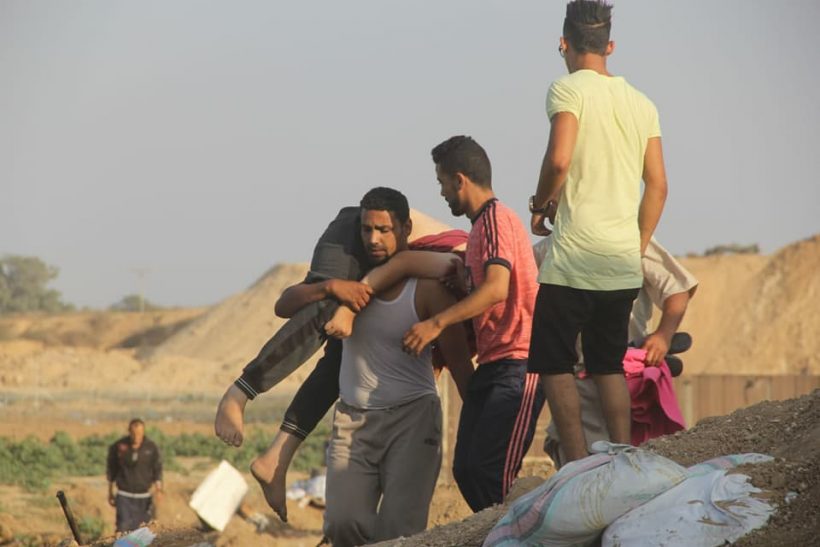
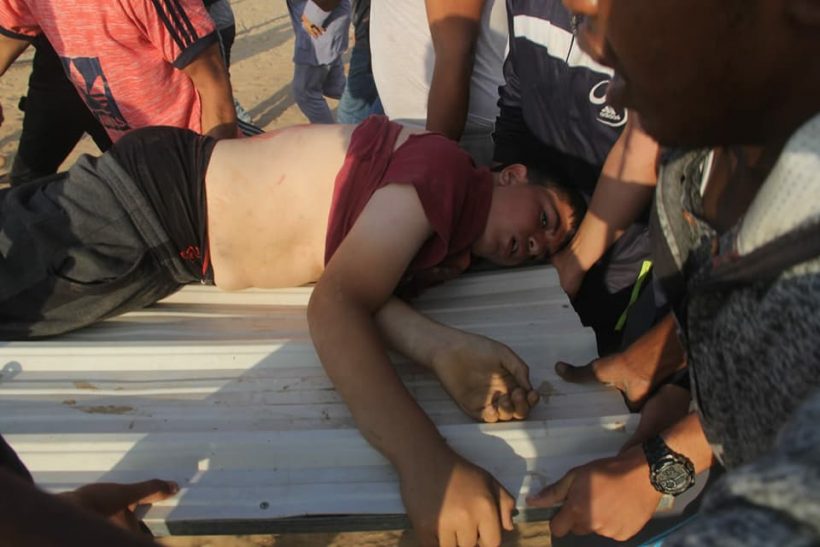
GAZA – A Palestinian youth was shot and injured by the Israeli military east of the Bureij refugee camp, in central Gaza Strip on Wednesday evening.
A PIC news correspondent said a bullet fire by Israeli soldiers penetrated a 15-year-old child’s back. He was rushed to the Shuhadaa al-Aqsa Hospital, in Deir Balah, so as to be treated for his wounds, reported critical.
According to the Gaza-based Palestinian Health Ministry, 118 Palestinians were killed and 13,300 others injured by Israeli gunfire unleashed toward Palestinian protesters as they joined the Great March of Return, launched on March 30.
Labour Friends of Israel slammed for visiting country after recent killings of Palestinians
RT | May 30, 2018
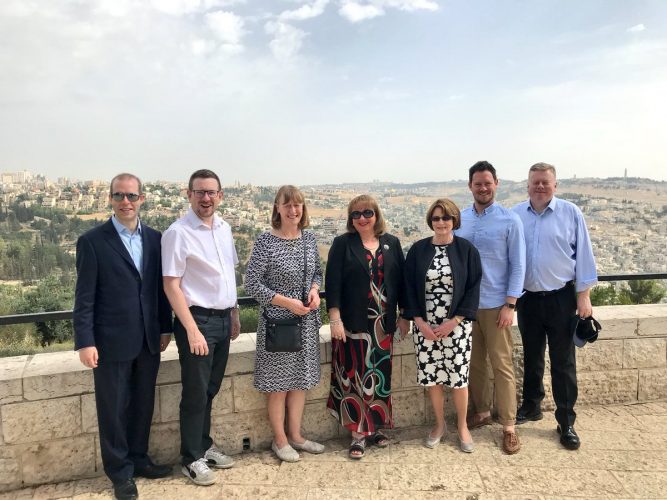
Labour Friends of Israel (LFI) have been heavily criticized for promoting their latest trip to Israel with a series of pictures on social media, just weeks after the ‘massacre’ of Palestinian protesters by Israeli Defense Forces.
LFI are currently in Israel to “promote bilateral ties and meet politicians”, according to Britain’s Jewish News. They’ve been marking their trip with a series of smiley photos and meetings with Israel’s Labor party, much to the dismay of many of those on Twitter who are outraged at Israeli military action against civilians.
Their first tweet said: “We’re in Israel this week for a parliamentary delegation – here’s the group in Jerusalem this morning.”
One LFI tweet pictured a meeting with Israeli Labor leader Avi Gabbay. He recently wrote to Jeremy Corbyn to notify him of his party’s severing of ties with the Labour leader in response to the “crisis” of anti-Semitism in the UK party. It would appear these LFI members are in Gabbay’s good books.
From just under 100 supporters and select officers, only 7 Labour members of LFI made the trip to Israel. They include MPs Andrew Gwynne, Labour’s National Co-ordinator, LFI chair Joan Ryan, who was the subject of an Al-Jazeera undercover investigation into links between Israeli diplomats and the LFI, as well as MPs Sharon Hodgson, Louise Ellman and Jonathan Reynolds.
The LFI came under fire for declaring that “Hamas must accept responsibility” for scores of Palestinians being killed in mid May, during demonstrations to mark 70 years since Nakba “the catastrophe”.
In a tweet that was subsequently deleted, LFI responded to the killing of more than 60, including 6 children and the injuring of some 2,500 Palestinians by stating: “Tragic events on the Gazan border; all civilian deaths are regrettable. Hamas must accept responsibility for these events. Their successful attempt to hijack peaceful protest as cover to attack Israeli border communities must be condemned by all who seek peace in the Middle East.”
The widely-condemned statement has reportedly led to a number of Labour MPs disassociating themselves from the group, including Tulip Siddiq and Catherine West, who requested being removed from LFI’s supporters list, according to media outlet, Skwawkbox.
‘Israel’s detention of freedom flotilla is a crime’
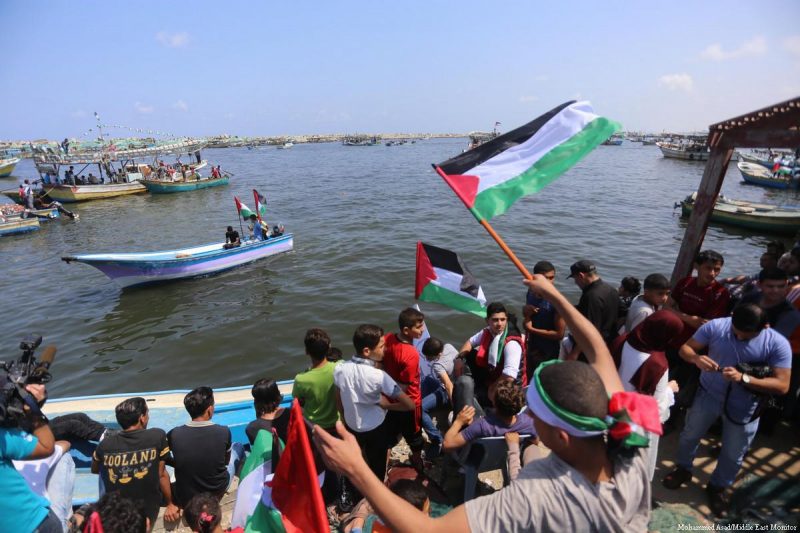
A ship carrying 20 Palestinians set out from the Port of Gaza in the hopes of breaking Israel’s decade-long maritime embargo of the Gaza Strip [Mohammed Asad/Middle East Monitor]
MEMO | May 30, 2018
Head of the Popular International Committee to Support Gaza, Dr Essam Yousef, called on the international community to pressure Israel to immediately release the passengers of a ship that set sail yesterday from Gaza heading to Cyprus in an effort to break the 12 year siege of the enclave.
Israeli occupation forces flanked the ship as it reached nine nautical miles from Gaza’s shores only for them to force it on to the Israeli port of Ashdod to the north of Gaza.
In a press statement today, Yousef condemned “the latest crime which is to be added to the occupation’s criminal record against the Palestinian people and the people of Gaza, who have been besieged for 12 years. This is a violation of all international conventions, laws, and legislations.”
Yousef held the Israeli authorities completely responsible for the safety of the ship’s passengers, who are “ill, students and unarmed civilians”.
“How can a state with an arsenal of deadly weapons as big as Israel and which considers itself a regional force superior to the rest of the region’s countries on a military level, pursue a ship carrying the ill and students who’s only aspiration is to leave the besieged Gaza Strip for treatment and education?” Yousef asked.
“Isn’t this state ashamed of itself, as it acts like a rogue state above the law, building its strength and force on the remains of innocent, starving and oppressed Palestinian people,” he added.
Yousef called on the governments of the free world and humanitarian and human rights organisations, as well as all international institutions to continue to pressure the occupation to lift the illegal and immoral siege imposed on two million people in Gaza, posing a blatant violation of all international charters related to human rights.
He also stressed the “Palestinian people’s right to move in and out of their country for treatment, education, work and any other activity, like the rest of the peoples of the world. No force on earth can continue to imprison and suffocate an entire nation who aspires for freedom and a dignified life.”
Lebanon launches search for first oil & gas reserves despite Israeli threats
RT | May 30, 2018
Beirut has announced the start of its oil and gas exploration for offshore energy reserves in the Mediterranean after approving a plan submitted by a consortium of France’s Total, Italy’s Eni and Russia’s Novatek.
Energy and Water Minister Cesar Abi Khalil said Lebanon plans to launch a second offshore licensing round by the end of 2018 or early 2019.
In February, the country signed its first offshore oil and gas exploration and production agreements with the Total-Eni-Novatek consortium for offshore Blocks 4 and 9.
Part of Block 9 contains waters disputed with neighboring Israel but the consortium said it had no plans to drill in that area. Lebanese authorities gave the go-ahead this week for exploration of the two blocks to begin, said Khalil.
The exploration period can last up to three years and the first well is expected to be drilled in 2019, providing all government departments grant necessary licenses and permissions “on time and without delay”, he added.
The minister explained that drilling would determine whether Lebanon had commercial reserves and, if so, their scale. Lebanon shares the Levant Basin in the eastern Mediterranean with Israel, Cyprus, and Syria. A range of big sub-sea gas fields have been discovered in the area since 2009.
However, the country was far behind Israel and Cyprus in exploring and developing its share of resources as a result of political issues over the past few years, and a dispute with Israel over Lebanon’s southern maritime border.
Israel had earlier threatened Lebanon over drilling in areas which it considers to be disputed. It warned Lebanon that it would pay a “full price” if another war breaks out between the two countries.
Three months ago, Lebanese President Michel Aoun appealed to US Secretary of State Rex Tillerson, asking for Washington’s “effective role” in settling the dispute with Israel over offshore oil drilling areas. After the US proposed sharing the offshore blocks, Lebanon rejected its offer to “help.”
The US proposal reportedly specified that the Lebanese would take up 65 percent of the disputed sections of the shelf. Commenting on the proposal Aoun said Lebanon will not give Israel a “millimeter.” He underlined that the offshore energy blocks are located in Lebanon’s waters and thus are within Beirut’s exclusive economic zone.
Lebanon and Israel’s dispute runs over a triangular area of around 860 square kilometers (332 square miles) of waters, which could contain huge reserves of natural gas and maybe even crude oil.
Exposing the dynamics of UNSC draft resolutions on Palestine
MEMO | May 29, 2018
Last week, the UN Security Council discussed a draft resolution on providing international protection for Palestinians, upon request by Kuwait’s permanent representative to the UN, Mansour Al-Otaibi. By the end of this week, the UNSC will be voting on the resolution, with Wafa news agency reporting that if the US uses its veto, Palestinians will call upon the UN General Assembly for “an extraordinary meeting under the title ‘Uniting for Peace’”.
It is safe to say that Palestinians are ensnared politically, and every gesture that is ostensibly for their protection is but another manacle that consolidates their isolation. Lest anyone jump on the bandwagon of “protection”, it is best that one takes into account that the international community has repeatedly confirmed its loyalties lie with Israel. Its credibility as regards protection, therefore, should be immediately denounced. Asking two fundamental questions juxtaposed against each other would clarify international intentions once and for all.
What does Palestine mean for Palestinians? What does Palestine mean to the international community?
For the first question, it is imperative that one draws upon Palestinian narratives of their land and follow the trajectory of how the entire territory that is their right was colonised by Israel’s existence. From that departure point, it is also important to include two rights that the international community wilfully ignores: the right of return and the right of struggle, by all means, against colonialism.
The second question deals more with disregard rather than concern. Even before Israel’s inception, Palestine was treated as a commodity and its people fodder for collateral damage. The Partition Plan of 29 Novermber 1947 is now hypocritically marked as the International Day of Solidarity with the Palestinian People. Let us be clear upon what this alleged solidarity has entailed: supporting colonial Israel and its so-called “right to defend itself” against the population that it has colonised and ostracised. UN solidarity has condoned massacres of Palestinians and forced displacement. In return, it has dedicated one specific day for remembrance which has yet to cause revulsion internationally, rather than acquiescence to commemoration.
The juxtaposition between both questions occurs now, in terms of the Palestinian right of return and their right to struggle for liberation from colonialism. On paper, the UN has not denied these rights. However, it has forced Palestinians into a vacuum where knowledge of rights is not tantamount to accessibility. The UN has created slogans for Palestinians while aiding Israel diplomatically, to the point that is has become a duty to separate the authentic, internationalist, solidarity with Palestinians from the exploitative, symbolic, corrupted remembrance which the UN has bequeathed to Palestinians.
As the UN derives impunity from its own existence, with what conscience can we declare approval for protection emanating from the institution? We must remember that “international protection” is concocted from the exterior, with Palestinians having little to no say in how such protection would be provided, what form would it take and what parameters would be imposed by the UN. Is it too late to remember that during other massacres, UN rhetoric was primarily concerned with Israel’s “right to defend itself”? Does memory fade with the passing of years to the point that the Nakba and subsequent massacres are forgotten? I believe not. A memory that emanates from within has the power to transcend time.
Palestinians do not deserve repetitive attempts at manipulating their rights and having the UN establish its collaborative dominion at their expense. This is not to say that Palestinians do not need protection. However, they are not in need of protection from Israel’s accomplices to degrade their options further by increasing their risks of being politically targeted. Two rights and the means to achieve them are what Palestinians need – the right of return and the right to struggle by all means for liberation. A unifying, internationalist force that is ready to stand by Palestinians to help them achieve their rights. Anything less than that is calling Palestinians to play a part in their betrayal.
Israel bill to limit Palestinians’ access to High Court passes first reading
MEMO | May 29, 2018
Israeli politicians waved through a bill that would limit Palestinians’ access to the High Court last night, according to the Jerusalem Post.
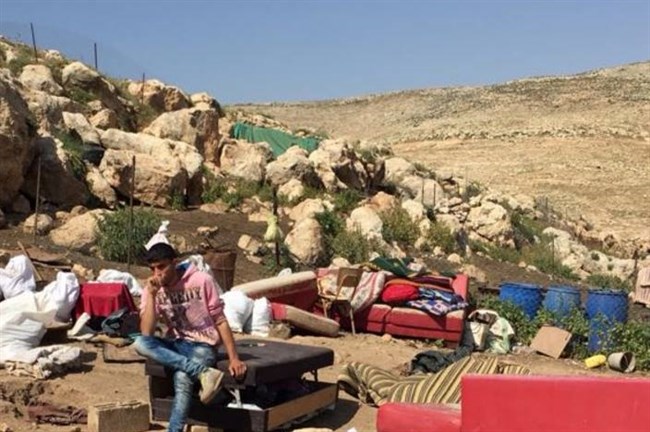
The bill would prevent many cases, including those of housing demolitions and Israeli land grabbing offences, from reaching the High Court, instead redirecting them to district courts in the occupied West Bank.
Right-wing politicians stated that the bill would reduce the number of complaints pertaining to land ownership that are often filed by Palestinians and left-wing organisations in the aftermath of settler occupation.
Justice Minister Ayelet Shaked, a supporter of the bill, rejoiced in its passing of the first reading.
“The move will also reduce the heavy burden imposed on the High Court of Justice,” she said adding that the High Court “handles more than 2,000 petitions each year, and should reject many of them outright.”
Critics however argued that the bill was a step towards annexation of the West Bank, by expanding the power of district courts outside of Israeli sovereignty.
Zionist Union MK Tzipi Livni expressed concern that the move would strengthen the argument that Palestinians should have the right to vote in Israel, as has been suggested as part of the one-state solution.
Shaked defended the bill, stating that in the case of land ownership claims, it would place the burden of proof on the Palestinians filing the case, not the Israeli settlers.
The bill will also refer other issues to the lower court, such as restraining orders and Israel entry permits.
Israel has long sought to annex the occupied West Bank to preserve the illegal settlements in the area, but has struggled with what the fate of Palestinians would be.
Earlier this month, Israel’s deputy defence minister, MK Rabbi Eli Ben-Dahan, claimed that Israel could annex the entirety of the occupied West Bank, without giving its Palestinian residents the right to vote.
“The clear and absolute thing is that we are here in the Land of Israel and we are not afraid of any attempts to frighten us,” he said. “They want to scare us that maybe soon we will not be a majority and therefore we have to abandon Judea and Samaria [the West Bank]. This is a grave mistake.”
Read also:
Palestinians call to save their homes from Israeli demolition orders
8 things I learned about Palestine while touring 8 Western nations
By Ramzy Baroud | MEMO | May 29, 2018
On 20 February, I embarked on a global book tour that has, thus far, taken me to eight nations. The main theme of all my talks in various cultural, academic and media platforms was the pressing need to refocus the discussion on Palestine on the struggle, aspirations and history of the Palestinian people.
But, interacting with hundreds of people and being exposed to multiple media environments in both mainstream and alternative media, I also learned much about the changing political mood on Palestine in the western world.
While the nations I have visited – the US, Canada, the UK (England and Scotland), the Netherlands, Austria, Australia and New Zealand – do not in any way represent all western countries, the diverse platforms that were available to me allowed me to gain a reasonably good perspective on the ideas, perceptions and attitudes of people in government, media, academia and civil society:
First, the civil society support base for Palestine is growing exponentially, not only in the number of people who are concerned with – or interested in – learning about Palestine, but also in the nature of that engagement as well. The detachment or sense of despair of the past, has all but completely vanished, being replaced with a proactive approach – as in people wanted to be agents of change at local and national levels.
Second, the consensus regarding the support of the Boycott, Divestment and Sanctions (BDS) movement is constantly increasing among unions, churches, university campuses, etc. The old view that BDS was divisive and counter-productive hardly has much traction these days, and most of the remaining debates concerning BDS are not concerned with the ethics of the boycott strategy, but the nature and extent of the boycott.
Third, the degree of decisiveness in supporting Palestinians has also been heightened. The wishy-washy stances that wagered on the Israeli “peace movement’ or Labour Party “doves”, while condemning “extremists on both sides”, has diminishing appeal.
Indeed, the successive Israeli wars on Gaza and the continued siege on the Strip have all gradually, but irreversibly, pushed the narrative on Palestine towards a whole new direction, one that has little room to wait for an Israeli awakening. The recent lethal Israeli response to Gaza’s peaceful Great March of Return protests has further galvanised support for Palestinians, even among relatively apolitical audiences.
Fourth, unable to push back against growing pro-Palestine movements, Israeli and pro-Israel supporters are pushing, like never before, the accusation of anti-Semitism against those who question the Israeli occupation, use the term “Israeli Apartheid” or support BDS.
While the tactic is no longer silencing the discussion on Palestine, it is creating the necessary distraction to divert attention, energy and resources to less urgent issues. A case in point is the British media’s obsession with the, supposedly, rampant anti-Semitism within the Labour Party at a time when thousands of Gazans were injured and scores killed while peacefully protesting in Gaza.
Fifth, young people are less likely to be intimidated by long-standing Israeli tactics. While the older generation of civil society leaders and activists are unwittingly beholden to the many smearing tactics used by Israel and its supporters, the younger generation is not as easily intimidated. Part of the reason is that digital media – social media, in particular – has helped younger people achieve a degree of global connectivity that has heightened their sense of unity and resolve.
The new generation of Palestinian university students and young intellectuals are also reclaiming their role in this trajectory. Their ability to connect with western societies as insiders and outsiders has helped bridge cultural and political gaps.
Sixth, while “One Democratic State Solution” ideas are yet to achieve the critical mass that could, and will, eventually push for a change in policies amongst various governments, the so-called “Two-State Solution” no longer commands a dedicated following. It is almost a complete reversal from the views that permeated during my earlier world tours, nearly 20 years ago.
Seventh, some intellectual, and even civil society circles, are still obstructed by the erroneous thinking that the best way to convey the Palestinian viewpoint is through non-Palestinians. This belief is even championed by some Palestinians themselves (especially members of previous generations who suffered political and cultural marginalisation and discrimination).
Although many anti-Zionist Jewish and Western intellectuals have been placed at the centre stage to articulate a Palestinian message, the alienation of the Palestinians from their own discourse has proven costly. Despite strong and growing support for Palestine, there is still a serious deficiency in an authentic understanding of Palestine and the aspirations of the Palestinian people – their history, culture, everyday realities and viewpoints.
Needless to say, what is needed is an urgent and complete reclamation of the narrative over Palestine and the decolonisation of the Palestinian discourse.
Eighth, the connection between the Palestinian struggle for freedom and that of other indigenous groups is often highlighted, but much more can be done. Israeli supporters are actively pushing the misleading notion that Israelis are the “natives” of the land and are, thus, reaching out to indigenous communities around the world in search for common ground. While the reality is to the contrary, pro-Palestine groups can do much more to link the struggle of the indigenous native Palestinians with that of other indigenous and other oppressed and historically marginalised groups around the world.
A general, but equally important realisation I have experienced throughout my three-month journey has been the numerous personal and group initiatives carried out by thousands of people all over the world in solidarity with the Palestinian people: from 11-year-old Salma, who convinced all of her classmates in Perth, Australia, to write Palestine on the map in her geography class, despite knowing that they would all have been marked down for their action, to the elderly couple in Auckland, New Zealand, who, well into their 80s and walking with much difficulty, continue to hand Palestine flyers to passers-by at a busy street corner, every week, for the last 20 years.
It is these people, and millions like them, who represent the real constituency for Palestine. They are fighters in the trenches of human solidarity that neither Israel, nor anyone else, can possibly defeat.
Israel, NATO carry out naval drills in Haifa
MEMO | May 29, 2018
The British air defence destroyer HMS Duncan and Spanish naval frigate “Victoria” on Friday docked on a NATO mission in northern Israel’s Haifa Port to participate in a joint naval exercise with the Israeli military, Israel Defence reported yesterday.
According to the Israeli army spokesperson, this is the first time a Spanish warship has docked in an Israeli port.
The maneuvers, the army explained, will include meetings between senior officials from the Israeli navy and their NATO counterparts.
The joint exercise “underscores NATO’s commitment to the strategic relationship with the Israel Navy and to the maintenance of stability in the region,” the spokesperson added.
Israel’s relationship with NATO has been defined as a “partnership”, according to the Jerusalem Post. It has been a member of the NATO Mediterranean Dialogue since it was initiated in 1994, along with six other non-NATO Mediterranean countries, including Jordan, Algeria, Egypt, Mauritania, Morocco and Tunisia.
Palestinians call to save their homes from Israeli demolition orders
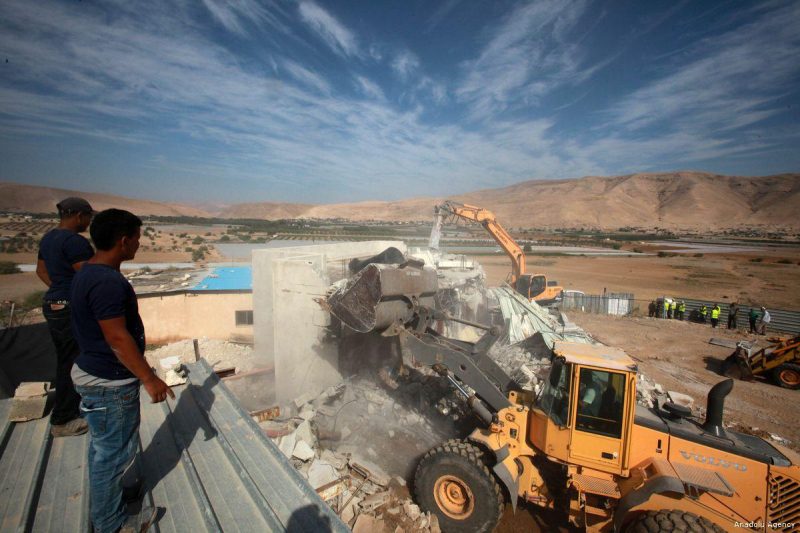
Palestinians watch the demolition of their home in the West Bank on 7 November 2017 [Nedal Eshtayah/Anadolu Agency]
MEMO | May 28, 2018
Palestinian families in the village of Aqaba, north of the West Bank, on Sunday called on Palestinian human rights organizations and the government to save their homes from the Israeli demolition orders.
The Israeli authorities have recently issued orders to demolish the homes of 20 families in the village of Aqaba under the pretext of being built in Area C.
The head of Aqaba village council, Sami Sadiq said the decision was issued by the Israeli Defence Ministry and ordered the all houses built during the past six months in Area C to be demolished if they were not inhibited by their owners.
He added that the village council has been trying to contact human rights organizations and the media in an attempt to stop the decision and protect the homes.
In an interview with Turkey’s Anadolu news agency, he pointed out that the houses are built on land owned by their owners who have owner documents.
Ibrahim Yusuf Jaber, the owner of one of the houses threatened with demolition said the decision stipulates to demolish the house within 60 days if I do not move in, but 40 days have already passed while we received the orders only two days ago.
Watch: Video of about Al Aqaba village
Featured Video

Why Hamas Really Attacked Israel on Oct. 7
or go to
Aletho News Archives – Video-Images
From the Archives
Confronting the Threat of Ethnic Bioweapons
By Tony Cartalucci – New Eastern Outlook – 29.11.2017
The United States Air Force’s 59th Medical Wing’s molecular biology branch recently was revealed to have been collecting specifically Russian RNA and synovial (connective) tissue samples, prompting fears in Russia of a possible US directed ethnic-specific bioweapons program. … continue
Blog Roll
 Aletho News
- Sally Rooney’s books pulled from UK over support for Palestine Action
- Bombs for Tel Aviv, Promises for Riyadh
- Israeli ad agency conducted vast global espionage campaign using online ads: Report
- Oct. 7 Forever Marks The Big Reveal: ‘We See You, Israel, We Revile You, We Reject You!’
- Meet the US generals and admirals advancing Israeli policy
- Israel’s Straw Widow Protocol: The Kill Zones Where Civilians Were Labelled ‘Terrorists’
- Leading Israeli Think Tank Publishes Psychotic Israeli ‘National Security’ Doctrine
- Are the United States and Israel in Decline-and-Fall Mode?
- Why Hamas Really Attacked Israel on Oct. 7
- Declassified UK exposes British man who fought for ‘Israel’ in Gaza
- If Americans Knew
- No, the world zionist movement is not an antisemitic conspiracy theory
- Hundreds of IDF investigations into killings still have no public outcome, BBC Verify finds
- After Ashley Moody Epstein Probe, Donors Linked to Him Poured Money Into her Senate Campaign
- Worried about Russian meddling in UK politics? Wait till you see what Israel is up to
- Israeli settlers attack West Bank center for disabled children, church leader calls for int’l action
- Pulling Out Teeth Just to Live: How Israel Has Devastated Dental Care in Gaza
- Gaza’s “ceasefire” death toll passes 1,500 – Daily Update
- Activists Abused By Israel Return to New Freedom Flotilla Mission
- 60 Minutes won’t tell the full truth about Israeli settler violence
- Nearly 50,000 women, girls killed or severely injured in Gaza since October 2023: UN Women
- No Tricks Zone
- New Study Suggests Large Regions Of The Pacific Ocean Have Been Cooling For The Last 80 Years
- Germany’s Green Energy Debacle: High Energy Costs Force Kahla Porzellan to Close After 182 Years!
- New Study: 50 Years Of The Most Aggressive ‘Net Zero’ Policies Can Only Affect The Global Climate By 0.03°C
- US September “Heat” Was No Record…Many Records Set Decades Ago
- Latest European Green Energy Debacle; Portugal’s Largest Flagship Solar Park Insolvent!
- Green Energy Debacle: German Expert Professor Fritz Vahrenholt Warns Of Severe Economic And Social Consequences
- Two More Paleo Reconstructions Affirm Meters-Higher Sea Levels Across Ireland, Brazil 7000-6000 Years Ago
- New Study: Earth And Venus Surface Warmth Largely Explained By Convection And Lapse Rate, Not CO2 Or Radiation
- 2025 Nature Paper Claiming Worsening Global Drought Gets RETRACTED …Heavily Flawed
- New Study: ‘Global Drought Shows No Detectable Recent Acceleration Under Climate Warming’

