Palestinian woman shot, injured by Israeli forces at Qalandiya checkpoint
Ma’an – February 27, 2017
BETHLEHEM – A Palestinian woman was shot and injured by Israeli security guards at the Qalandiya checkpoint between the occupied West Bank and occupied East Jerusalem on Monday afternoon, as Israeli police claimed she was carrying a bag in a “suspicious manner.”
Israeli police spokeswoman Luba al-Samri said in a statement that a “suspicious” Palestinian woman entered the vehicle lane of the checkpoint “seemingly carrying an object.”
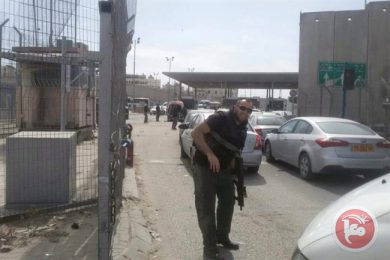 “The security guards noticed her and instructed her to stop but she ignored the instructions,” al-Samri said.
“The guards then started arrest procedures and neutralized the woman,” al-Samri added, using an Israeli forces term to indicate that a Palestinian was shot without specifying whether they were injured or killed.
Al-Samri later clarified that the woman had been “lightly injured,” and that she had been “carrying a bag” in a way that raised the security guards’ suspicions.
The police spokeswoman said that the Palestinian was in her thirties and was a resident of the village of Kafr Aqab in the West Bank district of Jerusalem with a Jerusalem ID.
The Qalandiya checkpoint is notorious for being confusing to navigate.
According to Ma’an documentation, five Palestinians were killed at the checkpoint in 2016, including two Palestinian siblings — Maram Salih Hassan Abu Ismail who was 23 years old and five months pregnant, and her 16-year-old brother Ibrahim — in April after Israeli officials claimed the two were attempting to carry out a stabbing attack.
However, witnesses said that the brother and sister posed no threat at the time of their death. Yet the Israeli Justice Ministry later dropped its probe into the killings after it was revealed that a contractor, not a member of the police, had killed the Abu Ismails.
Former prisoner Ihsan Dababseh seized once more by Israeli occupation forces

Samidoun Palestinian Prisoner Solidarity Network – February 27, 2017
Former Palestinian prisoner Ihsan Dababseh was seized by Israeli occupation forces in a pre-dawn raid on her home in the town of Nuba south of al-Khalil on Monday, 27 February; they took her to the Etzion interrogation center, reported Asra Voice.
The home of Dababseh, 30, has been raided on multiple occasions over the last weeks with demands that she report for interrogation. During these raids, her family home was ransacked and belongings torn apart.
Dababseh is one of ten Palestinian women prisoners whose story is featured in “For the Love of Palestine: Stories of Women, Imprisonment and Resistance,” created by members of the Prison, Labor and Academic Delegation to Palestine.
Dababseh was released after 21 months in Israeli prison on 10 July 2016; she had been imprisoned since 13 October 2014 on charges of membership in a prohibited organization, in her case the Palestinian Islamic Jihad movement. She previously spent two years in Israeli prison from 2007 to 2009 on similar charges. All major Palestinian political parties are labeled prohibited organizations by the Israeli occupation. During her imprisonment she had been isolated with four other Palestinian women as punishment for raising the Palestinian flag on the anniversary of the Nakba.
In 2014, Reham Alhelsi reported, “Israeli occupation soldiers raided her house several times, sent her 4 summons and threatened to blow up her house of she didn’t come to interrogation center. She went with her mother to detention center and was detained and her personal computer was confiscated, while her mother told to leave.”
During her prior arrest from 2007 to 2009, the Israeli occupation soldiers who had arrested and blindfolded her made a video of themselves dancing around her as she was blindfolded and held against the wall, which they distributed.
Palestinian children attend class in the street after Israel shuts down school
Ma’an – February 26, 2017
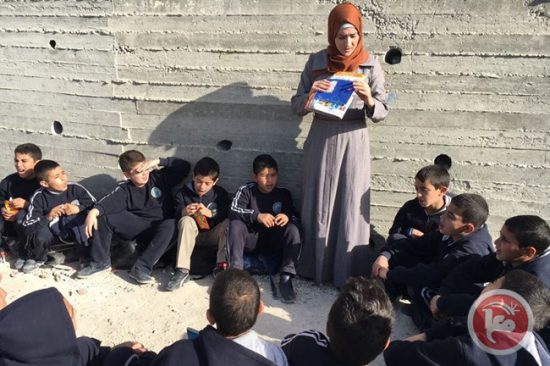
JERUSALEM – After Israeli authorities shut down a Palestinian elementary school in the occupied East Jerusalem town of Sur Bahir last Thursday over alleged “incitement” in its study materials, students attended class in the street on Sunday and protested against Israel’s decision to close the school.
Children who were enrolled at al-Nukhba (“the elite” in Arabic) arrived to the campus with their parents in an action organized by the parent committees of Sur Bahir’s schools, holding posters expressing support for al-Nukhba and denouncing Israel’s closure of educational institutions as “tyrannical.”
Last Thursday, head of the school Luay Jamal Bkirat and the school’s financial manager Nasser Hamed were summoned to an Israeli police station for interrogation, when Israeli intelligence officials informed them that the school was being shut down for carrying inciting content in the teaching materials used at the school.
Bkirat denied the claims, saying that al-Nukhba school was “teaching the Palestinian curriculum used in all schools in Jerusalem and that no one of the faculty had ever been summoned for interrogation before over incitement.”
He added that the school — which serves 250 boys from kindergarten to grade six — was opened last year and gained a temporary operating license from the Jerusalem municipality, and that the license was revoked in November for unknown reasons.
Bkirat condemned the decision and said that he would “conduct procedures to stop this decision which aims to destroy education.”
The Times of Israel reported that the school was shut down for being a “Hamas front,” after a months-long joint probe by Israel’s Education Ministry, Jerusalem police, and Israeli intelligence, the Shin Bet.
Israeli authorities from the education ministry claimed the school was established by Hamas with the aim of teaching “content that undermines the sovereignty of Israel,” and that the school’s aims were “consistent with the ideology of the terror organization, which calls for the destruction of Israel,” the Times of Israel said.
According to the Israeli news outlet, the ministry ordered the school not to open in September “and when it continued to operate, issued the closure order.”
Israeli Jews and Palestinians study in separate school systems in occupied East Jerusalem, with the Palestinian schools run by either Israel’s Jerusalem municipality, the Islamic Waqf and administered by the Palestinian Ministry of Education, private institutions, or UNRWA, the UN agency responsible for Palestinian refugees.
According to the Palestinian Ministry of Education, Palestinian children suffer from routine Israeli interference and political pressure to replace Palestinian curricula with an Israeli one in occupied East Jerusalem, where full Israeli military and civil control deprives students from proper and secure educational services.
A 2016 report by Israeli daily Haaretz also said that Palestinian schools in occupied East Jerusalem received less than half the funds that the Jerusalem municipality transferred to Jewish schools in West Jerusalem.
Though Sur Bahir lies beyond the periphery of occupied East Jerusalem, the town remained under full Israeli security and civil control within Israel’s Jerusalem municipality after the territory was illegally annexed in 1967.
A 2011 report by the Applied Research Institute – Jerusalem (ARIJ) said that due to a lack of some levels of education in Sur Bahir, many students were forced to attend schools in neighboring villages.
Elor Azaria verdict: a personal view
International Solidarity Movement | February 26, 2017
Hebron, occupied Palestine – Yesterday the Israeli soldier Elor Azaria was sentenced to 18 months in prison for the extra-judicial killing of Abdel Fattah al-Sharif, which happened last year in Hebron. Everybody in Hebron was waiting for the sentence. Everybody knew by one o’clock what it was. Everyone was heavy hearted. Palestinian friends compared a sentence of two years for stone throwing with Azaria’s eighteen months for murder. The implications here on the ground for what soldiers can do with impunity is also clear to all.
We at ISM had been in touch with Imad Abu Shamsiya, the Palestinian who filmed the execution, in case he wanted our support if the settlers were angry at the sentence as he has experienced large amounts of threats and harassment from both soldiers and settlers for bringing this incident to light.
Today I get email from the UK with news of how the case was reported on the BBC flagship morning show:
‘… almost all of the piece consisted of a discussion with their Jerusalem correspondent about Israeli anger that Azaria had been jailed. The fact that Palestinians were angered at the brevity of the sentence was tacked on as an afterthought. It was not explained that the Israeli soldiers are an army of occupation that is protecting settlers who are in Hebron illegally. It was not explained that Abdel Fattah al-Sherif had been lying injured and motionless on the ground for ten minutes and presenting no threat to anyone before Azaria executed him. Al-Sherif was described as “an attacker”, Azaria as “a soldier”. The framing of what happened could have been scripted by the IDF. The impression given was of the IDF acting in support of the civil authorities and being subjected to a military assault by enemy combatants. The right-wing Israeli perspective that Azaria was an inexperienced conscript who acted in the heat of the moment in battle was reported unchallenged. The alternative view that al-Sharif had committed grievous bodily harm or some such criminal assault before being totally incapacitated and that he was then murdered in cold blood by a heavily-armed agent of an occupying power was not given.’
Shame.
The video so bravely filmed by Imad which led to the case being heard at all can be seen here.
White House Cautioned Against Designating Iran’s IRGC a Terrorist Organization
By Stephen Lendman | February 26, 2017
In early February, unnamed US officials told Reuters the Trump administration might designate Iran’s Islamic Revolutionary Guard Corp (IRGC) a terrorist organization.
The White House didn’t respond to a request for comment. Iran categorically denies involvement in terrorism. No evidence suggests it, just baseless allegations.
Reports now indicate the proposed action stalled, US defense, state, and intelligence officials warning it could backfire, undermining Trump’s pledge to combat ISIS, along with complicating enforcement of the Iran nuclear deal.
US NATO allies are against it. The designation was supposed to be announced this month. It’s unclear if it’s suspended or cancelled altogether.
IRGC involvement is important in combating regional terrorism in Syria, Iraq and perhaps Yemen.
The administration’s proposal was part of a broader scheme to get tougher on Iran – instead of responsibly working to end 38 years of US-instigated adversarial relations.
If implemented, it would be the first move of this kind under the 1996 Foreign Terrorist Organizations law against a foreign government – meant for al-Qaeda and likeminded groups.
It would likely initiate tougher sanctions on Iran, possibly undermining the nuclear deal, sabotaging what took years to agree on.
Iranian Foreign Minister Mohammad Javad Zarif praised the IRGC’s efforts in combating terrorism, saying:
“The entire world admits that the IRGC has rendered the utmost support to (Iran’s) neighboring countries in the face of terrorism” – warning of adverse consequences if Trump orders more sanctions on Iran.
Reports indicate he intended to designate the ICRG and Egypt’s Muslim Brotherhood terrorist organization on Monday – during a visit to CENTCOM’s Tampa headquarters.
It’s believed Israel, Saudi Arabia and other Gulf states urged him to target Iran’s IRGC. It’s now on hold.
Stephen Lendman can be reached at lendmanstephen@sbcglobal.net. His new book is titled Flashpoint in Ukraine: How the US Drive for Hegemony Risks WW III.
Palestinians face intense online hate from Israelis, say campaigners
Palestinian lawyers call for investigation of police minister as survey shows soaring levels of anti-Arab speech on Hebrew social media

By Jonathan Cook • Middle Eastern Eye • February 25, 2017
Israel’s 1.7 million Palestinian citizens are facing a tidal wave of incitement and hate speech on social media, including from government ministers, community leaders have warned.
They say the increasingly hostile political climate in Israel is stoking violence from the police and street gangs, and has laid the ground for a recent raft of racist legislative proposals.
The alert comes as a group of Palestinian lawyers demand that Israel’s attorney general investigates Gilad Erdan, the internal security minister, for incitement to racism.
Adalah, a legal group for Israel’s Palestinian minority, highlighted statements from Erdan blaming Palestinian citizens for “arson terrorism” last November after forest fires swept the country, despite their having been no prosecutions.
“Israel has experienced arson terrorism and I won’t let anyone sweep this fact under the rug,” he wrote on Facebook in December. “Why does it seem unrealistic that Arabs would attempt to harm Jews?”
Adalah argued Erdan’s comments were part of a wider government strategy to portray Palestinian citizens, about 20 per cent of Israel’s population, as a “fifth column”.
Although other government ministers had incited, the group said, Erdan’s statements were especially harmful because of his role overseeing the police. Adalah said he was bolstering a police culture that already treated Palestinian citizens as an “enemy within”.
“Incitement from Erdan is dangerous because it reinforces and sanctions existing prejudices in the police,” Nadim Shehadeh, a lawyer with Adalah, told Middle East Eye. “As a result, the police are likely to have an even lighter finger on the trigger.”
Concern about the effects of incitement from leading politicians has been underscored by a survey published this month that found rocketing levels of online abuse from Israeli Jews against Palestinians.
 7amleh, an organisation promoting social media rights for Palestinians, identified 675,000 posts in Hebrew last year expressing racism or hatred towards Palestinians – one every 46 seconds, and more than double the previous year’s figure.
“There are terrifying levels of hate speech online from Israeli Jews,” Nadim Nashef, 7amleh’s director, told MEE. “No one in Israel – politicians, the police, the courts and the social media companies – has shown any interest in doing something about it.
“But it’s worse than that. The politicians are fuelling the problem. It has become completely normal in Israel to incite against Palestinians. You find it everywhere. It is entirely mainstream.”
The research identified more than 50,000 Hebrew speakers as persistent offenders on social media, especially Facebook, said Nashef. Spikes in online abuse correlated with incitement from Israeli politicians and the media, he added.
Popular terms of abuse included threats to kill, rape, burn, expel, and assault Palestinians.
Both Adalah and 7amleh said incitement from Israeli Jews was rarely investigated or prosecuted. Palestinians in Israel and the occupied territories, on the other hand, had their accounts closed or were arrested and jailed over less serious online activity.
7amleh said its research showed that the brunt of online abuse was directed at leading Palestinian politicians in Israel.
The most common targets were Haneen Zoabi, one of only two Palestinian women in the parliament, and Ahmed Tibi, a former adviser to the late Palestinian leader Yasser Arafat, 7amleh said. Both Zoabi and Tibi have reported regular death threats.
According to the survey, they received more online abuse than the leader of the Palestinian Authority in the West Bank, Mahmoud Abbas.
“When we are targeted rather than the Palestinian leadership in the occupied territories, a clear message is sent to the [Jewish] public that we have no place in the parliament and those we represent have no right to be citizens,” Zoabi told MEE.
 The climate of incitement had very concrete effects, said Zoabi: “It gives a green light to police violence. It is converted into shootings and deaths.”
She said dozens of Palestinian citizens had died in unexplained circumstances at the hands of the police in the last 15 years.
Zoabi also pointed to the increasing reports of gangs chanting “Death to the Arabs!” in Israeli cities and Jerusalem, as well as a growing incidence of street assaults.
Polls have shown high levels of racial prejudice among Israeli Jews. A survey last year found 49 per cent would not live in the same building as a Palestinian citizen.
Another showed a similar number of 16 and 17-year-olds would deny Palestinian citizens the right to vote.
Adalah said constant incitement from government politicians had made possible the drafting of ever-more discriminatory and anti-democratic legislation.
Shehadeh noted that recent laws allowed the parliament to expel the minority’s legislators over their views, and hampered the work of human rights groups assisting Palestinians.
Zoabi agreed. “Every week we see bills being introduced, such as a ban on the mosque call to prayer, or moves to step up home demolitions in Palestinian communities. The political culture sanctions ever more violence through legislation.”
Nashef said a turning point in the levels of incitement could be traced to comments by Israel’s prime minister, Benjamin Netanyahu, at the last general election, in early 2015. Netanyahu posted a video on Facebook telling the Jewish public it was vital they voted because “Arab voters are coming out in droves to the polls”.
“When the prime minister talks like this, then everyone else understands that it is okay to do it too,” Nashef said.
7amleh’s survey showed a significant peak of online incitement and hate speech last November, as hundreds of fires broke out across Israel and the occupied territories, triggered by a prolonged drought and high winds.
Despite the exceptional weather conditions, Erdan led government ministers in accusing Palestinians, especially those in Israel, of being behind the fires.
Adalah cited Erdan’s Facebook post from early December. Dozens of Palestinian citizens were arrested by police, but none have been charged with “nationalist crimes” over the fires.
Nevertheless, Netanyahu has continued to make similar accusations, stating last month: “That fact that we can’t prove it [that the fires were terrorism] doesn’t mean it’s not what happened.”
 Nashef said: “These inciteful statements garner a lot of media attention and our research shows they have a powerful impact in shaping public attitudes. But few notice when they turn out to be based on lies or misinformation.”
Adalah also cited comments by Erdan justifying the fatal shooting of Yacoub Abu al-Qiyan by police last month during a demolition operation in Umm al-Hiran, a Bedouin community in Israel’s south.
A police video and post-mortem examination report indicated that Abu al-Qiyan lost control of his car after he was shot, and careered into a group of policemen, killing one of them.
According to Israeli media, a justice ministry report – due to published next month – has found no evidence that Abu al-Qiyan carried out an attack or belonged to an extremist organisation.
Nonetheless, said Shehadeh, Erdan and other government ministers repeatedly accused Abu al-Qiyan, without evidence, of being an Islamic State terrorist.
Erdan tweeted hours after the two deaths: “The terrorist sharply turned his wheel and quickly accelerated in order to run over a group of police officers.”
Netanyahu’s office similarly described the incident as a “car-ramming attack”. Implying that Abu al-Qiyan was part of global trend of Islamic terrorism, Netanyahu said Israel and the world were “fighting this murderous phenomenon”.
Adalah’s letter to the attorney general also pointed out that Erdan had repeatedly blamed the deaths in Umm al-Hiran on Palestinian legislators there to protest against the demolitions. Erdan singled out Ayman Odeh, the leader of the Joint List, the Palestinian coalition in the parliament.
In comments to the media, he said: “Ayman Odeh and the rest of the MKs from the Arab [sic] List who have come to enflame sentiments this morning: This blood is also on your hands. … You are a disgrace to the State of Israel.”
In Umm al-Hiran, Odeh was himself injured twice, including to the head, by sponge-tipped bullets fired at him by police.
Problem with Facebook
Nashef criticised Facebook, where most of the online hate speech was found, for contributing to the problem.
Last summer Facebook agreed to crack down on what Israel defines as incitement by Palestinians. Paradoxically, Erdan was the minister who met the tech companies.
According to reports, in the first half of 2016, a tenth of all content restrictions imposed by Facebook globally were at the Israeli government’s behest.
But Nashef said nothing was being done to deal with incitement and hate speech from the Jewish public.
“It is not reasonable that large numbers of Palestinians have their accounts shut down or are arrested and jailed for online hate speech, while Israeli Jews can engage in the same or worse activity and there are no consequences,” he said.
Neither the justice or police ministries were available for comment.
7amleh said the biggest peak in online abuse followed the arrest last March of army medic Elor Azaria. He was filmed executing a badly wounded Palestinian, Abdel Fattah al-Sharif. This week he was sentenced to 18 months’ jail for manslaughter.
Several government ministers, including Netanyahu, expressed strong support for Azaria.
The survey showed another outburst of online abuse followed attacks last September by the culture minister, Miri Regev, against two Palestinian cultural icons.
She described the late national poet Mahmoud Darwish as the “leader of the Palestinian industry of lies”, and accused a popular rapper, Tamer Nafar, of giving “legitimacy to terrorism”.
Israel to build touristic park on Mount of Azzeitun in Jerusalem

Mount of Azzeitun
Palestine Information Center – February 25, 2107
OCCUPIED JERUSALEM – The Israeli municipal authority in Occupied Jerusalem plans to seize a large tract of Palestinian land on Mount of Azzeitun (Olives) to carry out development of a touristic park.
According to a report published by Iroshalim newspaper, a master plan for the park was submitted recently to the district planning and building committee in Occupied Jerusalem to obtain approval.
The local residents in Azzeitun area, however, are deprived of using the land where the park project would take place for building homes or establishing projects for their own benefit.
The new project will be 6.3 kilometers long and extend to the Hebrew University on al-Masharif (Scopus) Mount.
It will overlook the Old City of Jerusalem and include roads, bistros, public toilets, an information center, a souvenir store, a parking lot and other structures.
Israel seeks to carry out many Judaization plans in Jerusalem as part of its effort to change the historical Arab character and identity of the city.
Castigated by the Southern Poverty Law Center
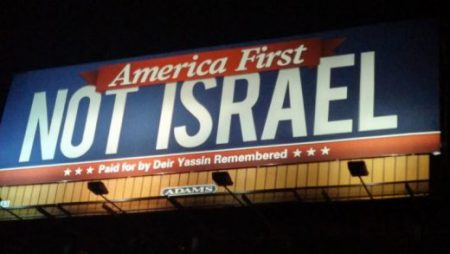
By Deir Yassin Remembered | Dissident Voice | February 24, 2017
The “public” that allegedly “protested” against this billboard in Ann Arbor, as reported by the Rochester Democrat and Chronicle, were not the only folks watching DYR.
The SPLC has now included DYR on its Hate Map.
Dan McGowan responds:
The Southern Poverty Law Center (SPLC) recently criticized Deir Yassin Remembered (DYR) by including it on the so-called Hate Map, purportedly for the high crime of Holocaust denial.
Apparently if the SPLC disagrees with you, it will label you as a racist or a hatemonger. There is no discussion, no defense, and no chance of winning a defamation suit against it.
The SPLC is the cash cow of the civil rights movement. Last year it took in over $58 million, some of which was added to its bloated endowment of over $328 million held in questionable investments, some in off shore accounts.
Its two chief executives together received over $800,000. Of its nine top executives, none come from minorities.
The SPLC claims to reject hate, embrace diversity, and respect differences. But often the SPLC and the people who believe their fear mongering behave exactly the opposite. The SPLC campaigns to deny free speech and freedom of association to groups of Americans with whom they disagree, often doing so to pander to other groups for more contributions all in the name of promoting “tolerance.” For example, if the British historian David Irving plans a lecture in Syracuse, the SPLC will protest any venue he might select, leaflet cars at his hotel saying, “There is a Nazi staying here,” and photograph and shout at anyone who might try to attend.
SPLC slime is not reserved solely for skinheads and members of the KKK. Dr. Ben Carson got a dose for opposing same sex marriage. SPLC later apologized but the charge never completely goes away, leading Carson to say that fear of being on the SPLC’s list serves to shut people up.
The SPLC makes money out of fear mongering and promoting the idea that Americans are inundated with hateful people, particularly on the radical right. The favorite target is the KKK and white supremacists.
The Baltimore Sun characterizes SPLC operations this way: “Its business is fundraising, and its success at raking in the cash is based on its ability to sell gullible people on the idea that present-day America is awash in white racism and anti-Semitism, which it will fight tooth-and-nail as the public interest law firm it purports to be.”1
It is understandable that the SPLC will run out of rocks under which to look for old KKK members and skinheads, but why criticize Deir Yassin Remembered, a small not-for-profit organization of Jews and non-Jews working to build a memorial for Palestinians murdered in 1948 on the west side of Jerusalem? DYR is certainly not the radical right. DYR practices and preaches tolerance; it has agreed to the advice of none other than the Latin Patriarch of Jerusalem that its memorial show the Christian tenet of forgiveness. Its advisory board boasts diversity; it is composed of half men, half women, half Jews, half non-Jews. It has worked continuously since 1994 for Palestinian human rights, including equal rights of citizenship, with no compensation for any executive and with less than $5,000 of reserves.
The answer lies in the writings of some of the DYR members who have questioned the use of the Holocaust as both the sword and shield of Israel. The Holocaust has been used to justify the need for a Jewish state and its expropriation of Palestinian land; the Holocaust is used to monopolize victimhood and defend Israel from criticism of its brutal and unending occupation.
But it is more than that. The Holocaust has morphed from a historical event to a religion, which must not be contradicted for fear of being branded an apostate or a hater or a denier or an anti-Semite. Religious faith is self-validating, impervious to reason, and regards proposals to scientifically validate its claims as profane in all senses of the word.
So, anyone who is skeptical about the number “six million,” about mass extermination in gas chambers, or about Nazi orders for extermination is to be named and shamed and hated. For this topic, there can be no diversity of opinion and no respect for inquiry or debate.
Don’t tell us that the United States government claimed Hitler murdered over 20 million people until the late 1970s when that number was officially revised downwards and carved in stone at 11 million. Don’t tell us that Jewish historians today claim the 5 million number of non-Jewish victims is overstated. Don’t remind us that the lampshade and the soap-from-human-fat stories were simple gruel propaganda and have no historical significance. Don’t remind us that Elie Wiesel took his violin to Auschwitz and that none of his family was gassed. Don’t remind us that Elie chose to retreat with the Nazis rather than be liberated from Auschwitz as was the father of Anne Frank.
Fear mongering and sliming little organizations like DYR is fake news. It is ridiculous disinformation to keep SPLC campaign money coming in. It foments hate and bigotry and intolerance by the very hypocrites who claim the opposite.
- “The truth about ʻhate crimesʼ and the racial justice racket” by Ron Smith, Baltimore Sun, December 3, 2008.
Deir Yassin Remembered seeks progress on behalf of the over 100 Palestinian men, women, and children who were victims of the Deir Yassin Massacre. Read other articles by Deir Yassin Remembered, or visit Deir Yassin Remembered’s website.
ISIS Calls For Backup: Israel Attacks Syrian Army Positions Near Damascus
Israel bombs Syrian army positions on the eve of peace talks in Geneva

War by any means
By Rudy Panko | Russia Insider | February 22, 2017
Syria peace talks are expected to begin this week in Geneva. And what are the Israelis doing? Bombing Syrian Arab Army positions near the Lebanese border.
Because as we all know, the Israelis are really good at these “ceasefire” things. Especially when they have no business interfering in any way in a conflict:
Minutes ago, an Israeli warplane conducted an airstrike over the western countryside of Damascus, targeting the Syrian Arab Army’s (SAA) positions in the Qalamoun Mountains near the Lebanese border.
A Syrian Army source told Al-Masdar this morning that the Israeli warplane had crossed into Syria after flying over Lebanon’s ‘Arsal Barrens, where both Al-Qaeda and the Islamic State (ISIS) are headquartered in the eastern Beqa’a Governorate. The Syrian Army source added that the specific location of the attack was in the Jard Nalhleh area of the Qalamoun Mountains.
Oh, isn’t that interesting? The Israelis flew over ISIS and al-Qaeda positions — but saved their bombs for the Syrians. Quite telling.
There were no reported casualties.
If Israel admits that it did indeed bomb a sovereign state unprovoked (which is unlikely to happen), it will probably claim that it was targeting “terrorists” such Hezbollah. The problem is that Russia’s Foreign Minister Sergei Lavrov has made it clear that Russia thinks Hezbollah has played an important role in defeating ISIS in Syria.
A bit of a diplomatic pickle for the Israelis, no?
Israel doesn’t want to return Syrian land that it stole, so it needs the war in Syria to continue. These airstrikes aren’t too surprising.
Israel blocks EU lawmakers’ entry into besieged Gaza Strip
Press TV – February 22, 2017
The Tel Aviv regime has prevented five European parliamentarians from entering the Gaza Strip as the Palestinian enclave remains under an inhumane Israeli siege.
In a statement released on Wednesday, Neoklis Sylikiotis, a Cypriot Member of the European Parliament (MEP), denounced the Israeli obstruction of the lawmakers’ access to the Palestinian coastal sliver.
“The refusal of access to Gaza by the Israeli authorities to the European Parliament on arbitrary grounds is unacceptable,” the statement read.
However, Israel claimed that the MEPs were not among those allowed to enter the Gaza Strip.
Similar European delegations have been barred from Gaza since 2011 though a team led by the head of the European Parliament’s budget committee was allowed to visit once, the statement added.
“What is there to hide from us?” it further asked, condemning Israel’s “systematic” entry bans to Gaza.
It also called on the international community to pressure the Tel Aviv regime to lift the Gaza blockade that has been in place Since June 2007 and affected almost all the two million inhabitants of the enclave.
The World Bank and the United Nations say the Gaza siege has killed all exports and damaged the Palestinian territory’s economy.
Tel Aviv has waged three wars on Gaza since 2008, including the 2014 offensive that left more than 2,200 Palestinians dead.
Israel’s demolition plan ‘unacceptable’
Separately on Wednesday, Robert Piper, the UN humanitarian coordinator for the Palestinian territories, visited the Palestinian Bedouin village of Khan al-Ahmar in the occupied West Bank and voiced alarm over an Israeli plan to demolish structures there.
On Sunday, Israeli forces distributed demolition orders to 40 structures, including tents, huts and a school in the village.
According to Palestinian media outlets, Khan al-Ahmar residents were given until Thursday to vacate the village.
“Khan al-Ahmar is one of the most vulnerable communities in the West Bank struggling to maintain a minimum standard of living in the face of intense pressure from the Israeli authorities to move,” Piper said in a statement. “This is unacceptable and it must stop.”
International bodies and rights groups say Israel’s sustained demolitions of Palestinian homes are aimed at uprooting Palestinians from their native territories, and expropriating more land for the expansion of settlements.
Tel Aviv is has accelerated its land grab and settlement construction activities in the occupied Palestinian lands after pro-Israel US President Donald Trump took office.
Israeli forces have demolished over 48,000 Palestinian homes and buildings since the 1967 occupation of the Palestinian lands, according to the Israeli Committee Against House Demolitions.
Featured Video

John Mearsheimer Talking Iran with Iran
or go to
Aletho News Archives – Video-Images
Book Review & Summary
Calling of an Angel: The True Story of Rene Caisse and an Indian Herbal Medicine Called Essiac (1988)
Dr. Gary L. Glum – 30 Q&As – Book Review & Summary
Lies are Unbekoming | October 17, 2026
On June 10, 1975, Dr. Chester Stock, a vice president at Memorial Sloan-Kettering Institute for Cancer Research, wrote to a Canadian nurse named Rene Caisse: “Enclosed are test data in two experiments indicating some regressions in sarcoma 180 of mice treated with Essiac.” The sentence sat in a letter from one of the world’s largest private cancer research centers, concerning an herbal tea an elderly English woman had learned from an Ojibwa medicine man at a northern Ontario mining camp in the 1890s. The tests were terminated the following year after Sloan-Kettering admitted, in sworn affidavit three years later, that they had prepared the injectable solution improperly from the dried material supplied — freezing and thawing the herb rather than boiling it as Rene had instructed. By the time Calling of an Angel was published in 1988, Rene Caisse had been dead for a decade, having treated thousands of cancer patients across fifty-six years in her Bracebridge, Ontario kitchen, never charging a fee, and refusing every offer — from Memorial Sloan-Kettering, the National Cancer Institute, Merck, Parke Davis, and private corporations dangling contracts up to $1 million — to release her formula before the medical establishment admitted her remedy had merit. … continue
Blog Roll
 Aletho News
- Vice President J.D. Vance’s Deceptive ‘Antiwar’ Campaign Speech
- Iran: Palestinians’ rights must not be compromised in Gaza’s future; US, Israel to blame for Hormuz situation
- Ongoing tales of Syrian chemical weapons
- Moscow blasts UN for ignoring torture of Russian POWs
- Millions of Books Could Have Been Destroyed in Lebanon During Israeli Bombings
- Moscow warns of ‘hunt for Russians’
- Calling of an Angel: The True Story of Rene Caisse and an Indian Herbal Medicine Called Essiac (1988)
- South Korean Assistance to the U.S. in the War with Iran: Between Allied Duty and National Interests
- Pharma- and Gates-Funded GAVI Seeks to Assure Parents
- John Mearsheimer Talking Iran with Iran
- If Americans Knew
- Israeli soldiers debunk Israel’s talking points
- In West Bank, Israeli settlers are totally out of control – Daily Update
- NPR investigation finds evidence of widespread fraud at mall kiosks tied to Israeli skincare brand
- Tucker Carlson exposes Israeli Lies about the Oct 7th attack, Charlie Kirk, and the U.S.
- Israel has detained thousands of Palestinian children since Oct 7th – over half spent time in solitary, many uncharged
- Israeli Analysis: Is Netanyahu Planning an ‘October Surprise’ Attack Before Israel’s Election?
- Israeli settlers brutally attack Palestinians and Washington Post female photographer, 65
- Words Have Changed, Occupation Continues: The Reality of the Gaza Ceasefire
- Gaza’s child amputees are growing faster than their prosthetics allow
- Israel keeps Palestinians struggling just to survive–Daily Update
- No Tricks Zone
- New Study Suggests Large Regions Of The Pacific Ocean Have Been Cooling For The Last 80 Years
- Germany’s Green Energy Debacle: High Energy Costs Force Kahla Porzellan to Close After 182 Years!
- New Study: 50 Years Of The Most Aggressive ‘Net Zero’ Policies Can Only Affect The Global Climate By 0.03°C
- US September “Heat” Was No Record…Many Records Set Decades Ago
- Latest European Green Energy Debacle; Portugal’s Largest Flagship Solar Park Insolvent!
- Green Energy Debacle: German Expert Professor Fritz Vahrenholt Warns Of Severe Economic And Social Consequences
- Two More Paleo Reconstructions Affirm Meters-Higher Sea Levels Across Ireland, Brazil 7000-6000 Years Ago
- New Study: Earth And Venus Surface Warmth Largely Explained By Convection And Lapse Rate, Not CO2 Or Radiation
- 2025 Nature Paper Claiming Worsening Global Drought Gets RETRACTED …Heavily Flawed
- New Study: ‘Global Drought Shows No Detectable Recent Acceleration Under Climate Warming’

