Britain’s sickening infatuation with Israel continues
Here in the UK the Campaign Against the Arms Trade (CAAT) has initiated a judicial review in a bid to halt UK arms sales to Saudi Arabia on suspicion that they are being used against civilians in Yemen. The indiscriminate nature of Saudi air-strikes makes it highly likely that British weaponry is being deployed in breach of international humanitarian law.
The slaughter has been going on for nearly 2 years leading to a humanitarian crisis of appalling magnitude and great cruelty. Since the Yemen campaign began the British government has granted export licences for more than £3.3 billions worth of war equipment when there was a “clear risk” that some of it would be used in violation of all norms of human conduct.
It is claimed that the Government has ignored warnings by senior civil servants and its own arms control experts, and some records of expressed concern have gone missing. This is no great surprise when we discover that export licensing is overseen by none other than the Secretary of State for international trade, Liam Fox. For Fox has ‘form’ as a crazed stooge of Israel and a sworn enemy of Iran.
Fox, while Secretary of State for Defence, was quoted on the Conservative Friends of Israel website as saying: “…We must remember that in the battle for the values that we stand for, for democracy against theocracy, for democratic liberal values against repression – Israel’s enemies are our enemies and this is a battle in which we all stand together or we will all fall divided.”
And in June 2015 Fox declared: “It is logical to assume that Iran’s intentions are to develop a nuclear weapons capability and any claims that its intentions are exclusively peaceful should not be regarded as credible… Iran’s nuclear intentions cannot be seen outside the context of its support for terror proxies, arguably the defining feature of its foreign policy. The risks are clear.”
Fox was forced to resign as Defence Secretary in 2011 following scandalous goings-on between him, his ‘close friend’ Adam Werritty, the UK ambassador to Israel and Israeli intelligence figures allegedly involved in plotting sanctions against Iran.
Just lately prime minister Theresa May has accused Iran of working with Hezbollah, interfering in Iraq, sending fighters to Syria to help Assad, and supporting the Houthis in the conflict in Yemen. The British Government, of course, can meddle where it pleases and recently concluded another huge arms deal with the Saudis which, says Mrs May, is for the sake of long-term security in the Gulf. She argues that the same extremists who plot terror in the Gulf states are also targeting the streets of Europe: “Gulf security is our security.”
However, public pressure to end arms sales to Saudi Arabia is now so great that the Government has adopted a new export licensing scheme that hides the value and scale of weaponry being supplied.
The reason for the British Government’s current hostility towards Iran was plain from what David Cameron told the Knesset in 2014: “A nuclear armed Iran is a threat to the whole world not just Israel. And with Israel and all our allies, Britain will ensure that it is never allowed to happen.” That position carries forward into the present day and beyond, and serves as an excuse for the rednecks who rule our political swamp to carry on being unpleasant to the Muslim world.
After sucking up to Trump Britain rolls out red carpet to another of the world’s undesirables
Theresa May lost no time in welcoming Mr Netanyahu to London. The two leaders this week agreed to establish a new UK-Israel Trade Working Group to strengthen their existing trade and investment relationship and “to prepare the ground for a post-Brexit trade agreement”. What good that will do in the face of rising popularity among the public of boycotting everything Israeli remains to be seen.
Regional issues including Syria and Iran are to be on the agenda for discussion. And regarding Palestine May repeated the mantra that “We remain committed to a two-state solution as the best way of building stability and peace for the future”…. though she doesn’t say what that will look like.
Netanyahu also met with Foreign Secretary Boris Johnson and they sat alongside the desk on which the Balfour Declaration was composed in 1917. As for the forthcoming Balfour Declaration centenary celebrations, a statement said that May invited Prime Minister Netanyahu to attend events taking place in the UK “as a Guest of Government” and that Prime Minister Netanyahu “also invited her to visit him in Israel”.
Netanyahu didn’t miss the opportunity to warn that Iran “seeks to annihilate Israel” and called on nations to back renewed sanctions against the Iranian regime.
Israel’s ‘nest of spies’ in London
I looked up one of my old reports about how Craig Murray, a former UK ambassador to Uzbekistan, argued five years ago that British policy was being driven in an underhand fashion by the Israel lobby. He linked Matthew Gould, the then British ambassador to Israel, with the Fox-Werritty scandal and raised questions about meetings between Gould, Liam Fox and Fox’s strange friend Adam Werritty. Werritty was referred to as Fox’s adviser but according to reports he was backed financially by Israel lobbyists and had no security clearance and therefore no authorised role.
Murray, with many useful contacts from his days as an ambassador, claimed to have serious evidence connecting Gould with a secret plan to attack Iran, but the Foreign Office and the Cabinet Secretary blocked questions. Murray published his story ‘Matthew Gould and the plot to attack Iran’ here.
In it he pointed out that “Matthew Gould does not see his race or religion as irrelevant. He has chosen to give numerous interviews to both British and Israeli media on the subject of being a Jewish ambassador, and has been at pains to be photographed by the Israeli media participating in Jewish religious festivals. Israeli newspaper Haaretz described him as ‘not just an ambassador who is Jewish, but a Jewish ambassador’. That rather peculiar phrase appears directly to indicate that the potential conflict of interest for a British ambassador in Israel has indeed arisen.”
He went on to say that Gould stood suspected of participating with Fox and Werritty “in a scheme to forward war with Iran, in co-operation with Israel”. The stonewalling by the Cabinet Office and Foreign Office led Murray to conclude that “something very important is being hidden right at the heart of government”.
Labour MP Paul Flynn remarked that no previous ambassadors to Israel had been Jewish so that a conflict of interest and accusations of going native would be avoided. He was immediately rebuked. Flynn also asked about meetings between Werritty and Gould, as some reports suggested that Gould, Werritty and Fox discussed a potential military strike on Iran with Mossad. “I do not normally fall for conspiracy theories,” said Flynn, “but the ambassador has proclaimed himself to be a Zionist and he has previously served in Iran.”
Fox had earlier made the idiotic claim: “Israel’s enemies are our enemies”, and the Jewish Chronicle hailed him as “a champion of Israel within the government”. Furthermore Fox continually rattled the sabre against Iran which, of course, is no threat to Britain but regarded by Israel as a bitter enemy. Iraq too was Israel’s enemy, not ours. Yet Fox, according to the theyworkforyou.com, voted “very strongly” for the Iraq war. He was also an enthusiastic supporter of the war in Afghanistan.
Given that Fox so eagerly waved the flag of a foreign military power and was a man with dangerous beliefs and demonstrably weak judgement, how could those who appointed him not see that he was unfit to serve as a Minister of the British Crown – unless they were similarly tainted?
When the Werritty relationship came to light Fox jumped before being flung from the battlements. But instead of melting into obscurity he has now been rehabilitated into the senior ranks of Government and is once again a Minister of the Crown. And after watching the trail blazed by our former Jewish ambassador to the Jewish State, we now gawp with fascination at the inevitably messy conflicts of interest arising from Trump’s pick for US ambassador to Israel – David Friedman, a Jewish lawyer with scant respect for international law or Middle East sensitivities.
Despite the strong whiff of misconduct David Cameron rewarded Gould with head of The Office of Cyber Security & Information Assurance (OCSIA), which includes e-crime, working with private sector partners on exchanging information, and engaging with international partners in improving the security of cyberspace and information security. Did it seem right for such a person to be in charge of crucial security matters at the heart of our Government? What was in fellow Zionist David Cameron’s mind when he appointed him?
Could it have had anything to do with the UK-Israel academic collaboration ventures with cyber research funding, which involve partnerships between British and Israeli universities and cover research areas such identity management, regulating cyber security, privacy assurance, mobile and cloud security, human aspects of security, and cryptography?
Both countries signed a Memorandum of Understanding on digital co-operation in March 2014. And Gould’s new appointment came at a time when the Cameron government was lecturing us on threats to national security and announcing plans to trawl through our personal emails and web browsers in order to “keep us safe”. Question was, who would trawl Gould’s private emails?
The vipers in our bosom
CAAT expect a decision on the judicial review on arms to Saudi Arabia in 4 to 6 weeks. In the meantime an undercover Al Jazeera report has revealed that a senior political officer at the Israeli embassy in London, Shai Masot, was plotting with stooges among British MPs and other vipers in the political snake-pit to “take down” senior government figures including Boris Johnson’s deputy at the Foreign Office, Sir Alan Duncan, a noted sympathiser of the Palestinian’s struggle. This should have resulted in the expulsion of the ambassador himself, the Israeli propaganda maestro and Netanyahu’s pet, Mark Regev, who took up the post last year. Regev is the sort of person no sensible government would let into their country. But he was let off the hook and the affair hurriedly smoothed over with an announcement from the Foreign Office that the matter was closed.
Craig Murray, however, has been digging again. The Foreign Office deflected his many questions and dismissed the idea that Masot was anything more than a member of the technical and administrative staff at the embassy. “This is plainly a nonsense,” says Murray. “Masot, as an ex-Major in the Israeli Navy and senior officer in the Ministry of Strategic Affairs, is plainly senior to many who are on the Diplomatic List.” He concludes that the Foreign Office is complicit in “a large nest of Israeli spies seeking to influence policy and opinion in the UK in a pro-Israeli direction. That is why the government reaction to one of those spies being caught on camera plotting a scandal against an FCO minister, and giving £1 million to anti-Corbyn MPs, was so astonishingly muted.”
All this and the recent UN resolution 2334, which condemned Israel’s continuing squats on Palestinian land as illegal and an obstacle to peace, has done nothing to disturb the cosy relationship between Her Majesty’s Government and the obnoxious Israelis.
On the contrary, after May’s meeting with Netanyahu a Downing Street spokesperson said they focused on, yes, cyber security: “In their discussions, the Prime Ministers committed to working together to build on our longstanding relationship and the strong ties that already exist between our two countries in a wide range of areas, from trade and investment, to innovation and technology, and defence and security. They talked about the important work we do together on intelligence-sharing and cyber-security, and committed to talk further about how we can deepen this cooperation, to help keep our people safe”.
Sitting comfortably?
Stuart Littlewood worked on jet fighters in the RAF then pursued a career in industrial marketing, primarily in oil, electronics, card technology and retail automation. More recently he freelanced with innovation and marketing research consultancies. Member of the Chartered Institute of Marketing. Psychology degree Exeter University. Served as a county councillor (Cambridgeshire) and spokesman on the Police Authority. Associate of the Royal Photographic Society.
Since retiring has been a newspaper columnist and produced two photo-documentary books.
February 12, 2017
Posted by aletho |
Ethnic Cleansing, Racism, Zionism, Timeless or most popular, War Crimes, Wars for Israel | Iran, Israel, Sanctions against Iran, UK, Zionism |
Leave a comment
Trump is not inclined to move the US embassy from Tel Aviv to Jerusalem, according to Israeli media reports, despite making several assertions on the topic during his campaign.
According to various Israeli media citing Palestinian media, Palestinian Authority leaders have received a “reassuring” message from the Trump administration. The reports also say US security officials spoke directly to Palestinian intelligence head Majid Faraj.
While these reports are yet to be confirmed, Trump had already been presenting a more moderate position, notably during an interview for Israeli newspaper Israel Hayom.
“I am thinking about the embassy, I am studying the embassy [issue], and we will see what happens,” Trump reportedly said earlier. “The embassy is not an easy decision. It has obviously been out there for many, many years, and nobody has wanted to make that decision. I’m thinking about it very seriously, and we will see what happens.”
The issue of relocating the US embassy was also raised during the visit of King Abdullah of Jordan, who said that preserving the multi-religious status of Jerusalem is very important.
“In our view, Jerusalem is extremely important. Our firm stance is that we reject any unilateral efforts that attempt to change the Arab, Muslim and Christian identity of the Holy City,” said Jordanian foreign minister Al Safadi.
Trump the president has been more critical of Israel’s policy towards Palestine than Trump the candidate. He recently criticized Israel’s policy of building settlements on Palestinian territory, saying this practice “doesn’t help the peace process.”
“We are looking at that, and we are looking at some other options we’ll see. But no, I am not somebody that believes that going forward with these settlements is a good thing for peace,” he said in an interview with an Israeli journalist.
He was, however, extremely critical of the December resolution by the UN Security Council that expressed the same sentiment: calling for an end to settlement building as detrimental to the peace process and illegal under international law.
February 11, 2017
Posted by aletho |
Ethnic Cleansing, Racism, Zionism, War Crimes | Israel, Palestine, United States, Zionism |
Leave a comment
The Palestinian Authority Ambassador to the United Kingdom has described the British government’s invitation for Benjamin Netanyahu to celebrate the 100th anniversary of the notorious Balfour Declaration in London as a “new slap for the Palestinians,” it has been reported.
“Britain has to correct its mistake, apologise to the Palestinians and recognise the Palestinian state instead of inviting the Israeli prime minister to celebrate 100 years of granting Palestinian land for Jews to build their state,” insisted Professor Manuel Hassassian.
The PA response to the government invitation coincided with the British parliament discussing a motion to call on Israel to halt settlement activities in the occupied Palestinian territories immediately.
Last Monday, the Israeli parliament, the Knesset, approved a law which legalises previously illegal — even under Israeli law — settlement outposts built on private Palestinian land in the occupied territories. All Israeli settlements are illegal according to international laws and conventions.
Hassassian said that he was commissioned to contact the British foreign office to get clarifications about Netanyahu’s invitation. The ambassador said that the Minister of State for Middle East Affairs, Tobias Ellwood MP, initially ignored his request for a meeting. When Ellwood did respond, said Hassassian, he agreed to a meeting but did not specify a date and time.
February 11, 2017
Posted by aletho |
Ethnic Cleansing, Racism, Zionism, Timeless or most popular, War Crimes | Human rights, Israel, Palestine, UK, Zionism |
Leave a comment

The Times of Israel reports that Lord Jacob Rothschild recently revealed new details about the crucial role his ancestors played in obtaining the Balfour Declaration, which “helped pave the way for the creation of Israel.”
The 80-year-old Rothschild is the current head of the banking family and a strong supporter of Israel.
The Balfour Declaration (text below) was an official 1917 letter from the British Foreign Minister, Lord Balfour, addressed to Lord Rothschild, a Zionist leader in Britain at the time and the current Lord Rothschild’s uncle.
During a television interview, the Times of Israel reports that Balfour revealed for the first time the role of his cousin Dorothy de Rothschild.
Rothschild described Dorothy, who was in her teens at the time, as “devoted to Israel,” and said: ‘What she did, which was crucially important.’”
Rothschild said that Dorothy connected Zionist leader Chaim Weizmann to the British establishment. Dorothy “told Weizmann how to integrate, how to insert himself into British establishment life, which he learned very quickly.”
Rothschild said that the way the declaration was procured was extraordinary. “It was the most incredible piece of opportunism.”
“[Weizmann] gets to Balfour,” Rothschild described, “and unbelievably, he persuades Lord Balfour, and Lloyd George, the prime minister, and most of the ministers, that this idea of a national home for Jews should be allowed to take place. I mean it’s so, so unlikely.”

The interview was was conducted by former Israeli ambassador Daniel Taub as part of the Balfour 100 project. Taub interviewed Rothschild at Waddeston Manor in Buckinghamshire, a manor bequeathed to the nation by the Rothschild family in 1957, where the Declaration is kept.
According to Ambassador Taub, the declaration “changed the course of history for the Middle East.”
The Times reports that Rothschild said his family at the time was divided on the idea of Israel, noting that some members “didn’t think it was a good thing that this national home be established there”.
Dorothy’s letters are also stored at Waddeston. They describe her later dealings with diverse Zionist leaders and her advice on the organization of the Zionist Conference, according to the Times.
Rothschild said that the Declaration went through five drafts before finally being issued on November 2, 1917.
Alison Weir reports in her book, Against Our Better Judgment: The Hidden History of How the U.S. Was Used to Create Israel, that drafts of the declaration went back and forth to Zionists in the United States before the document was finalized. The main writer was secret Zionist Leopold Amery.
Balfour Declaration Text:
Foreign Office
November 2nd, 1917
Dear Lord Rothschild,
I have much pleasure in conveying to you. on behalf of His Majesty’s Government, the following declaration of sympathy with Jewish Zionist aspirations which has been submitted to, and approved by, the Cabinet
His Majesty’s Government view with favour the establishment in Palestine of a national home for the Jewish people, and will use their best endeavors to facilitate the achievement of this object, it being clearly understood that nothing shall be done which may prejudice the civil and religious rights of existing non-Jewish communities in Palestine or the rights and political status enjoyed by Jews in any other country.
I should be grateful if you would bring this declaration to the knowledge of the Zionist Federation.
Yours,
Arthur James Balfour
February 10, 2017
Posted by aletho |
Corruption, Ethnic Cleansing, Racism, Zionism, Timeless or most popular, War Crimes | Balfour Declaration, Israel, Palestine, UK, Zionism |
Leave a comment

NEGEV – In the latest instance of Israel’s demolition campaign in the Negev region of southern Israel, homes were demolished in two unrecognized Bedouin villages on Wednesday, while Israeli police surrounded the village of Umm al-Hiran.
Israeli bulldozers, escorted by Israeli police, demolished a house in the village of Wadi al-Naam in the western part of the Negev in southern Israel.
Locals told Ma’an that the demolished house was owned by an elderly woman and her daughter. A member of the local committee, Yousif Ziyadin, said that an emergency session would be held to discuss the Israeli demolition.
A relative of the elderly homeowner, Ahmad Zanoun, told Ma’an that 100-year-old Ghaytha Zanoun and her 60-year-old daughter Hilala were living in the house, both of whom suffer from various health issues.
Zanoun said that both Ghaytha and Hilala were unable to walk, and noted that the family had renovated the home in accordance with their doctor’s suggestions due to their health conditions.
He added that Ghaytha and her daughter now were homeless following the demolition.
The Wadi al-Naam village was established in the 1950s soon after the 1948 Arab-Israeli war that established the state of Israel. Military officials forcibly transferred the Negev Bedouins to the site during the 17-year period when Palestinians inside Israel were governed under Israeli military law, which ended shortly before Israel’s military takeover of Gaza and the West Bank, including East Jerusalem, in 1967.
In July, the Israeli government approved plans to build townships for Israel’s Bedouin community. The planned township is expected to be built just south of Shaqib al-Salam, another Bedouin township, and would transfer at least 7,000 Bedouins from the unrecognized village of Wadi al-Naam, Israeli newspaper Haaretz reported last year.
The approved village would comprise of an area of approximately 9,000 dunams (2,224 acres), while providing housing to some 9,000 residents, The Times of Israel also reported.
The proposal to expand the area of Shaqib al-Salam was challenged in Israel’s Supreme Court in 2015, as the Association of Civil Rights in Israel (ACRI), who assisted in the court proceedings, argued that any expansion of the town would be followed by the forcible removal of Bedouins from unrecognized villages, particularly from Wadi al-Naam.
Yaron Kelner, spokesperson for ACRI, confirmed to Ma’an on Wednesday that residents of Wadi al-Naam have continued to refuse the relocation deal.
Meanwhile, Israeli bulldozers also demolished a mobile home in the unrecognized village of al-Zarnouq in the Negev. However, no other details were provided about the demolition.
The Israeli government has plans to evacuate thousands of residents from al-Zarnouq to the recognized village of Rahat in order to build over the land for new housing for non-Bedouin Israeli citizens.
According to Israeli newspaper Haaretz, the Israeli government approved in 2011 plans to transfer tens of thousands of Bedouins in unrecognized villages, including al-Zarnouq, into officially recognized settlements.
The ongoing attempts at transferring the Bedouins originated from the Prawer Report, a document outlining expulsion plans for the unrecognized Bedouin community. It was officially adopted by the Israeli government in 2013.
According to Israeli human rights group Adalah, the plan would “result in the destruction of 35 ‘unrecognized’ Arab Bedouin villages, the forced displacement of up to 70,000 Arab Bedouin citizens of Israel, and the dispossession of their historical lands in the Negev.”
In another incident in the Negev on Wednesday, the Yoav unit of the Israeli police surrounded the village of Umm al-Hiran. According to locals, residents have expressed fear that their presence could signal another demolition, the last of which erupted into deadly violence when Israeli police raided the village prior to demolishing homes. A local Bedouin teacher and an Israeli police officer were killed at the time.
Meanwhile, the Bedouin village of al-Araqib was demolished for the 109th time on Wednesday.
Bedouin communities in the Negev have been the target of a heightened demolition campaign in recent weeks, following Israeli leaders publicly expressing their commitment to demolish Palestinian structures lacking difficult to obtain Israeli-issued building permits across Israel and occupied East Jerusalem in response to the Israeli-court sanctioned evacuation of the illegal Amona settler outpost.
In December, Netanyahu released a video to address settlers of the Amona outpost, assuring them that he would commit to “enforcing laws” on “illegal construction” in Israel, referring primarily to Palestinian communities that are often forced to build without Israeli-issued building permits, due to what rights groups have attributed to discriminatory zoning policies in Israel which have excluded many Palestinian-Israeli communities from being included in the regional and municipal development plans.
According to the Association for Civil Rights in Israel (ACRI), more than half of the approximately 160,000 Negev Bedouins reside in unrecognized villages.
Rights groups have claimed that the demolitions in Bedouin villages is a central Israeli policy aimed at removing the indigenous Palestinian population from the Negev and transferring them to government-zoned townships to make room for the expansion of Jewish Israeli communities.
February 9, 2017
Posted by aletho |
Civil Liberties, Ethnic Cleansing, Racism, Zionism, Subjugation - Torture | Human rights, Israel, Palestine, Zionism |
Leave a comment
Prime Minister Benjamin Netanyahu has urged Washington, London and their allies to create a “joint front” against Iran, citing Tehran’s supposedly aggressive behavior as the reason. Iranian analysts told Sputnik Persian that Israel “has no right” to come up with such initiatives since it is the main reason behind regional tensions.
“Israel is the main source of all conflicts in the Middle East,” Hossein Ruyvaran, an expert on the Middle East and the Arab world who teaches at the University of Tehran, said. “Since this state was established in 1948, the region has been plagued by many wars sparked by Israel – in 1948, 1956, 1973, 1982, 2006, 2008, 2012 and 2014. The Israeli regime is the main reason for regional tensions due to its ambitions. This regime has tried to change the geopolitical orientation in the region.”
These remarks came in response to Netanyahu calling on the United States and the United Kingdom to adopt a tough stance on Iran due to Tehran’s ostensibly “defiant aggression” and in light of the country’s “defiance against the international order.”
“Claims that Iran is the key threat [in the Middle East] and the main reason behind all troubles in the region are groundless,” Ruyvaran said. “Israel has tried to use these accusations to turn the West against Iran. Meanwhile, the UN Security Council has adopted Resolution 2234 which strongly condemns Israel’s unlawful settlements on occupied lands.”
Hassan Hanizadeh, Iranian political analyst and former chief editor of the Mehr News Agency, expressed similar sentiments. He referred to Netanyahu’s remarks as “anti-Iranian political propaganda.”
“Not many countries are ready to support Israel since everyone knows that Israel has occupied Arab lands, including the Golan Heights, Gaza and East Jerusalem,” he said. “This is why Israel has no right to accuse Iran of aggression since it itself is an aggressor. … Israel has no right to mention or urge to create a front against Iran. If a front against aggression must be created, then it should be targeted against Israel, not Iran.”Netanyahu’s comments came after Iran had tested a new ballistic missile last week. The United States imposed new sanctions on Tehran, with US President Donald Trump tweeting that the Islamic Republic has been “formally put on notice” for conducting the test. He added that Iran was “playing with fire.”
Tehran has repeatedly said that its missile program is defensive in nature and does not threaten other countries. On Monday, Iranian Foreign Ministry spokesman Bahram Qasemi said that the test was not intended “to send a message” to the new US administration.
February 8, 2017
Posted by aletho |
Economics, Ethnic Cleansing, Racism, Zionism, Wars for Israel | Iran, Israel, Middle East, Palestine, Sanctions against Iran, UK, United States, Zionism |
Leave a comment
Saudi Arabian Oil Co. (Aramco) has chosen the New York-based boutique investment bank Moelis & Co to advise on its initial public offering, reports say.
The sale of the world’s biggest oil company is the latest of several moves by the Saudi government to generate revenues in the face of a gaping budget deficit.
Aramco had invited banks in January to pitch for an advisory position on what is expected to be the world’s biggest initial public offering.
JPMorgan, which has been Aramco’s commercial banker for years, and Michael Klein, a former star Citigroup banker, had been advising Saudi authorities on the IPO.
However, the kingdom’s decision to pick a small banker has surprised many observers. International business outlets such as Bloomberg and the Financial Times said the choice represents a coup for Moelis founded no earlier than 2007.
The IPO, which is predicted to raise about $100 billion, is set to yield millions of dollars in fees and push Moelis up in global investment bank rankings.
Last year, Moelis hired Shlomo Yanai, a retired Israeli military officer, to join the firm as a senior adviser. Yanai had earlier been offered the directorship of the Israeli spy agency Mossad by Prime Minister Benjamin Netanyahu but he turned it down.
The oil giant’s initial public offering, holding $2 trillion in assets, is expected to take place in 2018 with an initial sale of a five-percent share.
According to Bloomberg, Aramco expects Moelis to help it select underwriters for the sale, make decisions on potential listing venues and ensure the IPO goes smoothly.
Saudi Arabia is currently dealing with a budget deficit of nearly $100 billion caused by a sharp slump in oil prices as well as Riyadh’s rising military expenditure. The kingdom emerged as the world’s third largest military spender in 2015 when it began its military campaign against Yemen.
The Saudis have also been forced to introduce a series of austerity measures that include canceling of some bonuses offered to state employees and increasing of entry visa fees for residents and foreigners.
The ruling Saudi family will transfer the revenue from the sale of Aramco to the country’s public investment fund (PIF), which will then be tapped to purchase strategic financial and industrial assets abroad.
February 8, 2017
Posted by aletho |
Corruption, Economics | Israel, Saudi Arabia |
Leave a comment
Why would one of Toronto’s leading anti-racist writers share a stage with three individuals who support an explicitly racist institution?
Recently radio host and Toronto Star columnist Desmond Cole spoke at a forum put on by the Mosaic Institute titled “Canada in a Trump World”. It was about “increased racist and xenophobic attacks” and offered a “dialogue for communities to come together for honest conversation.”
Executive director of the Mosaic Institute and head of the Canadian Jewish Congress between 2005 and 2011, Bernie Farber also spoke. So did former Executive Director of the B’nai Brith league for Human rights, Karen Mock. The chair of the event was Warren Kinsella, a former board member of the Canada-Israel Committee.
All three of these individuals have worked with or expressed support for the Jewish National Fund. An owner of 13 per cent of Israel’s land, the JNF discriminates against Palestinian citizens of Israel (Arab Israelis) who make up one-fifth of the population. According to a UN report, JNF lands are “chartered to benefit Jews exclusively,” which has led to an “institutionalized form of discrimination.” Echoing the UN, a 2012 US State Department report detailing “institutional and societal discrimination” in Israel says JNF “statutes prohibit sale or lease of land to non-Jews.”
In October JSpaceCanada, which Karen Mock chairs, was a “participating organization” with JNF Canada on an event honouring the life of former Israeli president Shimon Peres. Mock also sat on the board of the Canadian Peres Center for Peace Foundation, which raised funds for the Israeli-based Peres Center For Peace. In Israel the Peres Center operated a slew of projects with JNF Canada and other branches of the racist organization.
In 2001 Mock spoke at a Hamilton rally titled “Israel under siege”.
In August Warren Kinsella criticized a Green Party of Canada resolution calling on the Canada Revenue Agency to rescind the JNF’s charitable status because of its “discrimination against non-Jews in Israel.” Alongside Ezra Levant, Kinsella sat on the board of directors of the Canada-Israel Committee, whose personnel were often close to the JNF. In 2014 Kinsella approved of Israel’s invasion of Gaza, which led to the killing of 2,200 Palestinians.
For his part, Bernie Farber called the Alliance of Concerned Jewish Canadians (Independent Jewish Voices predecessor) “a rump on the edge of Jewish society” because it, among other things, called for the Canada Revenue Agency to rescind the JNF’s charitable status. During Farber’s quarter century at the Canadian Jewish Congress the organization and its personnel had many ties to the JNF. In 2015 the Consulate of Israel in Toronto co-hosted an event with Farber’s Mosaic Institute.
Should we laugh or cry at an antiracist forum put on by individuals with ties to an organization practicing discriminatory land-use policies outlawed in this country half a century ago? Does Farber, Mock and Kinsella’s support for an explicitly racist institution concern Desmond Cole or does he have an opinion about Ottawa subsidizing racist land use policies abroad?
February 6, 2017
Posted by aletho |
Deception, Ethnic Cleansing, Racism, Zionism | Canada, Israel, JSpaceCanada, Mosaic Institute, Palestine, Zionism |
Leave a comment
Israeli Prime Minister Benjamin Netanyahu will face hundreds of protesters when he meets with his British counterpart Theresa May in London on Monday morning.
Pro-Palestine activists have organized a demonstration outside Downing Street, where Netanyahu is due to discuss among other things the rising ‘threat’ of Iran.
A Facebook page advertising the event claims to have support from several activist organizations, including Palestine Solidarity Campaign, Stop the War Coalition, War on Want and the Muslim Association of Britain.
Some 268 people have confirmed they will attend, according to the page.
Before flying to Britain, Netanyahu said he wants to “tighten” relations with the UK in the face of the “extraordinary aggression” from Iran after the Islamic Republic tested a ballistic missile over the weekend. Tehran denies the test was in breach of the 2015 nuclear deal.
“We are in a period of diplomatic opportunities and challenges. The opportunities stem from the fact that there is a new administration in Washington, and a new government in Britain,” Netanyahu said.
“I intend to speak with both of them about tightening relations, between each side and Israel and trilaterally.”
According to the Telegraph, a Downing Street spokesman said May was expected to raise concerns about illegal settlement building, but it would only form a small part of their discussions.
Netanyahu’s visit comes six weeks after Britain assisted in the passage of a UN Security Council resolution condemning Israel’s illegal settlements in the West Bank as a “flagrant violation under international law.”
The resolution was able to pass because the United States made the unusual choice not to exercise its veto power.
Britain played a key role in brokering the resolution, according to the Guardian, which claimed the Foreign Office did not deny it had been involved in the drafting process.
Netanyahu reacted furiously to UNSC resolution 2334, reserving his strongest condemnation for outgoing US President Barack Obama.
In a sign of frustration with London, Netanyahu summoned Britain’s ambassador on Christmas Day for a telling-off.
Nine other ambassadors were also summoned by the Israeli PM, including the US ambassador.
February 6, 2017
Posted by aletho |
Ethnic Cleansing, Racism, Zionism, Militarism | Benjamin Netanyahu, Israel, Sanctions against Iran, UK, Zionism |
Leave a comment
 In Belgium, 482 professors and researchers, and more than 190 artists, have written an open letter calling on their authorities to withdraw from participating in a European Union funded research project called LAW TRAIN, in which Belgium and Spain cooperate with the Israeli National Police.
The project, aimed at developing joint interrogation methods, is coordinated by an Israeli university with particularly deep ties to Israel’s army and notorious security services. The signatories of this open letter highlight that Israeli methods are tested on Palestinians. Israel’s illegal detention of Palestinian political prisoners, and the systematic abuse and torture perpetrated by Israeli security forces during interrogations, is well documented. And, in 2016 alone, Israelis interrogated at least 7,000 Palestinians, including over 400 children.
This open letter is part of broader efforts by the Belgian Coalition To Stop Law Train, and broader European-wide efforts against the participation of the Israeli military, homeland security and police sector in research and development funded by the European Union. Other forms of mobilizing have included direct actions, conferences, and lobbying.
February 5, 2017
Posted by aletho |
Civil Liberties, Ethnic Cleansing, Racism, Zionism, Solidarity and Activism, Subjugation - Torture, Timeless or most popular | European Union, Human rights, Israel, Palestine, Zionism |
Leave a comment
By Douglas Edward Steil | Aletho News | February 5, 2017
One of President Trump’s most popular slogans in the context of key policy goals is “America First”, which necessarily implies that this ideal is not currently – and has not in the recent past – been the case. More importantly, in light of the facts, it signals a direct challenge toward the only foreign entity, together with its domestic supporters, that brazenly demands that its interests to be place ahead of America’s and has repeatedly gotten its way through its lobbying efforts: Israel. Political pundit Patrick Buchanan put it succinctly many years ago when he pointed out that Capitol Hill was Israeli-occupied territory.
By now nearly everyone knows that America’s many wars in the Middle East were not waged for the sake of “oil”, nor which currencies oil might be sold for, but simply to destabilize and ultimately destroy Israel’s perceived adversaries in the region in order to remain the strongest power and expand its territorial ambitions in accordance with the Oded Yinon Plan, formulated in 1982, to achieve the “Greater Israel” envisaged by Zionist fanatics, symbolized by the blue stripes of Israeli national flag, which represent the Nile and Euphrates rivers. Prior to the second US invasion of Iraq in 2003 anti-war demonstrators deceptively waved signs or chanted slogans that said “No War for Oil” even though the US Oil-Lobby publicly opposed the war while the Israel-Lobby, spearheaded by the then ascendant Neo-Con political movement, enthusiastically promoted it.
It is understood that this and subsequent wars, including the ongoing military conflict in Syria, have been a disaster for America and, by extension, Europe. Viewed from a Zionist perspective, however, they are continuing to achieve their intended goal. On the tenth anniversary of the ground incursion into Iraq from Kuwait by the US Army – almost exactly on the hour during the vernal equinox – Puppet Obama duly arrived at the airport near Tel Aviv amid widely televised fanfare, accompanying prime minister Netanyahu for an extended tour on the tarmac, where his entire cabinet of ministers were standing there on that windy and sunny day to personally greet and thank Obama for his servitude.
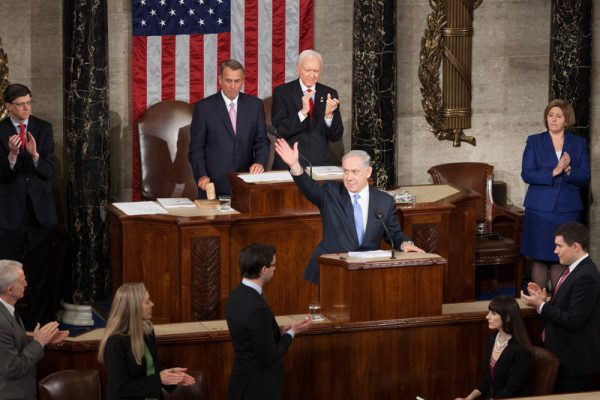
Nearly two years later, in March 2015, during what must surely have been, thus far, the lowest point in American history since 1776, Buchanan’s observation years before was proven correct in a grandiose way for all to see and hear. Netanyahu appeared before a joint session of Congress to give a rousing speech, which was interrupted by applause 39 times, of which 23 were standing ovations – more than a quarter of the time Netanyahu stood before the podium consisted of applause and jubilation by America’s “elected representatives”, conveying unambiguously that, as far as they are concerned, Israel comes first, not America.
A few days from now, on February 15, Netanyahu is scheduled for an official visit to the White House. There has been much speculation and chatter recently regarding the possible establishment of a US Embassy in Jerusalem. President Trump will have an opportunity to signal to Netanyahu what “America First” means. At the very least he should remain true to the same executive position since Harry Truman’s presidency, which recognizes, as does the United Nations, that no state has sovereignty over Jerusalem, given that the specifics pertaining to this issue remain subject to future negotiations between the parties involved in the dispute. This longstanding executive position was reaffirmed by the US Supreme Court on June 8, 2015 in Zivotofsky v. Kerry (“Jerusalem Passport Case”) and therefore constitutes “settled law”.
President Trump could surprise many by indeed proclaiming his intent to establish a US Embassy to Jerusalem in the heart of Jerusalem (inside the walled old town, ideally as close as possible to the key point where the Armenian Quarter, Christian Quarter, Jewish Quarter, and Muslim Quarter meet, perhaps at the LaHamin Market or St. Marks Road) while – of course – continuing to maintain the US Embassy to Israel in Tel Aviv. Additionally, so as to demonstrate even-handedness, he should announce plans to also establish a new US Embassy to Palestine in Ramallah, perhaps also a General Consular office in Gaza as well as the eastern part of the West Bank, if their Consular office in western part of Jerusalem were to remain in place. Such a public announcement could be crafted to fit within the 140 available characters of a “Tweet” message and could be timed for release just a few seconds before Trump and Netanyahu were to meet – so that Netanyahu would first learn about it from the press afterwards, on camera. This would be consistent with Israel’s regular announcements of new illegal settlements timed to greet US high officials in the past.
A new US Embassy to Jerusalem would formally extend the Supreme Court decision and thus formally recognize in a highly symbolic way the official “Corpus Separatum ” status of Jerusalem. Such an embassy would not even need to be manned inside; it could be as small as a big high definition screen and a server inside a thick storefront window, advertising an informational web site, but would include at least an armed Marine guard on duty. Presto – with rapid follow-through action after such an announcement Trump will have delivered “in style” on the promise for a new US Embassy in Jerusalem, as other countries will be scrambling to do likewise – after nearly seven long decades of stalling let the serious negotiations finally begin.
This editorial may be freely distributed only in its entirety, with an explicit reference “initially appeared at Aletho News” that includes a direct link or URL to this original site.
February 5, 2017
Posted by aletho |
Timeless or most popular, Wars for Israel | Benjamin Netanyahu, Iraq, Israel, Middle East, Obama, Palestine, Syria, United States, Zionism |
Leave a comment
A senior Israeli official played down Friday remarks from the White House that building new or expanding existing settlements in the occupied Palestinian territories “may not be helpful” in securing peace.
In an apparent break from President Donald Trump’s previously full-throated support of settlements building, White House spokesman Sean Spicer told reporters on Thursday that the new administration hadn’t yet taken an official position on settlements.
Responding Friday, Israeli ambassador to the United Nations Danny Danon said Spicer’s comments didn’t amount to “a U-turn”.
“The statement is very clear and essentially means: wait for the meeting with (Israeli) Prime Minister (Benjamin) Netanyahu, who is arriving in Washington in less than two weeks to meet President Trump, and then we’ll determine our policy,” Danon told Israeli public radio.
The Zionist entity has now approved more than 6,000 settler units since Trump took office having signaled a softer stance on settlement construction than predecessor Barack Obama.
“While we don’t believe the existence of settlements is an impediment to peace, the construction of new settlements or the expansion of existing settlements beyond their current borders may not be helpful,” Spicer said on Thursday.
Trump is scheduled to welcome Netanyahu to the White House on February 15.
February 3, 2017
Posted by aletho |
Ethnic Cleansing, Racism, Zionism, Illegal Occupation | Benjamin Netanyahu, Donald Trump, Israel, Palestine, United States, Zionism |
Leave a comment