Birzeit University condemns Israeli ‘military attack’ on campus
Ma’an – January 11, 2016
 BETHLEHEM – Birzeit University on Monday condemned an Israeli army raid into its campus in Ramallah overnight, during which it said Israeli forces confiscated and damaged university equipment.
“Birzeit University condemns this attack and the direct violation of the sanctity of the university campus,” the university said in a statement. “This is a belligerent military attack on the university and our right to education and all the principles involved in the freedom of education.”
The university said that Israeli soldiers raided the campus in more than 15 military vehicles shortly before 3 a.m., breaching the campus’ western gate and storming the university’s student council and faculty of science.
“The military confiscated equipment and computers used in the activities of the students council and destroyed and damaged furniture leaving a great deal of havoc behind,” the university said.
“This is a blatant attack on our student council and the sanctity of democratic values. This violation of the campus is a part of a blatant and systematic attack on the right of education and freedom of expression.”
Birzeit University condemned a range of other “outrageous acts” by Israel, including the detention of some 80 students, including more than 25 taken into Israeli custody since a wave of unrest swept the occupied Palestinian territory in October.
“Stealing our students’ lives and working to destroy the sanctity of our university campus and our right to education is an atrocious and obvious attempt to destroy the will of the Palestinian people,” the university said.
The university added that the “constant” attacks against it would “strengthen the university’s commitment to its noble cause — education.”
The Israeli army confirmed that the raid took place. An army spokesperson said that Israeli forces had “seized material, including propaganda belonging to Hamas.”
Tel Aviv Attacker Executed by Security Forces; Targeted Shin Bet Agent; Father Was Palestinian Collaborator
By Richard Silverstein | Tikun Olam | January 8, 2016
Today, the inevitable happened. Nasha’at Milhem, who had attacked a Tel Aviv bar last Friday and killed three Israelis, was himself murdered by security forces. I say “executed,” because this has become standard policy with all Palestinians suspected of lifting even a pinkie finger against Israelis. They are almost all “put down” like mad dogs. Because they’re Palestinian. Not worthy of being treated like human beings. I even predicted his liquidation here:
“There can be no doubt that Milhem will not be apprehended alive. Israel’s security services specialize in confronting Palestinian militants dedicated to going out in a blaze of resistance and glory. They are inevitably killed after being asked to surrender and then responding with a hail of bullets, to which security forces had no choice but to respond, killing the suspect in the process.”

Note planted weapon placed near Milhem’s body
The standard narrative offered by the security apparatus is that the terrorists seek to die in a hail of bullets like the conventional Hollywood mob movie. Here’s Haaretz’s bogus version:
Nashat Melhem, the suspected gunman behind the Tel Aviv shooting last week, was shot dead in a firefight with police forces in his hometown of Arara in northern Israel on Friday.

Milhem, sought to avenge his father’s collaboration with Shin Bet by assassination of his handler
Why would a reporter merely transcribe a claim like this in their report? Did they examine the scene to determine whether there was a firefight? Did Milhem fire any bullets at anyone? As usual, even the supposedly liberal champion Haaretz swallows the security narrative hook, line and sinker.
My take: nope, no firefight. Just an outright liquidation of terror vermin, as Israeli police and Shin Bet commanders see it. Though I object generally to terror porn, I’m displaying a picture of his corpse because I want to show the effrontery of the security forces who I am almost certain planted a weapon next to Milhem’s body. An image of the murder scene from a different angle shows a second pistol of some kind (or a separate part of the weapon lying by his side) in his hand. This is no different from the scores of cases in which they planted knives next to the bodies of Palestinians murdered by the same Israeli executioner-security forces.

Mourners at funeral of Ruimi. Pixellated face is that of “Shin,” Shin Bet agent who “ran” Mohammed Milhem, and who was Nata’ash’s intended target.
Compare this to the treatment accorded the settler terror conspirators. They murdered an 18 month-old baby, his mother and father. Were they executed when apprehended? Were their families’ homes torn down in retribution as regularly happens with Palestinian suspects (surely, the Milhem home will be demolished if it hasn’t been already)? No, none of this happened. Further, one of the murderers, a Jewish Shin Bet collaborator, betrayed his handler and refused to reveal the plot. He was at the scene of the crime and a willing participant. He, Israel Keller, has been released from detention and likely will remain uncharged because to do so would embarrass the Shin Bet.
Justice is blind, as far as Jewish terror is concerned. Palestinian terror? Justice has 20-20 vision.
But there is a larger story here as well. Israel was rife with rumors sweeping social media that Milhem himself was a Shin Bet collaborator who deliberately killed one of the victims, Shimon Ruimi, who was supposedly a Shin Bet agent or even his handler. These rumors seemed quite promising, and the half-baked story offered by the authorities seemed unconvincing.
But my regular security source clammed up when asked for comment. So I couldn’t post anything definitive about the incident. Now, I can. My source reveals:
“Nash’aat’s father, Muhammad, was/is a Shabak collaborator, and that’s why he got a licence for a gun – a very rare thing for an Arab citizen. One of his handlers was “Shin” (‘ש), a close friend of Shimon Ruimi. Muhammad is now being interrogated by Shabak, suspected of involvement in an apparent plot (possibly ISIS-inspired) to assassinate “Shin” who was in the TA pub with several friends, celebrating the birthday of one of them. Nash’aat used his father’s gun to fire at the pub trying to hit “Shin”, but missed and killed his friend (Ruimi) and another man (who worked in the pub). No other details are available, and it’s still unclear why he later murdered the Arab taxi driver.”
As I’m quoting my source, I’ll add my own qualifications of his statement. I don’t understand why the son of the collaborator would be the one to exact revenge, unless he was ashamed of his father’s spying on behalf of the Shin Bet and sought redemption through this attack. I’m also leery about crediting any outside force for the attack or even for inspiring the attack. It seems too convenient to link ISIS to the attack. It follows the standard Likudist narrative that Israel is a gentle creature swimming in a sea of Islamist piranhas.
As I’ve written here numerous times, Palestinians have all too many legitimate domestic grievances and too much suffering to explain their taking up arms against a sea of troubles, aka Israel. Bringing in external factors merely confuses things, which is what the Israeli regime wants.
NOTE: Please read my new Mint Press article revealing Shin Bet’s abject failure to stop Duma murders, State Department’s Silence Deafening After U.S. Citizens Engage In Israeli Settler Violence
Although 2016 looks bleak for Gaza, there is a chink of light
By Dr Daud Abdullah | MEMO | January 5, 2016
Throughout the whole of 2015 the Rafah Crossing between the Gaza Strip and Egypt was open for just 21 days. On 31 December, the Egyptian authorities opened the border to deliver the corpse of a 28 year-old mentally-ill Palestinian, Ishaq Khalil Hassan, who was shot in full view of the cameras after he had strayed into Egyptian waters while swimming in the Mediterranean. As the Israeli-led — and Egyptian-backed — blockade of Gaza enters its tenth year, there is little hope that the Rafah Crossing will be opened for any meaningful number of days in 2016.
In fact, a combination of domestic and external factors are likely to continue to prevent an early end to the siege. The cold-blooded killing of Hassan by the Egyptian army in late December was indicative of a hardening of Cairo’s attitudes toward the Palestinians in Gaza. As a result, many more will pay with their lives, either through being denied unrestricted passage through Rafah to get essential medical treatment, or by attempting to smuggle basic needs through the tunnels once described as Gaza’s “lifeline”; or by falling victim to Israeli or Egyptian state violence.
For now, there is no shortage of excuses for keeping the Rafah Crossing closed; the usual excuse given to the Palestinians is that the security situation in north Sinai necessitates the closure. While it is true that there is a deadly insurgency in the Sinai which is taxing the resources of the Egyptian security forces and needs a massive political effort to resolve, that does not justify the demonisation and extrajudicial killing of Palestinians.
It has not gone unnoticed that on every occasion that the crossing was open last year there was a major security incident on the Egyptian side of the border. Coincidence? Perhaps, or maybe such incidents were planned in order to provide the Egyptian authorities with an excuse to keep Rafah closed. We will probably never know.
Israel’s role in prolonging Gaza’s humanitarian ordeal, however, is far more clear-cut. Soon after Hamas was elected to run the Palestinian Authority in January 2006 the Israelis imposed economic sanctions against the enclave. At the time, Dov Weisglass, an advisor to the then Israeli Prime Minister Ehud Olmert, said, “The idea is to put the Palestinians on a diet, but not to make them die of hunger.”
The following year, Israel declared Gaza to be a “hostile entity” and tightened further its sanctions regime. By adopting this designation, the Israeli cabinet had in effect voted to keep Gaza under a permanent state of siege.
Repeated calls by world leaders, including UN chief Ban Ki-moon, to end the blockade have all fallen on deaf ears. In 2010, Mr Ban condemned the blockade, saying that it caused “unacceptable sufferings.” Today, international aid agencies have confirmed that 80 per cent of Gaza’s inhabitants are aid dependent because of unemployment and poverty created by the Israeli siege.
It has now become abundantly clear that the aims of the blockade have gone well beyond the near-starvation proposed by Weisglass; it has been extended to ensure that young Palestinians in Gaza are even denied the basic right to an education. According to the Palestinian ministry of education, the blockade is currently impeding the building of 55 schools in the territory.
Internally, political analysts and observers in Gaza don’t expect 2016 to be any better than last year. There is a general sense among most that without a resolution of the differences between the two main factions, Fatah and Hamas, things will not improve. Perhaps the most intractable factor in this dossier is who controls the Rafah Crossing.
This week, a new formula has been proposed by the Popular Front for the Liberation of Palestine (PFLP), Islamic Jihad and other factions to resolve the issue. It suggests the appointment of an independent body of technocrats to oversee the border with the reappointment of those Fatah officials who were removed when Hamas took over the territory in 2007. At the same time, it stipulates that those officials employed by Hamas should retain their positions. An agreement on this formula between Fatah and Hamas could pull the rug from under the feet of the Egyptian government and nudge it to reopen the crossing.
Another ray of hope comes from the ongoing talks between Turkey and Israel, both of whom have now decided to normalise relations. While Israel has agreed to some of the Turkish conditions —notably an apology for the Freedom Flotilla attack in 2010 and compensation for the victims’ families — one condition remains hanging in the balance: Ankara’s demand for an end to the blockade of Gaza. As it has done so many times in the past, Israel has agreed to an “easing” of the restrictions but, as before, it has not actually defined what that means. If past experience is anything to go by, it means very little.
Sources close to the talks, though, have told MEMO that Turkey has proposed the construction of a sea port in Gaza and offered to administer it. So far Benjamin Netanyahu and his government remain implacably opposed to this. Nevertheless, although it will be a bitter pill to swallow it may actually be the best face-saving device for the Israelis to accept. After all, Israeli commentators and intelligence officials alike have realised that instead of weakening Hamas the blockade has strengthened the movement.
While it is hard to imagine a year worse than 2015, Gaza is caught in a downward spiral from which it will be difficult to escape. However, this Turkish proposal provides a chink of light that, with goodwill, could lead to 2016 not being as bad as last year after all. Some courageous steps are needed to make it work, but it is possible. to 2016 not being as bad as last year after all. Some courageous steps are needed to make it work, but it is possible.
BDS in the Crosshairs
By Lawrence Davidson | To The Point Analyses | January 9, 2016
Most readers will know that the United States has served as the patron of Israel for decades. Why has it done so? The commonly given reasons are suspect. It is not because the two countries have overlapping interests. The U.S. seeks stability in the Middle East (mostly by supporting dictators) and Israel is constantly making things unstable (mostly by practicing ethnic cleansing against Palestinians, illegally colonizing conquered lands and launching massive assaults against its neighbors). Nor, as is often claimed, is the alliance based on “shared Western values.” The U.S. long ago outlawed racial, ethnic and religious discrimination in the public sphere. In Israel, religious-based discrimination is the law. The Zionist state’s values in this regard are the opposite of those of the United States.
So why is it that a project that seeks to pressure Israel to be more cognizant in foreign affairs of regional stability, and more democratic and egalitarian in domestic affairs, is now under fire by almost every presidential candidate standing for the 2016 election?
That project in dispute is BDS, the Boycott, Divestment and Sanctions movement, promoted by civil society throughout the Western world. BDS is directed at Israel due to its illegal colonization of the Occupied Territories and its general apartheid-style discrimination against non-Jews in general and Palestinians in particular.
The Candidates and BDS
With but two exceptions, every presidential candidate in both parties is condemning the BDS Movement. Lets start with the two exceptions. The first exception is the Green Party candidate Jill Stein, who has taken the accurate position that “the United States has encouraged the worst tendencies of the Israeli government.” She has pledged to use both diplomatic and economic means to change Israeli behavior, behavior which she rightly believes is in contravention of international law and violates human rights.
The second exception is the Republican candidate Donald Trump, who recently told a meeting of Jewish Republicans that he didn’t think Israel is serious about peace and that they would have to make greater efforts to achieve it. When he was booed he just shrugged and told the crowd that he did not care if they supported him or not, “I don’t want your money.” Unfortunately, this appears to be the only policy area where Mr. Trump is reasonable [Russia relations? MENA interventions?].
Jill Stein gets absolutely no media coverage and Donald Trump gets too much. And neither is in the “mainstream” when it comes to American political reactions to BDS. However, the rest of the
presidential candidates are. Here is what is coming out of the “mainstream”:
— Jeb Bush (Republican), 4 December 2015: “On day one I will work with the next attorney general to stop the BDS movement in the United States, to use whatever resources that exist” to do so.
— Ted Cruz (Republican), 28 May 2015: “BDS is premised on a lie and it is anti-Semitism, plain and simple. And we need a president of the United States who will stand up and say if a university in this country boycotts the nation of Israel than that university will forfeit federal taxpayer dollars.”
— Marco Rubio (Republican), 3 December 2015: “This [BDS] coalition of the radical left thinks it has discovered a clever, politically correct way to advocate Israel’s destruction. As president,
I will call on university presidents, administrators, religious leaders, and professors to speak out with clarity and force on this issue. I will make clear that calling for the destruction of Israel is the same as calling for the death of Jews.”
Hillary Clinton (Democrat), 2 July 2015: In a letter to Haim Saban, who is a staunch supporter of the Zionist state and also among the biggest donors to the Democratic Party, she said, “I know you agree that we need to make countering BDS a priority, I am seeking your advice on how we can work together – across party lines and with a diverse array of voices – to fight back against further attempts to isolate and delegitimize Israel.”
Bernie Sanders (Democrat), 20 October 2015: “Sanders’ fraught encounter with BDS supporters who challenged his defense of Israel at a town hall meeting in Cabot [Vermont] last year was captured on YouTube.” Sanders told them to “shut up.”
The Legitimacy of Boycott
This hostility to the tactic of boycott runs counter to both U.S. legal tradition and the country’s broader historical tradition.
For instance, advocating and practicing BDS can be seen as a constitutionally protected right. It certainly is more obviously protected by the First Amendment’s guarantee of free speech than is the use of money to buy elections. Thus, if Zionist lobbyists can use money to buy support for Israel, why can’t anti-Zionists use their free speech rights to challenge that support? It should be noted that, in this regard, most Americans of voting age think it is the Zionists, and not the anti-Zionists, who have gone too far.
According to a December 2015 Brookings Institute poll, 49% of Democratic voters and 25% of Republican voters think that Israel has too much influence with U.S. politicians. Those supporting BDS in the United States might give some thought as to how to use these numbers to uphold their cause.
Then there is the fact of well-established historical tradition. The war for American Independence was build upon a framework of boycott. In November 1767, England introduced the Townshend Acts, requiring the colonists to pay a tax on a large number of items. The reply to this was both a boycott of British goods by many colonial consumers which was eventually followed by a boycott on the importation of such goods on the part of colonial merchants.
Subsequently, Americans have used the tactic of boycott against:
— (1930s) Goods produced by Nazi Germany
— (1960s and 1970s) California-grown grapes in support of the United Farm Workers
— (1970s and 1980s) All aspects of the economy and cultural output of South Africa
— (1980) The Moscow-hosted Olympics of 1980
— Myriad number of boycotts of various companies and products ranging from Nestle (baby formula) to Coca Cola. See the list given by the Ethical Consumer.
The reality is that the tactic of boycott has long been as American as the proverbial apple pie.
Conclusion
Apple pie not withstanding, the legal and historical legitimacy of boycott no longer has much impact on the attitudes of presidential candidates or, for that matter, members of Congress. Nor does the fact that the changes the BDS movement seeks to make in Israeli behavior would be to the benefit of U.S. interests in the Middle East.
Instead what the positions of the candidates seem to indicate is that there will be an almost certain attack on the Boycott, Divestment and Sanctions movement, coming from the very highest levels of U.S. power, sometime soon after the 2016 elections.
How is it that such a contradiction between national interests and established tradition on the one hand, and imminent government policy on the other can exist? The answer is not difficult to come by. It is just a matter of fact that constitutional rights, historical tradition, and indeed the very interests of the nation, can be overridden by special interest demands. The demands of what George Washington once called “combinations and associations” of “corrupted citizens” who would “betray or sacrifice the interests of their own country” in favor of those of some other “favorite nation.” It is exactly such demands that are now given priority by the politicians in Washington.
This form of corruption will go on as long as the general public does not seem to care that it is happening. And it is sadly clear that the BDS activists alone cannot overcome this indifference. Thus, the politicians can dismiss the Brookings Poll numbers mentioned above. They can shrug and say, So what? As long as that majority does not express their opinion by actively demanding a change in the situation, as long as they are not successfully organized to do so, their opinion cannot compete with the millions of special interest dollars flowing into political campaigns.
In many ways our greatest enemy is our own indifference to the quiet erosion of important aspects of the democratic process. Allowing the attack on BDS only contributes to this disintegration of rights. A combination of localness and ignorance sets us up for this feeling of indifference. However, in the end, there can be no excuse for not paying attention. One morning you will wake up to find that valued rights and traditions are no longer there for you.
Israeli Welfare Ministry, Foster Agencies, Traffic in Palestinian Children
By Richard Silverstein | Tikun Olam | January 9, 2016

Daniella Vaknin’s daughter, Adel, at her settlement pre-school
A few months ago, I wrote about a shocking Israeli Supreme Court decision which ratified the officially-sanctioned theft of children from a mixed Jewish-Palestinian couple and their adoption by an Orthodox Jewish couple who planned to raise the children with no access to their birth identity. The decision was flagrantly racist and defied many Israeli child welfare regulations. But it was the decision of the highest court in the land. One which foreign observers continue to mistakenly credit with being a beacon of western democratic values.
Tonight brings a new saga of judicially-sanctioned racism and woe perpetrated again by the Israeli Welfare Ministry (run by Minister Haim Katz) and its child services agency.

Daniella with daughter, Adel at younger age
Over a decade ago, Daniella Vaknin was a troubled teenager living in an Orthodox home in the settlement of Avney Heifetz. Daniella was labelled as rebellious, violent, aggressive, and sent to an institution for troubled youth. She was abused at this facility and ran away. She stayed away till she became an adult and could make her own decisions. At that time, she met a Palestinian man, Ala’a Suliman, whose family lived in the West Bank village of Zetta. They fell in love. Against her parents wishes, she moved to his village, married him, and became pregnant. They had a daughter they named Adel.
Daniella’s mother continued to pressure her to abandon her marriage and return to live with her parents among Jews. She warned her daughter that the Israeli social welfare system would frown on her decision and might take her child away. Even then, despite living among Palestinians in the West Bank, child welfare officials summoned her to a meeting where they pummeled her with questions about her baby, the care she was providing, etc. Among the first questions they asked was why she wore a hijab to meet with them. Daniella responded that she did this out of respect to her husband’s family. The social workers clearly disapproved of this and saw it as a rejection of her Jewish roots.
Eventually, Daniella understood the immense pain she was causing her mother and decided to return home. But that is when the trouble really began. A neighbor of her parents reported falsely that Ala’a had threatened Daniela. That permitted them to further question her. She denied that her husband had ever threatened her. But it didn’t help matters.
Her parents and the child welfare officials persuaded her to place Adel in a pre-school program. This enabled Daniella to work. She got two jobs and commuted many hours to work each day. Luckily, her mother’s best friend agreed to provide care to the child and the arrangement seemed to suit everyone. Except child welfare. They argued that her long hours of work meant she had abandoned her baby, another false claim.
One day, the authorities came to Adel’s pre-school and took her into custody. Daniella had not been provided any warning of their intent. And they had obtained no judicial order approving the removal as is required by child welfare regulations (they obtained an order ex post facto). They justified taking Adel away from Daniela by dredging up her wayward childhood. They claimed she was an unfit mother because she had not changed her ways. That she abandoned her daughter. That her biological father was a threat to mother and daughter.
Adel was not taken into emergency protective services as would be normal in such cases. She was given directly into the hands of her foster parents, Yehuda and Shoshana Damri. This raises serious questions of a conspiracy between the Damris and child services. In effect, this is child trafficking. How can a government agency assign a child to another family before it even has legal custody of the child? It’s the worst violation of the rights of the mother.
Ala’a also tried to intervene in the legal process to assert his paternal rights. But when the case came before an Israeli Palestinian judge in Nazareth, he astonishingly ruled that no Palestinian father could have any parental rights when the adopted child was to raised by as a Jew. The ruling had little or no basis in law. But that hardly mattered. If you ask why a Palestinian judge would rule against a Palestinian father remember, just as with security cases, judges are tightly bound to those who appear before them regularly: government officials. They tend to rule in favor of authority and against individual citizens who have little or no power. People just like Daniella and Ala’a. This a perfect example of a Palestinian Muslim judge ruling against a Palestinian father in order to curry favor with the Jewish judicial power structure. Divide and conquer.
In a separate ruling, the authorities found that Ala’a had “abandoned” Adel because he had not visited her. In truth, no Palestinian may enter Israel legally without a permit. Permits are given exceedingly sparingly and Ala’a could not get one to visit his daughter. To official Israel, this didn’t matter. The fact that he did not visit his daughter, regardless of the reason, permitted them to steal his parental rights from him.
System Rigged Against Kids, Parents
None of the accusations against either parent is true. But it hardly matters in the Israeli welfare system. Social workers have absolute power. Their actions are unchecked. Parents have no recourse. And judges always go along with the child welfare authorities. They rarely side with parents, even biological parents. They often make decisions that directly contravene official regulations. But no one takes notice.
The entire process of foster care is hugely rewarding for the many agencies involved in it. One of the largest is Orr Shalom. It supervised Adel’s own foster care arrangement with the family which fostered her after she was removed from her mother’s care. In fact, child welfare authorities would have consulted with Orr Shalom even before taking Adel away from Daniella. The agency also would’ve identified prospective foster parents.
Orr Shalom and other such agencies receive more than $4,000 per month from the Welfare Ministry for every child who enters their custody. If you multiply this by the hundreds of children in foster care, it becomes a lucrative business. Nor is it beneficial for them to return foster children to the biological parents care. As such, you’ve created a system which works diametrically opposite to what should be the societal interest in having children raised by their natural parents.
This may explain why they targeted Adel. Not to mention that foster parents as well earn up to $500 per month for their role. So social workers working for these child welfare agencies are always on the look-out for vulnerable young mothers from whom they may wrest a child. In short, it’s a racket and the children trafficked and their biological parents are often the victims.
Of course, there are myriad justifications authorities and social workers offer for separating children from their mothers. Think about the Christian missionaries who forcibly removed Native American and Aboriginal children from their parents in order to “civilize” the children and introduce them to “modern ways.” Israeli social workers believe they are doing a social good by removing children from ‘troubled homes’ and finding more stable homes for them. There are, of course, hundreds of Jewish couples who cannot conceive and desperately seek to adopt a baby. They are often willing to pay handsomely for the privilege.

Daniella’s Facebook group, “Fighting to Return Adel.”
Orthodox Settlers Foster Palestinian Child
Such a couple were Yehuda and Shoshana Damri. They were Orthodox Jews who lived in the West Bank settlement of Elkanah. Once Adel was taken from her mother, she was placed in foster care with the Damris. Daniella of course objected strenuously to all of this, but to no avail. She created a Facebook page vowing to fight for her rights to Adel. She plastered hundreds of flyers seeking information about where her baby had been taken.
The Damris wanted to adopt because Yehuda was sterile and could not produce a child. This is particularly traumatic for an Orthodox family because one of the most important Biblical commandments is: “Be fruitful and multiply.” Under halacha, infertility of either spouse is grounds for divorce. The couple would’ve been highly motivated, since they couldn’t have their own child, to find one to adopt.
Adel was a beautiful child with black hair and piercing dark eyes. Their prayers seemed to be answered when the social workers gave her to them. But later, Shoshana decided she wanted her own child and not to raise the child of a stranger. She and her husband could not work out their fundamental differences. Eventually, they divorced.
That raised problems with the adoption agency. By regulation, single parents may not be foster parents nor may they adopt. By rights, they should have returned Adel to her mother for that reason alone. But naturally that didn’t happen. Officials winked and nodded at regulations and Adel remained in Yehuda’s care. To return Adel to her mother would’ve ended Orr Shalom’s gravy train. So he had to find a wife to marry as quickly as possible in order to retain custody of Adel. It took him nearly two years. But he finally did and now he is ‘kosher l’mehadrin.’
In the meantime, Daniella had no idea where her daughter lived. Though regulations permitted short twice monthly meetings with Adel, they never happened. So she did some detective work and discovered where her daughter lived and which pre-school she attended. She brought along her smart phone and took a few blurry pictures of Adel in her classroom. For her troubles, the teachers swarmed all over her and sent her packing. She left the premises without raising a fuss.
But the next day, Damri sicced the police on Daniella. They accused her of attempting to kidnap her daughter. Though this never happened, it’s precisely the sort of accusation that officials can use to bolster a fabricated case against a mother to justify stealing her daughter.
Daniella is further concerned about her daughter’s well-being when she discovered the medication record for Adel at her local medical clinic. You can see from the prescription form that she’s being pumped full of Ritalin (20mg per day), a commonly over-prescribed drug for young children. Adel’s emotional state is terrible and the instability of her circumstances weighs heavily on her. She was uprooted from her biological mother and grandmother; inserted into a family she didn’t know with a foster-mother who rejected her and decided to divorce her foster-father. Then, after he remarried she was forced to come to know yet another maternal figure, the third in only a few year’s time. Adel has endured far more than her share of emotional upheaval. All thanks to a system designed to benefit the bureaucracy and the foster agencies, rather than her.
The Damri family is quite well-connected among the settler movement. A relative, Yochai Damri, was recently elected the official leader of the Mt. Hebron settler community council. He had the support of Naftali Bennett’s Bayit Yehudi Party. Though I don’t know the political or ideological leanings of the Damris, it’s almost goes without saying that, given their Orthodox religious beliefs and living in Elkanah, that they are ultra-nationalists.
This raises another problem under child welfare regulations. When children are adopted, officials must respect the religious and ethnic traditions of the child’s biological parents. The idea of having a child with a Palestinian Muslim father adopted by an Orthodox Jewish couple living in a West Bank settlement is a serious violation of adoption regulations.
There can be only one explanation for the adoption agency’s decision to place Adel with the Damris. They object to miscegenation. They further object to a child of a Jewish parent who might be raised as a Palestinian; or even by a mother who was once married to a Palestinian. When offered a choice between having Adel raised by a single mother who had rejected her own Orthodox upbringing; or an Orthodox Jewish couple living in a settlement, there was no question which was preferable.

Education Minister Naftali Bennett dressed as policeman forbids Israeli reader from entering a bookstore to buy Borderline, the banned novel. (Eran Wolkowski)
Just as the Supreme Court decision I referred to above displayed Israeli racism resplendent, Adel’s theft from Daniela confirms that Israel is a State in which religious identity trumps individual or democratic rights. It further confirms that Israel is not a democracy, but a theocracy in which Jews reign supreme.
The trampling of the rights of parents in the social welfare system is but one symptom of a disease ravaging the Israeli body politic. That the system can kidnap children and wrench them from the arms of loving parents merely because it disapproves of a lifestyle or marital choice, is part of the sickness afflicting Israel. In a society respecting the rule of law such grave violations of human rights would never be tolerated. In Israel, they are de rigueur.
I called the Welfare Ministry press office, the government child welfare agency (Sherut LaYeled), and several social workers assigned to Adel’s case for comment. I reached one of the social workers twice and each time she hung up on me without uttering a word. I also sent them an e mail requesting comment. No one has yet responded.
Banning Books and Miscegenation, Israel-Style
On a related note, an Israeli novelist published a young adult book recently called Borderline. It deals with an Israeli Jewish woman who meets a Palestinian man and falls in love with him. The book was recommended for inclusion in the national high school reading curriculum. However, the education ministry under the ‘able’ direction of Naftali Bennett, decided that it must protect the tender, confused identities of Israeli teenagers. The pedagogic specialists determined that reading such literature would confuse them about their own Jewish identity and give them the mistaken impression that miscegenation was a desirable phenomenon.
This is only a slightly more elegant approach than that of the thugs of Lehava, who prefer to beat Palestinian men who dare to dream they may soil the purity of Jewish maidens. So you see that the evils of this system permeate all: from child adoptions to the public schools. It is riddled with the concept of Jewish racialism and superiority. These are values derived directly from the ideology of Meir Kahane, who is, to my chagrin, the patron saint of the contemporary Israeli State.
NOTE: Please read my latest article on the Duma murders published at Mint Press News, State Department’s Silence Deafening After U.S. Citizens Engage In Israeli Settler Violence.
New Jersey high schooler accused of violating bullying laws for making anti-Israel tweets

@bendykoval / Twitter
RT | January 7, 2016
A social media storm erupted after administrators at a New Jersey high school accused a student of bullying because of anti-Israel comments that she posted on Twitter. They say that the tweets may have violated the state’s broad anti-bullying laws.
Bethany Koval, a 16-year-old Israeli Jew, said on Wednesday that she was called to the principal’s office at Fair Lawn High School and reprimanded for making tweets criticizing Israel and mentioning that a pro-Israel classmate had unfollowed her on Twitter.
Administrators warned her that she could face legal consequences for her actions, since New Jersey has some of the strictest anti-bullying legislation in the country. Under the New Jersey Anti-Bullying Bill of Rights Act, which only came into force in 2011, she could be suspended or expelled.
Koval is a prolific Twitter user. She had made over 21,000 tweets and has almost 7,000 followers, many of whom she gained in the last few days. The fiasco that she is the center of has since become a social media sensation.
The outspoken high schooler has been met with both support and opposition online.
When Koval was called down to the principal’s office, she began documenting the situation on Twitter.
“I’m about to be exposed for being anti-Israel. Pray for me,” she tweeted.
A few minutes later, she tweeted that the administrator threatened to “file a bullying case” against her.
“It’s against state law to express unpopular political views on the Internet, now.”
In addition to rebuking her and warning her about legal consequences, the administator searched Koval’s phone to make sure that she had not recorded their conversation. The student could be sued if she had, he told her.
The administrator was correct in their assumption; Koval posted videos of the meeting on Twitter. In one recording, Koval can heard telling the administrator that her tweets may have been controversial, but she didn’t think they were “problematic.”
“Well that’s your interpretation,” the administrator said. “There’s a state law that might interpret it differently.”
In a second clip, the administrator can be heard warning her about legal consequences again.
“You can sit there with your smug attitude right now, but if it’s got to go into a bullying case because you think it shouldn’t be and the state says it is, you’re going to lose,” he said.
Fair Lawn High School Principal James Marcella told The New York Times that the issue has been referred to the school district’s superintendent, Bruce Watson, and that a statement would be released on Thursday afternoon.
Stanley Cohen, a lawyer consulted by Koval’s family, said that he doubted that the complaints over her tweets would end up being a legal matter. He said he hoped school officials would look beyond “the emotion of the moment and say ‘Move on, this is no big deal,’” adding that he believes that young people should be encouraged to express their opinions in an academic environment.
READ MORE: UCLA and Berkeley anti-Semitism resolutions ‘blur lines,’ hurt debate – critics
The Disingenuous Apologies for Israel’s Assault on Palestinian Education
By Matt Peppe | Just the Facts | January 6, 2016
As the American Historical Association (AHA) prepares to vote this week on a symbolic resolution that affirms support for the right to education in the occupied Palestinian territories, apologists for the Israeli regime’s policies against Palestinians are putting forward nonsensical rationalizations for their opposition to the measure. Writing in History News Network, University of Maryland History Professor Jeffrey Herf essentially argues that his profession has no practical value: “as historians we have neither the knowledge nor expertise to evaluate conflicting factual assertions about events in Israel, the West Bank and Gaza.”
If historians should not evaluate the veracity of factual assertions about an issue then what exactly is the use of historical studies? To merely compile and organize documents? Surely a historian’s job involves analytical — in addition to technical — skills. And surely their methods include empirical analysis – no different than a scientist testing a theory. If someone says the earth is round but another person says the earth is flat, that doesn’t mean the scientist should throw his hands up in the air and say “as scientists we have neither the knowledge nor expertise to evaluate conflicting factual assertions.”
Historians analyzing political questions use the same principles as scientists testing a theory. Take, for example, conflicting accounts of the actions of the Belgians under King Leopold in the Congo near the end of the 19th century. Leopold claimed he treated the Congolese people benevolently as part of his “Christian duty” to help the poor. Others claimed Leopold’s forces were engaged in the systematic plunder of resources carried out through massive violence. They described women held hostage by Belgian forces to force Congolese men to engage in involuntary labor, with the hands of those who did not produce enough rubber for the colonists cut off and kept as trophies.
According to Herf’s axiom, historians would not have the ability to distinguish between these competing claims. It would be outside the scope of the historical vocation to evaluate the available evidence and reach a conclusion about the truth.
In the Congo, the African American historian George Washington Williams worked tirelessly to document the true condition of the local population under Belgian rule. As Adam Hochschild explains in his book King Leopold’s Ghost, Williams’s insistence on questioning the official narrative enabled him to uncover and expose the brazen lies meant to cover up the genocidal destruction of an entire society for the material enrichment of a tyrant.
“Williams was a pioneer among American historians in the use of nontraditional sources. He sensed what most academics only began to acknowledge nearly a hundred years later: that in writing the history of powerless people, drawing on conventional, published sources is far from enough,” Hochschild writes.
Much like the Belgian regime in the Congo more than a century ago, the state of Israel today covers up its crimes against Palestinians by denial, deflection and counter-accusations. They rely on the support of apologists in media, government, civil society, and academia to side with authority by accepting their justifications at face value.
Herf writes that “(i)t is fair to insist that where there is an indictment, we must pay attention to the case for the defense.” Absolutely true. But we must pay attention to the evidence for the case itself, not merely conclude that the existence of a defense means there is no way to draw a conclusion about the facts.
Herf requested a response from the Israeli Embassy on accusations presented in the AHA resolution. Among their claims are that the movement of faculty, staff and visitors in the West Bank are not limited except occasionally because “Palestinian universities periodically serve as sites of violence and incitement.”
The evidence is overwhelming that movement in the West Bank is severely limited and adversely impacts education. A UN report found that checkpoints, settler violence, and long commutes present risks to West Bank students. Another UN report documented 542 obstacles to movement in the West Bank. Students from Gaza are denied permission to study in the West Bank, a policy that has been criticized by Amnesty International. The policy has been endorsed by Israel’s High Court. The Israeli Defense Forces (IDF) have raided West Bank universities. Visiting academics are denied entry to the West Bank. After arbitrarily being denied entry to deliver several lectures there, world-renowned scholar Noam Chomsky compared his treatment by Israeli authorities to that of Stalinist regimes.
There is no evidence presented, however, to support the claim that Palestinian universities serve as sites of violence and incitement.
Herf also quotes the Israeli Embassy defending their bombing of the Islamic University in Gaza (IUG) in 2014 during Operation Protective Edge “not because it was a university but because it was used by the terrorist organization Hamas to manufacture and fire rockets at Israeli civilians.”
First, it should be noted that Hamas is not recognized as a terrorist organization by the United Nations. The description carries exactly as much weight as Hamas calling the Israeli regime a terrorist organization. But that is beside the point. The accusation is that Hamas used the university to make and fire rockets.
The source provided for this claim is “Israeli military intelligence officials.” After the bombing, the IDF claimed to target a “weapons development center” within the university. This is a predictable accusation. The IDF made similar accusations after bombing the same university in 2008. A UN report on that conflict “did not find any information about their use as a military facility or their contribution to a military effort that might have made them a legitimate target.”
Rami Almeghari, who teaches journalism at IUG, noted in the Electronic Intifada that the university is not run by Hamas or any other political party. Students and faculty, like those at any higher educational institutional, have varied political affiliations. Many others, like himself, belong to no party.
“Contrary to what Israel claims,” Almeghari writes, “Gaza universities do not have departments dedicated to military research or training. This is in contrast to Israeli universities which play an integral role in the military occupation and weapons development and have actively promoted the onslaught in Gaza.”
None of the Israeli government’s accusations are substantiated by anything other than its own word – which should be treated with the same skepticism as any criminal defendant pleading his innocence. On the other hand, a mountain of evidence from independent sources (Amnesty International, Human Rights Watch, UNESCO, Palestinian Centre for Human Rights, Institute for Middle East Understanding, B’Tselem, etc.) supports the accusations in the AHA resolution.
The idea that evaluating contrasting factual assertions and reaching a judgment is outside the scope of a historian’s profession is asinine. This notion is beneficial for the propagation of state propaganda, but devastating for the advancement of human rights, including the right to education.
Canadian media is ignoring evidence of 1948 Israeli massacres
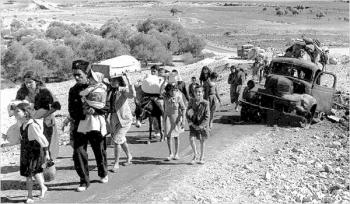
By Dan Freeman-Maloy | Rabble | January 6, 2016
The better part of a decade ago, I described the Toronto Star‘s Mitch Potter as “a canary in the mineshaft of liberal Canadian racism.” A piece on 1948 Palestine published in a recent edition of The Star shows the canary very close to asphyxiating.
Since Potter insists he was within his rights to describe Palestinian fighters in Gaza as “lemming-like,” he’ll surely forgive the metaphor.
The article, entitled “The Toronto man who saved Nazareth,” celebrates the heritage of Ben Dunkelman, the most prominent Canadian to travel to 1948 Palestine to support the Zionist war effort. In more than 2500 words spread across The Star‘s “Insight” section, Potter and his editors transform this Canadian’s role in occupying Palestinian communities into fodder for patriotism. “What he did was bring his hard-earned Canadian military professionalism to help organize a chaotic fighting force and help set down the rules of engagement,” the Star quotes one of a number of friendly sources as explaining. “And that included saying, ‘No, we will not expel civilians.'”
The record of this “gentle giant of a man,” as Potter introduces Dunkelman, is well documented. The son of the founder of Ontario retail giant Tip Top Tailors and a veteran of the Queen’s Own Rifles of Canada, Dunkelman was not an obscure figure. In Canada, he was an eminent member of the country’s community of patriotic respectables. In Palestine, he was a participant in the mass expulsion of Palestinians from the Galilee, commanding troops who repeatedly massacred civilians.
Dunkelman’s record of Canadian patriotism and Zionist colonization has long made for a popular sell. He has been happily remembered as “a Canadian and Israeli war hero,” as The Globe and Mail once described him. His basic character should be apparent to anyone who picks up his autobiography, Dual Allegiance.
Potter’s article for The Star pines over lost pages of this book without conveying to readers its utterly thuggish tone. The first five pages, to give you a sense, move from a description of a fight Dunkelman picked with a Palestinian (“Kneeling astride him, I began hitting him again and again, until his body went limp”) to boyhood reminiscences that feature a young Dunkelman in Toronto, soon to enroll in Upper Canada College, “waving a little Union Jack.” A lovely patriotic tale.
In Palestine, Dunkelman did not stop at beating Palestinians with his fists. In the summer and autumn of 1948, he served as commander of the Seventh (Armoured) Brigade of the newly established Israel Defence Forces (IDF). This is a representative sample of how Potter now presents this history to The Star‘s readership: “Named to lead Israel’s 7th Brigade in the final phase of the 1948 war, Dunkelman pushed methodically — and almost bloodlessly — through the Galilee with a series of nighttime flanking movements, eventually ending at the Litani River in Lebanon. He quite literally shaped borders, delivering territory Israel might not otherwise hold today.”
“Bloodlessly”?
One of the Seventh Brigade’s “nighttime flanking movements,” on October 29-30, 1948, brought the Palestinian village of Safsaf under Dunkelman’s command. A Palestinian woman from Safsaf, Umm Shahadah al-Salih, described what happened the next morning. Villagers were ordered to assemble in file around two houses to the north of the village.
“As we lined up, a few Jewish soldiers ordered four girls to accompany them to carry water for the soldiers. Instead, they took them to our empty houses and raped them. About 70 of our men were blindfolded and shot to death, one after the other, in front of us. The soldiers took their bodies and threw them on the cement covering of the village’s spring and dumped sand on them.”
If Potter’s editors can cough up subway fare to Yonge and Bloor, he can read this and other accounts for free at the local library, in Nafez Nazzal’s The Palestinian Exodus from Galilee, 1948. The Seventh Brigade’s trail of death, destruction and mass displacement of Palestinians from the Galilee into Lebanon is detailed authoritatively by Nazzal.
But right, this is a Canadian discussion of Palestine. Surely, Palestinians can’t be trusted! Unfortunately for Potter and The Star, more than mistrust of Palestinian testimony would be needed to make their whitewashing of these massacres halfway credible. In 1978, the year that Nazzal’s study was published, Israel began declassifying documents on these events. The Israeli record tells much the same story.
Israel Galili had been chief of staff of the Haganah, the main precursor to the IDF. In a declassified November 11, 1948 briefing cited by Israeli historian Benny Morris, Galili described the conduct of Dunkelman’s men in Safsaf. He spoke of the fate of “52 men tied with a rope and dropped into a well and shot,” and of three cases of rape, including of a 14-year-old girl. He also described large-scale killing of civilians by the Seventh Brigade in the villages of Saliha, Jish, and Sa’sa’. In Sa’sa’, Galili said, Dunkelman’s troops committed “mass murder” and then forced all remaining survivors out: “The whole village was expelled.”
Palestinian witnesses recount the most horrifying details. One survivor of the occupation of Safsaf recalled the stabbing of a pregnant woman with a bayonet. The witness lived out his life in the Ayn Al-Hilweh refugee camp in Lebanon; his testimony was kept alive by his nephew and cited in Ilan Pappé’s The Ethnic Cleansing of Palestine. In his memoirs, Dunkelman admits to authorizing looting by his forces, but predictably does not discuss most abuses. He does, however, proudly relate how one of his units set a landmark in the summer of 1948 with “the first bayonet charge ever mounted by the Israeli Army.” Facing an Arab position in the central Galilee, the company commander “ordered his men to fix bayonets; then, yelling like banshees, they rushed the Arab positions. When the astonished Arabs saw what was coming up the hill at them, they kicked off their boots and fled in terror.”
We don’t know much about specific atrocities with bayonets. We do know that Operation Hiram, during which Dunkelman’s troops carried out severe atrocities, helped push Palestinians out of the Upper Galilee en masse. On October 31, Dunkelman received an order from the IDF’s northern command spelling out this objective: “The inhabitants should be assisted to leave the conquered areas,” Dunkelman was instructed.
Here massacres by Dunkelman’s troops played their part. “What happened at Safsaf and Jish no doubt reached the villagers of Ras al Ahmar, ‘Alma, Deishum and al Malikiya hours before the Seventh Brigade’s columns,” writes Morris. “These villages, apart from ‘Alma, seem to have been completely or largely empty when the IDF arrived.” A week and a half into November 1948, an IDF intelligence report observed that “more than 50,000 new refugees” had crossed the border into Lebanon as a result of Operation Hiram.
Dunkelman — cue Potter’s praise — did not order expulsions in every Palestinian community that his forces occupied. He specifically opposed the (widespread) expulsion of Palestinian Christians by Israeli forces. When in July 1948 his troops occupied one of the main Christian centres in Palestine, the city of Nazareth, he spared it the harsher treatment he accorded to predominantly Muslim villages in its vicinity.
Potter is effusive with praise! He laments to The Star‘s readership that Dunkelman “won no medals for refusing to molest civilians” in Nazareth, but takes the opportunity to trumpet Canadian civility: “Transpose that morality to the modern era and imagine how the U.S. military interrogations at Abu Ghraib might have played out with a Dunkelman in command.” If those held at gunpoint were Muslims? Should we really follow this thread? “In many of the Palestinian oral histories that have now come to the fore,” observes Ilan Pappé, “few brigade names appear. However, Brigade Seven is mentioned again and again, together with such adjectives as ‘terrorist’ and ‘barbarous.'”
Israel has not declassified enough documentation for us to know for certain whether Dunkelman ordered his troops to massacre Palestinian civilians in line with instructions from higher-level IDF officers, took the initiative himself, or left the details to lower levels of command. But there is no record of him taking any action to discipline the culprits. By all accepted standards, he is therefore among them. Only the best liberal patriots want to award war criminals prizes for each possible war crime they didn’t commit.
Introducing a co-edited volume entitled Nakba: Palestine, 1948, and the Claims of Memory, Lila Abu-Lughod and Ahmad Sa’di explore the challenges of asserting Palestinian memory “under the conditions of its silencing by the thundering story of Zionism.” Engaging with 1948 as a landmark of enduring trauma, both individual and collective, may not be simple. But one can imagine an alternate universe in which Canadian journalists made a respectable effort. In which some attempt was made to look to the kind of work assembled by Abu-Lughod and Sa’di, to consider the recorded memories of those who lives were uprooted by Dunkelman’s troops, to bring their experiences into this history.
Instead, The Star basks in patriotic self-satisfaction and ignores the evidence.
This is not just a question of professional standards, or of historical accuracy. As Abu-Lughod and Sa’di argue, “the Nakba is not over yet.” It was Israel’s current defence minister, Moshe Ya’alon, who described Israel’s twenty-first-century assaults on Palestinians as “the second half of 1948.” How this war is represented abroad can affect its continuation into the present. I haven’t paid much attention to Potter’s work since his distortions of Israel’s 2006 assaults on Gaza and Lebanon. But it seems he’s decided to whitewash past and present attacks on the Palestinians in much the same spirit.
People in Canada need to demand better. In the coming period, we will have to face the fact that the end of the Harper years did not spell an end to Canadian support for Israel’s perpetual warfare against the Palestinian people. The liberal patriotic impulse is to bury this problem in comforting myths: to pretend that even in its support for Israel, Canadian liberalism shines. This requires nothing less than falsification of the record. An open discussion of the realities of Palestine will raise troubling questions about local burdens of responsibility. If this is what drives so many opinion-makers to avoid it, it is also what makes it urgent.
Dan Freeman-Maloy is an activist and writer based in Montreal. For a more detailed review of the record of Western recruits in 1948 Palestine, see this article of his from the Journal of Palestine Studies.
Israelis force Palestinians off plane in Greece
Press TV – January 6, 2016
Israeli passengers aboard a Greek plane have forced two Palestinians to leave the flight after demanding further security checks on them.
Aegean Airlines said in a statement on Tuesday that the incident occurred on a flight that was leaving the Athens International Airport to Tel Aviv on Sunday.
According to the airlines, a group of Israelis on the flight “very vocally and persistently” requested a security check on the two Palestinian passengers. When police checked the passengers’ passports and found nothing suspicious, Israelis then demanded a further check of the cabin.
“It started with 3-4 people, and by the end, there were 60-70 people standing up, demanding that the pair disembark,” a company spokesperson said, adding, “The pilot said anyone who does not feel safe to fly should disembark, and would not be compensated.”
The Palestinian passengers, however, left the plane themselves. They were compensated for the incident and took another flight to Tel Aviv on Monday.
Palestinian officials on Wednesday demanded that the Greek government act over the incident, saying the decision to remove the Palestinian passengers was “racist.”
“We are outraged by how two Palestinians were treated with discrimination and prejudice at the hands of the Aegean cabin crew prior to the departure of last Sunday’s flight,” said senior Palestinian official, Saeb Erekat, who added, “We call upon the Greek government to take strong action against this racist act, including compensation for the two Palestinian passengers.”
The incident occurred amid a wave of violence against the Palestinians in the Occupied Palestinian territories, where at least 144 Palestinians have been killed since the violence erupted in various towns of West Bank and Gaza. Some 25 Israelis have also died during the same period.
Featured Video

Why the U.S. Should Pull Back From the First Island Chain
or go to
Aletho News Archives – Video-Images
From the Archives
Only 19.7% of Americans agree with US State Dept on Israeli settlements
… Most American adults of voting age don’t appear willing to reject the applicability of international law to Israel’s ongoing colonization of occupied territories in East Jerusalem, the West Bank and Golan Heights. … Full article
Blog Roll
 Aletho News
- British Government Employees Were Fact-Checking the News at the BBC. Nobody Told You.
- Albania on fire: who’s behind the riots?
- Egypt’s Civil Democratic Movement rejects involvement in regional war
- Egypt collaborates with Israel to build ‘Green Rafah’ project over erased Palestinian city
- Rising fuel prices and shortages have helped drive ongoing protests and rioting in France
- Tokyo protests demand Takaichi’s resignation over support for ‘Israel’
- Jennifer Kavanagh: Why the U.S. Should Pull Back From the First Island Chain
- Yemen denounces international community’s silence on Saudi aggression, siege
- UAE and Saudi Arabia move toward renewed coordination against Sanaa
- How Iran’s two-week retaliatory strikes exposed cracks in US military architecture in Persian Gulf
- If Americans Knew
- More on how Bari Weiss is using CBS on behalf of Israel
- What the UK Is Doing to Pro-Palestine Novelist Sally Rooney Is an Act of Orwellian Villainy
- ‘We will build palaces for Jews in Gaza’: Right-wing activists establish new outpost near border
- ‘You see us burning, you stay silent’: Family’s agony over mother and sons burned to death in Gaza tent
- Israel keeps Palestinian journalist Bushra al-Tawil in isolation for 46 days
- US-Israel integration plan puts US military tech in Israel’s hands
- Israeli Strike Burns Gaza Mother Alive in Front of Toddler, ‘Without Generating Any Headlines’
- ‘The Israel Experience with Mike Huckabee’: The Ambassador’s Family Sells Trips to Israel
- As Gazans carry out mass burial, food insecurity is getting worse – Daily Update
- Israeli rabbi permits occupiers to steal Palestinian olive harvest in West Bank
- No Tricks Zone
- Predictions Made By Renowned Climate Proifessor Over Past Decades Have Been Proven To Be Poor
- New Study Suggests Large Regions Of The Pacific Ocean Have Been Cooling For The Last 80 Years
- Germany’s Green Energy Debacle: High Energy Costs Force Kahla Porzellan to Close After 182 Years!
- New Study: 50 Years Of The Most Aggressive ‘Net Zero’ Policies Can Only Affect The Global Climate By 0.03°C
- US September “Heat” Was No Record…Many Records Set Decades Ago
- Latest European Green Energy Debacle; Portugal’s Largest Flagship Solar Park Insolvent!
- Green Energy Debacle: German Expert Professor Fritz Vahrenholt Warns Of Severe Economic And Social Consequences
- Two More Paleo Reconstructions Affirm Meters-Higher Sea Levels Across Ireland, Brazil 7000-6000 Years Ago
- New Study: Earth And Venus Surface Warmth Largely Explained By Convection And Lapse Rate, Not CO2 Or Radiation
- 2025 Nature Paper Claiming Worsening Global Drought Gets RETRACTED …Heavily Flawed