Israeli forces punish Kafr Qaddum by damaging the water supply system
International Solidarity Movement | August 16, 2015
Kafr Qaddum, Occupied Palestine – On Saturday the 15th of August 2015, the villagers from Kafr Qaddum once again demonstrated against the blockage of the road leading to Nablus as well as the nearby Kedumin settlement. In solidarity with the local people there were a few international activists and journalists covering the demonstration.
The non-violent protest was immediately suppressed by the Israeli occupation forces shooting dozens of teargas canisters and live ammunition. Instead of the frequently used bad-smelling skunk water, the army drove a bulldozer into the village. This bulldozer destroyed the only water pipe in the village, leaving the people Kafr Qaddum without any connection to water until the pipe is repaired. Especially during the hot summer months, water is a scarce and essential good.
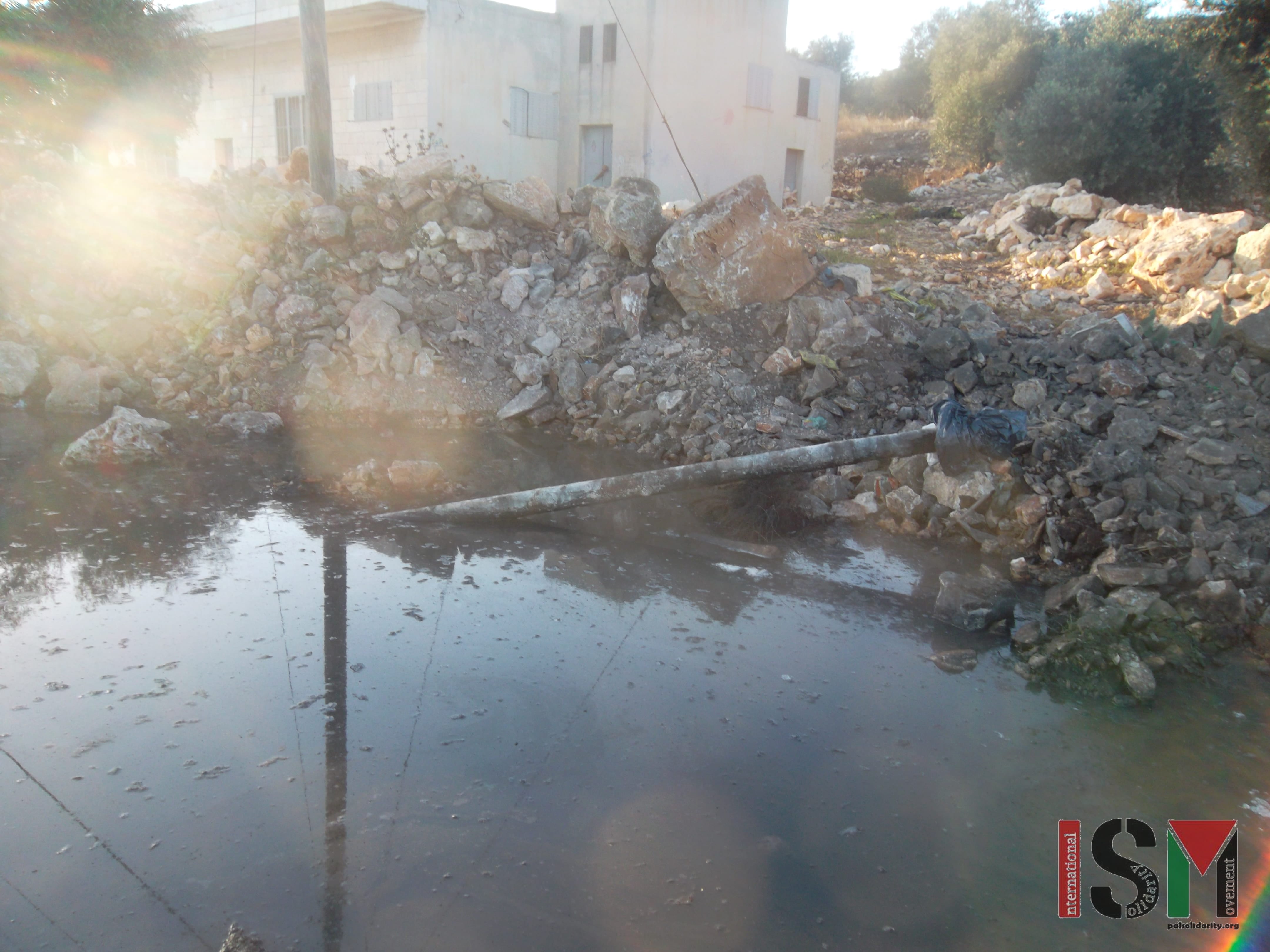
Murad Shtaiwi, one of the leaders of Kafr Qaddum Popular Committee, understands the damage to the water pipe as a way to collectively punish the village for its ongoing resistance. The costs of a new pipe have to be paid for by the municipality. As Murad explains, damaging the water pipe is a deliberate attempt by the Israeli army to suppress the support among the villagers to continue to protests and thus block future demonstrations.
Israeli settlers torch Bedouin tent near Ramallah

(MaanImages/Zakariyya al-Sidda)
Ma’an – August 13, 2015
RAMALLAH – Israeli settlers torched a Bedouin tent in the area of Ein Samiya near Kafr Malik village in northern Ramallah Thursday morning, local sources told Ma’an.
A group of Israeli settlers raided the village of Ein Samiya and threw flammable material on a Bedouin tent before the residents noticed and attacked the settlers, forcing them to flee the area.
An Israeli army spokesperson confirmed the attack but could give no further details.
The fire caused substantial damages to the tent but locals were able to put the fire out without any injuries, locals said.
Israeli settlers also sprayed “price tag” near the scene and signed slogans calling for the killing of Palestinians and expelling them out of their lands.
Graffiti sprayed in red paint also read “administrative revenge” alongside a crudely drawn Star of David.

The graffiti seemed to refer to the internment without charge — known as administrative detention — of three alleged Jewish extremists in the wake of a July 31 arson attack in the West Bank village of Duma that killed 18-month-old Palestinian Ali Saad Dawabsha and his father Saad.
Locals said Israeli forces and police arrived to the area, investigated the incident, and dusted for fingerprints at the scene.
On Wednesday, Israeli forces had closed the Ein Samiya area road and prevented Palestinians from using it.
Recent weeks have seen a rise in Israeli settler attacks against Palestinians in the West Bank.
An 18-month-old Palestinian, Ali Dawabsha, was burned alive when alleged Israeli extremists firebombed their home at the end of last month in the village of Duma near Nablus.
The toddler’s father, Saad Dawabsha, succumbed to his wounds a week later, after suffering third degree burns on 80 percent of his body.
On Saturday morning, Israeli settlers attacked a Palestinian home with firebombs and rocks in an area east of Tayba in the Ramallah district. The bombs landed outside of the house, causing no damage, locals told Ma’an.
Israeli settlers have carried out at least 120 attacks on Palestinians in occupied East Jerusalem and the West Bank since the start of this year, according to the UN Office for the Coordination of Humanitarian Affairs.
Zionist Entity Releases Suspects in Arson Attack
Al-Manar | August 10, 2015
 Israeli occupation authorities released all suspects detained as part of a probe into the firebombing of a Palestinian home that burned to death an 18-month-old child and his father.
“All those arrested yesterday for interrogation have been released,” a spokeswoman for the Shin Bet security agency told AFP, without providing further details.
They did not provide the number of those detained in the raids early Sunday in wildcat Jewish settlement outposts in the West Bank near the Palestinian village of Duma, where the brutal firebombing occurred.
Wildcat outposts in the Israeli-occupied West Bank are notorious for housing Zionist settlers, referred to as hilltop youth.
The Palestinian family’s small brick and cement home in Duma was gutted by fire early on July 31, and a Jewish Star of David spray-painted on a wall along with the words “revenge” and “long live the Messiah”.
The arson attack on the family’s home in the occupied West Bank that killed 18-month-old Ali Dawabsha and his father, Saad sparked an international outcry over the ongoing Israeli crimes against Palestinians.
Mother Riham and four-year-old son Ahmed were also in an Israeli hospital, where a spokeswoman described their condition last week as life-threatening.
Source: AFP
As Palestinians Die, NY Times Shields Israel
By Barbara Erickson | TimesWarp | August 9, 2015
One week has passed since a Palestinian toddler died in an arson fire, one day since the boy’s father also perished from burns, and The New York Times has provided us with some half dozen stories on the tragedy. Only one of these was deemed fit to make the front page, however, and this fact is instructive: The favored story was not the original crime or the deaths of two villagers but a report on Israeli angst.
This maneuver was just one more piece of evidence that the Times has tried to provide an Israeli spin to this story. The paper has also adopted the government line that the concern here is extremism, not official policies and actions, and it has failed to provide the full context of settler violence in occupied Palestine.
When the story broke, the Times placed the news that 18-month-old Ali Dawabsheh was burned to death on page 4 of the Aug. 1 of the print edition. The brief article about his father’s demise appears on page 9 today. Other stories—concerning protests, accusations and additional responses to the news—were also on inside pages.
It was only when Jerusalem bureau chief Jodi Rudoren filed an article on Israeli “soul searching” that the editors saw fit to give the story a prominent spot in its Friday edition.
The print article, “Two Killings Make Israelis Look Inward,” received a favored site on page 1 above the fold. This, the editors are saying, is the real news here—not the shocking death of a helpless child, the lingering and painful death of his father or even the legacy of settler attacks—but the feelings of ordinary Israelis.
The arson attack has received this much attention in the Times only because it was impossible to ignore: It made headlines worldwide and forced Israeli officials to condemn the act and vow to take action. But the Times stories have failed to report the full extent of violence against Palestinians and official complicity in these actions.
Readers of the newspaper are unlikely to know that Israeli settlers have often resorted to arson and that their actions have never, until now, caused much concern among government officials. B’Tselem, an Israeli rights group, reports that “in recent years Israeli civilians set fire to dozens of homes, mosques, businesses, agricultural land and vehicles in the West Bank. The vast majority of these cases were never solved, and in many of them the Israeli police did not even bother taking elementary investigative actions.”
B’Tselem also notes that West Bank Palestinians are tried in military courts, with minimal rights and protection, while settlers living in the same area appear in civilian courts. Most shocking of all: The conviction rate for Palestinians in military courts is 99.74 percent.
The Times has acknowledged the charges of unequal treatment in an Isabel Kershner story titled “Israeli Justice in West Bank Is Seen as Often Uneven,” but the headline leaves the impression that we are dealing with opinions here, not facts, and the story fails to provide the data that would reveal just how uneven the system is.
In fact, B’Tselem reports that over an 11-year period only 11 percent of settler violence cases resulted in an indictment, nearly a quarter of the cases were never investigated and in the few cases where settlers were tried and convicted, they usually received “extremely light sentences.” The numbers are even more glaring when we note that Palestinians, knowing the outcomes and facing obstacles, often fail to file complaints.
These percentages, however, are less scandalous than the statistics concerning security forces. The Israeli monitoring group Yesh Din reports that 94 percent of the investigations into complaints about Israeli soldiers suspected of violence against Palestinians and their property are closed without action.
Yet the Times, following the lead of the Israeli government, has focused on “extremists” as the problem, ignoring the officially sanctioned destruction wrought by the military: In defiance of international law, the army helps the state confiscate land and destroy property to make room for illegal Jewish settlements.
In recent weeks and months, the Israeli army has been responsible for widespread destruction of Palestinian property in the West Bank. Here are a few examples:
- On July 22 the army invaded the village of Beit Ula and destroyed a Roman-era water well and 450 olive trees.
- On July 2 the army uprooted an acre of agricultural land west of Hebron and issued demolition orders for a home and a water well.
- On June 15 the Israeli army uprooted dozens of olive tree saplings over five acres in Husan, a village west of Bethlehem.
- On May 4 the army evacuated the residents of Wadi al Maleh in the Jordan Valley for “training exercises” and set fire to grazing land using live ammunition. Residents were denied access to the land to put out the fires.
- During the month of June in the Jordan Valley the army forced hundreds of Palestinians from their homes for “military maneuvers” and used live ammunition that set fire to acres of grazing land.
- As of Aug. 3 the army was responsible for demolishing 302 Palestinian structures in 2015, displacing 304 people in the West Bank and East Jerusalem.
Times readers almost never read of these actions taken by the military with the official blessing of the government, and they rarely learn of most settler attacks. (Nor do they learn that settlers are allowed to carry weapons while Palestinians are denied even the most basic arms for defense.)
Now the Times, in the face of an international scandal, has done what it can to minimize the damage to Israel, muting the charges of unequal justice, placing Israeli “soul searching” on prominent display, joining the Israeli effort to blame extremists and ignoring the officially sanctioned crimes against Palestinians.
Israeli angst is fit to print in the Times, but Israeli crimes against Palestinians are something else again. If they are deemed worthy of notice, they may come to light in the back pages, under evasive headlines—all part of an effort to protect Israel at the expense of our right to be informed.
Nablus residents protest Israeli water supply cut-off

Ma’an – August 5, 2015
NABLUS – Dozens of Palestinian residents of the West Bank village of Kafr Qaddum staged a sit-in on Wednesday to protest the Israeli national water company cutting off its supply to the village, locals said.
Hamzeh Jumaa, the head of the village council, told Ma’an that the Israeli water company Mekorot cut off its supply on Sunday.
He said that the water supplies some 4,000 people living in Kafr Qaddum in Nablus, which he highlighted was an agricultural village.
He said that thousands of poultry birds had died due to a lack of water combined with extreme temperatures.
Jumaa said that they have not received any answer from Mekerot as to why the water was cut off or when it will be brought back.
The council head added that Mekerot provides water to all Palestinian villages and illegal Israeli settlements in the surrounding area.
Israelis, including settlers, have access to 300 liters of water per day, according to EWASH, while the West Bank average is around 70 liters, below the World Health Organization’s recommended minimum of 100 liters per day for basic sanitation, hygiene and drinking.
Kafr Qaddum has lost large swathes of its land to Israeli settlements, outposts and the separation wall, all illegal under international law.
According to the Applied Research Institute of Jerusalem, more than 10 percent of the village’s land has been confiscated for the establishment of the settlements alone — Kedumim, Kedumim Zefon, Jit, and Givat HaMerkaziz.
Residents of Kafr Qaddum stage regular protests, including a weekly Friday march, to protest land confiscations as well as the closure of the village’s southern road by Israeli forces.
The road, which has been closed 13 years, is the main route to the nearby city of Nablus, the nearest economic center.
Israeli forces regularly use violent means to suppress the protests.
Update on Photo of “Israeli Officer Being Shielded from Stone-throwing Settlers”

Popular Struggle Coordination Committee Facebook page
Video showing the actual story not apparent in the viral picture of RHR Field Coordinator Zakaria Sadah and Qusra Mayor… returning policewoman to prevent second officer from shooting Palestinians…
“The bottom line is that, while settlers are calling this an intentional publicity stunt, and some Palestinians are angry with Zakaria and the Qusara mayor for having helped an Israeli policewoman. (The residents of Qusara and the hundreds of additional Palestinians he has helped are not angry with him.)
The fact is that Zakaria may very well have saved Palestinian lives, as another police officer was preparing to shoot. Zakaria is a one person command center who is often the first person to get a call when something happens. He is hated by settlers in the area for having foiled many attempts to attack, threaten, invade and trespass.
On this particular day, he was with reporters in Douma (where he had also been the first to arrive early last Friday morning, and help evacuate the wounded) when he received the call to come quickly to Qusra, because Israelis had descended from the Eish Kodesh outpost and were trying to prevent Palestinians from developing land in Area B by shouting and standing in front of the equipment.
Although the army now acknowledges that this is Area B, where they have no authority to stop land development, when Zakaria arrived, the army seemed to be siding with the Israelis.
In another video posted on Ynet, you see a settler claiming that Palestinians had thrown stones at him. just before the portion of the video here, you see a police officer speaking with the Israelis. This officer, then, comes over and attempts to arrest Palestinians. Quickly he starts using a taser and, then, the Palestinains do start throwing stones.
The frightened policewoman froze, began to cry, and got caught in between the Palestinians, on one side, and security forces with Israeli citizens on the other. She wasn’t hurt, but rocks were falling near her from one side, and tear gas and stun grenades from the other.
Sensing that she was in danger, the police officer in a t-shirt, whom we see later extending his hand to take the policewoman, prepared to shoot at Palestinians.
You can hear Zakaria shouting “Don’t shoot! Don’t shoot!”
You then see Zakaria and the Qusara mayor escorting the policewoman and the other officer extending his hand to draw her to him.”
http://rhr.org.il/eng/2015/08/the-context-behind-the-photo/
Updated from:
08/04/15 (Press TV/Al Ray) In this picture, which was posted on social media websites last week, two Palestinians can be seen protecting a female Israeli police officer from a group of stone-throwing Israeli settlers.
Shaul Golan, an Israeli photographer, took the picture during clashes between settlers and Palestinian farmers in the illegal Israeli settlement of Esh Kodesh in the West Bank on Saturday.
When Israeli police forces arrived on the scene to break up the clashes, the settlers started throwing rocks at them too.
According to the UN Office for the Coordination of Humanitarian Affairs, settlers frequently attack local Palestinian villages and prevent farmers from reaching their lands.
The Israeli regime maintains a defiant stand on the issue of its illegal settlements on Palestinian land as it refuses to freeze settlement expansion. Tel Aviv has come under repeated and widespread international condemnation over the issue.
Israel opens pub on Islamic cemetery lands in Jerusalem
MEMO | August 3, 2015
Israeli authorities yesterday opened a new coffee shop and pub build on part of the land belonging to the historical Islamic cemetery of Ma’manillah in the old city of Jerusalem, Quds Press reported.
In a statement, Al-Aqsa Organisation for Waqf and Heritage said that an Israeli coffee network is running the new facility while the building is managed by the Israeli municipality in Jerusalem.
The group condemned the “violation” against the cemetery, noting that opening this pub and coffee shop came as part of a series of violations against this historic cemetery.
Only 20 of the 200 dunams of the original total area of the cemetery has not been destroyed, the organisation said. However, it reiterated that this area is desecrated on a daily basis.
Ma’manillah is a historic Muslim cemetery that contains the remains of figures from the early Islamic period. It includes several historic shrines and tombs. Muslims stopped using it in 1927 when the Supreme Muslim Council decided to preserve it as an historic site.
AL-KHALIL (HEBRON): Palestinian children targeted by the Israeli Military
CPTnet | July 31, 2015

“Recognizing that, in all countries in the world, there are children living in exceptionally difficult conditions, and that such children need special consideration…” – from the Preamble of the UN Convention on the Rights of the Child
In the past two weeks, CPT has witnessed a significant increase in the targeting of Palestinian children by Israeli occupying forces. From soldiers confiscating their bicycles to chasing them down in the street, the Israeli occupying forces are stripping children of their fundamental right to rest and leisure, to engage in play and recreational activities.
These are the stories that CPT has documented in Hebron’s Old City, but many more stories of boys and girls remain invisible.
Sunday 19 July – A six-year-old boy was swarmed by the heavily armed Israeli military, forced to empty his pockets, and aggressively interrogated.
Monday 20 July – Israeli soldiers detained and allegedly assaulted 14-year-old Anan, then took him to the police station. The Israeli military then continued to raid the streets of Hebron, detaining young people outside an Internet cafe at 9:30 pm.
Thursday 23 July – Israeli soldiers invaded a Palestinian house in the Old City of Hebron while chasing a Palestinian boy. The soldiers claimed that the boy ran away from them, which made him “suspicious”.
Friday 24 July – Four boys were playing in the street when six Israeli soldiers began charging towards them and yelling. The boys ran home, and the Israeli soldiers followed them into their house. After five minutes of questioning the boys, the soldiers left.
Saturday 25 July – Wasim, 10 years old, was riding his bike with his friends behind a patrol of soldiers. The soldiers told him to go ahead and pass them on his bike, but then blocked CPTers from following. Wasim told CPT that the soldiers slapped his face as they took him towards the gate. Palestinians in the community and CPTers advocated for the release of the boy, but the Israeli soldiers pushed back and took him. Another witness saw the soldiers kicking Wasim as they took him away. They released him ten minutes later.
Tuesday 28 July – Israeli Border Police stopped a Palestinian child who was trying to pass through the military turnstile near the Ibrahimi Mosque. The Border Police opened the gate for him, helped him move his bike, and then looked him in the eye and said, “I confiscated your bike, now leave.” The Border Police then told the child, “You know only walking is allowed here. Next time you will bring a car trying to pass.” After five minutes, another Border Police officer gave the child his bike back and asked him to leave.
The International Solidarity Movement (ISM) also reported that a teenage boy was stopped and detained by a group of Israeli soldiers near the Souq in Hebron’s Old City. The reason for his detention was that he had a small box of children’s “pop pop fireworks.” Soldiers detained the boy for thirty minutes and then released him.
Wednesday 30 July – Moath, 16-years-old, was picked off the streets in Hebron by Israeli soldiers who body searched him, zip-tied his hands behind his back, and blindfolded him. CPT asked about the nature of his detention, but received no reason. Soldiers took Moath into custody for identification and released after an hour. Watch the video here.
“States Parties recognize the right of the child to rest and leisure, to engage in play and recreational activities…. States Parties shall ensure that no child be subjected to torture or other cruel, inhuman or degrading treatment or punishment.” – from Articles 31 and 37 of the UN Convention on the Rights of the Child
It is not only the fact that the Israeli military oppresses children and violates their human rights that is the outrage, but that it does so with impunity. These incidents did not happen in a corner or a dark alleyway, but in public spaces. CPT is sometimes able to advocate for the rights of children, but despite the presence of human rights observers, there is still a lack of accountability for Israeli occupying forces. It is up to all of us to share these stories, and shift the prevailing narrative towards one of truth and justice.
Zionist settlers kill Palestinian toddler in arson attack
Ma’an – July 31, 2015
 NABLUS – Israeli settlers killed a Palestinian toddler and injured four others early Friday morning after setting their home ablaze near Nablus in the occupied West Bank in what the Israeli leadership called an act of terrorism.
Israeli settlers smashed the windows of two homes in the Palestinian village of Duma before throwing flammable liquids and Molotov cocktails inside, a local resident told Ma’an.
Ali Saad Dawabsha, one-and-a-half years old, was trapped in the house and died shortly after sustaining serious burns, said Ghassan Daghlas, a local official who monitors settlement activity in the northern West Bank.
His mother and father, Riham and Saad, and their son Ahmad, four, also sustained serious injuries and were evacuated by Israeli forces to hospital.
The mother was in critical condition with third-degree burns covering 90 percent of her body, an Israeli doctor told public radio, stressing that her life was threatened. The father had burns on 80 percent of his body.
The Israeli settlers from nearby settlements also attacked and partially burned the home belonging to Maamoon Rashid Dawabsha.
Local media reported that the graffiti said “revenge” and “long live the Messiah” and that the attackers threw firebombs inside the two homes, one of which was empty.
The homes were located near the main entrance to the village and the settlers were able to flee the scene quickly before residents identified them, Daghlas said.
Dozens of villagers from Duma rushed to help rescue the two families from their burning homes, witnesses said. The injured were later taken to Israeli hospitals for treatment via a military helicopter.
Musallem Dawabsha, 23, told Ma’an : “We saw four settlers running away keeping distance between each other. We tried to chase them but they fled to the nearby Maale Efrayim settlement.” … Full article
AL-KHALIL (HEBRON): Twenty years of CPT Palestine in photos
CPTnet | July 18, 2015
This summer marks the twentieth year of Christian Peacemaker Team’s presence in Palestine. While that does not seem to be a reason to celebrate, we do feel we should mark the occasion.
|
|
|


|


Israel to Build Jewish Settlements over Occupied Historic Muslim Cemetery
IMEMC News & Agencies | July 14, 2015
Q-Press media center for Jerusalem and al-Aqsa affairs today said that the planning and construction committee in occupied Jerusalem, last week, has approved the construction of a huge project on land of the Ma’man Allah historic Islamic cemetery, on which an Israeli school has already been built. The land will also be used for settlement housing, a hotel and a shopping center.
Haaretz newspaper said, according to the PNN, that Israeli occupation authorities pushed to execute the project on the land even though it is Islamic Waqf (property) that cannot be seized.
Israeli occupation is still going on with the project with complete knowledge that there are existing graves underneath the land.
The newspaper added that the Israeli plan includes building 192 settlement units, a hotel and a shopping center. The project was initiated by Eiden company, which follows the Israeli Jerusalem municipality.
To its part, Al-Aqsa foundation for Waqf and heritage said that the Israeli municipality in Jerusalem, through this project, was continuing to Judaize the Islamic cemetery, violating all the laws and conventions which ban desecrating sanctuaries under any occupation.
Israeli authorities have targeted the cemetery for years. They have established different projects including parks, hotels, schools and shopping centers on the land, violating even the rights of the dead.
Israeli committee approves expansion of Jerusalem settlement
Ma’an – July 8, 2015
 JERUSALEM – A researcher said Tuesday that an Israeli committee for zoning and planning has allocated private Palestinian land to expand the illegal French Hill settlement in East Jerusalem.
Ahmad Sub Laban, a settlement affairs researcher, told Ma’an that 25 dunams (6 acres) of land from Shufat and al-Issawiya has been allocated to the the settlement area to establish a commercial zone.
Palestinian residents of Shufat had been trying to obtain licenses to build on the land which was confiscated, but were denied permission by Israel’s Jerusalem municipality.
Palestinians in occupied East Jerusalem suffer from a chronic lack of services and severe unemployment as a result of Israeli municipal policies which allocate few resources to the community.
Over 75 percent of Palestinians, and 82 percent of children, live below the poverty line in East Jerusalem, according to the Association for Civil Rights in Israel.
Only 14 percent of East Jerusalem is zoned for Palestinian residential construction, ACRI says, while one-third of Palestinian land has been confiscated since 1967 to build illegal Jewish-only settlements.
Featured Video

“Historic Russia”: The Land Putin Will Not Give Back
or go to
Aletho News Archives – Video-Images
From the Archive
How Ukraine Tortured and Slaughtered Donbass
By Kit Klarenberg | Al Mayadeen | July 11, 2024
Almost immediately after the proxy war erupted, ISIS-tier footage of the torture and murder of Russians in Ukrainian custody emerged.
On July 6th, the New York Times published an astonishing investigation: In Ukraine, Killings of Surrendering Russians Divide an American-Led Unit. The article documents in grim detail how Chosen Company, an international volunteer battalion for Kiev, routinely executes Russian prisoners of war. It is the very first mainstream admission that this practice – a brazen breach of the Geneva Conventions, and a grave war crime – is widespread among Ukraine’s fighters, both foreign and homegrown. … continue
Blog Roll
 Aletho News
- BRITAIN’S WARNING: PREPARE FOR WAR
- “Historic Russia”: The Land Putin Will Not Give Back
- How the Cambridge Analytica scandal still haunts Mark Zuckerberg
- The Ongoing Cancellation Campaign Against a Dissenting Academic in Norway
- Yemen and ‘the Houthis’: Challenging Sami Hamdi’s Narrative
- No, Christians did not invent Zionism
- AIPAC-led lobbying network opens branches in Cypriot, Greek parliaments
- Araghchi blasts ‘parasitic’ alliance as US taxpayers pay for Israel’s war on Iran
- Easy fix for Europe’s chaos? Stop fueling war against Russia
- Putin’s key remarks on peace talks and Europe’s ‘schizophrenia’
- If Americans Knew
- An error has occurred; the feed is probably down. Try again later.
- No Tricks Zone
- Two New Studies Find Thwaites Glacier Melt Cannot Be Driven By Human Activity Or A Warming Ocean
- E-Cars Reduce CO2 Emissions By Only 41% Compared To Internal Combustion Engine Vehicles
- Predictions Made By Renowned Climate Professor Over Past Decades Have Been Proven To Be Poor
- New Study Suggests Large Regions Of The Pacific Ocean Have Been Cooling For The Last 80 Years
- Germany’s Green Energy Debacle: High Energy Costs Force Kahla Porzellan to Close After 182 Years!
- New Study: 50 Years Of The Most Aggressive ‘Net Zero’ Policies Can Only Affect The Global Climate By 0.03°C
- US September “Heat” Was No Record…Many Records Set Decades Ago
- Latest European Green Energy Debacle; Portugal’s Largest Flagship Solar Park Insolvent!
- Green Energy Debacle: German Expert Professor Fritz Vahrenholt Warns Of Severe Economic And Social Consequences
- Two More Paleo Reconstructions Affirm Meters-Higher Sea Levels Across Ireland, Brazil 7000-6000 Years Ago

