Prisoners’ day at weekly Bil’in demonstration
International Solidarity Movement | April 17, 2015
Bil’in, Occupied Palestine – Over 300 people attended the Prisoners’ Day demonstration in Bil’in. The Israeli army fired endless amounts of teargas and shot one person in the chest with a live ammunition.
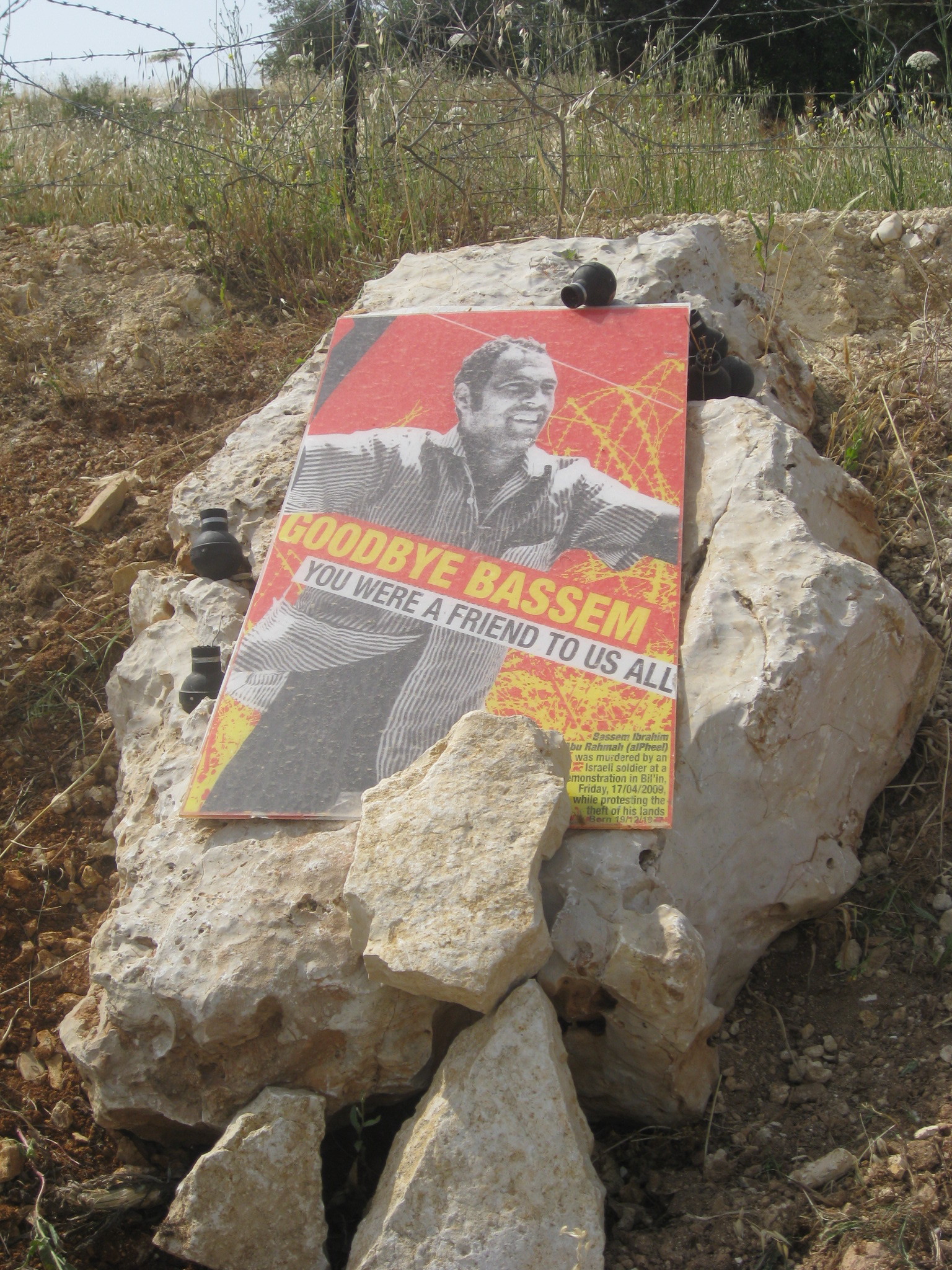
After the prayer, protesters marched towards the apartheid wall and the illegal settlement of Modi’in, situated just outside of Bil’in. A truck loaded with a sound system led the chanting crowd. Most were either waving Palestinian flags, holding up banners in support of the Palestinians imprisoned in Israeli prisons to mark Prisoners’ Day, or were holding posters of Bassem, a local who was killed six years ago by the Israeli army. As the march got closer to the wall, Israeli forces fired over 50 rounds of teargas canisters towards the protesters. The area was heavily clouded with this gas during most of the afternoon, which caused many to suffer from its inhalation. The shooting of this teargas also caused the dry grass between the olive trees to repeatedly catch fire.
During the protest, one person was shot with a rubber-coated steel bullet, while a 17 years old boy was shot in the chest with live ammunition. He was immediately taken to hospital by the ambulance. His condition is stable.
The 17th April is Prisoners’ Day in Palestine. Thousands of Palestinians are arrested arbitrarily on a daily basis by the Israeli forces, despite prohibition by international law. According to B’Tselem, “at the end of February 2015, 5,609 Palestinian security detainees and prisoners were held in Israeli prisons”. Since 1967, when Israel furthered its occupation to the West Bank, Gaza and East Jerusalem, an equivalent of approximately 20% of the total population in the Occupied Palestinian Territories (OPT), and 40% of all males have been detained (CEPR). While in prison, they are subject to wide-ranging violations of their rights and dignity. Such practices may include physical and psychological torture, deprivation of family visits, denial of access to lawyers and unlawful transfer out of the Occupied Palestinian Territories, among many other things. The Israeli occupying forces continue to violate the provisions of the Fourth Geneva Convention Relative to the Protection of Civilian Persons in Time of War, in particular against the Palestinian prisoners.
Today also marked the 6th anniversary of Bassem Abu Rameh’s death. Nicknamed Pheel, he was a much loved figure in the town of Bil’in. On the 17th April 2009, the Israeli army shot him with a teargas canister projectile which killed him shortly after. Aged 30, Pheel had been to all the non-violent protests, activities and creative actions against the apartheid wall in his town. Those who knew him remember him as a caring person who made everybody laugh and had the heart of a child, says Mohammad Khatib, a member of the Bil’in Popular Committee Against the Wall and Settlements.
According to the report by the United Nations Office for the Coordination of Humanitarian Affairs within the occupied Palestinian Territories, 442 people in the West Bank and 15 people in Gaza have been injured by the Israeli forces since the beginning of this year. On top of this, five people have been killed.
Home demolition in Jerusalem: “They want our land. We need help to protect it.”
International Solidarity Movement | April 1, 2015
Jerusalem, Occupied Palestine – Nureddin Amro and his brother Sharif Amro and their families were awakened at 5:30 am by over a hundred Israeli soldiers who came to demolish their home in the Wadi Al-Joz neighborhood of occupied East Jerusalem on Tuesday, March 31, 2015. Both men are blind. The brothers live with their ill 79-year-old mother, their spouses and children. Nureddin has three young children, Sharif has four; all are under 14. Israeli soldiers pointed their guns in through the windows of the house while the children were still asleep and cut the electricity and phone lines to the house.
“We were asleep. They banged on the doors and shouted. Soldiers completely surrounded the neighborhood. There were dogs and aircraft. It was frightening,” said Nureddin. “There was no advanced notice. No reason given. They announced that they came to demolish the house and they started doing it while we were still inside.”
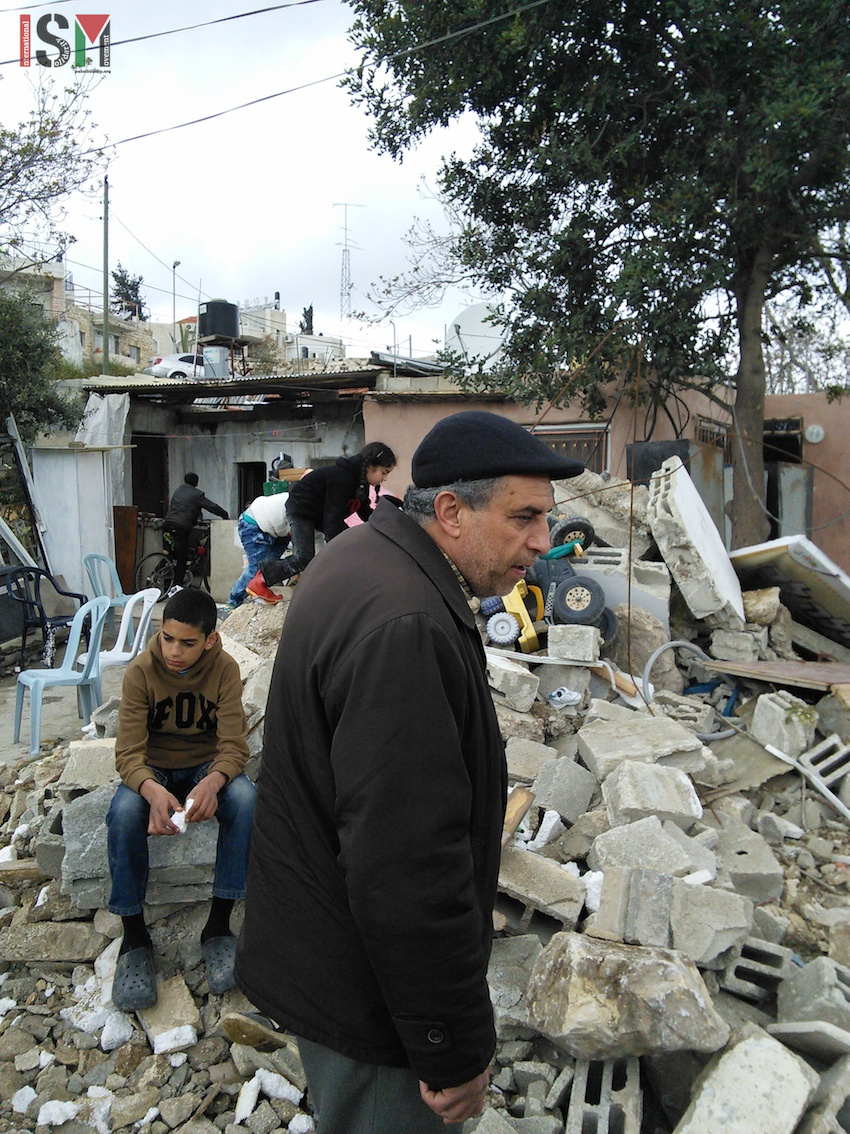
The Amro family stands in the rubble of their demolished home
Nureddin asked for time to go to court or the municipality for an explanation, but the soldiers refused. The soldiers assaulted the family, kicking Sharif and beating everyone, including the women and children. “They attacked us and locked us in one of the rooms. My son and brother were injured. They stayed for four hours and destroyed four rooms, the garden. They would not give us time to take anything from the rooms. All of our things, the children’s pets, their rabbits and chickens were killed under the rubble” Sharif was taken to the hospital after a soldier kicked the blind man hard in the ankle. Israeli forces refused to even let the family salvage their belongings before they tore it down.
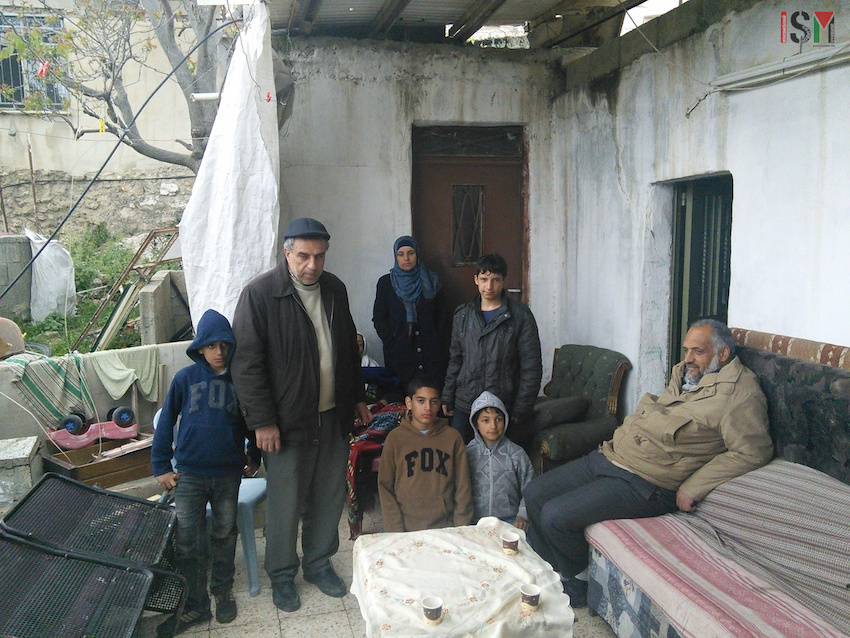
Members of the Amro family gathered beside the part of their home that is still standing
Nurredin is the founder and principal of the Siraj al-Quds School for visually impaired and sighted children in Jerusalem. He is a Synergos Institute Social Innovator and was recognized by the British Council for his leadership working for positive change and social development for people with special needs. According to Nureddin, there was no demolition order against the homes although there have been demolitions in the neighborhood before. They had received warnings a couple of months ago to clean up scrap wood, wires and materials that were around the house, and they did the cleaning as required.
While they were demolishing the rooms of the Amro family’s home Israeli forces destroyed a fence on the neighboring Totah family’s land, along with a shelter that housed a horse, chickens, and a dog. Soldiers also cut the family’s internet and broke the water line. The father of the Totah family was beaten, handcuffed, and arrested; he was later released.
As of this writing, the part of the house that remains standing where Nureddin and his brother are staying with their families; still has no electricity, water, sewage or telephone services. Soldiers returned to the family’s home again this morning, moving the rubble that was visible from the street and threatening that they would be back.
Israeli authorities have already annexed land across from the Wadi Al-Joz neighborhood, creating a national park which encompasses an illegal Israeli settlement. Local residents reported, speaking of the constant threat of settlement expansion under the Israeli occupation, that “they want to get rid of all the houses, all the neighborhood. They want to put their hands on this land from here to the Old City.”
The Roots of Netanyahu’s Electoral Victory: Colonial Expansion and Fascist Ideology
By James Petras :: 03.24.2015
“It is always a meritorious deed to get hold of a Palestinian’s possessions” – The code of Jewish Law revised and updated by Benjamin Netanyahu
Benjamin Netanyahu’s re-election makes him the longest serving prime minister in Israel’s history. His 20% margin of victory (30 Knesset seats to 24 for his nearest opponent) underlines the mass base of his consolidation of power.
Most critical commentators cite Netanyahu’s racist pronouncements; his rejection of any two state solution and his overt appeal for a mass Jewish voter turnout to counteract the ‘droves of Arab voters’ for his electoral victories.
There is no question that the majority of Israeli Jewish leaders and parties support Netanyahu’s racist pronouncements and ‘no-state’ solution and joined him in a coalition government. But the larger issue is the positive mass response to Netanyahu’s call to action. Nearly three quarters of the electorate turned out (73%) to elect him. Moreover, Netanyahu has been elected prime minister for four terms: between 1996-99 and more recently 2009-20.
What is more, the opposition has not differed from the Netanyahu coalition regime’s Judeo-centric policies and pronouncements. In other words, ‘racist’ ideology per se is not what drives the Israeli majority to repeatedly support Netanyahu.
Jewish-centered racism is an integral and accepted part of Israel’s political culture.
Social Colonialism and Netanyahu’s Popularity
There is a more fundamental, ongoing material basis which accounts for Netanyahu’s electoral victories and mass appeal: His regime’s aggressive, perpetual and escalating seizure and dispossession of Palestinians land and his massive financing of Israel’s Jewish colonial towns.
In other words, Netanyahu’s appeal is rooted in the large-scale, long-term housing which hundreds of thousands of low and middle income Israeli Jews have obtained via his brutal land-grabbing policy. The so-called ‘settlers’ are in part armed Israeli Jewish colonists who engage in open theft and defend Netanyahu, because they materially benefit from his policies… It is not only those who have already colonized Palestinian land grabbed after 1967 – over 650,000 Jews – who vote for Netanyahu, but there are the hundreds of thousands of others in Israel, priced out of the Israeli real estate bubble, who cannot afford comfortable housing and look to the West Bank and Jerusalem for a ‘Jewish solution’ at the expense of the Palestinian inhabitants.
Racism, the foul language directed at Palestinians, which pervades Israeli-Jewish culture (‘Arab scum’ is one of many such common expressions) found expression even among the songs celebrating Netanyahu’s latest electoral victory. Racism serves to justify the land grabbing. Can the settler mind even imagine that an ‘inferior people’ should complain about land grabs by the ‘chosen people’ ? Modern educated Jewish professionals wax indignant that shepherds and olive farmers should hold back the development of glitzy shopping malls, million dollar community centers (for Jews only, of course), hospitals, sports complexes and high tech industrial parks.
And if they – ‘the Arabs’ – object to their own displacement, all the better: Their resistance provides an excellent pretext for armed Jewish settler thugs to invade a village, drive out the inhabitant and call in Netanyahu’s bulldozers, as a prelude to establishing an ‘outpost’, first steps to a new Jews only colony!
The key to Netanyahu’s big vote is that he responds favorably and forcefully in favor of new colonies. The self-styled Israeli Defense (sic) Force (IDF) is dispatched to protect the local vandals and to shoot live ammo at any rock-throwing Palestinian adolescent defending the family patrimony.
Netanyahu acts and speaks for the rapacious Jewish colonial masses. The opposition criticized Netanyahu on the basis of his neglect of socio-economic issues in Israel, especially, the soaring prices of housing in the major cities. But they failed to attract many Jewish voters because Netanyahu offers a more attractive alternative solution – the seizure of more Palestinian land and the construction of Jewish homes, instead of fighting powerful Jewish real estate moguls, land speculators and corporate landlords inside Israel.
Extremism at the Service of Jewish Housing is No Vice
For the mass of Israeli Jews, looking for a cheap, easy and government-financed road to comfortable middle class housing, seizing and occupying Palestinian property is a very attractive and viable ‘solution’.
Netanyahu’s ‘final solution’ for the Palestinians – no state – is a guarantee that land, which is seized and housing which is built, will remain under Jewish jurisdiction. The ‘final solution’ for Palestinians is the housing solution for the Jewish masses.
Under Netanyahu, from 2013 to 2015, two-thirds of new housing construction (for Jews only) has taken place on stolen Palestinian lands. His regime spends $252 million dollars a year on Jews-only colonies (‘settlements’). The Netanyahu regime spends $950 for each Jewish colonist in the West Bank, double what is invested for each Jewish Israeli resident in Tel Aviv. For the most aggressive Jewish colonists, those who destroy the productive olive groves, torch Palestinian homes and who establish ‘settler outposts’, Netanyahu spends $1,483 a year . . . with promises of roads, electricity, schools, swimming pools and air conditioning to come!
Owning the Holy City Secures the Unsavory Vote
Netanyahu’s big vote in Jerusalem can be accounted for by the fact that over 300,000 Jews have been the beneficiaries of land grabs and sparkling high-rise condos in what had been centuries-old Palestinian neighborhoods.
Netanyahu assures the Jerusalem Jews that ‘their city’ is and always will be the capital of Israel, an undivided Jewish city.
Sticking his finger in the eyes of the EU and US officials, who claim otherwise, energizes and emboldens the Jewish voters
Netanyahu’s ethnic cleansing is unrelenting: That is why he is re-elected over and over again. Israeli colonial settlements grew by over 5% each year from 2009 – 2015. There is no backtracking with Bibi Netanyahu: at this rate of ‘erasure’ all of historical Palestine will be Judified by 2050 at the latest!
Netanyahu claims that Israeli Jews must have their ‘lebensraum’ . . .
Israel and other colonial powers, like England in the 19th century and Germany in the 20th century, ‘solve’ their domestic social problems and social unrest by exporting populations across borders. The attractiveness of this solution is that it preserves the power and privileges of the domestic economic elite and provides an ‘escape valve’ for the local disaffected masses.
Emigration to settler colonies requires violent dispossession of the local inhabitants. If stiff resistance emerges – the imperial powers resort to genocide; extermination of native peoples by the English, Slavic peoples by the Germans, Palestinian Arabs and other non-Jews by the Israeli Jews.
Long past is the notion that Israeli Jews would solve their social -economic problems via a collectivist economy and popular struggle against Jewish plutocrats.
Today Jewish-Israeli millionaires flourish alongside orthodox, secular, Sephardic, Ashkenazi, Sabra and Russian emigrant colonists. The former exploits labor and markets, while the latter dispossesses Palestinians. Netanyahu has discovered a formula for uniting quarrelsome Jewish parties, leaders and voters and for winning elections.
Moreover, Netanyahu has secured the financial and political backing of numerous overseas Jewish-Zionist billionaires. He has secured the unconditional support of tens of thousands of middle class Israel-First activists, academics and professionals who operate AIPAC and dozens of similar propaganda mills in Washington and Christian Zionists throughout the US. Netanyahu’s overseas backers ensure that the US government may grumble and criticize, but will never disrupt Netanyahu’s ‘plan’ of an ethnically pure ‘Greater Israel’ with Jerusalem as its ‘eternal’ capital. Obama may whine and talk to the press about ‘reconsidering US-Israeli relations’ but he has assured Israel and Netanyahu that military and economic ties will remain intact.
Conclusion
Netanyahu has succeeded in setting a colonial agenda for all Israeli-Jewish parties (bar one).
He has established the fact that competitive elections and opposition political parties are compatible and even facilitate violent colonial expansion.
He has established the fact that Israel and its people embrace a racist ideology and receive the endorsement of most Western leaders, and mass media and the unconditional support of its overseas fifth column.
Israel’s project for Palestine, the creation of a single Jewish state, is far more than the demented vision of one man. It has been taken to heart by the great mass of the Israeli-Jewish people and their overseas supporters. The victory of Netanyahu and his supporters marks a historic victory for all those regimes and people across the world who believe and fight for an imperial dominated world.
Resistance to the destruction of olive trees in Wadi Qana
International Solidarity Movement | March 22, 2015
Tuesday, 17th March 2015, four farmers in the Salfit valley of Wadi Qana were issued with notices that they had 48 hours to remove their olives trees or they would be removed at their own cost. Failure to execute the orders are punishable by imprisonment, or fines up to the maximum penalty of the law.
Supporters, many from the nearby village of Deir Istiya, as well as locals and internationals, turned out in anticipation of soldier presence or settler provocation, but no conflict took place.

A crowd of approximately 250 supporters gathering in the valley were met by a festive atmosphere. Representatives from various organisations in conjunction with the Deir Istiya Municipality converged to remove waste from the spring and its surroundings.
In 2008 and 2011 farmers of Wadi Qana were issued with similar notices. These removal orders were not carried out. In 2012 trees were removed without notice. Approximately 3,000 trees have been destroyed in Wadi Qana by settler attacks and by order of Israeli authorities.
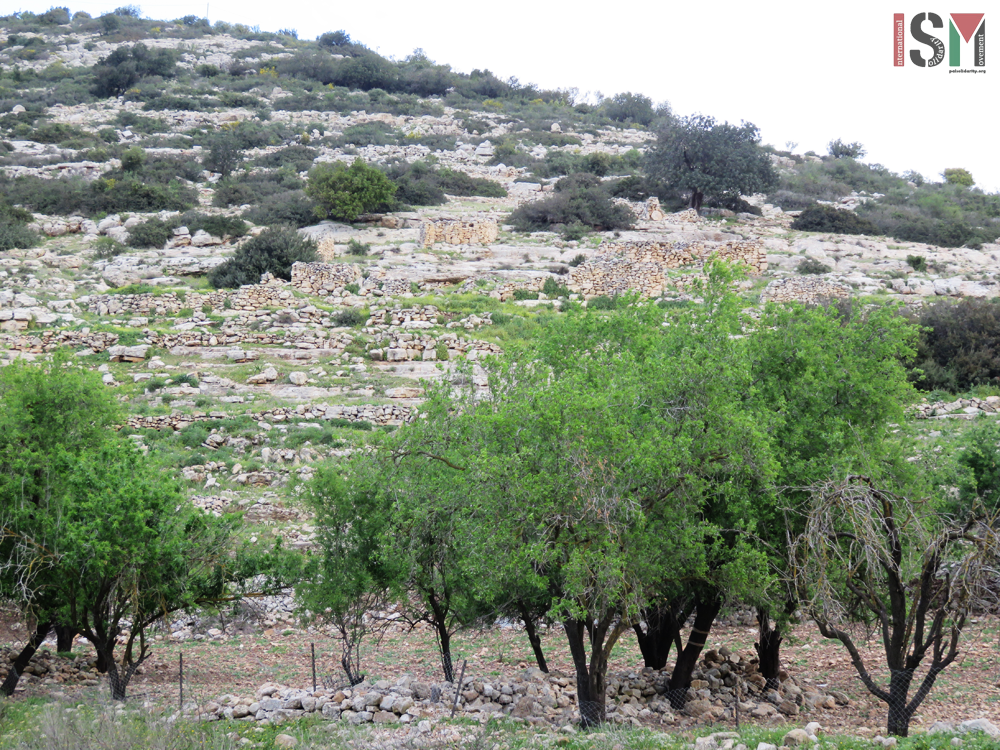
The Deir Istiya region has a population of approximately 12,000 people, 4,000 of whom live in town. The illegal settlements of the area, of which seven surround Wadi Qana, house approximately 15,000 settlers. Wadi Qana itself sits within the 31,000 hectares around Deir Istiya which has been zoned as Area C, leaving only the 1,527 hectares of the township in Palestinian controlled Area A. Under the Oslo Accords, Israeli law forbids Palestinians to build structures or plant trees in Area C, while conversely, entitling illegal Israeli settlements to develop and expand. (Al Jazeera has a good explanation of the different areas here.)
Speaking of the situation in Area C, a frustrated resident of Deir Istiya exclaimed, “They have the right to cut the old olive trees but we have no right to grow a new one. See the discriminations?”
Wadi Qana is a strategic area in the region, containing several significant natural springs. These springs and the crops which they irrigate have been under serious threat since 1994 when settlements began running sewage into the valley. While this practice was limited in 2005, many ocurrences have been identified, with four settlements’ waste currently believed to be pumping into the valley below.
While only two of the seventeen natural springs remain unpolluted, water from the underground aquifers is dropping due to the increasing demands of the ongoing settlement expansion. This has caused many farmers to move away from orange and vegetable crops to the more arid-adapted olive trees. The livelihoods of farmers of Wadi Qana are increasingly under threat because of the occupation and its apartheid laws.
Israeli forces level land east of Jerusalem
Ma’an – 10/03/2015
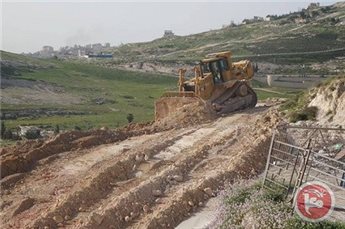 JERUSALEM – Israeli forces leveled vast areas of land in the East Jerusalem town of al-Issawiya on Tuesday morning, a local committee member told Ma’an.
According to Muhammad Abu al-Hummus, member of a local follow-up committee, large numbers of Israeli troops and municipality inspectors escorted bulldozers and excavators into the southeastern outskirts of the town, where they demolished stone walls and steel structures used by local farmers as store houses and livestock barns.
Abu al-Hummus said the bulldozers “deliberately” ruined the dirt roads used by farmers to access their fields.
The land is located in an area Israeli authorities have earmarked for a national park, in a controversial plan known as “11092”, which aims to turn 700 dunums of land in the Palestinian towns of al-Issawiya and al-Tur into Israeli parkland.
A statement from the Palestinian Center for Human Rights in 2013 previously stated that “the plan is part of the Israeli government’s plans to create a Jewish demographic majority in the occupied city.”
In September 2014, an Israeli planning council suspended the plan until the needs of the Arab towns could be assessed. However, the council, which previously approved the annexation of the 700 dunums, said that approval of the plan could be justified and was not fundamentally illegal.
According to Abu al-Hummus, the local Israeli municipality has ignored the plan’s suspension.
“Israeli forces brush aside court decisions and decisions made by different committees when it comes to implementing settlement expansion plans,” he said.
The land leveled on Tuesday is owned by the Abu Asab, Ubeid, Dari, Abu al-Hummus and Ulayyan among others.
East Jerusalem was seized by Israel along with the West Bank in 1967 during the Six-Day War, and since then, the Israeli government has undertaken a policy of “Judaization” across the city, constructing Jewish settlements and demolishing Palestinian homes.
There are now believed to be more than 300,000 Jewish settlers in East Jerusalem.
The international community views East Jerusalem as part of the Palestinian territories and recognizes the annexation and settlement programs as illegal under international law.
(MaanImages/Muhammad Sayyad)
Four Palestinians and one female German demonstrator shot with live ammunition at “Open Shuhada Street” protest

Israeli military sniper aiming up the road towards the Open Shuhada Street demonstrators
International Solidarity Movement | February 28, 2015
Hebron, Occupied Palestine – On February 27 in occupied Al-Khalil (Hebron), Israeli forces fired live ammunition towards nonviolent protesters participating in the annual Open Shuhada Street demonstration, injuring five including four Palestinian activists, one of them 17 years old, and one German citizen. More were also injured by rubber-coated steel bullets and stun grenades as soldiers and Border Police blocked the roads leading towards Shuhada Street and attacked the protesters.
Close to a thousand Palestinians, accompanied by Israeli and international supporters, marched towards one of the closed entrances to Shuhada Street carrying flags and signs and chanting. They called for the opening of Shuhada Street, whose closure to Palestinians has become a symbol of Israel’s Apartheid system, and for an end to the occupation. The march was turned back by stun grenades, rubber coated steel bullets and live ammunition fired by the Israeli military. Around twenty demonstrators were injured in total; Hebron Hospital reported that at least six were admitted and two required surgery. One Palestinian activist, Hijazi Ebedo, 25, was arrested at the demonstration; all he had been doing was chanting and holding a sign.
Issa Amro, coordinator and co-founder of Youth Against Settlements (YAS) stated: “The protest, which was joined by groups from all over Palestine, marked the twenty-first anniversary of the Ibrahimi Mosque Massacre. Israeli occupying forces shot live ammunition towards peaceful protesters, which is against international law. The Israeli military should be held accountable in international court for their actions.”
“Julia was standing and filming next to me when suddenly she fell to the ground,” stated Leigh, a Canadian activist who was standing next to Julia when she was shot.
Julia, the injured 22-year-old German activist from Berlin, was evacuated to Hebron Hospital where she is being treated for a live gunshot wound which entered and exited her leg. “The brutality of Israeli forces is unbelievable, it seems like they don’t have a limit,” she stated. “In Palestine I have seen Israeli forces shooting tear gas, stun grenades, rubber and live ammunition at any kind of demonstration that is against the occupation. It doesn’t matter for them if it is peaceful or if there are kids attending. Yesterday I saw the army attack children who had been dancing in the street. Two people were shot with live ammunition in Bil’in. They shot me as I was standing and filming. It seems the soldiers just shoot at any one.”
The Open Shuhada Street demonstration marks the anniversary of the 1994 Ibrahimi Mosque massacre, when right wing extremist settler Baruch Goldstein murdered 29 Palestinians while they worshipped in the mosque. Following the massacre, Israeli forces shut down Palestinian businesses on Shuhada Street–once a commercial center–and began to implement the policies which would lead to what is now a total closure of the vast majority of the street to Palestinians. Twenty one years after the massacre, settlers from illegal Israeli settlements use the street freely while Palestinians are assaulted, shot and arrested when they attempt to reach it en masse during the Open Shuhada Street demonstration every year.
Greek Orthodox Church decries attacks by Jewish settlers
MEMO | February 26, 2015
The Patriarch of the Holy City of Jerusalem and all Palestine, Theophilos III, denounced on Thursday what he called “repeated” attacks on Christian and Muslim places of worship in the Palestinian territories by extremist Jewish settlers.
“The targeting of churches and mosques is caused by pervasive racism and hatred,” he said in a statement.
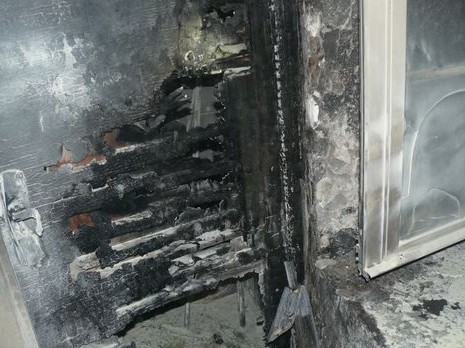
Earlier Thursday, Jewish Settlers set fire to part of a religious school affiliated with Jerusalem’s Greek Orthodox Church, Which they sprayed with anti-Christian graffiti. On Wednesday, settlers torched and sprayed graffiti on a West Bank mosque.
Theophilos III said Christians represented an “integral part” of the Holy Land, its history and its future, going on to assert that the Greek Orthodox Church was one of the world’s most important churches.
“Criminals will not intimidate this church or its flock,” he declared.
He called on government agencies to address repeated settler attacks on places of worship.
Earlier Thursday, The Palestinian Foreign Ministry called on both the Vatican and the international community to protect Islamic and Christian places of worship from what it described as “Jewish extremism.”
“We strongly condemn these acts,” the ministry said in a statement. “Yesterday a mosque near Bethlehem was torched and today a church in Jerusalem [was attacked].”
Extremist Jews, the ministry asserted, continued to attack Muslim and Christian places of worship while the Israeli government did nothing to stop them.
The ministry went on to blame the Israeli government for the trend, calling on the Vatican, the international community and the UN to help protect local religious sites.
On Wednesday, Jewish Settlers set fire to a mosque near the southern West Bank city of Bethlehem, Which Also they covered with anti-Arab and anti-Muslim graffiti.
Several instances of settler attacks on Muslim places of worship have been reported recently, both in the Israeli-occupied West Bank and in the self-proclaimed Jewish state itself.
Israeli settlement activities increased by 40% in 2014
MEMO | February 24, 2015
Israeli settlement construction in the occupied Palestinian territories increased by 40 per cent during 2014, Anadolu has reported. According to Israeli NGO Peace Now, which campaigns against illegal settlement construction, Israel started building 3,100 residential units in the Palestinian territories last year. It added that tenders for 4,485 additional residential units were published throughout 2014.
“On 30 January,” notes a Peace Now report, “tenders were issued for 450 more units in the occupied West Bank by the government of Israeli Prime Minister Benjamin Netanyahu.” Between 31 March 2009 and last month, the NGO pointed out, the two governments led by Netanyahu promoted at least 106 construction plans for 13,077 different residential units in 57 settlements.
International law considers the West Bank and East Jerusalem as occupied territories captured by Israel in 1967. All construction of Jewish settlements on the land is illegal. Palestinian negotiators have insisted that the establishment and building of Israeli settlements has to end before the stalled peace talks with Israel can resume.
Thousands of Palestinian homes on Israeli demolition ‘shortlist’

MEMO | February 14, 2015
More than 20,000 Palestinian homes in Jerusalem have been shortlisted to be demolished by the Israeli occupation authorities, Jerusalem Centre for Social and Economic Rights (JCSER) has revealed.
The centre’s head, Ziad Hamouri, said that the reason these homes have been shortlisted for demolition is that they were built without building licences issued by the Israeli municipality in the occupied city. Applications for such licences from Palestinians are rarely approved.
According to Hamouri, the Israelis use the licence issue as a pretext to get rid of the centuries-old Palestinian existence in Jerusalem. Few Palestinians can afford a building licence even if an application is approved. “The Israeli demands for a construction licence are punitive financially and procedurally,” said Hamouri. “Every licence takes from five to eight years to be issued and they cost from $30,000 t0 $50,000 each.”
Such measures do not apply to Jews living in the city, who even find apartments ready-made for them to move into and are exempt from frequent and very high taxes.
The Palestinian Authority has called for the international community to stop Israel taking ever more Palestinian land by stealth.
International Solidarity Movement honors Kayla Mueller
International Solidarity Movement | February 9, 2015
 Occupied Palestine – Kayla Mueller volunteered with the International Solidarity Movement from August to September of 2010.
On 4 August 2013 Kayla, 26, originally from Prescott, Arizona, was working with Syrian refugees when she was kidnapped after leaving a Spanish Doctors Without Borders hospital in Aleppo. Since that time she has been held in captivity by Da’esh (ISIS). This information was not previously released publicly out of concerns for her safety. On February 6th, Da’esh announced that she had been killed by Jordanian airstrikes in Raqqa, northern Syria. The validity of their announcement has not been confirmed.
Our hearts are with Kayla, her family, friends, and all those who have lost liberty, lives and loved ones in the global struggle for freedom and human rights.
With the ISM, Kayla worked with Palestinians nonviolently resisting the confiscation and demolitions of their homes and lands. In the Sheikh Jarrah neighborhood of Occupied East Jerusalem, she stayed with the Al Kurd family to try and prevent the takeover of their home by Israeli settlers.
Kayla accompanied Palestinian children to school in the neighborhood of Tel Ruimeda in Al-Khalil (Hebron) where the children face frequent attacks by the Israeli settlers and military. She stayed with villagers in Izbat Al Tabib in a protest tent to try to prevent the demolition of homes in the village. She joined weekly Friday protests in Palestinian villages against the confiscation of their lands due to Israel’s illegal annexation wall and settlements.
Kayla published writing online about her work in Palestine with the International Solidarity Movement in August and September 2010. “How can I ignore the blessing of freedom of speech when I know that people I deeply care for can be shot dead for it?” she wrote.
Below are excerpts from two of Kayla’s posts.
October 29, 2010:
“I could tell a few stories about running desperately from what you pray are rubber-coated steel bullets launched from the gun tip of a reckless and frightened 18-year old.”
“I could tell a few stories about sleeping in front of half demolished buildings waiting for the one night when the bulldozers come to finish them off; fearing sleep because you don’t know what could wake you. . . . I could tell a few stories about walking children home from school because settlers next door are keen to throw stones, threaten and curse at them. Seeing the honest fear in young boys eyes when heavily armed settlers arise from the outpost; pure fear, frozen from further steps, lip trembling.”
“The smell and taste of tear gas has lodged itself in the pores of my throat and the skin around my nose, mouth and eyes. It still burns when I close them. It still hangs in the air like invisible fire burning the oxygen I breathe. When I cry tears for this land, my eyes still sting. This land that is beautiful as the poetry of the mystics. This land with the people who’s hearts are more expansive than any wall that any man could ever build. Yes, the wall will fall. The nature of impermanence is our greatest ally and soon the rules will change, the tide will turn and just as the moon waxes and wanes over this land so too the cycles of life here will continue. One day the cycle will once again return to freedom.”
“Oppression greets us from all angles. Oppression wails from the soldiers radio and floats through tear gas clouds in the air. Oppression explodes with every sound bomb and sinks deeper into the heart of the mother who has lost her son. But resistance is nestled in the cracks in the wall, resistance flows from the minaret 5 times a day and resistance sits quietly in jail knowing its time will come again. Resistance lives in the grieving mother’s wails and resistance lives in the anger at the lies broadcasted across the globe. Though it is sometimes hard to see and even harder sometimes to harbor, resistance lives. Do not be fooled, resistance lives.”
On New Year’s Day of 2011, Kayla received news that Jawaher Abu Rahma, from the village of Bil’in where Kayla had demonstrated in solidarity with her and her family, had been killed by tear gas asphyxiation. On the first of January 2011, Kayla wrote:
“I felt compelled to blog on this today. The first day of 2011, the actual day that she died, just a few hours ago in a village called, Bil’in.”
“Every Friday in Bil’in villagers and international/Israel activists march to the barbed wire fence where an enormous and expanding illegal settlement is visible to protest the theft of their land and their livelihoods. The Palestinians are armed with rocks, the other activists with cameras and collectively they are armed with their bones. Each Friday the demonstration is met with violence; rubber-coated steel bullets, tear gas and sounds bombs are the usual choice of artillery. Lives are taken as a result of the violence and Jawaher Abu Rahmah’s life was taken today.
I have been to this village,
I demonstrated in this village,
I demonstrated arm in arm with her brothers,
and I knew her.”
……………
“My first demonstration in Palestine was in Bil’in and that is when I met Ashraf, Jawaher’s brother. Despite his broken English he always made a point to make sure we were ok when we were at the demonstration in his village, to help us cough up the tear gas and walk off the anxiety. He showed us his village and we played with the kids. Ashraf would bring us water or tea and help us find rides out of the village back to the cities. In the summer of 2008, Ashraf was participating in the demonstration and was detained by the Israeli Defense Forces (IDF). After he was blind-folded and his hands bound, an IDF soldier shot him in the foot from a distance of about 2 meters shattering his toes and leaving him in trauma as one could imagine.”
(As with all of these video clips, the content may be too graphic for some, please use discretion).
“Just the next year in 2009 Ashraf’s brother, Bassem Abu Rahma, was participating in the demonstration and was attempting to communicate with the IDF soldiers telling them to stop shooting the steel-coated rubber bullets as an Israeli activist had been shot in the leg and needed medical attention. Not soon after an Israeli soldier illegally used a tear gas canister as a bullet hitting Bassem in the chest, stopping his heart and killing him instantly.”
And now just today, the daughter of the Rahmah family, Jawaher, has been asphyxiated from tear gas inhalation. Jawaher was not even participating in the weekly demonstration but was in her home approximately 500 meters away from where the tear gas canisters were being fired (by wind the tear gas reaches the village and even the nearby illegal settlement often). There is currently little information as to how she suffocated but the doctor that attended her said a mixture of the tear gas from the IDF soldiers and phosphorus poisoned her lungs causing asphyxiation, the stopping of the heart and death this afternoon after fighting for her life last night in the hospital. The following is a clip from today showing hundreds of Palestinians, Israelis and international activist carrying her body to her families home where they said their final goodbyes.
“This family has a tragic story, but it is the story of life in Palestine.”
“Thank you for reading. Ask me questions and ask yourself questions but most importantly, question the answers.
Forever in solidarity,
Kayla”
Demonstrators face military violence for protesting Israeli President Rivlin’s visit
International Solidarity Movement | February 5, 2015
Hebron, Occupied Palestine – On Monday, February 2nd, Palestinian demonstrators faced military violence at the hands of Israeli forces in occupied Al-Khalil (Hebron). Protesters gathered in Bab Al-Zawiye, on the H1 (Palestinian administered) side of Shuhada checkpoint, to denounce Israeli president Reuven Rivlin’s visit to the illegal Israeli settlement of Beit Hadassah. Israeli sodliers and border police fired rounds of tear gas and numerous stun grenades, injuring at least two protesters.
The demonstration was organised by local Palestinian organisation Youth Against Settlements against the visit of the Israeli president to the settlement, which is illegal under international law and serves as a frequent source of oppression and violence against local Palestinians. Palestinians claimed their own rights, trampled by the military occupation, in the face of the visit’s attempt to legitimate the settler colonisation. Some signs called for opening the once vibrant and now closed Shuhada street, some for an end to the illegal settlements, some for President Rivlin to be brought before the International Criminal Court.
Around fifty Palestinians began the demonstration outside of Shuhada Checkpoint, holding signs and banners and hanging Palestinian flags on the fence. Israeli forces stopped them from passing through the checkpoint, preventing them from protesting on Shuhada street, near where the president was due to speak. As protesters continued to demonstrate, holding signs, waving flags and chanting for an end to occupation, a group of Israeli soldiers and border police exited the checkpoint and pushed protesters further back. Soldiers also occupied the roofs overlooking Bab Al-Zawiye “I just heard a soldier on a roof say ‘okay, enough’ and five minutes later they started throwing stun grenades and tear gas,” stated an ISM activist. “It was extremely sudden, and very scary.”
Israeli forces targetted Palestinian activists and organizers, hitting many in the legs with stun grenades and tear gas grenades. One man was hit directly with a stun grenade, which detonated right by his leg. “He screamed and fell down, rolling on the ground” one ISM activist recalled. Another man was also hit in the head with a stun grenade after the Israeli forces continued to use potentially lethal force against unarmed Palestinian protesters.
Demonstrators then attempted to continue the protest into the souq (Al-Khalil’s Old City market), but Israeli forces threatened them with stun grenades and prevented them from advancing. The protesters decided to go back after the army launched one stun grenade directly into the group of demonstrators. The protest eventually dispersed in Bab Al-Zawiye, after being targeted by a few more rounds of tear gas grenades.
Demolitions in Qusra
International Solidarity Movement | February 3, 2015
Qusra, Occupied Palestine – In the early morning of February 2nd, 2015, Israeli forces demolished a two-room structure, a water well, and damaged a stone wall in Qusra, Occupied West Bank. All of the destroyed property was on land belonging to brothers Anwar and Akram Tayseer.
Israeli forces, at approximately 5:00am, destroyed the property with bulldozers. When farmers went out into their fields at 5:00am, five Israeli military jeeps were still present at the site, loitering around the recently destroyed infrastructure. The occupying forces refused to speak with anyone. The water well and small concrete structure were built with money donated by the French Consulate, to facilitate agricultural development in the vulnerable region. Located in Area C, Qusra is subject to common attacks from nearby illegal Israeli settlements, mainly the Esh Kodesh outpost. Settlers living in the illegal outpost Esh Kodesh have been implicated in various ´price tag´ attacks throughout the West Bank (acts of violence against Palestinians by settlers). Settlers come after every time local Palestinians work their land, in day or night, sometimes armed with iron bars; families often wake up to destroyed trees, structures, or crops. Israeli soldiers are often present at these incidents, intervening only to protect settlers. An Israeli military watchtower was constructed on the hill overlooking the agricultural lands around ten months ago. In the past, village residents have received Israeli orders to stop building on their land, which they have always respected (despite their illegality). However, it is not uncommon, according to locals, for farmers to have their agricultural structures demolished shortly after receiving these orders, despite the lack of further development.
This is not the first time the Tayseer´s family land has been attacked by settlers. On one occasion two years ago, Akram Tayseer was taken by the settlers, and severely beaten. He sustained injuries which put him in the hospital for two months, in his head, face, and arm. He was unable to leave his home for one year. Since this incident, residents recount that they have not seen him smile, and perceive that he is broken inside. The family has documents indicating their ownership of the land and the property which once stood on it.
The cost of agricultural structure demolished is approximately 5000 NIS (~$1275USD). The water well served as a collection site, and an important reservoir to nourish the fields. Enclosing the plots of land, around 500 meters of a traditional Palestinian stone wall was dismantled. The fields are the main source of income for the family.
According to OCHA (United Nations Office for the Coordination of Humanitarian Affairs), 82 Palestinian homes and agricultural structures have been demolished by Israel since the beginning of 2015. Under the Fourth Geneva Convention, it is illegal for occupying powers to destroy property; Article 53 states: “Any destruction by the Occupying Power of real or personal property belonging individually or collectively to private persons…is prohibited.” Since 1967, Israel has demolished over 27,000 Palestinian structures in the Occupied West Bank.
Featured Video

“Historic Russia”: The Land Putin Will Not Give Back
or go to
Aletho News Archives – Video-Images
From the Archive
How Ukraine Tortured and Slaughtered Donbass
By Kit Klarenberg | Al Mayadeen | July 11, 2024
Almost immediately after the proxy war erupted, ISIS-tier footage of the torture and murder of Russians in Ukrainian custody emerged.
On July 6th, the New York Times published an astonishing investigation: In Ukraine, Killings of Surrendering Russians Divide an American-Led Unit. The article documents in grim detail how Chosen Company, an international volunteer battalion for Kiev, routinely executes Russian prisoners of war. It is the very first mainstream admission that this practice – a brazen breach of the Geneva Conventions, and a grave war crime – is widespread among Ukraine’s fighters, both foreign and homegrown. … continue
Blog Roll
 Aletho News
- US taxpayer money laundered back through Ukraine – Musk
- Before COVID, an NIH lab chief proposed making a SARS-like bat virus more infectious
- Gates, Bourla on Trial in Netherlands Accused of ‘Great Reset’ Scheme at Vaccine Injury Hearing
- BRITAIN’S WARNING: PREPARE FOR WAR
- “Historic Russia”: The Land Putin Will Not Give Back
- How the Cambridge Analytica scandal still haunts Mark Zuckerberg
- The Ongoing Cancellation Campaign Against a Dissenting Academic in Norway
- Yemen and ‘the Houthis’: Challenging Sami Hamdi’s Narrative
- No, Christians did not invent Zionism
- AIPAC-led lobbying network opens branches in Cypriot, Greek parliaments
- If Americans Knew
- Damning report shows the media must confront its failures on Gaza
- BBC senior broadcaster speaks out on Gaza coverage
- Netanyahu vows vast West Bank invasion in response to 20-minute skirmish that left 2 Israeli soldiers and 2 Palestinian fighters dead
- Tied up and tortured: Israel using US-made electroshock weapons on Palestinian detainees
- The outsourced risk: how newsrooms rely on Gaza’s freelancers without protecting them
- Gaza bakeries forced to shut as Israel blocks flour shipments
- Gaza’s breast cancer patients face a deadly wait for treatment amid Israel’s genocide
- DAILY UPDATE: Latest essential news on Palestine, Israel, & region
- The Israel Lobby’s Changing Fortunes
- AIPAC has become such a political liability that it’s shifting to a more “nimble” approach to buying politicians
- No Tricks Zone
- Two New Studies Find Thwaites Glacier Melt Cannot Be Driven By Human Activity Or A Warming Ocean
- E-Cars Reduce CO2 Emissions By Only 41% Compared To Internal Combustion Engine Vehicles
- Predictions Made By Renowned Climate Professor Over Past Decades Have Been Proven To Be Poor
- New Study Suggests Large Regions Of The Pacific Ocean Have Been Cooling For The Last 80 Years
- Germany’s Green Energy Debacle: High Energy Costs Force Kahla Porzellan to Close After 182 Years!
- New Study: 50 Years Of The Most Aggressive ‘Net Zero’ Policies Can Only Affect The Global Climate By 0.03°C
- US September “Heat” Was No Record…Many Records Set Decades Ago
- Latest European Green Energy Debacle; Portugal’s Largest Flagship Solar Park Insolvent!
- Green Energy Debacle: German Expert Professor Fritz Vahrenholt Warns Of Severe Economic And Social Consequences
- Two More Paleo Reconstructions Affirm Meters-Higher Sea Levels Across Ireland, Brazil 7000-6000 Years Ago

