Synagogue killings on the site of an Israeli massacre of Palestinians
On the Contrary | November 21, 2014
The moral lesson of the “Nazi Holocaust” is supposed to be that humanity must not forget what happened. Yet many of the beneficiaries of “Holocaust” sympathy and reparations have worked to make certain that the world does not remember the mass murder of Arabs by Israelis. The 2100 Palestinians killed by the Israelis last summer are now all but forgotten in the US media; and the cruel irony of having this week’s synagogue attack in west Jerusalem occur on the site of the village of Deir Yassin, where the massacre of Palestinians by Israeli terrorists occurred, and where the village once stood, is completely lost on the oblivious US media. For this writer, as a student of the religion of Orthodox Judaism, the media’s indifference would appear to be the result of having drank too often at the trough of Talmudic mentality, in which the lives of Judaic persons are more valued and highly prized than those of their enemies and victims. Prof. McGowan elaborates in a note to Mr. Avnery:
In the wake of the recent events in the synagogue at Har Nof, Uri Avnery has written an article which you can read here. Like all his work, Avnery’s article is informative, original and beautifully written. But it has a glaring omission.
11/21/14
Dear Uri:
I know that you realize that the Har Nof neighborhood in West Jerusalem, where four rabbis and a police officer were recently murdered, is built on the lands of Deir Yassin, the Arab village which no longer exists, that was the site of the 1948 massacre, which according to Menachem Begin, was pivotal to the founding of the Jewish state. This was an early massacre in the Nakba (“catastrophe” i.e. the Israeli conquest of Palestine); there were many more to follow, but it struck fear among Palestinians, causing many to flee, also giving the Jews an angle for campaigns of terror, which they visited on other Palestinian villages, basically “Get out or we’ll do to you what we did in Deir Yassin.”
It is interesting to ask why the media, which has been all over this synagogue massacre, mentions nothing about what happened on this site on April 9, 1948?Why does Wikipedia fail to even cite Deir Yassin in its history of Har Nof?
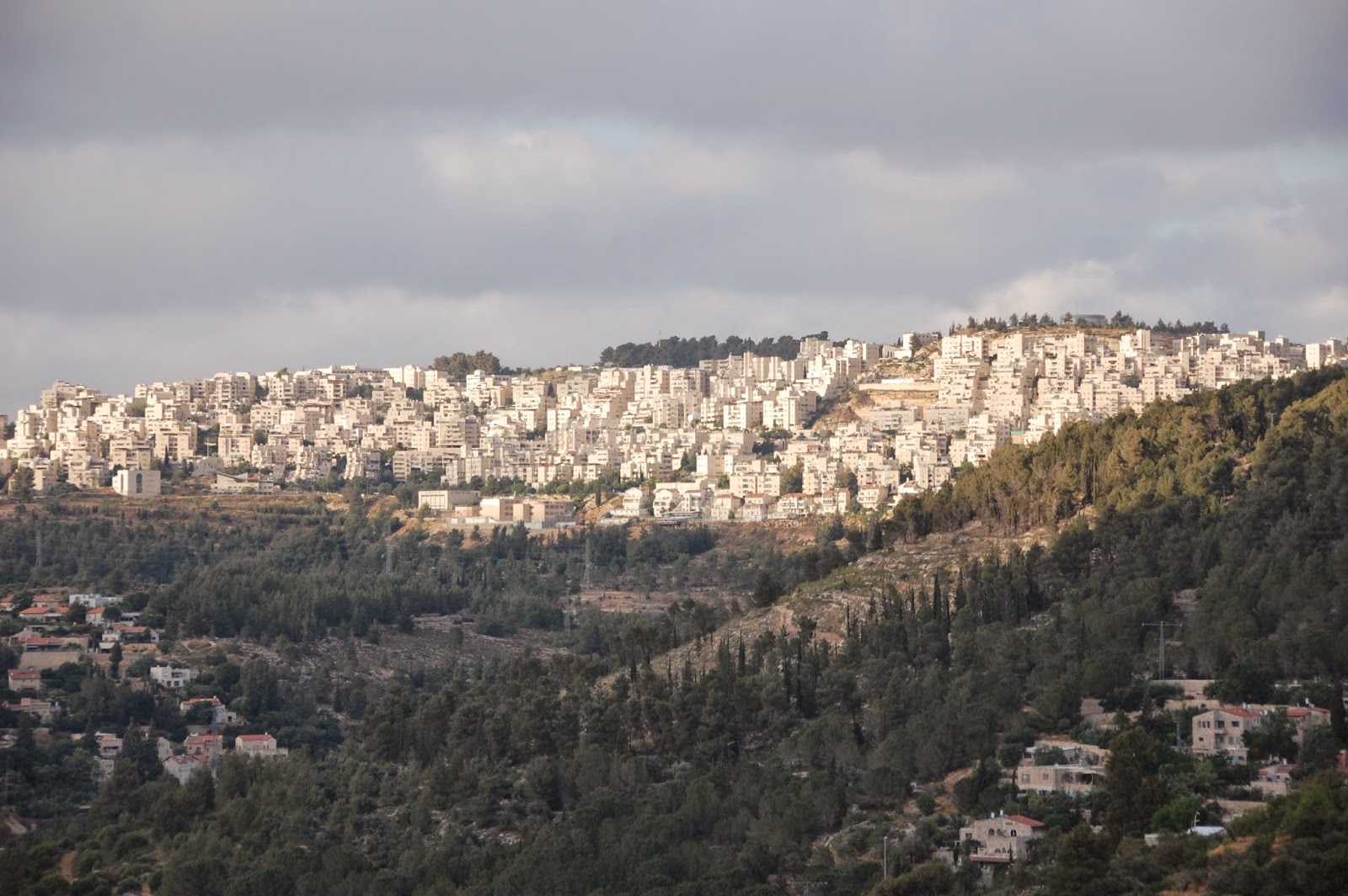
The picture (above) of Har Nof is taken from Yad Vashem, the most prestigous Holocaust memorial. The water tower at the top right is next to the main buildings of Deir Yassin, which today serves as a mental hospital, mostly for those suffering with too much religion, an affliction also known as “The Jerusalem Syndrome.”
At Yad Vashem all visitors, and especially American politicians, are repeatedly told to “Never forget.” At Deir Yassin the message is “Never mind.”
There is not even a signpost among the old Arab buildings to indicate that it was once a prosperous Arab village of about 750 people.
In building the Har Nof settlement much of the Deir Yassin cemetery was destroyed. The rest is now littered with trash and condoms. Har Nof children have been seen digging up Arab graves. (Imagine the outcry had they been desecrating Jewish graves.) Apartment buildings of Har Nof are built on the old quarry where villagers were executed and their bodies dumped and burned on April 10, 1948.
The ironies are breathtaking. But some of us still remember.
Daniel McGowan
Professor Emeritus, Hobart and William Smith Colleges
Three shot with live ammunition during Nabi Saleh protest
International Solidarity Movement | November 22, 2014
Nabi Saleh, Occupied Palestine – Israeli forces shot and injured three Palestinians participating in a weekly Friday demonstration in the village of Nabi Saleh. Soldiers fired .22 caliber bullets, a form of live ammunition which has maimed and killed many Palestinians, even as Israel continues to claim it as a “less lethal” way of assaulting demonstrators.
Yesterday at noon between forty and fifty Palestinians, Israelis, international activists and journalists marched down from the center of Nabi Saleh towards a water spring stolen by a nearby illegal settlement. The Israeli forces awaited them down the road with two military jeeps and a police jeep. Some youths threw stones towards the military vehicles. Soldiers and police fired tear gas canisters and rubber-coated steel bullets at demonstrators as the group walked down the road.
 After a brief period of calm, a police jeep equipped with a tear gas dispenser drove up and down the road, firing tear gas at protesters. A few suffered from excessive tear gas inhalation, including a boy under the age of ten.
In addition to continuing to fire rubber coated steel bullets and tear gas, soldiers also began to shoot .22 live ammunition. Two seventeen-year-old boys were shot while throwing stones, one in the thigh and one in both the hand and foot. One Israeli soldier fired at a child under the age of twelve as the boy was running away up the hill beside the road.
Nariman Tamimi, a thirty-eight-year-old woman from the village, was shot in the thigh at close range with a .22 bullet. Israeli soldiers shot her in front of her children and family, driving away and leaving her in the road. She was taken away for medical treatment, where she underwent surgery, and currently remains in hospital.
Israeli soldiers protect Jewish settlers attacking Palestinian village
Yesh Din | November 20, 2014
Israeli occupation forces did nothing to stop Jewish settlers from attacking Palestinian villagers, according to videos released by the Yesh Din rights group, showing soldiers pointing guns at Palestinians while Israelis are throwing stones from behind the soldiers.
The soldiers appear to be protecting the masked and armed Jewish settlers from Yitzhar during their attack on Palestinians in the village of Urif in the West Bank on Tuesday.
“IDF soldiers have the obligation, based on international law and High Court of Justice rulings, to protect Palestinian residents from violence, and IDF soldiers have the authority to detain suspects, including Israeli suspects, until the police arrive,” Yesh Din said in a statement.
“The disturbing video footage demands vigorous investigation and the immediate prosecution of the soldiers involved. An examination must also be carried out of whether the soldiers’ commanders bear liability for the conduct of their subordinates,” attorney Emily Schaeffer Omer-Man, legal advisor to Yesh Din’s said.
Palestinians repair thoroughfare in nonviolent action
CPTnet | November 15, 2014
 SOUTH HEBRON HILLS — On Saturday, 15 November 2014 the South Hebron Hills Popular Committee (a nonviolent Palestinian organisation resisting occupation in the South Hebron Hills region), coordinated an action to develop the road that connects the city of Yatta to At-Tuwani and surrounding villages located in the area Israel has designated Firing Zone 918. Under the watchful eyes of the Israeli military and police, the action was attended by members of the South Hebron Hills Popular Committee, residents of At-Tuwani, Israeli peace activists from Ta’ayush, and internationals from Christian Peacemaker Teams (CPT), International Solidarity Movement (ISM) and EAPPI.
The unpaved road that runs between villages and the town of Yatta is the access route that Palestinians travel for employment, education, water, healthcare, and other necessities of life. Surrounded by the tarmacked roads developed by the Israeli state for the settlers living illegally in the area, the rubble and holes in the Palestinian roads illustrate the stark inequalities of power that characterise the Israeli occupation, and the specific context of the South Hebron Hills and Firing Zone 918.
Because Israel bans Palestinian construction with tractors and other machines in the area without rarely-given Israeli permits, busy hands set about with buckets and hoes attempting to remove rubble and stones and fill in the many potholes on the road.
A member of the South Hebron Hills Popular committee from At-Tuwani explained, “This road serves all the people from Yatta and around… This is a very bad road – the school bus can’t [travel on it] and when people need to bring something by tractor, it is very difficult. This road is also not good if you need to use an ambulance to take people to the hospital. Ten years ago it was an asphalt road, but at the start of the Al Aqsa intifada (in 2002), Israel demolished the road.”
He also said, “we need to build a channel for rain water… Last year with the snow, all this is closed with water…You need a machine to fix this road but the DCO asks us for a permit, but will not give one to us to use a machine to work here… Now every week we try to fix it with small things, with our hands, before the rain comes.”
The racial politics of occupation are clear in his statement that “if a Palestinian comes alone to work here, the army and the police would arrest him quickly and stop him working, but it helps having international people and cameras to film everything.”
Despite the slow progress made with hands, buckets and hoes, six Israeli police and military jeeps arrived. They told the Palestinians they could not carry the work out without a permit, and a soldier declared such work a supposed ‘health and safety’ hazard, an ironic statement given the ‘health and safety’ hazards of the current state of the road, not to mention the myriad physical and psychological effects of occupation.
Legal issues surrounding the firing zone and the South Hebron Hills are complex, with numerous bureaucratic intricacies through which it is nigh impossible for Palestinians to gain a permit for construction. Members of the South Hebron Hills Popular Committee asserted the unlikelihood of gaining such a permit demanded by the military, and managed to converse with soldiers until the action ended at the time initially planned by the committee.
Jewish settlers storm Al-Aqsa compound in Jerusalem
MEMO | November 16, 2014
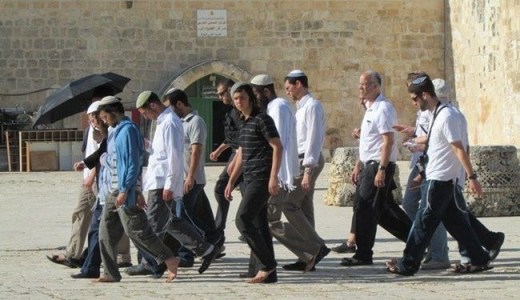
Scores of Jewish settlers on Sunday stormed the Al-Aqsa Mosque complex in occupied East Jerusalem, a Palestinian official said.
“As many as 59 settlers stormed the holy compound through Al-Magharbeh Gate under the protection of Israeli police,” Sheikh Azzam al-Khatib, director-general of the Organization for Muslim Endowments and Al-Aqsa Affairs, told Anadolu Agency.
The settlers wandered through the compound’s courtyards, passing through the Qibali and Marawani mosques inside the holy complex before departing through Al-Silsileh Gate, he added.
Meanwhile, Israeli police allowed Palestinian men to enter the compound while denying women’s entry.
“We performed the noon prayers outside the gates of the compound after we were denied access by Israeli police,” one of the women who had been barred from entering the complex told Anadolu Agency.
“At least 70 women were barred from entering the complex since the early morning,” the woman, who asked to remain anonymous, told AA.
Tension has been running high in East Jerusalem since Israel closed the Al-Aqsa Mosque compound late last month following the shooting of an extremist rabbi in West Jerusalem.
The closure of Al-Aqsa, along with the killing of a young Palestinian man suspected of shooting the rabbi, has fueled angry protests by Palestinians in East Jerusalem .
Earlier this month, an Israeli police officer was killed when a Palestinian driver ran over a group of Israeli pedestrians in East Jerusalem. The Palestinian motorist was shot and killed on the spot by Israeli police in the immediate wake of the attack.
For Muslims, Al-Aqsa represents the world’s third holiest site. Jews, for their part, refer to the area as the “Temple Mount,” claiming it was the site of two Jewish temples in ancient times.
Israel occupied East Jerusalem during the 1967 Middle East War. It later annexed the holy city in 1980, claiming it as the capital of the self-proclaimed Jewish state – a move never recognized by the international community.
In September 2000, a visit to the site by controversial Israeli politician Ariel Sharon sparked what later became known as the “Second Intifada,” a popular uprising against the Israeli occupation in which thousands of Palestinians were killed.
Police investigation failure increases in ideological offenses against Palestinians despite new Nationalistic Crimes Unit
Everyone did as they saw fit
By Yossi Gurvitz | Yesh Din | November 12, 2014
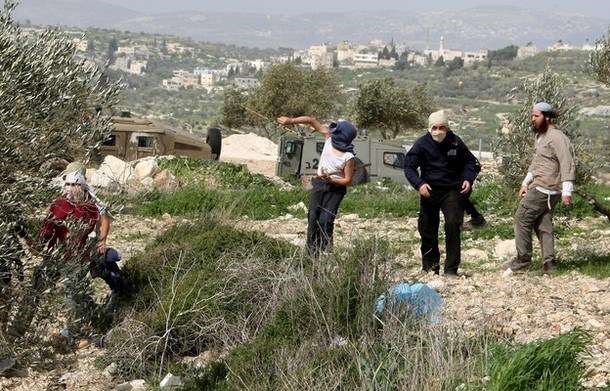
Imagine the following scenario: you’re in your courtyard, when a gang shows up, insulting you in what is supposed to be your safest place, beating you in the presence of your children, stealing or destroying your belongings. Picking yourself up, you know there’s no point in calling the police – because in the vast majority of cases, the police won’t catch the offenders. Oh, by the way – the criminals are from a different ethnic group.
Do you think you could live this way? Because this is how many Palestinians in the West Bank have to live. We have just published our annual data sheet on law enforcement – or rather the lack of law enforcement – in the West Bank.
If you are a Palestinian and you’ve been attacked or otherwise harmed by Israeli civilians in the West Bank, there is little to no chance the police will solve the case. Yesh Din has been monitoring the police investigation cases of complaints filed by Palestinians against Israeli civilians since 2005. The unambiguous data show that of 1,045 cases we are monitoring, the police concluded its investigation of 970 cases. 72 indictments were made (about 7.4% of the cases), and the police managed to lose 11 file cases. 884 cases were concluded due to police investigation failure.
593 cases were closed as “perpetrator unknown”, meaning the police failed to identify a suspect. 195 cases were concluded because of “lack of sufficient evidence”, i.e. the police managed to suggest a suspect but lacked the evidence to indict the suspect. 76 cases were closed on the grounds of “absence of criminal culpability” – that is, police claims that no crime was committed; we appealed 25 of these cases, since the investigation was unfinished or we believed there was enough evidence for an indictment. Finally, 12 cases were closed due to “lack of public interest”.
In two cases, the police concluded the perpetrator could not be indicted, probably due to age (minors); and one case was closed because it fell under the jurisdiction of another agency. The police’s general failure rate in 2005-2014 is 85.2%. Ironically, it was in the two years (2013-2014) in which the Nationalist Crime Department was active that the rate of police failure actually rose to 89.6%. The police tell us they invest many more assets and efforts in fighting nationalist-based crimes; so far, it fails to demonstrate results.
And why do I speak of “people breaking into your courtyard”? Because settlers enter private Palestinian property in the West Bank time and again. In our files from 2013-2014 we emphasized the setting of the crimes. It turns out that 28.3% of the recorded incidents took place within Palestinian villages and towns. Most of the incidents still take place in the countryside near the villages – territories which are to be dispossessed – but more than a quarter of the incidents are invasions of towns and villages, places where the settlers have no reason to visit, uninvited.
And the Israeli police, including the new and much ballyhooed Nationalist Crime Department, doesn’t know – or, perhaps, knows but is unwilling – how to deal with Israelis who commit nationalist crimes. This failure is anything but new: back in 1982 the Karp Report warned that Palestinian residents in the West Bank do not trust the Israeli justice system, and that in many cases they avoid complaining to the police since it is pointless. The Karp Report further found that law enforcement in the West Bank failed – and was the first government report to note this failure.
This is Israeli law and order. This is how it has been maintained for over 30 years: an order of rulers and ruled, with a thin legal coating of “laws of occupation” which allows us to say all is well, since it is temporary. For the past 47 years.
Map of locations of offenses against Palestinians in the West Bank
Israeli settlers torch mosque, copies of the Quran in West Bank
Al-Akhbar | November 12, 2014
A group of Israeli settlers broke in and torched a mosque in the Palestinian village of al-Mughayyir near Ramallah in the occupied West Bank early Wednesday, locals told Ma’an news agency, hours after settlers attempted to assault several Palestinian security officers in Nablus.
Witnesses, who went to the mosque at around 4:40 am to perform dawn prayer, said the settlers burnt 12 copies of the Quran, Islam’s holy book, and set the carpets of the first floor of the two-story building on fire.
Racist slogans were also spray painted on the walls of the mosque, witnesses added.
The same mosque has been targeted by Israeli settlers before, locals told Ma’an.
“Every time the mosque is torched, the (Israeli) occupation police conduct an investigation just for show, and never arrest a single settler,” one resident said.
The incident is the latest in a series of attacks carried out by the settlers against mosques in the occupied West Bank.
This year, in January and October, two mosques were set ablaze in the West Bank. Similarly, in 2012, settlers torched the entrance of a mosque near the city of Nablus.
The settlers also leave behind racist Hebrew script reading “price tag” or “Arabs out!” on the walls of the mosques.
On Tuesday, Israeli settlers smashed the windshields of more than 30 Palestinian vehicles and damaged other Palestinian properties during a rally on the main road south of Nablus in the northern West Bank.
Witnesses said that settlers also sprayed racist slogans, such as “No cars for Arabs” and “No terror attacks,” on a sidewalk.
Meanwhile, also on Tuesday, dozens of Israeli settlers from the Yitzhar settlement in southern Nablus attempted to assault several Palestinian security officers after they parked their car on the road at the entrance of the settlement.
Zakariya al-Sadda, a human rights activist with Rabbis for Human Rights, told Ma’an that Israeli settlers forced five officers from Palestinian security forces to stop while on their way to Ramallah to take part in a festival celebrating the anniversary of Yasser Arafat’s death.
The Palestinian Liaison Department intervened and solved the issue, Sadda said, adding that the Palestinian officers left the settlement’s entrance after dozens of settlers gathered and attempted to assault them.
Settler violence against Palestinians and their property is systematic and often abetted by Israeli authorities, who rarely intervene in the violent attacks or prosecute the perpetrators.
According to the UN Office for the Coordination of Humanitarian Affairs, there were at least 399 incidents of settler violence against Palestinians in the occupied West Bank in 2013.
Israeli authorities have also allowed Zionist settlers to take over homes in Palestinian neighborhoods both in annexed East Jerusalem and the West Bank, announced plans to build thousands of settlements strictly for Israeli settlers in East Jerusalem while ignoring Palestinian residents.
More than 500,000 Israeli settlers live in settlements across the West Bank and occupied East Jerusalem, in contravention of international law.
Israel occupied East Jerusalem and the West Bank during the 1967 Middle East War. It later annexed the holy city in 1980, claiming it as the capital of the self-proclaimed Zionist state – a move never recognized by the international community.
(Ma’an, Al-Akhbar)
Israel to confiscate 3,200 acres of Palestinian land near Jerusalem
Ma’an – 08/11/2014
JERUSALEM – Israeli authorities have delivered orders to the village of Beit Iksa north of Jerusalem ordering the confiscation of 12,852 dunums (3,176 acres) of Palestinian land, locals said on Saturday.
Locals told Ma’an that soldiers deployed at the military checkpoint at the entrance to the village delivered confiscation orders signed by the Israeli military commander in the West Bank Nitzan Alon that gave them until Dec. 31, 2017 to remain on their land.
Villagers said that soldiers informed them that an official from the Israeli military liaison would arrive on Monday to specify which lands would be confiscated, adding that the lands confiscated would be used for “military purposes.”
If carried out, the confiscation would dramatically reduce the land available to Beit Iksa’s 1,700 people, the majority of whom are refugees who fled to the area in 1967 after the existing population of the village was forced to flee by Israeli authorities.
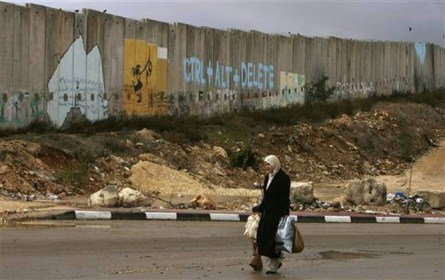
Although located immediately next to Jerusalem, the village’s lands have been progressively confiscated and the village is surrounded on all sides by the Israeli separation wall. Villagers can no longer travel to Jerusalem without permits, and Palestinians not resident in Beit Iksa cannot enter the single Israeli checkpoint that allows access to the village.
Ninety-three percent of the village is under full Israeli military control, and a majority of the total land of the village falls in areas outside of the separation wall, meaning they have been de facto confiscated, including about 1,500 dunums (371 acres) where Jewish-only settlements have been built.
The head of the Beit Iksa village council Saada al-Khatib told Ma’an that according to the order and the maps that soldiers had shown them Saturday, the lands that will be confiscated are between parcels 7 and 8 and include Haraeq al-Arab, Thahr Biddu, Numus, and Khatab areas around the village.
Al-Khatib added that the Israeli authorities claim that the confiscation order has been under way since 2012, and that the new order issued on Saturday only emphasizes the old order.
The order will prevent dozens of farmers from reaching their lands, he said, calling upon Palestinian ministries and national institutions to support the village of Beit Iksa and its neighbors.
He added that the order came after the Israeli municipality announced the approval of 244 housing units to be built in the Ramot settlement, which was previously built on lands confiscated from the settlement.
Al-Khatib warned that the land confiscation orders being issued to many villages include his own aim to carry out the “Judaization” of Beit Iksa after sealing the village shut and surrounding it with a checkpoint and the separation wall, turning it into an 2,500-dunum prison.
Israeli occupation authorities demolish two homes in East Jerusalem
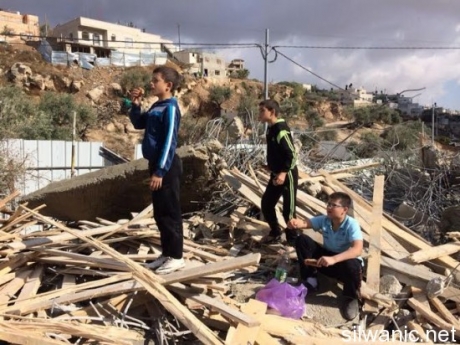
MEMO | November 4, 2014
Israel demolished two homes in Silwan, south of Al-Aqsa Mosque in East Jerusalem, today claiming they were constructed without a license, eye witnesses said.
Eye witnesses reported that “a large bulldozer belonging to the Israeli municipality arrived this morning at Wadi Yasoul in Silwan accompanied by Israeli police and army forces.”
They added: “The Israeli forces surrounded the home of the released prisoner Khalil Abu Rajab and demolished it before demolishing Assem Abu Subaih’s home.”
Witnesses noted that the “demolition occurred without prior warning. There are concerns that more demolitions will take place in the area.”
“Abu Subaih’s home consists of three rooms and he lived in it with his five family members. As for Abu Rajab’s home, it was made up of two apartments he lived in with seven family members and his mother,” sources reported.
These demolitions occurred after Israeli media outlets reported a few days ago that the Israeli Mayor of Jerusalem Nir Barkat approved a series of sanctions against Palestinians in the city, including demolishing unlicensed homes “in order to stop the phenomenon of throwing rocks”.
Various clashes between the Palestinian youth and Israeli forces have continued in a number of neighbourhoods in East Jerusalem since last July.
Palestinian, Israeli and international human rights organisations noted that while the municipality has been increasingly giving building permits to Israelis in East Jerusalem, it is restricting construction work done by Palestinians, which forces many to build without permits.
The Israeli Information Centre for Human Rights in the Occupied Territories (B’tselem) said: “While large-scale constructing and major investments are being carried out in Jewish neighbourhoods, the Israeli authorities are working on stifling all development and construction for Palestinian residents, which make up about a third of the city’s population.”
The Planning and Building Committee of the Israeli Ministry of Interior approved the construction of 500 settlement units in Ramat Shlomo settlement in Shuafat in northern Jerusalem yesterday which provoked Palestinian and international criticism.
Palestinian stone-throwers face up to 20 years in Israel prison
Al-Akhbar | November 3, 2014
Israeli cabinet on Sunday approved an amendment to the Israeli penal code to enable more severe punishment against Palestinians convicted of involvement in “stone-throwing” attacks against Israeli targets.
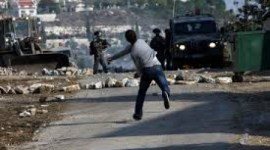 The new sections, which will be added to the Israeli penal code, would allow the imposition of a prison sentence up to 20 years for those convicted of throwing stones or other objects at Israeli vehicles.
“Israel is strongly acting against terrorists, against who throw stones, Molotov cocktails and fireworks,” Israeli Prime Minister Benjamin Netanyahu said at the weekly cabinet meeting.
Netanyahu went on to say that the new legislation aims to restore what he called “peace to all parts of Jerusalem.”
“We will dedicate massive force and an aggressive legislation to restore quiet and security to every part of our capital,” he added.
The new code would slap an imprisonment sentence of ten years against whoever throws stones or other objects at vehicles and 20 years for doing so with the view of exposing passengers to danger. Whoever throws rocks at police cars in order to obstruct the work of Israeli police will be jailed for up to five years.
Moreover, the law would also allow Israeli forces to imprison Palestinian minors under the pretext of allegedly endangering the lives of Israelis by throwing stones.
On Friday, Israeli Occupation Forces in occupied East Jerusalem attempted to detain two Palestinian children, a two-year-old and a nine-year old, on suspicion of throwing stones.
Last week, Israeli forces detained four Palestinian children, aged 13 to 16, for allegedly throwing stones at Israeli cars.
In 2013, a group of seven Israeli soldiers and an officer detained 5-year old Wadi’a Maswadeh after the boy allegedly threw a stone at a Zionist settler’s car at a checkpoint near Hebron.
According to a 2013 UN children’s fund’s report, over the past decade, Israeli forces have arrested, interrogated and prosecuted around 7,000 children between 12 and 17, mostly boys, noting the rate was equivalent to “an average of two children each day.”
A report by Defense for Children International (DCI) published in May 2014 said Israeli jails 20 percent of Palestinian children prisoners in solitary confinement. … Full article
SodaStream closes illegal settlement factory but remains actively complicit in the displacement of Palestinians
Palestinian Students’ Campaign for the Academic Boycott of Israel | October 30, 2014
Palestinian boycott, divestment and sanctions (BDS) activists today welcomed the news that SodaStream has announced it is to close its factory in the illegal Israeli settlement of Mishor Adumim following a high profile boycott campaign against the company.
“SodaStream’s announcement today shows that the boycott, divestment and sanctions (BDS) movement is increasingly capable of holding corporate criminals to account for their participation in Israeli apartheid and colonialism,” said Rafeef Ziadah, a spokesperson for the Palestinian Boycott, Divestment and Sanctions National Committee (BNC), the broad coalition of Palestinian civil society organisations that leads and supports the BDS movement.
“BDS campaign pressure has forced retailers across Europe and North America to drop SodaStream, and the company’s share price has tumbled in recent months as our movement has caused increasing reputational damage to the SodaStream brand,” she added.
The news of this major success against a company famed for its role in illegal Israeli settlements broke amidst intensifying demonstrations against Israel’s policies of colonisation in Jerusalem.
Grassroots boycott activism saw SodaStream dropped by major retailers across North America and Europe including Macy’s in the US and John Lewis in the UK.
SodaStream was forced to close its flagship store in Brighton in the UK as a result of regular pickets of the store.
Soros Fund Management, the family office of the billionaire investor George Soros, sold its stake in SodaStream following BDS pressure.
SodaStream’s share price fell dramatically in recent months as sales dried up, particularly in North America.
After reaching a high of $64 per share in October 2013, the stock fell to around $20 per share this month. SodaStream has estimated its third quarter revenue will be $125 million, down almost 14 percent from the same period last year.
But Ziadah warned that SodaStream will still remain actively complicit in the displacement of Palestinians and will remain a focus of boycott campaigning.
“Even if this announced closure goes ahead, SodaStream will remain implicated in the displacement of Palestinians. Its new Lehavim factory is close to Rahat, a planned township in the Naqab (Negev) desert, where Palestinian Bedouins are being forcefully transferred against their will. Sodastream, as a beneficiary of this plan, is complicit with this violation of human rights,” she said.
SodaStream’s participation in Israel’s forced displacement of Palestinians gained international notoriety when A-list celebrity Scarlett Johansson signed up to be a brand ambassador for the company. Following an international campaign urging Oxfam end its relationship with Johansson for endorsing SodaStream, the actor decided to quit Oxfam.
SodaStream has also come under fire for its treatment of Palestinian workers in its West Bank factory, as Ziadah explains:
“Any suggestion that SodaStream is employing Palestinians in an illegal Israeli settlement on stolen Palestinian land out of the kindness of its heart is ludicrous.”
“Palestinian workers are paid far less than their Israeli counterparts and SodaStream recently fired 60 Palestinians following a dispute over food for the breaking of the Ramadan fast. Workers have previously said they are treated ‘like slaves’”.
“Palestinians are forced to work inside settlements in sub-standard conditions because of Israel’s deliberate destruction of the Palestinian economy. There’s an urgent need for the creation of decent and dignified jobs within the Palestinian economy.”
SodaStream have said all workers will be offered jobs at its new plant, although Israel’s apartheid wall and severe restrictions on movement will make the commute to the new plant difficult for its Palestinian workers.
All of the main Palestinian trade unions have called for boycott and are members of the Palestinian BDS National Committee, the civil society coalition that leads the BDS movement and helped to initiate the campaign against SodaStream.
The BNC quotes included in this release can be found in the following coverage of this story:
New York Times : http://www.nytimes.com/2014/10/31/world/middleeast/sodastream-to-close-factory-in-west-bank.html?_r=0
International Business Times : http://www.ibtimes.co.uk/israel-bds-movement-scores-victory-sodastream-close-controversial-factory-west-bank-settlement-1472320
Israel closes al-Aqsa to all visitors after the shooting of a right-wing rabbi
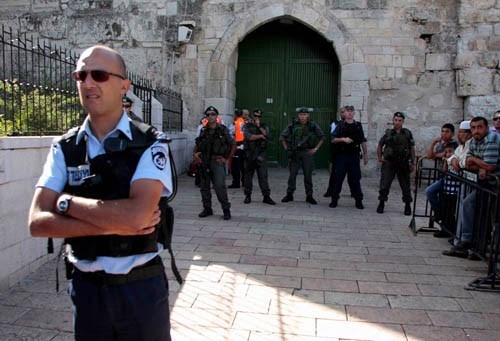
Al-Akhbar | October 30, 2014
Israeli Occupation Forces on Thursday closed the al-Aqsa Mosque compound to all visitors after an overnight shooting incident in which a man on a motorbike tried to gun down an Israeli hardliner.
“This dangerous Israeli escalation is a declaration of war on the Palestinian people and its sacred places and on the Arab and Islamic nation,” Palestinian President Mahmoud Abbas spokesman Nabil Abu Rudeina quoted him as saying on Thursday.
“We hold the Israeli government responsible for this dangerous escalation in Jerusalem that has reached its peak through the closure of the al-Aqsa mosque this morning,” he told AFP.
“The state of Palestine will take all legal measures to hold Israel accountable and to stop these ongoing attacks,” he added.
Earlier on Thursday, Israeli forces killed a Palestinian man suspected of the shooting attack on the Israeli hardliner, a spokesman said.
“The Palestinian, who was the main suspect in the Wednesday night attack, was eliminated at his home in Jerusalem’s Abu Tor neighborhood by special police forces,” police spokesman Micky Rosenfeld told AFP.
Abu Tor straddles the seam line between west Jerusalem and the occupied eastern sector, which was occupied by Israel during the 1967 Six Day War.
The suspect’s death took place just hours after a gunman on a motorcycle had opened fire at a right-wing Zionist Rabbi called Yehuda Glick at a rally in Jerusalem, leaving him critically wounded.
Glick was reportedly shot in his upper body at “close range” at an event outside the Menachem Begin Heritage Center in Jerusalem, where a number of Israeli members of Knesset and right-wing activists were in attendance, Israeli news site Ynet said.
Israeli Prime Minister Benjamin Netanyahu on Thursday ordered a “significant increase” in police deployments in Jerusalem following the shooting.
“I have ordered a significant increase in forces as well as in means (available to them) so we can both ensure security in Jerusalem and also maintain the status quo in the holy places,” he said in a statement released by his office.
The attack was reported after a conference focused on the reconstruction of a Jewish temple on top of the al-Aqsa mosque was concluded at the center, with top right-wing Zionist officials and activists in attendance.
The incident comes amid increasing tension in Jerusalem over an expected Knesset vote to potentially divide the al-Aqsa mosque compound — the third-holiest site in Islam — between Muslims and Jews, or else restrict Muslim worship at the site.
The Israeli army radio announced early October that the ministry of tourism was working on a plan to allow Jews to enter the al-Aqsa compound through the Cotton Merchants Gate, in addition to the Moroccan Gate which is already used as an entrance for non-Muslims.
Although mainstream Jewish leaders consider it forbidden for Jews to enter the area, right-wing nationalist activists have increasingly called for Jewish prayer to be allowed on the site.
Since Israel occupied East Jerusalem in 1967, an agreement with Jordan has maintained that Jewish prayer be allowed at the Western Wall plaza — built on the site of a Palestinian neighborhood of 800 that was destroyed immediately following the conquest — but not inside the al-Aqsa mosque compound itself.
Yehuda Glick is an American-born Israeli and the chairman of the Temple Mount Heritage Fund, a Zionist organization focused on “strengthening the relationship between Israel and the Temple Mount.”
Critics charge that the Fund actually leads Jewish tours to the site with the intention of leading Jewish prayer there — currently banned under Israeli agreements — and encouraging Jews to destroy the Al-Aqsa mosque and build a Jewish temple there.
He has been previously banned by Israeli authorities from entering the compound due to provocations while on the site.
For Muslims, al-Aqsa represents the world’s third holiest site.
Al-Aqsa restrictions, violations
Israel continues to restrict the entry of Palestinian worshipers into al-Aqsa for the fifth week in a row.
In an urgent message to the US administration on Sunday, Palestinian Authority President Mahmoud Abbas warned that Israel’s continued provocations at the mosque complex would lead to a “wide-reaching explosion.”
Israeli authorities have imposed restrictions on Palestinians seeking to enter the al-Aqsa Mosque compound, denying Muslim men under 40 access to the holy site while facilitating the entry of Zionist settlers of all ages.
In recent months, hundreds of extremist Zionist settlers – often accompanied by Israeli security forces – have repeatedly forced their way into East Jerusalem’s flashpoint al-Aqsa Mosque complex.
The frequent violations anger Palestinians who fear Zionist presence on the al-Aqsa is aimed at usurping the site.
Abbas said Saturday legal measures would be taken to prevent Zionist settlers from attacking Jerusalem’s flashpoint Al-Aqsa mosque compound.
“The Palestinian leadership will be taking the necessary legal measures, at the international level, regarding the aggression of settlers on the Al-Aqsa mosque,” Abbas said in a speech to the Revolutionary Council of his Fatah party.
“We will not allow settlers to attack the mosque,” he added, referring to the entire compound, which is the third holiest site in Islam.
A Palestinian official last week called for holding an emergency Arab and Islamic summit to discuss Israeli plans to divide the al-Aqsa Mosque compound between Palestinians and Israelis.
“Israel is racing against time to legitimize storming of the al-Aqsa Mosque compound by herds of extremist settlers,” Ahmed Qurei, a member of the Executive Committee of the Palestine Liberation Organization (PLO), said in a statement.
Earlier this month, UN chief Ban Ki-moon said he was “deeply concerned by repeated provocations at the holy sites in Jerusalem,” saying that such actions “only inflame tensions and must stop.”
Meanwhile, Lebanon’s Hezbollah resistance movement condemned the “Israeli aggressions within the al-Aqsa Mosque compound” and slammed “Arab silence” and “international complicity.”
The resistance group called on “directing all efforts to protect al-Aqsa and the Islamic and Christian holy sites.”
Israel occupied East Jerusalem during the 1967 Middle East War. It later annexed the holy city in 1980, claiming it as the capital of the self-proclaimed Zionist state – a move never recognized by the international community.
In September 2000, a visit to the site by controversial Israeli leader Ariel Sharon sparked what later became known as the “Second Intifada” – a popular uprising against the Israeli occupation in which thousands of Palestinians were killed.
(Ma’an, AFP, Al-Akhbar)
Featured Video

Stanislav Krapivnik: Russia-Iran Cooperation & Escalation in Ukraine
or go to
Aletho News Archives – Video-Images
Frlom the Archives
Are the Jews indigenous to Palestine?
By David Miller | Al Mayadeen | August 3, 2022
There is a rising tide of claims from apologists for the crimes of Zionism that they have been misunderstood. Palestinians might be indigenous to Palestine, but the Jews definitely are. What is called the ‘Israel-Palestine’ conflict, they say, is competition over the same small piece of land by two rival groups of indigenous people. But are the Jews indigenous to the Levant? And what are the consequences of the argument?
In fact, most of the power structure of the Zionist state is dominated by Ashkenazi Jews who have no ancestral link to Palestine. Overall despite very significant financial and infrastructural contributions from Western European countries (especially the US, UK and France, for example via the Rothschild family), Eastern European Ashkenazim have been at the centre of the Zionist power structure since the early years of the 20th Century. … continue
Blog Roll
 Aletho News
- UK readies deployment of Prince of Wales carrier amid war on Iran
- Iran warns of consequences after US strike on water plant
- US Bases in Middle East Fail to Secure Nations & Become Safety Risk – Expert
- Iranian Crisis Becomes Embarrassment for US Military That Can’t Protect Anyone – MidEast Analyst
- IAEA Never Had Reasons to Forgo Talks With Iran — Russian MFA Spox
- Iran pledges to ‘respect sovereignty of neighbors’, declares US-Israel assets ‘primary targets’
- USA and Israel: Who is the lord and who is the colony?
- Indian journalist reveals severe Israeli censorship after escape from occupied territories
- Majority of Israelis Back War with Iran as Anti-War Minority Faces Stigmatization
- Are the Jews indigenous to Palestine?
- If Americans Knew
- US, Israel ravage Iran and Lebanon; 4 killed in Gaza – Not a ceasefire Day 148
- US troops were told war on Iran was ‘all part of God’s divine plan’, watchdog alleges
- Trump wants to run the show in Iran, but doesn’t know what he’s doing – Not a ceasefire Day 147
- ‘Dirty Work’ :The truth about how Israel was founded
- Mass Expulsion in Lebanon as Israel Expands War: “We Don’t Know Where to Go”
- Lies, distortions, and propaganda: how the U.S. mainstream media coverage on Iran hides the truth
- Palestinians in Gaza fear famine returning as Israel cuts off food amid Iran war
- AIPAC, other pro-Israel groups enter midterms with $100 million to spend
- Iranian girls killed by ‘double-tap’ strikes on Minab school
- Bari Weiss Is Going Full ‘Propaganda-Palooza’ With the Iran War
- No Tricks Zone
- Televised! Leading German Political Candidate Tells Schoolchildren CO2 Makes Sun Hotter!
- New Study: A Century Warming Of 1.1°C Is ‘Commonplace’ And ‘Not Unusual’ During This Interglacial
- New Study: ‘Internal Noise’ And Volcanic Forcing Can Trigger 10-15°C Warming Within Decades
- Glaciers Worldwide Are Suddendly Surging, Experts Blame Warming!
- Surprising Discovery: Sahara Is Greening…Billions Of Trees Where Once Thought To Be Barren
- New Research Reaffirms Clouds, Aerosols, And Surface Solar Radiation Are ‘Driving The Climate System’
- Germany: Electric Car Catches Fire At Charging Station, Sets Off Local “Inferno”, Widespread Damage
- New Study: Canada’s New Brunswick Was 1°C Warmer Than Today During The Medieval Warm Period
- Coal Power Back In Trend As Globe Tries To Keep Pace With Growing Demand For Power
- New Study: A 4°C Warmer Beaufort Sea Had ‘No Sea Ice’ 11,700 – 8200 Years Ago
 Aletho News