Trump demands Arab states normalize with Israel in exchange for Iran ceasefire: Report
Press TV – May 25, 2026
US President Donald Trump has told several Arab and Muslim leaders that he expects them to establish formal relations with Israel in exchange for a ceasefire deal with Iran to end the war, according to American officials.
Axios, citing the officials, said that Trump made the demand during a phone conversation on Saturday with leaders from Saudi Arabia, the United Arab Emirates, Qatar, Pakistan, Turkey, Egypt, Jordan, and Bahrain.
According to the same sources, all eight leaders expressed support for the potential agreement with Tehran during the call.
“We are with you on this deal,” one official was quoted as telling Trump, according to the report.
Another official familiar with the conversation said the US president indicated that he would next speak with Israeli Prime Minister Benjamin Netanyahu and hoped to bring him into a joint call with the same group of Arab and Muslim leaders in the future.
Trump also pushed those countries that have not yet joined the so-called Abraham Accords – a series of 2020 US-brokered normalization deals with Israel signed under the Trump administration – to do so and establish formal ties with the Tel Aviv regime, the officials added.
Saudi Arabia, Qatar, and Pakistan currently maintain no official diplomatic relations with Israel.
One of the officials told Axios that there was “silence on the line” after Trump’s demand, prompting the president to joke and ask “if they are still there.”
The development comes as indirect talks between Tehran and Washington, mediated by Pakistan and facilitated by Qatar, continue based on the Islamic Republic’s 14-point proposal to reach a memorandum aimed at putting an end to the US-Israeli war on Iran.
Speaking in a televised interview on Saturday, Iranian Foreign Ministry spokesman Esmaeil Baghaei said Iran and the United States have edged closer to finalizing the 14-point memorandum to end the imposed war, halt American maritime aggression, and secure the release of Iran’s blocked assets.
He emphasized that Iran’s focus at this stage remains exclusively on ending the US-Israel war based on its proposal, which has been shuttled back and forth several times.
The criminal US-Israeli aggression against Iran began on February 28 with airstrikes that assassinated senior Iranian officials and commanders, including Leader of the Islamic Revolution Ayatollah Seyyed Ali Khamenei.
Iranian Armed Forces responded by launching daily missile and drone operations targeting locations in the Israeli-occupied territories as well as US military bases and assets across the region.
Furthermore, Iran retaliated against the strikes by closing the Strait of Hormuz, which resulted in a significant increase in oil prices and its by-products.
On April 8, forty days into the war, a Pakistan-brokered temporary ceasefire between Iran and the US took effect.
Negotiations ensued in the Pakistani capital, Islamabad, but stopped short of an agreement amid Washington’s maximalist demands and insistence on unreasonable positions.
Kata’ib Hezbollah warns Jordan over allowing US-Israeli reconnaissance missions against Iraq
Press TV – May 19, 2026
The Kata’ib Hezbollah resistance movement has warned the Amman government against ongoing reconnaissance missions launched by the United States and Israel from Jordanian soil against Iraqi resistance fighters, particularly the Popular Mobilization Units (PMU).
“In the wake of unfolding developments across the region and US-Israeli actions against Iraq’s security and stability, the enemies are aggressively seeking to escalate tensions against the (Iraqi) resistance front and the PMU,” Abu Mujahid al-Assaf, the security chief of the group, said in a statement on Monday evening.
He warned that the patience of heroic resistance fighters in the face of blatant Israeli violations of ceasefire agreements and recurrent acts of aggression against Iraq’s national sovereignty is about to run out.
Assaf noted that the bulk of US and Israeli surveillance missions are being launched from Jordan, warning that this serves as a prelude for attacks against Iraq.
The Jordanian government, therefore, is strongly advised to take lessons from missile and drone operations conducted in retaliation for the US-Israeli war of aggression against Iran, as “patience is starting to run out,” the senior Kata’ib Hezbollah official emphasized.
He further said that the US and Israel, based on received information, are preparing for a fresh round of strikes against commanders of Iraqi resistance groups and the PMU, commonly known by its Arabic name Hashd al-Sha’abi.
Assaf warned Washington and Tel Aviv against any strikes on Iraq, stressing that the response to such a folly would be comprehensive, and the United States would have to shoulder responsibility for all serious repercussions in such a case.
The remarks come as US military aircraft have been scrambling over the past few days to transfer personnel and munitions from one military installation to another across Iraq.
The prospect of an expanded and far more violent war
By Kurt Nimmo | Another Day in the Empire | April 18, 2026
… Earlier this month, Israeli minister Bezalel Smotrich declared an official start to the Greater Israel project. He included Syria, Lebanon, and Palestine in the project. Since the establishment of Israel in 1948, Zionists have strived to weaken neighboring states, dismantle their military capacity, and worked to reshape the balance of power in West Asia. The original plan called for occupying and ethnically cleansing the entirety of Palestine, all of Jordan, south Lebanon, Syria, and Iraq, the Sinai Peninsula in Egypt, and northern Saudi Arabia.
The Nazis had a similar plan during their occupation of Europe in the Second World War. It was called the “Greater Germanic Reich” (Großgermanisches Reich). In the autumn of 1933, Adolf Hitler made plans to annex territories including Bohemia, parts of western Poland, and Austria to Germany. He also aimed to create satellite or puppet states that would lack independent economies or policies. Nazi racial theories classified the Germanic peoples of Europe as part of a racially superior Nordic subset within the broader Aryan race, which they considered to be the sole true bearers of civilized culture.
In Deuteronomy, the Jewish God chooses Israel to be his holy (kadosh) and treasured (segulah) people. Deuteronomy 14:2 states God has chosen the Jews “to be a people for Himself, a special treasure above all the peoples who are on the face of the earth.” According to the Torah, “Eretz Israel” (“Land of Israel” in Hebrew), now defined as “Greater Israel,” was “given” to the “children of Abraham” and serves as the basis for “a merger of religious fundamentalism and modern political ethno-nationalism, whereby ancient texts are used to justify a modern military expansionist state.” In regard to Lebanon, the Zionists believe Greater Israel extends up to the Sidon and Litani rivers.
According to Amichai Friedman, a rabbi in the Israeli Army, “This land is ours, the whole land, including Gaza, including Lebanon,” while Daniella Weiss, a Jewish ethnonationalist and former mayor of Kedumim, called for the “invasion of Lebanon” immediately after the war in Gaza. Lebanon-born Israeli journalist Edy Cohen posted to social media that areas of Lebanon, including Faraya and Kesrouan, will also suffer the fate of Gaza, that is to say ethnic cleansing, massacres, and wholesale theft of land, homes (those not demolished), and infrastructure. … Full article
Iran demands reparations from Arab states
RT | April 14, 2026
Iran has demanded that five Arab states hosting US bases pay reparations for American and Israeli airstrikes on its territory.
In a letter to the UN Secretary General Antonio Guterres on Monday, Iranian envoy Amir Saeid Iravani argued that Saudi Arabia, Bahrain, Qatar, the UAE, and Jordan had allowed the US to use their territory to attack Iran and, in some cases, were directly involved in “unlawful armed attacks targeting civilian objects.”
Iravani added that the Arab states “should make full reparation to the Islamic Republic of Iran, including compensation for all material and moral damage sustained as a result of their internationally wrongful acts.”
The Gulf states had previously demanded that Iran be held liable for war damage, a claim Iravani rejected as “legally untenable and fundamentally divorced from the factual and legal realities.”
The US and Israel launched strikes on Iran on February 28, stating that the goal was to dismantle Iran’s nuclear and ballistic missile programs. The attacks killed dozens of senior officials, including Iran’s longtime supreme leader, Ali Khamenei, as well as more than 1,300 civilians. In addition to military sites, the US and Israel targeted energy infrastructure, bridges, universities, and schools.
Iran responded by striking US bases in the region and civilian infrastructure in Gulf states, including oil and gas facilities, airports, and seaports. Tehran said the strikes were an exercise of its right to self-defense.
One martyr, 5 injuries in US attack on Iraqi border crossing with Iran
Al Mayadeen | April 4, 2026
On Saturday, Major General Omar Al-Waeli, head of the Iraqi Border Ports Authority, confirmed the martyrdom of one person and injuries to five others following an attack on the Shalamcheh border crossing with Iran.
Al Mayadeen’s correspondent in Basra reported that movement at the crossing has been completely suspended, adding that US warplanes targeted the Iranian passport hall at the border point.
Since the onset of the US-Israeli war on Iran, American attacks have relentlessly targeted Iraq, including Popular Mobilization Forces (PMF) units and centers.
PMF martyr, injruies in US attack earlier today
Earlier today, the PMF reported that its 45th Brigade, part of the Jazira Operations Sector, was attacked at the al-Qaim border crossing. The assault left one PMF member martyred, four others injured, and one Ministry of Defense employee wounded.
In response to the repeated aggression, the Iraqi Cabinet directed the armed forces and the Popular Mobilization Forces to defend themselves and respond to any attacks on their positions.
The cabinet also instructed the Ministry of Foreign Affairs to submit an official complaint to the UN Security Council, condemning the attacks and demanding they be stopped.
Iraqi Resistance calls for action against US-Israeli regional allies
Similarly, the Iraqi Resistance Coordination Committee praised the Iraqi people’s positions in support of the Axis of Resistance, while calling for punitive measures against countries that enable US-Israeli aggressions in the region.
In a statement, the Committee said that “the alignment of the rulers of Jordan, Saudi Arabia, and the UAE with the criminality of the Zionist-American enemy against the Islamic Republic and their betrayal of the honorable free people of Iraq represent the height of baseness and vileness.”
It stressed that this “requires a firm deterrent response from the Iraqi government,” adding that such measures should begin with “punishing Jordan in particular, as it serves as a launch point for enemy aircraft targeting the fighters of the Popular Mobilization Forces and Iraqi security forces,” calling for “the complete closure of the land border crossing and the suspension of Iraqi oil grants.”
The Committee also stated that the Iraqi Resistance has avoided harming Kuwait’s economic interests and infrastructure while targeting US forces in the country. It further called for avoiding harm to Qatar’s interests, excluding US bases, “in appreciation of Doha’s responsible positions toward the Palestinian cause and the Axis of Resistance.”
The war of liberation of the Arab and Islamic peoples expands across the Gulf
By Eduardo Vasco | Strategic Culture Foundation | April 1, 2026
Another country has joined the war against the United States and Israel: Iraq. Not officially, of course. The Iraqi state has not declared war on anyone, nor has it signaled direct participation in the conflict that began a month ago, when Washington and Tel Aviv began cowardly attacks against Iran.
But the Iraqi state is not particularly relevant for the purposes of this article. This is because, similarly to Lebanon, Iraq has lived for more than a decade under a kind of dual power: the state, represented by its institutions controlled by the ruling classes, the national bourgeoisie, large landowners, and bureaucrats aligned with the United States; and, on the other hand, an extremely powerful popular armed organization: the Popular Mobilization Forces.
At the same time that the Iraqi army was collapsing, the Shiite militias were fundamental in resisting the American occupation and in defeating the Islamic State nearly ten years ago—just as Hezbollah was responsible for expelling the Israeli army from Lebanon in 2006. And, like Hezbollah in Lebanon, the PMF gained enormous authority due to the role they played in the war of national liberation. Unlike Hezbollah, they are a united front of various organizations, but they are also Shiite—thus representing the most oppressed masses of the country—exist thanks to the coordination carried out by General Qassem Soleimani, and are to some extent integrated into the Iraqi state apparatus—part of them are paramilitary forces that obey the armed forces, and their political organs have representation in parliament and even in ministries.
This demonstrates the power of the PMF. The state was forced to integrate them into its structure in order to control them. However, what has been happening is that they are winning the hearts and minds of the military itself, thanks to their example of selflessness in the struggle against the enemies of the Iraqi people and the Arab and Islamic peoples: imperialism and Zionism.
Since the beginning of the genocidal war in Gaza and Operation Al-Aqsa Flood, their fighters have carried out a series of military actions against targets in Israel and American military bases in Iraq and Syria. American attacks against Iraqi militias—whether from outside, violating Iraq’s sovereignty, or from within, violating agreements with the government regarding troop presence—have strained relations between the Iraqi state and imperialism.
Although at first Iraqi institutions feared confronting the United States (for example, the judiciary ordered the arrest of those responsible for the attack on the Ayn al-Assad airbase in August 2024), the continuous disrespect by the U.S. toward the Iraqi people and territory forced authorities to change their position: government, parliament, and army began opposing the U.S. military presence. More than a shift in perspective, they were compelled to adopt this stance to avoid losing even more ground to the PMF, seen by the Iraqi people as the main bastion of the struggle for national sovereignty. The army, for example, could not remain passive while forces under its command were repeatedly attacked by a foreign power—the same power that invaded, destroyed, and subjugated the country for over a decade.
Thus, at the end of 2024, the Iraqi government and parliament approved the end of the international coalition imposed on Iraq by the United States under the pretext of fighting the Islamic State. Troops only left the federal unit in January 2026. Likewise, Iraq expelled the United Nations Assistance Mission, created in 2003 to help reorganize the country for imperialist exploitation.
In any case, U.S. and European imperialist troops continue to operate on Iraqi territory—at least 2,500 in the autonomous Kurdistan region—violating Iraq’s integrity and sovereignty. They are expected to leave by September, and Prime Minister Mohammed Shia al-Sudani has indicated to the press that they should depart even sooner. His argument is that an Iraq free of foreign troops would facilitate the disarmament of resistance groups, which would no longer have reason to remain armed—a balanced position, although it reveals the discomfort of the state bureaucracy and ruling class with an armed population, yet still more measured than that of the Lebanese government, which is attempting to forcibly disarm Hezbollah while effectively handing over the country’s territory to Israel. Sudani and his government have been struggling to control the PMF, even after last year’s reform aimed at reducing their autonomy.
After numerous violations by U.S. armed forces and proportional retaliation by the PMF, Iraqi authorities—certainly under overwhelming popular pressure—authorized all security forces in the country, including the PMF, to “act under the principle of the right of response and self-defense” against any attacks on their positions. The authorization came immediately after a U.S. bombing killed 15 fighters, including leaders, at PMF headquarters in Anbar province. The Iraqi Joint Operations Command directly blamed the U.S. and Israel for the strike.
This marks a turning point both for the Iraqi armed resistance and for the entire regional Axis of Resistance. The Iraqi state itself was forced to recognize the authority of the PMF, which now gains significant momentum. While they can increase their popularity among the masses and among lower and mid (or even higher) ranks of the state bureaucracy, they also bind the Iraqi state to defending the country—meaning a further shift toward a position opposing the United States and Israel.
According to the pro-U.S. outlet Alhurra, sources close to Prime Minister al-Sudani said he faced “internal pressure” to approve the pro-PMF measure and that the “majority voice” within the national security council supported it.
The most reactionary regimes in the Gulf understand the situation. The Jordanian monarchy, a vassal of imperialism and Zionism and an enemy of Iran and the Arab and Islamic peoples, called on Baghdad to follow the example of Lebanon’s puppet government and repudiate resistance actions. This appeal will not be heeded. It is already somewhat too late for that.
With the PMF joining the anti-imperialist war, the Axis of Resistance is significantly strengthened. In 2022, they had 230,000 members. It is very likely that this number has increased considerably. Likewise, with this endorsement from the Iraqi government, their popularity may grow even further and their ranks multiply. Thanks to Iranian support, their arsenal includes tanks, missiles, mortars, rockets, drones, and more.
The entry of the Iraqi resistance into the war also encourages other forces in the region. There are reports that Islamic resistance in Jordan has also attacked a U.S. base earlier this week, acting for the first time since the war began. Ansarallah, for its part, also officially announced its entry into the war last weekend.
What remains of the U.S. presence in Iraq had already been targeted by the PMF—for example, the Victory base in Baghdad and the Erbil airbase in Kurdistan. Even the U.S. diplomatic presence is under pressure: on the first day of the aggression, when the United States and Israel martyred Khamenei and 160 Iranian girls, a crowd attempted to storm Baghdad’s Green Zone, where major government buildings and Western embassies are located. It and the Al-Rashid Hotel in that protected zone were also struck by drones. In Erbil, at least one French soldier was killed and others injured in a resistance operation against the invaders.
Some organizations within the PMF also carried out attacks against American targets in Gulf countries governed by imperialist-backed regimes. The group Saraya Awliya al-Dam, responsible for some of these attacks, warned that any additional U.S. troop deployments to the Middle East “will compel us to intensify operations against the American presence in any country.”
Thanks to the PMF, imperialism was forced to end its official occupation of Iraq after years of destruction that began with the 2003 invasion. Thanks to them, the Islamic State—serving imperialist interests in the region—was defeated about ten years ago. Thanks to them, the Iraqi government imposed a withdrawal of U.S. and allied troops at the end of last year. And now, thanks to them, what remains of the imperialist presence in Iraq may be nearing its end.
This is a great service to the Iraqi people and to all peoples of the Middle East, as each American base destroyed or closed is a blow against imperialist presence in the region—a blow against the subjugation of those peoples. It is another step toward the definitive liberation of the Arab and Islamic peoples.
Washington approves billions in new arms sales to Gulf states as concerns grow over stocks of air defenses
The Cradle | March 20, 2026
Washington has approved around $7 billion in arms to the UAE – as part of a larger package for Gulf states hosting US bases and currently facing retaliatory Iranian strikes, the Wall Street Journal (WSJ) reported.
The US State Department is “not required” to announce the billions in arms to the UAE “under the rules governing U.S. arms exports, which use different modalities for different types of sales,” the report said.
“The Trump administration on Thursday moved forward with $23 billion in weapons sales to the UAE, Kuwait, and Jordan,” in order to “bolster those countries militarily during the conflict with Iran,” US officials told WSJ.
“The proposed weapons sales include more than $16 billion announced earlier on Thursday by the State Department, including air-defense systems, bombs, and radar for the UAE, and $8 billion in air-defense equipment for Kuwait,” the report added.
The officials said the deals include the sale of Patriot PAC-3 Missiles (worth $5.6 billion) and CH-47 Chinook helicopters (worth $1.32 billion) to the UAE.
“The US also approved $37 million in so-called Direct Commercial Sales of Predator XP drones and sustainment programs for light B-250/350 aircraft with an unspecified dollar value,” the officials went on to tell WSJ.
Washington has invoked an emergency clause in the US arms control law for the part of the sales to the UAE. As a result, deals can “bypass” the congressional review protocol, WSJ added.
The State Department said on 19 March that sales to the UAE will improve the Gulf state’s “capability to meet current and future threats.”
According to an Anadolu Agency (AA) report from early March, Gulf countries spent over $3 billion in the first four days of the war alone.
WSJ reported on 2 March that Washington’s Arab allies were in a “race against time” due to quickly depleting stockpiles of US-made interceptors.
“The intensity of interceptor usage that we have seen over the last couple of days can’t be maintained for more than another week – probably a couple of days at most, and then they will feel the pain of interceptor shortage,” Fabian Hoffmann, a missile expert at the University of Oslo, told the outlet at the time.
The report, citing another expert, stated that these countries will have to “ration” their defenses and “change tactics” to a “much more judicious use of those incredibly high-demand interceptors that are running low, and using them only against the highest-value targets, the ballistic missiles.”
The brutal US-Israeli war on Iran has reached the end of its third week.
Tehran has continued its massive and unprecedented campaign of retaliatory strikes on Israel as well as US military assets across the region. Iran closed the Strait of Hormuz to Washington and its allies, and is targeting vessels that attempt to cross in violation of its warnings.
The global price of oil has now shot up past $119.
Tehran struck several major energy facilities across the Gulf on Wednesday: the Ras Laffan site in Qatar, Habshan Gas Facility in the UAE, and SAMREF Refinery in Saudi Arabia.
An Iranian missile also struck Israel’s Haifa Oil Refinery on Thursday.
Israel had bombed Iran’s South Pars Gas Field earlier this week, with direct approval from US President Donald Trump.
The Hidden Map: US and Israel May Use Unexpected Neighbors to Attack Iran
By Robert Inlakesh | The Palestine Chronicle | February 15, 2026
Amidst heightened tensions between the US-Israeli alliance and Iran, an enormous amount of focus has been placed in the media on Iran’s missile program and how this will impact any upcoming war. What is often ignored are the origins of the regional threats to Tehran and its stability.
While covering each and every threat to the Islamic Republic of Iran would be beyond the scope of such an article, there are a number of hostile nations surrounding the country that can be used to destabilize the nation. The United Arab Emirates (UAE) and, to a lesser extent, Azerbaijan, are often cited as pro-Israeli, but there is another nation that flies under the corporate media’s radar.
Iran shares its second-largest land border with the nation of Turkmenistan, a country that is rarely mentioned as a regional player. What many don’t know is that the nation, long characterized as a neutral player, has strong ties with both the US and Israel.
Turkmenistan: Neutral State or Strategic Corridor?
Unlike many Muslim-majority nations, Turkmenistan has long recognized and maintained ties with the Israelis, their relationship beginning in 1993. Then, in April of 2023, these ties were further cemented with the inauguration of a permanent Israeli embassy in Ashgabat for the first time.
It should therefore be no surprise that Tel Aviv and Ashbagat’s relationship is closest in the intelligence sharing and security cooperation spheres. Afterall, the Israeli embassy – opened back in 2023 – was strategically placed only 17 kilometers away from Iran’s border, marking a major symbolic achievement for Israel, especially as it operates through what are suspected to be thousands of Mossad recruited agents inside the Islamic Republic.
Although Israel has no official military bases inside Turkmenistan, there have been a number of reports indicating that it has set up attack drone bases inside the country. This would make sense, considering that Ashbagat has been purchasing Israeli drone technology since the 2010s, more recently acquiring the SkyStriker tactical loiter munition (suicide drone), developed by Elbit Systems.
Ashgabat has long been in alignment with the West. In May of 1994, it became the first country to join NATO’s Partnership for Peace (PfP) program. However, the following year, the UN approved granting Turkmenistan the status of a neutral country, meaning it would not join military blocs.
In 2001, following the September 11 attacks, this neutral stance suddenly began to change. While other Central Asian nations – Kyrgyzstan, Tajikistan, and Uzbekistan – all immediately offered their military bases to the United States, due in large part to their concerns over the advancements of the Taliban, Turkmenistan only publicly admitted to allowing the US to use its airspace for military cargo aircraft to travel in transit.
In reality, the US airforce were operating a team on the ground in Ashgabat in order to coordinate refueling operations. In 2004, the Russian State protested the growing US-Turkmenistan military relationship, after reports emerged stating that American forces had “gained access to use almost all the military airfields of Turkmenistan, including the airport in Nebit-Dag near the Iranian border.”
Reports, which are not possible to independently verify but nonetheless have appeared consistent throughout the years, indicate that the US military has even established remote desert bases throughout different locations inside Turkmenistan.
Clinging to its neutral status on the public stage, Ashgabat rejects any mention of cooperation of this kind, including the denial of a 2015 statement by then US Central Command chief Lloyd Austin that the Turkmens had expressed their interest in acquiring US military equipment.
Signals of Military Activity
Perhaps the most concerning developments are the more recent revelations, revealed through OSINIT channels and Turkmen media, citing flight trackers to monitor the movement of US aircraft in the region. These reports indicate the confirmation that US Air Force transport aircraft C-17A Globemaster III and MC-130 Super Hercules have landed at undisclosed locations in Turkmenistan.
The significance of this, opposed to the rest of the military buildup that has been occurring in potential preparation for an attack on Iran, is that of the MC-130 Super Hercules, which is used specifically for transporting special forces teams, running night operations, as well as performing unconventional takeoffs and landings.
Paired with a recent report issued by the New York Times, indicating that the US’ options not only include an air campaign against Iranian nuclear and missile sites, but ground raids using special forces, it could be concluded that Turkmenistan is the location from which the US may seek to inject special forces units into Iran.
The Wider Ring around Iran
The Turkmenistan factor clearly cannot be ignored here, despite it often being dismissed as a neutral power that maintains friendly relations with both Russia and China. In fact, because of these relationships, with Moscow in particular, Tehran has refrained from attempting to expand its reach into the Central Asian country.
To Iran’s benefit is that Chinese and, to a lesser extent, Russian influence can reduce the extent to which the US and Israel can use Iran’s neighbors to threaten it. In Pakistan, for example, it is clear that both Islamabad’s joint security concerns – largely over Balochi militant groups – along its border, in addition to Beijing’s influence, make it highly unlikely that Pakistan would remain neutral and is instead inclined to help support Iran; within its limits, it should be added.
Azerbaijan is another potential threat to the stability of the Islamic Republic, due in large part to the large Azeri population in Iran’s own Azerbaijan Province. However, the vast majority of Azeri citizens are in fact loyal to the State and no major separatist movement exists at this time. The Iranian President Masoud Pezeshkian and Ayatollah Khamenei himself are both ethnically part Azeri.
Meanwhile, many supporters of the Israeli puppet Reza Pahlavi openly express their intention to crack down on the Azeri ethnic minority inside Iran. During the reign of the CIA-MI6-installed Shah of Iran, minority groups suffered immensely, due to a clear tradition of ethno-nationalism that exists amongst the current supporters of the deposed monarchy.
Baku, for its part, is the top gas supplier to Israel, maintaining close military, diplomatic and intelligence ties with them. Azerbaijan even made Hebrew media headlines for its use of Israeli suicide drones and other military equipment during its war with Armenia.
On the other hand, Iran is militarily superior to Azerbaijan and has a considerable base of support amongst the nation’s population, of which the majority belong to the Shia branch of the Islamic faith. Therefore, Tehran has major leverage and could not only paralyze its oil and gas infrastructure, but perhaps has the potential of organic movements forming within Azerbaijan that will owe allegiance to Iran.
There is also the threat that the Israelis, in particular, will attempt to use Kurdish militant groups in Iraqi Kurdistan in order to carry out attacks on the Islamic Republic. Israel does not publicly acknowledge its presence in northern Iraq, yet Iran has directly struck its bases housing Mossad operatives in the past, while Kurdish separatist groups have been utilized countless times in attempts to destabilize the country. During the June 12-day-war last year, Israel also weaponized these proxies.
For those also concerned about Afghanistan’s role in threatening Iranian security, this has always historically been a precarious situation, yet Tehran has not only been improving its ties with Kabul, it officially recognized the Islamic Emirate during the past week. Again, this does not mean there is no potential threat there, but an alliance that holds with the Taliban government may prove important.
Gulf States, Jordan and the Regional Balance
Then there are the more obvious players, the UAE and Bahrain, which are not only partners of the Israelis as part of the so-called “Abraham Accords” but are overtly aligned with Tel Aviv’s regional agenda.
The Emiratis are speculated to hold some cards regarding trade, but their leverage is negligible. Both the Bahraini and Emirati leaderships are clearly anxious, because Iran’s responses to the use of their territory to attack the Islamic Republic could quickly collapse their regimes.
Jordan, meanwhile, is where the US appears to be focusing much of its military buildup, even withdrawing forces previously stationed in Syria’s al-Tanf region into the Hashemite Kingdom’s territory.
The Jordanian leadership is evidently permitting its territory to become a key battleground, which will likely be subjected to attacks if the US chooses to use it to aid the Israeli-US offensive, but it is simply powerless in such a scenario.
Jordan has become a Western-Israeli intelligence and military hub in the region, meaning that if King Abdullah II objects to the demands of its allies, he understands well that his rule could be ended in a matter of hours. Therefore, he must risk his country being caught in the crossfire and just hope that an internal uprising doesn’t take shape, which is one of the reasons why he has been so hostile to the Muslim Brotherhood, fearing they could end up leading any revolt as the organization did in Egypt.
Turkiye, on the other hand, which is also a major regional player, is likely to play both sides behind the scenes, attempting to stay out of such a fight. If it takes either side, it will suffer the repercussions. Perhaps the most important role it could play is to prevent its bases or airspace from being used by the US.
Saudi Arabia and Qatar both maintain cordial relations with Iran, clearly favoring a scenario where no war occurs at all, because they are home to US bases. As we saw last June, the US used its CENTCOM headquarters in Doha to direct its attack on Iran’s nuclear sites, and as a result, Iran’s Islamic Revolutionary Guard Corps (IRGC) struck US facilities there.
Riyadh and Doha do not want to get dragged into such a scenario. It is also of note that they have a vested interest in neither side winning the war conclusively, because it is in their interests for there to be a multi-polar West Asia, not an Israeli-dominated region that will inevitably consume them.
A Conflict with Wider Consequences
Some have also speculated about Syria’s role in any war. Damascus is clearly in the US-Israeli sphere of influence, but it will have a negligible impact in its current form. If Syria’s military forces assault Lebanon or Iraq, they will suffer enormous blows and fail tremendously. The only wildcard with Syria is whether armed groups there will choose to use the opportunity to attack Israel, although as a military power, the Syrians are a relative non-factor at the current time.
For now, the US-Israeli plot to stir civil war inside Iran and to follow through with an air campaign that aids their proxies has failed. Given the readiness of Iran’s allies in Iraq, Lebanon, Yemen, and even Palestine, perhaps beyond, the US would be entering a point of no return scenario if it were to attempt a regime change operation.
– Robert Inlakesh is a journalist, writer, and documentary filmmaker. He focuses on the Middle East, specializing in Palestine.
Why is the US using Jordan as the main base in possible Iran attack?
By Ali Jezzini | Al Mayadeen | January 23, 2026
US forces have amassed in Jordan ahead of a possible war on Iran, aiming to shift early retaliation away from Israelis, and exploit US airpower, while risking strategic miscalculation and overreach.
Over the past week, the United States has significantly reinforced its military footprint in West Asia amid rising tensions with Iran, deploying F-15 fighter jets and KC-135 tanker aircraft to Jordan’s Muwaffaq Salti Air Base as part of a broader repositioning of airpower ahead of a potential attack on Iran.
This buildup, which can be tracked using publicly available satellite images, comes against the backdrop of Iranian warnings to retaliate against American bases in the region should Washington — or its allies — launch an attack on Iranian territory. It also follows movements of US forces and dependents at several regional posts as a staging for possible offensive operations. The intensification of US deployments has thrust installations like Muwaffaq Salti, long a strategic node in Western forces’ deployment in West Asia, into the spotlight as both a potential launch point for attacks and a possible target in any wider conflict.
Why Jordan’s Muwaffaq Salti Air Base?
Part of the United States’ increasing focus on Jordan’s Muwaffaq Salti Air Base is not simply due to its distance from Iran’s most accurate short-range ballistic missiles, approximately 800–900 kilometers from Iran’s borders, but also because it may be intended to function as a primary Iranian target, or punching bag, in any initial phase of a wider war.
What follows is an attempt to analyze American strategic thinking, though it does not claim that events will necessarily unfold in this precise manner. From Washington’s perspective, “Israel” remains the crown jewel of the imperial order, an extension of US polity itself. During the most recent phase of confrontation, “Israel” encountered serious difficulties intercepting Iranian ballistic missiles, threats it now equates with nuclear weapons in strategic gravity. This urgency explains the current haste, as Iranians ought to possess much greater defensive capabilities in the future, coupled with the baptism by fire they endured during the June 12-day war.
Destroying Iran’s missile program outright is unrealistic, since large parts of the supply and production chains are dispersed in highly fortified underground facilities. As a result, targeting the Islamic system itself, seeking regime change, and sustaining what the US deems as acceptable costs may appear more logical to American planners. In their calculation, such an outcome would justify heavy losses, provided it ends the conflict definitively.
Israeli claims regarding the self-sufficiency and effectiveness of their air defenses are among the most exaggerated on earth. In reality, NATO intelligence and military capabilities played a decisive role in interception efforts, operating out of Jordan. This included US, Jordanian, and French air forces taking off from Jordanian bases, in addition to extensive intelligence, logistics, and aerial refueling missions done by NATO countries, including the UK.
Israeli leadership attempted to strike early under ideal surprise conditions before defensive gaps accumulated and before they were drawn into a prolonged escalation cycle they could not sustain. Even internal measures, such as preventing Israeli settlers from leaving during the war, reflected an acute awareness of how fragile the situation could become if panic spread; that kind of optics is strategically disastrous for a regime that sells itself as secure, resilient, and permanent.
Most interception during the last confrontation in June 2025 was conducted by US naval assets using SM-3 interceptors and THAAD systems. Roughly 25 percent of all THAAD interceptors ever produced were reportedly consumed in that single episode. The persistent exaggeration of Israeli offensive and defensive capabilities, while significant but short-winded, serves two purposes:
- First, it counters the internal Israeli narrative that the United States “saved Israel” after October 7, a deeply sensitive issue tied to Israeli national security self-perception that panics at the idea of having such a level of dependency on the US.
- Second, it preserves an image of invincibility before regional actors, enhancing the regime’s deterrence.
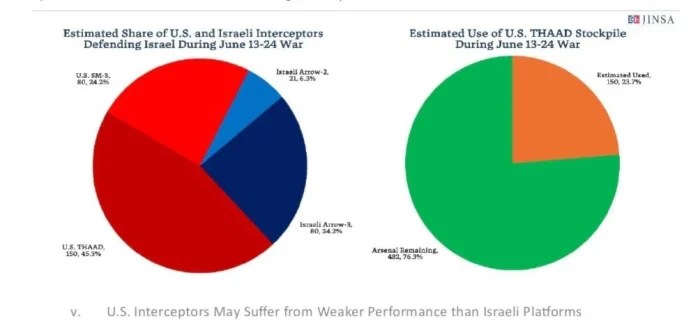
Returning to Jordan: American planners show little concern for Jordanian costs or the consequences for the base itself, which is situated around 70km from the capital Amman. From this perspective, it may even be deemed acceptable for the US if Iran expends part of its ballistic arsenal striking the base, even at the cost of Jordanian casualties.
The American assumption is that they would then be able to launch a major air campaign to destroy Iranian missile production, storage, and launch sites. This would pave the way for an Israeli entry into a second phase of the war, one in which it would no longer face missile volumes it cannot absorb, as it almost did in the June war, as it was running out of interceptors after a presumed US airpower success in weakening the system and reducing launch capacity.
From Iran’s standpoint, directly starting with “Israel” may actually be more rational. An Israeli participation in any war appears almost inevitable, either immediately or at a later stage, for multiple reasons.
Despite the massive US buildup, which includes more than 36 F-15Es, an aircraft carrier, and several destroyers with capabilities to launch cruise missiles, Israelis still retain greater immediate regional firepower than the United States, but it seeks to avoid sudden, large-scale damage to its own infrastructure.
American intentions likely go beyond limited bombings, assassinations, or “decapitation” strikes, as seen previously, if their attack would make sense in terms of weighing gains and possible losses. They may include direct strikes targeting the Iranian leadership, severe economic and energy infrastructure degradation, and long-term destabilization designed to enable internal regime change, added to the sanctions.
The withdrawal of American aircraft from Gulf bases was not only due to their vulnerability to short-range, high-precision weapons that Iran’s arsenal is full of, but also to protect Gulf oil production in the event of war. Gulf states, for their part, would publicly distance themselves from hostilities to shield their economies and prevent market shocks, particularly to avoid upsetting Trump amid any market volatility.
While it is possible to disrupt US operations at Muwaffaq Salti Air Base, expending large numbers of ballistic missiles there, missiles that could instead strike high-value counter force and counter value Israeli targets, may be less strategically viable than other options if the US is prepared to escalate toward total confrontation regardless. Completely and permanently disabling the base would be difficult, and the strategic outcome would likely remain unchanged.
American planners appear convinced that Iran will avoid targeting Jordanian state infrastructure or attempting to destabilize the Jordanian monarchy, as such actions can be used for counterpropaganda. They assume Iran will focus on Western and Israeli forces, confining hostilities to sparsely populated desert areas that Jordan can absorb.
Jordan, governed by a monarchy heavily dependent on Western and Gulf countries’ political and economic support, appears to share this assessment. King Abdullah likely believes his rule faces no serious internal risk and that alignment with Western strategy is the safer course, as his country was credited for being “Israel’s” shield against Iranian drones in the June 2025 war.
Under this framework, the US would launch an air campaign using aircraft operating from Jordan to strike western Iran, while carrier-based aircraft in the Arabian Sea attempt to open corridors toward central Iran from the Gulf. This would allow heavy bombers from Diego Garcia to penetrate deeper and strike strategic targets. The Israeli occupation would then enter at a later stage.
The simplest counter-strategy is to do precisely what the Americans do not expect, and to inflict maximum cost. The theory that remains largely unrefuted: Trump is risk-averse. As Western media itself jokes, TACO (Trump Always Chickens Out), he dislikes long wars, favors last-minute, flashy interventions, and avoids sustained attrition. This suggests a vulnerability: American short-termism and reluctance to absorb prolonged pain, particularly when multiple theaters remain active.
Some may ask why Iran does not simply launch a preemptive strike. This is a clear option, but not an uncomplicated one. An initial Iranian strike could rally American public opinion behind a longer war, granting Trump broader authority, resources, and popular support. While it would disrupt US planning and cause early damage, it might ultimately strengthen Washington’s domestic position. By contrast, an American-initiated war, prolonged, unpopular, and costly, would be far more vulnerable to internal pressure, especially if American losses mount.
Adding to the complexity, two Emirati Il-76 cargo aircraft reportedly landed in Tel Aviv before flying on to Turkmenistan. These aircraft are known to be used by the UAE to supply proxy forces with weapons, particularly in Sudan and Somalia, raising the possibility that they were transporting drones or intelligence equipment for regional operations.
The picture remains highly complex, and it is entirely possible that nothing will happen. Still, based on current force deployments and escalation patterns, the probability of a US attack appears to have risen beyond a 50-50 threshold.
This analysis reflects what American planners may be thinking, not what will necessarily occur. It should be noted that after the previous war, many US and Israeli officials declared that Iran’s nuclear and missile programs had been torpedoed, and the system effectively destroyed, assessments that quickly proved false. Now, only months later, they appear to believe that an even more violent war is required to achieve what the last one supposedly already accomplished.
On the other hand, if endurance is possible and the United States is forced to retreat, Trump TACOs or abandon Israelis mid-conflict — an outcome not inconceivable under a president like Trump — the cumulative effects of “Israel’s” recent dominance and coercion across the region may yet be reversed.
As mentioned earlier, the US buildup is not sufficient to start a prolonged attack against Iran with the high goals of regime change. The buildup still does seem as defensive posturing shielding the Israelis, so a chance the Israelis might initiate and use the limited US and Western buildup as a shield is still significant. A scenario similar to what happened in the last war, but that does entail Israeli losses in the opening phase.
Conclusion
What emerges from this assessment is a US strategy built on supposed escalation control, risk displacement, and the assumption that others will behave within predefined limits. Washington appears to believe it can shape the battlefield geographically, pushing early phases of the war away from the fragile “Israel”, absorbing initial retaliation through peripheral bases, and then intervening decisively to reshape the balance before handing the fight back to Israelis under more favorable conditions. This is not a strategy aimed at victory in the classical sense, but at managing exposure and buying time.
The weakness in this thinking lies in its dependence on predictability. It assumes Iran will refrain from actions that collapse the carefully constructed sequencing of the war, that regional systems will remain stable under strain, and that American political leadership will tolerate the costs long enough to reach a decisive point. None of these assumptions is guaranteed. If any one of them fails, the entire escalation ladder becomes unstable.
Ultimately, the outcome of any confrontation will not be decided by the opening phase or by claims of technological superiority, but by endurance, political cohesion, and the ability to impose sustained costs on an adversary unwilling to absorb them.
The United States may possess overwhelming firepower, but it remains constrained by limited strategic patience and domestic vulnerability. If those constraints are effectively exploited, the very war designed to resolve the Iranian question may instead deepen American entanglement and erode the regional order it seeks to preserve.
Unchecked expansionism: Senior Knesset member calls for ‘full Israeli control of Syria’
Press TV – March 10, 2025
In a brazen declaration of expansionist Zionist ambitions, an Israeli Knesset member has openly called for Syria to be placed under the regime’s full control.
Boaz Bismuth said Israel “will not allow a military force to emerge in Syria after Assad’s fall.”
“Damascus must be under full Israeli control, and we will ensure that it comes under our control.”
The remarks reveal long-standing Israeli objectives to reshape West Asia by force.
“Syria is our bridge to the Euphrates, and in the future we will reach Iraq and Kurdistan.”
The extremist Israeli politician also voiced wishful thinking that the entire region should become subordinate to Israeli policies.
“Syria must be completely subordinate to us, as must Jordan, without any military capabilities.”
“We wake up the King of Jordan in the middle of the night to make him carry out our orders.”
Israeli prime minister Benjamin Netanyahu recently said the regime will not tolerate the presence of the HTS or any other forces affiliated with the new rulers in southern Syria.
He also said the regime’s troops will remain stationed at a so-called “buffer zone,” seized following the fall of President Bashar al-Assad, inside the occupied Golan Heights.
The buffer zone was created by the United Nations after the 1973 Arab-Israeli War. A UN force of about 1,100 troops had patrolled the area since then.
Netanyahu said the regime’s forces will maintain an indefinite military presence at the summit of Mount Hermon, and the adjacent security zone.
Mount Hermon, known as Jabal al-Shaykh in Arabic, is a huge cluster of snowcapped mountain peaks towering above the Syria-Lebanon border.
It overlooks the Damascus countryside as well as the Golan Heights, which Israel occupied during the 1967 Six-Day War.
Following the downfall of Assad, the Israeli military has been launching airstrikes against military installations, facilities, and arsenals belonging to Syria’s now-defunct army.
The strikes were accompanied by ground incursions, as tanks and armored bulldozers penetrated Syrian territory, beyond the Golan Heights to Qatana, barely 30 kilometers from Damascus.
Israel has been condemned for the termination of the 1974 ceasefire agreement with Syria, and exploiting the chaos in the country in the wake of Assad’s downfall to make a land grab.
Former al-Qaeda affiliate the HTS took control of Damascus in early December in a stunning offensive, prompting Israel to move forces into a UN-monitored demilitarized zone within Syria.
The Israeli regime has occupied some 600 kilometers of Syrian territory since the fall of Assad.
The HTS remained conspicuously silent on the unprecedented Israeli aggression, refusing to condemn the land theft, a move seen by regional experts as a sign of internal instability.
With US Or Against US? America’s ultimatum to Arab leaders
By Robert Inlakesh – Al Mayadeen – February 18, 2025
For 15 months, the majority of the Arab and Muslim World’s leaders sat back as the first live-streamed genocide took place inside the land of Palestine. Praying for a return to the status quo that once supported their rules, they have now been faced with an ultimatum. Now, it’s time to pick a side.
While US President Donald Trump presented his idea of clearing out Gaza’s civilian population, taking control of the territory, and reconstructing it, he did so using the tone of someone believing such actions would be humanitarian in nature. In reality, what was being proposed was an invasion, mass murder, and ethnic cleansing.
To be clear, the likelihood of such an invasion occurring is slim, not least because it involves an enormous amount of planning to implement correctly and there is simply no evidence that any moves are being made in this direction. However, the threat of such a monstrosity alone has proven enough to instantly mobilise the Arab and Muslim nation’s leaderships in a way we have not witnessed in decades.
Suddenly, they woke up, after behaving as if the people of the Gaza Strip were not being mass murdered on an industrial scale, on the land of the Prophets, on the land of Al-Aqsa Mosque and the Holy Sepulchre. Not even the invasion of Lebanon, the murder of some 3,000 people, nor the occupation of more Syrian lands, nor the threats of annexation in the West Bank, had mobilised these leaders. The screams of Gaza’s youths, the tears of Gaza’s mothers, the honor stripped from the tortured and raped, nothing registered.
But now, for the first time, we feel a pulse. Why? Because everyone’s head is on the chopping block. A glimpse was caught of what Donald Trump’s proposed future could cause and the likes of Jordanian King Abdullah II realised they are just another Arab in the eyes of the Israeli-US alliance, nothing more and nothing less. The only reason they remain is because they capitulate. This was Trump’s true message; it was not so much as a threat but a reminder.
Without delving too deep into the issue of an American invasion of Gaza, it would prove disastrous in so many ways that it seems unrealistic on the face of things. This is not least due to the enormous costs involved in a US occupation that could travel north of hundreds of billions in US taxpayer dollars, while the US soldier casualties would be high and place enormous domestic pressure on Trump. This would likely be America’s new Vietnam, as the star-spangled coffins would trigger outrage across the States.
A US invasion would also fail to achieve the objectives set out by Trump, because Palestinians will not leave willingly and this could easily turn into a situation where the US army picks up from where the Israelis left off; inflicting Genocide. If the ethnic cleansing would work partially, the destabilizing effects would be horrific.
As mentioned above, the majority of the leaders of Arab and Muslim nations may have stood aside and allowed the Gaza Genocide to unfold, yet their populations are now more motivated to defeat the Zionist occupiers than ever before.
Opening the ‘gates of hell’
When Hamas announced that it would postpone the weekly prisoner exchange arrangement until the Israelis allowed sufficient humanitarian aid to enter Gaza, in accordance with the ceasefire agreement, Donald Trump’s reaction was to threaten opening the “gates of hell”. Despite the threats that came from Trump and Netanyahu, the Israelis caved under pressure and were quickly set to allow the prisoner exchange to go ahead as planned.
Whether the US President is truly the mastermind behind his own rhetoric or not, which is quite frankly unlikely, reading between the lines has actually helped achieve four objectives:
- The outrageous and illegal proposals that Trump has put forth have helped save the image of Israeli PM Benjamin Netanyahu in front of his extremist coalition.
- The rhetoric has therefore given the Zionist regime more wiggle room to reach the second phase of the agreement, as the more extreme elements in the regime now feel as if they will get to complete their ethnic cleansing, settlement, and occupation endeavors.
- Upon the initial conclusion of the ceasefire agreement, the momentum in terms of popular understanding of power dynamics – manufactured as a result of the ongoing media war – had Hamas painted as the victor and the Zionist regime a loser. Trump managed to suddenly shift the conversation and manipulate popular understandings of who is in control and “winning” the war.
- It has brought together the Arab and Muslim leaders who were previously inactive or distant from the post-war Gaza plan.
Donald Trump is actively speaking as if he is a more extreme Zionist fanatic than Netanyahu, but is yet to follow through on any of his threats. If he continues to speak in such a way, it is possible that the US will have to start following through on some of the President’s rhetoric, however, in order for Washington to maintain credibility.
The reality in the region is that the leaderships of West Asia are still trying to revert back to the status quo that existed pre-October 7, 2023. Now they are having to come to terms with the fact that this is no longer an option.
Although this may seem hyperbolic, the “Israel” that everyone knew from before is no more, it no longer exists. To those who have studied the issue closely, this was somewhat inevitable. Right now, we are living through a scenario that occurred prior to 1948, where the Zionist regime had to try and define itself. For some time, they managed through their military superiority to pacify those around them or overcome armed confrontations with brute force, all while developing their economy and pretending as if they were operating a European State in the Eastern Mediterranean.
This was never going to last, not least because the Palestinian to Jewish population inside the borders of historic Palestine had become roughly 50/50. On top of this, the fastest growing Jewish group has been the Haredim (Ultra-Orthodox), who do not serve in the army and don’t even believe in the worth of modern Nation States. Yet, all Israelis wanted the West Bank and to rule over occupied Jerusalem. With land concessions to the Palestinian Authority off the table, there were only ever going to be two options that the Zionists were going to have to choose from: Commit a genocide or mass ethnic cleansing; or both.
With the rise of right-wing nationalist religious fundamentalism, the secular-leaning right-wing system that modelled itself off of “Western Liberal Democracies” suddenly found itself under threat. Prior to October 7, 2023, this was a dominant theme in Israeli politics, where the religious ultra-nationalists were challenging the somewhat contradictory vision that was held onto by around half of the Israeli Jewish population.
What happened here is that the secular-leaning Israelis were trying to cling onto their delusion that they could simply live in a liberal Jewish supremacist Apartheid colony forever and expect a level of stability that they had long enjoyed due to the overwhelming power of their military. On the other hand, the extremist right-wing coalition of Benjamin Netanyahu that won power in late 2022 began to present an alternative vision in a way that hadn’t been done before.
Then came the wakeup call, Hamas launched Operation al-Aqsa Flood, and the Zionists were forced to wrestle with the fact that you cannot continue oppressing the Palestinian people and expect them to simply go away or give up on their struggle for national liberation. Because of the racist collective narcissism trained into the minds of the Zionist settlers, they reacted in the most emotional way possible. This is why Zionists in the West have also been working overtime to suppress any criticism; their racism is being challenged.
The knee-jerk reaction of the Zionists was to think “how dare these people challenge our supremacy”. For the first time in its history, the Zionist Entity had been militarily torn to pieces and proven incapable of overcoming an indigenous resistance force armed primarily with light weapons and self-produced armaments. US-Israeli supremacy in West Asia appeared to be crumbling, so the occupying entity and its imperialist backer responded in the only way they know how, mass murder.
What happened in Gaza was a frenzy of racist violence that was supposed to “teach a lesson” to the Arab and Muslim peoples that they will remain forever inferior. The genocide was calculated to send a message: resist our supremacy and you will die.
Two things are now happening:
- The “Israel” of the past died, now it is scrambling to redefine and recreate itself.
- The US is attempting to revive its efforts to transform the region through normalisation and the construction of new trade routes, but is going to do so using maximum force in order to put down any semblance of dissent.
So where does this all fit into Donald Trump’s crazy threats? It’s simple. The United States is projecting its intention to remodel the entire region. This message is clear, yet it won’t likely come through a US invasion of Gaza, rather from putting tremendous pressure on the nations of the region to capitulate and work as slaves of the US-Israeli alliance.
If Jordan, Egypt, and Saudi Arabia do not capitulate, their leaderships will be replaced by ones that do. In the event that either a US invasion of Gaza or mass ethnic cleansing occurred, Egypt would be destabilised and likely face a limited Israeli incursion into the Sinai, while the Jordanian government could be toppled, or at the very least the nation will be totally destabilised, then, in the backdrop, Saudi Arabia could also be in the cross-hairs.
Hundreds of thousands of Gazans being ethnically cleansed into the Kingdom of Jordan would inevitably birth a new Palestinian Resistance front also, which could happen regardless at this point.
The ethnic cleansing of Palestine between 1947-49 left a major scar on the Arab World as a whole, one that has never healed. What just occurred in Gaza is a much deeper wound that will inspire Resistance until the end of the Zionist regime. Although it is often not factored into the equation, the Israelis also murdered 3,000 people in Lebanon too, including the late Secretary General of Hezbollah, Seyyed Hassan Nasrallah.
A mistake often made by the imperialists and settler colonialists is assuming that because a population appears pacified today, it will also be tomorrow. In reality, revolutions and resistance movements take time, with mass mobilisation sometimes occurring due to what could be perceived as mere chance when it emerges.
Meanwhile, the US is now offering the same option to the Arab and Muslim World that was presented by George W. Bush Jr. upon his announcement of the so-called “War on Terror”: “You are either with us or with the terrorists!”
It may be presented in a different way, but the truth is that there is no way to play the role of holding a middle-ground position. Now is the time, submit to being a slave, even losing your territory, pride and stability; or you decide to resist. The problem for a nation like Jordan is that if you resist, you may also be overthrown.
Donald Trump’s comments for now were designed to force the Arab and Muslim leaders to come to a joint consensus and present an alternative plan to his insane proposal, which appears to be working. Interestingly enough, it appears as if this is actually helping to allow for the Gaza ceasefire to reach phase 2.
Unfortunately for these leaders, the Palestinian issue they now face is not over with Gaza. In the event of the Israelis annexing the West Bank, this could eventually trigger the downfall of the Palestinian Authority and/or initiate a major uprising. In such a scenario, the Israeli military could then seek to ethnically cleanse large swathes of the West Bank too. The destination of these displaced refugees could also end up being Jordan.
Even former US Secretary of State Antony Blinken warned, in his second last address about foreign policy, of the collapse of the normalization agreements between the Zionist regime and its neighbours in Amman and Cairo. Speaking at a conference organised by the Atlantic Council, Blinken used the first part of his speech to espouse pure Israeli propaganda, before speaking candidly on a few issues towards the latter half of his address. He stressed that without a so-called “Two-State solution”, the normalisation deals with Egypt and Jordan could collapse.
If a resistance front opens inside Jordan, it could be the beginning of the end for the Zionist regime. Jordan shares the largest, mostly undefended, land border with occupied Palestine. Once a major resistance movement is rooted there, the war would expand in such a way that no one is capable of predicting. It is also clear that the Zionists seek to continue their aggression against Iran, Yemen, and to degrade Hezbollah at all costs in Lebanon.
All of what is mentioned above will not likely just unfold overnight, everything takes time. Yet there is no question that the war is far from over.
Featured Video

Iran FM Araghchi: “Hormuz Will No Longer Be the Same”
or go to
Aletho News Archives – Video-Images
From the Archives
Sam Husseini: The entire US establishment helped lie their way into the Iraq war
By Slava Zilber | American Herald Tribune | October 14, 2019
Sam Husseini is a senior analyst with the Institute for Public Accuracy, independent journalist and contributor to The Nation and FAIR.
Slava Zilber: Sam, three years ago, you appeared on Talk Nation Radio with David Swanson and spoke about the case of the GCHQ whistleblower Katharine Gun. You pointed out that the people involved in the spying on the UN and the people authorizing the Iraq War were not held accountable:
“Virtually everybody who went along with the war, whether it is Kerry or Clinton, of course, the Bush administration themselves has falsified their own records in terms of why, what they did, when they did, why they did it, to the extent that they’ve been scrutinised at all.”
You also address it in a recent article. And recently, Joe Biden has been lying about his position on the Iraq War. How can such an important issue escape meaningful scrutiny? … continue
Blog Roll
 Aletho News
- Oman FM: Persian Gulf states, Iran, Iraq should form security pact excluding US
- Trump peddles fresh falsehoods, claims Iran ‘started the war’ as US aggression drags on
- Ukraine quagmire? Yes, but it’s for NATO, not Russia
- US intelligence hypes Chinese, Russian space threats while accelerating its own military buildup in orbit
- Iran FM Araghchi: “Hormuz Will No Longer Be the Same”
- EU facing trillion-euro debt hole while seeking more cash for Kiev
- How US, Europe, Persian Gulf states exhausted missile stockpiles, splurged billions to defend Israel
- Up in arms… Koreans reject U.S. empire’s plan to make South Korea the next Ukraine
- Iran, Turkey, Pakistan, Saudi Arabia could advance region-led security framework in Tehran: FM spox
- Netizens condemn Japanese drama for projecting Japan’s wartime atrocities onto Chinese characters
- If Americans Knew
- An error has occurred; the feed is probably down. Try again later.
- No Tricks Zone
- Sudden Stratospheric Warming, Powerful El Niño Combination May Lead To Extreme Europe Cold, Energy Crisis!
- Two New Studies Find Thwaites Glacier Melt Cannot Be Driven By Human Activity Or A Warming Ocean
- E-Cars Reduce CO2 Emissions By Only 41% Compared To Internal Combustion Engine Vehicles
- Predictions Made By Renowned Climate Professor Over Past Decades Have Been Proven To Be Poor
- New Study Suggests Large Regions Of The Pacific Ocean Have Been Cooling For The Last 80 Years
- Germany’s Green Energy Debacle: High Energy Costs Force Kahla Porzellan to Close After 182 Years!
- New Study: 50 Years Of The Most Aggressive ‘Net Zero’ Policies Can Only Affect The Global Climate By 0.03°C
- US September “Heat” Was No Record…Many Records Set Decades Ago
- Latest European Green Energy Debacle; Portugal’s Largest Flagship Solar Park Insolvent!
- Green Energy Debacle: German Expert Professor Fritz Vahrenholt Warns Of Severe Economic And Social Consequences

