Obama: US Military Engaged in Anti-Terror Operations Across 15 Countries
Sputnik — 13.06.2016
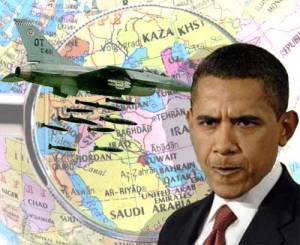 US military personnel are engaged in counterterrorism operations across 15 different countries, President Barack Obama said in a biannual statement to Congress released on Monday.
The letter outlined US military counterrorism operations across the globe in Afghanistan, Iraq, Syria, Turkey, Somalia, Yemen, Djibouti, Libya, Cuba, Niger, Cameroon, the Central African Republic, Egypt, Jordan, and Kosovo. All nations have US combat-equipped personnel deployed for a specific counterterrorism mission.
Obama indicated that that there is no timeline for the war on terrorism, and he will direct “additional measures to protect US citizens and interests” if necessary.
“It is not possible to know at this time the precise scope or the duration of the deployments of US Armed Forces necessary to counter terrorist threats to the United States,” Obama said.
Under the 2001 authorization for use of military force, the US president must update Congress every six months on the military operations against al-Qaeda, the Taliban and associated forces.
‘Saudi Arabia providing banned chemical munitions to Nusra Front’
Press TV – May 19, 2016
A senior European official says Saudi Arabia is providing members of the al-Qaeda-affiliated Nusra Front with internationally-banned chemical weapons.
Secretary General of the European Department for Security and Information (DESI) Haitham Abu Said the terrorists regularly use the munitions in their attacks against Syrian civilians.
Abu Said said Wednesday that the ammunition are being supplied to the extremists monthly under a plan drawn up in Bulgaria, and sneaked into Syria through militant-held areas on the border with Jordan.
Abu Said further noted that Nusra Front terrorists have on a number of occasions used weapons containing chemical agents against Syrians, most recently in the strategic northwestern province of Aleppo.
He added that international organizations have recorded several such incidents in the past.
The remarks come as the Russian Defense Ministry said that several trucks, carrying improvised chemical weapons, have been transported to Aleppo from neighboring Idlib.
“The arms are said to contain chlorine-based toxins,” the ministry said in a statement.
On May 3, Director General of the Organization for the Prohibition of Chemical Weapons (OPCW) Ahmet Uzumcu said that the Takfiri Daesh terrorist group might have already used chemical weapons both in Iraq and Syria.
Uzumcu said fact-finding teams from The Hague-based watchdog had discovered evidence that suggest the use of sulfur mustard in attacks in the two crisis-hit Arab countries.
“Although they could not attribute this to Daesh… there are strong suspicions that they may have used” chemical weapons, Uzumcu said.
On April 7, 23 people were killed and over 100 others injured in a chemical attack by Daesh terrorists against members of the Kurdish People’s Protection Units (YPG) in the city of Aleppo.
Videos posted online purportedly show yellow gas rising over Sheikh Maqsood neighborhood in Aleppo, some 355 kilometers (220 miles) north of Damascus.
The development came only three days after al-Ikhbariyah Syria satellite television network reported that Daesh had fired a barrage of rockets, carrying mustard gas, at a Syrian military airport in the eastern city of Dayr al-Zawr.
According to a report by the Syrian-American Medical Society, Daesh has carried out more than 160 attacks involving “poisonous or asphyxiating agents, such as sarin, chlorine, and mustard gas” since the beginning of the Syrian conflict in 2011.
At least 1,491 people have been killed in the chemical attacks.
In August 2013, hundreds of people were also killed in a chemical attack in the Ghouta suburb of Damascus. According to reports, the rockets used in the assault were handmade and contained sarin.
Leaked Memo: Jordan’s King Reveals UK SAS Forces On The Ground In Syria, Israel Supports Nusra
By Brandon Turbeville | Activist Post | May 10, 2016
According to a leaked memo obtained by the Guardian in late March, 2016 King Abdullah of Jordan apparently briefed US officials on the fact that Jordanian Special Forces would be deployed to Libya to work alongside the British SAS. In that same briefing, Abdullah also allegedly stated that British SAS had been active in Libya since early 2016.
As Randeep Ramesh wrote for the Guardian at the time,
According to the notes of the meeting in the week of 11 January, seen by the Guardian, King Abdullah confirmed his country’s own special forces “will be imbedded [sic] with British SAS” in Libya.
According to the memo, the monarch met with US congressional leaders – including John McCain, the chairman of the Senate armed services committee, and Bob Corker, the chairman of the Senate foreign relations committee. Also present was the House of Representatives speaker, Paul Ryan.
King Abdullah said UK special forces needed his soldiers’ assistance when operating on the ground in north Africa, explaining “Jordanian slang is similar to Libyan slang”.
Abdullah also allegedly pointed out that the British had been instrumental in setting up a “mechanized battalion” in Southern Syria made up of “local tribal fighters” (aka terrorists) and lead by a “local commander” for the purposes of fighting against the Syrian government forces.
The Jordanian king also stated that his troops were ready to fight side by side with the British and Kenyans for the purposes of invading Somalia.
According to the Guardian,
The full passage of the briefing notes says: “On Libya His Majesty said he expects a spike in a couple of weeks and Jordanians will be imbedded [sic] with British SAS, as Jordanian slang is similar to Libyan slang.”
The monarch’s apparent openness with the US lawmakers is an indication of just how important an ally Jordan is to the US in the region. Since the 1950s Washington has provided it with more than $15bn (£10.5bn) in economic and military aid.
However, the Jordanians had become frustrated over perceived US inaction over the Middle East in recent months. Five years of fighting in Syria have dramatically impacted on Jordan, which has absorbed more than 630,000 Syrian refugees, and the king has repeatedly called for decisive action to end the conflict.
Interestingly enough, the King also allegedly admitted that Turkey and specifically Recep Erdogan is hoping for the victory of “radical Islamists” in Syria and that Israel is tacitly supporting al-Qaeda/al-Nusra in Syria.
Ramesh summarizes the King’s alleged statements by writing:
- The Turkish president, Recep Tayyip Erdoğan, “believes in a radical Islamic solution to the problems in the region” and the “fact that terrorists are going to Europe is part of Turkish policy, and Turkey keeps getting a slap on the hand, but they get off the hook”.
- Intelligence agencies want to keep terrorist websites “open so they can use them to track extremists” and Google had told the Jordanian monarch “they have 500 people working on this”.
- Israel “looks the other way” at the al-Qaida affiliate Jabhat al-Nusra on its border with Syria because “they regard them as an opposition to Hezbollah”.
In March, Stratfor analysts reported that UK Special Forces were already in Libya and that they were “escorting MI6 teams to meet with Libyan officials about supplying weapons and training to the Syrian army and to militias against the Islamic State. The British air force bases Sentinel aircraft in Cyprus for surveillance missions around [the Isis Libyan stronghold] Sirte as well.”
The presence of Western/NATO Special Forces in Syria is by no means a revelation at this point. These forces have been present in the embattled Middle Eastern country for some time.
In October, 2015, it was announced by the White House that 50 Special Forces troops would be sent to Syria. This announcement came days after it was reported that U.S. Special Forces commandoes were working with Kurdish forces to “free prisoners of the Islamic State” in Syria. Later, the presence of U.S. Special Forces in Syria was tacitly acknowledged in 2015 when the U.S. took credit for the killing of Abu Sayyaf.
Reports circulated in October, 2014 that U.S. soldiers and Special Forces troops were fighting alongside Kurdish battalions in Kobane. An article by Christof Lehmann published in March 20, 2015 stated,
Evidence about the presence of U.S. special forces in the Syrian town Ayn al-Arab a.k.a. Kobani emerged. Troops are guiding U.S. airstrikes as part of U.S support for the Kurdish separatist group PYD and the long-established plan to establish a Kurdish corridor.
A photo taken in Ayn al-Arab shows three U.S. soldiers. One of them “Peter” is carrying a Bushnell laser rangefinder, an instrument designed to mark targets for U.S. jets, reports Ceyhun Bozkurt for Aydinlik Daily.
The photo substantiated previous BBC interviews with U.S. soldiers who are fighting alongside the Kurdish separatist group PYD in Syria.
The photo of the three U.S. troopers also substantiates a statement by PYD spokesman Polat Can from October 14, 2014, reports Aydinlik Daily. Can admitted that a special unit in Kobani provides Kurdish fighters with the coordinates of targets which then would be relayed to “coalition forces”.
The first public U.S. Special Forces raid in Syria took place in July, 2014 when Delta Force personnel allegedly attempted to rescue several Americans being held by ISIS near Raqqa. Allegedly, the soldiers stormed the facility but the terrorists had already moved the hostages. While the raid would provide evidence that U.S. Special Forces were operating in Syria in 2014, many researchers believe the story is simply fabricated by the White House to provide legitimacy to the stories of murdered hostages and thus the subsequent pro-war propaganda that ensued as well as to promote the gradual acceptance of U.S. troops on the ground in Syria.
In 2012, an article published in the Daily Star by Deborah Sherwood revealed that SAS Special Forces and MI6 agents were operating inside Syria shortly after the destabilization campaign began in earnest. Sherwood writes,
Special Forces will help protect the refugees in Syria along the borders.
Last week as the president ignored an international ceasefire, plans were being finalised to rescue thousands of Syrians.SAS troops and MI6 agents are in the country ready to help rebels if civil war breaks out as expected this weekend.
They also have hi-tech satellite computers and radios that can instantly send back photos and details of refugees and Assad’s forces as the situation develops.
Whitehall sources say it is vital they can see what is happening on the ground for themselves so Assad cannot deny atrocities or battles.
And if civil war breaks out the crack troops are on hand to help with fighting, said the insider.
. . . . .
“Safe havens would be an invasion of Syria but a chance to save lives,” said a senior Whitehall source.
“The SAS will throw an armed screen round these areas that can be set up within hours.
“There are guys in the communications unit who are signallers that can go right up front and get involved in close-quarter fighting.”
In addition, in March 2012, it was reported by Lebanon’s Daily Star that 13 French intelligence agents had been captured by the Syrian government, proving not only that Western Special Ops presence in Syria did, in fact, exist but also that it existed essentially from the start.
Brandon Turbeville – article archive here – is the author of seven books, Codex Alimentarius — The End of Health Freedom, 7 Real Conspiracies, Five Sense Solutions and Dispatches From a Dissident, volume 1 andvolume 2, The Road to Damascus: The Anglo-American Assault on Syria, and The Difference it Makes: 36 Reasons Why Hillary Clinton Should Never Be President.
Huge US Government Arms Delivery to Al-Qaeda Revealed by Official Website
Sputnik – April 9, 2016
A transport solicitation found on a federal website reveals the US government keeps shipping weapons to Al-Qaeda and other belligerent groups in Syria.
According to the British military information agency Jane’s, two transport solicitations were found on a US government website FedBizGov.org (Federal Business Opportunities), that looked for shipping companies to transport explosive material from Constanta, Romania, to the port of Aqaba in Jordan on behalf of the US Navy’s Military Sealift Command.
“The cargo listed in the document included AK-47 rifles, PKM general-purpose machine guns, DShK heavy machine guns, RPG-7 rocket launchers, and 9K111M Faktoria anti-tank guided weapon (ATGW) systems,” says Jane’s.
The solicitation was released in November, 2015. One ship with nearly one thousand tons of weapons and ammo left Constanta in Romania on December. It sailed to Agalar in Turkey which is a military pier and then to Aqaba in Jordan. Another ship with more than two-thousand tons of weapons and ammo left in late March, followed the same route and was last recorded on its way to Aqaba on April 4.
According to Zero Hedge, such cargo weight equals millions of rifles, machine-guns and mortar shots, as well as thousands of new light and heavy weapons and hundreds of new anti-tank missiles.
Neither Turkey nor Jordan use such weapons designed in the USSR. This hints these weapons are going to Syria where, as has been reported for years by multiple independent sources, half of them go directly to al-Qaeda which operates in Syria under the alias Jabhat al-Nusra.
Official: Israel obstructs Jordan agricultural exports to the OPT
MEMO | March 3, 2016
 Israel has been obstructing Jordanian agricultural exports to the Occupied Palestinian Territories under the pretext that Jordanian products do not conform to Israeli specifications, leading to exports completely stopping in 2015 and early 2016, a Jordanian official revealed.
Salah Al-Tarawneh, assistant secretary-general of the Jordanian ministry of agriculture for marketing and information, said in remarks to Quds Press that the Palestinian Authority asked last month to import tomatoes from Jordan but the Israeli side refused to allow their entry under the pretext that they contain viruses.
Al- Tarawneh explained that although the PA has repeatedly asked the Israeli side to increase agricultural trade with Jordan to meet its needs, Israel has continually refused under the pretext that Jordanian products do not conform to Israeli specifications.
According to data from the Jordanian ministry of agriculture, Jordan’s exports of vegetables and fruits to PA controlled areas completely stopped in 2015.
During the same year, Jordan’s agricultural exports to Israel amounted to more than 20,000 tons of vegetables and 5,000 tons of fruit.
Saudi invasion of Syria: The bluff that could ignite World War III
By Finian Cunningham | RT | February 7, 2016
The Saudi plan to send ground troops into Syria appears to be just a ruse. But this is precisely the kind of reckless saber-rattling that could ignite an all-out war, one that could embroil the United States and Russia.
Saudi rulers have reportedly amassed a 150,000-strong army to invade Syria on the alleged pretext “to fight against terrorism” and to defeat the so-called Islamic State (also known as ISIS/ISIL). Saudi officials told CNN that in addition to Saudi troops there are ground forces from Egypt, Turkey, Sudan, Morocco, Jordan, Qatar, Bahrain and the United Arab Emirates.
Syria’s Foreign Minister Walid al-Muallem gave a categorical response, saying the move would be seen as an act of aggression and that any invasion force regardless of its stated reasons for entering Syria will be sent back in “wooden coffins”.
Nevertheless, US President Barack Obama has welcomed the Saudi plan to intervene in Syria.
Obama’s Defense Secretary Ashton Carter is this week due to meet in Brussels with counterparts from the US-led so-called “anti-terror” coalition to make a decision on the whether to activate the Saudi plan. A Saudi military spokesman has already said that if the US-led coalition gives its consent then his country will proceed with the intervention.
In recent weeks, Carter and other senior US officials, including Vice President Joe Biden, have been calling for increased regional Arab military action against ISIS in Syria and Iraq. Carter and Biden have also said the US is prepared to send in its own ground troops en masse if the Geneva peace talks collapse.
Now, those talks appear to be floundering. So, does that mean that a large-scale invasion of US-led foreign armies in Syria is on the way?
Let’s step back a moment and assess what is really going on. The Saudi warning – or more accurately “threat” – of military intervention in Syria is not the first time that this has been adverted to. Back in mid-December, when Riyadh announced the formation of a 34-Islamic nation alliance to “fight terrorism”, the Saudis said that the military alliance reserved the right to invade any country where there was deemed to be a terror threat – including Syria.
Another factor is that the House of Saud is not pleased with US-led diplomatic efforts on Syria. US Secretary of State John Kerry’s bustling to organize the Geneva negotiations – supposedly to find a peace settlement to the five-year conflict – is seen by the Saudis as giving too many concessions to the Syrian government of President Bashar al-Assad and his foreign allies, Russia, Iran and Lebanon’s Hezbollah.
The Geneva talks – which came unstuck last week – can be arguably assessed as not a genuine internal Syria process to resolve the war – but rather they are a cynical political attempt by Washington and its allies to undermine the Syrian government for their long-held objective of regime change. The inclusion among the political opposition at Geneva of Al Qaeda-linked militants, Jaish al-Islam and Ahrar al-Sham, with Western backing, illustrates the ulterior purpose.
The Washington Post gave the game away when it reported at the weekend: “The Obama administration has found itself increasingly backed into a corner by Russian bombing in Syria that its diplomacy has so far appeared powerless to stop.”
In other words, the Geneva diplomacy, mounted in large part by Kerry, was really aimed at halting the blistering Russian aerial campaign. The four-month intervention ordered by Russian President Vladimir Putin has turned the tide of the entire Syrian war, allowing the Syrian Arab Army to win back strategically important terrain.
That the Russian military operations have not stopped, indeed have stepped up, has caused much consternation in Washington and its allies.
Russia and Syria can reasonably argue that the UN resolutions passed in November and December give them the prerogative to continue their campaign to defeat ISIS and all other Al Qaeda-linked terror groups. But it seems clear now that Kerry was counting on the Geneva talks as a way of stalling the Russian-Syrian assaults on the regime-change mercenaries.
Kerry told reporters over the weekend that he is making a last-gasp attempt to persuade Russia to call a ceasefire in Syria. Indicating the fraught nature of his discussions with Russian counterpart Sergei Lavrov, Kerry said: “The modalities of a ceasefire itself are also being discussed… But if it’s just talks for the sake of talks in order to continue the bombing, nobody is going to accept that, and we will know that in the course of the next days.”
Moscow last week was adamant that it would not stop its bombing operations until “all terrorists” in Syria have been defeated. Syria’s Foreign Minister al-Muallem reiterated this weekend that there would be no ceasefire while illegally armed groups remain in Syria.
What we can surmise is that because the US-led covert military means for regime change in Syria is being thwarted and at the same time the alternative political means for regime change are also not gaining any traction – due to Russia and Syria’s astuteness on the ulterior agenda – the Washington axis is now reacting out of frustration.
Part of this frustrated reaction are the threats from Saudi Arabia, Turkey and other regional regimes – with US tacit approval – to go-ahead with a direct military intervention.
In short, it’s a bluff aimed at pressuring Syria and Russia to accommodate the ceasefire demands, which in reality are to serve as a breathing space for the foreign-backed terrorist proxies.
From a military point of view, the Saudi troop invasion cannot be taken remotely serious as an effective deployment. We only have to look at how the Saudi regime has been battered in Yemen over the past 10 months – in the Arab region’s poorest country – to appreciate that the Saudis have not the capability of carrying out a campaign in Syria.
As American professor Colin Cavell noted to this author: “Saudi intervention in Syria will have as much success as its intervention in Yemen. History has clearly shown that mercenary forces will never fight external wars with any success or elan, and no Saudi soldier in his right mind truly supports the Saudi monarchy. Everyone in Saudi Arabia knows that the House of Saud has no legitimacy, is based solely on force and manipulation, propped up by the US and the UK, and – if it did not have so much money – is a joke, run by fools.”
Thus, while a military gambit is decidedly unrealistic, the real danger is that the Saudi rulers and their American patrons have become so unhinged from reality that they could miscalculate and go into Syria. That would be like a spark in a powder keg. It will be seen as an act of war on Syria and its allies, Russia, Iran and Hezbollah. The US would inevitably be drawn fully into the spiral of a world war.
History has illustrated that wars are often the result not of a single, willful decision – but instead as the result of an ever-quickening process of folly.
Syria is just one potential cataclysm.
Finian Cunningham (born 1963) has written extensively on international affairs, with articles published in several languages. Originally from Belfast, Northern Ireland, he is a Master’s graduate in Agricultural Chemistry and worked as a scientific editor for the Royal Society of Chemistry, Cambridge, England, before pursuing a career in newspaper journalism. For over 20 years he worked as an editor and writer in major news media organizations, including The Mirror, Irish Times and Independent. Now a freelance journalist based in East Africa, his columns appear on RT, Sputnik, Strategic Culture Foundation and Press TV.
Netanyahu: Saudi Arabia sees Israel as an ally
Press TV – January 23, 2016
Israeli Prime Minister Benjamin Netanyahu says Saudi Arabia now sees Tel Aviv “as an ally rather as an enemy” as he claims “a great shift taking place” in the Arab policy toward the Palestinian issue.
“Saudi Arabia recognizes that Israel is an ally rather than an enemy because of the two principle threats that threaten them, Iran and Daesh,” he told CNN’s Fareed Zakaria on the sidelines of the World Economic Forum in Davos Friday.
Both Saudi Arabia and Israel are fiercely opposed to a nuclear accord between Iran and the West which came into force recently. They are worried the agreement could boost Iran’s role in the region.
Last week, The Wall Street Journal reported that Israel was actively seeking to strengthen ties with Arab powers in the wake of the nuclear deal with Iran.
Daesh ideology is rooted in Wahhabism which is widely promoted by Saudi clerics and tolerated by the kingdom’s rulers. Both Saudi Arabia and Israel support Takfiri groups fighting in Syria. Meanwhile, there is no known case of a Daesh attack on either Saudi or Israeli targets.
Netanyahu also said “there is a great shift taking place” in the Saudi-led policy toward the Palestinian issue, citing Israel’s “relationships” with unknown Arab states.
“By nurturing these relationships that are taking place now with the Arab world, that could actually help us resolve the Israeli-Palestinian conflict, and we’re actually working towards that end,” he said.
Netanyahu’s overtures to Saudi Arabia and its allies come in the midst of international outcry after Tel Aviv declared 154 hectares (380 acres) of Palestinian territory in the Jordan Valley as “state lands.”
Yuval Steinitz, Israel’s minister for national infrastructure, energy, and water, returned recently from an energy conference in the UAE, where Tel Aviv recently established a diplomatic mission. Israel’s Channel 2 suggested that the real aim of the trip may have been for the two sides to covertly conduct strategy meetings.
In recent months, Egypt returned its ambassador to Tel Aviv while a group of Jordanian pilots paid a “working visit” to Israel and trained closely with their Israeli counterparts during US-sponsored military exercises.
Turkish President Recep Tayyip Erdogan also recently expressed an interest in easing tensions with Israel after reaching an agreement to restore relations last month. Sudan is also said to be considering normalizing ties with Israel.
Syria: Has Anyone Stepped Back from the Brink?
By Michael Jabara CARLEY | Strategic Culture Foundation | 26.12.2015
John Kerry, the US Secretary of State, recently visited Moscow to discuss the Syrian crisis with his colleague Sergei Lavrov and President Vladimir Putin. Journalists observed handshakes, smiles, even hearty laughter, between Kerry and his Russian counterparts. Syrian President Bashar al Assad does not have to resign immediately, Kerry declared, and the United States is not trying to isolate Russia. What good news, and what a surprise for the Russians. The Moscow show seemed a great success. Kerry strolled along Stariy Arbat Street, met smiling Russian pedestrians and bought souvenirs to take home. A few days later the UN Security Council passed a resolution, calling for a ceasefire and negotiations. Russian and western journalists alike now say there is some hope to avoid the worst in Syria. And as you may already know, if the United States wants a ceasefire, it’s because their «moderate» Jihadist allies are getting beaten up now by the Syrian Arab Army backed by Russian air support.
Is cautious optimism warranted about a Syrian peace? It is hard to see how. Kerry may say whatever he wants in Moscow, but when he gets back to Washington, he sings a different song, or his colleagues do. His boss, President Obama, said «Assad has to go» only a few days after Kerry returned home. And then there is the new phantasmagorical story published by Seymour B Hersh, the muckraking US journalist, who has revealed that not everyone inside the US government is brain dead. It’s a remarkable discovery when you think about US foreign policy. Some military officials, and no less than the former Chief of Staff, General Martin Dempsey, were actually indirectly, and very secretly, passing military intelligence to the Syrian government to help it fight Daesh, Al-Qaeda and allied Jihadist forces operating in Syria. At the same time, the CIA, with Obama’s support, was sending arms hither and thither in Syria to help the Jihadists overthrow the Assad government.
General Dempsey left office in September 2015 and was replaced by General Joseph Dunford, a true blue Russophobe, who says Russia is an «existential threat» to the United States. It is a classic Washington response: the US aggressor accuses its intended victim of aggression. Just the other day (22 December), the United States slapped on gratuitous new sanctions against Russia. It’s the same old pretext: Russian «aggression» in the Ukraine.
Yet another US provocation, you might think, as Russia searches for a peaceful settlement of the Syrian war. The Russian government is taking a sensible position, but in the present circumstances, is a negotiated peace a real possibility? If the war in Syria were simply a civil war, as is often repeated in the media, you could encourage the belligerents to put on suits and ties and sit down at a table to negotiate a settlement. Unfortunately, the war in Syria is not a civil war: it is rather a proxy war of aggression led by the United States, Britain, and France (until the Paris massacre in November), and pursued vigorously in the region by Turkey, Saudi Arabia, Qatar, Jordan, and Apartheid Israel.
Turkey is playing a dirty, evil role. It provides arms and supplies across its borders for Daesh in Syria. Oil taken from Syrian wells by Daesh travels in the opposite direction, sold at cut rate prices, to provide revenue to the Jihadists for their war against Assad. It is estimated that Daesh was obtaining $40 millions a month from exported oil (before Russian intervention), but this is a bagatelle in terms of the money necessary for the Jihadists to wage war against Syria. Hundreds of millions are required. Saudi Arabia and Qatar are important suppliers and financiers of the Salafi Jihadist movement. Jordan permits training of Jihadists on its territory and allows passage across its frontiers into Syria. Israel also provides support from the occupied Golan territory, even providing medical care to wounded Jihadists. A coalition of states, four of which are NATO members, is waging a war of aggression against Syria. Against this array of deadly enemies, the Syrian government and the Syrian Arab Army, in a remarkable feat of arms, has been able to hold out for more than four years. President Assad has proven his courage and tenacity as a leader by refusing US summons to resign and by staying in Damascus to share the personal danger which all Syrians must endure simply to live in their country. No wonder Obama wants to get rid of Assad before talk about Syrian elections for he would almost certainly win them.
Sputnik in Moscow has estimated that there are as many as 70,000 foreign Jihadists fighting in Syria.

These forces appear for the most part are well motivated, supplied largely with US weapons and deeply entrenched in various parts of Syria. Since the Russian intervention on the side of the Syrian government, progress has been made in rooting out Jihadist forces, but as long as supply routes remain open across Turkey, Iraq, Jordan, Israel, even Lebanon, the war in Syria is not going to end.
Turkey’s role is particularly dangerous. It is a NATO member and it uses this privileged position to commit acts of aggression against Iraq and Syria. It shot down a Russian warplane in a well-planned ambush, likely with US connivance, and then ran to hide in NATO’s skirts. Apparently, the Turkish government hoped to sabotage budding European cooperation with Russia against Daesh, or to provoke a NATO-Russian war, as insane as that might seem. Other NATO members, the United States, France, and Britain, have also been deeply involved in the proxy war against Syria. Indeed, after the destruction of Libya, it has been reported that NATO planes were secretly used to transport Jihadists and Libyan arms to other Middle Eastern fronts. NATO members are effectively allied with Daesh and its Al-Qaeda derivatives against the Syrian government.
To be sure, the United States and its European vassals have attempted to cover up their links to the Jihadist war in Syria by launching make-believe air attacks on Daesh targets, occasionally bombing a caterpillar tractor here or there and blowing up a lot of sand in people’s eyes. Russian intervention exposed the double game of the United States and changed the balance of military forces in Syria.
Even now however, the US air force sends warning messages to Jihadist truck drivers to get away from their vehicles before it attacks them. Or it refuses altogether to attack trucks carrying Daesh oil, claiming it’s private civilian property. How preposterous! Since World War II, when has the United States hesitated to attack civilian targets? It is understandable that Obama and the CIA, having been caught red-handed in Syria, are furious with Putin for exposing them. Nevertheless, the Russian government has offered the United States, a porte de sortie, pushing for an anti-Jihadist alliance and peace talks to settle the war.
Peace is a marvelous idea and the US escape route, a practical gesture, but how is Foreign Minister Lavrov going to get Saudi Arabia, Turkey, Qatar, Jordan, and Israel, not to mention the United States and Britain, to stop supporting the Jihadist movement in Syria and Iraq? Talk about an impossible alliance: it’s like taking a writhing nest of asps to your breast and hoping they won’t bite you. Are such hopes realistic? «Maybe not but that’s diplomacy,» Lavrov might respond: «we have to try nevertheless». These days it takes infinite patience and great theatrical skills to be a Russian diplomat. Russia is trying to finesse the United States into dropping its support of «moderate» Jihadists. In fact, such moderates do not exist.

Neither does the so-called Free Syrian Army (FSA). The Jihadists decapitate a few hapless victims, and FSA volunteers run away in horror leaving their arms for Daesh. Or, they laugh at the infidels’ stupidity and go over, arms in hand, to the Jihadist side.
Even if Russia could get real commitments from the United States, which is as yet quite uncertain, what is to be done about Turkey, Saudi Arabia and the Gulf states? And what is to be done with all the foreign Jihadists in Syria? Are these terrorists and war criminals going to be encouraged to return to the 40+ different countries whence they came to stir up violence there? And what is to be done about the Syrian Jihadists, though there is no open source information about their numbers? Will they be allowed to remain at large, or worse, will they be recognised as a legitimate Syrian opposition?
Even an anti-Jihadist coalition of willing members will have hard work rooting out Daesh and its allies. But the coalition of asps which Russia is trying to organise is composed of Daesh supporters. How is that going to work? One fears not at all well since the would-be alliance members, with the possible exception of France, have not abandoned their backing of Daesh, whatever one hears to the contrary notwithstanding. The United States remains the chief culprit continuing to pursue its two-faced, dangerous policies.

«The four core elements of Obama’s Syria policy remain intact today», Seymour Hersh says: «an insistence that Assad must go; that no anti-IS (Islamic State) coalition with Russia is possible; that Turkey is a steadfast ally in the war against terrorism; and that there really are significant moderate opposition forces for the US to support».
Policy based on false premises invariably leads to failure. Obama’s policy is no exception. Assad is a courageous leader of Syrian resistance against the Jihadist invasion. The only possible successful coalition against Daesh, Al-Qaeda and their affiliates is with Assad and with Russia. Turkey is a dangerous provocateur, playing with matches amongst open kegs of gunpowder, trying to drag NATO into a deeper de facto alliance with Daesh or even war with Russia. Finally, there are no «moderate» Jihadist forces in Syria. The Free Syrian Army barely exists at all, and the so-called moderates are no less murderous than their Daesh allies.
One cannot fault the Russians for trying to organise an anti-Jihadist alliance in Syria, but their potential allies, apart perhaps from the apparently repentant French, are all snakes in the grass. And Obama, the Nobel Peace Prize winner, is the biggest snake of all. «Do you realise what you have done?» Putin asked at the UN in September. Not yet apparently, reports to the contrary notwithstanding. But then, as we know, there are none so blind as those who will not see.
100,000 foreign troops incl. Americans to be deployed in Iraq, MP claims
RT | December 10, 2015
The US is to send some 10,000 troops to Iraq to provide support for a 90,000-strong force from the Gulf states, a leading Iraqi opposition MP has warned. The politician said the plan was announced to the Iraqi government during a visit by US Senator John McCain.
During a meeting in Baghdad on November 27, McCain told Prime Minister Haider Abadi and a number of senior Iraqi cabinet and military officials that the decision was ‘non-negotiable’, claimed Hanan Fatlawi, the head of the opposition Irada Movement.
“A hundred thousand foreign troops, including 90,000 from Saudi Arabia, the UAE, Qatar and Jordan, and 10,000 troops from America will be deployed in western regions of Iraq,” she wrote on her Facebook page.
She added that the Iraqi prime minister protested the plan, but was told that “the decision has already been taken.”
McCain and fellow hawk Senator Lindsey Graham have both been calling for a tripling in the current number of US troops deployed in Iraq to 10,000, and also advocate sending an equal number of troops to Syria to fight against the terrorist group Islamic State (IS, formerly ISIS/ISIL) and the government of Syrian President Bashar Assad. The Americans would prop up a 90,000-strong international ground force provided by Sunni Arab countries like Egypt, Turkey and Saudi Arabia.
“The region is ready to fight. The region hates ISIL – they are coming for Sunni Arab nations. Turkey hates ISIL. The entire region wants Assad gone. So there is an opportunity here with some American leadership to do two things: to hit ISIL before we get hit at home and to push Assad out,” Graham argued during the joint visit to Baghdad in November.
“Saudi Arabia, Egypt, Turkey – they have regional armies and they would go into the fight if we put [the removal of] Assad on the table. Most of the fight will be done by the region. They will pay for this war,” he added.
The US currently has about 3,600 troops in Iraq, including 100 special operations troops deployed last month to take part in combat missions involving hostage rescue and the assassination of IS leaders. The White House is reluctant to commit a large ground force, citing the cost in human lives and money and the possible political ramifications of what will be portrayed by America’s opponents as yet another Western invasion of the Arab world.
The McCain-Graham plan also poses the risk of direct confrontation between the proposed coalition force and Russia and Iraq, which are both militarily assisting the Assad government and may not stay out of the fight – something which the hawkish duo have not factored into their plan.
This is especially true after Turkey’s downing of a Russian bomber plane on the Turkish-Syrian border, which Moscow considered a stab in the back and which sent relations with Ankara to a low not seen for decades.
Baghdad has its own concerns about a Turkish presence on its territory after Ankara sent troops into western Iraq and refused to withdraw them, despite Iraqi protests. Ankara claimed the incursion was made under a 2014 invitation from Iraqi Prime Minister Abadi.
Tracking ISIS to DC’s Doorsteps
By Ulson Gunnar – New Eastern Outlook – 23.11.2015
The problem with America’s “anti-ISIS coalition” is not a matter of poor planning or a lack of resources. It is not a matter of lacking leadership or military might. The problem with America’s “anti-ISIS coalition” is that it never existed in the first place. There is no US-led war on ISIS, and what’s worse, it appears that the US, through all of its allies, from across the Persian Gulf to Eastern Europe and even within Washington itself, are involved in feeding ISIS, not fighting it.
Going from Syria itself, outward according to geographical proximity, we can trace ISIS’ support all the way back to Washington itself. And as we do, efforts like the “talks” in Vienna, and all the non-solutions proposed by the US and its allies, appear ever more absurd while the US itself is revealed not as a stabilizing force in a chaotic world, but rather the very source of that chaos.
In Syria
Within Syria itself, it is no secret that the US CIA is arming, training, funding and equipping militant groups, groups the US now claims Russia is bombing instead of “ISIS.” However, upon reading carefully any report out of newspapers in the US or its allies it becomes clear that these “rebels” always seem to be within arms reach of listed terrorist organizations, including Jabhat al Nusra.
Al Nusra is literally Al Qaeda in Syria. Not only that, it is the terrorist organization from which ISIS allegedly split from. And while the US has tried to add in a layer of extra plausible deniability to its story by claiming Nusra and ISIS are at odds with one another, the fact is Nusra and ISIS still fight together on the same battlefield toward the same objectives.
And while we’ll get to who is propping up these two terrorist groups beyond Syria’s borders, it should be noted that the US and European media itself has reported a steady flow of weapons and fighters out from its own backed “rebel” groups and into the ranks of Nusra and ISIS.
Articles like Reuters’ “U.S.-trained Syrian rebels gave equipment to Nusra: U.S. military” give at least one explanation as to where ISIS is getting all of its brand new Toyota trucks from:
Syrian rebels trained by the United States gave some of their equipment to the al Qaeda-linked Nusra Front in exchange for safe passage, a U.S. military spokesman said on Friday, the latest blow to a troubled U.S. effort to train local partners to fight Islamic State militants.
The rebels surrendered six pick-up trucks and some ammunition, or about one-quarter of their issued equipment, to a suspected Nusra intermediary on Sept. 21-22 in exchange for safe passage, said Colonel Patrick Ryder, a spokesman for U.S. Central Command, in a statement.
Before this, defections of up to 3,000 so-called “Free Syrian Army” (FSA) “rebels” had been reported, even by the London Guardian which claimed in its article “Free Syrian Army rebels defect to Islamist group Jabhat al-Nusra” that:
Abu Ahmed and others say the FSA has lost fighters to al-Nusra in Aleppo, Hama, Idlib and Deir al-Zor and the Damascus region. Ala’a al-Basha, commander of the Sayyida Aisha brigade, warned the FSA chief of staff, General Salim Idriss, about the issue last month. Basha said 3,000 FSA men have joined al-Nusra in the last few months, mainly because of a lack of weapons and ammunition. FSA fighters in the Banias area were threatening to leave because they did not have the firepower to stop the massacre in Bayda, he said. Advertisement
The FSA’s Ahrar al-Shimal brigade joined al-Nusra en masse while the Sufiyan al-Thawri brigade in Idlib lost 65 of its fighters to al-Nusra a few months ago for lack of weapons. According to one estimate the FSA has lost a quarter of all its fighters.
Al-Nusra has members serving undercover with FSA units so they can spot potential recruits, according to Abu Hassan of the FSA’s al-Tawhid Lions brigade.
Taken together, it is clear to anyone that even at face value the US strategy of arming “moderate rebels” is a complete failure and that to continue proposing such a failed strategy is basically an admission that (in fact) the US seeks to put weapons and trained fighters directly into the ranks of Al Nusra and other hardcore terrorist groups. Of course, in reality, that was the plan all along. So even before our journey leaves Syria, we see how the US is feeding, not fighting terrorism, completely and intentionally.
Turkey
And of course, before many of the fighters even reach the battlefield in Syria, they have spent time training, arming up and staging in Turkey and Jordan. There has been a lot of talk in Washington, London and Brussels about establishing safe havens in Syria itself for this army of rebel-terrorists, but in reality, Turkey and Jordan have served this purpose since the war began in 2011. All the US and its allies want to do now is extend these safe havens deeper into Syrian territory.
But before that, a steady stream of supplies, weapons and fighters have been pouring over the border, provided by the Persian Gulf monarchies (Saudi Arabia and Qatar in particular) and with the explicit complicity of the Turkish government.
German broadcaster Deutsche Welle videotaped hundreds of trucks pouring over the Turkish border, bound for ISIS in Syria as part of its story, “ISIS and Turkey’s porous borders” (video here). It was not a scene one would describe as “smuggling” behind the back of Turkish authorities, but rather a scene reminiscent of the Iraq War where fleets of trucks openly supported the full-scale invasion of Iraq by America’s military.
Turkey’s borders aren’t merely porous, they are wide open, with the Turkish government itself clearly involved in filling up the fleets of supply trucks bound for ISIS on a daily basis.
In recent days, as Russia has begun decimating fleets of these trucks, and in particular, oil tankers that, instead of bringing supplies into Syria, are stealing oil for export beyond Syria’s borders, there has been talk about just who this oil is being sold to. Turkey’s name comes up yet again.
Business Insider in its article “Here’s How ISIS Keeps Selling So Much Oil Even While Being Bombed And Banned By The West” reveals:
Most of the oil is bought by local traders and covers the domestic needs of rebel-held areas in northern Syria. But some low-quality crude has been smuggled to Turkey where prices of over $350 a barrel, three times the local rate, have nurtured a lucrative cross-border trade.
And if some readers don’t find the argument that ISIS sustains itself from within Turkish territory entirely convincing, perhaps a direct admission from the US State Department itself might help. Its Voice of America media network recently reported in an article titled “US, Turkey Poised for Joint Anti-ISIS Operation, Despite Differences” that:
Some have even suspected the Turkish government of cooperating with IS, making allegations that range from weapons transfers to logistical support to financial assistance and the provision of medical services. The Cumhuriyet daily this week published stories that alleged Turkish Intelligence was working hand-in-hand with IS. A former IS spy chief told the paper that during the siege of the Syrian city of Kobani last year, Turkish Intelligence served McDonald’s hamburgers to IS fighters brought in from Turkey.
Some analysts say the pending border operation could help silence some of the criticism.
That the US is still working openly with Turkey despite increasing evidence that Turkey itself is sustaining ISIS in Syria, indicates that the US itself is also interested in perpetuating the terrorist group’s activities for as long as possible/plausible.Eastern Europe
 Those nations in Eastern Europe who have either joined NATO or now aspire to, also appear to be directly involved. The large torrent of weapons needed to sustain ISIS’ terrorism within Syria cannot, as a matter of managing public perception, appear to be coming entirely from US arsenals themselves (though hundreds of TOW missile systems and M16s do regularly show up in the hands of Nusra, ISIS and other terrorists organizations). Instead, Soviet bloc weapons are needed and to get them, the US has tapped NATO members like Croatia and aspiring NATO member Ukraine to help arm its ISIS legions.
In 2013 it was revealed by the New York Times in their article Arms Airlift to Syria Rebels Expands, With Aid From C.I.A. that:
Although rebel commanders and the data indicate that Qatar and Saudi Arabia had been shipping military materials via Turkey to the opposition since early and late 2012, respectively, a major hurdle was removed late last fall after the Turkish government agreed to allow the pace of air shipments to accelerate, officials said.
Simultaneously, arms and equipment were being purchased by Saudi Arabia in Croatia and flown to Jordan on Jordanian cargo planes for rebels working in southern Syria and for retransfer to Turkey for rebels groups operating from there, several officials said.
One wonders how many of these weapons “coincidentally” ended up in Nusra or ISIS’ hands.
More recently, the NATO-installed junta in Ukraine has been implicated not in supplying weapons to ISIS by proxy, but supplying them to ISIS much more directly after a high-profile bust was made in Kuwait implicating Kiev.
International Business Times reported in its article “Ukraine Weapons To ISIS? Kiev Denies Charge After Islamic State Terrorists Caught In Kuwait” that:
The Ukrainian military has denied knowledge of how its weapons made it into the hands of Islamic State group terrorists. Lebanese citizen Osama Khayat, who was arrested this week in Kuwait with other suspects, said he purchased arms in Ukraine that were meant to be delivered to the militant group in Syria via smuggling routes in Turkey.
Perhaps readers notice a pattern. Washington is using its vast global network and allies to arm and fund terrorists in Syria, supported by massive logistical networks flowing through Turkey and to a lesser extent, Jordan. Everyone from America’s allies in Kiev and Zagreb, to Riyad and Doha, to Ankara and Amman are involved which goes far in explaining just how ISIS got so powerful, and why it still remains so powerful despite its widening war on what appears to be the entire world.
The United States
And all of this brings us back to Washington itself. Surely Washington notices that each and every single one of its allies is involved in feeding, not fighting ISIS. When each and every one of its allies from Kiev to Ankara are involved in arming and supplying ISIS, Washington not only knows, it is likely orchestrating it all to begin with.
And proving this is not a matter of deduction or mere implications. Proving this requires simply for one to read a 2012 Department of Intelligence Agency (DIA) report (.pdf) which openly admitted:
If the situation unravels there is the possibility of establishing a declared or undeclared Salafist principality in eastern Syria (Hasaka and Der Zor), and this is exactly what the supporting powers to the opposition want, in order to isolate the Syrian regime, which is considered the strategic depth of the Shia expansion (Iraq and Iran).
If, at this point, one is unclear on just who these “supporting powers to the opposition” are, the DIA report itself reveals it is the West, NATO (including Turkey) and its allies in the Persian Gulf.
This Salafist (Islamic) principality (state), or ISIS for short, was not an indirect consequence of US foreign policy, it was (and still very much is) a concerted conspiracy involving multiple states spanning North America, Europe, and the Middle East. It could not exist otherwise.
While Russia attempts to reach westward to piece together an inclusive coalition to finally put an end to ISIS, it is clear that it does so in vain. Washington, Brussels and their regional allies in the Middle East have no intention of putting an end to ISIS. Even today, this very moment, the US and its allies are doing everything within their power to ensure the survival of their terrorist armies inside of Syria for as long as possible before any ceasefire is agreed to. And even if a peace settlement of some sort is struck, all it will do is buy Syria time. No matter how much damage Russia and its genuine coalition consisting of Iran, Iraq and Lebanon deal ISIS within Syria, the networks that fed it from Turkey, Jordan, the Persian Gulf, Eastern Europe and Washington itself remain intact.
One hopes that these networks can be diminished through the principles of multipolarism within the time being bought for Syria through the blood, sacrifice and efforts of Syrian soldiers and Russian airmen.
Ulson Gunnar is a New York-based geopolitical analyst and writer.
Featured Video

Meet The Ellisons: Zionists, Technocrats, Moguls
or go to
Aletho News Archives – Video-Images
Frlom the Archives
The Doctrine of ‘Superior People’: The Bond between Israel and World Zionism
By James Petras :: 09.04.2015
Introduction
The single greatest feat of Israel and its overseas missions has not been material success, or the military conquest of millions of unarmed Palestinians, it has been ideological – the widespread acceptance in the US of a doctrine that claims ‘Jews are a superior people.’
Apart from small extremist rightwing sects who exhibit visceral anti-Semitism and denigrate everything Jewish, there are very few academics and politicians willing to question this supremacist doctrine. On the contrary, there is an incurable tendency to advance oneself by accepting and embellishing on it.
For example, in August 2015, US Vice-President Joseph Biden attributed ‘special genius’ to Jews, slavish flattery that embarrassed even New York’s liberal Jewish intellectuals.
Israel’s dominant role in formulating US Middle East policy is largely a product of its success at recruiting, socializing and motivating overseas Jews to act as an organized force to intervene in US politics and push Israel’s agenda.
What motivates American Jews, who have been raised and educated in the US to serve Israel? After all, these are individuals who have prospered, achieved high status and occupy the highest positions of prestige and responsibility. Why would they parrot the policies of Israel and follow the dictates of Israeli leaders (a foreign regime), serving its violent colonial, racist agenda?
What binds a majority of highly educated and privileged Jews to the most rabidly rightwing Israeli regime in history – a relationship they actually celebrate?
What turns comfortable, prosperous American Jews into vindictive bullies, willing and able to blackmail, threaten and punish any dissident voices among their Gentile and Jewish compatriots who have dared to criticize Israel?
What prevents many intelligent, liberal and progressive Jews from openly questioning Israel’s agenda, and especially confronting the role of Zionist zealots who serve as Tel Aviv’s fifth column against the interest of the United States?
There are numerous historical and personal factors that can and should be taken into account to understand this phenomenon.
In this essay I am going to focus on one – the ideology that ‘Jews are a superior people’. The notion that Jews, either through some genetic, biologic, cultural, historical, familial and/or upbringing, have special qualities allowing them to achieve at a uniquely higher level than the ‘inferior’ non-Jews.
We will proceed by sketching the main outline of the Jewish supremacist ideology and then advance our critique.
We will conclude by evaluating the negative consequences of this ideology and propose a democratic alternative. … continue
Blog Roll
 Aletho News
- Meet The Ellisons: Zionists, Technocrats, Moguls
- US failures in Iran reveal Russia is key to South Korea’s strategic security
- ‘All ports in Persian Gulf will be legitimate targets if Iranian ports are attacked’
- 40 Years of Endless War, Data Point by Data Point
- Department of War Using Palantir AI to Pick Targets in Iran
- American bases do not protect – they attack the peoples of the Persian Gulf
- ‘We’ve Obliterated Their Missiles’
- Syrian president vows ‘absolute support’ to disarm Hezbollah
- Ukraine attacking Russian gas pipeline to stop deliveries to Europe – Defense Ministry
- ‘Heinous crime’: Iran denounces Israeli assassination of 4 Iranian diplomats in Lebanon
- If Americans Knew
- Israeli strategic plans to “remake the Middle East” from the 1950s and since
- Honoring Gaza’s women who refused to let the world look away
- 97% of victims of war on Iran are Iranian, 98% of victims in war on Gaza are Gazans – Not a ceasefire Day 152
- Early Iran strikes cost $5.6 billion in munitions, Pentagon estimates
- Israel Decided the War, But Trump’s America Fights and Pays the Bill
- Conscientious Objector Group: Phone ‘Ringing Off Hook’ As Huge Mobilization Underway
- U.S. support for Israel continues to plummet, despite media’s best efforts
- Threats and missiles fly, death tolls soar in Iran, Lebanon, Gaza – Not a ceasefire Day 151
- Lebanon: Israel’s White Phosphorous Use Risks Civilian Harm
- Corporate Media Go All Out To Support The US-Israeli War On Iran
- No Tricks Zone
- Destructive Green New Deal: German Energy And Metal Group Warns Of Drastic Crisis
- New Study Documents A 20-Year Pause In Arctic Sea Ice Decline – Driven By Internal Variability
- Wake-up Call: Survey Shows Majority Of Germans Now Favor Postponing Climate Targets!
- Televised! Leading German Political Candidate Tells Schoolchildren CO2 Makes Sun Hotter!
- New Study: A Century Warming Of 1.1°C Is ‘Commonplace’ And ‘Not Unusual’ During This Interglacial
- New Study: ‘Internal Noise’ And Volcanic Forcing Can Trigger 10-15°C Warming Within Decades
- Glaciers Worldwide Are Suddendly Surging, Experts Blame Warming!
- Surprising Discovery: Sahara Is Greening…Billions Of Trees Where Once Thought To Be Barren
- New Research Reaffirms Clouds, Aerosols, And Surface Solar Radiation Are ‘Driving The Climate System’
- Germany: Electric Car Catches Fire At Charging Station, Sets Off Local “Inferno”, Widespread Damage
 Aletho News