Israeli circles cautiously monitor developments in Jordan as reports indicate Tel Aviv, Riyadh involvement in failed coup
Al-Manar | April 5, 2021
The Israeli circles continued monitoring the dangerous developments in Jordan without giving public statements for fear of exacerbating the cold ties with the Jordanian leadership.
Zionist reports indicated that the Israeli intelligence was directly involved in the recent incidents in Amman, adding that the ties between the arrested officials and the Saudi crown prince, Mohammad bin Salman, hint at KSA involvement in the coup as well.
The Jordanian intelligence intercepted a phone call between an Israeli Mossad officer and the wife of former crown prince Hamzah bin Al-Hussein who was offered a private jet to leave Jordan into a foreign country, according to the reports.
State media reported citing Jordan’s armed forces on Saturday that former Jordanian crown prince, also a half-brother of King Abdullah II, was told to halt actions undermining national security.
Hasan bin Zaid, a member of Jordan’s royal family and envoy to Saudi Arabia, and King Abdullah’s long-time confidant Basem Ibrahim Awadallah were arrested on Saturday, the state news agency Petra reported, citing a security source.
The Israeli media expressed concerns about the possibility of a considerable shift in Jordan’s strategic policy, citing the cold relation between KIng Abdullah II and the Zionist PM Benjamin Netanyahu.
Arab regimes seek to field Israeli-backed Dahlan for Palestinian elections
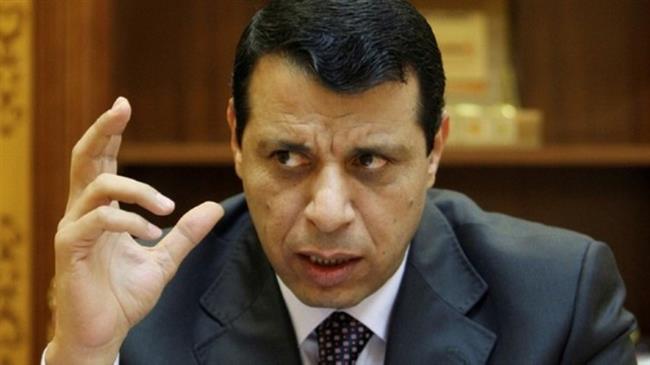
Press TV – February 7, 2021
Several Arab states are reportedly putting pressure on Palestinian political factions to reinstate exiled former Fatah strongman Mohammed Dahlan and field him against Hamas in the upcoming elections.
Sources told Arabic Post news website on Saturday that the UAE, Egypt and Jordan are trying to compel Fatah, Palestine Liberation Organization (PLO) and Palestinian Authority (PA) President Mahmoud Abbas to reinstate the Israeli-backed Dahlan and his supporters.
Abbas dismissed Dahlan from the movement in 2011 and stripped the 58-year-old of all his merits, after which he fled to the United Arab Emirates.
Last September, US Ambassador to Israel David Friedman set off an uproar after suggesting Washington was considering supporting Dahlan to overthrow Abbas as the next Palestinian Authority chief.
Dahlan was sentenced in absentia to three years in prison in 2016 by a Palestinian court for corruption, and ordered to repay $16 million, according to his lawyers.
Dahlan once led a coup against the elected Hamas government in Gaza in 2007. The plan was a massive failure which saw Hamas rout out Dahlan’s forces in a matter of days in the summer of 2007.
President Abbas announced in a decree last month that the 2021 general elections will include legislative elections being held on May 22, presidential elections on July 31 and the Palestinian National Council elections on August 31.
Leaders of 14 Palestinian political factions, including Hamas and Fatah, are scheduled to start a comprehensive national dialog in the Egyptian capital of Cairo on February 8, aiming to reach an agreement on the mechanism for holding the general elections in Palestine.
Sorry, Google and World Bank, but Middle Eastern Crops Keep Thriving

By H. Sterling Burnett | ClimateRealism | November 4, 2020
Google News today is promoting articles (see the Google-promoted PhysOrg article here, for example) about a speculative World Bank “study” claiming climate change is threatening crop production in the Middle East. The World Bank study is full of speculation but short on facts. Real-world data show crop yields per acre and total crop production are consistently and dramatically rising in each of the Middle East countries examined by the World Bank study.
In its study, titled “Water in the Balance,” the World Bank says, “[w]hile information about water scarcity at present and in the future is available there is little knowledge of what this increasing scarcity means for Middle Eastern … food security. Agriculture will suffer because of climate change and water scarcity….”
In particular the World Bank asserts water scarcity caused by climate change will reduce farm production in Iran, Iraq, Jordan, Lebanon, Syria, and Turkey. The available evidence strongly suggests that will not happen.
Had the study’s authors examined real-world data concerning crop production in the Middle Eastern countries, they would have found, even amidst substantial strife in the region, crop yields and overall production have increased dramatically. More food is being produced even as thousands of acres of agricultural lands have been abandoned during regional conflicts.
Data from the U.N. Food and Agriculture Organization show during the period of modest warming since 1989:
- Cereal crop production in Iraq increased 91 percent, even as the acreage being harvested fell 5 percent.
- Cereal crop production in Iran increased 187 percent, while the acreage harvested increased by just 2.6 percent.
- Cereal Crop production in Jordan increased 15 percent, even as the acreage harvested declined 30 percent.
- Cereal Crop production in Lebanon increased 115 percent, while acreage harvested increased 30 percent.
- Cereal Crop production in Syria increased 22 percent, even as acreage harvested declined 66 percent.
- Cereal Crop production in Turkey increased 46 percent, even though acreage harvested declined 19 percent.
It is clearly good news – and not a climate crisis – that Middle Eastern countries have increased crop production despite the fact that many of them have been embroiled in internal political strife, outright civil warfare, and external conflicts. That good news is ignored in the World Bank’s doom-and-gloom report.
Global warming lengthens growing seasons, reduces frost events, and makes more land suitable for crop production. Also, carbon dioxide is an aerial fertilizer for plant life. In addition, crops also use water more efficiently under conditions of higher carbon dioxide, losing less water to transpiration. The latter fact should have allayed the World Bank’s concern about climate change induced water shortages leading to crop failure.
The benefits of more atmospheric carbon dioxide and a modestly warming world have resulted in 17 percent more food being available per person today than there was 30 years ago, even as the number of people has grown by billions. Indeed, the last 20 years have seen the largest decline in hunger, malnutrition, and starvation in human history.
Sorry, World Bank, Google, and PhysOrg, but that does not equate to a climate crisis.
H. Sterling Burnett, Ph.D. is managing editor of Environment & Climate News and a research fellow for environment and energy policy at The Heartland Institute. Burnett worked at the National Center for Policy Analysis for 18 years, most recently as a senior fellow in charge of NCPA’s environmental policy program. He has held various positions in professional and public policy organizations, including serving as a member of the Environment and Natural Resources Task Force in the Texas Comptroller’s e-Texas commission.
The goal of Israel’s 1982 invasion of Lebanon was to turn Jordan into Palestine, says Ehud Barack
MEMO | May 4, 2020
The goal of the First Lebanon War was to bring down the Hashemite Kingdom of Jordan and turn the country into Palestine, former Israeli Prime Minister Ehud Barak has said in a shocking admission about the true intention of the Zionist state.
Israelis were told that the objective of the 1982 invasion of Lebanon was to remove forces belonging to the Palestinian Liberation Organisation and end the threat posed by the resistance group to its northern communities. Barack admitted that this was untrue, explaining that the real goal was to use the “pretext of Palestinian terror” to force the PLO back to Jordan where they would take over government from the Hashemite Kingdom.
“The idea was to use the pretext of Palestinian terror, which they (the PLO) were providing us with, to attack them in south Lebanon and turn that into a leverage [Israel can use] and join the Christian (forces) in Beirut,” Barak said in an interview with Maariv, the sister publication of the Jerusalem Post.
“The assumption was that they (the PLO) will have to return to Jordan and unlike what happened in 1970 (when the late King Hussein ordered the forcible expulsion of the PLO) this time they will be ready and take over the government.”
“And in that way Zion is redeemed,” Barak continued. “In Jordan a Palestinian state will be created and the conflict could be resolved.”
Barack suggested that the PLO would have learnt the lessons of Black September – the 1970 conflict with Jordan which led to the expulsion of Palestinians to Lebanon – and stand a better chance of deposing the late King Hussein.
Barack’s admission would suggest that Israel did not achieve any of its war objectives. A second stated goal was to aid Lebanese Christians in order to gain a regional ally. A Christian-dominated Lebanon was seen as a potential ally, supportive of the Jewish state as two minority-countries in the region.
Not only was this hope dashed when the Christian President of Lebanon Bachir Gemayel was assassinated in September 1982, Israel’s image across the world took a tumble for enabling hundreds of Phalangist fighters – Israel’s paramilitary ally in Lebanon – to carry out a massacre in Sabra and Shatila refugee camp.
Jordanian lawmakers vote to prohibit natural gas imports from Israel
Press TV – January 19, 2020
Jordan’s parliament has voted in favor of a motion to ban natural gas imports from the Occupied Palestinian Territories in the wake of mass protests against the government’s multi-billion-dollar agreement with the Tel Aviv regime.
“The majority has voted to send the urgent motion to the government” requesting a law banning Israeli gas imports to Jordan, said Speaker of the House of Representatives Atef Tarawneh in remarks carried live by state television network on Sunday.
The text states that “the government, its ministries and state institutions and companies are prohibited from importing gas from Israel.”
Video footage showed a majority of legislators in the lower house stand up to back the motion.
The move came after 58 lawmakers out of the 130-strong legislature demanded such a ban in a letter to the parliament last month.
The motion will be passed to the government for approval, and must be sent back to the legislature for a formal vote at the upper house of the parliament.
Earlier this month, Jordan’s National Electric Power Co. said gas pumping from the Occupied Territories had started as part of a ten-billion-dollar deal.
The cash-strapped desert kingdom has defended the agreement, alleging it would cut $600 million a year from the state’s energy bill.
On Friday, hundreds of Jordanians took to the streets of Amman in a demonstration organized by the Jordanian National Campaign Against the Gas Agreement with the Zionist Entity to express their resentment over the “shameful” deal with the Israeli regime.
They called on the government to scrap the gas import agreement, and demanded the ouster of Prime Minister Omar Razzaz.
Last week, hundreds of people protested in the northeastern Jordanian city of Zarqa against the import of natural gas from Israel.
The mayor of Zarqa, Imad al-Momani, called on the authorities to “cancel this humiliating agreement” while speaking to the demonstrators.
On September 26, 2016, Jordan’s National Electric Power Company signed a 10-billion-dollar deal with US-based Noble Energy and Israeli partners in order to tap the Leviathan natural gas field in the Mediterranean Sea off the coast of Israel for the supply of approximately 1.6 trillion cubic feet of natural gas, or 300 million cubic feet per day (mcf/d), over a 15-year term.
On March 26 last year, members of Jordan’s parliament called for the cancellation of the gas deal with Israel during a parliamentary session closed to the public.
Tarawneh stated at the time that all sectors of the society and members of parliament utterly reject Jordanian electricity company agreement to buy Israeli natural gas.
Several legislators argued that the multi-billion-dollar deal violates Article 33, section two of the Jordanian constitution, which states, “Treaties and agreements which entail any expenditures to the Treasury of the State or affect the public or private rights of Jordanians shall not be valid unless approved by the parliament; and in no case shall the secret terms in a treaty or agreement be contrary to the overt terms.”
Lawmaker Saddah al-Habashneh said the deal was unconstitutional, stressing that members of parliament were not given access to read what he called the “secret” deal.
“Why are they hiding it? It’s a clue that there is something. It is totally rejected,” he commented.
Habashneh then demanded the deal be scrapped along with Jordan’s peace accord with Israel – known as Wadi Araba Treaty and signed on October 26, 1994.
“We are calling for the Wadi Araba agreement to be dropped. What is peace when they’re attacking Gaza?” the parliamentarian said.
“And with yesterday’s recognition of the Golan Heights, what’s left? We want dignity,” he said.
On March 25, 2019, US President Donald Trump signed a proclamation, formally recognizing Israel’s ‘sovereignty’ over the Golan Heights. The announcement came as Israeli Prime Minister Benjamin Netanyahu visited the White House.
The Syrian Ministry of Foreign Affairs and Expatriates, in a statement, called the decision a “blatant attack on the sovereignty and territorial integrity” of Syria.
“The liberation of the Golan by all available means and its return to the Syrian motherland is an inalienable right,” according to the statement carried by Syria’s official news agency SANA, which added, “The decision … makes the United States the main enemy of the Arabs.”
The Arab League also condemned the move, saying “Trump’s recognition does not change the area’s status.”
Iran, Iraq, Russia and Turkey also condemned Washington’s move.
Israel seized the Golan Heights from Syria after the 1967 Six-Day War and later occupied it in a move that has never been recognized by the international community. The regime has built dozens of settlements in the area ever since and has used the region to carry out a number of military operations against the Syrian government.
Israel’s countdown to achieve the ‘alternative homeland’ in Jordan begins
By Dr Adnan Abu Amer | MEMO | January 1, 2020
The Israeli right is preparing to present a plan to overthrow the Jordanian king after annexing the Jordan Valley in the West Bank to realise the dream of Jordan being converted to Palestine. They aim to establish a confederation between the PA and “Palestinian Jordan” because the Israeli right is interested in annexing the West Bank without the millions of Palestinians within it. Forcing them to head to Jordan.
Israel’s Haaretz newspaper revealed in late December the Israeli right-wing’s approaches and plans, led by Prime Minister Benjamin Netanyahu. This is based on the claims that Israel has major plans for Jordan, but these plans do not include the same king. This is evidenced by several articles and reports written by right-wing Israeli writers this month who all present similar justifications and results, the main of them all is to destroy the peace treaty with Jordan.
Right-wing Israelis believe that annexing the Jordan Valley is a tactical operation aimed at hitting two Israeli birds with one stone: the first is to work to annex the West Bank and cancel the peace agreement with Jordan, and the second is to topple the Hashemite royal family and to embody the dream of Jordan being Palestine.
It is interesting that this dream is shared by all the Israeli right, with all its components and currents, because they are enthusiastic supporters of the idea that Jordan is Palestine. The ruling Israeli right has begun to detest King Abdullah II.
When King Abdullah is shamefully toppled, Israel will be able to complete its annexation of the West Bank and establish a confederation between the Palestinian Authority and “Palestinian Jordan”.
Moreover, according to the Israeli perception, when that happens, the Palestinians in the West Bank will obtain political rights in Jordan.
According to this Israeli theory, when the Palestinian state is established in Jordan, the Palestinians can resolve their issue, put an end to their suffering and stop using armed operations against Israel, because since 1988, Palestinians in the West Bank have been able to obtain temporary Jordanian passports.
It is worth noting that the Israeli approach may contradict Jordan’s interest in reducing the total number of Palestinians in the kingdom because it refuses at the moment to receive Palestinian refugees from Syria in the way it allowed Syrian and Iraqi refugees to seek refuge on its soil.
Perhaps such aspirational Israeli calls towards Jordan are encouraged by the fact that the two-state solution to the Palestinian-Israeli conflict is no longer practical or realistic. Meanwhile, there are claims that the alternative solution is the establishment of an Arab Palestinian state east of the Jordan River, which will achieve peace between Israel and Palestine. They also claim that the river can be used to transport goods and products from either side, with the Israeli Jewish state on one side and the Arab Palestinian country on the other, side by side.
There is another Israeli scenario of Jordan hosting more Palestinians and instead of the kingdom becoming a Palestinian republic, they become citizens with full rights in the Hashemite Kingdom.
The return of Gilad Sharon after a long absence was noteworthy. He is the son of the late Prime Minister Ariel Sharon, who had strong relations with the late King Hussein, King Abdullah’s father. Gilad Sharon returned to claim that the current Jordanian king would not dare to oppose the annexation of the Jordan Valley by Israel, because Israel has him by his weak spot and the continuation of his rule depends on Israel. He also said that if the king opened his mouth, Israel would turn off the water tap and leave the kingdom to go thirsty.
All these are efforts to drive the king to cancel the peace agreement with Israel and allow Tel Aviv to remove him.
King Abdullah finds himself caught between the anger of the Jordanian public and Israel. The situation of his government has become really difficult because his country’s budget is suffering, the sources of income are declining, the Gulf states, which have always been a source of support for Jordan, have reduced their aid, and millions of Arab refugees have flocked to the kingdom in recent years.
In spite of the increase of tensions between Jordan and Israel over the past year, security coordination between them continues as usual and the intelligence cooperation is at its best. This raises questions about the king failing to use this card to pressure Israel unless this cooperation serves him and not the kingdom.
Canada Wants to Be an ‘Asset of Israel’ at the UN Security Council
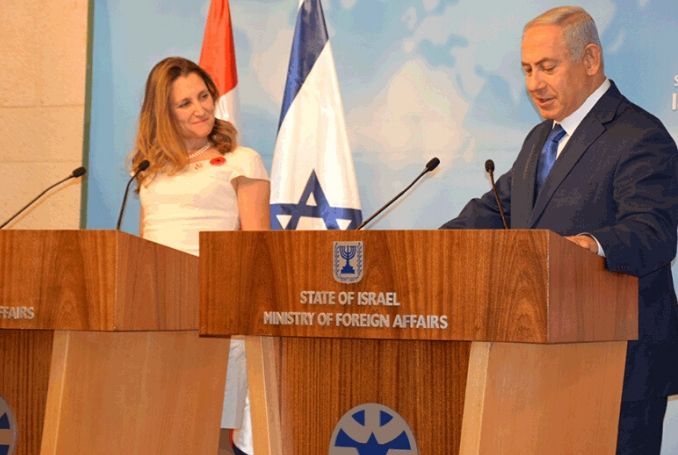
Deputy PM of Canada, Christya Freeland (L), and Israeli PM Benjamin Netanyahu. (Photo: Supplied)
By Hanna Kawas | Palestine Chronicle | December 30, 2019
Canadian activists have compiled a study of Canada’s 2019 voting record at the United Nations on resolutions that document and censure Israeli violations of international law.
There was much fanfare made about Canada’s orphan “yes” vote at the UN General Assembly this year on “The right of the Palestinian people to self-determination” resolution. But in the broader context of the other 17 resolutions calling out Israel’s war crimes, that Canada either voted against (15) or abstained on (2), this lone vote can only be seen as deceptive and hypocritical.
Justin Trudeau, explaining his government’s vote to Canadian Zionists, stated:
“The government felt that it was important to reiterate its commitment to a two-states-for-two-peoples solution at a time when its prospects appear increasingly under threat”.
However, if the Trudeau government was really committed to a “two-states-for-two-peoples solution”, it is inconceivable that at the same time they also voted against:
- A resolution to support the work of the “Committee on the Exercise of the Inalienable Rights of the Palestinian People” that affirms the UN “has a permanent responsibility towards the question of Palestine until the question is resolved in all its aspects”;
- The “Peaceful settlement of the question of Palestine” resolution that calls “on Member States not to recognize any changes to the pre-1967 borders, including with regards to Jerusalem”;
- “The Syrian Golan” resolution that “Demands once more that Israel withdraw from all the occupied Syrian Golan to the line of 4 June 1967 in implementation of the relevant Security Council resolutions”;
- “Permanent sovereignty of the Palestinian people in the Occupied Palestinian Territory, including East Jerusalem, and of the Arab population in the occupied Syrian Golan over their natural resources” resolution;
- The resolution that condemns the “Israeli settlements in the Occupied Palestinian Territory, including East Jerusalem, and the occupied Syrian Golan” and reaffirms the “inadmissibility of the acquisition of territory by force”; and
- The resolution concerning “Israeli practices affecting the human rights of the Palestinian people in the Occupied Palestinian Territory, including East Jerusalem” that expresses “grave concern about the continuing systematic violation of the human rights of the Palestinian people by Israel”.
And finally, why would Canada vote against a resolution to uphold the rights of “Persons displaced as a result of the June 1967 and subsequent hostilities”, unless it supports Israel’s ethnic cleansing of the West Bank and the “Greater Israel Project”?!
Some observers have speculated that Canada’s lone vote was motivated by Trudeau’s desire to obtain a seat on the UN Security Council. Over a year ago, then Foreign and now Deputy PM Chrystia Freeland was quoted as follows during a visit to Israel:
“She also mentioned Canada’s current bid for one of 10 non-permanent seats on the UN Security Council for 2021-2022, which she hoped would allow Canada to serve as an ‘asset for Israel and… strengthen our collaboration’.”
So, this is what Canada plans to do if it gets sufficient votes for a seat, be an “asset for Israel”?
Canada is relying on the votes, and possible lobbying, of some Arab reactionary regimes to get the backing required for the Security Council seat; one example is Jordan.
Just last month during a visit, “Jordan’s King Abdullah II told Prime Minister Justin Trudeau that the Middle Eastern kingdom supports Canada’s bid for a seat on the United Nations Security Council”. This was according to Jordan’s ambassador to Canada, Majed Alqatarneh, who also said Jordan “believes it is important that Canada have a seat on the Security Council”.
Canada also seems to be counting on the support of certain diplomatic circles from the US; former U.S. ambassador to Ottawa, Bruce Heyman stated:
“For me, today, when the U.N. General Assembly is all together, a Canadian seat on the U.N. Security Council is more important than ever”.
We tell Mr. Trudeau that instead of your objective of getting a seat at the UN Security Council, you may end up with a seat in front of the ICC. If the “two-states-for-two-peoples solution… prospects appear increasingly under threat”, it is because of Canada’s (and others) unconditional support for Israeli occupation, war crimes, and apartheid.
– Hanna Kawas is Chairperson of the Canada Palestine Association and co-host of Voice of Palestine. Visit: http://www.cpavancouver.org.
Jordan protests expected ahead of Israel gas deal
MEMO | December 16, 2019
Jordan is expected to witness a wave of popular protests as the implementation of a $10 billion gas deal with Israel looms on the horizon. Activists and lawmakers in the Hashemite Kingdom have been calling on the government to cancel the agreement with Israel, saying that the US has forced Jordan to sign the deal despite its economic and moral prejudices.
According to its opponents, the agreement about “the gas stolen from Palestine” stipulates that if any gas fields are discovered in Jordan during the lifespan of the deal, the buyer (Jordan) may not reduce the import price by more than 20 per cent.
Campaigners calling for the cancellation of the agreement have asked for a meeting next Tuesday to discuss ways to convince the government to cancel it. The Coordinator of the national campaign to cancel the gas agreement with Israel, Hisham Al-Bustani, told Quds Press : “There are two ways to confront the agreement with its imminent implantation date at the beginning of next month. We either press parliament to stop its implementation, or wait for popular escalation through vigils.”
Raed Al-Khazaaleh is the Chairman of the Foreign Affairs Committee in the Jordanian House of Representatives. He has also called for the gas agreement with Israel to be cancelled. Anyone who signed it, he insists, must be held accountable.
In 2016, Israel signed a $10 billion deal with the Jordan Electric Power Company to supply Amman with natural gas for 15 years. The agreement will provide the Kingdom with approximately 45 billion cubic metres of gas from the Leviathan offshore gas field.
Israel has previously stated that some of the deal’s revenues will be paid towards the military budget. It is expected to start pumping gas to Jordan in January.
Jordan seeks to restore diplomatic relations with Syria: Minister
Press TV – December 6, 2019
Jordan plans to restore full diplomatic relations with neighboring Syria in a further sign of Arab states embracing President Bashar al-Assad after a UAE diplomat praised him for “wise leadership” this week.
Jordanian Minister of State and Agriculture Samir Habashneh said Thursday he will travel to Syria later this month as part of a nearly 30-strong delegation, Arabic- language Ammon news website reported.
Former Prime Minister Taher al-Masri will head the delegation to restore Amman-Damascus bilateral relations to the level prior to the outbreak of foreign-sponsored Syrian conflict, it said.
Habashneh said Jordan and Syria actually have common areas of interest, stressing that the visit should have taken place much earlier in order to enhance communication between the two countries.
Commenting on a possible meeting with President Assad, he stated that the matter is in the hands of the Syrian side, and that the Jordanian delegates would like to sit for talks with the 54-year-old Syrian leader, senior officials and representatives of the Syrian people.
Jordan’s official Petra news agency, citing Foreign Ministry spokesman Sufian Qudah, reported earlier this year that the Amman government had appointed a new chargé d’affaires to its embassy in Damascus.
“It was decided to appoint a Jordanian diplomat at the rank of charge d’affaires in the Jordanian embassy in Damascus,” the Jordanian official said.
He underlined that the “decision has been made in line with Jordan’s stance since the outbreak of the Syrian crisis in 2011 to keep the Jordanian embassy in Damascus open.”
Jordanian lawmakers first asked for the improvement of Jordan-Syria ties to the level before the start of the Syrian crisis last year, stressing that the relations are beneficial to both nations, Arabic-language Rai al-Youm newspaper reported last December.
Around the same time, Bahrain announced that work at the kingdom’s embassy “in the Syrian Arab Republic is going on whilst the Embassy of the Syrian Arab Republic to the Kingdom of Bahrain is carrying out its duties and flights connecting the two countries are operational without interruption.”
It came a day after the United Arab Emirates officially reopened its embassy in Damascus.
Earlier this week, the UAE’s top diplomat in Syria praised President Assad for his “wise leadership”, in one of the strongest expressions of support yet from a country that once backed Damascus’ enemies in the war.
Speaking at a ceremony to mark UAE national day on Dec. 2, UAE charge d’affaires Abdul-Hakim Naimi said he hoped “security and stability prevails throughout the Syrian Arab Republic under the wise leadership of President Bashar Al-Assad.”
“Syria-UAE relations are solid, distinct and strong,” he added, according to a video posted by Russian broadcaster RT.
Arab countries’ restoration of diplomatic ties with Damascus takes place at a time when the Syrian army troops are finalizing their victory against foreign-backed terror groups and restoring peace and stability to the war-torn country.
Earlier this year, Reuters news agency cited sources as saying that Washington had lobbied Persian Gulf states including the UAE to hold off restoring ties with Syria.
Syria has been gripped by foreign-backed militancy since March 2011. The Syrian government says the Israeli regime and its Western and regional allies are aiding Takfiri terrorist groups wreaking havoc in the country.
A lesson for the Palestinian leadership: Real reasons behind Israel’s arrest and release of Labadi, Mi’ri

Jordanian citizen Heba Al-Labadi (C), following detention by Israeli forces, was released from prison and returned to Jordan on 6 November 2019
By Ramzy Baroud | MEMO | November 11, 2019
The release on November 6 of two Jordanian nationals, Heba al-Labadi and Abdul Rahman Mi’ri from Israeli prisons was a bittersweet moment. The pair were finally reunited with their families after harrowing experiences in Israel. Sadly, thousands of Palestinian prisoners are still denied their freedom, still subjected to all sorts of hardships at the hands of their Israeli jailers.
Despite the jubilant return of the two prisoners, celebrated in Jordan, Palestine and throughout the Arab world, several compelling questions remain unanswered: why were they held in the first place? Why were they released and what can their experience teach Palestinians under Israeli occupation?
Throughout the whole ordeal, Israel failed to produce any evidence to indict Labadi and Mi’ri for any wrongdoing. In fact, it was this lack of evidence that made Israel hold the two Jordanian nationals in Administrative Detention, without any judicial process whatsoever.
Oddly, days before the release of the two Jordanians, an official Israeli government statement praised the special relationship between Amman and Tel Aviv, describing it as “a cornerstone of stability in the Middle East”.
The reality is that the relationship between the two countries has hit rock bottom in recent years, especially following US President Donald Trump’s advent to the White House and the subsequent, systematic dismantling of the “peace process” by Trump and the Israeli government.
Not only did Washington and Tel Aviv demolish the region’s political status quo, one in which Jordan featured as a key player, top US diplomats also tried to barter with King Abdullah II so that Jordan would settle millions of Palestinian refugees in the country in exchange for large sums of money.
Jordan vehemently rejected US offers and attempts at isolating the Palestinian leadership in Ramallah.
On October 21, 2018, Jordan went even further, by rejecting an Israeli offer to renew a 25-year lease on two enclaves in the Jordan Valley, Al-Baqura and Al-Ghamar. The government’s decision was a response to protests by Jordanians and elected parliamentarians, who insist on Jordan’s complete sovereignty over all of its territories.
This particular issue goes back years. Jordan and Israel signed a peace treaty in 1994. An additional annex in the treaty allowed Israel to lease part of the Jordan Valley for 25 years. A quarter of a century later, the Jordan-Israel Peace Treaty failed to achieve any degree of meaningful normalization between both countries, especially as neighboring Palestine remains under Israeli occupation. The stumbling block of that coveted normalization was – and remains – the Jordanian people, who strongly rejected a renewed Israeli lease over Jordanian territories.
Israeli negotiators must have been surprised by Jordan’s refusal to accommodate Israeli interests. With the US removing itself, at least publicly, from the brewing conflict, Israel resorted to its typical bullying, by holding two Jordanians hostage, hoping to force the government to reconsider its decision regarding the Jordan Valley.
![Palestinians stage a demonstration in support of Palestinian-Jordanian woman Hiba Al-Labadi, who stages a hunger strike after she was arrested by Israeli forces, in East Jerusalem on 31 October 2019. [Mostafa Alkharouf - Anadolu Agency]](https://i0.wp.com/www.middleeastmonitor.com/wp-content/uploads/2019/11/20191031_2_39089439_49038745.jpg?resize=933.5%2C622&quality=85&strip=all&ssl=1)
Palestinians demonstrate in support of hunger striking Hiba Al-Labadi, after her arrest by Israeli forces, in East Jerusalem on 31 October 2019. [Mostafa Alkharouf – Anadolu Agency ]
The Israeli strategy backfired. The arrest of Labadi – who started a hunger strike that lasted for over 40 days – and Mi’ri, a cancer survivor, was a major PR disaster for Israel. Not only did the tactic fail to deliver any results, it further galvanized the Jordanian people, and government regarding the decision to reclaim Al-Baqura and al-Ghamar.
Labadi and Mi’ri were released on November 6. The following day, the Jordanian government informed Israel that its farmers will be banned from entering Al-Baqura area. This way, Jordan retrieved its citizens and its territories within the course of 24 hours.
Three main reasons allowed Jordan to prevail in its confrontation with Israel. First, the steadfastness of the prisoners themselves; second, the unity and mobilization of the Jordanian street, civil society organizations and elected legislators; and third, the Jordanian government responding positively to the unified voice of the street.
This compels the question: what is the Palestinian strategy regarding the nearly 5,000 Palestinian prisoners held unlawfully in Israel?
While the prisoners themselves continue to serve as a model of unity and courage, the other factors fundamental to any meaningful strategy aimed at releasing all Palestinian prisoners remain absent.
Although factionalism continues to undermine the Palestinian fight for freedom, prisoners are fighting the same common enemy. The famed “National Conciliation Document”, composed by the unified leadership of Palestinian prisoners in Israeli jails in 2006, is considered the most articulate vision for Palestinian unity and liberation.
For ordinary Palestinians, the prisoners remain an emotive subject, but political disunity is making it nearly impossible for the energies of the Palestinian street to be harnessed in a politically meaningful way. Despite much lip service paid to freeing the prisoners, efforts aimed at achieving this goal are hopelessly splintered and agonizingly factionalized.
As for the Palestinian leadership, the strategy championed by Palestinian Authority leader, Mahmoud Abbas, is more focused on propping up Abbas’ own image than alleviating the suffering of the prisoners and their families. Brazenly, Abbas exploits the emotional aspect of the prisoners’ tragedy to gain political capital, while punishing the families of Palestinian prisoners in order to pursue his own self-serving political agenda.

Jordanian citizen Heba Al-Labadi (C) was released from an Israeli prison and has returned to Jordan on 6 November 2019
“Even if I had only one penny, I would’ve given it to the families of the martyrs, prisoners and heroes,” Abbas said in a theatrical way during his United Nations General Assembly speech last September.
Abbas, of course, has more than one penny. In fact, he has withheld badly needed funds from the families of the “martyrs, prisoners and heroes.” On April 2018, Abbas cut the salaries of government employees in Gaza, along with the money received by the families of Gaza prisoners held inside Israeli jails.
Heba al-Labadi and Abdul Rahman Mi’ri were released because of their own resolve, coupled with strong solidarity exhibited by ordinary Jordanians. These two factors allowed the Jordanian government to publicly challenge Israel, leading to the unconditional release of the two Jordanian prisoners.
Meanwhile, thousands of Palestinian prisoners, including 500 administrative detainees continue to languish in Israeli prisons. Without united and sustained popular, non-factional mobilization, along with the full backing of the Palestinian leadership, the prisoners are likely to carry on with their fight, alone and unaided.
See also:
Israel and the PA: security relations have never been better
Jordanian Detained by Israel Says He was Used as ‘Bargaining Chip’ for Jordan Valley Lands

Heba al Labadi and Abdul Rahman Miri have been held in Israeli prisons without charges for over two months
Palestine Chronicle – November 10, 2019
A Jordanian man formerly detained in Israel has accused the neighboring country of using him and another prisoner as “bargaining chips” to prevent the loss of two Jordan Valley territories.
Abdul Rahman Miri, a Jordanian citizen of Palestinian descent, was held by the Israeli authorities for months without charge alongside fellow Jordanian Heba al-Labadi.
Their detention was not the only issue causing a diplomatic scuffle between Israel and Jordan over the past months, however.
The kingdom announced last year it would not extend a lease to Israel on two pieces of land in the Jordan Valley, ending 25 years of de facto Israeli authority over the Al-Baqura and Al-Ghamar areas.
Despite Jordan announcing its intention a year in advance of the leases’ expiration, Israeli officials and civilians in the valley have reportedly continued to hold out hope that Israeli farmers will continue to be able to live and work on the land.
Speaking on the sidelines of a meeting held by the National Committee for Jordanian Detainees and Missing Persons Held in Israeli Prisons on Friday, Miri alleged that the Israeli authorities had attempted to use his and Labadi’s detention as a “bargaining chip” with which to secure the continued lease of al-Baqura and al-Ghamar.
The Wadi Araba peace deal, signed in 1994, restored diplomatic and economic relations between Jordan and Israel. As part of the agreement, the kingdom leased Israel the Jordan Valley farmlands.
The agreement is highly contentious in Jordan, of which a significant number of citizens are of Palestinian descent. Anti-normalization activists in the kingdom have previously called for the cancellation of the Wadi Araba treaty.
Miri and Labadi returned to Jordan on Wednesday after months in detention, where they were allegedly tortured after being accused of links to Hezbollah and Hamas.
Their release came a week after Jordan recalled its ambassador to Israel over their detention.
Jordan has said Israeli citizens will be banned from entering Baqura from Sunday onward.
The kingdom has not yet stated whether Israeli farmers will be allowed to access lands in al-Ghamar.
Featured Video

Iran FM Araghchi: “Hormuz Will No Longer Be the Same”
or go to
Aletho News Archives – Video-Images
From the Archives
Sam Husseini: The entire US establishment helped lie their way into the Iraq war
By Slava Zilber | American Herald Tribune | October 14, 2019
Sam Husseini is a senior analyst with the Institute for Public Accuracy, independent journalist and contributor to The Nation and FAIR.
Slava Zilber: Sam, three years ago, you appeared on Talk Nation Radio with David Swanson and spoke about the case of the GCHQ whistleblower Katharine Gun. You pointed out that the people involved in the spying on the UN and the people authorizing the Iraq War were not held accountable:
“Virtually everybody who went along with the war, whether it is Kerry or Clinton, of course, the Bush administration themselves has falsified their own records in terms of why, what they did, when they did, why they did it, to the extent that they’ve been scrutinised at all.”
You also address it in a recent article. And recently, Joe Biden has been lying about his position on the Iraq War. How can such an important issue escape meaningful scrutiny? … continue
Blog Roll
 Aletho News
- Oman FM: Persian Gulf states, Iran, Iraq should form security pact excluding US
- Trump peddles fresh falsehoods, claims Iran ‘started the war’ as US aggression drags on
- Ukraine quagmire? Yes, but it’s for NATO, not Russia
- US intelligence hypes Chinese, Russian space threats while accelerating its own military buildup in orbit
- Iran FM Araghchi: “Hormuz Will No Longer Be the Same”
- EU facing trillion-euro debt hole while seeking more cash for Kiev
- How US, Europe, Persian Gulf states exhausted missile stockpiles, splurged billions to defend Israel
- Up in arms… Koreans reject U.S. empire’s plan to make South Korea the next Ukraine
- Iran, Turkey, Pakistan, Saudi Arabia could advance region-led security framework in Tehran: FM spox
- Netizens condemn Japanese drama for projecting Japan’s wartime atrocities onto Chinese characters
- If Americans Knew
- An error has occurred; the feed is probably down. Try again later.
- No Tricks Zone
- Sudden Stratospheric Warming, Powerful El Niño Combination May Lead To Extreme Europe Cold, Energy Crisis!
- Two New Studies Find Thwaites Glacier Melt Cannot Be Driven By Human Activity Or A Warming Ocean
- E-Cars Reduce CO2 Emissions By Only 41% Compared To Internal Combustion Engine Vehicles
- Predictions Made By Renowned Climate Professor Over Past Decades Have Been Proven To Be Poor
- New Study Suggests Large Regions Of The Pacific Ocean Have Been Cooling For The Last 80 Years
- Germany’s Green Energy Debacle: High Energy Costs Force Kahla Porzellan to Close After 182 Years!
- New Study: 50 Years Of The Most Aggressive ‘Net Zero’ Policies Can Only Affect The Global Climate By 0.03°C
- US September “Heat” Was No Record…Many Records Set Decades Ago
- Latest European Green Energy Debacle; Portugal’s Largest Flagship Solar Park Insolvent!
- Green Energy Debacle: German Expert Professor Fritz Vahrenholt Warns Of Severe Economic And Social Consequences

