By Whitney Webb | MintPress News | June 24, 2019
The iconic golden dome of the Dome of the Rock and Al-Aqsa mosque, located on the Temple Mount or Haram el-Sharif, is the third holiest site in Islam and is recognized throughout the world as a symbol of the city of Jerusalem. Yet, this ancient site that dates back to the year 705 C.E. is being targeted for destruction by increasingly influential extremist groups that seek to erase Jerusalem’s Muslim heritage in pursuit of colonial ambitions and the fulfillment of end-times prophecy.
Some observers may have noticed the growing effort by some Israeli government and religious officials to remove the Dome of the Rock and Al-Aqsa mosque from the Jerusalem skyline, not only erasing the holy site in official posters, banners and educational material but also physically removing the building itself. For instance, current Knesset member of the ruling Likud Party, American-born Yehuda Glick, was also the director of the government-funded Temple Institute, which has created relics and detailed architectural plans for a temple that they hope will soon replace Al-Aqsa. Glick is also close friends with Yehuda Etzion, who was part of a failed plot in 1984 to blow up Al-Aqsa mosque and served prison time as a result.
“In the end we’ll build the temple and it will be a house of prayer for all nations,” Glick told Israeli newspaper Maariv in 2012. A year later, Israel’s Agriculture Minister Uri Ariel stated that “[w]e’ve built many little, little temples… but we need to build a real Temple on the Temple Mount.” Ariel stated that the new Jewish Temple must be built on the site where Al-Aqsa currently sits “as it is at the forefront of Jewish salvation.” Since then, prominent Israeli politicians have become more and more overt in their support for the end of Jordanian-Palestinian sovereignty over the mosque compound, leading many prominent Palestinians to warn in recent years of plans to destroy the mosque.
In recent years, a centuries-old effort by what was once a small group of extremists has gone increasingly mainstream in Israel, with prominent politicians, religious figures and political parties advocating for the destruction of the Dome of the Rock and Al-Aqsa mosque in order to fulfill a specific interpretation of an end-times prophecy that was once considered fringe among practitioners of Judaism.
As Miko Peled, Israeli author and human-rights activist, told MintPress, the movement to destroy Al-Aqsa and replace it with a reimagined Temple “became notable after the 1967 war,” and has since grown into “a massive colonial project that uses religious, biblical mythology and symbols to justify its actions” — a project now garnering support from both religious and secular Israelis.
While the push to destroy Al-Aqsa and replace it with a physical Third Temple has gained traction in Israel in recent years, this effort has advanced at a remarkably fast pace in just the past few weeks, owing to a confluence of factors. These factors, as this report will show, include the upcoming revelation of the so-called “Deal of the Century,” the push for a war with Iran and Lebanon’s Hezbollah, and the Trump administration’s dramatic lenience in regards to the activity of Jewish extremist groups and extremist settlements in Israel.
These factors correlate with a quickening of efforts to destroy Al-Aqsa and the very real danger the centuries-old holy site faces. While the U.S. press has occasionally mentioned the role of religious extremism in dictating the foreign policy of prominent U.S. politicians like Secretary of State Mike Pompeo, it has rarely shone a light on the role of Jewish extremism in directing Israel’s foreign policy — foreign policy that, in turn, is well-known to influence American policies.
When taken together, the threats to Al-Aqsa are clearly revealed to be much greater than the loss of a physical building, though that itself would be a grave loss for the world’s Muslim community, which includes over 1.8 billion people. In addition, the site’s destruction would very likely result in a regional and perhaps even global war with clear religious dimensions.
To prevent such an outcome, it is essential to highlight the role that extremist, apocalyptic interpretations of both the Jewish and Christian faiths are playing in trends that, if left unchecked, could have truly terrifying consequences. Both of these extremist groups are heavily influenced by colonial ambitions that often supersede their religious underpinning.
In Part I of this two-part series, MintPress examines the growth of extremist movements in Israel that openly promote the destruction of Al-Aqsa, from a relatively isolated fringe movement within Zionism to mainstream prominence in Israel today; as well as how threats to the historic mosque have grown precipitously in just the past month. MintPress interviewed Israeli author and activist Miko Peled; Rabbi Yisroel Dovid Weiss of Neturei Karta in New York; Imam and scholar of Shia Islam, Sayed Hassan Al-Qazwini, of the Islamic Institute of America; and Palestinian journalist and academic Ramzy Baroud for their perspectives on these extremist groups, their growing popularity, and the increasing threats to the current status quo at Haram El-Sharif/Temple Mount.
The second part of this series will detail the influence of this extremist movement in Israeli politics as well as American politics, particularly among Christian Zionist politicians in the United States. The ways in which this movement’s goal have also influenced Israeli and U.S. policy — particularly in relation to the so-called “Deal of the Century,” President Donald Trump’s recognition of Jerusalem as Israel’s capital, and the push for war against Iran and Lebanon’s Hezbollah — will also be examined.
Two centuries in the cross-hairs
Though efforts to wrest the contested holy site from Jordanian and Palestinian control have picked up dramatically in recent weeks, the Al-Aqsa mosque compound had long been targeted prior to Israel’s founding and even prior to the formation of the modern Zionist movement.
For instance, Rabbi Zvi Hirsh Kalisher — who promoted the European Jewish colonization of Palestine from a religious perspective well before Zionism became a movement — expounded on an early form of what would later be labeled “religious Zionism” and was particularly interested in the acquisition of Haram el-Sharif (i.e., the Temple Mount) as a means of fulfilling prophecy.
As noted in the essay “Proto-Zionism and its Proto-Herzl: The Philosophy and Efforts of Rabbi Zvi Hirsch Kalisher” by Sam Lehman-Wilzig, Professor of Israeli Politics and Judaic Studies at Bar-Ilan University in Israel, Kalisher sought to court wealthy European Jews to finance the purchase of Israel for the purpose of resettlement, particularly the Temple Mount. In an 1836 letter to Baron Amschel Rothschild, Kalisher suggested that the eldest brother of the wealthy banker family use his abundant funds to bring Jewish sovereignty to Palestine, specifically Jerusalem and the Temple Mount:
[E]specially at a time like this, when the Land of Israel is under the dominion of the Pasha… perhaps if his most noble Excellency pays him a handsome sum and purchases for him some other country (in Africa) in exchange for the Holy Land, which is presently small in quantity but great in quality… this money would certainly not be wasted… for when the leaders of Israel are gathered from every corner of the world… and transform it into an inhabited country, the many G-d-fearing and charitable Jews will travel there to take up their residency in the Holy Land under Jewish sovereignty… and be worthy to take up their portion in the offering upon the altar. And if the master (Ibrahim Pasha) does not desire to sell the entire land, then at least he should sell Jerusalem and its environs… or at least the Temple Mount and surrounding areas.” (emphasis added)
Kalisher’s request was met with a noncommittal response from Baron Rothschild, leading Kalisher to pursue other wealthy European Jewish families, like the Montefiores, with the same goal in mind. And, though Kalisher was initially unsuccessful in winning the support of the Rothschild family, other notable members of the wealthy European banking dynasty eventually did become enthusiastic supporters of Zionism in the decades that followed.
Kalisher was also influential in another way, as he was arguably the first modern Rabbi to reject the idea of patiently waiting for God to fulfill prophecy and proposed instead that man should take concrete steps that would lead to the fulfillment of such prophecies, a belief that Kalisher described as “self help.” For Kalisher, settling European Jews in Palestine was but the first step, to be followed by other steps that would form an active as opposed to a passive approach towards Jewish Messianism. These subsequent steps included the construction of a Third Temple, to replace the Second Temple destroyed by the Romans around the year 70 C.E., and the reinitiation of ritual animal sacrifices in that Temple, which Kalisher believed could only be placed on the Temple Mount, where Al-Aqsa then sat and still sits.
Kalisher wasn’t alone in his views, as his contemporary, Rabbi Judah Alkalai, wrote the following in his book Shalom Yerushalayim:
It is obvious that the Mashiach ben David [Messiah of the House of David] will not appear out of thin air in a fiery chariot with fiery horses, but will come if the Children of Israel bend to the task of preparing themselves for him.”
Though Kalisher wasn’t the lone voice promoting these ideas, his beliefs — aside from promoting the physical settlement of European Jews in Palestine — remained relatively fringe for decades, if not more than a century, as secular Jews were hugely influential in the Zionist movement after its official formation. However, prominent religious Zionists did influence the Zionist movement in key ways prior to Israel’s founding. One such figure was Rabbi Abraham Isaac Kook, who sought to reconcile Zionism and Orthodox Judaism as the Ashkenazi Chief Rabbi of Palestine, a position he assumed in 1924.
Yet, Rabbi Yisroel Dovid Weiss of Neturei Karta, an ultra-Orthodox Jewish group based in New York that opposes Zionism, told MintPress that many religious Zionists have since latched onto Kalisher’s ideas, which were widely rejected during his lifetime, in order to justify neocolonial actions sought by secular Zionists. “This rabbi, at the time, other rabbis ‘roared’ against him and his beliefs weren’t accepted,” Rabbi Weiss stated, “But now, the ones who are talking about building this Third Temple…. these are Zionists and they have found some rabbi whose ideas benefit them that they have been using to justify Zionist acts” that are not aligned with Judaism “and make them kosher.”
Weiss further expanded on this point, noting that the participants of the modern religious Zionism movement that seek to build a new Jewish temple where Al-Aqsa currently stands are, at their core, Zionists who have used religious imagery and specific interpretations of religious texts as cover for neo-colonial acts, such as the complete re-making of the Temple Mount.
“It’s like a wolf in a sheepskin… These people who want to incorporate the teachings of this rabbi [Rabbi Kalisher] are proudly saying that they are Jewish, but are doing things Jews are forbidden from doing,” such as ascending to and standing upon the Temple Mount, which Rabbi Weiss stated was “a breach of Jewish law,” long forbidden by that law according to a consensus among Jewish scholars and rabbis around the world that continued well beyond the formation of the Zionist movement in the 19th century.
Weiss also told MintPress:
There are only a few sins in Judaism — which has many, many laws, that lead to a Jew being cut off from God — and to go up to the Temple Mount is one of them… This is because you need a certain level of holiness to ascend and… the process to attain that level of holiness and purity cannot be done today, because [aspects of and the items required by] the necessary purity rituals no longer exist today.”
Rabbi Weiss noted that, for this reason, the Muslim community that has historically governed the area where Al-Aqsa mosque stands never had any problems with the Jewish community in relation to the Temple Mount, as it has been known for centuries that Jews cannot ascend to the area where the mosque currently sits and instead prayed only at the Western Wall. He also stated that the prophetic idea of a Third Temple was, prior to Zionism, understood as indicating not a change in physical structures on the Temple Mount, but a metaphysical, spiritual change that would unite all of mankind to worship and serve God in unison.
Rabbi Weiss asserted that the conflict regarding Al-Aqsa mosque started only with the advent of Zionism and the associated neo-colonial ambition to fundamentally alter the status quo and structures present at the site as a means of erasing key parts (i.e., Palestinian parts) of its heritage. “This [the use of religion to justify ascending to and taking control of the Temple Mount] is a trap for conning other people into supporting them,” concluded the Rabbi.
Nonetheless, Kalisher’s impact can be seen in today’s Israel more than ever, thanks to the rise and mainstream acceptance within Israel of once-fringe elements of religious Zionism, which were deeply influenced by the ideas of rabbis like Kalisher and have served in recent decades as an incubator for some of Israel’s most radical political elements.
Meanwhile, as the debate within Judaism over the Temple Mount has changed dramatically since the 19th century, its significance in Islam has remained steadfast. According to Imam Sayed Hassan Al-Qazwini, “Al-Aqsa is the third holiest mosque in Islam… it is considered to be the place where the Prophet Muhammad ascended to heaven and has been mentioned in the Qoran, which glorifies that mosque and identifies it as a blessed mosque. All Muslims, whether they are Sunni or Shia, revere that mosque” — a fact that has remained unchanged for over a millennium and continues to today.
Religious Zionism gains political force
The modern rise of the religious Zionist movements that promote the destruction of Al-Aqsa mosque and its replacement with a Third Jewish Temple is most often traced back to the Six Day War of 1967. According to Miko Peled, who recently wrote a piece for MintPress News regarding the threats facing Al-Aqsa, “religious Zionism” as a political force became more noticeable following the 1967 war. Peled told MintPress:
After the ‘heartland’ of Biblical Israel came under Israeli control, the religious Zionists, who before then were marginalized, saw it as their mission to settle those newly conquered lands, and to be the new pioneers, so to speak. They took on the job that the socialist Zionist ideologues had in settling Palestine and ridding it of its native Arab population in the years leading up to Israel’s establishment and up to the early 1950s. They saw the “return” of Hebron, Bethlehem, Nablus, or Shchem and, of course, the Old City of Jerusalem as divine intervention and now it was their turn to make their mark.
It began with a small group of Messianic fanatics who forced the government – who at that point, after 1967, was still secular Zionist – to accept their existence in the highly populated areas within the West Bank. That was how the city of Kiryat Arba [illegal settlement in the occupied West Bank] was established. The government, it is worth noting, was happy to be forced into this. From a small group that people thought were fringe lunatics to a Jewish city in the heart of Hebron region.”
Peled further noted that this model, employed by the religious extremist groups that founded illegal West Bank settlements like Kiryat Arba, “has been used successfully since then and it is now used by the groups that are promoting the new Temple in place of Al-Aqsa mosque in Jerusalem.” He continued, pointing out that “whereas 20-30 years ago they were considered a fringe group, this year they expect more than 50,000 people to enter the compound to support the group and their goals. Religious Israeli youth who opt out of military service and choose national service instead may work with the [Third] Temple building organizations.”

Extremist settlers escorted by Israeli after they stormed the Al-Aqsa Mosque compound on July 22, 2018. Mostafa Alkharouf | Anadolu
Dr. Ramzy Baroud — journalist, academic and founder of The Palestine Chronicle — agreed with Peled’s sense that the Third Temple movement or Temple Activist movement has grown dramatically in recent years and has become increasingly mainstream in Israel. Baroud told MintPress:
There has been a massive increase in the number of Israeli Jews who force their way into the Al-Aqsa mosque compound to pray and practice various rituals… In 2017 alone, over 25,000 Jews who visited the compound — accompanied by thousands of soldiers and police officers and provoking many clashes that resulted in the death and wounding of many Palestinians. Since 2017, the increase in Jews visiting the compound has been very significant if compared to the previous year when around 14,000 Jews made that same journey.”
Baroud also noted:
[The Temple Activist movement] has achieved a great deal in appealing to mainstream Israeli Jewish society in recent years. At one point, it was a marginal movement, but with the rise of the far right in Israel, their ideas and ideologies and religious aspirations have also become part of the Israeli mainstream.”
As a result, Baroud asserted:
[There is] an increasing degree of enthusiasm among Israeli Jews that is definitely not happening at the margins [of society], but is very much a part of the mainstream, more so than at any time in the past, to take over the Al-Aqsa mosque, demolish the mosque in order to rebuild the so-called Third Temple.”
However, Rabbi Weiss disagreed with Peled and Baroud that this faction presents a real threat to the mosque, given that the mosque’s destruction is widely rejected by Diaspora Jewry (i.e., Jews living outside of Israel) and that destroying it would not only cause conflicts with the global Muslim community but also numerous Jewish communities outside of Israel.
As Rabbi Weiss told MintPress:
Some of the largest and most religious [i.e. ultra-orthodox] Jewish communities outside of Israel, like the second largest community of religious [ultra-orthodox] Jews in Williamsburg, Brooklyn [in New York], and also in Israel … are opposed to this concept of taking over the Temple Mount and other related ideas.”
Weiss argued that many of these religious Zionists in Israel that are pushing for a new Temple “do not follow Jewish law to the letter and don’t come from the very religious communities, including the settlers…They don’t go to expressly religious schools, they go to Zionist schools. Their whole view is built on Zionism and [secondarily] incorporates the religion,” as opposed to the reverse. As a result, the destruction of the Al-Aqsa mosque, in Weiss’ view, could greatly alienate the state of Israel from these more religious and ultra-orthodox communities.
In addition, Rabbi Weiss felt that many Jewish and secular Israelis would also reject such a move because it would create even more conflicts, which many Israelis do not want. He described the Temple Activists as “a vocal minority” that represented a “fringe” among adherents to Judaism and a group within Zionism that has tried to use the Temple Mount “in order to be able to excuse their occupation and to try to portray this [the occupation of Palestine] as a religious conflict,” with the conflict surrounding the Temple Mount being an extension of that.
Weiss believed that the push to take over the Temple Mount was a “scare tactic” aimed at securing the indefinite nature of the occupation, and noted that many Israelis did not want a spike in or renewal of conflict that would inevitably result if the mosque were to be destroyed. He also added that he did not think there was a “real threat” of the mosque being targeted because international rabbinical authorities have stood fast in their opposition to the project promoted by the Temple Activists.
“Tomorrow might be too late”
It is hardly a coincidence that the growth of Temple Activism and associated movements like “neo-Zionism” have paralleled the growth in threats to the Al-Aqsa mosque itself. Many of these threats can be understood through the doctrine developed by Rabbi Kalisher and others in the mid-19th century — the idea that “active” steps must be taken to bring about the reconstruction of a Jewish Temple at Haram El-Sharif in order to bring about the Messianic Age.
Indeed, during the 1967 war, General Shlomo Goren, the chief rabbi of the IDF, had told Chief of Central Command Uzi Narkiss that, shortly after Israel’s conquest of Jerusalem’s Old City, the moment had come to blow up the Al-Aqsa mosque and the Dome of the Rock. “Do this and you will go down in history,” Goren told Narkiss. According to Tom Segev’s book 1967, Goren felt that the site’s destruction could only be done under the cover of war: “Tomorrow might be too late.”
Goren was among the first Israelis to arrive at the then-recently conquered Old City in Jerusalem and was joined at the newly “liberated” Al-Aqsa compound by a young Yisrael Ariel, who now is a major leader in the Temple Activist movement and head of the Temple Institute, which is dedicated to constructing a Third Temple where Al-Asqa mosque currently stands.
Narkiss rejected Goren’s request, but did approve the razing of Jerusalem’s Moroccan quarter. According to Mondoweiss, the destruction of the nearly seven centuries old Jerusalem neighborhood was done for the “holy purpose” of making the Western Wall more accessible to Jewish Israelis. Some 135 homes were flattened, along with several mosques, and over 700 Palestinians were ethnically cleansed as part of that operation.
Following the occupation of East Jerusalem, Al-Aqsa has come under increasing threat, just as extremist movements who seek to destroy the site have grown. In 1969, a Christian extremist from Australia, Daniel Rohan, set fire to the mosque. Rohan had been studying in Israel and, prior to committing arson, had told American theology student Arthur Jones, who was studying with Rohan, that he had become convinced that a new temple had to be built where Al-Aqsa stood.
Then, in 1984, a group of messianic extremists known as the Jewish Underground was arrested for plotting to use explosives to destroy Al-Aqsa and the Dome of the Rock. Ehud Yatom, who was a security official and commander of the operation that foiled the plot, told Israel’s Channel 2 in 2004 that the planned destruction of the site would have been “horrible, terrible,” adding that it could provoke “the entire Muslim world [into a war] against the state of Israel and against the Western world, a war of religions.”
One of those arrested in 1984 in connection with the bomb plot, former Jewish Underground member Yehuda Etzion, subsequently wrote from prison that his group’s mistake was not in targeting the historic mosque, which he called an “abomination,” but in acting before Israeli society would accept such an act. “The generation was not ready,” Etzion wrote, adding that those sympathetic to the Jewish Underground movement “must build a new force that grows very slowly, moving its educational and social activity into a new leadership.”
“Of course I cannot predict whether the Dome of the Rock will be removed from the Mount while the new body is developing or after it actually leads the people,” Etzion stated, “but the clear fact is that the Mount will be purified [from Islamic shrines] with certainty…”
Upon his release from prison, Etzion founded the Chai Vekayam (Alive and Existing) movement, a group that Al Jazeera’s Mersiha Gadzo described as aimed at “shaping public opinion as a prerequisite for building a Third Temple in the religious complex in Jerusalem’s Old City where Al Aqsa Mosque and the Dome of the Rock are located.” Gadzo also notes that “according to messianic belief, building the Third Temple at the Al Aqsa compound — where the First and Second Temples stood some 2,000 years ago — would usher the coming of the Messiah.”
Six years later, another group called the Temple Mount Faithful, which is dedicated to building the Third Temple, provoked what became known as the Al-Aqsa massacre in 1990 after its members attempted to place a cornerstone for the Third Temple on the Temple Mount / Haram El-Sharif, leading to riots that saw Israeli police shoot and kill over 20 Palestinians and wound an estimated 150 more.
This was followed by the riots in 1996 after Israel opened up a series of tunnels that had been dug under Al-Aqsa mosque that many Palestinians worried would be used to damage or destroy the mosque. Those concerns may have been well-founded, given the involvement of then- and current Israeli Prime Minister Benjamin Netanyahu and Third Temple activist groups in creating the tunnels and in subsequent excavations near the holy site, which were and continue to be officially described as “archaeological” in nature. During the 1996 incident, 80 Palestinians and 14 Israeli police officers were killed.
Some Israeli archaeologists have argued that these tunnels have not been built for archaeological or scientific purposes and are highly unlikely to result in any new discoveries. One such Israeli archaeologist, Yoram Tseverir, told Middle East Monitor in 2014 that “the claims that these excavations aim at finding scientific information are marginal” and called the still-ongoing government-sponsored excavations under Al-Aqsa “wrong.” When those “archaeological” excavations at Al-Aqsa resulted in damage to the Western Wall near Al-Aqsa last year, a chorus of prominent Palestinians, including the spokesman for the Fatah Party, claimed that Israel’s government had devised a plan to destroy the mosque.
Since 2000, Al-Aqsa mosque has been the site of incidents that have resulted in new state crackdowns by Israel against Palestinians both within and well outside of Jerusalem. Indeed, the Second Intifada was largely provoked by the visit of the then-Likud candidate for prime minister, Ariel Sharon, who entered Al-Aqsa mosque under heavy guard. Then-spokesman for Likud, Ofir Akounis, was later quoted by CNN as saying that the reason for Sharon’s visit was “to show that under a Likud government it [the Temple Mount] will remain under Israeli sovereignty.”
That single visit by Sharon led to five years of heightened tensions, more than three thousand dead Palestinians and an estimated thousand dead Israelis, as well as a massive and still continuing crackdown on Palestinians living under Israeli occupation and in the blockaded Gaza Strip.
Dr. Ramzy Baroud told MintPress that Sharon’s provocation in particular, and subsequent provocations, are often planned and used by Israeli politicians in order to justify crackdowns and restrictions on Palestinians. He argued:
[Some powerful Israeli politicians] use these regular provocations at Al Aqsa to create the kind of tensions that increase violence in the West Bank and to [then] carry out whatever policies they have in mind. They know exaclty how to provoke Palestinians and there is no other issue that is as sensitive and unifying in the Palestinian psyche as Al-Aqsa mosque.
Not only do we need to be aware of the fact that [provocations at] Al-Aqsa mosque are being used to implement archaic, destructive plans [i.e., destruction of Al-Aqsa and construction of a Third Temple] by certain elements that are now very much at the core of Israeli politics, but also the fact that this type of provocation is also used to implement broader policies pertaining to Palestinians elsewhere.”
Drums beating loud
While there have long been efforts to destroy the historic Al-Aqsa mosque and the Dome of the Rock, recent weeks have seen a disturbing and dramatic uptick in incidents that suggest that the influential groups in Israel that have long pushed for the mosque’ s destruction may soon get their way. This reflects what Ramzy Baroud described to MintPress as how support for the construction of the Third Temple where Al-Aqsa currently sits is now “greater than at any time in the past” within Israeli society.
Earlier this month on June 2, a religious adviser to the Palestinian Authority (PA), Mahmoud Al-Habbash, took to social media to warn of an “Israeli plot against the Al-Aqsa Mosque,” adding that “If the Muslims don’t act now [to save the site]… the entire world will pay dearly.”
Al-Habbash’s statement was likely influenced by a disturbing event that occurred that same day at the revered compound when Israeli police provided cover for extremist Israeli settlers who illegally entered the compound during the final days of the Islamic holy month of Ramadan. Israeli police used pepper spray and rubber bullets to disperse Palestinian worshippers who had gathered at the mosque during one of Islam’s most important holidays while allowing over a thousand Israeli Jews to enter the compound. Forty-five Palestinians were wounded and several were arrested.
Though such provocative visits by Jewish Israelis to Al-Aqsa have occurred with increasing frequency in recent years, this event was different because it up-ended a long-standing agreement between Jordan’s government, which manages the site, and Israel that no such visits take place during important Islamic holidays. As a consequence, Jordan accused Israel’s government of “flagrant violations” of that agreement by allowing visits from religious nationalists, which Jordan described as “provocative intrusions by extremists.”
Less than a week after the incident, Israel’s Culture and Sports Minister, Miri Regev, a member of the Netanyahu-led Likud Party, called for more settler extremists to storm the compound, stating: “We should do everything to keep ascending to the Temple Mount … And hopefully, soon we will pray in the Temple Mount, our sacred place.” In addition, Regev also thanked Israel’s Interior Security Minister, Gilad Erdan, and Jerusalem’s police chief for guarding the settler extremists who had entered the compound.
In 2013, then-member of the Likud Party Moshe Feiglin told the Knesset that allowing Jewish Israelis to enter the compound is “not about prayer.” “Arabs don’t mind that Jews pray to God. Why should they care? We all believe in God,” Feiglin — who now heads the Zehut, or Identity, Party — stated, adding, “The struggle is about sovereignty. That’s the true story here. The story is about one thing only: sovereignty.”
In other words, Likud and its ideological allies view granting Jewish Israelis entrance to “pray” at the site of the mosque as a strategy aimed at reducing Palestinian-Jordanian control over the site. Feiglin’s past comments give credibility to Rabbi Weiss’ claim, referenced earlier on in this report, that the religious underpinnings and religious appeals of the Temple Activists are secondary to the settler-colonial (i.e., Zionist) aspect of the movement, which seeks to remove Palestinian and Muslim heritage from the Temple Mount as part of the ongoing Zionist project.
Feiglin, earlier this year in April, called for the immediate construction of the Third Temple, telling a Tel Aviv conference, “I don’t want to build a [Third] Temple in one or two years, I want to build it now.” The Times of Israel, reporting on Feiglin’s comments, noted that the Israeli politician is “enjoying growing popularity.”
Earlier this month, and not long after Miri Regev’s controversial comments, an event attended by Israeli Prime Minister Benjamin Netanyahu and the Israeli mayor of Jerusalem, Moshe Leon, used a banner that depicted the Jerusalem skyline with the Dome of the Rock noticeably absent. Though some may write off such creative photo editing as a fluke, it is but the latest in a series of similar incidents where official events or materials have edited out the iconic building and, in some cases, have replaced it with a reconstructed Jewish temple.
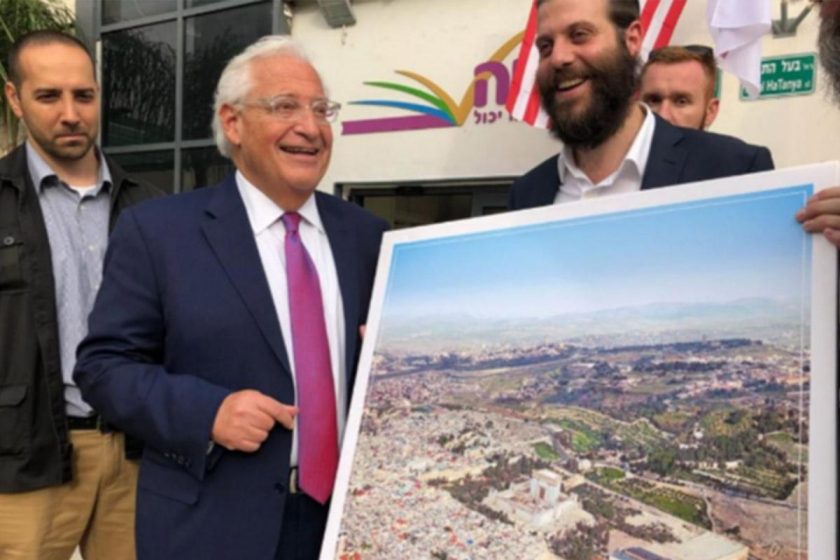
US Ambassador to Israel David Friedman poses with a picture of the ‘Third Temple,’ May 22, 2018. Israel Cohen | Kikar Hashabat
The day before that event, Israeli police had arrested three members of the Al-Aqsa Mosque compound’s Reconstruction Committee, which is overseen by the government of Jordan. Those arrested included the committee’s head and its deputy head, and the three men were arrested while performing minor restoration work in an Al-Aqsa courtyard. The Jordan-run authority condemned the arrests, for which no official reason was given, and called the move by Israeli police “an intervention in their [the men’s] reconstruction work.” According to Palestinian news agency Safa, Israeli police have also prevented the entry of tools necessary for restoration work to the site and have restricted members of the authority from performing critical maintenance work.
In addition, another important figure at Al-Aqsa, Hanadi Al-Halawani, who teaches at the mosque school and has long watched over the site to prevent its occupation by Israeli forces, was arrested late last month.
Arrests of other key Al-Aqsa personnel have continued in recent days, such as the arrest of seven Palestinian residents of Jerusalem, including guards of the mosque, and their subsequent ban from entering the site. The Palestinians were arrested at their homes last Sunday night in early morning raids and the official reason for their arrest remains unclear. So many arrests in such a short period have raised concerns that, should the spate of arrests of important Al-Aqsa personnel continue, future incidents at the site, such as the mysterious fire that broke out last April at Al-Aqsa while France’s Notre Dame was also ablaze, may not be handled as effectively owing to staff shortages.
Soon after those arrests, 60 members of a settler extremist group entered the al-Aqsa compound under heavy guard from Israeli police. Safa news agency reported that these settlers have recently been accompanied by Israeli intelligence officials in their incursions at the site.
All of these recent provocations and arrests in connection with the mosque come soon after the King of Jordan, Abdullah II, publicly stated in late March that he had recently come under great pressure to relinquish Jordan’s custodianship of the mosque and the contested holy site upon which it is built. Abdullah II vowed to continue custodianship over Christian and Muslim sites in Jerusalem, including Al-Aqsa, and declined to say who was pressuring him over the site. However, his comments about this pressure to cede control over the mosque came just days after he had visited the U.S. and met with American Vice President Mike Pence, a Christian Zionist who believes that a Jewish Temple must replace Al-Aqsa to fulfill an end times prophecy.
In May, an Israeli government-linked research institute, the Jerusalem Center for Public Affairs, wrote that Abdullah II had nearly been toppled in mid-April, just weeks after publicly discussing external pressure to relinquish control over Al-Aqsa. The report stated that Abdullah II had been a target of a “plot undermining his rule,” which led him to replace several senior members of his government. That report further claimed that the plot had been aimed at removing obstacles to the Trump administration’s “Deal of the Century,” which is supported by Israel’s government.
Last year, some Israeli politicians sought to push for a transfer of the site’s custodianship to Saudi Arabia, sparking concern that this could be connected to plans by some Third Temple activists to remove Al-Aqsa from Jerusalem and transfer it piece-by-piece to the Saudi city of Mecca. On Thursday, the Jerusalem Center for Public Affairs published an article asserting that “tectonic shifts” were taking place in relation to who controls Al-Aqsa, with a Saudi-funded political group making dramatic inroads that could soon alter which country controls the historic mosque compound.
Sayyed Hassan Al-Qazwini told MintPress that, in his view, the current custodianship involving Jordan’s government is not ideal, as control over the Al-Aqsa mosque “should lie in the hands of its people, [and] Al-Aqsa mosque belongs Palestine;” if not, at the very least, a committee of Muslim majority nations should be formed to govern the holy site because of its importance. As for Saudi Arabia potentially receiving control over the site, Al-Qazwini told MintPress that “the Saudis are not qualified as they are not even capable of running the holy sites in Saudi Arabia itself. Every year, there has been a tragedy and many pilgrims have died during hajj time [annual Islamic pilgrimage].”
Once fringe, now approaching consensus
The threat to Al-Aqsa mosque and the Dome of the Rock compound, the third holiest site in Islam and of key importance to three major world religions, is the result of the dramatic growth of what was once a fringe movement of extremists. After the Six Day War, these fringe elements have fought to become more mainstream within Israel and have sought to gain international support for their religious-colonialist vision, particularly in the United States. As this article has shown, the threats to Al-Aqsa have grown significantly in the past decades, spiking in just the past few weeks.
As former Jewish Underground member Yehuda Etzion had called for decades ago, an educational and social movement aimed at gaining influence with Israeli government leadership has been hugely successful in its goal of engineering consent for a Third Temple among many religious and secular Israelis. So successful has this movement been that numerous powerful and influential Israeli politicians, particularly since the 1990s, have not only openly promoted these beliefs, and the destruction of Al-Aqsa mosque and the Dome of the Rock, but have also diverted significant amounts of government funding to organizations dedicated to replacing the historic mosque with a new temple.
As the second and final installment of this series will show, this movement has gained powerful allies, not just in Israel’s government, but among many evangelical Christians in the United States, including top figures in the Trump administration who also feel that the destruction of Al-Aqsa and the reconstruction of a Jewish Temple are prerequisites for the fulfillment of prophecy, albeit a different one. Furthermore, given the influence of such movements on the Israeli and U.S. governments, these beliefs of active Messianism are also informing key policies of these same governments and, in doing so, are pushing the world towards a dangerous war.
Whitney Webb is a MintPress News journalist based in Chile. She has contributed to several independent media outlets including Global Research, EcoWatch, the Ron Paul Institute and 21st Century Wire, among others. She has made several radio and television appearances and is the 2019 winner of the Serena Shim Award for Uncompromised Integrity in Journalism