Journalism faces dire situation in Kashmir
By Shahana Butt – Press TV – August 22, 2019
Kashmir – In Indian-administered Kashmir, journalists and journalism are suffering the worst work challenges in decades. There has been a complete communication gag in the region since New Delhi revoked Kashmir’s special status.
This is not a usual gathering or a political meeting, these are the journalists gathered under one roof, working on Kashmir stories.
Kashmir’s administration has created a media center for journalists in the region following the criticism over the media dysfunction.
In the absence of communication facilities like the internet, mobile phones and landlines, this facilitation center created by government is the only source for journalists to send their reports out of Kashmir.
These four desktops and one cellular mobile phone have become lifeline for journalists working from Kashmir. From early morning till late evening, journalists wait in queues for their turn to come.
After New Delhi’s move of scrapping Kashmir’s autonomous status on August 5, Kashmir has witnessed a complete communication blackout. Not just international media outlets suffered, but local and regional news networks and journalists were hit the hardest.
In Indian-administered Kashmir, there are hundreds of journalists associated with more than a hundred news dailies and over 40 national and international media outlets, the communication blackout not only stopped local publications but pushed the entire Himalayan region to somewhere around stone age.
The local administration in Kashmir has no idea as to when this communication blockade will end. Journalists say the information blackout has furthered the fear among people and has created space for rumor-mongering and false news, adding to the already existing panic.
Jammu and Kashmir: the Legitimacy of Article 370

Photograph Source: Motohiro Sunouchi – CC BY 2.0
By Nyla Ali Khan | CounterPunch | August 20, 2019
Introduction
The recent unilateral decision of Prime Minister Modi’s government to revoke Article 370, which guaranteed the special status of Jammu and Kashmir; dismemberment of the State, and its diminishment are flagrant violations of the sovereign Constitution of India. These maneuvers jeopardize the federal structure of India. The erosion of the rights and privileges of a State is an unhealthy precedent to set in a diverse and federal country. The current curbing of political and civil rights in Jammu and Kashmir is deplorable.
Historical Perspective
On 26 October 1947, Maharaja Hari Singh signed the “Instrument of Accession” to India, officially ceding to the government of India jurisdiction over defense, foreign affairs and communications. The accession of J & K to India was accepted by Lord Mountbatten with the proviso that once political stability was established in the region, a referendum would be held in which the people of the State would either validate or veto the accession. After signing the Instrument of Accession, the maharaja appointed his political adversary, Sheikh Mohammad Abdullah, as the head of an interim government.
On 2 November 1947, Pandit Jawaharlal Nehru, the first Prime Minister of independent India, reiterated his government’s pledge to not only the people of Kashmir, but also to the international community, to hold a referendum in Indian and Pakistani-administered Jammu and Kashmir under the auspices of a world body like the United Nations, in order to determine whether the populace preferred to be affiliated with India or Pakistan. Nehru emphasized this commitment several times at public forums over the next few years.
In January 1948 India referred the Kashmir dispute to the United Nations. Prime Minister Nehru took the dispute with Pakistan over Kashmir beyond local and national boundaries by bringing it before the UN Security Council, and seeking a ratification of India’s “legal” claims over Kashmir. The UN reinforced Nehru’s pledge of holding a plebiscite in Kashmir, and in 1948 the Security Council established the United Nations Commission for India and Pakistan (UNCIP) to play the role of mediator in the Kashmir issue. The UNCIP adopted a resolution urging the government of Pakistan to cease the infiltration of tribal mercenaries and raiders into J & K. It also urged the government of India to demilitarize the State by “withdrawing their own forces from Jammu and Kashmir and reducing them progressively to the minimum strength required for the support of civil power in the maintenance of law and order.” The resolution proclaimed that once these conditions were fulfilled, the government of India would be obligated to hold a plebiscite in the State in order to either ratify or veto the accession of J & K to India.
In the meantime, the Government of Jammu and Kashmir negotiated with the central government to ensure that it would be allowed to function as a fully autonomous unit within the federation. Article 370 of the Constitution of India ensured that apart from defense, foreign affairs, and communications, decisions with regard to other matters would be determined with the consent of the Government of Jammu and Kashmir. There was a reason that special status was guaranteed to Jammu and Kashmir under Article 370 of the Indian Constitution. On 13 July 1950, the new government of J & K, headed by Sheikh Mohammad Abdullah, made a landmark decision.
“Between 1950 and 1952, 700,000 landless peasants, mostly Muslims in the Valley but including 250,000 lower-caste Hindus in the Jammu region, became peasant-proprietors as over a million acres were directly transferred to them, while another sizeable chunk of land passed to government-run collective farms. By the early 1960s, 2.8 million acres of farmland (rice being the principal crop in the Valley) and fruit orchards were under cultivation, worked by 2.8 million smallholding peasant-proprietor households.” (Bose 2003: 27–28)
This metamorphosis of the agrarian economy had groundbreaking political consequences. This revolutionary measure, which greatly improved the human development index in the State, would not have been possible without Article 370. The political logic of autonomy and Article 370 of the Indian Constitution was necessitated by the need to bring about socioeconomic transformations.
The legislative bill, which had orchestrated this transformation, won the unstinting support of thousands of erstwhile disenfranchised peasants. But displaced landlords and officials in the Dogra regime made no bones about their hatred of the political supremacy of the new class of Kashmiri Muslims. This hatred unleashed a reign of terror and brutality against the Valley’s new political class.
The “defining moment in Jammu and Kashmir’s post-Indian independence history” came in 1950 when disenfranchised peasants “were freed from the shackles of landlords through a law that gave them ownership rights on the land they tilled. . . . The sweeping land reforms under the Big Landed Estates Abolition Act passed on July 13, 1950, changed the complexion of Kashmiri society. The historical image of the emaciated local farmer in tatters, with sunken faces and listless eyes, toiling to fill the granaries of landlords changed overnight into one of a landowner who expected to benefit from the labor he had put in for generations” (Ahmed, F.). This program emphasized the necessity of abolishing exploitative landlordism without compensation and enfranchising tillers by granting them the lands they worked on. Many policy makers in the Indian subcontinent, political scientists, and economists have acknowledged the effectiveness and rigor of land reforms in Jammu and Kashmir, which benefited underprivileged farmers in all three parts of the State—Jammu, Kashmir, and Ladakh.
In August 1952, the government of J & K reiterated the commitment of to the principles of secularism and democracy which enabled the forging of ties with the Indian nation-state: “The supreme guarantee of our relationship with India is the identity of secular and democratic aspirations, which have guided the people of India as well as those of Jammu and Kashmir in their struggle for emancipation, and before which all constitutional safeguards will take a secondary position.” For the layperson, the “new Kashmir” in which the hitherto peripheralized Muslim population of the Valley and marginalized women would reinsert themselves into the language of belonging a welcome development.
But the nationalist project of the Praja Parishad had sought the subsumption of religious minorities into a centralized and authoritarian state since the 1940s. These integrative and centralist measures were met with massive opposition, which the government of India suppressed with bloody maneuvers. The volcanic nature of the protests in the Valley gave a veneer of legitimacy to its action of large-scale repression of leaders of the Plebiscite Front. Sheikh Mohammad Abdullah was also arrested, for the umpteenth time, under the Defense of India Rules, to further hush the voices of dissent.
Sheikh Mohammad Abdullah underlined in his letter to Shyama Prasad Mukherjee, founder of the Bharatiya Jan Sangh, in February 1953,
When talking about the constitutional aspect, it is sometimes conveniently forgotten that the Praja Parishad wants that Article 370 should be expunged from the Constitution. So far as we are concerned, we have maintained that the special position accorded to the State can alone be the source of a growing unity and closer association between the State and India. The Constituent Assembly of India took note of the special circumstances obtaining in the State and made provisions accordingly.
To entertain the doubt that the Muslims of Kashmir would now give up their secular ideals would be uncharitable, although the statements and the pronouncements made by the leaders of communal parties in India from time to time and the inspiration and guidance they are providing at the moment to the Praja Parishad leadership in Jammu is, no doubt, giving them a rude shock. But let me assure you and the people of India that the Muslims in Kashmir will not falter from their ideals even if they are left alone in this great battle for secularism and human brotherhood.
As I’ve said on other forums, the Constitution of India seeks to guarantee respect for the rule of law, the independence of the judiciary, and the integrity of the electoral process. But time and again, provisions of the Constitution of India have been breached in Kashmir, and the ideals that it enshrines have been forgotten. In Kashmir, rights relating to life, liberty, dignity of the people, and freedom of expression guaranteed by the Constitution, embodied in the fundamental covenants and enforceable by courts of law, have been flouted. The revocation of Article 370, without consultation, makes it clear that the much lauded parliamentary democracy in India has been unable to protect a genuine democratic set-up in Kashmir.
Heads of Governments cannot avoid their ethical and moral responsibilities toward the peoples of the States in a federal country. The lives of those people cannot be torn asunder by paramilitary forces and other “upholders” of the law.
Blow to Kashmiriyat
“Kashmiriyat” was not handed down to me as an unachievable and abstract construct. On the contrary, it was crystallized for me as the eradication of a feudal structure and its insidious ramifications. It was the right of the tiller to the land he worked on. It was the unacceptability of any political solution that did not take the aspirations and demands of the Kashmiri people into consideration. It was the right of Kashmiris to high offices in education, the bureaucracy and government; the availability of medical and educational facilities in Jammu, Kashmir and Ladakh. It was the preservation of literatures and and historical artifacts that defined an important aspect of “Kashmiriyat.” It was the formation of the Constituent Assembly of J & K to institutionalize the Constitution of the State in 1951, which was an enormous leap toward the process of democratization. It was the fundamental right of both women and men to free education up to the university level. It was, constitutionally, equal opportunities afforded to both sexes in the workplace. It was the nurturing of a contact zone in social, political and intellectual ideologies and institutions. It was pride in a cultural identity that was generated in a space created by multiple perspectives.
Trust cannot be won and unity cannot be maintained by the display of national chauvinism and erosion of Kashmiriyat.
Nyla Ali Khan is the author of Fiction of Nationality in an Era of Transnationalism, Islam, Women, and Violence in Kashmir, The Life of a Kashmiri Woman, and the editor of The Parchment of Kashmir. Nyla Ali Khan has also served as an guest editor working on articles from the Jammu and Kashmir region for Oxford University Press (New York), helping to identify, commission, and review articles. She can be reached at nylakhan@aol.com.
Kashmir Caged: A Fact-Finding Report

Army patrol on the road | Image courtesy Kavita Krishnan
By Jean Drèze, Kavita Krishnan, Maimoona Mollah and Vimal Bhai | Indian Cultural Forum | August 14, 2019
We spent five days (9-13 August 2019) traveling extensively in Kashmir. Our visit began on 9 August 2019 – four days after the Indian government abrogated Articles 370 and 35A, dissolved the state of Jammu and Kashmir, and bifurcated it into two Union Territories.
When we arrived in Srinagar on 9 August, we found the city silenced and desolated by curfew, and bristling with Indian military and paramilitary presence. The curfew was total, as it had been since 5th August. The streets of Srinagar were empty and all institutions and establishments were closed (shops, schools, libraries, petrol pumps, government offices, banks). Only some ATMs and chemists’ shops – and all police stations – were open. People were moving about in ones and twos here and there, but not in groups.
We travelled widely, inside and outside Srinagar – far beyond the small enclave (in the centre of Srinagar) where the Indian media operates. In that small enclave, a semblance of normalcy returns from time to time, and this has enabled the Indian media to claim that life in Kashmir is back to normal. Nothing could be further from the truth.
We spent five days moving around and talking to hundreds of ordinary people in Srinagar city, as well as villages and small towns of Kashmir. We spoke to women, school and college students, shopkeepers, journalists, people who run small businesses, daily wage labourers, workers and migrants from UP, West Bengal and other states. We spoke to Kashmiri Pandits and Sikhs who live in the Valley, as well as Kashmiri Muslims.
Everywhere, we were cordially received, even by people who were very angry about the situation or sceptical of our purpose. Even as people expressed their pain, anger, and sense of betrayal against the Government of India, they extended warmth and unstinting hospitality to us. We are deeply moved by this.
Except for the BJP spokesperson on Kashmir Affairs, we did not meet a single person who supported the Indian government’s decision to abrogate Article 370. On the contrary, most people were extremely angry, both at the abrogation of Article 370 (and 35A) and at the manner in which it had been done.
Anger and fear were the dominant emotions we encountered everywhere. People expressed their anger freely in informal conversation, but no-one was willing to speak on camera. Anyone who speaks up is at risk of persecution from the government.
Many told us that they expected massive protests to erupt sooner or later (after restrictions were relaxed, after Eid, after 15 August, or even later), and anticipated violent repression even if the protests were peaceful.
A summary of our observations
-
There is intense and virtually unanimous anger in Kashmir against the Indian government’s decision to abrogate Articles 370 and 35A, and also about the way this has been done.
-
To control this anger, the government has imposed curfew-like conditions in Kashmir. Except for some ATMs, chemists’ shops and police stations, most establishments are closed for now.
-
The clampdown on public life and effective imposition of curfew have also crippled economic life in Kashmir, that too at a time of the BakrEid festival that is meant for abundance and celebration.
-
People live in fear of harassment from the government, army or police. People expressed their anger freely in informal conversation, but no-one was willing to speak on camera.
-
The Indian media’s claims of a rapid return to normalcy in Kashmir are grossly misleading. They are based on selective reports from a small enclave in the centre of Srinagar.
-
As things stand, there is no space in Kashmir for any sort of protest, however peaceful. However, mass protests are likely to erupt sooner or later.
Reactions To The Government’s Treatment of J&K
-
When our flight landed, and the airlines staff announced that passengers could switch on our mobiles, the entire flight (with mostly Kashmiris in it) burst into mocking laughter. “What a joke”, we could hear people say – since mobile and landline phones and internet have all been blocked since 5 August!
-
As soon as we set foot in Srinagar, we came across a few small children playacting in a park. We could hear them say ‘Iblees Modi’. ‘Iblees’ means ‘Satan’.
-
The words we heard over and over from people about the Government decisions on J&K were ‘zulm’ (oppression), ‘zyadti’ (excess/cruelty), and ‘dhokha’ (betrayal). As one man in Safakadal (downtown Srinagar) put it, “The Government has treated us Kashmiris like slaves, taking decisions about our lives and our future while we are captive. It’s like forcing something down our throats while keeping us bound and gagged, with a gun to our heads.”
-
In every lane of Srinagar city, every town, every village, that we visited, we received an extensive schooling from ordinary people, including school kids, on the history of the Kashmir dispute. They were angry and appalled at the manner in which the Indian media was whitewashing this history. Many said: “Article 370 was the contract between Kashmir’s leadership and India’s. Had that contract not been signed, Kashmir would never have acceded to India. With Article 370 gone, India no longer has any basis for its claim over Kashmir.” One man in the Jahangir Chowk area near Lal Chowk, described Article 370 as a ‘mangalsutra’ (sacred necklace worn by married women) symbolising a contract (analogous to the marital contract) between Kashmir and India. (More on people’s reactions to the abrogation of Articles 370 and 35A below)
-
There is widespread anger against the Indian media. People are imprisoned in their homes, unable to communicate with each other, express themselves on social media, or make their voices heard in any way. In their homes, they watch Indian TV claim that Kashmir welcomes the Government decisions. They seethe with rage at the erasure of their voices. As one young man in Safakadal put it, “Kiski shaadi hai, aur kaun naach raha hai?! (It’s supposed to be our wedding, but it’s only others who are dancing!) If this move is supposed to be for our benefit and development, why not ask what we ourselves think about it?”
Reactions To The Abrogation Of Article 370 and 35A
-
A man in Guree village (Anantnag district) said: “Hamara unse rishta Article 370 aur 35A se tha. Ab unhone apne hi paer par kulhadi mar di hai. In Articles ko khatm kar diya hai. Ab to ham azad ho gaye hain.” (Our relation with them (India) was through Article 370 and Article 35A. Now they have themselves committed the folly of dissolving these Articles. So now we are free.” The same man raised slogans of “We want freedom” followed by slogans of “Restore Articles 370 and 35A.”
-
Many described Article 370 and 35A as Kashmir’s “pehchan” (identity). They felt that the abrogation of these Articles is a humiliating attack on Kashmir’s self-respect and identity.
-
Not all demanded restoration of Article 370. Many said that it was only the parliamentary parties who had asked people to have faith that India would honour the contract that was Article 370. The abrogation of Article 370 only discredited those “pro-India parties”, and vindicated those who argued for Kashmir’s “azaadi” (independence) from India, they felt. One man in Batamaloo said: “Jo india ke geet gate hain, apne bande hain, ve bhi band hain! (Those who sang praises of India, India’s own agents, they too are imprisoned!” A Kashmiri journalist observed, “Many people are happy about the treatment the mainstream parties are getting. These parties batted for the Indian State and are being humiliated now.”
-
“Modi has destroyed India’s own law, its own Constitution” was another common refrain. Those who said this, felt that Article 370 was more important to India (to legitimise its claim to Kashmir) than it was to Kashmir. But the Modi Government had not only sought to destroy Kashmir, it had destroyed a law and Constitution that was India’s own.
-
A hosiery businessman in Jahangir Chowk, Srinagar said, “Congress ne peeth mein choora bhonka tha, BJP ne saamne se choora bhonka hai.” (Congress had stabbed us from the back, BJP is stabbing us up front). He added, “They strangled their own Constitution. It’s first step towards Hindu Rashtra.”
-
In some ways, people were more concerned about the effects of the abrogation of 35A than that of 370. It is widely recognised that Article 370 retained only nominal, symbolic autonomy and had already been diluted. With 35A gone, though, people fear that “State land will be sold cheap to investors. Ambani, Patanjali etc can come in easily. Kashmir’s resources and land will be grabbed. In Kashmir as it stands now, education and employment levels are better than in the mainland. But tomorrow Kashmiris will have to compete for Government jobs with those from other states. After one generation, most Kashmiris won’t have jobs or be forced to move to the mainland.”
“Normalcy” – Or “Peace Of The Graveyard”?
Is the situation in Kashmir “normal” and “peaceful”? The answer is an emphatic NO.
-
One young man in Sopore said: “This is bandook ki khamoshi (the silence at gunpoint), kabristan ki khamoshi (the peace of the graveyard).”
-
The newspaper Greater Kashmir had one (front) page of news and a sports page at the back: the two inside pages were full of cancellation announcements of weddings or receptions!
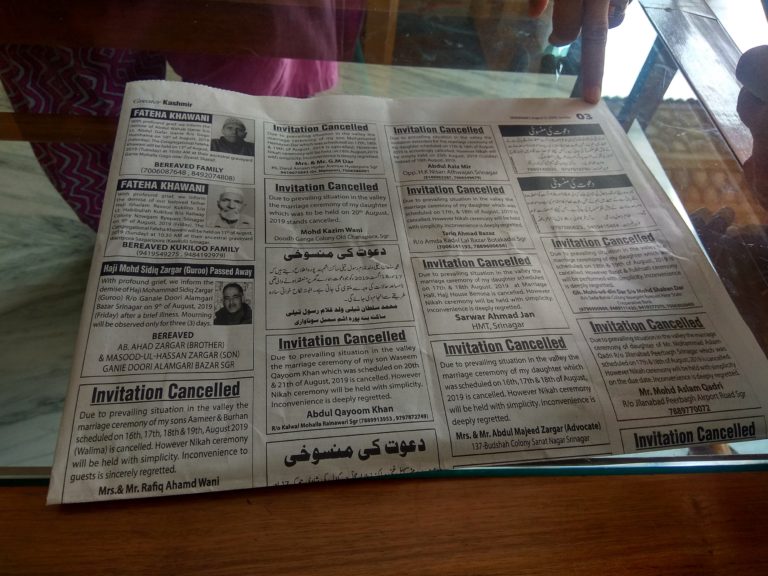
Invitations cancelled I Image courtesy Kavita Krishnan
-
Between 5-9 August, people had suffered for lack of food, milk, and basic needs. People had been prevented even from going to hospitals in case of sickness.
-
The Government claim is that only Section 144 has been imposed, not “curfew”. But in reality, police vans keep patrolling Srinagar warning people to “stay safe at home and not venture out during the curfew”, and tell shops to close their shutters. They demand that people display “curfew passes” to be allowed to move about.
-
All of Kashmir is under curfew. Even on Eid, the roads and bazaars were silent and desolate. All over Srinagar, mobility is restricted by concertina wires on streets, and massive paramilitary deployment. Even on Eid, this was the case. In many villages, azaan was prohibited by the paramilitary and people were forced to do namaaz prayers at home rather than collectively at the mosque as it usual on Eid.
-
In Anantnag, Shopian and Pampore (South Kashmir) on the day of Eid, we only saw very small kids dressed in Eid finery. Everyone else was in mourning. “We feel like we’re in jail”, said a woman in Guree (Anantnag). Girls in Nagbal (Shopian) said, “With our brothers in police or army custody, how can we celebrate Eid?”
-
On 11 August, on the eve of Eid, a woman at Sopore told us she had come to the bazaar during a brief respite in the curfew, to buy a few supplies for Eid. She said: “We were prisoners in our own homes for 7 days. Even today, shops are closed in my village Langet, so I came to Sopore town to shop for Eid and to check on my daughter who is a nursing student here.”
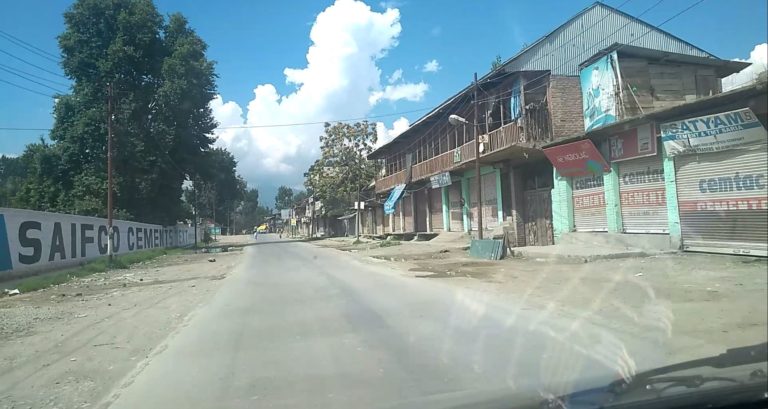
Eid in Pulwama | Image courtesy Kavita Krishnan
-
“It’s Army rule not Modi rule. There are more soldiers here than people”, said a young baker at Watpura near Bandipora. His friend added, “We’re afraid, because the army camp nearby keeps imposing impossible rules. They insist we have to return within half an hour if we leave home. If my kid isn’t well, and I have to take her to the hospital, it may take more than half an hour. If someone visits their daughter who lives in next village, they may take more than half hour to return. But if there’s any delay, they will harass us.” The CRPF paramilitary is everywhere, outside nearly every home in Kashmir. These are clearly not there to provide “security” to Kashmiris – on the contrary, their presence creates fear for the people.
-
Sheep traders and herders could be seen with unsold sheep and goats. Animals they had been rearing all year long, would not be sold. This meant they would incur a huge loss. With people unable to earn, many could not afford to buy animals for the Eid sacrifice.
-
A shopkeeper from Bijnore (UP) showed us the stacks of unsold sweets and delicacies going waste, since people could not buy them. Shops and bakeries wore a deserted look on the eve of Eid, with their perishable food items lying unsold.
-
An asthmatic auto driver in Srinagar, showed us his last remaining dose of salbutamol and asthalin. He had been trying for the past several days to buy more – but the chemists’ shops and hospitals in his area had run out of stocks. He could go to other, bigger hospitals – but CRPF would prevent him. He showed us the empty, crushed cover of one asthalin inhaler – when he told a CRPF man he needed to go further to get the medicine, the man stamped on the cover with his boot. “Why stamp on it? He hates us, that’s why”, said the auto driver.
Protests, Repression, and Brutality
-
Some 10,000 people protested in Soura (Srinagar) on 9 August. The forces responded with pellet gun fire, injuring several. We attempted to go to Soura on 10 August, but were stopped by a CRPF barricade. We did see young protestors on the road that day as well, blockading the road.
-
We met two victims of pellet gun injuries in SMHS hospital in Srinagar. The two young men (Waqar Ahmad and Wahid) had faces, arms and torso full of pellets. Their eyes were bloodshot and blinded. Waqar had a catheter in which the urine, red with blood from internal bleeding, could be seen. Their family members, weeping with grief and rage, told us that the two men had not been pelting stones. They had been peacefully protesting.
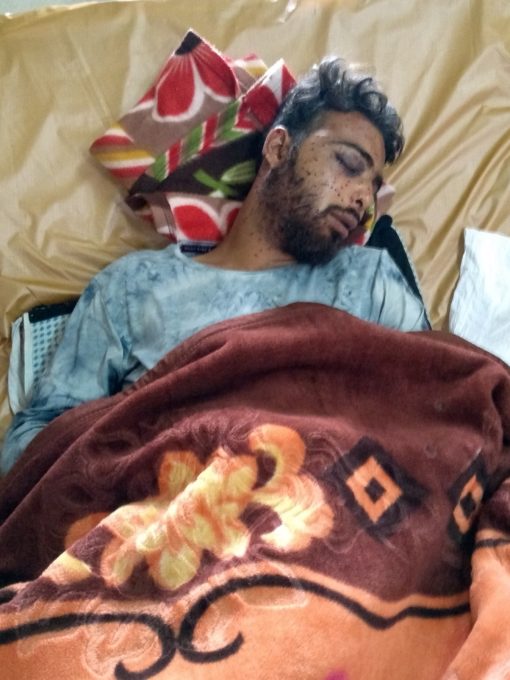
Pellet gun victim | Image courtesy Vimal Bhai
-
On 6 August, a graphic designer for the Rising Kashmir newspaper, Samir Ahmad, (in his early 20s) had remonstrated with a CRPF man near his home in the Manderbag area of Srinagar, asking him to allow an old man to pass. Later the same day, when Samir opened the door to his house, CRPF fired at him with a pellet gun, unprovoked. He got 172 pellets in his arm and face near the eyes, but his eyesight is safe. It is clear that the pellet guns are deliberately aimed at the face and eyes, and unarmed, peaceful civilians standing at their own front doors can be targets.
-
At least 600 political leaders and civil society activists are under arrest. There is no clear information on what laws are invoked to arrest them, or where they are being held.
-
A very large number of political leaders are under house arrest – it is impossible to ascertain how many. We tried to meet CPIM MLA Mohd Yusuf Tarigami – but were refused entry into his home in Srinagar, where he is being under house arrest.
-
In every village we visited, as well as in downtown Srinagar, there were very young schoolboys and teenagers who had been arbitrarily picked up by police or army/paramilitary and held in illegal detention. We met a 11-year-old boy in Pampore who had been held in a police station between 5 August and 11 August. He had been beaten up, and he said there were boys even younger than him in custody, from nearby villages.
-
Hundreds of boys and teens are being picked up from their beds in midnight raids. The only purpose of these raids is to create fear. Women and girls told us of molestation by armed forces during these raids. Parents feared meeting us and telling us about the “arrests” (abductions) of their boys. They are afraid of Public Security Act cases being filed. The other fear is that the boys may be “disappeared” – i.e killed in custody and dumped in mass graves of which Kashmir has a grim history. As one neighbour of an arrested boy said, “There is no record of these arrests. It is illegal detention. So if the boy “disappears” – i.e is killed in custody – the police/army can just say they never had him in custody in the first place.”
-
But the protests are not likely to stop. A young man at Sopore said: “Jitna zulm karenge, utna ham ubharenge” (The more you oppress us, the more we will rise up) A familiar refrain we heard at many places was: “Never mind if leaders are arrested. We don’t need leaders. As long as even a single Kashmiri baby is alive, we will struggle.”
The Gag On Media
-
A journalist told us: “Newspapers are printing in spite of everything. Without the internet, we do not get any feed from agencies. We were reduced to reporting the J&K related developments in Parliament, from NDTV! This is undeclared censorship. If Govt is giving internet and phone connectivity to police but not to media houses what does it mean? We had some people come to our offices, speaking on behalf of Army and CRPF, asking “Why are you publishing photos of the curfew-affected streets?”
-
Kashmiri TV channels are completely closed and unable to function.
-
Kashmiri newspapers that carry the barest mention of protests (such as the one on Soura) are made to feel the heat from the authorities.
-
Foreign press reporters told us that they are facing restrictions on their movement by the authorities. Also, because of the lack of internet, they are unable to communicate with their own main offices.
-
When we visited Press Enclave in Srinagar on 13 August, we found the newspaper offices closed and the area deserted except for a few stray journalists, and some CID men. One of the journalists told us that papers could not be printed till at least 17 August, because they have run out of newsprint which comes from Delhi.
-
As mentioned above, one graphic designer working with a newspaper suffered pellet gun injuries, during a completely unprovoked attack by CRPF
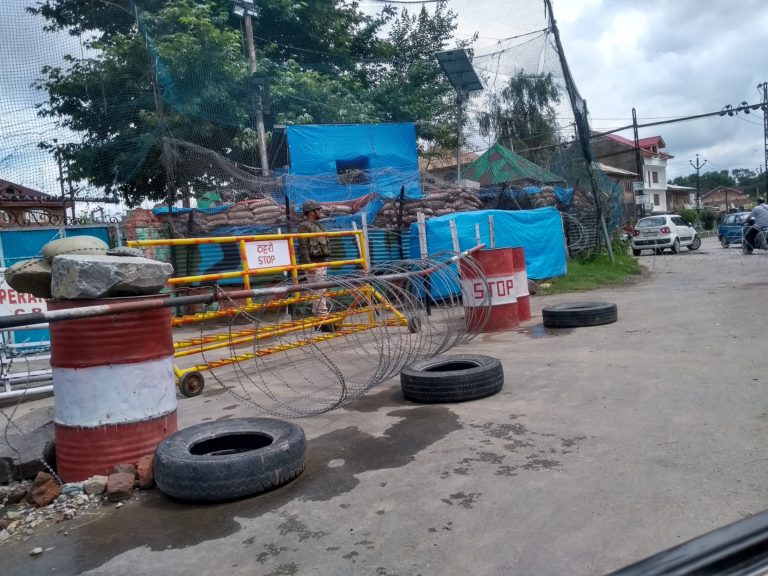
A checkpoint in Srinagar | Image courtesy Vimal Bhai
Does Kashmir Lack Development?
In an op-ed in the Times Of India (August 9, 2019), former Foreign Secretary and Ambassador Nirupama Rao wrote: “A young Kashmiri told this writer a few months ago her birthplace was in the “stone age”; that in terms of economic development, Kashmir was two hundred years behind the rest of India.”
We struggled to find this “backward”, “stone age” Kashmir anywhere at all.
-
It is striking how in every Kashmiri village, we found young men and women who go to college or University; speak Kashmiri, Hindi and English fluently; and are able to argue points of Constitutional and international law in relation to the Kashmir conflict with factual accuracy and erudition. All four of the team members are familiar with villages in North Indian states. This high level of education is extremely rare in any village in, say, Bihar, UP, MP, or Jharkhand.
-
The homes in rural Kashmir are all pucca constructions. We saw no shacks like the ones that are common in rural Bihar, UP, Jharkhand.
-
There are poor people in Kashmir, certainly. But the levels of destitution, starvation and abject poverty seen in many North Indian states, is simply absent in rural Kashmir.
-
We met migrant labourers from North India and West Bengal at many places. They told us that they feel safe and free from xenophobic violence that they face in, say, Maharashtra or Gujarat. Daily wage migrant labourers told us “Kashmir is our Dubai. We earn Rs 600 to Rs 800 per day here – that is three or four times what we earn in other states.”
-
We found Kashmir refreshingly free of communal tension or mob lynchings. We met Kashmiri pandits who told us they felt safe in Kashmir, and that the Kashmiris always celebrate their festivals together. “We celebrate Eid, Holi, Diwali together. That is our Kashmiriyat. It is something different, special,” said one Kashmiri Pandit young man.
-
The myth of the “backward” Kashmiri woman is perhaps the biggest lie. Kashmiri girls enjoy a high level of education. They are articulate and assertive. Of course, they face and resist patriarchy and gender discrimination in their societies. But does BJP, whose Haryana CM and Muzaffarnagar MLA speak of “getting Kashmiri brides” as though Kashmiri women are property to be looted, have any right to preach feminism to Kashmir? Kashmiri girls and women told us, “We are capable of fighting our own battles. We don’t want our oppressors to claim to liberate us!”
The BJP Spokesperson’s “Warning”
We met BJP spokesperson on Kashmir affairs, Ashwani Kumar Chrungoo at the office of Rising Kashmir, a Kashmir newspaper. The conversation was initially cordial. He told us he had come to Kashmir from Jammu to persuade people to support the abrogation of Article 370. His main argument was that since the BJP had won a 46% vote share in J&K and had won an unprecedented majority in Parliament, they had not only a right but a duty to keep their promise of scrapping Article 370. “46% vote share – that’s a license”, he said.
He refused to acknowledge that this 46% vote share while winning only three Lok Sabha seats (Jammu, Udhampur and Ladakh) was possible only because the voter turnout in the three other LS seats (Srinagar, Anantnag and Baramulla) was the lowest in the whole country.
Should a Government impose an unpopular decision on people of Kashmir who have not voted for that decision, at gunpoint? Chrungoo said, “In Bihar when Nitish Kumar imposed prohibition, he didn’t ask the alcoholics for their permission or consent. It’s the same here.” His contempt for the people of Kashmir was evident from this analogy.
Towards the end of the conversation, he became increasingly edgy when confronted by facts and arguments by us. He got up and wagged a finger at Jean Dreze, saying “We won’t let anti-nationals like you do your work here. I am warning you.”
Conclusion
The whole of Kashmir is, at the moment, a prison, under military control. The decisions taken by the Modi Government on J&K are immoral, unconstitutional and illegal. The means being adopted by the Modi Government to hold Kashmiris captive and suppress potential protests are also immoral, unconstitutional, and illegal.
-
We demand the immediate restoration of Articles 370 and 35A.
-
We assert that no decision about the status or future of J&K should be taken without the will of its people.
-
We demand that communications – including landline telephones, mobile phones and internet be restored with immediate effect.
-
We demand that the gags on the freedom of speech, expression and protest be lifted from J&K with immediate effect. The people of J&K are anguished – and they must be allowed to express their protest through media, social media, public gatherings and other peaceful means.
-
We demand that the gags on journalists in J&K be lifted immediately.
Jean Drèze, economist
Kavita Krishnan, Communist Party of India (Marxist-Leninist) and AIPWA
Maimoona Mollah, All India Democratic Women’s Association (AIDWA)
Vimal Bhai, National Alliance of People’s Movements (NAPM)
India’s narrative on J&K is hyperbolic
By M. K. BHADRAKUMAR | Indian Punchline | August 13, 2019
Editorials have appeared in two leading Delhi newspapers today (here and here) urging the government to present a credible, appealing diplomatic narrative on the J&K developments.
The Indian narrative so far is largely focused on the domestic audience. It has gone to ridiculous extents by projecting that the situation is actually quite “normal” in J&K. Pictures of National Security Advisor Ajit Doval savouring (mutton) biryani with Kashmiri Muslims on a street corner in Srinagar have been doing the rounds. (Indeed, it was a charade to hoodwink the public.)
Crude propaganda won’t win hearts and minds. A narrative has to be crafted rationally. It’s common knowledge that there is little acceptance of the government move among Kashmiri Muslims.
When it comes to the external projection of the Indian narrative, given the fact that India’s case is flying in the face of international law and the UN Charter, the government must be capable of sensitivity.
The government would have seized the initiative at the diplomatic level if only soon after Home Minister Amit Shah piloted through both houses of the parliament at breakneck speed the legislation on abrogating Article 370 of the constitution, External Affairs Minister S. Jaishankar had stood up and made a suo moto statement offering to discuss all differences with Pakistan bilaterally in a comprehensive dialogue in the best interests of regional security, peace and stability.
Of course, such a momentous initiative would have required imagination, far-sightedness and wisdom — and, most important, political courage at the leadership level. The shortfall in statecraft and diplomacy is appalling.
A self-righteous attitude will not do. Take EAM’s demarche with the Chinese counterpart State Councilor and Foreign Minister Wang Yi in Beijing on Monday. The MEA readout spells out the Indian stance on the following lines:
One, constitutional amendment is an “internal matter for India” and the “sole prerogative of the country”.
Two, abrogation of J&K’s special status (including changes in Ladakh’s status) is aimed at “promoting better governance and socio-economic development”.
Three, the government move has “no implication for either the external boundaries of India or the Line of Actual Control” with China.
And, four, India is “not raising any additional territorial claims.”
Incredibly enough, this was how EAM brushed aside China’s “serious concern over the recent escalation of turmoil in Kashmir” – that “any unilateral action that may complicate the situation in Kashmir should not be taken; that the Kashmir issue is a dispute born out of the region’s colonial history and should be properly handled in a peaceful way in line with the UN Charter, relevant resolutions of the UN Security Council and bilateral agreements between Pakistan and India”; and, its expectation that “India will play a constructive role in regional peace and stability.” (here, here, here, here and here)
EAM’s rejoinder may have some resonance domestically within India as a macho attitude, but it will only arouse mirth and derision abroad — even in the diplomatic enclave in Chanakyapuri area.
No P5 member country has officially voiced support for India. There is no shred of evidence that the Russian Foreign Ministry voiced support for India on the issue — not on the FO website; neither in a Tass or Novosti report nor even in the irrepressible Russian press. Some fly-by-night operator well-versed with the Indian rope trick, apparently spread fake news on a Friday night and it became “breaking news” in India by next morning. Pathetic.
Simply put, the Indian stance articulated by EAM is fundamentally flawed in logic and can only be counter-productive, as it shuts the door on discussion. The point is, Kashmir is an international dispute and India unilaterally changed J&K’s “status” in violation of the relevant UN resolutions. No one will accept India’s claim that it is an “internal matter”.
World opinion accepts that Pakistan is a party to Kashmir dispute. It is beside the point that India is not redrawing boundaries. And it’s gratuitous to say there is “no implication” for the LOC or the LOAC. If things were that simple, why couldn’t Modi government stomach the CPEC passing through Gilgit-Baltistan? We screamed, “territorial sovereignty” blah, blah.
World opinion will only believe that Delhi’s real intention is to change the demographic balance so that there shall be no Muslim-majority entity henceforth within the Indian Union.
If such unilateral acts in modern history are as simple as “internal matter”, why is no one recognising Russia’s annexation of Crimea? Why is Beijing so sensitive on intervention in Hong Kong? Why is the US insisting on “freedom of navigation” in South China Sea? Why is the US raising eyebrow over the North Sea Route and the Arctic? What is wrong with Iran’s claim over Persian Gulf as sovereign territory? What prevents Sri Lanka’s Mahinda Rajapaksa from solving the Tamil problem in similar fashion (as he hinted last week)?
The Modi government will be creating a long-term, intractable problem for India for generations to come by adopting such an ostrich approach. Analysts have pointed out (here and here) that the change in Ladakh’s status makes the India-China border dispute incredibly complicated and all but unsolvable. India’s international standing can get seriously damaged.
The only way to address the conundrum is to propose to Pakistan that India is ready to discuss these differences. Fortuitously, Pakistan also faces the unhappy situation that no one in the international community is showing willingness to stand up and be counted as its partner to push back at India.
The bottom line is that India enjoys wide acceptance for its insistence on bilateralism to resolve differences with Pakistan. India should now tactfully exercise this privilege. It is always possible to hold out informal assurances that there’ll be no “colonisation” of Kashmir valley. After all, we have such safeguards for many regions of India.
The window of opportunity shall not remain open for long. From all accounts, the ground situation in J&K is explosive and the grating roar of human misery is approaching. PM Imran Khan’s prognosis on another Pulwama is not off the mark. For Delhi to build a new architecture in J&K out of the debris all around, a dialogue with Pakistan is critically important.
Mediation Is the Way Forward for Kashmir
By Brian Cloughley | Strategic Culture Foundation | August 13, 2019
It so happened that when the most recent Kashmir crisis broke on 5 August I was at a gathering of the UN Blue Berets of Kashmir. We served together in that beautiful but now chaotic region 39 years ago and have had a reunion almost every year since then. We have rarely been able to discuss good news about Kashmir, because there hasn’t been any.
The August decision by India’s ultra-nationalist Prime Minister to unilaterally change the status of the territory is only one of the many disasters to befall it in the seventy years since the Muslim majority state, the fiefdom of a Hindu Maharaja, was allocated to India by the colonial British who in 1947 had been forced to grant independence to India, resulting in creation of the separate nations of Pakistan and India which disagree about the status of the territory.
Before examining the Indian government’s recent actions, a most important aspect of the Kashmir dispute has to be clarified. It concerns the matter of bilateralism as interpreted by India. This was indicated, for example, by the newspaper the Chandigarh Tribune which stated on 8 August that “UN chief Antonio Guterres has recalled the Simla Agreement of 1972, a bilateral agreement between India and Pakistan that rejects third-party mediation in Kashmir after Islamabad asked him to play his ‘due role’ following New Delhi’s decision to revoke Jammu and Kashmir’s special status.”
The Tribune is one of India’s best newspapers. Its reports are usually factual, objective and well-written. But it is flat wrong in its contention that the Simla Accord “rejects” third party mediation about Kashmir, because it most certainly does no such thing.
The Tribune was retailing the policy of the Indian government whose External Affairs Minister Subrahmanyam Jaishankar announced on 2 August that he had “conveyed to American counterpart Mike Pompeo, this morning in clear terms, that any discussion on Kashmir, if at all warranted, will only be with Pakistan and only bilaterally.” India has for decades insisted that involvement of any third party is not permissible and that there can be no mediation.
It is obvious why India refuses to countenance mediation — because it is almost certain that any independent, objective mediator would make the point that UN Security Council agreements still apply to the territory, and that none of them, most notably the matter of a plebiscite, have been annulled or in any manner diluted. As the BBC has noted, “In three resolutions, the UN Security Council and the United Nations Commission in India and Pakistan recommended that as already agreed by Indian and Pakistani leaders, a plebiscite should be held to determine the future allegiance of the entire state.”
But it is India’s relentless and wilful misinterpretation of its existing accord with Pakistan that is the greatest blockage in the path to reconciliation.
The Simla Agreement between India and Pakistan was signed by Prime Minister Indira Gandhi and President Zulfiqar Ali Bhutto following the 1971 war between the countries, which resulted in creation of Bangladesh, formerly East Pakistan. It lays down that “the principles and purposes of the Charter of the United Nations shall govern the relations between the two countries” and “the two countries are resolved to settle their differences by peaceful means through bilateral negotiations or by any other peaceful means mutually agreed upon between them . . .”
First, the mention of the United Nations, which is important because the UN Charter states in Paragraph 33 that “The parties to any dispute, the continuance of which is likely to endanger the maintenance of international peace and security, shall, first of all, seek a solution by negotiation, enquiry, mediation, conciliation, arbitration, judicial settlement, resort to regional agencies or arrangements, or other peaceful means of their own choice.”
Mediation and arbitration are proposed, and the Simla Accord does not in any way discount or reject them. Its statement “That the two countries are resolved to settle their differences by peaceful means through bilateral negotiations or by any other peaceful means mutually agreed upon between them” is quite clear that by inclusion of the phrase “or by any other peaceful means” that mediation is not excluded.
India is intent on becoming a permanent member of the UN Security Council, but this will be impossible if it continues to ignore the content of the UN Charter Chapter 1, Article 1, Paragraph 1, which says its aim is “To maintain international peace and security, and to that end: to take effective collective measures for the prevention and removal of threats to the peace, and for the suppression of acts of aggression or other breaches of the peace, and to bring about by peaceful means, and in conformity with the principles of justice and international law, adjustment or settlement of international disputes or situations which might lead to a breach of the peace.”
It is difficult to see how India’s inflexible opposition to international mediation can benefit India or — much more importantly — the twelve million inhabitants of Indian-administered Kashmir. The decision by Prime Minister Modi to annul Article 370 of the Constitution and thus abolish the special status of Indian-administered Kashmir was simply a movement in his ultra-nationalist campaign to ensure supremacy of Hindus. Since 1948 the Article has meant that the territory’s citizens have their own Constitution, their own laws, and the right to property ownership, with non-Kashmiris not being permitted to buy land. It is this last that is a major life-changer for the region, because southern Hindus will now be encouraged to by land and property, and gradually (or perhaps not-so-gradually) displace the Kashmiris themselves.
Modi promised “new opportunity and prosperity to the people” — but if he thought, before he made the announcement about annulment of citizen’s rights, that this would be greeted with enthusiasm and that his policy would indeed benefit the people of the territory, then why did he send “tens of thousands of Indian troops . . . in addition to the half a million troops already stationed there”? Why did the Central Government “shut off most communication with [the territory], including internet, cellphone and landline networks”?
Obviously he was expecting resentment from every Kashmiri. And he got it.
Even the news outlet India Today was slightly bemused, and three days before the Modi decision was made public reported that “In the past one week, the Narendra Modi government has decided to send an additional 38,000 troops to the Kashmir Valley in two batches — 10,000 and 28,000. This follows a statement by the home ministry in Parliament that the situation has improved in Kashmir Valley.” In other words the Central Government was well aware that the Constitution decision would provoke anger and bitterness on the part of Kashmiris and was well-prepared to take military action to crush any manifestation of discontent.
The New York Times observed that “Clamping down on millions of people is an extraordinary step for the world’s largest democracy. . . As tensions have risen in recent days, groups of young men, full of years of pent-up frustration, have squared off with soldiers, hurling rocks and ducking buckshot. Security forces arrested more than 500 people and put them in makeshift detention centres.”
On 9 August a reporter for the UK’s Guardian managed to find out that because of the clampdown on communications “people cannot call relatives, or call ambulances if there is an emergency. Public transport is not running, which means those with health problems can only get to a hospital if they have a car – and even then they struggle to get far. Across the city, many roads are permanently blocked by loops of barbed wire. At checkpoints, people – including families with children – can be seen pleading with police to let them pass. Most people, nervous that tensions were building last week, had stocked up on food and essentials, but it’s not known how long the curfew will last.”
On 10 August the BBC’s reporter filed that “Thousands of people took to the streets in Srinagar after Friday prayers, in the largest demonstration since a lockdown was imposed in Indian-administered Kashmir. The BBC witnessed the police opening fire and using tear gas to disperse the crowd. Despite that, the Indian government has said the protest never took place.”
Welcome to the Occupied Territory of Kashmir.
India and Pakistan continue to claim the whole of Kashmir, but neither government can seriously believe that any mediation tribunal would judge this to be appropriate. There would be compromise — the sort of compromise that India and Pakistan are incapable of reaching on their own.
If ever mediation was needed, it is now, before there is eruption that could lead to nuclear war between India and Pakistan.
China backs the opening of Kashmir file in UNSC
By M. K. BHADRAKUMAR | Indian Punchline | August 10, 2019
The “special and emergency visit” by Pakistani Foreign Minister Shah Mahmood Qureshi to Beijing on Friday August 9 has been highly successful in getting China to voice open support for Islamabad’s proposed move to raise the Kashmir issue in the UN Security Council.
From both Pakistani and Chinese accounts, the outcome of the meeting between the Chinese State Councilor and Foreign Minister Wang Yi and Qureshi conveys a significant “pro-Pakistan” shift in Beijing’s stance apropos the situation around J&K, which was more or less on neutral ground initially. (See my blog China reacts to J&K, India demands reciprocity.)
How far the reference to China’s “internal affairs” in the MEA spokesman’s remarks on August 6 (which appeared to be a knee-jerk reaction) provoked Beijing is a moot point now. Indeed, Qureshi’s air dash to Beijing signalled Pakistan’s desperate need of Chinese open support and China cannot afford to be seen wanting.
According to the Xinhua report, the cutting edge of Wang’s remarks lies in his listing of the UN Charter (which upholds international peace and security, fundamental human rights, adherence to international law and obligations of member states to adhere to treaties, etc.), relevant resolutions of the UN SC on Kashmir (on the status of J&K, holding of plebiscite, UNMOGIP, etc.) and the bilateral agreements between Pakistan and India (Shimla Agreement and the Lahore Declaration) — in that sequence as the road map on Kashmir.
China has de facto pledged support to Pakistan when the latter raises the Kashmir issue in the UN SC. Wang doubled down on Beijing going the whole hog to support Pakistan: “China and Pakistan are all-weather strategic partners and have always understood and supported each other on issues concerning core interests, which is also a good tradition that both countries should cherish. China will continue to firmly support Pakistan in safeguarding its legitimate rights and uphold fairness for Pakistan in international affairs.”
Qureshi reciprocated subsequently by telling the media in Beijing, “Pakistan is not looking at the military option. We are rather looking at political, diplomatic and legal options to deal with the prevailing situation.” Wang reportedly advised Qureshi that Pakistan should prioritise its national development and peace in South Asia and seek a new path of peaceful co-existence with India.
The Radio Pakistan reported that the Wang-Qureshi meeting lasted for two and half hours, which suggests that substantive discussions took place regarding strategy on Kashmir. The Pakistani report said Wang also agreed that “steps taken by India are unilateral that have changed the status quo and structure” of J&K and “could jeopardize the peace and stability in the region.” It added that Wang “was in concurrence that Jammu and Kashmir has been recognized as a disputed region and its resolution should also be in the light of UN resolutions.”
The overt, dramatic shift in the Chinese stance against Indian interests would have taken into account the ambivalence in the US position on Kashmir. Against the backdrop of the controversial remarks by President Trump to mediate on Kashmir, the US state department spokesperson, when asked on Friday’s press briefing in Washington, blithely passed the buck to the White House.
The spokesperson also underscored, “Obviously, we just had Prime Minister (Imran) Khan here, not just because of Kashmir. That’s certainly an incredibly important issue and something that we follow closely, but we have a host of issues that we work with India on quite closely and that we work with Pakistan on quite closely. I would say that we are – as a State Department, we are incredibly engaged in Southeast Asia.”
During the coming week, two senior US officials are landing in Delhi at the same time — US deputy secretary of state John Sullivan (corresponding to ministerial rank) and Acting deputy secretary of state in charge of South Asia Alice Wells. Sullivan is reaching Delhi from Bhutan while Wells who was on a scheduled visit to Islamabad has extended her tour by travelling to India as well.
By the way, Sullivan becomes the highest ranking US official to visit Bhutan in decades. His visit signals a Churchillian approach in the US policies toward China lately — “We shall fight on the beaches, we shall fight on the landing grounds, we shall fight in the fields and in the streets, we shall fight in the hills.” Historically, this is the first time that Bhutan finds itself being courted as a frontline state in the Cold War cockpit.
Clearly, Sullivan’s visit augurs the same centrality to Bhutan in the US geo-strategy that Washington has lately begun attaching to Mongolia. In June, US National Security Advisor John Bolton visited Ulaanbaatar; in July, President Trump hosted Mongolian President Khaltmaa Battulga in the White House; by August already, the US Defence Secretary Mark Esper touched down in Ulaanbaatar on a daylong follow-up visit “to expand their military training, joint exercises and defense intelligence sharing”, according to Stratfor, US think tank wired into the security and defence establishment.
The big question is, whether Sullivan is delivering an invitation from Trump to the Dragon King of the Kingdom of Bhutan, Jigme Khesar Namgyel Wangchuck.
Equally, there is the likelihood that the US may seek the establishment of intelligence outposts in Bhutan. En route to Mongolia, Def Secy Esper told reporters openly that the US is working to build relationships with key countries in the Indo-Pacific that share values and respect for each other’s sovereignty, “whether it’s Mongolia this trip, Vietnam, a future trip, Indonesia, other countries who I think are key.”
In a reference to China, Esper said, “We’ve got to be able to compete with them.” An AP report quoted a senior US official that the US seeks to expand its defense and intelligence cooperation with Mongolia, noting that its location makes it ideal for listening posts and monitoring stations for peering into both U.S. adversaries.
According to the US state department, Sullivan “will explore expanding and deepening our ties with the government and people of Bhutan.” Of course, any significant expansion of US-Bhutan relations can only happen with the concurrence and approval of India. This is where Chinese sensitivities arise.
Possibly, Beijing senses that Sullivan’s Bhutan trip figured in the meeting between foreign minister S. Jaishankar and his American counterpart Mike Pompeo in Thailand recently. Sullivan is expected to meet Jaishankar.
Most importantly, the state department announcement on Thursday implied that Sullivan’s visits to Thimpu and Delhi are a back-to-back mission with the aim “to advance the United States’ partnership with two nations that are critical to preserving the rules-based order in the Indo-Pacific region.”
To be sure, Beijing would have taken note that the fizz has gone out of the Wuhan Spirit — with just a couple of months left for the visit by Chinese President Xi Jinping to India in October. The Wang-Qureshi meeting testifies to it.
Modi Sent A Message To All Of India’s Minorities With His Latest Moves In Kashmir
By Andrew Korybko | Eurasia Future | 2019-08-07
Modi’s unprecedented revocation of Kashmir’s relative “autonomy” is meant to send a message to all of India’s minorities that they too might see what little rights they have left rescinded as well if they dare to resist the central government like the aforementioned region’s Muslims have. India’s international perception managers have spun the false narrative that Kashmir is the only region under New Delhi’s control that enjoys special privileges, but that’s not true at all since the amendments made to Article 371 of the constitution provide similar relative “autonomy” to a handful of others, mostly located in the restless Northeast that’s colloquially known as the “Seven Sisters”. More specifically, Mizoram and Nagaland also have restrictions in place prohibiting the purchase of land by non-residents, but they too could see these supposed “guarantees” taken away at a moment’s notice like what just happened with Kashmir’s if they ever experience a revival of separatist sentiment.
Awareness of these little-known facts by observers from abroad dismantles New Delhi’s narrative that Kashmir’s relative “autonomy” was taken away in order to promote the growth, development, and security of the region since Mizoram and Nagaland especially have been plagued by violence for years already. In fact, India bombed its own people a little over half a century ago for the first time ever when attacking Mizo rebels, and it’s currently in the process of negotiating a secretive peace deal with their Naga counterparts who are demanding their own flag, constitution, and recognition of their irredentist claims in the Northeastern region (the first two of which Kashmir had up until Monday). Not only that, but both quasi-“autonomous” regions are also terribly underdeveloped, with their socio-economic and security situations mirroring Kashmir’s (if not being worse in some respects) and therefore debunking the state’s claims that these three reasons were why the latter’s rights were suddenly taken away from it.
When comparing Kashmir, Mizoram, and Nagaland, it’s clear that the greatest difference between the first-mentioned and the other two is that this Muslim minority-majority region has most actively resisted the central government, showing that Modi’s latest moves against its people are strictly punitive in nature, especially when considering the implications of allowing non-residents to purchase property there. An Indian RT op-ed contributor was seemingly ecstatic about how “demographically, the idea is to dissolve Kashmiri separatism in a sea of Indian nationalism through the intermixing of populations, blunting the sharp edge of separatism that comes from lack of ethnic heterogeneity in the Kashmir Valley, where 97 percent of the population is Muslim”, even though Pakistani Prime Minister Khan warned the world that this amounts to ethnic cleansing. Put another way, India is unleashing the same “Weapons of Mass Migration” that Ivy League researcher Kelly M. Greenhill wrote about.
Mizoram and Nagaland, however, are spared from being victimized by this demographic variation of Hybrid War so long as they continue to submit to the central authorities, but even then there’s no assurance that the government will honor the privileges bestowed upon them in the amendments to Article 371 after showing how easily they could remove these similar rights from the Kashmiris. There are more than enough Hindu-extremist settlers in the BJP’s heartland that are eager to colonize what they regard as the “backwards” people of those two Northeastern regions if their relative “autonomy” was rescinded, just like there are many Zionist settlers in “Israel” just waiting for Tel Aviv’s permission to do the same to even more Palestinians in the West Bank, so these smaller targeted populations could be even comparatively easier to ethnically cleanse than the Kashmiris if they dare to step out of line and anger the “Indian Empire” that their representatives agreed to become “protectorates” of.
Former Jammu and Kashmir Chief Ministers Taken into Custody as India Scraps State’s Special Status
Sputnik – 05.08.2019
New Delhi – Former Chief Ministers of the Indian state of Jammu and Kashmir Omar Abdullah and Mehbooba Mufti are among several prominent leaders who have been reportedly taken into custody by the authorities.
The move came after the Indian parliament’s Upper House passed a Bill on Monday to split the State into two separate territories. Earlier, the Indian government had revoked the state’s special constitutional status under Article 370.
“Taking into consideration the current situation in Kashmir and strong security concerns, it has become imperative to take measures to prevent the law and order situation in Kashmir from deteriorating any further,” the Office of the Executive Magistrate in Srinagar said in an order addressed to Mehbooba Mufti.
On Sunday evening, both Mufti – the leader of People’s Democratic Party (PDP) and Omar Abdullah- Vice President of National Conference (NC) were placed under house arrest.
Mufti, the last serving Chief Minister of Jammu and Kashmir from 2016 to 2018, was taken from her home in the state capital of Srinagar to a nearby government guest house.
Revocation of Article 370
Article 370 provided Jammu and Kashmir with an autonomous constitution as well as key decision-making rights. But earlier in the day, the Indian Home Minister Amit Shah said that the law was an impediment to the state’s growth, hampering the development of democracy and healthcare in the region, while fostering poverty and entrenching corruption in the state.
Relations between India and Pakistan have long been tense over competing claims to parts of the Kashmir region since the countries gained independence from Britain in 1947.
India Responded To Trump’s Mediation Proposal By Killing More Kashmiris
By Andrew Korybko | EurasiaFuture | 2019-08-05
India defiantly responded to Trump’s mediation proposal by killing more Kashmiris and concocting yet another “politically convenient” conspiracy theory about so-called “Pakistani-backed terrorists” there in order to distract the world from its plan to unleash a wave of “Weapons of Mass Migration” that might forever change the demographic balance of this disputed territory to its long-term favor.
Modi’s Response To Trump
The situation in Indian-Occupied Kashmir (IOK) and along the Line of Control (LoC) is almost worse than it’s ever been before after New Delhi’s latest aggressive actions there that can be interpreted as an asymmetrical response to Trump’s recent mediation proposal. The US’ new military-strategic ally rejected the President’s earlier claims that Modi requested his assistance in mediating an end to the decades-long Kashmir Conflict, which coincided with increased shelling along the LoC that started during Pakistani Prime Minister Khan’s very successful visit to Washington last month and continues to this day. These provocations were shortly thereafter followed by the concocting of a “politically convenient” conspiracy theory about so-called “Pakistani-backed terrorists” there in order to distract the world from India’s egregious human rights abuses against the people of Kashmir and its illegal use of cluster bombs in targeting civilians on the Pakistani side of the LoC.
“Weapons Of Mass Migration”
While all of this might seem like a random flare-up of violence to the unaware observer, there’s actually a method behind the madness in that India is preparing to unleash a wave of “Weapons of Mass Migration” that might forever change the demographic balance of this disputed territory to its long-term favor. There were suspicions that the recent dispatch of over 20,000 more paramilitary forces to IOK wasn’t just to “protect Hindu pilgrims” like the Indian media alleged, but to reinforce the over half a million forces that are already there ahead of what turned out to be the repealing of constitutional clauses that guarantee a relative degree of “autonomy” for the region and prevented non-residents from purchasing property there. The implications of doing away with this special policy are enormous because they could lead to the large-scale influx of foreigners that would almost certainly provoke another wave of armed resistance from the desperate locals.
Machiavellian Perception Management
Anticipating this, India knew that it would inevitably have to dispatch more military forces to IOK, but it wanted to do so under the cover of a “publicly plausible” pretext in order to avoid international criticism, ergo the excuse of the latest reinforcement measures being due to what it claimed was the threat posed by “Pakistani-backed terrorists” to Hindu pilgrims. It then initiated a new round of shelling across the LoC, using cluster bombs in order to guarantee a response that it could then decontextualize and deceptively misportray as “Pakistani aggression”. This in turn led to New Delhi ordering non-Muslims to leave the region “in the interests of (their) safety and security” when the real reason that all of this is happening is so that they’re not caught up in the impending wave of violence that might soon be unleashed after the authorities revoked Kashmir’s “autonomous” status a little more than a week before India’s independence day later this month.
Exposing The Plot
This Machiavellian plot might very well backfire, though, because Pakistan is already preemptively exposing it in the international informational sphere and proving that there’s a reason why India can be regarded as a rogue state nowadays. Prime Minister Khan even tweeted about it too, thereby ensuring that the rest of the world pays more attention to Pakistan’s serious concerns about the deteriorating security situation along the LoC and the ever-worsening humanitarian one in IOK. In addition, India’s regional aggression is a personal affront to Trump’s peacemaking efforts, which might trigger him to double down on the game of “hardball” that he’s playing with it lately. The Democrats could also sense a self-interested political opportunity to put pressure on his administration by demanding that they cease further security cooperation with India until it stops its human rights violations in Kashmir, just as they’ve tried to do vis-a-vis Saudi Arabia and Yemen earlier this year.
Self-Inflicted Damage
Whichever way one looks at it, India’s recent aggression is counterproductive to its own interests. The country’s carefully crafted international image of supposedly being the peaceful land of Bollywood and yoga is shattered, and any revocation of Kashmir’s “autonomy” will return the region to being a global flash point, to say nothing of making it even more difficult for the military to indefinitely perpetuate its occupation in the face of heightened resistance from the locals. India had the chance to change history by admitting that it asked Trump to mediate in Kashmir and then taking his public disclosure of this secret as a signal to start that process, but it instead tried to make a fool out of him by pretending that no such request was ever made. Such strategic missteps as that one and the aforementioned risk isolating India even more in the international community and could even endanger its very existence in the event that they eventually lead to a hot war with Pakistan.
India strips Kashmir of autonomous status; Pakistan warns of ‘all options’
Press TV – August 5, 2019
The Indian government has scrapped the special autonomy status for the disputed region of Kashmir as part of attempts to fully integrate the Muslim-majority region with the rest of the country.
The Indian Ministry of Home Affairs announced on Monday that India’s President Ram Nath Kovind had signed a decree abolishing Article 370 of the constitution that grants a measure of autonomy to Jammu and Kashmir, including the right to draft its own laws.
The decree declared the measure came into force “at once.”
The president also moved a bill proposing that the Indian-administered part of Kashmir be divided into two regions directly ruled by New Delhi.
The government in New Delhi lifted a ban on property purchases by people from outside Jammu and Kashmir, opening the way for Indians to invest and settle in the disputed region like any other part of India, a measure likely to provoke a backlash in the territory.
The controversial move came after large parts of the Muslim-majority territory was placed under lockdown, with mobile networks, internet services and telephone landline services having been cut.
Moreover, prominent political leaders in the Indian-administered region of Kashmir were placed under house arrest and the Indian paramilitary forces deployed thousands of extra troops across the region, raising fears of a crackdown.
Indian Prime Minister, Narendra Modi, had earlier pushed for radical political changes in Jammu and Kashmir even before he won a re-election in May.
Modi said the old laws had hindered Kashmir’s integration with the rest of India.
Pakistan slams ‘illegal’ India move in Kashmir
The Indian government’s move on Monday to strip Kashmir of the special autonomy it has had for seven decades prompted a furious response from nuclear-armed rival Pakistan.
Pakistan’s foreign ministry denounced the move as “illegal” in a statement, saying, “as the party to this international dispute, Pakistan will exercise all possible options to counter the illegal steps.”
Meanwhile, a senior Pakistani security source said that a meeting of the Pakistani military’s top commanders had been called for Tuesday.
Kashmir has been split between India and Pakistan since it was partitioned in 1947. Both countries claim all of Kashmir and have fought three wars over the territory.
Indian troops are in constant clashes with armed groups seeking Kashmir’s independence or its merger with Pakistan. India regularly accuses Pakistan of arming and training militants and allowing them across the restive frontier in an attempt to launch attacks. Pakistan strongly denies the allegation.
In recent years, southern Kashmir has seen intense fighting between Indian forces and armed Kashmiri fighters, who are demanding independence for the Himalayan region.
The conflict has left tens of thousands dead, mostly civilians.
Pakistan is blackmailing Modi and Doval
By M. K. BHADRAKUMAR | Indian Punchline | April 11, 2019
Doublespeak is commonplace in statecraft. A celebrated case is of the former US President Barack Obama who was facing re-election in 2012. Battered by criticism by his Republican contender Mitt Romney for being “soft” on Russia, Obama sought a private understanding with the Kremlin leadership that he couldn’t afford to be seen by the American public as flexible on relations with Russia until the presidential election in November that year got over.
Obama and his interlocutor then Russian President Dmitry Medvedev were unaware that their deal-making conversation on March 26, 2012 in Seoul was caught on open microphone, with the latter agreeing to Obama’s proposition that Russians would be patient until he secured his second term as president.
Quite obviously, the strong likelihood is that Pakistan Prime Minister Imran Khan’s reported optimism was not intuitively arrived at when he told the international media on Tuesday that if Prime Minister Narendra Modi won a second term in office, a Kashmir settlement was entirely conceivable.
Imran Khan would only have spoken with the full awareness of Modi’s complex political personality. In particular, he has the great advantage of being privy to the confidential exchanges between then Pakistan Prime Minister Nawaz Sharif and Modi during the latter’s celebrated surprise visit to Lahore in December 2015 as well as the ‘back channel’ conversations between the National Security Advisors of the two countries. Unlike in our dysfunctional system in the most recent years, Pakistan’s ISI keeps meticulous track of all high-level exchanges with India.
The Indian public knows hardly anything about what transpired between Modi and Nawaz in Lahore — or for that matter, during their famous “informal conversation” in Paris 25 days earlier, which probably set up the Lahore meeting.
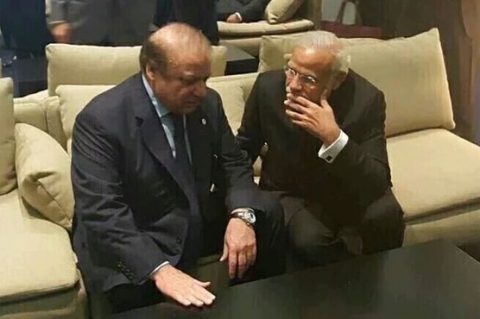
(Nawaz Sharif and Modi in “informal” conversation, Paris, Nov 30, 2015)
But make no mistake that the ISI kept track. The Pakistani side was actually expecting Modi’s surprise visit to Lahore and had made elaborate arrangements for a red carpet reception for the visiting Indian leader. Beyond doubt, every move that Modi made on Pakistani soil and every word he spoke to Nawaz was stored away as memory in the ISI archives.
Suffice to say, it is only Modi who is today in a position to clarify on what basis Imran Khan could have said with such audacity, “Perhaps if the BJP – a right-wing party – wins, some kind of settlement in Kashmir could be reached.”
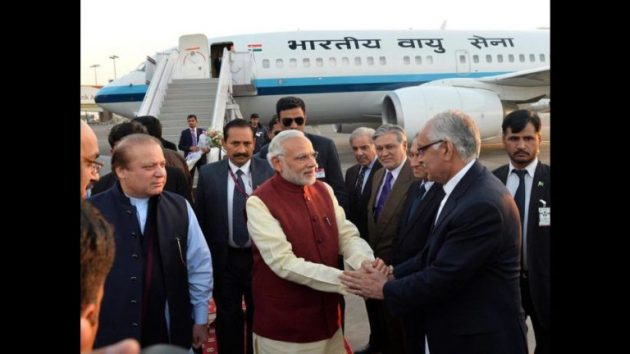
(Nawaz Sharif receiving Modi at the tarmac of Lahore airport, Dec 25, 2015)
Equally, Imran Khan’s caustic remark about the Congress is not unwarranted, when he said he didn’t expect the grand old party to deliver on a Kashmir settlement. Imran Khan cannot be unaware that although Manmohan Singh (or his NSAs) didn’t hang tough on Pakistan in the Indian media, he was tough as nail when it came to defending India’s national interests and didn’t make any concessions whatsoever to Pakistan.
In fact, Congress Party’s record has been consistently “hardline”, although it couldn’t match Modi’s rhetoric. Bangladesh war, occupation of Siachen, maritime boundary in Sir Creek — these are just three templates in India-Pakistan relations that alone should testify to the legacy of Congress rule. It must be remembered that the systematic erosion of Kashmir’s autonomy and India’s breach of promises to the Kashmir people took place in the decades since the fifties right up to the eighties only under Congress governments when BJP wasn’t even around as a gadfly.
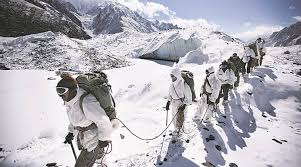
(Indian troops defending Siachen.)
So, the big question is about the signal that Imran Khan is giving when he reposes confidence in Modi to settle the Kashmir problem. Contextually, he would have three objectives — one, cautioning Modi against going too far in demonising Pakistan in his election rallies, no matter his political compulsions; two, projecting to the international audience an air of reasonableness in Pakistani policies ; and, three, forestalling any precipitate move by Modi to ratchet up tensions with Pakistan in the coming weeks between now and May 23, especially if a spectre of defeat haunts him in the election.
This last point is relevant if we factor in the decision by Islamabad only last Sunday to publicise “reliable intelligence” and “authentic information” available with it to the effect that India might make some military moves against Pakistan in the second half of April, once the elections got under way in India, out of which Modi could make political capital by whipping up jingoism.
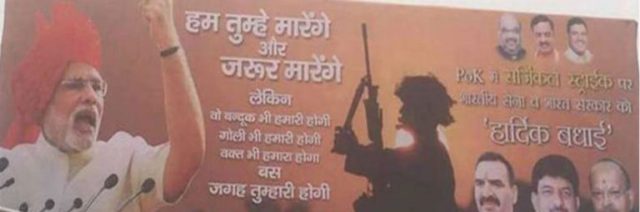
(BJP election poster with Modi and Indian soldier providing backdrop)
The intriguing part in all this is what Imran Khan really thinks of Modi as a politician. Historically, there is a perception in Pakistan that the BJP is a “Baniya party” of wheeler-dealers. But the past five years of BJP rule would have somewhat dispelled such notions. Imran Khan cannot but be aware that Modi is a creation of the RSS and unless and until he broke that umbilical cord, he cannot plough a de-ideologised furrow toward Pakistan.
Now, this is where the Modi-Nawaz exchanges and the back channel conversations between Ajit Doval and his counterpart in Islamabad, former NSA Lt. Gen. Nasser Khan Janjua, come into play. The Indian public knows nothing about the contents of these exchanges and conversations. But ISI knows, the GHQ in Rawalpindi knows and Imran Khan knows. (And, indeed, Modi and Doval know.)
Importantly, therefore, a Pakistani Prime Minister for the first time in the past 7 decades has interfered in an Indian general election and showed his preference for a particular political leader. This is unacceptable. This is blackmail.
Yet, Modi only is responsible for it. Figuring out that he has nothing positive to project before the Indian electorate, Modi made Pakistan the centre piece of his election campaign to malign and embarrass Congress and to deflect attention from burning issues such as unemployment, agrarian crisis, Rafale scam, etc. But by doing so, Modi held open a door through which Imran Khan has simply walked in.
Look at the kind of things Imran Khan says on the eve of an Indian general election — that he prefers Modi (to Rahul Gandhi) as his interlocutor; that “Muslim-ness is being attacked” in India; that Muslims in India are unhappy; that Modi is electioneering like Israel’s Netanyahu, exploiting “fear and nationalist feeling”; that J&K’s special status is under attack; that Kashmiris are waging a political struggle and there is no military solution to it; that “there is still the possibility if the polls turn against Modi in the next few weeks that India could take some further military action against Pakistan” and so on.
The most intriguing remark Imran Khan made was that Modi’s much-touted Balakot attack on February 27 was only an act of dissimulation and so the Pakistani retaliation the next day was a pro forma act — as if it were an elaborate pantomime being played out with Modi as the master choreographer. As he put it, the IAF bombed trees and the PAF retaliated by bombing stones.
These are exceptional remarks for the leader of a foreign country to make. But Modi cannot take exception, because he only invited this Pakistani slur on India’s democracy and its leadership. Clearly, Pakistan is blackmailing Modi and Doval. This seems like Modi’s “Obama moment” in Seoul 7 years ago.
Pakistan’s PM Slams India’s Modi and Israel’s Netanyahu as “Morally Bankrupt”
Sputnik – 09.04.2019
New Delhi – Pakistan Prime Minister Imran Khan on Tuesday launched a scathing attack on Indian Prime Minister Narendra Modi and Israeli Prime Minister Benjamin Netanyahu on the day when Israel is voting to elect its next government; India will begin the voting process for its general elections shortly.
“When leaders in Israel and India show a moral bankruptcy in their readiness to annex the occupied West Bank and India-Occupied Kashmir in defiance of international law, UN Security Council resolutions & their own Constitution for votes, don’t their people feel a sense of outrage and wonder how far they will go simply to win an election?” Imran Khan tweeted on Tuesday.
Israelis are voting on Tuesday, with Prime Minister Benjamin Netanyahu, leader of the right-wing Likud Party, seeking a fifth term in office.
Around 900 million will begin casting their votes starting on 11 April in a seven-phase polling process in India that will end with the announcement of its results on 23 May. The ruling Bharatiya Janata Party (BJP) hopes to retain control of the 543-seat Lok Sabha (Indian Lower House of Parliament).
“Our duty is to protect our nation, while Congress (the country’s main opposition party) and its supporters are anti-national. They are in favour of Article 370 (pertaining to unfair privileges to the strife-ridden state of Jammu and Kashmir). What Congress’s sham document (manifesto) is stating is exactly what Pakistan is saying,” PM Modi thundered at an election rally on Tuesday.
The BJP, in its 48-page manifesto, has made a new pledge to scrap Article 370 and Article 35A that gives special privileges to residents of India in the Kashmir region, such as laws preventing outsiders from buying property.
Earlier, Imran Khan took to Twitter to criticise the Indian government for fuelling war hysteria with Pakistan after the mid-February incident, when more than 40 Indian soldiers were killed in a terrorist attack in the Pulwama district of Kashmir.
Pakistan-based Jaish-e-Mohammed had claimed responsibility for the attack but the Indian government had squarely pegged blame on the Imran Khan government for allegedly sponsoring terror activities in India. In retaliation, the Indian Air Force had conducted an aerial strike on 26 February, describing it as a non-military strike against terrorist facilities in Balakot, inside Pakistan. The following day, the two nuclear-armed nations embroiled themselves in their first aerial clash in decades, which resulted in the loss of air assets.
Featured Video
America Racing to Strategic Defeat in Iran
or go to
Aletho News Archives – Video-Images
From the Archives
Should Europeans ‘Thank’ the Americans for Destroying Nord Stream?
By Robert Bridge | Strategic Culture Foundation | September 29, 2022
With an investigation continuing into the destruction of the Nord Stream gas pipeline that provided energy supplies to Europe from Russia, there appears to be just one prime suspect, and that should surprise nobody.
Following the sabotage of the Nord Stream 1 and 2 gas pipelines, former Polish Foreign Minister Radoslaw Sikorski already seemed to know the identity of the perpetrator when he tweeted out: “Thank you, USA.”
At first glance, it seemed that Sikorski was speaking sarcastically, berating Washington for carrying out an attack that will have severe repercussions for the people of Europe. After all, how could anyone see any good coming from the termination of Europe’s primary source of gas reserves with winter just around the corner? It was Sikorski’s homeland of Poland, after all, that urged its citizens to collect firewood in the face of dwindling gas reserves.
In fact, the Polish diplomat was speaking one-hundred percent literally… continue
Blog Roll
 Aletho News
- UK’s New Pandemic Plan Would Turn Big Tech Into a Mass Location Tracking Network
- Growing insecurity, soaring prices fuel protests in north as regime bans evacuation: Sources
- Iran denies responsibility for ‘depraved’ attack on Kuwait desalination plant
- Bring The Troops Back. End This War Now!
- Can we please stop calling Israel the ‘only democracy in the Middle East’ now?
- US should start removing its troops from Germany, proposes AfD co-leader Chrupalla
- Iran Red Crescent: 600 educational centers attacked in US-Israeli ‘war crimes’
- Russian Oil Tanker Arrives in Cuba Amid U.S. Blockade
- America Racing to Strategic Defeat in Iran: Lt Col Daniel Davis
- FTC Warns Visa, Mastercard, PayPal, Stripe Over Political Debanking
- If Americans Knew
- As Iran targets US military bases, will they be relocated to Israel? Not a ceasefire Day 171
- Will Trump Go Kamikaze?
- Is the University of Florida Shutting Down College Republicans over Israel Criticism?
- Jewish extremist arrested over alleged plot to firebomb Palestinian activist Nerdeen Kiswani’s home
- More than half of Palestinian child detainees have no charges
- The More Murderous Israel Gets, The More We Hear About “Antisemitism”
- Land Day and the Palestinian struggle after 30 months of genocide
- The Iran War Is About Palestine
- Israeli soldiers echo settler ideology, talk of revenge after targeting Palestinians and detaining CNN crew in the West Bank
- Israeli Policies Threaten Future of Christian Schools in Jerusalem
- No Tricks Zone
- New Study Finds Warming Saves Lives…Cold Temperatures 12 Times More Deadly Than Excess Heat
- German Science Blog Accuses PIK Climate Institute Of Hallucinating Climate Tipping Points
- Devastating Assessment Of Comirnaty Vaccine By Former Senior Pfizer Europe Toxicologist
- New Study: CO2 Is ‘Effectively Negligible’ As An Explanatory Climate Change Factor Since 2000
- Former Pfizer Toxicologist Dr. Helmut Sterz Tells Bundestag Hearing Pfizer Vaccine Should Have Never Been Approved
- Energy Expert: Germany’s Nuclear Phaseout Was A “500 Billion Euro Mistake”
- New Research: South Australia’s Mid-Holocene Sea Surface Temperatures Were 4°C Warmer Than Today
- Storing Green Energy To Last Germany 10 Days Would Require A 60-Million Tonne Battery
- New Studies: UK Sea Levels Were 4 Meters Higher Than Today During The Mid-Holocene
- Destructive Green New Deal: German Energy And Metal Group Warns Of Drastic Crisis
 Aletho News