Iran, Kazakhstan share many objectives on regional stability, nuclear disarmament: FM Zarif
Press TV – April 8, 2021
Foreign Minister Mohammad Javad Zarif says Iran and Kazakhstan have many common goals when it comes to global nuclear disarmament and regional stability.
In a post on his Twitter account on Thursday, Zarif hailed his “substantive and fruitful meetings” with Kazakh President Kassym-Jomart Tokayev and Foreign Minister Mukhtar Tleuberdi which were held in Kazakhstan’s capital Nur-Sultan on Wednesday during his third leg of a four-nation Central Asian tour.
“Our two countries share many objectives on regional stability and global nuclear disarmament,” the top Iranian diplomat said.
In his tweet, Zarif once again highlighted the top priority of the neighboring states in Iran’s foreign policy.
During a meeting between Zarif and Tokayev in the Kazakh capital of Nur-Sultan, formerly called Astana, the two sides discussed bilateral relations and the latest developments surrounding the peace processes in Afghanistan and Syria in addition to Iran’s nuclear deal.
In talks with his Kazakh counterpart, Zarif highlighted the many historical and cultural commonalities linking the two nations.
“Excellent talks were held on important regional and international issues, and we thank Kazakhstan for its support of the Islamic Republic of Iran on international fronts,” he said.
The Iranian and Kazakh foreign ministries also signed a 15-article document for cooperation between the two countries aimed at reinforcing friendly, fraternal and neighborly relations based on mutual respect and trust.
Zarif visited Uzbekistan and Kyrgyzstan before heading to Kazakhstan. He will visit Turkmenistan as the last leg of his tour.
The Latin Alphabet in Central Asia — America’s Geopolitical Tool
By Vladimir Odintsov – New Eastern Outlook – 04.12.2019
Central Asia has long been one of the key fronts in America’s ideological battle and information war against Russia.
A year ago, the American geopolitical intelligence platform Stratfor published its forecast for US policy in Central Asia, which focuses much attention on Russia. Analysts from this agency, which is dubbed the “Shadow CIA”, indicated in this forecast that the United States is looking to strengthen ties with countries along the periphery of the former Soviet Union — from Eastern Europe to the Caucasus and Central Asia — in an effort to put more pressure on Russia. A geopolitical war is going to be waged against Russia, or a multi-domain battle to use the American military terminology, affecting the political, economic, energy and military spheres.
Washington has long identified the Central Asian republics and Afghanistan a “zone of US national interests”, which is why this region is targeted with the full spectrum of American information campaigns. In order for these campaigns to be effective, not only have so-called “independent” media outlets and pro-Western NGOs, been making a massive contribution in Central Asia over the past number of years, which the US has been busily implanting in the region, but military specialists in information warfare have also been recruited — servicemen from the United States Army’s 4th Psychological Operations Group. The 8th Psychological Operations Group is responsible for work in Central Asia, which runs the Caravanserai information portal, a website specifically created to counter Russia, sponsored by the United States Central Command and targeted at residents of Uzbekistan, Kazakhstan, Kyrgyzstan and Tajikistan.
The main aim shared by most of the information campaigns Washington supports is to separate the regional population from Russia, mentally and psychologically, and to undermine Russia’s position in Central Asia. The campaigns mainly target young people in the hope that the leaders of the future in these countries will have been brought up on Western “democratic” ideals and will therefore be less inclined to partner with Russia.
Special programs are being launched and implemented by NGOs and “independent” media outlets in order to counteract Russia’s influence in the CIS countries. For instance, a new five-year program called MediaCAMP was presented at the end of last year in Kazakhstan and Tajikistan, which is run in Kazakhstan, Tajikistan and Uzbekistan by an American NGO called Internews Network (California, USA), and receives heavy funding from the United States Agency for International Development (USAID). The program has a budget of $15 million. Its official goal is “to develop a more balanced information environment”, but in reality, it is used for intensive anti-Russian propaganda. Internews Network had its activity suspended in Russia back in 2007, but it has continued to operate efficiently in most Central Asian countries up to this day. The USAID Agency, funded by the United States federal government, also ran programs in Russia up until 2012 when it was banned.
One clear example of the United States’ involvement in this anti-Russian information war in Central Asia would be the material that was published at the end of January by the Pentagon’s Caravanserai information portal mentioned earlier, pushing Central Asian countries to switch to the Latin alphabet. At the same time, Washington does not try to hide the fact that specialists in information warfare are pushing people to use the Latin alphabet instead of the Cyrillic alphabet, and it is part of their plan because it primarily acts as a tool to drive a cultural wedge between Russia and the Central Asian republics, and would erase the Russian language’s historical presence in Eurasia, constricting and shrinking the Russian-speaking cultural sphere and sphere of information.
It is important to remember that the extensive process of transcribing almost all the languages spoken in the Soviet Union into Cyrillic, which began in 1935, was one of the measures the Soviet government took to unite people in the former USSR. This included transliterating languages with a rich written tradition, interrupted by the reforms of the late 1920s, and languages that had only recently adopted a written form. By 1940, the “Cyrillization of the entire country” was largely complete. Dozens of languages acquired a writing system which united them with the Russian cultural sphere, and it was essentially the first time speakers of these languages received access to a single Eurasian space to share information. After the Second World War ended with Soviet victory in 1945, the Cyrillic alphabet was further consolidated as the main alphabet in the Soviet Union and the Eastern Bloc which was beginning to take shape (for example, the Cyrillic alphabet was introduced in Mongolia).
That is why Caravanserai’s sponsors not only see replacing the Cyrillic alphabet with the Latin alphabet as a kind of symbolic act; it is also meant to drive a mental and psychological wedge between Central Asian countries and Russia. This is the precise aim of the language conflict and Russophobia Washington has been encouraging in the Baltic States, Ukraine, and in some countries in the Caucasus.
It was Washington that began stirring things up, stressing the need for Latinization in Central Asian countries through various channels under its control in Kazakhstan, where Russian is not only a native language for the ethnic Russians who live there, but also for many of the Kazakhs, Ukrainians, Germans and Koreans living in Kazakhstan. Now the Russian language has even been erased from Kazakhstan’s national tenge banknotes. Around 300 thousand people have emigrated from Kazakhstan over the past 10 years, most of them Slavs, and to some extent, it is due to this policy. As it was put in an article published in the Polish newspaper Rzeczpospolita in November 2017, “by abandoning the Cyrillic alphabet, Nazarbayev is cutting the umbilical cord with Russia.”
Latinization has also been foisted in Kyrgyzstan and Uzbekistan.
However, as we have seen in recent years, switching to the Latin alphabet has clearly been an unhappy experience in Uzbekistan and Kazakhstan. Thus, it is worth recalling that Uzbekistan looked to the Turkish model in its first years of independence, and switching to the Latin alphabet was viewed a sort of “basis for unity”. Transitioning to the Latin alphabet also came to symbolize national identity and independence for the new Uzbek authorities. At the time however, no one stopped to consider the financial side of this transition, the costs associated with transliterating a huge archive of literature from Cyrillic into Latin script. Another thing no one saw coming was the conflict between generations reading in different alphabets. Relations between Uzbekistan and Turkey cooled within a very short space of time, the alphabet stayed the same, but the country’s education suffered a significant loss, which even affected basic literacy.
Attempts to switch to Latin have unleashed significant problems in Kazakhstan. In the 80 years since Kazakhstan made the transition from Arabic to Cyrillic, a huge network of libraries was created in this country, even in remote villages. The country had already achieved a literacy rate of 100%, which meant that the whole “matrix” of thinking for the entire population would need to be changed in switching to a new alphabet, and that would not only entail significant financial costs, but would also create generational conflict.
People in the region have responded to the attempts the West has been making to replace the Cyrillic alphabet with the Latin alphabet in Central Asian countries as fast as possible. They have increasingly begun to realize that there is no point in making this transition. Russian is a second language in Central Asian countries anyway, these states are geographically, economically, politically and linguistically distant from the West, and they are members of the Eurasian Economic Union, where the working language is Russian. Given these circumstances, there is a growing understanding that this issue requires a logical approach and some common sense, and linguistic problems should not be politicized.
Various foreign NGOs, such as Freedom House and other similar organizations, have been interfering in the domestic affairs of Central Asian states, destroying the linguistic and cultural heritage of the people who live there, and clearly pose a threat to their constitutional order, a threat coming from outside the region, so it is therefore unsurprising that this issue has been discussed more and more heatedly over recent years, with an increasingly resounding negative tone.
Kazakhstan to forgive debts of the poor, end bank bailouts
RT | June 27, 2019
In a first major policy announcement, the newly elected president of Kazakhstan Kassym-Jomart Tokayev said he will write off bad loans held by as much as a sixth of the country’s population.
As part of the debt forgiveness program he aims to end costly state rescues of private banks. The 66-year-old was elected president on June 9 after longtime leader Nursultan Nazarbayev stepped down as head of state in March.
The Central Asian country has been struggling with a decade-long crisis which forced the government to pump at least $18 billion into lenders as the banking sector was collapsing under the weight of bad debts. Kazakhstan’s central bank is conducting a review of asset quality which prompted speculation that a new round of bailouts could be in the works.
“My attitude is that there should be no governmental bailouts” for lenders, Tokayev told Bloomberg in an interview. “My assessment of this issue as a president is that the government should not get involved any more, any longer, with its loans as far as private banks are concerned.”
He noted that while the debt-relief initiative could help lenders, the total cost was likely to come in at “a bit less than $1 billion.”
According to the Kazakh president, more than three million people in the country of 18 million will get help to get rid of debts. It is aimed at “people who find themselves in very difficult living circumstances,” said Tokayev.
The presidential administration estimated that about 500,000 people are not able to manage their debt. In 86 percent of cases, the loans are less than 1 million tenge ($2,650), while the average debt is about 300,000 ($788) tenge.
Talking about past bailouts Tokayev dismissed any political connections, saying “the lesson has been accepted by us.”
“We will take lessons from the past, from what has happened in the banking system, and I think that in a couple of years you’ll have absolutely new questions,” he added.
Is This The Most Important Geopolitical Deal Of 2018?
By Olgu Okumus | Oilprice.com | August 13, 2018
The two-decade-long dispute on the statute of the Caspian Sea, the world largest water reserve, came to an end last Sunday when five littoral states (Russia, Iran, Turkmenistan, Kazakhstan and Azerbaijan) agreed to give it a special legal status – it is now neither a sea, nor a lake. Before the final agreement became public, the BBC wrote that all littoral states will have the freedom of access beyond their territorial waters, but natural resources will be divided up. Russia, for its part, has guaranteed a military presence in the entire basin and won’t accept any NATO forces in the Caspian.
Russian energy companies can explore the Caspian’s 50 billion barrels of oil and its 8.4 trillion cubic meters of natural gas reserves, Turkmenistan can finally start considering linking its gas to the Turkish-Azeri joint project TANAP through a trans-Caspian pipeline, while Iran has gained increased energy supplies for its largest cities in the north of the country (Tehran, Tabriz, and Mashhad) – however, Iran has also put itself under the shadow of Russian ships. This controversy makes one wonder to what degree U.S. sanctions made Iran vulnerable enough to accept what it has always avoided – and how much these U.S. sanctions actually served NATO’s interests.
If the seabed, rich in oil and gas, is divided this means more wealth and energy for the region. From 1970 until the dissolution of the Soviet Union (USSR) in 1991, the Caspian Sea was divided into subsectors for Azerbaijan, Russia, Kazakhstan and Turkmenistan – all constituent republics of the USSR. The division was implemented on the basis of the internationally-accepted median line.
After the dissolution of the Soviet Union, the new order required new regulations. The question was over whether the Caspian was a sea or a lake? If it was treated as a sea, then it would have to be covered by international maritime law, namely the United Nations Law of the Sea. But if it is defined as a lake, then it could be divided equally between all five countries. The so-called “lake or sea” dispute revolved over the sovereignty of states, but also touched on some key global issues – exploiting oil and gas reserves in the Caspian Basin, freedom of access, the right to build beyond territorial waters, access to fishing and (last but not least) managing maritime pollution.
The IEA concluded in World Energy Outlook (WEO) 2017 that offshore energy has a promising future. More than a quarter of today’s oil and gas supply is produced offshore, and integrated offshore thinking will extend this beyond traditional sources onwards to renewables and more. Caspian offshore hydrocarbon reserves are around 50 billion barrels of oil equivalent (equivalent to one third of Iraq’s total oil reserves) and 8.4 trillion cubic meters of gas (almost equivalent to the U.S.’ entire proven gas reserves). As if these quantities were not themselves enough to rebalance Eurasian energy demand equations, the agreement will also allow Turkmenistan to build the Trans-Caspian pipeline, connecting Turkmenistan’s resources to the Azeri-Turkish joint project TANAP, and onwards to Europe – this could easily become a counter-balance factor to the growing LNG business in Europe.
Even though we still don’t have firm and total details on the agreement, Iran seems to have gained much less than its neighbors, as it has shortest border on the Caspian. From an energy perspective, Iran would be a natural market for the Caspian basin’s oil and gas, as Iran’s major cities (Tehran, Tabriz, and Mashhad) are closer to the Caspian than they are to Iran’s major oil and gas fields. Purchasing energy from the Caspian would also allow Iran to export more of its own oil and gas, making the country a transit route from the Caspian basin to world markets. For instance, for Turkmenistan (who would like to sell gas to Pakistan) Iran provides a convenient geography. Iran could earn fees for swap arrangements or for providing a transit route and justify its trade with Turkey and Turkmenistan as the swap deal is allowed under the Iran-Libya Sanctions Act (ILSA, or the D’Amato Act).
If the surface water will be in common usage, all littoral states will have access beyond their territorial waters. In practical terms, this represents an increasingly engaged Russian presence in the Basin. It also reduces any room for a NATO presence, as it seems to be understood that only the five littoral states will have a right to military presence in the Caspian. Considering the fact that Russia has already used its warships in the Caspian to launch missile attacks on targets within Syria, this increased Russian presence could potentially turn into a security threat for Iran.
Many questions can now be asked on what Tehran might have received in the swap but one piece of evidence for what might have pushed Iran into agreement in its vulnerable position in the face of increased U.S. sanctions. Given that the result of those sanctions seems to be Iran agreeing to a Caspian deal that allows Russia to place warships on its borders, remove NATO from the Caspian basin equation, and increase non-Western based energy supplies (themselves either directly or indirectly within Russia’s sphere of geopolitical influence) it makes one wonder whose interests those sanctions actually served?
Caspian Sea Convention Bans Military Presence of Non-Littoral States in Region
RT | August 12, 2018
Vladimir Putin attended the Caspian Sea summit in Kazakhstan which he said has “milestone” significance. There five littoral powers finally made a breakthrough on trade, security and environment following 20 years of talks.
This year’s meeting has been “an extraordinary, milestone event,” Russian President Vladimir Putin told his counterparts in Kazakhstan’s port city of Aktau, where the summit took place. Leaders of the Caspian Five came there to seal a convention on the legal status of the sea washing shores of Azerbaijan, Iran, Kazakhstan, Russia and Turkmenistan.
“It is crucial that the convention governs … maritime shipping and fishing, sets out military cooperation among [Caspian] nations and enshrines our states’ exclusive rights and responsibilities over the sea’s future,” Putin said. He added the landmark accord also limits military presence in the Caspian Sea to the five littoral countries.
From now on, no country from outside the region will be allowed to deploy troops or establish military bases on the Caspian shores. The five states themselves will also decide on how to deal with issues currently affecting the Caspian Sea region, such drugs and terrorism.
“Hotspots, including Middle East and Afghanistan, aren’t far away from the Caspian Sea,” the President stated. “Therefore, the very interests of our peoples require our close cooperation.”
The summit may give boost to digitalization of commerce, mutual trade and logistics, Putin suggested. “Transportation is one of key factors of sustainable growth and cooperation of our countries,” he argued. Additionally, the five states will establish the Caspian Economic Forum “to develop ties between our countries’ businesses,” Putin told.
The Caspian Sea is home to some 48 billion barrels of oil and 292 trillion cubic feet of natural gas in proven offshore reserves. A range of important pipelines are going through the Caspian Sea, connecting Central Asia and Caucasus with the Mediterranean.
US in Afghanistan to Influence Russia, Iran, China – Russian Foreign Ministry
Sputnik – March 14, 2108
The United States retains its presence in Afghanistan to exert influence on neighboring countries and regional rivals – namely, Russia, Iran and China, Russian Foreign Ministry’s Second Asian Department Director Zamir Kabulov told Sputnik in an interview.
“In our opinion, the United States is in Afghanistan primarily with the aim of controlling and influencing the political processes in its neighboring countries, and also demonstrating its power to its regional competitors, primarily China, Russia and Iran. The United States is clearly trying to achieve destabilization of Central Asia and later transfer it to Russia in order to subsequently present itself as the only defender against potential and emerging threats in the region,” Kabulov said.
According to the diplomat, Russia and other countries neighboring with Afghanistan have questions about the true goals and time frame of the US military presence in the Central Asian country.
“If the United States and its NATO allies intend to continue their destructive policy in Afghanistan, this will mean that the West is heading toward the revival of the Cold War era in this part of the world. We closely monitor the developments and are ready to respond in cooperation with our partners and other like-minded people,” Kabulov noted.
The diplomat pointed out that Washington still failed to understand that the Afghan conflict could not be resolved solely by military means, stressing that it was impossible to defeat the Taliban by force.
Moscow is puzzled by the attempts of the United States and NATO to persuade Afghanistan to replace Russian weapons and military equipment, such move leads to reduction of Afghan’s military potential, Zamir Kabulov told Sputnik in an interview.
“The course taken by the United States and NATO to persuade Kabul to replace Russia-made small arms and aircraft is surprising, as it will inevitably lead to a decrease in the combat capabilities of the Afghan armed forces and further deterioration of the situation,” Kabulov said.
The diplomat reminded that a bilateral intergovernmental agreement on Russia’s defense industry assistance to Afghanistan had entered into force in November 2016, adding that the document created the legal framework for Russian assistance in arming and equipping the Afghan security forces.
“At the moment, negotiations are underway on repairs and supplies of spare parts for the Afghan Air Force’s helicopters for various purposes, produced in Russia (the Soviet Union),” Kabulov added.
Afghanistan Parliamentary Election
The parliamentary election in Afghanistan is unlikely to take place in July in the current circumstances, Kabulov said.
“I do not think that the parliamentary elections in Afghanistan will be held in July this year as scheduled. The Taliban continue to control about half of the country’s territory, engage in hostilities, organize and carry out terrorist attacks in large cities, and, apparently, are not going to make compromises and reconciliation with the Afghan government,” Kabulov said.
Afghanistan’s Independent Election Commission (IEC) is also unlikely to accomplish all the necessary procedures before the date set for the vote, given that the commission has announced earlier that the registration of voters will complete only by early August, the diplomat noted.
Furthermore, disagreements between the presidential administration and its political opposition regarding the parameters of the upcoming elections still remain unresolved, the official noted.
“In my opinion, if elections are conducted in the current circumstances, their results will not improve the political situation in the country and confidence in the current government, will not force the armed opposition to cooperate with the government,” Kabulov added.
The diplomat also noted that the Daesh terror group posed a serious threat to holding the election.
“The Daesh jihadists pose a serious threat to the security of the conduct of elections, especially in the north and a number of eastern provinces of Afghanistan. Some polling stations in the provinces of Helmand, Uruzgan, Kunduz, Badakhshan, Faryab and Ghazni are the most problematic in terms of security, according to the IEC data. I think that, in fact, the list of problematic areas in terms of organization of voting is much longer,” Kabulov said.
Afghanistan Reconciliation Talks
Russia considers the so-called Moscow format of talks an optimal platform for the promotion of national reconciliation in Afghanistan, Zamir Kabulov noted.
“Unfortunately, the existence of a large number of international formats on the Afghan issue has not significantly contributed to the involvement of the Taliban in peace negotiations. In this regard, we consider the Moscow format of consultations launched by us in early 2017 as the optimal platform for substantive negotiations to promote national reconciliation and establish a constructive dialogue between the government of Afghanistan and the Taliban movement,” Kabulov said.
Kabulov also noted that Moscow considered the format of talks in the Afghan capital as one approach toward achieving a collective solution to the problems surrounding Afghan settlement.
“A signal of international support for the resolution of the intra-Afghan conflict through political dialogue with the government of Afghanistan has been sent to the Taliban. The Taliban ignored the recent meeting of the ‘Kabul process’ in the Afghan capital, insisting on direct talks with the United States,” the diplomat added.
In February 2017, Russia, China, Pakistan, Iran, India and Afghanistan came together in Moscow for talks to promote the national reconciliation process in Afghanistan through regional cooperation with Kabul in the leading role. Apart from the aforementioned states, the latest round in April gathered five Central Asian countries: Kazakhstan, Kyrgyzstan, Tajikistan, Turkmenistan and Uzbekistan. The United States refused to take part in the meeting.
Afghanistan has long suffered political, social and security-related instability because of the simmering insurgency, including that of the Taliban, but also because of the actions of the Daesh terror group.
The United States has been in Afghanistan for almost 17 years following the 9/11 attacks. Before his election, Trump slammed sending US troops and resources to the Central Asian country.
Propaganda, Confrontation and Profit
By Brian CLOUGHLEY | Strategic Culture Foundation | 06.12.2017
The waves, the artificial tides of anti-Russian propaganda continue to beat upon the ears and eyes of Western citizens, spurred by Washington politicians and bureaucrats whose motives vary from deviously duplicitous to blatantly commercial. It is no coincidence that there has been vastly increased expenditure on US weaponry by Eastern European countries.
Complementing the weapons’ build-up, which is so sustaining and lucrative for the US industrial-military complex, the naval, air and ground forces of the US-NATO military alliance continue operations ever closer to Russia’s borders.
Shares and dividends in US arms manufacturing companies have rocketed, in a most satisfactory spinoff from Washington’s policy of global confrontation, and the Congressional Research Service (CRS) records that “arms sales are recognized widely as an important instrument of state power. States have many incentives to export arms. These include enhancing the security of allies or partners; constraining the behaviour of adversaries; using the prospect of arms transfers as leverage on governments’ internal or external behaviour; and creating the economics of scale necessary to support a domestic arms industry.”
The CRS notes that arms deals “are often a key component in Congress’s approach to advancing US foreign policy objectives,” which is especially notable around the Baltic and throughout the Middle East, where US wars have created a bonanza for US weapons makers — and for the politicians whom the manufacturers reward so generously for their support. (Additionally, in 2017 arms manufacturers spent $93,937,493 on lobbying Congress.)
Some countries, however, do not wish to purchase US weaponry, and they are automatically categorised as being influenced by Russia, which is blamed for all that has gone wrong in America over the past couple of years. This classification is especially notable in the Central Asian Republics.
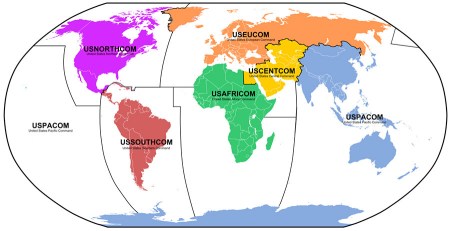
The US military’s Central Command (Centcom) states that its “area of responsibility spans more than 4 million square miles and is populated by more than 550 million people from 22 ethnic groups, speaking 18 languages… and confessing [sic] multiple religions which transect national borders. The demographics create opportunities for tension and rivalry.” Centcom is deeply engaged in the US wars in Iraq, Syria and Afghanistan, and supports Saudi Arabia in its war on Yemen, and the extent of its influence in the Pentagon’s self-allotted geographical Area of Responsibility is intriguing, to say the least. Some of its priorities were revealed in March 2017 by the Commander of this enormous military realm, General Joseph Votel, in testimony to the Armed Services Committee of the House of Representatives in Washington.
General Votel’s description of US self-allocated “responsibilities” was astonishing in its imperialistic arrogance.
As Commander of Centcom, General Votel gave the Armed Services Committee a colourful tour of his territory, describing nations in terms ranging from condescendingly supportive to patently insolent, and he devoted much time to describing relations with countries abutting Russia, Iran and China, which nations, he declared, are trying “to limit US influence in the sub-region.” That “sub-region” includes many countries immediately on the borders of Russia, Iran and China, and averaging 7,000 miles (11,000 kilometres) from Washington.
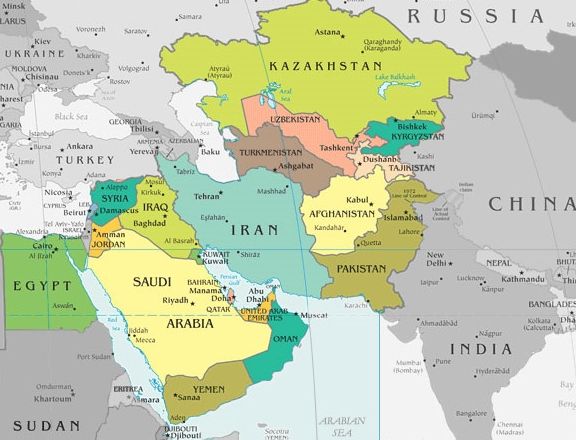
CENTCOM countries (coloured)
First he dealt with Kazakhstan with which the US has its “most advanced military relationship in Central Asia” in furtherance of which Washington is “making notable progress… despite enduring Russian influence.” It is obviously unacceptable to the Pentagon that Russia wishes to maintain cordial relations with a country with which it has a border of 6,800 kilometres. Then General Votel went into fantasyland by claiming that “Kazakhstan remains the most significant regional contributor to Afghan stability…” which even the members of the Congressional Committee would have realised is spurious nonsense.
But more nonsense was to follow, with General Votel referring to Kyrgyzstan in patronising terms usually associated with a Viceroy or other colonial master of a region that Votel describes as “widely characterized by pervasive instability and conflict,” which he failed to note were caused by the US wars in Afghanistan and Iraq.
He told the Committee that Kyrgyzstan “sees political pressure from its larger, more powerful neighbours, including Russia, hosting a small Russian airbase outside the capital, Bishkek. Despite ongoing challenges in our bilateral and security cooperation, we continue to seek opportunities to improve our mil-to-mil relationship.” He did not explain why Kyrgyzstan should be expected to embrace a military alliance with United States Central Command, but Viceroys don’t have to provide explanations.
Votel then moved to consider Tajikistan with which “our mil-to-mil relationship is deepening despite Moscow’s enduring ties and the presence of the military base near Tajikistan’s capital of Dushanbe, Russia’s largest military base outside of its borders.” Not only this, says Votel, but China (having a 400 Kilometre border with Tajikistan) has had the temerity to have “initiated a much stronger military cooperation partnership with Tajikistan, adding further complexity to Tajikistan’s multi-faceted approach to security cooperation.”
No: China hasn’t added any complexity to Tajikistan’s circumstances. What has complicated their relations is the fact that Afghanistan is in a state of chaos, following the US invasion of 2001, and drugs and terrorists cross the border (1,300 kilometres long) from Afghanistan into Tajikistan, which is trying to protect itself. During its sixteen years of war in Afghanistan there has been no attempt by the United States to secure that border.
None of these countries wants to be forced into a military pact with the United States, and Turkmenistan (border with Afghanistan 750 kilometres) has made it clear it doesn’t want to be aligned with anyone. But General Votel states that its “UN-recognized policy of ‘positive neutrality’ presents a challenge with respect to US engagement.” No matter what is desired by Turkmenistan, it seems, there must always be a way for the United States Central Command to establish military relations and, as General Votel told the Defence Committee, “we are encouraged somewhat by Turkmenistan’s expressed interest in increased mil-to-mil engagement with the US within the limits of their ‘positive neutrality’ policy.”
In the minds (to use the word loosely) of General Votel and his kind, it doesn’t matter if a country wants nothing whatever to do with the United States’ military machine, and wants very much to be left alone to get on with things without any interference. Adoption of such a policy by any nation presents a “challenge” and the United States, which in this region is overseen by General Votel’s Central Command, is determined to seek military “engagement” irrespective of what is desired by governments. Arms sales would swiftly follow.
Votel’s tour of his area of responsibility covered Afghanistan, about which his most absurd assertion was “I believe what Russia is attempting to do is they are attempting to be an influential party in this part of the world. I think it is fair to assume they may be providing some sort of support to [the Taliban] in terms of weapons or other things that may be there.”
There was not a shred of evidence provided, but the Committee accepted the pronouncement. Obviously if an allegation is made about Russia it doesn’t matter if it is false. It must be believed. But unfortunately for the imperial Votel and his deferential audience, a person with some sense of truth and balance came up two months later with a statement rubbishing Votel’s unfounded and provocative accusation. In May the Director of the US Defence Intelligence Agency told a Senate Committee that “We have seen indication that [Russia] offered some level of support [to the Taliban], but I have not seen real physical evidence of weapons or money being transferred.” The mainstream media gave no publicity to the truth, and continue to blame Russia for all the ills that befall the US Empire, at home and overseas.
The state of affairs was summed up admirably by Jacob Hornberger of the Future of Freedom Foundation on December 4 when he wrote that “Central to any national-security state is the need for official enemies, ones that are used to frighten and agitate the citizenry. If there are no official enemies, the American citizenry might begin asking some discomforting questions: What do we need a national-security state for? Why not abolish the CIA and dismantle the military-industrial complex and the NSA. Why can’t we have our limited-government, constitutional republic back?”
The Motto of the Pentagon’s Central Command is “Prepare, Pursue, Prevail.” and the Central Asian Republics would be well-advised to bear in mind these threats and think hard about the underlying motif of the US military-industrial complex which is “Propagandise, Provoke, Profit.”
Top General Warns That NATO Wants to Turn Post-Soviet Space ‘Into Another Syria’
Sputnik – 08.09.2016
A top Russian general has voiced his frustration over NATO’s lack of cooperation with a Russian-led alliance involving countries from the former Soviet space, saying that the Western alliance doesn’t seem to want countries in the former USSR to ally with one another, allowing NATO pick them off one by one at their leisure.
Speaking at a press conference in Moscow on Wednesday, Col. Gen. Nikolai Bordyuzha, secretary general of the Collective Security Treaty Organization, a military alliance involving six post-Soviet states, including Russia, Belarus, Armenia, Kazakhstan, Kyrgyzstan and Tajikistan, had some harsh words for Russia’s NATO partners.
The North Atlantic Alliance, he said, has been consistently opposed to any military integration between Russia and its partners in the CSTO, and the reason is that NATO wants to deprive these countries of their collective security guarantees.
“Why do you think NATO does not cooperate with the CSTO?” the general asked. “It’s simple – they have no need to support processes of [defense] integration. This way, things will be like in Syria, and nobody will be able to let out a peep. The country is being pounded, and there’s no one to help them, since it didn’t have any allies. And this is the situation they want to create for us as well,” Bordyuzha said, referring to the members of the CSTO.
Furthermore, the officer warned that the Western media has been engaged in what he called campaign of information warfare against the CSTO. “They will tell lies all day, every day. Everything that is being said about the CSTO is presented in a way that’s the opposite to how things are in reality,” Bordyuzha noted. “This is done, for example, in order to ensure that Tajikistan was not together with Russia,” he added.
Ultimately, Bordyuzha suggested that the Western political, media and military effort’s “most important task is to splinter our unity, to separate our nations into our own ‘national apartments’, and to dictate their terms to everyone individually.”
In this scenario, the officer emphasized that while the CSTO has absolutely no plans to fight a war of aggression against NATO, neither does it fear an attack by the Western alliance. “That’s why the CSTO exists,” Bordyuzha quipped.
The Collective Security Treaty Organization, formed in 1992, shortly after the collapse of the Soviet Union, integrates the defense capabilities of six former Soviet republics, including Russia, Belarus, Armenia, Kazakhstan, Kyrgyzstan and Tajikistan. Afghanistan and Serbia became observers to the organization in 2013. Former members include Azerbaijan, Georgia and Uzbekistan.
Signatories to the alliance are not able to join other military alliances, and aggression against one member is considered aggression against all.
The CSTO holds yearly command exercises and drills to improve coordination between its states militaries, the most recent being Cooperation-2016, which took place last month in Russia’s Pskov region.
Lawmaker hints at US role in turmoil around Russian borders
RT | July 21, 2016
The recent violent events in Turkey, Armenia and Kazakhstan could have been provoked by special services “from across the ocean,” a Russian MP working on the committee in charge of Eurasian integration has commented.
“In my opinion these are all links in one chain. The events in Turkey, Armenia and in Aktobe, Kazakhstan, are all connected and were all provoked from abroad. I think that special services from across the ocean are dealing with these issues, destabilizing the situation in these countries,” the deputy chair of the State Duma Committee for Eurasian Integration and Commonwealth of Independent States, Kazbek Taisayev, told Life news portal.
The MP said that Western nations were not interested in a calm situation near Russian borders and took steps to prevent such developments.
“As soon as we start a normal dialogue with our neighbors, something immediately happens in these countries,” he said.
“We need to unite our efforts, I think that we have enough political will to render mutual help to poor nations,” Taisayev stated.
The comment came shortly after a group of radical nationalists stormed and captured a police station in Armenia’s capital, Yerevan, killing one policeman and taking several more hostage. The attackers demanded the release of Armenian opposition figure Jirayr Sefilyan, who was detained last month after authorities reportedly uncovered a plot to seize several buildings and telecommunication facilities in Yerevan.
The standoff continues and on Wednesday night Armenian police used tear gas to dissolve a rally of Sefiyan’s supporters in central Yerevan.
In early June, a group of radicals raided two gun shops, hijacked a bus and attacked a military base in the city of Aktobe, Kazakhstan, killing at least five people and wounding 10 more. Police fought off the terrorists, killing four of them and arresting seven more.
This week two people allegedly connected with radical Islamist groups opened fire at a police station in Kazakhstan’s largest city, Almaty, killing seven people and injuring nine more. President Nursultan Nazarbaev has called the attack an act of terrorism.
On July 15, an attempted military coup took place in Turkey. A large group of military officers attempted to seize power, displacing President Recep Tayyip Erdogan. However, their plans were thwarted by police and thousands of ordinary people who took to the streets of Ankara and Istanbul. According to Turkish authorities 246 government supporters and at least 24 coup plotters were killed during the conflict. Thousands of Turkish military and law enforcement personnel were arrested and fired in the large-scale purge that followed these events.
On Wednesday, Erdogan announced the introduction of a state of emergency in Turkey for three months.
Erdogan and the government have said that the attempted coup was masterminded by Muslim cleric Fethullah Gulen who is currently living in the United States. Ankara also demanded Gulen’s extradition.
READ MORE:
Protesters clash with police in Yerevan amid ongoing hostage situation
5 killed, 9 injured in Almaty terrorist attack on police station (GRAPHIC)
‘Russia set to fund railway line between Iran, Azerbaijan’
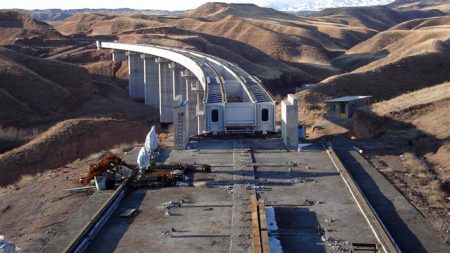
Press TV – July 3, 2016
Russia is reportedly poised to finance a railway line connecting Iran with its northern neighbor Azerbaijan.
According to Tasnim news agency, head of the press service of Azerbaijan Railways OJSC Nadir Azmammadov, has said that Russian Railways OJSC has discussed the terms of its participation in the financing of the Rasht-Astara (Iran)-Astara (Azerbaijan) railway with the related parties in the Azeri capital, Baku.
The report said representatives of the railways of Azerbaijan, Iran and Russia attended the talks in which the Azeri side informed the partners about the projects and tasks ahead.
Baku believes the international transport corridor will improve Azerbaijan’s transit potential as well as its ties with the other two countries.
Participants in the talks reportedly signed a final protocol.
The trilateral railway project is aimed at connecting Northern Europe with Southeast Asia.
The railway line will initially transport five million tonnes of cargo when it is launched in the near future.
Last November, Iran and Russia signed an agreement worth 1.2 billion euros to electrify a train line, linking north-central Iran to the northeastern border with Turkmenistan.
The agreement signed between Russian Railways and the Islamic Republic of Iran Railways (RAI) envisages constructing power stations and overhead power lines along the Garmsar-Sari-Gorgan-Inche Burun route in Iran.
“The implementation of the contract will improve the capacity of passenger trains and raise transit to 8 million tonnes,” said RAI Managing Director Mohsen Poursaeed-Aqaei who signed the document.
The train line, among the first in Iran with a history of 80 years, extends to Turkmenistan and Kazakhstan and links the Central Asia to the Persian Gulf and beyond.
The project was also set to be financed by the Russian government and would be implemented in 36 months, which includes manufacturing all electric locomotives inside Iran, electrifying 495 kilometers of railway and building 32 stations and 95 tunnels.
Hybrid Wars 4. In the Greater Heartland (III)
By Andrew KORYBKO | Oriental Review | April 8, 2016
(Please read Part I and Part II prior to this article)
Turkmenistan:
The threat facing Turkmenistan is less of a Color Revolution than an Unconventional War. The catalyst for this conflict would be a terrorist invasion coming from Afghanistan that unexpectedly sweeps northwards along the Murgab River. Such an offensive doesn’t even have to reach the national capital in order to be successful, since all that it really needs to do is capture the city of Mary, the capital of the resource-rich Mary Region. This part of the country contains the lion’s share of Turkmenistan’s gas reserve, which includes the massive and decades-long functioning Dauletabad Field and the newly discovered Galkynysh Field, the latter being the world’s second-largest find.
It wouldn’t be all that difficult for terrorists to take over this plot of land either, since the Murgab River is scattered with tiny villages along its banks that could provide cover from government airstrikes and places to provoke pitched battles from. The fertile land nearby is endowed with agricultural potential that’s surely being stored somewhere closely accessible, and this could help feed the occupying forces until greater conquests are made. In short, the Murgab River is the most militarily and logistically sustainable route for an ISIL-like invasion of Turkmenistan, and it leads straight to the gas heart of Eurasia that’s critically connected to China and will possibly be linked to India in the coming decade as well.
The risk of terrorists gaining control of the largest source of China’s gas imports and possibly even destroying the facilities is too much for multipolar strategists in Beijing and Moscow to bear, and it’s assured that they’ve already engaged in some sort of unofficial contingency planning with their counterparts in Ashgabat. An anti-terrorist Chinese intervention is largely precluded due to geographic distances and a lack of support and logistics facilities en route, but the Russian military has no such hindrances and would be much more likely to assist the Turkmen authorities if called upon to do so. This is of course a last resort and would only be commissioned if Turkmenistan proves itself unable to stem the terrorist tide and defend its gas infrastructure, but such an event is most assuredly being planned for just in case the Turkmen-Afghan border proves to be just as fragile of a defense against terrorists as the Syrian-Iraqi one was before it.

Kazakhstan:
Kazakhstan and the other three remaining states of former Soviet Central Asia are greatly at risk of a “Central Asian Spring” breaking out in the Fergana Valley, and Part IV of the Greater Heartland series will focus exclusively on this ever likely scenario. Accordingly, the rest of this section will explore the other Hybrid War vulnerabilities facing these four countries.
The geographically largest state in the Greater Heartland region is surprisingly immune from many of the conventional socio-political factors that lead to Hybrid Wars (excluding the variables that will later be discussed about the “Central Asian Spring”). If one was blind to the domestic and international contexts pertinent to Kazakhstan, then they’d be inclined to believe that the Russian population constitutes the greatest threat to the country’s sovereignty, although this couldn’t be anywhere further from the truth. Theoretically speaking, this demographic satisfies all of the criteria necessary for sparking a Hybrid War, but Kazakhstan’s multipolar alignment with the Eurasian Union and respectful treatment of this influential minority group precludes any chances that they or Russia would ever try to move forward with this scenario. On the reverse, the very inclusion of such a large Russian minority within Kazakhstan ties Astana and Moscow closer together than just about any other state in the former Soviet Union and works to enhance, not deteriorate, relations between them.
The only vulnerability in this relatively secure setup is if the US and its proxy NGO affiliates succeed in brainwashing the Russian-Kazakh population with Pravy Sektor- and Navalny-esque extreme nationalism, which could then create a delicate geopolitical situation where the raucous Russian minority agitates against Astana and attempts to drive a wedge between Kazakhstan and Russia. Security officials in both states are likely well aware of this obvious scenario and can be predicted to have rehearsed coordinated contingency measures for responding to it. Nonetheless, if such a virulent, discriminatory, and destructive ideology as “Greater Russian Nationalism” is allowed to fester in multicultural Kazakhstan and parts of the Russian Federation itself, then a scandalous outbreak in the Near Abroad could provoke a simultaneous cross-border event inside of Russia, especially if ‘sleeper sympathizers’ organize anti-government protests against Moscow’s “betrayal” of its compatriots out of its refusal to replicate the Crimean scenario in Northern Kazakhstan.
Another destabilization possibility that mustn’t be discounted in Kazakhstan is a repeat of the Zhanaozen riots, the ‘localized’ Color Revolution attempt that was sparked by a simmering labor dispute in 2011. The oil field workers were fed up with what they complained to be poor working conditions, low wages, and unpaid salaries, and this created an attractive atmosphere for Color Revolutionaries to exploit. Keeping with Color Revolution tradition, the riots started on 16 December, the 20th anniversary of Kazakh independence, and were presumably expected to signal the beginning of the regime change attempt to other cells across the country, almost one year to the day that the “Arab Spring” Color Revolution first broke out in Tunisia.
Seething with preexisting anger, the workers were extraordinarily easy to exploit, and the carnage they committed killed over a dozen people and injured more than 100 before a state of emergency and necessary military intervention restored order. The authorities’ decisive reaction and the multicultural, patriotic identity of most Kazakhs can be credited with preventing the spread of the Color Revolution virus from the distant Turkmen border all the way to centrally located capital, but the strategic lessons that can be learned from this episode are that: labor disputes and organizing could be both a cover and spark for a Color Revolution; and that destabilizations could start outside of the major cities and originate in the far-flung provinces.
Kyrgyzstan:
This tiny mountainous republic is notably split along a steep North-South divide, with the capital of Bishkek being located along the northern plains while the major population centers of Jalal-abad and Osh reside in the southern Fergana Valley. The clan-based nature of Kyrgyz society has played a strong role in influencing the political system, and this has consequently created identity resentment among whichever group was disproportionately underrepresented at the given moment. Although the situation has relatively stabilized and become somewhat more ‘equitable’ since the 2010 Color Revolution, clan-based tension and its geographic affiliations are still deeply ingrained in the national psyche, and any visible calmness simply belies the aggravating tensions that lay just beneath the surface. As confirmation of this assessment, one need only remember the misleading “stability” that many had inaccurately judged to be prevalent in the country just prior to the 2005 and 2010 Color Revolutions, and after witnessing the ferocious clan-based and ethnic violence that exploded after each of them, it’s improbable to assume that the individual drivers of such identity conflicts simply disappeared on their own after only half a decade.
What really happened is that they went underground as usual and abstained from the national discourse, while still remaining psychologically mobilized and ready to act the moment a future destabilization distracts or dissolves the security forces and provides another strategic opening for settling unresolved blood feuds that still linger from last time. The most violent-prone area of Kyrgyzstan is its southern Fergana region that abuts Uzbekistan, and it’s here where radical Islamic elements have taken root. The difficulty in forcibly eradicating them is that any major Kyrgyz security operation so close to the Uzbek border, let alone one that potentially targets ethnic Uzbeks, could create a hostile impression towards much-stronger Uzbekistan, which in turn could use the events as a pretext for activating a prearranged plan to mobilize in response to the ‘human rights violations’ allegedly being committed against its ethnic compatriots. Tashkent’s geopolitical loyalty has always been nebulous and ill-defined, and the country’s been working more closely with the US ever since the 2014 drawdown in Afghanistan. Washington needs a Lead From Behind partner in Central Asia, and it’s possible that Uzbekistan has been designated this role, which if it doesn’t comply with, could lead to the “Central Asian Spring” scenario that will soon be discussed.
To return to the Hybrid War threats facing Kyrgyzstan, it’s important to highlight that the country’s mountainous terrain is very accommodating to guerrilla warfare. The southern mountain ranges are sparsely populated and the government barely has any presence in some of the more isolated areas. Looking at the regional geography at play, it’s conceivable that Fergana-based terrorists could receive weapons and fighters from Afghanistan by taking advantage of the lack of governance present in Southern Kyrgyzstan and Tajikistan’s Gorno-Badakhshan Autonomous Region. After all, this route is already used to smuggle tons of drugs, so it’s certainly possible that it could be used to transport terrorists and weapons along the way as well (if this isn’t being done already). It’s very difficult for the Kyrgyz authorities to exert full control over this region because of tight financial and human resources, a current prioritization on the more populated areas, and the inhibitive geography involved.
To emphasize the last point, wintertime typically renders all of the few north-south roads impassable and strands the mountainous southern-based citizens in their villages for the duration of the season. This effectively splits the country into two, and if timed to coincide with a Hybrid War, then it could give the regime change insurgents active in that region enough time to consolidate their gains and prepare for the hostilities that would inevitably recommence after the snow melts in spring. When one thinks of a terrorist-driven “caliphate”, the last thing that probably comes to mind is a mountainous, snow-covered retreat, but this is exactly what ISIL or any likeminded group could feasibly create in Southern Kyrgyzstan if they played their cards ‘right’. It would be extremely challenging to dislodge the terrorists in such a scenario, and the danger in doing so would critically spike if it were revealed that they had access to anti-aircraft weapons. The Kyrgyz military would obviously be unsuited for such a difficult task and would have to resort to their Russian partners in the CSTO for assistance, with Moscow predictably helping through a combination of drone surveillance and air strikes just as it’s currently doing in Syria at the moment.
Tajikistan:
The threat facing Tajikistan is structurally similar to the one in Kyrgyzstan, and it’s that the country’s large swath of mountainous geography could be exploited by terrorist groups in facilitating smuggling routes or providing cavernous shelter. It goes without saying that Tajikistan’s border with Afghanistan is perhaps its greatest vulnerability, but some respite could be found in the fact that there are more ethnic Tajiks in Afghanistan than in Tajikistan, and that if this community were properly mobilized to its fullest extent, then it could provide an effective bulwark against the Taliban and other terrorist groups. At the moment, however, this doesn’t seem to be the case, since the Taliban was able to briefly capture the northern provincial capital of Kunduz at the end of September and achieve their greatest military success since 2001.
Up to this point, it had been largely assumed that this part of Afghanistan was the least welcoming to the Taliban owing to the valiant history of the Northern Alliance and the relatively secular Tajik community that inhabits the region. What Kunduz taught observers is that these two factors are no longer the strongest determinants of regional security, and that the Taliban has succeeded in the past decade and a half in proselytizing their ideology, gaining sympathizers, and infiltrating enough fighters into the area so as to set up an effective base of operations. The converts that they’ve claimed, the supporters that they’ve acquired, and the terrorists that they’ve relocated to Northern Afghanistan all played an integral role in the Taliban’s capture of Kunduz, and just because they had to conventionally retreat from the city doesn’t mean that their soft infrastructure had to withdraw as well. The reason that this is relevant to Tajikistan is that it proves that the Taliban have a strong presence right along the Amu Darya river border and that fears about their cross-border militant potential are not misplaced.
More domestically, however, the greatest threat comes from the Islamic Renaissance Party, the newly banned organization that represented the last legal party of political Islam in the region. The process was in the works for a while, but ultimately it was decided that the group was full of terrorists and needed to be shut down as soon as possible, with the decision being spurred by rogue former Deputy Defense Minister Abdukhalim Nazarzoda’s coup attempt earlier that month. He and a group of followers slaughtered over 30 soldiers in the capital of Dushanbe before fleeing into the mountains where they were finally hunted down and killed a week later. The subsequent investigation revealed that the deputy head of the Islamic Renaissance Party, Mahmadali Hayit, had consorted with the coup plotters earlier in the year and that 13 members of the party were suspected of being involved in the attacks, so it makes absolute sense that the organization would be outlawed soon thereafter in the interests of national security. At the same time, however, the proclamation came so abruptly that the authorities didn’t have time to completely extinguish the organization, and countless sympathizers and probable sleeper cells can be assumed to be embedded in society. Whether they’ll make the transition to militant action on behalf of the terrorist organization or repent for their prior allegiance to it and disown its ideology remain to be seen, but the actionable threat remains nonetheless and is obviously a destabilizing factor that could be leveraged in any coming Hybrid War against Tajikistan.
Uzbekistan:
Aside from the “Central Asian Spring” scenario that will be detailed in Part IV, there are still quite a few other Hybrid War threats facing the region’s largest country. Uzbekistan is first and foremost threatened by a complete breakdown in law and order stemming from a succession crisis after the passing of Islam Karimov. The author previously explored the contours of these chilling possibilities in his piece “Uzbekistan’s Bubbling Pot Of Destabilization”, but to concisely summarize, the clan-based nature of Uzbek society coupled with the competition between the National Security Service and the Interior Ministry creates a cataclysmic scenario where a black hole of disorder arises in the heart of Central Asia and rapidly spreads throughout the rest of the region.
The only thing that could stop the previously held-together society from dramatically decentralizing down to Somalian-style warlordship would be the rapid reconsolidation of power under one of the two competing security agencies, but since their rivalry could predictably intensify in the days following Karimov’s death (and with the resultant security breakdown this would entail if they focus more on one another than on their designated subjects), it can’t be precluded that Uzbekistan could unravel before anyone realizes what even happened. Of course, if Karimov publicly designates a successor prior to his death or steps down and allows his designee to rule before then, this could potentially assuage the risks inherent in this scenario, but it doesn’t look too likely that this would happen, nor would these steps prevent the rival agency from attempting a major power play the moment the ‘head honcho’ inevitably dies anyhow.
Parallel with this possible tumult could be an explosion of terrorism from the Islamic Movement of Uzbekistan, Hizb ut Tahrir, ISIL, the Taliban, some yet-to-be-named organization, and/or a combination of these groups, which would exacerbate the already deteriorating security situation in the country and divide the security services’ focus even more. There’s also the likelihood that the Taliban or ISIL might even make a conventional move on Uzbekistan amidst the greater breakdown of regional order, which in that case would usher in a global crisis similar to the one that transpired when ISIL crossed into and began conquering Iraq.
Therefore, true to the theory of Hybrid War, any type of social disruption in the tightly controlled Uzbek society, be it through a Color Revolution, succession crisis, or a combination of factors, would create a tantalizing opportunity for Unconventional Warriors to rise up against the state and increase the odds of regime change. In this case, if there’s no real government in power at the moment, then it would prolong the “regime vacuum” and amplify country’s disorder until it reaches the critical point of spreading to its neighbors. Therefore, in such a scenario as the one previously described, it’s important for some leader or leading entity (e.g. military junta) to assume power as soon as possible in order to preempt a regional breakdown. In hindsight, it was precisely this quick emergence of leadership, however weak and fragmented, that emerged in Kyrgyzstan after the 2010 Color Revolution that helped to miraculously contain the chaos and prevent it from turning into a “Central Asian Spring”.
Before addressing this curious concept that’s been alluded to a few times already, it’s necessary to briefly touch upon a minor socio-political factor in Uzbekistan that shouldn’t be overlooked when discussing forthcoming disorder there. The autonomous republic of Karakalpakstan is a little-known administrative entity in the former Soviet Union that handsomely sits atop rich oil and gas reserves and provides transit to two energy pipelines to Russia. The dried-up majority of the Aral Sea has endowed the region even more oil and gas than was previously accessible, meaning that Karakalpakstan will likely become more important than ever to the Uzbek state.
Still, its energy potential isn’t the exact reason why the autonomous republic is brought up when discussing Hybrid War scenarios, since there lately have been whispers of a Karakalpakstan “independence” movement that provocatively wants to join Russia. In all probability, this isn’t a genuine movement but rather a proxy front controlled by the US to advance the objective of straining the already frayed ties between Russia and Uzbekistan. The appearance of a “pro-Russian” separatist organization at the crossroads of Uzbekistan, Kazakhstan, and Turkmenistan isn’t incidental, and its’ designed to destabilize the entire region if ever given the opportunity. On its own, the Karakalpakstan “independence” movement is powerless to do anything to upset the Central Asian balance, but in the event that the eastern more populated part of the country descends into bedlam following one or some of the abovementioned scenarios, then it’s likely that this group will emerge from the shadows (or more likely, be parachuted or infiltrated into the theater) to violently lay stake to its secessionist claim so that it can then transform into an American protectorate.

To be continued…
Andrew Korybko is the American political commentator currently working for the Sputnik agency. He is the post-graduate of the MGIMO University and author of the monograph “Hybrid Wars: The Indirect Adaptive Approach To Regime Change” (2015). This text will be included into his forthcoming book on the theory of Hybrid Warfare.
Russian Ties in Central Asia Threaten US Interests – CENTCOM Chief Nominee
Sputnik – 09.03.2016
WASHINGTON — CENTCOM commander nominee General Joseph Votel said that Russia’s trade and military relationships with neighboring Central Asian states threaten US interests in the region.
Russia’s trade and military relationships with neighboring Central Asian states threaten US interests in the region, US Central Command (CENTCOM) commander nominee General Joseph Votel said in testimony to the Senate Armed Services Committee on Wednesday.
“Russia has moved to assert itself in Central Asia through a combination of military, economic and informational means in an effort to resurrect its great power status and hedge against perceived instability emanating from Afghanistan,” Votel stated.
After 14 years, the United States has reduced its military presence in Afghanistan to 9,800 troops, with plans to reduce troop levels to 5,500 by 2017. In the past year, Taliban militants and Daesh terrorist fighters have been on the rise in Afghanistan, prompting US commander of operations there, General John Nicholson, to describe the conditions in the country as “deteriorating.”
Votel further argued that Russian security partnerships with former Soviet states in Central Asia “make it difficult for the United States” to deepen defense ties in the region, which he described as a “key US interest.”
Since 1992, Russia has partnered with neighboring nations in the Collective Security Treaty Organization (CSTO). Russia also founded the Eurasian Economic Union in 2014, to further regional economic development among member nations including Armenia, Belarus, Kazakhstan and Kyrgyzstan.
Featured Video
Yemen joins the war – Red Sea could be blocked next – Saudi regime at risk
or go to
Aletho News Archives – Video-Images
From the Archives
A superpower and “the world’s sickest warrior state”
By Paul J. Balles | March 8, 2010
Living through five or six major wars has hardened me to what I thought were the extremes of inhuman cruelty and brutality.
Two things made those extremes almost bearable: the brutality always revealed – at least according to the media coverage – the viciousness of the enemy. It was therefore quite understandable when our “brave men and women” pulverized the enemy.
Films of Japanese torturing captive Americans somehow justified holding Japanese Americans in internment camps during World War II; and only a small percentage of Americans found the bombing of Hiroshima and Nagasaki unreasonably vengeful at best, at worst, depraved.
The media giants in America portrayed the North Koreans as barbaric beasts with their captives, quite unlike their southern counterpoints – our allies during the Korean War. No one ever felt the need to explain how the South Koreans were a civilized breed while the North Koreans were absolute savages, at least according to the official line.
In Vietnam, our warriors justifiably (or so the media made us believe) dropped napalm on the North Vietnamese who had the gall to hide in villages and tunnels to ravage our invaders. At least it was accepted practice until some rogue photojournalist filmed a young girl screaming down a Vietnamese road in flames. … continue
Blog Roll
 Aletho News
- Russian tanker approaches Cuba despite US oil blockade
- Marandi: Yemen joins the war – Red Sea could be blocked next – Saudi regime at risk
- Pro-Palestinian French member of European Parliament denied entry to Canada
- Pakistan to Host US-Iran Talks
- How Indonesia’s tilt toward the US left it stranded in the Strait of Hormuz
- US has no choice but to retreat from Iranian borders: Top commander
- Iran Retaliation Strikes Chemical Plant Near Dimona
- AWACS’ Destruction is a Major Loss for US Military – Ex-DoW Analyst
- Israel’s Iran Strategy Uses US Military & Gulf States as Its Pawns
- Iran: Trump wanted regime change, now just begging for Hormuz to open
- If Americans Knew
- Israeli police block Catholic cardinal from entering Church of the Holy Sepulchre on Palm Sunday
- Israel is assassinating journalists again, more than any other nation, anywhere, ever – Not a ceasefire Day 170
- Over 300 US service members wounded, majority have brain injuries – Not a ceasefire Day 169
- Researchers at Human Rights Watch Resign Over Blocked Report on Palestinian Refugee Return
- Jewish Groups Are Backing a War Americans Don’t Want
- Eric Fingerhut Thinks He’s the President of the Jews
- Top Jewish Philanthropists, Rabbis Urge Israeli President to Take Action Against ‘Jewish Extremists’
- Don’t Be Fooled. Zionist Leaders Have Always Wanted to Control Southern Lebanon
- Israel’s widespread use of torture is a core element of its genocide against the Palestinian people
- In Israel’s War on Iran, Many Middle East US Bases Rendered “All But Uninhabitable”
- No Tricks Zone
- German Science Blog Accuses PIK Climate Institute Of Hallucinating Climate Tipping Points
- Devastating Assessment Of Comirnaty Vaccine By Former Senior Pfizer Europe Toxicologist
- New Study: CO2 Is ‘Effectively Negligible’ As An Explanatory Climate Change Factor Since 2000
- Former Pfizer Toxicologist Dr. Helmut Sterz Tells Bundestag Hearing Pfizer Vaccine Should Have Never Been Approved
- Energy Expert: Germany’s Nuclear Phaseout Was A “500 Billion Euro Mistake”
- New Research: South Australia’s Mid-Holocene Sea Surface Temperatures Were 4°C Warmer Than Today
- Storing Green Energy To Last Germany 10 Days Would Require A 60-Million Tonne Battery
- New Studies: UK Sea Levels Were 4 Meters Higher Than Today During The Mid-Holocene
- Destructive Green New Deal: German Energy And Metal Group Warns Of Drastic Crisis
- New Study Documents A 20-Year Pause In Arctic Sea Ice Decline – Driven By Internal Variability
 Aletho News