Chile vote is a blow to corporate Canada and Trudeau
By Yves Engler · October 26, 2020
With Chileans voting overwhelming to rewrite the country’s Pinochet era constitution it’s a good moment to reflect on Ottawa’s support for his coup against Salvador Allende. It’s also worth looking at Canadian companies’ opposition to the popular uprising that lead to the referendum on reforming the dictatorship’s neoliberal constitution.
On Sunday nearly 8 in 10 Chileans voted to rewrite the country’s Augusto Pinochet era constitution. The vote was the culmination of months of antigovernment protests that began against a hike in transit fares last October and morphed into a broader challenge to economic inequality and other injustices. The dictatorship’s constitution entrenches pro-capitalist policies and was widely seen as contributing to the country’s large economic divide.
The Pierre Trudeau government was hostile to Allende’s elected government and predisposed to supporting Pinochet’s dictatorship. Days after the September 11 1973 coup against Allende, Andrew Ross, Canada’s ambassador to Chile cabled External Affairs: “Reprisals and searches have created panic atmosphere affecting particularly expatriates including the riffraff of the Latin American Left to whom Allende gave asylum … the country has been on a prolonged political binge under the elected Allende government and the junta has assumed the probably thankless task of sobering Chile up.” Thousands were incarcerated, tortured and killed in “sobering Chile up”.
Within three weeks of the coup, Canada recognized Pinochet’s military junta. Diplomatic support for Pinochet led to economic assistance. Just after the coup Canada voted for a $22 million Inter American Development Bank loan “rushed through the bank with embarrassing haste.” Ottawa immediately endorsed sending $95 million from the International Monetary Fund to Chile and supported renegotiating the country’s debt held by the Paris Club. After refusing to provide credits to the elected government, on October 2nd, 1973, Export Development Canada announced it was granting $5 million in credit to Chile’s central bank to purchase six Twin Otter aircraft from De Havilland, which could carry troops to and from short makeshift strips.
By 1978, Canadian support for the coup d’etat was significant. It included:
- Support for $810 million in multilateral loans with Canada’s share amounting to about $40 million.
- Five EDC facilities worth between $15 and $30 million.
- Two Canadian debt re-schedulings for Chile, equivalent to additional loans of approximately $5 million.
- Twenty loans by Canadian chartered banks worth more than $100 million, including a 1977 loan by Toronto Dominion to DINA (Pinochet’s secret police) to purchase equipment.
- Direct investments by Canadian companies valued at nearly $1 billion.
Prominent Canadian capitalists such as Peter Munk and Conrad Black were supporters of Pinochet.
When the recent protests began against billionaire president Sebastián Piñera in October, Trudeau supported the embattled right-wing leader. Two weeks into massive demonstrations against Piñera’s government, the PM held a phone conversation with the Chilean president who had a 14% approval rating. According to Amnesty International, 19 people had already died and dozens more were seriously injured in protests. A couple thousand were also arrested by a government that declared martial law and sent the army onto the streets for the first time since Pinochet. A Canadian Press story on the conversation noted, “a summary from the Prime Minister’s Office of Trudeau’s phone call with Pinera made no direct mention of the ongoing turmoil in Chile, a thriving country with which Canada has negotiated a free trade agreement.”
Rather than express concern about state-backed repression in Chile, the Prime Minister criticized “election irregularities in Bolivia” during his October conversation with Piñera. The false claims of “election irregularities” were then being used to justify ousting leftist indigenous president Evo Morales.
Amidst the massive demonstrations against Piñera in October, Trudeau also discussed Venezuela. In another phone conversation with Piñera two months ago Trudeau again raised “the situation in Venezuela”, according to the official readout, as he did in February 2018 and previously.
Chile is the top destination for Canadian investment in Latin America at over $20 billion. Over 50% of Chile’s large mining industry is Canadian owned and Canadian firms are major players in the country’s infrastructure. Scotiabank is one of the country’s biggest banks.
A number of stories highlighted Scotiabank’s concerns about the protests against inequality that ultimately lead to Sunday’s constitutional referendum. The Financial Post noted, “Scotiabank’s strategic foray into Latin America hits a snag with Chile unrest” and “Riots, state of emergency in Chile force Scotiabank to postpone investor day.” The CEO of the world’s 40th largest bank blamed the protests on an “intelligence breakdown” with people outside Chile “that came in with an intention of creating havoc.” In a January story titled “Why Brian Porter is doubling down on Scotiabank’s Latin American expansion”, he told the Financial Post that Twitter accounts tied to Russia sparked the unrest against Piñera!
Canadian companies, with Ottawa’s support, have led a number of environmentally and socially destructive projects in Chile. In the mid 2000s Toronto-based Brookfield Asset Management led a consortium, with US $700 million invested by the Canadian Pension Plan and British Columbia Investment Management Corporation, pushing to build a massive power line and dams in Chile’s Patagonia region, one of the planet’s greatest environmental treasures. “This kind of project could never be implemented in a full-fledged democracy,” explained Juan Pablo Orrego, a prominent Chilean environmentalist, to the Georgia Straight. “Our country is still under a constitutional, political, and financial checkmate to democracy which was put in place during the [Pinochet] military dictatorship and empowers the private sector.”
Sunday’s referendum is a blow to Canadian corporations operating in Chile and the Trudeau government’s alliance with right-wing governments in the Hemisphere.
Bolivian court drops ‘terrorism’ charges against ex-President Evo Morales, withdraws arrest warrant
RT | October 26, 2020
Bolivia’s regional court in La Paz has dismissed “terrorism” charges and dropped the arrest warrant issued against former President Evo Morales, arguing that his rights were violated and judicial procedures breached.
The ex-president’s rights, including his right for judicial protection, have been violated, Judge Jorge Quino, the head of the Departmental Court of Justice in La Paz, said as he explained the court’s decision to grant a request filed by Morales’ lawyers.
He also said that judicial procedures were violated in this case since Morales was not properly summoned. The charges were dropped as the prosecutors did not comply with the procedures established by law, Quino told Bolivia’s Unitel TV Network.
The ruling does not mean though that the currently exiled former president, who was indicted for inciting riots and “terrorism” in the wake of his ousting last year, can safely return home just yet. The decision is yet to be approved by the nation’s Plurinational Constitutional Court which can still reverse it.
An arrest warrant against Morales was issued by the Bolivian prosecutor general back in December 2019 under a ‘provisional’ government formed in the wake of a coup. The interim government, led by right-wing Senator Jeanine Anez, argued that his calls for protest amounted to “sedition and terrorism,” and vowed to jail the ex-president “for the rest of his life.”
Morales, who ruled the nation for 14 years, resigned from the presidency and went into hiding in November 2019, under pressure from the military. Earlier that month he was [falsely] accused of election fraud by the opposition after a controversial vote.
Following his resignation, Morales first traveled to Mexico and eventually arrived in Argentina where President Alberto Fernandez granted him political asylum.
Still, even in absence of its leader, Morales’ Movement Toward Socialism (MAS) party secured majorities in both chambers of the Bolivian parliament in the latest general elections held on October 18. Socialist Luis Arce, who served as an economy minister under Morales and was allegedly handpicked by the former leader as a presidential candidate, also won the vote, securing a landslide victory against his leading rival, Carlos Mesa.
Whoever wins the US presidency the pressure on Venezuela will continue: Scholar
Press TV | October 26, 2020
Whoever wins the presidency on November 3 election in the United States the pressure on Venezuela will continue, an American human rights expert and peace activist says.
Daniel Kovalik, who teaches international human rights at the University of Pittsburgh School of Law in the state of Pennsylvania, made the remarks in an interview with Press TV on Monday.
In Venezuela, many say US presidential candidates Donald Trump and Joe Biden represent the same threat against peace in the world, especially in Latin America. They believe whoever the winner is, the South American country will go on fighting against illegal US sanctions.
“In terms of Venezuela they’re certainly correct that whoever wins the presidency whether Joe Biden or Donald Trump the pressure on Venezuela will continue in the form of sanctions and other provocations,” Kovalik told Press TV on Monday.
“You have to remember in fact that it was Obama that began the sanctions regime against Venezuela when Joe Biden was Vice President,” he said.
“And in terms of resisting, it’s critical that Venezuela continue to resist this pressure and hold firm. I think it gives courage to other countries around the world like Iran, North Korea, Nicaragua, Cuba that are also under pressure by the US – pressure to change their governments,” he added.
“We see what happened in Bolivia recently with the election, which voted out the coup government after a year. And I think that’s given a lot of hope to people. So I, you know, Venezuela has to hold on tight, regardless of who wins the US election,” he concluded.
Venezuelans claim that US presidential election will not improve the foreign policy of the United States toward other nations, including those in Latin America, as this region is regarded by Washington as its political backyard.
Whether Republican Trump is re-elected or his Democratic rival Biden emerges victorious, Venezuelans affirm that the meddlesome and aggressive US policy against the Bolivarian Republic will not cease as both politicians belong to a political system that characterizes US imperialism. Venezuelans say Trump and Biden are the same in political terms.
Regarding the US sanctions, experts believe they won’t be lifted if Biden wins the Presidency. In spite of the US savage policies against Venezuela, people seem to be hopeful about a better future.
Observers say Democrats and Republicans in Washington have both led hostile policies against Latin American, Venezuelans say no matter who wins the US Presidency, the hostility will go on but Venezuelans won’t surrender.
Bolivian President Demands OAS Chief Resign Over His Part in 2019 Coup
By James Tweedie – Sputnik – 25.10.2020
Bolivia’s newly-elected president, Luis Arce, has demanded the head of the Organisation of American States (OAS) resign over his role in the 2019 coup d’etat.
Arce, Movement for Socialism (MAS) leader, said on Saturday OAS Secretary-General Luis Almagro should go for “moral and ethical reasons.”
“We do not agree that an important body should be in the hands of people who support a particular political party or political trend in the region, and that it interferes in the internal affairs of a country,” Arce said. “If it was able to do that in Bolivia, imagine, you could do it with any other country, and we can’t allow that.”
Almagro oversaw the OAS audit of last year’s presidential election that overturned president Evo Morales’ landslide victory in the first round. Morales, Latin America’s first fully-indigenous leader, reluctantly invited the OAS to validate the count after a wave of opposition rioting over alleged ballot fraud and violent attacks on MAS politicians.
That included the shocking attack on Patricia Arce Guzman, the mayoress of the town of Vinto. Opposition rioters dragged her from the municipal offices before setting them on fire, then cut her hair, painted her face red and forced her to walk barefoot through the town as they spat and urinated on her. Arce Guzman was elected a senator last week.
”There was no fraud, there was a whole preparation for a coup, of which the OAS was unfortunately a part,” Arce told La Razón in reference to the audit, adding that Almagro “interfered, violated Bolivian regulations, and those of any international body observing an electoral process; he interfered in internal affairs.”
Other Latin American government officials laid into Almagro this week.
Venezuelan UN envoy Samuel Moncada pointed out Almagro’s dishonesty in claiming at the OAS General Assembly in Washington this week: “We told Evo Morales not to quit”
“Almagro has no shame, he represents the ideological, political and moral ruin of the OAS on the continent.” Moncada wrote. “Never more will this kind of criminal be able to deceive our peoples!”
Mexican undersecretary of foreign affairs Maximiliano Reyes Zúñiga accused Almagro on Tuesday of making “factious” use of the OAS electoral observer mission in 2019 to legitimise the opposition fraud claims.
And on Wednesday the Puebla Group, whose members include former presidents of Bolivia, Brazil, Ecuador, Uruguay and Spain, published an open letter urging Almagro to resign.
Despite formerly serving as foreign minister of his native Uruguay under leftist president José Mujica, Almagro has led the charge against socialist governments in Latin America Since assuming leadership of the Washington-based OAS in 2015.
He has been a constant critic of Venezuelan President Nicolas Maduro and his government, even attacking the country’s National Electoral Council after the opposition failed to gather enough signatories for a presidential recall referendum. In 2016 he invoked the Inter-American Democratic Charter against Caracas, claiming there had been “an alteration of the constitutional order” there.
In 2018 Almagro led efforts to bring Maduro and other Venezuelan leaders to trial at the International Criminal Court in The Hague. In 2019 he revived the doctrine of “Responsibility to Protect” – previously used to justify the 2003 invasion of Iraq – to urge other states to intervene in Venezuela.
Nicaragua’s elected government has also been an occasional target for Almagro. In 2019 he sought to invoke the Democratic Charter against Daniel Ortega’s Sandinista government.
Just this week at the OAS meeting in Washington, the secretary-general warned Managua the bloc would not recognise the result of next November’s presidential election if it did not comply with a list of demands.
“Daniel Ortega will have to demonstrate how independent he is from the bad practices that Cuba and the Bolivarian regime [in Venezuela] instigate,” Almagro said.
A group of 14 OAS members, led by the US, voted to expel Cuba from the bloc in January 1962. In response, revolutionary leader Fidel Castro dubbed the organisation the “Yankee Ministry of Colonies and a military bloc against the peoples of Latin America.”
Even after the OAS voted to allow Cuba to re-join in 2009, the island nation has consistently refused to do so.
Data from Bolivia’s Election Add More Evidence That OAS Fabricated Last Year’s Fraud Claims
The MAS Received More Votes in Almost All of the OAS’s 86 Suspect Precincts in 2020 than in 2019
By Jake Johnston | CEPR | October 21, 2020
On Sunday, October 20, Bolivians went to the polls and overwhelmingly elected Luis Arce of the MAS party president. Private quick counts released the night of the vote showed Arce receiving more than 50 percent of the vote and holding a more than 20 percentage point lead over second place candidate Carlos Mesa. As of Wednesday morning, just over 88 percent of votes had been tallied in the official results system — and Arce’s lead is even greater. The MAS candidate’s vote share is, at the time of writing, 54.5 compared to 29.3 for Mesa. As the final votes are counted, Arce’s vote share will likely increase further.
At this point, there can be no questioning Arce’s victory. The election came nearly exactly a year after the October 2019 elections which were followed by violent protests and the ouster of then president Evo Morales, who resigned under pressure from the military. Official results in that vote showed Morales and the MAS party winning with a 10.56 percentage point advantage over Mesa, just over the 10 point margin of victory needed for Morales to win the election outright, without having to stand in a run-off election. However, the Organization of American States (OAS) alleged widespread manipulation of the results, feeding a narrative of electoral fraud that served as a pretext for the November 10, 2019 coup.
With Arce’s 2020 victory now all but confirmed, what do the 2020 results tell us about the OAS allegations of fraud in last year’s vote?
The OAS’s initial claims of fraud centered around a “drastic” and “inexplicable” change in the trend of the vote, which allegedly took place after the preliminary results system, or TREP, was suspended for nearly 24 hours. In the time since, myriad statistical analyses — from CEPR (beginning the day after the OAS allegations), and from academics at MIT, Tulane, University of Pennsylvania and elsewhere, have shown the OAS’s statistical analysis to be deeply flawed. In fact, there was no “inexplicable” change in the trend of the vote.
The OAS has refused to respond to these studies, or to queries about their statistical analysis from members of Congress, and has instead pointed to other alleged irregularities identified in the OAS audit. Statistical analysis is just informative, the OAS claimed, but the real evidence was in an audit that they carried out after the elections.
In that audit, the only evidence purporting to show an actual impact on the results of the elections were 226 tally sheets from 86 voting centers across the country. The OAS alleged that the tally sheets had been doctored. They noted that, if you removed the votes for Morales from all of these 226 tally sheets, his entire advantage above the 10 percentage point threshold for a first-round win disappeared. In other words, these 226 tally sheets served as supposed proof that Morales had cheated in order to win in the first round.


Excerpts from the OAS audit report
In March 2020, CEPR published an 82-page report detailing how the rest of the OAS allegations were just as flawed as the statistical analysis that formed the basis for the fraud narrative that led to Morales’s forced removal from office. We looked into these 226 tally sheets, showing the flaws in the OAS analysis and pointing out that the results in these voting centers closely matched results from previous elections. There was, in fact, nothing surprising about MAS performing extremely well in these areas. Further, we noted that while OAS officials had repeatedly spoken publicly about forged tally sheets, the auditors had provided no evidence to back up that allegation.
Now that there are disaggregated voting results from this Sunday’s elections, we can see that results in the centers where the OAS had allegedly identified doctored tally sheets follow the same patterns as in the 2019 elections. Table 1, below, presents the 2020 results (with 88 percent of votes counted overall) in all 86 voting centers where the OAS alleged that tally sheets had been manipulated last year.
Table 1.
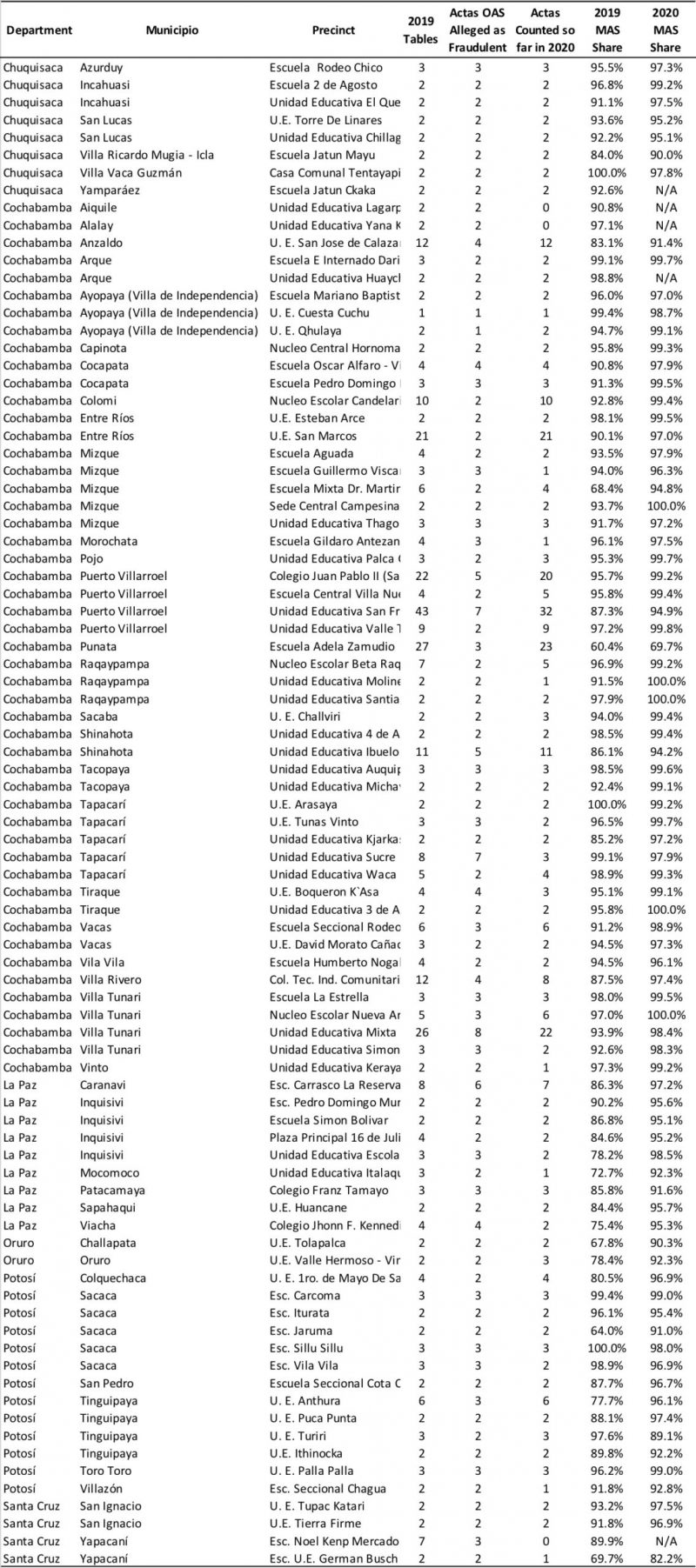
We have at least partial data for 81 of the 86 voting centers, and in all but 9, the MAS share of the vote has increased when compared to 2019.
In 2019, the OAS and other observers appeared scandalized by the fact that, in many rural areas, Morales had received more than 90 percent of the vote — and in some cases, even 100 percent of the vote. This, they claimed, surely sufficed as evidence of fraud. But, the 2020 results thus far further discredit the unsubstantiated claims made by the OAS, which served as justification for a coup d’etat and the repression that followed. To this day, former electoral officials remain under house arrest based on nothing more than the OAS audit.
As we noted in the March report, the communities targeted in the OAS analysis of these 226 tally sheets are, in the majority of cases, predominantly Indigenous. Though it may come as a shock to see a candidate receive 100 percent of the votes, it shouldn’t. Community voting — in which a community comes to a consensus around who to vote for — is a widely recognized phenomenon in Bolivia.
What the OAS alleged is that electoral jurors, the citizens selected at random by the electoral authorityTSE to serve as electoral officials at each voting table, did not print their names on the tally sheets — but that someone else had written their names. To be clear, the OAS does not allege that all 226 were filled out by the same individual; — in no case does the OAS allege that more than 7 tally sheets were filled out by the same person. Further, in only one of the 226 cases does the OAS allege any problem at all with any signatures on the tally sheets. Rather than fraud, the most likely explanation for this is simply that a notary (each notary oversees about 8 voting tables), or some other official with clear handwriting, printed the names and then each juror signed the tally sheet. It is not clear, from the electoral regulations, that this is even a violation of the electoral law. Either way, the results from 2020 further confirm that there was nothing abnormal about the results on these 226 tally sheets in 2019. Further, what the OAS identified as irregularities had no discernable impact on the results of the election.
We can’t go back to 2019, or erase the racist violence unleashed on the population following the coup. On Sunday, Bolivians showed their courage, and the power of organized social movements, in righting the wrong of 2019. But that victory shouldn’t allow us to forget about 2019, or the role that international actors played in overthrowing a democratically elected government. Those 226 tally sheets never showed fraud, as the OAS asserted. They do, however, reveal how the OAS disenfranchised tens of thousands of Indigenous Bolivians in its galling attempts to justify the undemocratic removal of an elected leader.
Jake Johnston is a Senior Research Associate at the Center for Economic and Policy Research in Washington, D.C.
Major oil discovery puts Suriname in spotlight amid Venezuela crisis and US-China trade war
By Uriel Araujo | October 22, 2020
Although Guyana’s newly discovered oil reserves and US interests in the region have been the focus of attention, not many analysts have been noticing neighboring Suriname, one of Latin America’s poorest countries. Guyana’s prospects have certainly changed tremendously – its economy was forecasted by the IMF to grow 85% percent this year. We should expect similar things in Suriname with the discovery of new oil fields offshore that are estimated to have 1.4 billion barrels, according to Rystad Energy. This has already attracted interest from foreign investors.
The wider Guyana-Suriname Basin is being described as the world’s number one offshore exploration. ExxonMobil has already discovered the equivalent of more than 8 billion barrels worth of oil in the region and has announced its 18th oil discovery in the Stabroek block in Guyana. Oil experts believe that what Exxon is doing in Guyana can be reproduced in Suriname.
Last month, after three discoveries, oil company Apache announced a fourth offshore well, all in Suriname’s Block 58. Recently, Shell bought a package of Kosmos Energy’s exploration assets, including a 33% stake in Suriname’s Block 42. Malaysian oil company Petronas has already spudded its first well in Suriname on October 12.
In fact, this makes Suriname a potentially future wealthy petro-state. This in itself is sure to place the country on the international radar soon, and this is happening at a time of crisis.
This region is indeed rich in national resources. In fact, there is also a new gold rush going on – gold prices have gone up 25% this year – with conflicts in the Brazilian-Suriname border region between local indigenous tribes and artisanal miners from Suriname and elsewhere. Such problems could be used in the narrative wars depending on how leaders in the Suriname capital of Paramaribo position themselves on the Venezuela issue. The issue of drug trafficking and gold smuggling is one of the main rhetorical weapons employed by the US against Venezuela.
Furthermore, Chinese aspirations in the Caribbean region and the Northeastern Atlantic coast of South America have been increasing friction between Beijing and Washington. Suriname has seen a recent wave of Chinese companies and Chinese migrants arrive. Also, Beijing and Paramaribo have held a strategic cooperative partnership since November 2019 – in areas such as communication, energy and infrastructure construction but also medicine, law enforcement and coordination on global issues. Moreover, Suriname and Venezuela reaffirmed on August 10 their commitment to further expand ties, including in energy, food, and cultural agreements.
Mike Pompeo’s September 17 visit to Suriname and Guyana made him the first US Secretary of State to do so. Pompeo did ask Suriname and Guyana to favor US businesses over China. The latter has invited both South American countries into its Belt and Road Initiative.
In the near future, we can expect a lot of competition between oil giants such as Chevron, ExxonMobil and the Chinese National Offshore Oil Corporation (CNOOC) over Surinamese oil in international bidding. And, as we have seen with the dispute over 5G and Chinese company Huawei (involving Brazil as well), there is a global US-Chinese trade war going on. So, it is not just “the attraction of oil”, as some analysts have described it. Trade disputes often are an aspect of geopolitical competition and closer economic relations may accompany cooperation in other areas and narratives of “shared values”.
Another hot issue is Venezuela. It is surrounded by nations that do not recognize the current government. It borders to the west with Colombia; to south with Brazil; and, finally with Guyana (to the East). In fact, there would be, in terms of physical continuity, a straight line towards the Atlantic Ocean in the Guyana Shield Region of small countries aligned with the US over hostilities against Caracas, further isolating and encircling Venezuela.
After Pompeo’s trip, some analysts are concerned the US could be planning another intervention against Venezuela. Pompeo’s visit to Suriname was certainly also aimed at exerting some influence on Suriname ‘s new president Chan Santokhi. Last week, Washington sent Homeland, Treasury, USAID, State Department, and high level teams from three other Departments to Suriname. It is the first time that six American government agencies were simultaneously in a mission in Suriname.
To counter Chinese influence, the US can certainly offer plenty of investment opportunities and also help Suriname with its engagement with the IMF, as well as with USAID. Should Washington and Paramaribo relations further develop, Suriname shall be expected to distance itself from Venezuelan President Nicolas Maduro. Venezuela is the one hot issue the Caricom bloc, of which Suriname is a member, currently faces. So far, Caricom has maintained a non-interference position.
The northeast coast of South America remains quite tense, with migration crises, smuggling as well as narcotics-related conflicts and border disputes involving Venezuela and Guyana. The US and Guyana conduct joint maritime patrols near the Venezuela-Guyana border and the latter supports “democratic change” for Venezuela. Should Venezuela-Guyana tensions escalate, Suriname too will be pressed to take a side.
On Monday, Suriname and Guyana issued a joint statement reaffirming their commitment for cooperation in transportation infrastructure and other areas. However, competition between the two countries for the development of their deepwater resources may also ensue and Suriname’s close ties with Venezuela are certainly a concern to Guyana.
We should be hearing a lot about Suriname in the near future on the back of these developments. The discovery of oil fields is not the only thing that is new for Suriname. The geopolitical scenario too has changed, with a so-called “new cold war” going on in South America and the Caribbean between Russia, China and Venezuela on one side, and the US, Colombia, and Brazil on the other.
For Suriname, therefore, the current scenario may present an almost existential problem. Considering US history of interference abroad and the tense situation around Venezuela, Suriname could very well find out that being in the spotlight might also be a curse. In 2017 when Russian Foreign Minister Sergei Lavrov visited Suriname, Moscow and Paramaribo were close to signing a military cooperation agreement – but the conversation stalled. Suriname would perhaps benefit greatly from restarting such a conversation. Due to its size and its limitations, Suriname cannot afford to be “neutral”: it will need to take a side in the current “new cold war”.
Uriel Araujo is a researcher with a focus on international and ethnic conflicts.
Bolivia election is a blow to Trudeau’s policy
By Yves Engler · October 21, 2020
 Massive support for Bolivia’s Movimiento al Socialismo at the polls is a rejection of last year’s Canadian-backed coup against Evo Morales. The vote was also a blow to Trudeau’s policy of seeking to overthrow left-wing governments in the region.
On Sunday Morales’ former finance minister, Luis Acre, won 55% of the vote for president. His MAS party also took a large majority in the Congress.
The unexpectedly large victory is a decisive rebuke of Ottawa’s support for the ouster of Bolivia’s first indigenous president. Hours after the military command forced Evo Morales to resign on November 10, then foreign affairs minister Chrystia Freeland released a celebratory statement declaring, “Canada stands with Bolivia and the democratic will of its people.”
Ottawa provided significant support for the Organization of American States’ effort to discredit Bolivia’s 2019 vote, which fueled opposition protests and justified the coup. Ottawa promoted and financed the OAS’ effort to discredit the presidential poll and two Canadian technical advisers were part of the audit mission to Bolivia. “Canada commends the invaluable work of the OAS audit mission in ensuring a fair and transparent process, which we supported financially and through our expertise”, noted Freeland at the time.
But, the OAS audit mission was designed to precipitate Morales ouster. A slew of academic and corporate media studies have demonstrated the partisan nature of the OAS audit mission and the weekend’s election results confirm it. Still, Global Affairs promoted the organization’s involvement in Bolivia’s elections. On Saturday their Canada in Bolivia account tweeted, “Canada is pleased to support the Organization of American States (OAS) electoral observation mission to Bolivia.”
For a year Ottawa stayed silent while the unelected Jeanine Anez regime ramped up repression and anti-indigenous measures as well as drastically shifted the country’s foreign policy. Worse than silence, on Bolivia’s national day in August Global Affairs claimed Canada and Bolivia’s “strong bilateral relationship is founded on our shared values of democracy, human rights and a celebration of diversity.”
Global Affairs ignored the ‘caretaker’ government’s repeated postponement of elections. Even worse, when the country’s social movements launched a general strike in August to protest the ‘caretaker’ government’s repeated postponement of elections Global Affairs echoed the coup government’s claims that the protests undermined the fight against the pandemic. Canada in Bolivia tweeted, “Canada calls for humanitarian aid to be allowed to circulate freely in Bolivia to fight #COVID19 & calls on all social actors to support the country’s democratic institutions and to use those mechanisms to resolve any disputes.” (Protesters let ambulances and other medical vehicles circulate with little disruption.)
Looking at a year of the Canada in Bolivia Twitter account I did not find a single criticism of the coup government. But, there were more than 15 posts critical of the Venezuelan government. On October 14 Canada in Bolivia tweeted, “the conditions needed for free and fair elections do not exist in Venezuela” and linked to a Lima Group statement declaring renewed “support of President Juan Guaidó.” (After usurping power Anez joined the Lima Group of countries seeking to oust Nicolas Maduro’s government.) Two months earlier the account called for “concerted international actions in support of a peaceful return to democracy in Venezuela” and linked to a Lima Group statement reiterating their “firm commitment to interim president Juan Guaidó.”
Contrasting the Trudeau government’s response to an unelected, anti-indigenous, elitist government in Bolivia to that of Venezuela’s elected, pro-poor president is telling. So is their silence on the election results in Bolivia. Nearly 72 hours after the polls closed Ottawa has yet to release a statement congratulating Arce or the MAS on their massive victory.
The election results in Bolivia are a major blow to Canadian policy in that country and Ottawa’s bid to wipe out the remnants of the leftist pink tied in Latin America.
Further, the victory of MAS shows Canada for what it has always (unfortunately) been: an imperialist power seeking to maintain the world’s massively unfair status quo.
Arce to Restore Bolivian Relations With Cuba and Venezuela, Blasts OAS

teleSUR – October 21, 2020
Bolivia’s elected president Luis Arce said that he would carry out a foreign policy of restoration of relationships with Venezuela, Cuba, and Iran.
“We are going to reestablish all relations. This government has acted very ideologically, depriving the Bolivian people of access to Cuban medicine, Russian medicine, and advances in China. For a purely ideological issue, it has exposed the population in a way unnecessary and harmful,” Arce explained.
The former Economy Minister, during the 14 years mandate of Indigenous leader Evo Morales, participated in the process of increasing Bolivian’s literacy levels and offering free healthcare to thousands with the support of Cuban doctors. All this social progress was radically paralyzed by the coup born government of Jeanine Añez.
Likewise, Arce emphasized that his government will open the door to all countries based on mutual respect and sovereignty. “Nothing more,” Arce remarked.
On the other hand, the Movement Towards Socialism (MAS) leader warned that the Organization of the American States (OAS) has to amend its mistakes in Bolivia. The OAS co-authored the report on the 2019 elections that served as a pretext to coup Evo Morales. This report was later proved to be inaccurate. It has also supported the de facto government of Jeanine Añez, who carried out massacres and sank the country into an unprecedented economic recession.
In this sense, Arce was clear that the “OAS has to make amends for their mistakes. But if it does not, we (the elected government) will work, as well as with other countries, with international organizations that respect us.”
Socialist Presidential Candidate Arce Wins Bolivia’s Elections

Luis Arce and David Choquehuanca celebrate the results of the elections, La Paz, Bolivia, Oct. 19, 2020. | Photo: EFE
teleSUR – October 19, 2020
After midnight on Sunday, Bolivian authorities allowed the results of the exit polls to be known. The Movement Towards Socialism (MAS) presidential candidate Luis Arce obtained 52.4 percent of the votes, the Citizen Community (CC) candidate Carlos Mesa got 31.5 percent, and the “We Believe Alliance” candidate Luis Fernando Camacho reached 14.1 percent of the votes.
Bolivia’s president-elect Arce thanked the people for their support and for their peaceful participation in the electoral process.
“We have recovered democracy and hope. We ratify our commitment to work with social organizations. We are going to build a national unity government.”
Previously, the Movement Towards Socialism (MAS) spokesperson Sebastian Mitchell made an official statement regarding the absence of definitive data on the elections. He said that mainstream media and exit-polls companies know that Socialist candidate Arce had already exceeded 45 percent of the votes.
“Election observers do not understand if the absence of information results from inefficiency or if the government is implementing a strategy to win two or three days, generate violence, and justify a military intervention,” Mitchell said.
The Bolivian Socialists’ message was categorical and clear: “we call on the community to avoid provocations… let’s end this nightmare we have been living for a year.”
A few minutes before the official information was issued, former President Evo Morales, who remains a political asylee in Argentina, recalled that millions of Bolivians cast their vote peacefully and demanded that the coup-born regime led by Jeanine Añez respect the results.
“Yesterday we denounced that the authorities suspended the presentation of the results of the exit poll companies. That was suspicious,” the Socialist leader said
“Everything indicates that the MAS has won the elections and won a majority of seats in both chambers,” Evo added.
Luis Arce: ‘We Recovered Democracy and Took Back Our Country’
The winner of Bolivia’s elections Luis Arce Monday celebrated the unofficial results of the quick vote-counting as he said, “we will govern for all, we will redirect the change without hate.”
On Sunday night, Bolivian authorities allowed the results of the exit polls to be presented to the public. There it was observed that the Movement Towards Socialism (MAS) won the elections with 53 percent of the votes in its favor. In the second place was the right-wing candidate Carlos Mesa, who got the 30.8 percent of the votes.
Minutes after learning of these results, Arce assured the people that “we will restore unity in our country, and we will recover the economy, step by step.”
In the Socialist headquarters in La Paz, the slogans “We are MAS” were heard repeatedly. In several areas of El Alto, La Paz, and Cochabamba, firecrackers were heard as a sign of celebration.
“I want to thank the Bolivian people for their vote. We will work to recover their hopes and expectations,” said Arce, who was accompanied by Vice-President David Choquehuanca.
MAS Senate candidate Leonardo Loza expressed that “we will not be a government of persecution. But there will be no forgetting or forgiving for those who got killed in Senkata and Sacaba during the 2019 coup.”
“MAS had a resounding victory. We have become millions,” Bolivia’s former President Evo Morales stressed.
The coup-born regime’s leader Jeanine Añez acknowledged MAS’ victory and congratulated the Arce-Choquehuanca binomial for having achieved a majority of the votes.
“We still do not have the official count, but the data shows that MAS won. Congratulations to the winners. I ask them to govern with Bolivia and democracy in mind,” Añez tweeted.
So far, the Supreme Electoral Tribunal (TSE) official vote count has only processed 15.66 percent of the total votes.
Chilean government agrees with new constitution, but vetoes new Constituent Assembly
By Lucas Leiroz | October 19, 2020
Chile has been experiencing violent popular protests for over a year. The general dissatisfaction with the government of Sebastián Piñera and his allies has generated strong unrest in the country, which has worried the Chilean political elite. In this sense, fear of the consequences of the rebellions has led government officials to propose an agreement to stop the violence, but, apparently, the proposal is intended only to serve the interests of the government itself.
The Agreement for Social Peace and the New Constitution was then signed, celebrated between the political parties allied with the government and a large part of the opposition. This agreement provides for a plebiscite – scheduled for October 25th – in which Chileans must define whether they want a new Constitution and whether it should be elaborated by means of a Mixed Convention or a Constitutional Convention. These conditions are generating rejection in several social, political and territorial organizations that consider it lacking in popular legitimacy.
This pact does not include an original and sovereign Constituent Assembly as an option, but two mechanisms, which differ in integration. In the case of the Mixed Convention, it would be composed of 50% of representatives of the Congress and 50% of elected citizens; on the other hand, the Constitutional Convention would be 100% composed of representatives expressly chosen for that instance. The total impossibility of calling for a new Constituent Assembly demonstrates how it seeks to implement reforms that do not fully meet popular interests but prioritize the agendas of the government and the current congressmen.
The current Chilean Constitution does not allow a new Assembly to be convened, because this constitution is the same as it was during the military dictatorship. This means that the transition to a democratic regime has not been completed in Chile, which still has a dictatorial constitution. For the country to become a democratic nation, it is necessary to change the constitution and the government must agree to do so. The purpose of calling an Assembly is precisely to change the Constitution, so the excuse that the formation of the Assembly is “unconstitutional” cannot be evoked: if the government agrees to change the Constitution, it must do so democratically.
Faced with this scenario, many popular leaders pointed out that the agreement does not allow a true popular participation or citizenship, and is therefore insufficient to meet the demands of people, representing nothing more than a political maneuver to deceive the Chileans and contain the protests. It was also emphasized that the agreement remains silent about the several cases of abuse of authority and violation of human rights reportedly perpetrated by the Chilean police during the demonstrations. Obviously, the most correct thing to do on this issue would be to establish a committee to investigate such crimes, with judgment and punishment of those responsible, but this is not mentioned in the “agreement” proposed by the government.
Although the opinions of participants from different organizations are similar with regard to the constitutional process, the way of facing the plebiscite differs among them. There are many assemblies that campaign for the population to ignore this process, abdicating from voting in the referendum and focusing on direct action calling for the Constituent Assembly, but there are other organizations that allow freedom of action for its members, not openly opposing the vote in the referendum. This neutral attitude towards voting happens mainly because of a “despair” that has been seen in the population: in the absence of other means and in the hope of improvement, people tend to vote, even if everything indicates that there will be no changes, regardless the result. Still, there is a strong media campaign in favor of the referendum. The main Chilean news agencies maintain agreements with the government and campaign to support the referendum as a “peaceful resolution” measure. As a result, many people are deluded and decide to vote.
In fact, there is no possibility that the referendum will guarantee real changes in the life of the Chilean population, simply because the “agreement” was imposed unilaterally, without any popular endorsement. The only way to really achieve a more just society is by calling for a new Constituent Assembly, which will completely change the Chilean political structure, prioritizing popular interests, such as the social principles of work, citizenship and democratic participation. In addition, it is necessary to thoroughly investigate the crimes allegedly committed by the Chilean police against the demonstrators.
But there is no institutional way to achieve these goals. The government obviously has a privileged situation in relation to the protesters, as it is in power and can unilaterally decide the conditions of peace. Therefore, it only remains for popular organizations to continue protesting. However, many organizations tend to capitulate and adhere to the “agreement” for the reasons explained. Apparently, the referendum will take place, the protests will continue, but they will decrease significantly and, in short, there will be no real change in Chilean society.
Lucas Leiroz is a research fellow in international law at the Federal University of Rio de Janeiro.
US Southern Command Chief Admits Plans Against Venezuela
teleSUR- October 7, 2020
Venezuela’s Foreign Affairs Minister Jorge Arreaza Monday denounced that the U.S. Southern Command Admiral Craig Faller openly admitted his country’s plans to violently overthrow President Nicolas Maduro.
On Monday, Faller commented at an online meeting organized by the business forum Council of the Americas that the international attempts to bring down Venezuela’s government have worked, although not quickly enough for the Venezuelan people.
He not only said that such efforts have not worked quick enough but also that it took an entire generation to get to this point and that it will take a while to unblock Venezuela’s democratic framework.
The Admiral also attributed certain external factors such as the help of Cuba, Russia, China and Iran to the alleged slow change within Venezuela.
Arreaza pointed out that this arrogant position of the members of the White House is unacceptable as they insist on violating the Charter of the United Nations and the most basic principles of international law through threats and blockades.
This statement shows Washington’s systematic and widespread attacks on Venezuela, which constitutes a crime against humanity.
Venezuela’s government will add Faller’s confessions to the criminal complaint it filed against the U.S. government on Feb. 13 before the Hague’s International Criminal Court.
In this complaint, President Maduro requests the White House to lift all coercive measures against his country since the U.S. government prevents Venezuela from acquiring food and medicines and from negotiating freely on the international market.
Featured Video

Col Doug Macgregor: America’s Back to ENDLESS WARS
or go to
Aletho News Archives – Video-Images
From the Archives
Rabbi Shmuel Eliyahu: Leave No Palestinian or Arab Alive
By Jonas E. Alexis | Veterans Today | July 23, 2017
Israeli Rabbi Shmuel Eliyahu seems to have picked up where the late Rabbi Ovadiah Yosef left off. The Israeli army, Eliyahu said, must slaughter the Palestinians “and leave no one alive.” The Palestinians, the good rabbi continued, must be “destroyed and crushed in order to end violence.” Here is Eliyahu’s algorithm:
“If they don’t stop after we kill 100, then we must kill 1,000. And if they do not stop after 1,000, then we must kill 10,000. If they still don’t stop we must kill 100,000, even a million.”
There is more to this “logic” than meets the eye and ear. Eliyahu even postulated that the Israeli army ought not to get involved in arresting Palestinians because “If you leave him alive, there is a fear that he will be released and kill other people. We must eradicate this evil from within our midst.”
You may say that this is just an isolated case. No Israeli official believes that, right? … continue
Blog Roll
Recent Comments
papasha408 on Germany demands UN Rapporteur… papasha408 on Israel Demanding that Iran Lim… Coronistan on Why can’t western leaders acce… John Edward Kendrick on German government ‘embezzling’… loongtip on Von der Leyen to have new secu… papasha408 on First Gaza, then the world: Th… papasha408 on Is Nixing Aid to Israel a Pois… papasha408 on Japan to Sign Up For NATO’s Uk… Redracam on Iran Willing to Dilute Enriche… loongtip on When Threats Replace Evid… loongtip on Zelensky tried to kill the cha… eddieb on I might get killed for posting…


 Aletho News
- Germany puts caveat on more missiles for Ukraine
- UK High Court rules Palestine Action ban unlawful
- Populations in key NATO nations balk at sacrifices for military spending – poll
- Ukraine to ban Russian literature – culture minister
- 40 State Attorneys General Want To Tie Online Access to ID
- Col Doug Macgregor: America’s Back to ENDLESS WARS
- Villains of Judea: Haim Saban
- Germany demands UN Rapporteur Albanese resign, joining France
- Hamas official says Netanyahu joining ‘peace council’ is a farce
- Israel Demanding that Iran Limit the Range of Missiles to 300 Kilometers
- If Americans Knew
- AZAPAC, the new PAC opposing Israeli domination of U.S policies
- Haim Saban: Billionaire for Israel
- Rafah e-wallet plan highlights Israel’s deepening financial occupation
- Viral post claims Netanyahu sought legal approval, igniting speculation about Israel’s organ harvesting
- AIPAC Has a New Opponent: PAL PAC
- Right-Wing Catholic Off Trump Religion Panel After Israel-Gaza Remarks at Antisemitism Event
- Jewish terrorism, apartheid rule the West Bank – Not a ceasefire Day 125
- Why Israel persecutes children like my son Shadi
- In Gaza, One Man Is Searching for the Remains of His Family With a Flour Sifter
- Horrific situation in Gaza, West Bank – Not a ceasefire Day 124
- No Tricks Zone
- German Gas Crisis…Chancellor Merz Allegedly Bans Gas Debate Ahead of Elections!
- Pollen Reconstructions Show The Last Glacial’s Warming Events Were Global, 10x Greater Than Modern
- Germany’s Natural Gas Storage Level Dwindles To Just 28%… Increasingly Critical
- New Study Rebuts The Assumption That Anthropogenic CO2 Molecules Have ‘Special’ Properties
- Climate Scientist Who Predicted End Of “Heavy Frost And Snow” Now Refuses Media Inquiries
- Polar Bear Numbers Rising And Health Improving In Areas With The Most Rapid Sea Ice Decline
- One Reason Only For Germany’s Heating Gas Crisis: Its Hardcore-Dumbass Energy Policy
- 130 Years Later: The CO2 Greenhouse Effect Is Still Only An Imaginary-World Thought Experiment
- New Study Affirms Rising CO2’s Greening Impact Across India – A Region With No Net Warming In 75 Years
- Germany’s Natural Gas Crisis Escalates … One Storage Site Near Empty …Government Silent
 Aletho News