How an Israeli Spy-Linked Tech Firm Gained Access to the US Gov’t’s Most Classified Networks
By Whitney Webb |
Unlimited Hangout| July 15, 2020
If the networks of the U.S. military, the U.S. intelligence community and a slew of other U.S. federal agencies were running the software of a company with deep ties, not only to foreign companies with a history of espionage against the U.S. but also foreign military intelligence, it would — at the very least — garner substantial media attention. Yet, no media reports to date have noted that such a scenario exists on a massive scale and that the company making such software recently simulated the cancellation of the 2020 election and the declaration of martial law in the United States.
Earlier this month, MintPress News reported on the simulations for the U.S. 2020 election organized by the company Cybereason, a firm led by former members of Israel’s military intelligence Unit 8200 and advised by former top and current officials in both Israeli military intelligence and the CIA. Those simulations, attended by federal officials from the FBI, DHS and the U.S. Secret Service, ended in disaster, with the elections ultimately canceled and martial law declared due to the chaos created by a group of hackers led by Cybereason employees.
The first installment of this three part series delved deeply into Cybereason’s ties to the intelligence community of Israel and also other agencies, including the CIA, as well as the fact that Cybereason stood to gain little financially from the simulations given that their software could not have prevented the attacks waged against the U.S.’ electoral infrastructure in the exercise.
Also noted was the fact that Cybereason software could be potentially used as a backdoor by unauthorized actors, a possibility strengthened by the fact that the company’s co-founders all previously worked for firms that have a history of placing backdoors into U.S. telecommunications and electronic infrastructure as well as aggressive espionage targeting U.S. federal agencies.
The latter issue is crucial in the context of this installment of this exclusive MintPress series, as Cybereason’s main investors turned partners have integrated Cybereason’s software into their product offerings. This means that the clients of these Cybereason partner companies, the U.S. intelligence community and military among them, are now part of Cybereason’s network of more than 6 million endpoints that this private company constantly monitors using a combination of staff comprised largely of former intelligence operatives and an AI algorithm first developed by Israeli military intelligence.
Cybereason, thus far, has disclosed the following groups as lead investors in the company: Charles River Ventures (CRV), Spark Capital, Lockheed Martin and SoftBank. Charles River Ventures (CRV) was among the first to invest in Cybereason and has been frequently investing in other Israeli tech start-upsthat were founded by former members of the elite Israeli military intelligence Unit 8200 over the last few years. Spark Capital, based in California, appears to have followed CRV’s interest in Cybereason since the venture capitalist who co-founded Spark and led its investment in Cybereason is a former CRV partnerwho still has close ties to the firm.
While CRV and Spark Capital seem like just the type of investors a company like Cybereason would attract given their clear interest in similar tech start-ups coming out of Israel’s cyber sector, Cybereason’s other lead investors — Lockheed Martin and SoftBank — deserve much more attention and scrutiny.
Cybereason widely used by US Government, thanks to Lockheed
“A match made in heaven,” trumpeted Forbes at the news of the Lockheed Martin-Cybereason partnership, first forged in 2015. The partnership involved not only Lockheed Martin becoming a major investor in the cybersecurity company but also in Lockheed Martin becoming the largest conduit providing Cybereason’s software to U.S. federal and military agencies.
Indeed, as Forbes noted at the time, not only did Lockheed invest in the company, it decided to integrate Cybereason’s software completely into its product portfolio, resulting in a “model of both using Cybereason internally, and selling it to both public and private customers.”
Cybereason CEO and former offensive hacker for Israeli military intelligence — Lior Div — said the following of the partnership:
Lockheed Martin invested in Cybereason’s protection system after they compared our solution against a dozen others from the top industry players. The US firm was so impressed with the results they got from Cybereason that they began offering it to their own customers – among them most of the top Fortune 100 companies, and the US federal government. Cybereason is now the security system recommended by LM to its customers for protection from a wide (sic) malware and hack attacks.”
Rich Mahler, then-director of Commercial Cyber Services at Lockheed Martin, told Defense Daily that the company’s decision to invest in Cybereason, internally use its software, and include the technology as part of Lockheed Martin’s cyber solutions portfolio were all “independent business decisions but were all coordinated and timed with the transaction.”
How independent each of those decisions actually was is unclear, especially given the timing of Lockheed Martin’s investment in Cybereason, whose close and troubling ties to Israeli intelligence as well as the CIA were noted in the previous installment of this investigative series. Indeed, about a year prior to their investment in the Israeli military intelligence-linked Cybereason, Lockheed Martin opened an office in Beersheba, Israel, where the IDF has its “cyberhub”. The office is focused not on the sales of armaments, but instead on technology.
Marilyn Hewson, Lockheed Martin’s CEO, said the following during her speech that inaugurated the company’s Beersheba office:
The consolidation of IDF Technical Units to new bases in the Negev Desert region is an important transformation of Israel’s information technology capability… We understand the challenges of this move. Which is why we are investing in the facilities and people that will ensure we are prepared to support for these critical projects. By locating our new office in the capital of the Negev we are well positioned to work closely with our Israeli partners and stand ready to: accelerate project execution, reduce program risk and share our technical expertise by training and developing in-country talent.”
Beersheba not only houses the IDF’s technology campus, but also the Israel National Cyber Directorate, which reports directly to Israel’s Prime Minister, as well as a high-tech corporate park that mostly houses tech companies with ties to Israel’s military intelligence apparatus. The area has been cited in several media reports as a visible indicator of the public-private merger between Israeli technology companies, many of them started by Unit 8200 alumni, and the Israeli government and its intelligence services. Lockheed Martin quickly became a key fixture in the Beersheba-based cyberhub.
Not long before Lockheed began exploring the possibility of opening an office in Beersheba, the company was hacked by individuals who used tokens tied to the company, RSA Security, whose founders have ties to Israel’s defense establishment and which is now owned by Dell, a company also deeply tied to the Israeli government and tech sector. The hack, perpetrated by still unknown actors, may have sparked Lockheed’s subsequent interest in Israel’s cybersecurity sector.
Soon after opening its Beersheba office, Lockheed Martin created its Israel subsidiary, Lockheed Martin Israel. Unlike many of the company’s other subsidiaries, this one is focused exclusively on “cybersecurity, enterprise information technology, data centers, mobile, analytics and cloud” as opposed to the manufacture and design of armaments.
Haden Land, then-vice president of research and technology for Lockheed Martin, told the Wall Street Journal that the creation of the subsidiary was largely aimed at securing contracts with the IDF and that the company’s Israel subsidiary would soon be seeking partnership and investments in pursuit of that end. Land oversaw the local roll-out of the company’s Israel subsidiary while concurrently meeting with Israeli government officials. According to the Journal, Land “oversees all of Lockheed Martin’s information-systems businesses, including defense and civilian commercial units” for the United States and elsewhere.
Just a few months later, Lockheed Martin partnered and invested in Cybereason, suggesting that Lockheed’s decision to do so was aimed at securing closer ties with the IDF. This further suggests that Cybereason still maintains close ties to Israeli military intelligence, a point expounded upon in great detail in the previous installment of this series.
Thus, it appears that not only does Lockheed Martin use Cybereason’s software on its own devices and on those it manages for its private and public sector clients, but it also decided to use the company’s software in this way out of a desire to more closely collaborate with the Israeli military in matters related to technology and cybersecurity.
The cozy ties between Lockheed Martin, one of the U.S. government’s largest private contractors, and the IDF set off alarm bells, then and now, for those concerned with U.S. national security. Such concern makes it important to look at the extent of Cybereason’s use by federal and military agencies in the United States through their contracting of Lockheed Martin’s Information Technology (IT) division. This is especially important considering Israeli military intelligence’s history of using espionage, blackmail and private tech companies against the U.S. government, as detailed here.
While the exact number of U.S. federal and military agencies using Cybereason’s software is unknown, it is widespread, with Lockheed Martin’s IT division as the conduit. Indeed, Lockheed Martin was the number one IT solutions provider to the U.S. federal government up until its IT division was spun off and merged with Leidos Holdings. As a consequence, Leidos is now the largest IT provider to the U.S. government and is also directly partnered with Cybereason in the same way Lockheed Martin was. Even after its IT division was spun off, Lockheed Martin continues to use Cybereason’s software in its cybersecurity work for the Pentagon and still maintains a stake in the company.
The Leidos-Lockheed Martin IT hybrid provides a litany of services to the U.S. military and U.S. intelligence. As investigative journalist Tim Shorrock noted for The Nation, the company does “everything from analyzing signals for the NSA to tracking down suspected enemy fighters for US Special Forces in the Middle East and Africa” and, following its merger with Lockheed and consequential partnership with Cybereason, became “the largest of five corporations that together employ nearly 80 percent of the private-sector employees contracted to work for US spy and surveillance agencies.” Shorrock also notes that these private-sector contractors now dominate the mammoth U.S. surveillance apparatus, many of them working for Leidos and — by extension — using Cybereason’s software.
Leidos’ exclusive use of Cybereason software for cybersecurity is also relevant for the U.S. military since Leidos runs a number of sensitive systems for the Pentagon, including its recently inked contract to manage the entire military telecommunications infrastructure for Defense Information Systems Agency (DISA). In addition to maintaining the military telecom network, Cybereason is also directly partnered with World Wide Technologies (WWT) as of this past October. WWT manages cybersecurity for the U.S. Army, maintains DISA’s firewalls and data storage as well as the U.S. Air Force’s biometric identification system. WWT also manages contracts for NASA, itself a frequent target of Israeli government espionage, and the U.S. Navy. WWT’s partnership is similar to the Lockheed/Leidos partnership in that Cybereason’s software is now completely integrated into its portfolio, giving the company full access to the devices on all of these highly classified networks.
Many of these new partnerships with Cybereason, including its partnership with WWT, followed claims made by members of Israel’s Unit 8200 in 2017 that the popular antivirus software of Kaspersky Labs contained a backdoor for Russian intelligence, thereby compromising U.S. systems. The Wall Street Journal was the first to report on the alleged backdoor but did not mention the involvement of Unit 8200 in identifying it, a fact revealed by the New York Times a week later.
Notably, none of the evidence Unit 8200 used to blame Kaspersky has been made public and Kaspersky noted that it was actually Israeli hackers that had been discovered planting backdoors into its platform prior to the accusation levied against Kaspersky by Unit 8200. As the New York Times noted:
Investigators later discovered that the Israeli hackers had implanted multiple back doors into Kaspersky’s systems, employing sophisticated tools to steal passwords, take screenshots, and vacuum up emails and documents.”
Unit 8200’s claims ultimately led the U.S. government to abandon Kaspersky’s products entirely in 2018, allowing companies like Cybereason (with its own close ties to Unit 8200) to fill the void. Indeed, the very agencies that banned Kaspersky now use cybersecurity software that employs Cybereason’s EDR system. No flags have been raised about Cybereason’s own collaboration with the very foreign intelligence service that first pointed the finger at Kaspersky and that previously sold software with backdoors to sensitive U.S. facilities.
SoftBank, Cybereason and the Vision Fund
While its entry into the U.S. market and U.S. government networks is substantial, Cybereason’s software is also run throughout the world on a massive scale through partnerships that have seen it enter into Latin American and European markets in major ways in just the last few months. It has also seen its software become prominent in Asia following a partnership with the company Trustwave. Much of this rapid expansion followed a major injection of cash courtesy of one of the company’s biggest clients and now its largest investor, Japan’s SoftBank.
SoftBank first invested in Cybereason in 2015, the same year Lockheed Martin initially invested and partnered with the firm. It was also the year that SoftBank announced its intention to invest in Israeli tech start-ups. SoftBank first injected $50 million into Cybereason, followed by an additional $100 million in 2017 and $200 million last August. SoftBank’s investments account for most of the money raised by the company since it was founded in 2012 ($350 million out of $400 million total).
Prior to investing, Softbank was a client of Cybereason, which Ken Miyauchi, president of SoftBank, noted when making the following statement after Softbank’s initial investment in Cybereason:
SoftBank works to obtain cutting edge technology and outstanding business models to lead the Information Revolution. Our deployment of the Cybereason platform internally gave us firsthand knowledge of the value it provides, and led to our decision to invest. I’m confident Cybereason and SoftBank’s new product offering will bring a new level of security to Japanese organizations.”
SoftBank — one of Japan’s largest telecommunications companies — not only began to deploy Cybereason internally but directly partnered with it after investing, much like Lockheed Martin had done around the same time. This partnership resulted in SoftBank and Cybereason creating a joint venture in Japan and Cybereason creating partnerships with other tech companies acquired by SoftBank, including the U.K.’s Arm, which specializes in making chips and management platforms for Internet of Things (IoT) devices.
SoftBank’s interest in Cybereason is significant, particularly in light of Cybereason’s interest in the 2020 U.S. election, given that SoftBank has significant ties to key allies of President Trump and even the president himself.
Indeed, SoftBank’s Masayoshi Son was among the first wave of international business leaders who sought to woo then-president-elect Trump soon after the 2016 election. Son first visited Trump Tower in December 2016 and announced, with Trump by his side in the building’s lobby, that SoftBank would invest $50 billion in the U.S. and create 50,000 jobs. Trump subsequently claimed on Twitter that Son had only decided to make this investment because Trump had won the election.
Son told reporters at the time that the investment would come from a $100 billion fund that would be created in partnership with Saudi Arabia’s sovereign wealth fund as well as other investors. “I just came to celebrate his new job. I said, ‘This is great. The US will become great again,’” Son said, according to reports.
Then, in March of 2017, Son sent top SoftBank executives to meet with senior members of Trump’s economic team and, according to the New York Times, “the SoftBank executives said that because of a lack of advanced digital investments, the competitiveness of the United States economy was at risk. And the executives made the case, quite strongly, that Mr. Son was committed to playing a major role in addressing this issue through a spate of job-creating investments.” Many of SoftBank’s investments and acquisitions in the U.S. since then have focused mainly on artificial intelligence and technology with military applications, such as “killer robot” firm Boston Dynamics, suggesting Son’s interest lies more in dominating futuristic military-industrial technologies than creating jobs for the average American.
After their initial meeting, Trump and Son met again a year later in June 2018, with Trump stating that “His [Son’s] $50 billion turned out to be $72 billion so far, he’s not finished yet.” Several media reports have claimed that Son’s moves since Trump’s election have sought to “curry favor” with the President.
Through the creation of this fund alongside the Saudis, SoftBank has since become increasingly intertwined with Saudi Crown Prince Muhammad bin Salman (MBS), a key ally of President Trump in the Middle East known for his authoritarian crackdowns on Saudi elites and dissidents alike. The ties between Saudi Arabia and SoftBank became ever tighter when MBS took the reins in the oil kingdom and after SoftBank announced the launch of the Vision Fund in 2016. SoftBank’s Vision Fund is a vehicle for investing in hi-tech companies and start-ups and its largest shareholder is the Public Investment Fund of Saudi Arabia. Notably, Son decided to launch the Vision Fund in Riyadh during President Trump’s first official visit to the Gulf Kingdom.
In addition, the Mubadala Investment Company, a government fund of the United Arab Emirates (UAE), gave $15 billion to the Vision Fund. UAE leadership also share close ties to the Trump administration and MBS in Saudi Arabia.
As a consequence, SoftBank’s Vision Fund is majority funded by two Middle Eastern authoritarian governments with close ties to the U.S. government, specifically the Trump administration. In addition, both countries have enjoyed the rapid growth and normalization of ties with the state of Israel in recent years, particularly following the rise of current Saudi Crown Prince Muhammad bin Salman and Jared Kushner’s rise to prominence in his father-in-law’s administration. Other investments in the Vision Fund have come from Apple, Qualcomm and Oracle’s Larry Ellison, all tech companies with strong ties to Israel’s government.
The Saudi and Emirati governments’ links to the Vision Fund are so obvious that even mainstream outlets like the New York Times have described them as a “front for Saudi Arabia and perhaps other countries in the Middle East.”
SoftBank also enjoys close ties to Jared Kushner, with Fortress Investment Group lending $57 million to Kushner Companies in October 2017 while it was under contract to be acquired by SoftBank. As Barron’s noted at the time:
When SoftBank Group bought Fortress Investment Group last year, the Japanese company was buying access to a corps of seasoned investors. What SoftBank also got is a financial tie to the family of President Donald Trump’s senior advisor and son-in-law, Jared Kushner.”
According to The Real Deal, Kushner Companies obtained the financing from Fortress only after its attempts to obtain funding through the EB-5 visa program for a specific real estate venture were abandoned after the U.S. Attorney and the Securities and Exchange Commission began to investigate how Kushner Companies used the EB-5 investor visa program. A key factor in the opening of that investigation was Kushner Companies’ representatives touting Jared Kushner’s position at the White House when talking to prospective investors and lenders.
SoftBank also recently came to the aid of a friend of Jared Kushner, former CEO of WeWork Adam Neumann. Neumann made shocking claims about his ties to both Kushner and Saudi Arabia’s MBS, even asserting that he had worked with both in creating Kushner’s long-awaited and controversial Middle East “peace plan” and claimed that he, Kushner and MBS would together “save the world.” Neumann previously called Kushner his “mentor.” MBS has also discussed on several occasions his close ties with Kushner and U.S. media reports have noted the frequent correspondence between the two “princelings.”
Notably, SoftBank invested in Neumann’s WeWork using money from the Saudi-dominated Vision Fund and later went on to essentially bail the company out after its IPO collapse and Neumann was pushed out. SoftBank’s founder, Masayoshi Son, had an odd yet very close relationship with Neumann, perhaps explaining why Neumann was allowed to walk with $1.7 billion after bringing WeWork to the brink of collapse. Notably, nearly half of SoftBank’s approximately $47 billion investments in the U.S. economy since Trump’s election, went to acquiring and then bailing out WeWork. It is unlikely that such a disastrous investment resulted in the level of job creation that Son had promised Trump in 2016.
Given that it is Cybereason’s top investor and shareholder by a large margin, SoftBank’s ties to the Trump administration and key allies of that administration are significant in light of Cybereason’s odd interest in 2020 U.S. election scenarios that end with the cancellation of this year’s upcoming presidential election. It goes without saying that the cancellation of the election would mean a continuation of the Trump administration until new elections would take place.
Furthermore, with Cybereason’s close and enduring ties to Israeli military intelligence now well-documented, it is worth asking if Israeli military intelligence would consider intervening in 2020 if the still-to-be-decided Democratic contender was strongly opposed to Israeli government policy, particularly Israel’s military occupation of Palestine. This is especially worth considering given revelations that sexual blackmailer and pedophile Jeffrey Epstein, who targeted prominent U.S. politicians, mostly Democrats, was in the employ of Israeli military intelligence.
Notably, Cybereason’s doomsday election scenarios involved the weaponization of deep fakes, self-driving cars and hacking Internet of Things devices, with all of those technologies being pioneered and perfected — not by Russia, China or Iran — but by companies directly tied to Israeli intelligence, much like Cybereason itself. These companies, their technology and Cybereason’s own work creating the narrative that U.S. rival states seek to undermine the U.S. election in this way, will all be discussed in the conclusion of MintPress’ series on Cybereason and its outsized interest in the U.S. democratic process.
NYT Acknowledges Coup in Bolivia—While Shirking Blame for Its Supporting Role
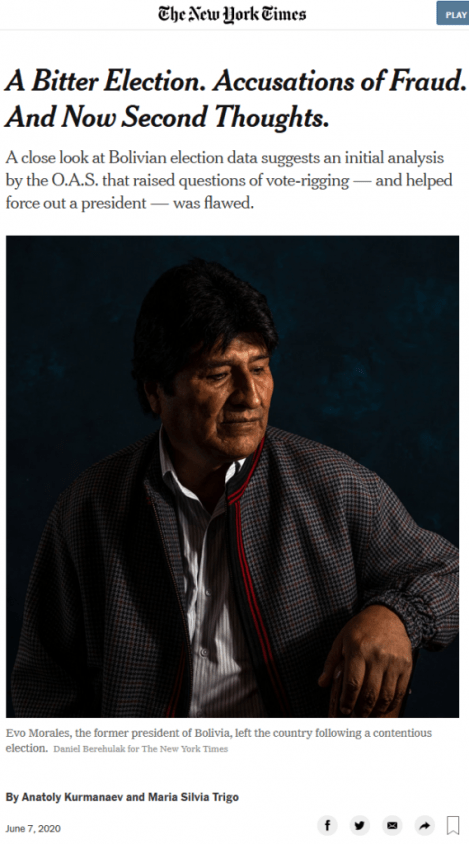
If the New York Times (6/7/20) has had second thoughts about its coverage of the 2019 Bolivian election and subsequent coup, it hasn’t shared them with its readers.
By Camila Escalante with Brian Mier | FAIR | July 8, 2020
The New York Times (6/7/20) declared that an Organization of American States (OAS) report alleging fraud in the 2019 Bolivian presidential elections—which was used as justification for a bloody, authoritarian coup d’etat in November 2019—was fundamentally flawed.
The Times reported the findings of a new study by independent researchers; the Times brags of contributing to it by sharing data it “obtained from Bolivian electoral authorities,” though this data has been publicly available since before the 2019 coup.
The article never uses the word “coup”—it says that President Evo Morales was “push[ed]…from power with military support”—but it does acknowledge that “seven months after Mr. Morales’s downfall, Bolivia has no elected government and no official election date”:
A staunchly right-wing caretaker government, led by Jeanine Añez… has not yet fulfilled its mandate to oversee swift new elections. The new government has persecuted the former president’s supporters, stifled dissent and worked to cement its hold on power.
“Thank God for the New York Times for letting us know,” must think at least some casual readers, who trust the paper’s regular criticism of rising authoritarianism within the US—perhaps adding, “Well, I guess it’s too late to do anything about Bolivia now.”
The fact is, the Times has been patting itself on the back for acknowledging authoritarianism in neofascist regimes that it helped normalize in Latin America for at least 50 years. The only surprise to readers who are aware of this ugly truth is that this time it took so long.
It only took the Times 15 days and the arrest of 20,000 leftists, for example, to counter nine articles supportive of the April 1, 1964, Brazilian military coup (Social Science Journal, 1/97) with a warning (4/16/64) that “Brazil now has an authoritarian military government. ” As was the case with Brazil in 1964, recognizing that Bolivia has now succumbed to authoritarianism may help the New York Times’ image with progressive readers, but it doesn’t do anything for the oppressed citizens of the countries involved.
While the coup was unfolding, and when Northern solidarity for Bolivia’s Movement for Socialism government (MAS in Spanish) might have helped avert disaster, the New York Times was whistling a different tune. The day after Morales’ re-election (10/21/19), it portrayed the paramilitary putschists who were carrying out violent threats against elected officials and their families as victims of repressive police actions perpetrated by the socialist government. “Opponents of Mr. Morales angrily charged ‘fraud, fraud!’” read the post-election article:
Heavily armed police officers were deployed to the streets, where they clashed with demonstrators on Monday night, according to television news reports.
One day after Morales was removed from power, the Times (11/11/19) engaged in victim-blaming, with a news analysis headlined ‘This Will Be Forever’: How the Ambitions of Evo Morales Contributed to His Fall.” The first Indigenous president in Latin American history was not being deposed illegally, after winning a fair election, by groups of armed paramilitary thugs, amid threats of murder and rape to his family members, the Times implied; rather, he was being brought down due to his own character faults as a Machiavellian back-stabber.
I arrived in Bolivia on November 13, 2019, shortly after Jeanine Añez’ unconstitutional swearing in as unelected, interim president, on a cartoonishly oversized Bible. I was there as a reporter for MintPress News and teleSUR, and two of the active sites I reported from were in the most militantly MAS-dense areas: In Sacaba, where the coup regime’s first massacre took place on November 15, and in El Alto, where the Senkata massacre took place on November 19.
The third, and most extensively covered, resistance to the coup was in the heart of the city of La Paz, where daily protests were staged. Beyond these major conflict areas, there were large mobilizations in Norte Potosí, the rural provinces of the department of La Paz, Zona Sud of Cochabamba, Yapacani and San Julian. The vast majorities within all rural areas across the country were also in deep resistance to the coup.
The November coup represented the ousting of a government deeply embedded in the country’s Indigenous campesino and worker movements, by internal colonial-imperialist actors, led in large part by Bolivia’s fascist and neoliberal opposition sectors, most notably Luis Fernando Camacho and Carlos Mesa, who received ample support from the US government and the far-right Bolsonaro administration of Brazil. The Indigenous and social movement bases resisting the coup were deeply distrusting of Bolivian media, which they immediately deemed as having played a key role in it.
Those same groups that were hostile towards major Bolivian news networks and journalists lined up to be heard by myself and those who accompanied me, once they recognized my teleSUR press credentials. One woman attending a cabildo (mass meeting) of the Fejuves (neighborhood organizations) of El Alto detailed how her workplace, Bolivia TV, had been attacked by right-wing mobs as the coup authorities got rid of those deemed sympathizers of the constitutional government, replacing them by force almost immediately.
Indigenous Bolivian communities were at the very forefront of the protests and resistance actions against the coup, namely the blocking of key highways and roads, as in the case of Norte Potosí, the blocking of the YPFB gas plant in Senkata, and 24-hour camps blocking the entry to the Chapare province. La Paz was militarized, making it impossible to get near Plaza Murillo, the site of the Presidential Palace and the Congress. I witnessed daily violent repression by security forces against those who gathered in protest near the perimeter of the Plaza, including unions and groups such as the Bartolina Sisa Confederation, a nationwide organization of Indigenous and campesina women, and the highly organized neighborhood associations of El Alto.
One might think this kind of grassroots, pro-democracy mobilization coordinated by working-class people against an authoritarian takeover would be the type of thing the New York Times would applaud. After all, it ran over 100 articles championing Hong Kong’s protesters in the last six months of 2019 alone.

Anatoly Kurmanaev, author of this New York Times piece (12/5/19) that ignored real-time critiques of the OAS’s complaints about the Bolivian election, was a co-author of the piece (6/7/20) acknowledging that some have “second thoughts” about the OAS attacks on Evo Morales.
As resistance grew on the streets of Bolivia, however, the New York Times only continued the rationalization of the unconstitutional, authoritarian taking of power, using the now-discredited OAS report to do so.
“Election Fraud Aided Evo Morales, International Panel Concludes,” read a December 5 article—one of several the paper ran discrediting the democratic electoral process. Like the others, it failed to challenge dubious claims by the right-wing coalition in charge of the OAS—which received $68 million, or 44% of its budget, from the Trump administration in 2017—that Evo Morales was elected via “lies, manipulation and forgery to ensure his victory.”
A newspaper that prides itself on showing the full picture could have cited the debunking of the OAS study conducted by the Center for Economic and Policy Research (CEPR), an organization with two Nobel Laureate economists on its board, whose co-director Mark Weisbrot has written over 20 op-ed pieces for the New York Times. Even before the coup, CEPR (11/8/19) published an analysis of the Bolivian vote that concluded, “Neither the OAS mission nor any other party has demonstrated that there were widespread or systematic irregularities in the elections of October 20, 2019.”
The fatal flaws in the report the OAS used to subvert a member government, long obvious, are now undeniable even to the New York Times. But the paper still hasn’t acknowledged, let alone apologized for, the credulous reporting that gave it a leading role in bringing down an elected president and the violence that followed.
Bolivia’s Struggle to Restore Democracy after OAS Instigated Coup
By Frederick B. Mills, Rita Jill Clark-Gollub, Alina Duarte | Council on Hemispheric Affairs | July 9, 2020
On October 21, 2019, the Organization of American States (OAS) issued a fateful communique on the presidential elections in Bolivia: “The OAS Mission expresses its deep concern and surprise at the drastic and hard-to-explain change in the trend of the preliminary results revealed after the closing of the polls.”[1] The mission’s report came in a highly polarized political context. Rather than wait for a careful and fair-minded analysis of the election results, it raised unsubstantiated doubts about the legitimacy of President Evo Morales’ lead as some of the later vote tallies were being reported. This was a bombshell report at a time when it appeared that Morales had garnered a sufficient margin of victory over his right wing opponent, Carlos Mesa, to avoid a runoff election.
The manufactured electoral fraud was quickly debunked by experts in the field. Detailed analyses of the election results were conducted by the Center for Economic and Policy Research (CEPR)[2] and Walter R. Mebane, Jr., professor of Political Science and Statistics at the University of Michigan in early November 2019.[3] These were later corroborated by researchers at MIT’s Election Data and Science Lab[4] and more recently by an article published by the New York Times[5] featuring the study of three academics: Nicolás Idrobo (University of Pennsylvania), Dorothy Kronick (University of Pennsylvania), and Francisco Rodríguez (Tulane University)[6].
All of these professional and academic analyses found the charges of fraud by the OAS to have been unfounded.
The OAS electoral mission, however, had already poisoned the well. The false narrative of electoral fraud gave ammunition to anti-Bolivarian forces in the OAS and the right wing opposition inside Bolivia to contest the outcome of the election and go on the offensive against Morales and his party, the Movement Towards Socialism (Movimiento al Socialismo, MAS). During a three-week period, a right wing coalition led protests over the alleged electoral fraud, while pro-government counter protesters defended the constitutional government. The military and police cracked down on the pro-Morales protesters, while showing sympathy for right wing demonstrators. Then, on November 10, 2019, in its “Electoral integrity analysis,” the OAS doubled down on its dubious claims, impugning “the integrity of the results of the election on October 20, 2019.”[7]
The track record of the OAS electoral mission, which was invited to observe and assess the election by the Bolivian government of Evo Morales, had already been stained by its 2015 debacle in Haiti.[8] In the case of Bolivia, the mission politicized election results and set the stage for murder by a coup regime. It appears that there is not much political daylight between the judgment of the OAS electoral commission and the rabidly anti-Bolivarian OAS Secretary, Luis Almagro. Far from finding that the coup against Morales constituted a breach in the democratic order of Bolivia, the OAS simply exploited its position as arbiter of the election to rally behind the right wing coup leaders.
Morales resigns and a “de facto” right wing regime unleashes a wave of repression
Despite the relentless drive by Washington against Bolivarian governments in the region, President Morales was apparently unprepared for the disloyalty within his security forces and he was caught off guard by the OAS propensity to serve US interests in the region. MAS activists, legislators, union activists, Indigenous organizations, and social movement activists, however, continued to resist the coup even as they faced arrest and violence from the de facto regime.
The coup forces exercised extreme violence against authorities of the Morales’ administration and MAS legislators (the majority of Congress). Several houses were burned down and some relatives of authorities were kidnapped and injured, all with total impunity and without protection by the security forces.[9]
With the OAS-instigated coup gaining traction within the security forces and police, as well as Morales’ political adversaries, the President chose the path of accommodation. He offered to reconstitute the electoral authority and hold fresh elections. This concession to OAS authority was met by calls from the police and military for his resignation. Rather than launch a campaign of resistance from the MAS stronghold of Chapare, Morales resigned his post, opting for exile in an unsuccessful bid to avoid further bloodshed. Jeanine Áñez, an opposition party senator with Plan Progreso para Bolivia Convergencia Nacional, proclaimed herself President after the resignation of Senate President Adriana Salvatierra, who refused to legitimize the coup with an unjustified “succession.”[10]
The scenes in the streets of Cochabamba turned ugly. It was a field day for racist attacks on the majority Indigenous population. The Indigenous flag–the wiphala–was burned in the streets, and much fanfare was made when Áñez, surrounded by right wing legislators, held up a large leather bible and declared, “The Bible has returned to the palace.” Such attempts to resubordinate Bolivia’s plurinational heritage were met with widespread resistance.
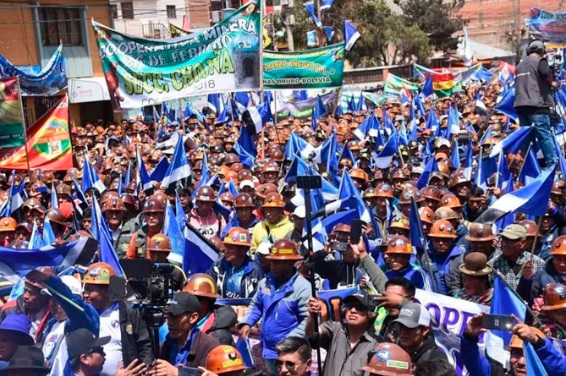
Workers of all industries and sectors continue protests against Áñez and to protect social rights created under Morales’s government (photo credit: MAS-IPSP, http://www.masipsp.bo).
After thirteen years of impressive economic growth, poverty reduction, recovery of the nation’s natural resources, and the inclusion of formerly marginalized sectors in the political life of the country under the leadership of President Evo Morales, Bolivia had now suffered an enormous blow to the liberatory project of the 2009 Constitution. But the coup fit perfectly into the US-OAS drive to recolonize the Americas.
Secretary General Luis Almagro, who would never let an opportunity to attack the Bolivarian cause go to waste, immediately recognized self-proclaimed President, Senator Jeanine Áñez, adding yet one more crime to the long list from his shameful tenure at the OAS.[11] At a special meeting of the OAS on November 12, 2020 Almagro declared, “There was a coup in the State of Bolivia; it happened when an electoral fraud gave the triumph to Evo Morales in the first round.”[12]
During the meeting, 14 member states of the OAS (Argentina, Brasil, Canada, Chile, Colombia, Costa Rica, Ecuador, the US, Guatemala, Guyana, Honduras, Panama, Paraguay, Peru) and the unelected US-backed shadow government of Venezuela called for new elections in Bolivia “as soon as possible,” while Mexico, Uruguay and Nicaragua warned against the precedent being set by the “coup” against Evo Morales. The ambassador of Mexico to the OAS, Luz Elena Baños, described the coup against Morales as “a serious breach in the constitutional order by means of a coup d’etat,” adding “the painful days when the Armed Forces sustained and deposed governments ought to remain in the past.” [13] The Trump administration echoed Almagro’s declaration and moved quickly to endorse what was now a “de facto” government.[14] The OAS was now at the service of two unelected, US-backed, self-proclaimed presidents (Juan Guaidó for Venezuela and Jeanine Áñez for Bolivia).
What followed was the brutal repression of widespread protests amid grass roots clamor for the return of President Morales,[15] who, from his exile in Mexico and later Argentina, still held great clout among rank and file MAS militants and the popular movements. The horrific massacre in Sacaba, on November 15, followed by a massacre in Senkata, on November 19, carried out by the security forces, exposes the coup regime to future prosecution for crimes against humanity.[16] Rather than pacify the country, the repression only galvanized the MAS, which still held a majority in the legislature, as well as the peasant unions and grassroots organizations in their struggle to restore Bolivian democracy. There was indeed a coup, but it had not and still has not been consolidated.
New elections could be compromised by lawfare
Today, Bolivia stands at a crossroads. In June 2020, popular calls were mounting for new elections and the restoration of democracy, despite the ongoing repression. In response to this pressure, on June 22, Áñez signed off on legislation to hold new elections in September. Former president Carlos Mesa (2003-2005) of the right wing Citizens Community Party would face off against the MAS candidate, former Minister of Finance (2006-2019), Luis Arce. Áñez’s decision drew the ire of Minister of Government, Arturo Murillo, who characterizes the most popular political party in the country as narco-terrorist. Murillo even threatened MAS legislators with arrest if they refused to approve promotions for the very military officials responsible for the repression.[17]
Should democratic elections prevail, recent polls do not look good for the “de facto” regime. In a poll taken by CELAG between June 13 and July 3, the MAS candidate, Luis Arce, leads with 41.9% support, followed by Carlos Mesa, with 26.8%, and Áñez, with 13.3%.[18]

Luis Arce, from the MAS party, leads the presidential race in Bolivia (Source: CELAG, https://www.celag.org/wp-content/uploads/2020/07/panorama-politico-y-social-bolivia-web-2.pdf)
Although Áñez initially said she would not run for president,[19] she later decided to do so even over the objections of her fellow opposition members.[20] The latter said that this went against her purported objective of only serving as a transition government until new elections could be held—initially on May 3, but later canceled due to the COVID-19 pandemic. Not only was Áñez never a favorite in the polls, her de facto government has been unrelenting in its attempts to persecute the MAS and kick it out of the race.
On March 30 a government oversight agency (Gestora Pública de Seguridad Social de Largo Plazo) filed formal charges against MAS presidential candidate Luis Arce for “economic damages to the State” while he was Minister of Finance. According to the Bolivian Information Agency, his alleged crimes are linked to the contracting of two foreign companies to provide software for the administration of the national pension system.[21]
The charges state that the previous administration paid US$3 million as an advance for a contract valued at US$5.1 million to the Panamanian company Sysde International Inc. However, said company never delivered the software. Consequently, the MAS administration contracted the Colombian company Heinsohn Business Technology for US$10.4 million, on top of which payments were to be made of US$1.6 million annually for the license and source code.
Luis Arce responded to the charges during a press conference,[22] stating that during his tenure, “We entered into a contract for a system and the company failed us, so we filed suit against the company.” But he stressed that the charges simply seek to disqualify the MAS to prevent the party from participating in the presidential election.
Evo Morales took to Twitter to say, “The imminent electoral defeat of the de facto government is leading it to trump up new charges against the MAS-IPSP every day. Now, as we have denounced, they have filed charges based on false conjecture against our candidate to ban him from running for office because he is leading in the polls.”[23]
On July 6, the Attorney General of Bolivia charged Evo Morales himself. The charges are terrorism and financing of terrorism coordinated from exile, and preventive detention has been requested. This is a rehashing of similar charges brought last November, charges denied by Morales.[24]
The persecution against the overthrown government has not stopped. Seven former officials remain asylees at the Mexican Embassy in La Paz: the former Minister of the Presidency, Juan Ramón Quintana Taborga; the former Minister of Defense, Javier Zavaleta; the former government minister, Hugo Moldiz Mercado; the former Minister of Justice, Héctor Arce Zaconeta; the former Minister of Cultures, Wilma Alanoca Mamani; the former governor of the Department of Oruro, Víctor Hugo Vásquez; and the former director of the Information Technology Agency, Nicolás Laguna.
The current Minister of Government, Arturo Murillo, affirmed upon assuming power that the authorities of the constitutional government of Evo Morales would be “hunted” and imprisoned before any arrest warrant was issued.[25] And now, eight months after the coup d’etat, the de facto government has refused to deliver safeguards to the asylum seekers at the embassy even though Bolivia and Mexico are parties to the American Convention on Human Rights, which in its article 22 establishes the right to seek and receive asylum[26].
Calls for free and fair elections without subversion by the OAS
The consequences of the OAS’ bad faith monitoring of the 2019 Bolivian election cannot be overstated. Not only were lives lost in the chaos and violence spurred by the statements of the OAS Electoral Observation Mission, which also resulted in scores of injuries and detentions. But the de facto regime continues its reign of terror, even repressing people protesting hunger during the pandemic lockdown,[27] while it dismantles the extensive social programs put into place during the years of MAS government.[28] Despite the repression, grassroots social movements in Bolivia, most notably peasant and Indigenous women who have bravely withstood attacks by the de facto regime, continue to insist on true democracy. They are inspired by the 2009 Constitution creating the Plurinational State, with its promise of a “democratic, productive, peace-loving and peaceful Bolivia, committed to the full development and free determination of the peoples.”[29]
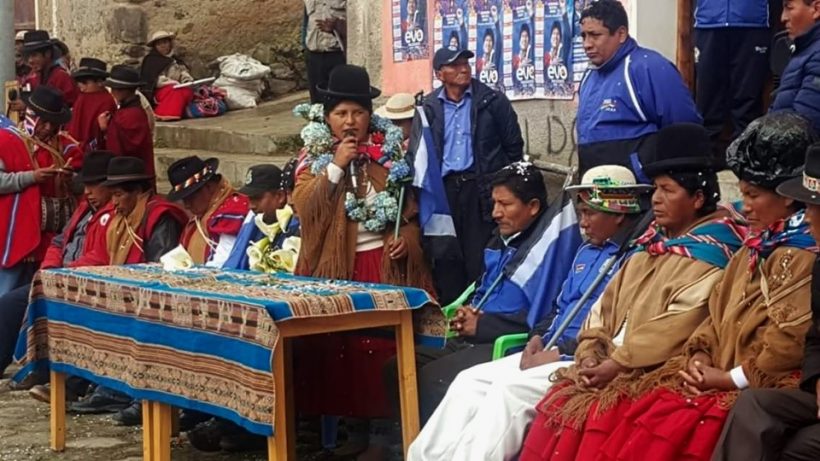
Indigenous women have been at the forefront of the fight to restore democracy in Bolivia (photo credit: MAS-IPSP, http://www.masipsp.bo).
On July 8, the MAS-IPSP “categorically” rejected the participation of an OAS electoral mission for the September presidential election, on account of their responsibility for the coup against the constitutional government.[30] The communique declared that “it is not ethical for [the OAS electoral mission] to participate again for having been part of and complicit with a coup against the democracy and Social State of Constitutional Law of Bolivia”, and “that [the OAS] is not an impartial organization to defend and guarantee peace, democracy and transparency, but rather a sponsor of petty interests that are foreign to the democratic will of the Bolivian people.” [31]
Bolivia is at a crossroads. Will the de facto regime of Jeanine Áñez, having completed a coup and in command of the security forces, allow a return to democratic procedures to resolve political differences? Or will she join her Minister of Government, Arturo Murillo, in seeking to undermine, through political persecution and lawfare, any chance that the MAS ticket will be on the ballot, let alone allow free elections to take place?
The condemnation of the coup by Mexico, Nicaragua and Uruguay on November 12 was just the start of international solidarity with the call for a return to democracy in Bolivia. On November 21, 31 US organizations denounced “the civic-military coup in Bolivia.” [32] On June 29, 2020 the Grupo de Puebla, a forum that convenes former presidents, intellectuals, and progressive leaders of the Americas, released a statement condemning the actions of the OAS. “The Puebla Group considers that what happened in Bolivia casts serious doubts on the role of the OAS as an impartial electoral observer in the future.”[33] The international community can honor the clamour for free and fair elections in Bolivia by condemning the de facto regime’s use of political persecution and lawfare, supporting democratic elections in September, and rejecting any further role of the OAS in monitoring elections in the Americas.
Patricio Zamorano provided editorial support and research for this article.
Translations from Spanish to English are by the authors.

Luis Arce, presidential candidate, and David Choquehuanca, running for the vice-presidency. They lead all surveys so far (photo credit: MAS-IPSP, http://www.masipsp.bo/).
End notes
[1] “Statement of the OAS Electoral Observation Mission in Bolivia,” https://www.oas.org/en/media_center/press_release.asp?sCodigo=E-085/19
[2] “What Happened in Bolivia’s 2019 Vote Count?” https://cepr.net/report/bolivia-elections-2019-11/
[3] “Evidence Against Fraudulent Votes Being Decisive in the Bolivia Election,” http://www-personal.umich.edu/~wmebane/Bolivia2019.pdf
[4] “Bolivia dismissed its October elections as fraudulent. Our research found no reason to suspect fraud,” https://www.washingtonpost.com/politics/2020/02/26/bolivia-dismissed-its-october-elections-fraudulent-our-research-found-no-reason-suspect-fraud/
[5] “New York Times Admits Key Falsehoods that Drove Last Year’s Coup in Bolivia: Falsehoods Peddled by the US, its Media, and the Times,” https://theintercept.com/2020/06/08/the-nyt-admits-key-falsehoods-that-drove-last-years-coup-in-bolivia-falsehoods-peddled-by-the-u-s-its-media-and-the-nyt/. See also the study by CELAG, “Sobre la OEA y las elecciones en Bolivia”, (Nov. 19, 2019). CELAG conducted a study of both the OAS report and CEPR’s analysis and concluded: “The findings of the analysis allow us to affirm that the preliminary report of the OAS does not provide any evidence that could be definitive to demonstrate the alleged “fraud” alluded to by Secretary General, Luis Almagro, at the Permanent Council meeting held on November 12 . On the contrary, instead of sticking to a technically grounded electoral audit, the OAS produced a questionable report to induce a false deduction in public opinion: that the increase in the gap in favor of Evo Morales in the final section of the count was expanding by fraudulent causes and not by the sociopolitical characteristics and the dynamics of electoral behavior that occur between the rural and urban world in Bolivia.” https://www.celag.org/sobre-la-oea-y-las-elecciones-en-bolivia/
[6] “Do Shifts in Late-Counted Votes Signal Fraud? Evidence From Bolivia,” https://papers.ssrn.com/sol3/papers.cfm?abstract_id=3621475
[7] “Preliminary Findings Report to the General Secretariat,” http://www.oas.org/documents/eng/press/Electoral-Integrity-Analysis-Bolivia2019.pdf
[8] “Elections in Haiti pose post-electoral crisis, by Clément Doleac and Sabrina Hervé, Dec. 10, 2015. COHA. https://www.coha.org/elections-in-haiti-pose-post-electoral-crisis/
[9] “El Grupo de Puebla rechazó el golpe contra Evo Morales y se solidarizó con el pueblo boliviano,” https://www.infonews.com/el-grupo-puebla-rechazo-el-golpe-contra-evo-morales-y-se-solidarizo-el-pueblo-boliviano-n281357
[10] “Salvatierra: Mi renuncia fue coordinada con Evo y Alvaro,” https://www.google.com/url?q=https://www.paginasiete.bo/nacional/2020/1/24/salvatierra-mi-renuncia-fue-coordinada-con-evo-alvaro-244454.html&sa=D&ust=1593696030403000&usg=AFQjCNE_kAMqtAOBGCXdjJV5nkBsfQEWPQ
[11] “Almagro: Evo Morales fue quien cometió un “golpe de Estado,” DW. https://www.dw.com/es/almagro-evo-morales-fue-quien-cometi%C3%B3-un-golpe-de-estado/a-51218739
[12] https://twitter.com/oas_official/status/1194389549037830145?lang=en
[13] “La OEA y la crisis en Bolivia: un choque de relatos irreconciliables”, EFE, Nov. 12, 2019. https://www.efe.com/efe/usa/politica/la-oea-y-crisis-en-bolivia-un-choque-de-relatos-irreconciliables/50000105-4109588
[14] “Statement from President Donald J. Trump Regarding the Resignation of Bolivian President Evo Morales,” https://www.whitehouse.gov/briefings-statements/statement-president-donald-j-trump-regarding-resignation-bolivian-president-evo-morales/
[15] “With the Right-wing coup in Bolivia nearly complete, the junta is hunting down the last remaining dissidents,” https://thegrayzone.com/2019/11/27/right-wing-coup-bolivia-complete-junta-hunting-dissidents/
[16] “Brutal Repression in Cochabamba, Bolivia: So far nine killed, scores wounded,” COHA. https://www.coha.org/brutal-repression-in-cochabamba-bolivia-november-15-2019/
[17] “Bolivian regime threatens to imprison lawmakers, officials,” https://www.telesurenglish.net/news/Bolivian-Regime-Threatens-to-Imprison-Lawmakers-Officials-20200524-0004.html
[18] “Encuesta Bolivia, July 2020”, CELAG, https://www.celag.org/encuesta-bolivia-julio-2020/
[19] “Evo Morales busca un candidato y Añez dice que no participará en elecciones”, https://www.lavoz.com.ar/mundo/evo-morales-busca-un-candidato-y-anez-dice-que-no-participara-en-elecciones
[20] “A Jeanine Añez hasta los aliados le critican su candidatura”, https://www.pagina12.com.ar/244221-a-jeanine-anez-hasta-los-aliados-le-critican-su-candidatura
[21] Gestora Pública denuncia formalmente al exministro Luis Arce por daño económico al Estado” https://www1.abi.bo/abi_/?i=452014
[22] “Luis Arce asegura que la denuncia en su contra busca inhabilitar su participación en las elecciones”, https://www.youtube.com/watch?v=-DYvPUk643w
[23] “Fiscalía boliviana acusa de terrorismo a Evo Morales.” https://www.eltiempo.com/mundo/latinoamerica/fiscalia-boliviana-acusa-de-terrorismo-a-evo-morales-515054
[24] “Fiscalía boliviana acusa a Morales de terrorismo y pide su arresto,” https://www.hispantv.com/noticias/bolivia/470654/anez-morales-terrorismo-detencion
[25] “¿Quién es Arturo Murillo?”, https://www.pagina12.com.ar/239232-quien-es-arturo-murillo
[26] “American Convention on Human Rights,” https://www.cidh.oas.org/basicos/english/basic3.american%20convention.htm
[27] “Valiente resistencia en K’ara K’ara enfrenta represión policial y militar”, https://www.laizquierdadiario.com/Valiente-resistencia-en-K-ara-K-ara-enfrenta-represion-policial-y-militar
[28] “Bolivia’s Coup President has Unleashed a Campaign of Terror,” https://www.jacobinmag.com/2020/05/bolivia-coup-jeanine-anez-evo-morales-mas
[29] “Bolivia (Plurinational State of) Constitution of 2009,” https://www.constituteproject.org/constitution/Bolivia_2009.pdf
[30] MAS-IPSP tweet, July 8, rejecting OAS mission for September elections.
[31] “El MAS rechaza observadores de la OEA en elecciones bolivianas,” July 9, Telesur. https://www.telesurtv.net/news/bolivia-movimiento-socialismo-rechazo-observadores-oea-20200709-0002.html
[32] “31 US organizations denounce the brutal repression in Bolivia,” COHA. https://www.coha.org/31-us-organizations-denounce-the-brutal-repression-in-bolivia/
[33] ttps://www.telesurtv.net/news/grupo-puebla-rechaza-oea-observador-internacional-20200629-0085.html
US plans to invade Venezuela through Colombia
By Lucas Leiroz | July 10, 2020
Colombia is under a pro-Washington government. The country’s current president, Iván Duque Márquez, has been noted for a series of policies of alignment with the United States, continuing the legacy of his predecessor, former president Juan Manuel Santos, who has made Colombia a NATO “global partner”, allowing the country to participate in joint military operations of the Western military alliance. In general, the long scenario of crises and tensions in Colombia, marked by drug trafficking and the conflict between criminal factions and rebel parties, has driven its governments towards a policy of alignment with Washington in exchange for security, which has increased in recent years.
However, not all Colombian politicians approve these measures. Recently, the leftist senator Iván Cepeda asked Colombian Congressional President Lidio García to convene a session to investigate and legally control the government in its collaboration with the constant arrival of American soldiers in the country. According to Cepeda, the presence of these military personnel is hostile to Colombia, deeply affecting the maintenance of national sovereignty.
Cepeda claims that the government should consult the National Congress before allowing the American military to arrive. A recent decision by the Supreme Court of Cundinamarca proved Cepeda right. According to the judges of the Court, the unilateral decision to allow the entry of foreign troops violates the Colombian National Constitution, and the Executive Branch must previously submit the matter to the Congress. For this reason, the Court asked the government to send information about the joint operations in progress, with the aim of clarifying the reason for the arrival of American troops. The deadline for sending the report was July 6 and was not met by the government – which claims it will appeal the decision. Due to the non-compliance, Cepeda filed a request for the establishment of a special congressional session.
The exact number of US military personnel in the country is uncertain, which further raises suspicions about the case. Some sources say there are more than 800 Americans, while others say they are between 50 and 60 military personnel. No official note was given by the government to explain the reasons and the exact number of soldiers. On the other hand, the American Embassy in Colombia, under pressure, commented on the case, giving an unsatisfactory answer. According to American diplomats, military personnel are arriving in Colombia to carry out joint operations to combat drug trafficking. Apparently, these operations would aim to carry out a siege against Venezuela and Nicolás Maduro, who, according to Donald Trump, has links with drug trafficking in the region. It is important to remember that Trump’s accusations against Maduro were never substantiated nor has any evidence been provided of such links between the Venezuelan president and drug trafficking.
Recently, Colombian mercenaries invaded Venezuela by sea in American vessels. Venezuelan security forces neutralized the attack, but since then it has become clear that Colombia is willing to collaborate with the US to overthrow the government of Nicolás Maduro. Apparently, therefore, American troops arriving in the country are preparing for a next step in this old American project to occupy Venezuela.
The justification that the Venezuelan government has links with drug trafficking becomes even more curious when the American ally is precisely Colombia, a state that historically has structural links with organized crime and the illegal drug trade in South America, being considered by experts in the whole world as a true narco-state. Likewise, the United States is not innocent of scandals involving international trafficking. The CIA has repeatedly been accused of collaborating with criminal networks worldwide. The American invasion of Afghanistan in 2001 guaranteed to the US the complete control of opium production in the region. In Mexico, in exchange for information and resources, American intelligence has collaborated several times with the activities of the so-called Guadalajara Cartel. Still, for years, American intelligence collaborated with Panamanian general Manuel Noriega, who has been publicly involved in drug trafficking since the 1960s, in exchange for military support against guerrillas in Nicaragua.
In fact, we can see that drug trafficking is a flawed and inconsistent justification for an invasion against Venezuela. Colombia and the United States have much more credible and notorious evidence of drug trafficking and are precisely the countries articulating this operation. We can imagine the real reasons behind this: unable to maintain its global hegemony, Washington desperately tries to guarantee its power in Latin America, and, for that, it tries to overthrow Maduro; Colombia provides support to the US in exchange for a mask for its own criminal activities, carried out in collusion by the government and criminal networks of drug trafficking groups – such activities will be falsely attributed to Maduro.
Anyway, what seems clear now is that the US plans to invade Venezuela through Colombia.
Lucas Leiroz is a research fellow in international law at the Federal University of Rio de Janeiro.
‘Pattern’ of Abuse by Colombian Soldiers Raises Questions Over US’ Continued Funding for Forces
Sputnik – July 7, 2020
The rapes of two young, Indigenous girls by soldiers in rural Colombia have shed light on the role that the US plays in expanding and training the Colombian military, two activists told Sputnik.
Nathalie Hrizi, an educator, a political activist and the editor of Breaking the Chains, told Radio Sputnik’s Loud & Clear on Tuesday that the sexual assaults of the two minors highlight a continued pattern of abuse at the hands of Colombian service members.
“Essentially, these two rapes have raised attention to what is a pattern in Colombia and a pattern associated with the human rights abuses and violations of the Colombian military,” Hrizi told show host Nicole Roussell.
“And so there have been protests … really, the Indengenous community are those that have been organizing.”
One of the assaults involved an 11-year-old girl from Colombia’s Embera tribe and has since seen seven soldiers from an army garrison in western Colombia arrested after admitting to the minor’s abduction and rape.
The second case was revealed in recent weeks by the Peace and Reconciliation Foundation, a Colombian think tank, which detailed the September 2019 abduction and repeated rape of a 15-year-old from the country’s Nukak Maku tribe. Both assaults have led to widespread protests across Colombia.
Speaking to Radio Sputnik’s Loud & Clear on Tuesday, Hrizi explained that the Embera tribe is located in an autonomous territory near a military station.
“That rape has been really, in the eyes of the public, connected to another rape that happened in September to another Indigenous girl in a different area. She’s a 15-year-old girl in the Guaviare area,” Hrizi explained.
“On September 8, soldiers abducted her, and they kept her for five days … they raped her and denied her food and water … that has not really received any real widespread acknowledgment until more recently because of the way the Colombian military is organized,” Hrizi added.
Since 2016, at least 118 members of the Colombian army have been investigated over accusations that they sexually abused minors, Colombian General Eduardo Zapateiro revealed on July 1, Reuters reported. The Colombian army, which has battled for decades against leftist guerilla forces, as well as criminal gangs formed by former members of right-wing paramilitary groups, has long been accused of human rights violations.
It’s important to note “the power of this Indigenous protest movement and the really important ways in which that movement is drawing connections between violence against women and broader abuses of power, whether at the hands of the military, police, rich people or otherwise, and that very much includes the role of the US in expanding and training the Colombian military,” Hannah Dickinson, an associate professor at Hobart and William Smith Colleges and an organizer with the Geneva Women’s Assembly, told Sputnik.
According to a report by Defense News, the US military has helped train Colombia’s soldiers for decades, despite widespread condemnation of human rights abuses by the Colombian military.
“In 1999, the US aid to Colombia jumped from $3 billion to $7.5 billion, and civic and human rights organizations in Colombia have been documenting cases of sexual violence against Indigenous women for the past 12 years,” Dickinson explained.
Twitter Targets Accounts of MintPress and Other Outlets Covering Unrest in Bolivia
By Alan Macleod | MintPress News | June 29, 2020
Social media giant Twitter took the step of suspending the official account of MintPress News on Saturday. Without warning, the nine-year-old account with 64,000 followers was abruptly labeled as “fake” or “spam” and restricted. This move is becoming a frequent occurrence for alternative media, especially those that openly challenge U.S. power globally.
Immediately preceding the ban, MintPress had been sharing stories about Israeli government crimes against Palestinians, the Saudi-led onslaught in Yemen (both funded and supported by Washington), and about activists challenging chemical giant Monsanto’s latest plans. However, MintPess correspondent Ollie Vargas, stationed in Bolivia and covering the coup and other events there, had another theory on the suspension. Vargas noted that his account, along with union leader Leonardo Loza and independent Bolivian outlets Kawsachun Coca and Kawsachun News were all suspended at the same time. “There was a coordinated takedown of numerous users & outlets based in Chapare, Bolivia. Thousands of fake accounts appeared after the coup. We believe they’re being mobilized to mass report those who criticize the regime,” he said. Since the November coup, Bolivia has been the sight of intense political struggle, with MintPress one of the only Western outlets, large or small, extensively covering the situation (and from a perspective that directly challenges the official US government line). Vargas added that all those accounts suspended appeared in his Twitter bio.
In December, MintPress reported how the strongly conservative Bolivian elite is treating social media as a key battleground in pushing the coup forward, with over 5,000 accounts created on the day of the insurrection tweeting using pro-coup hashtags. With the new administration still lacking both legitimacy and public support, it appears the next step is to simply silence dissenting voices online like they have been silenced inside the country. Kawsachun Coca and Kawsachun News, located in the Chapare region, still not under government control, are among the only remaining outlets critical of the Añez administration.
As Twitter has developed into a worldwide medium of communication, it has also grown an increasingly close relationship with Western state power. In September, a senior Twitter executive was unmasked as an active duty officer in a British Army brigade whose specialty was online and psychological warfare. It was almost entirely ignored by corporate media; the one and only journalist at a major publication covering the story was pushed out of his job weeks later. Earlier this month, Twitter announced it worked with a hawkish U.S.- and Australian-government sponsored think tank to purge nearly 200,000 Chinese, Russian and Iranian accounts from its platform. It has also worked hard to remove Venezuelan users critical of U.S. regime change, including large numbers of government members. Meanwhile, despite detailed academic work exposing them, Venezuelan opposition bot networks remain free to promote intervention.
Facebook has also been working hand-in-hand with the Atlantic Council, a NATO think tank, to determine what users and posts are legitimate and what is fake news, effectively giving control over what its 2.4 billion users see in their news feeds to the military organization. Reddit, another huge social media platform, recently appointed a former deputy director at the council to be its head of policy.
Earlier this year, Facebook announced that it was banning all positive appraisals of Qassem Soleimani, the Iranian general and statesman assassinated by the Trump administration. This, it explained, was because Trump had labeled the Iranian Revolutionary Guard Corps (IRGC) a terrorist organization. “We operate under U.S. sanctions laws, including those related to the U.S. government’s designation of the IRGC and its leadership,” it said in a statement. This is particularly worrying, as Soleimani was the country’s most popular public figure, with over 80 percent of Iranians holding a positive view of him, according to a University of Maryland poll. Therefore, because of the whims of the Trump administration, Facebook began suppressing a majority view shared by Iranians with other Iranians in Farsi across all its platforms, including Instagram. Thus, the line between the state, the military industrial complex, and big media platforms whose job should be to hold them to account has blurred beyond distinction. The incident also once again highlights that big tech monopolies are not public resources, but increasingly tightly controlled American enterprises working in conjunction with Washington.
More worryingly, it is the tech companies themselves who are pushing for this integration. “What Lockheed Martin was to the twentieth century,” wrote Google executives Eric Schmidt and Larry Cohen in their book, The New Digital Age, “technology and cyber-security companies [like Google] will be to the twenty-first.” The book was heartily endorsed by Atlantic Council director Henry Kissinger.
After an online outcry including journalists like Ben Norton directly appealing to administrators, the accounts were reinstated today. However, the weekend’s events are another point of reference in the trend of harassing and suppressing independent, alternative or foreign media that challenges the U.S. state power, an increasingly large part of which is linked to the big online media platforms we rely on for free exchange of ideas, opinions and discourse.
On the incident, MintPress founder Mnar Muhawesh said:
Twitter’s ban hammer and censorship army of flaggers is an attempt to re-tighten state and corporate control over the free flow of information. That’s why it’s no wonder independent media like MintPress News, Kawsachun, and watchdog journalists covering state crimes like Ollie Vargas have been targeted in what appears to be an organized effort to silence and censor dissent. Twitter’s message is very clear: our first amendment is not welcome, as long as it challenges establishment narratives.”
Alan MacLeod is a Staff Writer for MintPress News. After completing his PhD in 2017 he published two books: Bad News From Venezuela: Twenty Years of Fake News and Misreporting and Propaganda in the Information Age: Still Manufacturing Consent.
How Venezuela helped defeat Canada’s Security Council bid

By Yves Engler · June 26, 2020
Was Canada defeated in its bid for a seat on the United Nations Security Council because of Justin Trudeau’s effort to overthrow Venezuela’s government? Its intervention in the internal affairs of another sovereign country certainly didn’t help.
According to Royal Military College Professor Walter Dorn, “I spoke with an ambassador in NYC who told me that yesterday she voted for Canada. She had also cast a ballot in the 2010 election, which Canada also lost. She said that Canada’s position on the Middle East (Israel) had changed, which was a positive factor for election, but that Canada’s work in the Lima Group caused Venezuela to lobby hard against Canada. Unfortunately (from her perspective and mine), Venezuela and its allies still hold sway in the Non-Aligned Movement (NAM or G77).”
The only country’s diplomats — as far as I can tell — that publicly campaigned against Canada’s bid for a seat on the Security Council were Venezuelan. Prior to the vote Venezuela’s Vice-Minister of foreign relations for North America, Carlos Ron, tweeted out his opposition: “With its deafening silence, Canada has de facto supported terrorists and mercenaries who recently plotted against Venezuela, threatening regional peace and security. The UNSC is entrusted with upholding the United Nations Charter and maintaining International Peace and Security: Canada does not meet that criteria.”
The post was re-tweeted by Foreign Minister Jorge Arreaza, who has 1.6 million followers, and numerous Venezuelan diplomats around the world, including the Venezuelan ambassador to the UN. Joaquín Pérez Ayestarán added, “Canada recognizes an unelected, self-proclaimed President in Venezuela, in complete disregard for the will of the voters. It also tries to isolate Venezuela diplomatically & supports sanctions that affect all Venezuelans. Is the Security Council the place for more non-diplomacy?”
After Canada lost its Security Council bid Ron noted, “not surprised with UN Security Council election results today. A subservient foreign policy may win you Trump’s favor, but the peoples of the world expect an independent voice that will stand for diplomacy, respect for self-determination, and peace.” He also tweeted an Ottawa Citizen article titled “Why Black and brown countries may have rejected Canada’s security council bid.”
For his part, UN ambassador Ayestarán tweeted, “losing two consecutive elections to the Security Council of United Nations within a 10-years period is a clear message that you are not a reliable partner and that the international community has no confidence in you for entrusting questions related to international peace and security.”
Over the past couple of years the Trudeau government has openly sought to overthrow Venezuela’s government. In a bid to elicit “regime change”, Ottawa has worked to isolate Caracas, imposed illegal sanctions, took that government to the International Criminal Court, financed an often-unsavoury opposition and decided a marginal opposition politician was the legitimate president.
Canada’s interference in Venezuelan affairs violates the UN and OAS charters. It is also wildly hypocritical. In its bid to force the Maduro government to follow Canada’s (erroneous) interpretation of the Venezuelan constitution Ottawa is allied in the Lima Group with President Juan Orlando Hernandez, who openly defied the Honduran Constitution. Another of Canada’s Lima Group allies is Colombian President Ivan Duque who has a substantially worse human rights record.
Reflecting the interventionist climate in this country, some suggested Canada’s position towards Venezuela would actually help it secure a seat on the Security Council. A few weeks before the vote the National Post’s John Ivison penned a column titled “Trudeau’s trail of broken promises haunt his UN Security Council campaign” that noted “but, Canada’s vigorous participation in the Lima Group, the multilateral group formed in response to the crisis in Venezuela, has won it good notices in Latin America.” (The Lima Group was set up to bypass the Organization of American States, mostly Caribbean countries, refusal to interfere in Venezuela’s affairs.) A Canadians for Justice and Peace in the Middle East factsheet regarding “Canada’s 2020 bid for a UN Security Council seat” echoed Ivison’s view. It claimed, “Canada also presents a positive image to Latin American states, likely reinforced by its leadership of the Lima Group in 2019 and by its promise to allocate $53 million to the Venezuelan migration crisis.”
While it is likely that Lima Group countries voted for Canada, a larger group of non-interventionist minded countries outside of that coalition didn’t. Venezuelan officials’ ability to influence Non-Aligned Movement and other countries would have been overwhelmingly based on their sympathy for the principle of non-intervention in other countries’ affairs and respect for the UN charter.
The Liberals’ policy towards Venezuela has blown up in its face. Maduro is still in power. Canada’s preferred Venezuelan politician, Juan Guaidó, is weaker today than at any point since he declared himself president a year and a half ago. And now Venezuela has undermined the Liberals’ effort to sit on the Security Council.
Will Canada’s defeat at the UN spark a change in its disastrous Venezuela policy?
Trump slams Guaidó while expressing openness in speaking with Maduro
By Paul Antonopoulos | June 22, 2020
In what potentially could be a radical change in Washington’s policy towards Venezuela, U.S. president Donald Trump confessed that he has had doubts about his decision to recognize opposition leader Juan Guaidó as president of the South American country. Trump revealed in an interview with Axios in the Oval Office what he thinks about the self-proclaimed wannabe president of Venezuela, Guaidó, and even confessed that he “would maybe think” of meeting personally with Venezuelan President Nicolás Maduro, who has already publicly expressed his willingness to talk with the American president.
“Maduro would like to meet. And I’m never opposed to meetings — you know, rarely opposed to meetings. I always say, you lose very little with meetings. But at this moment, I’ve turned them down,” Trump said.
In a preview of the interview published by Axios, Trump revealed how little confidence he has in Guaidó because the politician failed to take control of the Venezuelan government despite the strong support provided by the U.S. and another 60 countries that recognize him as the legitimate president.
Asked by Axios whether he regretted his decision on backing Guaidó on the advice of John Bolton, his former National Security Advisor, Trump initially said “not particularly,” but then went on to say, “I could have lived with it or without it, but I was very firmly against what’s going on in Venezuela.”
In another part of the interview, Trump speaks directly of the moment when he decided to recognize the opposition leader as president: “Guaidó was elected. I think that I wasn’t necessarily in favor, but I said — some people that liked it, some people didn’t. I was OK with it. I don’t think it was — you know, I don’t think it was very meaningful one way or the other.”
Also, in the preview, Axios quoted a fragment of Bolton’s upcoming book The Room Where It Happened, where he reveals some behind the scenes diplomacy of the Trump Administration and the private feelings the president has about Guaidó. Bolton says that Trump “thought Guaidó was ‘weak,’ as opposed to Maduro, who was ‘strong’” and that “Trump was calling Guaidó the ‘Beto O’Rourke of Venezuela,’ hardly the sort of compliment an ally of the United States should expect.” O’Rourke, who was a Democratic Presidential Candidate and is one of Trump’s biggest critics, was called a “poor bastard” who “quit like a dog” by the American president, a demonstration of just how low Trump thinks of Guaidó.
Trump in the interview described Bolton as a “nutjob” who may be the “dumbest human being on Earth.” Trump could perhaps seek to slowly normalize relations with Maduro and move away from Guaidó, while placing the blame entirely on Bolton for the escalation of hostilities between Washington and Caracas.
In 2019, shocking events were triggered when Guaidó proclaimed himself president. An attempt to forcibly enter a shipment of “solidarity aid” into Venezuela from Colombia that likely had weapons was made; Venezuela suddenly was without electricity after a cyberattack; there was another coup attempt; and, many attacks on military barracks. Yet, Maduro survived the intense pressures from the U.S. and sixty of its allies.
The American President is known to admire authoritarianism and/or strong leaders. Despite sanctions, coup attempts and threats of military invasion, Maduro has not only survived the U.S.-led destabilization, but cemented his positions as leader of Venezuela. Although they may be adversaries, it would not be a wild claim to say that Trump admires Maduro’s strength and determination, especially as Guaidó utterly failed when he had every advantage afforded to him.
If someone had said in 2019 that just a year later Venezuela would not only be more stable than the U.S. when we consider the Black Lives Matter uprising in the aftermath of the George Floyd murder, but would also achieve a seat in the UN Human Rights commission, no one would have believed it.
The U.S. could not allow 2019 to confirm the decline of its dominance over Latin America. With the defeat it suffered in Venezuela, the return of Cristina Kirchner in Argentina and the breakdown of neoliberal governments in the region, Washington had to resort to coups to protect its interests, as seen in Bolivia.
Venezuela now has a fragmented opposition to Maduro that is immersed in an internal war. At this point, Guaidó is not guaranteed to be re-elected as president of the National Assembly. For the U.S. however, it does not matter who occupies that position so long as they are serving Washington’s agenda. The so-called Deep State in the U.S. remains pitifully unchanged in their policy to destroy the existence of sovereign governments in the region. However, is Trump attempting to break free of such war hawks by expressing an openness to speak with Maduro? Although Trump may have individual opinions on not wanting to challenge Venezuela, despite public rhetoric, he will be restricted by the main power structures that exist in the U.S. and push for complete dominance no matter the administration in power and what they want to achieve.
Paul Antonopoulos is an independent geopolitical analyst.
Cut Overseas Police Training Programs

Photograph Source: Lorie Shaull from St Paul, United States – CC BY-SA 2.0
By Jeremy Kuzmarov | CounterPunch | June 15, 2020
The police killing of George Floyd in Minneapolis has ignited protests across the United States and calls to demilitarize and defund the police.
A similar demand should be made to cut overseas police training programs including in Afghanistan.
The U.S. government has long adopted overseas police training as a cornerstone of nation building and counterinsurgency programs.
The idea is that American police will instill professional and democratic standards, including a respect for civil liberties among foreign counterparts and help stabilize violence prone countries.
The Floyd killing has exposed, however, that American police lack professional and humane standards and need to be retrained and reformed. They are ill suited to improve other countries’ police.
In Afghanistan, where the U.S. has spent an estimated $87 billion dollars over nineteen years training security forces, the police are notorious for corruption, sectarianism, incompetence and brutality.
In an interview quoted in the Afghanistan Papers, Thomas Johnson, a Navy official who served as a counterinsurgency adviser in Kandahar province, said that Afghans viewed the police as predatory bandits, calling them “the most hated institution” in Afghanistan.
This latter outcome resulted in part from the militarized tactics promoted by American advisers and their importation of police technologies which could be used for repressive ends.
In Honduras, where the U.S. expanded police aid following a 2009 coup d’états that ousted the mildly progressive José Manuel Zelaya, American trained units have been implicated in torture and drug related corruption, and carried out predawn raids of activists involved in protesting contested elections.
These units were trained under an initiative promoted by President Obama and extended by Trump that provided hundreds of millions of dollars for law enforcement training and assistance, mostly under the War on Drugs.
In the early 1960s, the Kennedy administration created the United States Agency for International Development’s infamous Office of Public Safety (OPS), to modernize the police forces in countries considered vulnerable to communist subversion.
Headed by CIA agent Byron Engle, who combined a deep commitment to civilian police work with an appreciation for the darker areas of political police intelligence, the OPS initially employed liberal reformers.
As political policing gained primacy, however, OPS agents became contemptuous of human rights and imported policing technologies that were used to hunt down dissidents and violently quell protests.
Charles Maechling Jr., staff director of the Special Group on Counterinsurgency under Kennedy, acknowledged that in failing to “insist on even rudimentary standards of criminal justice and civil rights, the United States provided regimes having only a façade of constitutional safeguards with up-dated law enforcement machinery readily adaptable to political intimidation and state terrorism. Record keeping in particular was immediately put to use tracking down student radicals and union organizers.”
By 1973, the OPS was abolished by Congress because of its connection to torture carried out by U.S. trained police forces in South Vietnam and Brazil.
Many OPS veterans subsequently returned to work for police forces back in the U.S., where some continued to promote tactics that encouraged police abuse, including in the suppression of urban riots.
Unfortunately, there is a long pattern of abuse in American police forces, that overseas police programs have helped to compound.
As momentum grows for a transformation of the police, activists should be demanding an end to the practice of exporting police repression and a change to the American approach towards foreign policy more broadly.
Jeremy Kuzmarov is the author of The Russians are Coming, Again: The First Cold War as Tragedy, the Second as Farce (Monthly Review Press, 2018) and Obama’s Unending Wars: Fronting for the Foreign Policy of the Permanent Warfare State (Atlanta: Clarity Press, 2019).
Parliament summons Jeanine Áñez to clarify corruption scandal
By Lucas Leiroz | May 29, 2020
The coup d’état carried out in Bolivia was the starting point for a major wave of social, political and economic setbacks in the country. Bolivia is the poorest country in South America, with very high poverty rates, however, during the years of Evo Morales, the country’s growth was enormous, reaching the point of being the South American country with the greatest economic growth. The seizure of power by the coup d’état represented the return of the worst growth rates, in addition to a huge escalation of violence against indigenous populations – extremely respected previously by Evo Morales – and gigantic corruption scandals.
Bolivia’s interim president, Jeanine Añez, recently proved the nature behind the new government by being indicted in a lawsuit. Añez and the Minister of Foreign Affairs, Karen Longaric, were the first people summoned to provide information for a current investigation. The charge against both is of involvement in corruption networks during the purchase of ventilators and other medical supplies to – supposedly – fight the pandemic.
The corruption scandal in Bolivia started a few weeks ago, when health professionals reported that the Spanish ventilators acquired by the Bolivian State were of low quality and unfit for hospital use with the purpose of facing a pandemic. According to official sources, the Bolivian government has spent more than $27,000 on each device (about 170 devices), while domestic producers (Bolivians) charge about $1,000.
“This investigation will summon Jeanine Áñez, Longaric and other officials involved in this purchase that has become theft of the pockets of the entire Bolivian people,” lawmaker Édgar Montaño told reporters. According to the parliamentarian, Áñez must acknowledge that she knew all the details of the agreement, which she herself had ordered, while Longaric must explain why no action was taken after the Bolivian consul in Barcelona sent a report with the details of the contract. It is also worth remembering that, on Wednesday (May 20), Bolivia’s Minister of Health, Marcelo Navajas, was arrested and dismissed from office on suspicion of involvement in the corruption scandal.
As investigations progress, the situation becomes increasingly serious for Bolivian domestic politics, as major corruption schemes and illicit deals are discovered, revealed, and meticulously used as political weapons in party disputes within the country. Some people and groups that support the legitimate Bolivian president, Evo Morales, are innocently celebrating the performance of the Bolivian Parliament “against the coup”, but, in fact, there is no reason to celebrate so far.
If, on the one hand, there is something positive in the fact that the illicit activities of the coup government are being exposed, on the other, the central objective of the coup is being accomplished: the intention of the groups that financed and supported the overthrow of Morales was never to put Jeanine Añez (or any other politician) in power, but to completely destabilize the Bolivian State, creating a scenario of absolute political chaos, with total institutional bankruptcy, thus facilitating the transformation of Bolivia into a land of foreign interference.
In fact, we can predict that from now on it is likely that the next presidents of Bolivia, be they left or right (terms absolutely outdated and geopolitically irrelevant), will fall in succession, without completing their mandates and the country’s command will remain, thus, vulnerable and without a central guardian of law and order. Within the chaotic scenario, the irregular action of external agents and foreign meddling in Bolivia will be simpler and, in addition to structural problems such as poverty and hunger, Bolivians would have to deal with a situation of total subordination to foreign powers – which it did not exist in the time of Morales, when the country tried to chart a sovereign and independent way, besides achieving diverse progress in many social indices.
What now happens in Bolivia can also be seen when we analyze several previous experiences. Countries victimized by the so-called “colorful revolutions” – hybrid wars disguised under the mask of democratic revolutions – tend to be characterized after the outcome of such “revolutions” by the establishment of true “zombie states”, which consist of nothing more than innocuous institutions and without any strength to deal with the real problems of their countries.
With the presidential election situation still uncertain in the midst of the pandemic – the Executive Branch and the Judiciary made different decisions and, amid institutional chaos, nothing is yet fully defined – the future of the Bolivian government is really unknown, but the scenario is very pessimistic, with few expectations of overcoming the crisis. The tendency is for Jeanine to fall and, after her, the next president will also not fulfill his mandate completely. In contemporary hybrid warfare, attacks are continuous and “colorful revolutions” tend to be permanent.
Lucas Leiroz is a research fellow in international law at the Federal University of Rio de Janeiro.
Featured Video
Chinese jet fuel and the myth of energy independence
or go to
Aletho News Archives – Video-Images
Book Review
Former Insiders Criticize Iran Policy as U.S. Hegemony
By GARETH PORTER | CounterPunch | February 27, 2013
“Going to Tehran” arguably represents the most important work on the subject of U.S.-Iran relations to be published thus far.
Flynt Leverett and Hillary Mann Leverett tackle not only U.S. policy toward Iran but the broader context of Middle East policy with a systematic analytical perspective informed by personal experience, as well as very extensive documentation.
More importantly, however, their exposé required a degree of courage that may be unparalleled in the writing of former U.S. national security officials about issues on which they worked. They have chosen not just to criticise U.S. policy toward Iran but to analyse that policy as a problem of U.S. hegemony. … continue
Blog Roll
 Aletho News
- What is fueling unrest across the EU?
- Why no power can undermine Iran’s eternal dominance over the Strait of Hormuz
- Is The War Against Iran Over?
- Iran war will leave long-term ‘scar’ on Wall Street, investors warn
- How Iran decimated US power projection in West Asia: Military lessons of 40-day war
- Iran’s report details US-Israeli war crimes in targeting schools, hospitals, livelihoods
- NATO’s Slow Fracture: How Trump’s Iran War Exposed the Instrument of Hegemony
- Chinese jet fuel and the myth of energy independence
- Ukraine Sea Drone Fired From Libya Hit Russian Tanker in Mediterranean
- IRGC: Iranian forces launched no attacks during ceasefire hours
- If Americans Knew
- Military aid to Israel emerges as the latest political litmus test for Democrats
- The only Palestinian children’s rights organization closes following years-long Israeli campaign against it
- ‘I Can’t Forget the Smell’: Lebanese Reel After Israel Kills Over 300 in Single Day
- DNC Shoots Down Resolutions Calling Out AIPAC and Limiting Arms to Israel
- TCN: Is Israel Blackmailing President Trump?
- Israel killed at least 303 Lebanese yesterday – who were they? Daily Update
- Amnesty: Urgent – Protect Lebanese civilians from brutal escalation in Israeli attacks
- Is The War Against Iran Over?
- Inside the Israeli army’s propaganda wing
- Hundreds of Gaza Amputees Stranded in Legal Limbo
- No Tricks Zone
- New Study: No Linear Warming Or Glacier Retreat Along Northern Antarctic Peninsula Since 1980s
- An Inconvenient Tree: Uncovered In Alps… Europe Much Warmer Than Today 6000 Years Ago
- New Study Reports A 60% Slowdown In Greenland’s Ice Loss Rate In The Last Decade
- Low Intensity Tornado Wrecks Major Solar Farm, Creating A Potential Toxic Dump
- New Study Finds Warming Saves Lives…Cold Temperatures 12 Times More Deadly Than Excess Heat
- German Science Blog Accuses PIK Climate Institute Of Hallucinating Climate Tipping Points
- Devastating Assessment Of Comirnaty Vaccine By Former Senior Pfizer Europe Toxicologist
- New Study: CO2 Is ‘Effectively Negligible’ As An Explanatory Climate Change Factor Since 2000
- Former Pfizer Toxicologist Dr. Helmut Sterz Tells Bundestag Hearing Pfizer Vaccine Should Have Never Been Approved
- Energy Expert: Germany’s Nuclear Phaseout Was A “500 Billion Euro Mistake”
 Aletho News