The OAS lied to the public about the Bolivian election and coup
Facts show nothing suspicious about the re-election of Evo Morales
By Mark Weisbrot | MarketWatch | November 19, 2019
What is the difference between an outright lie — stating something as a fact while knowing that it is false — and a deliberate material representation that accomplishes the same end? Here is an example that really pushes the boundary between the two, to the point where the distinction practically vanishes.
And the consequences are quite serious; this misrepresentation (or lie) has already played a major role in a military coup in Bolivia last week. This military coup overthrew the government of President Evo Morales before his current term was finished — a term to which nobody disputes that he was democratically elected in 2014.
More violent repression and even a civil war could follow.
OAS mission
The Organization of American States (OAS) sent an Electoral Observation Mission to Bolivia, entrusted with monitoring the Oct. 20 national election there. The day after the election, before all the votes were even counted, the mission put out a press release announcing its “deep concern and surprise at the drastic and hard-to-explain change in the trend of the preliminary results…”
Here is what the OAS was referring to: there is an unofficial “quick count” of the voting results that involves contractors who upload results at intervals, as the tally sheets are available. At 7:40 p.m. on election day, they had reported about 84% of the votes and then stopped reporting for 23 hours (more on that below).
When they resumed reporting results at 95% of votes counted, Morales’s lead had increased from 7.9% before the interruption to just over 10%.
This margin was important because in order to win without a second-round runoff, a candidate needs either an absolute majority, or at least 40% and a 10-point margin over the second-place finisher. This margin — which grew to 10.6% when all the votes were counted in the official count — re-elected Morales without a second round.
Morales’s lead grew steadily
Now, if you had any experience with elections or maybe even arithmetic, what is the first thing you would want to know about the votes that came in after the interruption? You might ask, were people in those areas any different from people in the average precinct in the first 84%?
And was the change in Morales’s margin sudden, or was it a gradual trend that continued as more vote tally sheets were reported?
You might even want to ask these questions before expressing “deep concern and surprise” about what happened, especially in a politically very polarized situation that was already turning violent. … continue
OAS election observers subvert Bolivian democracy
By Yves Engler · November 18, 2019
Organization of American States election observers have played an important role in subverting Bolivian democracy.
While some may find it hard to believe that a regional electoral monitoring body would consciously subvert democracy, their actions in the South American country are not dissimilar to previous US/Canada backed OAS missions in Haiti.
“The OAS Election Audit That Triggered Morales’ Fall in Bolivia”, explained a New York Times headline. For his part, Bolivian President Evo Morales said the OAS “is in the service of the North American empire.”
After the October 20 presidential election, the OAS immediately cried foul. The next day the organization released a statement that expressed “its deep concern and surprise at the drastic and hard-to-explain change in the trend of the preliminary results [from the quick count] revealed after the closing of the polls.” Two days later they followed that statement up with a preliminary report that repeated their claim that “changes in the TREP [quick count] trend were hard to explain and did not match the other measurements available.”
But, the “hard-to-explain” changes cited by the OAS were entirely expected, as detailed in the Centre for Economic Policy Research’s report “What Happened in Bolivia’s 2019 Vote Count? The Role of the OAS Electoral Observation Mission”. The CEPR analysis points out that Morales’ percentage lead over the second place candidate Carlos Mesa increased steadily as votes from rural, largely indigenous, areas were tabulated. Additionally, the 47.1% of the vote Morales garnered aligns with pre-election polls and the vote score for his Movement toward Socialism party. The hullabaloo about the quick count stopping at 83% of the vote was preplanned and there is no evidence there was a pause in the actual counting.
But, the OAS’ statements gave oxygen to opposition protests. Their unsubstantiated criticism of the election have also been widely cited internationally to justify Morales’ ouster. In response to OAS claims, protests and Washington and Ottawa saying they would not recognize Morales’s victory, the Bolivian President agreed to a “binding” OAS audit of the first round of the election. Unsurprisingly the OAS’ preliminary audit report alleged “irregularities and manipulation” and called for new elections overseen by a new electoral commission. Immediately after the OAS released its preliminary audit US Secretary of State Mike Pompeo went further, saying “all government officials and officials of any political organizations implicated in the flawed October 20 elections should step aside from the electoral process.” What started with an easy-to-explain discrepancy between the quick count and final results of the actual counting spiraled into the entire election is suspect and anyone associated with it must go.
At Tuesday’s Special Meeting of the OAS Permanent Council on Bolivia the representative of Antigua and Barbuda criticized the opaque way in which the OAS electoral mission to Bolivia released its statements and reports. She pointed out how the organization made a series of agreements with the Bolivian government that were effectively jettisoned. A number of Latin American countries echoed this view.
US and Canadian representatives, on the other hand, applauded the OAS’ work in Bolivia. Canada’s representative to the OAS boasted that two Canadian technical advisers were part of the audit mission to Bolivia and that Canada financed the OAS effort that discredited Bolivia’s presidential election. Canada is the second largest contributor to the OAS, which receives between 44% and 57% of its budget from Washington.
It’s not surprising that an electoral mission from the Washington-based organization would subvert Bolivian democracy. OAS electoral observers have played more flagrant role in undermining Haitian democracy. In late 2010/early-2011 the US/Canada used an OAS election “Expert Verification Mission” to help extreme right-wing candidate Michel Martelly become president. Canada put up $6 million for elections that excluded Fanmi Lavalas from participating and following the first round of voting in November 2010, forced the candidate whom Haiti’s electoral council had in second place, Jude Celestin, out of the runoff. After Martelly’s supporters protested their candidate’s third place showing, a six person OAS mission, including a Canadian representative, concluded that Martelly deserved to be in the second round. But, in analyzing the OAS methodology, the CEPR determined that “the Mission did not establish any legal, statistical, or other logical basis for its conclusions.” Nevertheless, Ottawa and Washington pushed the Haitian government to accept the OAS’s recommendations. Foreign minister Lawrence Cannon said he “strongly urges the Provisional Electoral Council to accept and implement the [OAS] report’s recommendations and to proceed with the next steps of the electoral process accordingly.” In an interview he warned that “time is running out”, adding that “our ambassador has raised this with the president [Rene Préval] himself.” The CEPR described the intense western lobbying. “The international community, led by the US, France, and Canada, has been intensifying the pressure on the Haitian government to allow presidential candidate Michel Martelly to proceed to the second round of elections instead of [ruling party candidate] Jude Celestin.” This pressure included some Haitian officials having their US visas revoked and there were threats that aid would be cut off if Martelly’s vote total was not increased as per the OAS recommendation.
Half of Haiti’s electoral council agreed to the OAS changes, but the other half did not. The second round was unconstitutional, noted Haïti Liberté, as “only four of the eight-member Provisional Electoral Council (CEP) have voted to proceed with the second round, one short of the five necessary. Furthermore, the first-round results have not been published in the journal of record, Le Moniteur, and President Préval has not officially convoked Haitians to vote, both constitutional requirements.”
The absurdity of the whole affair did not stop the Canadian government from supporting the elections. Official election monitors from this country gave a thumbs-up to this exercise in what they said was democracy. After Martelly won the second round with 16.7 percent of registered voters support Cannon declared: “We congratulate the people of Haiti, who exercised their fundamental democratic right to choose who will govern their country and represent them on the world stage.” The left weekly Haiti Progrès took a different view. Describing the fraudulent nature of the elections, the paper explained: “The form of democracy that Washington, Paris and Ottawa want to impose on us is becoming a reality.”
A decade earlier another OAS election mission helped sabotage democracy in Haiti. After voting for 7,000 positions an OAS team on site described the May 2000 elections as “a great success for the Haitian population which turned out in large and orderly numbers to choose both their local and national governments.”
As the opposition protested the scope of Fanmi Lavalas’ victory, the OAS jumped on a technicality in the counting of eight Senate seats to subsequently characterize the elections as “deeply flawed”. The 50 percent plus one vote required for a first-round victory was determined by calculating the percentages from the votes for the top four candidates, while the OAS contended that the count should include all candidates. OAS concerns were disingenuous since they worked with the electoral council to prepare the elections and were fully aware of the counting method beforehand. The same procedure was used in prior elections, but they failed to voice any concerns until Fanmi Lavalas’ landslide victory. Finally, using the OAS method would not have altered the outcome of the elections and even after Jean Bertrand Aristide got the seven Lavalas senators to resign (one was from another party) the “deeply flawed” description remained.
Haiti’s political opposition used the OAS criticism of the election to justify boycotting the November 2000 presidential election, which they had little chance of winning. The US and Canada used the claims of electoral irregularities to justify withholding aid and Inter-American Development Bank loans to the Haitian government. OAS Resolutions 806 and 822 gave non-elected opposition parties an effective veto over the resumption of foreign aid to Aristide’s government. The OAS claims of “deeply flawed” elections played an important part in a multipronged campaign to oust Aristide’s government.
In an editorial responding to the coup in Bolivia, People’s Voice called for Canada to withdraw from the Washington dominated OAS. Internationalist minded Canadians should support that position.
But we should also recognize the blow Morales’ ouster represents to any effort to subvert the OAS. The Bolivian President’s removal is a further setback to the Latin American integration efforts represented in forums such as the Community of Latin American and Caribbean States. A potential replacement for the OAS, CELAC included all Latin American and Caribbean nations. But Canada and the US were excluded. By helping oust Morales the OAS has taken revenge on a politician who pushed an alternative, non-Washington based, model for ‘Nuestra America’.
Western Media Whitewash Bolivia’s Far-Right Coup
By Lucas Koerner and Ricardo Vaz | FAIR | November 15, 2019
Jeanine Áñez declared herself “interim president” in a near-empty Senate chamber on November 12, proceeding to don the presidential sash with the assistance of uniformed soldiers. Despite a lack of quorum rendering the move nakedly unconstitutional, Áñez was immediately recognized by the Trump administration and 10 Downing Street.
Tuesday’s scene seemed like a parody of January’s events in Venezuela, in which a virtually unknown lawmaker, invoking highly dubious constitutional arguments, proclaimed himself “interim president” to the delight of Washington.
For all the supposed threat Trump represents and the enthusiasm sparked by his possible impeachment, Western media continue to march lockstep behind his administration’s coups in Latin America.
Áñez has been sympathetically described as a “qualified lawyer” (BBC, 11/13/19), a “proud Christian” (France 24, 11/13/19) as well as a “women’s rights activist and television presenter” (Time, 11/12/19). Reuters (11/13/19) called her “Bolivian Interim President Jeanine Áñez,” AP(11/13/19) had her as “Bolivia’s newly declared interim president,” whereas for the BBC (11/13/19) she was simply “President Áñez.” AFP (published in France 24, 11/13/19) described her as “the South American country’s 66th president and the second woman to hold the post.”
This language mirrors corporate media profiles of Venezuelan coup leader Juan Guaidó (FAIR, 7/23/19), who was depicted as a “freedom fighter” (Fox Business, 1/29/19) and a “salsa-loving baseball fan” (Reuters, 1/23/19) who had “captured the heart of the nation” (New York Times, 3/4/19). References to Guaidó as “president,” however, have dwindled in the face of his repeated failure to seize power (FAIR, 7/23/19).
Meanwhile, corporate outlets have euphemistically labeled Áñez as “conservative” (Guardian, 10/13/19; New York Times, 10/12/19; Reuters, 10/13/19), eliding any mention of her far-right, virulently anti-indigenous politics. Áñez is a member of the right-wing Democratic Social Movement from the eastern lowland region of Santa Cruz, historically a bastion of separatist groups and home to some of the most powerful Bolivian oligarchic families. She has a history of making glaringly racist remarks, tweeting in 2013 (6/20/13) that the “Aymara New Year,” an indigenous holiday, was “Satanic”: “There is no replacement for God.” Just days before seizing power, she questioned on Twitter(11/6/19) whether some people being interviewed could really be Indigenous—because they were wearing shoes. For all of liberal journalists’ virtue-signaling concerning minority rights in the global North, the silence is deafening when it comes to blatant racism from pro-US elites in Latin America.
Áñez has another scandal brewing, which has yet to be reported in the English-speaking press: Her nephew was arrested for drug trafficking in 2017. According to EFE (10/20/17), Carlos Andrés Áñez Dorado was arrested in Brazil on October 15, 2017, in possession of 480 kilograms of cocaine—more than half a ton.
Given the extensive coverage corporate journalists gave to the arrest and conviction of Venezuelan first lady Cilia Flores’ “narco-nephews” in 2015–17 (e.g. Business Insider, 10/31/16; Miami Herald, 12/13/17; Daily Beast, 12/15/17), one could expect equally damning exposés in the case of Áñez. Readers shouldn’t hold their breath.
In addition to whitewashing Áñez, corporate journalists have sought to sanitize the image of the figure widely considered to be the real force behind the coup: Christian fundamentalist multimillionaire Luis Fernando Camacho.
Camacho is quite literally a fascist who got his political start in the sieg-heiling Santa Cruz Youth Union, an ultra-right paramilitary outfit that was instrumental in the Santa Cruz oligarchy’s 2008 US-backed secessionist plot which ultimately failed.
But none of this appears to matter to the Western media, which have portrayed Camacho as a “conservative protest leader” (BBC, 11/13/19), “a firebrand Christian” (Financial Times, 11/12/19) and a “civic leader” (Reuters, 11/7/19).
Also notoriously absent from mainstream coverage of the Bolivia coup are references to the fascist tactics employed by the opposition. Images and reports on social media showed MAS leaders attacked by mobs, tied to trees, their houses set on fire and several being forced to resign by opposition violence. Instead, corporate journalists innocuously described the increasingly violent right-wing mobilizations as “mass protests” (BBC, 10/31/19), “dissent” (AP, 11/8/19) and “civil disobedience” (New York Times, 10/31/19).
The right-wing violence was framed as “clashes” (DW, 11/8/19; France 24, 11/8/19) over “controversial” or “disputed” electoral results (Washington Post, 11/07/19; BBC, 11/7/19) enabling the US-backed opposition to don the mantle of pro-democracy protesters. To bolster this “fraud” narrative, Western journalists uncritically repeat the US-financed OAS’ claims of “irregularities,” and largely ignore a CEPR report that found no evidence discrediting the results.
Once Evo Morales was forced to resign, the switch was immediately flipped. State security forces, which had stepped aside to let Camacho’s fascist gangs wreak havoc and attack opponents, were now deployed to crush the inevitable resistance from indigenous MAS supporters. But now the media could resort to their tried and tested technique of criminalizing the anti-coup protests as “violence by looters or by Mr. Morales’ supporters” (New York Times, 11/12/19), just like was done in the case of anti-neoliberal rebellions in Chile and Ecuador (FAIR, 10/23/19). In some cases, journalists seemed to be preemptively justifying repression, for example writing that “violence erupted” after Morales’ resignation (Financial Times, 11/11/19), or that security forces were being deployed to “quell violence” (Reuters, 11/11/19). AP (11/13/19) asserted, perhaps wishfully, that “a sense of normalcy returned to the capital on Wednesday.”
Backed by Washington, the coup that the Western media deny is a coup (FAIR, 11/11/19) appears successful, at least for the time being. However, as in the short-lived 2002 coup in Venezuela, the media blackout and savage repression have not stopped multitudes of Bolivians from taking to the streets to restore democracy. Only time will tell if the pueblo will triumph.
Morales: Bolivia Suffers an Assault on the Power of the People
By Nino Pagliccia | CounterPunch | November 15, 2019
As the military coup continues to entrench itself in Bolivia, the first goal of the perpetrators is to appear to be following the constitutional process. But the façade is not enough to hide the real disaster of yet another self-proclaimed president in Latin America. When you thought that the Juan Guaido experiment in Venezuela was a total failure in every respect, Bolivia repeats the same pathetic tragedy.
The main character is Jeanine Añez, the second vice-president of the Bolivian Senate who proclaimed herself to be the “president” of Bolivia supposedly according to the constitution. She declared, “I immediately take the presidency of the State.” She is a senator for the rightwing party Democratic Unity and has been an adamant opponent of Evo Morales who was forced into exile in Mexico by the Bolivian armed forces top brass, who now have enthusiastically recognised the new “president”.
A couple of farcical moments maybe first, when Añez stood in the middle of an almost empty Senate hall. At least Juan Guaido had a small crowd when he self proclaimed in January 23. The second moment may have been when she walked into the presidential palace barely able to carry up high an oversized bible and declaring, “The bible returns to the [presidential] palace”. Later she added, “our power is God, the power is God.” Her religiosity is apparently very prominent.
But more seriously, what makes this a tragedy is that she appointed herself “president” in an almost empty Senate because the majority of senators are members of the government party, Movimiento Al Socialismo (MAS), and they were not present. Consequently there was no required quorum for the “vote” to take place. Prior to that, she quickly had to appoint herself president of the Senate because the MAS president and first vice-president were not present. So she skipped quite a few steps of the hierarchy breaking the constitution in order to appear to be entitled to the presidency…according to the constitution.
Evo Morales from Mexico twitted: “This self-proclamation is against articles 161, 169 and 410 of the State Political Constitution [Constitución Política del Estado – CPE] that determine the approval or rejection of a presidential resignation, the constitutional succession from the Senate or Deputy [Assembly] presidents and the higher authority of the CPE. Bolivia suffers an assault to the power of the people.”
In fact, Article 161 has two functions relevant in this case, one is “accept or deny the resignation of the President and of the Vice President of the State.” This has not been done. And secondly, “receive the oath of the President and the Vice President of the State.” We have not heard if the new “president” has done so, but regardless, all has to take place when “The [Senate and Deputy] Chambers will meet in Plurinational Legislative Assembly.” As we know, no such assembly is functioning.
Article 169 is crucial: “In case of impediment or definitive absence of the President of the State, the Vice President will replace him/her, and in case of his/her absence [in turn] the President of the Senate will replace him/her, and in case of his/her absence, the President of the Chamber of Deputies will replace him/her. In the latter case, new elections will be called within the maximum deadline of ninety days.” We have just indicated that this process has not been followed because the presidents of the two Chambers were not even present.
Article 410 states who will have to abide by the constitution. “All people, natural and legal, as well as public bodies, public functionaries and institutions, are all subject to this Constitution.” This clearly applies to all the coup perpetrators without exception. But they have not.
To invalidate even more this absurd unconstitutional scenario is that when the legitimate president of the Senate, Adriana Salvatierra, representing the MAS government Party, attempted to enter into the Senate to claim to be elected president of Bolivia according to the constitution she was not even allowed to enter. Admittedly she had resigned but her resignation was never formally accepted.
To conclude, we have to note that constitutions are written to lay down basic fundamental rights, guarantees and rules of the State. Everything else, including clarifications of any constitutional matter, is the attribution, in the case of Bolivia, of the Plurinational Constitutional Court. But this court in turn is composed of elected members who are now literally dysfunctional or disbanded, or nor legitimate.
But what is really important to note is that constitutions are written assuming normal circumstances in the country and that those normal circumstances will continue indefinitely. The reality is that there is nothing normal following a coup. All standard basic definitions and notions of democracy, independence, sovereignty and foreign intervention break down creating a vacuum that is immediately filled with ideology and interests. What really makes the whole event in Bolivia tragic is that it is triggered by a foreign induced Hybrid War not for the benefit of Bolivians.
‘Dictatorship has Returned to Bolivia’: Morales to teleSUR
teleSUR | November 17, 2019
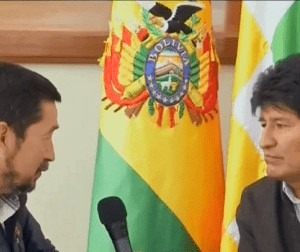 The legitimately-elected President of Bolivia, Evo Morales, told teleSUR on Saturday that dictatorship has returned to the South American country, given the recent events that triggered intense repression exerted by the de-facto government chaired by Senator Jeanine Áñez .
“The Bolivian people and the whole world know that we guarantee political stability. They said ‘Evo dictatorship’, now what Bolivia is living in is what we call a dictatorship.”
The Bolivian President said he was appalled by the recent reports regarding the civilian deaths at the hands of this new dictatorship.
“The people will always be united (…) The Bolivian people have never been taken from my memory. At any moment we will be as always sharing a resistance against economic policies, but for now, for democracy, for life, my dear Bolivia,” President Morales said.
On the media censorship imposed by the de-facto government in Bolivia, President Morales said that “now there is no freedom of expression” in the country. “The de facto communication minister who answers to the dictatorship in Bolivia said that seditious journalists, national and international, will be arrested.”
He also highlighted how the integration processes promoted by past governments such as those of Venezuela, Ecuador (by former President Rafael Correa) or Brazil (with former president Lula da Silva) seek to be destroyed by the interests of the U.S. empire.
“Unfortunately, some countries subject to the U.S. empire, destroy the integration processes: Unasur a political instance, Mercosur an economic instance, Celag an integration of all Latin America towards the liberation of the peoples,” President Morales continued.
In this sense, the legitimate President of Bolivia stressed that “we, Latin Americans, have the enormous responsibility, regardless of an economic, programmatic or social liberation, to free ourselves from the technological part.”
“Those who seek disintegration are not thinking about technological liberation, they are instruments of the capitalist system that will never like us to free ourselves from the technological part to establish sovereignty in our Latin America,” he added.
At Least 12 Dead Following Coup in Bolivia
teleSUR | November 14, 2019
At least 12 Bolivians have been killed and more than 530 injured by the violence that escalated in Bolivia following the coup against constitutional president Evo Morales, denounced the Ombudsman’s Office.
The human rights agency explained on its official website that among the injured are women, children, adolescents and journalists.
In turn, the institution – created in 1994 by constitutional mandate – posted on its Twitter account that on November 11 and 12, five Bolivians were killed (out of the total).
Of those deaths, four were due to the gunshots fired by the Armed Forces and the Police, and one due to suffocation by strangulation, the Ombudsman’s Office explained on its digital platform.
The events that forced Evo Morales’s resignation and consummated the coup d’état were unquestionably violent, as reported in an article published on the Mision Verdad webpage.
Opposition gangs attacked numerous politicians of the ruling Movement Towards Socialism, looted Morales’ house, and burned the residences of several high-level politicians, detailed the article.
Evo Morales announced his resignation as president on November 10 to stop the bloodshed, however, during a press conference in Mexico a country that granted him political asylum to preserve his life – he acknowledged that his decision did not halt the social upheaval.
In that sense, Morales called on the military to stop the bloodshed and initiate a national dialogue.
Make No Mistake, Morales’ Removal Is Directed Against Bolivia’s Indigenous
By Paul Antonopoulos | American Herald Tribune | November 13, 2019
It certainly has been a difficult year for reactionaries and neoliberals in South America as they failed to violently replace Venezuelan President Nicolás Maduro with U.S.-puppet Juan Guaidó, implement International Monetary Fund (IMF) demands against Ecuador after the people rose up, maintain the popularity of Chile’s billionaire President Sebastián Piñera’s after his attempts to raise the price of metro travel expanded into a larger anti-neoliberal movement, Evo Morales’ re-election in Bolivia, the election of Alberto Fernández in Argentina against neoliberal president Mauricio Macri, and, former Brazilian President Lula’s release from prison last week after serving a small part of his long sentence.
It certainly appears that the so-called Pink Tide, the wave of socialist and left-leaning governments that came to power across Latin America in the 2000’s and peaking in 2011, is returning to the region after being effectively replaced by the so-called “Blue Tide,” the Conservative Wave that saw Brazil, Argentina, Peru and other states return to conservative neoliberal governments. Effectively, the Monroe Doctrine has guided Washington’s belief since at least 1823 that Latin America is its backyard and has a right to protect it from foreign powers.
Former Bolivian President Evo Morales was one of the figures at the forefront of creating sovereignty and independence from the U.S. The first indigenous president of Bolivia reduced illiteracy from 13% in 2006 to 2.4% in 2018, reduced poverty from 60.6% in 2006 to 34.6% in 2018 and reduced unemployment from 9.2% in 2006 to 4.1% in 2018 – this was mostly achieved by ensuring that industries remained nationalized or were renationalized, and by becoming independent of the World Bank and the IMF.
And therefore, “in Bolivia, the American Empire Struck Back.”
With the American Empire experiencing major losses in Latin America this year, most significantly in Venezuela, while also seeing the release of former Brazilian President and pan-Latin Americanist, Lula, from prison, a quick victory was needed. A coup against Morales appeared to be the simplest victory for the Empire to achieve.
Why?
Former Venezuelan President Hugo Chávez made the military a bastion of Bolivarian ideology, ensuring that the entire hierarchy became radically anti-U.S. and patriotic. Therefore, even when Maduro faced a U.S.-orchestrated coup attempt earlier this year, there were very few defections from the Venezuelan military despite calls from Guaidó and Washington. Because Morales failed to radicalize the Bolivian military, he was always at risk of being militarily overthrown by unpatriotic forces willing to serve the American Empire.
Washington understands that Morales empowered the mostly left-leaning Indigenous population of Bolivia, accounting for 20% of the country’s population according to the 2012 census, with an additional 68% of the population being mestizo – mixed European and Indigenous ancestry. The whites of Bolivia account for 5% of the population but are on average far wealthier than the Indigenous and mestizos, and favor the right-wing opposition as they resist the shift of power from Whites towards the native majority.
Geographically, the overwhelming majority of Bolivia’s whites and most of the mixed-race populations live in the country’s eastern lowlands, which in itself is far wealthier than predominantly Indigenous regions of Bolivia.
This is a key point in trying to understand who Jeanine Áñez is, the self-declared interim president of Bolivia.
Who is she?
The self-proclaimed president comes from the sparsely populated flatland department of Beni, a stronghold for opposition to Morales. One of the department’s main economic activities is cattle ranching, operated by wealthy white or mestizo elites. She often criticizes socialism and expressed her fear that one day Bolivia will become like Venezuela, Nicaragua, “or worse, Cuba.” Her nephew in 2017 was caught trying to smuggle 480kg of cocaine into Brazil.
A Tweet from April 2013 truly reveals her contempt for the Indigenous population: “I dream of a Bolivia free of Indigenous satanic rites, the city is not for ‘Indians,’ they better go to the highlands or El Chaco.” Her radical Evangelical Christian beliefs legitimize her slander of Indigenous cultures as they are “satanic,” perhaps a remembrance to the days of Salem.
Of course, the U.S. has not made any denunciations of her self-proclaimed presidency. Nor did they denounce the Comite Ciudadano (Citizens Committee) who led the anti-Morales riots and violence. The right-wing organization is jointly led by ex-vice-president Carlos Mesa and Luis Fernando Camacho, the millionaire leader of the extreme right-wing pressure group Comite Civico (Civic Committee) of Santa Cruz, whose members do Nazi-style salutes.
Yes, the overthrow of Morales was backed by the American Empire.
Yes, the overthrow of Morales is because he encouraged pan-Latin American initiatives.
Yes, the overthrow of Morales was because he would not privatize much of Bolivia’s industries.
Yes, the overthrow of Morales was because he liberated Bolivia from the IMF and the World Bank.
But there is without a doubt a race element to his overthrow. As power was returning to the hands of the Indigenous people in Bolivia, the preservation of the elite minority had to be achieved. The removal of Morales and the ascendency of Áñez will surely regress the outstanding achievements made by Morales and bring a return to the strangling and exploitative neoliberal policies that kept Bolivia poor, and U.S. corporations and the local elite prosperous.
Exiled Bolivian president Morales blasts coup & hints at US role in it
RT | November 13, 2019
Ousted Bolivian President Evo Morales has accused the US-headquartered Organization of American States of making a political decision in backing the right-wing opposition, saying the coup continues to wreak havoc after his exile.
Speaking from Mexico a day after he fled Bolivia, Morales said: “The OAS is in the service of the North American empire.”
Morales said he “could not understand” how his military commanders could show such “disloyalty.”
“That confirms that my great crime is to be indigenous. It’s a class problem,” he said.
The exiled president said that after freeing itself from the International Monetary Fund, the Bolivian economy was doing better.
“We had big plans in the field of exports.”
Yet, the coup plotters “do not accept the nationalization of natural resources,” Morales said.
He also said the appointment of Jeanine Añez as “interim president” confirms the coup and called for a national dialogue to end violence in his country.
Morales also claimed that a mechanical failure on a helicopter he was traveling on in early November was “not accidental” and said he wants the incident to be investigated. The helicopter was forced to make an emergency landing just after takeoff due to a “mechanical fault in the tail rotor.”
The socialist leader said he would return to Bolivia if the people asked. He also pleaded with the Bolivian opposition to stop the violence continuing after his exile. “Why do they continue?” he asked.
Opposition senator declares herself ‘interim president’ of Bolivia without quorum or vote
RT | November 13, 2019
Opposition politician Jeanine Añez has declared herself “interim president” of Bolivia without a vote, but the party of ousted President Evo Morales said that the Senate had no quorum and the legislature’s session was not legal.
Añez’s actions echo those of Juan Guaido in Venezuela, who declared himself “interim president” in January with the backing of Washington and the Organization of American States (OAS). While Guaido has repeatedly failed to oust President Nicolas Maduro, however, the opposition in Bolivia – also backed by the US and OAS – has been able to force the resignation of Morales after the military defected to their side.
While opposition activists claimed that Añez’s declaration was in line with the Bolivian constitution, lawmakers from the ousted president’s Movement for Socialism called the assembly session illegal. They have refused to attend the proceedings, saying that armed groups loyal to the opposition controlled the roads and could not guarantee their safety.
Morales’s party has had the majority in both the Senate and the Chamber of Deputies, and its boycott leaves both bodies without a quorum. Vice-President Alvaro Garcia Linera also “resigned” along with Morales on November 10, leaving the country in legal limbo. Their supporters have called the forced resignations a “coup” and vowed to resist by force if necessary.
Washington hastened to hail Morales’s ouster as a “significant moment for democracy in the Western Hemisphere” and accused the socialist president of seeking to subvert the will of the people by running for a fourth term, even though the Bolivian courts had allowed it.
Morales was one of the few Latin American leaders bucking the US line on Venezuela and supporting Maduro. Landing in Mexico, where he was granted asylum, on Tuesday he vowed to continue to fight “as long as I live.”
The Bolivian Coup Is Not a Coup—Because US Wanted It to Happen
By Alan MacLeod | FAIR | November 11, 2019
Army generals appearing on television to demand the resignation and arrest of an elected civilian head of state seems like a textbook example of a coup. And yet that is certainly not how corporate media are presenting the weekend’s events in Bolivia.
No establishment outlet framed the action as a coup; instead, President Evo Morales “resigned” (ABC News, 11/10/19), amid widespread “protests” (CBS News, 11/10/19) from an “infuriated population” (New York Times, 11/10/19) angry at the “election fraud” (Fox News, 11/10/19) of the “full-blown dictatorship” (Miami Herald, 11/9/19). When the word “coup” is used at all, it comes only as an accusation from Morales or another official from his government, which corporate media have been demonizing since his election in 2006 (FAIR.org, 5/6/09, 8/1/12, 4/11/19).
The New York Times (11/10/19) did not hide its approval at events, presenting Morales as a power-hungry despot who had finally “lost his grip on power,” claiming he was “besieged by protests” and “abandoned by allies” like the security services. His authoritarian tendencies, the news article claimed, “worried critics and many supporters for years,” and allowed one source to claim that his overthrow marked “the end of tyranny” for Bolivia. With an apparent nod to balance, it did note that Morales “admitted no wrongdoing” and claimed he was a “victim of a coup.” By that point, however, the well had been thoroughly poisoned.
CNN (11/10/19) dismissed the results of the recent election, where Bolivia gave Morales another term in office, as beset with “accusations of election fraud,” presenting them as a farce where “Morales declared himself the winner.” Time’s report (11/10/19) presented the catalyst for his “resignation” as “protests” and “fraud allegations,” rather than being forced at gunpoint by the military. Meanwhile, CBS News (11/10/19) did not even include the word “allegations,” its headline reading, “Bolivian President Evo Morales Resigns After Election Fraud and Protests.”
Delegitimizing foreign elections where the “wrong” person wins, of course, is a favorite pastime of corporate media (FAIR.org, 5/23/18). There is a great deal of uncritical acceptance of the Organization of American States’ (OAS) opinions on elections, including in coverage of Bolivia’s October vote (e.g., BBC, 11/10/19; Vox, 11/10/19; Voice of America, 11/10/19), despite the lack of evidence to back up its assertions. No mainstream outlet warned its readers that the OAS is a Cold War organization, explicitly set up to halt the spread of leftist governments. In 1962, for example, it passed an official resolution claiming that the Cuban government was “incompatible with the principles and objectives of the inter-American system.” Furthermore, the organization is bankrolled by the US government; indeed, in justifying its continued funding, US AID argued that the OAS is a crucial tool in “promot[ing] US interests in the Western hemisphere by countering the influence of anti-US countries” like Bolivia.
In contrast, there was no coverage at all in US corporate media of the detailed new report from the independent Washington-based think tank CEPR, which claimed that the election results were “consistent” with the win totals announced. There was also scant mention of the kidnapping and torture of elected officials, the ransacking of Morales’ house, the burning of public buildings and of the indigenous Wiphala flag, all of which were widely shared on social media and would have suggested a very different interpretation of events.
Words have power. And framing an event is a powerful method of conveying legitimacy and suggesting action. “Coups,” almost by definition, cannot be supported, while “protests” generally should be. Chilean President Sebastian Piñera, a conservative US-backed billionaire, has literally declared war on over a million people demonstrating against his rule. Corporate media, however, have framed that uprising not as a protest, but rather a “riot” (e.g., NBC News, 10/20/19; Reuters, 11/9/19; Toronto Sun, 11/9/19). In fact, Reuters (11/8/19) described the events as Piñera responding to “vandals” and “looters.” Who would possibly oppose that?
Morales was the first indigenous president in his majority indigenous nation—one that has been ruled by a white European elite since the days of the conquistadors. While in office, his Movement Towards Socialism party has managed to reduce poverty by 42% and extreme poverty by 60%, cut unemployment in half and conduct a number of impressive public works programs. Morales saw himself as part of a decolonizing wave across Latin America, rejecting neoliberalism and nationalizing the country’s key resources, spending the proceeds on health, education and affordable food for the population.
His policies drew the great ire of the US government, Western corporations and the corporate press, who function as the ideological shock troops against leftist governments in Latin America. In the case of Venezuela, Western journalists unironically call themselves “the resistance” to the government, and describe it as their No. 1 goal to “get rid of Maduro,” all the while presenting themselves as neutral and unbiased actors.
The media message from the Bolivia case is clear: A coup is not a coup if we like the outcome.
The Conservative Tide Is Losing in Latin America – That’s Why Morales Had To Go
The Removal of Morales is a Minor Victory in a Series of Losses for Washington
By Paul Antonopoulos | November 12, 2019
Former Bolivian President Evo Morales resigned less than three months after completing his third term, ousted by what he denounced as a coup against him that prevented him from carrying out his fourth term that he was democratically elected to.
Morales sent shock waves all across Latin America when he announced he was stepping down from the presidency to avoid continued bloodshed between Bolivians before
accepting asylum in Mexico.
The first indigenous Bolivian president announced his resignation in a message on television, after returning to the coca-producing region of Chapare, his political and Union base, after having unsuccessfully sought in La Paz a political agreement that would allow him to complete his mandate that ends on January 22. Morales blamed the opposition candidate and former president Carlos Mesa (2003-2005), who came second in the last elections, and Luis Fernando Camacho, leader of the street protests, for the widespread violence in several cities that has left at least three dead and more than 300 injured.
The man who had left Bolivia “sovereign and independent economically and politically, with identity and dignity” claimed that he decided to resign as president after pressure from the Bolivian Workers’ Central and the mining unions, the Catholic Church and the military and police commanders – all in the effort to avoid greater bloodshed in the country.
This has come as an unexpected shock for supporters of Morales and is a major victory for Latin American reactionaries who have been suffering a string of major defeats in 2019. The year began with a violent and political coup attempt against Venezuelan President Nicolás Maduro from openly U.S.-puppet Juan Guaidó. Guaidó spectacularly failed despite having the state backing from most of Latin America, North America and the Europe Union, with many of these states cutting diplomatic ties with Caracas and applying sanctions against Venezuela. Venezuela was not left isolated however with China and Russia expanding economic relations with the Bolivarian country.
In the second half of the year, all in short succession, we have seen Ecuador violently rise up against President Lenín Moreno’s attempts to implement strangling International Monetary Fund (IMF) austerity measures; Chile violently rose up against President Sebastián Piñera’s attempts to raise the price of public transportation, which then exploded into a wider anti-neoliberal movement as the exploitative economic system has created a high cost of living; Morales’ re-election in Bolivia; the election of Peronist Alberto Fernández against incumbent neoliberal president Mauricio Macri who lost his re-election bid for a second term; the likelihood of Leftist Daniel Martínez winning the Uruguayan election on November 24; and, former Brazilian President Lula’s premature release from prison last week after controversially being charged with corruption.
It certainly has been a very tough year for U.S. President Donald Trump who appears to be desperately clinging onto the Monroe Doctrine, but failing. The U.S. cannot directly control the anger of the people in Ecuador and Chile, it cannot change how people vote in Argentina and Uruguay, and it spectacularly failed in Venezuela for reasons that will be addressed.
Rather, the U.S. specializes in Hybrid Wars for regime change, and Bolivia is easy pickings to wash out of the Pink Tide and into the Conservative Wave, also known as the Blue Tide. Although it is still uncertain what will happen in the near future, the question begs whether there is a suitable replacement for Morales. Although Morales’ policies may be continued by another president, the coup against him is a minor victory for U.S. puppets in Latin America that are facing far more difficult pressures.
Although it is easy to argue that Venezuela and Cuba have experienced far greater pressures – economically, diplomatically and militarily – from the U.S., it must be understood why Morales capitulated so easily to the rioters. Former Venezuelan President Hugo Chávez, a former military officer, had radicalized and ideologized the military to Bolivarian dogma and built a people’s militia capable of defending the government from threats. As Morales failed to ideologize the Bolivian military, reactionary and pro-U.S. forces remained, allowing them to apply pressure against the democratically elected Morales.
Morales created economic growth not seen elsewhere in South America, increased the quality of life, reduced illiteracy to 2.4% in 2018 from 13% in 2006, reduced unemployment from 9.2% in 2006 to 4.1%, reduced poverty from 60.6% in 2006 to 34.6%, and extreme poverty to 15.2% from 38.2% in 2006. However, many of these achievements were made by ensuring that industries remained nationalized and by becoming completely independent of the World Bank and International Monetary Fund. By becoming independent from the neoliberal order, the country was always at risk of experiencing a Hybrid War via color revolution, especially as Morales had not ideologized the military, essentially meaning he was always at risk of being militarily overthrown.
Despite the Conservative Wave experiencing electoral successes in the latter part of the 2010’s with neoliberalism returning to Brazil, Argentina, Peru and other Latin American states, the short period of time of Conservative Wave rule has meant the return of severe austerity, increasing unemployment and rising poverty to these countries, allowing for a second swing of the Pink Tide. This effectively means that Argentina and probably Uruguay could potentially face color revolutions if they begin to defy the neoliberal order, and Lula will always be at risk of returning to prison. With Ecuadorean protestors smashing any ideas of IMF strangling their country and Chile revolting against the “neoliberal ghost of Pinochet”, U.S. hegemony in Latin America is being severely challenged, and is losing.
Removing Morales was easy pickings and it demonstrates that neoliberalism is always willing to use violence to defend its interests. It also serves as a warning to Argentina that is firmly under IMF control and will surely be challenged when the President-Elect assumes power. It also serves as a warning to any full-time challenge to IMF interests across all Latin American countries. As Latin America begins to swing back against U.S. hegemony in the region, it can be expected we will see intensified violence in Venezuela and color revolutions emerging wherever the neoliberal order is permanently challenged. Morales was unfortunately the easiest target for the Conservative Wave to have a minor victory after a series of major losses for them. Although Morales may not be in power and is now in Mexico, there is every chance that his replacement will continue his policies and maintain Bolivia’s sovereignty and independence, effectively meaning the balance of power in the Andean country is still being contested between Pink Tide and Conservative Wave forces.
Paul Antonopoulos is a Research Fellow at the Center for Syncretic Studies.
Audios Containing Details of Alleged Coup Plan & US Involvement Emerge Amid Bolivian Crisis – Report
Sputnik – November 11, 2019
Bolivian President Evo Morales announced his resignation on 10 November after the heads of Bolivia’s armed forces and police urged him to step down amid ongoing violent protest in the country which erupted in the wake of the recent presidential election.
As Evo Morales stepped down as the President of Bolivia amid ongoing anti-government protests and the military urging him to resign, a series of audio recordings which allegedly feature opposition leaders calling for a coup against him were leaked via social media, El Periodico reports.
According to the media outlet, efforts aimed at destabilising Bolivia were to be coordinated from the US embassy, with one of the tapes allegedly mentioning that US senators Ted Cruz, Bob Menendez and Marco Rubio were committed to this agenda.
The plan outlined by the audios called for establishing a “civil-military transitional government” if Morales were to win the 20 October presidential election, which he did, and to not recognise his victory, citing alleged electoral fraud.
The opposition leaders featured in the recordings also allegedly called for a general strike across the country, to burn structures affiliated with the “government party” and to attack the Cuban embassy.
On 10 November, Bolivian President Evo Morales resigned after the national armed forces sided with demonstrators who opposed his serving a fourth term. The protests erupted after international observers found “grave irregularities” in the 20 October election.
Featured Video

Deception – Submarines against Olof Palme
or go to
Aletho News Archives – Video-Images
From the Archives
Woolsey Fire started at Santa Susana Field Lab — where “radioactive materials released were never accurately measured”
By John Laforge | CounterPunch | November 30, 2018
In my Nov. 16 column, I reported on potential radiation risks posed by California’s Woolsey wildfire having burned over parts or all of the Santa Susana Field Laboratory—south of Simi Valley, Calif., 30 miles outside Los Angeles—site of at least four partial or total nuclear reactor meltdowns.
The field laboratory operated 10 experimental reactors and conducted rocket engine tests. In his 2014 book Atomic Accidents, researcher James Mahaffey writes, “The cores in four experimental reactors on site … melted.” Reactor core melts always result in the release of large amounts of radioactive gases and particles. Clean up of the deeply contaminated site has not been conducted in spite of a 2010 agreement.
Los Angeles’s KABC-7 TV reported Nov. 13 that the Santa Susana lab site “appears to be the origin of the Woolsey Fire” which has torched over 96,000 acres. Southern Calif. Public Radio said, “According to Cal Fire, the Woolsey Fire started on the afternoon of Thursday, Nov. 8 … on the Santa Susana site.” … continue
Blog Roll
 Aletho News
- Dr. Abu-Sitta: Beirut ‘felt like a day in Shifa Hospital’
- Iran Has Won the War, It Will Be Up to the US to Secure the Peace: Mohammad Marandi
- Iran condemns assassination threats against Iranian negotiators amid US talks
- Brussels cannot say where its own pipeline inspectors are as Hungary’s oil lifeline remains shut
- Israel’s Iran War: Myth and Reality
- Between war and industrial breakdown: The US-Israeli attrition crisis
- Pressure builds on Iran to ‘drop’ Lebanon ceasefire demand as Islamabad talks hang in balance
- In another clash report, US denies agreement to release Iran’s assets
- What is fueling unrest across the EU?
- Why no power can undermine Iran’s eternal dominance over the Strait of Hormuz
- If Americans Knew
- Pro-Israel ‘Thinktanks’ and Individuals who Influence U.S. Foreign Policy
- Mearsheimer reveals how Israel dictates US policies on Iran, Gaza – video
- After killing 350+, Israel still has a “score to settle” with Lebanon before ceasefire – Daily Update
- Military aid to Israel emerges as the latest political litmus test for Democrats
- The only Palestinian children’s rights organization closes following years-long Israeli campaign against it
- ‘I Can’t Forget the Smell’: Lebanese Reel After Israel Kills Over 300 in Single Day
- DNC Shoots Down Resolutions Calling Out AIPAC and Limiting Arms to Israel
- TCN: Is Israel Blackmailing President Trump?
- Israel killed at least 303 Lebanese yesterday – who were they? Daily Update
- Amnesty: Urgent – Protect Lebanese civilians from brutal escalation in Israeli attacks
- No Tricks Zone
- German Expert: Heat Dome Led To Record Temps In Western USA…Warmer In 1934, 1936
- New Study: No Linear Warming Or Glacier Retreat Along Northern Antarctic Peninsula Since 1980s
- An Inconvenient Tree: Uncovered In Alps… Europe Much Warmer Than Today 6000 Years Ago
- New Study Reports A 60% Slowdown In Greenland’s Ice Loss Rate In The Last Decade
- Low Intensity Tornado Wrecks Major Solar Farm, Creating A Potential Toxic Dump
- New Study Finds Warming Saves Lives…Cold Temperatures 12 Times More Deadly Than Excess Heat
- German Science Blog Accuses PIK Climate Institute Of Hallucinating Climate Tipping Points
- Devastating Assessment Of Comirnaty Vaccine By Former Senior Pfizer Europe Toxicologist
- New Study: CO2 Is ‘Effectively Negligible’ As An Explanatory Climate Change Factor Since 2000
- Former Pfizer Toxicologist Dr. Helmut Sterz Tells Bundestag Hearing Pfizer Vaccine Should Have Never Been Approved
 Aletho News